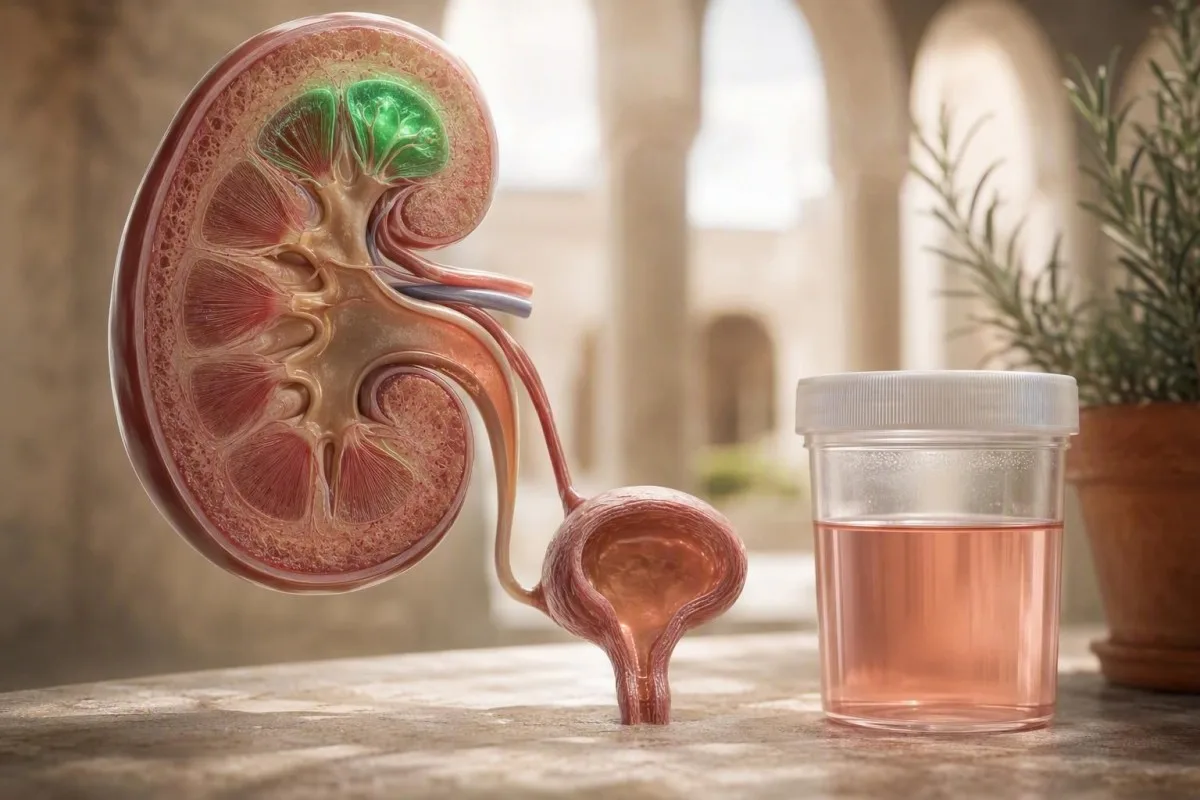
Sampel air kencing berwarna merah jambu atau perang seperti teh selepas larian yang panjang selalunya adalah hematuria sementara yang disebabkan oleh senaman, tetapi warna yang kelihatan tidak boleh diketepikan secara automatik. Masa, penemuan mikroskop, gejala, dan sampel ulangan yang direhatkan dengan betul menceritakan kisah sebenar.


- Hematuria yang disebabkan oleh senaman biasanya hilang dalam masa 24–72 jam selepas larian yang lasak; jika berterusan melebihi 72 jam, ia memerlukan pemeriksaan perubatan.
- Ambang mikroskopi sebanyak 3 atau lebih sel darah merah setiap medan kuasa tinggi dalam sampel air kencing yang dikumpulkan dengan betul memenuhi definisi AUA bagi mikroomaturia.
- Ketidakseragaman dipstick penting: pad darah positif dengan sifar hingga dua sel merah setiap medan kuasa tinggi menunjukkan mioglobin atau hemoglobin bebas berbanding pendarahan air kencing.
- Ulang masa adalah praktikal: elakkan senaman berat selama 48–72 jam, hidrasi seperti biasa, kemudian berikan sampel air kencing pertengahan aliran.
- Penilaian pada hari yang sama adalah masuk akal untuk darah beku, ketidakupayaan untuk membuang air kencing, demam, sakit sisi yang teruk sebelah, atau air kencing berwarna koko dengan sakit otot yang ketara.
- Corak amaran buah pinggang ialah darah campur protein, gulungan sel merah, tekanan darah tinggi, atau GFR yang menurun—bukan sekadar dipstick selepas perlumbaan.
- Petunjuk rabdomiolisis ialah air kencing yang gelap secara tidak seimbang dengan gejala otot yang teruk dan keputusan kreatina kinase sering melebihi 5 kali ganda had atas makmal.
- Konteks risiko kanser mengubah ambang siasatan: umur, pendedahan merokok, radiasi pelvis sebelum ini, dan hematuria ketara yang berterusan semuanya penting.
Mengapa larian boleh menyebabkan air kencing kelihatan merah jambu
Hematuria pelari biasanya kebocoran sel darah merah yang berpanjangan ke dalam air kencing selepas senaman yang kuat, selalunya pulih dalam masa 24–72 jam rehat. Walau bagaimanapun, air kencing berwarna merah jambu, merah, atau berwarna cola yang kelihatan patut diuji semula dengan betul berbanding andaian mudah bahawa larian menyebabkannya.
Di klinik, corak yang meyakinkan adalah mudah: perubahan warna bermula selepas larian yang luar biasa panjang, pantas, atau menuruni bukit; tiada demam, sakit sisi kolik, atau rasa terbakar semasa kencing; dan mikroskopi kembali normal selepas rehat. Kantesti ialah penganalisis ujian darah AI yang boleh meletakkan penanda buah pinggang yang berkaitan—kreatinin, eGFR, elektrolit, dan kreatina kinase—di samping sejarah senaman, bukannya merawat satu keputusan selepas perlumbaan sebagai diagnosis.
Mekanisme yang dicadangkan ialah sentuhan dinding pundi kencing mekanikal, anjakan aliran darah buah pinggang sementara, penumpuan berkaitan dehidrasi, dan kadang-kadang pecahan sel darah merah daripada hentakan kaki berulang. Bukti untuk setiap mekanisme adalah bercampur-baur, kerana kebanyakan kajian adalah kecil dan menggunakan jarak perlumbaan yang berbeza. Dalam 15 tahun amalan klinikal saya, sejarah usaha baharu adalah lebih penting daripada warna sahaja; ultramarathon pertama dan 5 km yang biasa tidak membawa kebarangkalian pra-ujian yang sama.
Darah yang kelihatan dalam air kencing selepas senaman tidak sama dengan hematuria pelari yang tidak berbahaya. A panduan bendera merah hematuria yang lebih luas adalah berguna kerana batu karang, jangkitan, penyakit glomerulus, dan kanser saluran kencing boleh berlaku secara kebetulan selepas larian.
Definisi praktikal
Hematuria yang disebabkan oleh senaman bermakna sel darah merah muncul dalam air kencing sejurus selepas keletihan dan hilang pada sampel yang diambil semula semasa rehat. Dipstick positif sahaja tidak membuktikan diagnosis ini, kerana reagen mengesan pigmen heme daripada sel darah merah yang utuh, hemoglobin bebas, atau mioglobin.
Adakah ia hematuria, hemoglobin, atau mioglobin?
Dipstick air kencing yang membaca positif untuk darah boleh mencerminkan sel darah merah, hemoglobin, atau mioglobin, dan mikroskopi memisahkannya. Air kencing merah jambu dengan banyak sel darah merah yang utuh menyokong hematuria; air kencing coklat gelap dengan sedikit atau tiada sel darah merah menimbulkan kebimbangan untuk pigmen daripada kecederaan otot atau hemolisis.
Mikroskopi air kencing menunjukkan 3 atau lebih sel darah merah setiap medan kuasa tinggi mengesahkan mikroomaturia apabila sampel dikumpulkan dengan bersih. Sebaliknya, dipstick yang sangat positif dengan 0–2 sel darah merah setiap medan kuasa tinggi harus membuat doktor mempertimbangkan mioglobinuria, terutamanya selepas pendedahan haba, beban otot jenis lebam, atau sakit otot tertunda yang teruk. Warna coklat atau cola lebih biasa bagi pigmen pekat daripada jumlah kecil pendarahan pundi kencing.
Mioglobin penting kerana ia boleh mengiringi rabdomiolisis dan kecederaan buah pinggang akut. Kepekatan kreatina kinase melebihi 5 kali ganda had atas normal makmal biasanya digunakan sebagai ambang biokimia untuk rabdomiolisis, walaupun gejala, kalium, kreatinin, dan pengeluaran air kencing menentukan keterdesakan. Lihat penjelasan praktikal kami tentang kreatinin kinase yang tinggi secara berbahaya bagi corak yang tidak sepatutnya ditunggu semalaman.
Pewarna makanan, bit, beri hitam, rifampicin, phenazopyridine, dan dehidrasi juga boleh mewarnakan air kencing tanpa sel merah. A pembezaan air kencing gelap membantu mengelakkan kesilapan biasa menganggap setiap sampel kemerahan mewakili darah.
Mengapa perbezaan mengubah penjagaan
Hematuria sel merah menunjukkan perhatian kepada saluran kencing, manakala mioglobinuria menunjukkan perhatian kepada otot rangka dan perlindungan buah pinggang. Kedua-duanya boleh berlaku selepas acara ketahanan, tetapi hanya mikroskopi dan ujian darah bersasar boleh membezakannya dengan pasti.
Cara membaca keputusan ujian air kencing selepas larian
Ujian air kencing selepas larian yang paling bermaklumat menggabungkan ujian celup, mikroskopi, pengukuran protein, dan graviti tentu. Darah pada ujian celup dengan sel merah sementara dan tiada protein sering berisiko rendah; darah campur protein atau silinder memerlukan penilaian buah pinggang yang lebih teliti.
Keputusan darah ujian celup dilaporkan sebagai negatif, surih, 1+, 2+, atau 3+, tetapi ia adalah isyarat saringan dan bukannya kiraan sel. AUA mentakrifkan mikrohematuria sebagai lebih daripada 3 sel darah merah setiap medan kuasa tinggi pada pemeriksaan mikroskopik, bukan keputusan ujian celup sahaja (Barocas et al., 2020). Perbezaan ini mengelakkan pelari daripada menjalani siasatan kanser yang tidak perlu selepas saringan positif palsu.
Graviti tentu melebihi 1.030 menunjukkan air kencing pekat di kebanyakan makmal dan boleh membuat warna kelihatan lebih membimbangkan, tetapi ia tidak menjelaskan sel merah yang disahkan. Protein 1+ atau lebih tinggi perlu dikuantitatifkan dengan nisbah albumin-kreatinin air kencing atau nisbah protein-kreatinin; proteinuria senaman sementara wujud, namun albuminuria berterusan mengubah pembezaan ke arah penyakit glomerular. Kami panduan lengkap analisis air kencing menjelaskan mengapa penanda ini tidak sepatutnya digabungkan menjadi satu keputusan.
AI mentafsir kreatinin dan eGFR bersama penemuan air kencing, masa senaman, dan nilai sebelumnya; kreatinin yang sedikit meningkat selepas perlumbaan panas tidak setara dengan penyakit buah pinggang kronik. Dalam amalan, saya meminta jarak, jenis permukaan, suhu, penggunaan anti-radang, masa haid, dan sama ada sampel diberikan dalam masa 2 jam selepas tamat.
Bilakah anda perlu mengulang ujian air kencing selepas berlari?
Ulang ujian air kencing 48–72 jam selepas larian lasak terakhir ialah pilihan yang masuk akal untuk hematuria pelari yang disyaki. Gunakan sampel pagi pertama atau sampel pertengahan aliran yang terhidrat dengan baik, tetapi jangan paksa minum berliter-liter air dengan serta-merta sebelumnya kerana pencairan melampau boleh mengaburkan penemuan yang berguna.
Untuk keabnormalan rutin selepas perlumbaan, saya biasanya mengesyorkan tiada selang masa, bukit, mengangkat berat, atau perlumbaan untuk 48 jam; selepas maraton, ultramaratón, penyakit haba, atau sakit yang tidak biasa, 72 jam lebih boleh dipertahankan. Minuman biasa mengikut rasa sudah cukup. Dehidrasi berlebihan boleh menurunkan graviti tentu di bawah 1.005 dan kadang-kadang membuat keputusan sempadan lebih sukar untuk ditafsirkan.
Jika mikroskopi kekal positif selepas 72 jam, aturkan semakan penjagaan primer dalam beberapa hari berbanding menguji berulang kali selepas senaman. Keputusan yang berterusan memerlukan pengukuran tekanan darah, kreatinin serum/eGFR, nisbah albumin-kreatinin air kencing, dan pertimbangan kultur atau pengimejan mengikut risiko. Hubungan antara usaha, penghidratan, dan anggaran penapisan yang lebih rendah sementara dibincangkan dalam panduan eGFR selepas senaman kami.
Seorang pelari maraton rekreasi berusia 52 tahun yang saya temui mempunyai 18 sel merah setiap medan berkuasa tinggi pada waktu petang selepas perlumbaan panas, tetapi 0–1 sel merah selepas 72 jam rehat; kreatininnya kembali dari 1.28 mg/dL kepada 0.96 mg/dL. Keputusan itu meyakinkan, tetapi rancangan yang sama tidak akan mencukupi untuk perokok berusia 52 tahun dengan warna air kencing yang berulang kali kelihatan.
Jangan uji di garisan penamat jika anda boleh mengelakkannya
Pengujian segera selepas senaman memaksimumkan peluang untuk mencari sel merah sementara, air kencing pekat, dan protein. Itu boleh berguna secara klinikal dalam rabdomiolisis yang disyaki, tetapi ia adalah masa yang buruk untuk menetapkan garis dasar pelari.
Corak hematuria selepas larian yang mana biasanya melegakan?
Episod yang terhad sendiri selepas larian intensif lebih meyakinkan apabila ia jelas sepenuhnya, kekurangan kesakitan atau gejala sistemik, dan tidak mempunyai proteinuria atau perubahan fungsi buah pinggang. Meyakinkan tidak bermakna diabaikan; ia bermakna disahkan dengan sampel yang direhatkan.
Fenotip berisiko lebih rendah ialah pelari muda atau pertengahan umur dengan pencetus usaha yang jelas, tekanan darah normal, tiada sejarah merokok, dan mikroskopi rehat normal. Dalam keadaan itu, satu keputusan sementara sebanyak 3–10 RBC/HPF selepas perlumbaan selalunya selesai tanpa rawatan. Saya masih akan mendokumentasikannya, kerana berulang selepas setiap larian panjang memerlukan semakan yang lebih teliti daripada peristiwa sekali sahaja.
Nisbah albumin-kreatinin air kencing yang normal umumnya di bawah 30 mg/g (di bawah 3 mg/mmol), walaupun makmal dan negara melaporkan unit secara berbeza. Darah tanpa albumin, silinder, atau sel merah dismorfik menjauhi kebocoran glomerular; ia tidak membuktikan sumber pundi kencing, tetapi ia membimbing soalan seterusnya. Penjelasan kami tentang protein dalam air kencing merangkumi bahagian ini dengan jelas.
Trauma pada pundi kencing lebih mungkin berlaku apabila air kencing sangat pekat dan pelari selesai dengan pundi kencing yang hampir kosong. Sesetengah pakar sukan mencadangkan untuk membuang air kecil sebelum larian yang panjang dan minum dengan kerap, tetapi ini adalah nasihat pencegahan dengan bukti percubaan yang terhad — bukan pengganti untuk penilaian apabila warna berterusan.
Keputusan normal mempunyai cap masa
Ujian negatif 3 hari selepas perlumbaan meyakinkan untuk episod itu, bukan jaminan seumur hidup. Hematuria kelihatan baharu beberapa bulan kemudian perlu dinilai atas meritnya sendiri, terutamanya selepas umur 40 tahun atau dengan pendedahan merokok.
Tanda amaran yang menjadikan hematuria pelari kurang berkemungkinan
Hematuria memerlukan penilaian segera apabila ia berterusan selepas 72 jam, berulang tanpa senaman berat, atau muncul dengan sakit, demam, bekuan darah, protein, atau perubahan fungsi buah pinggang. Gabungan penemuan lebih bermaklumat daripada sampel yang kelihatan dramatik dengan sendirinya.
Dapatkan nasihat perubatan segera untuk air kencing merah yang kelihatan yang bertahan melebihi , hentikan dos tinggi, walaupun anda sihat; ambang batas lebih rendah untuk orang yang berumur lebih dari 40 tahun, perokok semasa atau bekas, atau mereka yang mempunyai radiasi pelvis sebelum ini. Garis panduan AUA menggunakan stratifikasi risiko berdasarkan umur, merokok, tahap dan kegigihan darah mikroskopik, dan hematuria kasar sebelumnya berbanding merawat semua mikrohematuria secara seragam (Barocas et al., 2020).
Sel darah merah dismorfik, tiub sel darah merah, albuminuria ketara, hipertensi baharu, atau penurunan eGFR menunjukkan sumber penapis buah pinggang berbanding pundi kencing yang terkehel. Tiub sel darah merah tidak pernah menjadi akibat yang dijangka daripada larian biasa dan harus mendorong penilaian buah pinggang yang dipercepatkan. Lihat gambaran keseluruhan kami tentang tiub granular dan urin untuk sebab penemuan sedimen penting.
Thomas Klein, MD, menasihati pelari agar tidak menyusun sendiri berdasarkan warna sahaja: jangkitan saluran kencing boleh menyebabkan rasa terbakar, kekerapan membuang air kecil, pyuria, dan kadang-kadang hematuria, manakala batu lebih kerap menyebabkan sakit satu sisi yang tiba-tiba dan loya. Kultur paling membantu sebelum antibiotik apabila simptom jangkitan hadir.
Gabungan darah dan protein
Hematuria yang disahkan dengan proteinuria lebih membimbangkan daripada hematuria terpencil kerana kedua-duanya mungkin berasal dari penapis glomerular. Nisbah albumin-kreatinin urin 30 mg/g atau lebih tinggi harus diulang dan ditafsirkan bersama tekanan darah dan fungsi buah pinggang.
Bilakah air kencing merah jambu selepas bersenam memerlukan penjagaan pada hari yang sama?
Dapatkan penilaian segera pada hari yang sama untuk bekuan darah, ketidakupayaan untuk membuang air kecil, sakit sisi yang teruk, demam, rasa lemah, penurunan pengeluaran air kencing, atau air kencing gelap dengan sakit otot dan kelemahan yang teruk. Ciri-ciri ini menunjukkan melebihi hematuria akibat senaman yang tidak rumit.
Bekuan darah boleh menyekat aliran air kencing, dan ketidakupayaan untuk membuang air kecil adalah masalah segera tanpa mengira kecergasan atletik. Demam 38.0°C atau lebih dengan sakit sisi boleh menunjukkan jangkitan saluran kencing atas; sakit kolik yang teruk dengan muntah boleh menunjukkan batu. Tiada situasi harus diuruskan dengan menunggu ujian ulangan selepas larian.
Air kencing perang gelap selepas senaman ditambah dengan kepekaan otot yang ketara, kelemahan, bengkak, atau penurunan pengeluaran menimbulkan kebimbangan untuk rhabdomyolysis. Ujian awal biasanya termasuk kreatin kinase, kreatinin, kalium, kalsium, fosfat, dan analisis urin. A tentang rhabdomyolysis CrossFit adalah relevan kerana senaman eksentrik yang tidak biasa dilakukan—bukan berlari semata-mata—sering menjadi pencetus.
Dehidrasi teruk boleh menyebabkan keputusan buah pinggang kelihatan lebih teruk, tetapi ia juga boleh wujud bersama kecederaan sebenar. Jika anda pening, keliru, tidak dapat menelan cecair, atau sangat sedikit membuang air kecil untuk 8–12 jam, jangan cuba menyelesaikan masalah dengan minuman sukan di rumah.
Kehamilan dan antikoagulan
Pelari hamil dan orang yang mengambil antikoagulan perlu melaporkan hematuria yang kelihatan dengan segera. Antikoagulan boleh meningkatkan pendarahan tetapi tidak menghilangkan keperluan untuk mengenal pasti sumbernya; kehamilan juga mengubah ambang untuk memeriksa jangkitan, batu, dan penyakit buah pinggang.
Keadaan yang boleh didedahkan oleh larian berbanding disebabkan olehnya
Berlari boleh mendedahkan masalah kencing sedia ada dengan memekatkan air kencing atau menggesa ujian, bukannya menyebabkan hematuria itu sendiri. Batu, jangkitan, penyakit glomerulus, kelainan struktur, dan malignaniti kekal sebagai sebahagian daripada diagnosis pembezaan.
Batu karang kerap menyebabkan sakit unilateral dari pinggul ke pangkal paha, loya, dan sel darah merah pada mikroskop, walaupun batu tanpa rasa sakit berlaku. Jangkitan kencing lebih kerap menyebabkan terbakar, kerap membuang air kecil, mendesak, dan sel darah putih; keputusan nitrit negatif tidak menyingkirkannya. Panduan kami untuk esterase leukosit dengan nitrit negatif menerangkan corak campuran biasa ini.
Glomerulonefritis boleh berlaku selepas jangkitan saluran pernafasan atas dengan air kencing cola, bengkak, tekanan darah tinggi, proteinuria, dan sel darah merah dismorfik. Dalam garis panduan KDIGO 2024 CKD, albuminuria berterusan dan penurunan eGFR dianggap sebagai penanda risiko buah pinggang yang saling melengkapi, bukan ukuran yang boleh ditukar ganti (KDIGO, 2024).
Kantesti ialah alat analisis ujian darah berkuasa AI yang membantu pengguna mengenali corak merentas kreatinin, eGFR, albumin, elektrolit, dan CBC, tetapi ia tidak dapat mendiagnosis sumber anatomi hematuria. Pengimejan, mikroskop, kultur, dan pemeriksaan doktor masih melakukan kerja penentu.
Kanser jarang berlaku pada pelari muda, tetapi tidak mustahil pada orang dewasa
Hematuria yang kelihatan memerlukan penilaian walaupun senaman kelihatan seperti penjelasan yang jelas, terutamanya pada orang yang terdedah kepada merokok atau gejala berterusan. Risiko meningkat dengan usia dan pendedahan tembakau kumulatif, itulah sebabnya keputusan air kencing yang sama tidak membawa kepada pelan ujian yang sama.
Siapa yang memerlukan susulan urologi atau nefrologi?
Hematuria berterusan selepas sampel berulang yang direhatkan harus dinilai risiko untuk urologi, manakala hematuria serta proteinuria, tuang, hipertensi, atau eGFR yang terjejas menunjukkan nefrologi. Ramai orang hanya memerlukan ujian berulang yang diketuai oleh penjagaan primer; rujukan bergantung pada corak.
Penilaian urologi amat sesuai untuk hematuria yang kelihatan berulang, hematuria mikroskopik berterusan, sejarah merokok, pendedahan aromatik-amina pekerjaan, radiasi pelvis sebelumnya, atau gejala kencing tanpa jangkitan. Bergantung pada risiko, doktor boleh menggunakan ultrasound buah pinggang dan pundi kencing, CT urography, dan cystoscopy. Satu dipstick jejak pasca perlumbaan pada berusia 24 tahun adalah senario yang sangat berbeza daripada air kencing merah berulang pada bekas perokok berusia 58 tahun.
Kajian nefrologi menjadi lebih mungkin dengan nisbah albumin-kreatinin air kencing ≥30 mg/g, eGFR di bawah menunjukkan CKD, di bawah berlangsung selama 3 bulan atau lebih, tuang sel darah merah, atau tekanan darah yang sukar dikawal. Had pemotongan tersebut penting kerana penyakit buah pinggang kronik ditakrifkan oleh tempoh serta satu ukuran. Baca kami penyakit buah pinggang kronik kami untuk kategori praktikal.
Perkhidmatan tafsiran ujian makmal AI Kantesti boleh menandakan corak darah dan protein yang boleh berulang untuk dibincangkan, terutamanya apabila pengguna memuat naik keputusan daripada makmal yang berbeza. Ia harus menyokong, bukan menggantikan, seorang doktor yang memutuskan sama ada pengimejan kencing atau pemeriksaan pakar diperlukan.
Jangan biarkan antikoagulasi menamatkan perbualan
Penggunaan antikoagulan mengubah keterukan pendarahan tetapi tidak menetapkan punca hematuria. Dalam pengalaman saya, mengaitkan darah kencing berulang kepada apixaban, warfarin, atau aspirin tanpa siasatan boleh menangguhkan pengiktirafan batu, jangkitan, atau penyakit struktur.
Ujian darah yang manakah membantu selepas hematuria berkaitan senaman?
Ujian darah yang berguna bergantung pada simptom: kreatinin, eGFR, elektrolit, dan kreatin kinase menilai tekanan buah pinggang dan otot, manakala CBC menilai anemia atau petunjuk jangkitan. Panel meluas rutin kurang membantu berbanding ujian sasaran selepas sejarah tepat dan urinalisis.
Kreatinin boleh meningkat sementara selepas senaman ketahanan disebabkan metabolisme otot, pengurangan perfusi buah pinggang, dan dehidrasi. Persamaan eGFR kurang boleh dipercayai semasa perubahan kreatinin yang pantas, itulah sebabnya nilai berulang selepas 48–72 jam pemulihan biasa selalunya lebih bermakna daripada keputusan garisan penamat. Kami panduan semakan semula kreatinin berkaitan senaman memberikan konteks untuk pencetus kebimbangan yang kerap ini.
Kreatin kinase mempunyai julat selepas senaman yang luas: atlet terlatih boleh menunjukkan peningkatan selepas perlumbaan tanpa kecederaan buah pinggang, manakala nilai berkali-kali ganda melebihi had atas tempatan ditambah simptom memerlukan penilaian segera. Kalium melebihi 6.0 mmol/L boleh berbahaya dan memerlukan penilaian klinikal segera, terutamanya jika fungsi buah pinggang terjejas atau kecederaan otot disyaki.
CBC paling berguna apabila terdapat keletihan, pucat, pendarahan haid yang banyak, hematuria berulang, atau kebimbangan terhadap penyakit sistemik. Hemoglobin boleh jatuh selepas acara ketahanan daripada pengembangan isipadu plasma, kehilangan zat besi, atau hemolisis; feritin perlu ditafsirkan daripada keradangan akut dan latihan berat. Pelari ketahanan mungkin mendapati kami gambaran keseluruhan ujian darah atlet berguna untuk garis dasar yang masuk akal.
Jangan diagnosis penyakit buah pinggang daripada satu panel minggu perlumbaan
Peningkatan kreatinin sebanyak 0.3 mg/dL atau lebih boleh memenuhi kriteria kecederaan buah pinggang akut dalam tempoh masa yang betul, tetapi konteks dan ujian berulang adalah penentu selepas perlumbaan. Output air kencing yang rendah, peningkatan kalium, dan peningkatan berterusan membawa lebih berat daripada keputusan sempadan yang terpencil.
Cara mengumpul sampel air kencing ulangan yang boleh dipercayai oleh doktor
Sampel air kencing aliran tengah yang bersih selepas 48–72 jam tanpa senaman berat adalah cara terbaik untuk memeriksa sama ada hematuria telah selesai. Kesalahan pengumpulan, pencemaran haid, dan spesimen lama boleh mewujudkan keputusan yang mengelirukan.
Basuh tangan, mula membuang air kecil ke dalam tandas, kemudian kumpulkan bahagian aliran tengah tanpa menyentuh bahagian dalam bekas. Hantarkan sampel dengan segera—idealnya dalam 2 jam—atau ikuti arahan penyejukan makmal. Berdiri terlalu lama mengubah penampilan sel dan boleh menjadikan mikroskopi kurang boleh dipercayai.
Elakkan ujian semasa haid aktif jika boleh; jika ujian tidak dapat ditunggu, beritahu doktor dan makmal. Pencemaran faraj boleh menghasilkan sel merah dan protein yang kelihatan, manakala sel epitelium skuamosa sering menandakan sampel yang dikumpul dengan buruk. Panduan kami untuk sel epitel dalam air kencing menjelaskan mengapa ini bukan nota kaki makmal yang remeh.
Thomas Klein, MD, mengesyorkan merekod empat butiran bersama spesimen: sesi terakhir yang meletihkan, tempoh acara, suhu luar, dan semua ubat yang diambil dalam tempoh 72 jam sebelumnya. Keputusan tanpa masa lebih sukar untuk ditafsirkan—terutamanya apabila air kencing dikumpulkan selepas senaman berganda.
Ujian pagi pertama berbanding siang hari
Sampel pagi pertama pekat dan bagus untuk mengesan kelainan kecil, tetapi sampel tengah hari yang terhidrasi secara normal boleh diterima jika pengumpulan lebih bersih. Konsistensi lebih penting untuk perbandingan bersiri: gunakan keadaan yang lebih kurang sama pada setiap ulangan.
Penghidratan, ubat tahan sakit, dan suplemen yang mengubah gambaran
Dehidrasi boleh memekatkan air kencing dan meningkatkan tekanan buah pinggang, manakala NSAID boleh mengurangkan aliran darah buah pinggang semasa senaman ketahanan. Tiada faktor membuktikan punca hematuria, tetapi kedua-duanya mempengaruhi betapa berhati-hatinya pakar klinikal mentafsir keputusan selepas larian.
Bagi kebanyakan pelari, minum mengikut rasa dahaga dan menggantikan kehilangan secara beransur-ansur lebih selamat daripada memaksa cecair secara ketat. Natrium yang sangat rendah daripada pengambilan air yang berlebihan boleh berbahaya; natrium serum di bawah 125 mmol/L dengan sakit kepala, muntah, kekeliruan, atau sawan adalah kecemasan. Warna air kencing adalah petunjuk penghidratan kasar, bukan meter penghidratan yang tepat.
Ibuprofen, naproxen, dan NSAID lain boleh mengurangkan aliran darah buah pinggang yang dimediasi prostaglandin, terutamanya semasa tekanan haba, muntah, atau acara yang panjang. Saya menasihatkan pesakit untuk mengelakkan NSAID profilaksis rutin sebelum maraton melainkan pakar klinikal mereka sendiri telah memberikan sebab yang jelas. Konteks ubat dibincangkan dalam artikel keselamatan trend makmal kami artikel keselamatan trend makmal.
Vitamin C dos tinggi boleh mengganggu reaksi jalur ujian air kencing tertentu, dan suplemen yang dipasarkan untuk prestasi kadang-kadang mengandungi perangsang atau diuretik yang tidak disenaraikan. Bawa bekas atau gambar yang jelas ke janji temu; ia selalunya lebih berguna daripada cuba mengingati senarai ramuan serbuk berjenama. Panduan keselamatan suplemen kami untuk atlet panduan keselamatan suplemen untuk atlet menawarkan senarai semak yang masuk akal.
Penghidratan bukanlah rawatan untuk darah yang berterusan
Air mungkin membetulkan kepekatan, tetapi ia tidak merawat batu, jangkitan, proses glomerular, atau sumber air kencing struktural. Jika sel merah kekal pada sampel yang direhatkan dan dikumpul dengan baik, peningkatan harus berdasarkan corak dan bukannya eksperimen penghidratan lain.
Bolehkah anda terus berlari selepas hematuria akibat senaman?
Kebanyakan pelari boleh kembali secara beransur-ansur apabila warna air kencing normal semula, gejala tiada, dan sampel ulangan yang direhatkan meyakinkan. Jangan kembali ke latihan berat semasa air kencing kekal kelihatan merah, keputusan buah pinggang tidak normal, atau gejala otot menunjukkan rhabdomyolysis.
Selepas episod tunggal yang tidak rumit, saya biasanya mencadangkan larian mudah sahaja selama beberapa hari, kemudian bina semula jumlah dan intensiti secara beransur-ansur sepanjang 7–14 hari. Pelari harus berhenti dan mendapatkan semakan jika warna berulang, sakit berkembang, atau output air kencing berkurangan. Ini adalah pendekatan klinikal pragmatik, bukan preskripsi yang terbukti melalui percubaan.
Hematuria berulang selepas jarak yang sama mungkin memerlukan eksperimen praktikal: elakkan perlumbaan dehidrasi, buang air kecil sebelum larian panjang, perkenalkan latihan menuruni bukit dengan lebih perlahan, dan semak kesesuaian kasut atau permukaan. Simpan log rentak, haba, tempoh, warna air kencing, dan keputusan sampel. panduan makmal pelari maraton boleh membantu membezakan penanda pemulihan daripada sebab untuk menghentikan latihan.
Jangan berlatih melalui hematuria visual yang tidak dapat dijelaskan semata-mata kerana anda mempunyai acara yang dijadualkan. Atlet selalunya sangat baik dalam menahan ketidakselesaan; kemahiran yang lebih sukar adalah mengenali bahawa ketekunan adalah maklumat diagnostik, bukan ujian ketahanan.
Bina garis asas sebenar
Urinalisis asas dan panel buah pinggang yang diambil sekurang-kurangnya 72 jam dari latihan berat boleh menjadikan keputusan pasca perlumbaan masa depan lebih mudah ditafsirkan. Ini amat berguna untuk pelari ultralari, orang dengan satu buah pinggang, atau atlet yang menggunakan ubat-ubatan yang menjejaskan perfusi buah pinggang.
Apa yang perlu diberitahu kepada doktor anda tentang darah dalam air kencing selepas bersenam
Laluan terpantas kepada penilaian hematuria yang berguna ialah garis masa yang ringkas: warna air kencing, dos senaman, gejala, ubat-ubatan, dan masa ujian ulangan. Bawa nilai makmal sebenar dan bukannya hanya mesej bahawa sampel itu “positif untuk darah.”
Nyatakan sama ada air kencing berwarna merah jambu, merah terang, berwarna teh, atau mengandungi bekuan; sama ada warna muncul sebelum, semasa, atau selepas senaman; dan sama ada ia hilang selepas membuang air kencing pertama. Sertakan rasa terbakar, kekerapan membuang air kencing, demam, sakit sisi, loya, bengkak, dan pengurangan output. Terperinci rujukan warna air kencing boleh membantu menggambarkan pemerhatian dengan tepat tanpa mentafsirkannya secara berlebihan.
Bawa urinalisis sebelumnya, nilai kreatinin/eGFR, bacaan tekanan darah, sejarah merokok, sejarah buah pinggang keluarga, dan senarai ubat/suplemen. Kantesti ialah platform tafsiran biomarker AI yang boleh menyusun nilai ujian darah berulang dan menyorot perubahan yang bermakna, tetapi doktor perlu menghubungkan nilai-nilai tersebut dengan mikroskopi air kencing dan pemeriksaan.
Mulai 3 September 2026, prinsip klinikal kekal mudah: senaman adalah penjelasan yang mungkin hanya selepas keputusan itu selesai dan petunjuk yang bersaing tiada. Jika anda tidak pasti, tanyakan sama ada anda memerlukan mikroskopi, kultur, nisbah albumin-kreatinin, kreatinin ulangan, pengimejan, atau rujukan—bukan sekadar jalur ujian lain.
Soalan yang patut ditanya
Tanyakan sama ada sel darah merah utuh dilihat, sama ada protein atau silinder hadir, dan bila pengulangan selepas rehat perlu berlaku. Ketiga-tiga jawapan ini biasanya menjelaskan sama ada langkah seterusnya adalah susulan berjaga-jaga, ujian buah pinggang, ujian jangkitan, atau penilaian urologi.
Pelan tindakan yang masuk akal untuk hematuria pelari
Untuk satu episod tanpa rasa sakit selepas larian yang sukar, berehat daripada senaman berat selama 48–72 jam dan ulangi urinalisis tampalan bersih; dapatkan rawatan awal untuk tanda amaran atau warna visual yang berterusan. Matlamatnya bukanlah panik mahupun penolakan—ia adalah untuk membuktikan bahawa penemuan itu selesai.
Langkah pertama: hentikan latihan berat, hidrat seperti biasa, dan perhatikan masa dan gejala. Langkah kedua: ulangi mikroskopi selepas 48–72 jam. Langkah ketiga: jika darah berterusan, atau jika protein, silinder, sakit, demam, bekuan, output air kencing rendah, atau penanda buah pinggang abnormal muncul, aturkan penilaian perubatan dengan segera. Urutan ini menghalang kedua-dua penyakit yang terlepas dan pengimejan yang tidak perlu selepas sampel garis penamat sekali sahaja.
Apabila pasukan klinikal kami menyemak data makmal yang dimuat naik, kami mengutamakan corak: kreatinin yang meningkat ditambah CK tinggi dan output air kencing yang rendah lebih mendesak daripada kreatinin yang stabil dengan jalur air kencing sementara. Metodologi dan perlindungan Kantesti dihuraikan dalam validasi klinikal Kantesti, kami, dan pengawasan doktor kami diperincikan melalui Lembaga Penasihat Perubatan.
Kebanyakan pesakit mendapati bahawa ujian ulangan yang berjangka masa menukar perubahan warna yang membimbangkan kepada rancangan yang jelas. Tetapi jika naluri anda mengatakan ada sesuatu yang tidak kena—terutamanya jika air kencing masih merah esok—percayalah isyarat itu dan dapatkan penilaian.
Peraturan satu ayat
Air kencing merah jambu sekali selepas larian yang sukar mungkin bersifat sementara; air kencing merah jambu yang berterusan, berulang, atau muncul dengan gejala adalah hematuria sehingga dinilai dengan betul.
Soalan Lazim
Berapa lama hematuria pelari akan bertahan?
Hematuria pelari biasanya hilang dalam masa 24–72 jam selepas aktiviti fizikal yang berat dihentikan. Ujian air kencing ulangan yang praktikal ialah spesimen tampungan tengah aliran pertengahan yang dikumpulkan selepas 48–72 jam tanpa berlari lasak atau mengangkat berat. Air kencing merah jambu atau merah yang kelihatan berterusan melebihi 24 jam, atau hematuria mikroskopik yang masih ada selepas 72 jam, perlu dinilai oleh doktor. Demam, darah beku, sakit sisi yang teruk, pengurangan keluaran air kencing, atau sakit otot yang teruk mewajarkan penilaian pada hari yang sama.
Adakah darah dalam air kencing selepas bersenam adalah normal?
Darah dalam air kencing selepas bersenam boleh menjadi kesan sementara akibat larian yang cergas, dehidrasi, hentakan dinding pundi kencing, atau perubahan aliran darah buah pinggang jangka pendek, tetapi ia bukan sesuatu yang normal secara automatik. Mikroskopi yang mengesahkan 3 atau lebih sel darah merah setiap medan berkuasa tinggi memenuhi definisi AUA bagi mikrohematuria. Keputusan yang hilang pada sampel ulangan selepas berehat adalah meyakinkan, manakala darah, protein, kas, sakit, atau gejala kencing yang berterusan memerlukan penilaian lanjut. Warna air kencing yang kelihatan sentiasa perlu dilaporkan, terutamanya dalam kalangan orang dewasa yang terdedah kepada asap rokok atau episod berulang.
Bolehkah dehidrasi menyebabkan air kencing berwarna merah jambu selepas berlari?
Dehidrasi boleh menyebabkan air kencing kelihatan lebih gelap dan boleh memperbesarkan penemuan hematuria selepas bersenam dengan memekatkan kandungan air kencing, tetapi dehidrasi sahaja tidak dapat menjelaskan sel darah merah yang disahkan secara andal. Graviti tentu air kencing melebihi 1.030 sering menunjukkan air kencing pekat di kebanyakan makmal. Minum secara normal mengikut rasa dahaga dan ulangi sampel tangkapan bersih selepas 48–72 jam rehat berbanding cuba menghilangkan keputusan dengan air berlebihan. Dahaga yang teruk, pening, pengeluaran air kencing yang sangat rendah, atau kekeliruan memerlukan penilaian perubatan segera.
Apakah perbezaan antara hematuria dan myoglobinuria selepas bersenam?
Hematuria bermaksud sel darah merah utuh hadir dalam air kencing, manakala myoglobinuria mencerminkan pigmen otot yang dilepaskan selepas kecederaan otot. Ujian dipstick boleh positif untuk darah dalam kedua-dua situasi, jadi mikroskopi adalah penentu: myoglobinuria selalunya menghasilkan ujian dipstick positif dengan 0–2 sel darah merah sehelden kuasa tinggi. Sakit otot yang teruk, kelemahan, bengkak, air kencing gelap seperti cola, atau nilai kreatin kinase melebihi 5 kali ganda had atas makmal menimbulkan kebimbangan terhadap rhabdomyolysis. Corak tersebut memerlukan penilaian klinikal segera kerana fungsi kalium dan buah pinggang boleh berubah dengan cepat.
Adakah saya perlu berhenti berlari jika saya mengalami hematuria akibat bersenam?
Hentikan larian yang meletihkan sehingga warna air kencing kembali normal dan anda telah melengkapkan ujian ulangan setelah berehat, biasanya selepas 48–72 jam. Jika sampel ulangan adalah normal dan anda tidak mengalami sakit, demam, ketulan darah, proteinuria, atau kelainan fungsi buah pinggang, kebanyakan pelari boleh kembali secara beransur-ansur dalam masa kira-kira 7–14 hari. Jangan kembali ke latihan intensif apabila air kencing kekal kelihatan merah atau gelap, output air kencing berkurangan, atau gejala otot yang teruk hadir. Episod berulang selepas senaman yang serupa memerlukan semakan perubatan walaupun setiap episod pulih.
Bilakah hematuria memerlukan pakar urologi?
Hematuria mikroskopik yang berterusan selepas sampel ulangan semasa rehat, hematuria ketara berulang, atau hematuria pada individu yang mempunyai sejarah merokok, radiasi pelvis sebelum ini, atau gejala kencing sering memerlukan penilaian risiko urologi. Pakar urologi mungkin mempertimbangkan ultrasound, CT urography, dan sistoskopi mengikut usia dan risiko keseluruhan berbanding menggunakan satu ujian untuk semua orang. Hematuria dengan albuminuria 30 mg/g atau lebih, sel darah merah berjeluk, hipertensi, atau eGFR bawah 60 mL/min/1.73 m² lebih kuat menunjukkan nefrologi. Kepakaran yang betul bergantung pada corak ujian air kencing dan darah yang lengkap.
Dapatkan Analisis Ujian Darah Berkuasa AI Hari Ini
Sertai lebih 2 juta pengguna di seluruh dunia yang mempercayai Kantesti untuk analisis ujian makmal segera dan tepat. Muat naik keputusan ujian darah anda dan terima tafsiran menyeluruh biomarker 15,000+ dalam beberapa saat.
📚 Penerbitan Penyelidikan Dirujuk
Klein, T., Mitchell, S., & Weber, H. (2026). Sokongan Keputusan Klinikal Berbantu AI Pelbagai Bahasa untuk Triaj Awal Hantavirus: Reka Bentuk, Pengesahan Kejuruteraan, dan Penerapan Dunia Sebenar Merentasi 50,000 Laporan Ujian Darah yang Ditafsir. Kantesti Penyelidikan Perubatan AI.
Klein, T., Mitchell, S., & Weber, H. (2026). Penanda Aras Teknikal Automatik Berasaskan Rubrik yang Dipra-Registrasi bagi Enjin Tafsiran Ujian Darah Kantesti pada 100,000 Kes Ujian Sintetik. Kantesti Penyelidikan Perubatan AI.
📖 Rujukan Perubatan Luaran
⚕️ Penafian Perubatan
Artikel ini adalah untuk tujuan pendidikan sahaja dan tidak merupakan nasihat perubatan. Sentiasa rujuk pembekal penjagaan kesihatan yang berkelayakan untuk keputusan diagnosis dan rawatan.
Isyarat Kepercayaan E-E-A-T
Pengalaman
Semakan klinikal yang diketuai oleh doktor terhadap aliran kerja tafsiran makmal.
Kepakaran
Fokus perubatan makmal tentang bagaimana biomarker berkelakuan dalam konteks klinikal.
Kewibawaan
Ditulis oleh Dr. Thomas Klein dengan semakan oleh Dr. Sarah Mitchell dan Prof. Dr. Hans Weber.
Kebolehpercayaan
Tafsiran berasaskan bukti dengan laluan susulan yang jelas untuk mengurangkan kebimbangan.