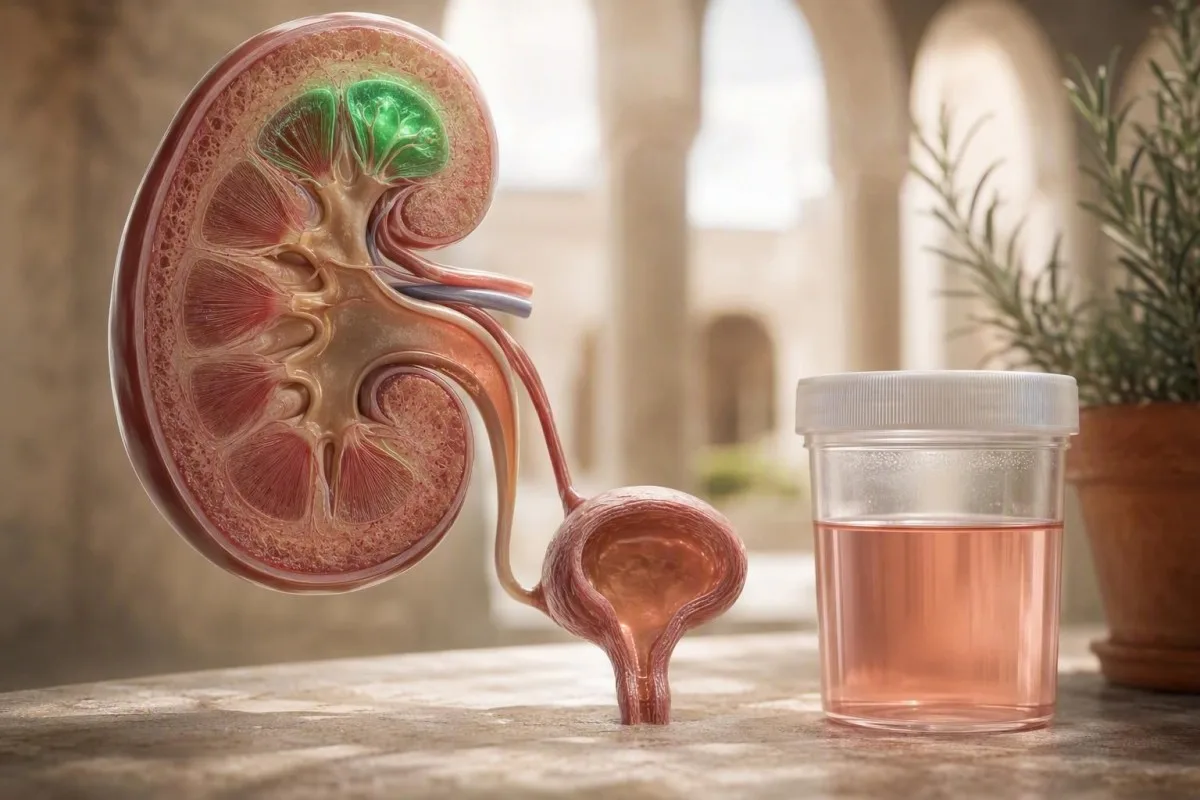
Sampel urine warna jambon utawa kaya teh sawise mlaku adoh asring mung hematuria nalika olahraga, nanging warna sing katon ora kena diabaikan. Wektu, asil mikroskop, gejala, lan sampel mbaleni sing wis diistirahatake kanthi apik bakal nuduhake crita nyata.


- Hematuria akibat olahraga biasane ilang ing 24–72 jam sawise mlaku sing abot; yen luwih saka 72 jam kudu direview dening dokter.
- Ambang mikroskopis 3 utawa luwih sel getih abang saben lapangan daya dhuwur ing sampel urine sing dikoleksi kanthi bener cocog karo definisi AUA babagan microhematuria.
- Ketidakcocokan dipstick penting: pad getih positif kanthi nol nganti rong sel abang saben lapangan daya dhuwur nuduhake mioglobin utawa hemoglobin bebas tinimbang pendarahan urin.
- Wektu mbaleni praktis: aja olahraga abot suwene 48–72 jam, hidrasi kanthi normal, banjur njupuk sampel urine tengah.
- Penilaian dina sing padha masuk akal kanggo gumpalan getih, ora bisa nguyuh, demam, lara pinggang sisih siji sing parah, utawa urine cola kanthi lara otot sing nemen.
- Pola bebaya ginjel iku getih ditambah protein, cetakan sel abang, tekanan darah tinggi, utawa GFR sing mudhun—dudu dipstick sawise lomba sing terisolasi.
- Tandha-tandha Rhabdomyolysis yaiku urine sing peteng banget kanthi gejala otot sing abot lan asil kreatin kinase sing asring luwih saka 5 kaping wates ndhuwur laboratorium.
- Konteks risiko kanker ngganti ambang wates kanggo investigasi: umur, paparan rokok, radiasi panggul sadurunge, lan hematuria sing katon terus-terusan kabeh penting.
Napa mlaku bisa nggawe urine katon jambon
Hematuria pelari biasane bocor sel abang menyang urin sawise olahraga abot sing umure cendhak, asring pulih ing 24-72 jam istirahat. Nanging, urine jambon, abang, utawa warna cola sing katon pantes dites maneh sing diklumpukake kanthi bener tinimbang asumsi santai yen mlaku nyebabake.
Ing klinik, pola sing njamin gampang dimangerteni: owah-owahan warna diwiwiti sawise laku sing biasane dawa, cepet, utawa mudhun; ora ana demam, nyeri pinggang kolik, utawa kobong nalika nguyuh; lan mikroskop normal sawise istirahat. Kantesti yaiku analis tes getih berbasis AI sing bisa nyelehake penanda ginjel sing gegandhengan—kreatinin, eGFR, elektrolit, lan kreatin kinase—ing jejere riwayat olahraga, tinimbang nambani siji asil pasca-balapan minangka diagnosis.
Mekanisme sing diusulake yaiku kontak tembok kandung kemih mekanik, pergeseran aliran getih ginjel sementara, konsentrasi sing ana gandhengane karo dehidrasi, lan kadhangkala pecah sel abang saka pukulan sikil sing bola-bali. Bukti kanggo saben mekanisme jujur dicampur, amarga umume panaliten cilik lan nggunakake jarak balapan sing beda. Ing praktik klinisku 15 taun, riwayat upaya anyar luwih penting tinimbang warna wae; ultramarathon pisanan lan 5 km sing akrab ora nggawa probabilitas pra-tes sing padha.
Getih sing katon ing urin sawise olahraga ora sinonim karo hematuria pelari sing jinak. A pituduh tandha bebaya hematuria sing luwih amba migunani amarga watu ginjel, infeksi, penyakit glomerulus, lan kanker saluran kemih bisa uga kapisan katon sawise laku.
Definisi praktis
Hematuria sing disebabake olahraga tegese sel abang katon ing urin sanalika sawise kesel lan ilang ing sampel istirahat sing diulang. Dipstick positif mung ora mbuktekake diagnosis iki, amarga reagen ndeteksi pigmen heme saka sel abang sing utuh, hemoglobin bebas, utawa mioglobin.
Apa iki hematuria, hemoglobin, utawa mioglobin?
Dipstick urin sing maca positif kanggo getih bisa nggambarake sel abang, hemoglobin, utawa mioglobin, lan mikroskopis misahake. Urine jambon kanthi akeh sel abang sing utuh ndhukung hematuria; urine coklat peteng kanthi sithik utawa ora ana sel abang nuduhake keprihatinan kanggo pigmen saka ciloko otot utawa hemolisis.
Mikroskopis urin nuduhake 3 utawa luwih sel getih abang saben lapangan daya dhuwur ngonfirmasi microhematuria nalika sampel diklumpukake kanthi resik. Sabanjure, dipstick sing positif banget kanthi 0-2 sel abang saben lapangan daya dhuwur kudu nggawe klinisi mikirake mioglobinuria, utamane sawise paparan panas, beban otot jinis remuk, utawa nyeri otot sing abot. Warna coklat utawa cola luwih khas saka pigmen sing terkonsentrasi tinimbang jumlah getihen kandung kemih sing sithik.
Mioglobin penting amarga bisa ngiringi rhabdomyolysis lan karusakan ginjel akut. Konsentrasi kreatin kinase ndhuwur 5 kaping wates ndhuwur normal laboratorium umume digunakake minangka ambang wates biokimia kanggo rhabdomyolysis, sanajan gejala, kalium, kreatinin, lan output urin nemtokake urgensi. Deleng panjelasan praktis kita babagan creatine kinase sing dhuwur banget kanggo pola sing ora kudu ditundha sewengi.
Pewarna panganan, bit, blackberry, rifampicin, phenazopyridine, lan dehidrasi uga bisa menehi warna urin tanpa sel abang. A diferensial urine peteng mbantu ngindhari kesalahan umum kanggo nganggep saben sampel abang minangka getih.
Kenapa bedane ngowahi perawatan
Hematuria sel abang ngarahake perhatian menyang saluran kemih, nalika mioglobinuria ngarahake perhatian menyang otot rangka lan pangayoman ginjel. Loro-lorone bisa kedadeyan sawise acara ketahanan, nanging mung mikroskopis lan tes getih sing ditargetake sing bisa ngurutake kanthi andal.
Cara maca asil urinalisis sawise mlaku
Tes urin sawise mlayu sing paling informatif nggabungake dipstick, mikroskopis, pangukuran protein, lan gravitas spesifik. Getih ing dipstick kanthi sel abang sing transien lan tanpa protein asring risiko kurang; getih plus protein utawa cetakan mbutuhake evaluasi ginjel sing luwih ati-ati.
Asil getih dipstick dilapurake minangka negatif, telusur, 1+, 2+, utawa 3+, nanging minangka sinyal screening tinimbang jumlah sel. AUA nemtokake microhematuria minangka luwih saka 3 sel getih abang saben lapangan daya dhuwur ing pemeriksaan mikroskopis, dudu asil dipstick wae (Barocas et al., 2020). Bedane iki ngindhari ngirim pelari menyang pemeriksaan kanker sing ora perlu sawise screening palsu-positif.
Gravitas spesifik ndhuwur 1.030 nuduhake urin sing kenthel ing akeh laboratorium lan bisa nggawe warna katon luwih nggegirisi, nanging ora nerangake sel abang sing dikonfirmasi. Protein 1+ utawa luwih kudu dikuantifikasi kanthi rasio albumin-kreatinin urin utawa rasio protein-kreatinin; proteinuria olahraga transien ana, nanging albuminuria sing persisten ngowahi diferensial menyang penyakit glomerular. Kita pandhuan lengkap babagan urinalisis njlentrehake kenapa tandha-tandha kasebut ora kudu digabung dadi siji asil.
Kantesti AI nerjemahake kreatinin lan eGFR bebarengan karo temuan urin, wektu olahraga, lan nilai sadurunge; kreatinin sing rada mundhak sawise balapan panas ora padha karo penyakit ginjel kronis. Ing laku, aku takon jarak, medan, suhu, panggunaan anti-inflamasi, wektu haid, lan apa sampel diwenehake ing 2 jam sawise rampung.
Kapan kudu mbaleni tes urine sawise mlaku?
Tes urin bola-bali 48–72 jam sawise mlaku atos pungkasan minangka pilihan standar sing logis kanggo hematuria pelari sing dicurigai. Gunakake sampel esuk pisanan utawa sampel tengah sing wis hidrasi kanthi apik, nanging aja meksa ngombe liter banyu sadurunge amarga pengenceran ekstrem bisa nyegah panemuan sing migunani.
Kanggo kelainan rutin sawise lomba, aku biasane nyaranake ora ana interval, bukit, ngangkat abot, utawa balapan kanggo 48 jam; sawise maraton, ultramaraton, penyakit panas, utawa rasa nyeri sing ora biasa, 72 jam luwih bisa dibenerake. Ngombe biasa nganti ngelak cukup. Hidrasi sing berlebihan bisa nyuda gravitas spesifik ing ngisor 1.005 lan kadhangkala nggawe asil wates luwih angel ditafsirake.
Yen mikroskopi tetep positif sawise 72 jam, atur review perawatan primer sajrone sawetara dina tinimbang bola-bali nguji sawise latihan. Asil sing terus-terusan mbutuhake pangukuran tekanan darah, kreatinin serum/eGFR, rasio albumin-kreatinin urin, lan pertimbangan kultur utawa pencitraan miturut risiko. Hubungan antarane usaha, hidrasi, lan perkiraan filtrasi sing mudhun sementara dibahas ing pandhuan eGFR pasca-olahraga kita.
Maraton rekreasi umur 52 taun sing dakkerteni duwe 18 sel abang saben lapangan daya dhuwur esuk sawise balapan panas, nanging 0-1 sel abang sawise 72 jam santai; kreatiniane bali saka 1,28 mg/dL dadi 0,96 mg/dL. Asil kasebut nggampangake, nanging rencana sing padha ora bakal cukup kanggo wong sing nggunakake udud umur 52 taun kanthi warna urin sing katon bola-bali.
Aja dites ing garis finis yen bisa dihindari
Tes langsung sawise olahraga nggedhekake kasempatan nemokake sel abang sementara, urin kenthel, lan protein. Sing bisa migunani sacara klinis ing rhabdomyolysis sing dicurigai, nanging wektu sing ala kanggo netepake garis dasar pelari.
Pola hematuria sawise mlaku endi sing biasane nuduhake yen ora apa-apa?
Episode sing mandheg dhewe sawise mlaku kanthi intensif luwih nggampangake nalika wis rampung, ora ana rasa lara utawa gejala sistemik, lan ora ana proteinuria utawa owah-owahan fungsi ginjal. Nggampangake ora ateges diabaikan; tegese dikonfirmasi kanthi sampel sing santai.
Fenotipe risiko luwih murah yaiku pelari enom utawa umur pertengahan kanthi pemicu usaha sing jelas, tekanan darah normal, ora ana riwayat ngrokok, lan mikroskopi santai normal. Ing setelan kasebut, asil tunggal transien saka 3–10 RBC/HPF sawise balapan asring rampung tanpa perawatan. Aku isih bakal nyathet, amarga kedadeyan maneh sawise saben mlaku dawa mbutuhake tinjauan sing luwih ati-ati tinimbang acara siji-sijine.
Rasio albumin-kreatinin urin normal biasane ing ngisor 30 mg/g (ing ngisor 3 mg/mmol), sanajan laboratorium lan negara nglaporke unit kanthi beda. Getih tanpa albumin, cetakan, utawa sel abang dismorfik nuduhake ora ana bocor glomerulus; ora mbuktekake sumber kandung kemih, nanging ngarahake pitakonan sabanjure. Panjelasan kita babagan protein ing urin njangkepi panggagahan iki kanthi cetha.
Cidra kandhung kemih luwih mungkin nalika cipréna banget kenthel lan pelari pungkasane kandhung kemih meh kosong. Sawetara klinisi olahraga nyaranake nguyuh sadurunge mlayu adoh lan ngombe kanthi rutin, nanging iki minangka saran pencegahan kanthi bukti uji coba sing winates—dudu pengganti evaluasi nalika warna tetep ana.
Asil normal duwe stempel wektu
Tes negatif 3 dina sawise balapan nyenengake kanggo episode kasebut, dudu jaminan seumur hidup. Hematuria katon anyar pirang-pirang wulan sabanjure kudu dievaluasi miturut mérite dhewe, utamane sawise umur 40 taun utawa kanthi paparan rokok.
Tandha bebaya sing nggawe hematuria pelari ora mungkin
Hematuria mbutuhake evaluasi cepet nalika terus nganti 72 jam, bola-bali tanpa olahraga abot, utawa katon kanthi rasa lara, demam, gumpalan, protein, utawa owah-owahan fungsi ginjel. Kombinasi panemonan luwih informatif tinimbang conto sing katon dramatis dhewe.
Golek saran medis sing pas wektune kanggo cipréna abang sing katon sing tahan ngluwihi 24 jam, sanajan sampeyan rumangsa sehat; ambang luwih murah kanggo wong luwih saka 40, perokok saiki utawa mantan, utawa wong sing sadurunge wis radiasi panggul. Pedoman AUA nggunakake stratifikasi risiko adhedhasar umur, udud, tingkat lan persistensi getih mikroskopis, lan hematuria sadurunge sing akeh tinimbang ngobati kabeh microhematuria kanthi cara sing padha (Barocas et al., 2020).
Sel abang dysmorphic, gumpalan sel abang, albuminuria signifikan, hipertensi anyar, utawa eGFR sing suda nuduhake sumber saringan ginjal tinimbang kandhung kemih sing keguncang. Gumpalan sel abang ora nate dadi akibat sing dikarepake saka mlayu biasa lan kudu nyebabake evaluasi ginjel sing cepet. Deleng ringkesan kita babagan gumpalan granular lan urin kenapa panemonan sedimen penting.
Thomas Klein, MD, menehi saran marang pelari supaya ora nyoba dhewe mung kanthi warna: infeksi saluran kemih bisa nyebabake kobong, kepinginan, pyuria, lan kadang hematuria, nalika watu luwih asring nyebabake rasa lara siji sisih sing dumadakan lan mual. Kultur paling mbiyantu sadurunge antibiotik nalika gejala infeksi ana.
Kombinasi getih plus protein
Hematuria sing dikonfirmasi kanthi proteinuria luwih ngkhawatirake tinimbang hematuria sing terisolasi amarga loro-lorone bisa asale saka saringan glomerular. Rasio albumin-kreatinin urin 30 mg/g utawa luwih dhuwur kudu diulang lan diinterpretasikake kanthi tekanan getih lan fungsi ginjel.
Kapan urine jambon sawise olahraga kudu dirawat dina iku uga?
Entuk evaluasi darurat ing dina sing padha kanggo gumpalan, ora bisa nguyuh, nyeri pinggang abot, demam, ora sadar, output urin suda, utawa cipréna peteng kanthi nyeri otot lan lemes sing abot. Fitur-fitur kasebut nuduhake ngluwihi hematuria sing ora rumit sing disebabake dening olahraga.
Gumpalan bisa ngalangi aliran urin, lan ora bisa ngliwati urin minangka masalah darurat tanpa preduli saka kabugaran atletik. Demam 38.0°C utawa luwih kanthi nyeri pinggang bisa nuduhake infeksi ginjel ndhuwur; rasa lara kolik abot kanthi mutah bisa nuduhake watu. Ora ana kahanan sing kudu diatasi kanthi ngenteni tes ulang sawise mlayu.
Cipréna coklat peteng sawise olahraga ditambahake tenderness otot sing ditandai, lemes, bengkak, utawa output suda nambah keprihatinan kanggo rhabdomyolysis. Tes awal biasane kalebu creatine kinase, kreatinin, kalium, kalsium, fosfat, lan urinalisis. A babagan rhabdomyolysis CrossFit iku wigati amarga latihan eksentrik sing ora biasa—dudu mung mlayu—iku pemicu sing kerep.
Dehidrasi abot bisa nggawe asil ginjel katon luwih ala, nanging uga bisa ana bebarengan karo ciloko nyata. Yen sampeyan ngelu, bingung, ora bisa ngombe cairan, utawa banget sithik urin ing 8–12 jam, aja nyoba ngrampungake masalah kasebut nganggo omben-omben olahraga ing omah.
meteng lan antikoagulan
Pelari ngandheg lan wong sing njupuk antikoagulan kudu nglapurake hematuria sing katon kanthi cepet. Antikoagulan bisa nambah pendarahan nanging ora ngilangi kabutuhan kanggo nemtokake sumberé; meteng uga ngganti ambang kanggo mriksa infeksi, watu, lan penyakit ginjel.
Kondisi sing bisa ditindakake mlaku tinimbang disebabake
Mlayu bisa mbukak masalah kemih sing wis ana kanthi ngonsentrasi urin utawa nyurung tes, tinimbang nyebabake hematuria kasebut. watu, infeksi, penyakit glomerular, kelainan struktural, lan keganasan tetep dadi bagean saka diagnosis diferensial.
watu ginjel asring nyebabake nyeri pinggang-kanggo-selangkangan, mual, lan sel abang ing mikroskopik, sanajan watu sing ora lara kedadeyan. Infeksi kemih luwih asring ngasilake kobong, frekuensi, desakan, lan sel putih; asil nitrit sing negatif ora bisa ngilangi. Pandhuan kita kanggo leukosit esterase kanthi nitrit negatif nerangake pola campuran umum iki.
Glomerulonefritis bisa ditampilake sawise infeksi saluran napas ndhuwur kanthi urin cola, bengkak, tekanan darah dhuwur, proteinuria, lan sel abang dismorfik. Ing pedoman KDIGO 2024 CKD, albuminuria sing terus-terusan lan eGFR sing suda dianggep minangka penanda risiko ginjel sing komplèks, ora minangka pangukuran sing bisa diganti (KDIGO, 2024).
Kantesti minangka alat analisis tes getih sing didukung AI sing mbantu pangguna ngenali pola ing creatinine, eGFR, albumin, elektrolit, lan CBC, nanging ora bisa diagnosa sumber anatomis hematuria. Imaging, mikroskopik, kultur, lan pemeriksaan dokter isih nindakake pakaryan sing nemtokake.
Kanker ora umum ing pelari enom, ora mokal ing wong diwasa
Hematuria sing katon mbutuhake evaluasi sanajan olahraga katon minangka panjelasan sing jelas, utamane ing wong sing kena asap rokok utawa gejala sing terus-terusan. Risiko mundhak kanthi umur lan paparan tembakau kumulatif, mula asil urin sing padha ora nyebabake rencana tes sing padha.
Sinten sing butuh tindak lanjut urologi utawa nefrologi?
Hematuria sing terus-terusan sawise sampel ulang sing wis tenang kudu dinilai risikone kanggo urologi, dene hematuria ditambah proteinuria, cetakan, hipertensi, utawa eGFR sing rusak nuduhake nefrologi. Akeh wong mung butuh tes ulang sing dipimpin perawatan primer; rujukan gumantung saka pola.
Evaluasi urologi utamane cocog kanggo hematuria katon sing bola-bali, hematuria mikroskopik sing terus-terusan, riwayat ngrokok, paparan amina aromatik ing papan kerja, radiasi pelvis sadurunge, utawa gejala kemih tanpa infeksi. Gumantung saka risiko, dokter bisa nggunakake ultrasound ginjal lan kandung kemih, CT urography, lan cystoscopy. Siji dipstick jejak pasca-balapan ing wong umur 24 taun iku beda banget karo urin abang sing bola-bali ing mantan perokok umur 58 taun.
Tinjauan nefrologi luwih mungkin karo rasio albumin-kreatinin urin ≥30 mg/g, eGFR ngisor 60 mL/min/1.73 m² tahan 3 wulan utawa luwih, cetakan sel abang, utawa tekanan darah sing angel dikontrol. Ambang wates kasebut penting amarga penyakit ginjel kronis ditemtokake dening durasi uga pangukuran tunggal. Waca kita tahapan penyakit ginjel kronis kanggo kategori praktis.
Layanan interpretasi tes laboratorium AI saka Kantesti bisa menehi tandha pola getih-lan-protein sing bisa diulangake kanggo dibahas, utamane nalika pangguna ngunggah asil saka laboratorium sing beda. Kudu ndhukung, ora ngganti, dhokter sing mutusake apa perlu pencitraan kemih utawa pemeriksaan spesialis.
Aja nganti antikoagulasi mungkasi obrolan
Panganggone antikoagulan ngganti tingkat pendarahan nanging ora nemtokake sababe hematuria. Miturut pengalamanku, nyebabake getih urin sing bolak-balik amarga apixaban, warfarin, utawa aspirin tanpa pemeriksaan bisa ngundhangake pangerten watu, infeksi, utawa penyakit struktural.
Tes getih endi sing mbantu sawise hematuria sing gegayutan karo olahraga?
Tes getih sing migunani gumantung saka gejala: kreatinin, eGFR, elektrolit, lan kreatin kinase nguji stres ginjel lan otot, dene CBC ngevaluasi anemia utawa tandha-tandha infeksi. Panel jembar rutin kurang mbiyantu tinimbang tes target sawise riwayat sing tepat lan urinalisis.
Creatinine bisa munggah nalika sawetara sawise olahraga ketahanan amarga metabolisme otot, nyuda perfusi ginjel, lan dehidrasi. Persamaan eGFR kurang dipercaya nalika owah-owahan kreatinin cepet, mula nilai bola-bali sawise 48–72 jam pemulihan biasa luwih penting tinimbang asil garis finis. Kita pandhuan mriksa ulang kreatinin sing gegayutan karo olahraga menehi konteks kanggo pemicu kuatir sing umum iki.
Kreatin kinase duwe sawetara pasca-olahraga sing amba: atlet sing dilatih bisa nuduhake elevasi sawise balapan tanpa ciloko ginjel, dene nilai sing kaping pirang-pirang luwih dhuwur tinimbang wates ndhuwur lokal ditambah gejala pantes dievaluasi kanthi cepet. Kalium ndhuwur 6.0 mmol/L bisa mbebayani lan mbutuhake evaluasi klinis sing cepet, utamane yen fungsi ginjel rusak utawa ciloko otot dicurigai.
CBC paling migunani nalika ana kesel, pucet, pendarahan menstruasi abot, hematuria sing bola-bali, utawa kuwatir babagan penyakit sistemik. Hemoglobin bisa mudhun sawise acara ketahanan saka ekspansi volume plasma, mundhut zat besi, utawa hemolysis; ferritin kudu diinterpretasikake adoh saka peradangan akut lan latihan abot. Pelari ketahanan bisa nemokake kita gambaran umum tes getih atlet migunani kanggo garis dasar sing masuk akal.
Aja ngobati penyakit ginjel saka siji panel minggu balapan
Kenaikan kreatinin 0,3 mg/dL utawa luwih bisa ketemu kriteria cedera ginjel akut ing jangka wektu sing tepat, nanging konteks lan tes bola-bali nemtokake sawise balapan. Output urin sing sithik, kalium sing munggah, lan elevasi sing terus-terusan luwih penting tinimbang asil wates sing terisolasi.
Cara ngumpulake sampel urine mbaleni sing bisa dipercaya dokter
Sampel urin midstream sing resik sawise 48-72 jam tanpa olahraga abot minangka cara paling apik kanggo mriksa manawa hematuria wis mari. Kesalahan koleksi, kontaminasi menstruasi, lan spesimen lawas bisa ngasilake asil sing salah.
Cuci tangan, wiwiti nguyuh menyang jamban, banjur kumpulake bagian midstream tanpa ndemek njero wadah. Kirimake sampel kanthi cepet - luwih becik ing 2 jam—utawa tindakake instruksi kulkas laboratorium. Ngadeg suwe-suwe ngganti tampilan sel lan bisa nggawe mikroskop kurang dipercaya.
Aja dites nalika menstruasi aktif yen bisa; yen tes ora bisa ngenteni, kandhani dokter lan laboratorium. Kontaminasi vagina bisa ngasilake sel abang lan protein sing katon, dene sel epitel skuamosa asring nuduhake sampel sing dikoleksi kanthi ala. Pandhuan kita kanggo sel epitel ing urin njelasake ngapa iki dudu cathetan sikil lab sing sepele.
Thomas Klein, MD, nyaranake nyimpen patang rincian bebarengan karo spesimen: sesi paling anyar sing abot, durasi acara, suhu njaba, lan kabeh obat sing dijupuk ing 72 jam sadurunge. Asil tanpa wektu luwih angel diinterpretasi—terutama nalika urin dikoleksi sawise latihan kaping pindho.
Pisanan esuk vs tes awan
Sampel esuk pisanan konsentrasi lan apik kanggo ndeteksi kelainan cilik, nanging sampel midstream awan sing dihidrasi kanthi normal bisa ditampa yen koleksi luwih resik. Konsistensi luwih penting kanggo perbandingan serial: gunakake kahanan sing padha saben mbaleni.
Hidrasi, obat penghilang rasa sakit, lan suplemen sing ngganti gambaran
Dehidrasi bisa ngonsentrasi urin lan nambah stres ginjel, dene NSAID bisa nyuda aliran getih ginjel sajrone olahraga ketahanan. Ora ana faktor sing mbuktekake sababe hematuria, nanging loro-lorone mengaruhi carane klinisi kanthi ati-ati ngetrapake asil sawise mlaku.
Kanggo umume pelari, ngombe nganti ngelak lan ngganti kerugian kanthi bertahap luwih aman tinimbang meksa ngombe kanthi kaku. Sodium sing sithik banget saka asupan banyu sing berlebihan bisa mbebayani; serum sodium ing ngisor 125 mmol/L kanthi sakit kepala, mutah, bingung, utawa kejang minangka darurat. Warna urin minangka tandha hidrasi kasar, dudu meter hidrasi sing tepat.
Ibuprofen, naproxen, lan NSAID liyane bisa nyuda aliran getih ginjel sing dimediasi prostaglandin, utamane nalika stres panas, mutah, utawa acara dawa. Aku menehi saran marang pasien supaya ngindhari NSAID prophylactic rutin sadurunge maraton kajaba panguwasa dhewe wis menehi alesan sing cetha. Konteks obat ditliti ing artikel keamanan tren lab kita artikel safety tren lab.
Vitamin C dosis dhuwur bisa ngganggu reaksi dipstick urin tartamtu, lan suplemen sing dipasaraké kanggo kinerja kadang ngandhut stimulan utawa diuretik sing ora kadhaptar. Gawa wadhah utawa foto sing cetha menyang janji; asring luwih migunani tinimbang nyoba ngelingi dhaptar bahan bubuk bermerek. Pandhuan keamanan suplemen kita kanggo atlet nawakake dhaptar periksa sing masuk akal. nawakake dhaptar priksa sing lumrah.
Hidrasi dudu perawatan kanggo getih sing terus-terusan
Banyu bisa mbenerake konsentrasi, nanging ora nambani watu, infeksi, proses glomerular, utawa sumber urin struktural. Yen sel abang isih ana ing sampel sing wis tenang, diklumpukake kanthi apik, eskalasi kudu adhedhasar pola tinimbang eksperimen hidrasi liyane.
Apa bisa terus mlaku sawise hematuria sing disebabake olahraga?
Umume pelari bisa bali kanthi bertahap yen warna urin wis normal, gejala wis ora ana, lan sampel mbaleni sing wis tenang meyakinkan. Aja bali menyang latihan abot nalika urin katon abang, asil ginjel ora normal, utawa gejala otot nuduhake rhabdomyolysis.
Sawise episode tunggal sing ora rumit, aku biasane nyaranake lari entheng mung sawetara dina, banjur mbangun maneh volume lan intensitas kanthi bertahap 7–14 dina. Pelari kudu mandheg lan njaluk tinjauan yen warna kasebut bola-bali, rasa lara muncul, utawa output urin mudhun. Iki minangka pendekatan klinis sing pragmatis, dudu resep sing wis dibuktekake kanthi uji coba.
Hematuria bola-bali sawise jarak sing padha bisa mbenani eksperimen praktis: ngindhari balapan dehidrasi, nguyuh sadurunge mlaku dawa, nglereni latihan mudhun luwih alon, lan mriksa ukuran sepatu utawa medan. Simpen log kacepetan, panas, durasi, warna urin, lan asil sampel. pandhuan lab kanggo pelari maraton bisa mbantu mbedakake tandha pemulihan saka alasan kanggo ngaso latihan.
Aja latihan nalika ana getih ing pipis sing katon lan ora dingerteni mung amarga ana acara sing dijadwalake. Atlet asring pinter ngatasi rasa ora nyaman; katrampilan sing luwih angel yaiku ngerti yen kegigihan minangka informasi diagnostik, dudu tes kekuwatan.
Gawe basa nyata
Tes urin lan panel ginjel sing dijupuk paling ora 72 jam saka latihan abot bisa nggawe asil pasca-balapan mbesuk luwih gampang diinterpretasikake. Iki utamane migunani kanggo pelari jarak jauh, wong sing duwe siji ginjel, utawa atlet sing nggunakake obat sing mengaruhi perfusi ginjel.
Apa sing kudu dicritakake marang dokter babagan getih ing urine sawise olahraga
Cara paling cepet kanggo ngukur hematuria sing migunani yaiku kanthi garis wektu sing ringkes: warna urin, dosis olahraga, gejala, obat-obatan, lan wektu tes ulang. Nggawa nilai laboratorium sing nyata tinimbang mung pesen yen conto kasebut “positif getih.”
Sebutake apa urin kasebut jambon, abang padhang, warna teh, utawa ngemot gumpalan; apa warna kasebut katon sadurunge, sajrone, utawa sawise olahraga; lan apa kasebut ilang sawise nguyuh pisanan. Kalebu kobong, desakan, demam, nyeri pinggang, mual, bengkak, lan output suda. Rinci referensi warna urin bisa mbantu njlèntrèhaké pengamatan kanthi akurat tanpa interpretasi luwih.
Nggawa tes urin sadurunge, nilai kreatinin/eGFR, cathetan tekanan darah, riwayat ngrokok, riwayat ginjel kulawarga, lan dhaptar obat/suplemen. Kantesti minangka platform interpretasi biomarker AI sing bisa ngatur nilai tes getih bola-bali lan nyorot owah-owahan sing signifikan, nanging dokter kudu nyambungake nilai-nilai kasebut karo mikroskop urin lan pemeriksaan.
Wiwit tanggal 3 September 2026, prinsip klinis tetep sederhana: olahraga minangka penjelasan sing bisa ditindakake mung yen asil kasebut wis rampung lan ora ana petunjuk sing saingan. Yen sampeyan ora yakin, takon apa sampeyan butuh mikroskop, kultur, rasio albumin-kreatinin, kreatinin ulang, pencitraan, utawa rujukan—ora mung dipstick liyane.
Pitakonan sing patut ditakokake
Takon apa sel getih abang sing utuh katon, apa protein utawa cetakan ana, lan kapan mbaleni nalika wis tenang. Telu jawaban kasebut biasane nerangake apa langkah sabanjure minangka tindak lanjut sing ngati-ati, tes ginjel, tes infeksi, utawa evaluasi urologi.
Rencana tumindak sing masuk akal kanggo hematuria pelari
Kanggo siji episode tanpa rasa sakit sawise mlaku kanthi abot, istirahat saka olahraga abot nganti 48-72 jam lan baleni tes urin resik; golek perawatan luwih awal kanggo tandha abang utawa warna sing katon terus-terusan. Tujuane ora panik utawa nolak—iku mbuktekake yen panemuan kasebut ilang.
Langkah siji: mandheg latihan abot, hidrasi normal, lan cathet wektu lan gejala. Langkah loro: baleni mikroskop sawise 48–72 jam. Langkah telu: yen getih tetep ana, utawa yen protein, cetakan, nyeri, demam, gumpalan, output urin kurang, utawa tandha ginjel sing ora normal katon, atur penilaian medis kanthi cepet. Urutan iki nyegah penyakit sing ilang lan pencitraan sing ora perlu sawise conto garis finis sapisan.
Nalika tim klinis kita mriksa data laboratorium sing diunggah, kita prioritas pola: kreatinin mundhak ditambah CK dhuwur lan output urin kurang luwih penting tinimbang kreatinin stabil kanthi dipstick urin sementara. Metodologi lan pangayoman Kantesti diterangake ing kita validasi klinis Kantesti’s, lan pengawasan dokter kita rinci liwat Dewan Penasehat Medis.
Umume pasien nemokake yen tes ulang wektu ngowahi owah-owahan warna sing nggegirisi dadi rencana sing jelas. Nanging yen naluri sampeyan ngandhani ana sing ora bener—utamane yen urin isih abang sesuk—pracaya sinyal kasebut lan dingerteni.
Aturan siji kalimat
Urin jambon sapisan sawise lari abot bisa sementara; urin jambon sing tetep ana, bali, utawa muncul kanthi gejala yaiku hematuria nganti dievaluasi kanthi bener.
Pitakonan sing Sering Ditakoni
Suwene nganti hematuria pelari?
Hematuria pelari lumrahe mendingi salebeting 24–72 jam sasampunipun olahraga abot mandheg. Tes urine ingkang praktis kangge ngulang inggih menika spesimen *clean-catch, midstream* ingkang dipunpendhet sasampunipun 48–72 jam tanpa lari banter utawi ngangkat barang abot. Pipis ingkang katon abrit utawi jambon ngantos 24 jam, utawi hematuria mikroskopis ingkang taksih wonten sasampunipun 72 jam, kedah dipunperiksa dening dokter. Gerah, gumpalan, nyeri pinggang ingkang nemen, mundhut cacahing pipis, utawi nyeri otot ingkang nemen mbeneri pemeriksaan dinten menika.
Apa getih ing pipis sawise olahraga iku lumrah?
Getih ing urin sawise olahraga bisa dadi efek nalika saka mlaku kenceng, dehidrasi, impact tembok kandung kemih, utawa owah-owahan aliran getih ginjel sedhela, nanging ora kanthi otomatis normal. Mikroskop sing ngonfirmasi 3 utawa luwih sel getih abang saben bidang daya dhuwur cocog karo definisi AUA babagan microhematuria. Asil sing ilang ing sampel ulang sing istirahat nyenengake, dene getih, protein, corak, lara, utawa gejala kemih sing terus-terusan mbutuhake evaluasi luwih lanjut. Warna urin sing katon kudu dilaporake, utamane ing wong diwasa kanthi paparan rokok utawa episode sing bola-bali.
Apa dehidrasi bisa nyebabake pipis warna jambon sawise mlayu?
Kaserengan bisa nggawe uyuh katon luwih peteng lan bisa nambahi temuan hematuria sawise olahraga kanthi ngonsentrasi isine uyuh, nanging kaserengan wae ora bisa njlentrehake sel abang sing wis dikonfirmasi. Gravitasi spesifik uyuh ing ndhuwur 1.030 asring nuduhake uyuh sing konsentrat ing akeh laboratorium. Ngombe kanthi normal nganti ngelak lan mbaleni sampel sing diresiki sawise istirahat 48-72 jam tinimbang nyoba ngilangi asil kanthi banyu sing akeh banget. Ngelak banget, pusing, output uyuh sing sithik banget, utawa bingung mbutuhake tinjauan medis sing cepet.
Apa bedane hematuria lan myoglobinuria sawise olahraga?
Hematuria tegese sel getih abang utuh ana ing urin, dene myoglobinuria nuduhake pigmen otot sing metu sawise ciloko otot. Dipstick bisa positif kanggo getih ing loro kahanan, mula mikroskopi iku nemtokake: myoglobinuria asring ngasilake dipstick positif kanthi 0–2 sel abang saben lapangan daya dhuwur. Nyeri otot sing abot, lemes, bengkak, urin coklat peteng kaya cola, utawa nilai creatine kinase luwih saka 5 kaping wates ndhuwur laboratorium ngunggahake keprihatinan kanggo rhabdomyolysis. Pola kasebut mbutuhake penilaian klinis sing cepet amarga kalium lan fungsi ginjal bisa cepet owah.
Apa aku kudu mandheg mlaku yen aku ngalami hematuria sing disebabake dening olahraga?
Mandhegake mlaku banter nganti warna pipis normal maneh lan wis ngrampungake tes mbaleni nalika istirahat, biasane sawise 48-72 jam. Yen conto mbaleni normal lan ora lara, demam, gumpalan, proteinuria, utawa kelainan fungsi ginjel, umume pelari bisa bali kanthi bertahap udakara 7-14 dina. Aja nerusake latihan abot nalika pipis isih katon abang utawa peteng, output pipis suda, utawa ana gejala otot sing abot. Episode sing bola-bali sawise latihan sing padha pantes ditinjau medis sanajan saben episode wis mari.
Kapan hematuria perlu diperiksake dhokter urologi?
Hematuria mikroskopis sing terus-terusan sawise sampel ulang sing istirahat, hematuria sing katon bola-bali, utawa hematuria ing wong sing duwe riwayat ngrokok, radiasi panggul sadurunge, utawa gejala kemih asring mbutuhake penilaian risiko urologis. Ahli urologi bisa nimbang ultrasonik, CT urographi, lan sistoskopi miturut umur lan risiko sakabehe tinimbang nggunakake siji tes kanggo kabeh wong. Hematuria kanthi albuminuria 30 mg/g utawa luwih, gulungan sel abang, hipertensi, utawa eGFR ngisor 60 mL/min/1.73 m² luwih nuduhake nefrologi. Spesialisasi sing bener gumantung saka pola tes urin lan getih sing lengkap.
Entuk Analisis Tes Getih Berbasis AI Dina Iki
Gabung karo luwih saka 2 yuta pangguna ing saindenging jagad sing percaya Kantesti kanggo analisis tes lab sing instan lan akurat. Unggah asil tes getihmu lan tampa interpretasi lengkap saka 15,000+ biomarker sajrone sawetara detik.
📚 Publikasi Riset sing Dirujuk
Klein, T., Mitchell, S., & Weber, H. (2026). Dhukungan Keputusan Klinis Berbantuan AI Multibasa Kanggo Triase Hantavirus Dini: Desain, Validasi Rekayasa, lan Penerapan Dunia Nyata Ing 50.000 Laporan Tes Darah sing Ditafsirake. Riset Medis AI Kantesti.
Klein, T., Mitchell, S., & Weber, H. (2026). Mesin Tolok Ukur Téknis Otomatis Adhedhasar Rubrik Pra-Dhaptar saka Mesin Interpretasi Tes Getih Kantesti ing 100.000 Kasus Tes Sintetis. Riset Medis AI Kantesti.
📖 Referensi Medis Eksternal
⚕️ Penafian Medis
Artikel iki mung kanggo tujuan edukasi lan ora dadi saran medis. Tansah konsultasi karo panyedhiya layanan kesehatan sing mumpuni kanggo keputusan diagnosis lan perawatan.
Sinyal Kepercayaan E-E-A-T
Pengalaman
Tinjauan klinis sing dipimpin dokter babagan alur kerja interpretasi lab.
Keahlian
Fokus kedokteran laboratorium babagan carane biomarker tumindak ing konteks klinis.
Kewibawaan
Ditulis dening Dr. Thomas Klein kanthi ditinjau dening Dr. Sarah Mitchell lan Prof. Dr. Hans Weber.
Kapercayan
Interpretasi adhedhasar bukti kanthi tindak lanjut sing cetha kanggo nyuda rasa kaget.