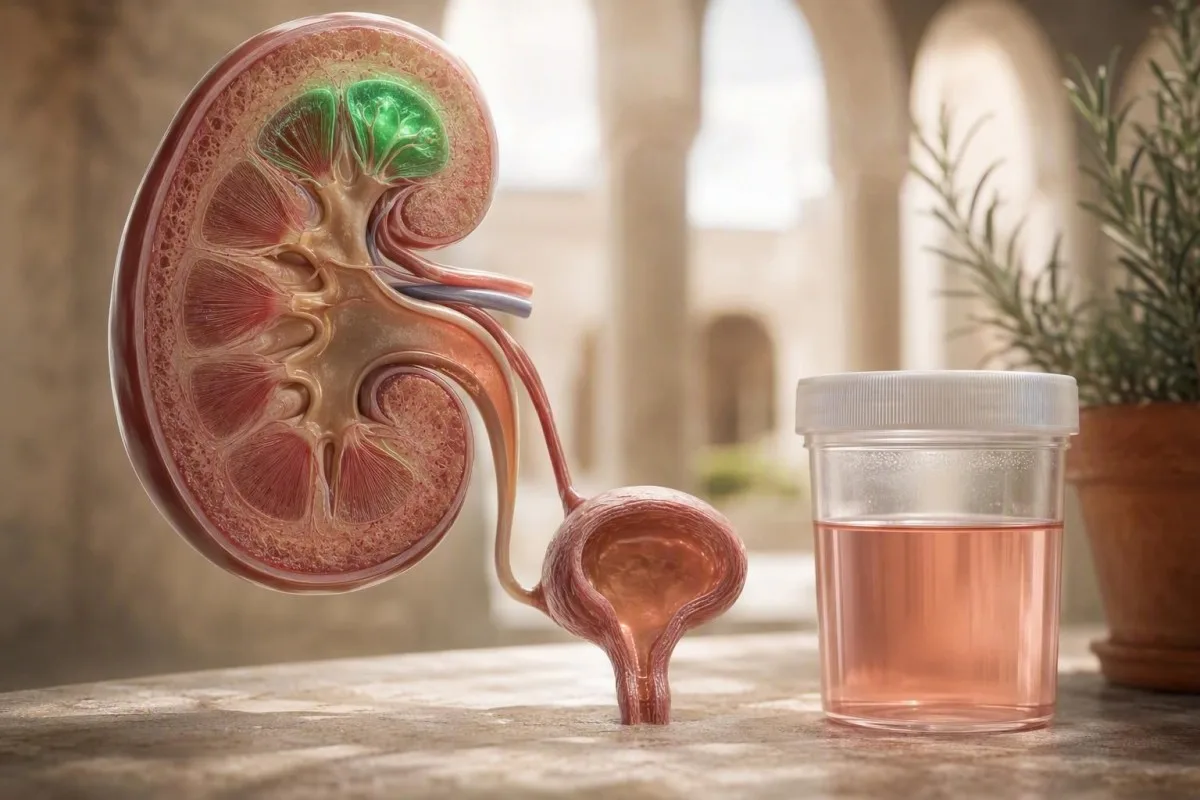
Ang pag-ihi na kulay rosas o tsaa pagkatapos ng mahabang pagtakbo ay madalas na pansamantalang ehersisyong-udyok na hematuria, ngunit ang nakikitang kulay ay hindi dapat basta-basta balewalain. Ang oras, mga natagpuan sa mikroskopyo, mga sintomas, at isang maayos na naulit na sample pagkatapos ng pahinga ang nagsasabi ng tunay na kuwento.


- Hematuria na dulot ng ehersisyo karaniwang nawawala sa loob ng 24–72 oras pagkatapos ng matinding pagtakbo; ang pagpapatuloy na lampas sa 72 oras ay nangangailangan ng medikal na pagsusuri.
- Mikroskopikong antas ng 3 o higit pang pulang selula ng dugo bawat high-power field sa isang maayos na nakolektang urine sample ay nakakatugon sa depinisyon ng AUA ng microhematuria.
- Dipstick mismatch ay mahalaga: ang positibong blood pad na may zero hanggang dalawang pulang selula bawat high-power field ay nagpapahiwatig ng myoglobin o free hemoglobin kaysa sa pagdurugo sa ihi.
- Paulit-ulit na oras ay praktikal: iwasan ang mabigat na ehersisyo sa loob ng 48–72 oras, uminom ng sapat na tubig, pagkatapos ay magbigay ng midstream urine sample.
- Pagsusuri sa parehong araw ay makatuwiran para sa mga namuong dugo, hindi kakayahang umihi, lagnat, malubhang sakit sa tagiliran na magkabilang panig, o kulay kape na ihi na may matinding pananakit ng kalamnan.
- Babala sa bato pattern ay dugo kasama ng protina, red-cell casts, mataas na presyon ng dugo, o bumababang eGFR—hindi isang nakahiwalay na dipstick pagkatapos ng karera.
- Clue sa Rhabdomyolysis ay hindi katimbang na madilim na ihi na may malubhang sintomas ng kalamnan at resulta ng creatine kinase na kadalasang higit sa 5 beses ng itaas na limitasyon ng laboratoryo.
- Konteksto ng panganib sa kanser ay nagbabago sa threshold para sa pagsisiyasat: ang edad, pagkakalantad sa paninigarilyo, naunang pelvic radiation, at patuloy na nakikitang hematuria ay mahalaga lahat.
Bakit nagiging kulay rosas ang ihi pagkatapos tumakbo
Ang hematuria ng runner ay karaniwang panandaliang pagtagas ng mga pulang selula sa ihi pagkatapos ng masiglang ehersisyo, kadalasang nawawala sa loob ng 24–72 oras ng pahinga. Gayunpaman, ang nakikitang kulay rosas, pula, o kulay cola na ihi ay nararapat sa isang maayos na nakolektang pag-uulit ng pagsusuri sa halip na isang kaswal na palagay na ito ay dulot ng pagtakbo.
Sa klinika, ang nakakapanatag na pattern ay prangka: ang pagbabago ng kulay ay nagsisimula pagkatapos ng hindi pangkaraniwang mahaba, mabilis, o pababang pagtakbo; walang lagnat, pananakit ng tagiliran, o pagkasunog ng ihi; at ang microscopy ay nagiging normal pagkatapos ng pahinga. Ang Kantesti ay isang AI blood test analyzer na maaaring ilagay ang mga kaugnay na marker ng bato—creatinine, eGFR, electrolytes, at creatine kinase—sa tabi ng kasaysayan ng ehersisyo, sa halip na gamutin ang isang resulta pagkatapos ng karera bilang isang diagnosis.
Ang mga iminungkahing mekanismo ay ang mekanikal na pagdampi ng pader ng pantog, pansamantalang paglipat ng daloy ng dugo sa bato, pag-concentrate na nauugnay sa dehydration, at paminsan-minsan na pagkasira ng pulang selula mula sa paulit-ulit na paghakbang. Ang ebidensya para sa bawat mekanismo ay tapat na pinaghalong, dahil karamihan sa mga pag-aaral ay maliit at gumagamit ng iba't ibang distansya ng karera. Sa aking 15 taon ng klinikal na kasanayan, ang kasaysayan ng isang bagong pagsisikap ay mas mahalaga kaysa sa kulay lamang; ang isang unang ultramarathon at isang pamilyar na 5 km ay hindi nagdadala ng parehong pre-test probability.
Ang nakikitang dugo sa ihi pagkatapos ng ehersisyo ay hindi katumbas ng benign runner’s hematuria. Isang mas malawak na gabay sa red-flag ng hematuria ay kapaki-pakinabang dahil ang mga bato sa bato, impeksyon, glomerular disease, at mga kanser sa urinary tract ay maaaring nagkataon na unang magpakita pagkatapos ng isang pagtakbo.
Ang praktikal na kahulugan
Ang ehersisyong dulot ng hematuria ay nangangahulugang lumilitaw ang mga pulang selula sa ihi pagkatapos ng ehersisyo at nawawala sa isang natigil na sample. Ang isang positibong dipstick lamang ay hindi nagpapatunay sa diagnosis na ito, dahil ang reagent ay nakakakita ng heme pigment mula sa buong pulang selula, malayang hemoglobin, o myoglobin.
Ito ba ay hematuria, hemoglobin, o myoglobin?
Ang isang dipstick ng ihi na nababasang positibo para sa dugo ay maaaring sumalamin sa mga pulang selula, hemoglobin, o myoglobin, at pinaghihiwalay sila ng microscopy. Ang kulay rosas na ihi na may maraming buong pulang selula ay sumusuporta sa hematuria; ang madilim na kayumangging ihi na may kaunti o walang pulang selula ay nagtatanim ng pag-aalala para sa pigment mula sa pinsala ng kalamnan o hemolysis.
Microscopy ng ihi na nagpapakita ng 3 o higit pang pulang selula ng dugo bawat mataas na power field ay kinukumpirma ang microhematuria kapag ang sample ay malinis na nakolekta. Sa kabilang banda, ang isang malakas na positibong dipstick na may 0–2 pulang selula bawat mataas na power field ay dapat magpag-isip sa isang kliniko tungkol sa myoglobinuria, lalo na pagkatapos ng pagkakalantad sa init, isang uri ng crush na kalamnan, o malubhang pagkaantala ng sakit ng kalamnan. Ang kayumanggi o kulay cola ay mas karaniwan ng konsentradong pigment kaysa sa isang maliit na halaga ng pagdurugo ng pantog.
Mahalaga ang Myoglobin dahil maaari itong samahan ng rhabdomyolysis at acute kidney injury. Isang konsentrasyon ng creatine kinase na higit sa 5 beses ng itaas na limitasyon ng normal sa laboratoryo ay karaniwang ginagamit bilang isang biochemical threshold para sa rhabdomyolysis, bagaman ang mga sintomas, potassium, creatinine, at output ng ihi ang nagdidikta ng pagkaapurahan. Tingnan ang aming praktikal na paliwanag ng lubhang mataas na creatine kinase para sa mga pattern na hindi dapat hintayin magdamag.
Ang mga pangkulay ng pagkain, beetroot, blackberry, rifampicin, phenazopyridine, at dehydration ay maaari ring makapagbigay ng kulay sa ihi nang walang mga pulang selula. A pagtatangi ng maitim na ihi ay nakakatulong upang maiwasan ang karaniwang pagkakamali ng pag-aakala na ang bawat mapulang sample ay nagpapahiwatig ng dugo.
Bakit nagbabago ang pangangalaga dahil sa pagkakaiba
Ang hematuria na may pulang selula ay nagtuturo ng atensyon sa urinary tract, samantalang ang myoglobinuria ay nagtuturo ng atensyon sa skeletal muscle at proteksyon ng bato. Parehong maaaring mangyari pagkatapos ng mga endurance event, ngunit ang microscopy at naka-target na pagsusuri sa dugo lamang ang makakapagbukod-bukod nito nang mapagkakatiwalaan.
Paano basahin ang resulta ng urinalysis pagkatapos tumakbo
Ang pinaka-nagbibigay-kaalamang post-run na pagsusuri sa ihi ay pinagsasama ang dipstick, microscopy, pagsukat ng protina, at tiyak na gravity. Ang dugo sa dipstick na may pansamantalang pulang selula at walang protina ay kadalasang mababa ang panganib; ang dugo kasama ang protina o mga cast ay nangangailangan ng mas maingat na pagsusuri sa bato.
Ang resulta ng dugo sa dipstick ay iniuulat bilang negatibo, trace, 1+, 2+, o 3+, ngunit ito ay isang signal ng screening kaysa sa bilang ng selula. Tinutukoy ng AUA ang microhematuria bilang higit sa 3 pulang selula ng dugo bawat high-power field sa microscopic examination, hindi lamang isang resulta ng dipstick (Barocas et al., 2020). Ang pagkakaibang ito ay nakakatulong upang maiwasan ang mga runner na magkaroon ng hindi kinakailangang pagsusuri para sa kanser pagkatapos ng isang maling positibong screening.
Ang tiyak na gravity na higit sa 1.030 ay nagpapahiwatig ng concentrated na ihi sa maraming laboratoryo at maaaring magmukhang mas nakakatakot ang kulay, ngunit hindi nito maipapaliwanag ang nakumpirmang mga pulang selula. Ang protina na 1+ o mas mataas ay dapat masukat gamit ang urine albumin-creatinine ratio o protein-creatinine ratio; mayroong transient exercise proteinuria, gayunpaman ang persistent albuminuria ay nagbabago sa differential patungo sa glomerular disease. Ang aming kumpletong gabay sa pagsusuri ng ihi ay nagpapaliwanag kung bakit hindi dapat pagsamahin ang mga marker na ito sa isang resulta.
Ang AI ay nagbibigay-kahulugan sa creatinine at eGFR kasama ang mga natuklasan sa ihi, tiyempo ng ehersisyo, at mga nakaraang halaga; ang isang solong bahagyang mataas na creatinine pagkatapos ng mainit na karera ay hindi katumbas ng malalang sakit sa bato. Sa pagsasagawa, tinatanong ko ang distansya, lupain, temperatura, paggamit ng anti-inflammatory, tiyempo ng regla, at kung ang sample ay ibinigay sa loob ng 2 oras pagkatapos matapos.
Kailan dapat ulitin ang pagsusuri ng ihi pagkatapos tumakbo?
Ang pag-uulit ng pagsusuri sa ihi 48–72 oras pagkatapos ng huling matinding takbo ay isang makatuwirang default para sa pinaghihinalaang hematuria ng mananakbo. Gumamit ng unang umaga o mahusay na hydrated na midstream na sample, ngunit huwag pilitin ang litro ng tubig kaagad bago dahil ang matinding pagkatunaw ay maaaring makalito sa mga kapaki-pakinabang na natuklasan.
Para sa isang karaniwang abnormalidad pagkatapos ng karera, karaniwan kong inirerekomenda ang walang mga interval, burol, mabigat na pagbubuhat, o mga karera para sa 48 oras; pagkatapos ng marathon, ultramarathon, init na karamdaman, o hindi pangkaraniwang pananakit, 72 oras ay mas mapaglalaban. Ang ordinaryong pag-inom sa uhaw ay sapat na. Ang sobrang pag-inom ay maaaring magpababa ng tiyak na gravity sa ibaba 1.005 at paminsan-minsan ay magpapahirap sa pag-interpret ng isang borderline na resulta.
Kung mananatiling positibo ang mikroskopya pagkatapos ng 72 oras, ayusin ang primary-care review sa loob ng ilang araw sa halip na paulit-ulit na pagsubok pagkatapos ng mga workout. Ang mga paulit-ulit na resulta ay karapat-dapat sa pagsukat ng presyon ng dugo, serum creatinine/eGFR, urine albumin-creatinine ratio, at pagsasaalang-alang ng kultura o imaging ayon sa panganib. Ang relasyon sa pagitan ng pagsisikap, hydration, at pansamantalang mas mababang pagtatantya ng filtration ay sakop sa aming gabay sa eGFR pagkatapos ng ehersisyo.
Isang 52-taong-gulang na recreational marathoner na nakita ko ay may 18 pulang selula bawat high-power field noong gabi pagkatapos ng mainit na karera, ngunit 0–1 pulang selula pagkatapos ng 72 nakapahingang oras; ang kanyang creatinine ay bumalik mula 1.28 mg/dL hanggang 0.96 mg/dL. Nakapagpapatibay ang resulta, ngunit ang parehong plano ay hindi sapat para sa isang 52-taong-gulang na naninigarilyo na may paulit-ulit na nakikitang kulay ng ihi.
Huwag sumubok sa finish line kung maaari mong iwasan ito
Ang pagsubok kaagad pagkatapos ng ehersisyo ay nagpapalaki ng tsansa na makahanap ng pansamantalang pulang selula, siksik na ihi, at protina. Iyan ay maaaring maging kapaki-pakinabang sa klinikal sa pinaghihinalaang rhabdomyolysis, ngunit ito ay isang mahinang oras upang maitatag ang baseline ng mananakbo.
Aling mga pattern ng hematuria pagkatapos tumakbo ang karaniwang nakakapanatag?
Ang isang self-limited na episode pagkatapos ng matinding pagtakbo ay mas nakapagpapatibay kapag ito ay ganap na nalinis, walang sakit o sistemikong sintomas, at walang proteinuria o pagbabago sa paggana ng bato. Ang nakapagpapatibay ay hindi nangangahulugang binabalewala; nangangahulugan ito na nakumpirma sa isang nakapahingang sample.
Ang mas mababang panganib na phenotype ay isang mas bata o nasa edad na mananakbo na may malinaw na exertional trigger, normal na presyon ng dugo, walang kasaysayan ng paninigarilyo, at normal na nakapahingang mikroskopya. Sa ganoong setting, isang solong pansamantalang resulta ng 3–10 RBC/HPF pagkatapos ng isang karera ay madalas na nalulutas nang walang paggamot. Ido-dokumento ko pa rin ito, dahil ang pag-ulit pagkatapos ng bawat mahabang takbo ay nararapat sa mas maingat na pagsusuri kaysa sa isang solong pangyayari.
Ang isang normal na urine albumin-creatinine ratio ay karaniwang sa ibaba 30 mg/g (sa ibaba 3 mg/mmol), bagaman ang mga laboratoryo at bansa ay nag-uulat ng mga yunit nang magkakaiba. Ang dugo na walang albumin, cast, o dysmorphic red cells ay nagpapahiwatig palayo sa glomerular leakage; hindi nito pinapatunayan ang pinagmulan ng pantog, ngunit ginagabayan nito ang susunod na tanong. Ang aming paliwanag ng protina sa ihi malinaw na tinatalakay ang dibisyong ito.
Ang pinsala sa pantog ay mas malamang kapag ang ihi ay napakataba at ang tumatakbo ay natapos na halos walang laman ang pantog. Ang ilang mga sports clinician ay nagmumungkahi ng pag-ihi bago ang mahabang pagtakbo at regular na pag-inom, ngunit ito ay payo sa pag-iwas na may limitadong ebidensya sa pagsubok—hindi kapalit ng pagsusuri kapag nagpapatuloy ang kulay.
Ang normal na resulta ay may time stamp
Ang negatibong pagsusuri 3 araw pagkatapos ng isang karera ay nakakapanatag para sa episode na iyon, hindi isang garantiya sa buong buhay. Ang bagong nakikitang hematuria ilang buwan pagkatapos ay dapat suriin sa sarili nitong merito, lalo na pagkatapos ng edad 40 o kung may exposure sa paninigarilyo.
Mga babalang senyales na nagpapababa ng posibilidad na ang hematuria ng tumatakbo ay dahil lamang sa ehersisyo
Ang hematuria ay nangangailangan ng mabilis na pagsusuri kapag nagpapatuloy ito pagkatapos ng 72 oras, nauulit nang walang matinding ehersisyo, o lumilitaw na may sakit, lagnat, bukol, protina, o pagbabago sa paggana ng bato. Ang kombinasyon ng mga natuklasan ay mas nagbibigay-kaalaman kaysa sa isang sample na mukhang dramatiko lamang.
Humingi ng napapanahong medikal na payo para sa nakikitang pulang ihi na tumatagal ng higit sa , itigil ang high-dose, kahit na pakiramdam mo ay maayos ka; mas mababa ang threshold para sa mga taong mahigit 40, kasalukuyan o dating naninigarilyo, o mga may dating pelvic radiation. Ginagamit ng AUA guideline ang risk stratification batay sa edad, paninigarilyo, antas at pagpapatuloy ng microscopic na dugo, at dating gross hematuria sa halip na tratuhin ang lahat ng microhematuria nang magkapareho (Barocas et al., 2020).
Ang mga dysmorphic red cells, red-cell casts, makabuluhang albuminuria, bagong hypertension, o nabawasan na eGFR ay nagpapahiwatig ng pinagmulan sa kidney-filter kaysa sa isang naalog na pantog. Ang mga red-cell cast ay hindi kailanman inaasahang bunga ng ordinaryong pagtakbo at dapat humingi ng mabilis na pagsusuri sa bato. Tingnan ang aming pangkalahatang-ideya ng granular at urinary casts kung bakit mahalaga ang mga natuklasan sa sediment.
Pinapayuhan ni Thomas Klein, MD, ang mga tumatakbo na huwag mag-self-triage gamit lamang ang kulay: ang impeksyon sa urinary tract ay maaaring magdulot ng paghapdi, pagka-apura, pyuria, at minsan hematuria, habang ang mga bato ay mas madalas na lumilikha ng biglaang isang-panig na sakit at pagduduwal. Ang kultura ay pinaka-kapaki-pakinabang bago ang mga antibiotic kapag may mga sintomas ng impeksyon.
Ang kombinasyon ng dugo at protina
Ang kumpirmadong hematuria na may proteinuria ay mas nakakabahala kaysa sa nakahiwalay na hematuria dahil pareho itong maaaring magmula sa glomerular filter. Ang urine albumin-creatinine ratio na 30 mg/g o mas mataas ay dapat ulitin at bigyang-kahulugan kasama ang presyon ng dugo at paggana ng bato.
Kailan kailangan ng agarang paggamot ang kulay rosas na ihi pagkatapos mag-ehersisyo?
Kumuha ng urgent assessment sa parehong araw para sa mga bukol, kawalan ng kakayahang umihi, matinding sakit sa tagiliran, lagnat, pagkahilo, nabawasan na output ng ihi, o madilim na ihi na may matinding pananakit at panghihina ng kalamnan. Ang mga tampok na ito ay nagtuturo lampas sa hindi kumplikadong hematuria na dulot ng ehersisyo.
Ang mga bukol ay maaaring humarang sa daloy ng ihi, at ang kawalan ng kakayahang umihi ay isang urgenteng problema anuman ang pisikal na kaangkupan. Ang lagnat na 38.0°C o mas mataas na may sakit sa tagiliran ay maaaring magpahiwatig ng impeksyon sa itaas na ihi; ang matinding pananakit na parang colic na may pagsusuka ay maaaring magpahiwatig ng bato. Wala sa mga sitwasyong ito ang dapat pamahalaan sa pamamagitan ng paghihintay para sa isang post-run repeat test.
Ang madilim na kayumangging ihi pagkatapos ng pagod kasama ang matinding pananakit ng kalamnan, panghihina, pamamaga, o nabawasang output ay nagpapataas ng pagkabahala para sa rhabdomyolysis. Karaniwang kasama sa paunang pagsusuri ang creatine kinase, creatinine, potassium, calcium, phosphate, at urinalysis. Isang gabay sa rhabdomyolysis ng CrossFit ay mahalaga dahil ang hindi sanay na eccentric exercise—hindi lang pagtakbo—ay isang madalas na sanhi.
Ang malubhang dehydration ay maaaring magpalala ng mga resulta ng kidney, ngunit maaari rin itong kasabay ng tunay na pinsala. Kung ikaw ay nahihilo, nalilito, hindi makainom, o kaunti lang ang ihi para sa 8–12 oras, huwag subukang lutasin ang problema gamit ang sports drinks sa bahay.
Pagbubuntis at mga anticoagulant
Ang mga buntis na runner at ang mga umiinom ng anticoagulant ay dapat agad na magreport ng nakikitang hematuria. Maaaring palalain ng mga anticoagulant ang pagdurugo ngunit hindi nito inaalis ang pangangailangang matukoy ang pinagmulan nito; binabago rin ng pagbubuntis ang threshold para sa pagsusuri ng impeksyon, bato, at sakit sa kidney.
Mga kondisyon na maaaring matuklasan ng pagtakbo sa halip na sanhi nito
Ang pagtakbo ay maaaring maglantad ng isang umiiral na problema sa urinary tract sa pamamagitan ng pagpapatamis ng ihi o pag-udyok ng pagsusuri, sa halip na maging sanhi ng hematuria mismo. Ang mga bato, impeksyon, sakit sa glomerular, mga abnormalidad sa istruktura, at kanser ay nananatiling bahagi ng differential diagnosis.
Ang mga bato sa bato ay madalas na nagdudulot ng sakit sa isang tagiliran mula balakang hanggang singit, pagduduwal, at mga pulang selula sa microscopic examination, bagaman nangyayari rin ang mga walang sakit na bato. Ang impeksyon sa urinary tract ay mas madalas na nagdudulot ng pag-ihi na may kasamang hapdi, madalas na pag-ihi, pagkaapurahan, at mga puting selula; ang negatibong resulta ng nitrite ay hindi nito tinatanggal ang posibilidad. Ang aming gabay sa leukocyte esterase na may negatibong nitrite ay nagpapaliwanag ng karaniwang pinaghalong pattern na ito.
Ang Glomerulonephritis ay maaaring magpakita pagkatapos ng impeksyon sa itaas na respiratory tract na may kulay-cola na ihi, pamamaga, mataas na presyon ng dugo, proteinuria, at mga dysmorphic na pulang selula. Sa KDIGO 2024 CKD guideline, ang patuloy na albuminuria at nabawasan na eGFR ay itinuturing na komplementaryong mga marker ng panganib sa bato, hindi mapagpapalitang mga sukat (KDIGO, 2024).
Kantesti ay isang AI-powered blood test analysis tool na tumutulong sa mga user na makilala ang isang pattern sa creatinine, eGFR, albumin, electrolytes, at isang CBC, ngunit hindi nito matutukoy ang anatomikong pinagmulan ng hematuria. Ang imaging, microscopy, culture, at pagsusuri ng doktor ay gumagawa pa rin ng mapagpasyang trabaho.
Ang kanser ay hindi karaniwan sa mga batang runner, ngunit hindi imposible sa mga matatanda.
Ang nakikitang hematuria ay nangangailangan ng pagsusuri kahit na ang ehersisyo ay tila isang malinaw na paliwanag, lalo na sa mga taong may exposure sa paninigarilyo o patuloy na sintomas. Ang panganib ay tumataas kasama ang edad at ang pinagsama-samang exposure sa tabako, kung bakit ang magkatulad na resulta ng ihi ay hindi humahantong sa magkatulad na mga plano sa pagsubok.
Sino ang nangangailangan ng follow-up sa urolohiya o neprolohiya?
Ang patuloy na hematuria pagkatapos ng pinahingang ulit na sample ay dapat na masuri ang panganib para sa urology, habang ang hematuria kasama ang proteinuria, casts, altapresyon, o nabawasan na eGFR ay tumuturo sa nephrology. Maraming tao ang nangangailangan lamang ng paulit-ulit na pagsubok na pinamumunuan ng primary care; ang referral ay nakasalalay sa pattern.
Ang urology assessment ay partikular na angkop para sa paulit-ulit na nakikitang hematuria, patuloy na microscopic hematuria, kasaysayan ng paninigarilyo, occupational aromatic-amine exposure, nakaraang pelvic radiation, o mga sintomas ng urinary tract na walang impeksyon. Depende sa panganib, maaaring gumamit ang mga clinician ng renal at bladder ultrasound, CT urography, at cystoscopy. Ang isang solong trace dipstick pagkatapos ng karera sa isang 24-taong-gulang ay ibang-iba na sitwasyon kaysa sa paulit-ulit na pulang ihi sa isang 58-taong-gulang na dating naninigarilyo.
Ang nephrology review ay mas malamang na mangyari sa urine albumin-to-creatinine ratio ≥30 mg/g, eGFR na mas mababa sa 60 mL/min/1.73 m² na tumatagal ng 3 buwan o higit pa, red-cell casts, o mahirap kontrolin na presyon ng dugo. Mahalaga ang mga cut-off na iyon dahil ang chronic kidney disease ay binibigyan ng kahulugan ng tagal pati na rin ng isang solong sukat. Basahin ang aming gabay sa mga yugto ng chronic kidney disease para sa mga praktikal na kategorya.
Ang serbisyo sa interpretasyon ng pagsusuri sa laboratoryo ng AI ng Kantesti ay maaaring mag-flag ng paulit-ulit na pattern ng dugo at protina para sa talakayan, lalo na kapag nag-a-upload ang mga user ng mga resulta mula sa iba't ibang laboratoryo. Dapat nitong suportahan, hindi palitan, ang isang clinician na nagpapasya kung kinakailangan ang urinary imaging o espesyalistang pagsusuri.
Huwag hayaang matapos ang usapan dahil sa anticoagulation
Ang paggamit ng anticoagulant ay nagbabago sa kalubhaan ng pagdurugo ngunit hindi nagtataguyod ng sanhi ng hematuria. Sa aking karanasan, ang pag-uugnay ng paulit-ulit na dugo sa ihi sa apixaban, warfarin, o aspirin nang walang pagsusuri ay maaaring makapagpabagal sa pagkilala ng mga bato, impeksyon, o structural disease.
Aling mga pagsusuri sa dugo ang nakakatulong pagkatapos ng hematuria na nauugnay sa ehersisyo?
Ang mga kapaki-pakinabang na pagsusuri sa dugo ay depende sa mga sintomas: ang creatinine, eGFR, electrolytes, at creatine kinase ay sumusuri sa stress ng bato at kalamnan, habang ang CBC ay sumusuri sa anemia o mga pahiwatig ng impeksyon. Ang mga karaniwang malawak na panel ay hindi gaanong nakakatulong kaysa sa naka-target na pagsubok pagkatapos ng tumpak na kasaysayan at urinalysis.
Maaaring tumaas pansamantala ang creatinine pagkatapos ng matinding ehersisyo dahil sa metabolismo ng kalamnan, nabawasan ang pagdaloy ng dugo sa bato, at dehydration. Ang mga equation ng eGFR ay hindi gaanong maaasahan sa mabilis na pagbabago ng creatinine, kaya naman ang isang paulit-ulit na halaga pagkatapos 48–72 oras ng karaniwang paggaling ay kadalasang mas makabuluhan kaysa sa isang resulta sa finish-line. Ang aming gabay sa pag-recheck ng creatinine na nauugnay sa ehersisyo ay nagbibigay ng konteksto para sa madalas na sanhi ng pagkabalisa na ito.
Ang creatine kinase ay may malawak na saklaw pagkatapos ng ehersisyo: ang mga sinanay na atleta ay maaaring magpakita ng pagtaas pagkatapos ng karera nang walang pinsala sa bato, habang ang mga halagang maraming beses na mas mataas kaysa sa lokal na pinakamataas na limitasyon kasama ang mga sintomas ay nangangailangan ng agarang pagsusuri. Ang potasa na mas mataas sa 6.0 mmol/L ay maaaring mapanganib at nangangailangan ng agarang klinikal na pagsusuri, lalo na kung may kapansanan sa paggana ng bato o pinaghihinalaang pinsala sa kalamnan.
Ang CBC ay pinaka-kapaki-pakinabang kapag may pagkapagod, pamumutla, mabigat na pagdurugo ng buwanan, paulit-ulit na hematuria, o pag-aalala para sa systemic illness. Ang hemoglobin ay maaaring bumaba pagkatapos ng mga kaganapan sa pagtitiis mula sa pagtaas ng plasma-volume, pagkawala ng bakal, o hemolysis; ang ferritin ay dapat bigyang-kahulugan malayo sa matinding pamamaga at mahirap na pagsasanay. Maaaring makita ng mga endurance runner ang aming pangkalahatang-ideya ng pagsusuri sa dugo ng atleta na kapaki-pakinabang para sa isang makatwirang baseline.
Huwag mag-diagnose ng sakit sa bato mula sa isang panel sa linggo ng karera
Ang pagtaas ng creatinine na 0.3 mg/dL o higit pa ay maaaring makatugon sa pamantayan ng acute kidney injury sa tamang takdang panahon, ngunit ang konteksto at paulit-ulit na pagsubok ay mapagpapasya pagkatapos ng karera. Ang mababang output ng ihi, pagtaas ng potasa, at patuloy na pagtaas ay mas mabigat kaysa sa isang nakahiwalay na resulta na nasa hangganan.
Paano mangolekta ng paulit-ulit na urine sample na mapagkakatiwalaan ng mga doktor
Ang isang malinis na catch midstream na sample ng ihi pagkatapos ng 48–72 oras nang walang matinding ehersisyo ay ang pinakamahusay na paraan upang suriin kung nalutas na ang hematuria. Ang mga pagkakamali sa koleksyon, kontaminasyon sa buwanan, at lumang specimen ay maaaring lumikha ng mga nakakalinlang na resulta.
Maghugas ng kamay, simulan ang pag-ihi sa banyo, pagkatapos ay kolektahin ang midstream na bahagi nang hindi hinahawakan ang loob ng lalagyan. Ibigay agad ang sample—mas mabuti sa loob ng 2 oras—o sundin ang mga tagubilin sa pagpapalamig ng laboratoryo. Ang matagal na pagtayo ay nagbabago sa hitsura ng selula at maaaring gawing hindi gaanong maaasahan ang mikroskopiya.
Iwasan ang pagsubok sa panahon ng aktibong buwanan kung maaari; kung hindi maaaring maghintay ang pagsubok, sabihin sa clinician at laboratoryo. Ang kontaminasyon sa ari ay maaaring magbigay ng tila mga pulang selula at protina, habang ang mga squamous epithelial cell ay madalas na nagpapahiwatig ng isang hindi maayos na nakolektang sample. Ang aming gabay sa epithelial cells sa ihi nagpapaliwanag kung bakit hindi ito isang simpleng paalala sa laboratoryo.
Thomas Klein, MD, ay nagrerekomenda ng pagtatala ng apat na detalye kasama ng specimen: ang huling masinsinang sesyon, tagal ng kaganapan, temperatura sa labas, at lahat ng gamot na nainom sa nakaraang 72 oras. Ang isang resulta na walang oras ay mas mahirap bigyang-kahulugan—lalo na kapag ang ihi ay nakolekta pagkatapos ng dobleng pag-eehersisyo.
Unang sample sa umaga kumpara sa pagsubok sa araw
Ang sample sa unang umaga ay puro at mabuti para sa pagtuklas ng maliliit na abnormalidad, ngunit ang normal na hydrated na sample sa araw na midstream ay katanggap-tanggap kung mas malinis ang pagkolekta. Ang pagkakapare-pareho ay mas mahalaga para sa paulit-ulit na paghahambing: gumamit ng halos parehong mga kondisyon sa bawat pag-uulit.
Ang hydration, mga gamot sa sakit, at mga suplemento na nagbabago ng larawan
Ang dehydration ay maaaring magpuro ng ihi at magpataas ng stress sa bato, habang ang NSAIDs ay maaaring magpababa ng daloy ng dugo sa bato sa panahon ng endurance exercise. Walang salik na nagpapatunay ng sanhi ng hematuria, ngunit pareho silang nakakaimpluwensya kung gaano maingat binibigyang-kahulugan ng mga kliniko ang isang resulta pagkatapos ng pagtakbo.
Para sa karamihan ng mga runner, ang pag-inom ayon sa pakiramdam at pagpapalit ng nawala nang dahan-dahan ay mas ligtas kaysa sa mahigpit na pagpilit ng mga likido. Ang napakababang sodium mula sa labis na pag-inom ng tubig ay maaaring mapanganib; serum sodium na mas mababa sa 125 mmol/L na may sakit ng ulo, pagsusuka, pagkalito, o seizure ay isang emergency. Ang kulay ng ihi ay isang magaspang na pahiwatig ng hydration, hindi isang eksaktong metro ng hydration.
Ang ibuprofen, naproxen, at iba pang NSAIDs ay maaaring magpababa ng daloy ng dugo sa bato na pinapamagitan ng prostaglandin, lalo na sa panahon ng heat stress, pagsusuka, o mahahabang kaganapan. Pinapayuhan ko ang mga pasyente na iwasan ang regular na prophylactic NSAIDs bago ang mga marathon maliban kung ang kanilang sariling kliniko ay nagbigay ng malinaw na dahilan. Ang konteksto ng gamot ay sinisiyasat sa aming artikulo sa kaligtasan ng trend sa laboratoryo.
Ang mataas na dosis ng bitamina C ay maaaring makagambala sa ilang mga reaksyon ng urine dipstick, at ang mga supplement na ibinebenta para sa performance ay kung minsan ay naglalaman ng mga hindi nakalistang pampasigla o diuretics. Dalhin ang mga lalagyan o malinaw na mga larawan sa isang appointment; ito ay kadalasang mas kapaki-pakinabang kaysa sa pagsubok na alalahanin ang listahan ng sangkap ng isang branded powder. Ang aming gabay sa kaligtasan ng supplement para sa mga atleta ay nag-aalok ng isang makatuwirang checklist.
Ang hydration ay hindi gamot para sa patuloy na dugo
Maaaring itama ng tubig ang konsentrasyon, ngunit hindi nito ginagamot ang bato, impeksyon, proseso ng glomerular, o structural urinary source. Kung mananatili ang mga pulang selula sa isang nakapahingang sample na maayos na nakolekta, ang pagtaas ay dapat ibatay sa pattern sa halip na sa isa pang eksperimento sa hydration.
Maaari ka bang magpatuloy sa pagtakbo pagkatapos ng exercise-induced hematuria?
Karamihan sa mga runner ay maaaring bumalik nang dahan-dahan kapag ang kulay ng ihi ay bumalik sa normal, ang mga sintomas ay wala, at ang isang nakapahingang sample na inulit ay nakakapanatag. Huwag bumalik sa mahirap na pagsasanay habang ang ihi ay nananatiling matingkad na pula, ang mga resulta ng bato ay abnormal, o ang mga sintomas ng kalamnan ay nagpapahiwatig ng rhabdomyolysis.
Pagkatapos ng isang hindi kumplikadong solong episode, karaniwan kong iminumungkahi ang madaling pagtakbo lamang sa loob ng ilang araw, pagkatapos ay isang unti-unting pagbuo muli ng dami at intensity sa loob ng 7–14 araw. Dapat huminto ang runner at humingi ng pagsusuri kung mauulit ang kulay, magkaroon ng sakit, o bumaba ang output ng ihi. Ito ay isang praktikal na klinikal na pamamaraan, hindi isang reseta na napatunayan sa pagsubok.
Ang paulit-ulit na hematuria pagkatapos ng parehong distansya ay maaaring magbigay-katwiran sa mga praktikal na eksperimento: iwasan ang pagtakbo nang dehydrated, umihi bago ang isang mahabang takbo, ipakilala ang downhill training nang mas mabagal, at suriin ang pagkakasuot ng sapatos o terrain. Magtala ng pace, init, tagal, kulay ng ihi, at mga resulta ng sample. Isang gabay sa laboratoryo para sa marathon runner ay makakatulong na makilala ang mga marker ng pagbawi mula sa mga dahilan upang ipagpaliban ang pagsasanay.
Huwag magsanay sa hindi maipaliwanag na nakikitang hematuria dahil lamang may nakatakda kang kaganapan. Ang mga atleta ay kadalasang mahusay sa pagpapaubaya sa kakulangan sa ginhawa; ang mas mahirap na kasanayan ay ang pagkilala na ang pagtitiyaga ay diagnostic information, hindi isang pagsubok ng katatagan.
Bumuo ng tunay na baseline
Ang isang baseline na urinalysis at kidney panel na kinuha nang hindi bababa sa 72 oras mula sa mabigat na pagsasanay ay maaaring gawing mas madaling bigyang-kahulugan ang mga resulta ng post-race sa hinaharap. Ito ay lalong kapaki-pakinabang para sa mga ultrarunner, mga taong may isang bato, o mga atleta na gumagamit ng mga gamot na nakakaapekto sa kidney perfusion.
Ano ang sasabihin sa iyong clinician tungkol sa dugo sa ihi pagkatapos ng ehersisyo
Ang pinakamabilis na ruta patungo sa isang kapaki-pakinabang na hematuria assessment ay isang maigsi na timeline: kulay ng ihi, ehersisyo na dosis, sintomas, gamot, at oras ng pag-uulit ng pagsusuri. Magdala ng aktwal na mga halaga ng laboratoryo sa halip na isang mensahe lamang na ang sample ay “positibo sa dugo.”
Sabihin kung ang ihi ay kulay rosas, matingkad na pula, kulay tsaa, o naglalaman ng mga namuong dugo; kung ang kulay ay lumitaw bago, habang, o pagkatapos ng ehersisyo; at kung ito ay nalinis pagkatapos ng unang pag-ihi. Isama ang paghapdi, pagkadali, lagnat, pananakit ng tagiliran, pagduduwal, pamamaga, at nabawasan ang output. Isang detalyadong reference sa kulay ng ihi ay makakatulong na ilarawan ang obserbasyon nang tumpak nang hindi ito labis na binibigyang-kahulugan.
Magdala ng mga nakaraang urinalysis, creatinine/eGFR na halaga, mga reading ng presyon ng dugo, kasaysayan ng paninigarilyo, kasaysayan ng sakit sa bato sa pamilya, at listahan ng gamot/supplement. Ang Kantesti ay isang AI biomarker interpretation platform na maaaring mag-ayos ng mga paulit-ulit na halaga ng pagsusuri sa dugo at mag-highlight ng mga makabuluhang pagbabago, ngunit kailangang ikonekta ng isang clinician ang mga halagang iyon sa microscopy at pagsusuri ng ihi.
Simula Setyembre 3, 2026, ang klinikal na prinsipyo ay nananatiling simple: ang ehersisyo ay isang posibleng paliwanag lamang pagkatapos na maresolba ang resulta at wala nang iba pang mga nakikipagkumpitensyang palatandaan. Kung hindi ka sigurado, magtanong kung kailangan mo ng microscopy, culture, albumin-creatinine ratio, repeat creatinine, imaging, o referral—hindi lang isa pang dipstick.
Mga Tanong na Sulit Itanong
Magtanong kung nakita ang mga buong pulang selula, kung may protina o casts, at kailan dapat magkaroon ng rested repeat. Ang tatlong sagot na iyon ay karaniwang naglilinaw kung ang susunod na hakbang ay maingat na pagsubaybay, pagsusuri sa bato, pagsusuri sa impeksyon, o isang urologic evaluation.
Isang makatuwirang plano ng pagkilos para sa hematuria ng tumatakbo
Para sa isang walang sakit na episode pagkatapos ng mabigat na pagtakbo, magpahinga mula sa mabigat na ehersisyo sa loob ng 48–72 oras at ulitin ang isang clean-catch urinalysis; humingi ng mas maagang pangangalaga para sa mga red flag o patuloy na nakikitang kulay. Ang layunin ay hindi pagpapanic o pagwawalang-bahala—ito ay pagpapatunay na ang natuklasan ay nareresolba.
Unang hakbang: itigil ang mabigat na pagsasanay, uminom ng sapat na tubig, at tandaan ang oras at mga sintomas. Pangalawang hakbang: ulitin ang microscopy pagkatapos 48–72 oras. Pangatlong hakbang: kung magpapatuloy ang dugo, o kung magkakaroon ng protina, casts, pananakit, lagnat, namuong dugo, mababang output ng ihi, o abnormal na mga marker sa bato, mag-ayos ng medikal na assessment kaagad. Pinipigilan ng pagkakasunud-sunod na ito ang parehong napalampas na sakit at hindi kinakailangang imaging pagkatapos ng isang one-off sample sa finish line.
Kapag sinusuri ng aming clinical team ang mga na-upload na datos sa laboratoryo, inuuna namin ang mga pattern: ang tumataas na creatinine kasama ang mataas na CK at mababang output ng ihi ay mas mahalaga kaysa sa isang stable na creatinine na may pansamantalang urine dipstick. Ang pamamaraan at mga proteksyon ng Kantesti ay inilalarawan sa aming impormasyon sa klinikal na pag-validate ng Kantesti, at ang aming physician oversight ay detalyado sa pamamagitan ng Medical Advisory Board.
Karamihan sa mga pasyente ay natutuklasan na ang isang naka-iskedyul na pag-uulit ng pagsusuri ay ginagawang malinaw na plano ang isang nakakabahalang pagbabago ng kulay. Ngunit kung ang iyong kutob ay nagsasabing may mali—lalo na kung ang ihi ay pula pa rin bukas—pagkatiwalaan ang signal na iyon at ipasuri ang sarili.
Ang isang-pangungusap na tuntunin
Ang kulay rosas na ihi minsan pagkatapos ng mabigat na pagtakbo ay maaaring pansamantala; ang kulay rosas na ihi na nagpapatuloy, nauulit, o kasama ng mga sintomas ay hematuria hanggang sa maayos na masuri.
Mga Madalas Itanong
Gaano katagal ang pagdurugo sa ihi ng isang mananakbo?
Ang hematuria ng mananakbo ay karaniwang nawawala sa loob ng 24–72 oras pagkatapos huminto ang mabigat na ehersisyo. Ang praktikal na pag-ulit ng pagsusuri sa ihi ay isang clean-catch, midstream specimen na kinolekta pagkatapos ng 48–72 oras na walang matinding pagtakbo o mabigat na pagbubuhat. Ang patuloy na nakikitang kulay rosas o pula na ihi na lumampas sa 24 oras, o microscopic hematuria na nananatili pagkatapos ng 72 oras, ay dapat tasahin ng isang clinician. Ang lagnat, mga namuong dugo, matinding pananakit ng tagiliran, nabawasan ang dami ng ihi, o matinding pananakit ng kalamnan ay nagbibigay-katwiran sa pagsusuri sa parehong araw.
Normal lang ba ang dugo sa ihi pagkatapos mag-ehersisyo?
Ang dugo sa ihi pagkatapos ng ehersisyo ay maaaring pansamantalang epekto ng masiglang pagtakbo, pagkawala ng tubig sa katawan, pagtama sa dingding ng pantog, o panandaliang pagbabago sa daloy ng dugo sa bato, ngunit hindi ito awtomatikong normal. Ang mikroskopikong pagpapatunay ng 3 o higit pang pulang selula ng dugo bawat mataas na kapangyarihang field ay nakakatugon sa depinisyon ng AUA ng microhematuria. Ang isang resulta na nawawala sa isang inulit na sample matapos magpahinga ay nagbibigay-kasiyahan, habang ang patuloy na dugo, protina, cast, sakit, o mga sintomas sa pag-ihi ay nangangailangan ng karagdagang pagsusuri. Ang nakikitang kulay ng ihi ay dapat laging iulat, lalo na sa mga matatanda na nalantad sa paninigarilyo o paulit-ulit na insidente.
Maaari bang maging sanhi ng kulay rosas na ihi ang dehydration pagkatapos tumakbo?
Ang dehydration ay maaaring maging sanhi upang ang ihi ay magmukhang mas madilim at maaaring magpalala ng natuklasang hematuria pagkatapos ng ehersisyo sa pamamagitan ng pagpapatindi ng mga laman ng ihi, ngunit ang dehydration lamang ay hindi mapagkakatiwalaang nagpapaliwanag ng mga nakumpirmang pulang selula. Ang urine specific gravity na higit sa 1.030 ay kadalasang nagpapahiwatig ng concentrated urine sa maraming laboratoryo. Uminom nang normal ayon sa pagkauhaw at ulitin ang malinis na sample pagkatapos ng 48–72 oras ng pahinga sa halip na subukang burahin ang resulta sa pamamagitan ng labis na tubig. Malubhang pagkauhaw, pagkahilo, napakakaunting output ng ihi, o pagkalito ay nangangailangan ng agarang pagsusuri ng doktor.
Ano ang pagkakaiba ng hematuria at myoglobinuria pagkatapos ng ehersisyo?
Ang hematuria ay nangangahulugang mayroong buo-buong red blood cells sa ihi, samantalang ang myoglobinuria ay sumasalamin sa pigment ng kalamnan na inilalabas pagkatapos ng pinsala sa kalamnan. Ang dipstick ay maaaring maging positibo para sa dugo sa parehong mga sitwasyon, kaya ang mikroskopya ay mapagpapasya: ang myoglobinuria ay madalas na nagbubunga ng positibong dipstick na may 0–2 red cells bawat high-power field. Ang matinding pananakit ng kalamnan, panghihina, pamamaga, madilim na kulay na parang cola na ihi, o halaga ng creatine kinase na higit sa 5 beses sa itaas na limitasyon ng laboratoryo ay nagpapataas ng pag-aalala para sa rhabdomyolysis. Ang pattern na iyon ay nangangailangan ng agarang pagtatasa ng klinikal dahil ang potassium at paggana ng bato ay maaaring mabilis na magbago.
Dapat ba akong tumigil sa pagtakbo kung mayroon akong ehersisyong nagdudulot ng hematuria?
Itigil ang matinding pagtakbo hanggang sa bumalik sa normal ang kulay ng ihi at makumpleto mo ang isang sinubok na ulit na pagsusuri, karaniwan pagkatapos ng 48–72 oras. Kung normal ang paulit-ulit na sample at wala kang sakit, lagnat, pamumuo ng dugo, proteinuria, o abnormalidad sa paggana ng bato, karamihan sa mga tumatakbo ay maaaring bumalik nang paunti-unti sa loob ng mga 7–14 araw. Huwag ipagpatuloy ang masinsinang pagsasanay kapag nananatiling matingkad o pula ang kulay ng ihi, nabawasan ang dami ng ihi, o may malalang sintomas sa kalamnan. Ang paulit-ulit na episode pagkatapos ng magkakatulad na ehersisyo ay nangangailangan ng medikal na pagsusuri kahit na gumaling ang bawat episode.
Kailan kailangan ng urologist ang hematuria?
Ang patuloy na microscopic hematuria pagkatapos ng pinahingang ulit na sample, paulit-ulit na visible hematuria, o hematuria sa isang tao na may kasaysayan ng paninigarilyo, dating pelvic radiation, o mga sintomas sa urinaryo ay madalas na nangangailangan ng pagsusuri sa panganib sa urolohiya. Maaaring isaalang-alang ng mga urologist ang ultrasound, CT urography, at cystoscopy ayon sa edad at pangkalahatang panganib sa halip na gumamit ng isang pagsusuri para sa lahat. Ang hematuria na may albuminuria na 30 mg/g o higit pa, red-cell casts, hypertension, o eGFR na mas mababa sa 60 mL/min/1.73 m² ay mas malakas na nagtuturo sa nephrology. Ang tamang espesyalidad ay nakasalalay sa kumpletong pattern ng pagsusuri sa ihi at dugo.
Kumuha ng AI-Powered Blood Test Analysis Ngayon
Sumali sa mahigit 2 milyong user sa buong mundo na nagtitiwala sa Kantesti para sa agarang at tumpak na pagsusuri ng lab test. I-upload ang iyong resulta ng blood test at makakuha ng komprehensibong interpretasyon ng mga biomarker ng 15,000+ sa loob ng ilang segundo.
📚 Mga Sanggunian na Publikasyon sa Pananaliksik
Klein, T., Mitchell, S., & Weber, H. (2026). Multilingual AI Assisted Clinical Decision Support para sa Maagang Hantavirus Triage: Disenyo, Pagpapatunay ng Inhinyeriya, at Tunay na Pag-deploy sa Mahigit 50,000 Interpretadong Ulat ng Pagsusuri sa Dugo. Kantesti AI Medical Research.
Klein, T., Mitchell, S., & Weber, H. (2026). Isang Pre-Registered, Rubric-Based Automated Technical Benchmark ng Kantesti Blood-Test Interpretation Engine sa 100,000 Synthetic Test Cases. Kantesti AI Medical Research.
📖 Mga Panlabas na Sanggunian sa Medikal
⚕️ Pagtatanggi sa Medikal
Ang artikulong ito ay para sa mga layuning pang-edukasyon lamang at hindi ito bumubuo ng medikal na payo. Palaging kumonsulta sa isang kwalipikadong tagapagbigay ng pangangalagang pangkalusugan para sa mga desisyon sa diagnosis at paggamot.
Mga Signal ng Tiwala ng E-E-A-T
Karanasan
Pinamumunuan ng manggagamot na klinikal na pagsusuri ng mga daloy ng interpretasyon ng mga pagsusuri sa laboratoryo.
Kadalubhasaan
Pokus sa laboratoryong medisina kung paano kumikilos ang mga biomarker sa kontekstong klinikal.
Pagka-awtoridad
Isinulat ni Dr. Thomas Klein na may pagsusuri ni Dr. Sarah Mitchell at Prof. Dr. Hans Weber.
Pagiging Mapagkakatiwalaan
Interpretasyong nakabatay sa ebidensya na may malinaw na mga susunod na hakbang upang mabawasan ang pag-aalarma.