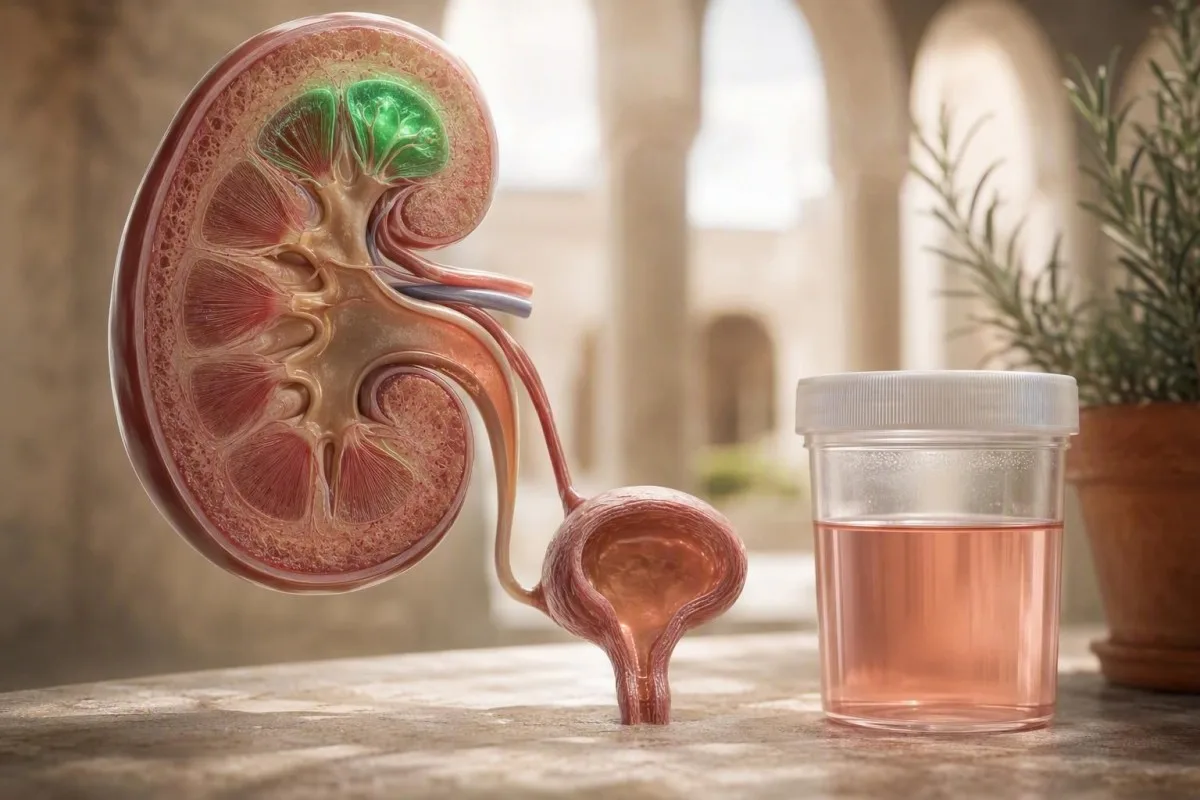
'n Rooi- of teekleurige urinemonster na 'n lang oefensessie is dikwels tydelike oefening-geïnduseerde hematurie, maar sigbare kleur moet nooit outomaties afgemaak word nie. Die tydsberekening, mikroskopiese bevindings, simptome en 'n behoorlik uitgeruste herhaalde monster vertel die ware verhaal.


- Oefening-geïnduseerde hematurie verdwyn gewoonlik binne 24–72 uur na strawwe hardloop; aanhoudendheid na 72 uur benodig mediese ondersoek.
- Mikroskopie drempel van 3 of meer rooibloedselle per hoë-krag veld in 'n behoorlik versamelde urinemonster voldoen aan die AUA-definisie van mikrohematurie.
- Dipstick wanpassing sake: 'n positiewe bloedblokkie met nul tot twee rooibloedselle per hoë-krag veld dui op mioglobien of vry hemoglobien eerder as urinale bloeding.
- Herhaaltyd is prakties: vermy strawwe oefening vir 48–72 uur, hidreer normaal, gee dan 'n middelstroom urinemonster.
- Assessering dieselfde dag is verstandig vir bloedklonte, onvermoë om urine te laat verbygaan, koors, een-sided ernstige flankpyn, of cola-kleurige urine met merkbare spierpyn.
- Nier waarskuwingspatroon is bloed plus proteïen, rooibloedsel-gietings, hoë bloeddruk, of 'n dalende eGFR—nie 'n geïsoleerde na-wedloop dipstick nie.
- Rhabdomyolysis-leidraad is disproporsioneel donker urine met ernstige spiersimptome en 'n kreatinien kinase-resultaat wat dikwels meer as 5 keer bo die laboratorium se boonste limiet is.
- Kankerrisiko-konteks verander die drempel vir ondersoek: ouderdom, rookblootstelling, vorige bestraling van die bekken, en aanhoudende sigbare hematurie is alles van belang.
Hoekom 'n oefensessie urine pienk kan laat lyk
Hardloper se hematurie is gewoonlik 'n kortstondige lek van rooibloedselle in die urine na strawwe oefening, wat dikwels binne 24–72 uur van rus opklaar. Nietemin verdien sigbare pienk, rooi of kolage-kleurige urine 'n behoorlik versamelde herhaaltoets eerder as 'n toevallige aanname dat hardloop dit veroorsaak het.
In die kliniek is die gerusstellende patroon reguit: kleurverandering begin na 'n ongewoon lang, vinnige of afdraende lopie; daar is geen koors, koliekagtige flankpyn, of urinêre brand nie; en mikroskopie normaliseer na rus. Kantesti is ’n KI-bloedtoets-analiseerder wat verwante niergrense—kreatinien, eGFR, elektroliete, en kreatinien kinase—naas die oefeninggeskiedenis kan plaas, eerder as om een na-wedstryd resultaat as 'n diagnose te behandel.
Die voorgestelde meganismes is meganiese blaaswandkontak, tydelike nierbloedvloeiverskuiwings, dehidrasie-verwante konsentrasie, en soms rooibloedselafbreking van herhalende voetstappe. Die getuienis vir elke meganisme is eerlik gemeng, omdat die meeste studies klein is en verskillende wedloopafstande gebruik. In my 15 jaar van kliniese praktyk, is die geskiedenis van 'n nuwe poging belangriker as die kleur alleen; 'n eerste ultramarathon en 'n bekende 5 km dra nie dieselfde voor-toets waarskynlikheid nie.
Sigbare bloed in urine na oefening is nie sinoniem met goedaardige hardloper se hematurie nie. A breër hematurie rooi-vlag gids is nuttig omdat nierstene, infeksie, glomulêre siekte, en urienwegkankers toevallig hulself na 'n lopie kan verklaar.
Die praktiese definisie
Oefening-geïnduseerde hematurie beteken rooibloedselle verskyn in urine kort na inspanning en verdwyn op 'n geruste herhaalsmonster. 'n Positiewe dipstick alleen bewys hierdie diagnose nie, omdat die reagens hemepigment van ongeskonde rooibloedselle, vry hemoglobien, of myoglobien opspoor.
Is dit hematurie, hemoglobien, of mioglobien?
'n Urinetoets wat positief vir bloed lees, kan rooibloedselle, hemoglobien, of myoglobien weerspieël, en mikroskopie skei dit. Pienk urine met baie ongeskonde rooibloedselle ondersteun hematurie; donkerbruin urine met min of geen rooibloedselle wek kommer oor pigment van spierbesering of hemolise.
Urinmikroskopie wat wys 3 of meer rooibloedselle per hoë-mag-veld bevestig mikrohematurie wanneer die monster skoon versamel is. Daarteenoor moet 'n sterk positiewe dipstick met 0–2 rooibloedselle per hoë-mag-veld 'n klinikus aan myoglobienurie laat dink, veral na hitteblootstelling, 'n kneusplek-tipe spierlas, of ernstige vertraagde spierpyn. Bruin of kolage-kleur is meer tipies van gekonsentreerde pigment as 'n klein hoeveelheid blaasbloeding.
Myoglobien is belangrik omdat dit gepaard kan gaan met rhabdomyolysis en akute nierbesering. 'n Kreatinien kinase-konsentrasie bo 5 keer die laboratorium se boonste normale limiet word algemeen gebruik as 'n biochemiese drempel vir rhabdomyolysis, hoewel simptome, kalium, kreatinien, en urienuitset dringendheid bepaal. Sien ons praktiese verduideliking van gevaarlik hoë kreatien kinase vir die patrone wat nie oornag hoef te wag nie.
Voedselkleursel, beet, bessies, rifampisien, fenazopiridien en dehidrasie kan ook urine kleur sonder rooi bloedselle. 'n donker urine differensiaal help om die algemene fout te vermy om aan te neem dat elke rooierige monster bloed verteenwoordig.
Hoekom die onderskeid sorg verander
Rooiseld hematurie rig aandag op die urienweg, terwyl mioglobienurie aandag rig op skeletspier en nierbeskerming. Albei kan voorkom na uithougebeure, maar slegs mikroskopie en geteikende bloedtoetse kan hulle betroubaar skei.
Hoe om 'n na-oefensessie urinale-resultaat te lees
Die mees insiggewende urinestoets na 'n rit kombineer dipstick, mikroskopie, proteïenmeting en spesifieke gravitasie. Bloed op dipstick met transient rooiselle en geen proteïen is dikwels lae risiko; bloed plus proteïen of rolletjies benodig 'n meer deurdagte nierassessering.
'n Dipstick bloedresultaat word gerapporteer as negatief, spoor, 1+, 2+, of 3+, maar dit is 'n siftingssein eerder as 'n seltelling. Die AUA definieer mikrohematurie as meer as 3 rooibloedselle per hoë-krag veld op mikroskopiese ondersoek, nie 'n dipstick resultaat alleen nie (Barocas et al., 2020). Hierdie onderskeid verhoed dat hardlopers in 'n onnodige kankerondersoek gestuur word na 'n vals-positiewe siftingsuitslag.
Spesifieke gravitasie bo 1.030 dui gekonsentreerde urine aan in baie laboratoria en kan kleur meer skrikwekkend laat lyk, maar dit verduidelik nie bevestigde rooiselle nie. Proteïen van 1+ of meer moet gekwantifiseer word met 'n urien albumin-kreatinien verhouding of proteïen-kreatinien verhouding; transient oefening proteinuria bestaan, nogtans verander aanhoudende albuminuria die differensiaal na glomeruliêre siekte. Ons volledige urinale gids verduidelik hoekom hierdie merkers nie in een resultaat saamgevoeg moet word nie.
Kantesti AI interpreteer kreatinien en eGFR saam met urienbevindinge, oefentydsberekening en vorige waardes; 'n enkele effens verhoogde kreatinien na 'n warm wedren is nie gelyk aan chroniese niersiekte nie. In die praktyk vra ek vir die afstand, terrein, temperatuur, anti-inflammatoriese gebruik, menstruele tydsberekening, en of die monster binne 2 uur na voltooiing gegee is.
Wanneer moet jy 'n urinetoets herhaal na 'n oefensessie?
Herhaal urinetoetsing 48–72 uur na die laaste strawwe hardloop is 'n sinvolle standaard vir vermoedelike hardloper se hematurie. Gebruik 'n eerste-oggend of goed-gehidreerde middelstroom monster, maar moenie dadelik liters water drink nie, want ekstreme verdunning kan nuttige bevindinge verbloem.
Vir 'n roetine-na-wedren-abnormaliteit, beveel ek gewoonlik geen intervalle, heuwels, swaar optel, of wedlope aan nie 48 uur; na 'n marathon, ultramarathon, hitte-siektes, of ongewone seerheid, 72 uur is meer verdedigbaar. Gewone drink tot dors is genoeg. Oor-hidrasie kan spesifieke swaartekrag onder 1.005 verlaag en soms 'n grenswaarde resultaat moeiliker om te interpreteer maak.
Indien mikroskopie positief bly na 72 uur, reël primêre-sorg oorsig binne dae eerder as herhaalde toetse na oefeninge. Volhardende resultate regverdig bloeddruk meting, serum kreatinien/eGFR, urine albumien-kreatinien verhouding, en oorweging van kultuur of beeldvorming volgens risiko. Die verhouding tussen inspanning, hidrasie, en 'n tydelik laer filtrasie-skatting word in ons post-oefening eGFR-gids.
'n 52-jarige ontspanningsmarathon-atleet wat ek gesien het, het 18 rooi selle per hoë-krag veld gehad die aand na 'n warm wedloop, maar 0–1 rooi selle na 72 rustige ure; sy kreatinien het teruggekeer van 1.28 mg/dL na 0.96 mg/dL. Die resultaat was gerusstellend, maar dieselfde plan sou nie genoeg wees vir 'n 52-jarige roker met herhaalde sigbare urine kleur nie.
Moenie by die eindstreep toets indien jy dit kan vermy nie
Toetsing onmiddellik na oefening maksimeer die kans om tydelike rooi selle, gekonsentreerde urine, en proteïen te vind. Dit kan klinies nuttig wees in vermoedelike rabdomiolise, maar dit is 'n swak tyd om 'n hardloper se basislyn vas te stel.
Watter na-oefensessie hematurie-patrone is gewoonlik gerusstellend?
'n Self-beperkte episode na intense hardloop is meer gerusstellend wanneer dit heeltemal opklaar, pyn of sistemiese simptome ontbreek, en geen proteïnurie of nierfunksie-verandering het nie. Gerusstellend beteken nie geïgnoreer nie; dit beteken bevestig met 'n rus-getroude monster.
Die laer-risiko fenotipe is 'n jonger of middeljarige hardloper met 'n duidelike sneller van inspanning, normale bloeddruk, geen rookgeskiedenis nie, en normale rus-getroude mikroskopie. In daardie opset, 'n enkele transiënte resultaat van 3–10 RBC/HPF na 'n wedloop word dikwels sonder behandeling opgelos. Ek sou dit steeds dokumenteer, want herhaling na elke lang lopie verdien 'n noukeuriger oorsig as 'n eenmalige gebeurtenis.
'n Normale urine albumien-kreatinien verhouding is oor die algemeen onder 30 mg/g (onder 3 mg/mmol), hoewel laboratoria en lande eenhede anders rapporteer. Bloed sonder albumien, silinders, of dismorfe rooi selle wys weg van glumerulêre lekkasie; dit bewys nie 'n blaasbron nie, maar dit lei die volgende vraag. Ons verduideliking van proteïen in urine dekking van hierdie afdeling duidelik.
Blaas trauma is meer waarskynlik wanneer urine baie gekonsentreerd is en die hardloper met 'n byna leë blaas eindig. Sommige sportklinici stel voor om voor 'n lang lopie te urineer en gereeld te drink, maar dit is voorkomingsadvies met beperkte proefbewyse – nie 'n plaasvervanger vir evaluasie wanneer kleur voortduur nie.
'n Normale resultaat het 'n tydstempel
'n Negatiewe toets 3 dae na 'n wedloop is gerusstellend vir daardie episode, nie 'n lewenslange waarborg nie. Nuwe sigbare hematuria maande later moet op sy eie meriete beoordeel word, veral na ouderdom 40 of met rookblootstelling.
Waarskuwingstekens wat hardloper se hematurie minder waarskynlik maak
Hematuria benodig dringende evaluasie wanneer dit na 72 uur voortduur, herhaal sonder strawwe oefening, of voorkom met pyn, koors, klonte, proteïen, of nierfunksie verandering. Die kombinasie van bevindings is meer insiggewend as 'n dramatiese monster op sigself.
Soek tydige mediese advies vir sigbare rooi urine wat langer as , stop hoë dosis, duur, selfs al voel jy goed; die drempel is laer vir mense ouer as 40, huidige of voormalige rokers, of diegene met vorige bekkenbestraling. Die AUA-riglyn gebruik risikostratifikasie gebaseer op ouderdom, rook, graad en volharding van mikroskopiese bloed, en vorige growwe hematuria eerder as om alle mikrohematuria identies te behandel (Barocas et al., 2020).
Dismorfiese rooibloedselle, rooibloedsel-rolletjies, beduidende albuminurie, nuwe hipertensie, of 'n verminderde eGFR dui op 'n nierfilterbron eerder as 'n geskudde blaas. Rooibloedsel-rolletjies is nooit 'n verwagte gevolg van gewone hardloop nie en moet versnelde nierbeoordeling aanvra. Sien ons oorsig van korrel- en urienrolletjies vir waarom sedimentbevindinge saak maak.
Thomas Klein, MD, raai hardlopers aan om nie self te triage met kleur alleen nie: 'n urienweginfeksie kan brand, dringendheid, pyurie, en soms hematuria veroorsaak, terwyl klippe meer dikwels skielike enkelsydige pyn en naarheid veroorsaak. 'n Kultuur is die nuttigste voor antibiotika wanneer infeksie simptome teenwoordig is.
Die bloed-plus-proteïen kombinasie
Gekonstateerde hematuria met proteinurie is meer kommerwekkend as geïsoleerde hematuria omdat albei by die glomerulusfilter kan ontstaan. 'n Urine albumin-kreatinien verhouding van 30 mg/g of hoër moet herhaal word en geïnterpreteer word met bloeddruk en nierfunksie.
Wanneer benodig pienk urine na oefening sorg op dieselfde dag?
Kry dieselfde dag dringende beoordeling vir klonte, onvermoë om te urineer, ernstige flankpyn, koors, flouheid, verminderde urine-uitset, of donker urine met ernstige spierpyn en swakheid. Hierdie kenmerke dui verder as onkompliseerde oefening-geïnduseerde hematuria.
Klonte kan urinêre vloei belemmer, en onvermoë om urine te laat loop is 'n dringende probleem ongeag atletiese fiksheid. Koors van 38.0°C of hoër met flankpyn kan 'n boonste urienweginfeksie aandui; ernstige koliekpyn met braking kan 'n klip aandui. Geen van hierdie situasies moet bestuur word deur te wag vir 'n post-lopie herhalingstoets nie.
Donkerbruin urine na inspanning plus merkbare spierongemak, swakheid, swelling, of verminderde uitset wek kommer vir rabdomiolise. Aanvanklike toetsing sluit gewoonlik kreatienkinase, kreatinien, kalium, kalsium, fosfaat, en urinaleise in. 'n CrossFit-rabdomiolise-gids is relevant omdat ongewone eksentrieke oefening—nie net hardloop nie—’n algemene sneller is.
Ernstige dehidrasie kan nieruitslae erger laat lyk, maar dit kan ook werklike besering wees. As jy duiselig, verward is, nie vloeistof kan binnehou nie, of baie min urineer vir 8–12 uur, moenie probeer om die probleem tuis met sportdrankies op te los nie.
Swangerskap en antikoagulante
Swanger hardlopers en mense wat antikoagulante gebruik, moet sigbare hematurie onmiddellik aanmeld. Antikoagulante kan bloeding versterk, maar verwyder nie die behoefte om die bron daarvan te identifiseer nie; swangerskap verander ook die drempel vir die ondersoek na infeksie, klippe en niersiekte.
Toestande wat 'n oefensessie kan openbaar eerder as veroorsaak
Hardloop kan ’n bestaande urinêre probleem blootlê deur urine te konsentreer of ’n toets aan te vra, eerder as om die hematurie self te veroorsaak. Klippe, infeksie, glomerulus siekte, strukturele abnormaliteite, en maligniteit bly deel van die differensiaaldiagnose.
Nierklippe veroorsaak dikwels unilaterale pyn van die flank na die lies, naarheid, en rooibloedselle op mikroskopie, hoewel pynlose klippe voorkom. Urinêre infeksie veroorsaak meer dikwels brand, gereelde urinering, drang, en witbloedselle; ’n negatiewe nitrietuitslag sluit dit nie uit nie. Ons gids oor leukosiet esterase met negatiewe nitriet verduidelik hierdie algemene gemengde patroon.
Glomerulonefritis kan voorkom na ’n boonste-respiratoriese infeksie met koladrankie-urine, swelling, verhoogde bloeddruk, proteinuria, en dismorfe rooibloedselle. In die KDIGO 2024 CKD riglyn word volgehoue albuminuria en verminderde eGFR behandel as aanvullende nierrisiko-merkers, nie uitruilbare metings nie (KDIGO, 2024).
Kantesti is ’n AI-aangedrewe bloedtoets-analisehulpmiddel wat gebruikers help om ’n patroon oor kreatinien, eGFR, albumin, elektroliete, en ’n CBC te herken, maar dit kan nie die anatomiese bron van hematurie diagnoseer nie. Beelding, mikroskopie, kweek, en kliniese ondersoek doen steeds die deurslaggewende werk.
Kanker is ongewoon by jong hardlopers, nie onmoontlik by volwassenes nie
Sigbare hematurie regverdig evaluasie selfs wanneer oefening ’n voor die hand liggende verduideliking blyk te wees, veral by mense met rookblootstelling of aanhoudende simptome. Risiko neem toe met ouderdom en kumulatiewe tabakblootstelling, daarom lei identiese urinêre resultate nie tot identiese toetsplanne nie.
Wie benodig urologie of nefrologie opvolg?
Aanhoudende hematurie na ’n rus-herhaalmonster moet risikobeoordeel word vir urologie, terwyl hematurie plus proteinuria, silinders, hipertensie, of verswakte eGFR na nefrologie wys. Baie mense benodig slegs herhalende toetse onder primêre sorgleiding; verwysing hang af van die patroon.
Urologiese evaluasie is veral geskik vir herhalende sigbare hematurie, aanhoudende mikroskopiese hematurie, ’n geskiedenis van rook, beroeps blootstelling aan aromatiese amiene, vorige bekken bestraling, of urienwegsimptome sonder infeksie. Afhangende van risiko, kan klinici nier- en blaas ultraklank, CT urographie, en sistoskopie gebruik. ’n Enkel naloop-spoorslag dipstick by ’n 24-jarige is ’n heel ander scenario as herhalende rooi urine by ’n 58-jarige voormalige roker.
Nefrologiese oorsig word meer waarskynlik met urine albumin-kreatinien verhouding ≥30 mg/g, eGFR onder 60 mL/min/1.73 m² wat 3 maande of langer duur, rooibloedsel silinders, of hoë bloeddruk wat moeilik beheerbaar is. Hierdie afsnypunte is belangrik omdat chroniese niersiekte gedefinieer word deur duur asook ’n enkele meting. Lees ons chroniese niersiekte stadiums-gids vir die praktiese kategorieë.
Kantesti se KI-laboratoriumtoetstolkingsdiens kan 'n herhaalbare bloed- en proteïenpatroon vir bespreking aandui, veral wanneer gebruikers resultate van verskillende laboratoriums oplaai. Dit moet 'n klinikus wat besluit of urinetoetse of spesialisondersoek nodig is, ondersteun, nie vervang nie.
Moenie toelaat dat antikoagulasie die gesprek beëindig nie.
Gebruik van antikoagulante verander bloeding swaarheid, maar bepaal nie 'n oorsaak vir hematurie nie. Na my ondervinding kan die toeskryf van herhalende bloed in die urine aan apiksaban, warfarien, of aspirien sonder 'n werk-op vertragings in die erkenning van klippe, infeksie, of strukturele siektes veroorsaak.
Watter bloedtoetse help na oefening-verwante hematurie?
Die nuttige bloedtoetse hang af van simptome: kreatinien, eGFR, elektroliete, en kreatien kinase assesseer nier- en spierstress, terwyl 'n CBC anemie of infeksie leidrade evalueer. Roetine breë panele is minder nuttig as geteikende toetsing na 'n presiese geskiedenis en urinale ontleding.
Kreatinien kan tydelik styg na uithouvermoë oefening weens spier metabolisme, verminderde nierperfusie, en dehidrasie. eGFR vergelykings is minder betroubaar tydens vinnige kreatinien verandering, daarom is 'n herhalende waarde na 48–72 uur van gewone herstel dikwels betekenisvoller as 'n eindlyn resultaat. Ons oefening-verwante kreatinien herkontrole gids gee konteks vir hierdie gereelde angs-sneller.
Kreatien kinase het 'n wye post-oefening reeks: opgeleide atlete kan verhogings na 'n wedloop toon sonder nierskade, terwyl waardes vele male bo die plaaslike boonste limiet plus simptome dringende assessering verdien. Kalium bo 6.0 mmol/L is potensieel gevaarlik en vereis dringende kliniese evaluasie, veral as nierfunksie benadeel is of spierbesering vermoed word.
'n CBC is die nuttigste wanneer daar moegheid, bleekheid, swaar menstruele bloeding, herhalende hematurie, of bekommernis oor sistemiese siekte is. Hemoglobien kan daal na uithouvermoë gebeurtenisse van plasma-volume uitsetting, ysterverlies, of hemolise; ferritien moet weg van akute inflammasie en harde oefening geïnterpreteer word. Uithouvermoë hardlopers mag ons atleet bloedtoets oorsig nuttig vind vir 'n sinvolle basislyn.
Moenie niersiekte van een wedren-week paneel diagnoseer nie.
'n Kreatinien styging van 0.3 mg/dL of meer kan aan 'n akute nierbesering kriteria voldoen in die regte tydraamwerk, maar konteks en herhalende toetsing is deurslaggewend na 'n wedloop. Lae urine-uitset, stygende kalium, en aanhoudende verhoging dra meer gewig as 'n geïsoleerde grenslyn resultaat.
Hoe om 'n herhaalde urinemonster te versamel wat dokters kan vertrou
'n Skoon-vang middellopende urinemonster na 48–72 uur sonder strawwe oefening is die beste manier om te kyk of hematurie opgelos het. Versamelingsfoute, menstruele kontaminasie, en 'n ou monster kan misleidende resultate skep.
Was hande, begin urineer in die toilet, versamel dan die middellopende gedeelte sonder om die binnekant van die houer aan te raak. Lewer die monster vinnig af – ideaal binne 2 uur—of volg die laboratorium se verkoelingsinstruksies. Langdurige staan verander sel voorkoms en kan mikroskopie minder betroubaar maak.
Vermy toetsing tydens aktiewe menstruasie waar moontlik; as toetsing nie kan wag nie, vertel die klinikus en laboratorium. Vaginale kontaminasie kan sigbare rooi bloedselle en proteïen produseer, terwyl skubberige epiteelselle dikwels 'n swak versamelde monster aandui. Ons gids na epiteelselle in urine verduidelik waarom dit nie 'n triviale laboratoriumvoetskrif is nie.
Thomas Klein, MD, beveel aan om vier besonderhede saam met die monster aan te teken: die laaste strawwe oefening, die duur van die gebeurtenis, die buitetemperatuur en alle medisyne wat in die vorige 72 uur geneem is. 'n Resultaat sonder tydsberekening is baie moeiliker om te interpreteer - veral wanneer die urine na 'n dubbele oefensessie versamel word.
Eersteoggend versus dagtoetse
'n Eerste-oggendmonster is gekonsentreerd en goed vir die opsporing van klein abnormaliteite, maar 'n normaal gehidreerde dagstroommonster is aanvaarbaar as die versameling skoner is. Konsekwentheid is belangriker vir reeksvergelyking: gebruik ongeveer dieselfde toestande by elke herhaling.
Hidrasie, pynmedikasie, en aanvullings wat die prentjie verander
Dehidrasie kan urine konsentreer en renale stres verhoog, terwyl NSAID's nierbloedvloei tydens uithouvermoë oefening kan verminder. Geen van hierdie faktore bewys die oorsaak van hematurie nie, maar albei beïnvloed hoe versigtig klinici 'n post-looptoglobin interpretteer.
Vir die meeste hardlopers is drink tot dors en die geleidelike vervanging van verliese veiliger as om vloeistowwe styf af te dwing. Baie lae natrium van oormatige waterinname kan gevaarlik wees; serum natrium onder 125 mmol/L met hoofpyn, braking, verwarring of aanvalle is 'n noodgeval. Urinkleur is 'n growwe hidrasie-aanwyser, nie 'n presiese hidrasiemeter nie.
Ibuprofen, naproxen en ander NSAID's kan prostaglandien-gemedieerde nierbloedvloei verminder, veral tydens hitte stres, braking of lang gebeurtenisse. Ek adviseer pasiënte om roetine profilaktiese NSAID's voor marathons te vermy, tensy hul eie klinikus 'n duidelike rede gegee het. Die medikasie konteks word ondersoek in ons laboratorium tendense veiligheidsartikel.
Hoë-dosis vitamien C kan inmeng met sekere urinetoetspapiere reaksies, en aanvullings wat vir prestasie bemark word, bevat soms onvermelde stimulante of diuretika. Bring die houers of duidelike foto's na 'n afspraak; dit is dikwels nuttiger as om te probeer om die bestanddeellys van 'n handelsmerkpoeier te onthou. Ons aanvullings veiligheidsgids vir atlete bied 'n sinvolle kontrolelys.
Hidrasie is nie 'n behandeling vir aanhoudende bloed nie
Water mag konsentrasie regstel, maar dit behandel nie 'n klip, infeksie, glomulêre proses of strukturele urinêre bron nie. As rooibloedselle op 'n uitgeruste, goed-versamel monster bly, moet opgradering gebaseer word op die patroon eerder as nog 'n hidrasie eksperiment.
Kan jy aanhou hardloop na oefening-geïnduseerde hematurie?
Die meeste hardlopers kan geleidelik terugkeer sodra urinkleur genormaliseer het, simptome afwesig is, en 'n uitgeruste herhalingsmonster gerusstellend is. Keer nie terug na strawwe opleiding terwyl urine sigbaar rooi bly, nierresultate abnormaal is, of spiersimptome rabdomiolise suggereer nie.
Na 'n ongekompliseerde enkele episode, stel ek gewoonlik net maklike draf vir 'n paar dae voor, dan 'n geleidelike herbou van volume en intensiteit oor 7–14 dae. Die hardloper moet stop en mediese advies inwin as kleur weer voorkom, pyn ontwikkel, of urine-uitset daal. Dit is 'n pragmatiese kliniese benadering, nie 'n proefbewese voorskrif nie.
Herhaalde hematurie na dieselfde afstand mag praktiese eksperimente regverdig: vermy om gedehidreerd te jaag, urineer voor 'n lang draf, stel afdraande opleiding stadiger bekend, en ondersoek skoene of terrein. Hou 'n logboek van pas, hitte, duur, urinkleur en monsterresultate. 'n marathonhardloper laboratoriumgids kan help om herstelmerkers te onderskei van redes om opleiding te onderbreek.
Moenie deur onverklaarbare sigbare hematuria oefen bloot omdat jy 'n geleentheid geskeduleer het nie. Atlete is dikwels uitstekend om ongemak te duld; die moeiliker vaardigheid is om te erken dat volharding diagnostiese inligting is, nie 'n taaiheidstoets nie.
Bou 'n ware basislyn
'n Basislyn urinale en nierpaneel wat ten minste 72 uur van strawwe oefening geneem is, kan toekomstige uitslae na die wedloop baie makliker maak om te interpreteer. Dit is veral nuttig vir ultralopers, mense met een nier, of atlete wat medisyne gebruik wat nierperfusie beïnvloed.
Wat om aan jou klinikus te vertel oor bloed in urine na oefening
Die vinnigste roete na 'n bruikbare hematuria-beoordeling is 'n bondige tydlyn: urinêre kleur, oefendosis, simptome, medisyne en herhaaltoets-tydsberekening. Bring werklike laboratoriumwaardes eerder as net “n boodskap dat die monster ”positief vir bloed" was.”
Gee aan of die urine pienk, helderrooi, tee-kleurig was, of bloedklonte bevat het; of kleur verskyn het voor, tydens, of na oefening; en of dit na die eerste urinering verdwyn het. Sluit in brand, dringendheid, koors, flankpyn, naarheid, swelling, en verminderde urienuitset. 'n Gedetailleerde urinêre kleur verwysing kan help om die waarneming akkuraat te beskryf sonder om dit te veel te interpreteer.
Bring vorige urinale, kreatinien/eGFR waardes, bloeddruklesings, rookgeskiedenis, familie niergeskiedenis, en 'n lys van medikasie/aanvullings. Kantesti is ’n AI-biomerk-interpretasieplatform wat herhaalde bloedtoetswaardes kan organiseer en betekenisvolle veranderinge kan uitlig, maar 'n klinikus moet daardie waardes met urienmikroskopie en -ondersoek verbind.
Vanaf 3 September 2026 bly die kliniese beginsel eenvoudig: oefening is 'n geloofwaardige verduideliking slegs nadat die resultaat opklaar en kompeterende leidrade afwesig is. As jy onseker is, vra of jy mikroskopie, kultuur, albumin-kreatinien-verhouding, herhaalde kreatinien, beeldvorming, of verwysing benodig—nie net nog 'n dipstick nie.
Vrae wat die moeite werd is om te vra
Vra of heel rooi bloedselle gesien is, of proteïen of silinders teenwoordig was, en wanneer 'n herhaling na rus moet plaasvind. Daardie drie antwoorde verduidelik gewoonlik of die volgende stap waaksaam opvolg, nier toetsing, infeksie toetsing, of 'n urologiese evaluering is.
'n Verstandige aksieplan vir hardloper se hematurie
Vir een pynlose episode na strawwe hardloop, rus van strawwe oefening vir 48–72 uur en herhaal 'n skoon-vang urinale; soek vroeër sorg vir rooi vlae of aanhoudende sigbare kleur. Die doel is nóg paniek nóg afwysing—dit is om te bewys dat die bevinding opklaar.
Stap een: stop strawwe oefening, hidreer normaal, en let op die tydsberekening en simptome. Stap twee: herhaal mikroskopie na 48–72 uur. Stap drie: as bloed voortduur, of as proteïen, silinders, pyn, koors, bloedklonte, lae urienuitset, of abnormale nier aanwysers verskyn, reël mediese beoordeling onmiddellik. Hierdie volgorde verhoed beide gemiste siekte en onnodige beeldvorming na 'n eenmalige eindlynmonster.
Wanneer ons kliniese span opgelaaide laboratoriumdata hersien, prioritiseer ons patrone: 'n stygende kreatinien plus hoë CK en lae urienuitset is dringender as 'n stabiele kreatinien met 'n verbygaande urine dipstick. Kantesti se metodologie en beskerming word in ons kliniese geldigheidsinligting, beskryf, en ons dokter toesig word in die Mediese Adviesraad.
uiteengesit. Die meeste pasiënte vind dat 'n herhaalde toets 'n ontstellende kleurverandering omskep in 'n duidelike plan. Maar as jou instink sê iets is verkeerd—veral as die urine môre nog rooi is—vertrou daardie sein en laat jouself beoordeel.
Die een-sin reël
Pienk urine een keer na 'n strawwe hardloop mag verbygaand wees; pienk urine wat voortduur, terugkeer, of voorkom met simptome is hematuria totdat dit behoorlik geëvalueer is.
Gereelde vrae
Hoe lank duur runner se hematurie?
Hematurie by hardlopers verdwyn algemeen binne 24–72 uur nadat strawwe oefening gestaak is. 'n Praktiese herhaalde urinetoets is 'n skoon-vangs, middelstroommonster wat versamel word na 48–72 uur sonder strawwe hardloop of swaar optel. Aanhoudende sigbare pienk of rooi urine na 24 uur, of mikroskopiese hematurie wat na 72 uur bly, moet deur 'n klinikus geassesseer word. Koors, bloedklonte, erge flankpyn, verminderde urienuitset, of erge spierpyn regverdig dieselfde dag assessering.
Is bloed in urine na oefening normaal?
Bloed in urine na oefening kan 'n kortstondige effek wees van strawwe hardloop, dehidrasie, blaaswandimpak, of korttermyn nierbloedvloeiveranderinge, maar dit is nie outomaties normaal nie. Mikroskopie wat 3 of meer rooibloedselle per hoë-kragveld bevestig, voldoen aan die AUA-definisie van mikrohematurie. 'n Resultaat wat verdwyn op 'n herhaalde monster na rus is gerusstellend, terwyl aanhoudende bloed, proteïen, silinders, pyn, of urinêre simptome verdere evaluering vereis. Sigbare urinêre kleur moet altyd gerapporteer word, veral by volwassenes met blootstelling aan rook of herhalende episodes.
Kan dehidrasie pienk urine veroorsaak na hardloop?
Dehidrasie kan urine donkerder laat lyk en 'n post-oefening hematurie-bevinding versterk deur urinêre inhoud te konsentreer, maar dehidrasie alleen verduidelik nie betroubaar bevestigde rooibloedselle nie. 'n Urine spesifieke swaartekrag bo 1.030 dui dikwels gekonsentreerde urine aan in baie laboratoriums. Drink normaal tot dors en herhaal 'n skoon-vangmonster na 48–72 uur rus eerder as om te probeer om die resultaat weg te spoel met oormatige water. Erge dors, duiseligheid, baie lae urine-uitset, of verwarring benodig dringende mediese oorsig.
Wat is die verskil tussen hematuria en myoglobinuria na oefening?
Hematurie beteken dat heel rooibloedselle in die urine teenwoordig is, terwyl mioglobienurie spierpigment weerspieël wat vrygestel word na spierbesering. 'n Dipstick kan positief wees vir bloed in beide situasies, so mikroskopie is deurslaggewend: mioglobienurie lewer dikwels 'n positiewe dipstick met 0–2 rooibloedselle per hoë-kragsveld. Erge spierpyn, swakheid, swelling, donker koladruiwe urine, of 'n kreatien kinase waarde bo 5 keer die laboratorium se boonste limiet verhoog kommer oor rabdomiolise. Daardie patroon benodig dringende kliniese assessering omdat kalium en nierfunksie vinnig kan verander.
Moet ek ophou hardloop as ek oefening-geïnduseerde hematurie het?
Hou op met strawwe hardloop totdat die urinekleur genormaliseer het en jy 'n uitgeruste herhalingstoets voltooi het, gewoonlik na 48–72 uur. Indien die herhaalde monster normaal is en jy geen pyn, koors, bloedklonte, proteinuria, of nierfunksie-abnormaliteit het nie, kan die meeste hardlopers geleidelik oor ongeveer 7–14 dae hervat. Moenie intense oefening hervat wanneer urine sigbaar rooi of donker bly, urineproduksie verminder is, of ernstige spiersimptome teenwoordig is nie. Herhalende episodes na soortgelyke oefensessies verdien mediese oorsig, selfs al los elke episode op.
Wanneer benodig hematurie 'n uroloog?
Persisterende mikroskopiese hematurie na 'n geruste herhaalde monster, herhaaldelike sigbare hematurie, of hematurie by 'n persoon met 'n rookgeskiedenis, vorige bekkenbestraling, of urinêre simptome regverdig dikwels 'n urologiese risiko-assesserings. Uroloë kan ultraklank, CT urografie, en sistoskopie oorweeg, afhangende van ouderdom en algehele risiko eerder as om een toets vir almal te gebruik. Hematurie met albuminurie van 30 mg/g of meer, rooibloedselgietings, hipertensie, of eGFR onder 60 mL/min/1.73 m² dui sterker op nefrologie. Die korrekte spesialiteit hang af van die volledige urine- en bloedtoetspatroon.
Kry vandag KI-aangedrewe bloedtoets-analise
Sluit aan by meer as 2 miljoen gebruikers wêreldwyd wat Kantesti vertrou vir onmiddellike, akkurate laboratoriumtoetsanalise. Laai jou bloedtoetsresultate op en ontvang omvattende interpretasie van 15,000+-biomerkers binne sekondes.
📚 Verwysde navorsingspublikasies
Klein, T., Mitchell, S., & Weber, H. (2026). Meertalige KI-gesteunde Kliniese Besluitondersteuning vir Vroeë Hantavirus Triage: Ontwerp, Ingenieursvalidering en Real-World Implementering oor 50,000 Geïnterpreteerde Bloedtoetsverslae. Kantesti KI Mediese Navorsing.
Klein, T., Mitchell, S., & Weber, H. (2026). ’n Vooraf-geregistreerde, Rubriek-gebaseerde Outomatiese Tegniese Benchmark van die Kantesti Bloedtoets-Interpretasie-enjin op 100 000 Sintetiese Toetsgevalle. Kantesti KI Mediese Navorsing.
📖 Eksterne mediese verwysings
⚕️ Mediese Vrywaring
Hierdie artikel is slegs vir opvoedkundige doeleindes en vorm nie mediese advies nie. Raadpleeg altyd ’n gekwalifiseerde gesondheidsorgverskaffer vir besluite oor diagnose en behandeling.
E-E-A-T Vertrouenseine
Ervaring
Kliniese oorsig gelei deur ’n geneesheer van laboratorium-interpretasie-werksvloei.
Kundigheid
Laboratoriumgeneeskunde fokus op hoe biomerkers in ’n kliniese konteks optree.
Gesagsvermoë
Geskryf deur dr. Thomas Klein met hersiening deur dr. Sarah Mitchell en prof. dr. Hans Weber.
Betroubaarheid
Bewysgebaseerde interpretasie met duidelike opvolgpaaie om alarm te verminder.