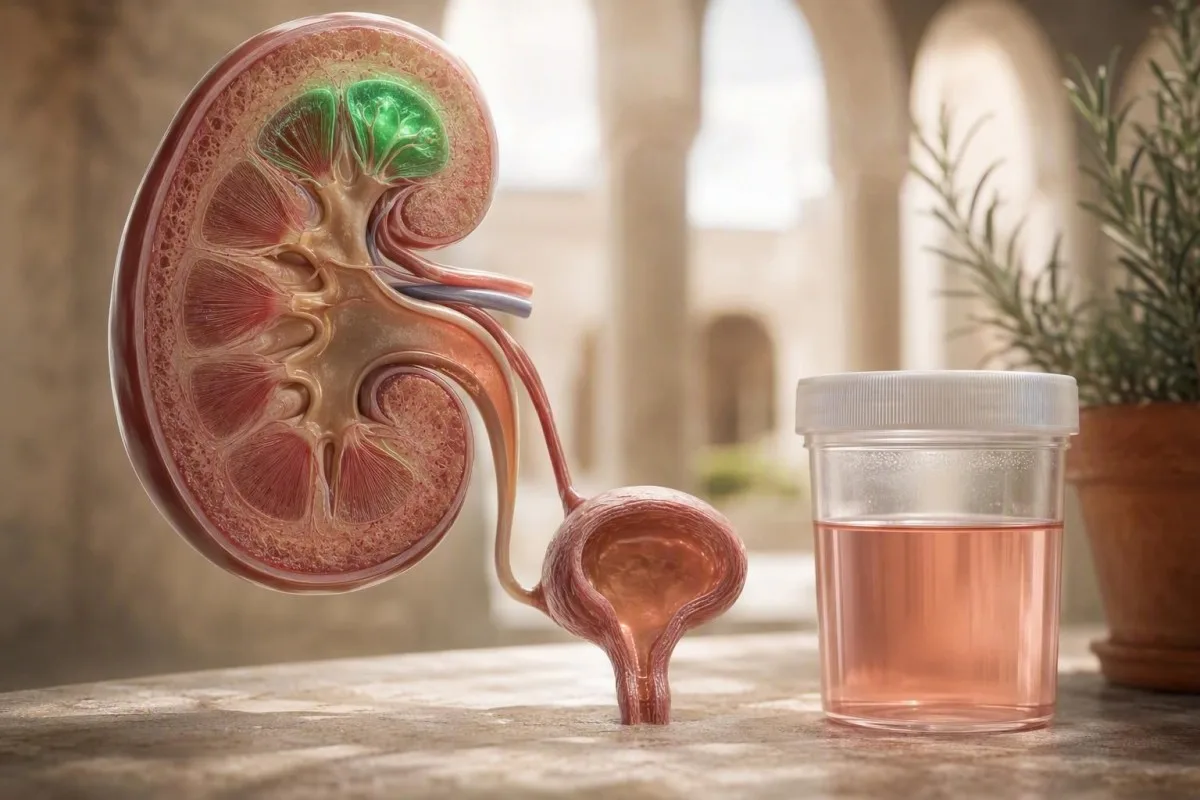
Is e sample deòth-dathach no deòth-tì, às dèidh ruith fhada, gu tric na hematuria sealach a dh’ adhbharaich eacarsaich, ach cha bu chòir dath faicsinneach a bhith air a dhi-chuimhneachadh gu bràth. Tha an ùine, na nithean a chithear fon mhiocroscop, na comharran, agus sampall ath-aithris, a tha air fois mhath a ghabhail, ag innse na fìor sgeòil.


- Ce: Fuil anns an fhualanas a tha air a bhrosnachadh le eacarsaich mar as trice a’ falbh taobh a-staigh 24–72 uairean às dèidh ruith chruaidh; feumar sgrùdadh meidigeach air mairsinneachd nas fhaide na 72 uairean.
- Stair a’ mhicrisgopaidh de 3 no barrachd cheallan fala dearga gach raon àrd-chumhachd ann an sampall fual a chaidh a chruinneachadh gu ceart a’ coinneachadh ri mìneachadh AUA air microhematuria.
- Measgachadh dipstick tha cudromach: tha pada fala deimhinneach le neoni gu dà chealla fala dearg gach raon àrd-chumhachd a’ nochdadh myoglobin no hemoglobin an-asgaidh seach fuil anns an t-slighe urinary.
- Ath-aithris air an àm tha practaigeach: seachain cruaidh-eacarsaich airson 48–72 uairean, hydrated gu h-àbhaisteach, an uairsin thoir seachad sampall fual meadhan-shruth.
- Measadh an aon latha tha ciallach airson cnapan, neo-chomas fual a chuir a-mach, fiabhras, pian mòr ann an aon taobh den taobh, no fual cola le pian mòr anns na fèithean.
- Pàtran rabhaidh nan dubhagan tha fuil a bharrachd air pròtain, tilgeadh cheallan fala dearga, bruthadh-fala àrd, no a’ tuiteam eGFR—chan e dipstick post-ruith dìreach.
- Clàr-amaich rhabdomyolysis tha fual gu math dorcha le fìor dhroch samhlaidhean fèithe agus toradh creatine kinase gu tric nas àirde na 5 tursan an crìoch àrd obair-lann.
- Co-theacs cunnart aillse ag atharrachadh an stairsich airson sgrùdadh: aois, nochdadh smocaidh, rèididheachd pelvic roimhe, agus hematuria faicsinneach leantainneach uile cudromach.
Carson a dh’ fhaodadh ruith a thoirt air fual nochdadh pinc
Tha hematuria ruitheadair mar as trice a’ sgìth de cheallan dearg a-steach do fual às dèidh eacarsaich làidir, gu tric a’ faighinn seachad air taobh a-staigh 24–72 uairean de fois. Ach, tha fual pinc, dearg, no dathte cola faicsinneach airidh air deuchainn ath-chruinnichte gu ceart seach beachd casual gur e ruith adhbharachadh.
Ann an clionaig, tha am pàtran comhfhurtail sìmplidh: bidh atharrachadh dath a’ tòiseachadh às dèidh ruith neònach fada, luath, no sìos cnoc; chan eil fiabhras, pian dubhaig colicky, no losgadh urinary ann; agus bidh microscopy a’ normalachadh às dèidh fois. Kantesti ’s e anailisiche deuchainn fala AI a th’ ann a dh’ fhaodadh comharran dubhaig co-cheangailte a chuir - creatinine, eGFR, electrolytes, agus creatine kinase - ri taobh eachdraidh eacarsaich, an àite a bhith a’ làimhseachadh aon toradh às dèidh rèis mar dhearbhadh.
Is e na pròiseasan a tha air am moladh conaltradh ball-dheug meacanaigeach, atharrachaidhean sealach ann an sruthadh fala dubhaig, dùmhlachd co-cheangailte ri dìth uisge, agus uaireannan briseadh cealla dearg bho bhriseadh cas ath-aithris. Tha an fianais airson gach pròiseas measgaichte gu onarach, oir tha a’ mhòr-chuid de sgrùdaidhean beag agus a’ cleachdadh astaran rèis eadar-dhealaichte. Anns na 15 bliadhna agam de chleachdadh clionaigeach, tha eachdraidh oidhirp ùr nas cudromaiche na an dath a-mhàin; chan eil a’ chiad ultramarathon agus 5 km eòlach a’ giùlan an aon dùil ro-dheuchainn.
Chan eil fuil faicsinneach ann am fual às dèidh eacarsaich co-ionann ri hematuria ruitheadair gun chron. A stiùireadh nas fharsainge de chomharran hematuria tha e feumail oir faodaidh clachan dubhaig, galar, galar glomerular, agus aillsean slighe urinary a’ chiad uair nochdadh às dèidh ruith.
An mìneachadh practaigeach
Tha hematuria air a bhrosnachadh le eacarsaich a’ ciallachadh gu bheil ceallan dearga a’ nochdadh ann am fual goirid às dèidh oidhirp agus a’ dol à bith air sampall ath-dheuchainn fois. Chan eil dipstick deimhinneach a-mhàin a’ dearbhadh an dearbhadh seo, oir tha an reagent a’ lorg pigment heme bho cheallan dearga slàn, hemoglobin an-asgaidh, no myoglobin.
A bheil e na hematuria, hemoglobin, no myoglobin?
Faodaidh dipstick fual a leughas deimhinneach airson fuil a bhith a’ nochdadh cheallan dearga, hemoglobin, no myoglobin, agus bidh microscopy gan sgaradh. Tha fual pinc le mòran cheallan dearga slàn a’ toirt taic do hematuria; tha fual donn dorcha le beagan no gun cheallan dearga a’ togail dragh airson pigment bho leòn fèithe no hemolysis.
Microscopy fual a’ sealltainn 3 no barrachd cheallan fola dearga gach raon àrd-chumhachd a’ dearbhadh microhematuria nuair a tha an sampall air a chruinneachadh gu glan. Air an làimh eile, bu chòir do dipstick làidir deimhinneach le 0–2 ceallan dearga gach raon àrd-chumhachd toirt air neach-clionaigeach myoglobinuria a mheas, gu sònraichte às dèidh nochdadh teas, luchd fèithe den t-seòrsa brisidh, no pian fèitheil air a chuir dheth gu dona. Tha dath donn no cola nas typiceil de pigment dùmhail na beag de shileadh bladder.
Tha myoglobin cudromach oir faodaidh e a bhith còmhla ri rhabdomyolysis agus tràilleachd dubhaig. Tha dùmhlachd creatine kinase nas àirde na 5 tursan an crìoch àrd obair-lann de normal air a chleachdadh gu cumanta mar stairsnich biochemical airson rhabdomyolysis, ged a tha samhlaidhean, potasium, creatinine, agus toradh fual a’ dearbhadh èiginn. Faic ar mìneachadh practaigeach de creatine kinase a bhaigh a tha cunnartach àrd airson na pàtranan nach bu chòir feitheamh tron oidhche.
Faodaidh dathan bìdh, biatas, dubhagan, rifampicin, phenazopyridine, agus dìth uisge cuideachd dath a thoirt air fual às aonais cheallan dearga. A dealbh-dhealachaidh fual dorcha a chuidicheas le bhith a' seachnadh a' mhearachd chumanta a bhith a' gabhail ris gu bheil a h-uile sampall dearg a' riochdachadh fuil.
Carson a dh'atharraicheas an eadar-dhealachadh cùram
Tha hematuria cheallan dearga a' stiùireadh aire gu slighe an t-siùcair, fhad 'sa tha myoglobinuria a' stiùireadh aire gu fèith chnàimh agus dìon dubhaig. Faodaidh an dà chuid tachairt às dèidh thachartasan cruaidh, ach dìreach gluasad-sgrion agus obair fala a chaidh a shònrachadh urrainn an rèiteachadh gu earbsach.
Mar a leughas tu toradh sgrùdaidh fual às dèidh ruith
An deuchainn fual as fiosrachail às dèidh ruith còmhla dipstick, gluasad-sgrion, tomhas pròtain, agus dùmhlachd sònraichte. Tha fuil air dipstick le ceallan dearga sealach agus gun phròtain gu tric a' ciallachadh cunnart ìseal; feumaidh fuil a bharrachd air pròtain no tilgeadh measadh dubhaig nas miosa.
Thathas ag aithris air toradh fala dipstick mar àicheil, lorg, 1+, 2+, no 3+, ach tha e na chomharra sgrìonaidh seach cunntas cheall. Tha an AUA a' mìneachadh microhematuria mar barrachd air 3 ceallan fala dearga gach raon àrd-chumhachd air sgrùdadh gluasadach, chan e toradh dipstick a-mhàin (Barocas et al., 2020). Tha an t-eadar-dhealachadh seo a' cur stad air ruith a chuir ann an obair aillse neo-riatanach às dèidh sgrìonadh ceàrr-dhearbhach.
dùmhlachd sònraichte os cionn 1.030 a' comharrachadh fual dùmhail ann am mòran obair-lann agus faodaidh e dath a dhèanamh nas eagallach, ach chan eil e a' mìneachadh cheallan dearga dearbhte. Bu chòir pròtain de 1+ no nas motha a bhith air a thomhas le co-mheas albumin-creatinine fual no co-mheas pròtain-creatinine; tha proteinuria eacarsaich sealach ann, ach tha albuminuria leantainneach ag atharrachadh an sgaradh a dh'ionnsaigh galar glomerular. Tha ar stiùireadh iomlan air anailis urine a' mìneachadh carson nach bu chòir na comharran seo a bhith air am measgachadh ann an aon toradh.
Bidh Kantesti AI a' mìneachadh creatinine agus eGFR còmhla ri toraidhean fual, ùine eacarsaich, agus luachan roimhe; chan eil aon creatinine beagan àrdaichte às dèidh rèis teth co-ionann ri tinneas dubhaig leantainneach. Ann an cleachdadh, bidh mi ag iarraidh air astar, tìr-mòr, teòthachd, cleachdadh anti-inflammatory, ùine menstrual, agus an deach an sampall a thoirt taobh a-staigh 2 uairean bho chrìochnachadh.
Cuin a bu chòir dhut deuchainn fual ath-aithris às dèidh ruith?
Tha deuchainn fual ath-aithris 48–72 uairean às dèidh an ruith chruaidh mu dheireadh na thomhas ciallach airson hematuria ruith air a bhith fo amharas. Cleachd sampall sa mhadainn no sampall meadhan-sruth làn uisge, ach na cuir uisgeachan lìonaidh ris dìreach roimhe seo oir faodaidh cus caolachadh na toraidhean feumail fhalach.
Airson gnàth-ghnàth às dèidh rèis, mar as trice bidh mi a’ moladh gun a bhith a’ dèanamh eadar-amasan, cnuic, togail trom, no rèisean airson 48 uairean; às dèidh rèis marathon, ultramarathon, tinneas teas, no pian neo-àbhaisteach, 72 uair a thìde tha barrachd dìon ann. Tha òl àbhaisteach gu pathadh gu leòr. Faodaidh cus uisgeachadh an dùmhlachd sònraichte a thoirt fo 1.005 agus uaireannan toraidhean crìche a dhèanamh nas duilghe a mhìneachadh.
Ma tha microscopy fhathast deimhinneach às dèidh 72 uairean, cuir air dòigh ath-bhreithneachadh cùram prìomh-oifis taobh a-staigh làithean seach a bhith a’ dèanamh dheuchainnean a-rithist às dèidh eacarsaich. Tha toraidhean leantainneach a’ gealltainn tomhas bruthadh-fala, serum creatinine/eGFR, co-mheas albumin-creatinine ann am fual, agus beachdachadh air cultar no ìomhaigh a rèir cunnart. Tha an ceangal eadar gnìomhachd, uisgeachadh, agus tuairmse sìoltachaidh a tha nas ìsle gu sealach air a chòmhdach anns an stiùireadh againn air eGFR às dèidh eacarsaich.
Bha neach-ruithidh cur-seachad 52-bliadhna a chunnaic mi a’ faighinn 18 ceallan dearga gach raon cumhachdach àrd air an oidhche às dèidh rèis theth, ach 0–1 ceallan dearga às dèidh 72 uairean fois; thill a creatinine bho 1.28 mg/dL gu 0.96 mg/dL. Bha an toradh misneachail, ach cha bhiodh an aon phlana gu leòr airson neach-smocaidh 52-bliadhna le dath fual faicsinneach a-rithist.
Na dèan deuchainn aig an loidhne crìochnachaidh ma gheibh thu seachainn e
Tha deuchainn a dhèanamh dìreach às dèidh eacarsaich a’ meudachadh an cothrom ceallan dearga sealach, fual dùmhail, agus pròtain a lorg. Faodaidh sin a bhith feumail gu clionaigeach ann an rhabdomyolysis air a bhith fo amharas, ach is e droch àm a th’ ann airson bunaiteach neach-ruithidh a stèidheachadh.
Dè na pàtranan hematuria às dèidh ruith a tha mar as trice a’ toirt misneachd?
Tha tachartas fèin-chuingealaichte às dèidh ruith làidir nas misneachail nuair a dh’ fhalbhas e gu tur, gun phian no comharraidhean siostamach, agus gun phròtainuria no atharrachadh gnìomh dubhaig. Chan eil misneachail a’ ciallachadh gun dearmad; tha e a’ ciallachadh dearbhadh le sampall fois.
Is e an ìomhaigh cunnart nas ìsle neach-ruithidh òg no meadhan-aois le brosnachadh gnìomh soilleir, bruthadh-fala àbhaisteach, gun eachdraidh smocaidh, agus microscopy fois àbhaisteach. Anns an t-suidheachadh sin, bidh aon toradh sealach de 3–10 RBC/HPF às dèidh rèis gu tric a’ socrachadh gun làimhseachadh. Bhiodh mi fhathast ga chlàradh, oir tha ath-nochdadh às dèidh gach ruith fhada airidh air ath-bhreithneachadh nas faiceallach na tachartas aon-ùine.
San fharsaingeachd, tha co-mheas albumin-creatinine fual àbhaisteach fo 30 mg/g (fo 3 mg/mmol), ged a bhios obair-lann agus dùthchannan a’ clàradh aonadan eadar-dhealaichte. Tha fuil às aonais albumin, tilgeadh, no ceallan dearga dysmorphic a’ stiùireadh air falbh bho dhuilgheadas glomerular; chan eil e a’ dearbhadh stòr bladder, ach tha e a’ stiùireadh an ath cheist. Ar mìneachadh air pròtain san fhuaim tha seo ga mhìneachadh gu soilleir.
Tha leòn air a' chriothan nas fhasa nuair a tha fual glè thiugh is gu bheil an ruithiche a' crìochnachadh le brios glan cha mhòr falamh. Tha cuid de luchd-leigheis spòrs a' moladh falmhachadh mus tèid ruith fhada agus òl gu cunbhalach, ach is e seo comhairle casg le fianais deuchainn cuingealaichte - chan e co-ionnanachadh nuair a mhaireas an dath.
Tha samhla-ùine aig toradh àbhaisteach
Tha deuchainn àicheil trì latha às dèidh rèis a' cur faochadh ris airson an tachartais sin, chan e gealltanas fad-beatha. Bu chòir hematuria a tha ri fhaicinn ùr mìosan às dèidh sin a mheasadh air na buadhan fhèin, gu h-àraidh às dèidh aois 40 no le nochdadh smocaidh.
Comharran rabhaidh a tha a’ dèanamh hematuria an ruitheadair nas mì-thagraidheach
Feumar hematuria a mheasadh gu sgiobalta nuair a mhaireas e às dèidh 72 uair, a' tilleadh gun eacarsaich chruaidh, no a' nochdadh le pian, fiabhras, clòthan, pròtain, no atharrachadh ann an gnìomh dubhaig. Tha an cothlamadh de thoraidhean nas fhiosraiche na sampall a tha a' coimhead drùidhteach leis fhèin.
Iarr comhairle mheidigeach sgiobalta airson fual dearg a tha ri fhaicinn a mhaireas nas fhaide na 24 uairean, eadhon ged a tha thu a' faireachdainn gu math; tha an stairsneach nas ìsle airson daoine thairis air 40, smocadairean gnàthach no roimhe, no an fheadhainn le rèididheachd pelvic roimhe. Tha stiùireadh an AUA a' cleachdadh roinneadh cunnairt stèidhichte air aois, smocadh, ceum agus mairsinneachd fala meanbhach, agus hematuria mòr roimhe an àite a bhith a' làimhseachadh a h-uile microhematuria mar an ceudna (Barocas et al., 2020).
Tha ceallan fola dearga deamorfach, clàran ceallan fola dearga, albuminuria chudromach, bruthadh-fala ùr, no eGFR nas ìsle a' comharrachadh tùs criathrag dubhaig an àite clag air a bheil buille. Chan eil clàran ceallan fola dearga gu bràth mar thoradh dùil air ruith àbhaisteach agus bu chòir dhaibh cur ris an t-seasamh dubhaig gu luath. Faic ar n-òrdugh air clàran gràinichte agus fual carson a tha toraidhean dùsgadh cudromach.
Tha Thomas Klein, MD, a' comhairleachadh ruithichean gun a bhith a' dèanamh cinn-latha le dath a-mhàin: faodaidh galar slighe urinary a bhith ag adhbhrachadh losgadh, èiginn, pyuria, agus uaireannan hematuria, fhad 's a bhios clachan nas trice a' cruthachadh pian obann aon-thaobhach agus nausea. Tha cultar gu math cuideachail mus tèid antibiotics a thoirt seachad nuair a tha comharraidhean galar ann.
An cothlamadh fuil-a-bharrachd-pròtain
Tha hematuria dearbhte le proteinuria nas draghail na hematuria iomallach oir faodaidh an dà chuid tighinn bhon chriathrag glomerular. Bu chòir co-mheas albumin-creatinine urinary de 30 mg/g no nas àirde a bhith air ath-aithris agus air a mhìneachadh le bruthadh-fala agus gnìomh dubhaig.
Cuin a dh’ fheumas fual pinc às dèidh eacarsaich cùram an aon latha?
Faigh measadh èiginneach an aon latha airson clòthan, neo-chomas fual a chuir air falbh, pian taobh trom, fiabhras, laigse, toradh fual nas ìsle, no fual dorcha le pian agus laigse mòr anns na fèithean. Tha na feartan sin a' dol nas fhaide na hematuria neo-fhillte air adhbhrachadh le eacarsaich.
Faodaidh clòthan sruthadh fual a bhacadh, agus tha neo-chomas fual a chuir seachad na dhuilgheadas èiginneach ge bith dè an fallaineachd lùth-chleasachd. Faodaidh fiabhras de 38.0°C no nas àirde le pian taobh a bhith a' comharrachadh galar àrd urinary; faodaidh pian colicky trom le cuir a-mach a bhith a' comharrachadh clach. Cha bu chòir gin de na suidheachaidhean sin a bhith air an làimhseachadh le bhith a' feitheamh ri deuchainn ath-aithris às dèidh ruith.
Tha fual dorcha donn às dèidh oidhirp a bharrachd air tairbhse mòr fèithe, laigse, sèid, no toradh nas ìsle a' togail dragh mu rhabdomyolysis. Tha deuchainn tòiseachaidh mar as trice a' gabhail a-steach creatine kinase, creatinine, potasium, calcium, fosfat, agus urinalysis. A stiùireadh rhabdomyolysis CrossFit againn tha e buntainneach oir tha eacarsaich eccentric neo-chumanta—chan ann a-mhàin ruith—na adhbhar tric.
Faodaidh dìth uisge dona a dhèanamh gum bi toraidhean nan dubhagan a’ coimhead nas miosa, ach faodaidh e cuideachd a bhith a’ fuireach còmhla ri fìor leòn. Ma tha thu a’ faireachdainn ceann aotrom, troimh-chèile, nach urrainn dhut lionn a chumail sìos, no gu bheil thu a’ faicinn glè bheag 8–12 uairean, na feuch ris an duilgheadas fhuasgladh le deochan spòrs aig an taigh.
Torrachas agus cungaidhean anticoagulant
Bu chòir do ruitheadairean trom agus daoine a tha a’ gabhail cungaidhean anticoagulant haematuria faicsinneach aithris gu sgiobalta. Faodaidh cungaidhean anticoagulant sè a dhoimhneachadh ach chan eil iad a’ toirt air falbh an fheum air a thùs a chomharrachadh; bidh torrachas cuideachd ag atharrachadh na stairsnich airson sgrùdadh galar, clachan, agus galar dubhaig.
Tinneasan a dh’ fhaodadh ruith a nochdadh an àite a bhith ag adhbhrachadh
Faodaidh ruith duilgheadas dubhaig a th’ ann mar-thà a nochdadh le bhith a’ dùmhlachadh an fhuail no a’ brosnachadh deuchainn, an àite a bhith a’ cur dragh air haematuria fhèin. Tha clachan, galar, galar glomerular, ana-mheudan structarail, agus malignancy fhathast mar phàirt den diagnosis eadar-dhealaichte.
Bidh clachan dubhaig gu tric ag adhbhrachadh pian aon-thaobhach bho thaobh gu groin, nausea, agus ceallan dearga air microscopy, ged a tha clachan gun phian a’ tachairt. Bidh galar dubhaig nas trice a’ toirt a-mach losgadh, tricead, èigneachadh, agus ceallan geala; chan eil toradh nitrite àicheil ga dùnadh a-mach. An stiùireadh againn airson esterase leukocyte le nitrite àicheil a’ mìneachadh a’ phàtrain mheasgaichte cumanta seo.
Faodaidh glomerulonephritis nochdadh às deidh galar àrd-anail le fuil-dath cola, sè, bruthadh-fala àrd, proteinuria, agus ceallan dearga dysmorphic. Anns an stiùireadh KDIGO 2024 CKD, thathas a’ làimhseachadh albuminuria leantainneach agus eGFR nas ìsle mar chomharran cunnairt dubhaig a tha a’ cur ri chèile, chan e tomhais a ghabhas atharrachadh (KDIGO, 2024).
Kantesti na inneal anailis deuchainn fala le AI a chuidicheas luchd-cleachdaidh gus pàtran aithneachadh thar creatinine, eGFR, albumin, electrolytes, agus CBC, ach chan urrainn dha stòr anatomical haematuria a dhearbhadh. Tha ìomhaigh, microscopy, cultar, agus sgrùdadh clionaigeach fhathast a’ dèanamh an obair chinnteach.
Tha aillse tearc ann an ruitheadairean òga, chan ann do-dhèanta ann an inbhich
Tha haematuria faicsinneach a’ cur feum air measadh eadhon nuair a tha eacarsaich a’ coimhead mar mhìneachadh follaiseach, gu sònraichte ann an daoine le nochdadh smocaidh no comharran leantainneach. Tha an cunnart a’ dol am meud le aois agus nochdadh tombaca cruinnichte, is e sin as coireach nach eil toraidhean fual coltach a’ leantainn gu planaichean deuchainn co-ionann.
Cò a dh’ fheumas leantainn suas ann an urology no nephrology?
Bu chòir haematuria leantainneach às deidh sampall ath-leasaichte a chaidh a shocrachadh a bhith air a mheasadh airson cunnart airson urology, fhad ‘s a tha haematuria a bharrachd air proteinuria, tilgeadh, mòr-fhulangas, no eGFR neo-chomasach a’ comharrachadh a dh'ionnsaigh nephrology. Feumaidh mòran dhaoine dìreach ath-dheuchainn air a stiùireadh le cùram prìomh; tha an iomradh an urra ris a’ phàtran.
Tha measadh Urology gu sònraichte iomchaidh airson haematuria faicsinneach ath-chuairteach, haematuria meanbh-bheag leantainneach, eachdraidh de smocadh, nochdadh obrach aromatic-amine, rèididheachd pelvic roimhe, no comharran dubhaig às aonais galar. A rèir cunnart, faodaidh luchd-clionaigeach ultrasound dubhaig is bladder, CT urography, agus cystoscopy a chleachdadh. Tha aon dipstick lorg às deidh rèis ann an 24-bliadhna gu math eadar-dhealaichte na an urine dearg ath-chuairteach ann an neach-smocaidh roimhe 58-bliadhna.
Tha ath-sgrùdadh nephrology nas dualtaiche le co-mheas albumin-creatinine fual ≥30 mg/g, eGFR nas ìsle na a’ moladh CKD, fo a mhaireas 3 mìosan no nas fhaide, tilgeadh ceallan dearga, no bruthadh-fala duilich a riaghladh. Tha na h-ìrean sin cudromach leis gu bheil tinneas dubhaig leantainneach air a mhìneachadh le fad a bharrachd air aon tomhas. Leugh ar iùl ìrean galar dubhaig leantainneach airson na roinnean practaigeach.
Faodaidh seirbheis mìneachaidh deuchainn fala Kantesti a bhith a’ comharrachadh pàtran fala is pròtain ath-aithris airson beachdachadh, gu sònraichte nuair a luchdaicheas luchd-cleachdaidh toraidhean bho dhiofar fheartan. Bu chòir dha taic a thoirt, gun a bhith a’ cur an àite, clionaig a’ co-dhùnadh a bheil feum air ìomhaigh urinary no sgrùdadh speisealta.
Na leig leis an dòrtadh fala an còmhradh a thabhann
Bidh cleachdadh anticoagulant ag atharrachadh cho dona sa tha bleeding ach chan eil e a’ stèidheachadh adhbhar airson hematuria. Nam eòlas, faodaidh a bhith a’ cur fuil urine ath-aithris gu apixaban, warfarin, no aspirin às aonais obair-obrach a bhith a’ cur dàil air aithneachadh clachan, galar, no tinneas structarail.
Dè na deuchainnean fala a chuidicheas às dèidh hematuria co-cheangailte ri eacarsaich?
Tha na deuchainnean fala feumail an urra ri comharran: bidh creatinine, eGFR, electrolytes, agus creatine kinase a’ measadh cuideam nan dubhagan is fèithean, fhad ‘s a nì CBC sgrùdadh air anemia no comharran gabhaltachd. Tha pannalan farsaing gnàthach nas lugha na deuchainnean targaid às deidh eachdraidh mionaideach agus mion-sgrùdadh urine.
Faodaidh creatinine èirigh gu sealach às deidh eacarsaich seasmachd air sgàth metabolism fèithe, lughdachadh perfusion nan dubhagan, agus dìth uisge. Tha co-aontarachd eGFR nas earbsaiche aig àm atharrachadh creatinine luath, is e sin as coireach gu bheil luach ath-aithris às deidh 48–72 uair de shlàinte àbhaisteach nas motha na toradh loidhne crìochnachaidh. Ar stiùireadh ath-sgrùdaidh creatinine co-cheangailte ri eacarsaich a’ toirt co-theacsa don bhrosnachadh iomagain tric seo.
Tha creatine kinase a’ nochdadh raon farsaing às deidh eacarsaich: faodaidh lùth-chleasaichean trèanaichte a bhith a’ nochdadh àrdachadh às deidh rèis gun mhilleadh nan dubhagan, fhad ‘s a tha luachan mòran nas àirde na an t-àite as àirde san ionadail a bharrachd air comharran airidh air measadh èiginneach. Potasium os cionn 6.0 mmol/L tha cunnartach gu bheil e comasach agus feumach air measadh clionaigeach èiginneach, gu sònraichte ma tha gnìomh nan dubhagan air a mhilleadh no ma tha teagamh ann mu mhilleadh fèithe.
Tha CBC as fheumail nuair a tha sgìth, pallor, bleeding menstrual trom, hematuria ath-aithris, no dragh mu thinneas siostamach. Faodaidh hemoglobin tuiteam às deidh tachartasan seasmachd bho leudachadh tomhas-fala, call iarainn, no hemolysis; bu chòir ferritin a mhìneachadh air falbh bho bhith a’ sèid gu luath agus trèanadh cruaidh. Faodaidh luchd-ruithidh seasmhachd ar geàrr-chunntas deuchainn fala lùth-chleasaiche feumail airson bunait ciallach.
Na dèan breithneachadh air tinneas nan dubhagan bho aon phannal seachdain rèis
Faodaidh àrdachadh creatinine de 0.3 mg/dL no barrachd coinneachadh ri slatan-tomhais dìth dubhaig acute ann an ùine cheart, ach tha co-theacsa agus ath-sgrùdadh deuchainn deimhinnte às deidh rèis. Tha toradh fual ìosal, potasium ag èirigh, agus àrdachadh leantainneach a’ giùlan barrachd cuideam na toradh crìche iomlan.
Mar a chruinnicheas tu sampall fual ath-aithris a dh’ fhaodas dotairean earbsadh ann
Tha sampall fual meadhan-shruth glan glan às deidh 48–72 uairean gun eacarsaich dian an dòigh as fheàrr air sgrùdadh a dhèanamh a bheil hematuria air fuasgladh. Faodaidh mearachdan cruinneachaidh, truailleadh menstrual, agus sampall sean toraidhean meallta a chruthachadh.
Nigh làmhan, tòisich a’ dèanamh fual a-steach don taigh-beag, an uairsin cruinnich am pàirt meadhan-shruth gun suathadh air taobh a-staigh an inneal. Lìbhrig an sampall gu sgiobalta - gu h-ìre mhath taobh a-staigh 2 uair—no lean stiùireadh reòiteag an fhactaraidh. Bidh seasamh fada ag atharrachadh coltas ceallan agus faodaidh e microscopy a dhèanamh nas earbsaiche.
Seachain deuchainn rè menstruation gnìomhach far a bheil sin comasach; mura h-urrainn deuchainn feitheamh, innis don chlinig agus don fhactaraidh. Faodaidh truailleadh vaginal a bhith a’ nochdadh ceallan dearga agus pròtain, fhad ‘s a bhios ceallan epithelial squamous gu tric a’ comharrachadh sampall a chaidh a chruinneachadh gu dona. Ar stiùireadh gu ceallan epithelial ann am fual a mhìneachadh carson nach eil seo na mhion-sgrìobhadh obair-lann gun iarraidh.
Tha Thomas Klein, MD, a' moladh ceithir rudan a chlàradh leis a' bhreac-sampaill: an obair chruaidh mu dheireadh, fad na h-ùine, teòthachd a-muigh, agus a h-uile cungaidh-leigheis a chaidh a ghabhail anns na 72 uairean roimhe sin. Tha toradh às aonais ùine nas duilghe a thuigsinn - gu h-àraid nuair a thèid an fhuaim a chruinneachadh an dèidh dùbail-ruith.
Sampaill na maidne an aghaidh deuchainn tron latha
Tha sampaill na maidne làn dùbhlachdach agus math airson a bhith a' lorg neo-riaghailteachdan beaga, ach tha sampaill meadhan-shruth latha àbhaisteach le uisgeachadh ceart ceart gu leòr ma tha cruinneachadh nas glaine. Tha cunbhalachd nas cudromaiche airson coimeas sreathach: cleachd timcheall air na h-aon chumhaichean aig gach ath-aithris.
Hydration, cungaidhean pian, agus stuthan cur-ris a dh’ atharraicheas an dealbh
Faodaidh dìth uisgeachadh an fhuaim a dhùblachadh agus an cuideam dubhaig a mheudachadh, fhad 's as urrainn do NSAIDs sruth fala dubhaig a lùghdachadh rè eacarsaich seasmhachd. Chan eil gin de na factaran sin a' dearbhadh adhbhar hematuria, ach bidh an dithis a' toirt buaidh air mar a bhios clionaigean a' tuigsinn toraidhean às dèidh ruith gu faiceallach.
Dha a' mhòr-chuid de ruithichean, tha òl gu pathadh agus a' cur air ais call mean air mhean nas sàbhailte na bhith a' toirt air falbh lionntan gu cruaidh. Faodaidh sodium gu math ìosal bho bhith ag òl cus uisge a bhith cunnartach; sodium serum fo 125 mmol/L le ceann goirt, cur a-mach, troimh-chèile, no glacaidhean na èiginn. Tha dath an fhuaim na chomharra uisgeachaidh garbh, chan e tomhas uisgeachaidh mionaideach.
Faodaidh Ibuprofen, naproxen, agus NSAIDs eile sruth fala dubhaig air a bheil buaidh air prostaglandin a lùghdachadh, gu h-àraid rè cuideam teas, cur a-mach, no tachartasan fada. Tha mi a' comhairleachadh euslaintich gun a bhith a' cleachdadh NSAIDs prophylactic àbhaisteach ro marathonan mura h-eil an dotair aca fhèin air adhbhar soilleir a thoirt seachad. Tha an co-theacsa cungaidh-leigheis air a sgrùdadh anns an artaigil againn mu shàbhailteachd leigheasan obair-lann obair-lann trend safety article.
Faodaidh dòsan àrda de bhiotaimin C bacadh a chur air cuid de dhòighean-obrachaidh dipstick fuaim, agus tha stuthan a tha air am margaidheachd airson coileanadh uaireannan a' gabhail a-steach luchd-brosnachaidh no diuretics nach eil air an liostadh. Thoir na dùilean no dealbhan soilleir gu dreuchd; tha e gu tric nas feumaile na bhith a' feuchainn ri cuimhneachadh air liosta nan grìtheidean de phùdar le suaicheantas. Tha an stiùireadh againn mu shàbhailteachd stuthan cur-ris airson lùth-chleasaichean stiùireadh cur-ris airson lùth-chleasaichean a' tabhann liosta-sgrùdaidh ciallach.
Chan eil uisgeachadh na leigheas airson fuaim leantainneach
Faodaidh uisge dùblachadh a cheartachadh, ach cha leigheas e clach, galar, pròiseas glomerular, no stòr dubhaig structarail. Ma tha ceallan dearga fhathast air sampaill fois, air a bheil cruinneachadh math, bu chòir àrdachadh a bhith stèidhichte air a' phàtran seach deuchainn uisgeachaidh eile.
An urrainn dhut cumail a’ ruith às dèidh hematuria a dh’ adhbharaich eacarsaich?
Faodaidh a' mhòr-chuid de ruithichean tilleadh mean air mhean aon uair 's gu bheil dath an fhuaim air a thighinn gu bhith àbhaisteach, gu bheil comharran air chall, agus gu bheil sampaill fois ath-aithris a' toirt misneachd. Na tilleadh gu trèanadh cruaidh fhad 's a tha an fhuaim a' nochdadh dearg, gu bheil toraidhean dubhaig neo-àbhaisteach, no gu bheil comharran fèithe a' nochdadh rhabdomyolysis.
An dèidh tachartas singilte gun duilgheadas, mar as trice tha mi a' moladh ruith furasta a-mhàin airson beagan làithean, an uairsin ath-thogail mean air mhean de thomhas agus dian thairis air 7–14 latha. Bu chòir don ruithiche stad a chuir ris agus ath-sgrùdadh iarraidh ma thig dath air ais, ma thig pian, no ma thuiteas toradh an fhuaim. Is e seo dòigh chlinigeach pragmatic, chan e òrdugh air a dhearbhadh le deuchainn.
Faodaidh hematuria ath-aithris às dèidh an aon astar a bhith a' fìreanachadh deuchainnean practaigeach: seachain rèis a' dìth uisgeachaidh, dèan fual mus ruith thu fada, cuir trèanadh sìos cnoc nas mean air mhean, agus ath-sgrùdadh freagarrachd bhrògan no talamh. Cùm log de astar, teas, fad, dath fuaim, agus toraidhean sampaill. Faodaidh stiùireadh obair-lann airson neach-ruith marathon cuideachadh le bhith a' sgaradh comharran faighinn air ais bho adhbharan airson trèanadh a stad.
Na trèanadh tro hematuria fa-leth gun mhìneachadh dìreach air sgàth gu bheil tachartas agad air a chlàradh. Gu tric bidh lùth-chleasaichean sàr-mhath ann a bhith a’ fulang mì-chofhurtachd; is e an sgil as duilghe a bhith ag aithneachadh gu bheil an dìcheall mar fhiosrachadh breithneachaidh, chan ann mar dheuchainn cruas.
Tog bun-loidhne fhìor
Faodaidh mion-sgrùdadh fual bunaiteach agus pannal dubhaig a chaidh a dhèanamh co-dhiù 72 uair ron trèanadh chruaidh a dhèanamh air toraidhean iar-ruith nas fhasa a mhìneachadh. Tha seo gu sònraichte feumail dhaibhsan a tha a’ ruith gu fada, daoine le aon dubhaig, no lùth-chleasaichean a tha a’ cleachdadh chungaidh-leigheis a bheir buaidh air perfusion nan dubhaig.
Dè a chanas tu ris an dotair agad mu fhuil ann am fual às dèidh eacarsaich
Is e an t-slighe as luaithe gu measadh hematuria feumail clàr-ama sgiobalta: dath na fual, dòs eacarsaich, comharran, cungaidhean-leigheis, agus ùine ath- dheuchainn. Thoir leat luachan obair-lann fìor an àite dìreach teachdaireachd gu robh an sampall “dearbhach airson fuil.”
Innseadh an robh an t-uisge pinc, dearg soilleir, dath tì, no an robh clotaichean ann; an robh an dath a’ nochdadh ron, rè, no às dèidh eacarsaich; agus an robh e a’ falbh às dèidh a’ chiad fhear. Gabh a-steach losgadh, èiginn, fiabhras, pian taobh, nausea, sèid, agus lughdachadh toradh. Mion-fhiosrachadh iomradh air dath na fual faodaidh e cuideachadh le bhith a’ toirt cunntas air an fheart gu ceart gun a bhith ga mhì-mhìneachadh.
Thoir leat mion-sgrùdaidhean fual roimhe seo, luachan creatinine/eGFR, leughaidhean bruthadh-fala, eachdraidh smocaidh, eachdraidh teaghlaich nan dubhaig, agus liosta de chungaidhean-leigheis/leasachaidhean. Kantesti na àrd-ùrlar mìneachaidh biomarker le AI a dh’ fhaodas luachan ath- dheuchainn fala ath-aithris a chuir air dòigh agus atharrachaidhean ciallach a chomharrachadh, ach feumaidh neach-clionaigeach na luachan sin a cheangal ri microscopy fual agus sgrùdadh.
Mar air 3 Sultain, 2026, tha prionnsapal clionaigeach fhathast sìmplidh: chan eil eacarsaich na mhìneachadh dligheach ach às deidh don toradh fuasgladh agus às aonais cnapan-starra farpaiseach. Ma tha teagamh ort, faighnich a bheil feum agad air microscopy, cultar, co-mheas albumin-creatinine, ath- dheuchainn creatinine, ìomhaigh, no iomradh—chan ann dìreach dipstick eile.
Ceistean airidh air faighneachd
Faighnich an robh ceallan fola dearga slàn air an faicinn, an robh pròtain no tilgeadh an làthair, agus cuin a bu chòir ath- dheuchainn fois a bhith ann. Mar as trice bidh na trì freagairtean sin a’ soilleireachadh a bheil an ath cheum a’ cumail sùil, a’ deuchainn nan dubhaig, a’ deuchainn galar, no measadh urolach.
Plana gnìomh ciallach airson hematuria an ruitheadair
Airson aon tachartas gun phian às deidh ruith chruaidh, gabh fois bho eacarsaich dian airson 48–72 uairean agus dèan ath-sgrùdadh air fual glan-glan; iarr cùram nas tràithe airson soidhnichean dearga no dath fa-leth leantainneach. Chan e an amas clisgeadh no dìmeas - is e dearbhadh gu bheil an lorg a’ fuasgladh.
Ceum a h-aon: stad a chur air trèanadh chruaidh, hydrated àbhaisteach, agus thoir fa-near an ùine agus na comharran. Ceum a dhà: ath-sgrùdadh microscopy às dèidh 48–72 uair. Ceum a trì: ma mhaireas fuil, no ma nochdas pròtain, tilgeadh, pian, fiabhras, clotaichean, toradh fual ìosal, no comharran dubhaig neo-àbhaisteach, cuir air dòigh measadh meidigeach gu sgiobalta. Tha an t-sreath seo a’ cur casg air gach cuid tinneas a chaillte agus ìomhaigh gun fheum às deidh aon sampall crìoch-loidhne.
Nuair a bhios an sgioba clionaigeach againn a’ sgrùdadh dàta obair-lann, bidh sinn a’ toirt prìomhachas do phàtranan: tha creatinine ag èirigh a bharrachd air CK àrd agus toradh fual ìosal nas èiginn na creatinine seasmhach le dipstick fual caochlaideach. Tha dòigh-obrach agus dìon Kantesti air am mìneachadh nar mu dhearbhadh clionaigeach Kantesti, agus tha ar stiùireadh lighiche air a mhìneachadh tro na Bòrd Comhairleachaidh Meidigeach.
Tha a’ mhòr-chuid de dh’ euslaintich a’ faighinn a-mach gu bheil ath- dheuchainn ùineail a’ tionndadh atharrachadh dath eagallach gu plana soilleir. Ach ma tha do intuition ag ràdh gu bheil rudeigin dheth - gu sònraichte ma tha an t-uisge fhathast dearg a-màireach - earbsa an comharra sin agus faigh measadh.
An riaghailt aon-seantans
Faodaidh fual pinc aon uair às dèidh ruith chruaidh a bhith caochlaideach; tha fual pinc a mhaireas, a’ tilleadh, no a’ nochdadh le comharran mar hematuria gus am bi measadh ceart air.
Ceistean Bitheanta
Dè cho fada ’s a mhaireas hematuria ruith-ruith?
Bidh dùmhlachd fala ann an fual ruith gu cumanta a’ falbh taobh a-staigh 24–72 uairean an dèidh stad a chuir air eacarsaich làidir. Is e deuchainn fual ath-aithris phractaigeach sampall glan-ghairbh, meadhan-shruthach air a chruinneachadh às dèidh 48–72 uairean gun ruith chruaidh no togail trom. Bu chòir do neach-clionaigeach measadh a dhèanamh air fual pinc no dearg a tha ri fhaicinn gu leantainneach nas fhaide na 24 uairean, no dùmhlachd fala meanbh-bheòil a dh’ fhanas às dèidh 72 uairean. Tha fiabhras, clotan, fìor phian taobh, lughdachadh toradh fual, no fìor phian fèithe a’ gealltainn measadh air an aon latha.
A bheil fuil anns an t-sruth às dèidh eacarsaich àbhaisteach?
Faodaidh fuil anns an fhualanas às dèidh eacarsaich a bhith na bhuaidh sealach air ruith dian, dìth uisge, buaidh air ballachan an lamhain, no atharrachaidhean geàrr-ùine ann an sruthadh fala anns na dubhagan, ach chan eil e gu fèin-obrachail àbhaisteach. Tha microscòpachd a tha a’ dearbhadh 3 no barrachd cheallan fola dearga gach raon cumhachdach a’ coinneachadh ri mìneachadh AUA air microhematuria. Tha toradh a dh’ fholças air sampall ath-aithris às deidh fois a’ toirt misneachd, fhad ‘s a tha fuil leantainneach, pròtain, tilgeachain, pian, no comharran urinary ag iarraidh tuilleadh measaidh. Bu chòir dath fualais follaiseach aithris an-còmhnaidh, gu sònraichte ann an inbhich a tha fosgailte do smocadh no tachartasan ath-chuairteach.
An urrainn do thiormachadh adhbharachadh fual pinc às deidh ruith?
Faodaidh dìth uisge a dhèanamh gum bi fual a’ nochdadh nas dorcha agus faodaidh e dìreadh a dhèanamh air lorg hematuria às dèidh eacarsaich le bhith a’ dùmhlachadh susbaint an urine, ach chan eil dìth uisge leis fhèin a’ mìneachadh ceallan dearga dearbhte gu earbsach. Gu tric tha dùmhlachd sònraichte uisge os cionn 1.030 a’ nochdadh urine dùmhail ann an mòran obair-lann. Deoch gu h-àbhaisteach nuair a tha pathadh ort agus dèan sampall glan-glacaidh a-rithist às dèidh 48–72 uair a thìde de fois seach a bhith a’ feuchainn ris an toradh a shruthladh air falbh le cus uisge. Tha pathadh mòr, ceann aotrom, glè bheag de chinneasachadh urine, no troimh-chèile a’ feumachdainn ath-sgrùdadh meidigeach luath.
Dè an diofar eadar hematuria agus myoglobinuria an dèidh eacarsaich?
Tha hematuria a' ciallachadh gu bheil ceallan fola dearga slàn an làthair ann an fual, agus tha myoglobinuria a' nochdadh pigment fèithe a chaidh fhoillseachadh às dèidh leòn fèithe. Faodaidh dipstick a bhith deimhinneach airson fuil anns an dà shuidheachadh, agus mar sin tha microscopy cinnteach: bidh myoglobinuria gu tric a' toirt a-mach dipstick deimhinneach le 0–2 ceallan dearga gach raon àrd-chumhachd. Bidh pian fèithe mòr, laigse, sè, fual dorcha cola, no luach creatine kinase os cionn 5 tursan an ìre as àirde den obair-lann a' togail dragh mu rhabdomyolysis. Feumaidh an clàr-ama sin measadh clionaigeach èiginneach oir faodaidh potassium agus gnìomh dubhaig atharrachadh gu luath.
Am bu chòir dhomh stad a ruith ma tha hematuria air adhbhrachadh le eacarsaich orm?
Stada ruith làidir gus an till dath an ùir gu àbhaist agus gu bheil thu air deuchainn ath-aithris fois a dhèanamh, mar as trice às deidh 48–72 uairean. Mas e àbhaisteach an sampall ath-aithris agus mura h-eil pian, fiabhras, clòthan, pròtain anns an ùir, no mì-rianachd obair nan dubhagan agad, faodaidh a’ mhòr-chuid de rònairean tilleadh mean air mhean thairis air timcheall air 7–14 latha. Na lean air trèanadh dian nuair a tha an ùir fhathast dearg no dorcha faicsinneach, tha toradh ùir air a lughdachadh, no gu bheil comharran tlàth trom ann. Bu chòir tachartasan ath-chuairteach às deidh obair-obrach coltach ris a bhith air an ath-sgrùdadh le dotair eadhon ged a thèid gach tachartas seachad.
Cuin a dh'fheumas hematuria lannsair ùirleach?
Leis an cileanachdan fala meanbh-mìn a mhaireas an dèidh sampall ath-aithris socair, cileanachdan fala faicsinneach a tha a’ tilleadh, no cileanachdan fala ann an neach le eachdraidh smocaidh, rèididheachd peilbheach roimhe, no comharran urinary gu tric ag iarraidh measadh cunnairt urinary. Faodaidh luchd-lèigh-ùghdarrais beachdachadh air ultrasound, CT urography, agus cystoscopy a rèir aois agus cunnart iomlan an àite a bhith a’ cleachdadh aon deuchainn dha na h-uile. Tha cileanachdan fala le albuminuria de 30 mg/g no barrachd, tilgeadh ceallan dearga, mòr-bhruthadh-fala, no eGFR fo 60 mL/min/1.73 m² a’ nochdadh nas làidire a dh’ionnsaigh nephrology. Tha an speisealachd cheart an crochadh air a’ phàtran deuchainn urinary is fala iomlan.
Faigh Mion-sgrùdadh Deuchainn Fala le Cumhachd AI an-diugh
Thig còmhla ri còrr is 2 mhillean neach air feadh an t-saoghail a tha a’ earbsa Kantesti airson mion-sgrùdadh sa bhad, ceart air deuchainnean obair-lann. Luchdaich suas na toraidhean deuchainn fala agad agus faigh mìneachadh coileanta air biomarcair 15,000+ ann an diogan.
📚 Foillseachaidhean Rannsachaidh le Iomraidhean
Klein, T., Mitchell, S., & Weber, H. (2026). Taic Co-dhùnaidh Clionaigeach Le Taic AI Ioma-chànanach airson Triàsadh Hantavirus Tràth: Dealbhadh, Dheimhinneachadh Innleadaireachd, agus Cur an sàs san t-Saoghal Fìor thairis air 50,000 Aithisg deuchainn fala eadar-theangaichte. Rannsachadh Leigheis AI Kantesti.
Klein, T., Mitchell, S., & Weber, H. (2026). Sgrùdadh Teicnigeach fèin-ghluasadach stèidhichte air Rubric a chaidh a chlàradh ro-làimh de Inneal Mìneachaidh Deuchainn Fala Kantesti air 100,000 cùis deuchainn fuadain. Rannsachadh Leigheis AI Kantesti.
📖 Iomraidhean Meidigeach Taobh a-muigh
⚕️ Àicheadh Meidigeach
Tha an artaigil seo dìreach airson adhbharan foghlaim agus chan eil e a’ dèanamh comhairle mheidigeach. Cuir fios an-còmhnaidh gu solaraiche cùram slàinte teisteanasach airson co-dhùnaidhean breithneachaidh is leigheis.
Comharran earbsa E-E-A-T
Eòlas
Lèirmheas clionaigeach air a stiùireadh le lighiche air sruthan-obrach mìneachaidh obair-lann.
Eòlas
Fòcas air leigheas obair-lann air mar a bhios bith-chomharraidhean (biomarkers) a’ giùlan ann an co-theacsa clionaigeach.
Ùghdarrasachd
Air a sgrìobhadh le Dr. Thomas Klein le ath-sgrùdadh le Dr. Sarah Mitchell agus Prof. Dr. Hans Weber.
Earbsachd
Mìneachadh stèidhichte air fianais le slighean leanmhainn soilleir gus dragh a lughdachadh.