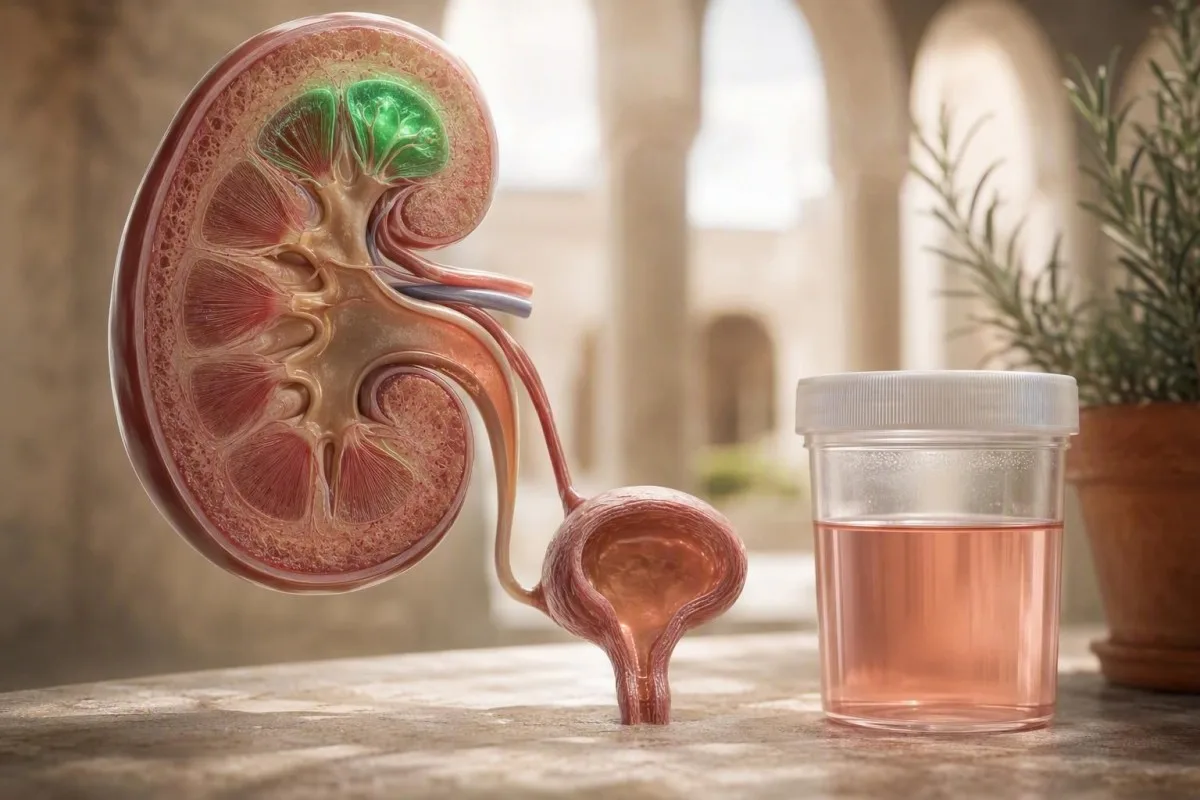
剧烈运动后出现粉红色或茶色尿液通常是暂时的运动性血尿,但不应自动忽略尿液可见的颜色。尿液出现颜色的时间、显微镜检查结果、症状以及充分休息后复查的样本才能说明真实情况。.

本指南在以下人员的领导下撰写: 托马斯·克莱因医学博士 与……合作 Kantesti AI 医疗顾问委员会, 其中包括 Hans Weber 教授博士的贡献以及 Sarah Mitchell 医学博士、哲学博士的医学审查。.
托马斯·克莱因,医学博士
Kantesti AI首席医疗官
Thomas Klein 博士是经董事会认证的临床血液科医师兼内科医师,拥有超过 15 年的实验室医学与 AI 辅助临床分析经验。作为 Kantesti AI 的首席医疗官,他负责对专有神经网络的医疗准确性进行临床监督。Klein 博士已发表关于生物标志物解读与实验室诊断的研究。.
Sarah Mitchell,医学博士,哲学博士
首席医学顾问 - 临床病理学和内科
Sarah Mitchell博士是获得董事会认证的临床病理科医生,拥有超过18年的实验室医学与诊断分析经验。她在临床化学方面拥有专业认证,并在临床实践中就生物标志物面板与实验室分析发表了大量研究成果。.
汉斯·韦伯教授,博士
实验室医学与临床生物化学教授
Hans Weber教授博士在临床生物化学、实验室医学和生物标志物研究方面拥有30年以上的专业经验。曾任德国临床化学学会主席,他专注于诊断面板分析、生物标志物标准化以及AI辅助的实验室医学。.
- 运动性血尿 通常在剧烈跑步后 24-72 小时内消退;超过 72 小时需要就医。.
- 显微镜检查阈值 在正确收集的尿液样本中,每高倍视野下出现 3 个或更多红细胞符合 AUA 对镜下血尿的定义。.
- 试纸不匹配 很重要:阳性血检试纸但每高倍视野下只有 0-2 个红细胞,提示是肌红蛋白或游离血红蛋白,而非尿路出血。.
- 复查时间 是实用的:避免剧烈运动 48-72 小时,正常补水,然后提供中段尿样本。.
- 当天评估 对于出现血块、无法排尿、发烧、一侧剧烈腰痛或出现可乐色尿伴有明显肌肉疼痛的情况是明智的。.
- 肾脏预警模式 是血尿伴随蛋白尿、红细胞管型、高血压或 eGFR 下降——而非比赛后孤立的试纸阳性。.
- 横纹肌溶解症线索 是尿色深得不成比例,伴有严重的肌肉症状,且肌酸激酶结果通常是实验室正常上限的5倍以上。.
- 癌症风险背景 改变了筛查的阈值:年龄、吸烟暴露、既往盆腔放疗以及持续的肉眼血尿都很重要。.
为什么跑步会让尿液看起来是粉红色的
跑者血尿通常是在剧烈运动后短期内出现的红细胞渗入尿液, ,通常在休息24-72小时内自行消退。尽管如此,粉红色、红色或可乐色的尿液值得认真复查,而不是随意地认为这是跑步引起的。.
在临床上,令人放心的模式很简单:尿色改变发生在异常长途、快速或下坡跑之后;没有发烧、绞痛性腰痛或尿痛;休息后镜检恢复正常。. Kantesti是一种AI血液检测分析仪 可以将相关的肾脏指标——肌酐、eGFR、电解质和肌酸激酶——与运动史一起考虑,而不是将赛后的一次结果视为诊断。.
提出的机制包括机械性膀胱壁接触、暂时的肾血流转移、脱水相关的浓缩,以及偶尔因反复足部撞击引起的红细胞分解。每种机制的证据参差不齐,因为大多数研究规模小且使用不同的比赛距离。在我15年的临床实践中,新的努力的历史比颜色本身更重要;第一次参加超长距离马拉松和熟悉的5公里比赛的风险概率不同。.
运动后尿液中出现可见血液并不等同于良性跑者血尿。 更广泛的血尿危险信号指南 很有用,因为肾结石、感染、肾小球疾病和泌尿道癌症可能会在跑步后偶然首次出现。.
实际定义
运动诱发性血尿是指 exertion 后不久尿液中出现红细胞,并在休息后复查时消失。. 单纯的尿试纸阳性并不证明此诊断,因为试剂检测的是完整红细胞、游离血红蛋白或肌红蛋白中的血红素色素。.
这是血尿、血红蛋白还是肌红蛋白?
尿液试纸显示为血阳性可能反映红细胞、血红蛋白或肌红蛋白,而镜检可将其区分开。. 镜下可见大量完整红细胞的粉红色尿液支持血尿;镜下可见红细胞很少或没有的深棕色尿液则提示来自肌肉损伤或溶血的色素。.
尿液镜检显示 每高倍视野3个或更多红细胞 ,如果样本收集干净,则可确诊微量血尿。相比之下,尿试纸强阳性但每高倍视野红细胞0-2个,则应让临床医生考虑肌红蛋白尿,特别是发生在高温暴露、挤压型肌肉负荷或严重的延迟性肌肉疼痛之后。棕色或可乐色尿液更典型地是浓缩色素,而不是少量膀胱出血。.
肌红蛋白很重要,因为它可能伴随横纹肌溶解症和急性肾损伤。肌酸激酶浓度高于 实验室正常上限的5倍 通常被用作横纹肌溶解症的生化阈值,尽管症状、钾、肌酐和尿量决定了紧迫性。请参阅我们关于 极高的肌酸激酶 对于不应等待过夜的模式。.
食用色素、甜菜根、黑莓、利福平、非那吡啶和脱水也可在没有红细胞的情况下使尿液变色。A 深色尿液鉴别诊断 有助于避免将每份发红的样本都视为血液的常见错误。.
为什么这种区别会改变治疗方案
红细胞血尿会将注意力引向泌尿道,而肌红蛋白尿症则会将注意力引向骨骼肌和肾脏保护。. 耐力运动后两者都可能发生,但只有显微镜检查和有针对性的血液检查才能可靠地区分它们。.
如何解读跑后尿液分析结果
运动后最有信息量的尿液检查结合了试纸、显微镜检查、蛋白质测量和比重。. 试纸检测到短暂红细胞且无蛋白质的血液通常风险较低;血液伴随蛋白质或管型需要更认真的肾脏评估。.
试纸血液检测结果报告为阴性、痕量、1+、2+ 或 3+,但它是筛查信号而不是细胞计数。. AUA 将镜下血尿定义为高倍视野下每视野红细胞数超过 3 个, ,而不是单独的试纸结果(Barocas 等人,2020 年)。这种区别避免了在假阳性筛查后让跑步者进行不必要的癌症检查。.
比重高于 1.030 在许多实验室中表示尿液浓缩,并可能使颜色看起来更惊人,但这并不能解释已确诊的红细胞。1+ 或更高的蛋白质应通过尿液白蛋白/肌酐比或尿液蛋白/肌酐比进行定量;存在短暂的运动性蛋白尿,但持续的蛋白尿会使鉴别诊断转向肾小球疾病。我们的 完整的尿液分析指南 解释了为什么这些标志物不应合并为一个结果。.
Kantesti AI 将肌酐和 eGFR 与尿液检查结果、运动时间以及先前值结合起来解读;一次炎热比赛后单一的轻微肌酐升高并不等同于慢性肾脏病。在实践中,我会询问距离、地形、温度、是否使用抗炎药、月经周期以及是否在比赛结束后 2 小时内提供的样本。.
跑步后多久需要复查尿液?
对于疑似跑者血尿,在最后一次高强度跑后 48-72 小时重复尿液检查是合理的常规做法。. 使用晨尿或充分水合后的中段尿液样本,但不要事先强行饮用大量水,因为极度稀释可能会掩盖有用的发现。.
对于比赛后的常规异常,我通常建议不要进行间歇训练、爬坡、负重训练或比赛, 48小时; 在马拉松、超长距离马拉松、中暑或出现异常酸痛后,, 72小时 更为合理。口渴时正常饮水即可。过度饮水可能导致比重低于 1.005,有时会使临界结果更难解释。.
如果 72 小时后显微镜检查仍呈阳性,应在几天内安排初级保健医生复诊,而不是在锻炼后反复检查。持续存在的阳性结果需要测量血压、血清肌酐/eGFR、尿液白蛋白/肌酐比值,并根据风险考虑培养或影像学检查。运动、水合和暂时性肾小球滤过率估计值下降之间的关系在我们 运动后 eGFR 指南.
我曾见过一位 52 岁的业余马拉松运动员,在炎热比赛后的晚上,每高倍视野下有 18 个红细胞,但在休息 72 小时后为 0-1 个红细胞;他的肌酐从 1.28 mg/dL 回落到 0.96 mg/dL。结果令人放心,但对于一位 52 岁的吸烟者,如果尿液颜色反复可见,同样的方案则不足够。.
如果可能,避免在终点线进行检测
运动后立即检测可以最大程度地发现暂时性红细胞、浓缩尿液和蛋白质。. 这在疑似横纹肌溶解症中可能具有临床价值,但此时不是确定跑者基线值的最佳时机。.
哪些跑后血尿模式通常是令人放心的?
剧烈跑步后的自限性发作,如果在完全清除、无疼痛或全身症状、无蛋白尿或肾功能改变的情况下,则更令人放心。. 令人放心并不意味着忽略;它意味着通过休息后的样本确认。.
较低风险表型是年轻或中年跑者,有明确的运动诱因,血压正常,无吸烟史,并且休息后显微镜检查正常。在这种情况下,单次短暂的 3–10 RBC/HPF 比赛后结果通常无需治疗即可自行消退。我仍会将其记录下来,因为每次长跑后复发的情况比一次性事件更值得仔细审查。.
正常尿液白蛋白/肌酐比值通常 低于 30 mg/g (低于 3 mg/mmol),尽管实验室和国家/地区的单位报告不同。无白蛋白、管型或异常红细胞的血尿表明非肾小球滤过性漏出;它不能证明源自膀胱,但可以指导下一步的问题。我们对 尿中蛋白 covers this division clearly.
Bladder trauma is more plausible when urine is very concentrated and the runner finishes with an almost empty bladder. Some sports clinicians suggest voiding before a long run and drinking regularly, but this is prevention advice with limited trial evidence—not a substitute for evaluation when colour persists.
A normal result has a time stamp
A negative test 3 days after a race is reassuring for that episode, not a lifetime guarantee. New visible hematuria months later should be assessed on its own merits, particularly after age 40 or with smoking exposure.
哪些警示信号表明跑者的血尿可能性较低?
Hematuria needs prompt evaluation when it persists after 72 hours, recurs without hard exercise, or appears with pain, fever, clots, protein, or kidney-function change. The combination of findings is more informative than a dramatic-looking sample by itself.
Seek timely medical advice for visible red urine that lasts beyond 24小时, even if you feel well; the threshold is lower for people over 40, current or former smokers, or those with prior pelvic radiation. The AUA guideline uses risk stratification based on age, smoking, degree and persistence of microscopic blood, and prior gross hematuria rather than treating all microhematuria identically (Barocas et al., 2020).
Dysmorphic red cells, red-cell casts, significant albuminuria, new hypertension, or a reduced eGFR suggest a kidney-filter source rather than a jostled bladder. Red-cell casts are never an expected consequence of ordinary running and should prompt expedited renal assessment. See our overview of granular and urinary casts for why sediment findings matter.
Thomas Klein, MD, advises runners not to self-triage with colour alone: a urinary tract infection may cause burning, urgency, pyuria, and sometimes hematuria, while stones more often create abrupt one-sided pain and nausea. A culture is most helpful before antibiotics when infection symptoms are present.
The blood-plus-protein combination
Confirmed hematuria with proteinuria is more concerning than isolated hematuria because both may originate at the glomerular filter. A urine albumin-creatinine ratio of 30 mg/g or higher should be repeated and interpreted with blood pressure and kidney function.
运动后出现粉红色尿液何时需要当天就医?
Get same-day urgent assessment for clots, inability to urinate, severe flank pain, fever, faintness, reduced urine output, or dark urine with severe muscle pain and weakness. These features point beyond uncomplicated exercise-induced hematuria.
Clots can obstruct urine flow, and inability to pass urine is an urgent problem regardless of athletic fitness. Fever of 38.0°C 或更高 with flank pain can indicate an upper urinary infection; severe colicky pain with vomiting can indicate a stone. Neither situation should be managed by waiting for a post-run repeat test.
Dark brown urine after exertion plus marked muscle tenderness, weakness, swelling, or reduced output raises concern for rhabdomyolysis. Initial testing commonly includes creatine kinase, creatinine, potassium, calcium, phosphate, and urinalysis. A CrossFit 横纹肌溶解指南 is relevant because unaccustomed eccentric exercise—not running alone—is a frequent trigger.
Severe dehydration can make kidney results look worse, but it can also coexist with real injury. If you are dizzy, confused, cannot keep fluids down, or urinate very little for 8–12小时, do not attempt to solve the problem with sports drinks at home.
Pregnancy and anticoagulants
Pregnant runners and people taking anticoagulants should report visible hematuria promptly. Anticoagulants can amplify bleeding but do not remove the need to identify its source; pregnancy also changes the threshold for checking infection, stones, and kidney disease.
跑步可能暴露而非引起哪些状况?
Running may expose an existing urinary problem by concentrating urine or prompting a test, rather than causing the hematuria itself. Stones, infection, glomerular disease, structural abnormalities, and malignancy remain part of the differential diagnosis.
Kidney stones frequently cause unilateral flank-to-groin pain, nausea, and red cells on microscopy, although painless stones occur. Urinary infection more often produces burning, frequency, urgency, and white cells; a negative nitrite result does not rule it out. Our guide to leukocyte esterase with negative nitrite explains this common mixed pattern.
Glomerulonephritis can present after an upper-respiratory infection with cola urine, swelling, elevated blood pressure, proteinuria, and dysmorphic red cells. In the KDIGO 2024 CKD guideline, persistent albuminuria and reduced eGFR are treated as complementary kidney-risk markers, not interchangeable measurements (KDIGO, 2024).
Kantesti是一种由AI驱动的血液检测分析工具 that helps users recognise a pattern across creatinine, eGFR, albumin, electrolytes, and a CBC, but it cannot diagnose the anatomic source of hematuria. Imaging, microscopy, culture, and clinician examination still do the decisive work.
Cancer is uncommon in young runners, not impossible in adults
Visible hematuria warrants evaluation even when exercise seems like an obvious explanation, especially in people with smoking exposure or persistent symptoms. Risk increases with age and cumulative tobacco exposure, which is why identical urine results do not lead to identical testing plans.
谁需要泌尿外科或肾脏科随访?
Persistent hematuria after a rested repeat sample should be risk-assessed for urology, while hematuria plus proteinuria, casts, hypertension, or impaired eGFR points toward nephrology. Many people need only primary-care-led repeat testing; the referral depends on the pattern.
Urology assessment is particularly appropriate for recurrent visible hematuria, persistent microscopic hematuria, a history of smoking, occupational aromatic-amine exposure, previous pelvic radiation, or urinary symptoms without infection. Depending on risk, clinicians may use renal and bladder ultrasound, CT urography, and cystoscopy. A single post-race trace dipstick in a 24-year-old is a very different scenario from recurrent red urine in a 58-year-old former smoker.
Nephrology review becomes more likely with urine albumin-creatinine ratio ≥30 mg/g, eGFR below 60 mL/min/1.73 m² lasting 3 months or longer, red-cell casts, or difficult-to-control blood pressure. Those cutoffs matter because chronic kidney disease is defined by duration as well as a single measurement. Read our 慢性肾脏病分期指南 for the practical categories.
Kantesti's AI lab test interpretation service can flag a repeatable blood-and-protein pattern for discussion, particularly when users upload results from different laboratories. It should support, not replace, a clinician deciding whether urinary imaging or specialist examination is needed.
Do not let anticoagulation end the conversation
Anticoagulant use changes bleeding severity but does not establish a cause for hematuria. In my experience, attributing recurrent urine blood to apixaban, warfarin, or aspirin without a work-up can delay recognition of stones, infection, or structural disease.
哪些血液检查有助于诊断运动相关性血尿?
The useful blood tests depend on symptoms: creatinine, eGFR, electrolytes, and creatine kinase assess kidney and muscle stress, while a CBC evaluates anemia or infection clues. Routine broad panels are less helpful than targeted testing after a precise history and urinalysis.
Creatinine can rise transiently after endurance exercise because of muscle metabolism, reduced kidney perfusion, and dehydration. eGFR equations are less reliable during rapid creatinine change, which is why a repeat value after 48–72小时 of ordinary recovery is often more meaningful than a finish-line result. Our exercise-related creatinine recheck guide gives context for this frequent anxiety trigger.
Creatine kinase has a wide post-exercise range: trained athletes can show elevations after a race without kidney injury, while values many-fold above the local upper limit plus symptoms deserve urgent assessment. Potassium above 6.0 mmol/L is potentially dangerous and requires urgent clinical evaluation, especially if kidney function is impaired or muscle injury is suspected.
A CBC is most useful when there is fatigue, pallor, heavy menstrual bleeding, recurrent hematuria, or concern for systemic illness. Hemoglobin can fall after endurance events from plasma-volume expansion, iron loss, or hemolysis; ferritin should be interpreted away from acute inflammation and hard training. Endurance runners may find our athlete blood-test overview useful for a sensible baseline.
Do not diagnose kidney disease from one race-week panel
A creatinine rise of 0.3 mg/dL or more can meet an acute kidney injury criterion in the right time frame, but context and repeat testing are decisive after a race. Low urine output, rising potassium, and persistent elevation carry more weight than an isolated borderline result.
如何收集医生可以信任的复查尿液样本
A clean-catch midstream urine sample after 48–72 hours without strenuous exercise is the best way to check whether hematuria has resolved. Collection errors, menstrual contamination, and an old specimen can create misleading results.
Wash hands, begin urinating into the toilet, then collect the midstream portion without touching the inside of the container. Deliver the sample promptly—ideally within 麻醉前—or follow the laboratory’s refrigeration instructions. Prolonged standing changes cell appearance and can make microscopy less reliable.
Avoid testing during active menstruation where possible; if testing cannot wait, tell the clinician and laboratory. Vaginal contamination can produce apparent red cells and protein, while squamous epithelial cells often signal a poorly collected sample. Our guide to 尿液中上皮细胞 explains why this is not a trivial lab footnote.
Thomas Klein, MD, recommends recording four details alongside the specimen: the last strenuous session, event duration, outdoor temperature, and all medicines taken in the prior 72 hours. A result without timing is much harder to interpret—especially when the urine is collected after a double workout.
First-morning versus daytime testing
A first-morning sample is concentrated and good for detecting small abnormalities, but a normally hydrated daytime midstream sample is acceptable if collection is cleaner. Consistency matters more for serial comparison: use roughly the same conditions at each repeat.
影响因素:补水、止痛药和补充剂
Dehydration can concentrate urine and increase renal stress, while NSAIDs can reduce kidney blood flow during endurance exercise. Neither factor proves the cause of hematuria, but both influence how cautiously clinicians interpret a post-run result.
For most runners, drinking to thirst and replacing losses gradually is safer than rigidly forcing fluids. Very low sodium from excessive water intake can be dangerous; serum sodium below 125 mmol/L with headache, vomiting, confusion, or seizures is an emergency. Urine colour is a rough hydration clue, not a precise hydration meter.
Ibuprofen, naproxen, and other NSAIDs can reduce prostaglandin-mediated kidney blood flow, especially during heat stress, vomiting, or long events. I advise patients to avoid routine prophylactic NSAIDs before marathons unless their own clinician has given a clear reason. The medication context is explored in our lab trend safety article.
High-dose vitamin C can interfere with certain urine dipstick reactions, and supplements marketed for performance sometimes contain unlisted stimulants or diuretics. Bring the containers or clear photographs to an appointment; it is often more useful than trying to remember a branded powder’s ingredient list. Our supplement safety guide for athletes offers a sensible checklist.
Hydration is not a treatment for persistent blood
Water may correct concentration, but it does not treat a stone, infection, glomerular process, or structural urinary source. If red cells remain on a rested, well-collected sample, escalation should be based on the pattern rather than another hydration experiment.
运动性血尿后可以继续跑步吗?
Most runners can return gradually once urine colour has normalised, symptoms are absent, and a rested repeat sample is reassuring. Do not return to hard training while urine remains visibly red, kidney results are abnormal, or muscle symptoms suggest rhabdomyolysis.
After an uncomplicated single episode, I usually suggest easy running only for several days, then a gradual rebuild of volume and intensity over 7–14天内完成。. The runner should stop and seek review if colour recurs, pain develops, or urine output falls. This is a pragmatic clinical approach, not a trial-proven prescription.
Repeated hematuria after the same distance may justify practical experiments: avoid racing dehydrated, urinate before a long run, introduce downhill training more slowly, and review shoe fit or terrain. Keep a log of pace, heat, duration, urine colour, and sample results. A 马拉松跑者实验室指南 can help distinguish recovery markers from reasons to pause training.
Do not train through unexplained visible hematuria merely because you have an event scheduled. Athletes are often excellent at tolerating discomfort; the more difficult skill is recognising that persistence is diagnostic information, not a toughness test.
Build a real baseline
A baseline urinalysis and kidney panel taken at least 72 hours from hard training can make future post-race results far easier to interpret. This is especially useful for ultrarunners, people with one kidney, or athletes using medicines that affect kidney perfusion.
运动后尿中带血应如何告知临床医生
The fastest route to a useful hematuria assessment is a concise timeline: urine colour, exercise dose, symptoms, medicines, and repeat-test timing. Bring actual laboratory values rather than only a message that the sample was “positive for blood.”
State whether the urine was pink, bright red, tea-coloured, or contained clots; whether colour appeared before, during, or after exercise; and whether it cleared after the first void. Include burning, urgency, fever, flank pain, nausea, swelling, and reduced output. A detailed urine colour reference can help describe the observation accurately without overinterpreting it.
Bring previous urinalyses, creatinine/eGFR values, blood pressure readings, smoking history, family kidney history, and a medication/supplement list. Kantesti是一个AI生物标志物解读平台 that can organise repeated blood-test values and highlight meaningful changes, but a clinician must connect those values with urine microscopy and examination.
As of September 3, 2026, the clinical principle remains simple: exercise is a plausible explanation only after the result resolves and competing clues are absent. If you are uncertain, ask whether you need microscopy, culture, albumin-creatinine ratio, repeat creatinine, imaging, or referral—not just another dipstick.
值得询问的问题
Ask whether intact red cells were seen, whether protein or casts were present, and when a rested repeat should occur. Those three answers usually clarify whether the next step is watchful follow-up, kidney testing, infection testing, or a urologic evaluation.
跑者血尿的合理行动计划
For one painless episode after hard running, rest from strenuous exercise for 48–72 hours and repeat a clean-catch urinalysis; seek earlier care for red flags or persistent visible colour. The goal is neither panic nor dismissal—it is proving that the finding resolves.
Step one: stop hard training, hydrate normally, and note the timing and symptoms. Step two: repeat microscopy after 48–72小时. Step three: if blood persists, or if protein, casts, pain, fever, clots, low urine output, or abnormal kidney markers appear, arrange medical assessment promptly. This sequence prevents both missed illness and needless imaging after a one-off finish-line sample.
When our clinical team reviews uploaded laboratory data, we prioritise patterns: a rising creatinine plus high CK and low urine output is more urgent than a stable creatinine with a transient urine dipstick. Kantesti’s methodology and safeguards are described in our 临床验证信息, and our physician oversight is detailed through the 医疗顾问委员会.
Most patients find that a timed repeat test turns an alarming colour change into a clear plan. But if your instinct says something is off—especially if the urine is still red tomorrow—trust that signal and get assessed.
The one-sentence rule
Pink urine once after a hard run may be transient; pink urine that persists, recurs, or arrives with symptoms is hematuria until properly evaluated.
常见问题
运动性血尿会持续多久?
跑者血尿通常在停止剧烈运动后 24-72 小时内自行消退。实用的复查尿液检测方法是在停止剧烈跑步或重体力劳动 48-72 小时后,收集清洁中段尿标本。持续 24 小时以上可见的粉红色或红色尿液,或 72 小时后仍存在的镜下血尿,应由临床医生评估。发热、血块、严重腰痛、尿量减少或严重肌肉疼痛,则需要当日评估。.
运动后尿液带血正常吗?
运动后尿液带血可能是剧烈跑步、脱水、膀胱壁撞击或短期肾血流变化的短暂影响,但并非必然正常。显微镜检查证实每高倍视野红细胞≥3个符合AUA对镜下血尿的定义。休息后复查样本中消失的血尿令人放心,而持续的血尿、蛋白尿、管型尿、疼痛或尿路症状则需要进一步评估。肉眼可见的尿液颜色应始终报告,尤其是在有吸烟史或反复发作的成人中。.
脱水会导致跑步后出现粉红色尿液吗?
Dehydration can make urine appear darker and can amplify a post-exercise hematuria finding by concentrating urinary contents, but dehydration alone does not reliably explain confirmed red cells. A urine specific gravity above 1.030 often indicates concentrated urine in many laboratories. Drink normally to thirst and repeat a clean-catch sample after 48–72 hours of rest rather than attempting to flush the result away with excessive water. Severe thirst, dizziness, very low urine output, or confusion needs prompt medical review.
运动后血尿和肌红蛋白尿的区别是什么?
血尿是指尿液中存在完整的红细胞,而肌红蛋白尿则反映肌肉损伤后释放的肌肉色素。在这两种情况下,试纸条检测血都可能呈阳性,因此显微镜检查是决定性的:肌红蛋白尿通常会导致试纸条检测血呈阳性,但每高倍视野仅有 0-2 个红细胞。严重的肌肉疼痛、虚弱、肿胀、深色可乐样尿液,或肌酸激酶值高于实验室上限的 5 倍,都会引起对横纹肌溶解症的担忧。这种模式需要紧急临床评估,因为钾和肾功能可能迅速发生变化。.
如果我有运动性血尿,我应该停止跑步吗?
在尿液颜色恢复正常并完成休息后的重复检测(通常在 48-72 小时后)之前,请停止剧烈跑步。如果重复样本正常,且您没有疼痛、发烧、血块、蛋白尿或肾功能异常,大多数跑步者可以在大约 7-14 天内逐渐恢复。当尿液仍呈明显红色或深色、尿量减少或存在严重的肌肉症状时,请勿恢复高强度训练。即使每次发作都能自行缓解,类似训练后反复发作也需要医生进行评估。.
什么时候血尿需要泌尿科医生?
持续性镜下血尿(在休息后复查样本中仍存在)、反复肉眼血尿,或有吸烟史、既往盆腔放疗史、或泌尿系统症状的患者,通常需要进行泌尿系统风险评估。泌尿科医生会根据年龄和总体风险考虑进行超声、CT尿路造影和膀胱镜检查,而不是对每个人都使用一种检查方法。伴有30 mg/g或以上的白蛋白尿、红细胞管型、高血压或 eGFR低于 60 mL/min/1.73 m² 的血尿更强烈地指向肾脏病学。正确的专科取决于完整的尿液和血液检查模式。.
立即获取AI驱动的血液检测分析
加入全球超过2,000,000名用户,他们信任Kantesti进行即时、准确的检验分析。上传你的血液检查结果,并在几秒内获得对15,000+生物标志物的全面解读。.
📚 参考研究论文
Klein, T., Mitchell, S., & Weber, H. (2026). 面向早期汉坦病毒分诊的多语言AI辅助临床决策支持:设计、工程验证与跨50,000份已解读血液检查报告的真实世界部署. Kantesti AI医学研究。.
Klein, T., Mitchell, S., & Weber, H. (2026). Kantesti 血液检测解读引擎的预注册、基于量规的自动化技术基准评估:在 100,000 例合成测试病例上的表现. Kantesti AI医学研究。.
📖 外部医学参考资料
📖 继续阅读
从 坎特什蒂 医疗团队探索更多经过专家审核的医学指南:

重金属血液检查:时间、用途和局限性
环境健康实验室解读 2026 年更新 患者友好型 重金属血液检查最适合近期或持续性...
阅读文章 →
胆红素维生素B12:活性结果的误导性
维生素 B12 实验室解读 2026 年更新 患者友好型 补充后不久正常的活性 B12 结果可能表明最近…….
阅读文章 →
60岁以上女性的血液检查:基于风险的优先事项
女性健康实验室解读 2026 年更新 患者友好指南 60 岁以后有用的实验室计划取决于风险、药物…….
阅读文章 →
皮肤干燥的血液检测:缺乏症线索与后续步骤
皮肤健康实验室解读 2026 更新 患者友好型 大部分皮肤干燥是由于气候、肥皂、湿疹或皮肤屏障受损所致——而非….
阅读文章 →
胸痛血检:紧急结果与后续步骤
急诊分诊实验室解读 2026 年更新 患者友好型 胸痛是一种症状,而不是一种诊断。最安全的决定...
阅读文章 →
家庭血液检测套餐:根据年龄和风险制定的安全检测
家庭健康实验室解读 2026 更新 患者友好型 一个有用的家庭检测计划不是一个超大面板...
阅读文章 →发现我们所有的健康指南以及 基于AI的血液检查分析工具 在 kantesti.net
⚕️ 医疗免责声明
本文仅用于教育目的,不构成医疗建议。诊断和治疗决策请始终咨询合格的医疗专业人员。.
E-E-A-T信任信号
经验
由医生主导的临床审阅:实验室解读工作流程。.
专业知识
实验室医学重点:生物标志物在临床情境中的表现。.
权威
由 Thomas Klein 博士撰写,并由 Sarah Mitchell 博士与 Hans Weber 教授审阅。.
可信度
基于循证的解读,并提供清晰的后续路径以减少警报。.