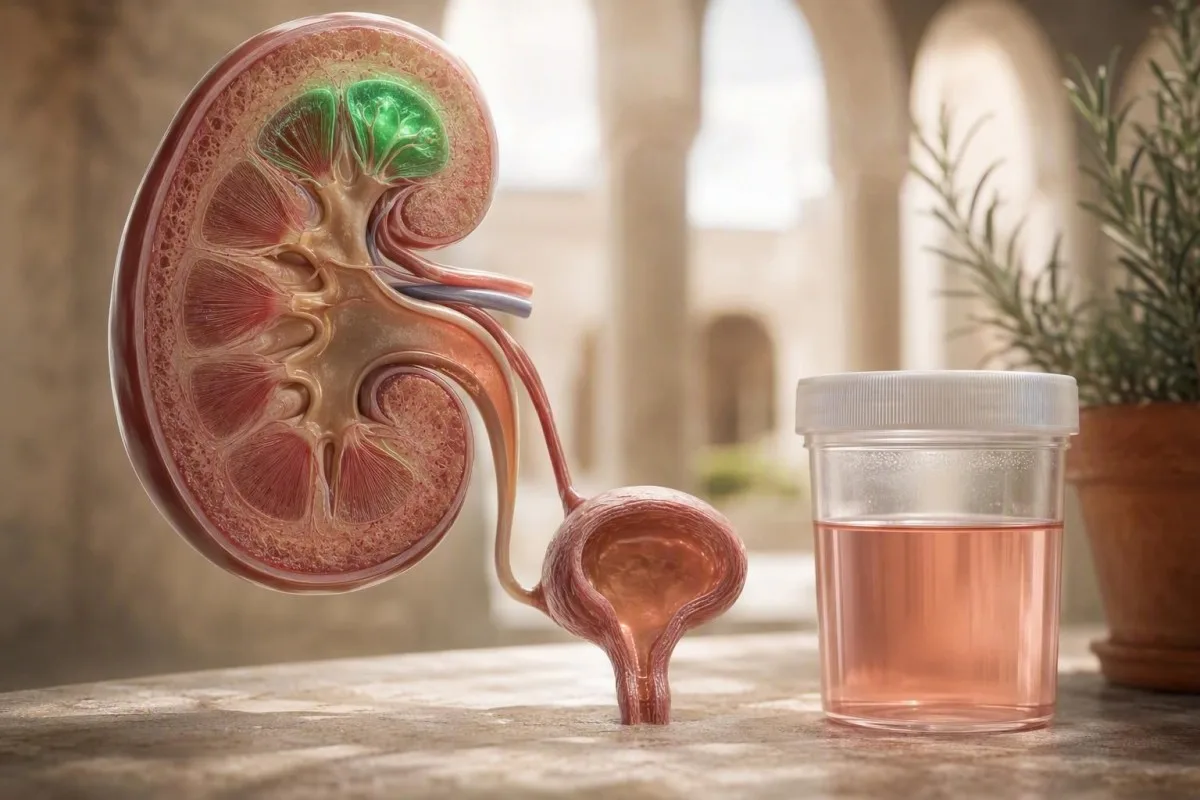
Ang sampol sa ihi nga mapula o sama sa tsa pagkahuman sa taas nga dagan kasagaran temporaryo nga ehersisyo-induced hematuria, apan ang makitang kolor dili gyud angay pasagdan. Ang oras, resulta sa mikroskopyo, mga sintomas, ug usa ka balido nga gisubli nga sampol nga nagpahulay nagpakita sa tinuod nga istorya.


- *Ehersisyo-gitukmod nga hematuria* kasagarang mawala sulod sa 24–72 ka oras human sa grabeng pagdagan; ang pagpadayon lapas sa 72 ka oras nagkinahanglan og medikal nga pagsusi.
- Mikroskopikong sukaranan sa 3 o labaw pa nga pula nga mga selula sa dugo matag high-power field sa usa ka balido nga nakolekta nga sampol sa ihi nagtuman sa depinisyon sa AUA sa microhematuria.
- Dipstick mismatch importante: ang positibo nga blood pad nga adunay zero ngadto sa duha ka pula nga selula matag high-power field nagpaila sa myoglobin o libre nga hemoglobin imbes nga pagdugo sa ihi.
- Gisubli nga oras praktikal: likayan ang grabeng ehersisyo sulod sa 48–72 ka oras, magpabilin sa normal nga hydration, unya maghatag ug midstream urine sample.
- Pagtasa sa sulod sa maong adlaw makatarunganon alang sa mga unod, dili makaihi, hilanat, usa ka kilid nga grabeng kasakit sa kilid, o ihi nga sama sa cola nga adunay dakong kasakit sa kaunoran.
- Pasidaan sa amimílo mao ang dugo dugang protina, red-cell casts, taas nga presyon sa dugo, o pagkunhod sa eGFR—dili usa ka isolated post-race dipstick.
- Senyales sa Rhabdomyolysis kay ang ihi nga dili kasagaran mangitngit nga adunay grabe nga mga sintomas sa kaunoran ug ang resulta sa creatine kinase kanunay nga labaw sa 5 ka pilo sa labing taas nga limitasyon sa laboratoryo.
- Konteksto sa risgo sa kanser nagbag-o sa sukaranan alang sa imbestigasyon: edad, pagkaladlad sa sigarilyo, naunang pelvic radiation, ug ang padayon nga makitang hematuria tanan importante.
Ngano nga ang usa ka dagan makapula sa ihi
Ang hematuria sa magdadagan kasagaran usa ka mubo nga pagtulo sa mga pula nga selula sa ihi pagkahuman sa kusog nga ehersisyo, nga kasagarang mawala sulod sa 24–72 oras nga pahulay. Bisan pa, ang makitang pink, pula, o sama sa cola nga ihi angayan og husto nga gikolekta nga pagsulay pag-usab kaysa usa ka kaswal nga pangagpas nga ang pagdagan ang hinungdan niini.
Sa klinika, ang makapahupay nga sumbanan direkta: ang pagbag-o sa kolor magsugod pagkahuman sa usa ka dili kasagaran nga taas, paspas, o paubos nga pagdagan; walay hilanat, sakit sa likod nga morag kulba, o pagsunog sa ihi; ug ang microscopy normal human sa pahulay. Ang Kantesti kay usa ka AI blood test analyzer nga makapahimutang sa may kalabutan nga mga marker sa kidney—creatinine, eGFR, electrolytes, ug creatine kinase—sa tupad sa kasaysayan sa ehersisyo, imbes nga trataron ang usa ka resulta pagkahuman sa lumba ingon usa ka pagdayagnos.
Ang gisugyot nga mga mekanismo mao ang mekanikal nga kontak sa bungbong sa pantog, temporaryo nga pagbalhin sa dagan sa dugo sa kidney, konsentrasyon nga may kalabotan sa dehydration, ug usahay pagkaguba sa pula nga selula gikan sa balik-balik nga pag-igo sa tiil. Ang ebidensya alang sa matag mekanismo tinuod nga nagkasagol, tungod kay kadaghanan sa mga pagtuon gamay ra ug naggamit og lain-laing mga gilay-on sa lumba. Sa akong 15 ka tuig nga praktis sa klinika, ang kasaysayan sa usa ka bag-ong paningkamot mas importante kaysa sa kolor lamang; ang usa ka unang ultramarathon ug usa ka pamilyar nga 5 km dili parehas ang pre-test probability.
Ang makitang dugo sa ihi pagkahuman sa ehersisyo dili parehas sa benign runner’s hematuria. A mas lapad nga giya sa red flag sa hematuria mapuslanon tungod kay ang mga bato sa kidney, impeksyon, sakit sa glomerular, ug mga kanser sa urinary tract mahimong sulagma nga unang mipakita pagkahuman sa usa ka pagdagan.
Ang praktikal nga depinisyon
Ang ehersisyo-induced hematuria nagpasabot nga ang mga pula nga selula makita sa ihi sa dili madugay pagkahuman sa exertion ug mawala sa usa ka gisulayan pag-usab nga sample nga nagpahulay. Ang positibo nga dipstick lamang dili makapamatuod niini nga pagdayagnos, tungod kay ang reagent makamatikod sa heme pigment gikan sa tibuuk nga mga pula nga selula, libre nga hemoglobin, o myoglobin.
Hematuria, hemoglobin, o myoglobin ba kini?
Ang usa ka urine dipstick nga mabasa nga positibo sa dugo mahimong magpakita sa mga pula nga selula, hemoglobin, o myoglobin, ug ang microscopy nagbahin kanila. Ang pink nga ihi nga adunay daghang tibuuk nga pula nga selula nagsuporta sa hematuria; ang ngitngit nga brown nga ihi nga adunay gamay o walay pula nga selula nagpatunghag kabalaka alang sa pigment gikan sa kadaot sa kaunoran o hemolysis.
Urine microscopy nagpakita 3 o labaw pa nga pula nga mga selula sa dugo matag high-power field nagpamatuod sa microhematuria kung ang sample husto nga nakolekta. Sa kasukwahi, ang kusganong positibo nga dipstick nga adunay 0–2 pula nga selula matag high-power field kinahanglan magpa-isip sa usa ka clinician sa myoglobinuria, ilabi na human sa pagkaladlad sa kainit, usa ka crush-type nga karga sa kaunoran, o grabe nga pagkalangan sa sakit sa kaunoran. Ang brown o cola nga kolor mas kasagaran sa concentrated pigment kaysa sa gamay nga kantidad sa pagdugo sa pantog.
Ang Myoglobin importante tungod kay kini mahimong kuyog sa rhabdomyolysis ug acute kidney injury. Ang konsentrasyon sa creatine kinase labaw sa 5 ka pilo sa laboratory upper limit of normal kasagarang gigamit ingon usa ka biochemical threshold alang sa rhabdomyolysis, bisan kung ang mga sintomas, potassium, creatinine, ug output sa ihi ang nagtino sa pagkadinalian. Tan-awa ang among praktikal nga pagpatin-aw sa taas kaayo nga creatine kinase alang sa mga sumbanan nga dili angay maghulat sa tibuok gabii.
Ang mga tina sa pagkaon, beet, blackberries, rifampicin, phenazopyridine, ug dehydration mahimo usab nga makapintal sa ihi nga walay pula nga mga selula. A dark urine differential makatabang sa paglikay sa kasagarang sayop sa pag-ingon nga ang matag mapula nga sample nagrepresentar sa dugo.
Ngano nga ang kalainan nagbag-o sa pag-atiman
Ang red-cell hematuria nagtudlo sa pagtagad sa urinary tract, samtang ang myoglobinuria nagtudlo sa skeletal muscle ug proteksyon sa amimika. Ang duha mahimong mahitabo human sa mga endurance event, apan ang microscopy ug targeted blood work lamang ang makasiguro niini sa kasaligan.
Unsaon pagbasa sa resulta sa urinalysis human sa dagan
Ang labing impormatibo nga post-run urine test naghiusa sa dipstick, microscopy, pagsukod sa protina, ug specific gravity. Ang dugo sa dipstick nga adunay transient red cells ug walay protina kasagaran ubos ang risgo; ang dugo ug protina o casts nagkinahanglan og dugang nga tino nga pagtimbang-timbang sa amimika.
Ang resulta sa dugo sa dipstick gitaho ingon nga negatibo, trace, 1+, 2+, o 3+, apan kini usa ka signal sa screening imbes nga cell count. Ang AUA naghubit sa microhematuria ingon nga labaw pa sa 3 ka pula nga selula sa dugo matag high-power field sa microscopic examination, dili lamang usa ka resulta sa dipstick (Barocas et al., 2020). Kini nga kalainan naglikay sa pagpadala sa mga runners ngadto sa dili kinahanglan nga cancer work-up human sa usa ka false-positive screen.
Specific gravity pataas 1.030 nagpakita sa concentrated nga ihi sa daghang mga laboratoryo ug mahimong maghimo sa kolor nga mas makahahadlok, apan kini dili makapatin-aw sa gikumpirma nga mga pula nga selula. Ang protina nga 1+ o labaw pa kinahanglan nga kuwentahon gamit ang urine albumin-creatinine ratio o protein-creatinine ratio; adunay transient exercise proteinuria, apan ang padayon nga albuminuria nagbag-o sa differential padulong sa glomerular disease. Ang among kompletong giya sa urinalysis nagpatin-aw ngano nga kini nga mga marker dili angay iusa ngadto sa usa ka resulta.
Ang Kantesti AI naghubad sa creatinine ug eGFR uban sa mga resulta sa ihi, oras sa ehersisyo, ug mga naunang kantidad; ang usa ka gamay nga pagtaas sa creatinine human sa init nga lumba dili katumbas sa chronic kidney disease. Sa praktis, mangutana ko sa gilay-on, terrain, temperatura, paggamit ug anti-inflammatory, oras sa pagregla, ug kung ang sample gihatag sulod sa 2 ka oras human sa paghuman.
Kanus-a kinahanglan balikon ang pagsulay sa ihi human makadagan?
Ang balik-balik nga pagsulay sa ihi 48–72 ka oras pagkahuman sa katapusang bug-at nga dagan usa ka maayong default alang sa gituohang hematuria sa magdadagan. Gumamit ug unang sample sa buntag o maayo nga hydrated nga midstream nga sample, apan ayaw pugsa ang daghang litro nga tubig sa dili pa kini himuon tungod kay ang grabeng pag-dilute makatago sa mapuslanong mga nahibal-an.
Alang sa usa ka rutina nga abnormalidad pagkahuman sa lumba, kasagaran akong girekomendar nga walay mga interval, bungtod, bug-at nga pag-alsa, o mga lumba alang sa 48 oras; pagkahuman sa usa ka marathon, ultramarathon, hilanat nga sakit, o dili kasagaran nga kasakit, 72 ka oras mas makatarunganon. Ang ordinaryo nga pag-inom hangtod sa kauhaw igo na. Ang sobrang pag-inom mahimong makapaubos sa specific gravity ubos sa 1.005 ug usahay makapalisud sa paghubad sa usa ka borderline nga resulta.
Kung ang microscopy magpabilin nga positibo pagkahuman sa 72 ka oras, pag-arrange ug primary-care review sa sulod sa mga adlaw imbes nga balik-balik nga pagsulay pagkahuman sa mga workout. Ang nagpadayon nga mga resulta nag-angkon sa pagsukod sa presyon sa dugo, serum creatinine/eGFR, urine albumin-creatinine ratio, ug konsiderasyon sa kultura o imaging sumala sa peligro. Ang relasyon tali sa pagpaningkamot, hydration, ug usa ka temporaryo nga mas ubos nga banabana sa pagsala gisakop sa among giya sa eGFR pagkahuman sa ehersisyo.
Usa ka 52-anyos nga recreational marathoner nga akong nakita adunay 18 ka pulang selula matag high-power field sa gabii pagkahuman sa init nga lumba, apan 0–1 ka pulang selula pagkahuman sa 72 ka oras nga pahulay; ang iyang creatinine mibalik gikan sa 1.28 mg/dL ngadto sa 0.96 mg/dL. Ang resulta nakahatag ug kasegurohan, apan ang parehas nga plano dili igo alang sa usa ka 52-anyos nga manigarilyo nga adunay balik-balik nga makita nga kolor sa ihi.
Ayaw pagsulay sa finish line kung mahimo nimo kini likayan
Ang pagsulay dayon pagkahuman sa ehersisyo nagpapataas sa kahigayonan nga makakita ug temporaryong pulang selula, concentrated nga ihi, ug protina. Kana mahimong mapuslanon sa klinika sa gituohang rhabdomyolysis, apan kini usa ka dili maayo nga panahon sa pagtino sa baseline sa magdadagan.
Unsang mga sumbanan sa hematuria human sa dagan ang kasagaran makapahupay?
Ang usa ka self-limited nga panghitabo pagkahuman sa grabe nga pagdagan mas makahatag ug kasegurohan kung kini hingpit nga mawala, walay kasakit o systemic nga mga sintomas, ug walay proteinuria o pagbag-o sa pag-andar sa amimislon. Ang makahatag ug kasegurohan wala magpasabot nga gibalewala; kini nagpasabot nga gikompirma sa usa ka pahulay nga sample.
Ang ubos nga risgo nga phenotype mao ang usa ka mas bata o middle-aged nga magdadagan nga adunay klaro nga exertional trigger, normal nga presyon sa dugo, walay kasaysayan sa pagpanigarilyo, ug normal nga rested microscopy. Sa kana nga kahimtang, usa ka single transient nga resulta sa 3–10 RBC/HPF pagkahuman sa usa ka lumba sagad mawala nga walay pagtambal. Akong irekord gihapon kini, tungod kay ang pagbalik-balik pagkahuman sa matag taas nga dagan nagkinahanglan ug mas mabinantayon nga pagrepaso kaysa usa ka higayon nga panghitabo.
Ang normal nga urine albumin-creatinine ratio sa kinatibuk-an ubos sa 30 mg/g (ubos sa 3 mg/mmol), bisan pa ang mga laboratoryo ug mga nasud nagreport sa mga yunit nga lahi. Ang dugo nga walay albumin, casts, o dysmorphic red cells nagtudlo palayo sa glomerular leakage; kini wala magpamatuod sa tinubdan sa pantog, apan kini naggiya sa sunod nga pangutana. Ang among pagpatin-aw sa protein sa ihi naglangkob niini nga dibisyon sa tin-aw.
Ang samad sa pantog mas posible kung ang ihi kay konsentrado kaayo ug ang magdadagan nahuman nga hapit walay sulod ang pantog. Ang ubang mga sports clinician nagsugyot nga magpagawas sa dili pa modagan og dugay ug moinom kanunay, apan kini usa ka tambag sa pagpugong nga adunay limitado nga ebidensya sa pagsulay—dili puli sa pagsusi kung magpadayon ang kolor.
Ang normal nga resulta adunay timestamp
Ang negatibo nga pagsulay 3 ka adlaw pagkahuman sa usa ka lumba makapahupay alang nianang higayona, dili usa ka tibuok kinabuhi nga garantiya. Ang bag-ong makita nga hematuria paglabay sa mga bulan kinahanglan susihon sa kaugalingon nga mga merito, labi na pagkahuman sa edad nga 40 o adunay pagkaladlad sa pagpanigarilyo.
Mga timailhan sa pasidaan nga naghimo sa hematuria sa magdadagan nga dili kaayo posible
Ang hematuria nagkinahanglan og dinalian nga pagsusi kung kini magpadayon pagkahuman sa 72 ka oras, mobalik nga wala’y kusog nga ehersisyo, o makita nga adunay kasakit, hilanat, mga lapok, protina, o pagbag-o sa pag-andar sa kidney. Ang kombinasyon sa mga nakaplagan mas impormasyon kaysa usa ka makapakurat nga tan-awon nga sample sa iyang kaugalingon.
Pangitaa ang tukma sa panahon nga tambag medikal alang sa makita nga pula nga ihi nga molungtad og sobra sa , hunong ang high-dose, bisan kung maayo ang imong pamati; ang threshold mas ubos alang sa mga tawo nga kapin sa 40, kasamtangan o kanhi manigarilyo, o kadtong adunay kaniadto nga pelvic radiation. Ang giya sa AUA naggamit og risk stratification base sa edad, pagpanigarilyo, ang gidak-on ug pagpadayon sa microscopic nga dugo, ug ang kaniadto nga gross hematuria imbes nga trataron ang tanan nga microhematuria sa parehas nga paagi (Barocas et al., 2020).
Ang mga dysmorphic red cells, red-cell casts, dakong albuminuria, bag-ong hypertension, o usa ka ubos nga eGFR nagsugyot og tinubdan sa kidney filter imbes nga usa ka gikuyog nga pantog. Ang mga red-cell cast dili gayud usa ka gipaabot nga sangputanan sa ordinaryo nga pagdagan ug kinahanglan magpukaw sa gipaspasan nga renal assessment. Tan-awa ang among kinatibuk-ang pagtan-aw sa granular ug urinary casts kung nganong hinungdanon ang mga nakaplagan sa sediment.
Si Thomas Klein, MD, nagtambag sa mga magdadagan nga dili mag-self-triage gamit lang ang kolor: ang impeksyon sa agianan sa ihi mahimong hinungdan sa pagsunog, pagkadinalian, pyuria, ug usahay hematuria, samtang ang mga bato kasagaran nagmugna og kalit nga usa ka kilid nga kasakit ug kasukaon. Ang kultura mao ang labing makatabang sa dili pa ang mga antibiotic kung adunay mga sintomas sa impeksyon.
Ang kombinasyon sa dugo ug protina
Ang gikumpirma nga hematuria nga adunay proteinuria mas makapaalarma kaysa sa nahilit nga hematuria tungod kay pareho silang mahimong magagikan sa glomerular filter. Ang usa ka urine albumin-creatinine ratio nga 30 mg/g o labaw pa kinahanglan balikon ug ipasabut uban sa presyon sa dugo ug pag-andar sa kidney.
Kanus-a ang mapula nga ihi human sa ehersisyo nagkinahanglan og pag-atiman sa samang adlaw?
Pagkuha ug dinalian nga pagsusi sa samang adlaw alang sa mga lapok, kawala makaihi, grabeng kasakit sa kilid, hilanat, pagkaluya, pagkunhod sa output sa ihi, o itom nga ihi nga adunay grabeng kasakit ug kahuyang sa kaunuran. Kini nga mga kinaiya nagpunting lapas sa wala’y komplikasyon nga exercise-induced hematuria.
Ang mga lapok makababag sa agianan sa ihi, ug ang kawala makaihi usa ka dinalian nga problema bisan unsa pa ang kahimsog sa atleta. Ang hilanat nga 38.0°C o mas taas nga adunay kasakit sa kilid mahimong magpakita sa usa ka impeksyon sa ibabaw nga urinary; ang grabeng sakit nga kolicky nga adunay pagsuka mahimong magpakita sa usa ka bato. Walay usa niini nga sitwasyon ang angay ipasulbad pinaagi sa paghulat sa usa ka post-run repeat test.
Ang itom nga kape nga ihi pagkahuman sa ehersisyo dugang sa dakong pagkalibang sa kaunuran, kahuyang, paghubag, o pagkunhod sa output nagpataas sa kabalaka alang sa rhabdomyolysis. Ang inisyal nga pagsulay sagad naglakip sa creatine kinase, creatinine, potassium, calcium, phosphate, ug urinalysis. Usa ka Giya sa rhabdomyolysis sa CrossFit hinungdan tungod kay ang dili maanad nga ehersisyo nga eccentric—dili lang ang pagdagan—kanunay nga hinungdan.
Ang grabeng dehydration mahimong makapagrabe sa resulta sa kidney, apan mahimo sab kini nga magkauban sa tinuod nga kadaot. Kung ikaw hubong, nalibog, dili makapugong sa mga likido, o gamay ra ang imong ihi sulod sa 8–12 oras, ayaw pagsulay sa pagsulbad sa problema gamit ang sports drinks sa balay.
Pagmabdos ug mga anticoagulant
Ang mga mabdos nga nagdagan ug ang mga tawo nga nag-inom og mga anticoagulant kinahanglan magreport dayon sa makitang hematuria. Ang mga anticoagulant mahimong makapadako sa pagdugo apan dili makawagtang sa panginahanglan sa pag-ila sa tinubdan niini; ang pagmabdos usab nagbag-o sa sukaranan sa pagsusi sa impeksyon, mga bato, ug sakit sa kidney.
Mga kondisyon nga mahimong ipadayag sa dagan imbes nga hinungdan
Ang pagdagan mahimong magbutyag sa usa ka kasamtangan nga problema sa ihi pinaagi sa pagpa-concentrate sa ihi o pag-aghat sa pagsulay, imbes nga hinungdan mismo sa hematuria. Ang mga bato, impeksyon, sakit sa glomerular, mga abnormalidad sa istruktura, ug kanser nagpabilin nga bahin sa differential diagnosis.
Ang mga bato sa kidney kanunay nga hinungdan sa sakit sa usa ka kilid gikan sa likod hangtod sa singit, kasukaon, ug pula nga mga selula sa microscopy, bisan kung adunay mga walay sakit nga bato. Ang impeksyon sa ihi mas kanunay nga hinungdan sa pagsunog, kanunay nga pag-ihi, pagkadinalian, ug puti nga mga selula; ang negatibong resulta sa nitrite dili makawagtang niini. Ang among giya sa leukocyte esterase nga adunay negatibong nitrite nagpatin-aw niining komon nga gisagol nga pattern.
Ang Glomerulonephritis mahimong magpakita human sa impeksyon sa taas nga respiratory tract nga adunay ihi nga sama sa cola, paghubag, taas nga presyon sa dugo, proteinuria, ug mga selula sa dugo nga dysmorphic. Sa KDIGO 2024 CKD guideline, ang padayon nga albuminuria ug ubos nga eGFR giisip nga mga komplementaryong timailhan sa risgo sa kidney, dili mga pagsukod nga mahimong ilisan (KDIGO, 2024).
Kantesti usa ka AI-powered nga blood test analysis tool nga makatabang sa mga tiggamit sa pag-ila sa usa ka sumbanan sa creatinine, eGFR, albumin, electrolytes, ug usa ka CBC, apan dili niini matino ang anatomikal nga tinubdan sa hematuria. Ang imaging, microscopy, culture, ug pagsusi sa doktor naghimo gihapon sa desisyon nga buhat.
Ang kanser dili kasagaran sa mga batan-ong runners, apan dili imposible sa mga hamtong
Ang makitang hematuria nagkinahanglan og pagsusi bisan kung ang ehersisyo daw usa ka klaro nga katin-awan, ilabi na sa mga tawo nga adunay exposure sa panigarilyo o padayon nga mga sintomas. Ang risgo modaghan sa edad ug sa kinatibuk-ang exposure sa tabako, mao nga ang managsamang resulta sa ihi dili mosangpot sa managsamang plano sa pagsulay.
Kinsa ang nanginahanglan ug follow-up sa urolohiya o nephrology?
Ang padayon nga hematuria human sa usa ka pahulay nga gisubli nga sample kinahanglan nga risk-assessed alang sa urolohiya, samtang ang hematuria dugang pa sa proteinuria, casts, hypertension, o nadaot nga eGFR nagtudlo ngadto sa nephrology. Daghang mga tawo ang nagkinahanglan lamang og balik-balik nga pagsulay nga gipangulohan sa primary care; ang referral nagdepende sa sumbanan.
Ang assessment sa urolohiya labi nga angay alang sa balik-balik nga makitang hematuria, padayon nga microscopic hematuria, kasaysayan sa panigarilyo, occupational aromatic-amine exposure, kanhi pelvic radiation, o mga sintomas sa ihi nga walay impeksyon. Depende sa risgo, ang mga doktor mahimong mogamit ug renal ug bladder ultrasound, CT urography, ug cystoscopy. Ang usa ka post-race trace dipstick sa usa ka 24-anyos lahi kaayo nga sitwasyon kaysa balik-balik nga pula nga ihi sa usa ka 58-anyos nga kanhi manigarilyo.
Ang nephrology review mahimong mas lagmit sa urine albumin-creatinine ratio ≥30 mg/g, eGFR ubos sa 60 mL/min/1.73 m² nga molungtad og 3 ka bulan o labaw pa, red-cell casts, o lisud-kontrolon nga presyon sa dugo. Kana nga mga cutoffs importante tungod kay ang chronic kidney disease gihubit sa gidugayon ingon man sa usa ka single measurement. Basaha ang among giya sa mga yugto sa chronic kidney disease alang sa praktikal nga mga kategorya.
Ang serbisyo sa paghubad sa resulta sa laboratory test sa AI sa Kantesti makahimo og marka sa usa ka balik-balik nga pattern sa dugo ug protina para hisgutan, labi na kung ang mga tiggamit mag-upload og mga resulta gikan sa lain-laing mga laboratoryo. Kinahanglan kini suportahan, dili ilisan, ang usa ka clinician nga magdesisyon kung gikinahanglan ba ang urinary imaging o espesyalista nga pagsusi.
Ayaw pasagdi nga ang anticoagulation magtapos sa panag-istoryahanay
Ang paggamit sa anticoagulant nag-usab sa kabug-at sa pagdugo apan wala magtukod og hinungdan sa hematuria. Sa akong kasinatian, ang pag-angkon sa balik-balik nga dugo sa ihi sa apixaban, warfarin, o aspirin nga walay trabaho mahimong makadelay sa pag-ila sa mga bato, impeksyon, o structural nga sakit.
Unsang mga pagsulay sa dugo ang makatabang human sa hematuria nga may kalabotan sa ehersisyo?
Ang mapuslanong mga pagsulay sa dugo nagdepende sa mga sintomas: ang creatinine, eGFR, electrolytes, ug creatine kinase nagsusi sa stress sa kidney ug kaunoran, samtang ang CBC nagsusi sa anemia o mga timailhan sa impeksyon. Ang rutina nga lapad nga mga panel dili kaayo makatabang kaysa sa gipunting nga pagsulay pagkahuman sa usa ka tukma nga kasaysayan ug urinalysis.
Ang creatinine mahimong motaas sa temporaryo human sa ehersisyo sa paglahutay tungod sa metabolismo sa kaunoran, pagkunhod sa kidney perfusion, ug dehydration. Ang mga equation sa eGFR dili kaayo kasaligan sa panahon sa paspas nga pagbag-o sa creatinine, mao nga ang balik-balik nga kantidad pagkahuman 48–72 oras sa ordinaryong pagkaayo kasagaran mas makahuluganon kaysa usa ka resulta sa linya sa paghuman. Ang among giya sa pagrepaso sa creatinine nga may kalabotan sa ehersisyo naghatag og konteksto alang niini nga kasagarang hinungdan sa kabalaka.
Ang Creatine kinase adunay lapad nga post-exercise range: ang mga nabansay nga atleta mahimong magpakita og pagtaas human sa usa ka lumba nga walay kadaot sa kidney, samtang ang mga kantidad nga daghang beses nga mas taas kaysa lokal nga taas nga limitasyon plus mga sintomas angayan sa dinalian nga pagsusi. Ang Potassium nga labaw sa 6.0 mmol/L mahimong delikado ug nanginahanglan dinalian nga pagsusi sa klinikal, labi na kung ang pag-andar sa kidney nadaot o ang kadaot sa kaunoran gisuspetsahan.
Ang CBC labing mapuslanon kung adunay pagkakapoy, kaput, bug-at nga pagdugo sa pagregla, balik-balik nga hematuria, o kabalaka alang sa systemic nga sakit. Ang hemoglobin mahimong moubos human sa mga kalihokan sa paglahutay gikan sa pagpalapad sa plasma-volume, pagkawala sa iron, o hemolysis; ang ferritin kinahanglan ipasabut nga layo sa acute inflammation ug bug-at nga pagbansay. Ang mga endurance runner mahimong makakita sa among overview sa blood-test sa atleta mapuslanon alang sa usa ka maalamon nga baseline.
Ayaw pag-diagnose og sakit sa kidney gikan sa usa ka panel sa semana sa lumba
Ang pagtaas sa creatinine nga 0.3 mg/dL o labaw pa mahimong makab-ot ang usa ka acute kidney injury criterion sa husto nga time frame, apan ang konteksto ug balik-balik nga pagsulay mao ang desisyon human sa usa ka lumba. Ang ubos nga output sa ihi, pagtaas sa potassium, ug padayon nga pagtaas adunay mas dako nga gibug-aton kaysa usa ka nahimulag nga resulta sa borderline.
Unsaon pagkuha og gisubli nga sampol sa ihi nga kasaligan sa mga doktor
Ang limpyo-pagdakop nga midstream nga sample sa ihi human sa 48–72 ka oras nga walay gahi nga ehersisyo mao ang pinakamaayong paagi sa pagsusi kung ang hematuria nawala na. Ang mga sayup sa pagkolekta, kontaminasyon sa pagregla, ug usa ka daan nga specimen mahimong makahimo og makapahisalaag nga mga resulta.
Hugasi ang mga kamot, magsugod sa pag-ihi sa kasilyas, dayon kolektaha ang midstream nga bahin nga dili mahikap ang sulod sa sudlanan. Ihatag ang sample dayon—labing maayo sulod sa 2 ka oras—o sundan ang mga instruksyon sa pagpabugnaw sa laboratoryo. Ang dugay nga pagtindog nagbag-o sa hitsura sa selula ug mahimong maghimo sa microscopy nga dili kaayo kasaligan.
Likayi ang pagsulay sa panahon sa aktibo nga pagregla kung mahimo; kung ang pagsulay dili mahimo, isulti sa clinician ug laboratoryo. Ang kontaminasyon sa kinatawo mahimong makahatag og daw mga selula sa dugo ug protina, samtang ang squamous epithelial cells sagad nagpakita og dili maayo nga nakolekta nga sample. Ang among giya sa epithelial cells sa ihi nagpatin-aw nganong dili kini usa ka gamay nga sulat sa lab.
Si Thomas Klein, MD, nagrekomendar sa pagrekord sa upat ka detalye uban sa specimen: ang kataposang mabug-at nga sesyon, ang gidugayon sa panghitabo, ang temperatura sa gawas, ug ang tanan nga mga tambal nga gikuha sa miaging 72 ka oras. Ang resulta nga walay oras mas lisud sabton—labi na kung ang ihi nakolekta human sa doble nga ehersisyo.
Unang buntag kumpara sa adlaw-adlaw nga pagsulay
Ang sample sa unang buntag concentrated ug maayo alang sa pag-detect sa gagmay nga mga abnormalidad, apan ang normal nga hydrated nga sample sa tunga-tunga sa adlaw madawat kung ang pagkolekta mas limpyo. Ang pagkamakanunayon mas importante alang sa sunod-sunod nga pagtandi: gamita ang halos parehas nga mga kondisyon sa matag balik.
Hydration, mga tambal sa kasakit, ug mga suplemento nga nagbag-o sa hulagway
Ang dehydration mahimong makapunting sa ihi ug makadugang sa stress sa kidney, samtang ang NSAIDs makapakunhod sa agos sa dugo sa kidney panahon sa endurance exercise. Walay usa niini nga mga hinungdan ang nagpamatuod sa hinungdan sa hematuria, apan pareho silang makaapekto kung unsa ka mabinantayon ang paghubad sa mga clinician sa resulta human sa pagdagan.
Alang sa kadaghanan sa mga magdadagan, ang pag-inom hangtod sa kauhaw ug pagpuli sa mga kawad-on sa hinay-hinay mas luwas kaysa sa estrikto nga pagpugos sa mga pluwido. Ang ubos kaayo nga sodium gikan sa sobra nga pag-inom og tubig mahimong delikado; serum sodium ubos sa 125 mmol/L nga adunay sakit sa ulo, pagsuka, kalibog, o mga pag-agaw usa ka emerhensya. Ang kolor sa ihi usa ka gibanabana nga timailhan sa hydration, dili usa ka tukma nga metro sa hydration.
Ang ibuprofen, naproxen, ug uban pang NSAIDs makapakunhod sa agos sa dugo sa kidney nga gipahinabo sa prostaglandin, labi na sa panahon sa stress sa kainit, pagsuka, o taas nga mga panghitabo. Nagtambag ako sa mga pasyente nga likayan ang regular nga prophylactic NSAIDs sa wala pa ang mga marathon gawas kung ang ilang kaugalingong clinician naghatag ug klaro nga rason. Ang konteksto sa tambal gisusi sa among artikulo sa kaluwasan sa trend sa lab.
Ang taas nga dosis sa bitamina C mahimong makabalda sa pipila ka mga reaksyon sa dipstick sa ihi, ug ang mga suplemento nga gibaligya alang sa pasundayag usahay adunay mga stimulant o diuretics nga wala gilista. Dad-a ang mga sudlanan o tin-aw nga mga litrato sa usa ka appointment; kini kanunay nga mas mapuslanon kaysa pagsulay sa paghinumdom sa listahan sa mga sangkap sa usa ka branded nga powder. Among giya sa kaluwasan sa suplemento alang sa mga atleta nagtanyag ug makatarunganon nga checklist.
Ang hydration dili usa ka pagtambal alang sa padayon nga dugo
Ang tubig mahimong makasulbad sa konsentrasyon, apan dili kini makasulbad sa usa ka bato, impeksyon, proseso sa glomerular, o tinubdan sa urinary tract. Kung ang mga pula nga selula magpabilin sa usa ka relaks, maayo nga nakolekta nga sample, ang pagpadayon kinahanglan ibase sa sumbanan kaysa sa laing eksperimento sa hydration.
Makadagan pa ba human sa ehersisyo-induced hematuria?
Kadaghanan sa mga magdadagan makabalik sa hinay-hinay kung normal na ang kolor sa ihi, wala na ang mga sintomas, ug ang usa ka relaks nga balik-balik nga sample makapadasig. Ayaw pagbalik sa bug-at nga pagbansay samtang ang ihi nagpabilin nga dayag nga pula, dili normal ang mga resulta sa kidney, o ang mga sintomas sa kaunuran nagpaila sa rhabdomyolysis.
Human sa usa ka uncomplicated single episode, kasagaran akong gisugyot ang sayon nga pagdagan lamang sulod sa pipila ka adlaw, dayon usa ka hinay-hinay nga pagtukod pag-usab sa gidaghanon ug intensity sulod sa 7–14 ka adlaw. Ang magdadagan kinahanglan mohunong ug mangayo og review kung mausab ang kolor, molambo ang kasakit, o maminaw ang output sa ihi. Kini usa ka praktikal nga klinikal nga pamaagi, dili usa ka reseta nga napatunayan sa pagsulay.
Ang balik-balik nga hematuria human sa parehas nga distansya mahimong makahatag og katarungan sa praktikal nga mga eksperimento: likayan ang paglumba nga dehydrated, pag-ihi sa wala pa ang usa ka taas nga dagan, pagpaila sa downhill training nga mas hinay, ug pagrepaso sa angay sa sapatos o terrain. Paghimo og log sa pace, kainit, gidugayon, kolor sa ihi, ug mga resulta sa sample. Usa ka giya sa laboratoryo sa marathon runner makatabang sa pag-ila sa mga marker sa pagkaayo gikan sa mga rason sa paghunong sa pagbansay.
Ayaw pagbansay pinaagi sa wala’y klarong hinungdan nga makita nga pagdugo sa ihi tungod lang kay aduna kay giplano nga kalihokan. Ang mga atleta sagad maayo kaayo sa pagtugot sa kasakit; ang mas lisud nga kahanas mao ang pag-ila nga ang paglahutay impormasyon sa pagdayagnos, dili pagsulay sa kalig-on.
Paghimo og tinuod nga baseline
Ang baseline urinalysis ug kidney panel nga gikuha labing menos 72 ka oras gikan sa bug-at nga pagbansay makapadali sa paghubad sa umaabot nga mga resulta human sa lumba. Kini ilabinang mapuslanon alang sa mga ultrarunner, mga tawo nga adunay usa ka kidney, o mga atleta nga naggamit ug mga tambal nga makaapekto sa kidney perfusion.
Unsay isulti sa imong clinician bahin sa dugo sa ihi human sa ehersisyo
Ang pinakapaspas nga dalan paingon sa mapuslanong hematuria assessment mao ang mubo nga timeline: kolor sa ihi, dosis sa ehersisyo, sintomas, mga tambal, ug oras sa pag-usab sa pagsulay. Pagdala og aktuwal nga mga laboratory value imbes nga usa lang ka mensahe nga ang sample “positibo sa dugo.”
Isulti kung ang ihi pink, hayag nga pula, kolor sa tsaa, o adunay mga lapok; kung ang kolor nagpakita sa wala pa, sa panahon, o pagkahuman sa ehersisyo; ug kung kini nawala human sa unang pag-ihi. Isama ang pagsunog, pagpilit, hilanat, kasakit sa kilid, kasukaon, paghubag, ug pagkunhod sa output. Usa ka detalyado reference sa kolor sa ihi makatabang sa paghulagway sa obserbasyon sa tukma nga paagi nga dili kini sobra ang paghubad.
Pagdala og kanhing mga urinalysis, creatinine/eGFR nga mga kantidad, mga reading sa presyon sa dugo, kasaysayan sa pagpanigarilyo, kasaysayan sa kidney sa pamilya, ug listahan sa mga tambal/supplement. Ang Kantesti kay usa ka AI biomarker interpretation platform nga makahan-ay sa balik-balik nga mga kantidad sa pagsulay sa dugo ug makapakita sa makahuluganon nga mga kausaban, apan ang usa ka clinician kinahanglan nga magkonektar sa mga kantidad nga kana sa urine microscopy ug pagsusi.
Sugod sa Septembre 3, 2026, ang prinsipyong klinikal nagpabilin nga simple: ang ehersisyo usa ka posibleng katin-awan human lang sa resulta nga mawala ug ang nagkompetensya nga mga timailhan wala na. Kung dili ka sigurado, pangutan-a kung kinahanglan nimo ang microscopy, culture, albumin-creatinine ratio, balik-balik nga creatinine, imaging, o referral—dili lang laing dipstick.
Mga pangutana nga angay isukna
Pangutan-a kung ang tibuuk nga mga selula sa dugo nakita, kung ang protina o mga cast anaa, ug kung kanus-a kinahanglan ang usa ka relaks nga pag-usab. Kanang tulo ka mga tubag kasagarang maklaro kung ang sunod nga lakang mao ang mabinantayong pag-follow-up, pagsulay sa kidney, pagsulay sa impeksyon, o usa ka urologic evaluation.
Usa ka makatarunganon nga plano sa aksyon alang sa hematuria sa magdadagan
Alang sa usa ka walay kasakit nga yugto human sa bug-at nga pagdagan, pahulay gikan sa kusog nga ehersisyo sulod sa 48–72 ka oras ug balik-balik nga pag-usab sa usa ka clean-catch urinalysis; mangayo og sayo nga pag-atiman alang sa mga pula nga bandila o padayon nga makita nga kolor. Ang tumong dili pag-panic o pagbalewala—kini mao ang pagpamatuod nga ang pagpangita mawala.
Unang lakang: hunong ang bug-at nga pagbansay, normal nga pag-inom og tubig, ug timan-i ang oras ug mga sintomas. Ikaduhang lakang: balik-balik nga microscopy human 48–72 oras. Ikatulong lakang: kung magpadayon ang dugo, o kung ang protina, mga cast, kasakit, hilanat, mga lapok, gamay nga output sa ihi, o dili normal nga mga marker sa kidney makita, paghikay dayon og medikal nga assessment. Kini nga han-ay nagpugong sa nasipyat nga sakit ug walay hinungdan nga imaging human sa usa ka higayon nga sample sa linya sa paghuman.
Sa diha nga ang among clinical team magrepaso sa mga na-upload nga datos sa laboratoryo, among giuna ang mga pattern: usa ka nagtaas nga creatinine dugang taas nga CK ug gamay nga output sa ihi mas dinalian kay sa usa ka lig-on nga creatinine nga adunay usa ka temporaryo nga urine dipstick. Ang methodology ug safeguards sa Kantesti gihulagway sa among impormasyon sa pagpanghimatuod sa klinikal, ug ang among physician oversight gidetalye pinaagi sa Lupon sa Medikal nga Magtatambag.
Kadaghanan sa mga pasyente nakakaplag nga ang usa ka gisukod nga balik-balik nga pagsulay makahimo sa usa ka makahahadlok nga kausaban sa kolor ngadto sa usa ka klaro nga plano. Apan kung ang imong instinct nag-ingon nga adunay sayup—labi na kung ang ihi pula pa ugma—tuohi kana nga signal ug magpa-assess.
Ang lagda sa usa ka sentence
Ang pink nga ihi kausa human sa bug-at nga pagdagan mahimong temporaryo; ang pink nga ihi nga magpadayon, mobalik, o moabut uban sa mga sintomas mao ang hematuria hangtod sa hustong pagsusi.
Kanunay nga Gipangutana nga mga Pangutana
Unsa kadugay molungtad ang hematuria sa magdadagan?
Ang hematuria sa mga atleta kasagaran mawala sulod sa 24–72 oras human mohunong ang bug-at nga ehersisyo. Ang praktikal nga pag-usab sa pagsulay sa ihi mao ang usa ka clean-catch, midstream specimen nga nakolekta human sa 48–72 oras nga walay bug-at nga pagdagan o pagpasanay. Ang padayon nga makita nga pink o pula nga ihi lampas sa 24 oras, o ang microscopic hematuria nga nagpabilin human sa 72 oras, kinahanglan nga susihon sa usa ka clinician. Hini, mga hugot nga kasakit sa kilid, pagkunhod sa output sa ihi, o grabe nga kasakit sa kaunoran naghatag og katarungan alang sa parehong adlaw nga pagsusi.
Normal ra ba ang dugo sa ihi human mag ehersisyo?
Ang dugo sa ihi pagkahuman sa ehersisyo mahimong temporaryo nga epekto sa kusog nga pagdagan, dehydration, pag-igo sa paril sa pantog, o temporaryo nga kausaban sa dagan sa dugo sa amim Adeno, apan dili kini awtomatikong normal. Ang mikroskopyo nga nagpamatuod ug 3 o labaw pa nga pula nga mga selula sa dugo kada high-power field nagtagbo sa depinisyon sa AUA sa microhematuria. Ang resulta nga mawala sa usa ka nagpahulay nga balik-balik nga sample makapahasubo, samtang ang padayon nga dugo, protina, casts, kasakit, o mga simtomas sa ihi nagkinahanglan ug dugang nga pagsusi. Ang makit-an nga kolor sa ihi kinahanglan kanunay nga i-report, labi na sa mga hamtong nga adunay pagkaladlad sa pagpanigarilyo o balik-balik nga mga yugto.
Ang dehydration ba makahatag og pink nga ihi human sa pagdagan?
Ang dehydration mahimong hinungdan nga magpakita ang ihi nga mas ngitngit ug makapalig-on sa usa ka post-exercise hematuria finding pinaagi sa pag-konsentrar sa mga sulud sa ihi, apan ang dehydration lamang dili kasaligan nga makapatin-aw sa gikumpirma nga mga red cells. Ang usa ka piho nga gibug-aton sa ihi nga labaw sa 1.030 kanunay nagpaila sa concentrated nga ihi sa daghang mga laboratoryo. Pag-inom nga normal hangtod sa kauhaw ug sublion ang usa ka clean-catch sample pagkahuman sa 48-72 ka oras nga pahulay kaysa pagsulay nga wagtangon ang resulta gamit ang sobra nga tubig. Ang grabe nga kauhaw, pagkalipong, gamay kaayo nga output sa ihi, o kalibog nanginahanglan dayon nga medikal nga pagsusi.
Unsa ang kalainan sa hematuria ug myoglobinuria human sa ehersisyo?
Ang hematuria nagpasabot nga adunay presensya sa tibuok nga pula nga mga selula sa dugo sa ihi, samtang ang myoglobinuria nagpakita sa pigment sa kaunoran nga gipagawas human sa kadaot sa kaunoran. Ang dipstick mahimong positibo sa dugo sa duha ka sitwasyon, busa ang mikroskopyo mao ang makatino: ang myoglobinuria kanunay maghatag ug positibo nga dipstick nga adunay 0–2 ka pula nga selula kada high-power field. Ang grabe nga kasakit sa kaunoran, kahuyang, paghubag, ngitngit nga kape nga ihi, o creatine kinase nga kantidad nga labaw sa 5 ka pilo sa labing taas nga limitasyon sa laboratoryo makapataas sa kabalaka alang sa rhabdomyolysis. Kana nga sumbanan nagkinahanglan ug dinalian nga pagtimbang-timbang sa klinika tungod kay ang potassium ug function sa kidney mahimong dali mausab.
Mohunong ba ko sa pagdagan kung ako adunay hematuria nga gipahinabo sa ehersisyo?
Hunong sa pagdagan og kusgan hangtod nga mo-normal ang kolor sa imong ihi ug makakompleto ka na og gisubli nga pagsulay samtang nagpahulay, kasagaran human sa 48–72 oras. Kon normal ang gisubli nga sample ug wala kay kasakit, hilanat, mga ugat sa dugo, proteinuria, o abnormalidad sa paggana sa imong kidney, kadaghanan sa mga magdadagan makabalik og hinay-hinay sulod sa mga 7–14 ka adlaw. Ayaw pagpadayon og bug-at nga pagbansay kon ang imong ihi nagpabilin nga klaro nga pula o itom, mikunhod ang imong pag-ihi, o adunay grabe nga mga simtoma sa kaunoran. Ang balik-balik nga mga hitabo human sa susamang mga ehersisyo angay nga susihon sa doktor bisan kon ang matag hitabo mawala.
Kanus-a kinahanglan ang hematuria sa usa ka urologist?
Ang padayon nga microscopic hematuria human sa pahulay ug gisubli nga sampol, balik-balik nga makita nga hematuria, o hematuria sa usa ka tawo nga nagpanigarilyo, adunay kasaysayan sa pelvic radiation, o mga simtomas sa urinaryo kasagaran nagkinahanglan ug pagsusi sa risgo sa urolohiya. Ang mga urolohista mahimong magkonsiderar ug ultrasound, CT urography, ug cystoscopy sumala sa edad ug kinatibuk-ang risgo imbes nga mogamit ug usa ka pagsulay alang sa tanan. Ang hematuria nga adunay albuminuria nga 30 mg/g o labaw pa, red-cell casts, taas nga presyon sa dugo, o eGFR ubos sa 60 mL/min/1.73 m² mas kusganong nagpunting ngadto sa nephrology. Ang saktong espesyalidad nagdepende sa kompleto nga sumbanan sa pagsulay sa ihi ug dugo.
Karon na ang AI-Powered Blood Test Analysis
Apil sa kapin sa 2 milyon nga mga user sa tibuok kalibutan nga nagsalig sa Kantesti para sa dayon ug tukma nga pag-analisa sa lab test. I-upload ang imong resulta sa blood test ug makadawat og komprehensibong pagsabot sa 15,000+ nga mga biomarker sulod sa mga segundo.
📚 Mga Napangalan nga Research Publications
Klein, T., Mitchell, S., & Weber, H. (2026). Multilingual AI Assisted Clinical Decision Support para sa Sayong Hantavirus Triage: Disenyo, Engineering Validation, ug Real-World Deployment sa 50,000 ka Gi-interpretang Report sa Blood Test. Kantesti AI Medical Research.
Klein, T., Mitchell, S., & Weber, H. (2026). Usa ka Pre-Registered, Rubric-Based Automated Technical Benchmark sa Kantesti Blood-Test Interpretation Engine sa 100,000 Synthetic Test Cases. Kantesti AI Medical Research.
📖 Mga Panlabas nga Sanggunian sa Medisina
⚕️ Pagpasabot sa Medikal
Kini nga artikulo para sa katuyoan sa edukasyon ra ug dili kini mosangpot sa medikal nga tambag. Kanunay mokonsulta sa usa ka kwalipikado nga healthcare provider alang sa mga desisyon sa diagnosis ug pagtambal.
Mga E-E-A-T Trust Signals
Kasinatian
Pagsusi sa klinika nga gipangulohan sa doktor sa mga workflow sa interpretasyon sa lab.
Kahanas
Pokus sa medisina sa laboratoryo kung giunsa paglihok ang mga biomarker sa konteksto sa klinika.
Pagka-awtorisado
Gisulat ni Dr. Thomas Klein ug gisusi ni Dr. Sarah Mitchell ug Prof. Dr. Hans Weber.
Kasaligan
Interpretasyon nga base sa ebidensya, nga adunay klaro nga mga agianan sa sunod nga buhat aron makunhuran ang kabalaka.