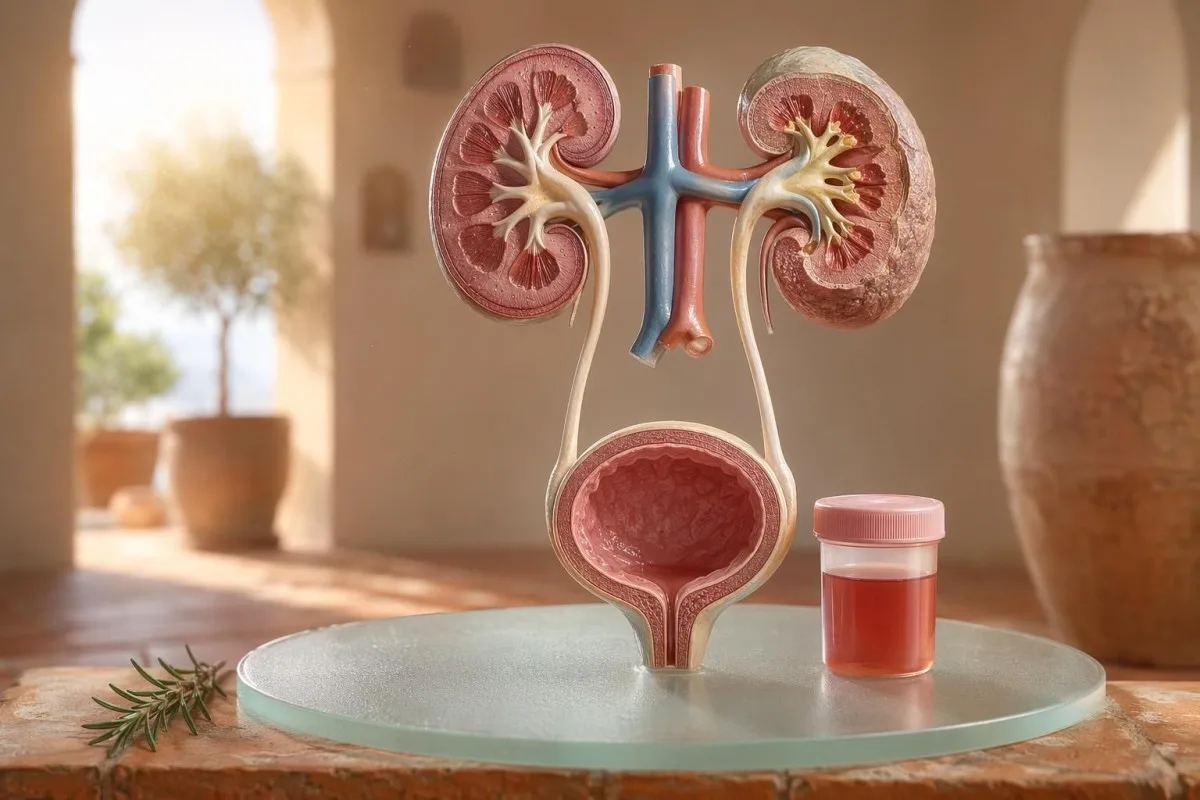
Panduan berasaskan pesakit untuk hematuria yang boleh dilihat dan mikroskopik, termasuk sebab darah pada dipstick tidak sama dengan sel darah merah di bawah mikroskop.


- Darah dalam air kencing bermaksud air kencing merah yang boleh dilihat, berwarna teh atau berwarna cola, atau hematuria mikroskopik yang ditemui semasa ujian; darah yang boleh dilihat sentiasa memerlukan susulan perubatan.
- Hematuria mikroskopik biasanya ditakrifkan sebagai 3 atau lebih sel darah merah per medan berkuasa tinggi pada sampel mikroskopi air kencing yang dikumpul dengan betul.
- Darah pada dipstick mengesan aktiviti heme, jadi ia mungkin positif daripada sel darah merah yang masih utuh, hemoglobin bebas atau myoglobin selepas kecederaan otot.
- Petunjuk UTI termasuk rasa pedih, kekerapan, esterases leukosit, nitrit dan sel darah putih; hematuria perlu diperiksa semula selepas jangkitan hilang.
- Sedimen air kencing dapatan seperti sel darah merah dismorfik, silinder sel darah merah atau protein yang ketara menunjukkan penyakit pada unit penapisan buah pinggang.
- Silinder air kencing ialah bahan teracu daripada tubul buah pinggang; cast sel darah merah adalah tanda amaran nefrologi dalam minggu yang sama, terutamanya jika disertai tekanan darah tinggi atau eGFR yang menurun.
- Tanda amaran kanser termasuk hematuria nyata tanpa sakit, ketulan darah, umur melebihi 45 tahun, sejarah merokok, pendedahan kimia pekerjaan dan episod berulang yang tidak dapat dijelaskan.
- Hematuria selepas bersenam biasanya reda dalam tempoh 48-72 jam; darah yang berterusan selepas rehat tidak seharusnya dipersalahkan pada larian atau berbasikal.
- Penilaian segera diperlukan untuk darah dalam air kencing bersama demam, sakit pinggang, ketulan yang menyebabkan penyumbatan kencing, kehamilan, trauma atau simptom anemia yang teruk.
Apa yang darah dalam air kencing maksudkan sebelum anda panik
Darah dalam air kencing boleh berpunca daripada jangkitan, batu, penyakit penapisan buah pinggang, keadaan prostat atau pundi kencing, ubat-ubatan, senaman, atau pencemaran daripada haid. Peraturan praktikalnya mudah: darah yang kelihatan, hematuria mikroskopik berulang, atau hematuria bersama sakit, demam, ketulan, tekanan darah tinggi, protein, atau fungsi buah pinggang yang berkurang memerlukan penilaian segera, bukan menunggu dengan pemerhatian.
Satu mangkuk tandas berwarna merah jambu selepas bit merah atau suplemen baharu bukan masalah klinikal yang sama seperti air kencing berwarna seperti cola selepas sakit tekak. Dalam amalan saya, kisah warna sering memberitahu saya tempat untuk melihat dahulu: merah terang dengan ketulan cenderung melibatkan salur kencing bahagian bawah, manakala air kencing coklat atau berwarna teh boleh bermaksud pigmen heme yang lebih lama daripada penapis buah pinggang.
Hematuria bukan diagnosis; ia merupakan tanda. Hematuria nyata bermaksud anda dapat melihat perubahan warna, manakala hematuria mikroskopik bermaksud air kencing kelihatan normal tetapi mikroskopi mendapati sel darah merah, biasanya pada 3 atau lebih sel darah merah setiap medan kuasa tinggi.
Kantesti ialah seorang Penganalisis ujian darah AI yang membantu pesakit menghubungkan dapatan air kencing dengan penanda buah pinggang seperti kreatinin, eGFR, CRP, hemoglobin dan platelet dalam satu garis masa. Jika warna mengelirukan, panduan warna air kencing menerangkan mengapa air kencing merah, coklat, oren dan kuning gelap tidak semuanya bermaksud perkara yang sama.
Darah pada dipstick tidak sama dengan RBC pada mikroskopi
Ujian dipstik air kencing yang ditanda darah positif mengesan aktiviti kimia seperti heme, bukan semestinya sel darah merah yang utuh. Mikroskopi menjawab soalan seterusnya: adakah terdapat RBC sebenar dalam sedimen air kencing, dan jika ya, bagaimana rupanya?
Ujian dipstik adalah pantas kerana pad reagen bertindak balas dengan aktiviti peroksidase heme. Ini bermakna hasil positif boleh berlaku dengan RBC yang utuh, hemoglobin bebas selepas pecahan sel darah merah, atau myoglobin selepas kecederaan otot yang ketara.
Mikroskopi lebih lambat tetapi lebih spesifik. Makmal yang teliti akan memusingkan air kencing, sedimen air kencing, dan melaporkan sel darah merah per medan kuasa tinggi; ramai klinisyen menggunakan 0-2 RBC/hpf sebagai normal dan 3 atau lebih RBC/hpf sebagai tidak normal pada orang dewasa.
Ketidakpadanan itu penting. Dipstik dengan darah 3+ dan 0-2 RBC/hpf membuatkan saya bertanya tentang rhabdomyolysis, hemolisis, bahan cemar pengoksida, dan pengendalian spesimen, bukannya terus melompat kepada penyakit pundi kencing; perbezaannya serupa dengan penaakulan dalam panduan kami perbandingan urinalisis dan kultur.
Bila petunjuk UTI menerangkan hematuria, dan bila ia tidak
Jangkitan saluran kencing boleh menyebabkan darah dalam air kencing, terutamanya dengan rasa pedih, urgensi, kekerapan, ketidakselesaan pelvis, leukocyte esterase, nitrit dan sel darah putih. Tetapi hematuria sepatutnya hilang selepas rawatan; RBC yang berterusan selepas UTI memerlukan pemeriksaan semula.
Dalam UTI bawah yang jelas, saya menjangka satu kelompok: disuria, kekerapan, leukocyte esterase positif, piuria selalunya melebihi 5-10 sel darah putih/hpf, dan kadangkala nitrit. Keputusan kultur positif tradisional ialah 100,000 CFU/mL, tetapi dalam wanita simptomatik, kiraan yang lebih rendah seperti 1,000-10,000 CFU/mL masih boleh bermakna secara klinikal.
Leukocyte esterase ialah enzim sel darah putih, bukan bukti bakteria. Keputusan positif bersama hematuria boleh berlaku akibat jangkitan, batu, kontaminasi, atau keradangan buah pinggang, sebab itulah panduan kami leukocyte esterase memisahkan petunjuk yang berguna daripada positif palsu yang biasa.
Nitrit lebih spesifik tetapi kurang sensitif kerana tidak semua bakteria menukar nitrat kepada nitrit. Jika simptom adalah tipikal tetapi nitrit negatif, kultur masih boleh positif; butiran praktikal diliputi dalam penerang keputusan nitrit.
Hematuria yang boleh dilihat: petunjuk warna, bekuan dan masa
Hematuria yang kelihatan tidak pernah sesuatu yang saya abaikan, walaupun ia berlaku sekali. Air kencing merah terang, ketulan, atau pendarahan tanpa sakit memerlukan penilaian segera kerana punca saluran kencing bawah menjadi lebih mungkin apabila usia dan pendedahan merokok meningkat.
Masa boleh menjadi sangat berguna. Darah hanya pada permulaan kencing mungkin menunjukkan uretra, darah di seluruh aliran boleh datang daripada punca pundi kencing atau buah pinggang, dan darah terminal berhampiran penghujung kadangkala menunjukkan kawasan leher pundi kencing.
Gumpalan biasanya bermaksud punca pendarahan berada di bawah penapis buah pinggang kerana gumpalan tidak mudah terbentuk selepas melalui glomeruli dan tubulus. Gumpalan yang menyekat aliran air kencing adalah kecemasan: distensi pundi kencing boleh menjadi menyakitkan dalam beberapa jam, dan penjagaan kateter mungkin diperlukan.
Lelaki kadangkala menganggap hematuria yang kelihatan selepas simptom kencing hanyalah iritasi prostat. Itu mungkin benar, tetapi jika PSA diperiksa semasa atau sejurus selepas jangkitan, tafsirannya boleh menjadi mengelirukan; kami Panduan PSA selepas UTI menerangkan mengapa ramai klinisyen menunggu 6-8 minggu sebelum mengulang PSA.
Ambang hematuria mikroskopik yang digunakan oleh doktor
Hematuria mikroskopik biasanya ditakrifkan sebagai 3 atau lebih RBC per medan kuasa tinggi pada spesimen air kencing yang dikumpul dengan betul. Garis panduan AUA/SUFU menggunakan ambang ini dan mengesyorkan penilaian berdasarkan risiko, bukannya merawat setiap pesakit dengan cara yang sama (Barocas et al., 2020).
Ujian dipstick sahaja tidak seharusnya digunakan untuk mendiagnosis hematuria mikroskopik. Dalam garis panduan AUA/SUFU Barocas et al. 2020, takrifannya bergantung pada mikroskopi kerana dipstick boleh menjadi positif daripada pigmen heme tanpa sel darah merah yang utuh.
Ujian ulangan bukanlah kelemahan; ia adalah perubatan yang baik. Jika seseorang mempunyai 3-10 RBC/hpf selepas senaman berat, demam, hubungan seks, haid, atau pengumpulan yang tercemar, saya biasanya mahu sampel ulangan yang bersih sebelum memesan imbasan, sama seperti yang kami nasihatkan untuk untuk makmal yang tidak normal berulang.
Risiko mengubah laluan. Seorang lelaki berusia 24 tahun dengan 4 RBC/hpf selepas larian separuh maraton tidak sama dengan lelaki berusia 68 tahun bekas perokok dengan 25 RBC/hpf pada dua spesimen, walaupun kedua-duanya secara teknikal memenuhi takrif hematuria.
Sedimen air kencing, protein dan silinder air kencing yang mengubah penilaian
Sedimen air kencing boleh mendedahkan sama ada hematuria berkemungkinan datang daripada penapis buah pinggang. Sel darah merah dismorfik, silinder sel darah merah, dan perubahan protein yang ketara mengalihkan kebimbangan kepada penyakit glomerular berbanding jangkitan pundi kencing yang mudah.
Sel darah merah yang kelihatan tidak sekata, berbintil (blebbed) atau berbentuk cincin dipanggil RBC dismorfik, dan ia menunjukkan laluan melalui penapis glomerular yang meradang. Acanthocytes melebihi kira-kira 5% sel darah merah urin sering dirawat sebagai petunjuk glomerular yang kuat, walaupun makmal berbeza dari segi tahap keyakinan yang mereka laporkan.
Protein ialah petunjuk kedua yang saya tidak abaikan. Nisbah albumin-kreatinin urin melebihi 30 mg/g, atau kira-kira 3 mg/mmol, adalah tidak normal, dan hematuria yang kelihatan bersama protein wajar semakan lebih cepat yang memfokuskan buah pinggang; kami panduan protein dalam air kencing memberikan ambang pada tahap pesakit.
Silinder air kencing ialah acuan kecil yang terbentuk di dalam tubulus buah pinggang. Silinder hialin boleh muncul selepas dehidrasi atau senaman, tetapi silinder sel darah merah adalah tidak normal dan biasanya menunjukkan glomerulonefritis; untuk rujukan urinalisis yang lebih luas, lihat kami panduan lengkap analisis air kencing.
Batu, senaman dan punca sementara hematuria
Batu dan senaman yang berat boleh menyebabkan hematuria, tetapi ia mempunyai garis masa yang berbeza. Hematuria berkaitan batu selalunya disertai sakit pinggang atau kristal, manakala hematuria akibat senaman biasanya akan reda dalam tempoh 48-72 jam selepas rehat.
Batu karang buah pinggang secara klasik menyebabkan gelombang sakit pinggang, loya, dan hematuria mikroskopik atau yang kelihatan. Kristal kalsium oksalat tidak membuktikan batu, tetapi ia meningkatkan kecurigaan apabila disertai sakit kolik; kami panduan kristal kalsium oksalat menerangkan petunjuk mikroskopi air kencing.
Hematuria akibat senaman adalah benar. Saya pernah melihat pelari maraton dengan 10-20 RBC/hpf pada pagi selepas perlumbaan, kultur normal, tiada protein, dan urinalisis ulangan yang benar-benar normal 3 hari kemudian.
Bahayanya ialah menyalahkan semuanya pada latihan. Jika hematuria berterusan melebihi 72 jam, muncul dengan urin berwarna gelap seperti cola, atau disertai CK yang tinggi, kreatinin yang meningkat, atau sakit otot, lihat di luar pundi kencing; kami panduan kreatinin semasa bersenam merangkumi pertindihan buah pinggang dan otot.
Tanda amaran merah buah pinggang yang doktor tidak abaikan
Hematuria bersama protein, tekanan darah tinggi, bengkak, eGFR berkurang, silinder sel darah merah atau kreatinin yang meningkat dengan cepat ialah tanda amaran buah pinggang. Dapatan ini menunjukkan unit penapisan mungkin sedang meradang, dan menunggu berbulan-bulan boleh menjejaskan fungsi buah pinggang.
KDIGO 2024 mentakrifkan penyakit buah pinggang kronik berdasarkan penanda kerosakan buah pinggang, seperti albuminuria, atau eGFR di bawah 60 mL/min/1.73 m² sekurang-kurangnya 3 bulan. Namun, dalam keadaan akut, hematuria bersama peningkatan kreatinin dalam tempoh hari atau minggu sudah memadai untuk meningkatkan tindakan sebelum takrif 3 bulan dipenuhi.
Albuminuria sering menjadi isyarat amaran awal. ACR 30-300 mg/g adalah peningkatan sederhana, melebihi 300 mg/g adalah peningkatan teruk, dan menggabungkan mana-mana satu dengan hematuria mengubah perbincangan; kami panduan ACR buah pinggang menerangkan mengapa albumin dalam air kencing mengesan kerosakan sebelum simptom.
Tekanan darah penting di sini. BP baharu 160/100 mmHg dengan air kencing seperti “cola” dan bengkak buku lali selepas jangkitan tekak membuatkan saya memikirkan glomerulonefritis, bukan sistitis; jika eGFR tidak pasti, kami panduan semakan semula GFR menerangkan bila cystatin C boleh menjelaskan fungsi buah pinggang.
Petunjuk risiko kanser tanpa panik
Hematuria kelihatan tanpa sakit, terutamanya selepas umur 45 tahun, memerlukan penilaian segera kerana kanser pundi kencing dan salur kencing atas boleh hadir dengan cara ini. NICE NG12 mengesyorkan rujukan disyaki-kanser untuk hematuria kelihatan yang tidak dapat dijelaskan pada orang dewasa berumur 45 tahun ke atas, atau hematuria kelihatan yang berterusan selepas rawatan UTI.
Kebanyakan hematuria bukan kanser. Namun, kes yang saya ingat ialah yang senyap: tiada sakit, tiada demam, tiada pedih, hanya dua episod air kencing merah pada perokok berusia 56 tahun yang hampir mengabaikannya.
Risiko terkumpul, bukan binari. Umur melebihi 45-50, sejarah merokok, pendedahan cyclophosphamide, radioterapi pelvis, hematuria kelihatan berulang, pendedahan pekerjaan kepada amina aromatik, dan ketulan semuanya meningkatkan keperluan untuk sistoskopi atau pengimejan.
Penanda prostat tidak menolak punca dari pundi kencing. Jika simptom kencing, perubahan PSA dan hematuria bertindih, semak masa dan status jangkitan dengan teliti; kami panduan penanda prostat menerangkan mengapa PSA hanya satu bahagian dalam penilaian saluran kencing lelaki.
Ubat-ubatan, antikoagulan dan penggera palsu
Ubat pencair darah boleh mendedahkan pendarahan, tetapi ia tidak seharusnya dipersalahkan secara automatik untuk hematuria. Hematuria berkaitan antikoagulan masih perlu dinilai kerana ubat itu mungkin mendedahkan batu, jangkitan, penyakit buah pinggang atau pertumbuhan dalam saluran kencing.
Warfarin, apixaban, rivaroxaban, aspirin dan clopidogrel boleh menjadikan pendarahan lebih ketara. Jika INR melebihi julat sasaran, pembetulannya penting, tetapi INR normal tidak menjadikan hematuria yang kelihatan tidak berbahaya.
Beberapa punca yang tidak menyebabkan pendarahan boleh meniru hematuria. Rifampicin boleh menjadikan air kencing jingga-merah, phenazopyridine boleh menjadikannya jingga terang, bit boleh mewarnakan air kencing pada individu yang mudah terdedah, dan dehidrasi boleh menggelapkan pigmen sehingga menakutkan pesakit; pemantauan antikoagulan diliputi dalam ujian keselamatan pencair darah.
Dipstick juga boleh mengelirukan selepas senaman berat atau kecederaan otot. Pad heme yang positif dengan sedikit atau tiada RBC mendorong pemikiran saya ke arah mioglobin, terutamanya jika CK melebihi 1,000 IU/L dan air kencing gelap.
Kanak-kanak, kehamilan dan pencemaran akibat haid
Hematuria pada kanak-kanak, kehamilan atau sekitar haid memerlukan pensampelan yang lebih bersih dan ambang yang lebih rendah untuk semakan. Keputusan air kencing yang sama boleh bermaksud perkara yang berbeza bergantung pada umur, status kehamilan, demam, tekanan darah dan kualiti pengumpulan.
Kontaminasi haid adalah perkara biasa dan tiada siapa sepatutnya berasa malu mengenainya. Jika keputusan tidak dijangka, ulangi sampel midstream clean-catch sekurang-kurangnya 48 jam selepas pendarahan berhenti; hematuria berterusan iaitu 3 atau lebih RBC/hpf menjadi lebih bermakna.
Kanak-kanak sering memerlukan pandangan yang berbeza. Hematuria selepas penyakit virus boleh bersifat sementara, tetapi hematuria bersama bengkak, tekanan darah tinggi, protein, atau pengeluaran air kencing yang berkurang memerlukan semakan pediatrik segera.
Kehamilan meningkatkan pertaruhan kerana UTI, batu, tekanan buah pinggang berkaitan preeclampsia dan kontaminasi boleh bertindih. Untuk corak amaran kehamilan pada hari yang sama yang melibatkan dapatan buah pinggang, hati, platelet dan air kencing, lihat bendera merah makmal kehamilan.
Ujian yang biasanya doktor lakukan selepas hematuria
Ujian seterusnya yang lazim selepas hematuria ialah urinalisis ulangan dengan mikroskopi, kultur air kencing jika jangkitan mungkin, ujian darah fungsi buah pinggang, protein air kencing atau ACR, pengukuran tekanan darah, serta pengimejan atau sistoskopi berdasarkan risiko. Urutan tepat bergantung pada simptom dan risiko.
Untuk simptom sistitis tidak rumit, kultur dan rawatan mungkin didahulukan, diikuti mikroskopi air kencing ulangan selepas simptom reda. Bagi hematuria kelihatan yang tidak menyakitkan, ramai klinisyen bergerak lebih awal ke arah pengimejan dan sistoskopi kerana menunggu episod berulang boleh melambatkan diagnosis.
Ujian darah menambah konteks yang tidak dapat diberikan oleh air kencing sahaja. Kreatinin, eGFR, urea atau BUN, elektrolit, CBC, CRP, komplemen C3/C4 dan penanda autoimun mungkin sesuai apabila keradangan buah pinggang disyaki; kami nisbah BUN/ kreatinin menerangkan satu corak buah pinggang yang biasa.
AI Kantesti boleh mengatur keputusan tersebut menjadi paparan arah aliran, tetapi semakan doktor kekal penting apabila terdapat tanda amaran. Pendekatan keselamatan klinikal kami diterangkan dalam Pengesahan Perubatan, termasuk cara kelompok yang tidak normal dikendalikan berbanding nombor terpencil.
Cara Kantesti membantu menyusun konteks hematuria
Kantesti ialah seorang perkhidmatan tafsiran ujian makmal AI yang membaca penanda darah yang hampir dengan air kencing dalam konteks, seperti kreatinin, eGFR, CRP, hemoglobin, platelet dan glukosa. Ia tidak mendiagnosis hematuria, tetapi ia membantu pesakit menyediakan ringkasan yang lebih bersih dan lebih berguna untuk doktor mereka.
Apabila saya menyemak hematuria, saya jarang melihat satu keputusan sahaja. Kreatinin normal 0.82 mg/dL, eGFR stabil melebihi 90, tiada protein dan kultur negatif terasa sangat berbeza daripada hematuria dengan eGFR 48 dan CRP 65 mg/L.
Kantesti ialah seorang platform tafsiran biomarker AI yang boleh memproses PDF ujian darah atau gambar yang dimuat naik dan menghubungkan penanda buah pinggang, keradangan dan anemia yang berada di luar julat dengan masa simptom. Kaedah di sebalik pembacaan corak itu diterangkan dalam Panduan Teknologi, dan liputan penanda yang lebih luas dihuraikan dalam panduan biomarker.
Satu tip praktikal: sebelum memuat naik, semak bahawa unit, tarikh dan pengecam pesakit ditangkap dengan betul. Ralat OCR boleh menukar 0.9 menjadi 9.0, iaitu kisah buah pinggang yang sama sekali berbeza; kami senarai semak muat naik PDF menunjukkan kesilapan yang saya minta pesakit tangkap dahulu.
Nota penyelidikan, tadbir urus dan senarai semak akhir
Sehingga 11 Julai 2026, pelan pesakit yang paling selamat ialah mengesahkan sama ada hematuria itu benar, mengenal pasti petunjuk jangkitan, mencari tanda amaran buah pinggang, dan mengeskalasi hematuria yang kelihatan atau berterusan. Jangan bergantung semata-mata pada warna air kencing.
Saya Thomas Klein, MD, dan nasihat saya sengaja bersifat konservatif kerana hematuria yang terlepas boleh menjadi penting. Kandungan perubatan Kantesti disemak dengan pengawasan klinikal daripada kami Lembaga Penasihat Perubatan, dan peranan kami adalah untuk membantu pesakit mengemukakan soalan yang lebih baik, bukan menggantikan doktor mereka.
Kantesti ialah seorang Alat analisis ujian darah berkuasa AI digunakan oleh berjuta-juta orang di seluruh 127 negara, jadi privasi dan kejelasan klinikal perlu dibina dalam aliran kerja, bukannya ditambah kemudian. Anda boleh membaca lebih lanjut tentang Kantesti LTD, struktur syarikat UK dan misi klinikal kami di Tentang Kami.
Kumpulan Penyelidikan Klinikal AI Kantesti. (2026). Penganalisis Ujian Darah AI: 2.5M Ujian Dianalisis | Laporan Kesihatan Global 2026. Zenodo. DOI: https://doi.org/10.5281/zenodo.18175532. ResearchGate: https://www.researchgate.net/. Academia.edu: https://www.academia.edu/.
Kumpulan Penyelidikan Klinikal AI Kantesti. (2026). Ujian Darah RDW: Panduan Lengkap untuk RDW-CV, MCV & MCHC. Zenodo. DOI: https://doi.org/10.5281/zenodo.18202598. ResearchGate: https://www.researchgate.net/. Academia.edu: https://www.academia.edu/.
Soalan Lazim
Adakah darah dalam air kencing sentiasa serius?
Darah dalam air kencing tidak semestinya serius, tetapi ia perlu disahkan dan dijelaskan. Keputusan mikroskopik sekali sahaja sebanyak 3-5 RBC/hpf selepas bersenam atau haid mungkin hilang pada ujian ulangan, manakala darah yang kelihatan, ketulan, demam, sakit pinggang, protein, tekanan darah tinggi atau eGFR yang menurun memerlukan semakan segera. Bagi orang dewasa yang berumur lebih 45 tahun, hematuria kelihatan tanpa sebab wajar dinilai secara segera walaupun tiada kesakitan.
Apakah perbezaan antara darah dipstick dan RBC dalam air kencing?
Ujian dipstick darah mengesan aktiviti kimia seperti heme, manakala mikroskopi air kencing mengira sel darah merah sebenar. Dipstick boleh menjadi positif daripada RBC yang masih utuh, hemoglobin bebas, atau myoglobin selepas kecederaan otot, jadi ia tidak sama dengan hematuria yang disahkan. Hematuria mikroskopik lazimnya ditakrifkan sebagai 3 atau lebih RBC per medan berkuasa tinggi pada sampel yang dikumpul dengan betul.
Bolehkah jangkitan saluran kencing (UTI) menyebabkan darah dalam air kencing?
Ya, jangkitan saluran kencing (UTI) boleh menyebabkan darah dalam air kencing, terutamanya apabila rasa pedih, kerap membuang air kecil, urgensi, esterase leukosit, nitrit dan sel darah putih juga ada. Keputusan kultur air kencing secara tradisional yang positif selalunya 100,000 CFU/mL, tetapi kiraan yang lebih rendah boleh menjadi penting dalam pesakit yang mempunyai simptom. Hematuria biasanya perlu diperiksa semula selepas rawatan kerana darah yang berterusan mungkin menunjukkan batu, penyakit buah pinggang atau punca lain bagi saluran kencing.
Bilakah saya perlu pergi ke rawatan segera untuk hematuria?
Dapatkan rawatan segera jika terdapat darah dalam air kencing bersama demam, sakit pinggang yang teruk, muntah, kehamilan, trauma baru-baru ini, ketulan darah, tidak dapat membuang air kencing, pengsan, atau simptom anemia yang teruk. Semakan perubatan dalam minggu yang sama juga sesuai untuk hematuria dengan protein, silinder sel merah, tekanan darah tinggi baharu atau kreatinin yang semakin meningkat. Aliran air kencing yang tersumbat akibat ketulan darah boleh menjadi menyakitkan dan tidak selamat dalam beberapa jam.
Bolehkah senaman menyebabkan hematuria mikroskopik?
Senaman yang berat boleh menyebabkan hematuria mikroskopik, terutamanya selepas larian jarak jauh, berbasikal yang sengit atau sukan kontak. Hematuria berkaitan senaman biasanya pulih dalam tempoh 48-72 jam selepas rehat dan tidak sepatutnya disertai dengan protein yang berterusan, penurunan eGFR, atau sakit otot yang teruk. Jika darah pada dipstick adalah positif tetapi mikroskopi menunjukkan sedikit RBC, doktor mungkin memeriksa CK kerana myoglobin akibat kecederaan otot boleh mencetuskan bacaan dipstick.
Apakah maksud silinder urin apabila darah ditemui?
Silinder urin ialah bahan berbentuk acuan yang terbentuk di dalam tubul buah pinggang, dan jenisnya mengubah maksud hematuria. Silinder hialin boleh muncul dengan dehidrasi atau senaman, tetapi silinder sel darah merah adalah tidak normal dan menunjukkan keradangan buah pinggang glomerular. Darah dalam air kencing bersama silinder sel darah merah, protein dan tekanan darah tinggi harus dirawat sebagai tanda amaran buah pinggang, bukan sebagai jangkitan kencing (UTI) yang mudah.
Bolehkah dehidrasi menyebabkan air kencing kelihatan seperti darah?
Dehidrasi selalunya menyebabkan air kencing berwarna kuning gelap atau perang, tetapi ia biasanya tidak menghasilkan sel darah merah dalam air kencing. Minum air dan aturkan ujian air kencing jika warnanya merah jambu, merah, perang, atau seperti minuman cola, terutamanya jika ia berterusan selepas penghidratan atau disertai kesakitan.
Dapatkan Analisis Ujian Darah Berkuasa AI Hari Ini
Sertai lebih 2 juta pengguna di seluruh dunia yang mempercayai Kantesti untuk analisis ujian makmal segera dan tepat. Muat naik keputusan ujian darah anda dan terima tafsiran menyeluruh biomarker 15,000+ dalam beberapa saat.
📚 Penerbitan Penyelidikan Dirujuk
Klein, T., Mitchell, S., & Weber, H. (2026). Penganalisis Ujian Darah AI: 2.5M Ujian Dianalisis | Laporan Kesihatan Global 2026. Kantesti Penyelidikan Perubatan AI.
Klein, T., Mitchell, S., & Weber, H. (2026). Ujian Darah RDW: Panduan Lengkap untuk RDW-CV, MCV & MCHC. Kantesti Penyelidikan Perubatan AI.
📖 Rujukan Perubatan Luaran
Institut Kebangsaan untuk Kesihatan dan Kecemerlangan Penjagaan (NICE) (2015). Kanser yang disyaki: pengiktirafan dan rujukan. Garis panduan NICE NG12. Garis Panduan NICE.
Kumpulan Petugas CKD Kidney Disease: Improving Global Outcomes (2024). Garis Panduan Amalan Klinikal KDIGO 2024 untuk Penilaian dan Pengurusan Penyakit Buah Pinggang Kronik. Kidney International.
⚕️ Penafian Perubatan
Artikel ini adalah untuk tujuan pendidikan sahaja dan tidak merupakan nasihat perubatan. Sentiasa rujuk pembekal penjagaan kesihatan yang berkelayakan untuk keputusan diagnosis dan rawatan.
Isyarat Kepercayaan E-E-A-T
Pengalaman
Semakan klinikal yang diketuai oleh doktor terhadap aliran kerja tafsiran makmal.
Kepakaran
Fokus perubatan makmal tentang bagaimana biomarker berkelakuan dalam konteks klinikal.
Kewibawaan
Ditulis oleh Dr. Thomas Klein dengan semakan oleh Dr. Sarah Mitchell dan Prof. Dr. Hans Weber.
Kebolehpercayaan
Tafsiran berasaskan bukti dengan laluan susulan yang jelas untuk mengurangkan kebimbangan.