ランナーズ血尿:運動後のピンク色の尿について

カテゴリー
記事
スポーツ医学 尿検査 2026年の更新 患者さん向け

A pink or tea-coloured urine sample after a long run is often temporary exercise-induced hematuria, but visible colour should never be automatically dismissed. The timing, microscope findings, symptoms, and a properly rested repeat sample tell the real story.

📖 約11分 📅
📝 公開: 🩺 医学的監修: ✅ エビデンスに基づく
⚡ 簡単な概要 v1.0 —
  1. 運動誘発性血尿 usually clears within 24–72 hours after strenuous running; persistence beyond 72 hours needs medical review.
  2. Microscopy threshold of 3 or more red blood cells per high-power field in a properly collected urine sample meets the AUA definition of microhematuria.
  3. Dipstick mismatch matters: a positive blood pad with zero to two red cells per high-power field suggests myoglobin or free hemoglobin rather than urinary bleeding.
  4. 繰り返しのタイミング is practical: avoid hard exercise for 48–72 hours, hydrate normally, then provide a midstream urine sample.
  5. 当日中の評価 is sensible for clots, inability to pass urine, fever, one-sided severe flank pain, or cola urine with marked muscle pain.
  6. Kidney warning pattern is blood plus protein, red-cell casts, high blood pressure, or a falling eGFR—not an isolated post-race dipstick.
  7. Rhabdomyolysis clue is disproportionately dark urine with severe muscle symptoms and a creatine kinase result often above 5 times the laboratory upper limit.
  8. Cancer-risk context changes the threshold for investigation: age, smoking exposure, prior pelvic radiation, and persistent visible hematuria all matter.

Why a run can make urine look pink

Runner’s hematuria is usually a short-lived leakage of red cells into urine after vigorous exercise, often resolving within 24–72 hours of rest. Still, visible pink, red, or cola-coloured urine deserves a properly collected repeat test rather than a casual assumption that running caused it.

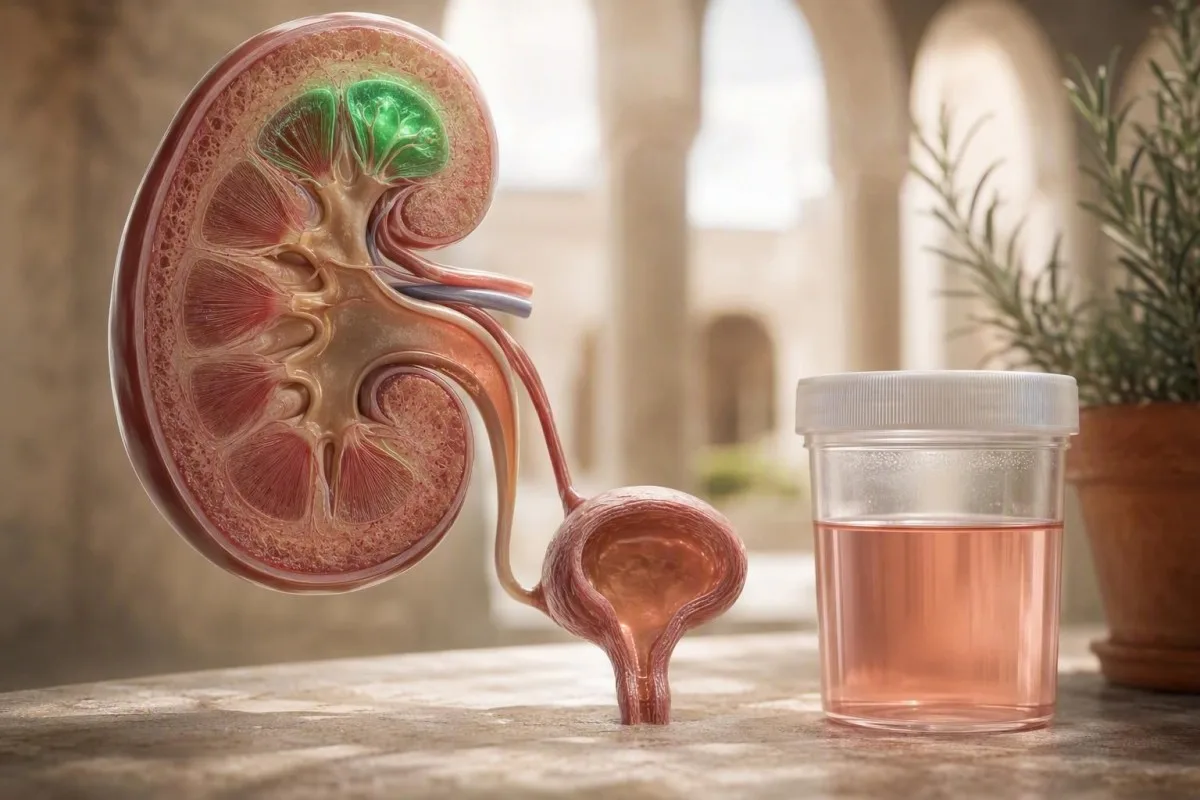
Hematuria shown as a pink urine specimen beside a kidney cross-section model
図1: Kidney filtration structures and a pink urine specimen represent post-run hematuria.

In clinic, the reassuring pattern is straightforward: colour change begins after an unusually long, fast, or downhill run; there is no fever, colicky flank pain, or urinary burning; and microscopy normalises after rest. KantestiはAI血液検査アナライザーです that can place related kidney markers—creatinine, eGFR, electrolytes, and creatine kinase—beside the exercise history, rather than treating one post-race result as a diagnosis.

The proposed mechanisms are mechanical bladder-wall contact, temporary renal blood-flow shifts, dehydration-related concentration, and occasionally red-cell breakdown from repetitive foot strike. The evidence for each mechanism is honestly mixed, because most studies are small and use different race distances. In my 15 years of clinical practice, the history of a new effort matters more than the colour alone; a first ultramarathon and a familiar 5 km do not carry the same pre-test probability.

Visible blood in urine after exercise is not synonymous with benign runner’s hematuria. A broader hematuria red-flag guide is useful because kidney stones, infection, glomerular disease, and urinary-tract cancers can coincidentally first declare themselves after a run.

The practical definition

Exercise-induced hematuria means red cells appear in urine soon after exertion and disappear on a rested repeat sample. A positive dipstick alone does not prove this diagnosis, because the reagent detects heme pigment from intact red cells, free hemoglobin, or myoglobin.

Is it hematuria, hemoglobin, or myoglobin?

A urine dipstick that reads positive for blood can reflect red cells, hemoglobin, or myoglobin, and microscopy separates them. Pink urine with many intact red cells supports hematuria; dark brown urine with few or no red cells raises concern for pigment from muscle injury or hemolysis.

Microscopic comparison of urinary red cells and muscle pigment signal in hematuria testing
図2: Microscopy distinguishes urinary red cells from heme pigment without intact cells.

Urine microscopy showing 3 or more red blood cells per high-power field confirms microhematuria when the sample is cleanly collected. By contrast, a strongly positive dipstick with 0–2 red cells per high-power field should make a clinician consider myoglobinuria, particularly after heat exposure, a crush-type muscle load, or severe delayed muscle pain. Brown or cola colour is more typical of concentrated pigment than a small amount of bladder bleeding.

Myoglobin matters because it can accompany rhabdomyolysis and acute kidney injury. A creatine kinase concentration above 5 times the laboratory upper limit of normal is commonly used as a biochemical threshold for rhabdomyolysis, though symptoms, potassium, creatinine, and urine output determine urgency. See our practical explanation of dangerously high creatine kinase for the patterns that should not wait overnight.

Food dyes, beetroot, blackberries, rifampicin, phenazopyridine, and dehydration can also colour urine without red cells. A 濃い尿の鑑別診断 helps avoid the common mistake of assuming every reddish sample represents blood.

Why the distinction changes care

Red-cell hematuria directs attention to the urinary tract, whereas myoglobinuria directs attention to skeletal muscle and kidney protection. Both can occur after endurance events, but only microscopy and targeted blood work can sort them reliably.

How to read a post-run urinalysis result

The most informative post-run urine test combines dipstick, microscopy, protein measurement, and specific gravity. Blood on dipstick with transient red cells and no protein is often low risk; blood plus protein or casts needs a more deliberate kidney assessment.

Urinalysis components arranged around a pink-tinted specimen for hematuria assessment
図3: Dipstick, microscopy, protein, and concentration results answer different clinical questions.

A dipstick blood result is reported as negative, trace, 1+, 2+, or 3+, but it is a screening signal rather than a cell count. The AUA defines microhematuria as more than 3 red blood cells per high-power field on microscopic examination, not a dipstick result alone (Barocas et al., 2020). This distinction avoids sending runners into an unnecessary cancer work-up after a false-positive screen.

Specific gravity above 1.030 indicates concentrated urine in many laboratories and can make colour look more alarming, but it does not explain away confirmed red cells. Protein of 1+ or greater should be quantified with a urine albumin-creatinine ratio or protein-creatinine ratio; transient exercise proteinuria exists, yet persistent albuminuria changes the differential toward glomerular disease. Our 完全な尿検査ガイド explains why these markers should not be merged into one result.

Kantesti AI interprets creatinine and eGFR alongside urine findings, exercise timing, and prior values; a single slightly raised creatinine after a hot race is not equivalent to chronic kidney disease. In practice, I ask for the distance, terrain, temperature, anti-inflammatory use, menstrual timing, and whether the sample was given within 2 hours of finishing.

Rested microscopy 0–2 RBC/HPF No microhematuria by AUA definition in a clean sample.
Microhematuria ≥3 RBC/HPF Repeat after exercise abstinence and assess risk factors.
Blood plus protein ≥3 RBC/HPF with ≥1+ protein Consider renal-focused testing, especially if persistent.
Pigment injury concern Strong dipstick blood with 0–2 RBC/HPF and CK >5× ULN Prompt clinical assessment for muscle injury and kidney effects.

When should you repeat a urine test after running?

Repeat urine testing 48–72 hours after the last hard run is a sensible default for suspected runner’s hematuria. Use a first-morning or well-hydrated midstream sample, but do not force litres of water immediately beforehand because extreme dilution can obscure useful findings.

Rested runner preparing a clean midstream urine sample for hematuria retesting
図4: A rested, clean-catch sample reduces exercise and collection-related false alarms.

For a routine post-race abnormality, I usually recommend no intervals, hills, heavy lifting, or races for 48時間; after a marathon, ultramarathon, heat illness, or unusual soreness, 72時間は激しい運動を避けてください。 is more defensible. Ordinary drinking to thirst is enough. Overhydration can lower specific gravity below 1.005 and occasionally make a borderline result harder to interpret.

If microscopy remains positive after 72 hours, arrange primary-care review within days rather than repeatedly testing after workouts. Persistent results warrant blood pressure measurement, serum creatinine/eGFR, urine albumin-creatinine ratio, and consideration of culture or imaging according to risk. The relationship between exertion, hydration, and a temporarily lower filtration estimate is covered in our post-exercise eGFR guide.

A 52-year-old recreational marathoner I saw had 18 red cells per high-power field the evening after a hot race, but 0–1 red cells after 72 rested hours; his creatinine returned from 1.28 mg/dL to 0.96 mg/dL. The result was reassuring, but the same plan would not be enough for a 52-year-old smoker with repeat visible urine colour.

Do not test at the finish line if you can avoid it

Testing immediately after exercise maximises the chance of finding temporary red cells, concentrated urine, and protein. That can be clinically useful in suspected rhabdomyolysis, but it is a poor time to establish a runner’s baseline.

Which post-run hematuria patterns are usually reassuring?

A self-limited episode after intense running is more reassuring when it clears completely, lacks pain or systemic symptoms, and has no proteinuria or kidney-function change. Reassuring does not mean ignored; it means confirmed with a rested sample.

Runner reviewing a normalised urine test after transient exercise-induced hematuria
図5: Resolution on a rested repeat sample is the most reassuring runner’s pattern.

The lower-risk phenotype is a younger or middle-aged runner with a clear exertional trigger, normal blood pressure, no smoking history, and normal rested microscopy. In that setting, a single transient result of 3–10 RBC/HPF after a race often settles without treatment. I would still document it, because recurrence after every long run deserves a more careful review than a one-off event.

A normal urine albumin-creatinine ratio is generally below 30 mg/g (below 3 mg/mmol), although laboratories and countries report units differently. Blood without albumin, casts, or dysmorphic red cells points away from glomerular leakage; it does not prove a bladder source, but it guides the next question. Our explanation of 尿中蛋白 covers this division clearly.

Bladder trauma is more plausible when urine is very concentrated and the runner finishes with an almost empty bladder. Some sports clinicians suggest voiding before a long run and drinking regularly, but this is prevention advice with limited trial evidence—not a substitute for evaluation when colour persists.

A normal result has a time stamp

A negative test 3 days after a race is reassuring for that episode, not a lifetime guarantee. New visible hematuria months later should be assessed on its own merits, particularly after age 40 or with smoking exposure.

Warning signs that make runner’s hematuria less likely

Hematuria needs prompt evaluation when it persists after 72 hours, recurs without hard exercise, or appears with pain, fever, clots, protein, or kidney-function change. The combination of findings is more informative than a dramatic-looking sample by itself.

Kidney and urinary tract illustration showing warning features alongside hematuria sample
図6: Persistent blood, protein, pain, or clots shift concern beyond temporary exertional change.

Seek timely medical advice for visible red urine that lasts beyond 24時間, even if you feel well; the threshold is lower for people over 40, current or former smokers, or those with prior pelvic radiation. The AUA guideline uses risk stratification based on age, smoking, degree and persistence of microscopic blood, and prior gross hematuria rather than treating all microhematuria identically (Barocas et al., 2020).

Dysmorphic red cells, red-cell casts, significant albuminuria, new hypertension, or a reduced eGFR suggest a kidney-filter source rather than a jostled bladder. Red-cell casts are never an expected consequence of ordinary running and should prompt expedited renal assessment. See our overview of granular and urinary casts for why sediment findings matter.

Thomas Klein, MD, advises runners not to self-triage with colour alone: a urinary tract infection may cause burning, urgency, pyuria, and sometimes hematuria, while stones more often create abrupt one-sided pain and nausea. A culture is most helpful before antibiotics when infection symptoms are present.

The blood-plus-protein combination

Confirmed hematuria with proteinuria is more concerning than isolated hematuria because both may originate at the glomerular filter. A urine albumin-creatinine ratio of 30 mg/g or higher should be repeated and interpreted with blood pressure and kidney function.

When does pink urine after exercise need same-day care?

Get same-day urgent assessment for clots, inability to urinate, severe flank pain, fever, faintness, reduced urine output, or dark urine with severe muscle pain and weakness. These features point beyond uncomplicated exercise-induced hematuria.

Clinical triage scene for severe post-exercise dark urine and kidney warning symptoms
図7: Urgent triage is appropriate when urinary colour change accompanies severe systemic symptoms.

Clots can obstruct urine flow, and inability to pass urine is an urgent problem regardless of athletic fitness. Fever of 38.0°C以上の発熱は、
with flank pain can indicate an upper urinary infection; severe colicky pain with vomiting can indicate a stone. Neither situation should be managed by waiting for a post-run repeat test.

Dark brown urine after exertion plus marked muscle tenderness, weakness, swelling, or reduced output raises concern for rhabdomyolysis. Initial testing commonly includes creatine kinase, creatinine, potassium, calcium, phosphate, and urinalysis. A CrossFit横紋筋融解症ガイド is relevant because unaccustomed eccentric exercise—not running alone—is a frequent trigger.

Severe dehydration can make kidney results look worse, but it can also coexist with real injury. If you are dizzy, confused, cannot keep fluids down, or urinate very little for 8–12時間, do not attempt to solve the problem with sports drinks at home.

Pregnancy and anticoagulants

Pregnant runners and people taking anticoagulants should report visible hematuria promptly. Anticoagulants can amplify bleeding but do not remove the need to identify its source; pregnancy also changes the threshold for checking infection, stones, and kidney disease.

Conditions a run can reveal rather than cause

Running may expose an existing urinary problem by concentrating urine or prompting a test, rather than causing the hematuria itself. Stones, infection, glomerular disease, structural abnormalities, and malignancy remain part of the differential diagnosis.

Anatomical urinary tract cross-section illustrating stone, infection, and kidney filter causes of hematuria
図8: A run can uncover urinary conditions that are not caused by exercise.

Kidney stones frequently cause unilateral flank-to-groin pain, nausea, and red cells on microscopy, although painless stones occur. Urinary infection more often produces burning, frequency, urgency, and white cells; a negative nitrite result does not rule it out. Our guide to leukocyte esterase with negative nitrite explains this common mixed pattern.

Glomerulonephritis can present after an upper-respiratory infection with cola urine, swelling, elevated blood pressure, proteinuria, and dysmorphic red cells. In the KDIGO 2024 CKD guideline, persistent albuminuria and reduced eGFR are treated as complementary kidney-risk markers, not interchangeable measurements (KDIGO, 2024).

KantestiはAIを活用した血液検査の解析ツールです that helps users recognise a pattern across creatinine, eGFR, albumin, electrolytes, and a CBC, but it cannot diagnose the anatomic source of hematuria. Imaging, microscopy, culture, and clinician examination still do the decisive work.

Cancer is uncommon in young runners, not impossible in adults

Visible hematuria warrants evaluation even when exercise seems like an obvious explanation, especially in people with smoking exposure or persistent symptoms. Risk increases with age and cumulative tobacco exposure, which is why identical urine results do not lead to identical testing plans.

Who needs urology or nephrology follow-up?

Persistent hematuria after a rested repeat sample should be risk-assessed for urology, while hematuria plus proteinuria, casts, hypertension, or impaired eGFR points toward nephrology. Many people need only primary-care-led repeat testing; the referral depends on the pattern.

Clinical referral pathway showing kidney-filter and urinary-tract evaluation for persistent hematuria
図9: Urine sediment and kidney markers help direct urology versus nephrology review.

Urology assessment is particularly appropriate for recurrent visible hematuria, persistent microscopic hematuria, a history of smoking, occupational aromatic-amine exposure, previous pelvic radiation, or urinary symptoms without infection. Depending on risk, clinicians may use renal and bladder ultrasound, CT urography, and cystoscopy. A single post-race trace dipstick in a 24-year-old is a very different scenario from recurrent red urine in a 58-year-old former smoker.

Nephrology review becomes more likely with urine albumin-creatinine ratio ≥30 mg/gであることはCKDを支持します。一方、48時間でのクレアチニン上昇が, eGFR below 未満であればCKDを示唆し、さらに lasting 3 months or longer, red-cell casts, or difficult-to-control blood pressure. Those cutoffs matter because chronic kidney disease is defined by duration as well as a single measurement. Read our 慢性腎臓病のステージガイド for the practical categories.

Kantesti's AI lab test interpretation service can flag a repeatable blood-and-protein pattern for discussion, particularly when users upload results from different laboratories. It should support, not replace, a clinician deciding whether urinary imaging or specialist examination is needed.

Do not let anticoagulation end the conversation

Anticoagulant use changes bleeding severity but does not establish a cause for hematuria. In my experience, attributing recurrent urine blood to apixaban, warfarin, or aspirin without a work-up can delay recognition of stones, infection, or structural disease.

Which blood tests help after exercise-related hematuria?

The useful blood tests depend on symptoms: creatinine, eGFR, electrolytes, and creatine kinase assess kidney and muscle stress, while a CBC evaluates anemia or infection clues. Routine broad panels are less helpful than targeted testing after a precise history and urinalysis.

Targeted kidney and muscle laboratory markers for evaluating exercise-related hematuria
図10: Kidney function, electrolytes, CBC, and creatine kinase provide complementary safety checks.

Creatinine can rise transiently after endurance exercise because of muscle metabolism, reduced kidney perfusion, and dehydration. eGFR equations are less reliable during rapid creatinine change, which is why a repeat value after 48〜72時間 of ordinary recovery is often more meaningful than a finish-line result. Our exercise-related creatinine recheck guide gives context for this frequent anxiety trigger.

Creatine kinase has a wide post-exercise range: trained athletes can show elevations after a race without kidney injury, while values many-fold above the local upper limit plus symptoms deserve urgent assessment. Potassium above 6.0 mmol/Lを超える is potentially dangerous and requires urgent clinical evaluation, especially if kidney function is impaired or muscle injury is suspected.

A CBC is most useful when there is fatigue, pallor, heavy menstrual bleeding, recurrent hematuria, or concern for systemic illness. Hemoglobin can fall after endurance events from plasma-volume expansion, iron loss, or hemolysis; ferritin should be interpreted away from acute inflammation and hard training. Endurance runners may find our athlete blood-test overview useful for a sensible baseline.

Do not diagnose kidney disease from one race-week panel

A creatinine rise of 0.3 mg/dL or more can meet an acute kidney injury criterion in the right time frame, but context and repeat testing are decisive after a race. Low urine output, rising potassium, and persistent elevation carry more weight than an isolated borderline result.

How to collect a repeat urine sample that doctors can trust

A clean-catch midstream urine sample after 48–72 hours without strenuous exercise is the best way to check whether hematuria has resolved. Collection errors, menstrual contamination, and an old specimen can create misleading results.

Clean-catch urine collection materials prepared for accurate hematuria repeat testing
図11: Correct clean-catch collection reduces contamination and improves result interpretation.

Wash hands, begin urinating into the toilet, then collect the midstream portion without touching the inside of the container. Deliver the sample promptly—ideally within 2時間—or follow the laboratory’s refrigeration instructions. Prolonged standing changes cell appearance and can make microscopy less reliable.

Avoid testing during active menstruation where possible; if testing cannot wait, tell the clinician and laboratory. Vaginal contamination can produce apparent red cells and protein, while squamous epithelial cells often signal a poorly collected sample. Our guide to 尿中の上皮細胞 explains why this is not a trivial lab footnote.

Thomas Klein, MD, recommends recording four details alongside the specimen: the last strenuous session, event duration, outdoor temperature, and all medicines taken in the prior 72 hours. A result without timing is much harder to interpret—especially when the urine is collected after a double workout.

First-morning versus daytime testing

A first-morning sample is concentrated and good for detecting small abnormalities, but a normally hydrated daytime midstream sample is acceptable if collection is cleaner. Consistency matters more for serial comparison: use roughly the same conditions at each repeat.

Hydration, pain medicines, and supplements that change the picture

Dehydration can concentrate urine and increase renal stress, while NSAIDs can reduce kidney blood flow during endurance exercise. Neither factor proves the cause of hematuria, but both influence how cautiously clinicians interpret a post-run result.

Runner hydration bottle, anti-inflammatory tablets, and kidney safety lab materials around hematuria assessment
図12: Hydration status and anti-inflammatory medicines can alter post-exercise kidney interpretation.

For most runners, drinking to thirst and replacing losses gradually is safer than rigidly forcing fluids. Very low sodium from excessive water intake can be dangerous; serum sodium below 125 mmol/L未満 with headache, vomiting, confusion, or seizures is an emergency. Urine colour is a rough hydration clue, not a precise hydration meter.

Ibuprofen, naproxen, and other NSAIDs can reduce prostaglandin-mediated kidney blood flow, especially during heat stress, vomiting, or long events. I advise patients to avoid routine prophylactic NSAIDs before marathons unless their own clinician has given a clear reason. The medication context is explored in our lab trend safety article.

High-dose vitamin C can interfere with certain urine dipstick reactions, and supplements marketed for performance sometimes contain unlisted stimulants or diuretics. Bring the containers or clear photographs to an appointment; it is often more useful than trying to remember a branded powder’s ingredient list. Our supplement safety guide for athletes offers a sensible checklist.

Hydration is not a treatment for persistent blood

Water may correct concentration, but it does not treat a stone, infection, glomerular process, or structural urinary source. If red cells remain on a rested, well-collected sample, escalation should be based on the pattern rather than another hydration experiment.

Can you keep running after exercise-induced hematuria?

Most runners can return gradually once urine colour has normalised, symptoms are absent, and a rested repeat sample is reassuring. Do not return to hard training while urine remains visibly red, kidney results are abnormal, or muscle symptoms suggest rhabdomyolysis.

Runner returning gradually to training after resolved exercise-induced hematuria testing
図13: A gradual return follows symptom resolution and a reassuring rested urine result.

After an uncomplicated single episode, I usually suggest easy running only for several days, then a gradual rebuild of volume and intensity over 7〜14日以内に、. The runner should stop and seek review if colour recurs, pain develops, or urine output falls. This is a pragmatic clinical approach, not a trial-proven prescription.

Repeated hematuria after the same distance may justify practical experiments: avoid racing dehydrated, urinate before a long run, introduce downhill training more slowly, and review shoe fit or terrain. Keep a log of pace, heat, duration, urine colour, and sample results. A マラソン走者の検査ガイド can help distinguish recovery markers from reasons to pause training.

Do not train through unexplained visible hematuria merely because you have an event scheduled. Athletes are often excellent at tolerating discomfort; the more difficult skill is recognising that persistence is diagnostic information, not a toughness test.

Build a real baseline

A baseline urinalysis and kidney panel taken at least 72 hours from hard training can make future post-race results far easier to interpret. This is especially useful for ultrarunners, people with one kidney, or athletes using medicines that affect kidney perfusion.

What to tell your clinician about blood in urine after exercise

The fastest route to a useful hematuria assessment is a concise timeline: urine colour, exercise dose, symptoms, medicines, and repeat-test timing. Bring actual laboratory values rather than only a message that the sample was “positive for blood.”

Patient hands sharing a structured post-run hematuria timeline during a clinical consultation
図14: A precise exercise and symptom timeline makes hematuria evaluation more efficient.

State whether the urine was pink, bright red, tea-coloured, or contained clots; whether colour appeared before, during, or after exercise; and whether it cleared after the first void. Include burning, urgency, fever, flank pain, nausea, swelling, and reduced output. A detailed urine colour reference can help describe the observation accurately without overinterpreting it.

Bring previous urinalyses, creatinine/eGFR values, blood pressure readings, smoking history, family kidney history, and a medication/supplement list. KantestiはAIバイオマーカー解釈プラットフォームです that can organise repeated blood-test values and highlight meaningful changes, but a clinician must connect those values with urine microscopy and examination.

As of September 3, 2026, the clinical principle remains simple: exercise is a plausible explanation only after the result resolves and competing clues are absent. If you are uncertain, ask whether you need microscopy, culture, albumin-creatinine ratio, repeat creatinine, imaging, or referral—not just another dipstick.

尋ねる価値のある質問

Ask whether intact red cells were seen, whether protein or casts were present, and when a rested repeat should occur. Those three answers usually clarify whether the next step is watchful follow-up, kidney testing, infection testing, or a urologic evaluation.

A sensible action plan for runner’s hematuria

For one painless episode after hard running, rest from strenuous exercise for 48–72 hours and repeat a clean-catch urinalysis; seek earlier care for red flags or persistent visible colour. The goal is neither panic nor dismissal—it is proving that the finding resolves.

Step one: stop hard training, hydrate normally, and note the timing and symptoms. Step two: repeat microscopy after 48〜72時間. Step three: if blood persists, or if protein, casts, pain, fever, clots, low urine output, or abnormal kidney markers appear, arrange medical assessment promptly. This sequence prevents both missed illness and needless imaging after a one-off finish-line sample.

When our clinical team reviews uploaded laboratory data, we prioritise patterns: a rising creatinine plus high CK and low urine output is more urgent than a stable creatinine with a transient urine dipstick. Kantesti’s methodology and safeguards are described in our 臨床的妥当性に関する情報, and our physician oversight is detailed through the 医療諮問委員会.

Most patients find that a timed repeat test turns an alarming colour change into a clear plan. But if your instinct says something is off—especially if the urine is still red tomorrow—trust that signal and get assessed.

The one-sentence rule

Pink urine once after a hard run may be transient; pink urine that persists, recurs, or arrives with symptoms is hematuria until properly evaluated.

よくある質問

ランナー血尿はどのくらい続きますか?

ランナー性血尿は、激しい運動を中止してから通常24~72時間以内に消失します。実用的な再尿検査は、激しいランニングや重い物 lifting を48~72時間行わない期間に採取した、クリーンキャッチ・ミッドストリーム検体です。24時間以上持続する目に見えるピンク色または赤色の尿、あるいは72時間後も残存する鏡検的血尿は、臨床医による評価を受けるべきです。発熱、血塊、重度の腰痛、尿量減少、または重度の筋肉痛は、当日の評価を正当化します。.

運動後の尿に血が混じるのは正常ですか?

運動後の尿中血は、激しいランニング、脱水、膀胱壁への衝撃、または一時的な腎臓血流の変化による一過性の影響である可能性がありますが、自動的に正常というわけではありません。高倍率視野で赤血球が3個以上確認される顕微鏡検査は、AUAの微量血尿の定義に該当します。安静にした再検査で消失する結果は安心材料ですが、持続する血尿、タンパク尿、円柱、痛み、または尿路症状はさらなる評価が必要です。肉眼で見える尿の色は、特に喫煙歴のある成人や再発エピソードがある場合は、常に報告されるべきです。.

脱水症状は、ランニング後の尿のピンク色の原因となりますか?

脱水は尿を濃く見せ、尿中の成分を濃縮することで運動後の血尿所見を増幅させる可能性がありますが、脱水だけでは確認された赤血球を確実に説明することはできません。多くの検査室では、尿比重が1.030を超えると尿が濃縮されていることを示します。過剰な水分で結果を洗い流そうとするのではなく、喉の渇きを感じるまで通常通り水分を摂取し、48〜72時間の休息後に清潔採取検体を再度採取してください。ひどい喉の渇き、めまい、尿量の極端な低下、または錯乱は、速やかな医学的評価が必要です。.

運動後の血尿とミオグロビン尿の違いは何ですか?

血尿は尿中に赤血球がそのまま存在することを意味するのに対し、ミオグロビン尿は筋肉損傷後に放出される筋肉色素を反映します。どちらの状況でも試験紙は陽性となる可能性があるため、顕微鏡検査が決定的な方法となります。ミオグロビン尿では、高倍率視野あたり赤血球が0〜2個でも試験紙が陽性となることがよくあります。激しい筋肉痛、脱力感、腫れ、コーラ色の濃い尿、またはクレアチンキナーゼ値が検査室の上限値の5倍を超える場合は、横紋筋融解症が懸念されます。このパターンは、カリウムと腎機能が急速に変化する可能性があるため、緊急の臨床評価が必要です。.

運動誘発性血尿がある場合、ランニングを中止すべきですか?

尿の色が正常に戻り、通常48〜72時間後の安静にした状態での再検査を完了するまで、激しいランニングは中止してください。再検査の検体が正常で、痛み、発熱、血栓、タンパク尿、または腎機能異常がない場合、ほとんどのランナーは14日〜7日かけて徐々に再開できます。尿が目に見えて赤または暗いまま、尿量が減少している、または重度の筋肉症状がある場合は、激しいトレーニングを再開しないでください。同様のワークアウトの後に繰り返されるエピソードは、各エピソードが解決した場合でも、医学的なレビューに値します。.

血尿はいつ泌尿器科医の診察が必要ですか?

休息後の反復検体でも持続する微小血尿、再発性の肉眼的血尿、または喫煙歴、骨盤部への放射線療法歴、もしくは尿路症状のある人における血尿は、しばしば泌尿器科的リスク評価を必要とします。泌尿器科医は、すべての人に一つの検査を用いるのではなく、年齢や全体的なリスクに応じて超音波検査、CT尿路造影、膀胱鏡検査を考慮することがあります。アルブミン尿が30 mg/g以上、赤血球円柱、高血圧、またはeGFRが60 mL/min/1.73 m²未満の血尿は、より強く腎臓内科を示唆します。適切な専門科は、完全な尿検査および血液検査のパターンによって決まります。.

今日、AIによる血液検査分析を

いますぐ利用しませんか。即時で正確な検査分析を提供するKantestiを信頼する、世界中の200万人以上のユーザーに参加してください。血液検査結果をアップロードすると、15,000+のバイオマーカーについて数秒で包括的な解釈が得られます。.

📚 Referenced Research Publications

1

Klein, T., Mitchell, S., & Weber, H. (2026). Multilingual AI Assisted Clinical Decision Support for Early Hantavirus Triage: Design, Engineering Validation, and Real-World Deployment Across 50,000 Interpreted Blood Test Reports.。 Kantesti AI Medical Research.

2

Klein, T., Mitchell, S., & Weber, H. (2026). 100,000件の合成テストケースにおけるKantesti血液検査解釈エンジンのための、事前登録・ルーブリックベースの自動化技術ベンチマーク.。 Kantesti AI Medical Research.

📖 外部の医学的参考文献

3

Barocas DA ほか(2020)。. 微小血尿:AUA/SUFUガイドライン.。.

4

腎疾患:世界的アウトカム改善(KDIGO)CKDワーキンググループ(2024年)。. KDIGO 2024 慢性腎臓病の評価および管理のための臨床診療ガイドライン.。 Kidney International.

200万以上分析されたテスト
127+
75+言語

⚕️ 医療免責事項

E-E-A-T 信頼性シグナル

経験

医師主導による、検査結果解釈ワークフローの臨床レビュー。.

📋

専門知識

臨床的な文脈においてバイオマーカーがどのように振る舞うかに焦点を当てた検査医学。.

👤

権威

トーマス・クライン博士が執筆し、サラ・ミッチェル博士およびハンス・ヴェーバー教授によるレビュー。.

🛡️

信頼性

アラームを減らすための明確なフォローアップ経路を備えた、エビデンスに基づく解釈。.

🏢 カンテスティ株式会社 イングランドおよびウェールズに登録 · 会社番号. 17090423 ロンドン、イギリス · kantesti.net
blank
Prof. Dr. Thomas Kleinによる

トーマス・クライン博士は、Kantesti AIにおける最高医療責任者(CMO)を務める、ボード認定の臨床血液専門医です。検査医学における15年以上の経験に加え、「血液検査結果」のAI支援による解釈に強い関心を持ち、新しい技術を日常の臨床実践につなげることに取り組んでいます。関心領域には、バイオマーカー解析、臨床意思決定支援の研究、集団特異的な基準範囲の最適化が含まれます。CMOとして、同プラットフォームの内部ベンチマークに対する臨床的インプットを提供し、Kantestiの教育レポートの医療品質に関する臨床的監督を行います。.

コメントを残す

メールアドレスが公開されることはありません。 が付いている欄は必須項目です
