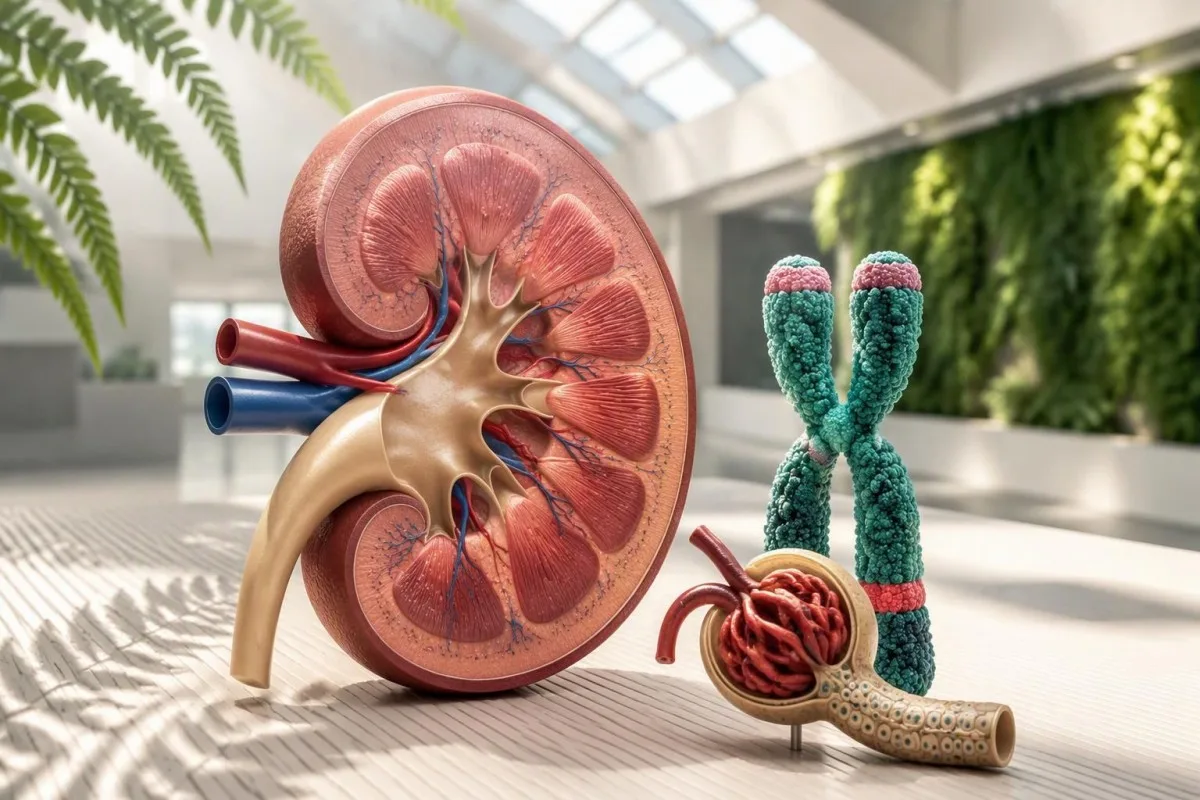
APOL1のリスクバリアントが2つある場合(G1/G1、G1/G2、G2/G2)は、遺伝性の腎疾患感受性を示しますが、診断を意味するものではありません。検査結果は、個人の将来を確実に予測することなく、遺伝カウンセリング、腎機能のモニタリング、生体腎ドナーの評価に役立てることができます。.


- リスクバリアントが2つ とは、G1/G1、G1/G2、G2/G2のいずれかを意味します。この3つはいずれもAPOL1高リスク遺伝子型に分類されます。.
- G1は1つのリスクアレル です。ただし、一般的なG1ハプロタイプには、同じ染色体上に連鎖した配列変化が2つ含まれます。.
- 高リスクは診断ではありません:APOL1の検査結果だけでは、慢性腎臓病、巣状分節性糸球体硬化症、または透析の必要性は確定しません。.
- 腎臓の評価には2つの測定項目が必要です:推算糸球体濾過量(eGFR)と尿アルブミン・クレアチニン比(ACR)です。.
- 持続する腎臓の異常値 3か月以上にわたり、eGFRが60 mL/min/1.73 m²未満、またはACRが30 mg/g以上であることを含みます。.
- 正常なベースライン検査結果 は、個別の年次モニタリング計画の根拠となることが多いものの、APOL1に特化した一律のスクリーニング間隔は確立されていません。.
- 遺伝的祖先は人種とは異なります:祖先情報は検査についての相談に役立ちますが、外見や人種的アイデンティティからAPOL1遺伝子型を判断することはできません。.
- 生体ドナーになるには別途カウンセリングが必要です 現在の腎臓の測定値が正常であっても、2つのリスクバリアントが適格性に影響する可能性があるためです。.
- 家族内の遺伝は予測できますが、発症は予測できません:それぞれがリスクアレルを1つ持つ親からは、妊娠ごとに子どもがリスクアレルを2つ受け継ぐ確率が25%です。.
APOL1の高リスク遺伝子型は、実際には何を意味するのでしょうか?
APOL1遺伝子検査 は、腎疾患の発症しやすさと関連する遺伝性バリアントを特定します。持っている 2つのAPOL1リスクバリアント—G1/G1、G1/G2、またはG2/G2—はリスクを高めますが、腎疾患の診断を確定するものでも、腎不全を保証するものでもありません。次のステップは、腎臓の測定値、家族歴、ドナーになることを検討しているかどうかによって異なります。.
APOL1の高リスク結果と慢性腎臓病は、別々の所見です。G1/G2で、eGFRが105 mL/min/1.73 m²、尿中ACRが6 mg/gの人でも、現在のCKDを示す証拠がない場合があります。これらの測定値が示すのは現在の腎臓の健康状態であり、生涯にわたる保証ではありません。.
APOL1検査は、単にラベルを付け加えるのではなく、意思決定に影響する場合に最も役立ちます。私はトーマス・クライン、Kantestiの最高医療責任者です。最初に次の3つの問いを分けて考えます。何を受け継いだのか、腎障害があるのか、そしてその結果がドナーや治療に関する相談に影響するのか、です。.
カンテスティは AI血液検査分析装置 腎臓関連の検査値の説明に役立ちますが、通常の血液化学検査ではAPOL1遺伝子型は分かりません。当社の CKD(慢性腎臓病)ステージングガイド は、eGFRと尿中アルブミンを併せて考慮する必要がある理由を説明しています。いずれの測定値も、専用の遺伝子検査の代わりにはなりません。.
G1/G1、G1/G2、G2/G2の結果はどのように読み取ればよいでしょうか?
G1/G1、G1/G2、G2/G2はいずれも、受け継いだAPOL1遺伝子コピーの両方に腎リスクアレルがあることを意味します。. G1/G1にはG1アレルが2つ、G1/G2にはそれぞれ1つずつ、G2/G2にはG2アレルが2つあります。いずれも腎機能の測定値ではありません。.
G1は通常、連鎖した2つのコード領域の変化を含むハプロタイプで、一般にS342GおよびI384Mと表されます。これらの変化は通常、同じ染色体上に一緒に存在し、 1つのG1リスクアレル, と数えられます。別々に受け継がれる2つのリスクアレルではありません。G2は、APOL1タンパク質から2つのアミノ酸を取り除く6塩基対の欠失です。.
G0/G0、G0/G1、G0/G2は、認識されているリスクアレルを0個または1個含むため、慣例的にAPOL1低リスク遺伝子型に分類されます。APOL1リスクが低いことは、腎疾患リスクがゼロであることを意味しません。糖尿病、高血圧、その他の遺伝性疾患、薬剤関連の障害は依然として起こり得ます。また、対象を限定した検査では、すべての腎疾患関連遺伝子が調べられるわけではありません。.
3つの高リスクの組み合わせから、個人の重症度を確実に順位づけることはできません。報告書にアレルの組み合わせではなく配列変化が記載されている場合は、それらを明示的な遺伝子型に変換してもらい、どの変化が同じ染色体上にあるかを判断するうえでの制約も明記してもらいましょう。当社の result-format explanation helps distinguish categorical genetic findings from numerical laboratory values.
APOL1のリスクバリアントが2つあっても、なぜ腎疾患が確実に起こるわけではないのでしょうか?
APOL1-associated kidney susceptibility has incomplete penetrance: some people with two risk alleles develop kidney disease, while others do not. Age, additional genetic factors, immune signaling, environmental exposures and existing kidney conditions influence outcomes, so a genotype alone cannot provide a dependable personal lifetime percentage.
Parsa and colleagues reported that, among AASK participants who already had hypertension-associated CKD, the composite outcome of kidney failure or doubling serum creatinine occurred in 58.1% of the high-risk group versus 36.6% of the lower-risk group (Parsa et al., 2013). Those figures describe progression in an affected study population—not the chance that a healthy person with G1/G2 will develop CKD.
Relative risk and absolute risk answer different questions. Even a twofold association does not tell a person their probability without a relevant starting risk and a time horizon; a 30-year-old with normal ACR and a 65-year-old with substantial albuminuria should not receive the same prediction simply because their APOL1 results match.
The proposed “second-hit” model is useful but incomplete: certain immune or cellular stresses may increase APOL1-related injury, yet clinicians cannot identify a single required trigger for every patient. This resembles the distinction between susceptibility and diagnosis discussed in our ApoE4 risk explanation, although the genes, organs and predictive evidence are different.
APOL1検査において、遺伝的祖先は人種とどのように異なるのでしょうか?
APOL1 G1 and G2 variants are associated particularly with genetic ancestry from parts of sub-Saharan Africa, not with a racial category itself. Race is a social classification, ancestry describes inherited population history, and neither a person’s appearance nor a single ancestry percentage establishes whether they carry zero, one or two risk alleles.
African ancestry is not one uniform genetic background. G1 and G2 frequencies differ substantially between populations, so a broad label such as “African,” “Black” or “mixed ancestry” is too coarse to establish an individual’s result; a family history extending across two or more regions can also be incomplete or unknown.
An ancestry-informed testing offer should be an invitation to discuss relevance, not a biological assumption about someone’s race. A person who does not identify as Black may carry two risk variants, while a person who does identify as Black may carry neither; asking about family origins is more respectful and clinically useful than inferring genetics from skin tone.
Race should not be used as a substitute for genotype or as an automatic adjustment to kidney-function interpretation. KDIGO 2024 supports avoiding race in eGFR computation; our Duffy-null neutrophil explanation illustrates another setting where a specific inherited finding is more informative than a racial label, although Duffy status does not predict APOL1 status.
APOL1遺伝子検査の恩恵を受ける可能性があるのはどのような人でしょうか?
APOL1 testing may be useful for selected people with unexplained or familial kidney disease, some patients with focal segmental glomerulosclerosis, and potential living kidney donors with relevant ancestry. Testing everyone solely because of race is not an appropriate substitute for individualized consent, clinical assessment and a clear explanation of what the result could change.
An unexplained kidney problem before age 50, several relatives with kidney failure, or a tissue diagnosis showing FSGS can justify a genetics discussion. APOL1 may be only one part of that assessment: other inherited kidney disorders can produce similar findings, and a targeted APOL1 test will not identify all of them.
A positive APOL1 result does not prove that APOL1 caused every abnormality on a kidney panel. For example, G1/G1 in a patient with diabetes and an ACR of 450 mg/g may represent an additional susceptibility rather than a complete explanation; clinicians still assess diabetes duration, retinal findings, urine sediment, medication exposure and the pace of eGFR change.
Testing an unaffected relative should have an agreed purpose, such as counseling or donor evaluation, rather than a promise that it will prevent disease. Our inherited family-risk discussion shows why the question “What will we do differently after either result?” matters before ordering a genetic test; the appropriate answer can differ between two members of the same family.
APOL1検査はどのように行われ、確認検査が必要なのはどのような場合でしょうか?
APOL1 genetic testing uses DNA, commonly obtained from a blood, saliva or cheek-swab specimen, to identify G1 and G2 alleles. The genotype normally remains unchanged throughout life, so one adequately performed clinical test is usually sufficient; repeat or confirmatory testing is reserved for uncertainty about specimen identity, assay coverage or the original result.
A clinical report should identify the tested variants, the genotype and the assay’s relevant limitations. Turnaround time varies between laboratories, and the genetic assay is separate from a same-day creatinine result; before paying, ask whether the fee includes counseling, whether both risk alleles are assessed, and whether an inconclusive result requires a second specimen.
An unexpected direct-to-consumer result may need confirmation in an accredited clinical laboratory before a transplant or other consequential decision. A screenshot showing two sequence changes is not necessarily proof of two risk alleles, particularly when the changes belong to the same G1 haplotype; the original report and its method matter more than an automated summary.
Kantesti’s laboratory explanations should preserve the distinction between genetic evidence and biochemical evidence rather than infer an APOL1 result from creatinine. Our 臨床検証フレームワーク describes the standards behind laboratory interpretation, while our 医療レポート安全ガイド explains why source verification is necessary before acting on a consequential result.
APOL1の遺伝カウンセリングでは、家族について何を扱うべきでしょうか?
APOL1 counseling should explain inheritance, uncertain disease prediction, family implications, privacy and the limits of testing. Each child inherits one APOL1 copy from each parent; predictable allele transmission does not translate into a predictable age of onset, disease severity or need for dialysis.
When both parents have one recognized APOL1 risk allele, each pregnancy has a 25% chance of two risk alleles, a 50% chance of one, and a 25% chance of none. These probabilities reset with every pregnancy; four children do not have to divide into those proportions, and a child inheriting two alleles is not thereby diagnosed with kidney disease.
A parent with G1/G2 passes a risk allele to every child: either G1 or G2, each with a 50% chance. If the other parent is G0/G0, none of their children will have two recognized risk alleles; a genetic counselor can explain when partner testing would meaningfully answer a family question rather than merely add anxiety.
Testing children requires a separate discussion about present medical benefit, consent and the child’s future autonomy—not simply applying an adult screening plan at age 8. Our carrier-screening counseling guide illustrates why inheritance terminology needs care, and our 年齢別の家族検査ガイドを使用できます。 helps distinguish targeted care from indiscriminate family screening.
高リスクの結果が出た後、どの腎臓関連血液検査が重要でしょうか?
Serum creatinine with eGFR is a standard blood-based assessment after an APOL1 high-risk result; cystatin C can improve assessment when creatinine is less reliable. Urine ACR must be added separately because an eGFR above 90 mL/min/1.73 m² does not rule out albumin leakage or early kidney damage.
Creatinine reflects both filtration and factors such as muscle mass, recent meat intake and some medications. A muscular adult with creatinine of 1.3 mg/dL may need a different interpretation from a frail adult with the same concentration; our muscular-adult creatinine guide explains why the laboratory flag alone is not a diagnosis.
A combined creatinine–cystatin C eGFR can be useful when a more accurate estimate could change a decision, including selected donor assessments. Cystatin C has its own influences, including glucocorticoid exposure and thyroid dysfunction, so it is not an infallible correction; our シスタチンC解釈ガイド discusses the two-marker approach.
カンテスティは AI血液検査の読み方プラットフォーム that can help put serial creatinine and eGFR reports into context, but laboratory trends cannot prove APOL1-related disease. KDIGO 2024 states that an eGFR change greater than 20% on a subsequent test in someone with CKD exceeds expected variability and warrants evaluation; a smaller change can still matter when it persists or accompanies rising albuminuria.
尿ACRとフォローアップの時期はどのように解釈すればよいでしょうか?
Urine ACR measures albumin leakage and is essential alongside eGFR when assessing APOL1 susceptibility. KDIGO albuminuria categories are A1 below 30 mg/g, A2 from 30–300 mg/g and A3 above 300 mg/g; persistent abnormalities require assessment even when filtration remains apparently normal.
One elevated ACR is not automatically persistent kidney damage. Strenuous exercise, fever, urinary infection and menstrual contamination can affect a result, so an ACR of 65 mg/g may need a properly timed repeat; our ACR作成ガイド explains practical collection steps without substituting a negative dipstick for a quantitative ratio.
An individualized annual review of blood pressure, eGFR and ACR is a reasonable discussion for an otherwise well adult with two risk alleles and normal baseline findings. That is a pragmatic monitoring plan, not a universal APOL1-specific guideline; established CKD, pregnancy, new hypertension or an abnormal trend may justify shorter intervals, such as 3–6 months, chosen by the treating clinician.
KDIGO 2024 considers a doubling of ACR on follow-up in someone with CKD a change that warrants evaluation. Urine microscopy adds a different kind of information: cellular casts or persistent red cells can point toward another process, as our 尿沈渣ガイド explains; APOL1 testing should not make those findings disappear from the differential diagnosis.
APOL1の結果を受けて、どのような場合に腎臓内科への紹介が必要でしょうか?
Nephrology referral is driven mainly by kidney abnormalities, progression, unexplained findings and donor questions—not by genotype alone. CKD requires evidence of abnormal kidney structure or function for at least 3 months; a rapidly changing creatinine result or concerning symptoms require prompt assessment without waiting for that chronicity threshold.
Persistent eGFR below 60 mL/min/1.73 m² or ACR at least 30 mg/g can satisfy CKD criteria when present for 3 months or longer. Referral urgency increases with advanced impairment, substantial albuminuria, a sustained downward trend or uncertainty about the cause; a normal eGFR does not make an ACR of 800 mg/g reassuring.
A hypothetical 36-year-old with G1/G2, eGFR 96 mL/min/1.73 m² and ACR 900 mg/g needs evaluation for significant albuminuria, not reassurance based on filtration alone. APOL1 susceptibility does not exclude membranous nephropathy or other glomerular disorders; our PLA2R antibody explanation describes one different diagnostic pathway that may become relevant when the clinical pattern fits.
Rapidly reduced urine output, breathlessness with swelling, or visible urine discoloration alongside worsening kidney measurements calls for urgent assessment. Some antibody-mediated conditions need especially rapid action, as discussed in our anti-GBM result guide; neither a known APOL1 result nor a 3-month CKD definition should delay an acute kidney evaluation.
高リスク遺伝子型によって、治療や日常の習慣は変わるのでしょうか?
An APOL1 high-risk genotype alone does not automatically justify kidney medication, a restrictive renal diet or supplements. Treatment depends on actual kidney disease, albuminuria, blood pressure and other conditions; proven CKD therapies should not be withheld merely because inherited susceptibility may contribute to the disease.
Blood-pressure control is a practical priority, but the measurement method changes how a target should be interpreted. KDIGO’s CKD guidance includes a standardized office systolic target below 120 mmHg when tolerated for appropriate adults; that is not an instruction to force every routine home reading below 120, especially with dizziness, frailty or other reasons to individualize treatment.
ACE inhibitors or ARBs and SGLT2 inhibitors may be indicated for particular CKD and albuminuria patterns, with monitoring of creatinine and potassium. Two risk alleles with normal eGFR and normal ACR do not automatically establish those indications; medication choices should follow the person’s documented condition and current local guidance rather than a genetic label.
No supplement, “kidney cleanse” or diet has been shown to erase G1 or G2 alleles. Avoid starting potassium restriction or a very-low-protein diet solely after a genetic result, and discuss frequent NSAID use with your clinician; our 腎臓サプリメントの安全性ガイド explains why products marketed for kidney health can create problems rather than prevent them.
APOL1のリスクバリアントが2つある場合、生体腎提供にどのような意味がありますか?
Two APOL1 risk variants may change living-kidney-donor eligibility even when current kidney function is normal. The concern is the donor’s future risk after losing kidney reserve, as well as possible implications for the donated kidney; transplant programs differ in how they incorporate the result into acceptance decisions.
The KDIGO living-donor guideline states that APOL1 genotyping may be offered to candidates with sub-Saharan African ancestry and that candidates should understand the uncertainty in predicting post-donation risk (Lentine et al., 2017). Many programs take a conservative approach to two risk alleles, particularly in younger candidates; there is no single internationally uniform APOL1 acceptance rule.
KDIGO 2017 considers donor GFR of at least 90 mL/min/1.73 m² generally acceptable, GFR from 60–89 individually assessable, and GFR below 60 unsuitable for donation. These filtration thresholds do not cancel APOL1 susceptibility; our BUNとクレアチニンのガイド explains why a reassuring chemistry result alone is not a complete donor assessment.
Age, albuminuria, blood pressure, family history and other health risks must be considered alongside the genotype. A young candidate has more remaining years in which disease could emerge, and related donors may share additional inherited risks; a transplant team should explain what a positive result means for eligibility before testing, not after a family has assumed donation will proceed.
APOL1の情報はどのようにプライバシーを守り、安全に取り扱うべきでしょうか?
APOL1 results are sensitive genetic information with implications for both the tested person and relatives. Before sharing a report with a clinical service or digital tool, check consent, access, retention and deletion options; protections against genetic discrimination differ between countries and between insurance products.
One person’s permission to share their result does not automatically authorize uploading a relative’s report. Remove unnecessary identifiers, consider who can access shared family accounts, and ask whether genetics information becomes part of a medical record; insurance and employment protections are jurisdiction-specific, so obtain local advice before assuming a general privacy statement covers every consequence.
カンテスティは AIバイオマーカー解釈プラットフォーム that can support understanding of kidney-related laboratory reports, but it does not replace APOL1 testing, genetic counseling or transplant eligibility review. Our プライバシーとデータに関する情報を確認し、 explains data-handling considerations; an AI interpretation taking approximately 60 seconds is not the same service as completing a molecular genetic assay.
Kantesti LTD is a UK company, number 17090423, and our organization information provides context about who operates the service. Family Health Risk features should use consented information rather than infer a relative’s genotype from race, kidney chemistry or another person’s two-allele result; keep the original clinical laboratory report available for professional review.
受診時に何を持参し、どの情報源が該当するでしょうか?
Bring the original APOL1 report, recent eGFR and urine ACR results, a medication list and a family kidney history to your appointment. As of October 19, 2026, this article distinguishes established guidance from uncertain individual prediction; its clinical references include the 2024 KDIGO CKD guideline and the 2017 KDIGO living-donor guideline.
A useful appointment can answer four concrete questions: Is kidney damage present, what is the monitoring interval, should relatives receive counseling, and does the result affect donation? My practical checklist as Thomas Klein, Chief Medical Officer at Kantesti, is to leave with a named clinician and a written next-test plan rather than an unsupported lifetime percentage; our 医学顧問情報 describes the expertise behind our clinical standards.
Serum albumin and urine albumin answer different questions, and confusing the two can derail a kidney discussion. Our 血清タンパク質ガイド provides supporting education on circulating proteins, but neither a normal serum albumin of 4.2 g/dL nor a normal albumin-to-globulin ratio excludes urinary albumin loss or determines an APOL1 genotype.
Complement tests are not routine APOL1 surveillance tests; C3 and C4 may become relevant when clinical findings suggest an immune-mediated kidney disorder. Our 補体検査ガイド is a supporting educational publication, not evidence for APOL1 penetrance; the two Zenodo resources listed below are separate from the directly relevant external medical references, and their ResearchGate and Academia.edu links are discovery searches rather than verified hosted copies.
よくある質問
APOL1のリスクバリアントを2つ持っていると、腎臓病になりますか?
APOL1リスクバリアントを2つ持つと腎疾患への感受性は高まりますが、発症や腎不全が確実になるわけではありません。G1/G1、G1/G2、G2/G2はいずれも高リスク遺伝子型に分類されますが、個々の転帰は異なります。現在の腎機能評価にはeGFRと尿中ACRが必要です。eGFRが100 mL/min/1.73 m²、ACRが5 mg/gであってもCKDとは診断されません。すでに腎疾患があった人々を対象とする研究の割合を当てはめるより、個別のモニタリング計画のほうが有用です。.
G1/G1、G1/G2、G2/G2の重症度は同じですか?
G1/G1、G1/G2、G2/G2はいずれも認識されているAPOL1リスクアレルを2つ含み、高リスク遺伝子型に分類されます。これらの遺伝子型の組み合わせは、個人の将来の疾患重症度を確実に順位付けするものではありません。G1には一般に、1本の染色体上に連鎖した2つの配列変化が含まれますが、これらの変化は1つのリスクアレルとして数えられます。3つの組み合わせのいずれを解釈する場合も、腎臓の測定値、年齢、臨床歴が引き続き必要です。.
高リスクのAPOL1検査結果が出た後、腎臓の検査はどのくらいの頻度で受けるべきですか?
0 二つのリスクバリアントを持つすべての人に一律に適用できる、APOL1に特化したモニタリング間隔はありません。ほかに健康上の問題がなく、ベースライン所見が正常な成人では、血圧、eGFR、尿中ACRを年1回確認することについて話し合うのが妥当な出発点です。既存のCKD、アルブミン尿、または変化する傾向がある場合は、担当医の判断で3~6か月など、より短い間隔が妥当となることがあります。新たな症状や腎機能の急激な変化があれば、次回の定期検査を待たず、より早く評価を受ける必要があります。.
APOL1リスクバリアントを2つ持っている場合、腎臓を提供できますか?
2つのAPOL1リスクバリアントは、現在の腎機能測定値が正常であっても、生体腎ドナーとしての適格性に影響する可能性があります。移植プログラムによって受け入れ方針は異なり、個人の提供後のリスクを正確に予測できないため、多くのプログラムでは慎重な対応が取られています。KDIGOの生体ドナーガイドラインでは、一般にGFRが90 mL/min/1.73 m²以上であれば許容可能とされていますが、この基準によって遺伝的リスクやその他の健康上のリスクが相殺されるわけではありません。クレアチニン値が正常ならドナーとして安全だと決めつける前に、プログラムのAPOL1方針についてカウンセリングを受けてください。.
APOL1検査は、黒人と自認する人だけを対象としていますか?
APOL1検査は人種的アイデンティティに限定されません。遺伝的祖先と人種は異なる概念だからです。G1およびG2は、特にサハラ以南のアフリカの一部地域に祖先を持つことと関連していますが、外見からリスクアレルを0個、1個、または2個持っているかどうかを判断することはできません。自分を黒人と認識していない人がこれらの変異を持っている場合もあれば、自分を黒人と認識している人がどちらも持っていない場合もあります。検査について話し合う際には、祖先、腎臓の所見、家族歴、および結果によって変わり得る判断を考慮する必要があります。.
私の子どもはAPOL1のリスク変異を2つ受け継ぎますか?
子どものAPOL1遺伝子型は、両親それぞれから受け継ぐ対立遺伝子によって決まります。両親がそれぞれリスク対立遺伝子を1つ持っている場合、各妊娠で子どもがリスク対立遺伝子を2つ受け継ぐ確率は25%です。一方の親がG1/G2、もう一方の親がG0/G0の場合、すべての子どもがリスク対立遺伝子を1つ受け継ぎ、認識されているリスク対立遺伝子を2つ受け継ぐ子どもはいません。これらの遺伝確率から、腎疾患が発症するかどうか、またいつ発症するかを予測することはできません。.
今日、AIによる血液検査分析を
いますぐ利用しませんか。即時で正確な検査分析を提供するKantestiを信頼する、世界中の200万人以上のユーザーに参加してください。血液検査結果をアップロードすると、15,000+のバイオマーカーについて数秒で包括的な解釈が得られます。.
📚 参考文献
📖 外部の医学的参考文献
Parsa A et al. (2013). APOL1 Risk Variants, Race, and Progression of Chronic Kidney Disease.。 ニューイングランド・ジャーナル・オブ・メディシン。.
Lentine KL et al. (2017). KDIGO Clinical Practice Guideline on the Evaluation and Care of Living Kidney Donors. 移植。.
腎疾患:世界的アウトカム改善(KDIGO)CKDワーキンググループ(2024年)。. KDIGO 2024 慢性腎臓病の評価および管理のための臨床診療ガイドライン.。 Kidney International.
⚕️ 医療免責事項
この記事は教育目的のみを対象としており、医療助言を構成するものではありません。診断や治療の判断を行う際は、必ず有資格の医療提供者にご相談ください。.
E-E-A-T 信頼性シグナル
経験
医師主導による、検査結果解釈ワークフローの臨床レビュー。.
専門知識
臨床的な文脈においてバイオマーカーがどのように振る舞うかに焦点を当てた検査医学。.
権威
トーマス・クライン博士が執筆し、サラ・ミッチェル博士およびハンス・ヴェーバー教授によるレビュー。.
信頼性
アラームを減らすための明確なフォローアップ経路を備えた、エビデンスに基づく解釈。.