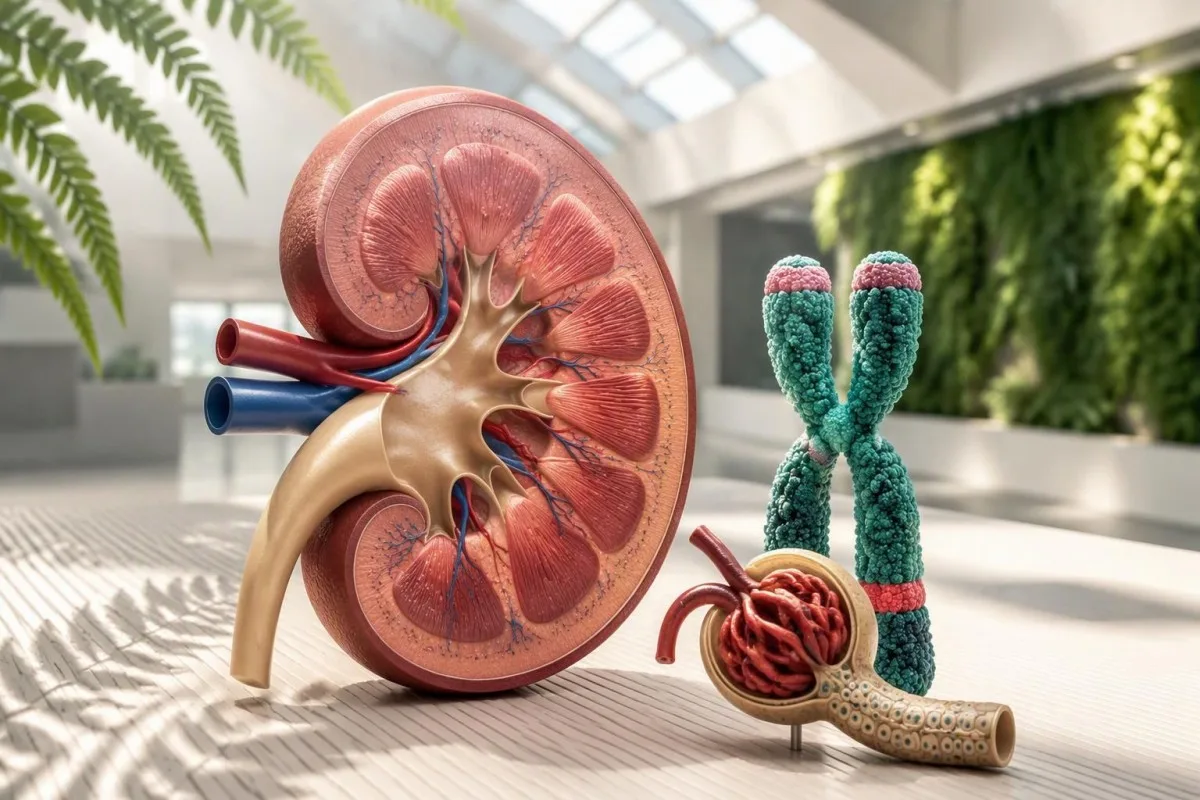
שני וריאנטים בסיכון של APOL1 — G1/G1, G1/G2 או G2/G2 — מצביעים על נטייה תורשתית למחלת כליות, ולא על אבחנה. התוצאות יכולות לסייע בייעוץ, בניטור הכליות ובהערכת תורמים חיים, בלי לנבא בוודאות את עתידו של אדם מסוים.


- שני וריאנטים בסיכון פירושם G1/G1, G1/G2 או G2/G2; כל שלוש האפשרויות מסווגות כגנוטיפ APOL1 בסיכון גבוה.
- G1 הוא אלל סיכון אחד אף שההפלוטיפ הנפוץ G1 מכיל שני שינויים ברצף המקושרים זה לזה באותו כרומוזום.
- סיכון גבוה אינו אבחנה: תוצאות APOL1 אינן מבססות אבחנה של מחלת כליות כרונית, גלומרולוסקלרוזיס מוקדי ומקטעי או צורך בדיאליזה.
- הערכת הכליות דורשת שתי מדידות: קצב הסינון הגלומרולרי המשוער, או eGFR, ויחס אלבומין-קריאטינין בשתן, או ACR.
- ממצאים כלייתיים מתמשכים כוללים eGFR מתחת ל־60 mL/min/1.73 m² או ACR של לפחות 30 mg/g במשך 3 חודשים או יותר.
- תוצאות בסיס תקינות תומכות לעיתים קרובות בתוכנית ניטור שנתית מותאמת אישית, אך לא נקבע מרווח סקר אוניברסלי ספציפי ל־APOL1.
- מוצא גנטי שונה מגזע: המוצא יכול לסייע בדיון על בדיקות, אך מראה חיצוני וזהות גזעית אינם יכולים לקבוע גנוטיפ של APOL1.
- תרומת כליה מאדם חי מחייבת ייעוץ נפרד משום ששתי וריאנטיות סיכון עשויות להשפיע על הזכאות, גם כאשר מדידות הכליות הנוכחיות תקינות.
- הורשה משפחתית ניתנת לחיזוי; מחלה לא: לשני הורים שלכל אחד מהם אלל סיכון אחד יש סיכוי של 25% לילד שיירש שני אללי סיכון בכל היריון.
מה המשמעות בפועל של גנוטיפ APOL1 בסיכון גבוה?
בדיקה גנטית ל-APOL1 מזהה וריאנטים תורשתיים הקשורים לרגישות למחלות כליה. הימצאות שתי וריאנטיות סיכון של APOL1—G1/G1, G1/G2 או G2/G2—מעלה את הסיכון אך אינה מאבחנת מחלת כליות ואינה מבטיחה אי־ספיקת כליות; הצעדים הבאים תלויים במדידות הכליות, בהיסטוריה המשפחתית ובשאלה אם נשקלת תרומה.
תוצאה בסיכון גבוה של APOL1 ומחלת כליות כרונית הם שני ממצאים שונים. אדם יכול להיות בעל G1/G2, עם eGFR של 105 mL/min/1.73 m² ו־ACR בשתן של 6 mg/g, ללא עדות ל־CKD בהווה; מדידות אלה מתארות את בריאות הכליות כעת, ולא מבטיחות דבר לכל החיים.
בדיקת APOL1 מועילה במיוחד כשהיא משנה החלטה, ולא רק מוסיפה תווית. אני תומס קליין, המנהל הרפואי הראשי של Kantesti, והייתי מפריד מלכתחילה בין שלוש שאלות: מה עבר בתורשה, האם קיים נזק לכליות, והאם התוצאה משנה את הדיון על תרומה או טיפול.
קנטסטי הוא מנתח בדיקות דם בינה מלאכותית שיכולות לסייע בהסבר מדידות מעבדה הקשורות לכליות, אך בדיקת כימיה שגרתית אינה יכולה לחשוף גנוטיפ של APOL1. שלנו מדריך שלבי CKD מסביר מדוע יש להביא בחשבון יחד את eGFR ואת האלבומין בשתן; אף אחת מהמדידות אינה תחליף לבדיקה גנטית ייעודית.
כיצד יש לפרש תוצאות G1/G1, G1/G2 ו-G2/G2?
G1/G1, G1/G2 ו־G2/G2 פירושם בכל אחד מהמקרים ששני עותקי הגן APOL1 שעברו בתורשה נושאים אלל סיכון לכליות. G1/G1 מכיל שני אללי G1, G1/G2 מכיל אחד מכל סוג, ו־G2/G2 מכיל שני אללי G2; אף אחד מהם אינו מדידה של תפקוד הכליות.
G1 הוא בדרך כלל הפלוטיפ המכיל שני שינויים מקודדים הקשורים זה לזה, המתוארים בדרך כלל כ־S342G ו־I384M. שינויים אלה עוברים בדרך כלל יחד בכרומוזום אחד ונחשבים לאלל סיכון אחד של G1, ולא לשני אללי סיכון נפרדים שעברו בתורשה; G2 הוא חסר בן שישה זוגות בסיסים שמסיר שתי חומצות אמינו מחלבון APOL1.
G0/G0, G0/G1 ו־G0/G2 מקובצים באופן המקובל כגנוטיפים של APOL1 בסיכון נמוך יותר, משום שהם מכילים אפס או אלל סיכון מוכר אחד. סיכון נמוך יותר של APOL1 אינו פירושו שאין סיכון למחלת כליות: סוכרת, יתר לחץ דם, מצבים גנטיים אחרים ופגיעה הקשורה לתרופות עדיין אפשריים, ובדיקות מוגבלות אינן בוחנות כל גן של מחלת כליות.
שלושת הצירופים בסיכון גבוה אינם מדדים אמינים לדירוג חומרת המחלה אצל אדם מסוים. אם בדוח מפורטים שינויי רצף ולא צמד אללים, בקשו מהמעבדה לתרגם אותם לגנוטיפ מפורש ולציין מגבלות כלשהן בקביעה אילו שינויים נמצאים על אותו כרומוזום; שלנו result-format explanation helps distinguish categorical genetic findings from numerical laboratory values.
מדוע שני וריאנטים בסיכון של APOL1 אינם מבטיחים מחלת כליות?
APOL1-associated kidney susceptibility has incomplete penetrance: some people with two risk alleles develop kidney disease, while others do not. Age, additional genetic factors, immune signaling, environmental exposures and existing kidney conditions influence outcomes, so a genotype alone cannot provide a dependable personal lifetime percentage.
Parsa and colleagues reported that, among AASK participants who already had hypertension-associated CKD, the composite outcome of kidney failure or doubling serum creatinine occurred in 58.1% of the high-risk group versus 36.6% of the lower-risk group (Parsa et al., 2013). Those figures describe progression in an affected study population—not the chance that a healthy person with G1/G2 will develop CKD.
Relative risk and absolute risk answer different questions. Even a twofold association does not tell a person their probability without a relevant starting risk and a time horizon; a 30-year-old with normal ACR and a 65-year-old with substantial albuminuria should not receive the same prediction simply because their APOL1 results match.
The proposed “second-hit” model is useful but incomplete: certain immune or cellular stresses may increase APOL1-related injury, yet clinicians cannot identify a single required trigger for every patient. This resembles the distinction between susceptibility and diagnosis discussed in our ApoE4 risk explanation, although the genes, organs and predictive evidence are different.
במה שונה מוצא גנטי מגזע בבדיקת APOL1?
APOL1 G1 and G2 variants are associated particularly with genetic ancestry from parts of sub-Saharan Africa, not with a racial category itself. Race is a social classification, ancestry describes inherited population history, and neither a person’s appearance nor a single ancestry percentage establishes whether they carry zero, one or two risk alleles.
African ancestry is not one uniform genetic background. G1 and G2 frequencies differ substantially between populations, so a broad label such as “African,” “Black” or “mixed ancestry” is too coarse to establish an individual’s result; a family history extending across two or more regions can also be incomplete or unknown.
An ancestry-informed testing offer should be an invitation to discuss relevance, not a biological assumption about someone’s race. A person who does not identify as Black may carry two risk variants, while a person who does identify as Black may carry neither; asking about family origins is more respectful and clinically useful than inferring genetics from skin tone.
Race should not be used as a substitute for genotype or as an automatic adjustment to kidney-function interpretation. KDIGO 2024 supports avoiding race in eGFR computation; our Duffy-null neutrophil explanation illustrates another setting where a specific inherited finding is more informative than a racial label, although Duffy status does not predict APOL1 status.
מי עשוי להפיק תועלת מבדיקה גנטית של APOL1?
APOL1 testing may be useful for selected people with unexplained or familial kidney disease, some patients with focal segmental glomerulosclerosis, and potential living kidney donors with relevant ancestry. Testing everyone solely because of race is not an appropriate substitute for individualized consent, clinical assessment and a clear explanation of what the result could change.
An unexplained kidney problem before age 50, several relatives with kidney failure, or a tissue diagnosis showing FSGS can justify a genetics discussion. APOL1 may be only one part of that assessment: other inherited kidney disorders can produce similar findings, and a targeted APOL1 test will not identify all of them.
A positive APOL1 result does not prove that APOL1 caused every abnormality on a kidney panel. For example, G1/G1 in a patient with diabetes and an ACR of 450 mg/g may represent an additional susceptibility rather than a complete explanation; clinicians still assess diabetes duration, retinal findings, urine sediment, medication exposure and the pace of eGFR change.
Testing an unaffected relative should have an agreed purpose, such as counseling or donor evaluation, rather than a promise that it will prevent disease. Our inherited family-risk discussion shows why the question “What will we do differently after either result?” matters before ordering a genetic test; the appropriate answer can differ between two members of the same family.
כיצד מתבצעת בדיקת APOL1, ומתי נדרש אישור?
APOL1 genetic testing uses DNA, commonly obtained from a blood, saliva or cheek-swab specimen, to identify G1 and G2 alleles. The genotype normally remains unchanged throughout life, so one adequately performed clinical test is usually sufficient; repeat or confirmatory testing is reserved for uncertainty about specimen identity, assay coverage or the original result.
A clinical report should identify the tested variants, the genotype and the assay’s relevant limitations. Turnaround time varies between laboratories, and the genetic assay is separate from a same-day creatinine result; before paying, ask whether the fee includes counseling, whether both risk alleles are assessed, and whether an inconclusive result requires a second specimen.
An unexpected direct-to-consumer result may need confirmation in an accredited clinical laboratory before a transplant or other consequential decision. A screenshot showing two sequence changes is not necessarily proof of two risk alleles, particularly when the changes belong to the same G1 haplotype; the original report and its method matter more than an automated summary.
Kantesti’s laboratory explanations should preserve the distinction between genetic evidence and biochemical evidence rather than infer an APOL1 result from creatinine. Our מסגרת אימות קלינית describes the standards behind laboratory interpretation, while our שלנו מדריך בטיחות דוח רפואי explains why source verification is necessary before acting on a consequential result.
אילו נושאים יש לכלול בייעוץ גנטי בנושא APOL1 למשפחות?
APOL1 counseling should explain inheritance, uncertain disease prediction, family implications, privacy and the limits of testing. Each child inherits one APOL1 copy from each parent; predictable allele transmission does not translate into a predictable age of onset, disease severity or need for dialysis.
When both parents have one recognized APOL1 risk allele, each pregnancy has a 25% chance of two risk alleles, a 50% chance of one, and a 25% chance of none. These probabilities reset with every pregnancy; four children do not have to divide into those proportions, and a child inheriting two alleles is not thereby diagnosed with kidney disease.
A parent with G1/G2 passes a risk allele to every child: either G1 or G2, each with a 50% chance. If the other parent is G0/G0, none of their children will have two recognized risk alleles; a genetic counselor can explain when partner testing would meaningfully answer a family question rather than merely add anxiety.
Testing children requires a separate discussion about present medical benefit, consent and the child’s future autonomy—not simply applying an adult screening plan at age 8. Our carrier-screening counseling guide illustrates why inheritance terminology needs care, and our מדריך בדיקות משפחתיות מבוסס גיל helps distinguish targeted care from indiscriminate family screening.
אילו בדיקות דם של הכליות חשובות לאחר תוצאה בסיכון גבוה?
Serum creatinine with eGFR is a standard blood-based assessment after an APOL1 high-risk result; cystatin C can improve assessment when creatinine is less reliable. Urine ACR must be added separately because an eGFR above 90 mL/min/1.73 m² does not rule out albumin leakage or early kidney damage.
Creatinine reflects both filtration and factors such as muscle mass, recent meat intake and some medications. A muscular adult with creatinine of 1.3 mg/dL may need a different interpretation from a frail adult with the same concentration; our muscular-adult creatinine guide explains why the laboratory flag alone is not a diagnosis.
A combined creatinine–cystatin C eGFR can be useful when a more accurate estimate could change a decision, including selected donor assessments. Cystatin C has its own influences, including glucocorticoid exposure and thyroid dysfunction, so it is not an infallible correction; our מדריך לפרשנות ציסטטין C discusses the two-marker approach.
קנטסטי הוא פלטפורמת פענוח בדיקות דם של AI that can help put serial creatinine and eGFR reports into context, but laboratory trends cannot prove APOL1-related disease. KDIGO 2024 states that an eGFR change greater than 20% on a subsequent test in someone with CKD exceeds expected variability and warrants evaluation; a smaller change can still matter when it persists or accompanies rising albuminuria.
כיצד יש לפרש ACR בשתן ואת מועד המעקב?
Urine ACR measures albumin leakage and is essential alongside eGFR when assessing APOL1 susceptibility. KDIGO albuminuria categories are A1 below 30 mg/g, A2 from 30–300 mg/g and A3 above 300 mg/g; persistent abnormalities require assessment even when filtration remains apparently normal.
One elevated ACR is not automatically persistent kidney damage. Strenuous exercise, fever, urinary infection and menstrual contamination can affect a result, so an ACR of 65 mg/g may need a properly timed repeat; our להכנת ACR explains practical collection steps without substituting a negative dipstick for a quantitative ratio.
An individualized annual review of blood pressure, eGFR and ACR is a reasonable discussion for an otherwise well adult with two risk alleles and normal baseline findings. That is a pragmatic monitoring plan, not a universal APOL1-specific guideline; established CKD, pregnancy, new hypertension or an abnormal trend may justify shorter intervals, such as 3–6 months, chosen by the treating clinician.
KDIGO 2024 considers a doubling of ACR on follow-up in someone with CKD a change that warrants evaluation. Urine microscopy adds a different kind of information: cellular casts or persistent red cells can point toward another process, as our משקעי שתן explains; APOL1 testing should not make those findings disappear from the differential diagnosis.
מתי תוצאת APOL1 מצריכה הפניה לנפרולוג?
Nephrology referral is driven mainly by kidney abnormalities, progression, unexplained findings and donor questions—not by genotype alone. CKD requires evidence of abnormal kidney structure or function for at least 3 months; a rapidly changing creatinine result or concerning symptoms require prompt assessment without waiting for that chronicity threshold.
Persistent eGFR below 60 mL/min/1.73 m² or ACR at least 30 mg/g can satisfy CKD criteria when present for 3 months or longer. Referral urgency increases with advanced impairment, substantial albuminuria, a sustained downward trend or uncertainty about the cause; a normal eGFR does not make an ACR of 800 mg/g reassuring.
A hypothetical 36-year-old with G1/G2, eGFR 96 mL/min/1.73 m² and ACR 900 mg/g needs evaluation for significant albuminuria, not reassurance based on filtration alone. APOL1 susceptibility does not exclude membranous nephropathy or other glomerular disorders; our PLA2R antibody explanation describes one different diagnostic pathway that may become relevant when the clinical pattern fits.
Rapidly reduced urine output, breathlessness with swelling, or visible urine discoloration alongside worsening kidney measurements calls for urgent assessment. Some antibody-mediated conditions need especially rapid action, as discussed in our anti-GBM result guide; neither a known APOL1 result nor a 3-month CKD definition should delay an acute kidney evaluation.
האם גנוטיפ בסיכון גבוה משנה את הטיפול או את ההרגלים היומיומיים?
An APOL1 high-risk genotype alone does not automatically justify kidney medication, a restrictive renal diet or supplements. Treatment depends on actual kidney disease, albuminuria, blood pressure and other conditions; proven CKD therapies should not be withheld merely because inherited susceptibility may contribute to the disease.
Blood-pressure control is a practical priority, but the measurement method changes how a target should be interpreted. KDIGO’s CKD guidance includes a standardized office systolic target below 120 mmHg when tolerated for appropriate adults; that is not an instruction to force every routine home reading below 120, especially with dizziness, frailty or other reasons to individualize treatment.
ACE inhibitors or ARBs and SGLT2 inhibitors may be indicated for particular CKD and albuminuria patterns, with monitoring of creatinine and potassium. Two risk alleles with normal eGFR and normal ACR do not automatically establish those indications; medication choices should follow the person’s documented condition and current local guidance rather than a genetic label.
No supplement, “kidney cleanse” or diet has been shown to erase G1 or G2 alleles. Avoid starting potassium restriction or a very-low-protein diet solely after a genetic result, and discuss frequent NSAID use with your clinician; our מדריך לבטיחות תוספי כליות explains why products marketed for kidney health can create problems rather than prevent them.
מה המשמעות של שני וריאנטים בסיכון של APOL1 לתרומה מן החי?
Two APOL1 risk variants may change living-kidney-donor eligibility even when current kidney function is normal. The concern is the donor’s future risk after losing kidney reserve, as well as possible implications for the donated kidney; transplant programs differ in how they incorporate the result into acceptance decisions.
The KDIGO living-donor guideline states that APOL1 genotyping may be offered to candidates with sub-Saharan African ancestry and that candidates should understand the uncertainty in predicting post-donation risk (Lentine et al., 2017). Many programs take a conservative approach to two risk alleles, particularly in younger candidates; there is no single internationally uniform APOL1 acceptance rule.
KDIGO 2017 considers donor GFR of at least 90 mL/min/1.73 m² generally acceptable, GFR from 60–89 individually assessable, and GFR below 60 unsuitable for donation. These filtration thresholds do not cancel APOL1 susceptibility; our המדריך ל-BUN וקריאטינין explains why a reassuring chemistry result alone is not a complete donor assessment.
Age, albuminuria, blood pressure, family history and other health risks must be considered alongside the genotype. A young candidate has more remaining years in which disease could emerge, and related donors may share additional inherited risks; a transplant team should explain what a positive result means for eligibility before testing, not after a family has assumed donation will proceed.
כיצד יש לטפל במידע על APOL1 באופן פרטי ובטוח?
APOL1 results are sensitive genetic information with implications for both the tested person and relatives. Before sharing a report with a clinical service or digital tool, check consent, access, retention and deletion options; protections against genetic discrimination differ between countries and between insurance products.
One person’s permission to share their result does not automatically authorize uploading a relative’s report. Remove unnecessary identifiers, consider who can access shared family accounts, and ask whether genetics information becomes part of a medical record; insurance and employment protections are jurisdiction-specific, so obtain local advice before assuming a general privacy statement covers every consequence.
קנטסטי הוא פלטפורמת פרשנות ביומרקרים של AI that can support understanding of kidney-related laboratory reports, but it does not replace APOL1 testing, genetic counseling or transplant eligibility review. Our מידע על פרטיות ונתונים explains data-handling considerations; an AI interpretation taking approximately 60 seconds is not the same service as completing a molecular genetic assay.
Kantesti LTD is a UK company, number 17090423, and our organization information provides context about who operates the service. Family Health Risk features should use consented information rather than infer a relative’s genotype from race, kidney chemistry or another person’s two-allele result; keep the original clinical laboratory report available for professional review.
מה כדאי להביא לפגישה, ואילו מקורות מידע רלוונטיים?
Bring the original APOL1 report, recent eGFR and urine ACR results, a medication list and a family kidney history to your appointment. As of October 19, 2026, this article distinguishes established guidance from uncertain individual prediction; its clinical references include the 2024 KDIGO CKD guideline and the 2017 KDIGO living-donor guideline.
A useful appointment can answer four concrete questions: Is kidney damage present, what is the monitoring interval, should relatives receive counseling, and does the result affect donation? My practical checklist as Thomas Klein, Chief Medical Officer at Kantesti, is to leave with a named clinician and a written next-test plan rather than an unsupported lifetime percentage; our מידע ייעוץ רפואי describes the expertise behind our clinical standards.
Serum albumin and urine albumin answer different questions, and confusing the two can derail a kidney discussion. Our לחלבון בדם provides supporting education on circulating proteins, but neither a normal serum albumin of 4.2 g/dL nor a normal albumin-to-globulin ratio excludes urinary albumin loss or determines an APOL1 genotype.
Complement tests are not routine APOL1 surveillance tests; C3 and C4 may become relevant when clinical findings suggest an immune-mediated kidney disorder. Our מדריך בדיקות משלים is a supporting educational publication, not evidence for APOL1 penetrance; the two Zenodo resources listed below are separate from the directly relevant external medical references, and their ResearchGate and Academia.edu links are discovery searches rather than verified hosted copies.
שאלות נפוצות
האם נשאות של שני וריאנטים בסיכון ב-APOL1 פירושה שאפתח מחלת כליות?
נשאות של שני וריאנטים בסיכון של APOL1 מגבירה את הנטייה למחלת כליות, אך אינה מבטיחה מחלה או אי־ספיקת כליות. G1/G1, G1/G2 ו־G2/G2 מסווגים כולם כגנוטיפים בסיכון גבוה, אך התוצאות אצל כל אדם שונות. הערכת מצב הכליות הנוכחית מצריכה eGFR ו־ACR בשתן; eGFR של 100 mL/min/1.73 m² ו־ACR של 5 mg/g אינם מבססים אבחנה של CKD. תוכנית מעקב אישית מועילה יותר מהחלת אחוז ממחקר שנערך בקרב אנשים שכבר סבלו ממחלת כליות.
האם G1/G1, G1/G2 ו־G2/G2 חמורים באותה מידה?
G1/G1, G1/G2 ו-G2/G2 מכילים כל אחד שני אללים מוכרים של APOL1 בסיכון, והם מסווגים כגנוטיפים בסיכון גבוה. שילובי הגנוטיפים אינם מאפשרים לדרג באופן מהימן את חומרת המחלה העתידית של אדם. G1 מכיל לרוב שני שינויים ברצף המקושרים זה לזה בכרומוזום אחד, אך שינויים אלה נחשבים לאלל סיכון אחד. מדדי כליות, גיל והיסטוריה רפואית עדיין נחוצים כדי לפרש כל אחד משלושת השילובים.
באיזו תדירות יש לבדוק את הכליות לאחר תוצאה המעידה על סיכון גבוה ב-APOL1?
0 אין מרווח מעקב אחיד וספציפי ל-APOL1 המתאים לכל אדם עם שתי וריאציות סיכון. עבור מבוגר שמצבו הכללי טוב והממצאים הראשוניים שלו תקינים, דיון בבדיקות שנתיות של לחץ דם, eGFR ו-ACR בשתן הוא נקודת פתיחה סבירה. מחלת כליות כרונית קיימת, אלבומינוריה או מגמת שינוי עשויות להצדיק מרווחים קצרים יותר, כגון 3–6 חודשים, לפי בחירת הרופא המטפל. תסמינים חדשים או שינוי מהיר בתפקוד הכליות מחייבים הערכה מוקדמת, ולא המתנה לבדיקה המתוכננת הבאה.
האם אוכל לתרום כליה אם יש לי שתי וריאנטיות סיכון של APOL1?
שני וריאנטים של סיכון ב-APOL1 עשויים להשפיע על הזכאות לתרומת כליה מן החי גם כאשר מדדי הכליות הנוכחיים תקינים. מדיניות הקבלה שונה בין תוכניות ההשתלה, ורבות מהן נוקטות גישה שמרנית, משום שלא ניתן לחזות במדויק את הסיכון האישי לאחר התרומה. הנחיות KDIGO לתורמי כליה מן החי מחשיבות בדרך כלל GFR של 90 mL/min/1.73 m² לפחות כקביל, אך סף זה אינו גובר על סיכונים גנטיים וסיכונים בריאותיים אחרים. קבלו ייעוץ בנוגע למדיניות התוכנית לגבי APOL1 לפני שתניחו שרמת קריאטינין תקינה מעידה על בטיחות התורם.
האם בדיקת APOL1 מתאימה רק לאנשים שמזדהים כשחורים?
בדיקת APOL1 אינה מוגבלת לזהות גזעית, משום שמוצא גנטי וגזע הם מושגים שונים. G1 ו-G2 קשורים במיוחד למוצא מחלקים שמדרום לסהרה באפריקה, אך מראה חיצוני אינו יכול לקבוע אם לאדם יש אפס, אלל סיכון אחד או שניים. אדם שאינו מזהה את עצמו כשחור עשוי לשאת את הווריאנטים האלה, ואילו אדם שמזהה את עצמו כשחור עשוי שלא לשאת אף אחד מהם. בדיונים על בדיקות יש להביא בחשבון מוצא, ממצאים כלייתיים, היסטוריה משפחתית ואת ההחלטה שתוצאות הבדיקה עשויות לשנות.
האם ילדיי יירשו שתי וריאנטי סיכון של APOL1?
הגנוטיפ של APOL1 אצל ילד תלוי באלל שהוא יורש מכל אחד מההורים. אם לכל אחד מההורים יש אלל סיכון אחד, בכל היריון יש סיכוי של 25% שילד יירש שני אללי סיכון. אם לאחד ההורים יש G1/G2 ולשני יש G0/G0, כל ילד יורש אלל סיכון אחד ואף ילד אינו יורש שני אללי סיכון מוכרים. הסתברויות ההורשה האלה אינן מנבאות אם או מתי תתפתח מחלת כליות.
קבל ניתוח בדיקות דם מבוסס בינה מלאכותית כבר היום
הצטרף ליותר מ-2 מיליון משתמשים ברחבי העולם שסומכים על Kantesti לצורך ניתוח מיידי ומדויק של בדיקות מעבדה. העלה את תוצאות בדיקות הדם שלך וקבל פרשנות מקיפה של ביומרקרים של 15,000+ בתוך שניות.
📚 פרסומי מחקר עם הפניות
Klein, T., Mitchell, S., & Weber, H. (2026). מדריך חלבונים בסרום: בדיקת דם לגלובולינים, אלבומין ויחס A/G. מחקר רפואי של Kantesti בינה מלאכותית.
Klein, T., Mitchell, S., & Weber, H. (2026). מדריך בדיקת דם משלים C3 C4 ו-ANA: טיטר. מחקר רפואי של Kantesti בינה מלאכותית.
📖 הפניות רפואיות חיצוניות
Parsa A et al. (2013). APOL1 Risk Variants, Race, and Progression of Chronic Kidney Disease. New England Journal of Medicine.
Lentine KL et al. (2017). KDIGO Clinical Practice Guideline on the Evaluation and Care of Living Kidney Donors. השתלה.
מחלת כליות: שיפור תוצאות גלובליות (KDIGO) קבוצת עבודה של CKD (2024). ההנחיה הקלינית של KDIGO 2024 להערכה וניהול של מחלת כליות כרונית. Kidney International.
⚕️ הצהרת אחריות רפואית
מאמר זה מיועד למטרות חינוכיות בלבד ואינו מהווה ייעוץ רפואי. תמיד יש להתייעץ עם גורם מוסמך בתחום הבריאות לצורך החלטות אבחון וטיפול.
אותות אמון E-E-A-T
הִתנַסוּת
סקירה קלינית בהובלת רופא של תהליכי עבודה לפענוח בדיקות מעבדה.
מוּמחִיוּת
רפואה מעבדתית מתמקדת באופן שבו סמנים ביולוגיים מתנהגים בהקשר קליני.
סמכותיות
נכתב על ידי ד״ר תומאס קליין, עם סקירה על ידי ד״ר שרה מיטשל ופרופ׳ ד״ר האנס וובר.
אֲמִינוּת
פרשנות מבוססת-ראיות עם מסלולי המשך ברורים כדי להפחית בהלה.