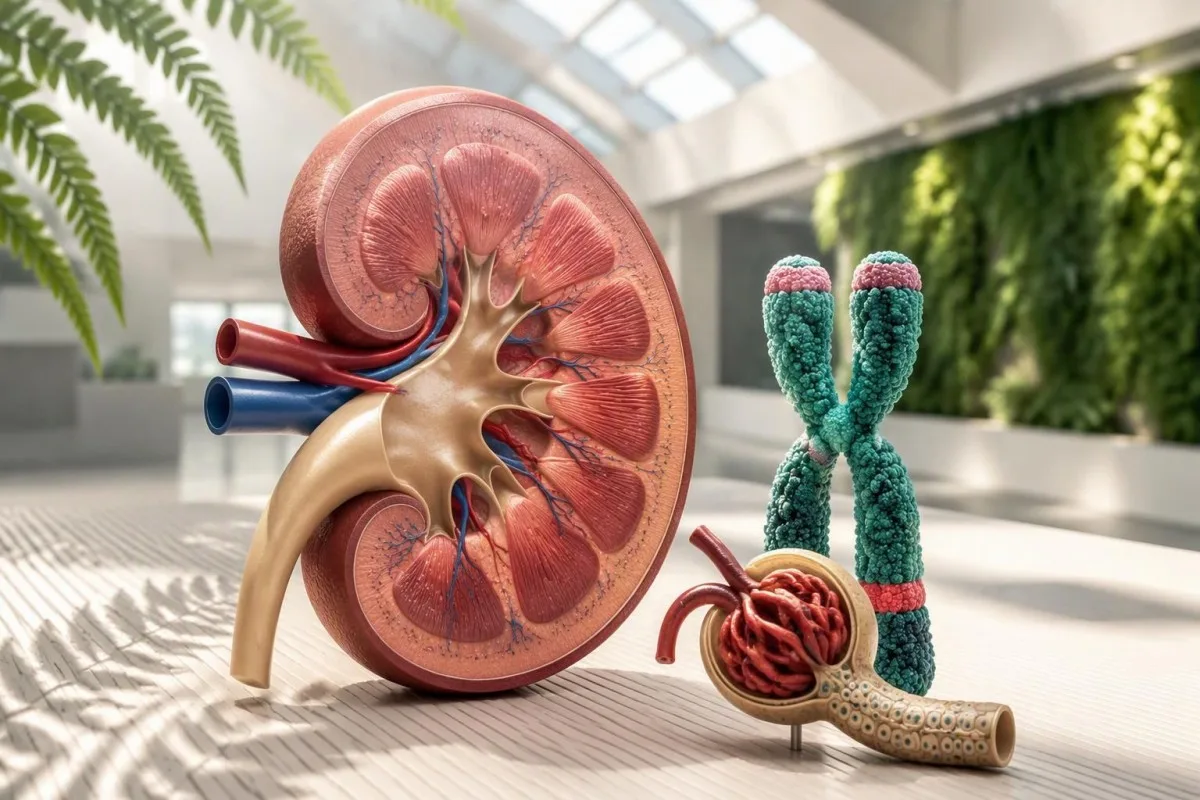
Dwa warianty ryzyka APOL1 — G1/G1, G1/G2 lub G2/G2 — wskazują na dziedziczną podatność na chorobę nerek, a nie na rozpoznanie. Wyniki mogą pomóc w poradnictwie, monitorowaniu nerek i ocenie żywego dawcy, ale nie pozwalają z pewnością przewidzieć przyszłości danej osoby.


- Dwa warianty ryzyka oznaczają G1/G1, G1/G2 lub G2/G2; wszystkie trzy klasyfikuje się jako genotyp APOL1 wysokiego ryzyka.
- G1 to jeden allel ryzyka mimo że częsty haplotyp G1 zawiera dwie sprzężone zmiany sekwencji na tym samym chromosomie.
- Wysokie ryzyko nie jest rozpoznaniem: wyniki APOL1 nie potwierdzają przewlekłej choroby nerek, ogniskowego segmentalnego stwardnienia kłębuszków nerkowych ani konieczności dializoterapii.
- Ocena nerek wymaga dwóch pomiarów: szacunkowego współczynnika filtracji kłębuszkowej, czyli eGFR, oraz stosunku albuminy do kreatyniny w moczu, czyli ACR.
- Utrzymujące się nieprawidłowości dotyczące nerek obejmują eGFR poniżej 60 mL/min/1.73 m² lub ACR wynoszący co najmniej 30 mg/g przez 3 miesiące lub dłużej.
- Prawidłowe wyniki wyjściowe często przemawiają za indywidualnym planem corocznego monitorowania, ale nie ustalono uniwersalnego odstępu między badaniami przesiewowymi swoistego dla APOL1.
- Pochodzenie genetyczne różni się od rasy: pochodzenie może być pomocne podczas omawiania badań, ale wygląd i tożsamość rasowa nie pozwalają określić genotypu APOL1.
- Oddanie nerki za życia wymaga odrębnego poradnictwa ponieważ dwa warianty ryzyka mogą wpływać na kwalifikację, nawet gdy aktualne pomiary czynności nerek są prawidłowe.
- Dziedziczenie w rodzinie można przewidzieć; choroby — nie: dwoje rodziców, z których każde ma jeden allel ryzyka, ma 25% szans na dziecko dziedziczące dwa allele ryzyka w każdej ciąży.
Co w praktyce oznacza genotyp APOL1 wysokiego ryzyka?
Badanie genetyczne APOL1 identyfikuje odziedziczone warianty związane z podatnością na choroby nerek. Posiadanie dwóch wariantów ryzyka APOL1—G1/G1, G1/G2 lub G2/G2—zwiększa ryzyko, ale nie stanowi rozpoznania choroby nerek ani nie przesądza o niewydolności nerek; dalsze postępowanie zależy od pomiarów czynności nerek, wywiadu rodzinnego i tego, czy rozważane jest oddanie nerki.
Wynik APOL1 wskazujący na wysokie ryzyko i przewlekła choroba nerek to dwa odrębne wyniki. Osoba może mieć G1/G2, eGFR wynoszący 105 mL/min/1.73 m² i ACR w moczu wynoszący 6 mg/g bez oznak aktualnej PChN; pomiary te opisują obecny stan nerek, a nie gwarancję na całe życie.
Badanie APOL1 jest najbardziej przydatne, gdy wpływa na decyzję, a nie tylko dodaje etykietę. Nazywam się Thomas Klein, jestem dyrektorem medycznym Kantesti i na początku rozdzieliłbym trzy kwestie: co zostało odziedziczone, czy występuje uszkodzenie nerek oraz czy wynik wpływa na rozmowę o dawstwie nerki lub leczeniu.
Kantesti jest Analizator do badań krwi AI które mogą pomóc w interpretacji laboratoryjnych pomiarów dotyczących nerek, ale rutynowy panel biochemiczny nie pozwala ustalić genotypu APOL1. Nasz przewodnik po stadiach CKD wyjaśnia, dlaczego należy uwzględniać łącznie eGFR i albuminę w moczu; żaden z tych pomiarów nie zastępuje specjalistycznego badania genetycznego.
Jak interpretować wyniki G1/G1, G1/G2 i G2/G2?
G1/G1, G1/G2 i G2/G2 oznaczają, że obie odziedziczone kopie genu APOL1 zawierają allel ryzyka choroby nerek. G1/G1 zawiera dwa allele G1, G1/G2 zawiera po jednym z każdego, a G2/G2 zawiera dwa allele G2; żaden z tych genotypów nie jest pomiarem czynności nerek.
G1 to zwykle haplotyp zawierający dwie sprzężone zmiany kodujące, powszechnie określane jako S342G i I384M. Zmiany te zazwyczaj są dziedziczone razem na jednym chromosomie i liczą się jako jeden allel ryzyka G1, a nie dwa odrębne odziedziczone allele ryzyka; G2 to delecja sześciu par zasad, która usuwa dwa aminokwasy z białka APOL1.
G0/G0, G0/G1 i G0/G2 są standardowo zaliczane do genotypów APOL1 niższego ryzyka, ponieważ zawierają zero lub jeden rozpoznany allel ryzyka. Niższe ryzyko związane z APOL1 nie oznacza zerowego ryzyka choroby nerek: nadal możliwe są cukrzyca, nadciśnienie, inne choroby genetyczne i uszkodzenie związane z lekami, a ograniczone badania nie obejmują wszystkich genów związanych z chorobami nerek.
Trzy kombinacje wysokiego ryzyka nie pozwalają wiarygodnie uszeregować indywidualnego stopnia zaawansowania. Jeśli w raporcie wymieniono zmiany sekwencji zamiast pary alleli, poproś laboratorium o podanie ich w postaci jednoznacznego genotypu oraz wskazanie wszelkich ograniczeń w ustaleniu, które zmiany znajdują się na tym samym chromosomie; nasz result-format explanation helps distinguish categorical genetic findings from numerical laboratory values.
Dlaczego dwa warianty ryzyka APOL1 nie gwarantują choroby nerek?
APOL1-associated kidney susceptibility has incomplete penetrance: some people with two risk alleles develop kidney disease, while others do not. Age, additional genetic factors, immune signaling, environmental exposures and existing kidney conditions influence outcomes, so a genotype alone cannot provide a dependable personal lifetime percentage.
Parsa and colleagues reported that, among AASK participants who already had hypertension-associated CKD, the composite outcome of kidney failure or doubling serum creatinine occurred in 58.1% of the high-risk group versus 36.6% of the lower-risk group (Parsa et al., 2013). Those figures describe progression in an affected study population—not the chance that a healthy person with G1/G2 will develop CKD.
Relative risk and absolute risk answer different questions. Even a twofold association does not tell a person their probability without a relevant starting risk and a time horizon; a 30-year-old with normal ACR and a 65-year-old with substantial albuminuria should not receive the same prediction simply because their APOL1 results match.
The proposed “second-hit” model is useful but incomplete: certain immune or cellular stresses may increase APOL1-related injury, yet clinicians cannot identify a single required trigger for every patient. This resembles the distinction between susceptibility and diagnosis discussed in our ApoE4 risk explanation, although the genes, organs and predictive evidence are different.
Czym pochodzenie genetyczne różni się od rasy w badaniu APOL1?
APOL1 G1 and G2 variants are associated particularly with genetic ancestry from parts of sub-Saharan Africa, not with a racial category itself. Race is a social classification, ancestry describes inherited population history, and neither a person’s appearance nor a single ancestry percentage establishes whether they carry zero, one or two risk alleles.
African ancestry is not one uniform genetic background. G1 and G2 frequencies differ substantially between populations, so a broad label such as “African,” “Black” or “mixed ancestry” is too coarse to establish an individual’s result; a family history extending across two or more regions can also be incomplete or unknown.
An ancestry-informed testing offer should be an invitation to discuss relevance, not a biological assumption about someone’s race. A person who does not identify as Black may carry two risk variants, while a person who does identify as Black may carry neither; asking about family origins is more respectful and clinically useful than inferring genetics from skin tone.
Race should not be used as a substitute for genotype or as an automatic adjustment to kidney-function interpretation. KDIGO 2024 supports avoiding race in eGFR computation; our Duffy-null neutrophil explanation illustrates another setting where a specific inherited finding is more informative than a racial label, although Duffy status does not predict APOL1 status.
Kto może odnieść korzyść z badania genetycznego APOL1?
APOL1 testing may be useful for selected people with unexplained or familial kidney disease, some patients with focal segmental glomerulosclerosis, and potential living kidney donors with relevant ancestry. Testing everyone solely because of race is not an appropriate substitute for individualized consent, clinical assessment and a clear explanation of what the result could change.
An unexplained kidney problem before age 50, several relatives with kidney failure, or a tissue diagnosis showing FSGS can justify a genetics discussion. APOL1 may be only one part of that assessment: other inherited kidney disorders can produce similar findings, and a targeted APOL1 test will not identify all of them.
A positive APOL1 result does not prove that APOL1 caused every abnormality on a kidney panel. For example, G1/G1 in a patient with diabetes and an ACR of 450 mg/g may represent an additional susceptibility rather than a complete explanation; clinicians still assess diabetes duration, retinal findings, urine sediment, medication exposure and the pace of eGFR change.
Testing an unaffected relative should have an agreed purpose, such as counseling or donor evaluation, rather than a promise that it will prevent disease. Our inherited family-risk discussion shows why the question “What will we do differently after either result?” matters before ordering a genetic test; the appropriate answer can differ between two members of the same family.
Jak wykonuje się badanie APOL1 i kiedy potrzebne jest potwierdzenie?
APOL1 genetic testing uses DNA, commonly obtained from a blood, saliva or cheek-swab specimen, to identify G1 and G2 alleles. The genotype normally remains unchanged throughout life, so one adequately performed clinical test is usually sufficient; repeat or confirmatory testing is reserved for uncertainty about specimen identity, assay coverage or the original result.
A clinical report should identify the tested variants, the genotype and the assay’s relevant limitations. Turnaround time varies between laboratories, and the genetic assay is separate from a same-day creatinine result; before paying, ask whether the fee includes counseling, whether both risk alleles are assessed, and whether an inconclusive result requires a second specimen.
An unexpected direct-to-consumer result may need confirmation in an accredited clinical laboratory before a transplant or other consequential decision. A screenshot showing two sequence changes is not necessarily proof of two risk alleles, particularly when the changes belong to the same G1 haplotype; the original report and its method matter more than an automated summary.
Kantesti’s laboratory explanations should preserve the distinction between genetic evidence and biochemical evidence rather than infer an APOL1 result from creatinine. Our kliniczne ramy walidacji describes the standards behind laboratory interpretation, while our przewodnik po bezpieczeństwie raportów medycznych explains why source verification is necessary before acting on a consequential result.
Co powinno obejmować poradnictwo genetyczne dotyczące APOL1 dla rodzin?
APOL1 counseling should explain inheritance, uncertain disease prediction, family implications, privacy and the limits of testing. Each child inherits one APOL1 copy from each parent; predictable allele transmission does not translate into a predictable age of onset, disease severity or need for dialysis.
When both parents have one recognized APOL1 risk allele, each pregnancy has a 25% chance of two risk alleles, a 50% chance of one, and a 25% chance of none. These probabilities reset with every pregnancy; four children do not have to divide into those proportions, and a child inheriting two alleles is not thereby diagnosed with kidney disease.
A parent with G1/G2 passes a risk allele to every child: either G1 or G2, each with a 50% chance. If the other parent is G0/G0, none of their children will have two recognized risk alleles; a genetic counselor can explain when partner testing would meaningfully answer a family question rather than merely add anxiety.
Testing children requires a separate discussion about present medical benefit, consent and the child’s future autonomy—not simply applying an adult screening plan at age 8. Our carrier-screening counseling guide illustrates why inheritance terminology needs care, and our przewodnika po badaniach rodzinnych w zależności od wieku helps distinguish targeted care from indiscriminate family screening.
Które badania krwi oceniające nerki są ważne po uzyskaniu wyniku wysokiego ryzyka?
Serum creatinine with eGFR is a standard blood-based assessment after an APOL1 high-risk result; cystatin C can improve assessment when creatinine is less reliable. Urine ACR must be added separately because an eGFR above 90 mL/min/1.73 m² does not rule out albumin leakage or early kidney damage.
Creatinine reflects both filtration and factors such as muscle mass, recent meat intake and some medications. A muscular adult with creatinine of 1.3 mg/dL may need a different interpretation from a frail adult with the same concentration; our muscular-adult creatinine guide explains why the laboratory flag alone is not a diagnosis.
A combined creatinine–cystatin C eGFR can be useful when a more accurate estimate could change a decision, including selected donor assessments. Cystatin C has its own influences, including glucocorticoid exposure and thyroid dysfunction, so it is not an infallible correction; our przewodnik po interpretacji cystatyny C discusses the two-marker approach.
Kantesti jest platforma do interpretacji wyników badań krwi AI that can help put serial creatinine and eGFR reports into context, but laboratory trends cannot prove APOL1-related disease. KDIGO 2024 states that an eGFR change greater than 20% on a subsequent test in someone with CKD exceeds expected variability and warrants evaluation; a smaller change can still matter when it persists or accompanies rising albuminuria.
Jak interpretować ACR w moczu i terminy badań kontrolnych?
Urine ACR measures albumin leakage and is essential alongside eGFR when assessing APOL1 susceptibility. KDIGO albuminuria categories are A1 below 30 mg/g, A2 from 30–300 mg/g and A3 above 300 mg/g; persistent abnormalities require assessment even when filtration remains apparently normal.
One elevated ACR is not automatically persistent kidney damage. Strenuous exercise, fever, urinary infection and menstrual contamination can affect a result, so an ACR of 65 mg/g may need a properly timed repeat; our przewodnik przygotowania ACR explains practical collection steps without substituting a negative dipstick for a quantitative ratio.
An individualized annual review of blood pressure, eGFR and ACR is a reasonable discussion for an otherwise well adult with two risk alleles and normal baseline findings. That is a pragmatic monitoring plan, not a universal APOL1-specific guideline; established CKD, pregnancy, new hypertension or an abnormal trend may justify shorter intervals, such as 3–6 months, chosen by the treating clinician.
KDIGO 2024 considers a doubling of ACR on follow-up in someone with CKD a change that warrants evaluation. Urine microscopy adds a different kind of information: cellular casts or persistent red cells can point toward another process, as our poradniku dotyczącym osadu moczu explains; APOL1 testing should not make those findings disappear from the differential diagnosis.
Kiedy wynik APOL1 wymaga skierowania do nefrologa?
Nephrology referral is driven mainly by kidney abnormalities, progression, unexplained findings and donor questions—not by genotype alone. CKD requires evidence of abnormal kidney structure or function for at least 3 months; a rapidly changing creatinine result or concerning symptoms require prompt assessment without waiting for that chronicity threshold.
Persistent eGFR below 60 mL/min/1.73 m² or ACR at least 30 mg/g can satisfy CKD criteria when present for 3 months or longer. Referral urgency increases with advanced impairment, substantial albuminuria, a sustained downward trend or uncertainty about the cause; a normal eGFR does not make an ACR of 800 mg/g reassuring.
A hypothetical 36-year-old with G1/G2, eGFR 96 mL/min/1.73 m² and ACR 900 mg/g needs evaluation for significant albuminuria, not reassurance based on filtration alone. APOL1 susceptibility does not exclude membranous nephropathy or other glomerular disorders; our PLA2R antibody explanation describes one different diagnostic pathway that may become relevant when the clinical pattern fits.
Rapidly reduced urine output, breathlessness with swelling, or visible urine discoloration alongside worsening kidney measurements calls for urgent assessment. Some antibody-mediated conditions need especially rapid action, as discussed in our anti-GBM result guide; neither a known APOL1 result nor a 3-month CKD definition should delay an acute kidney evaluation.
Czy genotyp wysokiego ryzyka zmienia leczenie lub codzienne nawyki?
An APOL1 high-risk genotype alone does not automatically justify kidney medication, a restrictive renal diet or supplements. Treatment depends on actual kidney disease, albuminuria, blood pressure and other conditions; proven CKD therapies should not be withheld merely because inherited susceptibility may contribute to the disease.
Blood-pressure control is a practical priority, but the measurement method changes how a target should be interpreted. KDIGO’s CKD guidance includes a standardized office systolic target below 120 mmHg when tolerated for appropriate adults; that is not an instruction to force every routine home reading below 120, especially with dizziness, frailty or other reasons to individualize treatment.
ACE inhibitors or ARBs and SGLT2 inhibitors may be indicated for particular CKD and albuminuria patterns, with monitoring of creatinine and potassium. Two risk alleles with normal eGFR and normal ACR do not automatically establish those indications; medication choices should follow the person’s documented condition and current local guidance rather than a genetic label.
No supplement, “kidney cleanse” or diet has been shown to erase G1 or G2 alleles. Avoid starting potassium restriction or a very-low-protein diet solely after a genetic result, and discuss frequent NSAID use with your clinician; our przewodnik po bezpieczeństwie suplementów nerkowych explains why products marketed for kidney health can create problems rather than prevent them.
Co dwa warianty ryzyka APOL1 oznaczają dla żywego dawstwa?
Two APOL1 risk variants may change living-kidney-donor eligibility even when current kidney function is normal. The concern is the donor’s future risk after losing kidney reserve, as well as possible implications for the donated kidney; transplant programs differ in how they incorporate the result into acceptance decisions.
The KDIGO living-donor guideline states that APOL1 genotyping may be offered to candidates with sub-Saharan African ancestry and that candidates should understand the uncertainty in predicting post-donation risk (Lentine et al., 2017). Many programs take a conservative approach to two risk alleles, particularly in younger candidates; there is no single internationally uniform APOL1 acceptance rule.
KDIGO 2017 considers donor GFR of at least 90 mL/min/1.73 m² generally acceptable, GFR from 60–89 individually assessable, and GFR below 60 unsuitable for donation. These filtration thresholds do not cancel APOL1 susceptibility; our przewodnik BUN i kreatynina explains why a reassuring chemistry result alone is not a complete donor assessment.
Age, albuminuria, blood pressure, family history and other health risks must be considered alongside the genotype. A young candidate has more remaining years in which disease could emerge, and related donors may share additional inherited risks; a transplant team should explain what a positive result means for eligibility before testing, not after a family has assumed donation will proceed.
Jak należy chronić prywatność i bezpieczeństwo informacji o APOL1?
APOL1 results are sensitive genetic information with implications for both the tested person and relatives. Before sharing a report with a clinical service or digital tool, check consent, access, retention and deletion options; protections against genetic discrimination differ between countries and between insurance products.
One person’s permission to share their result does not automatically authorize uploading a relative’s report. Remove unnecessary identifiers, consider who can access shared family accounts, and ask whether genetics information becomes part of a medical record; insurance and employment protections are jurisdiction-specific, so obtain local advice before assuming a general privacy statement covers every consequence.
Kantesti jest platforma do interpretacji biomarkerów przez AI that can support understanding of kidney-related laboratory reports, but it does not replace APOL1 testing, genetic counseling or transplant eligibility review. Our informacje o prywatności i danych explains data-handling considerations; an AI interpretation taking approximately 60 seconds is not the same service as completing a molecular genetic assay.
Kantesti LTD is a UK company, number 17090423, and our organization information provides context about who operates the service. Family Health Risk features should use consented information rather than infer a relative’s genotype from race, kidney chemistry or another person’s two-allele result; keep the original clinical laboratory report available for professional review.
Co należy przynieść na wizytę i które źródła informacji mają zastosowanie?
Bring the original APOL1 report, recent eGFR and urine ACR results, a medication list and a family kidney history to your appointment. As of October 19, 2026, this article distinguishes established guidance from uncertain individual prediction; its clinical references include the 2024 KDIGO CKD guideline and the 2017 KDIGO living-donor guideline.
A useful appointment can answer four concrete questions: Is kidney damage present, what is the monitoring interval, should relatives receive counseling, and does the result affect donation? My practical checklist as Thomas Klein, Chief Medical Officer at Kantesti, is to leave with a named clinician and a written next-test plan rather than an unsupported lifetime percentage; our medyczne informacje doradcze describes the expertise behind our clinical standards.
Serum albumin and urine albumin answer different questions, and confusing the two can derail a kidney discussion. Our przewodnik po białkach surowicy provides supporting education on circulating proteins, but neither a normal serum albumin of 4.2 g/dL nor a normal albumin-to-globulin ratio excludes urinary albumin loss or determines an APOL1 genotype.
Complement tests are not routine APOL1 surveillance tests; C3 and C4 may become relevant when clinical findings suggest an immune-mediated kidney disorder. Our przewodnik po badaniach uzupełniających is a supporting educational publication, not evidence for APOL1 penetrance; the two Zenodo resources listed below are separate from the directly relevant external medical references, and their ResearchGate and Academia.edu links are discovery searches rather than verified hosted copies.
Często zadawane pytania
Czy posiadanie dwóch wariantów ryzyka genu APOL1 oznacza, że zachoruję na chorobę nerek?
0 Posiadanie dwóch wariantów ryzyka APOL1 zwiększa podatność na choroby nerek, ale nie gwarantuje choroby ani niewydolności nerek. G1/G1, G1/G2 i G2/G2 są klasyfikowane jako genotypy wysokiego ryzyka, jednak indywidualne rokowania są różne. Bieżąca ocena stanu nerek wymaga oznaczenia eGFR i ACR w moczu; eGFR wynoszący 100 mL/min/1.73 m² i ACR wynoszący 5 mg/g nie potwierdzają PChN. Indywidualny plan monitorowania jest bardziej przydatny niż stosowanie odsetka z badania obejmującego osoby, które już chorowały na nerki.
Czy G1/G1, G1/G2 i G2/G2 są jednakowo poważne?
G1/G1, G1/G2 i G2/G2 zawierają po dwa uznane allele ryzyka APOL1 i zalicza się je do genotypów wysokiego ryzyka. Kombinacje genotypów nie pozwalają wiarygodnie uszeregować przyszłego nasilenia choroby u danej osoby. G1 zwykle obejmuje dwie sprzężone zmiany sekwencji na jednym chromosomie, ale zmiany te liczą się jako jeden allel ryzyka. Do interpretacji każdej z tych trzech kombinacji nadal konieczne są wyniki badań nerek, wiek i wywiad kliniczny.
0 Jak często należy kontrolować nerki po uzyskaniu wyniku wskazującego na wysokie ryzyko związane z APOL1?
Nie ma uniwersalnego harmonogramu monitorowania swoistego dla APOL1, który miałby zastosowanie do każdej osoby z dwiema wariantami ryzyka. W przypadku poza tym zdrowej osoby dorosłej z prawidłowymi wynikami wyjściowymi rozsądnym punktem wyjścia jest omówienie corocznych pomiarów ciśnienia tętniczego oraz oznaczeń eGFR i ACR w moczu. Wcześniejsza przewlekła choroba nerek (CKD), albuminuria lub zmieniające się wyniki mogą uzasadniać krótsze odstępy, na przykład co 3–6 miesięcy, ustalane przez lekarza prowadzącego. Nowe objawy lub szybka zmiana czynności nerek wymagają wcześniejszej oceny, zamiast czekania na kolejny zaplanowany pomiar.
Czy mogę oddać nerkę, jeśli mam dwa warianty ryzyka APOL1?
Dwa warianty ryzyka APOL1 mogą wpływać na kwalifikację do oddania nerki przez żywego dawcę, nawet gdy obecne wyniki badań nerek są prawidłowe. Programy transplantacyjne różnią się zasadami akceptacji, a wiele z nich stosuje zachowawcze podejście, ponieważ indywidualnego ryzyka po oddaniu nerki nie można dokładnie przewidzieć. Wytyczne KDIGO dotyczące żywych dawców zasadniczo uznają GFR wynoszący co najmniej 90 mL/min/1.73 m² za akceptowalny, jednak wartość progowa ta nie znosi ryzyka genetycznego ani innych zagrożeń dla zdrowia. Przed założeniem, że prawidłowy poziom kreatyniny potwierdza bezpieczeństwo dawcy, skonsultuj się z lekarzem w sprawie polityki ośrodka dotyczącej APOL1.
0 Czy badanie APOL1 dotyczy wyłącznie osób identyfikujących się jako osoby czarnoskóre?
Badanie APOL1 nie jest ograniczone do określonej tożsamości rasowej, ponieważ pochodzenie genetyczne i rasa to różne pojęcia. Warianty G1 i G2 są związane przede wszystkim z pochodzeniem z niektórych regionów Afryki Subsaharyjskiej, ale wygląd nie pozwala ustalić, czy dana osoba ma zero, jeden czy dwa allele ryzyka. Osoba, która nie identyfikuje się jako osoba czarna, może być nosicielem tych wariantów, podczas gdy osoba identyfikująca się jako czarna może nie mieć żadnego z nich. Omawiając badanie, należy wziąć pod uwagę pochodzenie, wyniki badań nerek, wywiad rodzinny oraz decyzję, którą wynik mógłby zmienić.
Czy moje dzieci odziedziczą dwa warianty ryzyka APOL1?
Genotyp dziecka w zakresie APOL1 zależy od allelu odziedziczonego od każdego z rodziców. Jeśli oboje rodzice mają po jednym allelu ryzyka, prawdopodobieństwo, że dziecko odziedziczy dwa allele ryzyka, wynosi w każdej ciąży 25%. Jeśli jeden rodzic ma G1/G2, a drugi G0/G0, każde dziecko odziedziczy jeden allel ryzyka i żadne nie odziedziczy dwóch uznanych alleli ryzyka. Te prawdopodobieństwa dziedziczenia nie pozwalają przewidzieć, czy ani kiedy wystąpi choroba nerek.
Uzyskaj analizę wyników badań krwi zasilaną przez AI już dziś
Dołącz do ponad 2 milionów użytkowników na całym świecie, którzy ufają Kantesti w zakresie natychmiastowej, dokładnej analizy badań laboratoryjnych. Prześlij swoje wyniki badań krwi i otrzymaj kompleksową interpretację biomarkerów 15,000+ w kilka sekund.
📚 Publikacje badawcze z odniesieniami
Klein, T., Mitchell, S., & Weber, H. (2026). Przewodnik po białkach surowicy: badanie krwi globulin, albumin i stosunku A/G.Kantesti AI Medical Research.
Klein, T., Mitchell, S., & Weber, H. (2026). Przewodnik do badania krwi C3 i C4 oraz miana ANA.Kantesti AI Medical Research.
📖 Zewnętrzne medyczne źródła odniesienia
Parsa A et al. (2013). APOL1 Risk Variants, Race, and Progression of Chronic Kidney Disease. New England Journal of Medicine.
Lentine KL et al. (2017). KDIGO Clinical Practice Guideline on the Evaluation and Care of Living Kidney Donors. Transplantation.
Kidney Disease: Improving Global Outcomes (KDIGO) CKD Work Group (2024). Wytyczne praktyki klinicznej KDIGO 2024 dotyczące oceny i leczenia przewlekłej choroby nerek. Kidney International.
⚕️ Zastrzeżenie medyczne
Ten artykuł ma wyłącznie charakter edukacyjny i nie stanowi porady medycznej. Zawsze konsultuj decyzje dotyczące diagnozy i leczenia z wykwalifikowanym pracownikiem ochrony zdrowia.
Sygnały zaufania E-E-A-T
Doświadczenie
Kliniczna weryfikacja procesów interpretacji przez lekarza.
Ekspertyza
Medycyna laboratoryjna skupiona na tym, jak zachowują się biomarkery w kontekście klinicznym.
Autorytatywność
Napisane przez dr. Thomasa Kleina, z recenzją dr Sarah Mitchell i prof. dr. Hansa Webera.
Solidność
Interpretacja oparta na dowodach, z jasnymi ścieżkami dalszego postępowania, aby ograniczyć alarm.