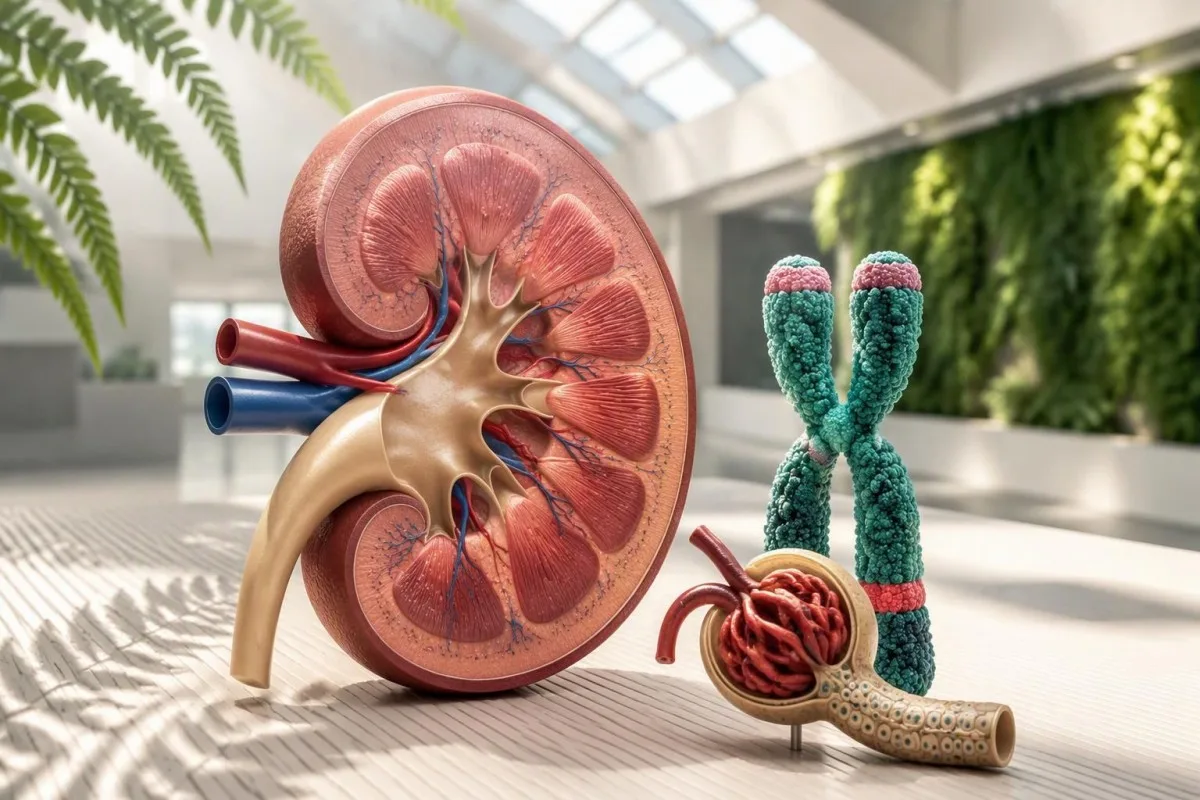
Dua varian risiko APOL1—G1/G1, G1/G2, atau G2/G2—menunjukkan kerentanan terhadap penyakit ginjal yang diwariskan, bukan diagnosis. Hasilnya dapat membantu konseling, pemantauan ginjal, dan penilaian donor hidup tanpa memprediksi masa depan seseorang dengan pasti.


- Dua varian risiko berarti G1/G1, G1/G2, atau G2/G2; ketiganya diklasifikasikan sebagai genotipe APOL1 berisiko tinggi.
- G1 adalah satu alel risiko meskipun haplotipe G1 yang umum mengandung dua perubahan sekuens yang terpaut pada kromosom yang sama.
- Risiko tinggi bukan diagnosis: hasil APOL1 tidak menetapkan penyakit ginjal kronis, glomerulosklerosis segmental fokal, atau kebutuhan untuk dialisis.
- Penilaian ginjal memerlukan dua pengukuran: laju filtrasi glomerulus estimasi, atau eGFR, dan rasio albumin-kreatinin urine, atau ACR.
- Kelainan ginjal yang menetap mencakup eGFR di bawah 60 mL/min/1.73 m² atau ACR minimal 30 mg/g selama 3 bulan atau lebih.
- Hasil dasar normal sering mendukung rencana pemantauan tahunan yang disesuaikan untuk setiap individu, tetapi belum ada interval skrining khusus APOL1 yang berlaku universal.
- Leluhur genetik berbeda dari ras: leluhur dapat menjadi pertimbangan dalam diskusi tentang pengujian, tetapi penampilan dan identitas rasial tidak dapat menentukan genotipe APOL1.
- Donasi organ dari donor hidup memerlukan konseling terpisah karena dua varian risiko dapat memengaruhi kelayakan meskipun pengukuran ginjal saat ini normal.
- Pewarisan dalam keluarga dapat diprediksi; penyakit tidak: dua orang tua yang masing-masing memiliki satu alel risiko memiliki peluang 25% untuk memiliki anak yang mewarisi dua alel risiko dalam setiap kehamilan.
Apa sebenarnya arti genotipe APOL1 berisiko tinggi?
Pemeriksaan genetik APOL1 mengidentifikasi varian bawaan yang terkait dengan kerentanan terhadap penyakit ginjal. Memiliki dua varian risiko APOL1—G1/G1, G1/G2 atau G2/G2—meningkatkan risiko, tetapi tidak mendiagnosis penyakit ginjal atau memastikan gagal ginjal; langkah selanjutnya bergantung pada pengukuran ginjal, riwayat keluarga, dan apakah donasi sedang dipertimbangkan.
Hasil APOL1 berisiko tinggi dan penyakit ginjal kronis adalah dua temuan yang berbeda. Seseorang dapat memiliki G1/G2, eGFR 105 mL/min/1.73 m², dan ACR urine 6 mg/g tanpa bukti CKD saat ini; pengukuran tersebut menggambarkan kesehatan ginjal saat ini, bukan jaminan seumur hidup.
Pengujian APOL1 paling bermanfaat ketika mengubah suatu keputusan, bukan sekadar menambahkan label. Saya Thomas Klein, Chief Medical Officer Kantesti, dan sejak awal saya akan memisahkan tiga pertanyaan: apa yang diwariskan, apakah terdapat kerusakan ginjal, dan apakah hasilnya mengubah diskusi tentang donor atau pengobatan.
Kantesti adalah seorang Analisa tes darah AI yang dapat membantu menjelaskan pengukuran laboratorium terkait ginjal, tetapi panel kimia darah rutin tidak dapat mengungkap genotipe APOL1. Kami panduan staging CKD menjelaskan alasan eGFR dan albumin urine harus dipertimbangkan bersama; tidak satu pun pengukuran dapat menggantikan pemeriksaan genetik khusus.
Bagaimana hasil G1/G1, G1/G2, dan G2/G2 harus dibaca?
G1/G1, G1/G2, dan G2/G2 masing-masing berarti kedua salinan gen APOL1 yang diwariskan membawa alel risiko ginjal. G1/G1 memiliki dua alel G1, G1/G2 memiliki masing-masing satu, dan G2/G2 memiliki dua alel G2; tidak satu pun merupakan pengukuran fungsi ginjal.
G1 biasanya merupakan haplotipe yang terdiri atas dua perubahan pengode terkait, yang umumnya disebut S342G dan I384M. Perubahan tersebut biasanya diwariskan bersama pada satu kromosom dan dihitung sebagai satu alel risiko G1, bukan dua alel risiko bawaan yang terpisah; G2 adalah delesi enam pasangan basa yang menghilangkan dua asam amino dari protein APOL1.
G0/G0, G0/G1, dan G0/G2 secara konvensional dikelompokkan sebagai genotipe APOL1 berisiko lebih rendah karena mengandung nol atau satu alel risiko yang telah diketahui. Risiko APOL1 yang lebih rendah bukan berarti risiko penyakit ginjal nol: diabetes, hipertensi, kondisi genetik lain, dan cedera terkait obat tetap mungkin terjadi, dan pemeriksaan terbatas tidak memeriksa setiap gen penyakit ginjal.
Ketiga kombinasi berisiko tinggi tersebut bukan peringkat tingkat keparahan individu yang andal. Jika laporan mencantumkan perubahan sekuens alih-alih pasangan alel, mintalah laboratorium menerjemahkannya menjadi genotipe yang jelas dan menyatakan keterbatasan apa pun dalam menentukan perubahan mana yang berada pada kromosom yang sama; kami result-format explanation helps distinguish categorical genetic findings from numerical laboratory values.
Mengapa dua varian risiko APOL1 tidak menjamin terjadinya penyakit ginjal?
APOL1-associated kidney susceptibility has incomplete penetrance: some people with two risk alleles develop kidney disease, while others do not. Age, additional genetic factors, immune signaling, environmental exposures and existing kidney conditions influence outcomes, so a genotype alone cannot provide a dependable personal lifetime percentage.
Parsa and colleagues reported that, among AASK participants who already had hypertension-associated CKD, the composite outcome of kidney failure or doubling serum creatinine occurred in 58.1% of the high-risk group versus 36.6% of the lower-risk group (Parsa et al., 2013). Those figures describe progression in an affected study population—not the chance that a healthy person with G1/G2 will develop CKD.
Relative risk and absolute risk answer different questions. Even a twofold association does not tell a person their probability without a relevant starting risk and a time horizon; a 30-year-old with normal ACR and a 65-year-old with substantial albuminuria should not receive the same prediction simply because their APOL1 results match.
The proposed “second-hit” model is useful but incomplete: certain immune or cellular stresses may increase APOL1-related injury, yet clinicians cannot identify a single required trigger for every patient. This resembles the distinction between susceptibility and diagnosis discussed in our ApoE4 risk explanation, although the genes, organs and predictive evidence are different.
Apa perbedaan leluhur genetik dengan ras dalam pemeriksaan APOL1?
APOL1 G1 and G2 variants are associated particularly with genetic ancestry from parts of sub-Saharan Africa, not with a racial category itself. Race is a social classification, ancestry describes inherited population history, and neither a person’s appearance nor a single ancestry percentage establishes whether they carry zero, one or two risk alleles.
African ancestry is not one uniform genetic background. G1 and G2 frequencies differ substantially between populations, so a broad label such as “African,” “Black” or “mixed ancestry” is too coarse to establish an individual’s result; a family history extending across two or more regions can also be incomplete or unknown.
An ancestry-informed testing offer should be an invitation to discuss relevance, not a biological assumption about someone’s race. A person who does not identify as Black may carry two risk variants, while a person who does identify as Black may carry neither; asking about family origins is more respectful and clinically useful than inferring genetics from skin tone.
Race should not be used as a substitute for genotype or as an automatic adjustment to kidney-function interpretation. KDIGO 2024 supports avoiding race in eGFR computation; our Duffy-null neutrophil explanation illustrates another setting where a specific inherited finding is more informative than a racial label, although Duffy status does not predict APOL1 status.
Siapa yang mungkin mendapat manfaat dari pemeriksaan genetik APOL1?
APOL1 testing may be useful for selected people with unexplained or familial kidney disease, some patients with focal segmental glomerulosclerosis, and potential living kidney donors with relevant ancestry. Testing everyone solely because of race is not an appropriate substitute for individualized consent, clinical assessment and a clear explanation of what the result could change.
An unexplained kidney problem before age 50, several relatives with kidney failure, or a tissue diagnosis showing FSGS can justify a genetics discussion. APOL1 may be only one part of that assessment: other inherited kidney disorders can produce similar findings, and a targeted APOL1 test will not identify all of them.
A positive APOL1 result does not prove that APOL1 caused every abnormality on a kidney panel. For example, G1/G1 in a patient with diabetes and an ACR of 450 mg/g may represent an additional susceptibility rather than a complete explanation; clinicians still assess diabetes duration, retinal findings, urine sediment, medication exposure and the pace of eGFR change.
Testing an unaffected relative should have an agreed purpose, such as counseling or donor evaluation, rather than a promise that it will prevent disease. Our inherited family-risk discussion shows why the question “What will we do differently after either result?” matters before ordering a genetic test; the appropriate answer can differ between two members of the same family.
Bagaimana pemeriksaan APOL1 dilakukan, dan kapan konfirmasi diperlukan?
APOL1 genetic testing uses DNA, commonly obtained from a blood, saliva or cheek-swab specimen, to identify G1 and G2 alleles. The genotype normally remains unchanged throughout life, so one adequately performed clinical test is usually sufficient; repeat or confirmatory testing is reserved for uncertainty about specimen identity, assay coverage or the original result.
A clinical report should identify the tested variants, the genotype and the assay’s relevant limitations. Turnaround time varies between laboratories, and the genetic assay is separate from a same-day creatinine result; before paying, ask whether the fee includes counseling, whether both risk alleles are assessed, and whether an inconclusive result requires a second specimen.
An unexpected direct-to-consumer result may need confirmation in an accredited clinical laboratory before a transplant or other consequential decision. A screenshot showing two sequence changes is not necessarily proof of two risk alleles, particularly when the changes belong to the same G1 haplotype; the original report and its method matter more than an automated summary.
Kantesti’s laboratory explanations should preserve the distinction between genetic evidence and biochemical evidence rather than infer an APOL1 result from creatinine. Our kerangka validasi klinis describes the standards behind laboratory interpretation, while our panduan keselamatan laporan medis kami explains why source verification is necessary before acting on a consequential result.
Apa yang harus dibahas dalam konseling genetik APOL1 untuk keluarga?
APOL1 counseling should explain inheritance, uncertain disease prediction, family implications, privacy and the limits of testing. Each child inherits one APOL1 copy from each parent; predictable allele transmission does not translate into a predictable age of onset, disease severity or need for dialysis.
When both parents have one recognized APOL1 risk allele, each pregnancy has a 25% chance of two risk alleles, a 50% chance of one, and a 25% chance of none. These probabilities reset with every pregnancy; four children do not have to divide into those proportions, and a child inheriting two alleles is not thereby diagnosed with kidney disease.
A parent with G1/G2 passes a risk allele to every child: either G1 or G2, each with a 50% chance. If the other parent is G0/G0, none of their children will have two recognized risk alleles; a genetic counselor can explain when partner testing would meaningfully answer a family question rather than merely add anxiety.
Testing children requires a separate discussion about present medical benefit, consent and the child’s future autonomy—not simply applying an adult screening plan at age 8. Our carrier-screening counseling guide illustrates why inheritance terminology needs care, and our panduan pemeriksaan keluarga berdasarkan usia kami helps distinguish targeted care from indiscriminate family screening.
Pemeriksaan darah ginjal apa yang penting setelah hasil berisiko tinggi?
Serum creatinine with eGFR is a standard blood-based assessment after an APOL1 high-risk result; cystatin C can improve assessment when creatinine is less reliable. Urine ACR must be added separately because an eGFR above 90 mL/min/1.73 m² does not rule out albumin leakage or early kidney damage.
Creatinine reflects both filtration and factors such as muscle mass, recent meat intake and some medications. A muscular adult with creatinine of 1.3 mg/dL may need a different interpretation from a frail adult with the same concentration; our muscular-adult creatinine guide explains why the laboratory flag alone is not a diagnosis.
A combined creatinine–cystatin C eGFR can be useful when a more accurate estimate could change a decision, including selected donor assessments. Cystatin C has its own influences, including glucocorticoid exposure and thyroid dysfunction, so it is not an infallible correction; our panduan interpretasi sistatin C discusses the two-marker approach.
Kantesti adalah seorang platform interpretasi tes darah AI that can help put serial creatinine and eGFR reports into context, but laboratory trends cannot prove APOL1-related disease. KDIGO 2024 states that an eGFR change greater than 20% on a subsequent test in someone with CKD exceeds expected variability and warrants evaluation; a smaller change can still matter when it persists or accompanies rising albuminuria.
Bagaimana ACR urine dan waktu tindak lanjut harus ditafsirkan?
Urine ACR measures albumin leakage and is essential alongside eGFR when assessing APOL1 susceptibility. KDIGO albuminuria categories are A1 below 30 mg/g, A2 from 30–300 mg/g and A3 above 300 mg/g; persistent abnormalities require assessment even when filtration remains apparently normal.
One elevated ACR is not automatically persistent kidney damage. Strenuous exercise, fever, urinary infection and menstrual contamination can affect a result, so an ACR of 65 mg/g may need a properly timed repeat; our persiapan ACR explains practical collection steps without substituting a negative dipstick for a quantitative ratio.
An individualized annual review of blood pressure, eGFR and ACR is a reasonable discussion for an otherwise well adult with two risk alleles and normal baseline findings. That is a pragmatic monitoring plan, not a universal APOL1-specific guideline; established CKD, pregnancy, new hypertension or an abnormal trend may justify shorter intervals, such as 3–6 months, chosen by the treating clinician.
KDIGO 2024 considers a doubling of ACR on follow-up in someone with CKD a change that warrants evaluation. Urine microscopy adds a different kind of information: cellular casts or persistent red cells can point toward another process, as our panduan sedimen urin kami explains; APOL1 testing should not make those findings disappear from the differential diagnosis.
Kapan hasil APOL1 perlu dirujuk ke nefrolog?
Nephrology referral is driven mainly by kidney abnormalities, progression, unexplained findings and donor questions—not by genotype alone. CKD requires evidence of abnormal kidney structure or function for at least 3 months; a rapidly changing creatinine result or concerning symptoms require prompt assessment without waiting for that chronicity threshold.
Persistent eGFR below 60 mL/min/1.73 m² or ACR at least 30 mg/g can satisfy CKD criteria when present for 3 months or longer. Referral urgency increases with advanced impairment, substantial albuminuria, a sustained downward trend or uncertainty about the cause; a normal eGFR does not make an ACR of 800 mg/g reassuring.
A hypothetical 36-year-old with G1/G2, eGFR 96 mL/min/1.73 m² and ACR 900 mg/g needs evaluation for significant albuminuria, not reassurance based on filtration alone. APOL1 susceptibility does not exclude membranous nephropathy or other glomerular disorders; our PLA2R antibody explanation describes one different diagnostic pathway that may become relevant when the clinical pattern fits.
Rapidly reduced urine output, breathlessness with swelling, or visible urine discoloration alongside worsening kidney measurements calls for urgent assessment. Some antibody-mediated conditions need especially rapid action, as discussed in our anti-GBM result guide; neither a known APOL1 result nor a 3-month CKD definition should delay an acute kidney evaluation.
Apakah genotipe berisiko tinggi mengubah pengobatan atau kebiasaan sehari-hari?
An APOL1 high-risk genotype alone does not automatically justify kidney medication, a restrictive renal diet or supplements. Treatment depends on actual kidney disease, albuminuria, blood pressure and other conditions; proven CKD therapies should not be withheld merely because inherited susceptibility may contribute to the disease.
Blood-pressure control is a practical priority, but the measurement method changes how a target should be interpreted. KDIGO’s CKD guidance includes a standardized office systolic target below 120 mmHg when tolerated for appropriate adults; that is not an instruction to force every routine home reading below 120, especially with dizziness, frailty or other reasons to individualize treatment.
ACE inhibitors or ARBs and SGLT2 inhibitors may be indicated for particular CKD and albuminuria patterns, with monitoring of creatinine and potassium. Two risk alleles with normal eGFR and normal ACR do not automatically establish those indications; medication choices should follow the person’s documented condition and current local guidance rather than a genetic label.
No supplement, “kidney cleanse” or diet has been shown to erase G1 or G2 alleles. Avoid starting potassium restriction or a very-low-protein diet solely after a genetic result, and discuss frequent NSAID use with your clinician; our panduan keamanan suplemen ginjal kami explains why products marketed for kidney health can create problems rather than prevent them.
Apa arti dua varian risiko APOL1 bagi donor hidup?
Two APOL1 risk variants may change living-kidney-donor eligibility even when current kidney function is normal. The concern is the donor’s future risk after losing kidney reserve, as well as possible implications for the donated kidney; transplant programs differ in how they incorporate the result into acceptance decisions.
The KDIGO living-donor guideline states that APOL1 genotyping may be offered to candidates with sub-Saharan African ancestry and that candidates should understand the uncertainty in predicting post-donation risk (Lentine et al., 2017). Many programs take a conservative approach to two risk alleles, particularly in younger candidates; there is no single internationally uniform APOL1 acceptance rule.
KDIGO 2017 considers donor GFR of at least 90 mL/min/1.73 m² generally acceptable, GFR from 60–89 individually assessable, and GFR below 60 unsuitable for donation. These filtration thresholds do not cancel APOL1 susceptibility; our untuk BUN dan kreatinin explains why a reassuring chemistry result alone is not a complete donor assessment.
Age, albuminuria, blood pressure, family history and other health risks must be considered alongside the genotype. A young candidate has more remaining years in which disease could emerge, and related donors may share additional inherited risks; a transplant team should explain what a positive result means for eligibility before testing, not after a family has assumed donation will proceed.
Bagaimana informasi APOL1 harus dijaga secara privat dan aman?
APOL1 results are sensitive genetic information with implications for both the tested person and relatives. Before sharing a report with a clinical service or digital tool, check consent, access, retention and deletion options; protections against genetic discrimination differ between countries and between insurance products.
One person’s permission to share their result does not automatically authorize uploading a relative’s report. Remove unnecessary identifiers, consider who can access shared family accounts, and ask whether genetics information becomes part of a medical record; insurance and employment protections are jurisdiction-specific, so obtain local advice before assuming a general privacy statement covers every consequence.
Kantesti adalah seorang platform interpretasi biomarker AI that can support understanding of kidney-related laboratory reports, but it does not replace APOL1 testing, genetic counseling or transplant eligibility review. Our informasi privasi dan data explains data-handling considerations; an AI interpretation taking approximately 60 seconds is not the same service as completing a molecular genetic assay.
Kantesti LTD is a UK company, number 17090423, and our organization information provides context about who operates the service. Family Health Risk features should use consented information rather than infer a relative’s genotype from race, kidney chemistry or another person’s two-allele result; keep the original clinical laboratory report available for professional review.
Apa yang harus Anda bawa ke janji temu, dan sumber mana yang relevan?
Bring the original APOL1 report, recent eGFR and urine ACR results, a medication list and a family kidney history to your appointment. As of October 19, 2026, this article distinguishes established guidance from uncertain individual prediction; its clinical references include the 2024 KDIGO CKD guideline and the 2017 KDIGO living-donor guideline.
A useful appointment can answer four concrete questions: Is kidney damage present, what is the monitoring interval, should relatives receive counseling, and does the result affect donation? My practical checklist as Thomas Klein, Chief Medical Officer at Kantesti, is to leave with a named clinician and a written next-test plan rather than an unsupported lifetime percentage; our informasi penasihat medis describes the expertise behind our clinical standards.
Serum albumin and urine albumin answer different questions, and confusing the two can derail a kidney discussion. Our panduan protein serum provides supporting education on circulating proteins, but neither a normal serum albumin of 4.2 g/dL nor a normal albumin-to-globulin ratio excludes urinary albumin loss or determines an APOL1 genotype.
Complement tests are not routine APOL1 surveillance tests; C3 and C4 may become relevant when clinical findings suggest an immune-mediated kidney disorder. Our panduan pengujian pelengkap is a supporting educational publication, not evidence for APOL1 penetrance; the two Zenodo resources listed below are separate from the directly relevant external medical references, and their ResearchGate and Academia.edu links are discovery searches rather than verified hosted copies.
Pertanyaan yang Sering Diajukan
Apakah memiliki dua varian risiko APOL1 berarti saya akan terkena penyakit ginjal?
0 Memiliki dua varian risiko APOL1 meningkatkan kerentanan terhadap penyakit ginjal, tetapi tidak menjamin terjadinya penyakit atau gagal ginjal. G1/G1, G1/G2, dan G2/G2 semuanya diklasifikasikan sebagai genotipe berisiko tinggi, tetapi luaran pada tiap individu bervariasi. Penilaian ginjal saat ini memerlukan eGFR dan ACR urine; eGFR sebesar 100 mL/min/1.73 m² dan ACR sebesar 5 mg/g tidak menetapkan CKD. Rencana pemantauan pribadi lebih bermanfaat daripada menerapkan persentase dari penelitian yang melibatkan orang-orang yang sudah menderita penyakit ginjal.
Apakah G1/G1, G1/G2, dan G2/G2 sama seriusnya?
G1/G1, G1/G2, dan G2/G2 masing-masing mengandung dua alel risiko APOL1 yang diakui dan dikelompokkan sebagai genotipe berisiko tinggi. Kombinasi genotipe tersebut bukanlah dasar yang dapat diandalkan untuk menentukan tingkat keparahan penyakit seseorang di masa mendatang. G1 biasanya mengandung dua perubahan sekuens yang terpaut pada satu kromosom, tetapi perubahan tersebut dihitung sebagai satu alel risiko. Pengukuran ginjal, usia, dan riwayat klinis tetap diperlukan untuk menafsirkan ketiga kombinasi tersebut.
Seberapa sering ginjal perlu diperiksa setelah hasil APOL1 berisiko tinggi?
Tidak ada interval pemantauan khusus APOL1 universal yang berlaku bagi setiap orang dengan dua varian risiko. Bagi orang dewasa yang selain itu sehat dan hasil pemeriksaan awalnya normal, membahas pemeriksaan tekanan darah, eGFR, dan ACR urine setiap tahun merupakan langkah awal yang wajar. CKD yang sudah ada, albuminuria, atau tren yang berubah mungkin membenarkan interval yang lebih singkat, misalnya 3–6 bulan, yang ditentukan oleh dokter yang merawat. Gejala baru atau perubahan fungsi ginjal yang cepat perlu dinilai lebih awal, bukan menunggu pemeriksaan terjadwal berikutnya.
Bisakah saya mendonorkan ginjal jika saya memiliki dua varian risiko APOL1?
Dua varian risiko APOL1 dapat memengaruhi kelayakan calon donor ginjal hidup meskipun hasil pengukuran fungsi ginjal saat ini normal. Kebijakan penerimaan berbeda-beda antarprogram transplantasi, dan banyak yang menerapkan pendekatan konservatif karena risiko pascadonasi pada setiap individu tidak dapat diprediksi secara tepat. Pedoman donor hidup KDIGO umumnya menganggap GFR minimal 90 mL/min/1.73 m² dapat diterima, tetapi ambang batas tersebut tidak mengesampingkan risiko genetik dan risiko kesehatan lainnya. Dapatkan konseling mengenai kebijakan APOL1 program tersebut sebelum berasumsi bahwa kadar kreatinin normal memastikan keamanan sebagai donor.
Apakah tes APOL1 hanya berlaku bagi orang yang mengidentifikasi diri sebagai orang kulit hitam?
0 APOL1 tidak terbatas pada identitas ras, karena leluhur genetik dan ras adalah konsep yang berbeda. G1 dan G2 secara khusus berkaitan dengan leluhur dari beberapa bagian Afrika sub-Sahara, tetapi penampilan tidak dapat memastikan apakah seseorang memiliki nol, satu, atau dua alel risiko. Seseorang yang tidak mengidentifikasi diri sebagai orang kulit hitam mungkin membawa varian ini, sementara seseorang yang mengidentifikasi diri sebagai orang kulit hitam mungkin tidak membawa keduanya. Diskusi tentang pengujian perlu mempertimbangkan leluhur, temuan ginjal, riwayat keluarga, dan keputusan yang mungkin berubah karena hasilnya.
Apakah anak-anak saya akan mewarisi dua varian risiko APOL1?
Genotipe APOL1 anak bergantung pada alel yang diwarisi dari masing-masing orang tua. Jika kedua orang tua masing-masing memiliki satu alel risiko, setiap kehamilan memiliki peluang 25% bagi anak untuk mewarisi dua alel risiko. Jika salah satu orang tua memiliki G1/G2 dan yang lainnya memiliki G0/G0, setiap anak mewarisi satu alel risiko dan tidak ada yang mewarisi dua alel risiko yang diakui. Probabilitas pewarisan ini tidak memprediksi apakah atau kapan penyakit ginjal akan terjadi.
Dapatkan Analisis Tes Darah Berbasis AI Hari Ini
Bergabunglah dengan lebih dari 2 juta pengguna di seluruh dunia yang mempercayai Kantesti untuk analisis instan dan akurat terhadap tes lab. Unggah hasil tes darah Anda dan terima interpretasi komprehensif biomarker 15,000+ dalam hitungan detik.
📚 Publikasi Riset yang Dirujuk
Klein, T., Mitchell, S., & Weber, H. (2026). Panduan Protein Serum: Tes Darah Globulin, Albumin & Rasio A/G. Kantesti Penelitian Medis AI.
Klein, T., Mitchell, S., & Weber, H. (2026). Panduan Tes Darah Komplemen C3 C4 & Titer ANA. Kantesti Penelitian Medis AI.
📖 Referensi Medis Eksternal
Parsa A et al. (2013). APOL1 Risk Variants, Race, and Progression of Chronic Kidney Disease. New England Journal of Medicine.
Lentine KL et al. (2017). KDIGO Clinical Practice Guideline on the Evaluation and Care of Living Kidney Donors. Transplantation.
Penyakit Ginjal: Meningkatkan Hasil Global (KDIGO) Kelompok Kerja PJKD (2024). Pedoman Praktik Klinis KDIGO 2024 untuk Evaluasi dan Tatalaksana Penyakit Ginjal Kronis. Kidney International.
⚕️ Penafian Medis
Artikel ini hanya untuk tujuan edukasi dan tidak merupakan nasihat medis. Selalu konsultasikan dengan penyedia layanan kesehatan yang berkualifikasi untuk keputusan diagnosis dan perawatan.
Sinyal Kepercayaan E-E-A-T
Pengalaman
Tinjauan klinis yang dipimpin dokter terhadap alur kerja interpretasi hasil lab.
Keahlian
Fokus pada kedokteran laboratorium tentang bagaimana biomarker berperilaku dalam konteks klinis.
Kewenangan
Ditulis oleh Dr. Thomas Klein dengan peninjauan oleh Dr. Sarah Mitchell dan Prof. Dr. Hans Weber.
Kepercayaan
Interpretasi berbasis bukti dengan jalur tindak lanjut yang jelas untuk mengurangi kepanikan.