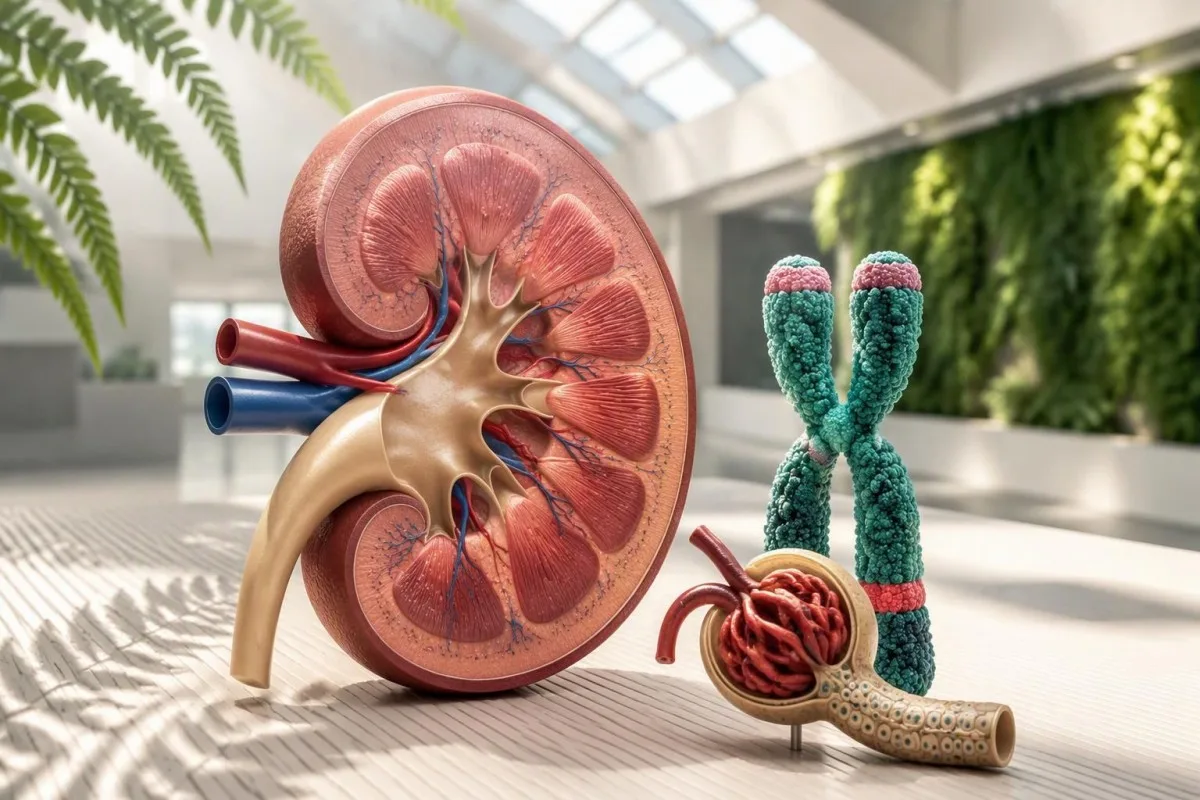
两个 APOL1 风险变异——G1/G1、G1/G2 或 G2/G2——表示遗传性肾病易感性,而非诊断结果。检测结果可用于指导遗传咨询、肾脏监测和活体供肾者评估,但无法确定地预测个人未来的健康状况。.


- 两个风险变异 指 G1/G1、G1/G2 或 G2/G2;这三种情况都归类为 APOL1 高风险基因型。.
- G1 是一个风险等位基因 尽管常见的 G1 单倍型包含同一条染色体上的两个连锁序列变异。.
- 高风险不等于诊断:APOL1 检测结果不能确诊慢性肾病、局灶节段性肾小球硬化症,也不代表需要透析。.
- 肾脏评估需要两项测量指标:估算肾小球滤过率,即 eGFR,以及尿白蛋白/肌酐比值,即 ACR。.
- 持续性肾脏异常 包括 eGFR 低于 60 mL/min/1.73 m²,或 ACR 达到至少 30 mg/g,且持续 3 个月或更久。.
- 基线结果正常 通常有助于制定个体化的年度监测计划,但尚未确定适用于所有人的 APOL1 特异性筛查间隔。.
- 遗传祖源不同于种族:祖源信息可为检测讨论提供参考,但外貌和种族认同无法确定 APOL1 基因型。.
- 活体捐献需要单独咨询 因为即使当前肾脏测量结果正常,存在两个风险变异也可能影响捐献资格。.
- 家族遗传具有可预测性;疾病则不然:在每次妊娠中,两个各有一个风险等位基因的父母,其子女遗传两个风险等位基因的概率为 25%。.
APOL1 高风险基因型究竟意味着什么?
APOL1基因检测 检测与肾病易感性相关的遗传变异。拥有 两个 APOL1 风险变异—G1/G1、G1/G2 或 G2/G2—会提高风险,但不能诊断肾病,也不意味着必然发生肾衰竭;后续步骤取决于肾脏测量结果、家族史以及是否考虑捐献。.
APOL1 高风险结果与慢性肾病是两种不同的发现。一个人可能为 G1/G2,eGFR 为 105 mL/min/1.73 m²,尿液 ACR 为 6 mg/g,且没有当前 CKD 的证据;这些测量结果描述的是目前的肾脏健康状况,并非对终身健康的保证。.
只有在 APOL1 检测结果会影响决策,而非仅仅增加一个标签时,检测才最有用。我是 Thomas Klein,Kantesti 的首席医疗官;一开始我会将问题分为三项:遗传了什么、是否存在肾损伤,以及结果是否会影响捐献者或治疗方面的讨论。.
Kantesti 是一个 人工智能血液检测分析仪 可帮助解释与肾脏相关的实验室测量结果,但常规化学检查面板无法揭示 APOL1 基因型。我们的 CKD 分期指南 解释了为何必须结合考虑 eGFR 和尿白蛋白;两者都不能替代专门的基因检测。.
应如何解读 G1/G1、G1/G2 和 G2/G2 检测结果?
G1/G1、G1/G2 和 G2/G2 均表示遗传自父母的两份 APOL1 基因拷贝都带有肾脏风险等位基因。. G1/G1 含有两个 G1 等位基因,G1/G2 各含一个,G2/G2 含有两个 G2 等位基因;这些都不是肾功能测量结果。.
G1 通常是一种单倍型,包含两个连锁的编码改变,通常称为 S342G 和 I384M。这些改变通常在同一条染色体上共同遗传,并计为 一个 G1 风险等位基因, ,而非两个独立遗传的风险等位基因;G2 是一个六碱基对缺失,会使 APOL1 蛋白失去两个氨基酸。.
按照惯例,G0/G0、G0/G1 和 G0/G2 被归为 APOL1 低风险基因型,因为它们含有零个或一个已知风险等位基因。APOL1 风险较低并不意味着肾病风险为零:糖尿病、高血压、其他遗传疾病以及药物相关损伤仍有可能发生,而且有限的检测不会检查所有肾病相关基因。.
这三种高风险组合并不能可靠地用于对个体严重程度进行排序。如果报告列出的是序列改变,而非等位基因组合,请让实验室将其转换为明确的基因型,并说明在判定哪些改变位于同一条染色体上时存在的任何局限;我们的 result-format explanation helps distinguish categorical genetic findings from numerical laboratory values.
为什么两个 APOL1 风险变异并不保证会患肾病?
APOL1-associated kidney susceptibility has incomplete penetrance: some people with two risk alleles develop kidney disease, while others do not. Age, additional genetic factors, immune signaling, environmental exposures and existing kidney conditions influence outcomes, so a genotype alone cannot provide a dependable personal lifetime percentage.
Parsa and colleagues reported that, among AASK participants who already had hypertension-associated CKD, the composite outcome of kidney failure or doubling serum creatinine occurred in 58.1% of the high-risk group versus 36.6% of the lower-risk group (Parsa et al., 2013). Those figures describe progression in an affected study population—not the chance that a healthy person with G1/G2 will develop CKD.
Relative risk and absolute risk answer different questions. Even a twofold association does not tell a person their probability without a relevant starting risk and a time horizon; a 30-year-old with normal ACR and a 65-year-old with substantial albuminuria should not receive the same prediction simply because their APOL1 results match.
The proposed “second-hit” model is useful but incomplete: certain immune or cellular stresses may increase APOL1-related injury, yet clinicians cannot identify a single required trigger for every patient. This resembles the distinction between susceptibility and diagnosis discussed in our ApoE4 risk explanation, although the genes, organs and predictive evidence are different.
遗传祖源与种族在 APOL1 检测中有何不同?
APOL1 G1 and G2 variants are associated particularly with genetic ancestry from parts of sub-Saharan Africa, not with a racial category itself. Race is a social classification, ancestry describes inherited population history, and neither a person’s appearance nor a single ancestry percentage establishes whether they carry zero, one or two risk alleles.
African ancestry is not one uniform genetic background. G1 and G2 frequencies differ substantially between populations, so a broad label such as “African,” “Black” or “mixed ancestry” is too coarse to establish an individual’s result; a family history extending across two or more regions can also be incomplete or unknown.
An ancestry-informed testing offer should be an invitation to discuss relevance, not a biological assumption about someone’s race. A person who does not identify as Black may carry two risk variants, while a person who does identify as Black may carry neither; asking about family origins is more respectful and clinically useful than inferring genetics from skin tone.
Race should not be used as a substitute for genotype or as an automatic adjustment to kidney-function interpretation. KDIGO 2024 supports avoiding race in eGFR computation; our Duffy-null neutrophil explanation illustrates another setting where a specific inherited finding is more informative than a racial label, although Duffy status does not predict APOL1 status.
哪些人可能受益于 APOL1 基因检测?
APOL1 testing may be useful for selected people with unexplained or familial kidney disease, some patients with focal segmental glomerulosclerosis, and potential living kidney donors with relevant ancestry. Testing everyone solely because of race is not an appropriate substitute for individualized consent, clinical assessment and a clear explanation of what the result could change.
An unexplained kidney problem before age 50, several relatives with kidney failure, or a tissue diagnosis showing FSGS can justify a genetics discussion. APOL1 may be only one part of that assessment: other inherited kidney disorders can produce similar findings, and a targeted APOL1 test will not identify all of them.
A positive APOL1 result does not prove that APOL1 caused every abnormality on a kidney panel. For example, G1/G1 in a patient with diabetes and an ACR of 450 mg/g may represent an additional susceptibility rather than a complete explanation; clinicians still assess diabetes duration, retinal findings, urine sediment, medication exposure and the pace of eGFR change.
Testing an unaffected relative should have an agreed purpose, such as counseling or donor evaluation, rather than a promise that it will prevent disease. Our inherited family-risk discussion shows why the question “What will we do differently after either result?” matters before ordering a genetic test; the appropriate answer can differ between two members of the same family.
APOL1 检测如何进行?何时需要确认?
APOL1 genetic testing uses DNA, commonly obtained from a blood, saliva or cheek-swab specimen, to identify G1 and G2 alleles. The genotype normally remains unchanged throughout life, so one adequately performed clinical test is usually sufficient; repeat or confirmatory testing is reserved for uncertainty about specimen identity, assay coverage or the original result.
A clinical report should identify the tested variants, the genotype and the assay’s relevant limitations. Turnaround time varies between laboratories, and the genetic assay is separate from a same-day creatinine result; before paying, ask whether the fee includes counseling, whether both risk alleles are assessed, and whether an inconclusive result requires a second specimen.
An unexpected direct-to-consumer result may need confirmation in an accredited clinical laboratory before a transplant or other consequential decision. A screenshot showing two sequence changes is not necessarily proof of two risk alleles, particularly when the changes belong to the same G1 haplotype; the original report and its method matter more than an automated summary.
Kantesti’s laboratory explanations should preserve the distinction between genetic evidence and biochemical evidence rather than infer an APOL1 result from creatinine. Our 临床验证框架 describes the standards behind laboratory interpretation, while our 医疗报告安全指南 explains why source verification is necessary before acting on a consequential result.
面向家庭的 APOL1 遗传咨询应涵盖哪些内容?
APOL1 counseling should explain inheritance, uncertain disease prediction, family implications, privacy and the limits of testing. Each child inherits one APOL1 copy from each parent; predictable allele transmission does not translate into a predictable age of onset, disease severity or need for dialysis.
When both parents have one recognized APOL1 risk allele, each pregnancy has a 25% chance of two risk alleles, a 50% chance of one, and a 25% chance of none. These probabilities reset with every pregnancy; four children do not have to divide into those proportions, and a child inheriting two alleles is not thereby diagnosed with kidney disease.
A parent with G1/G2 passes a risk allele to every child: either G1 or G2, each with a 50% chance. If the other parent is G0/G0, none of their children will have two recognized risk alleles; a genetic counselor can explain when partner testing would meaningfully answer a family question rather than merely add anxiety.
Testing children requires a separate discussion about present medical benefit, consent and the child’s future autonomy—not simply applying an adult screening plan at age 8. Our carrier-screening counseling guide illustrates why inheritance terminology needs care, and our 按年龄划分的家庭检测指南 helps distinguish targeted care from indiscriminate family screening.
高风险检测结果出来后,哪些肾脏血液检查很重要?
Serum creatinine with eGFR is a standard blood-based assessment after an APOL1 high-risk result; cystatin C can improve assessment when creatinine is less reliable. Urine ACR must be added separately because an eGFR above 90 mL/min/1.73 m² does not rule out albumin leakage or early kidney damage.
Creatinine reflects both filtration and factors such as muscle mass, recent meat intake and some medications. A muscular adult with creatinine of 1.3 mg/dL may need a different interpretation from a frail adult with the same concentration; our muscular-adult creatinine guide explains why the laboratory flag alone is not a diagnosis.
A combined creatinine–cystatin C eGFR can be useful when a more accurate estimate could change a decision, including selected donor assessments. Cystatin C has its own influences, including glucocorticoid exposure and thyroid dysfunction, so it is not an infallible correction; our 肌钙蛋白 C 解释指南 discusses the two-marker approach.
Kantesti 是一个 AI 血液检查解读平台 that can help put serial creatinine and eGFR reports into context, but laboratory trends cannot prove APOL1-related disease. KDIGO 2024 states that an eGFR change greater than 20% on a subsequent test in someone with CKD exceeds expected variability and warrants evaluation; a smaller change can still matter when it persists or accompanies rising albuminuria.
应如何解读尿液 ACR 和随访时间安排?
Urine ACR measures albumin leakage and is essential alongside eGFR when assessing APOL1 susceptibility. KDIGO albuminuria categories are A1 below 30 mg/g, A2 from 30–300 mg/g and A3 above 300 mg/g; persistent abnormalities require assessment even when filtration remains apparently normal.
One elevated ACR is not automatically persistent kidney damage. Strenuous exercise, fever, urinary infection and menstrual contamination can affect a result, so an ACR of 65 mg/g may need a properly timed repeat; our ACR 制备指南 explains practical collection steps without substituting a negative dipstick for a quantitative ratio.
An individualized annual review of blood pressure, eGFR and ACR is a reasonable discussion for an otherwise well adult with two risk alleles and normal baseline findings. That is a pragmatic monitoring plan, not a universal APOL1-specific guideline; established CKD, pregnancy, new hypertension or an abnormal trend may justify shorter intervals, such as 3–6 months, chosen by the treating clinician.
KDIGO 2024 considers a doubling of ACR on follow-up in someone with CKD a change that warrants evaluation. Urine microscopy adds a different kind of information: cellular casts or persistent red cells can point toward another process, as our 尿沉渣指南 explains; APOL1 testing should not make those findings disappear from the differential diagnosis.
什么情况下 APOL1 检测结果需要转诊至肾脏科?
Nephrology referral is driven mainly by kidney abnormalities, progression, unexplained findings and donor questions—not by genotype alone. CKD requires evidence of abnormal kidney structure or function for at least 3 months; a rapidly changing creatinine result or concerning symptoms require prompt assessment without waiting for that chronicity threshold.
Persistent eGFR below 60 mL/min/1.73 m² or ACR at least 30 mg/g can satisfy CKD criteria when present for 3 months or longer. Referral urgency increases with advanced impairment, substantial albuminuria, a sustained downward trend or uncertainty about the cause; a normal eGFR does not make an ACR of 800 mg/g reassuring.
A hypothetical 36-year-old with G1/G2, eGFR 96 mL/min/1.73 m² and ACR 900 mg/g needs evaluation for significant albuminuria, not reassurance based on filtration alone. APOL1 susceptibility does not exclude membranous nephropathy or other glomerular disorders; our PLA2R antibody explanation describes one different diagnostic pathway that may become relevant when the clinical pattern fits.
Rapidly reduced urine output, breathlessness with swelling, or visible urine discoloration alongside worsening kidney measurements calls for urgent assessment. Some antibody-mediated conditions need especially rapid action, as discussed in our anti-GBM result guide; neither a known APOL1 result nor a 3-month CKD definition should delay an acute kidney evaluation.
高风险基因型会改变治疗或日常习惯吗?
An APOL1 high-risk genotype alone does not automatically justify kidney medication, a restrictive renal diet or supplements. Treatment depends on actual kidney disease, albuminuria, blood pressure and other conditions; proven CKD therapies should not be withheld merely because inherited susceptibility may contribute to the disease.
Blood-pressure control is a practical priority, but the measurement method changes how a target should be interpreted. KDIGO’s CKD guidance includes a standardized office systolic target below 120 mmHg when tolerated for appropriate adults; that is not an instruction to force every routine home reading below 120, especially with dizziness, frailty or other reasons to individualize treatment.
ACE inhibitors or ARBs and SGLT2 inhibitors may be indicated for particular CKD and albuminuria patterns, with monitoring of creatinine and potassium. Two risk alleles with normal eGFR and normal ACR do not automatically establish those indications; medication choices should follow the person’s documented condition and current local guidance rather than a genetic label.
No supplement, “kidney cleanse” or diet has been shown to erase G1 or G2 alleles. Avoid starting potassium restriction or a very-low-protein diet solely after a genetic result, and discuss frequent NSAID use with your clinician; our 肾脏补充剂安全指南 explains why products marketed for kidney health can create problems rather than prevent them.
两个 APOL1 风险变异对活体捐肾意味着什么?
Two APOL1 risk variants may change living-kidney-donor eligibility even when current kidney function is normal. The concern is the donor’s future risk after losing kidney reserve, as well as possible implications for the donated kidney; transplant programs differ in how they incorporate the result into acceptance decisions.
The KDIGO living-donor guideline states that APOL1 genotyping may be offered to candidates with sub-Saharan African ancestry and that candidates should understand the uncertainty in predicting post-donation risk (Lentine et al., 2017). Many programs take a conservative approach to two risk alleles, particularly in younger candidates; there is no single internationally uniform APOL1 acceptance rule.
KDIGO 2017 considers donor GFR of at least 90 mL/min/1.73 m² generally acceptable, GFR from 60–89 individually assessable, and GFR below 60 unsuitable for donation. These filtration thresholds do not cancel APOL1 susceptibility; our BUN 和肌酐指南 explains why a reassuring chemistry result alone is not a complete donor assessment.
Age, albuminuria, blood pressure, family history and other health risks must be considered alongside the genotype. A young candidate has more remaining years in which disease could emerge, and related donors may share additional inherited risks; a transplant team should explain what a positive result means for eligibility before testing, not after a family has assumed donation will proceed.
应如何以保密且安全的方式处理 APOL1 信息?
APOL1 results are sensitive genetic information with implications for both the tested person and relatives. Before sharing a report with a clinical service or digital tool, check consent, access, retention and deletion options; protections against genetic discrimination differ between countries and between insurance products.
One person’s permission to share their result does not automatically authorize uploading a relative’s report. Remove unnecessary identifiers, consider who can access shared family accounts, and ask whether genetics information becomes part of a medical record; insurance and employment protections are jurisdiction-specific, so obtain local advice before assuming a general privacy statement covers every consequence.
Kantesti 是一个 AI 生物标志物解读平台 that can support understanding of kidney-related laboratory reports, but it does not replace APOL1 testing, genetic counseling or transplant eligibility review. Our 隐私和数据方面的信息 explains data-handling considerations; an AI interpretation taking approximately 60 seconds is not the same service as completing a molecular genetic assay.
Kantesti LTD is a UK company, number 17090423, and our organization information provides context about who operates the service. Family Health Risk features should use consented information rather than infer a relative’s genotype from race, kidney chemistry or another person’s two-allele result; keep the original clinical laboratory report available for professional review.
就诊时应携带哪些资料?哪些来源适用?
Bring the original APOL1 report, recent eGFR and urine ACR results, a medication list and a family kidney history to your appointment. As of October 19, 2026, this article distinguishes established guidance from uncertain individual prediction; its clinical references include the 2024 KDIGO CKD guideline and the 2017 KDIGO living-donor guideline.
A useful appointment can answer four concrete questions: Is kidney damage present, what is the monitoring interval, should relatives receive counseling, and does the result affect donation? My practical checklist as Thomas Klein, Chief Medical Officer at Kantesti, is to leave with a named clinician and a written next-test plan rather than an unsupported lifetime percentage; our 医疗咨询信息 describes the expertise behind our clinical standards.
Serum albumin and urine albumin answer different questions, and confusing the two can derail a kidney discussion. Our 血清蛋白指南 provides supporting education on circulating proteins, but neither a normal serum albumin of 4.2 g/dL nor a normal albumin-to-globulin ratio excludes urinary albumin loss or determines an APOL1 genotype.
Complement tests are not routine APOL1 surveillance tests; C3 and C4 may become relevant when clinical findings suggest an immune-mediated kidney disorder. Our 补体检测指南 is a supporting educational publication, not evidence for APOL1 penetrance; the two Zenodo resources listed below are separate from the directly relevant external medical references, and their ResearchGate and Academia.edu links are discovery searches rather than verified hosted copies.
常见问题
携带两个 APOL1 风险变异是否意味着我会患肾病?
0 拥有两个 APOL1 风险变异会增加肾病易感性,但并不意味着一定会患病或发生肾衰竭。G1/G1、G1/G2 和 G2/G2 均归为高风险基因型,但个体结局各不相同。目前评估肾脏状况需要检测 eGFR 和尿液 ACR;eGFR 为 100 mL/min/1.73 m²、ACR 为 5 mg/g 并不能确诊 CKD。制定个人监测计划,比套用针对已有肾病人群的研究百分比更有用。.
G1/G1、G1/G2 和 G2/G2 的严重程度相同吗?
G1/G1、G1/G2 和 G2/G2 均含有两个公认的 APOL1 风险等位基因,因此归类为高风险基因型。这些基因型组合并不能可靠地用于对个体未来疾病严重程度进行排序。G1 通常在同一条染色体上包含两个连锁的序列变异,但这些变异合计为一个风险等位基因。解读这三种组合中的任何一种,仍需结合肾脏指标、年龄和临床病史。.
高风险 APOL1 检测结果出来后,应多久检查一次肾脏?
对于携带两个风险变异的每个人,并没有普遍适用的 APOL1 特异性监测间隔。对于其他方面健康且基线检查结果正常的成年人,讨论每年检查血压、eGFR 和尿白蛋白/肌酐比(ACR)是一个合理的起点。已有慢性肾病(CKD)、白蛋白尿或指标趋势变化,可能需要缩短检查间隔,例如每 3–6 个月一次,具体由主治临床医生决定。出现新症状或肾功能迅速变化时,应尽早评估,而不是等到下一次计划检查。.
如果我有两个 APOL1 风险变异,可以捐献肾脏吗?
即使当前肾脏测量结果正常,两种 APOL1 风险变异也可能影响活体肾脏捐献者的资格。不同移植项目的接收政策各不相同,许多项目采取保守做法,因为无法准确预测个体捐肾后的风险。KDIGO 活体捐献者指南通常认为 GFR 至少为 90 mL/min/1.73 m² 可接受,但这一阈值并不能抵消遗传及其他健康风险。在认定肌酐正常即可证明捐献者安全之前,请先咨询相关项目关于 APOL1 的政策。.
APOL1 检测是否仅适用于自我认同为黑人的人?
APOL1检测并不限于某种种族身份,因为遗传祖源与种族是不同的概念。G1和G2尤其与来自撒哈拉以南非洲部分地区的祖源相关,但外貌无法确定某人携带零个、一个还是两个风险等位基因。自我认同为非黑人者可能携带这些变异,而自我认同为黑人者也可能两者都不携带。讨论是否进行检测时,应考虑祖源、肾脏检查结果、家族史以及检测结果可能改变的决策。.
我的孩子会遗传两个 APOL1 风险变异吗?
孩子的 APOL1 基因型取决于从父母双方各自遗传的等位基因。如果父母双方都各有一个风险等位基因,每次妊娠中孩子遗传两个风险等位基因的概率为 25%。如果一方的基因型为 G1/G2,另一方为 G0/G0,则每个孩子都会遗传一个风险等位基因,且没有孩子会遗传两个公认的风险等位基因。这些遗传概率无法预测是否会发生肾病或何时发生。.
立即获取AI驱动的血液检测分析
加入全球超过2,000,000名用户,他们信任Kantesti进行即时、准确的检验分析。上传你的血液检查结果,并在几秒内获得对15,000+生物标志物的全面解读。.
📚 参考研究论文
Klein, T., Mitchell, S., & Weber, H. (2026). 血清蛋白指南:球蛋白、白蛋白和白蛋白/球蛋白比值血液检测. Kantesti AI医学研究。.
Klein, T., Mitchell, S., & Weber, H. (2026). C3 C4 补体血液检查 & ANA 滴度指南. Kantesti AI医学研究。.
📖 外部医学参考资料
Parsa A et al. (2013). APOL1 Risk Variants, Race, and Progression of Chronic Kidney Disease.。 《新英格兰医学杂志》。.
Lentine KL et al. (2017). KDIGO Clinical Practice Guideline on the Evaluation and Care of Living Kidney Donors.。《移植》。.
肾脏病:改善全球预后(KDIGO)CKD工作组(2024)。. KDIGO 2024慢性肾脏病评估与管理临床实践指南.。 Kidney International。.
⚕️ 医疗免责声明
本文仅用于教育目的,不构成医疗建议。诊断和治疗决策请始终咨询合格的医疗专业人员。.
E-E-A-T信任信号
经验
由医生主导的临床审阅:实验室解读工作流程。.
专业知识
实验室医学重点:生物标志物在临床情境中的表现。.
权威
由 Thomas Klein 博士撰写,并由 Sarah Mitchell 博士与 Hans Weber 教授审阅。.
可信度
基于循证的解读,并提供清晰的后续路径以减少警报。.