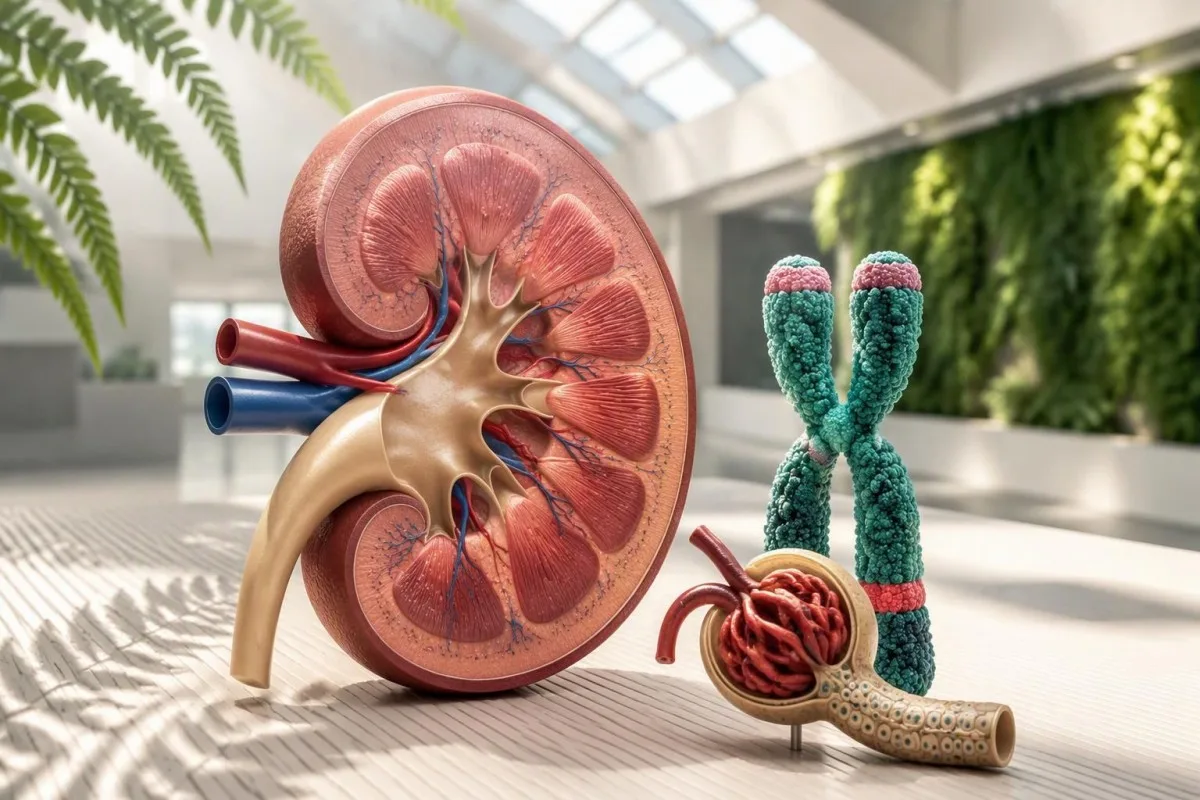
Two APOL1 risk variants—G1/G1, G1/G2 or G2/G2—indicate inherited kidney-disease susceptibility, not a diagnosis. Results can guide counseling, kidney monitoring and living-donor assessment without predicting an individual’s future with certainty.


- Two risk variants means G1/G1, G1/G2 or G2/G2; all three are classified as an APOL1 high-risk genotype.
- G1 is one risk allele even though the common G1 haplotype contains two linked sequence changes on the same chromosome.
- High risk is not a diagnosis: APOL1 results do not establish chronic kidney disease, focal segmental glomerulosclerosis or a need for dialysis.
- Kidney assessment needs two measurements: estimated glomerular filtration rate, or eGFR, and urine albumin-to-creatinine ratio, or ACR.
- Persistent kidney abnormalities include eGFR below 60 mL/min/1.73 m² or ACR of at least 30 mg/g for 3 months or longer.
- Normal baseline results often support an individualized annual monitoring plan, but no universal APOL1-specific screening interval is established.
- Genetic ancestry differs from race: ancestry can inform a testing discussion, but appearance and racial identity cannot determine an APOL1 genotype.
- Living donation requires separate counseling because two risk variants may affect eligibility even when current kidney measurements are normal.
- Family inheritance is predictable; disease is not: two parents with one risk allele each have a 25% chance of a child inheriting two risk alleles in each pregnancy.
What does an APOL1 high-risk genotype actually mean?
APOL1 genetik testi identifies inherited variants associated with kidney-disease susceptibility. Having two APOL1 risk variants—G1/G1, G1/G2 or G2/G2—raises risk but does not diagnose kidney disease or guarantee kidney failure; the next steps depend on kidney measurements, family history and whether donation is being considered.
A high-risk APOL1 result and chronic kidney disease are two different findings. A person can have G1/G2, an eGFR of 105 mL/min/1.73 m² and a urine ACR of 6 mg/g without evidence of current CKD; those measurements describe kidney health now, not a lifetime guarantee.
APOL1 testing is most useful when it changes a decision rather than simply adding a label. I’m Thomas Klein, Kantesti’s Chief Medical Officer, and I would separate three questions at the outset: what was inherited, whether kidney damage is present, and whether the result changes a donor or treatment discussion.
Kantesti bir AI kan testi analizörü that can help explain kidney-related laboratory measurements, but a routine chemistry panel cannot reveal an APOL1 genotype. Our CKD evreleme rehberi explains why eGFR and urine albumin must be considered together; neither measurement substitutes for a dedicated genetic assay.
How should G1/G1, G1/G2 and G2/G2 results be read?
G1/G1, G1/G2 and G2/G2 each mean that both inherited APOL1 gene copies carry a kidney-risk allele. G1/G1 contains two G1 alleles, G1/G2 contains one of each, and G2/G2 contains two G2 alleles; none is a kidney-function measurement.
G1 is usually a haplotype containing two linked coding changes, commonly described as S342G and I384M. Those changes generally travel together on one chromosome and count as one G1 risk allele, not two separate inherited risk alleles; G2 is a six-base-pair deletion that removes two amino acids from the APOL1 protein.
G0/G0, G0/G1 and G0/G2 are conventionally grouped as lower-risk APOL1 genotypes because they contain zero or one recognized risk allele. Lower APOL1 risk does not mean zero kidney-disease risk: diabetes, hypertension, other genetic conditions and medication-related injury remain possible, and limited assays do not examine every kidney-disease gene.
The three high-risk combinations are not reliable individual severity rankings. If a report lists sequence changes rather than an allele pair, ask the laboratory to translate them into an explicit genotype and state any limitations in determining which changes share a chromosome; our result-format explanation helps distinguish categorical genetic findings from numerical laboratory values.
Why don’t two APOL1 risk variants guarantee kidney disease?
APOL1-associated kidney susceptibility has incomplete penetrance: some people with two risk alleles develop kidney disease, while others do not. Age, additional genetic factors, immune signaling, environmental exposures and existing kidney conditions influence outcomes, so a genotype alone cannot provide a dependable personal lifetime percentage.
Parsa and colleagues reported that, among AASK participants who already had hypertension-associated CKD, the composite outcome of kidney failure or doubling serum creatinine occurred in 58.1% of the high-risk group versus 36.6% of the lower-risk group (Parsa et al., 2013). Those figures describe progression in an affected study population—not the chance that a healthy person with G1/G2 will develop CKD.
Relative risk and absolute risk answer different questions. Even a twofold association does not tell a person their probability without a relevant starting risk and a time horizon; a 30-year-old with normal ACR and a 65-year-old with substantial albuminuria should not receive the same prediction simply because their APOL1 results match.
The proposed “second-hit” model is useful but incomplete: certain immune or cellular stresses may increase APOL1-related injury, yet clinicians cannot identify a single required trigger for every patient. This resembles the distinction between susceptibility and diagnosis discussed in our ApoE4 risk explanation, although the genes, organs and predictive evidence are different.
How does genetic ancestry differ from race in APOL1 testing?
APOL1 G1 and G2 variants are associated particularly with genetic ancestry from parts of sub-Saharan Africa, not with a racial category itself. Race is a social classification, ancestry describes inherited population history, and neither a person’s appearance nor a single ancestry percentage establishes whether they carry zero, one or two risk alleles.
African ancestry is not one uniform genetic background. G1 and G2 frequencies differ substantially between populations, so a broad label such as “African,” “Black” or “mixed ancestry” is too coarse to establish an individual’s result; a family history extending across two or more regions can also be incomplete or unknown.
An ancestry-informed testing offer should be an invitation to discuss relevance, not a biological assumption about someone’s race. A person who does not identify as Black may carry two risk variants, while a person who does identify as Black may carry neither; asking about family origins is more respectful and clinically useful than inferring genetics from skin tone.
Race should not be used as a substitute for genotype or as an automatic adjustment to kidney-function interpretation. KDIGO 2024 supports avoiding race in eGFR computation; our Duffy-null neutrophil explanation illustrates another setting where a specific inherited finding is more informative than a racial label, although Duffy status does not predict APOL1 status.
Who may benefit from APOL1 genetic testing?
APOL1 testing may be useful for selected people with unexplained or familial kidney disease, some patients with focal segmental glomerulosclerosis, and potential living kidney donors with relevant ancestry. Testing everyone solely because of race is not an appropriate substitute for individualized consent, clinical assessment and a clear explanation of what the result could change.
An unexplained kidney problem before age 50, several relatives with kidney failure, or a tissue diagnosis showing FSGS can justify a genetics discussion. APOL1 may be only one part of that assessment: other inherited kidney disorders can produce similar findings, and a targeted APOL1 test will not identify all of them.
A positive APOL1 result does not prove that APOL1 caused every abnormality on a kidney panel. For example, G1/G1 in a patient with diabetes and an ACR of 450 mg/g may represent an additional susceptibility rather than a complete explanation; clinicians still assess diabetes duration, retinal findings, urine sediment, medication exposure and the pace of eGFR change.
Testing an unaffected relative should have an agreed purpose, such as counseling or donor evaluation, rather than a promise that it will prevent disease. Our inherited family-risk discussion shows why the question “What will we do differently after either result?” matters before ordering a genetic test; the appropriate answer can differ between two members of the same family.
How is the APOL1 test performed, and when is confirmation needed?
APOL1 genetic testing uses DNA, commonly obtained from a blood, saliva or cheek-swab specimen, to identify G1 and G2 alleles. The genotype normally remains unchanged throughout life, so one adequately performed clinical test is usually sufficient; repeat or confirmatory testing is reserved for uncertainty about specimen identity, assay coverage or the original result.
A clinical report should identify the tested variants, the genotype and the assay’s relevant limitations. Turnaround time varies between laboratories, and the genetic assay is separate from a same-day creatinine result; before paying, ask whether the fee includes counseling, whether both risk alleles are assessed, and whether an inconclusive result requires a second specimen.
An unexpected direct-to-consumer result may need confirmation in an accredited clinical laboratory before a transplant or other consequential decision. A screenshot showing two sequence changes is not necessarily proof of two risk alleles, particularly when the changes belong to the same G1 haplotype; the original report and its method matter more than an automated summary.
Kantesti’s laboratory explanations should preserve the distinction between genetic evidence and biochemical evidence rather than infer an APOL1 result from creatinine. Our klinik doğrulama çerçevesini içerir; laboratuvar yorumlarının nasıl test edildiğini ve tıbbi olarak nasıl gözden geçirildiğini açıklar. Kantesti’nin tıbbi gözden geçirme modeli, bizim describes the standards behind laboratory interpretation, while our tıbbi rapor güvenlik kılavuzumuz explains why source verification is necessary before acting on a consequential result.
What should APOL1 genetic counseling cover for families?
APOL1 counseling should explain inheritance, uncertain disease prediction, family implications, privacy and the limits of testing. Each child inherits one APOL1 copy from each parent; predictable allele transmission does not translate into a predictable age of onset, disease severity or need for dialysis.
When both parents have one recognized APOL1 risk allele, each pregnancy has a 25% chance of two risk alleles, a 50% chance of one, and a 25% chance of none. These probabilities reset with every pregnancy; four children do not have to divide into those proportions, and a child inheriting two alleles is not thereby diagnosed with kidney disease.
A parent with G1/G2 passes a risk allele to every child: either G1 or G2, each with a 50% chance. If the other parent is G0/G0, none of their children will have two recognized risk alleles; a genetic counselor can explain when partner testing would meaningfully answer a family question rather than merely add anxiety.
Testing children requires a separate discussion about present medical benefit, consent and the child’s future autonomy—not simply applying an adult screening plan at age 8. Our carrier-screening counseling guide illustrates why inheritance terminology needs care, and our yaşa göre aile test kılavuzu helps distinguish targeted care from indiscriminate family screening.
Which kidney blood tests matter after a high-risk result?
Serum creatinine with eGFR is a standard blood-based assessment after an APOL1 high-risk result; cystatin C can improve assessment when creatinine is less reliable. Urine ACR must be added separately because an eGFR above 90 mL/min/1.73 m² does not rule out albumin leakage or early kidney damage.
Creatinine reflects both filtration and factors such as muscle mass, recent meat intake and some medications. A muscular adult with creatinine of 1.3 mg/dL may need a different interpretation from a frail adult with the same concentration; our muscular-adult creatinine guide explains why the laboratory flag alone is not a diagnosis.
A combined creatinine–cystatin C eGFR can be useful when a more accurate estimate could change a decision, including selected donor assessments. Cystatin C has its own influences, including glucocorticoid exposure and thyroid dysfunction, so it is not an infallible correction; our sistatin C yorum kılavuzumuz discusses the two-marker approach.
Kantesti bir AI kan tahlili yorumlama platformu that can help put serial creatinine and eGFR reports into context, but laboratory trends cannot prove APOL1-related disease. KDIGO 2024 states that an eGFR change greater than 20% on a subsequent test in someone with CKD exceeds expected variability and warrants evaluation; a smaller change can still matter when it persists or accompanies rising albuminuria.
How should urine ACR and follow-up timing be interpreted?
Urine ACR measures albumin leakage and is essential alongside eGFR when assessing APOL1 susceptibility. KDIGO albuminuria categories are A1 below 30 mg/g, A2 from 30–300 mg/g and A3 above 300 mg/g; persistent abnormalities require assessment even when filtration remains apparently normal.
One elevated ACR is not automatically persistent kidney damage. Strenuous exercise, fever, urinary infection and menstrual contamination can affect a result, so an ACR of 65 mg/g may need a properly timed repeat; our ACR hazırlama kılavuzu explains practical collection steps without substituting a negative dipstick for a quantitative ratio.
An individualized annual review of blood pressure, eGFR and ACR is a reasonable discussion for an otherwise well adult with two risk alleles and normal baseline findings. That is a pragmatic monitoring plan, not a universal APOL1-specific guideline; established CKD, pregnancy, new hypertension or an abnormal trend may justify shorter intervals, such as 3–6 months, chosen by the treating clinician.
KDIGO 2024 considers a doubling of ACR on follow-up in someone with CKD a change that warrants evaluation. Urine microscopy adds a different kind of information: cellular casts or persistent red cells can point toward another process, as our idrar sediment rehberimizdeki explains; APOL1 testing should not make those findings disappear from the differential diagnosis.
When does an APOL1 result call for nephrology referral?
Nephrology referral is driven mainly by kidney abnormalities, progression, unexplained findings and donor questions—not by genotype alone. CKD requires evidence of abnormal kidney structure or function for at least 3 months; a rapidly changing creatinine result or concerning symptoms require prompt assessment without waiting for that chronicity threshold.
Persistent eGFR below 60 mL/min/1.73 m² or ACR at least 30 mg/g can satisfy CKD criteria when present for 3 months or longer. Referral urgency increases with advanced impairment, substantial albuminuria, a sustained downward trend or uncertainty about the cause; a normal eGFR does not make an ACR of 800 mg/g reassuring.
A hypothetical 36-year-old with G1/G2, eGFR 96 mL/min/1.73 m² and ACR 900 mg/g needs evaluation for significant albuminuria, not reassurance based on filtration alone. APOL1 susceptibility does not exclude membranous nephropathy or other glomerular disorders; our PLA2R antibody explanation describes one different diagnostic pathway that may become relevant when the clinical pattern fits.
Rapidly reduced urine output, breathlessness with swelling, or visible urine discoloration alongside worsening kidney measurements calls for urgent assessment. Some antibody-mediated conditions need especially rapid action, as discussed in our anti-GBM result guide; neither a known APOL1 result nor a 3-month CKD definition should delay an acute kidney evaluation.
Does a high-risk genotype change treatment or everyday habits?
An APOL1 high-risk genotype alone does not automatically justify kidney medication, a restrictive renal diet or supplements. Treatment depends on actual kidney disease, albuminuria, blood pressure and other conditions; proven CKD therapies should not be withheld merely because inherited susceptibility may contribute to the disease.
Blood-pressure control is a practical priority, but the measurement method changes how a target should be interpreted. KDIGO’s CKD guidance includes a standardized office systolic target below 120 mmHg when tolerated for appropriate adults; that is not an instruction to force every routine home reading below 120, especially with dizziness, frailty or other reasons to individualize treatment.
ACE inhibitors or ARBs and SGLT2 inhibitors may be indicated for particular CKD and albuminuria patterns, with monitoring of creatinine and potassium. Two risk alleles with normal eGFR and normal ACR do not automatically establish those indications; medication choices should follow the person’s documented condition and current local guidance rather than a genetic label.
No supplement, “kidney cleanse” or diet has been shown to erase G1 or G2 alleles. Avoid starting potassium restriction or a very-low-protein diet solely after a genetic result, and discuss frequent NSAID use with your clinician; our böbrek takviyesi güvenlik kılavuzumuz explains why products marketed for kidney health can create problems rather than prevent them.
What do two APOL1 risk variants mean for living donation?
Two APOL1 risk variants may change living-kidney-donor eligibility even when current kidney function is normal. The concern is the donor’s future risk after losing kidney reserve, as well as possible implications for the donated kidney; transplant programs differ in how they incorporate the result into acceptance decisions.
The KDIGO living-donor guideline states that APOL1 genotyping may be offered to candidates with sub-Saharan African ancestry and that candidates should understand the uncertainty in predicting post-donation risk (Lentine et al., 2017). Many programs take a conservative approach to two risk alleles, particularly in younger candidates; there is no single internationally uniform APOL1 acceptance rule.
KDIGO 2017 considers donor GFR of at least 90 mL/min/1.73 m² generally acceptable, GFR from 60–89 individually assessable, and GFR below 60 unsuitable for donation. These filtration thresholds do not cancel APOL1 susceptibility; our BUN ve kreatinin rehberimiz explains why a reassuring chemistry result alone is not a complete donor assessment.
Age, albuminuria, blood pressure, family history and other health risks must be considered alongside the genotype. A young candidate has more remaining years in which disease could emerge, and related donors may share additional inherited risks; a transplant team should explain what a positive result means for eligibility before testing, not after a family has assumed donation will proceed.
How should APOL1 information be handled privately and safely?
APOL1 results are sensitive genetic information with implications for both the tested person and relatives. Before sharing a report with a clinical service or digital tool, check consent, access, retention and deletion options; protections against genetic discrimination differ between countries and between insurance products.
One person’s permission to share their result does not automatically authorize uploading a relative’s report. Remove unnecessary identifiers, consider who can access shared family accounts, and ask whether genetics information becomes part of a medical record; insurance and employment protections are jurisdiction-specific, so obtain local advice before assuming a general privacy statement covers every consequence.
Kantesti bir Yapay zekâ biyobelirteç yorumlama platformu that can support understanding of kidney-related laboratory reports, but it does not replace APOL1 testing, genetic counseling or transplant eligibility review. Our gizlilik ve veri bilgilerini explains data-handling considerations; an AI interpretation taking approximately 60 seconds is not the same service as completing a molecular genetic assay.
Kantesti LTD is a UK company, number 17090423, and our organization information provides context about who operates the service. Family Health Risk features should use consented information rather than infer a relative’s genotype from race, kidney chemistry or another person’s two-allele result; keep the original clinical laboratory report available for professional review.
What should you bring to your appointment, and which sources apply?
Bring the original APOL1 report, recent eGFR and urine ACR results, a medication list and a family kidney history to your appointment. As of October 19, 2026, this article distinguishes established guidance from uncertain individual prediction; its clinical references include the 2024 KDIGO CKD guideline and the 2017 KDIGO living-donor guideline.
A useful appointment can answer four concrete questions: Is kidney damage present, what is the monitoring interval, should relatives receive counseling, and does the result affect donation? My practical checklist as Thomas Klein, Chief Medical Officer at Kantesti, is to leave with a named clinician and a written next-test plan rather than an unsupported lifetime percentage; our tıbbi danışmanlık bilgisi describes the expertise behind our clinical standards.
Serum albumin and urine albumin answer different questions, and confusing the two can derail a kidney discussion. Our serum protein rehberimiz provides supporting education on circulating proteins, but neither a normal serum albumin of 4.2 g/dL nor a normal albumin-to-globulin ratio excludes urinary albumin loss or determines an APOL1 genotype.
Complement tests are not routine APOL1 surveillance tests; C3 and C4 may become relevant when clinical findings suggest an immune-mediated kidney disorder. Our tamamlayıcı test kılavuzu is a supporting educational publication, not evidence for APOL1 penetrance; the two Zenodo resources listed below are separate from the directly relevant external medical references, and their ResearchGate and Academia.edu links are discovery searches rather than verified hosted copies.
Sıkça Sorulan Sorular
İki APOL1 risk varyantına sahip olmak böbrek hastalığına yakalanacağım anlamına mı geliyor?
İki APOL1 risk varyantına sahip olmak böbrek hastalığı yatkınlığını artırır, ancak hastalığı veya böbrek yetmezliğini kesinleştirmez. G1/G1, G1/G2 ve G2/G2 genotiplerinin tümü yüksek riskli olarak sınıflandırılır; ancak kişilerin sonuçları farklılık gösterir. Böbreklerin mevcut durumunu değerlendirmek için eGFR ve idrar ACR gerekir; 100 mL/min/1.73 m² eGFR ve 5 mg/g ACR, KBH tanısı koydurmaz. Kişiye özel bir izlem planı, zaten böbrek hastalığı olan kişilerden elde edilen bir çalışma yüzdesini uygulamaktan daha yararlıdır.
G1/G1, G1/G2 ve G2/G2 eşit derecede ciddi midir?
G1/G1, G1/G2 ve G2/G2 genotiplerinin her biri, tanınmış iki APOL1 risk aleli içerir ve yüksek riskli genotipler olarak gruplandırılır. Genotip kombinasyonları, bir bireyin gelecekteki hastalık şiddetini güvenilir biçimde sıralamak için kullanılamaz. G1 genellikle tek bir kromozomda bağlantılı iki dizi değişikliği içerir, ancak bu değişiklikler tek bir risk aleli sayılır. Bu üç kombinasyondan herhangi birini yorumlamak için böbrek ölçümleri, yaş ve klinik öykü hâlâ gereklidir.
Yüksek riskli bir APOL1 sonucu sonrasında böbrekler ne sıklıkla kontrol edilmelidir?
İki risk varyantı taşıyan herkes için geçerli, APOL1'e özgü evrensel bir izlem aralığı yoktur. Başlangıç bulguları normal olan ve genel sağlık durumu iyi bir yetişkin için yıllık kan basıncı, eGFR ve idrar ACR kontrollerini görüşmek makul bir başlangıçtır. Mevcut KBH, albüminüri veya değişen bir seyir, tedaviyi yürüten hekimin belirleyeceği 3–6 ay gibi daha kısa aralıkları gerekli kılabilir. Yeni belirtiler veya böbrek işlevinde hızlı bir değişiklik olduğunda, bir sonraki planlı kontrolü beklemek yerine daha erken değerlendirme gerekir.
İki APOL1 risk varyantım varsa böbreğimi bağışlayabilir miyim?
0 İki APOL1 risk varyantı, mevcut böbrek ölçümleri normal olsa bile canlı böbrek donörü olmaya uygunluğu etkileyebilir. Nakil programlarının kabul politikaları farklılık gösterir ve bireysel bağış sonrası risk kesin olarak öngörülemediğinden çoğu temkinli bir yaklaşım benimser. KDIGO canlı donör kılavuzu, genel olarak en az 90 mL/min/1.73 m² GFR değerini kabul edilebilir bulur; ancak bu eşik genetik ve diğer sağlık risklerini geçersiz kılmaz. Normal kreatinin değerinin donör güvenliğini kanıtladığını varsaymadan önce programın APOL1 politikası hakkında danışmanlık alın.
APOL1 testi yalnızca kendini Siyah olarak tanımlayan kişiler için mi geçerlidir?
APOL1 testi belirli bir ırksal kimlikle sınırlı değildir; çünkü genetik köken ve ırk farklı kavramlardır. G1 ve G2 özellikle Sahra Altı Afrika’nın bazı bölgelerinden gelen kökenle ilişkilidir, ancak görünüş, bir kişinin sıfır, bir veya iki risk aleli taşıyıp taşımadığını belirleyemez. Kendini Siyah olarak tanımlamayan bir kişi bu varyantları taşıyabilirken, kendini Siyah olarak tanımlayan bir kişi bunların hiçbirini taşımayabilir. Test konusundaki görüşmelerde köken, böbrek bulguları, aile öyküsü ve sonucun hangi kararı değiştirebileceği dikkate alınmalıdır.
Çocuklarım iki APOL1 risk varyantını kalıtır mı?
Bir çocuğun APOL1 genotipi, her bir ebeveynden miras aldığı alele bağlıdır. Her iki ebeveynin de bir risk aleli varsa, her gebelikte çocuğun iki risk aleli miras alma olasılığı 25%'tür. Ebeveynlerden birinde G1/G2, diğerinde G0/G0 varsa, her çocuk bir risk aleli miras alır ve hiçbir çocuk tanınan iki risk alelini miras almaz. Bu kalıtım olasılıkları, böbrek hastalığının ortaya çıkıp çıkmayacağını veya ne zaman ortaya çıkacağını öngörmez.
Bugün Yapay Zekâ Destekli Kan Tahlili Analizini Alın
Anlık ve doğru laboratuvar testi analizi için Kantesti’ye güvenen dünya genelindeki 2 milyondan fazla kullanıcıya katılın. Kan testi sonuçlarınızı yükleyin ve saniyeler içinde 15,000+ biyobelirteçlerinin kapsamlı yorumunu alın.
📚 Kaynak Gösterilen Araştırma Yayınları
Klein, T., Mitchell, S., & Weber, H. (2026). Serum Proteinleri Rehberi: Globulinler, Albumin ve A/G Oranı Kan Testi. Kantesti Yapay Zeka Tıbbi Araştırma.
Klein, T., Mitchell, S., & Weber, H. (2026). C3 C4 Kompleman Kan Testi ve ANA Titrasyon Rehberi. Kantesti Yapay Zeka Tıbbi Araştırma.
📖 Harici Tıbbi Kaynaklar
Parsa A et al. (2013). APOL1 Risk Variants, Race, and Progression of Chronic Kidney Disease. New England Journal of Medicine.
Lentine KL et al. (2017). KDIGO Clinical Practice Guideline on the Evaluation and Care of Living Kidney Donors. Nakil.
Böbrek Hastalığı: Küresel Sonuçların İyileştirilmesi (KDIGO) CKD Çalışma Grubu (2024). KDIGO 2024 Kronik Böbrek Hastalığının Değerlendirilmesi ve Yönetimi için Klinik Uygulama Kılavuzu. Kidney International.
⚕️ Tıbbi Uyarı
Bu makale yalnızca eğitim amaçlıdır ve tıbbi tavsiye niteliği taşımaz. Tanı ve tedavi kararları için her zaman yetkin bir sağlık hizmeti sağlayıcısına danışın.
E-E-A-T Güven Sinyalleri
Deneyim
Hekim liderliğinde laboratuvar yorumlama iş akışlarının klinik incelemesi.
Uzmanlık
Klinik bağlamda biyobelirteçlerin nasıl davrandığına odaklanan laboratuvar tıbbı.
Otorite
Dr. Thomas Klein tarafından yazılmış; Dr. Sarah Mitchell ve Prof. Dr. Hans Weber tarafından gözden geçirilmiştir.
Güvenilirlik
Alarmı azaltmaya yönelik net takip yollarıyla kanıta dayalı yorumlama.