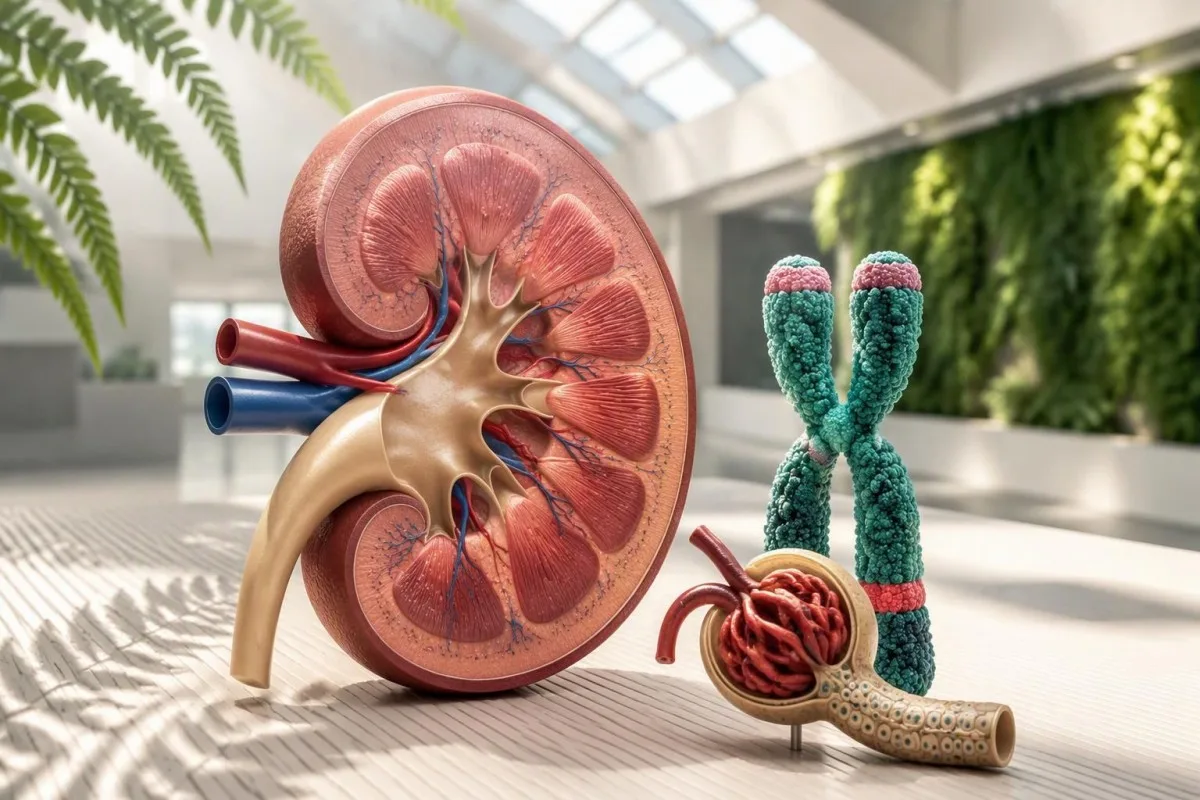
APOL1 کے دو خطرے والے ویریئنٹس—G1/G1، G1/G2 یا G2/G2—موروثی گردے کی بیماری کے امکان کی نشاندہی کرتے ہیں، تشخیص کی نہیں۔ نتائج مشاورت، گردوں کی نگرانی اور زندہ عطیہ دہندہ کے جائزے میں رہنمائی کر سکتے ہیں، لیکن کسی فرد کے مستقبل کی یقینی پیش گوئی نہیں کرتے۔.


- خطرے کے دو ویریئنٹس سے مراد G1/G1، G1/G2 یا G2/G2 ہے؛ ان تینوں کو APOL1 کا زیادہ خطرے والا جینوٹائپ قرار دیا جاتا ہے۔.
- G1 ایک خطرے والا الیل ہے حالاں کہ عام G1 ہاپلوٹائپ میں ایک ہی کروموسوم پر دو مربوط سلسلہ جاتی تبدیلیاں ہوتی ہیں۔.
- زیادہ خطرے کا مطلب تشخیص نہیں: APOL1 کے نتائج دائمی گردے کی بیماری، فوکل سیگمنٹل گلومیرولواسکلروسس یا ڈائلیسس کی ضرورت کی تشخیص نہیں کرتے۔.
- گردوں کی جانچ کے لیے دو پیمائشیں درکار ہیں: تخمینی گلومیرولر فلٹریشن ریٹ، یا eGFR، اور پیشاب میں البیومن اور کریاٹینین کا تناسب، یا ACR۔.
- گردوں کی مسلسل خرابیاں اس میں 60 mL/min/1.73 m² سے کم eGFR یا کم از کم 30 mg/g کا ACR، 3 ماہ یا اس سے زیادہ عرصے تک شامل ہے۔.
- معمول کے ابتدائی نتائج اکثر انفرادی سالانہ نگرانی کے منصوبے کی تائید کرتے ہیں، لیکن APOL1 کے لیے کوئی عالمگیر مخصوص اسکریننگ وقفہ طے نہیں ہے۔.
- جینیاتی نسب، نسل سے مختلف ہوتا ہے: نسب ٹیسٹنگ پر گفتگو میں رہنمائی کر سکتا ہے، لیکن ظاہری شکل اور نسلی شناخت سے APOL1 جین ٹائپ کا تعین نہیں کیا جا سکتا۔.
- زندہ عطیہ کے لیے الگ مشاورت ضروری ہے کیونکہ خطرے کی دو اقسام اہلیت پر اثر انداز ہو سکتی ہیں، چاہے گردوں کی موجودہ پیمائشیں معمول کے مطابق ہوں۔.
- خاندانی وراثت کا اندازہ لگایا جا سکتا ہے؛ بیماری کا نہیں: ہر حمل میں، ایک ایک خطرے کا ایلیل رکھنے والے دو والدین کے ہاں بچے کو خطرے کے دو ایلیل وراثت میں ملنے کا امکان 25% ہے۔.
APOL1 کا زیادہ خطرے والا جینوٹائپ دراصل کیا معنی رکھتا ہے؟
APOL1 کی جینیاتی جانچ گردوں کی بیماری کے امکان سے وابستہ موروثی اقسام کی شناخت کرتا ہے۔ ہونا APOL1 کے خطرے کے دو ایلیل—G1/G1، G1/G2 یا G2/G2— خطرہ بڑھاتے ہیں، لیکن گردوں کی بیماری کی تشخیص نہیں کرتے اور نہ ہی گردوں کے فیل ہونے کی ضمانت دیتے ہیں؛ اگلے اقدامات کا انحصار گردوں کی پیمائشوں، خاندانی تاریخ اور عطیہ دینے پر غور کیے جانے پر ہوتا ہے۔.
APOL1 کا زیادہ خطرے والا نتیجہ اور گردوں کی دائمی بیماری دو الگ نتائج ہیں۔ کسی شخص میں G1/G2، 105 mL/min/1.73 m² کا eGFR اور 6 mg/g کا پیشاب کا ACR ہو سکتا ہے، مگر موجودہ CKD کا کوئی ثبوت نہ ہو؛ یہ پیمائشیں اب گردوں کی صحت بتاتی ہیں، زندگی بھر کی ضمانت نہیں۔.
APOL1 ٹیسٹنگ سب سے زیادہ مفید تب ہوتی ہے جب یہ محض ایک لیبل کا اضافہ کرنے کے بجائے کسی فیصلے کو بدلتی ہو۔ میں تھامس کلائن، Kantesti کے چیف میڈیکل آفیسر ہوں، اور ابتدا ہی میں تین سوالات کو الگ رکھوں گا: کیا وراثت میں ملا، آیا گردوں کو نقصان پہنچا ہے، اور آیا نتیجے سے عطیہ دہندہ یا علاج کے بارے میں گفتگو بدلتی ہے۔.
کنٹیسٹی ایک ہے۔ اے آئی بلڈ ٹیسٹ تجزیہ کار جو گردوں سے متعلق لیبارٹری پیمائشوں کی وضاحت میں مدد دے سکتا ہے، لیکن معمول کا کیمسٹری پینل APOL1 جین ٹائپ ظاہر نہیں کر سکتا۔ ہمارا CKD اسٹیجنگ گائیڈ وضاحت کرتا ہے کہ eGFR اور پیشاب میں البومن کو ایک ساتھ کیوں دیکھنا ضروری ہے؛ ان میں سے کوئی بھی پیمائش مخصوص جینیاتی جانچ کا متبادل نہیں ہے۔.
G1/G1، G1/G2 اور G2/G2 کے نتائج کو کیسے سمجھنا چاہیے؟
G1/G1، G1/G2 اور G2/G2، ہر ایک کا مطلب ہے کہ وراثت میں ملنے والی APOL1 جین کی دونوں نقول میں گردوں کے خطرے کا ایک ایلیل موجود ہے۔. G1/G1 میں دو G1 ایلیل، G1/G2 میں ہر ایک میں سے ایک، اور G2/G2 میں دو G2 ایلیل ہوتے ہیں؛ ان میں سے کوئی بھی گردوں کی کارکردگی کی پیمائش نہیں ہے۔.
G1 عموماً ایک ہاپلوٹائپ ہوتا ہے جس میں کوڈنگ کی دو باہم منسلک تبدیلیاں شامل ہوتی ہیں، جنہیں عموماً S342G اور I384M کہا جاتا ہے۔ یہ تبدیلیاں عموماً ایک ہی کروموسوم پر ساتھ وراثت میں ملتی ہیں اور شمار ہوتی ہیں بطور G1 کا ایک خطرے والا ایلیل, ، دو الگ الگ موروثی خطرے کے ایلیل کے طور پر نہیں؛ G2 چھ بنیادی جوڑوں کا حذف ہونا ہے جس سے APOL1 پروٹین کے دو امینو ایسڈ نکل جاتے ہیں۔.
G0/G0، G0/G1 اور G0/G2 کو روایتی طور پر APOL1 کے کم خطرے والے جین ٹائپ کے طور پر درجہ بند کیا جاتا ہے، کیونکہ ان میں کوئی یا ایک تسلیم شدہ خطرے کا ایلیل ہوتا ہے۔ APOL1 کا کم خطرہ، گردوں کی بیماری کا صفر خطرہ نہیں ہوتا: ذیابیطس، ہائی بلڈ پریشر، دوسری جینیاتی حالتیں اور ادویات سے متعلق نقصان اب بھی ممکن ہیں، اور محدود جانچیں گردوں کی بیماری کے ہر جین کا معائنہ نہیں کرتیں۔.
زیادہ خطرے والے تین مجموعے، کسی فرد میں شدت کی قابلِ اعتماد درجہ بندی نہیں کرتے۔ اگر رپورٹ میں ایلیل کے جوڑے کے بجائے سیکوئنس کی تبدیلیاں درج ہوں، تو لیبارٹری سے کہیں کہ وہ انہیں واضح جین ٹائپ میں بیان کرے اور بتائے کہ یہ طے کرنے میں کیا حدود ہیں کہ کون سی تبدیلیاں ایک ہی کروموسوم پر ہیں؛ ہمارا result-format explanation helps distinguish categorical genetic findings from numerical laboratory values.
APOL1 کے دو خطرے والے ویریئنٹس گردے کی بیماری کی ضمانت کیوں نہیں دیتے؟
APOL1-associated kidney susceptibility has incomplete penetrance: some people with two risk alleles develop kidney disease, while others do not. Age, additional genetic factors, immune signaling, environmental exposures and existing kidney conditions influence outcomes, so a genotype alone cannot provide a dependable personal lifetime percentage.
Parsa and colleagues reported that, among AASK participants who already had hypertension-associated CKD, the composite outcome of kidney failure or doubling serum creatinine occurred in 58.1% of the high-risk group versus 36.6% of the lower-risk group (Parsa et al., 2013). Those figures describe progression in an affected study population—not the chance that a healthy person with G1/G2 will develop CKD.
Relative risk and absolute risk answer different questions. Even a twofold association does not tell a person their probability without a relevant starting risk and a time horizon; a 30-year-old with normal ACR and a 65-year-old with substantial albuminuria should not receive the same prediction simply because their APOL1 results match.
The proposed “second-hit” model is useful but incomplete: certain immune or cellular stresses may increase APOL1-related injury, yet clinicians cannot identify a single required trigger for every patient. This resembles the distinction between susceptibility and diagnosis discussed in our ApoE4 risk explanation, although the genes, organs and predictive evidence are different.
APOL1 ٹیسٹنگ میں جینیاتی نسب، نسل سے کس طرح مختلف ہے؟
APOL1 G1 and G2 variants are associated particularly with genetic ancestry from parts of sub-Saharan Africa, not with a racial category itself. Race is a social classification, ancestry describes inherited population history, and neither a person’s appearance nor a single ancestry percentage establishes whether they carry zero, one or two risk alleles.
African ancestry is not one uniform genetic background. G1 and G2 frequencies differ substantially between populations, so a broad label such as “African,” “Black” or “mixed ancestry” is too coarse to establish an individual’s result; a family history extending across two or more regions can also be incomplete or unknown.
An ancestry-informed testing offer should be an invitation to discuss relevance, not a biological assumption about someone’s race. A person who does not identify as Black may carry two risk variants, while a person who does identify as Black may carry neither; asking about family origins is more respectful and clinically useful than inferring genetics from skin tone.
Race should not be used as a substitute for genotype or as an automatic adjustment to kidney-function interpretation. KDIGO 2024 supports avoiding race in eGFR computation; our Duffy-null neutrophil explanation illustrates another setting where a specific inherited finding is more informative than a racial label, although Duffy status does not predict APOL1 status.
APOL1 جینیاتی ٹیسٹنگ سے کن لوگوں کو فائدہ ہو سکتا ہے؟
APOL1 testing may be useful for selected people with unexplained or familial kidney disease, some patients with focal segmental glomerulosclerosis, and potential living kidney donors with relevant ancestry. Testing everyone solely because of race is not an appropriate substitute for individualized consent, clinical assessment and a clear explanation of what the result could change.
An unexplained kidney problem before age 50, several relatives with kidney failure, or a tissue diagnosis showing FSGS can justify a genetics discussion. APOL1 may be only one part of that assessment: other inherited kidney disorders can produce similar findings, and a targeted APOL1 test will not identify all of them.
A positive APOL1 result does not prove that APOL1 caused every abnormality on a kidney panel. For example, G1/G1 in a patient with diabetes and an ACR of 450 mg/g may represent an additional susceptibility rather than a complete explanation; clinicians still assess diabetes duration, retinal findings, urine sediment, medication exposure and the pace of eGFR change.
Testing an unaffected relative should have an agreed purpose, such as counseling or donor evaluation, rather than a promise that it will prevent disease. Our inherited family-risk discussion shows why the question “What will we do differently after either result?” matters before ordering a genetic test; the appropriate answer can differ between two members of the same family.
APOL1 ٹیسٹ کیسے کیا جاتا ہے، اور تصدیق کب ضروری ہوتی ہے؟
APOL1 genetic testing uses DNA, commonly obtained from a blood, saliva or cheek-swab specimen, to identify G1 and G2 alleles. The genotype normally remains unchanged throughout life, so one adequately performed clinical test is usually sufficient; repeat or confirmatory testing is reserved for uncertainty about specimen identity, assay coverage or the original result.
A clinical report should identify the tested variants, the genotype and the assay’s relevant limitations. Turnaround time varies between laboratories, and the genetic assay is separate from a same-day creatinine result; before paying, ask whether the fee includes counseling, whether both risk alleles are assessed, and whether an inconclusive result requires a second specimen.
An unexpected direct-to-consumer result may need confirmation in an accredited clinical laboratory before a transplant or other consequential decision. A screenshot showing two sequence changes is not necessarily proof of two risk alleles, particularly when the changes belong to the same G1 haplotype; the original report and its method matter more than an automated summary.
Kantesti’s laboratory explanations should preserve the distinction between genetic evidence and biochemical evidence rather than infer an APOL1 result from creatinine. Our کلینیکل ویلیڈیشن فریم ورک شامل ہے جو یہ بتاتے ہیں کہ لیب کی تشریحات کیسے ٹیسٹ کی جاتی ہیں اور طبی طور پر کیسے ریویو کی جاتی ہیں۔ Kantesti کا میڈیکل ریویو ماڈل ہمارے describes the standards behind laboratory interpretation, while our میڈیکل رپورٹ سیفٹی گائیڈ explains why source verification is necessary before acting on a consequential result.
APOL1 کی جینیاتی مشاورت میں خاندانوں کے لیے کن امور کا احاطہ ہونا چاہیے؟
APOL1 counseling should explain inheritance, uncertain disease prediction, family implications, privacy and the limits of testing. Each child inherits one APOL1 copy from each parent; predictable allele transmission does not translate into a predictable age of onset, disease severity or need for dialysis.
When both parents have one recognized APOL1 risk allele, each pregnancy has a 25% chance of two risk alleles, a 50% chance of one, and a 25% chance of none. These probabilities reset with every pregnancy; four children do not have to divide into those proportions, and a child inheriting two alleles is not thereby diagnosed with kidney disease.
A parent with G1/G2 passes a risk allele to every child: either G1 or G2, each with a 50% chance. If the other parent is G0/G0, none of their children will have two recognized risk alleles; a genetic counselor can explain when partner testing would meaningfully answer a family question rather than merely add anxiety.
Testing children requires a separate discussion about present medical benefit, consent and the child’s future autonomy—not simply applying an adult screening plan at age 8. Our carrier-screening counseling guide illustrates why inheritance terminology needs care, and our عمر کے لحاظ سے خاندانی ٹیسٹنگ گائیڈ کا استعمال کر سکتے ہیں۔ helps distinguish targeted care from indiscriminate family screening.
زیادہ خطرے کا نتیجہ آنے کے بعد گردوں کے کون سے خون کے ٹیسٹ اہم ہیں؟
Serum creatinine with eGFR is a standard blood-based assessment after an APOL1 high-risk result; cystatin C can improve assessment when creatinine is less reliable. Urine ACR must be added separately because an eGFR above 90 mL/min/1.73 m² does not rule out albumin leakage or early kidney damage.
Creatinine reflects both filtration and factors such as muscle mass, recent meat intake and some medications. A muscular adult with creatinine of 1.3 mg/dL may need a different interpretation from a frail adult with the same concentration; our muscular-adult creatinine guide explains why the laboratory flag alone is not a diagnosis.
A combined creatinine–cystatin C eGFR can be useful when a more accurate estimate could change a decision, including selected donor assessments. Cystatin C has its own influences, including glucocorticoid exposure and thyroid dysfunction, so it is not an infallible correction; our سسٹٹین سی تشریح گائیڈ discusses the two-marker approach.
کنٹیسٹی ایک ہے۔ AI خون کے ٹیسٹ کی رپورٹ کی تشریح that can help put serial creatinine and eGFR reports into context, but laboratory trends cannot prove APOL1-related disease. KDIGO 2024 states that an eGFR change greater than 20% on a subsequent test in someone with CKD exceeds expected variability and warrants evaluation; a smaller change can still matter when it persists or accompanies rising albuminuria.
پیشاب کے ACR اور فالو اَپ کے وقت کی تشریح کیسے کرنی چاہیے؟
Urine ACR measures albumin leakage and is essential alongside eGFR when assessing APOL1 susceptibility. KDIGO albuminuria categories are A1 below 30 mg/g, A2 from 30–300 mg/g and A3 above 300 mg/g; persistent abnormalities require assessment even when filtration remains apparently normal.
One elevated ACR is not automatically persistent kidney damage. Strenuous exercise, fever, urinary infection and menstrual contamination can affect a result, so an ACR of 65 mg/g may need a properly timed repeat; our ACR تیاری گائیڈ explains practical collection steps without substituting a negative dipstick for a quantitative ratio.
An individualized annual review of blood pressure, eGFR and ACR is a reasonable discussion for an otherwise well adult with two risk alleles and normal baseline findings. That is a pragmatic monitoring plan, not a universal APOL1-specific guideline; established CKD, pregnancy, new hypertension or an abnormal trend may justify shorter intervals, such as 3–6 months, chosen by the treating clinician.
KDIGO 2024 considers a doubling of ACR on follow-up in someone with CKD a change that warrants evaluation. Urine microscopy adds a different kind of information: cellular casts or persistent red cells can point toward another process, as our پیشاب کے تلچھٹ کی گائیڈ explains; APOL1 testing should not make those findings disappear from the differential diagnosis.
APOL1 کا نتیجہ کب نیفرولوجی کے ماہر سے رجوع کرنے کا تقاضا کرتا ہے؟
Nephrology referral is driven mainly by kidney abnormalities, progression, unexplained findings and donor questions—not by genotype alone. CKD requires evidence of abnormal kidney structure or function for at least 3 months; a rapidly changing creatinine result or concerning symptoms require prompt assessment without waiting for that chronicity threshold.
Persistent eGFR below 60 mL/min/1.73 m² or ACR at least 30 mg/g can satisfy CKD criteria when present for 3 months or longer. Referral urgency increases with advanced impairment, substantial albuminuria, a sustained downward trend or uncertainty about the cause; a normal eGFR does not make an ACR of 800 mg/g reassuring.
A hypothetical 36-year-old with G1/G2, eGFR 96 mL/min/1.73 m² and ACR 900 mg/g needs evaluation for significant albuminuria, not reassurance based on filtration alone. APOL1 susceptibility does not exclude membranous nephropathy or other glomerular disorders; our PLA2R antibody explanation describes one different diagnostic pathway that may become relevant when the clinical pattern fits.
Rapidly reduced urine output, breathlessness with swelling, or visible urine discoloration alongside worsening kidney measurements calls for urgent assessment. Some antibody-mediated conditions need especially rapid action, as discussed in our anti-GBM result guide; neither a known APOL1 result nor a 3-month CKD definition should delay an acute kidney evaluation.
کیا زیادہ خطرے والا جینوٹائپ علاج یا روزمرہ عادات کو تبدیل کرتا ہے؟
An APOL1 high-risk genotype alone does not automatically justify kidney medication, a restrictive renal diet or supplements. Treatment depends on actual kidney disease, albuminuria, blood pressure and other conditions; proven CKD therapies should not be withheld merely because inherited susceptibility may contribute to the disease.
Blood-pressure control is a practical priority, but the measurement method changes how a target should be interpreted. KDIGO’s CKD guidance includes a standardized office systolic target below 120 mmHg when tolerated for appropriate adults; that is not an instruction to force every routine home reading below 120, especially with dizziness, frailty or other reasons to individualize treatment.
ACE inhibitors or ARBs and SGLT2 inhibitors may be indicated for particular CKD and albuminuria patterns, with monitoring of creatinine and potassium. Two risk alleles with normal eGFR and normal ACR do not automatically establish those indications; medication choices should follow the person’s documented condition and current local guidance rather than a genetic label.
No supplement, “kidney cleanse” or diet has been shown to erase G1 or G2 alleles. Avoid starting potassium restriction or a very-low-protein diet solely after a genetic result, and discuss frequent NSAID use with your clinician; our گردے کے سپلیمنٹ سیفٹی گائیڈ explains why products marketed for kidney health can create problems rather than prevent them.
APOL1 کے دو خطرے والے ویریئنٹس زندہ عطیہ کے لیے کیا معنی رکھتے ہیں؟
Two APOL1 risk variants may change living-kidney-donor eligibility even when current kidney function is normal. The concern is the donor’s future risk after losing kidney reserve, as well as possible implications for the donated kidney; transplant programs differ in how they incorporate the result into acceptance decisions.
The KDIGO living-donor guideline states that APOL1 genotyping may be offered to candidates with sub-Saharan African ancestry and that candidates should understand the uncertainty in predicting post-donation risk (Lentine et al., 2017). Many programs take a conservative approach to two risk alleles, particularly in younger candidates; there is no single internationally uniform APOL1 acceptance rule.
KDIGO 2017 considers donor GFR of at least 90 mL/min/1.73 m² generally acceptable, GFR from 60–89 individually assessable, and GFR below 60 unsuitable for donation. These filtration thresholds do not cancel APOL1 susceptibility; our BUN اور creatinine گائیڈ explains why a reassuring chemistry result alone is not a complete donor assessment.
Age, albuminuria, blood pressure, family history and other health risks must be considered alongside the genotype. A young candidate has more remaining years in which disease could emerge, and related donors may share additional inherited risks; a transplant team should explain what a positive result means for eligibility before testing, not after a family has assumed donation will proceed.
APOL1 کی معلومات کو نجی اور محفوظ طریقے سے کیسے سنبھالنا چاہیے؟
APOL1 results are sensitive genetic information with implications for both the tested person and relatives. Before sharing a report with a clinical service or digital tool, check consent, access, retention and deletion options; protections against genetic discrimination differ between countries and between insurance products.
One person’s permission to share their result does not automatically authorize uploading a relative’s report. Remove unnecessary identifiers, consider who can access shared family accounts, and ask whether genetics information becomes part of a medical record; insurance and employment protections are jurisdiction-specific, so obtain local advice before assuming a general privacy statement covers every consequence.
کنٹیسٹی ایک ہے۔ AI بایومارکر تشریح پلیٹ فارم that can support understanding of kidney-related laboratory reports, but it does not replace APOL1 testing, genetic counseling or transplant eligibility review. Our رازداری اور ڈیٹا کی معلومات explains data-handling considerations; an AI interpretation taking approximately 60 seconds is not the same service as completing a molecular genetic assay.
Kantesti LTD is a UK company, number 17090423, and our organization information provides context about who operates the service. Family Health Risk features should use consented information rather than infer a relative’s genotype from race, kidney chemistry or another person’s two-allele result; keep the original clinical laboratory report available for professional review.
آپ کو اپنی ملاقات پر کیا ساتھ لانا چاہیے، اور کون سے ذرائع قابلِ اطلاق ہیں؟
Bring the original APOL1 report, recent eGFR and urine ACR results, a medication list and a family kidney history to your appointment. As of October 19, 2026, this article distinguishes established guidance from uncertain individual prediction; its clinical references include the 2024 KDIGO CKD guideline and the 2017 KDIGO living-donor guideline.
A useful appointment can answer four concrete questions: Is kidney damage present, what is the monitoring interval, should relatives receive counseling, and does the result affect donation? My practical checklist as Thomas Klein, Chief Medical Officer at Kantesti, is to leave with a named clinician and a written next-test plan rather than an unsupported lifetime percentage; our طبی مشاورتی معلومات describes the expertise behind our clinical standards.
Serum albumin and urine albumin answer different questions, and confusing the two can derail a kidney discussion. Our سیرم پروٹین گائیڈ provides supporting education on circulating proteins, but neither a normal serum albumin of 4.2 g/dL nor a normal albumin-to-globulin ratio excludes urinary albumin loss or determines an APOL1 genotype.
Complement tests are not routine APOL1 surveillance tests; C3 and C4 may become relevant when clinical findings suggest an immune-mediated kidney disorder. Our تکمیل ٹیسٹنگ گائیڈ is a supporting educational publication, not evidence for APOL1 penetrance; the two Zenodo resources listed below are separate from the directly relevant external medical references, and their ResearchGate and Academia.edu links are discovery searches rather than verified hosted copies.
اکثر پوچھے گئے سوالات
کیا APOL1 کے دو خطرے کے متغیرات ہونے کا مطلب ہے کہ مجھے گردوں کی بیماری ہو جائے گی؟
APOL1 کے دو خطرے والے ویریئنٹس کی موجودگی گردے کی بیماری کے لیے حساسیت بڑھاتی ہے، لیکن بیماری یا گردوں کی ناکامی کی ضمانت نہیں دیتی۔ G1/G1، G1/G2 اور G2/G2 سبھی کو زیادہ خطرے والے جینوٹائپس شمار کیا جاتا ہے، تاہم ان کے انفرادی نتائج مختلف ہوتے ہیں۔ گردوں کی موجودہ کیفیت جانچنے کے لیے eGFR اور پیشاب کا ACR درکار ہے؛ eGFR کی 100 mL/min/1.73 m² قدر اور ACR کی 5 mg/g قدر سے CKD کی تشخیص قائم نہیں ہوتی۔ گردوں کی بیماری پہلے سے رکھنے والے افراد کے مطالعے کا فیصد لاگو کرنے کے بجائے ذاتی نگرانی کا منصوبہ زیادہ مفید ہے۔.
کیا G1/G1، G1/G2 اور G2/G2 یکساں طور پر سنگین ہیں؟
G1/G1، G1/G2 اور G2/G2 میں سے ہر ایک میں APOL1 کے دو تسلیم شدہ خطرے کے ایلیل ہوتے ہیں اور انہیں زیادہ خطرے والے جینوٹائپس کے گروہ میں رکھا جاتا ہے۔ جینوٹائپ کے یہ امتزاج کسی فرد میں مستقبل کی بیماری کی شدت کی قابلِ اعتماد درجہ بندی نہیں ہیں۔ G1 میں عموماً ایک ہی کروموسوم پر دو باہم منسلک سلسلہ جاتی تبدیلیاں ہوتی ہیں، لیکن ان تبدیلیوں کو ایک خطرے کا ایلیل شمار کیا جاتا ہے۔ ان تینوں میں سے کسی بھی امتزاج کی تشریح کے لیے گردوں کی پیمائشیں، عمر اور طبی تاریخ بدستور ضروری ہیں۔.
ہائی رسک APOL1 نتیجے کے بعد گردوں کا کتنی بار معائنہ کروانا چاہیے؟
0 ایسے ہر شخص پر لاگو ہونے والا کوئی عالمی APOL1 مخصوص نگرانی کا وقفہ نہیں ہے جس میں خطرے کی دو اقسام ہوں۔ بصورتِ دیگر صحت مند بالغ فرد میں، جس کے ابتدائی نتائج معمول کے مطابق ہوں، سالانہ بلڈ پریشر، eGFR اور پیشاب میں ACR کی جانچ پر بات کرنا ایک معقول نقطۂ آغاز ہے۔ پہلے سے موجود CKD، البیومین یوریا یا بدلتا ہوا رجحان مختصر وقفوں، مثلاً ہر 3–6 ماہ بعد، کی وجہ بن سکتا ہے؛ ان کا انتخاب معالج کرے گا۔ نئی علامات یا گردے کے فعل میں تیز تبدیلی کی صورت میں اگلی طے شدہ جانچ کا انتظار کرنے کے بجائے جلد معائنہ ضروری ہے۔.
اگر میرے پاس APOL1 کے خطرے کی دو جینیاتی اقسام ہوں تو کیا میں گردہ عطیہ کر سکتا ہوں؟
APOL1 کے دو خطرے سے وابستہ جینیاتی تغیرات زندہ گردہ عطیہ کرنے والے کی اہلیت پر اثر انداز ہو سکتے ہیں، چاہے موجودہ گردے کی پیمائشیں معمول کے مطابق ہوں۔ ٹرانسپلانٹ پروگراموں کی قبولیت کی پالیسیاں مختلف ہوتی ہیں، اور بہت سے پروگرام محتاط طریقۂ کار اپناتے ہیں، کیونکہ عطیہ کرنے کے بعد کسی فرد کے خطرے کی درست پیش گوئی نہیں کی جا سکتی۔ KDIGO کی زندہ عطیہ دہندگان سے متعلق رہنما ہدایت کے مطابق، عموماً کم از کم 90 mL/min/1.73 m² کا GFR قابلِ قبول سمجھا جاتا ہے، لیکن یہ حد جینیاتی اور صحت سے متعلق دیگر خطرات کو نظرانداز نہیں کرتی۔ یہ فرض کرنے سے پہلے کہ کریاٹینین کی معمول کی سطح عطیہ دہندہ کی حفاظت ثابت کرتی ہے، پروگرام کی APOL1 پالیسی کے بارے میں مشاورت حاصل کریں۔.
کیا APOL1 ٹیسٹنگ صرف اُن لوگوں پر لاگو ہوتی ہے جو اپنی شناخت سیاہ فام کے طور پر کرتے ہیں؟
0 اے پی او ایل 1 کی جانچ کسی نسلی شناخت تک محدود نہیں، کیونکہ جینیاتی نسب اور نسل مختلف تصورات ہیں۔ G1 اور G2 کا تعلق خاص طور پر سب صحارا افریقہ کے بعض حصوں سے نسب رکھنے والوں سے ہے، لیکن ظاہری شکل سے یہ طے نہیں کیا جا سکتا کہ کسی شخص میں صفر، ایک یا دو خطرے والے ایلِیلز ہیں۔ جو شخص خود کو سیاہ فام نہ سمجھتا ہو، اس میں یہ جینیاتی اقسام موجود ہو سکتی ہیں، جبکہ جو شخص خود کو سیاہ فام سمجھتا ہو، اس میں ان میں سے کوئی بھی موجود نہ ہو۔ جانچ کے بارے میں گفتگو میں نسب، گردوں سے متعلق نتائج، خاندانی تاریخ اور اس فیصلے کو مدنظر رکھنا چاہیے جسے نتیجہ بدل سکتا ہے۔.
کیا میرے بچوں کو APOL1 کے دو خطرے والے ویریئنٹس وراثت میں ملیں گے؟
بچے کا APOL1 جینوٹائپ ہر والدین سے وراثت میں ملنے والے ایلیل پر منحصر ہوتا ہے۔ اگر دونوں والدین میں ایک ایک خطرے والا ایلیل ہو، تو ہر حمل میں بچے کو دو خطرے والے ایلیل وراثت میں ملنے کا امکان 25% ہوتا ہے۔ اگر ایک والدین میں G1/G2 اور دوسرے میں G0/G0 ہو، تو ہر بچے کو ایک خطرے والا ایلیل وراثت میں ملتا ہے اور کسی کو بھی دو تسلیم شدہ خطرے والے ایلیل وراثت میں نہیں ملتے۔ وراثت کے یہ امکانات پیش گوئی نہیں کرتے کہ گردے کی بیماری ہوگی بھی یا نہیں، یا کب ہوگی۔.
آج ہی اے آئی سے طاقتور خون کے ٹیسٹ کا تجزیہ حاصل کریں
دنیا بھر میں 2M+ صارفین میں شامل ہوں جو فوری اور درست لیب ٹیسٹ تجزیے کے لیے Kantesti پر بھروسہ کرتے ہیں۔ اپنے خون کے ٹیسٹ کے نتائج اپلوڈ کریں اور چند سیکنڈ میں 15,000+ بایومارکرز کی جامع تشریح حاصل کریں۔.
📚 حوالہ دی گئی تحقیقی اشاعتیں
کلائن، ٹی.، مچل، ایس.، اور ویبر، ایچ. (2026). سیرم پروٹین گائیڈ: گلوبولنز، البومن اور اے/جی تناسب خون کا ٹیسٹ.۔ Kantesti اے آئی میڈیکل ریسرچ۔.
کلائن، ٹی.، مچل، ایس.، اور ویبر، ایچ. (2026). C3 C4 کمپلیمنٹ بلڈ ٹیسٹ اور ANA ٹائٹر گائیڈ.۔ Kantesti اے آئی میڈیکل ریسرچ۔.
📖 بیرونی طبی حوالہ جات
Parsa A et al. (2013). APOL1 Risk Variants, Race, and Progression of Chronic Kidney Disease.۔ نیو انگلینڈ جرنل آف میڈیسن۔.
Lentine KL et al. (2017). KDIGO Clinical Practice Guideline on the Evaluation and Care of Living Kidney Donors. transplantation.
کڈنی ڈیزیز: امپروونگ گلوبل آؤٹکمز (KDIGO) CKD ورک گروپ (2024). KDIGO 2024 کلینکل پریکٹس گائیڈ لائن برائے دائمی گردے کی بیماری کی تشخیص اور انتظام.۔ Kidney International.
⚕️ میڈیکل ڈس کلیمر
یہ مضمون صرف تعلیمی مقاصد کے لیے ہے اور طبی مشورہ نہیں ہے۔ تشخیص اور علاج کے فیصلوں کے لیے ہمیشہ کسی مستند صحت کے ماہر سے رجوع کریں۔.
E-E-A-T اعتماد کے اشارے
تجربہ
معالج کی قیادت میں لیب تشریح کے ورک فلو کا کلینیکل جائزہ۔.
مہارت
لیبارٹری میڈیسن کا فوکس یہ کہ بایومارکرز کلینیکل سیاق میں کیسے برتاؤ کرتے ہیں۔.
مستندیت
ڈاکٹر تھامس کلائن نے لکھا، ڈاکٹر سارہ مچل اور پروف. ڈاکٹر ہانس ویبر نے نظرثانی کی۔.
امانت داری
شواہد پر مبنی تشریح واضح فالو اپ راستوں کے ساتھ تاکہ گھبراہٹ کم ہو۔.