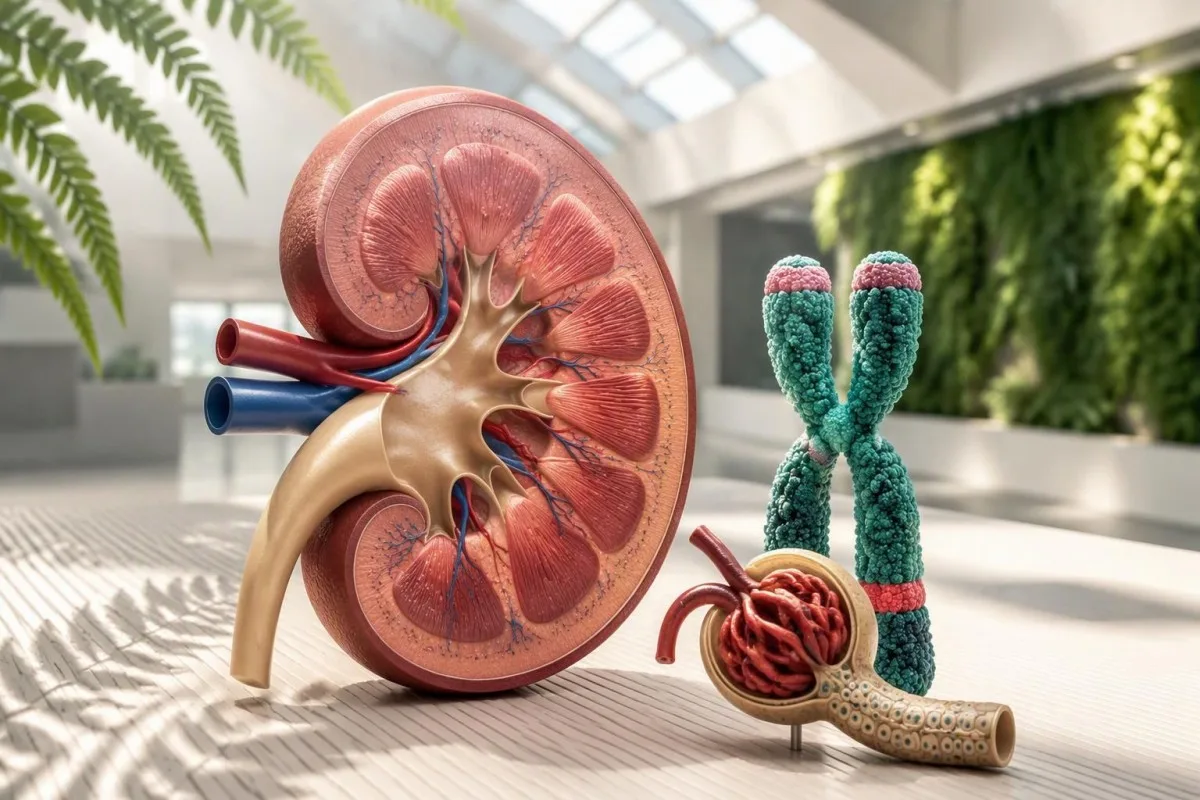
Два варианта риска APOL1 — G1/G1, G1/G2 или G2/G2 — указывают на наследственную предрасположенность к заболеванию почек, а не на диагноз. Результаты могут помочь при консультировании, наблюдении за состоянием почек и оценке живого донора, но не позволяют с уверенностью предсказать будущее конкретного человека.


- Два варианта риска означают G1/G1, G1/G2 или G2/G2; все три варианта классифицируются как генотип APOL1 высокого риска.
- G1 — это один аллель риска хотя распространенный гаплотип G1 содержит два сцепленных изменения последовательности в одной и той же хромосоме.
- Высокий риск — не диагноз: результаты анализа APOL1 не устанавливают диагноз хронической болезни почек, фокально-сегментарного гломерулосклероза и не определяют необходимость диализа.
- Для оценки состояния почек нужны два показателя: расчетная скорость клубочковой фильтрации, или eGFR, и отношение альбумина к креатинину в моче, или ACR.
- Стойкие отклонения показателей функции почек включают eGFR ниже 60 мл/мин/1,73 м² или ACR не менее 30 мг/г в течение 3 месяцев или дольше.
- Нормальные исходные результаты часто позволяют составить индивидуальный план ежегодного наблюдения, однако универсальный интервал скрининга, специфичный для APOL1, не установлен.
- Генетическое происхождение отличается от расы: происхождение может помочь при обсуждении тестирования, но внешность и расовая идентичность не позволяют определить генотип APOL1.
- Донорство при жизни требует отдельного консультирования поскольку наличие двух вариантов риска может повлиять на возможность стать донором, даже если текущие показатели функции почек в норме.
- Наследование в семье предсказуемо, заболевание — нет: если у каждого из двух родителей есть по одному аллелю риска, вероятность того, что ребёнок унаследует два аллеля риска, составляет 25% при каждой беременности.
Что на самом деле означает генотип APOL1 высокого риска?
Генетическое тестирование APOL1 выявляет наследуемые варианты, связанные с предрасположенностью к заболеваниям почек. Наличие двух вариантов риска APOL1—G1/G1, G1/G2 или G2/G2— повышает риск, но не служит диагнозом заболевания почек и не означает, что почечная недостаточность неизбежна; дальнейшие действия зависят от показателей функции почек, семейного анамнеза и от того, рассматривается ли вопрос о донорстве.
Результат APOL1, указывающий на высокий риск, и хроническая болезнь почек — это два разных показателя. У человека может быть генотип G1/G2, eGFR 105 мл/мин/1,73 м² и ACR мочи 6 мг/г, при этом признаков текущей ХБП нет; эти показатели характеризуют состояние почек сейчас, но не дают пожизненной гарантии.
Тестирование APOL1 наиболее полезно, когда оно влияет на решение, а не просто добавляет ярлык. Я Томас Кляйн, главный врач Kantesti, и вначале я бы разделил три вопроса: что унаследовано, есть ли повреждение почек и влияет ли результат на обсуждение донорства или лечения.
Кантести — это Анализатор анализа крови на основе искусственного интеллекта которые могут помочь объяснить лабораторные показатели, связанные с почками, но обычный биохимический анализ крови не позволяет выявить генотип APOL1. Наш гид по стадированию ХБП объясняет, почему eGFR и альбумин в моче следует оценивать вместе; ни один из этих показателей не заменяет специализированный генетический анализ.
Как следует трактовать результаты G1/G1, G1/G2 и G2/G2?
G1/G1, G1/G2 и G2/G2 означают, что обе унаследованные копии гена APOL1 несут аллель риска заболевания почек. G1/G1 содержит два аллеля G1, G1/G2 — по одному аллелю каждого типа, а G2/G2 — два аллеля G2; ни один из этих вариантов не является показателем функции почек.
G1 — это обычно гаплотип, содержащий два сцепленных кодирующих изменения, которые чаще всего обозначают как S342G и I384M. Эти изменения обычно наследуются вместе в составе одной хромосомы и считаются одним аллелем риска G1, а не двумя отдельными унаследованными аллелями риска; G2 — это делеция шести пар оснований, приводящая к удалению двух аминокислот из белка APOL1.
Генотипы G0/G0, G0/G1 и G0/G2 обычно относят к вариантам APOL1 с более низким риском, поскольку они содержат ноль или один признанный аллель риска. Более низкий риск, связанный с APOL1, не означает отсутствия риска заболевания почек: остаются возможными диабет, гипертония, другие генетические заболевания и повреждение, связанное с лекарственными препаратами; кроме того, ограниченные по охвату анализы не исследуют все гены, связанные с заболеваниями почек.
Три сочетания высокого риска не позволяют надёжно ранжировать индивидуальную степень тяжести. Если в заключении перечислены изменения последовательности, а не пара аллелей, попросите лабораторию указать соответствующий генотип и обозначить ограничения в определении того, какие изменения находятся в одной хромосоме; наша result-format explanation helps distinguish categorical genetic findings from numerical laboratory values.
Почему два варианта риска APOL1 не гарантируют развитие заболевания почек?
APOL1-associated kidney susceptibility has incomplete penetrance: some people with two risk alleles develop kidney disease, while others do not. Age, additional genetic factors, immune signaling, environmental exposures and existing kidney conditions influence outcomes, so a genotype alone cannot provide a dependable personal lifetime percentage.
Parsa and colleagues reported that, among AASK participants who already had hypertension-associated CKD, the composite outcome of kidney failure or doubling serum creatinine occurred in 58.1% of the high-risk group versus 36.6% of the lower-risk group (Parsa et al., 2013). Those figures describe progression in an affected study population—not the chance that a healthy person with G1/G2 will develop CKD.
Relative risk and absolute risk answer different questions. Even a twofold association does not tell a person their probability without a relevant starting risk and a time horizon; a 30-year-old with normal ACR and a 65-year-old with substantial albuminuria should not receive the same prediction simply because their APOL1 results match.
The proposed “second-hit” model is useful but incomplete: certain immune or cellular stresses may increase APOL1-related injury, yet clinicians cannot identify a single required trigger for every patient. This resembles the distinction between susceptibility and diagnosis discussed in our ApoE4 risk explanation, although the genes, organs and predictive evidence are different.
Чем генетическое происхождение отличается от расы при тестировании APOL1?
APOL1 G1 and G2 variants are associated particularly with genetic ancestry from parts of sub-Saharan Africa, not with a racial category itself. Race is a social classification, ancestry describes inherited population history, and neither a person’s appearance nor a single ancestry percentage establishes whether they carry zero, one or two risk alleles.
African ancestry is not one uniform genetic background. G1 and G2 frequencies differ substantially between populations, so a broad label such as “African,” “Black” or “mixed ancestry” is too coarse to establish an individual’s result; a family history extending across two or more regions can also be incomplete or unknown.
An ancestry-informed testing offer should be an invitation to discuss relevance, not a biological assumption about someone’s race. A person who does not identify as Black may carry two risk variants, while a person who does identify as Black may carry neither; asking about family origins is more respectful and clinically useful than inferring genetics from skin tone.
Race should not be used as a substitute for genotype or as an automatic adjustment to kidney-function interpretation. KDIGO 2024 supports avoiding race in eGFR computation; our Duffy-null neutrophil explanation illustrates another setting where a specific inherited finding is more informative than a racial label, although Duffy status does not predict APOL1 status.
Кому может быть полезно генетическое тестирование APOL1?
APOL1 testing may be useful for selected people with unexplained or familial kidney disease, some patients with focal segmental glomerulosclerosis, and potential living kidney donors with relevant ancestry. Testing everyone solely because of race is not an appropriate substitute for individualized consent, clinical assessment and a clear explanation of what the result could change.
An unexplained kidney problem before age 50, several relatives with kidney failure, or a tissue diagnosis showing FSGS can justify a genetics discussion. APOL1 may be only one part of that assessment: other inherited kidney disorders can produce similar findings, and a targeted APOL1 test will not identify all of them.
A positive APOL1 result does not prove that APOL1 caused every abnormality on a kidney panel. For example, G1/G1 in a patient with diabetes and an ACR of 450 mg/g may represent an additional susceptibility rather than a complete explanation; clinicians still assess diabetes duration, retinal findings, urine sediment, medication exposure and the pace of eGFR change.
Testing an unaffected relative should have an agreed purpose, such as counseling or donor evaluation, rather than a promise that it will prevent disease. Our inherited family-risk discussion shows why the question “What will we do differently after either result?” matters before ordering a genetic test; the appropriate answer can differ between two members of the same family.
Как проводят тест на APOL1 и когда требуется подтверждение результата?
APOL1 genetic testing uses DNA, commonly obtained from a blood, saliva or cheek-swab specimen, to identify G1 and G2 alleles. The genotype normally remains unchanged throughout life, so one adequately performed clinical test is usually sufficient; repeat or confirmatory testing is reserved for uncertainty about specimen identity, assay coverage or the original result.
A clinical report should identify the tested variants, the genotype and the assay’s relevant limitations. Turnaround time varies between laboratories, and the genetic assay is separate from a same-day creatinine result; before paying, ask whether the fee includes counseling, whether both risk alleles are assessed, and whether an inconclusive result requires a second specimen.
An unexpected direct-to-consumer result may need confirmation in an accredited clinical laboratory before a transplant or other consequential decision. A screenshot showing two sequence changes is not necessarily proof of two risk alleles, particularly when the changes belong to the same G1 haplotype; the original report and its method matter more than an automated summary.
Kantesti’s laboratory explanations should preserve the distinction between genetic evidence and biochemical evidence rather than infer an APOL1 result from creatinine. Our клиническую рамку валидации describes the standards behind laboratory interpretation, while our руководство по безопасности медицинских отчетов explains why source verification is necessary before acting on a consequential result.
Какие вопросы следует обсудить при генетическом консультировании по APOL1 для членов семьи?
APOL1 counseling should explain inheritance, uncertain disease prediction, family implications, privacy and the limits of testing. Each child inherits one APOL1 copy from each parent; predictable allele transmission does not translate into a predictable age of onset, disease severity or need for dialysis.
When both parents have one recognized APOL1 risk allele, each pregnancy has a 25% chance of two risk alleles, a 50% chance of one, and a 25% chance of none. These probabilities reset with every pregnancy; four children do not have to divide into those proportions, and a child inheriting two alleles is not thereby diagnosed with kidney disease.
A parent with G1/G2 passes a risk allele to every child: either G1 or G2, each with a 50% chance. If the other parent is G0/G0, none of their children will have two recognized risk alleles; a genetic counselor can explain when partner testing would meaningfully answer a family question rather than merely add anxiety.
Testing children requires a separate discussion about present medical benefit, consent and the child’s future autonomy—not simply applying an adult screening plan at age 8. Our carrier-screening counseling guide illustrates why inheritance terminology needs care, and our руководство по семейному тестированию с учетом возраста helps distinguish targeted care from indiscriminate family screening.
Какие анализы крови на состояние почек важны после получения результата высокого риска?
Serum creatinine with eGFR is a standard blood-based assessment after an APOL1 high-risk result; cystatin C can improve assessment when creatinine is less reliable. Urine ACR must be added separately because an eGFR above 90 mL/min/1.73 m² does not rule out albumin leakage or early kidney damage.
Creatinine reflects both filtration and factors such as muscle mass, recent meat intake and some medications. A muscular adult with creatinine of 1.3 mg/dL may need a different interpretation from a frail adult with the same concentration; our muscular-adult creatinine guide explains why the laboratory flag alone is not a diagnosis.
A combined creatinine–cystatin C eGFR can be useful when a more accurate estimate could change a decision, including selected donor assessments. Cystatin C has its own influences, including glucocorticoid exposure and thyroid dysfunction, so it is not an infallible correction; our руководство по интерпретации цистатина С discusses the two-marker approach.
Кантести — это Платформа для расшифровки анализа крови AI that can help put serial creatinine and eGFR reports into context, but laboratory trends cannot prove APOL1-related disease. KDIGO 2024 states that an eGFR change greater than 20% on a subsequent test in someone with CKD exceeds expected variability and warrants evaluation; a smaller change can still matter when it persists or accompanies rising albuminuria.
Как следует интерпретировать ACR мочи и сроки последующего наблюдения?
Urine ACR measures albumin leakage and is essential alongside eGFR when assessing APOL1 susceptibility. KDIGO albuminuria categories are A1 below 30 mg/g, A2 from 30–300 mg/g and A3 above 300 mg/g; persistent abnormalities require assessment even when filtration remains apparently normal.
One elevated ACR is not automatically persistent kidney damage. Strenuous exercise, fever, urinary infection and menstrual contamination can affect a result, so an ACR of 65 mg/g may need a properly timed repeat; our руководство по подготовке ACR explains practical collection steps without substituting a negative dipstick for a quantitative ratio.
An individualized annual review of blood pressure, eGFR and ACR is a reasonable discussion for an otherwise well adult with two risk alleles and normal baseline findings. That is a pragmatic monitoring plan, not a universal APOL1-specific guideline; established CKD, pregnancy, new hypertension or an abnormal trend may justify shorter intervals, such as 3–6 months, chosen by the treating clinician.
KDIGO 2024 considers a doubling of ACR on follow-up in someone with CKD a change that warrants evaluation. Urine microscopy adds a different kind of information: cellular casts or persistent red cells can point toward another process, as our руководстве по осадку мочи explains; APOL1 testing should not make those findings disappear from the differential diagnosis.
В каких случаях результат APOL1 служит основанием для направления к нефрологу?
Nephrology referral is driven mainly by kidney abnormalities, progression, unexplained findings and donor questions—not by genotype alone. CKD requires evidence of abnormal kidney structure or function for at least 3 months; a rapidly changing creatinine result or concerning symptoms require prompt assessment without waiting for that chronicity threshold.
Persistent eGFR below 60 mL/min/1.73 m² or ACR at least 30 mg/g can satisfy CKD criteria when present for 3 months or longer. Referral urgency increases with advanced impairment, substantial albuminuria, a sustained downward trend or uncertainty about the cause; a normal eGFR does not make an ACR of 800 mg/g reassuring.
A hypothetical 36-year-old with G1/G2, eGFR 96 mL/min/1.73 m² and ACR 900 mg/g needs evaluation for significant albuminuria, not reassurance based on filtration alone. APOL1 susceptibility does not exclude membranous nephropathy or other glomerular disorders; our PLA2R antibody explanation describes one different diagnostic pathway that may become relevant when the clinical pattern fits.
Rapidly reduced urine output, breathlessness with swelling, or visible urine discoloration alongside worsening kidney measurements calls for urgent assessment. Some antibody-mediated conditions need especially rapid action, as discussed in our anti-GBM result guide; neither a known APOL1 result nor a 3-month CKD definition should delay an acute kidney evaluation.
Влияет ли генотип высокого риска на лечение или повседневные привычки?
An APOL1 high-risk genotype alone does not automatically justify kidney medication, a restrictive renal diet or supplements. Treatment depends on actual kidney disease, albuminuria, blood pressure and other conditions; proven CKD therapies should not be withheld merely because inherited susceptibility may contribute to the disease.
Blood-pressure control is a practical priority, but the measurement method changes how a target should be interpreted. KDIGO’s CKD guidance includes a standardized office systolic target below 120 mmHg when tolerated for appropriate adults; that is not an instruction to force every routine home reading below 120, especially with dizziness, frailty or other reasons to individualize treatment.
ACE inhibitors or ARBs and SGLT2 inhibitors may be indicated for particular CKD and albuminuria patterns, with monitoring of creatinine and potassium. Two risk alleles with normal eGFR and normal ACR do not automatically establish those indications; medication choices should follow the person’s documented condition and current local guidance rather than a genetic label.
No supplement, “kidney cleanse” or diet has been shown to erase G1 or G2 alleles. Avoid starting potassium restriction or a very-low-protein diet solely after a genetic result, and discuss frequent NSAID use with your clinician; our руководство по безопасности добавок для почек explains why products marketed for kidney health can create problems rather than prevent them.
Что означают два варианта риска APOL1 для живого донора?
Two APOL1 risk variants may change living-kidney-donor eligibility even when current kidney function is normal. The concern is the donor’s future risk after losing kidney reserve, as well as possible implications for the donated kidney; transplant programs differ in how they incorporate the result into acceptance decisions.
The KDIGO living-donor guideline states that APOL1 genotyping may be offered to candidates with sub-Saharan African ancestry and that candidates should understand the uncertainty in predicting post-donation risk (Lentine et al., 2017). Many programs take a conservative approach to two risk alleles, particularly in younger candidates; there is no single internationally uniform APOL1 acceptance rule.
KDIGO 2017 considers donor GFR of at least 90 mL/min/1.73 m² generally acceptable, GFR from 60–89 individually assessable, and GFR below 60 unsuitable for donation. These filtration thresholds do not cancel APOL1 susceptibility; our руководство по BUN и креатинину explains why a reassuring chemistry result alone is not a complete donor assessment.
Age, albuminuria, blood pressure, family history and other health risks must be considered alongside the genotype. A young candidate has more remaining years in which disease could emerge, and related donors may share additional inherited risks; a transplant team should explain what a positive result means for eligibility before testing, not after a family has assumed donation will proceed.
Как обеспечить конфиденциальное и безопасное обращение с информацией об APOL1?
APOL1 results are sensitive genetic information with implications for both the tested person and relatives. Before sharing a report with a clinical service or digital tool, check consent, access, retention and deletion options; protections against genetic discrimination differ between countries and between insurance products.
One person’s permission to share their result does not automatically authorize uploading a relative’s report. Remove unnecessary identifiers, consider who can access shared family accounts, and ask whether genetics information becomes part of a medical record; insurance and employment protections are jurisdiction-specific, so obtain local advice before assuming a general privacy statement covers every consequence.
Кантести — это платформа для интерпретации биомаркеров с помощью ИИ that can support understanding of kidney-related laboratory reports, but it does not replace APOL1 testing, genetic counseling or transplant eligibility review. Our информацией о конфиденциальности и данных explains data-handling considerations; an AI interpretation taking approximately 60 seconds is not the same service as completing a molecular genetic assay.
Kantesti LTD is a UK company, number 17090423, and our organization information provides context about who operates the service. Family Health Risk features should use consented information rather than infer a relative’s genotype from race, kidney chemistry or another person’s two-allele result; keep the original clinical laboratory report available for professional review.
Что взять с собой на прием и какие источники информации использовать?
Bring the original APOL1 report, recent eGFR and urine ACR results, a medication list and a family kidney history to your appointment. As of October 19, 2026, this article distinguishes established guidance from uncertain individual prediction; its clinical references include the 2024 KDIGO CKD guideline and the 2017 KDIGO living-donor guideline.
A useful appointment can answer four concrete questions: Is kidney damage present, what is the monitoring interval, should relatives receive counseling, and does the result affect donation? My practical checklist as Thomas Klein, Chief Medical Officer at Kantesti, is to leave with a named clinician and a written next-test plan rather than an unsupported lifetime percentage; our медицинская консультативная информация describes the expertise behind our clinical standards.
Serum albumin and urine albumin answer different questions, and confusing the two can derail a kidney discussion. Our справочник по белкам сыворотки provides supporting education on circulating proteins, but neither a normal serum albumin of 4.2 g/dL nor a normal albumin-to-globulin ratio excludes urinary albumin loss or determines an APOL1 genotype.
Complement tests are not routine APOL1 surveillance tests; C3 and C4 may become relevant when clinical findings suggest an immune-mediated kidney disorder. Our руководство по дополнительному тестированию is a supporting educational publication, not evidence for APOL1 penetrance; the two Zenodo resources listed below are separate from the directly relevant external medical references, and their ResearchGate and Academia.edu links are discovery searches rather than verified hosted copies.
Часто задаваемые вопросы
Означает ли наличие двух вариантов риска APOL1, что у меня разовьётся заболевание почек?
Наличие двух вариантов риска APOL1 повышает предрасположенность к заболеваниям почек, но не означает неизбежного развития болезни или почечной недостаточности. Генотипы G1/G1, G1/G2 и G2/G2 относятся к генотипам высокого риска, однако исходы у разных людей различаются. Для оценки состояния почек в настоящее время необходимы eGFR и ACR мочи; eGFR 100 мл/мин/1,73 м² и ACR 5 мг/г не подтверждают наличие ХБП. Индивидуальный план наблюдения полезнее, чем применение процентного показателя из исследования людей, у которых уже было заболевание почек.
Являются ли G1/G1, G1/G2 и G2/G2 одинаково серьёзными?
G1/G1, G1/G2 и G2/G2 содержат по два признанных аллеля риска APOL1 и относятся к генотипам высокого риска. Комбинации генотипов не позволяют надежно ранжировать людей по тяжести заболевания в будущем. G1 обычно включает два сцепленных изменения последовательности на одной хромосоме, но они считаются одним аллелем риска. Для интерпретации любой из трех комбинаций по-прежнему необходимы показатели состояния почек, возраст и клинический анамнез.
Как часто нужно проверять почки после получения результата теста на APOL1, указывающего на высокий риск?
Универсального интервала наблюдения, специфичного для APOL1, который подходил бы всем людям с двумя вариантами риска, не существует. Если у взрослого в остальном хорошее самочувствие и исходные показатели в норме, разумно начать с обсуждения ежегодной проверки артериального давления, eGFR и ACR мочи. Наличие ХБП, альбуминурии или изменение динамики показателей может служить основанием для сокращения интервалов, например до 3–6 месяцев; их выбирает лечащий врач. При появлении новых симптомов или быстром изменении функции почек необходимо пройти обследование раньше, не дожидаясь следующей плановой проверки.
Могу ли я пожертвовать почку, если у меня есть два варианта риска APOL1?
Два варианта гена APOL1, связанных с риском, могут повлиять на возможность стать живым донором почки, даже если текущие показатели функции почек в норме. Трансплантационные программы различаются политикой отбора доноров, и многие придерживаются консервативного подхода, поскольку индивидуальный риск после донорства невозможно точно предсказать. Согласно рекомендациям KDIGO для живых доноров, GFR не менее 90 mL/min/1.73 m² обычно считается приемлемой, однако этот порог не отменяет генетические и другие риски для здоровья. Прежде чем считать нормальный уровень креатинина подтверждением безопасности донорства, узнайте о политике программы в отношении APOL1.
Тестирование APOL1 применимо только к людям, которые относят себя к чернокожим?
Тестирование APOL1 не ограничивается расовой идентичностью, поскольку генетическое происхождение и раса — разные понятия. Варианты G1 и G2 особенно связаны с происхождением из некоторых регионов Африки к югу от Сахары, однако по внешности нельзя определить, есть ли у человека ноль, один или два аллеля риска. Человек, который не идентифицирует себя как темнокожий, может быть носителем этих вариантов, а человек, который идентифицирует себя как темнокожий, может не быть носителем ни одного из них. При обсуждении тестирования следует учитывать происхождение, состояние почек, семейный анамнез и то, на какое решение может повлиять результат.
Унаследуют ли мои дети два варианта риска APOL1?
0. Генотип APOL1 ребенка зависит от аллеля, унаследованного от каждого из родителей. Если у обоих родителей есть по одному аллелю риска, вероятность того, что ребенок унаследует два аллеля риска, составляет 25% при каждой беременности. Если у одного родителя генотип G1/G2, а у другого — G0/G0, каждый ребенок унаследует один аллель риска, и ни один не унаследует два распознаваемых аллеля риска. Эти вероятности наследования не позволяют предсказать, разовьется ли заболевание почек и когда это произойдет.
Получите анализ крови с помощью ИИ уже сегодня
Присоединяйтесь к более чем 2 миллионам пользователей по всему миру, которые доверяют Kantesti для мгновенного и точного анализа лабораторных тестов. Загрузите результаты анализа крови и получите комплексную интерпретацию биомаркеров 15,000+ за считанные секунды.
📚 Ссылки на научные публикации
Кляйн, Т., Митчелл, С., и Вебер, Х. (2026). Руководство по сывороточным белкам: анализ крови на глобулины, альбумин и соотношение альбумин/глобулин (A/G).. Kantesti AI Medical Research.
Кляйн, Т., Митчелл, С., и Вебер, Х. (2026). Руководство по анализу крови на комплемент C3 и C4 и титр ANA. Kantesti AI Medical Research.
📖 Внешние медицинские источники
Parsa A et al. (2013). APOL1 Risk Variants, Race, and Progression of Chronic Kidney Disease. New England Journal of Medicine.
Lentine KL et al. (2017). KDIGO Clinical Practice Guideline on the Evaluation and Care of Living Kidney Donors. Transplantation.
Рабочая группа KDIGO по ХБП (Kidney Disease: Improving Global Outcomes) (2024). Клиническое практическое руководство KDIGO 2024 по оценке и ведению хронической болезни почек. Kidney International.
⚕️ Медицинское предупреждение
Эта статья предназначена только для образовательных целей и не является медицинской консультацией. Всегда консультируйтесь с квалифицированным специалистом здравоохранения по вопросам диагностики и решений по лечению.
Сигналы доверия E-E-A-T
Опыт
Клинический обзор рабочих процессов интерпретации лабораторных данных под руководством врача.
Экспертиза
Акцент на лабораторной медицине: как биомаркеры ведут себя в клиническом контексте.
Авторитетность
Написано доктором Томасом Кляйном при рецензировании доктором Сарой Митчелл и профессором доктором Хансом Вебером.
Доверие
Интерпретация на основе доказательств с понятными маршрутами дальнейших действий, чтобы снизить тревожность.