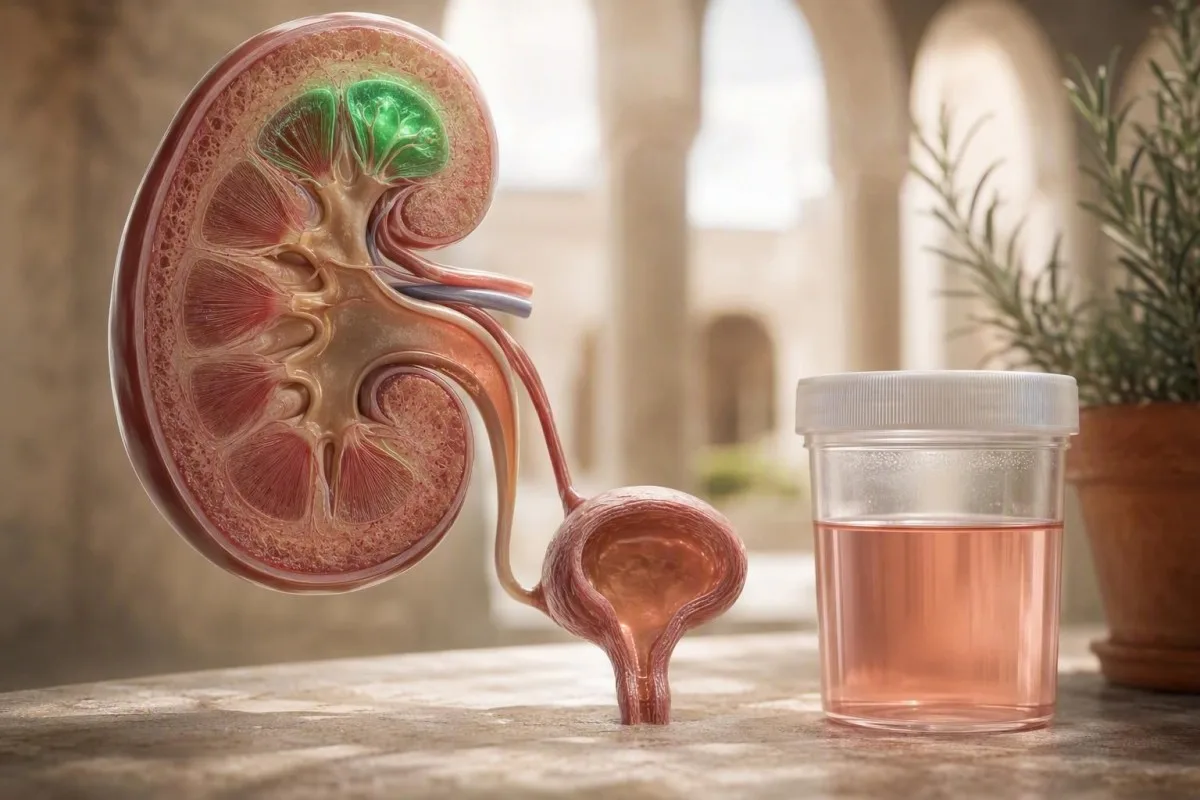
Una muestra de orina rosada o de color té después de una carrera larga es a menudo hematuria temporal inducida por el ejercicio, pero el color visible nunca debe ser desestimado automáticamente. El momento, los hallazgos microscópicos, los síntomas y una muestra repetida adecuadamente descansada cuentan la verdadera historia.


- Hematuria inducida por el ejercicio generalmente se resuelve dentro de las 24 a 72 horas posteriores a una carrera extenuante; la persistencia más allá de las 72 horas requiere evaluación médica.
- Umbral de microscopía de 3 o más glóbulos rojos por campo de alta potencia en una muestra de orina recolectada adecuadamente cumple con la definición de la AUA de microhematuria.
- Desajuste de la tira reactiva importa: una almohadilla de sangre positiva con cero a dos glóbulos rojos por campo de alta potencia sugiere mioglobina o hemoglobina libre en lugar de sangrado urinario.
- Repetir el momento es práctico: evite el ejercicio intenso durante 48–72 horas, hidrátese normalmente, luego proporcione una muestra de orina de chorro medio.
- Evaluación el mismo día es sensato para coágulos, incapacidad para orinar, fiebre, dolor intenso en un flanco, o orina de color cola con dolor muscular marcado.
- Patrón de advertencia renal es sangre más proteína, cilindros de glóbulos rojos, presión arterial alta o una caída en el eGFR—no una tira reactiva aislada post-carrera.
- Pista de rabdomiólisis se presenta de forma desproporcionada como orina oscura con síntomas musculares graves y un resultado de creatina quinasa a menudo superior a 5 veces el límite superior del laboratorio.
- Contexto de riesgo de cáncer cambia el umbral para la investigación: la edad, la exposición al tabaquismo, la radiación pélvica previa y la hematuria visible persistente son importantes.
Por qué una carrera puede hacer que la orina se vea rosada
La hematuria del corredor suele ser una fuga de corta duración de glóbulos rojos en la orina después de un ejercicio vigoroso,, que a menudo se resuelve dentro de las 24-72 horas de descanso. Aún así, la orina visible de color rosado, rojo o a base de cola merece una repetición adecuada de la prueba en lugar de una suposición casual de que correr la causó.
En la clínica, el patrón tranquilizador es sencillo: el cambio de color comienza después de una carrera inusualmente larga, rápida o cuesta abajo; no hay fiebre, dolor de flanco cólico ni ardor urinario; y la microscopía se normaliza después del descanso. Kantesti es un analizador de sangre con IA que pueden situar los marcadores renales relacionados —creatinina, eGFR, electrolitos y creatina quinasa— junto con el historial de ejercicio, en lugar de tratar un resultado posterior a la carrera como un diagnóstico.
Los mecanismos propuestos son el contacto mecánico con la pared de la vejiga, los cambios temporales en el flujo sanguíneo renal, la concentración relacionada con la deshidratación y, en ocasiones, la descomposición de los glóbulos rojos por el impacto repetitivo del pie. La evidencia de cada mecanismo está honestamente dividida, ya que la mayoría de los estudios son pequeños y utilizan diferentes distancias de carrera. En mis 15 años de práctica clínica, el historial de un nuevo esfuerzo importa más que el color por sí solo; una primera ultramaratón y una carrera de 5 km familiar no conllevan la misma probabilidad pre-test.
La sangre visible en la orina después del ejercicio no es sinónimo de hematuria benigna del corredor. una guía más amplia de señales de alerta para la hematuria es útil porque los cálculos renales, las infecciones, las enfermedades glomerulares y los cánceres del tracto urinario pueden manifestarse incidentalmente por primera vez después de una carrera.
La definición práctica
La hematuria inducida por el ejercicio significa que los glóbulos rojos aparecen en la orina poco después del esfuerzo y desaparecen en una muestra repetida en reposo. Un bastoncillo de prueba positivo por sí solo no confirma este diagnóstico, ya que el reactivo detecta el pigmento hemo de glóbulos rojos intactos, hemoglobina libre o mioglobina.
¿Es hematuria, hemoglobina o mioglobina?
Un bastoncillo de prueba de orina que dé positivo para sangre puede reflejar glóbulos rojos, hemoglobina o mioglobina, y la microscopía los separa. La orina rosada con muchos glóbulos rojos intactos apoya la hematuria; la orina marrón oscura con pocos o ningún glóbulo rojo aumenta la preocupación por el pigmento de la lesión muscular o la hemólisis.
La microscopía de orina que muestra 3 o más glóbulos rojos por campo de gran aumento confirma la microhematuria cuando la muestra se recoge limpiamente. Por el contrario, un bastoncillo de prueba fuertemente positivo con 0-2 glóbulos rojos por campo de gran aumento debería hacer que un clínico considere la mioglobinuria, particularmente después de exposición al calor, una carga muscular tipo aplastamiento o dolor muscular severo retardado. El color marrón o a base de cola es más típico de pigmento concentrado que de una pequeña cantidad de sangrado vesical.
La mioglobina es importante porque puede acompañar a la rabdomiólisis y a la lesión renal aguda. Una concentración de creatina quinasa superior a 5 veces el límite superior de lo normal del laboratorio se utiliza comúnmente como un umbral bioquímico para la rabdomiólisis, aunque los síntomas, el potasio, la creatinina y la producción de orina determinan la urgencia. Vea nuestra explicación práctica de creatina quinasa peligrosamente alta para los patrones que no deben esperar a que pase la noche.
Los colorantes alimentarios, la remolacha, las moras, la rifampicina, la fenazopiridina y la deshidratación también pueden teñir la orina sin glóbulos rojos. A diferencial de orina oscura ayuda a evitar el error común de asumir que cada muestra rojiza representa sangre.
Por qué la distinción cambia la atención
La hematuria de glóbulos rojos dirige la atención al tracto urinario, mientras que la mioglobinuria dirige la atención al músculo esquelético y a la protección renal. Ambos pueden ocurrir después de eventos de resistencia, pero solo la microscopía y los análisis de sangre dirigidos pueden distinguirlos de manera confiable.
Cómo leer un resultado de análisis de orina post-carrera
El análisis de orina post-carrera más informativo combina tira reactiva, microscopía, medición de proteínas y gravedad específica. La sangre en la tira reactiva con glóbulos rojos transitorios y sin proteínas es a menudo de bajo riesgo; la sangre más proteínas o cilindros requiere una evaluación renal más deliberada.
El resultado de sangre en la tira reactiva se reporta como negativo, traza, 1+, 2+ o 3+, pero es una señal de detección en lugar de un recuento de células. La AUA define la microhematuria como más de 3 glóbulos rojos por campo de gran aumento en el examen microscópico, no solo un resultado de tira reactiva (Barocas et al., 2020). Esta distinción evita que los corredores se sometan a un estudio de cáncer innecesario después de una detección falsos positiva.
Gravedad específica superior a 1.030 indica orina concentrada en muchos laboratorios y puede hacer que el color parezca más alarmante, pero no explica los glóbulos rojos confirmados. Las proteínas de 1+ o más deben cuantificarse con una relación albúmina-creatinina en orina o una relación proteína-creatinina; existe proteinuria transitoria por ejercicio, pero la albuminuria persistente cambia el diagnóstico diferencial hacia la enfermedad glomerular. Nuestro guía completa de análisis de orina explica por qué estos marcadores no deben fusionarse en un solo resultado.
El análisis de IA interpreta la creatinina y el eGFR junto con los hallazgos de orina, el momento del ejercicio y los valores previos; una creatinina ligeramente elevada después de una carrera calurosa no es equivalente a una enfermedad renal crónica. En la práctica, pregunto la distancia, el terreno, la temperatura, el uso de antiinflamatorios, el momento menstrual y si la muestra se proporcionó dentro de las 2 horas posteriores a la finalización.
¿Cuándo se debe repetir una prueba de orina después de correr?
Repetir el análisis de orina 48-72 horas después de la última carrera intensa es un criterio razonable para la hematuria del corredor sospechada. Use una muestra de la primera hora de la mañana o de mitad de chorro bien hidratada, pero no fuerce litros de agua inmediatamente antes, ya que la dilución extrema puede ocultar hallazgos útiles.
Para una anomalía rutinaria post-carrera, generalmente recomiendo no hacer intervalos, cuestas, levantamiento de pesas ni carreras para 48 horas; después de una maratón, ultramaratón, enfermedad por calor o dolor inusual, 72 horas es más defendible. Beber agua normal hasta tener sed es suficiente. La hiperhidratación puede reducir la gravedad específica por debajo de 1.005 y ocasionalmente dificultar la interpretación de un resultado límite.
Si la microscopia permanece positiva después de 72 horas, programe una revisión de atención primaria dentro de unos días en lugar de realizar pruebas repetidas después de los entrenamientos. Los resultados persistentes justifican la medición de la presión arterial, creatinina sérica/eGFR, relación albúmina-creatinina en orina y consideración de cultivo o imágenes según el riesgo. La relación entre el esfuerzo, la hidratación y una estimación de filtración temporalmente más baja se cubre en nuestra guía de eGFR post-ejercicio.
Un maratonista recreativo de 52 años que vi tenía 18 glóbulos rojos por campo de alta potencia la noche después de una carrera calurosa, pero 0-1 glóbulos rojos después de 72 horas de reposo; su creatinina volvió de 1.28 mg/dL a 0.96 mg/dL. El resultado fue tranquilizador, pero el mismo plan no sería suficiente para un fumador de 52 años con color de orina visible recurrente.
No analice en la línea de meta si puede evitarlo
El análisis inmediatamente después del ejercicio maximiza la posibilidad de encontrar glóbulos rojos temporales, orina concentrada y proteínas. Eso puede ser clínicamente útil en la rabdomiólisis sospechada, pero es un mal momento para establecer la línea de base de un corredor.
¿Qué patrones de hematuria post-carrera suelen ser tranquilizadores?
Un episodio autolimitado después de correr intensamente es más tranquilizador cuando se resuelve por completo, carece de dolor o síntomas sistémicos, y no tiene proteinuria ni cambios en la función renal. Tranquilizador no significa ignorado; significa confirmado con una muestra en reposo.
El fenotipo de menor riesgo es un corredor joven o de mediana edad con un desencadenante de esfuerzo claro, presión arterial normal, sin antecedentes de tabaquismo y microscopia en reposo normal. En ese contexto, un resultado único y transitorio de 3-10 RBC/HPF después de una carrera a menudo se resuelve sin tratamiento. Aún así lo documentaría, porque la recurrencia después de cada carrera larga merece una revisión más cuidadosa que un evento único.
Una relación albúmina-creatinina en orina normal es generalmente por debajo de 30 mg/g (por debajo de 3 mg/mmol), aunque los laboratorios y los países informan las unidades de manera diferente. La sangre sin albúmina, cilindros o glóbulos rojos dismórficos apunta a una fuga no glomerular; no prueba una fuente en la vejiga, pero guía la siguiente pregunta. Nuestra explicación de proteína en orina cubre esta división claramente.
El traumatismo de vejiga es más plausible cuando la orina está muy concentrada y el corredor termina con la vejiga casi vacía. Algunos médicos deportivos sugieren orinar antes de una carrera larga y beber regularmente, pero este es un consejo de prevención con evidencia limitada de ensayos, no un sustituto de la evaluación cuando el color persiste.
Un resultado normal tiene una marca de tiempo
Una prueba negativa 3 días después de una carrera es tranquilizadora para ese episodio, no una garantía de por vida. La nueva hematuria visible meses después debe evaluarse por sus propios méritos, particularmente después de los 40 años o con exposición al tabaquismo.
Señales de advertencia que hacen que la hematuria del corredor sea menos probable
La hematuria necesita una evaluación rápida cuando persiste después de 72 horas, recurre sin ejercicio intenso o aparece con dolor, fiebre, coágulos, proteína o cambio en la función renal. La combinación de hallazgos es más informativa que una muestra de aspecto dramático por sí sola.
Busque asesoramiento médico oportuno para la orina roja visible que dura más allá de 24 horas, incluso si se siente bien; el umbral es más bajo para personas mayores de 40 años, fumadores actuales o anteriores, o aquellos con radiación pélvica previa. La guía de la AUA utiliza la estratificación del riesgo basada en la edad, el tabaquismo, el grado y la persistencia de la sangre microscópica y la hematuria macroscópica previa, en lugar de tratar todas las microhematurias de manera idéntica (Barocas et al., 2020).
Los glóbulos rojos dismórficos, los cilindros de glóbulos rojos, la albuminuria significativa, la hipertensión nueva o una eGFR reducida sugieren un origen en el filtro renal en lugar de una vejiga sacudida. Los cilindros de glóbulos rojos nunca son una consecuencia esperada de la carrera ordinaria y deben de dar lugar a una evaluación renal expedita. Ver nuestro resumen de cilindros granulosos y urinarios para saber por qué importan los hallazgos del sedimento.
Thomas Klein, MD, aconseja a los corredores que no se autoevalúen solo por el color: una infección del tracto urinario puede causar ardor, urgencia, piuria y, a veces, hematuria, mientras que los cálculos más a menudo crean un dolor unilateral abrupto y náuseas. Un cultivo es más útil antes de los antibióticos cuando hay síntomas de infección.
La combinación de sangre y proteína
La hematuria confirmada con proteinuria es más preocupante que la hematuria aislada porque ambas pueden originarse en el filtro glomerular. Una relación albúmina-creatinina en orina de 30 mg/g o superior debe repetirse e interpretarse junto con la presión arterial y la función renal.
¿Cuándo necesita atención el mismo día la orina rosada después del ejercicio?
Busque evaluación urgente el mismo día si hay coágulos, incapacidad para orinar, dolor intenso en el flanco, fiebre, desmayos, disminución de la producción de orina o orina oscura con dolor y debilidad muscular intensos. Estas características apuntan más allá de la hematuria no complicada inducida por el ejercicio.
Los coágulos pueden obstruir el flujo de orina, y la incapacidad para orinar es un problema urgente independientemente de la condición física atlética. La fiebre de 38.0°C o más con dolor en el flanco puede indicar una infección superior del tracto urinario; el dolor cólico severo con vómitos puede indicar un cálculo. Ninguna de las dos situaciones debe manejarse esperando una prueba repetida después de la carrera.
La orina marrón oscura después del esfuerzo, junto con marcada sensibilidad muscular, debilidad, hinchazón o producción reducida, aumenta la preocupación por la rabdomiólisis. Las pruebas iniciales comúnmente incluyen creatina quinasa, creatinina, potasio, calcio, fósforo y análisis de orina. Un guía de rabdomiólisis de CrossFit es relevante porque el ejercicio excéntrico no acostumbrado, no solo correr, es un desencadenante frecuente.
La deshidratación severa puede hacer que los resultados renales parezcan peores, pero también puede coexistir con una lesión real. Si tiene mareos, confusión, no puede retener líquidos o orina muy poco durante 8–12 horas, no intente resolver el problema en casa con bebidas deportivas.
Embarazo y anticoagulantes
Las corredoras embarazadas y las personas que toman anticoagulantes deben informar la hematuria visible de inmediato. Los anticoagulantes pueden amplificar el sangrado pero no eliminan la necesidad de identificar su fuente; el embarazo también cambia el umbral para la detección de infecciones, cálculos y enfermedades renales.
Afecciones que una carrera puede revelar en lugar de causar
Correr puede exponer un problema urinario existente al concentrar la orina o provocar una prueba, en lugar de causar la hematuria en sí. Los cálculos, la infección, la enfermedad glomerular, las anomalías estructurales y la malignidad siguen siendo parte del diagnóstico diferencial.
Los cálculos renales con frecuencia causan dolor unilateral del flanco a la ingle, náuseas y glóbulos rojos en el microscopio, aunque existen cálculos indoloros. La infección urinaria con más frecuencia produce ardor, frecuencia, urgencia y glóbulos blancos; un resultado negativo de nitrito no lo descarta. Nuestra guía de esterasa de leucocitos con nitrito negativo explica este patrón mixto común.
La glomerulonefritis puede presentarse después de una infección del tracto respiratorio superior con orina de color cola, hinchazón, presión arterial elevada, proteinuria y glóbulos rojos dismórficos. En la guía KDIGO 2024 CKD, la albuminuria persistente y la reducción del eGFR se tratan como marcadores complementarios de riesgo renal, no como mediciones intercambiables (KDIGO, 2024).
Kantesti es una herramienta de análisis de pruebas de sangre impulsada por IA que ayuda a los usuarios a reconocer un patrón entre creatinina, eGFR, albúmina, electrolitos y un CBC, pero no puede diagnosticar la fuente anatómica de la hematuria. Las imágenes, la microscopía, el cultivo y el examen clínico aún realizan el trabajo decisivo.
El cáncer es poco común en corredores jóvenes, pero no imposible en adultos.
La hematuria visible justifica una evaluación incluso cuando el ejercicio parece una explicación obvia, especialmente en personas con exposición al tabaquismo o síntomas persistentes. El riesgo aumenta con la edad y la exposición acumulativa al tabaco, por lo que resultados de orina idénticos no conducen a planes de prueba idénticos.
¿Quién necesita seguimiento urológico o nefrológico?
La hematuria persistente después de una muestra repetida en reposo debe ser evaluada en cuanto a riesgo para urología, mientras que la hematuria más proteinuria, cilindros, hipertensión o eGFR alterado apunta a nefrología. Muchas personas solo necesitan pruebas repetidas dirigidas por atención primaria; la derivación depende del patrón.
La evaluación urológica es particularmente apropiada para hematuria visible recurrente, hematuria microscópica persistente, antecedentes de tabaquismo, exposición ocupacional a aminas aromáticas, radiación pélvica previa o síntomas urinarios sin infección. Dependiendo del riesgo, los médicos pueden usar ecografía renal y de vejiga, urografía por TC y cistoscopia. Una sola tira reactiva de traza post-carrera en un joven de 24 años es un escenario muy diferente a orina roja recurrente en un ex fumador de 58 años.
La revisión nefrológica se vuelve más probable con la relación albúmina-creatinina en orina ≥30 mg/g, eGFR por debajo de 60 mL/min/1.73 m² durante 3 meses o más, cilindros de glóbulos rojos o presión arterial difícil de controlar. Esos umbrales importan porque la enfermedad renal crónica se define por la duración y también por una sola medición. Lea nuestro guía de etapas de enfermedad renal crónica para las categorías prácticas.
El servicio de interpretación de análisis de laboratorio de Kantesti puede señalar un patrón repetible de sangre y proteínas para discusión, especialmente cuando los usuarios cargan resultados de diferentes laboratorios. Debe apoyar, no reemplazar, a un médico que decida si se necesitan imágenes urinarias o un examen especializado.
No deje que la anticoagulación ponga fin a la conversación.
El uso de anticoagulantes cambia la gravedad del sangrado pero no establece una causa de hematuria. En mi experiencia, atribuir sangre recurrente en la orina a apixabán, warfarina o aspirina sin un estudio puede retrasar el reconocimiento de cálculos, infecciones o enfermedades estructurales.
¿Qué análisis de sangre ayudan después de la hematuria relacionada con el ejercicio?
Los análisis de sangre útiles dependen de los síntomas: la creatinina, el eGFR, los electrolitos y la creatina quinasa evalúan el estrés renal y muscular, mientras que un CBC evalúa la anemia o las pistas de infección. Los paneles amplios de rutina son menos útiles que las pruebas dirigidas después de una historia clínica y un análisis de orina precisos.
La creatinina puede aumentar transitoriamente después del ejercicio de resistencia debido al metabolismo muscular, la reducción de la perfusión renal y la deshidratación. Las ecuaciones de eGFR son menos confiables durante un cambio rápido de creatinina, por lo que un valor repetido después 48–72 horas de una recuperación ordinaria es a menudo más significativo que un resultado en la línea de meta. Nuestro guía de control de creatinina relacionada con el ejercicio proporciona contexto para este frecuente desencadenante de ansiedad.
La creatina quinasa tiene un amplio rango post-ejercicio: los atletas entrenados pueden mostrar elevaciones después de una carrera sin daño renal, mientras que los valores muchas veces superiores al límite superior local más los síntomas merecen una evaluación urgente. El potasio por encima de 6.0 mmol/L es potencialmente peligroso y requiere evaluación clínica urgente, especialmente si la función renal está alterada o se sospecha lesión muscular.
Un CBC es más útil cuando hay fatiga, palidez, sangrado menstrual abundante, hematuria recurrente o preocupación por una enfermedad sistémica. La hemoglobina puede disminuir después de eventos de resistencia por expansión del volumen plasmático, pérdida de hierro o hemólisis; la ferritina debe interpretarse lejos de la inflamación aguda y el entrenamiento intenso. Los corredores de resistencia pueden encontrar útil nuestra reseña de análisis de sangre para atletas para una base razonable.
No diagnostique enfermedad renal con un solo panel de la semana de carrera.
Un aumento de creatinina de 0,3 mg/dL o más puede cumplir un criterio de lesión renal aguda en el marco de tiempo adecuado, pero el contexto y las pruebas repetidas son decisivos después de una carrera. La baja producción de orina, el aumento del potasio y la elevación persistente tienen más peso que un resultado aislado en el límite.
Cómo recolectar una muestra de orina repetida en la que los médicos puedan confiar
Una muestra de orina de chorro medio de limpieza capturada después de 48-72 horas sin ejercicio extenuante es la mejor manera de verificar si la hematuria se ha resuelto. Los errores de recolección, la contaminación menstrual y una muestra vieja pueden crear resultados engañosos.
Lávese las manos, comience a orinar en el inodoro, luego recoja la porción de chorro medio sin tocar el interior del recipiente. Entregue la muestra de inmediato, idealmente dentro de 2 horas—o siga las instrucciones de refrigeración del laboratorio. La permanencia prolongada cambia la apariencia de las células y puede hacer que la microscopía sea menos confiable.
Evite las pruebas durante la menstruación activa siempre que sea posible; si las pruebas no pueden esperar, informe al médico y al laboratorio. La contaminación vaginal puede producir glóbulos rojos y proteínas aparentes, mientras que las células epiteliales escamosas a menudo indican una muestra mal recolectada. Nuestra guía para células epiteliales en orina explica por qué esta no es una nota a pie de página trivial del laboratorio.
Thomas Klein, MD, recomienda registrar cuatro detalles junto con la muestra: la última sesión extenuante, la duración del evento, la temperatura exterior y todos los medicamentos tomados en las 72 horas previas. Un resultado sin información sobre el momento es mucho más difícil de interpretar, especialmente cuando la orina se recolecta después de un doble entrenamiento.
Muestra de la primera hora de la mañana versus prueba diurna
Una muestra de la primera hora de la mañana está concentrada y es buena para detectar anomalías pequeñas, pero una muestra de mitad de chorro diurna normalmente hidratada es aceptable si la recolección es más limpia. La consistencia importa más para la comparación seriada: use aproximadamente las mismas condiciones en cada repetición.
Hidratación, analgésicos y suplementos que cambian el panorama
La deshidratación puede concentrar la orina y aumentar el estrés renal, mientras que los AINE pueden reducir el flujo sanguíneo renal durante el ejercicio de resistencia. Ninguno de los factores demuestra la causa de la hematuria, pero ambos influyen en la cautela con la que los médicos interpretan un resultado posterior a la carrera.
Para la mayoría de los corredores, beber hasta tener sed y reponer las pérdidas gradualmente es más seguro que forzar líquidos rígidamente. Un sodio muy bajo por ingesta excesiva de agua puede ser peligroso; el sodio sérico por debajo de 125 mmol/L con dolor de cabeza, vómitos, confusión o convulsiones es una emergencia. El color de la orina es una pista aproximada de hidratación, no un medidor preciso de hidratación.
El ibuprofeno, el naproxeno y otros AINE pueden reducir el flujo sanguíneo renal mediado por prostaglandinas, especialmente durante el estrés por calor, vómitos o eventos largos. Aconsejo a los pacientes que eviten los AINE profilácticos de rutina antes de los maratones, a menos que su propio médico les haya dado una razón clara. El contexto de la medicación se explora en nuestro artículo sobre seguridad de tendencias de laboratorio.
La vitamina C en dosis altas puede interferir con ciertas reacciones de las tiras reactivas de orina, y los suplementos comercializados para el rendimiento a veces contienen estimulantes o diuréticos no declarados. Lleve los envases o fotografías claras a una cita; a menudo es más útil que intentar recordar la lista de ingredientes de un polvo de marca. Nuestra guía de seguridad de suplementos para atletas ofrece una lista de verificación sensata.
La hidratación no es un tratamiento para la sangre persistente
El agua puede corregir la concentración, pero no trata un cálculo, una infección, un proceso glomerular o una fuente urinaria estructural. Si quedan glóbulos rojos en una muestra en reposo y bien recolectada, la escalada debe basarse en el patrón en lugar de otro experimento de hidratación.
¿Se puede seguir corriendo después de la hematuria inducida por el ejercicio?
La mayoría de los corredores pueden regresar gradualmente una vez que el color de la orina se ha normalizado, los síntomas están ausentes y una muestra repetida en reposo es tranquilizadora. No regrese a entrenamientos intensos mientras la orina permanezca visiblemente roja, los resultados renales sean anormales o los síntomas musculares sugieran rabdomiólisis.
Después de un episodio único sin complicaciones, generalmente sugiero correr suavemente solo durante varios días, luego una reconstrucción gradual del volumen y la intensidad durante 7–14 días. El corredor debe detenerse y buscar revisión si el color reaparece, aparece dolor o la producción de orina disminuye. Este es un enfoque clínico pragmático, no una prescripción probada en ensayos.
La hematuria repetida después de la misma distancia puede justificar experimentos prácticos: evitar competir deshidratado, orinar antes de una carrera larga, introducir el entrenamiento cuesta abajo más lentamente y revisar el ajuste del calzado o el terreno. Lleve un registro del ritmo, el calor, la duración, el color de la orina y los resultados de las muestras. Un guía de laboratorio para corredores de maratón puede ayudar a distinguir los marcadores de recuperación de las razones para pausar el entrenamiento.
No entrene a través de hematuria visible inexplicable solo porque tenga un evento programado. Los atletas a menudo son excelentes para tolerar la incomodidad; la habilidad más difícil es reconocer que la persistencia es información diagnóstica, no una prueba de resistencia.
Construya una línea de base real
Un análisis de orina y un panel renal de referencia tomados al menos 72 horas después de un entrenamiento intenso pueden hacer que los futuros resultados post-carrera sean mucho más fáciles de interpretar. Esto es especialmente útil para ultrarred runners, personas con un solo riñón o atletas que usan medicamentos que afectan la perfusión renal.
Qué decirle a su médico sobre la sangre en la orina después del ejercicio
La ruta más rápida hacia una evaluación útil de la hematuria es una línea de tiempo concisa: color de la orina, dosis de ejercicio, síntomas, medicamentos y tiempo de repetición de la prueba. Aporte valores de laboratorio reales en lugar de solo un mensaje de que la muestra fue “positiva para sangre”.”
Indique si la orina era rosada, roja brillante, de color té o contenía coágulos; si el color apareció antes, durante o después del ejercicio; y si se aclaró después de la primera micción. Incluya ardor, urgencia, fiebre, dolor en el flanco, náuseas, hinchazón y disminución del volumen de salida. Un detallado referencia del color de la orina puede ayudar a describir la observación con precisión sin sobreinterpretarla.
Aporte análisis de orina previos, valores de creatinina/eGFR, lecturas de presión arterial, historial de tabaquismo, historial familiar de enfermedad renal y una lista de medicamentos/suplementos. Kantesti es una plataforma de interpretación de biomarcadores con IA que pueden organizar los valores de análisis de sangre repetidos y resaltar cambios significativos, pero un médico debe conectar esos valores con la microscopía y el examen de orina.
A partir del 3 de septiembre de 2026, el principio clínico sigue siendo simple: el ejercicio es una explicación plausible solo después de que el resultado se resuelva y las pistas competitivas estén ausentes. Si tiene dudas, pregunte si necesita microscopía, cultivo, relación albúmina-creatinina, repetición de creatinina, imágenes o derivación, no solo otra tira reactiva.
Preguntas que vale la pena hacer
Pregunte si se vieron glóbulos rojos intactos, si había proteína o cilindros, y cuándo debería repetirse en reposo. Esas tres respuestas generalmente aclaran si el siguiente paso es seguimiento vigilante, análisis de riñón, análisis de infección o una evaluación urológica.
Un plan de acción sensato para la hematuria del corredor
Para un episodio indoloro después de correr intensamente, descanse del ejercicio extenuante durante 48–72 horas y repita un análisis de orina de chorro medio; busque atención temprana para señales de alerta o color visible persistente. El objetivo no es ni el pánico ni la desestimación, sino demostrar que el hallazgo se resuelve.
Paso uno: deje de entrenar intensamente, hidrátese normalmente y anote el momento y los síntomas. Paso dos: repita la microscopía después de 48–72 horas. Paso tres: si la sangre persiste, o si aparecen proteínas, cilindros, dolor, fiebre, coágulos, baja producción de orina o marcadores renales anormales, programe una evaluación médica de inmediato. Esta secuencia previene tanto la enfermedad no detectada como las imágenes innecesarias después de una muestra única en la línea de meta.
Cuando nuestro equipo clínico revisa los datos de laboratorio cargados, priorizamos los patrones: una creatinina en aumento más CK alta y baja producción de orina es más urgente que una creatinina estable con una tira reactiva de orina transitoria. La metodología y las salvaguardias de Kantesti se describen en nuestro información de validación clínica de Kantesti, y nuestra supervisión médica se detalla a través del Consejo Asesor Médico.
La mayoría de los pacientes descubren que una prueba repetida programada convierte un cambio de color alarmante en un plan claro. Pero si su instinto le dice que algo anda mal, especialmente si la orina todavía está roja al día siguiente, confíe en esa señal y hágase evaluar.
La regla de una oración
La orina rosada una vez después de una carrera dura puede ser transitoria; la orina rosada que persiste, recurre o aparece con síntomas es hematuria hasta que se evalúa adecuadamente.
Preguntas frecuentes
¿Cuánto dura la hematuria del corredor?
La hematuria del corredor generalmente se resuelve en un plazo de 24 a 72 horas después de suspender el ejercicio extenuante. Una prueba de orina repetida y práctica consiste en una muestra de chorro medio, obtenida con técnica aséptica, recogida después de 48 a 72 horas sin correr intensamente ni levantar objetos pesados. La hematuria visible persistente, rosada o roja, más allá de las 24 horas, o la hematuria microscópica que permanece después de las 72 horas, debe ser evaluada por un médico. La fiebre, los coágulos, el dolor intenso en el flanco, la disminución de la producción de orina o el dolor muscular severo justifican una evaluación el mismo día.
¿Es normal tener sangre en la orina después del ejercicio?
La sangre en la orina después del ejercicio puede ser un efecto transitorio de la carrera vigorosa, la deshidratación, el impacto en la pared de la vejiga o cambios a corto plazo en el flujo sanguíneo renal, pero no es automáticamente normal. La microscopia que confirma 3 o más glóbulos rojos por campo de alta potencia cumple la definición de microhematuria de la AUA. Un resultado que desaparece en una muestra de repetición en reposo es tranquilizador, mientras que la sangre, las proteínas, los cilindros, el dolor o los síntomas urinarios persistentes requieren una mayor evaluación. El color visible de la orina siempre debe informarse, particularmente en adultos con exposición al tabaquismo o episodios recurrentes.
¿La deshidratación puede causar orina rosada después de correr?
La deshidratación puede hacer que la orina parezca más oscura y puede amplificar un hallazgo de hematuria pos-ejercicio al concentrar el contenido urinario, pero la deshidratación por sí sola no explica de manera confiable la presencia confirmada de glóbulos rojos. Una gravedad específica de la orina superior a 1.030 a menudo indica orina concentrada en muchos laboratorios. Beba normalmente hasta sentir sed y repita una muestra de orina limpia después de 48 a 72 horas de descanso en lugar de intentar eliminar el resultado con un exceso de agua. La sed intensa, el mareo, la producción muy baja de orina o la confusión requieren una revisión médica inmediata.
¿Cuál es la diferencia entre hematuria y mioglobinuria después del ejercicio?
Hematuria significa que hay glóbulos rojos intactos en la orina, mientras que la mioglobinuria refleja el pigmento muscular liberado después de una lesión muscular. Una tira reactiva puede ser positiva para sangre en ambas situaciones, por lo que la microscopia es decisiva: la mioglobinuria a menudo produce una tira reactiva positiva con 0-2 glóbulos rojos por campo de gran aumento. El dolor muscular severo, la debilidad, la hinchazón, la orina oscura tipo cola o un valor de creatina quinasa superior a 5 veces el límite superior del laboratorio generan preocupación por rabdomiólisis. Ese patrón necesita una evaluación clínica urgente porque el potasio y la función renal pueden cambiar rápidamente.
¿Debo dejar de correr si tengo hematuria inducida por el ejercicio?
Detenga la carrera extenuante hasta que el color de la orina se normalice y haya completado una prueba de repetición en reposo, generalmente después de 48 a 72 horas. Si la muestra de repetición es normal y no tiene dolor, fiebre, coágulos, proteinuria o anomalía en la función renal, la mayoría de los corredores pueden regresar gradualmente en aproximadamente 7 a 14 días. No reanude el entrenamiento intenso cuando la orina permanezca visiblemente roja u oscura, la producción de orina se reduzca o haya síntomas musculares graves. Los episodios recurrentes después de entrenamientos similares merecen revisión médica, incluso si cada episodio se resuelve.
¿Cuándo necesita la hematuria una derivación al urólogo?
La hematuria microscópica persistente después de una muestra de reposo repetida, hematuria visible recurrente o hematuria en una persona con antecedentes de tabaquismo, radiación pélvica previa o síntomas urinarios a menudo justifica una evaluación de riesgo urológico. Los urólogos pueden considerar ecografía, tomografía computarizada (TC) urografía y cistoscopia según la edad y el riesgo general en lugar de usar una prueba para todos. La hematuria con albuminuria de 30 mg/g o más, cilindros celulares, hipertensión o un eGFR por debajo de 60 mL/min/1.73 m² apunta más fuertemente hacia nefrología. La especialidad correcta depende del patrón completo de las pruebas de orina y sangre.
Obtén hoy un análisis de sangre con IA
Únete a más de 2 millones de usuarios en todo el mundo que confían en Kantesti para el análisis instantáneo y preciso de pruebas de laboratorio. Sube tus resultados de análisis de sangre y recibe una interpretación completa de los biomarcadores de 15,000+ en segundos.
📚 Publicaciones de investigación citadas
Klein, T., Mitchell, S., & Weber, H. (2026). Soporte de decisión clínica multilingüe asistido por IA para la detección temprana de hantavirus: diseño, validación de ingeniería y despliegue en el mundo real en más de 50.000 informes de análisis de sangre interpretados. Investigación médica con IA de Kantesti.
Klein, T., Mitchell, S., & Weber, H. (2026). Un punto de referencia técnico automatizado basado en rúbricas y pre-registrado del motor de interpretación de análisis de sangre de Kantesti en 100.000 casos de prueba sintéticos. Investigación médica con IA de Kantesti.
📖 Referencias médicas externas
⚕️ Descargo de responsabilidad médica
Este artículo es solo con fines educativos y no constituye asesoramiento médico. Consulta siempre a un profesional sanitario cualificado para decisiones de diagnóstico y tratamiento.
Señales de confianza E-E-A-T
Experiencia
Revisión clínica dirigida por un médico de los flujos de interpretación de análisis.
Pericia
Enfoque en medicina de laboratorio sobre cómo se comportan los biomarcadores en el contexto clínico.
Autoridad
Escrito por el Dr. Thomas Klein, con revisión de la Dra. Sarah Mitchell y el Prof. Dr. Hans Weber.
Integridad
Interpretación basada en la evidencia con vías de seguimiento claras para reducir la alarma.