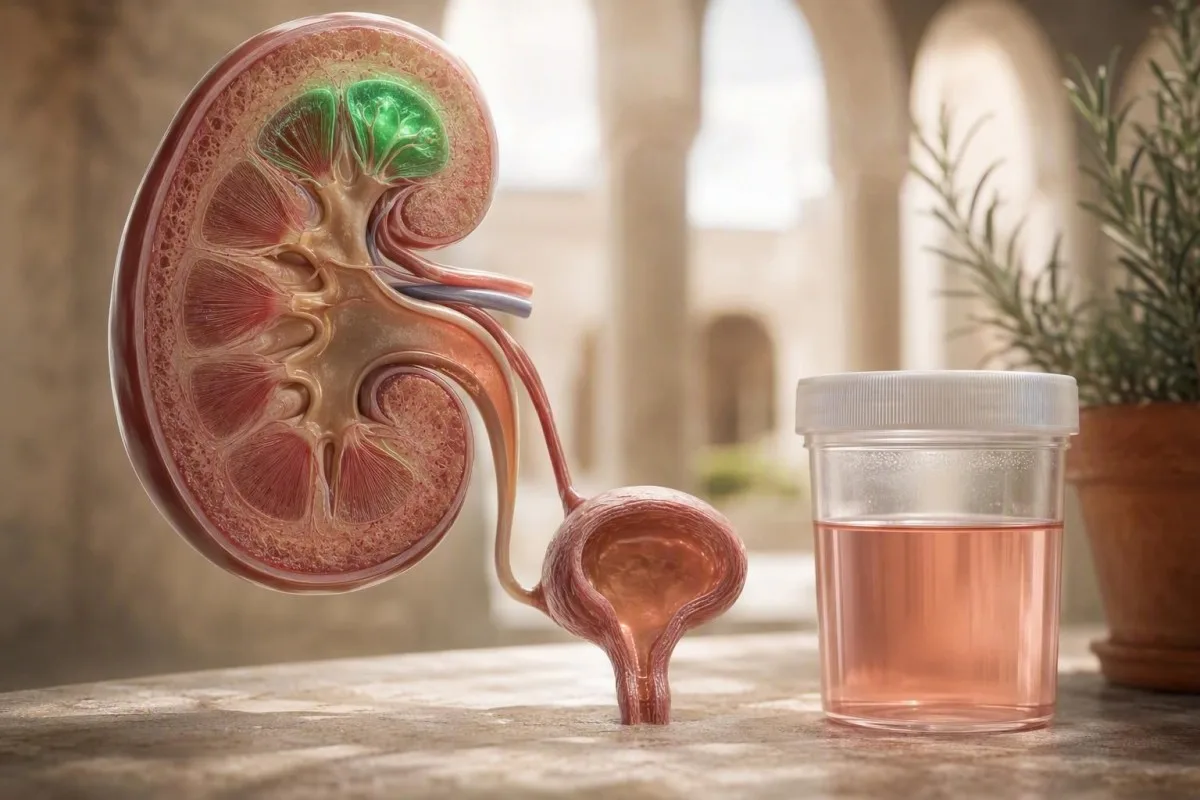
Uma amostra de urina rosa ou cor de chá após uma corrida longa é frequentemente hematúria temporária induzida pelo exercício, mas a cor visível nunca deve ser descartada automaticamente. O momento, os achados microscópicos, os sintomas e uma amostra repetida adequadamente descansada contam a verdadeira história.


- Hematuria induzida por exercício geralmente desaparece em 24–72 horas após corrida extenuante; persistência além de 72 horas requer avaliação médica.
- Limiar de microscopia de 3 ou mais glóbulos vermelhos por campo de grande aumento em uma amostra de urina coletada adequadamente atende à definição da AUA de microhematúria.
- Incompatibilidade de fita reagente importa: uma almofada de sangue positiva com zero a dois glóbulos vermelhos por campo de grande aumento sugere mioglobina ou hemoglobina livre em vez de sangramento urinário.
- Repetir o momento é prático: evite exercícios intensos por 48–72 horas, hidrate-se normalmente e, em seguida, forneça uma amostra de urina do jato médio.
- Avaliação no mesmo dia é sensato para coágulos, incapacidade de urinar, febre, dor intensa em um dos flancos, ou urina cor de cola com dor muscular acentuada.
- Padrão de alerta renal é sangue mais proteína, cilindros eritrocitários, pressão alta ou um eGFR em queda — não uma simples fita reagente pós-corrida.
- Pista de rabdomiólise é urina desproporcionalmente escura com sintomas musculares graves e um resultado de creatina quinase frequentemente acima de 5 vezes o limite superior do laboratório.
- Contexto de risco de câncer altera o limiar de investigação: idade, exposição ao tabagismo, radiação pélvica prévia e hematúria visível persistente são importantes.
Por que uma corrida pode deixar a urina rosa
A hematúria do corredor é geralmente um vazamento de curta duração de glóbulos vermelhos na urina após exercício vigoroso, muitas vezes resolvendo-se em 24 a 72 horas de repouso. Ainda assim, urina rosa, vermelha ou cor de cola visível merece um teste repetido adequadamente coletado, em vez de uma suposição casual de que a corrida a causou.
Na clínica, o padrão tranquilizador é simples: a mudança de cor começa após uma corrida incomumente longa, rápida ou em descida; não há febre, dor em cólica nos flancos ou ardência urinária; e a microscopia normaliza após repouso. Kantesti é um analisador de exames de sangue por IA que pode colocar marcadores renais relacionados — creatinina, eGFR, eletrólitos e creatina quinase — ao lado do histórico de exercícios, em vez de tratar um resultado pós-corrida como um diagnóstico.
Os mecanismos propostos são contato mecânico na parede da bexiga, desvios temporários do fluxo sanguíneo renal, concentração relacionada à desidratação e, ocasionalmente, quebra de glóbulos vermelhos por impacto repetitivo do pé. A evidência para cada mecanismo é honestamente mista, pois a maioria dos estudos é pequena e usa distâncias de corrida diferentes. Em meus 15 anos de prática clínica, a história de um novo esforço é mais importante do que a cor sozinha; uma primeira ultramaratona e uma corrida familiar de 5 km não carregam a mesma probabilidade pré-teste.
Sangue visível na urina após o exercício não é sinônimo de hematúria benigna do corredor. A guia mais amplo de sinais de alerta de hematúria é útil porque cálculos renais, infecção, doença glomerular e cânceres do trato urinário podem se manifestar coincidentemente pela primeira vez após uma corrida.
A definição prática
Hematúria induzida por exercício significa que glóbulos vermelhos aparecem na urina logo após o esforço e desaparecem em uma amostra repetida em repouso. Um teste de imersão positivo isoladamente não prova esse diagnóstico, pois o reagente detecta pigmento heme de glóbulos vermelhos intactos, hemoglobina livre ou mioglobina.
É hematúria, hemoglobina ou mioglobina?
Um teste de imersão urinário positivo para sangue pode refletir glóbulos vermelhos, hemoglobina ou mioglobina, e a microscopia os separa. Urina rosa com muitos glóbulos vermelhos intactos apoia a hematúria; urina marrom escura com poucos ou nenhum glóbulo vermelho levanta preocupação com pigmento de lesão muscular ou hemólise.
Microscopia urinária mostrando 3 ou mais glóbulos vermelhos por campo de alta potência confirma micro-hematúria quando a amostra é coletada limpa. Em contraste, um teste de imersão fortemente positivo com 0 a 2 glóbulos vermelhos por campo de alta potência deve levar o médico a considerar mioglobinúria, particularmente após exposição ao calor, uma carga muscular tipo esmagamento ou dor muscular tardia grave. Cor marrom ou de cola é mais típica de pigmento concentrado do que uma pequena quantidade de sangramento da bexiga.
Mioglobina é importante porque pode acompanhar rabdomiólise e lesão renal aguda. Uma concentração de creatina quinase acima de 5 vezes o limite superior normal do laboratório é comumente usada como um limiar bioquímico para rabdomiólise, embora sintomas, potássio, creatinina e débito urinário determinem a urgência. Veja nossa explicação prática de creatina quinase perigosamente alta para os padrões que não devem esperar durante a noite.
Corantes alimentares, beterraba, amoras, rifampicina, fenazopiridina e desidratação também podem colorir a urina sem células vermelhas. A diferencial de urina escura ajuda a evitar o erro comum de presumir que toda amostra avermelhada representa sangue.
Por que a distinção muda o tratamento
A hematúria por células vermelhas direciona a atenção para o trato urinário, enquanto a mioglobinúria direciona a atenção para o músculo esquelético e a proteção renal. Ambos podem ocorrer após eventos de resistência, mas apenas a microscopia e exames de sangue direcionados podem diferenciá-los de forma confiável.
Como ler um resultado de exame de urina pós-corrida
O exame de urina pós-corrida mais informativo combina fita reagente, microscopia, medição de proteína e densidade. Sangue na fita reagente com células vermelhas transitórias e sem proteína geralmente tem baixo risco; sangue com proteína ou cilindros requer uma avaliação renal mais deliberada.
Um resultado de sangue na fita reagente é relatado como negativo, traço, 1+, 2+ ou 3+, mas é um sinal de rastreio em vez de uma contagem celular. A AUA define micro-hematúria como mais de 3 glóbulos vermelhos por campo de alta potência em exame microscópico, não apenas um resultado de fita reagente (Barocas et al., 2020). Essa distinção evita que corredores passem por uma investigação desnecessária de câncer após um rastreio falso-positivo.
Densidade acima de 1.030 indica urina concentrada em muitos laboratórios e pode tornar a cor mais alarmante, mas não explica células vermelhas confirmadas. Proteína de 1+ ou superior deve ser quantificada com uma razão albumina-creatinina urinária ou razão proteína-creatinina; existe proteinúria transitória induzida por exercício, no entanto, albuminúria persistente muda o diferencial para doença glomerular. Nosso guia completo de urinálise explica por que esses marcadores não devem ser agrupados em um único resultado.
A IA interpreta creatinina e eGFR juntamente com achados urinários, tempo de exercício e valores anteriores; uma única creatinina ligeiramente elevada após uma corrida intensa não é equivalente a doença renal crônica. Na prática, pergunto a distância, terreno, temperatura, uso de anti-inflamatórios, ciclo menstrual e se a amostra foi coletada até 2 horas após o término.
Quando você deve repetir um exame de urina após correr?
Repetir o exame de urina 48–72 horas após a última corrida intensa é um padrão sensato para hematúria do corredor suspeita. Use uma amostra da primeira manhã ou do jato médio bem hidratado, mas não force litros de água imediatamente antes, pois a diluição extrema pode obscurecer achados úteis.
Para uma anormalidade de rotina pós-corrida, geralmente recomendo sem intervalos, subidas, levantamento de peso ou corridas para 48 horas; após uma maratona, ultramaratona, doença pelo calor ou dor incomum, 72 horas é mais defensável. Beber normalmente conforme a sede é suficiente. A hiperidratação pode diminuir a densidade específica abaixo de 1.005 e ocasionalmente dificultar a interpretação de um resultado limítrofe.
Se a microscopia permanecer positiva após 72 horas, agende uma revisão na atenção primária em dias, em vez de testar repetidamente após os treinos. Resultados persistentes justificam medição da pressão arterial, creatinina sérica/eGFR, relação albumina-creatinina urinária e consideração de cultura ou imagem de acordo com o risco. A relação entre esforço, hidratação e uma estimativa de filtração temporariamente mais baixa é abordada em nosso guia de eGFR pós-exercício.
Um maratonista recreativo de 52 anos que vi tinha 18 células vermelhas por campo de alta potência na noite após uma corrida quente, mas 0-1 células vermelhas após 72 horas de repouso; sua creatinina voltou de 1,28 mg/dL para 0,96 mg/dL. O resultado foi tranquilizador, mas o mesmo plano não seria suficiente para um fumante de 52 anos com cor de urina visível repetida.
Não teste na linha de chegada, se puder evitar
O teste imediatamente após o exercício maximiza a chance de encontrar células vermelhas temporárias, urina concentrada e proteína. Isso pode ser clinicamente útil na rabdomiólise suspeita, mas é um momento ruim para estabelecer a linha de base de um corredor.
Quais padrões de hematúria pós-corrida são geralmente tranquilizadores?
Um episódio autolimitado após corrida intensa é mais tranquilizador quando desaparece completamente, não apresenta dor ou sintomas sistêmicos, e não há proteinúria ou alteração da função renal. Tranquilizador não significa ignorado; significa confirmado com uma amostra de repouso.
O fenótipo de menor risco é um corredor jovem ou de meia-idade com um gatilho exaustivo claro, pressão arterial normal, sem histórico de tabagismo e microscopia de repouso normal. Nesse cenário, um único resultado transitório de 3–10 RBC/HPF após uma corrida geralmente se resolve sem tratamento. Eu ainda documentaria isso, pois a recorrência após cada corrida longa merece uma revisão mais cuidadosa do que um evento único.
Uma relação albumina-creatinina urinária normal é geralmente abaixo de 30 mg/g (abaixo de 3 mg/mmol), embora laboratórios e países relatem unidades de forma diferente. Sangue sem albumina, cilindros ou glóbulos vermelhos dismórficos afasta a possibilidade de extravasamento glomerular; isso não prova uma origem na bexiga, mas orienta a próxima pergunta. Nossa explicação de proteína na urina cobre esta divisão claramente.
Trauma na bexiga é mais plausível quando a urina está muito concentrada e o corredor termina com a bexiga quase vazia. Alguns clínicos desportivos sugerem urinar antes de uma corrida longa e beber regularmente, mas este é um conselho de prevenção com evidências limitadas de ensaios clínicos — não um substituto para avaliação quando a cor persiste.
Um resultado normal tem um carimbo de data/hora
Um teste negativo 3 dias após uma corrida é tranquilizador para esse episódio, não uma garantia vitalícia. Nova hematúria visível meses depois deve ser avaliada pelos seus próprios méritos, particularmente após os 40 anos de idade ou com exposição ao tabagismo.
Sinais de alerta que tornam a hematúria do corredor menos provável
A hematúria necessita de avaliação imediata quando persiste após 72 horas, recorre sem exercício intenso, ou aparece com dor, febre, coágulos, proteína, ou alteração da função renal. A combinação de achados é mais informativa do que uma amostra com aspeto dramático por si só.
Procure aconselhamento médico atempado para urina vermelha visível que dure além 24 horas, mesmo que se sinta bem; o limiar é mais baixo para pessoas com mais de 40 anos, fumadores atuais ou ex-fumadores, ou aqueles com radioterapia pélvica prévia. A diretriz da AUA utiliza a estratificação de risco baseada na idade, tabagismo, grau e persistência de sangue microscópico, e hematúria macroscópica prévia em vez de tratar todas as micro-hematúrias de forma idêntica (Barocas et al., 2020).
Células vermelhas dismórficas, cilindros de eritrócitos, albuminúria significativa, nova hipertensão ou um eGFR reduzido sugerem uma fonte no filtro renal em vez de uma bexiga traumatizada. Cilindros de eritrócitos nunca são uma consequência esperada de corrida ordinária e devem justificar uma avaliação renal expedita. Veja a nossa visão geral de cilindros granulosos e urinários para perceber a importância dos achados de sedimento.
Thomas Klein, MD, aconselha os corredores a não fazerem autotriagem apenas pela cor: uma infeção do trato urinário pode causar ardor, urgência, piúria e, por vezes, hematúria, enquanto as pedras mais frequentemente criam dor súbita unilateral e náuseas. Uma cultura é mais útil antes dos antibióticos quando os sintomas de infeção estão presentes.
A combinação sangue-mais-proteína
Hematúria confirmada com proteinúria é mais preocupante do que hematúria isolada porque ambos podem originar-se no filtro glomerular. Uma razão albuminacreatinina urinária de 30 mg/g ou superior deve ser repetida e interpretada com a pressão arterial e a função renal.
Quando a urina rosa após o exercício precisa de atendimento no mesmo dia?
Procure avaliação urgente no mesmo dia para coágulos, incapacidade de urinar, dor intensa nos flancos, febre, desfalecimento, redução do débito urinário, ou urina escura com dor e fraqueza muscular severas. Estas características apontam para além da hematúria não complicada induzida pelo exercício.
Coágulos podem obstruir o fluxo urinário, e a incapacidade de urinar é um problema urgente independentemente da condição física atlética. Febre de 38,0°C ou mais com dor nos flancos pode indicar uma infeção do trato urinário superior; dor cólica intensa com vómitos pode indicar uma pedra. Nenhuma destas situações deve ser gerida à espera de um teste de repetição pós-corrida.
Urina castanha escura após esforço mais sensibilidade muscular acentuada, fraqueza, inchaço ou redução do débito urinário levanta preocupação para rabdomiólise. Testes iniciais incluem frequentemente creatina quinase, creatinina, potássio, cálcio, fosfato e análise de urina. A guia de rabdomiólise do CrossFit é relevante porque o exercício excêntrico não habitual — não apenas a corrida — é um gatilho frequente.
A desidratação severa pode fazer com que os resultados renais pareçam piores, mas também pode coexistir com lesão real. Se você estiver tonto, confuso, não conseguir reter líquidos ou urinar muito pouco por 8–12 horas, não tente resolver o problema com bebidas esportivas em casa.
Gravidez e anticoagulantes
Corredoras grávidas e pessoas que tomam anticoagulantes devem relatar hematúria visível prontamente. Os anticoagulantes podem amplificar o sangramento, mas não removem a necessidade de identificar sua origem; a gravidez também altera o limiar para verificar infecções, pedras e doenças renais.
Condições que uma corrida pode revelar em vez de causar
A corrida pode expor um problema urinário preexistente ao concentrar a urina ou ao induzir um teste, em vez de causar a hematúria em si. Pedras, infecção, doença glomerular, anormalidades estruturais e malignidade permanecem como parte do diagnóstico diferencial.
Pedras nos rins frequentemente causam dor unilateral do flanco à virilha, náuseas e eritrócitos na microscopia, embora pedras indolores ocorram. A infecção urinária mais frequentemente produz ardor, frequência, urgência e leucócitos; um resultado negativo de nitrito não a exclui. Nosso guia para esterase leucocitária com nitrito negativo explica esse padrão misto comum.
A glomerulonefrite pode se apresentar após uma infecção do trato respiratório superior com urina escura (cor de cola), inchaço, pressão arterial elevada, proteinúria e eritrócitos dismórficos. Na diretriz KDIGO 2024 CKD, albuminúria persistente e eGFR reduzido são tratados como marcadores complementares de risco renal, não medições intercambiáveis (KDIGO, 2024).
Kantesti é uma ferramenta de análise de exame de sangue com IA que ajuda os usuários a reconhecer um padrão em creatinina, eGFR, albumina, eletrólitos e um CBC, mas não pode diagnosticar a fonte anatômica da hematúria. Imagem, microscopia, cultura e exame clínico ainda realizam o trabalho decisivo.
Câncer é incomum em corredores jovens, não impossível em adultos.
A hematúria visível justifica avaliação mesmo quando o exercício parece uma explicação óbvia, especialmente em pessoas com exposição ao tabagismo ou sintomas persistentes. O risco aumenta com a idade e a exposição cumulativa ao tabaco, razão pela qual resultados de urina idênticos não levam a planos de teste idênticos.
Quem precisa de acompanhamento urológico ou nefrológico?
Hematúria persistente após uma nova amostra em repouso deve ser avaliada quanto ao risco urológico, enquanto hematúria mais proteinúria, cilindros, hipertensão ou eGFR comprometido apontam para nefrologia. Muitas pessoas precisam apenas de testes repetidos supervisionados pela atenção primária; o encaminhamento depende do padrão.
A avaliação urológica é particularmente apropriada para hematúria visível recorrente, hematúria microscópica persistente, histórico de tabagismo, exposição ocupacional a aminas aromáticas, radiação pélvica prévia ou sintomas urinários sem infecção. Dependendo do risco, os médicos podem usar ultrassom renal e da bexiga, urografia por TC e cistoscopia. Um único traço em dipstick pós-corrida em um jovem de 24 anos é um cenário muito diferente de urina vermelha recorrente em um ex-fumante de 58 anos.
A revisão nefrológica torna-se mais provável com a razão albumina-creatinina na urina ≥30 mg/g, eGFR abaixo de 60 mL/min/1,73 m² por 3 meses ou mais, cilindros celulares vermelhos ou pressão arterial difícil de controlar. Esses pontos de corte importam porque a doença renal crônica é definida pela duração, bem como por uma única medição. Leia nosso guia das fases da doença renal crónica para as categorias práticas.
O serviço de interpretação de testes de laboratório por IA da Kantesti pode sinalizar um padrão repetível de sangue e proteína para discussão, especialmente quando os usuários carregam resultados de diferentes laboratórios. Deve apoiar, não substituir, um médico que decide se são necessárias imagens urinárias ou exame especializado.
Não deixe que a anticoagulação termine a conversa
O uso de anticoagulantes altera a gravidade do sangramento, mas não estabelece uma causa para a hematúria. Na minha experiência, atribuir sangue recorrente na urina à apixabana, varfarina ou aspirina sem uma investigação pode atrasar o reconhecimento de cálculos, infecção ou doença estrutural.
Quais exames de sangue ajudam após hematúria relacionada ao exercício?
Os exames de sangue úteis dependem dos sintomas: creatinina, eGFR, eletrólitos e creatina quinase avaliam o estresse renal e muscular, enquanto um CBC avalia pistas de anemia ou infecção. Painéis amplos de rotina são menos úteis do que testes direcionados após um histórico preciso e análise de urina.
A creatinina pode aumentar transitoriamente após exercícios de resistência devido ao metabolismo muscular, redução da perfusão renal e desidratação. As equações de eGFR são menos confiáveis durante alterações rápidas da creatinina, razão pela qual um valor repetido após 48–72 horas da recuperação ordinária é frequentemente mais significativo do que um resultado na linha de chegada. Nosso guia de reexame de creatinina relacionado ao exercício fornece contexto para este gatilho de ansiedade frequente.
A creatina quinase tem uma ampla faixa pós-exercício: atletas treinados podem apresentar elevações após uma corrida sem lesão renal, enquanto valores muitas vezes acima do limite superior local, mais sintomas, merecem avaliação urgente. Potássio acima de 6,0 mmol/L é potencialmente perigoso e requer avaliação clínica urgente, especialmente se a função renal estiver prejudicada ou se houver suspeita de lesão muscular.
Um CBC é mais útil quando há fadiga, palidez, sangramento menstrual intenso, hematúria recorrente ou preocupação com doença sistêmica. A hemoglobina pode cair após eventos de resistência devido à expansão do volume plasmático, perda de ferro ou hemólise; a ferritina deve ser interpretada longe de inflamação aguda e treinamento intenso. Corredores de resistência podem achar nossa visão geral dos exames de sangue para atletas útil para uma linha de base sensata.
Não diagnostique doença renal com um painel de uma semana de corrida
Um aumento na creatinina de 0,3 mg/dL ou mais pode atender a um critério de lesão renal aguda no período de tempo certo, mas o contexto e os testes repetidos são decisivos após uma corrida. Baixo débito urinário, aumento do potássio e elevação persistente têm mais peso do que um resultado isolado limítrofe.
Como coletar uma amostra de urina repetida em que os médicos possam confiar
Uma amostra de urina de jato médio limpo após 48–72 horas sem exercício extenuante é a melhor maneira de verificar se a hematúria foi resolvida. Erros de coleta, contaminação menstrual e uma amostra antiga podem criar resultados enganosos.
Lave as mãos, comece a urinar no vaso sanitário, em seguida, colete a porção do jato médio sem tocar no interior do recipiente. Entregue a amostra prontamente — idealmente dentro de 2 horas—ou siga as instruções de refrigeração do laboratório. Ficar em pé por muito tempo altera a aparência das células e pode tornar a microscopia menos confiável.
Evite testar durante a menstruação ativa, se possível; se o teste não puder esperar, informe o clínico e o laboratório. A contaminação vaginal pode produzir células vermelhas e proteína aparentes, enquanto células epiteliais escamosas frequentemente sinalizam uma amostra mal coletada. Nosso guia para células epiteliais na urina explica por que isso não é uma nota de rodapé laboratorial trivial.
Thomas Klein, MD, recomenda registrar quatro detalhes junto com a amostra: a última sessão extenuante, a duração do evento, a temperatura externa e todos os medicamentos tomados nas 72 horas anteriores. Um resultado sem tempo é muito mais difícil de interpretar, especialmente quando a urina é coletada após um treino duplo.
Teste da primeira amostra da manhã versus teste diurno
Uma amostra da primeira manhã é concentrada e boa para detectar pequenas anormalidades, mas uma amostra do meio do dia normalmente hidratada é aceitável se a coleta for mais limpa. A consistência é mais importante para comparação serial: use aproximadamente as mesmas condições em cada repetição.
Hidratação, medicamentos para dor e suplementos que alteram o quadro
A desidratação pode concentrar a urina e aumentar o estresse renal, enquanto os AINEs podem reduzir o fluxo sanguíneo renal durante o exercício de resistência. Nenhum fator prova a causa da hematúria, mas ambos influenciam com que cautela os médicos interpretam um resultado pós-corrida.
Para a maioria dos corredores, beber à sede e repor as perdas gradualmente é mais seguro do que forçar rigidamente os fluidos. Sódio muito baixo devido à ingestão excessiva de água pode ser perigoso; sódio sérico abaixo 125 mmol/L com dor de cabeça, vômito, confusão ou convulsões é uma emergência. A cor da urina é uma pista aproximada de hidratação, não um medidor preciso de hidratação.
Ibuprofeno, naproxeno e outros AINEs podem reduzir o fluxo sanguíneo renal mediado por prostaglandinas, especialmente durante estresse por calor, vômito ou eventos longos. Aconselho os pacientes a evitar AINEs profiláticos rotineiros antes de maratonas, a menos que seu próprio médico tenha dado um motivo claro. O contexto da medicação é explorado em nosso artigo sobre segurança de tendências laboratoriais.
A vitamina C em altas doses pode interferir em certas reações de fitas urinárias, e suplementos comercializados para desempenho às vezes contêm estimulantes ou diuréticos não listados. Leve os recipientes ou fotografias claras para uma consulta; geralmente é mais útil do que tentar lembrar a lista de ingredientes de um pó de marca. Nosso guia de segurança de suplementos para atletas oferece uma lista de verificação sensata.
A hidratação não é um tratamento para sangue persistente
A água pode corrigir a concentração, mas não trata um cálculo, infecção, processo glomerular ou fonte urinária estrutural. Se os glóbulos vermelhos permanecerem em uma amostra descansada e bem coletada, a escalada deve ser baseada no padrão em vez de outro experimento de hidratação.
Você pode continuar correndo após hematúria induzida pelo exercício?
A maioria dos corredores pode retornar gradualmente assim que a cor da urina normalizar, os sintomas estiverem ausentes e uma amostra repetida descansada for tranquilizadora. Não retorne ao treino intenso enquanto a urina permanecer visivelmente vermelha, os resultados renais estiverem anormais ou os sintomas musculares sugerirem rabdomiólise.
Após um episódio único sem complicações, geralmente sugiro corrida leve apenas por vários dias, depois uma reconstrução gradual do volume e intensidade ao longo de 7–14 dias. O corredor deve parar e procurar avaliação se a cor recorre, surge dor ou o débito urinário diminui. Esta é uma abordagem clínica pragmática, não uma prescrição comprovada em ensaios.
Hematúria repetida após a mesma distância pode justificar experimentos práticos: evite competir desidratado, urine antes de uma corrida longa, introduza o treino em descidas mais lentamente e revise o ajuste do tênis ou o terreno. Mantenha um registro de ritmo, calor, duração, cor da urina e resultados das amostras. Um maratonista pode ajudar a distinguir marcadores de recuperação de motivos para pausar o treinamento.
Não treine com hematúria visível inexplicável apenas porque tem um evento agendado. Os atletas são frequentemente excelentes em tolerar o desconforto; a habilidade mais difícil é reconhecer que a persistência é informação diagnóstica, não um teste de resistência.
Crie um registro base real
Uma análise de urina e um painel renal de base realizados pelo menos 72 horas após um treino intenso podem tornar os resultados futuros pós-corrida muito mais fáceis de interpretar. Isto é especialmente útil para ultracorredores, pessoas com um rim ou atletas que usam medicamentos que afetam a perfusão renal.
O que dizer ao seu médico sobre sangue na urina após o exercício
A rota mais rápida para uma avaliação útil de hematúria é um cronograma conciso: cor da urina, dose de exercício, sintomas, medicamentos e tempo para repetir o teste. Traga valores reais de laboratório em vez de apenas uma mensagem de que a amostra foi “positiva para sangue”.”
Indique se a urina estava rosa, vermelho vivo, cor de chá ou continha coágulos; se a cor apareceu antes, durante ou após o exercício; e se desapareceu após a primeira micção. Inclua ardor, urgência, febre, dor nos flancos, náuseas, inchaço e diminuição do débito urinário. Um detalhado guia de cores de urina pode ajudar a descrever a observação com precisão sem interpretá-la em excesso.
Traga análises de urina anteriores, valores de creatinina/eGFR, leituras de pressão arterial, histórico de tabagismo, histórico familiar de doenças renais e uma lista de medicamentos/suplementos. Kantesti é uma plataforma de interpretação de biomarcadores por IA que podem organizar valores repetidos de exames de sangue e destacar alterações significativas, mas um clínico deve conectar esses valores com a microscopia e exame da urina.
A partir de 3 de setembro de 2026, o princípio clínico permanece simples: o exercício é uma explicação plausível apenas depois que o resultado se resolve e as pistas concorrentes estão ausentes. Se estiver incerto, pergunte se precisa de microscopia, cultura, relação albumina-creatinina, repetição da creatinina, imagem ou encaminhamento — não apenas outro teste rápido.
Perguntas que valem a pena fazer
Pergunte se células vermelhas intactas foram vistas, se proteína ou cilindros estavam presentes, e quando um teste repetido em repouso deve ocorrer. Essas três respostas geralmente esclarecem se o próximo passo é acompanhamento vigilante, testes renais, testes de infecção ou uma avaliação urológica.
Um plano de ação sensato para hematúria do corredor
Para um episódio indolor após corrida intensa, descanse de exercício extenuante por 48–72 horas e repita uma análise de urina de jato médio; procure atendimento mais cedo para sinais de alerta ou cor visível persistente. O objetivo não é pânico nem descarte — é provar que o achado se resolve.
Passo um: pare o treino intenso, hidrate normalmente e anote o tempo e os sintomas. Passo dois: repita a microscopia após 48–72 horas. Passo três: se o sangue persistir, ou se proteína, cilindros, dor, febre, coágulos, baixo débito urinário ou marcadores renais anormais aparecerem, agende uma avaliação médica prontamente. Esta sequência evita tanto doenças não detectadas quanto exames de imagem desnecessários após uma amostra única da linha de chegada.
Quando nossa equipe clínica revisa os dados laboratoriais carregados, priorizamos padrões: um aumento da creatinina, juntamente com CK alta e baixo débito urinário, é mais urgente do que uma creatinina estável com um teste rápido urinário transitório. A metodologia e as salvaguardas da Kantesti são descritas em nosso informações de validação clínica da Kantesti, e nossa supervisão médica é detalhada através do Conselho Consultivo Médico.
A maioria dos pacientes descobre que um teste repetido programado transforma uma mudança de cor alarmante em um plano claro. Mas se o seu instinto diz que algo está errado — especialmente se a urina ainda estiver vermelha amanhã — confie nesse sinal e procure avaliação.
A regra de uma frase
Urina rosa uma vez após uma corrida intensa pode ser transitória; urina rosa que persiste, recorre ou aparece com sintomas é hematúria até ser devidamente avaliada.
Perguntas frequentes
Quanto tempo dura a hematúria do corredor?
A hematúria do corredor geralmente desaparece dentro de 24–72 horas após a interrupção do exercício extenuante. Um teste de urina prático e repetido é uma amostra de jato médio obtida após higiene local, coletada após 48–72 horas sem corrida intensa ou levantamento de peso pesado. Hematúria visível persistente, rosa ou vermelha, após 24 horas, ou hematúria microscópica que permanece após 72 horas, deve ser avaliada por um clínico. Febre, coágulos, dor intensa nos flancos, diminuição do volume urinário ou dor muscular intensa justificam avaliação no mesmo dia.
É normal ter sangue na urina após o exercício?
Sangue na urina após o exercício pode ser um efeito transitório de corrida vigorosa, desidratação, impacto na parede da bexiga ou alterações de curta duração no fluxo sanguíneo renal, mas não é automaticamente normal. A microscopia que confirma 3 ou mais glóbulos vermelhos por campo de grande aumento atende à definição de micro-hematúria da AUA. Um resultado que desaparece em uma amostra repetida após repouso é tranquilizador, enquanto sangue persistente, proteína, cilindros, dor ou sintomas urinários requerem mais avaliação. A cor visível da urina deve ser sempre relatada, particularmente em adultos com exposição ao tabagismo ou episódios recorrentes.
A desidratação pode causar urina rosada após a corrida?
A desidratação pode fazer a urina parecer mais escura e pode amplificar um achado de hematúria pós-exercício ao concentrar o conteúdo urinário, mas a desidratação por si só não explica de forma confiável a presença de glóbulos vermelhos confirmada. Uma densidade urinária acima de 1,030 geralmente indica urina concentrada em muitos laboratórios. Beba normalmente até sentir sede e repita uma amostra de jato médio após 48–72 horas de repouso, em vez de tentar diluir o resultado com excesso de água. Sede intensa, tontura, produção de urina muito baixa ou confusão necessitam de avaliação médica imediata.
Qual a diferença entre hematúria e mioglobinúria após o exercício?
Hematúria significa a presença de glóbulos vermelhos intactos na urina, enquanto a mioglobinúria reflete o pigmento muscular liberado após lesão muscular. Um teste de tira reativa pode dar positivo para sangue em ambas as situações, portanto, a microscopia é decisiva: a mioglobinúria frequentemente produz um teste de tira reativa positivo com 0 a 2 glóbulos vermelhos por campo de grande aumento. Dor muscular intensa, fraqueza, inchaço, urina de cor escura tipo cola ou um valor de creatina quinase acima de 5 vezes o limite superior do laboratório levanta a suspeita de rabdomiólise. Esse padrão necessita de avaliação clínica urgente porque o potássio e a função renal podem mudar rapidamente.
Devo parar de correr se tiver hematúria induzida pelo exercício?
Interrompa a corrida extenuante até que a cor da urina normalize e você tenha completado um teste de repetição em repouso, geralmente após 48-72 horas. Se a amostra de repetição estiver normal e você não tiver dor, febre, coágulos, proteinúria ou anormalidade na função renal, a maioria dos corredores pode retornar gradualmente em cerca de 7-14 dias. Não retome o treinamento intenso quando a urina permanecer visivelmente vermelha ou escura, a produção de urina for reduzida ou houver sintomas musculares graves. Episódios recorrentes após treinos semelhantes merecem revisão médica, mesmo que cada episódio se resolva.
Quando a hematúria necessita de um urologista?
Hematuria microscópica persistente após uma nova amostra de repouso, hematuria visível recorrente ou hematuria em pessoa com histórico de tabagismo, radiação pélvica prévia ou sintomas urinários geralmente justifica avaliação de risco urológico. Urologistas podem considerar ultrassonografia, urografia por TC e cistoscopia de acordo com a idade e o risco geral, em vez de usar um único exame para todos. Hematuria com albuminuria de 30 mg/g ou mais, cilindros celulares, hipertensão ou eGFR abaixo de 60 mL/min/1.73 m² indicam mais fortemente nefrologia. A especialidade correta depende do padrão completo de exames de urina e sangue.
Faça hoje a análise de exame de sangue com IA
Junte-se a mais de 2 milhões de usuários no mundo todo que confiam na Kantesti para análise instantânea e precisa de exames laboratoriais. Envie seus resultados de exame de sangue e receba uma interpretação abrangente de biomarcadores 15,000+ em segundos.
📚 Publicações de pesquisa referenciadas
Klein, T., Mitchell, S., & Weber, H. (2026). Suporte de Decisão Clínica Multilíngue Auxiliado por IA para Triagem Precoce de Hantavírus: Design, Validação de Engenharia e Implantação no Mundo Real em 50.000 Relatórios de Exames de Sangue Interpretados. Pesquisa Médica por IA da Kantesti.
Klein, T., Mitchell, S., & Weber, H. (2026). Uma Benchmark Técnica Automatizada Pré-Registrada, Baseada em Rubrica, da Interpretação de Testes de Sangue da Máquina Kantesti em 100.000 Casos de Teste Sintéticos. Pesquisa Médica por IA da Kantesti.
📖 Referências Médicas Externas
⚕️ Aviso Médico
Este artigo é apenas para fins educacionais e não constitui aconselhamento médico. Consulte sempre um profissional de saúde qualificado para decisões de diagnóstico e tratamento.
Sinais de confiança E-E-A-T
Experiência
Revisão clínica orientada por médicos dos fluxos de interpretação de exames laboratoriais.
Especialização
Foco em medicina laboratorial sobre como os biomarcadores se comportam no contexto clínico.
Autoridade
Escrito pelo Dr. Thomas Klein, com revisão da Dra. Sarah Mitchell e do Prof. Dr. Hans Weber.
Confiabilidade
Interpretação baseada em evidências, com caminhos de acompanhamento claros para reduzir alarmes.