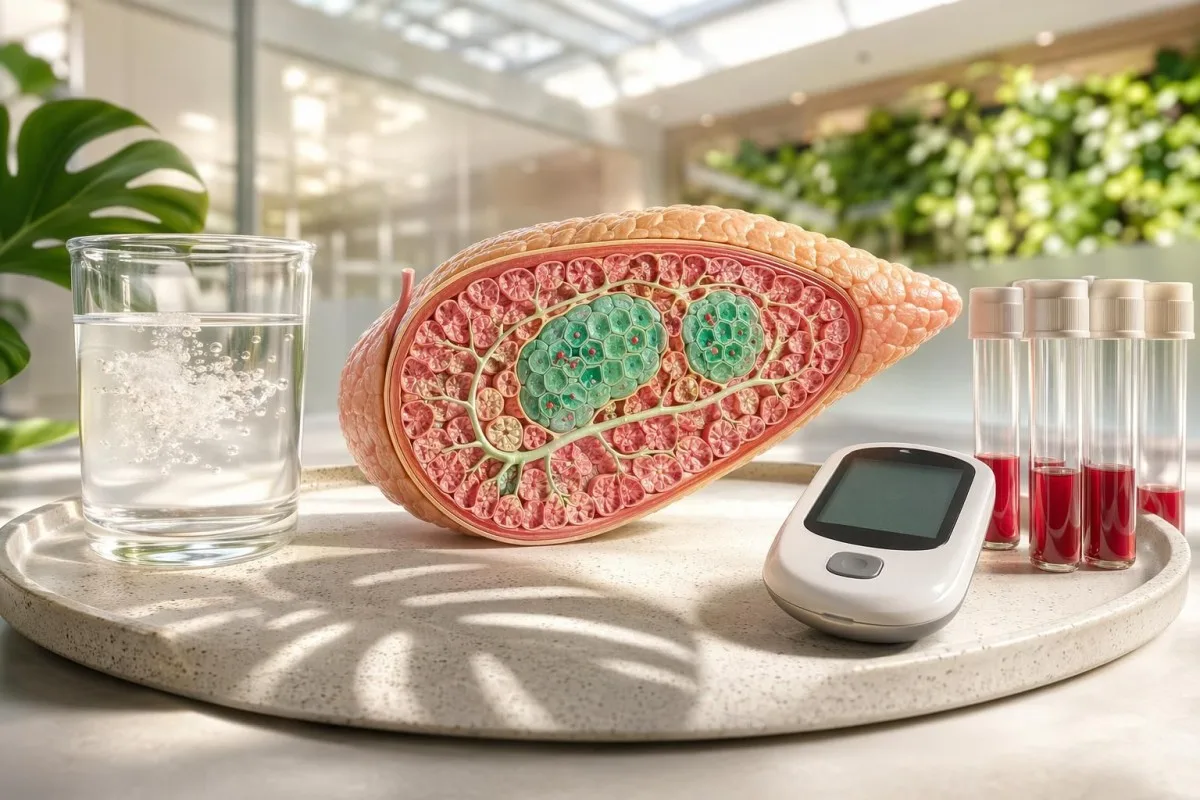
En praktisk guide för efterkontroll efter förlossningen för alla som fått besked om att graviditetens blodsockervärden var normala igen, men ändå vill veta vad som händer härnäst.


- 75 g OGTT vid 4–12 veckor efter förlossningen är det föredragna testet efter graviditetsdiabetes eftersom det upptäcker problem med glukos efter 2 timmar som fastande glukos kan missa.
- Diabetessgränser är fastande plasmaglukos ≥126 mg/dL, glukos vid 2 timmar i OGTT ≥200 mg/dL, HbA1c ≥6.5%, eller slumpmässigt glukos ≥200 mg/dL med symtom.
- Gränsvärden för prediabetes är fastande glukos 100–125 mg/dL, glukos vid 2 timmar i OGTT 140–199 mg/dL, eller HbA1c 5.7–6.4%.
- HbA1c tidigt efter förlossningen kan vara falskt lågt efter blodförlust vid förlossningen eller vid hög omsättning av röda blodkroppar, så det bör inte ersätta OGTT vid 4–12 veckor.
- Normalt glukos under graviditeten efter förlossningen raderar inte framtida risk; graviditetsdiabetes är ofta ett stresstest för betaceller som avslöjar sårbarhet år innan typ 2-diabetes.
- Intervall för omtestning var 1–3:e år livet ut om efterkontrollen efter förlossningen är normal, och vanligtvis årligen om något resultat ligger i området för prediabetes.
- Före en ny graviditet be om glukostestning före befruktning eller tidigt under första trimestern, särskilt om tidigare GDM krävde insulin eller läkemedel.
- Riskmarkörer såsom fasteinsulin, triglycerider, HDL, ALT och urinens albumin-kreatinin-kvot diagnostiserar inte diabetes, men de hjälper till att uppskatta kardiometabol risk.
Blodproverna som diagnostiserar diabetes efter graviditetsdiabetes
Blodproverna som upptäcker diabetes efter graviditetsdiabetes är de 75 g 2-timmars orala glukostoleranstestet, fasteplasmaglukos, HbA1c, och slumpmässigt plasmaglukos när klassiska symtom föreligger. OGTT är vanligtvis det bästa testet för screening av diabetes efter förlossningen vid 4–12 veckor eftersom det upptäcker nedsatt hantering av 2-timmarsglukos innan fasteglukos eller HbA1c blir avvikande.
Som Thomas Klein, MD, säger jag till patienter att frågan inte bara är om siffran är hög i dag; det handlar om huruvida bukspottkörteln fortfarande har tillräcklig reserv efter graviditeten. Ett fasteglukos på 94 mg/dL kan se betryggande ut, medan ett OGTT-värde efter 2 timmar på 168 mg/dL tyst säger att det första fasens insulinrespons släpar efter.
En diagnos av diabetes utanför graviditet ställs med fasteplasmaglukos ≥126 mg/dL, glukos vid 2-timmars OGTT ≥200 mg/dL, HbA1c ≥6.5%, eller slumpmässigt plasmaglukos ≥200 mg/dL med symtom som törst, frekvent urinering eller oförklarlig viktnedgång. För en jämförelse i klartext av diagnostiska och monitorerande tester, våra gränsvärden för diabetesprov guide en användbar följeslagare.
Kantesti är en AI-blodtestanalysator som läser av glukos efter förlossningen, HbA1c, lipider och njurmarkörer i samma kliniska sammanhang i stället för som isolerade varningsflaggor. I vår analys av 2M+ uppladdade labbrapporter återkommer ett mönster: människor kommer ihåg graviditetsdiagnosen, men deras OGTT-resultat vid 4–12 veckor hamnar ofta aldrig i den långsiktiga hälsoregistreringen.
Varför normalt glukos under graviditeten inte nollställer framtida risk
Normalt glukos efter förlossningen nollställer inte framtida diabetesrisk eftersom graviditetsdiabetes vanligtvis speglar en begränsad betacellsreserv under graviditetsstress. Förlossningen avlägsnar placenta-hormoner, men det innebär inte nödvändigtvis att insulinresistensen, den genetiska risken, benägenheten för fettlever eller bukspottkörtelns betacells sårbarhet repareras.
Placenta producerar hormoner som driver insulinresistensen uppåt, ofta som mest märkbart efter 24–28 veckor. När glukos normaliseras efter födseln betyder det att stressfaktorn har försvunnit; det bevisar inte att de insulinproducerande cellerna har obegränsad reserv.
Bellamy et al. rapporterade i The Lancet att kvinnor med tidigare graviditetsdiabetes hade ungefär en 7-faldigt högre risk för senare typ 2-diabetes jämfört med dem utan GDM (Bellamy et al., 2009). I vardagspraktiken ser jag riskklustret med ökad midjemått, triglycerider över 150 mg/dL, lågt HDL, hereditet, PCOS och sömnstörning under de första två åren efter förlossningen.
Ett normalt HbA1c på 5.3% sex månader efter förlossningen kan fortfarande samexistera med tidig insulinresistens. Om du vill ha den djupare metabola bilden förklarar vår guide till testning av insulinresistens varför fasteinsulin och glukos kan börja glida innan A1C passerar gränsen för prediabetes.
När screening för diabetes efter förlossningen bör ske
Screening för diabetes efter förlossningen bör ske 4–12 veckor efter förlossningen, helst med ett 75 g 2-timmars OGTT. Om det fönstret missades är bästa tidpunkten att testa nu; jag skulle inte vänta till nästa årliga hälsokontroll om graviditeten var 6 månader eller 6 år sedan.
American Diabetes Association rekommenderar ett 75 g OGTT vid 4–12 veckor efter förlossningen och livslång screening var 1–3 år efter gestationell diabetes (American Diabetes Association Professional Practice Committee, 2024). ACOG stödjer också screening i detta tidiga fönster, och många obstetriska mottagningar försöker nu beställa det innan 6-veckorsbesöket så att det inte glöms bort (ACOG, 2018).
Amning, sömnstörningar och förändringar i postpartumvikt kan alla ändra glukos från dag till dag, men de är inte skäl att hoppa över testning. De flesta patienter kan göra OGTT under amning; det praktiska problemet är ofta barnomsorg under väntan på 2 timmar på labbet, inte biologin.
Om du också behöver kontroller för anemi, sköldkörtelfunktion, leverenzym eller njurmarkörer efter förlossningen, vår checklista för postpartumprover visar vilka tester som ofta kombineras med glukosscreening. Ett enda besök kan ofta täcka mer än ett postpartumproblem.
Hur det 75 g orala glukostoleranstestet tolkas
De oralt glukostoleranstest efter graviditet mäter fasteglukos och glukos efter 2 timmar efter en 75 g glukosdryck. Ett värde efter ≥200 mg/dL 2 timmar diagnostiserar diabetes, medan 140–199 mg/dL diagnostiserar nedsatt glukostolerans, även när fasteglukos är normalt.
Testet fungerar eftersom det utmanar proteinsystemet för insulin snarare än att observera det i vila. Enligt min erfarenhet klarar personer med tidigare GDM ofta faste-delen men misslyckas med 2-timmars-delen; detta mönster tyder på fördröjd insulinsöndring efter måltider.
Förbered dig med vanlig kost i minst 3 dagar, helst inklusive minst 150 g kolhydrat per dag om inte din behandlare har sagt något annat. Att äta väldigt lågkolhydratkost innan ett OGTT kan förstärka glukosökningen och göra tolkningen rörig; vår fasta-reglerna guide tar upp detaljer om vatten, kaffe och tidpunkter.
Träna inte hårt under väntan på 2 timmar, och säg till på labbet om du kräks eller inte kan dricka upp. Ett resultat bör upprepas eller ersättas med ett annat diagnostiskt test om proceduren inte genomfördes korrekt.
Vad fastande glukos kan och inte kan upptäcka
Fasteplasmaglukos upptäcker diabetes när fastevärdet är ≥126 mg/dL, men det kan missa isolerad glukosintolerans efter måltid vid graviditetsdiabetes. Det är användbart, billigt och upprepningsbart; det är bara för grovt för att ersätta OGTT efter förlossningen.
Ett fasteglukos på 100–125 mg/dL är prediabetes enligt ADA-kriterierna, medan <100 mg/dL generellt anses vara normalt i USA. Vissa internationella system använder 110 mg/dL som den lägre gränsen för nedsatt fasteglukos, vilket är en av anledningarna till att patienter blir förvirrade när de flyttar mellan länder.
Den kliniska fällan är fasteglukos på 88–96 mg/dL med ett 2-timmars OGTT på 155–185 mg/dL. Personen kan få höra att allt är bra om man bara beställt fasteglukos, men deras glukosbiologi vid måltider är redan onormal.
Morgonglukos påverkas av sömnbrist, sen nattlig ätning, kortikosteroider, infektion och gryningsfenomenet. Vår riktlinje för fasteglukos förklarar varför ett enstaka morgonresultat bör tolkas med föregående kväll och sömnkvalitet i åtanke.
Varför HbA1c är praktiskt men inte perfekt efter förlossningen
HbA1c upptäcker diabetes vid ≥6.5%, men det är mindre tillförlitligt under de första 4–12 veckorna efter förlossningen eftersom blodförlust vid förlossning och omsättning av röda blodkroppar kan förvränga resultatet. HbA1c är användbart senare, särskilt för långtidsuppföljning, men det bör inte ersätta det första OGTT efter förlossningen.
HbA1c uppskattar genomsnittligt glukos under ungefär 8–12 veckor, viktat mot den senaste månaden. Efter förlossningen kan anemi, transfusion, järnbrist eller snabb ersättning av röda blodkroppar få värdet att avvika från den sanna glukosbilden.
Järnbrist kan falskt höja HbA1c hos vissa patienter, medan nyligen inträffad blödning kan sänka det falskt. Det här är ett av de områden där sammanhanget betyder mer än siffran; ett postpartum-HbA1c på 5.6% kanske inte är lika betryggande om ferritin är 8 ng/mL och OGTT aldrig gjordes.
Om ditt A1c inte stämmer med fingerstickvärden eller symtom, läs vår guide om A1c-precision innan du tar värdet för givet. Jag brukar kombinera HbA1c med fasteglukos, CBC och ferritin när postpartumhistorien känns inkonsekvent.
När slumpmässigt glukos eller symtom kräver snabb åtgärd
Slumpmässigt plasmaglukos upptäcker diabetes när det är ≥200 mg/dL och symtom föreligger. Efter graviditetsdiabetes behövs en akut omvärdering vid högt glukos med kräkningar, uttorkning, snabb viktnedgång, ketoner, dimsyn eller ovanlig utmattning.
Den mesta diabetesen efter GDM är typ 2, men postpartum autoimmun diabetes kan ibland uppträda, särskilt om viktnedgången är snabb och ketoner finns. Jag har sett patienter avfärdas som bara trötta nyblivna föräldrar när deras glukos var 280 mg/dL och de redan hade ketoner.
Ett slumpmässigt glukos på 140–199 mg/dL är inte diagnostiskt i sig, men det bör leda till fasteglukos, HbA1c eller OGTT beroende på tidpunkt och symtom. Ett slumpmässigt värde över 300 mg/dL, särskilt med buksmärta eller ansträngd andning, ska behandlas som akut sjukvård samma dag.
Ett enstaka förhöjt värde kan inträffa efter en infektion, steroider eller en mycket kolhydratrik måltid, men mönstret spelar roll. Vår guide till oväntat högt glukos förklarar hur kliniker skiljer stresshyperglykemi från tidig diabetes.
Blodmarkörer som visar risk innan diabetes uppträder
Fasteinsulin, C-peptid, triglycerider, HDL, ALT och urinens albumin-kreatinin-kvot diagnostiserar inte diabetes, men de hjälper till att visa metabol risk efter graviditetsdiabetes. Dessa markörer kan avslöja insulinresistens, benägenhet för fettlever eller tidig njurpåverkan medan glukos fortfarande tekniskt sett är normalt.
Fasteinsulin över ungefär 15–20 µIU/mL kan tyda på insulinresistens, även om laboratoriemetoderna skiljer sig och det inte finns någon universell diagnostisk gräns. HOMA-IR använder fasteinsulin och fasteglukos; värden över 2.0-2.5 väcker ofta misstanke hos vuxna, men etnicitet, BMI och val av analysmetod påverkar tolkningen.
Triglycerider över 150 mg/dL och HDL under 50 mg/dL hos kvinnor följer ofta med insulinresistens. ALT över cirka 25-30 IU/L hos en kvinna med tidigare GDM kan vara en tidig ledtråd till fettlever även när labbflaggan fortfarande säger normal.
Kantesti är en plattform för tolkning av AI-biomarkörer som behandlar ett normalt A1C efter graviditetsdiabetes som en riskmarkörfråga, inte en grön signal för alltid. Om du vill räkna ut insulinresistens utifrån dina värden, visar HOMA-IR-beräkning guiden formeln och dess begränsningar.
Hur ofta man bör göra omtest om efterkontrollen är normal
Om efterkontrollen postpartum är normal efter graviditetsdiabetes, testa om var 1-3 år för livet. Testa tidigare, ofta årligen, om vikten ökar, prediabetes uppträder, en ny graviditet planeras eller om läkemedel som steroider eller antipsykotika ökar glukosrisken.
ADA:s rekommendation om livslång screening vart 1-3 år finns eftersom risken för diabetes ökar över tid, inte bara under det första året postpartum. På min mottagning brukar jag vanligtvis välja 1-års intervall för alla med prediabetes, insulinbehandlad GDM, BMI över 30, stark hereditet eller PCOS.
Ett normalt test 2026 är fortfarande användbart eftersom det blir din baslinje. Fasteglukos som driver från 82 till 96 mg/dL över 3 år kan vara mer meningsfullt än ett enstaka flaggat resultat, särskilt om triglycerider och midjemått också ökar samtidigt.
Kantesti AI kan rita glukos, HbA1c, triglycerider och ALT över tid så att små förändringar syns innan de blir dramatiska. Vår trendanalys artikel förklarar varför lutning och klustring ofta betyder mer än en enskild labsignal.
Vad du ska be din läkare beställa
Be om en 75 g 2-timmars OGTT vid 4–12 veckor postpartum, eller fasteplasmaglukos plus HbA1c om en OGTT inte är möjlig. För långsiktig risk, fråga om lipider, ALT, kreatinin, eGFR och kvoten albumin–kreatinin i urin bör kontrolleras tillsammans med dina glukosmarkörer.
En rimlig första remiss postpartum lyder ofta: fasteglukos, 75 g 2-timmars glukos, HbA1c, CBC om det var kraftig blodförlust vid förlossningen, ferritin om anemi misstänks, lipidpanel och CMP om den kardiometabola risken är hög. Inte varje patient behöver alla tester, men remissen bör stämma med graviditetshistorien.
Om du hade fastehyperglykemi under graviditeten eller behövde insulin skulle jag vara mer aggressiv med tidig uppföljning. Om din GDM var mild och kostkontrollerad spelar OGTT fortfarande roll, men den långsiktiga rytmen kan ligga närmare var 2–3 år när alla resultat är normala.
För läsare som vill förstå vad varje markör faktiskt mäter, vår biomarkörguide som täcker tusentals labbmarkörer och vanliga skillnader i enheter. Detta är särskilt hjälpsamt när ett labb rapporterar glukos i mg/dL och ett annat i mmol/L.
Vad läkare gör med gränsfall eller motstridiga resultat
Gränsfall eller motstridiga diabetesresultat bör vanligtvis upprepas eller bekräftas med ett annat diagnostiskt test. Ett fasteglukos på 124 mg/dL, HbA1c på 6.4%, eller en 2-timmars OGTT på 198 mg/dL är ingen axelryckning; det är ett resultat precis under/kring tröskeln som förtjänar en plan.
Utan klassiska symtom bekräftar de flesta kliniker diabetes med ett upprepat avvikande resultat. Om två olika tester inte stämmer överens upprepas typiskt sett testet som ligger över den diagnostiska tröskeln, och patientens kontext avgör hur snabbt det sker.
Thomas Klein, MD, praktisk regel: låt inte ordet gränsfall få resultatet att kännas harmlöst. En 2-timmars OGTT på 196 mg/dL efter tidigare GDM innebär ofta mer framtida risk än ett fasteglukos på 101 mg/dL, även om båda kan hamna under prediabetes.
Vår guide till prediabetes-trösklar förklarar hur fasteglukos, A1c och OGTT definierar olika biologiska problem. Jag brukar beskriva prediabetes efter GDM som ett behandlingsfönster snarare än en väntrumssituation.
Särskilda situationer: amning, anemi, PCOS och läkemedel
Amning, anemi, PCOS, GLP-1-läkemedel, steroider och sköldkörtelsjukdom kan ändra hur postpartum-diabeteslabb bör tolkas. Glukosgränserna är desamma, men den tilltro du lägger i HbA1c, fasteglukos eller insulinnivåer kan förändras avsevärt.
Amning förbättrar ofta glukosmetabolismen och kan sänka risken för framtida typ 2-diabetes, men den eliminerar inte behovet av screening. Om du tar insulin eller sulfonureider postpartum, fråga din vårdgivare om risken för hypoglykemi under längre amningspass eller om måltider missas.
PCOS tillför en separat insulinresistensväg, och tidigare GDM plus PCOS är en av kombinationerna jag behandlar med extra stor respekt. Vår PCOS-labbmönster förklarar varför fasteinsulin, lipider och androgener kan spela roll även när glukos ännu inte är diagnostiskt.
Steroidinjektioner, högdosprednisolon, vissa antipsykotika och svår sömnbrist kan tillfälligt höja glukos. Evidensen kring exakta sömntrösklar postpartum är ärligt talat blandad, men jag ser sämre fastevärden när sömnen är fragmenterad under 5–6 timmar i veckor.
Hur Kantesti läser prover för postpartum-diabetes på ett säkert sätt
Kantesti läser postpartum-diabetesprover genom att kombinera glukoströsklar med tidpunkt, graviditetshistorik, tecken på anemi, lipidmönster och njurmarkörer. Målet är inte att ersätta din vårdgivare; det är att göra riskmönstret tydligare innan ditt besök.
Kantesti är ett AI-drivet analysverktyg för blodprov som används av 2M+ personer i 127 länder, med tolkning av blodprovs-PDF eller foto på cirka 60 sekunder. För screening av postpartum-diabetes separerar vårt neurala nätverk diagnostiska glukoskriterier från riskkontextmarkörer som triglycerider, HDL, ALT och urin ACR.
En typisk uppladdning kan visa HbA1c 5.5%, fastande glukos 92 mg/dL, ferritin 10 ng/mL och ingen OGTT. Kantesti AI skulle inte diagnostisera diabetes utifrån de siffrorna, men det bör flagga att tidig postpartum HbA1c kan vara opålitlig och att den rekommenderade OGTT saknas.
Våra metoder är i linje med publicerade kliniska standarder och intern läkargranskning; läsare kan se vår kliniska valideringsstandarder och den förhandsregistrerade AI-benchmarken. Om du laddar upp en skanning i stället för att skriva in värden, så PDF-uppladdningsarbetsflöde förklarar hur rapporter läses och kontrolleras.
En praktisk plan för omtestning för 2026 och framåt
Per den 26 maj 2026 är den säkraste planen efter gestationell diabetes OGTT vid 4–12 veckor, upprepad screening vart 1–3 år och tidigare testning före en ny graviditet. Om något resultat ligger i predibetesintervallet, behandla det som ett aktivt preventionsfönster, inte som en mild laboratorienyfikenhet.
Min vanliga rutin är enkel: ta den första postpartum OGTT, spara resultatet och lägg sedan nästa glukoskontroll i kalendern innan livet blir hektiskt. Om din 2-timmars OGTT är 140–199 mg/dL, be om ett tydligt uppföljningsintervall, en nutritionsplan och ett träningsmål i stället för en vag påminnelse om att vara försiktig.
Om din diabetescreening är normal, säg ändå till varje framtida vårdgivare att du hade GDM. Den där enda raden ändrar hur jag läser ett fasteglukos på 103 mg/dL, en triglyceridnivå på 180 mg/dL, eller en HbA1c som kryper från 5,2% till 5,6% under flera år.
Kantesti Ltd är ett brittiskt hälsoteknikföretag, och våra läkare granskar medicinskt innehåll genom vår medicinsk rådgivande nämnd och kliniska styrningsprocess som beskrivs i Om oss. Slutsats: rätt tester är inte komplicerade, men tidpunkten och tolkningen betyder mer än de flesta får veta.
Relaterade Kantesti-forskningspublikationer
Screening för diabetes efter förlossning ingår ofta i en mer omfattande laboratoriegranskning som inkluderar CBC, järnstatus och njurmarkörer. De Kantesti DOI-publikationer som anges nedan stödjer närliggande metoder för tolkning av blodprover, inklusive erytrocytindex och kvoter för njurfunktion som kan påverka tillförlitligheten för HbA1c eller bedömningen av långsiktig metabol risk.
Vanliga frågor
Vilka blodprover upptäcker diabetes efter graviditetsdiabetes?
Blodproverna som upptäcker diabetes efter graviditetsdiabetes är det 75 g 2-timmars orala glukostoleranstestet, fasteplasmaglukos, HbA1c och slumpmässigt plasmaglukos när symtom föreligger. Diabetes diagnostiseras genom fasteglukos ≥126 mg/dL, 2-timmars OGTT-glukos ≥200 mg/dL, HbA1c ≥6.5% eller slumpmässigt glukos ≥200 mg/dL med klassiska symtom. OGTT föredras vid 4–12 veckor postpartum eftersom det kan upptäcka nedsatt hantering av 2-timmarsglukos även när fasteglukos är normalt.
Är det orala glukostoleranstestet efter graviditet bättre än HbA1c?
Ja, det orala glukostoleranstestet efter graviditet är vanligtvis bättre än HbA1c för den första postpartum-screeningen vid 4–12 veckor. HbA1c kan påverkas av blodförlust i samband med förlossning, anemi, transfusion eller snabb omsättning av röda blodkroppar, medan OGTT direkt mäter glukoshanteringen efter en glukosdos på 75 g. HbA1c blir mer användbart senare för långsiktig screening och uppföljning av trender.
När bör screening för diabetes efter graviditetsdiabetes (GDM) göras?
Efterkontroll av diabetes efter graviditetsdiabetes bör göras 4–12 veckor efter förlossningen, helst med ett 75 g 2-timmars OGTT. Om tidsfönstret missades ska testning göras så snart som praktiskt möjligt i stället för att vänta på symtom. Om resultatet efter förlossningen är normalt ska diabeteskontroll upprepas var 1–3:e år livet ut.
Kan HbA1c vara normalt men OGTT vara onormal efter graviditetsdiabetes?
Ja, HbA1c kan vara normalt medan OGTT är onormalt efter graviditetsdiabetes. En person kan ha HbA1c 5.3% och fasteglukos 92 mg/dL men ett 2-timmars OGTT-värde på 160 mg/dL, vilket är nedsatt glukostolerans. Detta händer eftersom HbA1c speglar genomsnittligt glukos, medan OGTT belastar insulinresponsen efter en glukosbelastning.
Vad betyder resultaten prediabetes efter graviditetsdiabetes?
Prediabetes efter graviditetsdiabetes definieras av fasteplasmaglukos 100–125 mg/dL, glukos vid 2-timmars OGTT 140–199 mg/dL eller HbA1c 5,7–6,4%. En avvikelse vid 2-timmars OGTT är särskilt vanlig efter GDM och kan missas om endast fasteglukos beställs. Prediabetes bör vanligtvis leda till årlig uppföljning och en strukturerad preventionsplan.
Hur ofta bör jag omtesta om mitt efterförlossningsscreeningresultat är normalt?
Om ditt efterförlossningsscreening för diabetes är normalt efter graviditetsdiabetes, testa om var 1–3:e år livet ut. Många kliniker väljer årlig provtagning om du hade insulinbehandlad GDM, prediabetes, PCOS, BMI över 30, stark hereditet i familjen eller stigande triglycerider. Provtagning bör också upprepas före en ny graviditet eller tidigt under första trimestern.
Påverkar amning diabetesens blodprovsresultat?
Amning kan förbättra glukosmetabolismen och kan sänka risken för framtida typ 2-diabetes, men det eliminerar inte behovet av efterförlossningsscreening för diabetes. De diagnostiska gränsvärdena för fasteglukos, OGTT och HbA1c ändras inte för att någon ammar. Om diabetesläkemedel används postpartum kan vårdgivare justera tidpunkt eller dos för att minska risken för hypoglykemi under långa amningspass eller missade måltider.
Kan jag använda en kontinuerlig glukosmätare istället för glukostoleranstestet efter förlossningen?
Nej. En kontinuerlig glukosmätare kan visa användbara dagliga glukosmönster, men den ersätter inte laboratoriefastande glukos, HbA1c eller ett 75 g OGTT för att diagnostisera diabetes efter graviditetsdiabetes. Din läkare kan använda den senare för att stödja livsstils- eller behandlingsbeslut.
Behöver mitt barn diabetesutredning eftersom jag hade graviditetsdiabetes?
Nyföddas glukos kan kontrolleras på sjukhuset, särskilt om du använde insulin eller läkemedel under graviditeten, men de flesta barn behöver inte pågående blodprover för diabetes enbart på grund av moderns graviditetsdiabetes. Håll regelbundna besök hos barnläkare och stöd familjens vanor kring balanserade måltider, aktivitet och sömn.
Vad händer om jag inte kan tolerera glukosdrycken vid postpartum OGTT?
Berätta för din vårdgivare innan testet. De kan boka om med strategier mot illamående, kontrollera fasteglukos och HbA1c, eller tillfälligt använda data från hem- eller kontinuerlig glukosmätning, men dessa alternativ kan inte fullt ut ersätta den diagnostiska OGTT:n.
Få AI-drivna analyser av blodprov redan idag
Gå med i över 2 miljoner användare världen över som litar på Kantesti för snabb och korrekt analys av blodprover. Ladda upp dina blodprovsresultat och få en heltäckande tolkning av 15,000+-biomarkörer på sekunder.
📚 Refererade forskningspublikationer
Klein, T., Mitchell, S., & Weber, H. (2026). Blodprov RDW: Komplett guide till RDW-CV, MCV & MCHC. Kantesti AI Medical Research.
Klein, T., Mitchell, S., & Weber, H. (2026). Förklaring av BUN/kreatinin-förhållandet: Guide till njurfunktionstest. Kantesti AI Medical Research.
📖 Externa medicinska referenser
American Diabetes Association Professional Practice Committee (2024). 2. Diagnos och klassificering av diabetes: Standards of Care in Diabetes—2024. Diabetes Care.
⚕️ Medicinsk ansvarsfriskrivning
Den här artikeln är endast avsedd för utbildningsändamål och utgör inte medicinsk rådgivning. Rådgör alltid med en behörig vårdgivare för beslut om diagnos och behandling.
E-E-A-T förtroendesignaler
Uppleva
Läkarledd klinisk granskning av arbetsflöden för laboratorietolkning.
Expertis
Laboratoriemedicinskt fokus på hur biomarkörer beter sig i kliniskt sammanhang.
Auktoritet
Skrivet av Dr. Thomas Klein med granskning av Dr. Sarah Mitchell och Prof. Dr. Hans Weber.
Trovärdighet
Evidensbaserad tolkning med tydliga uppföljningsspår för att minska larm.