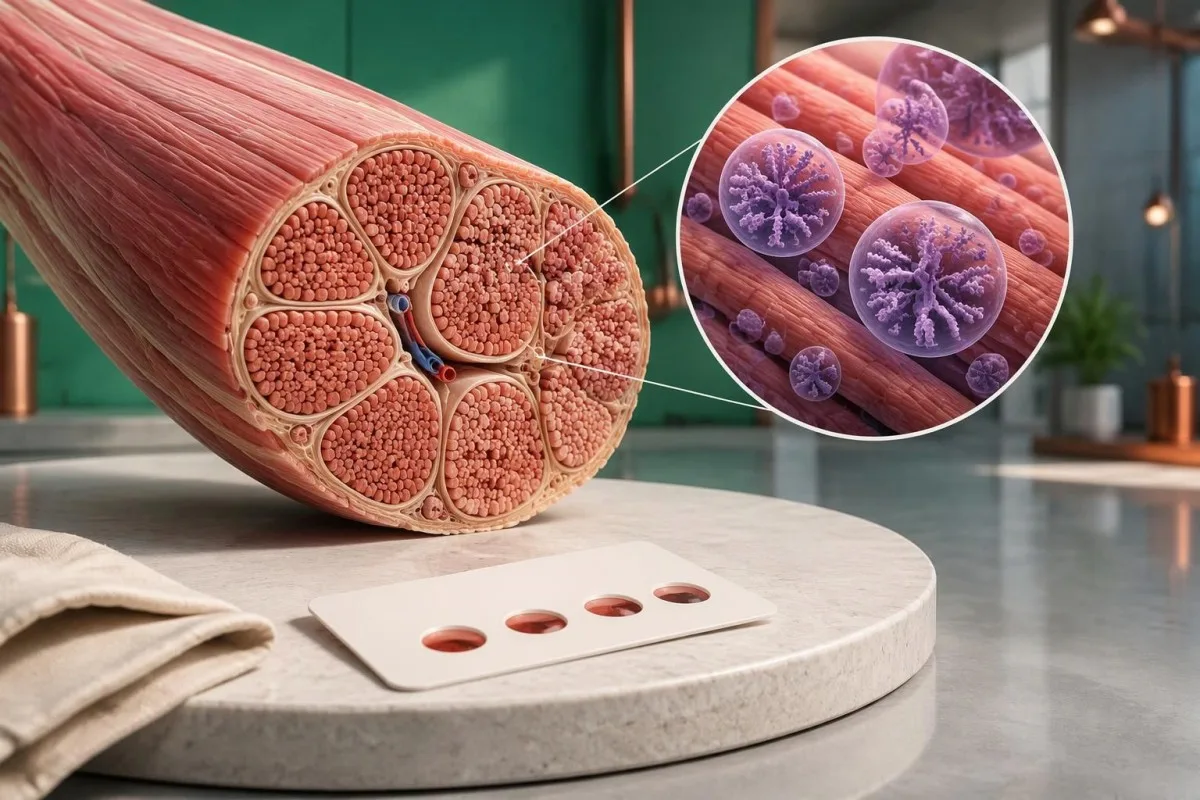
Нізкі вынік аналізу на фермент GAA выклікае падазрэнне на хваробу Помпе, але аднаго скрынінга недастаткова для пацвярджэння дыягназу. Паўторнае даследаванне адпаведнага ўзору і генетычны аналіз GAA дапамагаюць адрозніць сапраўдны дэфіцыт, статус носьбіта і псеўдадэфіцыт.

Асноўныя высновы
- Нізкая актыўнасць ферменту GAA — гэта сігнал для далейшага абследавання, а не дыягназ; 1 анамальны вынік аналізу сухой плямы крыві патрабуе пацвярджэння пад кіраўніцтвам спецыяліста.
- Рэферэнтныя дыяпазоны залежаць ад узору і метаду аналізу; nmol/h/mL нельга непасрэдна параўноўваць з nmol/h/mg protein.
- Рэшткавая актыўнасць ферменту пры класічнай інфантыльнай форме хваробы Помпе часта ніжэйшая за 1%, але гэты паказчык не з'яўляецца універсальным парогам скрынінга.
- Псеўдадэфіцыт можа зніжаць лабараторную актыўнасць GAA, не выклікаючы хваробу Помпе; паўторны аналіз тым жа метадам можа зноў даць нізкі вынік.
- Аналіз гена GAA шукае варыянты, якія выклікаюць захворванне і закранаюць абедзве копіі гена; для класіфікацыі і вызначэння фазы неабходна інтэрпрэтаваць 2 варыянты.
- Варыянты з нявызначаным значэннем не ўстанаўліваюць хваробу Помпе; 1 або 2 варыянты з нявызначаным клінічным значэннем патрабуюць дадатковых доказаў.
- Сямейная рызыка складае 25% для хворага дзіцяці пры кожнай цяжарнасці, калі абодва бацькі з’яўляюцца носьбітамі патагеннага варыянта GAA.
- Неадкладная ацэнка неабходная немаўляці з нізкай актыўнасцю GAA і цяжкасцямі з кармленнем, выяўленай слабасцю або падазрэннем на паражэнне сэрца; не чакайце планавага паўторнага аналізу.
Што насамрэч азначае нізкі вынік аналізу на фермент GAA?
A Тэст на хваробу Помпе паказвае, што нізкая актыўнасць GAA азначае, што лабараторыя выявіла зніжаную актыўнасць кіслай альфа-глюказідазы ва ўмовах свайго аналізу. Гэта не даказвае наяўнасць хваробы Помпе: 1 нізкі вынік скрынінгу можа сведчыць пра сапраўдны дэфіцыт, псеўдадэфіцыт, перакрыцце паказчыкаў у носьбітаў або праблему з узорам.

Актыўнасць GAA вымярае функцыю ферменту, а не проста колькасць бялку ферменту. Спачатку трэба праверыць 3 дэталі: тып узору, адзінкі вымярэння і парогавае значэнне лабараторыі; вынік, апісаны як нізкі без гэтых звестак, нельга надзейна інтэрпрэтаваць у параўнанні з лічбай, знойдзенай у інтэрнэце.
Прычына правядзення аналізу змяняе значэнне станоўчага выніку скрынінгу. У нованароджанага, выяўленага пры папуляцыйным скрынінгу, і 45-гадовага чалавека з прагрэсавальнай слабасцю ў вобласці сцёгнаў першапачатковая верагоднасць хваробы Помпе розная, нават калі паведамленыя значэнні ферменту супадаюць; таму сімптомы і вынікі агляду варта разглядаць разам з лабараторным вынікам.
Станоўчы вынік скрынінгу — гэта не тое самае, што пацверджаная хвароба. Калі 2 лабараторыі выкарыстоўваюць розныя субстраты або спосабы падрыхтоўкі ўзораў, іх лікавыя вынікі могуць адрознівацца, нават калі ніводная з лабараторый не дапусціла памылкі; удакладніце, ці прызначаны наступны візіт для паўторнага скрынінгавага вымярэння або для сапраўды пацвярджальнага аналізу актыўнасці ферменту.
Кантэсці — гэта Аналізатар крыві са штучным інтэлектам які можа дапамагчы ўпарадкаваць вынікі аналізу GAA разам са звычайнымі лабараторнымі паказчыкамі, але не можа ўстанавіць дыягназ хваробы Помпе на падставе 1 выніку з пазнакай аб адхіленні. Наша інфармацыя пра кампанію тлумачыць, як арганізавана гэтая служба; пры падазрэнні на спадчынны дэфіцыт ферменту ўсё роўна неабходна звярнуцца да спецыяліста па метабалічных або нервова-мышачных захворваннях.
Чаму дэфіцыт GAA выклікае праблемы з цягліцамі і сэрцам?
Хвароба Помпе ўзнікае праз дэфіцыт лізасомнай кіслай альфа-глюказідазы, ферменту, які расшчапляе глікаген унутры клеткавых адсекаў для перапрацоўкі рэчываў. GAA уздзейнічае на глюкозныя сувязі тыпаў альфа-1,4 і альфа-1,6; недастатковая актыўнасць прыводзіць да назапашвання глікагену, асабліва ў шкілетных цягліцах і сардэчнай мышцы.

Пры класічнай дзіцячай форме хваробы Помпе актыўнасць GAA у дыягнастычных узорах часта складае менш за 1% ад нормы. Пры позняй форме хваробы актыўнасць можа захоўвацца на больш высокім узроўні, часам прыкладна 2–40% у пэўных аналізах; гэтыя апісальныя дыяпазоны перакрываюцца з абмежаваннямі аналізаў і не павінны замяняць пацверджаную лабараторыяй дыягнастычную інтэрпрэтацыю.
Рэкамендацыі Kishnani et al. 2006 года, апублікаваныя ў Genetics in Medicine, апісваюць сувязь паміж дэфіцытам GAA, назапашваннем глікагену і ацэнкай розных сістэм арганізма. Клінічнае адрозненне вызначаецца не толькі тым, ці ніжэйшая актыўнасць за 1%: узрост пры з’яўленні сімптомаў, паказчыкі стану сэрца і функцыя дыхальных цягліц таксама дапамагаюць вызначыць форму і тэрміновасць захворвання.
Звычайны вынік аналізу на глюкозу не вымярае вывядзенне лізасомнага глікагену. Напрыклад, у ўмоўнага дарослага чалавека ўзровень глюкозы нашча можа складаць 92 mg/dL, хоць у яго ёсць спадчыннае парушэнне назапашвання глікагену ў цягліцах; нармальны ўзровень глюкозы не сведчыць пра тое, што глікаген унутры лізасом цягліц перапрацоўваецца нармальна.
Пры іншых лізасомных захворваннях задзейнічаны іншыя ферменты і гены, таму іх парогавыя значэнні нельга ўжываць для аналізу на хваробу Помпе. Наша тлумачэнне пацвярджэння хваробы Гашэ з дапамогай аналізу ферменту ілюструе больш агульную паслядоўнасць абследавання — ад аналізу ферменту да генетычнага даследавання, адначасова паказваючы, чаму аналіз ферменту на адно захворванне не можа замяніць аналіз на іншае.
Ці існуе норма актыўнасці ферменту GAA?
There is no single universal normal range for GAA enzyme activity. Dried blood spots, leukocytes and cultured fibroblasts use different preparations and reporting units; a number expressed in nmol/h/mL cannot be directly compared with a result expressed in nmol/h/mg protein.
A screening cutoff separates samples needing follow-up from samples passing that screen. It does not necessarily separate affected people from unaffected people with complete accuracy; laboratories may use different fluorometric or tandem mass spectrometry methods, and 2 screening programs may therefore select different recall thresholds.
For a clearly hypothetical example, suppose a laboratory uses a DBS screening cutoff of 1.5 nmol/h/mL and reports 0.7 nmol/h/mL. The result is below that invented laboratory threshold, but dividing 0.7 by 1.5 gives 47% of the cutoff—not 47% of normal enzyme activity and not a severity score.
The lower limit of detection is different from the clinical cutoff. A report reading less than 0.1 in its stated units may mean the method cannot quantify lower activity reliably; it does not prove absolute absence of enzyme, and repeating measurements close to that analytical floor may produce proportionally large variation.
Screening performance also depends on prevalence. In a hypothetical group with 10 true-positive and 100 false-positive results, only about 9% of positive screens represent disease; those invented counts are not Pompe screening statistics, but explain why якасныя і колькасныя вынікі require different interpretation.
| Узровень | Дыяпазон | Што гэта значыць |
|---|---|---|
| Passes hypothetical screen | ≥1.5 nmol/h/mL | Illustrative DBS cutoff only; not a universal normal range and not an absolute exclusion in a symptomatic person. |
| Below hypothetical cutoff | <1.5 nmol/h/mL | Illustrative follow-up threshold only; true deficiency, pseudodeficiency and specimen effects still need separation. |
Навошта паўтараць аналіз GAA з іншага ўзору?
Repeat GAA testing checks whether low activity is reproducible and whether specimen quality or assay interference explains it. Confirmation usually moves beyond 1 screening card to a fresh, appropriately handled specimen, often with GAA measurement in leukocytes or another specialist-selected cell preparation.

Heat, humidity and inadequate drying can reduce enzyme activity in a dried blood spot. A low result after 2 days of poorly controlled transport may deserve a fresh collection, but transport history cannot be used to dismiss a result automatically; the laboratory should assess card quality and its stability requirements.
Acarbose is used in some GAA assay methods to suppress interfering maltase-glucoamylase activity. That interference can make measured activity appear higher and potentially obscure deficiency; checking how a laboratory isolates GAA activity can therefore matter more than obtaining a second number with the same unresolved methodological limitation.
Two low DBS results still do not automatically confirm Pompe disease. Pseudodeficiency can reproduce across repeated measurements, including some confirmatory methods; when enzyme and genetic findings disagree, a specialist laboratory may recommend cultured fibroblast testing or additional molecular investigation rather than simply ordering a third screening card.
Give the laboratory the dates of collection, recent transfusions or transplantation, and any enzyme replacement treatment already received. Our guide to уплыў якасці ўзору на вынікі аналізаў explains the general distinction between biological findings and specimen problems; GAA testing has its own handling rules, so do not import another test's redraw interval.
Чым псеўдадэфіцыт GAA адрозніваецца ад хваробы Помпе?
GAA pseudodeficiency means an inherited variant lowers measured enzyme activity without causing the glycogen-storage disorder Pompe disease. Two commonly discussed variants are c.1726G>A, p.Gly576Ser, and c.2065G>A, p.Glu689Lys; their interpretation depends on the complete genotype and the assay used.
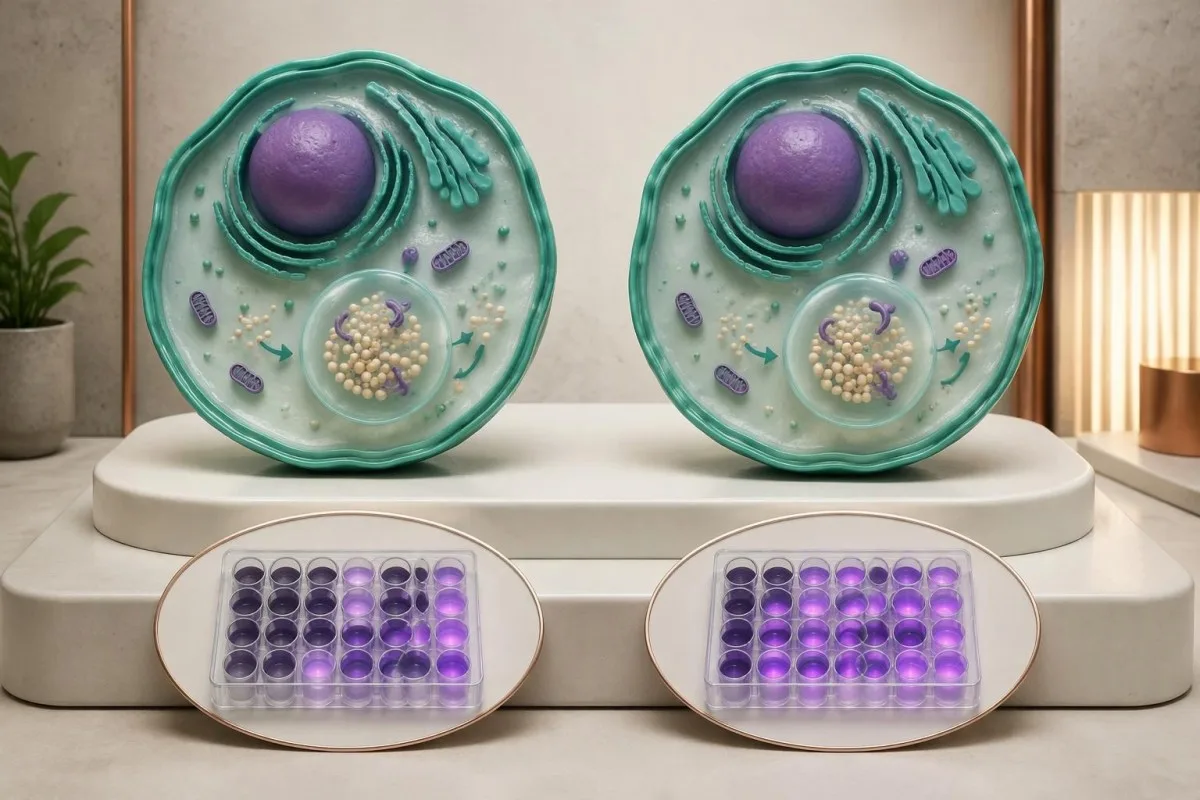
Pseudodeficiency is a biochemical testing issue, not an early stage of Pompe disease. A person with only pseudodeficiency variants does not need Pompe treatment because of 1 low activity result; the specialist must first verify that disease-causing variants or another explanation have not been missed.
The p.Gly576Ser and p.Glu689Lys variants are often found together on 1 gene copy and are particularly relevant in some East Asian ancestry populations. Ancestry changes how often laboratories encounter this pattern, but cannot establish or exclude pseudodeficiency in an individual; people from other backgrounds can carry these variants too.
Pseudodeficiency can remain low on repeat enzyme testing. The practical distinction is whether the complete biochemical and genetic evidence supports disease-causing GAA deficiency, not whether a second result falls below an arbitrary percentage; specialists may compare different assay substrates or cell preparations when the pattern remains ambiguous.
Pseudodeficiency variants can also coexist with a disease-causing variant, making a short report misleading if it lists everything under mutations. Our Fabry enzyme and genetics guide shows another situation where enzyme results need genetic context, although Fabry's X-linked inheritance differs from Pompe's 2-copy recessive mechanism.
Што трэба шукаць пры аналізе гена GAA?
GAA gene testing investigates whether disease-causing variants affect both copies of the GAA gene. Pompe disease is autosomal recessive, and the GAA gene is located on chromosome 17; interpretation requires variant classification, adequate test coverage and, when needed, confirmation that variants affect opposite gene copies.
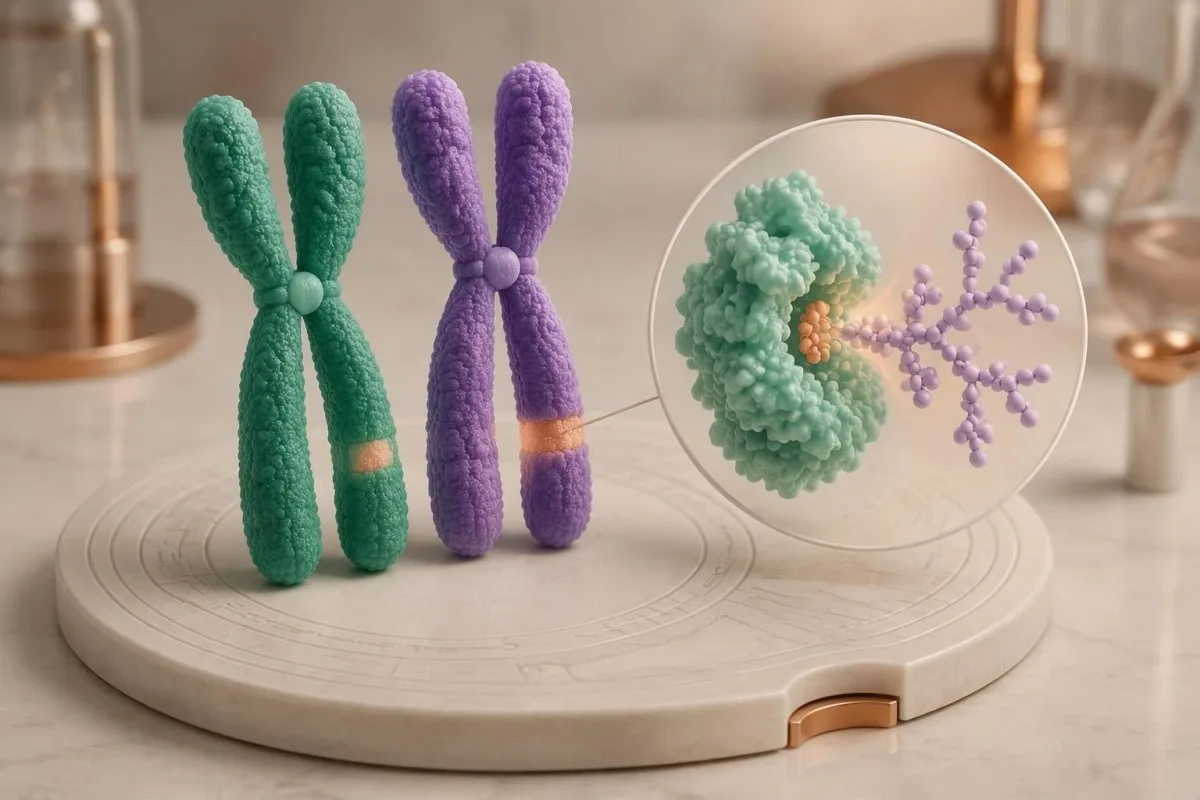
Two pathogenic or likely pathogenic GAA variants in trans support molecular confirmation of Pompe disease. In trans means the variants affect opposite gene copies; 2 variants in cis affect the same copy and do not, by themselves, demonstrate a recessive disease genotype.
Standard sequencing detects many small substitutions and insertions or deletions, but does not answer every possible genetic question. If only 1 disease-causing variant is found despite convincing enzyme deficiency, ask whether deletion/duplication analysis was included and whether poorly covered or deep intronic regions require further investigation.
A common later-onset-associated GAA variant is c.-32-13T>G, which affects splicing. Finding this variant on 1 copy does not diagnose Pompe disease, and finding it with another disease-causing variant does not precisely predict the age symptoms will begin; residual splicing and other biological factors influence presentation.
Parental testing can help establish phase when a laboratory detects 2 different variants but cannot determine their arrangement. Our guide to inherited disease genetic reports explains why inheritance and family testing matter, while the actual gene coverage and diagnostic criteria must remain specific to GAA.
Як інтэрпрэтаваць патагенныя, нявызначаныя і адмоўныя вынікі?
A pathogenic result, a variant of uncertain significance and a negative result have different diagnostic meanings. Genetic laboratories commonly use 5 categories: pathogenic, likely pathogenic, uncertain significance, likely benign and benign; a VUS is not equivalent to a disease-causing GAA variant.
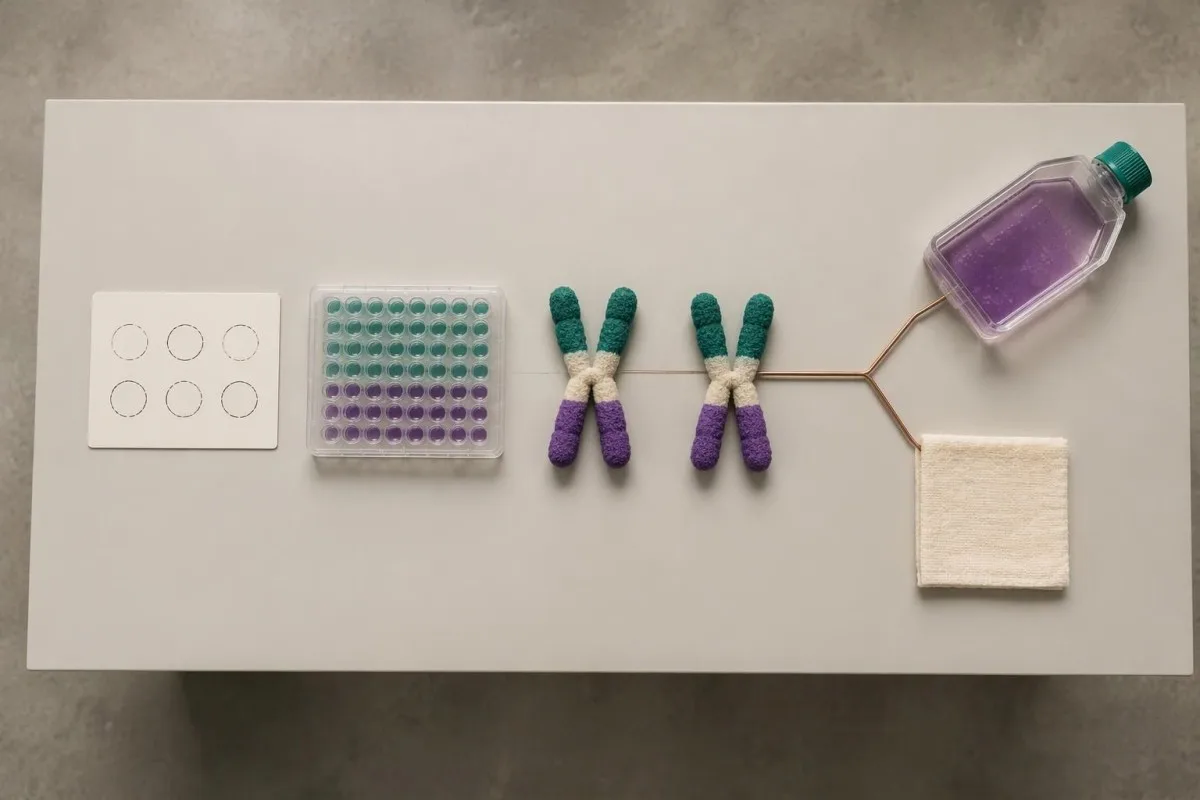
Richards et al.'s 2015 ACMG/AMP consensus established the widely used 5-category sequence-variant framework and states that a VUS should not guide clinical decision-making as though pathogenic. For Pompe evaluation, low enzyme activity can contribute evidence, but its value depends on whether pseudodeficiency and assay limitations have been addressed.
One pathogenic variant plus 1 VUS is an unresolved combination, not automatic confirmation or exclusion. Depending on the enzyme and clinical findings, specialists may investigate family segregation, RNA effects or variant-specific functional evidence; a diagnostic enzyme result may support disease even while the second molecular finding remains incompletely characterized.
A negative sequencing report means the test found no reportable variants within its scope. It does not prove that every GAA-related mechanism was examined; 1 negative limited test may warrant expanded testing when properly performed enzyme studies and the clinical pattern remain strongly suggestive.
Кантэсці — гэта Платформа AI для расшыфроўкі аналізу крыві that can help separate a report's 5 classification terms from its numerical enzyme findings, without adjudicating an uncertain genotype. Our тэхнічныя і клінічныя стандарты describe interpretation boundaries; our uncertain gene-result explanation provides a related example of why variants and diagnoses are not interchangeable.
Ці азначае адзін варыянт GAA статус носьбіта або захворванне?
One confirmed disease-causing GAA variant usually indicates carrier status if a second disease-causing variant and diagnostic enzyme deficiency are absent. Carriers do not typically develop Pompe disease; when both parents are carriers, each pregnancy has a 25% affected, 50% carrier and 25% non-carrier probability.
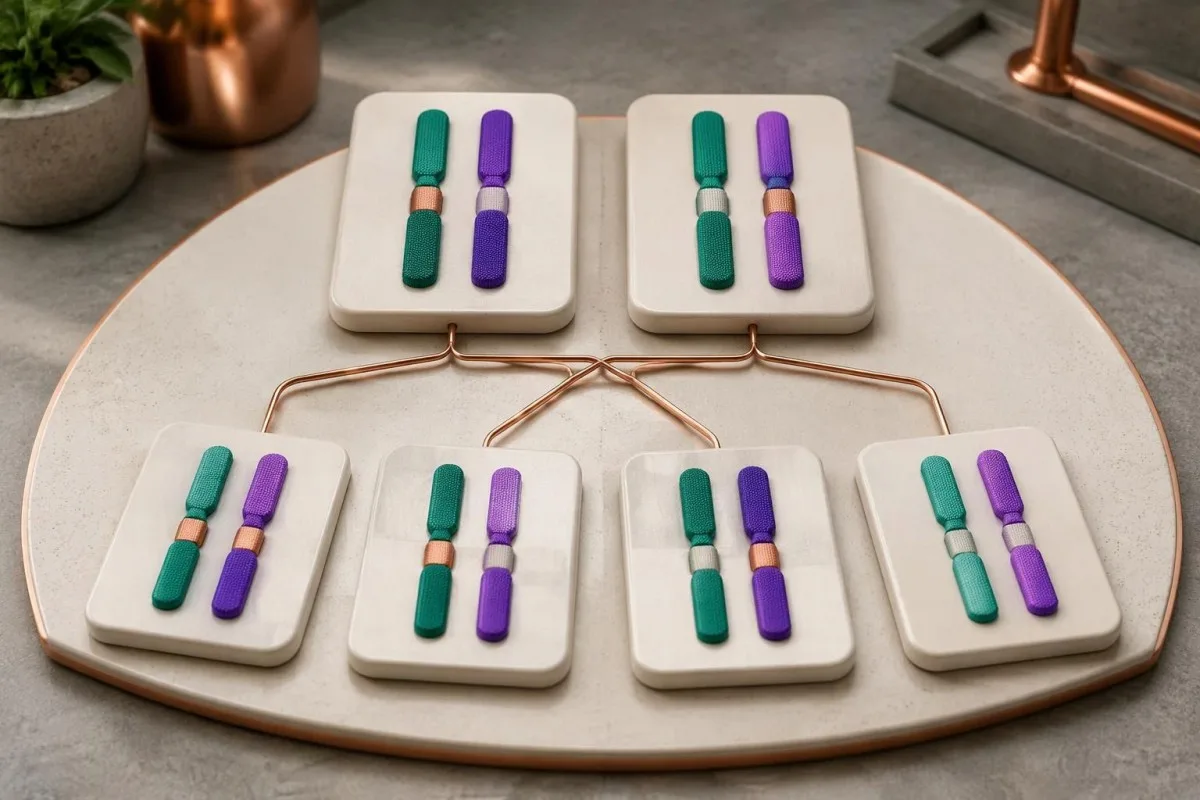
Carrier enzyme values can overlap with values in unaffected people. GAA activity is therefore not a reliable standalone carrier test, and a carrier's activity should not be assumed to equal exactly 50% of a laboratory's normal mean; targeted genetic testing is generally more informative when a familial variant is known.
The 25% affected-child probability applies independently to each pregnancy when both parents carry disease-causing variants capable of producing Pompe disease together. Having 1 unaffected child does not reduce the next pregnancy's Mendelian probability, and pseudodeficiency variants should not be substituted for pathogenic variants in that calculation.
Family testing is most useful after the affected person's variants are clarified. If a symptomatic adult has only 1 identified pathogenic variant, relatives should not be reassured that the entire family question is settled until the specialist considers whether the second variant was missed by the original assay.
For a hypothetical couple, one partner carrying a pathogenic GAA variant and the other carrying only a pseudodeficiency variant does not create the same 25% Pompe risk as 2 pathogenic-variant carriers. Our carrier screening limitations guide explains why a report's coverage and residual risk deserve discussion before reproductive decisions.
Якія іншыя вынікі лабараторных аналізаў дапамагаюць пры абследаванні на хваробу Помпе?
Creatine kinase, AST, ALT and urinary glucose tetrasaccharide can support Pompe evaluation, but none confirms the diagnosis alone. Urinary glucose tetrasaccharide may be reported as Glc4 or within a Hex4 assay; these 2 report terms require method-specific interpretation rather than assumption that every laboratory measures exactly the same thing.
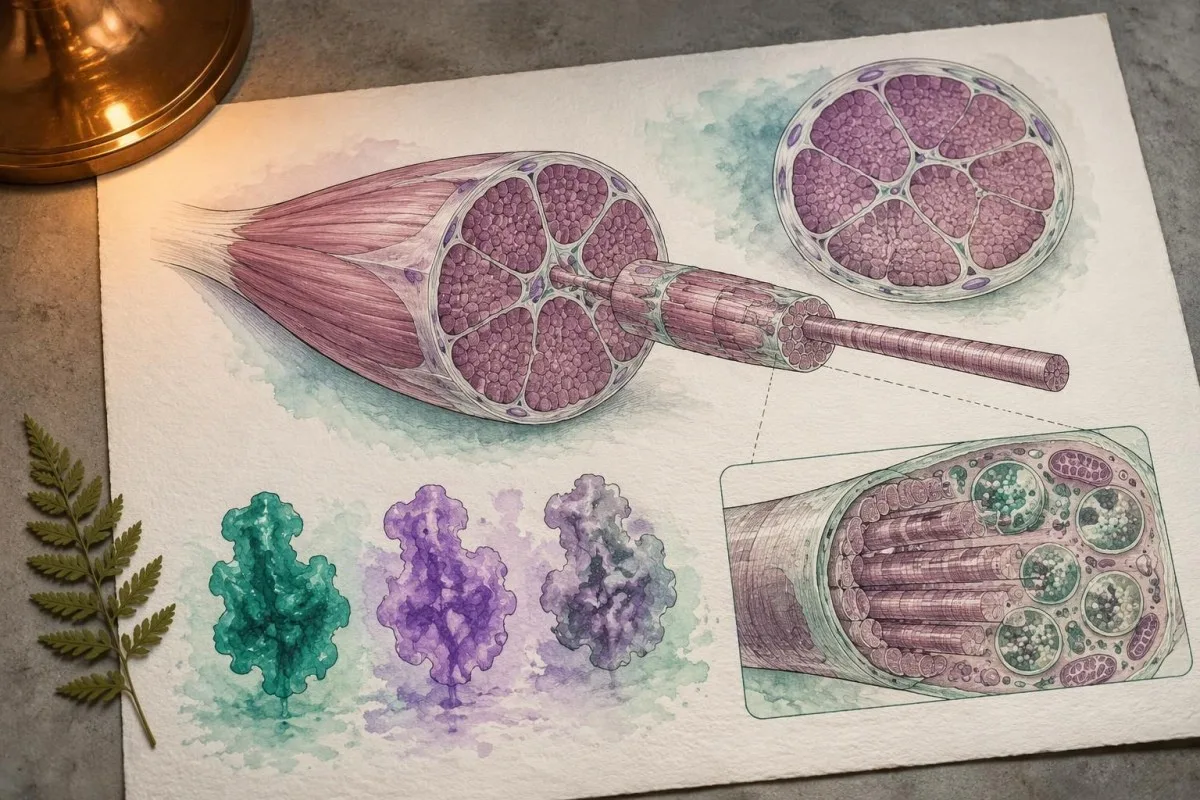
Normal CK does not exclude later-onset Pompe disease. In a hypothetical adult with progressive difficulty rising from a chair, CK of 140 U/L may fall within that laboratory's interval despite clinically meaningful weakness; the combination of symptoms and low confirmed GAA activity matters more than a reassuring CK flag.
AST and ALT can rise because of muscle involvement, not only liver disease. A hypothetical AST of 86 U/L with elevated CK and muscle weakness deserves a muscle-aware assessment; our aldolase and muscle marker guide explains why additional muscle enzymes may help characterize the pattern without identifying its cause.
Urinary Glc4 is a supportive glycogen-related biomarker, not a Pompe-specific diagnostic test. Reference limits vary with age and method, and elevation can occur in other circumstances; 1 elevated result should be interpreted alongside enzyme findings, genetics and the laboratory's creatinine-normalized units.
A falling CK or Glc4 after treatment does not automatically prove that strength or breathing has improved by the same percentage. Our discussion of AST interpretation beyond liver disease illustrates why 2 related markers can move together while still answering different questions about tissue injury and function.
Навошта правяраць дыханне, калі вынік аналізу на хваробу Помпе анамальны?
Pompe disease can weaken the diaphragm and other respiratory muscles, sometimes before obvious walking difficulty. Assessment may include seated and supine forced vital capacity, respiratory muscle pressures and sleep-related testing; a daytime oxygen saturation of 97% does not rule out overnight hypoventilation.
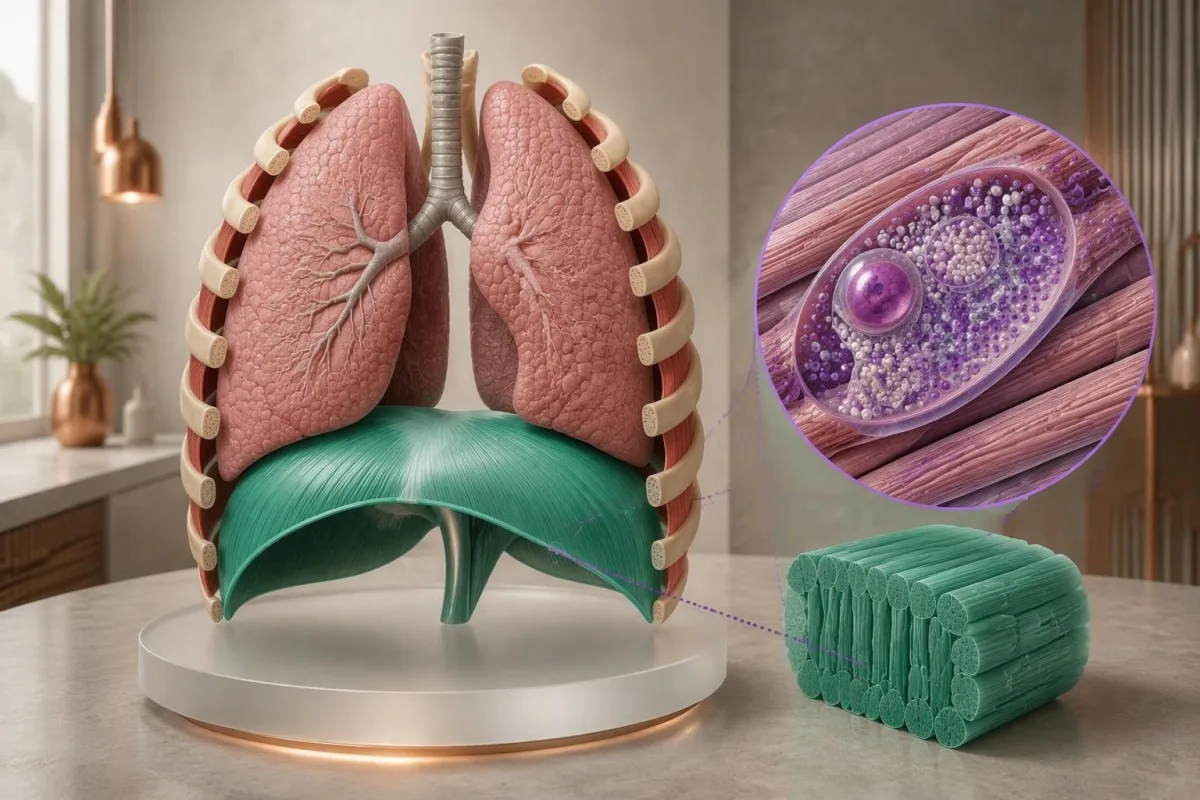
A position-related fall in vital capacity can suggest diaphragm weakness. For example, a hypothetical seated FVC of 3.0 L and supine FVC of 2.4 L represents a 20% decline; the specialist interprets that difference with technique, predicted values and symptoms, rather than treating it as a Pompe-specific cutoff.
Morning headaches, unrefreshing sleep and difficulty breathing when lying flat can justify evaluation for sleep-related hypoventilation. These symptoms do not identify Pompe disease on their own; our кіраўніцтва па тэсціраванні на дыхавіцу explains why laboratory results cannot replace respiratory examination and physiological testing.
Arterial carbon dioxide is normally about 35–45 mmHg in adults, with context-dependent variation. A value above 45 mmHg indicates hypercapnia, but its urgency depends on pH, symptoms and the clinical setting; our blood gas interpretation guide explains why oxygen and carbon dioxide answer different questions.
Severe breathlessness, confusion, blue coloration or rapidly worsening weakness warrants emergency care, not an online interpretation session. A confirmed molecular result affecting 2 GAA copies does not measure current respiratory safety; clinicians need direct functional assessment to decide whether ventilation support or urgent monitoring is necessary.
Што адбываецца пасля станоўчага скрынінга нованароджанага на хваробу Помпе?
A positive newborn Pompe screen requires prompt specialist assessment, confirmatory enzyme testing and genetic evaluation. It does not mean every infant has Pompe disease; the immediate task is to distinguish pseudodeficiency or carrier findings from infantile disease and a later-onset-associated genotype affecting both GAA copies.

Burton et al.'s 2017 Pediatrics newborn-screening algorithms describe an initial evaluation integrating GAA confirmation, molecular testing and clinical assessment. If an infant has feeding difficulty, marked hypotonia or suspected cardiomyopathy, do not wait 2 weeks for a routine repeat appointment; the screening team should arrange urgent metabolic and cardiac evaluation.
Classic infantile Pompe disease commonly involves hypertrophic cardiomyopathy. A newborn's echocardiogram and electrocardiogram help assess risk that cannot be estimated from 1 enzyme number; absence of obvious heart symptoms at home does not replace the specialist examination after an abnormal screen.
CRIM status concerns whether cross-reactive GAA protein is present and helps specialists plan immune-risk management around enzyme replacement therapy. Less than 1% enzyme activity does not by itself establish CRIM-negative status, because an inactive protein may still be present; this is a protein-expression question, not just an activity threshold.
Later-onset-associated findings in a newborn require a monitoring plan, not an invented age-of-onset prediction. Even 2 classified disease-causing variants may not reveal when symptoms will emerge; our рэкамендацыі па бяспечным выкарыстанні ШІ ў педыятрыі explains why pediatric results require age-specific context and clinician-led decisions.
Як спецыялісты высвятляюць прычыны супярэчлівых вынікаў аналізаў у дарослых?
Conflicting adult Pompe results are resolved by checking specimen quality, confirmatory enzyme methods, variant classification and clinical fit. One low screen plus 1 genetic finding rarely tells the whole story; specialists investigate whether the apparent conflict comes from pseudodeficiency, an incomplete molecular test or another cause of weakness.

Consider a hypothetical 52-year-old with mild fatigue, low DBS GAA activity and only the 2 commonly discussed pseudodeficiency variants. If specialist testing supports pseudodeficiency and no disease-causing genotype, the low screen does not explain the fatigue; other causes should be assessed rather than attaching a Pompe label to an incidental biochemical finding.
A second hypothetical adult has progressive hip weakness, a 20% positional FVC decline, confirmed cellular GAA deficiency and 2 pathogenic variants in trans. Together, those findings support Pompe disease; a normal routine glucose or modest CK result would not outweigh the converging biochemical, genetic and functional evidence.
Convincing enzyme deficiency with only 1 identified pathogenic variant deserves further investigation. The appropriate next step may be deletion/duplication analysis, RNA studies or another specialist assay—not automatically calling the person a carrier; the investigation should also check whether non-Pompe neuromuscular conditions better explain the examination.
Variant-related disease monitoring is not the same as predicting a person's future from their DNA. Our inherited neuromuscular risk guide offers a related family-testing perspective, but 2 conditions can differ substantially in inheritance, penetrance and treatment triggers.
Што ўзяць з сабой на прыём да спецыяліста па хваробе Помпе?
Bring the complete enzyme report, complete genetic report and a dated symptom history to a Pompe specialist appointment. Three report details are especially useful: specimen type, assay units and variant classification; screenshots showing only a red flag or the word mutation can omit information that changes the interpretation.

Ask whether confirmatory testing has already been completed and whether the laboratory measured GAA specifically in an appropriate cell preparation. If 2 variants were found, ask whether they are in trans; if only 1 was found, ask what variant types and regions the test could detect.
Do not try to raise GAA activity with supplements or diet before confirmation. No vitamin or food corrects inherited pathogenic variants affecting both GAA copies; nutrition may support general care after diagnosis, but cannot substitute for enzyme confirmation or specialist treatment planning.
Кантэсці — гэта Інструмент аналізу вынікаў аналізу крыві з падтрымкай AI that can help organize report terminology and associated laboratory trends, not decide whether 2 uncertain variants establish Pompe disease. Our кіраўніцтва па праверцы крыніцы заключэння explains why the original document remains the reference when an automated explanation and a specialist interpretation differ.
Genetic documents can contain information relevant to relatives as well as the tested person. Before sharing 1 family member's report, check consent and remove unnecessary identifiers; Kantesti's інфармацыю пра прыватнасць і даныя describes our handling approach, while sharing results with relatives should follow a genetic counselor's guidance.
Навуковыя публікацыі і абмежаванні інтэрпрэтацыі аналізаў на хваробу Помпе
Pompe test interpretation rests on disease-specific enzyme, genetic and clinical evidence—not on general laboratory publications or an AI explanation. Kantesti includes 3 directly relevant external sources below and 2 separate educational publications; the iron and coagulation publications are not evidence for diagnosing Pompe disease.
The 2006 Kishnani guideline provides disease-specific diagnostic and management context, while the 2017 Burton newborn-screening paper addresses confirmation after population screening. Their recommendations should be applied with the specialist laboratory's validated methods; neither supplies 1 universally transferable DBS enzyme cutoff for every instrument and population.
Richards et al.'s 2015 ACMG/AMP publication explains the 5-category variant framework used to distinguish pathogenic findings from uncertainty. Classification can change when new evidence becomes available, so ask the genetics service whether an unresolved result has a reanalysis pathway rather than assuming every VUS will eventually become pathogenic.
Наш адукацыйны публікацыя па даследаваннях жалеза addresses a different laboratory domain. The separate публікацыя пра даследаванне згусальнасці крыві also covers unrelated markers; their 2 DOI records are provided for publication transparency, not as supporting citations for GAA deficiency or pseudodeficiency.
матэрыялы Kantesti стандарты медыцынскага кантэнту distinguish patient education from diagnosis and treatment instructions. The practical endpoint is a documented interpretation of 3 evidence streams—enzyme testing, genetic analysis and clinical assessment—with urgent care taking priority whenever infantile disease or respiratory compromise is suspected.
Часта задаваныя пытанні
Ці заўсёды нізкая актыўнасць фермента GAA азначае хваробу Помпе?
Нізкая актыўнасць фермента GAA не заўсёды азначае хваробу Помпе. Адзін анамальны вынік скрынінгу можа сведчыць пра сапраўдны дэфіцыт, псеўдадэфіцыт, дэградацыю ўзору або перакрыцце з актыўнасцю, звязанай з носьбітствам. Для пацвярджэння патрэбна інтэрпрэтацыя спецыялістам адпаведнага аналізу актыўнасці фермента, генетычных вынікаў па GAA і клінічнага кантэксту. Паўторнае правядзенне толькі таго ж скрынінгавага аналізу можа зноў выявіць псеўдадэфіцыт, а не развязаць праблему.
Які нармальны ўзровень ферменту GAA?
There is no universal normal GAA enzyme level because specimen preparation, assay substrate and reporting units differ between laboratories. A value in nmol/h/mL cannot be directly compared with a value in nmol/h/mg protein. Classic infantile Pompe disease often has less than 1% of normal activity in diagnostic tissue assays, but this is not a universal newborn-screening cutoff. Use the reference information printed on the original report and the specialist laboratory's interpretation.
Ці могуць два нізкія вынікі аналізаў на GAA усё яшчэ быць вынікам псеўдадэфіцыту?
Два нізкія вынікі аналізаў на GAA усё яшчэ могуць сведчыць пра псідадэфіцыт, асабліва калі выкарыстоўваюцца аднолькавыя або падобныя метады аналізу. Варыянты псідадэфіцыту зніжаюць вымераную актыўнасць, але самі па сабе не выклікаюць хваробу назапашвання глікагену Помпе. Спецыялісты адрозніваюць гэтую карціну, улічваючы поўны генатып GAA, характарыстыкі аналізу і, калі неабходна, іншы клетачны матэрыял або функцыянальнае даследаванне. Таму два паўторна атрыманыя нізкія значэнні не раўназначныя двум незалежным пацвярджэнням захворвання.
Ці пацвярджаюць два варыянты гена GAA хваробу Помпе?
Два варыянты GAA не пацвярджаюць аўтаматычна хваробу Помпе. Два патагенныя або верагодна патагенныя варыянты ў транс, якія закранаюць розныя копіі гена, пацвярджаюць малекулярнае пацвярджэнне дыягназу, тады як два варыянты ў цыс закранаюць толькі адну копію. Варыянты нявызначанага значэння і варыянты псеўдадэфіцыту нельга лічыць усталяванымі прычынамі захворвання. Даныя аб актыўнасці фермента і клінічныя даныя застаюцца асабліва карыснымі, калі класіфікацыя або фаза не вызначаны.
Ці можа нармальны ўзровень КК выключыць познаманіфестную хваробу Помпе?
Normal CK cannot rule out late-onset Pompe disease. A hypothetical CK of 140 U/L may fall within a laboratory's reference interval despite progressive proximal weakness or diaphragm involvement. CK measures muscle injury-related enzyme release, not lysosomal GAA function. Persistent compatible symptoms deserve specialist assessment even when routine muscle markers are reassuring.
Наколькі тэрмінова трэба рэагаваць на станоўчы вынік аналізу нованароджанага на хваробу Помпе?
Пры станоўчым выніку скрынінга нованароджанага на хваробу Помпе трэба неадкладна звязацца са службай скрынінгу або камандай па метабалічных захворваннях, а немаўля з цяжкасцямі пры кармленні, выяўленай гіпатаніяй або падазрэннем на паражэнне сэрца патрабуе тэрміновага абследавання. Адна станоўчая карта скрынінгу не пацвярджае дыягназ, але пры падазрэнні на класічную інфантыльную форму захворвання нельга чакаць звычайнага прыёму праз некалькі тыдняў. Спецыялісты арганізуюць пацвярджальнае даследаванне актыўнасці ферментаў, генетычнае абследаванне і ацэнку стану сэрца, часта паралельна. Пры цяжкіх парушэннях дыхання або зніжэнні ўзроўню рэакцыі патрэбна экстраная дапамога.
Якая рызыка для дзяцей, калі абодва бацькі з’яўляюцца носьбітамі хваробы Помпе?
Калі абодва бацькі з'яўляюцца носьбітамі патагенных варыянтаў GAA, у кожнай цяжарнасці верагоднасць нараджэння дзіцяці з захворваннем складае 25%, дзіцяці-носьбіта — 50%, а дзіцяці, які не атрымае ў спадчыну ніводнага сямейнага варыянта, — 25%. Гэтыя верагоднасці дзейнічаюць незалежна для кожнай цяжарнасці. Варыянты псеўдадэфіцыту нельга лічыць узаемазаменнымі з патагеннымі варыянтамі ў гэтым разліку. Генетычнае кансультаванне дапамагае пацвердзіць вынікі абследавання бацькоў і растлумачыць магчымасці тэставання.
Атрымайце тлумачэнне вынікаў аналізу крыві
Загрузіце свой лабараторны справаздачу, і AI Kantesti за некалькі секунд простай мовай растлумачыць кожны біямаркер. Ім карыстаюцца больш за 2 мільёны чалавек па ўсім свеце.
Спасылкі
- Кляйн, Т., Мітчэл, С., і Вебер, Х. (2026). Даведнік па даследаванні абмену жалеза: агульная жалезазвязвальная здольнасць, насычэнне жалезам і звязвальная здольнасць. Kantesti AI Medical Research. DOI
- Кляйн, Т., Мітчэл, С., і Вебер, Х. (2026). Норма aPTT: кіраўніцтва па D-Dimer і Protein C для ацэнкі згусальнасці крыві. Kantesti AI Medical Research. DOI
- Kishnani PS et al. (2006). Pompe disease diagnosis and management guideline. Генетыка ў медыцыне. DOI PubMed
- Burton BK et al. (2017). The Initial Evaluation of Patients After Positive Newborn Screening: Recommended Algorithms Leading to a Confirmed Diagnosis of Pompe Disease. Pediatrics. DOI
- Richards S et al. (2015). Стандарты і рэкамендацыі па інтэрпрэтацыі варыянтаў паслядоўнасці: сумесная кансенсусная рэкамендацыя Амерыканскай калегіі медыцынскай генетыкі і геномікі і Асацыяцыі малекулярнай паталогіі. Генетыка ў медыцыне. DOI PubMed
- 2 млн+Прааналізаваныя тэсты
- 127+Краіны
- 100+Мовы
Пра медыцынскую каманду


Сігналы даверу E-E-A-T
Вопыт
Клінічны агляд, які вядзе лекар, працэсаў інтэрпрэтацыі лабараторных паказчыкаў.
Экспертыза
Фокус лабараторнай медыцыны на тым, як біямаркеры паводзяць сябе ў клінічным кантэксце.
Аўтарытэтнасць
Медыцынскую рэцэнзію правёў доктар Томас Кляйн пры ўдзеле доктара Сары Мітчэл і прафесара, доктара Ганса Вэбера.
Надзейнасць
Інтэрпрэтацыя на аснове доказаў з выразнымі шляхамі далейшых дзеянняў, каб паменшыць трывогу.






Медыцынская адмова ад адказнасці
Гэты артыкул прызначаны толькі для адукацыйных мэт і не з’яўляецца медычнай парадай. Заўсёды кансультуйцеся з кваліфікаваным спецыялістам аховы здароўя для прыняцця рашэнняў па дыягностыцы і лячэнні.
Апублікавана · Звязацца з рэдакцыйнай камандай
Апублікавана кампаніяй Kantesti Ltd, зарэгістраванай у Англіі і Уэльсе, нумар кампаніі. 17090423, Лондан, Злучанае Каралеўства.
