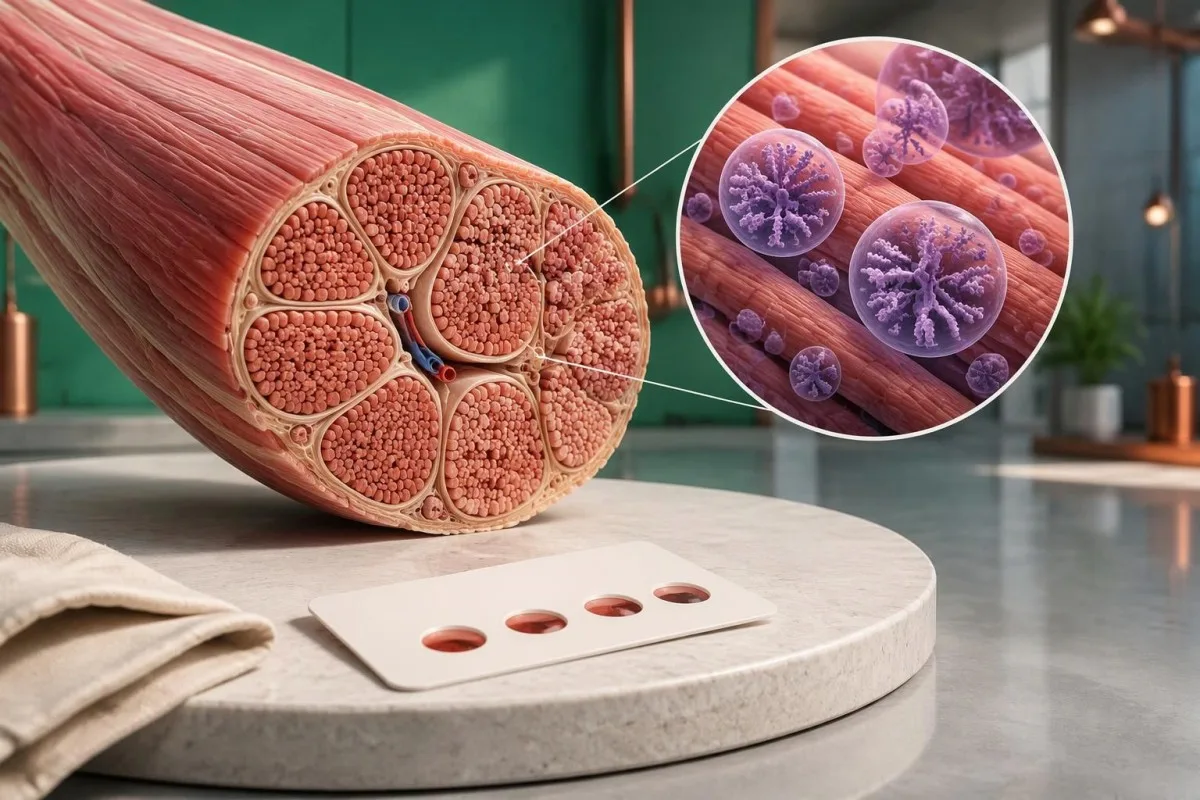
Mažas GAA fermento rodiklis kelia įtarimą dėl Pompe ligos, tačiau vien atrankinis tyrimas jos patvirtinti negali. Pakartotinis tyrimas su tinkamu mėginiu ir GAA genetinė analizė padeda atskirti tikrąjį fermento trūkumą, nešiotojo būklę ir pseudotrūkumą.

Svarbiausios išvados
- Mažas GAA fermento aktyvumas yra signalas atlikti tolesnius tyrimus, o ne diagnozė; 1 nenormalų išdžiovinto kraujo lašo tyrimo rezultatą turi patvirtinti specialisto nurodyti tyrimai.
- Etaloniniai intervalai priklauso nuo mėginio ir tyrimo metodo; nmol/h/mL negalima tiesiogiai lyginti su nmol/h/mg baltymo.
- Liekamasis fermento aktyvumas sergant klasikine kūdikių Pompe liga dažnai nesiekia 1%, tačiau šis skaičius nėra universalus atrankinio tyrimo ribinis dydis.
- Pseudotrūkumas gali sumažinti laboratorijoje nustatomą GAA aktyvumą nesukeldamas Pompe ligos; pakartojus tą patį tyrimą, mažas rezultatas gali pasikartoti.
- GAA geno tyrimas ieško ligą sukeliančių variantų, veikiančių abi geno kopijas; klasifikuojant ir nustatant fazę reikia įvertinti 2 variantus.
- Neaiškios reikšmės variantai nepatvirtina Pompe ligos; 1 arba 2 neaiškios reikšmės variantams reikia papildomų įrodymų.
- Rizika šeimai yra 25% kiekvieno nėštumo metu susilaukti sergančio vaiko, kai abu tėvai turi ligą sukeliantį GAA variantą.
- Skubus įvertinimas būtina kūdikiui, kurio GAA aktyvumas mažas, be to, jam sunku maitintis, pasireiškia ryškus silpnumas arba įtariamas širdies pažeidimas; nelaukite įprastinio pakartotinio tyrimo.
Ką iš tiesų reiškia mažas GAA fermento rodiklis?
A Pompe ligos tyrimas rodo, kad esant mažam GAA aktyvumui laboratorija savo tyrimo sąlygomis nustatė sumažėjusią rūgštinės alfa gliukozidazės funkciją. Tai nepatvirtina Pompe ligos: 1 mažas atrankinio tyrimo rezultatas gali rodyti tikrą fermento trūkumą, pseudotrūkumą, nešiotojo būklės sąlygotą rezultatų persidengimą arba mėginio problemą.

GAA aktyvumo tyrimu vertinama fermento funkcija, o ne vien tai, kiek fermento baltymo yra. Pirmiausia reikia patikrinti 3 dalykus: mėginio tipą, matavimo vienetus ir laboratorijos sprendimo ribą; rezultato, apibūdinto kaip mažas, neįmanoma patikimai įvertinti pagal internete rastą skaičių, jei šių duomenų nėra.
Tyrimo priežastis keičia teigiamo atrankinio tyrimo rezultato reikšmę. Naujagimio, nustatyto atliekant visuotinę patikrą, ir 45 metų asmens, kuriam progresuoja klubų raumenų silpnumas, pradinė Pompe ligos tikimybė skiriasi, net jei nurodytos fermento vertės sutampa; todėl kartu su laboratorinio tyrimo rezultatu reikia vertinti simptomus ir apžiūros duomenis.
Teigiamas atrankinio tyrimo rezultatas nereiškia, kad liga patvirtinta. Jei 2 laboratorijos naudoja skirtingus substratus arba mėginių paruošimo metodus, jų skaitiniai rezultatai gali skirtis, nors nė viena laboratorija nepadarė klaidos; pasiteiraukite, ar kitas vizitas skirtas dar vienam atrankiniam matavimui, ar tikrai patvirtinamajam fermento tyrimui.
Kantesti yra AI kraujo tyrimo analizatorius kuris gali padėti susisteminti GAA tyrimo ataskaitą kartu su įprastų laboratorinių tyrimų duomenimis, tačiau pagal 1 pažymėtą rezultatą Pompe ligos diagnozės patvirtinti negali. Mūsų įmonės informacija paaiškinama, kaip organizuojama paslauga; įtarus paveldimą fermento trūkumą, vis tiek būtina kreiptis į metabolinių ligų arba nervų ir raumenų ligų specialistą.
Kodėl GAA trūkumas sukelia raumenų ir širdies sutrikimų?
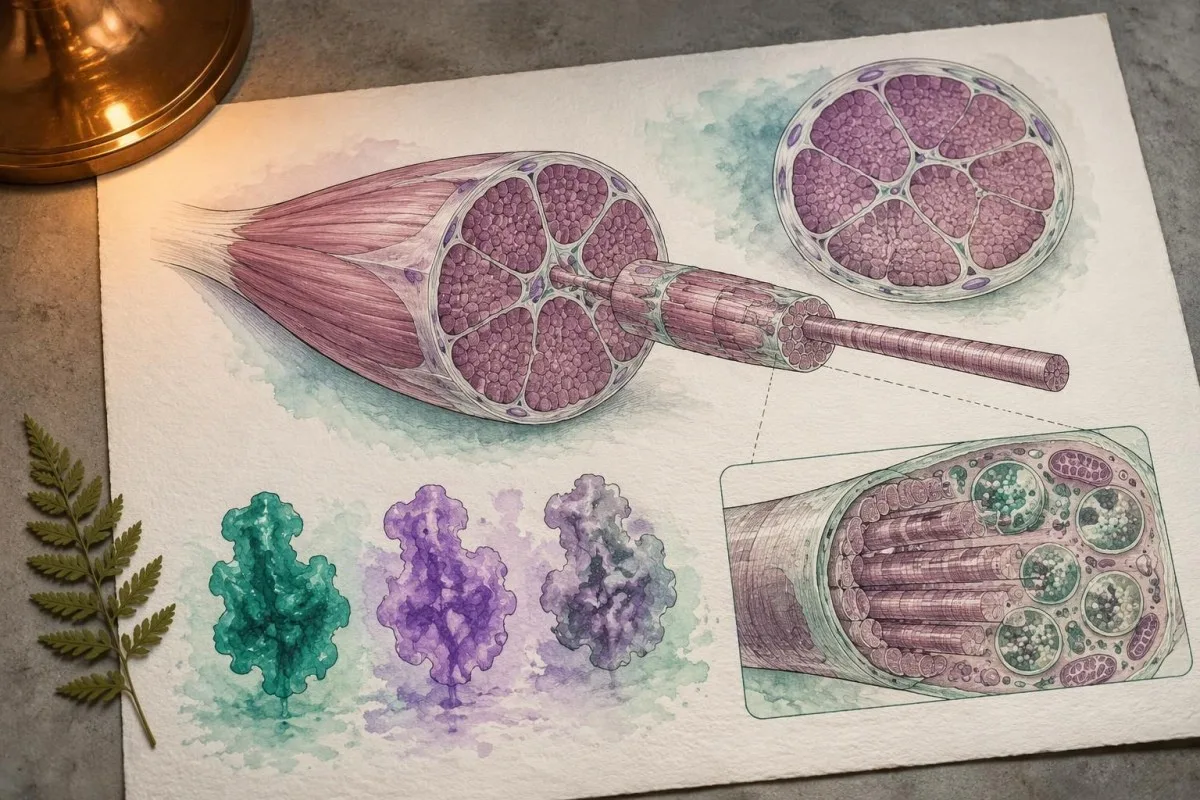
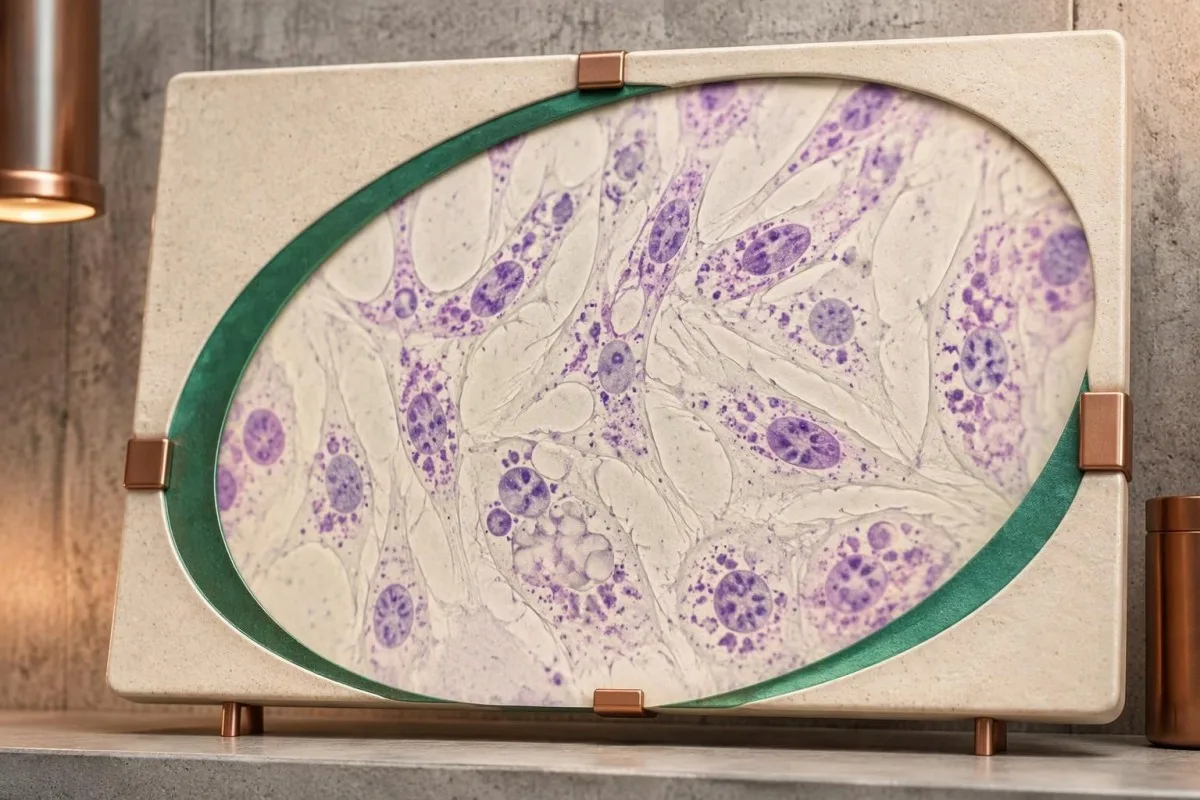
Pompe ligą sukelia lizosominės rūgštinės alfa gliukozidazės trūkumas, – šis fermentas skaido glikogeną ląstelių perdirbimo skyriuose. GAA veikia alfa-1,4 ir alfa-1,6 gliukozės jungtis; dėl nepakankamo aktyvumo kaupiasi glikogenas, ypač griaučių ir širdies raumenyse.
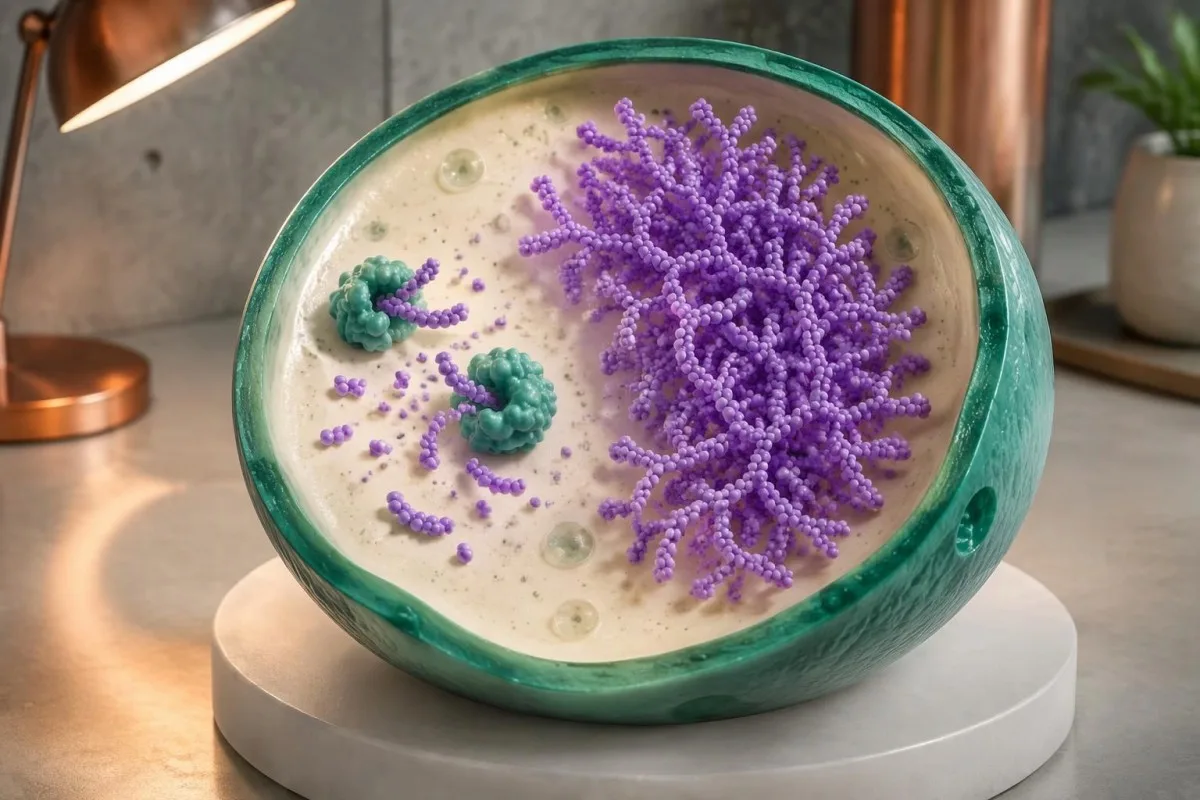
Sergant klasikine kūdikių Pompe liga, GAA aktyvumas diagnostiniuose audinių mėginiuose dažnai yra mažesnis nei 1% normalaus aktyvumo. Vėliau pasireiškianti liga gali būti susijusi su didesniu išlikusiu aktyvumu, kartais konkrečiuose tyrimuose siekiančiu maždaug 2–40%; šie aprašomieji intervalai persidengia su tyrimo metodo apribojimais ir negali pakeisti laboratorijos patvirtinto diagnostinio įvertinimo.
Kishnani ir kt. 2006 m. žurnale 'Genetics in Medicine“ paskelbtose rekomendacijose aprašomas GAA trūkumo, glikogeno kaupimosi ir daugelio organų sistemų įvertinimo ryšys. Klinikinis skirtumas nustatomas ne vien pagal tai, ar aktyvumas mažesnis nei 1%: ligos formai ir skubumui nustatyti taip pat svarbus amžius simptomų pradžioje, širdies būklė ir kvėpavimo raumenų funkcija.
Įprastinis gliukozės tyrimas neparodo, kaip skaidomas lizosomose esantis glikogenas. Pavyzdžiui, hipotetinio suaugusiojo gliukozės koncentracija nevalgius gali būti 92 mg/dL, nors jis turi paveldimą raumenų glikogeno kaupimosi sutrikimą; normali gliukozės koncentracija neįrodo, kad glikogenas raumenų lizosomose skaidomas įprastai.
Sergant kitomis lizosominėmis ligomis, sutrinka kitų fermentų ir genų veikla, todėl jų ribinių verčių negalima taikyti Pompe ligos tyrimams. Mūsų paaiškinimas apie Gošė ligos patvirtinimą fermento tyrimu parodo bendresnę fermento tyrimo ir genetinio patvirtinimo eigą bei paaiškina, kodėl vienos ligos fermento tyrimas negali pakeisti kitos ligos tyrimo.
Ar yra nustatytas normalus GAA fermento aktyvumo intervalas?
There is no single universal normal range for GAA enzyme activity. Dried blood spots, leukocytes and cultured fibroblasts use different preparations and reporting units; a number expressed in nmol/h/mL cannot be directly compared with a result expressed in nmol/h/mg protein.
A screening cutoff separates samples needing follow-up from samples passing that screen. It does not necessarily separate affected people from unaffected people with complete accuracy; laboratories may use different fluorometric or tandem mass spectrometry methods, and 2 screening programs may therefore select different recall thresholds.
For a clearly hypothetical example, suppose a laboratory uses a DBS screening cutoff of 1.5 nmol/h/mL and reports 0.7 nmol/h/mL. The result is below that invented laboratory threshold, but dividing 0.7 by 1.5 gives 47% of the cutoff—not 47% of normal enzyme activity and not a severity score.
The lower limit of detection is different from the clinical cutoff. A report reading less than 0.1 in its stated units may mean the method cannot quantify lower activity reliably; it does not prove absolute absence of enzyme, and repeating measurements close to that analytical floor may produce proportionally large variation.
Screening performance also depends on prevalence. In a hypothetical group with 10 true-positive and 100 false-positive results, only about 9% of positive screens represent disease; those invented counts are not Pompe screening statistics, but explain why kokybiniai ir kiekybiniai rezultatai require different interpretation.
| Lygis | Diapazonas | Ką tai reiškia |
|---|---|---|
| Passes hypothetical screen | ≥1.5 nmol/h/mL | Illustrative DBS cutoff only; not a universal normal range and not an absolute exclusion in a symptomatic person. |
| Below hypothetical cutoff | <1.5 nmol/h/mL | Illustrative follow-up threshold only; true deficiency, pseudodeficiency and specimen effects still need separation. |
Kodėl GAA tyrimą reikia pakartoti su kitu mėginiu?
Repeat GAA testing checks whether low activity is reproducible and whether specimen quality or assay interference explains it. Confirmation usually moves beyond 1 screening card to a fresh, appropriately handled specimen, often with GAA measurement in leukocytes or another specialist-selected cell preparation.
Heat, humidity and inadequate drying can reduce enzyme activity in a dried blood spot. A low result after 2 days of poorly controlled transport may deserve a fresh collection, but transport history cannot be used to dismiss a result automatically; the laboratory should assess card quality and its stability requirements.
Acarbose is used in some GAA assay methods to suppress interfering maltase-glucoamylase activity. That interference can make measured activity appear higher and potentially obscure deficiency; checking how a laboratory isolates GAA activity can therefore matter more than obtaining a second number with the same unresolved methodological limitation.
Two low DBS results still do not automatically confirm Pompe disease. Pseudodeficiency can reproduce across repeated measurements, including some confirmatory methods; when enzyme and genetic findings disagree, a specialist laboratory may recommend cultured fibroblast testing or additional molecular investigation rather than simply ordering a third screening card.
Give the laboratory the dates of collection, recent transfusions or transplantation, and any enzyme replacement treatment already received. Our guide to prieš jį laikant biologiniu atsikūrimu, reikia peržiūrėti tyrimo metodą ir mėginį; mūsų vadove apie explains the general distinction between biological findings and specimen problems; GAA testing has its own handling rules, so do not import another test's redraw interval.
Kuo GAA pseudotrūkumas skiriasi nuo Pompe ligos?
GAA pseudodeficiency means an inherited variant lowers measured enzyme activity without causing the glycogen-storage disorder Pompe disease. Two commonly discussed variants are c.1726G>A, p.Gly576Ser, and c.2065G>A, p.Glu689Lys; their interpretation depends on the complete genotype and the assay used.
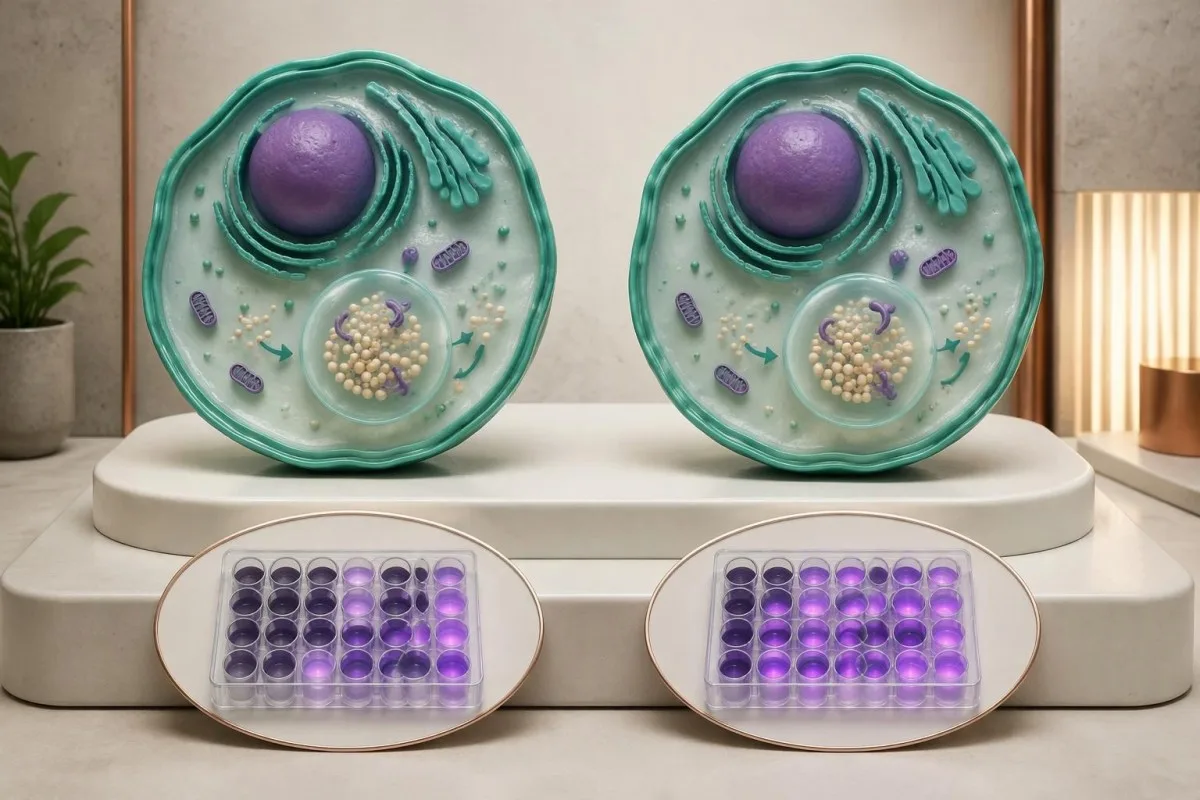
Pseudodeficiency is a biochemical testing issue, not an early stage of Pompe disease. A person with only pseudodeficiency variants does not need Pompe treatment because of 1 low activity result; the specialist must first verify that disease-causing variants or another explanation have not been missed.
The p.Gly576Ser and p.Glu689Lys variants are often found together on 1 gene copy and are particularly relevant in some East Asian ancestry populations. Ancestry changes how often laboratories encounter this pattern, but cannot establish or exclude pseudodeficiency in an individual; people from other backgrounds can carry these variants too.
Pseudodeficiency can remain low on repeat enzyme testing. The practical distinction is whether the complete biochemical and genetic evidence supports disease-causing GAA deficiency, not whether a second result falls below an arbitrary percentage; specialists may compare different assay substrates or cell preparations when the pattern remains ambiguous.
Pseudodeficiency variants can also coexist with a disease-causing variant, making a short report misleading if it lists everything under mutations. Our Fabry enzyme and genetics guide shows another situation where enzyme results need genetic context, although Fabry's X-linked inheritance differs from Pompe's 2-copy recessive mechanism.
Ko reikėtų ieškoti tiriant GAA geną?
GAA gene testing investigates whether disease-causing variants affect both copies of the GAA gene. Pompe disease is autosomal recessive, and the GAA gene is located on chromosome 17; interpretation requires variant classification, adequate test coverage and, when needed, confirmation that variants affect opposite gene copies.
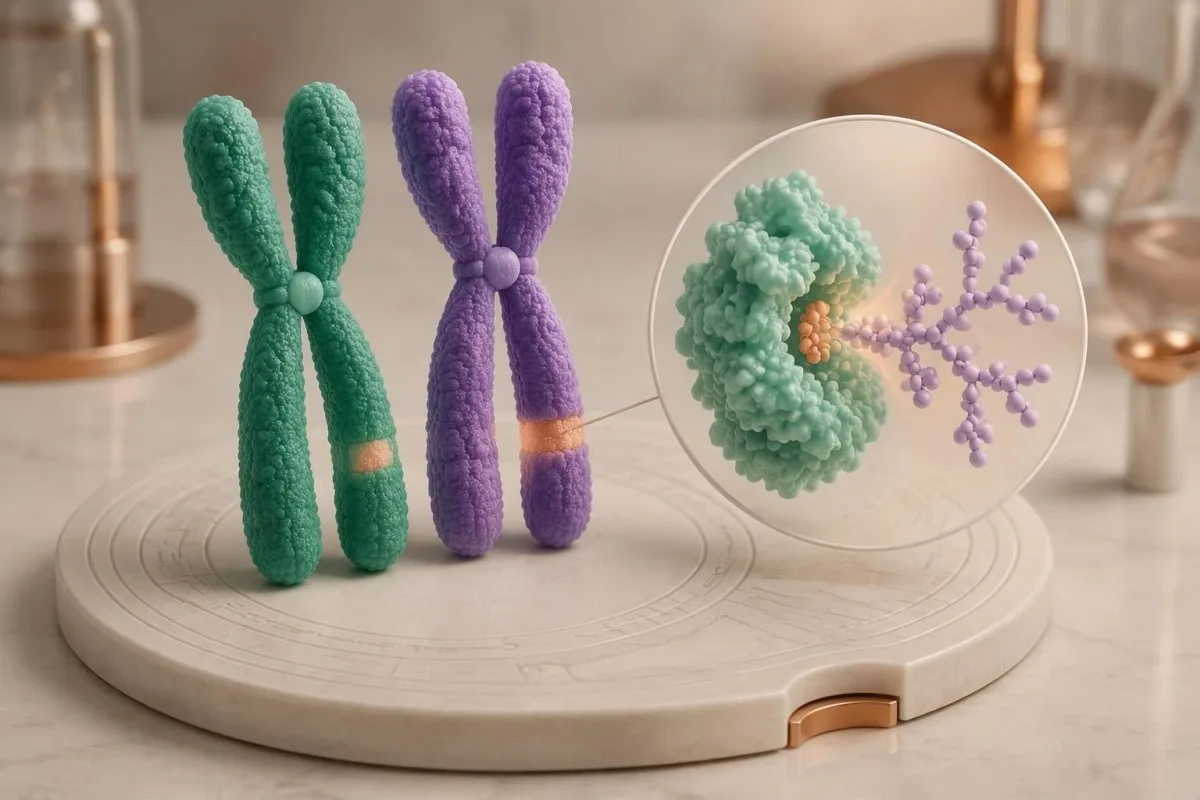
Two pathogenic or likely pathogenic GAA variants in trans support molecular confirmation of Pompe disease. In trans means the variants affect opposite gene copies; 2 variants in cis affect the same copy and do not, by themselves, demonstrate a recessive disease genotype.
Standard sequencing detects many small substitutions and insertions or deletions, but does not answer every possible genetic question. If only 1 disease-causing variant is found despite convincing enzyme deficiency, ask whether deletion/duplication analysis was included and whether poorly covered or deep intronic regions require further investigation.
A common later-onset-associated GAA variant is c.-32-13T>G, which affects splicing. Finding this variant on 1 copy does not diagnose Pompe disease, and finding it with another disease-causing variant does not precisely predict the age symptoms will begin; residual splicing and other biological factors influence presentation.
Parental testing can help establish phase when a laboratory detects 2 different variants but cannot determine their arrangement. Our guide to inherited disease genetic reports explains why inheritance and family testing matter, while the actual gene coverage and diagnostic criteria must remain specific to GAA.
Kaip vertinti patogeninius, neaiškios reikšmės ir neigiamus rezultatus?
A pathogenic result, a variant of uncertain significance and a negative result have different diagnostic meanings. Genetic laboratories commonly use 5 categories: pathogenic, likely pathogenic, uncertain significance, likely benign and benign; a VUS is not equivalent to a disease-causing GAA variant.
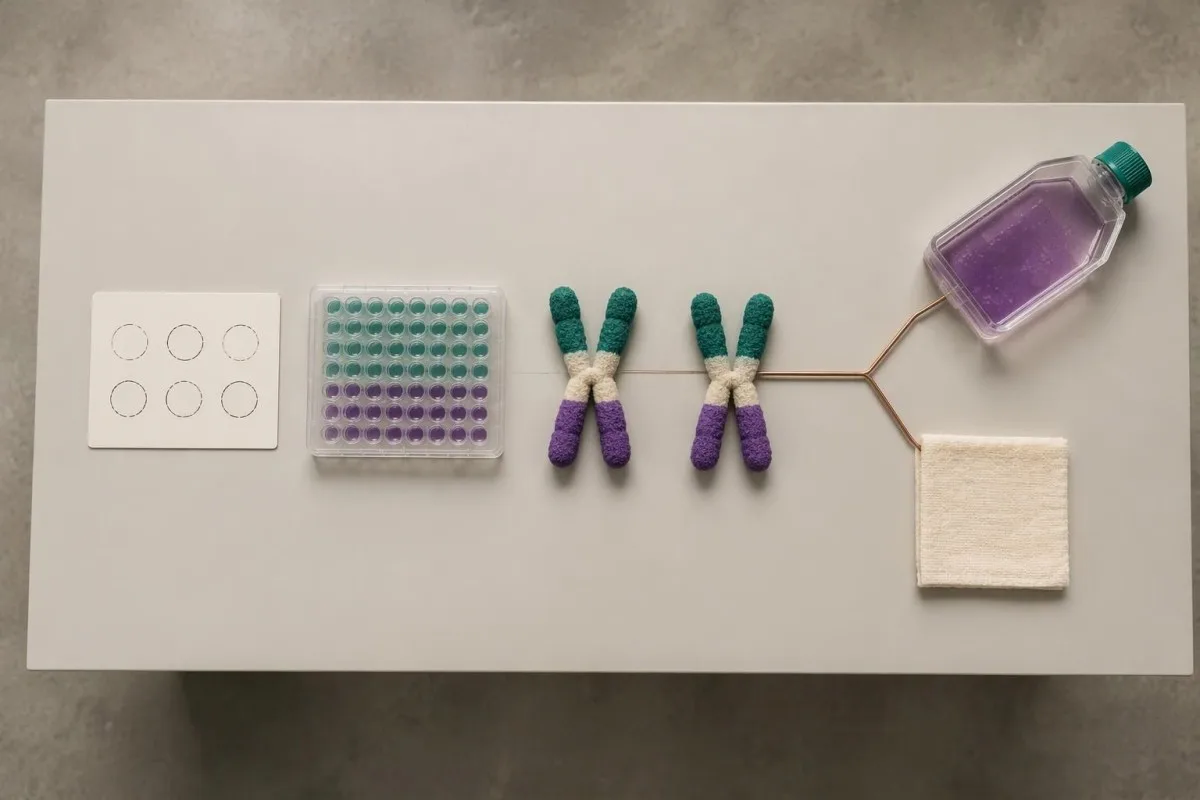
Richards et al.'s 2015 ACMG/AMP consensus established the widely used 5-category sequence-variant framework and states that a VUS should not guide clinical decision-making as though pathogenic. For Pompe evaluation, low enzyme activity can contribute evidence, but its value depends on whether pseudodeficiency and assay limitations have been addressed.
One pathogenic variant plus 1 VUS is an unresolved combination, not automatic confirmation or exclusion. Depending on the enzyme and clinical findings, specialists may investigate family segregation, RNA effects or variant-specific functional evidence; a diagnostic enzyme result may support disease even while the second molecular finding remains incompletely characterized.
A negative sequencing report means the test found no reportable variants within its scope. It does not prove that every GAA-related mechanism was examined; 1 negative limited test may warrant expanded testing when properly performed enzyme studies and the clinical pattern remain strongly suggestive.
Kantesti yra AI kraujo tyrimo rezultatų interpretavimo platforma that can help separate a report's 5 classification terms from its numerical enzyme findings, without adjudicating an uncertain genotype. Our techniniai ir klinikiniai standartai describe interpretation boundaries; our uncertain gene-result explanation provides a related example of why variants and diagnoses are not interchangeable.
Ar vienas GAA variantas reiškia nešiotojo būklę, ar ligą?
One confirmed disease-causing GAA variant usually indicates carrier status if a second disease-causing variant and diagnostic enzyme deficiency are absent. Carriers do not typically develop Pompe disease; when both parents are carriers, each pregnancy has a 25% affected, 50% carrier and 25% non-carrier probability.
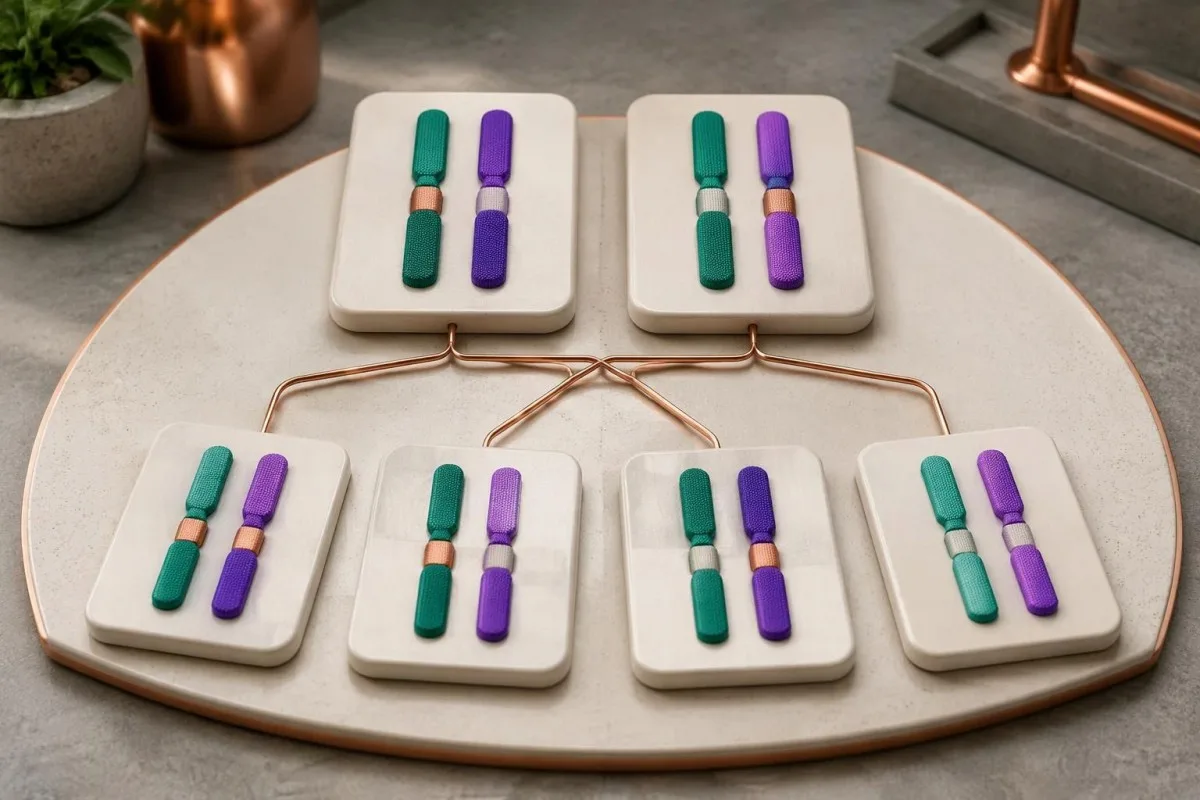
Carrier enzyme values can overlap with values in unaffected people. GAA activity is therefore not a reliable standalone carrier test, and a carrier's activity should not be assumed to equal exactly 50% of a laboratory's normal mean; targeted genetic testing is generally more informative when a familial variant is known.
The 25% affected-child probability applies independently to each pregnancy when both parents carry disease-causing variants capable of producing Pompe disease together. Having 1 unaffected child does not reduce the next pregnancy's Mendelian probability, and pseudodeficiency variants should not be substituted for pathogenic variants in that calculation.
Family testing is most useful after the affected person's variants are clarified. If a symptomatic adult has only 1 identified pathogenic variant, relatives should not be reassured that the entire family question is settled until the specialist considers whether the second variant was missed by the original assay.
For a hypothetical couple, one partner carrying a pathogenic GAA variant and the other carrying only a pseudodeficiency variant does not create the same 25% Pompe risk as 2 pathogenic-variant carriers. Our carrier screening limitations guide explains why a report's coverage and residual risk deserve discussion before reproductive decisions.
Kurie kiti laboratorinių tyrimų rezultatai patvirtina Pompe ligos vertinimą?
Creatine kinase, AST, ALT and urinary glucose tetrasaccharide can support Pompe evaluation, but none confirms the diagnosis alone. Urinary glucose tetrasaccharide may be reported as Glc4 or within a Hex4 assay; these 2 report terms require method-specific interpretation rather than assumption that every laboratory measures exactly the same thing.
Normal CK does not exclude later-onset Pompe disease. In a hypothetical adult with progressive difficulty rising from a chair, CK of 140 U/L may fall within that laboratory's interval despite clinically meaningful weakness; the combination of symptoms and low confirmed GAA activity matters more than a reassuring CK flag.
AST and ALT can rise because of muscle involvement, not only liver disease. A hypothetical AST of 86 U/L with elevated CK and muscle weakness deserves a muscle-aware assessment; our aldolase and muscle marker guide explains why additional muscle enzymes may help characterize the pattern without identifying its cause.
Urinary Glc4 is a supportive glycogen-related biomarker, not a Pompe-specific diagnostic test. Reference limits vary with age and method, and elevation can occur in other circumstances; 1 elevated result should be interpreted alongside enzyme findings, genetics and the laboratory's creatinine-normalized units.
A falling CK or Glc4 after treatment does not automatically prove that strength or breathing has improved by the same percentage. Our discussion of AST interpretation beyond liver disease illustrates why 2 related markers can move together while still answering different questions about tissue injury and function.
Kodėl nustačius nenormalų Pompe ligos tyrimo rezultatą reikia įvertinti kvėpavimą?
Pompe disease can weaken the diaphragm and other respiratory muscles, sometimes before obvious walking difficulty. Assessment may include seated and supine forced vital capacity, respiratory muscle pressures and sleep-related testing; a daytime oxygen saturation of 97% does not rule out overnight hypoventilation.
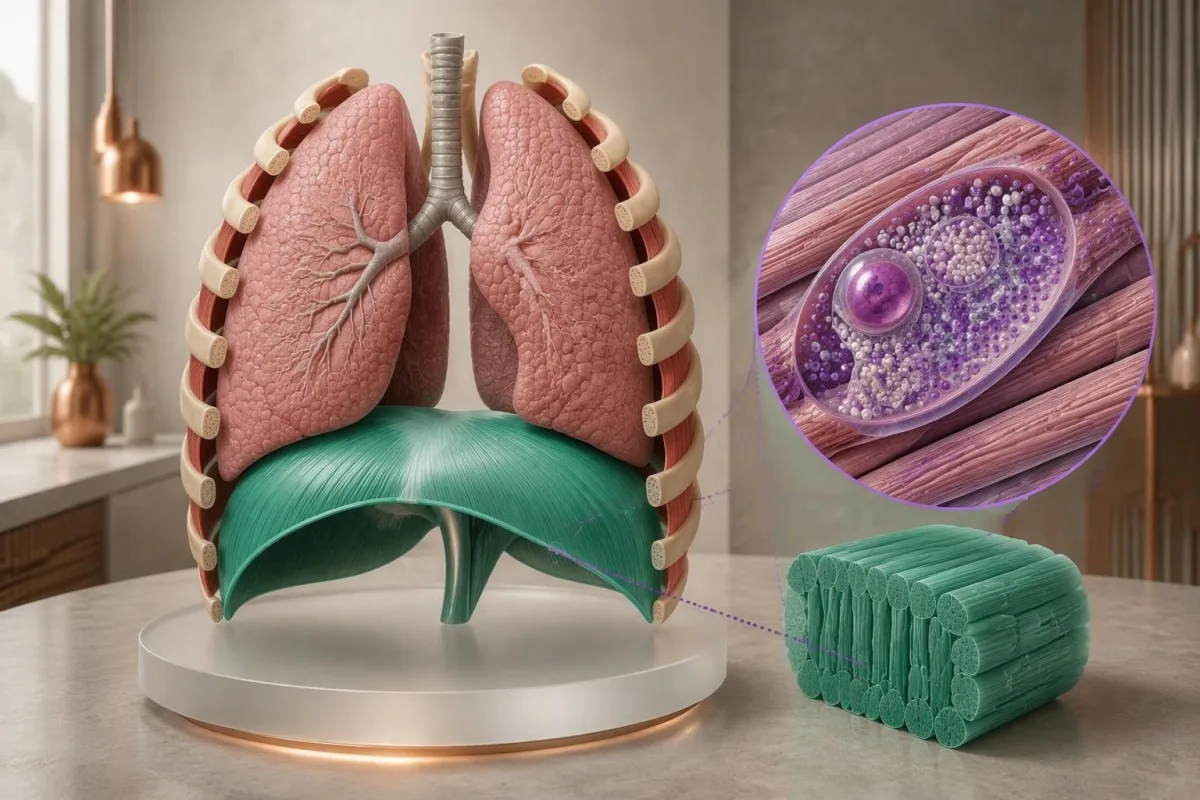
A position-related fall in vital capacity can suggest diaphragm weakness. For example, a hypothetical seated FVC of 3.0 L and supine FVC of 2.4 L represents a 20% decline; the specialist interprets that difference with technique, predicted values and symptoms, rather than treating it as a Pompe-specific cutoff.
Morning headaches, unrefreshing sleep and difficulty breathing when lying flat can justify evaluation for sleep-related hypoventilation. These symptoms do not identify Pompe disease on their own; our trumpinė kvėpavimo testo vadovas explains why laboratory results cannot replace respiratory examination and physiological testing.
Arterial carbon dioxide is normally about 35–45 mmHg in adults, with context-dependent variation. A value above 45 mmHg indicates hypercapnia, but its urgency depends on pH, symptoms and the clinical setting; our blood gas interpretation guide explains why oxygen and carbon dioxide answer different questions.
Severe breathlessness, confusion, blue coloration or rapidly worsening weakness warrants emergency care, not an online interpretation session. A confirmed molecular result affecting 2 GAA copies does not measure current respiratory safety; clinicians need direct functional assessment to decide whether ventilation support or urgent monitoring is necessary.
Kas vyksta gavus teigiamą naujagimių Pompe ligos atrankinio tyrimo rezultatą?
A positive newborn Pompe screen requires prompt specialist assessment, confirmatory enzyme testing and genetic evaluation. It does not mean every infant has Pompe disease; the immediate task is to distinguish pseudodeficiency or carrier findings from infantile disease and a later-onset-associated genotype affecting both GAA copies.

Burton et al.'s 2017 Pediatrics newborn-screening algorithms describe an initial evaluation integrating GAA confirmation, molecular testing and clinical assessment. If an infant has feeding difficulty, marked hypotonia or suspected cardiomyopathy, do not wait 2 weeks for a routine repeat appointment; the screening team should arrange urgent metabolic and cardiac evaluation.
Classic infantile Pompe disease commonly involves hypertrophic cardiomyopathy. A newborn's echocardiogram and electrocardiogram help assess risk that cannot be estimated from 1 enzyme number; absence of obvious heart symptoms at home does not replace the specialist examination after an abnormal screen.
CRIM status concerns whether cross-reactive GAA protein is present and helps specialists plan immune-risk management around enzyme replacement therapy. Less than 1% enzyme activity does not by itself establish CRIM-negative status, because an inactive protein may still be present; this is a protein-expression question, not just an activity threshold.
Later-onset-associated findings in a newborn require a monitoring plan, not an invented age-of-onset prediction. Even 2 classified disease-causing variants may not reveal when symptoms will emerge; our vaikų sveikatos AI saugos gairėse explains why pediatric results require age-specific context and clinician-led decisions.
Kaip specialistai išsiaiškina prieštaringus suaugusiųjų tyrimų rezultatus?
Conflicting adult Pompe results are resolved by checking specimen quality, confirmatory enzyme methods, variant classification and clinical fit. One low screen plus 1 genetic finding rarely tells the whole story; specialists investigate whether the apparent conflict comes from pseudodeficiency, an incomplete molecular test or another cause of weakness.

Consider a hypothetical 52-year-old with mild fatigue, low DBS GAA activity and only the 2 commonly discussed pseudodeficiency variants. If specialist testing supports pseudodeficiency and no disease-causing genotype, the low screen does not explain the fatigue; other causes should be assessed rather than attaching a Pompe label to an incidental biochemical finding.
A second hypothetical adult has progressive hip weakness, a 20% positional FVC decline, confirmed cellular GAA deficiency and 2 pathogenic variants in trans. Together, those findings support Pompe disease; a normal routine glucose or modest CK result would not outweigh the converging biochemical, genetic and functional evidence.
Convincing enzyme deficiency with only 1 identified pathogenic variant deserves further investigation. The appropriate next step may be deletion/duplication analysis, RNA studies or another specialist assay—not automatically calling the person a carrier; the investigation should also check whether non-Pompe neuromuscular conditions better explain the examination.
Variant-related disease monitoring is not the same as predicting a person's future from their DNA. Our inherited neuromuscular risk guide offers a related family-testing perspective, but 2 conditions can differ substantially in inheritance, penetrance and treatment triggers.
Ką reikėtų atsinešti į vizitą pas Pompe ligos specialistą?
Bring the complete enzyme report, complete genetic report and a dated symptom history to a Pompe specialist appointment. Three report details are especially useful: specimen type, assay units and variant classification; screenshots showing only a red flag or the word mutation can omit information that changes the interpretation.

Ask whether confirmatory testing has already been completed and whether the laboratory measured GAA specifically in an appropriate cell preparation. If 2 variants were found, ask whether they are in trans; if only 1 was found, ask what variant types and regions the test could detect.
Do not try to raise GAA activity with supplements or diet before confirmation. No vitamin or food corrects inherited pathogenic variants affecting both GAA copies; nutrition may support general care after diagnosis, but cannot substitute for enzyme confirmation or specialist treatment planning.
Kantesti yra AI pagrindu veikiantis kraujo tyrimų analizės įrankis that can help organize report terminology and associated laboratory trends, not decide whether 2 uncertain variants establish Pompe disease. Our ataskaitos šaltinio patikros vadovas explains why the original document remains the reference when an automated explanation and a specialist interpretation differ.
Genetic documents can contain information relevant to relatives as well as the tested person. Before sharing 1 family member's report, check consent and remove unnecessary identifiers; Kantesti's informacija apie privatumą ir duomenis describes our handling approach, while sharing results with relatives should follow a genetic counselor's guidance.
Mokslinės publikacijos ir Pompe ligos tyrimų rezultatų interpretavimo ribos
Pompe test interpretation rests on disease-specific enzyme, genetic and clinical evidence—not on general laboratory publications or an AI explanation. Kantesti includes 3 directly relevant external sources below and 2 separate educational publications; the iron and coagulation publications are not evidence for diagnosing Pompe disease.
The 2006 Kishnani guideline provides disease-specific diagnostic and management context, while the 2017 Burton newborn-screening paper addresses confirmation after population screening. Their recommendations should be applied with the specialist laboratory's validated methods; neither supplies 1 universally transferable DBS enzyme cutoff for every instrument and population.
Richards et al.'s 2015 ACMG/AMP publication explains the 5-category variant framework used to distinguish pathogenic findings from uncertainty. Classification can change when new evidence becomes available, so ask the genetics service whether an unresolved result has a reanalysis pathway rather than assuming every VUS will eventually become pathogenic.
Mūsų edukaciniame geležies tyrimų publikacija addresses a different laboratory domain. The separate krešėjimo tyrimų publikacijoje also covers unrelated markers; their 2 DOI records are provided for publication transparency, not as supporting citations for GAA deficiency or pseudodeficiency.
„Kantesti“ 0 medicininio turinio standartai distinguish patient education from diagnosis and treatment instructions. The practical endpoint is a documented interpretation of 3 evidence streams—enzyme testing, genetic analysis and clinical assessment—with urgent care taking priority whenever infantile disease or respiratory compromise is suspected.
Dažnai užduodami klausimai
Ar mažas GAA fermento aktyvumas visada reiškia Pompes ligą?
Mažas GAA fermento aktyvumas ne visada reiškia Pompe ligą. Vienas nenormalus atrankinio tyrimo rezultatas gali atspindėti tikrąjį trūkumą, pseudotrūkumą, mėginio degradaciją arba aktyvumo persidengimą su nešiotojams būdingu aktyvumu. Patvirtinimui reikalingas specialisto atliktas tinkamo fermento tyrimo, GAA genetinių radinių ir klinikinio konteksto vertinimas. Vien pakartojus tą patį atrankinį tyrimą, gali vėl būti nustatytas pseudotrūkumas, o ne išspręstas klausimas.
Koks yra normalus GAA fermento kiekis?
There is no universal normal GAA enzyme level because specimen preparation, assay substrate and reporting units differ between laboratories. A value in nmol/h/mL cannot be directly compared with a value in nmol/h/mg protein. Classic infantile Pompe disease often has less than 1% of normal activity in diagnostic tissue assays, but this is not a universal newborn-screening cutoff. Use the reference information printed on the original report and the specialist laboratory's interpretation.
Ar du žemi GAA tyrimų rezultatai vis tiek gali reikšti pseudodeficitą?
Du žemi GAA tyrimų rezultatai vis dar gali rodyti pseudodeficitą, ypač kai naudojami tie patys arba panašiai paveikti tyrimo metodai. Pseudodeficito variantai sumažina išmatuotą aktyvumą, tačiau patys nesukelia Pompe glikogeno kaupimo ligos. Specialistai šį atvejį atskiria remdamiesi visu GAA genotipu, tyrimo ypatybėmis ir, kai reikia, kitu ląstelių preparatu arba funkciniu tyrimu. Todėl du pakartotinai gauti maži skaičiai nėra lygiaverčiai dviem nepriklausomiems ligos patvirtinimams.
Ar du GAA geno variantai patvirtina Pompe ligą?
Du GAA variantai automatiškai nepatvirtina Pompe ligos. Dvi patogeninės arba tikėtinai patogeninės variantų kopijos trans padėtyje, paveikiančios priešingas geno kopijas, patvirtina molekulinę diagnozę, o dvi variantų kopijos cis padėtyje veikia tik vieną kopiją. Neaiškios reikšmės variantai ir pseudodeficito variantai negali būti laikomi patvirtintais ligą sukeliančiais radiniais. Fermentų ir klinikiniai duomenys išlieka ypač naudingi, kai klasifikacija ar fazė nėra nustatyta.
Ar normalus CK rodiklis gali atmesti vėlai prasidedančią Pompe ligą?
Normal CK cannot rule out late-onset Pompe disease. A hypothetical CK of 140 U/L may fall within a laboratory's reference interval despite progressive proximal weakness or diaphragm involvement. CK measures muscle injury-related enzyme release, not lysosomal GAA function. Persistent compatible symptoms deserve specialist assessment even when routine muscle markers are reassuring.
Kiek skubus yra teigiamas naujagimio Pompe ligos tyrimo rezultatas?
Gavus teigiamą naujagimio Pompe ligos tyrimo rezultatą, reikia nedelsiant susisiekti su patikros arba medžiagų apykaitos ligų specialistų komanda, o kūdikį, kuriam sunku maitintis, būdinga ryški hipotonija arba įtariamas širdies pažeidimas, būtina skubiai įvertinti. Vienas teigiamas patikros mėginys diagnozės nepatvirtina, tačiau įtarus klasikinę kūdikių ligos formą nereikėtų laukti įprasto vizito po kelių savaičių. Specialistai organizuoja patvirtinamąjį fermento tyrimą, genetinį ištyrimą ir širdies būklės vertinimą, dažnai lygiagrečiai. Esant dideliems kvėpavimo sunkumams ar sumažėjusiam sąmoningumui, būtina skubi medicinos pagalba.
Kokia rizika kyla vaikams, jei abu tėvai yra Pompe ligos nešiotojai?
0 Jei abu tėvai turi ligą sukeliančių GAA variantų, kiekvieno nėštumo metu yra 25% tikimybė susilaukti šia liga sergančio vaiko, 50% tikimybė susilaukti vaiko, kuris būtų ligos nešiotojas, ir 25% tikimybė susilaukti vaiko, kuris nepaveldėtų nė vieno šeimoje nustatyto varianto. Šios tikimybės kiekvieno nėštumo atveju yra nepriklausomos. Pseudodeficito variantai atliekant šį skaičiavimą nėra lygiaverčiai patogeniniams variantams. Genetiko konsultacija padeda patvirtinti tėvų tyrimų rezultatus ir paaiškinti tyrimų galimybes.
Sužinokite, kaip skaityti kraujo tyrimo rezultatus
Įkelkite laboratorinio tyrimo ataskaitą ir Kantesti AI per kelias sekundes paprasta kalba paaiškins kiekvieną biomarkerį. Juo naudojasi daugiau nei 2 milijonai žmonių visame pasaulyje.
Nuorodos
- Klein, T., Mitchell, S., & Weber, H. (2026). Geležies tyrimų vadovas: TIBC, geležies įsotinimas ir geležies surišimo geba. Kantesti AI medicininiai tyrimai. DOI
- Klein, T., Mitchell, S., & Weber, H. (2026). aPTT normos intervalas: D-dimeras, C baltymas ir krešėjimo tyrimų vadovas. Kantesti AI medicininiai tyrimai. DOI
- Kishnani PS et al. (2006). Pompe disease diagnosis and management guideline. Genetika medicinoje. DOI PubMed
- Burton BK et al. (2017). The Initial Evaluation of Patients After Positive Newborn Screening: Recommended Algorithms Leading to a Confirmed Diagnosis of Pompe Disease. Pediatrics. DOI
- Richards S ir kt. (2015). Sekos variantų interpretavimo standartai ir gairės: bendra Amerikos medicininės genetikos ir genomikos koledžo bei Molekulinės patologijos asociacijos konsensuso rekomendacija. Genetika medicinoje. DOI PubMed
- 2M+Ištirti tyrimai
- 127+Šalys
- 100+Kalbos
Apie medicinos komandą


E-E-A-T patikimumo signalai
Patirtis
Gydytojo vadovaujama klinikinė laboratorinių tyrimų interpretavimo darbo eigų peržiūra.
Ekspertizė
Laboratorinės medicinos dėmesys tam, kaip biomarkeriai elgiasi klinikiniame kontekste.
Autoritetas
Mediciniškai peržiūrėjo dr. Thomas Klein, prisidėjo dr. Sarah Mitchell ir prof. dr. Hans Weber.
Patikimumas
Įrodymais pagrįsta interpretacija su aiškiais tolesnių veiksmų keliais, siekiant sumažinti nerimą.






Medicininė atsakomybės ribojimo nuostata
Šis straipsnis skirtas tik mokymo tikslais ir nesudaro medicininės konsultacijos. Visada kreipkitės į kvalifikuotą sveikatos priežiūros specialistą dėl diagnozės ir gydymo sprendimų.
Paskelbta · Susisiekite su redakcine komanda
Išleido Kantesti Ltd, registruota Anglijoje ir Velse, įmonės Nr. 17090423, Londonas, Jungtinė Karalystė.
