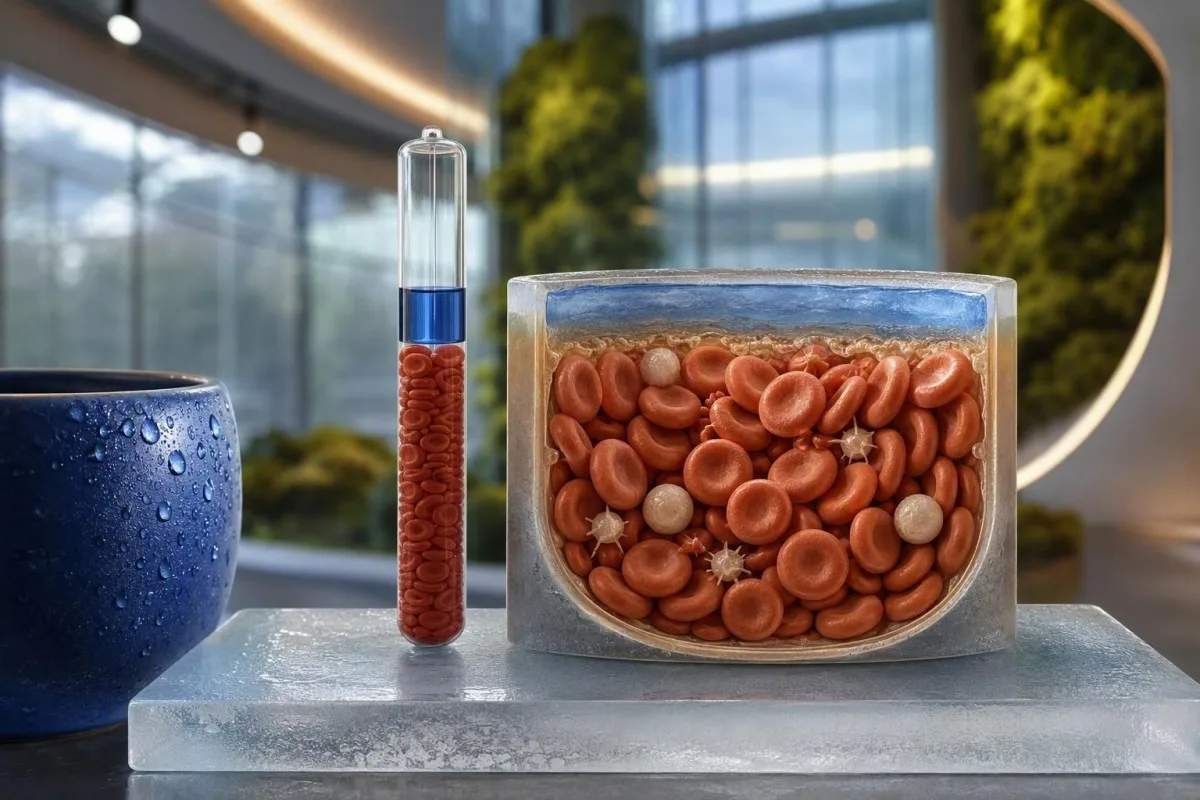
A high red blood cell count can reflect concentrated blood rather than extra red cells. The first task is separating temporary fluid loss from a persistent elevation that needs a proper work-up.


- Σχετική ερυθροκυττάρωση means plasma water has fallen, making the RBC count, hemoglobin, and hematocrit look high without creating new cells.
- Όριο ΠΟΥ values that support possible polycythemia vera are hemoglobin above 16.5 g/dL in men or 16.0 g/dL in women, or hematocrit above 49% and 48%, respectively.
- Hydration retest is usually reasonable for a mild, isolated elevation after vomiting, diarrhea, heat exposure, fasting, or strenuous exercise—if you are otherwise well.
- Διουρητικά can raise hematocrit through fluid loss; do not stop prescribed medication without the clinician who prescribed it.
- μετράει το μοτίβο: high albumin, total protein, sodium, BUN/creatinine ratio, and urine specific gravity support dehydration more than true red-cell overproduction.
- Χρόνος επανάληψης is commonly 1–2 weeks after recovery, normal fluid intake, and 24–48 hours without unusually hard exercise, unless urgent symptoms are present.
- επίμονη αύξηση after good hydration warrants assessment for smoking exposure, sleep-disordered breathing, altitude, testosterone, lung or kidney disease, erythropoietin, and often JAK2 testing.
- Επείπτωτα συμπτώματα include chest pain, new breathlessness, one-sided weakness, visual loss, confusion, or a painful swollen leg; these need immediate care, not a home retest.
What a high RBC result usually means
A high RBC count can be a false high from dehydration when fluid loss concentrates the cellular part of blood; it does not automatically mean your marrow is making too many red cells. The clue is whether hemoglobin and hematocrit normalize after recovery and ordinary drinking, rather than staying elevated on a well-prepared repeat CBC.
The RBC count reports the number of red cells per litre, while αιματοκρίτης reports the fraction of whole blood occupied by those cells. Adult reference intervals vary by laboratory, but many use roughly 4.5–5.9 × 10¹²/L for men and 4.1–5.1 × 10¹²/L for women. A value just above range is often less informative than the hemoglobin and hematocrit beside it; our guide to τι περιλαμβάνει μια CBC εξηγεί το γιατί.
Dehydration lowers the liquid component of blood within hours, so the same red-cell mass occupies a smaller measured volume. In clinic, I commonly see this after a stomach bug: RBC 5.8 × 10¹²/L, hemoglobin 17.1 g/dL, hematocrit 51%, then normal values after recovery. This is relative erythrocytosis, not a laboratory mistake and not necessarily a disease.
Το Καντέστι είναι ένα Αναλυτής εξέτασης αίματος AI that reads RBC, hemoglobin, hematocrit, red-cell indices, kidney markers, and prior results together. As of September 5, 2026, our clinical review workflow treats a single borderline CBC flag as a prompt to check preparation and trend—not as a diagnosis.
RBC count is not the same as red-cell mass
A CBC cannot directly measure total red-cell mass. It measures concentration, which rises when plasma volume contracts; specialised isotope red-cell-mass studies are now rarely needed, but they illustrate why a concentrated CBC can look alarming without an actual increase in cells.
Relative erythrocytosis versus true red-cell excess
Relative erythrocytosis is a high RBC, hemoglobin, or hematocrit caused by reduced plasma volume, whereas absolute erythrocytosis reflects genuinely increased red-cell mass. Hydration can correct the first pattern but will not correct the second.
True erythrocytosis may be primary, as in polycythemia vera, or secondary to increased erythropoietin from low oxygen, medicines, or rarely a kidney process. The 2016 WHO criteria use hemoglobin above 16.5 g/dL in men or 16.0 g/dL in women as thresholds that should raise the question of polycythemia vera, particularly when persistent (Arber et al., 2016). A single value is not enough to diagnose it.
The practical distinction is the rest of the panel. Dehydration high RBC count patterns often include high albumin, total protein, urea/BUN, sodium, and concentrated urine; absolute erythrocytosis may leave these markers unremarkable. Review our focused article on slightly elevated hemoglobin if hemoglobin, rather than RBC alone, is the flagged result.
A normal RBC count does not rule out erythrocytosis if hemoglobin or hematocrit is high, and an elevated RBC count alone can occur with small red cells from iron deficiency or thalassemia trait. This is why MCV and ferritin matter; a high RBC with MCV below 80 fL is a different clinical conversation.
How dehydration changes the CBC and kidney markers
Dehydration usually raises RBC count, hemoglobin, and hematocrit together, and it often raises albumin, total protein, urea/BUN, creatinine, and urine concentration. A mismatched result—for example, high RBC with low hemoglobin—does not fit simple hemoconcentration well.
A BUN/creatinine ratio above about 20:1 in US units can support reduced kidney perfusion from fluid loss, although gastrointestinal bleeding, protein intake, corticosteroids, and low muscle mass can alter the ratio. Creatinine may rise modestly after heat exposure or a long run because both filtration and muscle metabolism change. Our αφυδάτωση και eGFR covers when a low eGFR should be repeated.
Urine specific gravity of 1.025 or higher is compatible with concentrated urine, but it is not a direct hydration meter. Glucose, protein, and some imaging contrast agents can also increase it, so a clinician should interpret it with symptoms and electrolytes. A urine specific gravity reference is useful when the CBC and urinalysis were collected on the same day.
I advise against trying to force-normalise a test by drinking several litres immediately before a draw. Rapid overdrinking can lower sodium, and it creates another unrepresentative sample; normal meals and ordinary thirst-guided fluids for 24–48 hours are generally safer for people without a fluid restriction.
Vomiting, diarrhea, heat, fasting, and diuretics
Vomiting, diarrhea, heavy sweating, prolonged fasting, and diuretic medicines can all cause a temporary high RBC concentration by reducing plasma water. The degree of elevation depends more on fluid loss and replacement than on how unwell a person feels.
Acute vomiting often produces low chloride and sometimes high bicarbonate because gastric acid and fluid are lost. Loop diuretics such as furosemide and thiazides can produce a similar volume-contracted profile, especially in older adults. A low chloride result belongs in the same clinical frame; see vomiting and diuretic chloride clues για το μοτίβο.
Do not stop a prescribed diuretic to improve a CBC without medical advice. People taking these medicines for heart failure, cirrhosis, resistant hypertension, or kidney disease may need a tailored fluid plan, because indiscriminate drinking can worsen swelling or breathlessness. The right question is whether the dose, symptoms, weight, blood pressure, and renal results fit together.
Thirst is helpful but imperfect in adults over 65 and in people with diabetes, kidney disease, or certain neurological conditions. Dark yellow urine, dry mouth, postural light-headedness, reduced urination, and a weight drop of 1 kg over 24 hours can support fluid loss, but severe symptoms deserve assessment rather than self-treatment.
Exercise can temporarily concentrate your blood
Hard endurance exercise can raise hematocrit and hemoglobin for several hours through sweat loss and plasma-volume shifts, even though repeated training may lower baseline hematocrit through expanded plasma volume. Timing is therefore unusually important for athletes.
A 90-minute run in warm weather can remove 1–3 litres of fluid, depending on body size, climate, and sweat rate. Sampling immediately after a race may also show higher creatinine, CK, albumin, and total protein; that cluster is more useful than an RBC result alone. Our marathon blood-test timing guide discusses the recovery markers that commonly change.
For routine monitoring, I usually suggest avoiding unusually intense exercise for 24–48 ωρών before the draw, arriving rested, and drinking normally the day before. This is not a universal laboratory rule, and elite-athlete monitoring may deliberately test under load—but consistency matters more than perfection. Dr. Thomas Klein has seen many unnecessary referrals disappear once an athlete is retested after a normal recovery week.
Kantesti’s Οδηγός έρευνας για BUN και κρεατινίνη is particularly helpful when an endurance athlete has both a high hematocrit and a borderline kidney flag. A falling weight, high urine specific gravity, and short recovery interval make hemoconcentration plausible; muscle pain, cola-coloured urine, or very high CK require a different level of caution.
A safe plan for repeating a mildly high CBC
A mildly elevated RBC count can usually be repeated after 1–2 weeks of recovery, ordinary hydration, and stable medication use when you have no red-flag symptoms. Repeat sooner only if your clinician requests it or the initial result was substantially elevated.
Before the repeat, record whether you had diarrhea, vomiting, fever, alcohol intake, a sauna, long travel, altitude exposure, fasting, or intense exercise in the prior 72 hours. Keep your usual diet and medication schedule unless your clinician tells you otherwise. This baseline blood-test preparation guide has a practical checklist for avoiding accidental variation.
Use the same laboratory when possible, because analyser methods and reference intervals differ. Ask for a CBC with hemoglobin, hematocrit, MCV, RDW, white-cell count, and platelets; persistent elevation accompanied by high platelets or white cells is more concerning for a marrow process than isolated erythrocytosis. A recent illness can affect these lines in opposite directions, so the full panel counts.
Το Καντέστι είναι ένα υπηρεσία ερμηνείας δοκιμών AI that compares a new CBC with earlier values and flags changes that exceed ordinary variation. Our trend approach does not replace a clinician, but it can preserve the crucial context—exercise, illness, medications, and prior hematocrit—that is often lost when a single result is viewed alone.
When a repeat high result needs erythrocytosis testing
Persistently high hemoglobin above 16.5 g/dL in men or 16.0 g/dL in women, or hematocrit above 49% or 48%, should prompt a clinician to evaluate erythrocytosis after dehydration is excluded. The usual first tests are repeat CBC, erythropoietin level, oxygen assessment, and JAK2 mutation testing when appropriate.
Polycythemia vera is a myeloproliferative neoplasm in which JAK2 mutations are found in about 98% of affected patients. Low serum erythropoietin supports primary marrow overproduction, but no single blood test should be interpreted in isolation. The British Society for Haematology guideline recommends a structured approach that separates primary from secondary erythrocytosis (McMullin et al., 2019).
Symptoms can be subtle: headaches, blurred vision, itch after a warm shower, unusual facial flushing, fatigue, or a past clot may matter more than the exact RBC value. For a fuller explanation of hematocrit, erythropoietin, and JAK2, read our οδηγό συμπτωμάτων πολυκυθαιμίας. Many people with mild laboratory elevation have none of these features.
I am careful not to imply that every persistent high count is cancer. Smoking-related carbon monoxide exposure, untreated sleep apnea, lung disease, testosterone, high altitude, and some kidney conditions are more common explanations in many practices. Still, persistence is precisely why a repeat CBC should not become an endless cycle of casual retesting.
Low oxygen, smoking, and sleep apnea as high RBC causes
Chronic low oxygen can stimulate erythropoietin and cause a truly elevated red blood cell count; sleep apnea, smoking-related carbon monoxide exposure, and lung disease are frequent causes. A normal daytime oxygen saturation does not fully exclude overnight oxygen drops.
Obstructive sleep apnea can cause modest erythrocytosis, particularly when there are substantial overnight oxygen desaturations. Loud snoring, witnessed pauses, morning headaches, resistant hypertension, and daytime sleepiness should trigger a sleep-focused history rather than an assumption that dehydration explains everything. A για τις εξετάσεις αίματος για τη δύσπνοια outlines the broader cardiopulmonary context.
Cigarette smoking raises carboxyhemoglobin, which reduces oxygen delivery despite a pulse oximeter that may look reassuring. Vaping does not create the same carbon monoxide exposure as combustible tobacco, but it has other health risks and should still be discussed honestly. Carbon monoxide testing or co-oximetry is sometimes more useful than a routine oxygen saturation.
Kantesti AI interprets a high RBC result alongside hemoglobin, hematocrit, kidney markers, and reported sleep or smoking factors rather than presenting a generic cause list. That contextual reading is especially valuable when the hematocrit is 50% after hydration and the patient reports unrefreshing sleep.
Altitude, testosterone, and medicines that raise RBC
Living or training at altitude and using testosterone can increase red-cell production, so the elevation may be real rather than dehydration-related. The timing of exposure often answers more than the initial number.
At altitude, lower oxygen pressure stimulates erythropoietin and raises hemoglobin over days to weeks; the expected range depends on elevation, duration, ancestry, and laboratory reference data. A CBC collected during or shortly after a mountain stay should be interpreted against that exposure. Our altitude hemoglobin retest guide explains why return-to-sea-level timing matters.
Testosterone injections, gels, pellets, and some anabolic agents can cause erythrocytosis. Many prescribing protocols reduce or pause therapy when hematocrit reaches 54%, although individual risk decisions differ, especially in people with cardiovascular disease or sleep apnea. Never donate blood or alter a prescribed dose as a substitute for discussing the result with the prescriber.
Less commonly, SGLT2 diabetes medicines can cause a small rise in hematocrit, partly through plasma-volume effects and possibly erythropoietin signalling. A medication list should include over-the-counter androgen products, injectable treatments, and recent changes—not merely medicines printed in the electronic record.
CBC clues that change the level of concern
High RBC is more concerning when hemoglobin and hematocrit are also high, especially with elevated platelets, white cells, low erythropoietin, or abnormal cells on a smear. A high RBC with low MCV often points instead toward small-cell disorders.
An MCV below 80 fL with a relatively high RBC count can occur in thalassemia trait, where cells are small but numerous. Iron deficiency can also lower MCV, although it more often lowers hemoglobin over time; ferritin and transferrin saturation clarify the distinction. Our Συγκριτικό MCV και MCH explains why the RBC number alone misleads.
High white cells or platelets alongside a high hematocrit do not diagnose polycythemia vera, but they lower the threshold for a haematology review. A peripheral smear, ferritin, erythropoietin, JAK2 testing, and sometimes bone-marrow assessment may follow. Our μονοπάτι ελέγχου για καρκίνο του αίματος shows why these tests are sequenced rather than ordered indiscriminately.
Dr. Thomas Klein’s practical rule is simple: look for agreement across independent signals. A hematocrit of 52%, platelets of 520 × 10⁹/L, and low erythropoietin is a fundamentally different pattern from hematocrit 50% after a heatwave with albumin 5.3 g/dL and concentrated urine.
Symptoms and clot risk: when high RBC is urgent
Seek urgent care for a high RBC result with chest pain, sudden shortness of breath, coughing blood, fainting, new weakness, speech difficulty, visual loss, or a painful swollen leg. These symptoms can reflect a clot or another acute condition and should never wait for a repeat CBC.
Higher hematocrit can increase blood viscosity, but symptoms and overall vascular risk determine urgency more reliably than a modest isolated elevation. Polycythemia vera carries a recognised thrombotic risk, particularly with older age, prior thrombosis, cardiovascular risk factors, and uncontrolled counts. Tefferi and Barbui's 2021 review describes risk-adapted treatment rather than treating every raised count in the same way.
Headache alone is common and nonspecific; headache with new visual symptoms, weakness, or confusion is not. Likewise, a warm shower itch can occur in polycythemia vera but also in dry skin and allergy, so it is a clue, not proof. Review blood-test warning signs for chest pain if symptoms are part of why the test was ordered.
Do not take aspirin solely because an RBC count is high unless your clinician recommends it. Aspirin has bleeding risks and may be inappropriate with ulcers, anticoagulants, low platelets, or certain medical histories. Emergency services are the safer choice when focal neurological or cardiopulmonary symptoms develop.
Why your prior CBCs may answer the question
A stable mildly high RBC count over years has a different meaning from a rapid rise over weeks, and trends can distinguish personal baseline from new disease. Compare results using hemoglobin, hematocrit, MCV, and the same laboratory whenever possible.
Biological variation and analyser variation mean a small change is not always a real physiological change. A 0.3 g/dL hemoglobin difference between two draws may reflect hydration, posture, timing, or ordinary variation; a sustained climb from 15.2 to 17.3 g/dL deserves more attention. Our article on ουσιώδεις εργαστηριακές μεταβολές explains the reference-change-value concept.
Keep a simple record of altitude, smoking status, testosterone dose, illness, heavy exercise, menstrual bleeding, and fluid losses at each draw. That record is more clinically useful than chasing one exact “ideal” RBC count. In my experience, the absence of this context is why patients receive conflicting explanations from different appointments.
Το Kantesti, ένα Πλατφόρμα ερμηνείας βιοδεικτών AI, can display serial CBC values beside renal and protein markers to identify concentration patterns. We encourage users to treat trend analysis as preparation for a clinician conversation, not a replacement for an examination or targeted testing.
Pregnancy, older age, and chronic disease considerations
Pregnancy usually lowers hemoglobin and hematocrit through plasma-volume expansion, so a high value in pregnancy deserves clinician review rather than a casual dehydration assumption. In older adults and people with heart or kidney disease, fluid advice must be individualised.
During pregnancy, plasma volume expands by roughly 40–50%, creating physiological dilution; many maternity services investigate hemoglobin above 16.0 g/dL because it may signal inadequate plasma expansion or other concerns. Severe vomiting in early pregnancy can still concentrate the CBC, but persistent elevation should be discussed with the maternity team. See προειδοποιητικά σημεία από την εξέταση αίματος στην εγκυμοσύνη for same-day scenarios.
Older adults may not report thirst reliably, while heart failure and advanced kidney disease can make excess fluid dangerous. A rapid change in ankle swelling, weight, breathlessness, or urine output matters more than trying to meet a generic water target. Diuretic adjustments belong with the clinician managing the underlying condition.
Children have age-specific hemoglobin ranges, and a value that looks high on an adult portal may be appropriate at a particular age or altitude. A paediatric clinician should interpret persistent elevation, particularly with cyanosis, congenital heart disease, or poor growth.
Questions to take to your clinician after a high RBC count
Ask whether your result represents hemoconcentration, whether hemoglobin and hematocrit are also high, and what repeat conditions are appropriate for your health history. Good questions prevent both premature alarm and missed persistent erythrocytosis.
Bring the complete report, not just the flagged RBC value, plus previous CBCs and a current medication list. Ask: “Were albumin, total protein, sodium, creatinine, BUN/urea, and urine concentration consistent with fluid loss?” This οδηγός πρωτεϊνών ορού can help you understand why albumin belongs in that discussion.
If the elevation persists, ask whether oxygen assessment, sleep testing, erythropoietin, ferritin, JAK2 testing, or haematology referral fits your pattern. The answer will differ for a 28-year-old endurance athlete with hematocrit 50% and a 67-year-old smoker with hematocrit 55% and a prior clot. Specific history changes the work-up.
Kantesti’s clinical methodology is overseen with published quality standards and physician input; readers can review our προσέγγιση ιατρικής επικύρωσης before using any automated interpretation. Dr. Thomas Klein’s bottom line is that hydration is a reasonable first check for a mild isolated result, but persistent high values deserve a real explanation.
The practical bottom line on dehydration and high RBC
Dehydration can cause a false-looking high RBC result by concentrating blood, but it should be considered a working explanation only when the clinical context and companion laboratory markers agree. A normal repeat after recovery is reassuring; a persistent elevation should be investigated.
For an isolated, mild elevation after heat, gastrointestinal illness, fasting, or strenuous exercise, recover normally and repeat the CBC under consistent conditions in roughly 1–2 weeks. Avoid extreme water loading, and do not change diuretics, testosterone, or other prescribed medicine without advice. If you are unsure whether your result is only marginal, our οδηγός εκτός ορίων explains laboratory flags.
For repeated hematocrit above 49% in men or 48% in women, or hemoglobin above 16.5 g/dL or 16.0 g/dL, ask for directed assessment rather than repeating indefinitely. Smoking exposure, sleep apnea, altitude, medication effects, erythropoietin, and JAK2 status are commonly considered in the next phase. Symptoms suggesting clotting or stroke need urgent care.
Το Καντέστι είναι ένα Εργαλείο ανάλυσης αιματολογικών εξετάσεων με AI-powered built to organise these results and their trends for an informed medical discussion. Our physician reviewers and Ιατρική Συμβουλευτική Επιτροπή emphasise the same principle: context first, repeat testing when safe, and prompt clinical review when the pattern persists.
Συχνές Ερωτήσεις
Μπορεί η αφυδάτωση να προκαλέσει υψηλό αριθμό RBC;
Ναι. Η αφυδάτωση μπορεί να προκαλέσει υψηλό αριθμό RBC, επειδή η απώλεια νερού από το πλάσμα συγκεντρώνει τα ερυθρά αιμοσφαίρια σε μικρότερο όγκο αίματος, ένα πρότυπο που ονομάζεται σχετική ερυθροκυττάρωση. Η αιμοσφαιρίνη και ο αιματοκρίτης συνήθως αυξάνονται μαζί με τον αριθμό των RBC, ενώ μπορεί επίσης να είναι αυξημένες η λευκωματίνη, η ολική πρωτεΐνη, το BUN/η ουρία ή το ειδικό βάρος των ούρων. Μια ήπια μεμονωμένη αύξηση συχνά επανέρχεται στο φυσιολογικό μετά την ανάρρωση και την επαρκή ενυδάτωση, αλλά επίμονος αιματοκρίτης άνω του 49% στους άνδρες ή του 48% στις γυναίκες χρειάζεται κλινική αξιολόγηση.
How much water should I drink before repeating a high RBC test?
Most adults should drink their usual amount according to thirst for 24–48 hours before a repeat CBC rather than deliberately drinking excessive volumes. A practical target is pale-yellow urine and normal urination, not completely clear urine or forced water intake. People with heart failure, advanced kidney disease, cirrhosis, or a prescribed fluid limit should ask their clinician for an individual plan. Drinking several litres quickly can lower sodium and produce an unrepresentative result.
How long after dehydration should I repeat a CBC?
A repeat CBC is commonly done 1–2 weeks after vomiting, diarrhea, fever, heat exposure, or significant exercise has resolved. For exercise-related changes, avoid unusually hard training for 24–48 hours before the sample and maintain normal fluid intake. The timing may be sooner when hematocrit is markedly high, symptoms are present, or kidney markers are abnormal. Use the same laboratory where possible so reference ranges and analyser methods are comparable.
What RBC count is considered dangerously high?
There is no single RBC count that defines danger because risk depends more on hematocrit, hemoglobin, symptoms, cause, and clot history. A hematocrit around 60% or higher generally warrants prompt same-day clinical assessment, while persistent values above 49% in men or 48% in women justify an erythrocytosis work-up. Chest pain, sudden breathlessness, visual loss, weakness, speech difficulty, or a painful swollen leg are urgent regardless of the exact number. These symptoms require emergency assessment rather than waiting to hydrate or retest.
Can diuretics cause elevated red blood cells?
Diuretics can cause an elevated red blood cell concentration by reducing plasma volume, especially after dose increases, hot weather, poor intake, vomiting, or diarrhea. They do not usually make the marrow manufacture extra red cells, so the effect may reverse when fluid balance is corrected. Do not stop furosemide, hydrochlorothiazide, or another prescribed diuretic on your own because these medicines may be controlling heart failure, blood pressure, or swelling. Discuss the CBC together with weight, blood pressure, creatinine, sodium, potassium, and symptoms.
Does a high RBC count always mean polycythemia vera?
No. Most high RBC results do not automatically mean polycythemia vera; dehydration, smoking-related carbon monoxide, sleep apnea, altitude, lung disease, and testosterone are common alternatives. Polycythemia vera becomes more likely when hemoglobin remains above 16.5 g/dL in men or 16.0 g/dL in women, hematocrit stays above 49% or 48%, erythropoietin is low, and JAK2 testing is positive. Polycythemia vera has a JAK2 mutation in about 98% of cases. A clinician should interpret these tests as a pattern, not diagnose from one CBC flag.
Λάβετε σήμερα ανάλυση εξετάσεων αίματος με AI
Εγγραφείτε σε πάνω από 2 εκατομμύρια χρήστες παγκοσμίως που εμπιστεύονται το Kantesti για άμεση, ακριβή ανάλυση εργαστηριακών εξετάσεων. Ανεβάστε τα αποτελέσματα εξετάσεων αίματος και λάβετε ολοκληρωμένη ερμηνεία βιοδεικτών του 15,000+ μέσα σε δευτερόλεπτα.
📚 Παραπομπές σε δημοσιεύσεις έρευνας
Klein, T., Mitchell, S., & Weber, H. (2026). Επεξήγηση της αναλογίας BUN/Κρεατινίνης: Οδηγός δοκιμής νεφρικής λειτουργίας. Ιατρική έρευνα του Kantesti με AI.
Klein, T., Mitchell, S., & Weber, H. (2026). Ουροβιλινογόνο σε εξέταση ούρων: Οδηγός πλήρους γενικής εξέτασης ούρων 2026. Ιατρική έρευνα του Kantesti με AI.
📖 Εξωτερικές ιατρικές αναφορές
⚕️ Ιατρική αποποίηση ευθύνης
Αυτό το άρθρο προορίζεται μόνο για εκπαιδευτικούς σκοπούς και δεν αποτελεί ιατρική συμβουλή. Συμβουλεύεστε πάντα έναν κατάλληλο επαγγελματία υγείας για αποφάσεις σχετικά με τη διάγνωση και τη θεραπεία.
Σήματα εμπιστοσύνης E-E-A-T
Εμπειρία
Κλινική ανασκόπηση από ιατρό για τις ροές εργασίας ερμηνείας εργαστηριακών αποτελεσμάτων.
Πραγματογνωμοσύνη
Εστίαση στην εργαστηριακή ιατρική στο πώς συμπεριφέρονται οι βιοδείκτες στο κλινικό πλαίσιο.
Αυθεντικότητα
Γραμμένο από τον Δρ. Thomas Klein με ανασκόπηση από την Δρ. Sarah Mitchell και τον Καθ. Dr. Hans Weber.
Αξιοπιστία
Ερμηνεία βασισμένη σε τεκμηριωμένα δεδομένα με σαφείς οδούς παρακολούθησης για τη μείωση του συναγερμού.