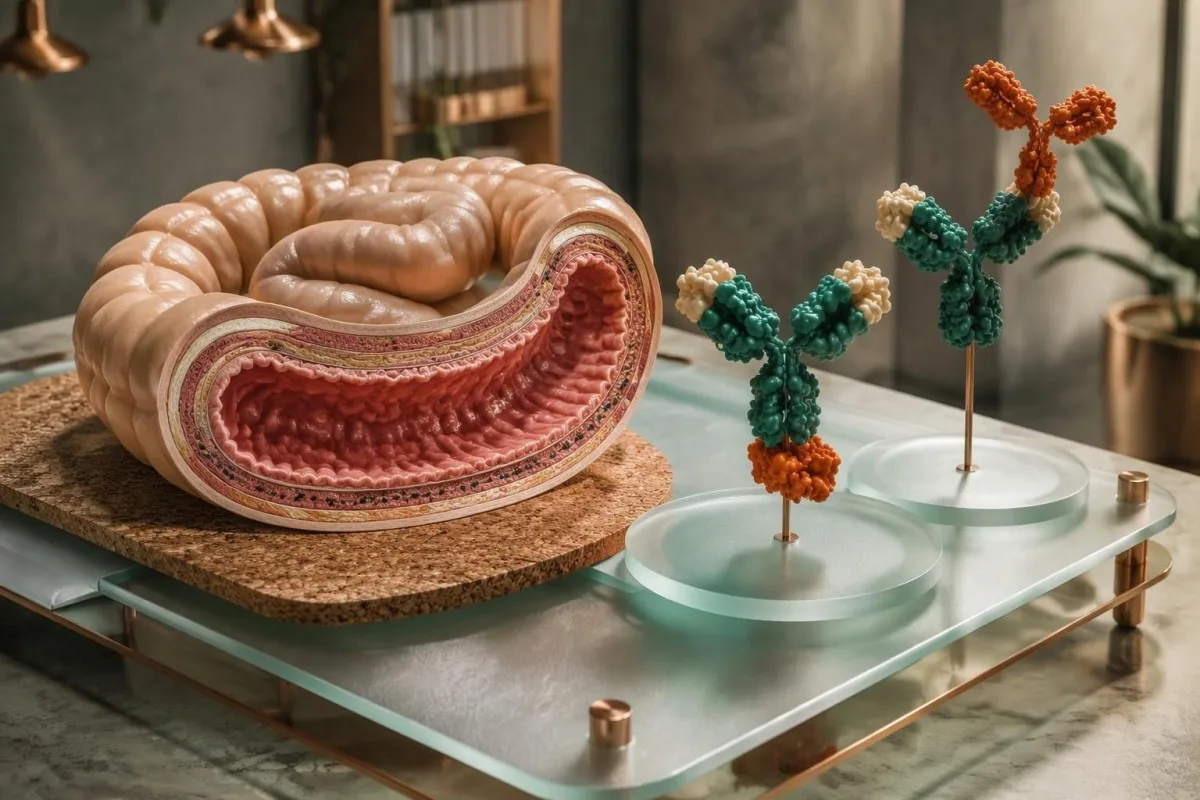
การตรวจระดับอินฟลิซิแมบใช้ความเข้มข้นของยาควบคู่กับการตรวจหาแอนติบอดีเพื่ออธิบายการสูญเสียการควบคุม IBD ระดับยาต่ำโดยไม่มีแอนติบอดีในระดับสูงอย่างมีนัยสำคัญบ่งชี้ว่าได้รับยาไม่เพียงพอ ส่วนระดับยาต่ำร่วมกับแอนติบอดีในระดับสูงอย่างต่อเนื่องบ่งชี้ว่ามีการกำจัดยาโดยอาศัยภูมิคุ้มกัน หากยังมีการอักเสบที่กำลังดำเนินอยู่แม้ได้รับยาอย่างเพียงพอ อาจบ่งชี้ถึงความล้มเหลวของกลไกการออกฤทธิ์ แต่ควรสรุปเช่นนั้นหลังจากยืนยันการอักเสบ การเก็บตัวอย่างที่ถูกต้อง และเป้าหมายที่เหมาะสมกับวัตถุประสงค์การรักษาแล้วเท่านั้น.

ประเด็นสำคัญ
- ผลตรวจที่จับคู่กัน ช่วยแยกการได้รับอินฟลิซิแมบไม่เพียงพอออกจากการกำจัดยาที่สัมพันธ์กับแอนติบอดี แต่ผลตรวจอย่างใดอย่างหนึ่งเพียงอย่างเดียวไม่ได้พิสูจน์สาเหตุที่อาการกลับมา.
- การเก็บตัวอย่างก่อนให้ยา หมายถึงการเก็บตัวอย่างส่งตรวจทางห้องปฏิบัติการก่อนเริ่มให้ยาทางหลอดเลือดดำครั้งถัดไป ไม่ใช่ 2 วันหลังจากนั้น.
- เกณฑ์ระดับยาในช่วงคงสภาพอาการ แตกต่างกัน: แนวทางของ AGA ปี 2017 แนะนำระดับอย่างน้อย 5 µg/mL สำหรับการติดตามแบบตอบสนองต่อปัญหา ขณะที่ฉันทามติของผู้เชี่ยวชาญระบุช่วง 5–10 µg/mL สำหรับช่วงคงสภาพอาการ.
- ระดับอินฟลิซิแมบต่ำ โดยไม่มีแอนติบอดี อาจเกิดจากการกำจัดยาเร็วขึ้น การสูญเสียโปรตีนทางลำไส้ การให้ยาล่าช้า หรือระยะห่างระหว่างการให้ยานานเกินไป.
- แอนติบอดีต่ออินฟลิซิแมบ มีความสำคัญมากที่สุดเมื่อพบอย่างต่อเนื่อง มีนัยสำคัญสำหรับการตรวจวิเคราะห์นั้น และมีระดับยาต่ำมากหรือตรวจไม่พบ.
- ความล้มเหลวเชิงกลไกที่อาจเกิดขึ้น ต้องมี IBD ที่กำลังดำเนินอยู่ซึ่งยืนยันได้อย่างเป็นรูปธรรม แม้ได้รับยาในระดับเพียงพอ; อาการท้องเสียร่วมกับระดับยาต่ำสุด 8 µg/mL ไม่เพียงพอที่จะยืนยันภาวะนี้.
- หน่วยของการตรวจวิเคราะห์ ใช้แทนกันไม่ได้: infliximab 1 µg/mL เท่ากับ 1 mg/L แต่ไม่สามารถแปลงหน่วย U/mL และ AU/mL ของแอนติบอดีให้เป็นหน่วยอื่นได้แบบครอบคลุมทุกกรณี.
- การเปลี่ยนแปลงการรักษา ควรปรึกษาทีมดูแล IBD ของคุณ; ในบางกรณีที่ตอบสนองต่อการรักษาลดลง อาจพิจารณาให้ระดับยาอยู่ที่ 10–15 µg/mL ก่อนเลิกใช้ infliximab.
การตรวจระดับอินฟลิซิแมบบอกอะไรได้จริง ๆ?
หนึ่ง การตรวจระดับ infliximab วัดปริมาณ infliximab ที่หมุนเวียนอยู่ในกระแสเลือด โดยมักตรวจร่วมกับ แอนติบอดีต้านยา, เพื่อประเมินว่าร่างกายได้รับยาไม่เพียงพอหรือมีการกำจัดยาโดยภูมิคุ้มกันหรือไม่ ผลระดับยา 2 µg/mL ที่ตรวจไม่พบแอนติบอดีเป็นประเด็นที่ต้องพิจารณาต่างจากระดับยา 2 µg/mL ที่พบแอนติบอดีสูงอย่างต่อเนื่อง; ไม่ว่ากรณีใดก็ไม่ได้หมายความโดยอัตโนมัติว่าต้องหยุดยา.
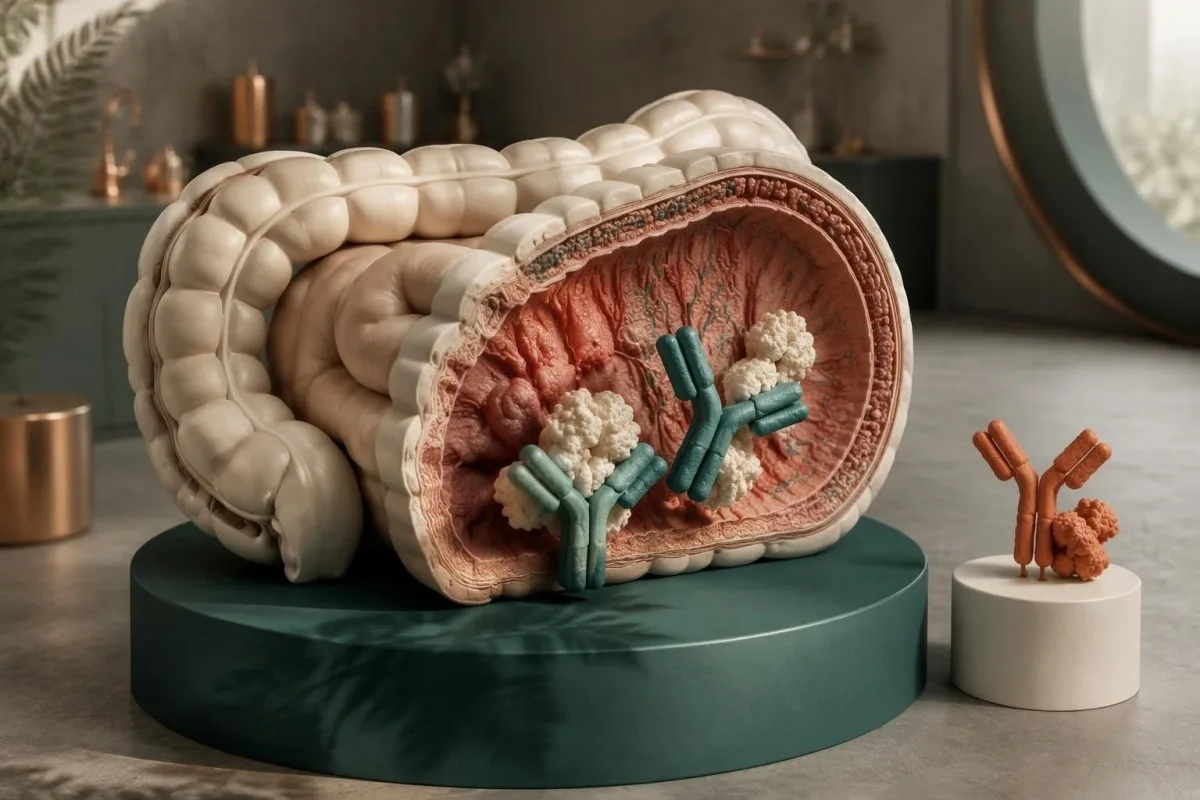
การติดตามระดับยาเพื่อการรักษาแบบตอบสนองต่ออาการ คือการตรวจที่ทำเมื่ออาการแย่ลงหรือมีหลักฐานว่าโรคกำลังดำเนินอยู่ ซึ่งแตกต่างจากการติดตามเชิงรุกในช่วงที่ดูเหมือนโรคสงบ: ระดับยาต่ำสุดสมมติที่ 4 µg/mL อาจเป็นเหตุให้ตรวจเพิ่มเติมเมื่อมีอาการกำเริบที่ยืนยันแล้ว แต่เมื่อผลส่องกล้องและตัวบ่งชี้จากอุจจาระแสดงว่าหายจากการอักเสบอย่างต่อเนื่อง ก็อาจต้องพิจารณาในแง่มุมที่ต่างออกไป.
Infliximab ยับยั้ง ทูเมอร์เนโครซิสแฟกเตอร์, ซึ่งมักเรียกย่อว่า TNF; การตรวจความเข้มข้นของยาไม่ได้วัดว่า TNF ทุกสัญญาณในลำไส้ถูกทำให้เป็นกลางแล้วหรือไม่ ผลตรวจในซีรัมที่ 7 µg/mL วัดปริมาณยาในกระแสเลือด ไม่ใช่ฤทธิ์ของยาในลำไส้แต่ละส่วนที่ได้รับผลกระทบ หรือระดับการหายของการอักเสบในลำไส้.
การแปลผลในทางปฏิบัติต้องพิจารณาข้อมูลอย่างน้อย 3 ด้าน ได้แก่ ความเข้มข้นของยา ผลตรวจแอนติบอดี และกิจกรรมของโรคที่ยืนยันได้อย่างเป็นรูปธรรม การตอบสนองต่อการรักษาก่อนหน้านี้ก็สำคัญเช่นกัน—อาการที่กลับมาอีกหลังควบคุมโรคได้ 18 เดือนถือเป็นการสูญเสียการตอบสนองภายหลัง ขณะที่การควบคุมโรคไม่ได้ตั้งแต่เริ่มรักษาก่อให้เกิดข้อสงสัยที่ต่างออกไปเกี่ยวกับระดับยาช่วงชักนำให้เกิดการตอบสนองและกลไกการรักษา.
คันเตสตีเป็น เครื่องวิเคราะห์ผลเลือด AI ที่ช่วยให้ผู้อ่านเข้าใจผลตรวจ infliximab และแอนติบอดีควบคู่กัน โดยไม่ตีความผลตรวจทางห้องปฏิบัติการ 1 ค่าเป็นคำสั่งปรับขนาดยา แพลตฟอร์มของเราดำเนินงานโดย Kantesti LTD, UK Company No. 17090423; ข้อมูลเกี่ยวกับ องค์กรของเรา แยกต่างหากจากหลักฐานทางคลินิกที่สนับสนุนการติดตามระดับยาเพื่อการรักษา.
ควรเก็บตัวอย่างตรวจระดับอินฟลิซิแมบช่วงระดับยาต่ำสุดเมื่อใด?
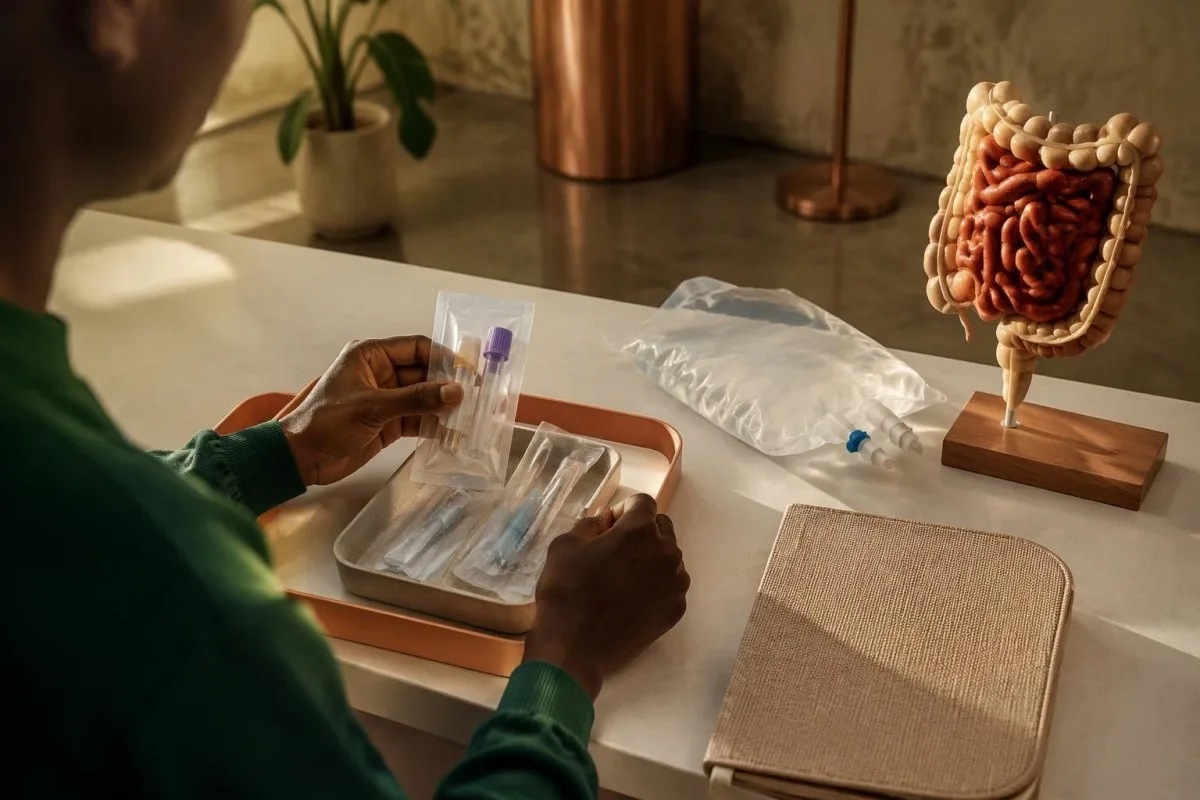
ระดับยา infliximab ชนิดให้ทางหลอดเลือดดำ ณ จุดต่ำสุด ควรเก็บตัวอย่างทันทีก่อนเริ่มให้ยาครั้งถัดไป ซึ่งเป็นช่วงที่ความเข้มข้นของยาใกล้ระดับต่ำสุดในรอบการให้ยานั้น ตัวอย่างที่เก็บหลังให้ยา 2 วันไม่ใช่ระดับยาต่ำสุด และไม่ควรนำไปเปรียบเทียบโดยตรงกับเป้าหมายระดับยาบำรุงรักษาก่อนให้ยา.
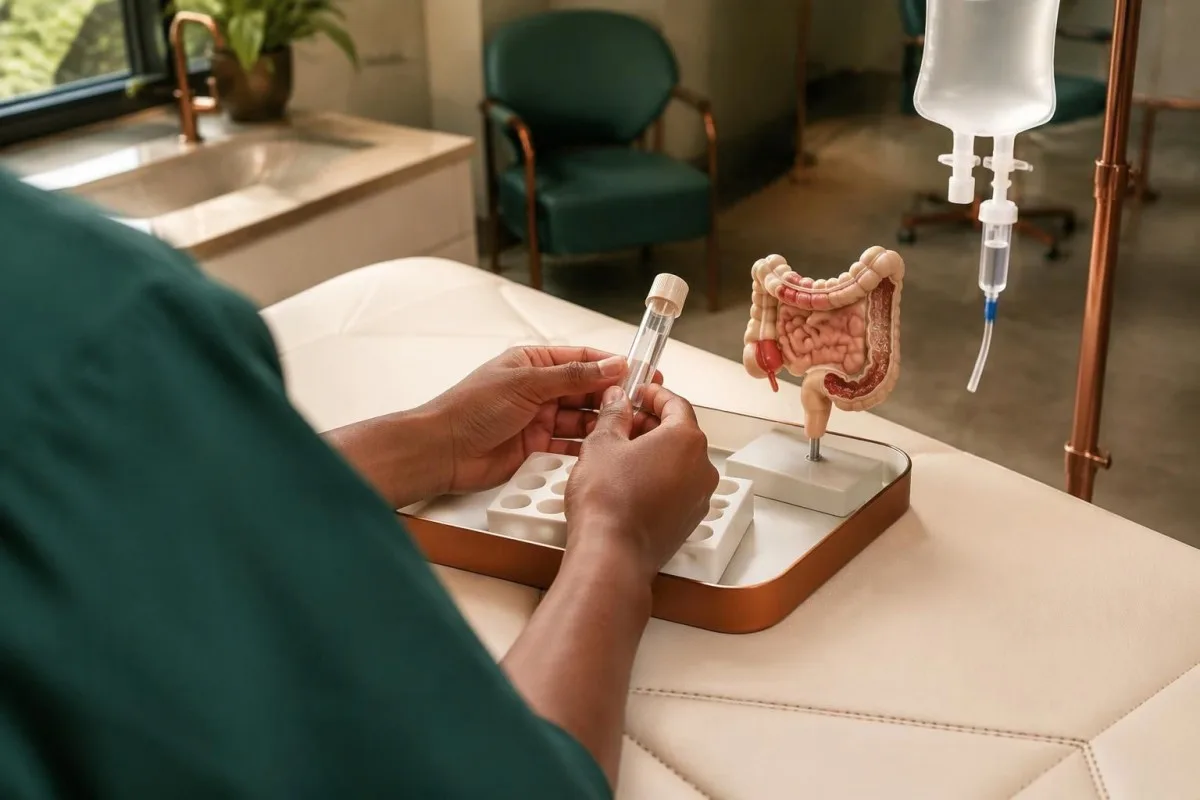
ระยะเวลาที่เก็บตัวอย่างอาจเปลี่ยนความหมายที่เห็นได้ของผลตรวจ โดยที่ประสิทธิผลของการรักษาไม่เปลี่ยนแปลง ตัวอย่างเช่น ค่า 18 µg/mL สมมติที่เก็บไม่นานหลังให้ยา และค่า 3 µg/mL ที่เก็บก่อนให้ยาครั้งถัดไป อาจเป็นผลจากรอบการให้ยาเดียวกัน—ไม่ใช่การทรุดลงอย่างฉับพลันระหว่างสถานะการรักษา 2 ช่วงที่เป็นอิสระต่อกัน.
บันทึกวันที่ให้ยาครั้งก่อน ขนาดยาจริงเป็น mg ช่วงห่างตามกำหนด และเวลาเก็บตัวอย่างก่อนแปลผลรายงาน หากเลื่อนการให้ยาทุก 8 สัปดาห์ออกไปจนถึงสัปดาห์ที่ 10 ความเข้มข้นที่ได้จะสะท้อนช่วงปลอดยาที่ยาวนานขึ้น; จึงไม่สามารถตอบได้อย่างชัดเจนว่าตารางการให้ยาทุก 8 สัปดาห์เดิมทำให้ได้รับยาในระดับเพียงพอหรือไม่.
Collection from a line recently used to administer infliximab can contaminate the specimen and produce a misleadingly high result. Ask the infusion service about its collection protocol, and tell it if sampling occurred after treatment started; the timing principles resemble other pre-dose medication tests, although their targets differ.
Fasting is generally not required for the infliximab concentration itself, but another test ordered during the same visit may have preparation requirements. Our อธิบายวิธีการลดสัญญาณรบกวนที่หลีกเลี่ยงได้ explains how to document medication timing; for this test, an accurate infusion timeline usually matters more than an 8-hour fast.
ระดับอินฟลิซิแมบเท่าใดจึงถือว่าเพียงพอ?
ไม่มี no universal adequate infliximab trough for every patient, disease phenotype, assay, and treatment phase. The 2017 AGA guideline suggested at least 5 µg/mL during reactive maintenance monitoring, while a 2021 expert consensus described maintenance concentrations of 5–10 µg/mL and higher exposure in selected loss-of-response situations.
The AGA benchmark of at least 5 µg/mL is a clinical decision aid, not a healthy-population reference range (Feuerstein et al., 2017). Infliximab is a prescribed biologic: an untreated person normally has no circulating infliximab, so a laboratory's therapeutic interval should never be read like the normal range for sodium.
The TAXIT trial enrolled 263 adults with stable responses and optimized intravenous infliximab toward 3–7 µg/mL before randomized follow-up. Its primary remission endpoint did not improve with concentration-based dosing, although some secondary outcomes favored that approach; this explains why the historical 3–7 µg/mL window is useful context rather than a universal modern target (Vande Casteele et al., 2015).
Cheifetz et al. (2021) recommended considering exposure of 10–15 µg/mL before discontinuing infliximab for secondary loss of response in selected patients. This is expert consensus, not proof that everyone should be escalated to 15 µg/mL; fistulas, endoscopic goals, disease severity, safety, and prior optimization affect whether that reasoning applies.
A concentration of 12 µg/mL is not automatically toxic, and a concentration of 4 µg/mL does not automatically require escalation in an asymptomatic patient with documented healing. Unlike the narrower toxicity discussions around some ยาอื่นๆ ที่ติดตามระดับต่ำสุด, infliximab has no single established serum toxicity cutoff that dictates action.
| ระดับ | ช่วง | ความหมาย |
|---|---|---|
| Historical TAXIT optimization window | 3–7 µg/mL | Studied in adults with stable responses; not a universal threshold for active disease or fistula healing. |
| AGA reactive maintenance benchmark | At least 5 µg/mL | Suggested in the 2017 guideline for reactive monitoring; interpret alongside objective activity and the assay. |
| Expert-consensus maintenance range | 5–10 µg/mL | Described by the 2021 consensus; the appropriate goal varies with disease phenotype and desired outcome. |
| Selected loss-of-response reassessment | 10–15 µg/mL | Exposure experts suggest considering before abandoning treatment in selected cases; not a routine target or toxicity range. |
เหตุใดระดับอินฟลิซิแมบจึงต่ำโดยไม่มีแอนติบอดี?
Low infliximab levels with no significant antibodies usually suggest pharmacokinetic underexposure: too little drug remains available over the dosing interval. A trough of 1.5 µg/mL can reflect faster clearance, intestinal protein loss, a delayed infusion, or insufficient dose or frequency—not necessarily failure of TNF blockade as a treatment mechanism.

Severe intestinal disease can increase infliximab clearance and allow protein, including therapeutic antibody, to be lost through the bowel. A hypothetical patient with albumin of 28 g/L and a trough of 1 µg/mL therefore needs assessment of disease burden and protein loss, not just a question about whether the infusion was attended.
Low albumin is associated with faster infliximab clearance, but it is not a direct measure of drug binding or an instruction to apply a free-drug correction. Albumin of 30 g/L and 40 g/L may provide different clearance context; our คู่มือการตีความโปรตีนในซีรั่ม explains why inflammation, liver synthesis, nutrition, and loss must be distinguished.
Infliximab is mainly broken down through protein-catabolic pathways rather than cleared unchanged by the kidneys. A creatinine of 90 µmol/L cannot predict the infliximab trough, and the medicine should not be interpreted using small-molecule renal dosing assumptions; body size, inflammatory burden, and treatment interruptions may be more informative.
Kantesti AI helps place a low trough alongside reported albumin, CRP, and infusion timing; 1 result cannot identify the clearance pathway by itself. Low albumin should not automatically trigger protein supplements, because inflammation also changes circulating proteins—as explained in our guide to inflammation and transferrin.
ระดับยาต่ำร่วมกับการมีแอนติบอดีบ่งชี้อะไร?
Low or undetectable infliximab with persistent high antibodies suggests immune-mediated pharmacokinetic failure: antibodies can accelerate clearance, neutralize drug activity, or both. A trough below an assay's 0.5 µg/mL quantification limit with a substantial antibody result is more concerning than a weak antibody signal alongside a maintained drug concentration.

Anti-infliximab antibody tests usually detect binding antibodies; they do not all directly measure neutralizing activity. A positive result of 20 U/mL therefore identifies an assay-defined antibody signal, not a universal percentage of blocked infliximab or a precise prediction of how much benefit remains.
Antibody persistence and magnitude influence whether dose optimization is likely to recover exposure. Cheifetz et al. (2021) described low-titer antibodies as below 10 U/mL for the homogeneous mobility shift assay specifically; that threshold must not be transferred to an ELISA reporting AU/mL or to another laboratory's calibration.
A single low antibody result may be transient or become less clinically relevant after supervised treatment optimization. Repeating paired drug and antibody testing can distinguish a 1-time signal from a rising pattern, but severe disease or an infusion reaction may require action before a second result is available.
Antibodies to infliximab are not the same as antibodies against your own bowel, and they do not by themselves diagnose an immediate allergy. Our explanation of ประเภทผลแอนติบอดีที่เป็นบวก helps separate these concepts; breathlessness or faintness during an infusion still requires immediate attention regardless of the antibody number.
เมื่อใดที่ระดับยาต่ำสุดซึ่งเพียงพอบ่งชี้ถึงความล้มเหลวของกลไกการออกฤทธิ์?
ความล้มเหลวเชิงกลไกที่อาจเกิดขึ้น means objectively active IBD persists despite sufficient infliximab exposure for the treatment goal. A trough of 8 µg/mL with confirmed active colitis may raise this possibility, but selected patients need further exposure optimization before clinicians conclude that another inflammatory pathway should be targeted.

An adequate serum concentration cannot prove that TNF is the only pathway driving a person's current disease. Persistent endoscopic activity with a trough of 12 µg/mL is more supportive of a mechanism problem than the same concentration with normal objective testing and symptoms from bile acid diarrhea.
Calling treatment failure at exactly 5 µg/mL can be premature when the goal is fistula control or substantial endoscopic improvement. The 10–15 µg/mL reassessment discussed in the 2021 consensus provides a safeguard against abandoning an under-optimized treatment, but it is not a requirement to escalate every patient with symptoms.
Objective evidence also has limits: CRP of 3 mg/L does not exclude active IBD, especially in people whose CRP has remained low during previous flares. Borderline stool results need context and sometimes repetition; our guide to ค่ากลางของ fecal calprotectin explains why an isolated intermediate value should not determine a biologic switch.
The strongest case for changing mechanism combines 3 findings: documented inflammation, adequate exposure on a correctly timed sample, and an inadequate clinical response despite appropriate optimization. Structural complications, such as a fixed Crohn's stricture, can also cause symptoms that neither more infliximab nor a different biologic will reliably reverse.
ผลตรวจแอนติบอดีเป็นบวกได้หรือไม่เมื่อระดับอินฟลิซิแมบเพียงพอ?
Antibodies can be detected while infliximab remains measurable or adequate, particularly with drug-tolerant assays. A trough of 7 µg/mL and a weak positive antibody result do not automatically mean treatment failure; the assay, antibody trend, and evidence of disease activity determine how much weight that finding deserves.

Drug-tolerant methods can identify antibodies in samples containing infliximab that would interfere with some drug-sensitive methods. This greater analytical sensitivity may reveal early or low-level immunogenicity, but 1 newly detected signal does not necessarily establish clinically meaningful loss of response.
A qualitative positive result contains less information than a quantitative result with the assay's cutoff and units. A report reading only positive cannot distinguish a value just above a 10 AU/mL cutoff from a much larger signal; our guide to การทดสอบเชิงคุณภาพและเชิงปริมาณ explains what each format can establish.
Compare antibody trajectories using the same laboratory method whenever feasible. Hypothetical results of 12, 15, and 13 AU/mL across 3 correctly timed visits may carry a different implication from 12, 80, and 200 AU/mL, although analytical variability and clinical findings still prevent interpretation from trend alone.
คันเตสตีเป็น แพลตฟอร์มการแปลผลตรวจเลือดของ AI that helps distinguish a reported antibody cutoff from a treatment target. When the report lacks the method or units, our interpretation should preserve that uncertainty rather than labeling 1 positive result as proof that infliximab has stopped working.
เหตุใดวิธีการตรวจทางห้องปฏิบัติการและหน่วยของแอนติบอดีจึงสำคัญ?
Infliximab and antibody results are method-dependent, so values from different assays are not always interchangeable. Infliximab 1 µg/mL equals 1 mg/L, but antibody results in U/mL, AU/mL, or ng/mL do not have a universal conversion because laboratories use different standards, detection limits, and approaches to drug interference.
An assay may report free or functionally available drug differently from another method that detects a broader pool of circulating drug. Two laboratories can therefore produce somewhat different concentrations from similar specimens; a change from 6 to 8 µg/mL after switching methods may not represent a true gain in exposure.
Below the quantification limit means the assay cannot reliably assign a numerical concentration below its validated boundary. A report of less than 0.4 µg/mL is not proof of exactly 0 µg/mL, and greater than 100 U/mL cannot tell you whether the true antibody result is 110 or 1,000 U/mL.
Some laboratories use reflex antibody testing only when the drug concentration falls below a preset threshold. If antibodies were not tested because infliximab was 9 µg/mL, the result is not equivalent to antibodies negative; ask whether the antibody field says not performed, not detected, or below detection.
Kantesti's report interpretation should retain the assay name, units, and collection context instead of silently converting 20 AU/mL into another method's scale. Our ข้อมูลระเบียบวิธีทางคลินิก explains the distinction between technical interpretation and clinical decision-making; no AI explanation removes the need to confirm an unusual result with the reporting laboratory.
แพทย์ยืนยันได้อย่างไรว่าอาการที่กลับมาเป็น IBD?
Returning symptoms do not necessarily mean returning intestinal inflammation; clinicians combine stool markers, CRP, infection testing, endoscopy, and imaging as appropriate. Three loose stools daily with a trough of 6 µg/mL can arise from active IBD, an intestinal infection, bile acid diarrhea, or a functional bowel disorder.
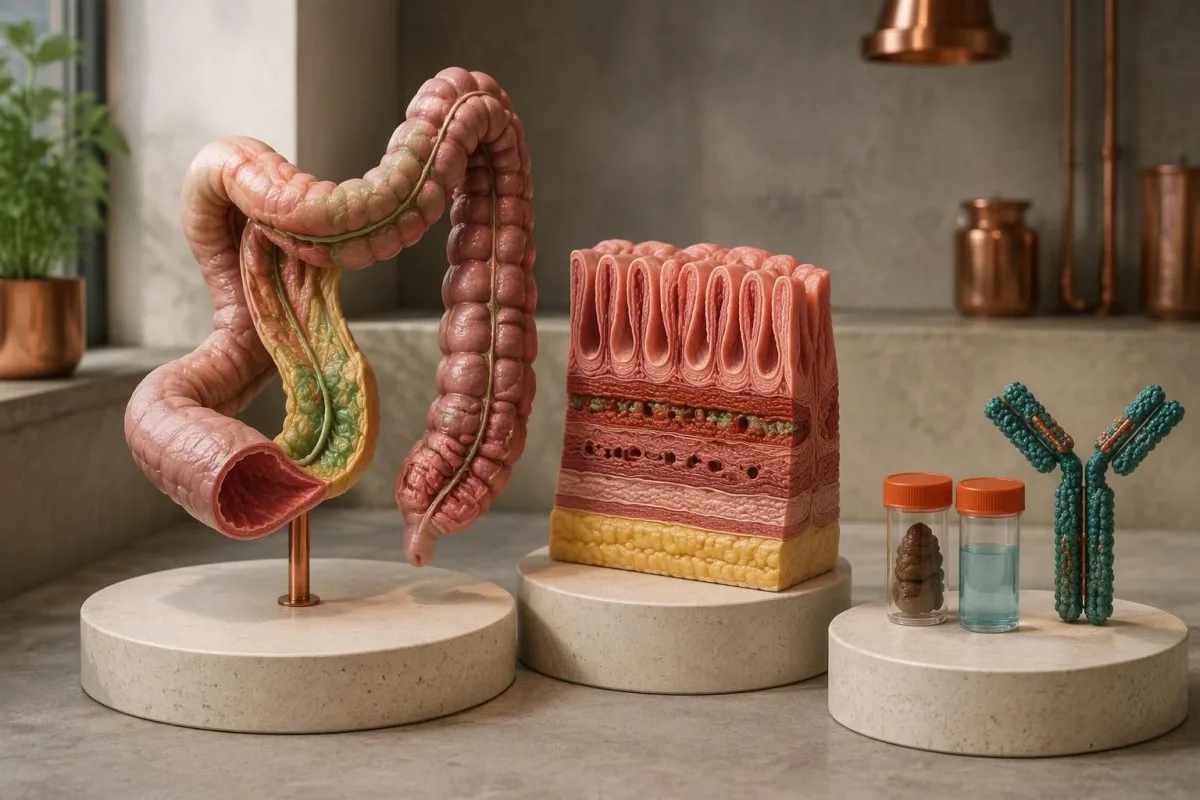
Fecal calprotectin and lactoferrin assess intestinal inflammatory activity rather than infliximab exposure. A hypothetical calprotectin of 800 µg/g adds different information from a trough of 2 µg/mL; our stool inflammation marker comparison explains why paired disease and drug measurements answer separate clinical questions.
C. difficile testing can be necessary during new or worsening diarrhea, even without recent antibiotics. A positive screening test and negative toxin result require contextual interpretation, not automatic classification as an IBD flare; our guide to ผลตรวจ C. difficile ที่ไม่สอดคล้องกัน describes why 2 test components can disagree.
Bile acid diarrhea is particularly relevant after ileal disease or resection and can persist despite controlled inflammation. A person with a trough of 10 µg/mL and reassuring objective IBD assessment may need a different evaluation; our explanation of SeHCAT retention results covers one diagnostic route where that test is available.
Bloating, gas, and altered stool frequency can also reflect bacterial overgrowth or carbohydrate malabsorption. At least 2 explanations can coexist with IBD, so a satisfactory trough should not end the assessment; our SIBO breath test guide explains preparation and limitations rather than treating breath testing as proof of every symptom's cause.
ทีมดูแล IBD อาจรับมือกับการได้รับยาไม่เพียงพออย่างไร?
Low exposure without substantial persistent antibodies may lead an IBD team to increase the infliximab dose, shorten the dosing interval, or address a treatment interruption. A common adult intravenous maintenance schedule is 5 mg/kg every 8 weeks after induction, but any adjustment requires individualized prescribing and reassessment of disease activity.
For a hypothetical 70 kg adult, 5 mg/kg corresponds to 350 mg before local preparation or rounding rules. Shortening an unchanged dose from every 8 weeks to every 6 weeks increases average drug administered per unit time by about 33%; the trough increase cannot be predicted as exactly 33% because clearance is not constant.
Increasing the dose and shortening the interval are not pharmacokinetically identical strategies. A larger dose changes peak exposure, while a shorter interval reduces time for concentrations to decline; a hypothetical patient whose symptoms repeatedly return during week 7 may prompt a different discussion from someone symptomatic throughout all 8 weeks.
A useful reassessment checks both exposure and the treatment outcome rather than declaring success because the trough rose. If infliximab increases from 2 to 9 µg/mL but calprotectin remains 900 µg/g and endoscopic disease persists, the new result has narrowed the explanation without necessarily improving the underlying disease.
The timing of repeat testing depends on severity, the revised schedule, and the clinical question; waiting 3 months is not appropriate for every deteriorating patient. Our แนวโน้มความปลอดภัยของยา explains why comparable dates and methods matter, but an app should never independently recommend extra infusions.
พิจารณาการเปลี่ยนการรักษาหรือการรักษาแบบผสมผสานเมื่อใด?
Persistent high antibodies with low drug may favor changing treatment, while adequate exposure with confirmed active IBD may favor switching to a different mechanism. Low-level immunogenicity can sometimes be addressed through supervised optimization or an immunomodulator, but a result of 15 U/mL alone cannot determine which option offers the best benefit-risk balance.
Switching within the anti-TNF class can make sense when infliximab previously controlled disease but antibody-associated clearance now prevents adequate exposure. Switching to another mechanism becomes more persuasive when inflammation persists with adequate exposure; these are 2 different failure patterns, not interchangeable reasons to choose the next medicine.
An immunomodulator such as azathioprine or methotrexate may reduce immunogenicity in selected circumstances, but adding one introduces additional monitoring and adverse-effect risks. Before azathioprine, TPMT testing and safety assessment can inform prescribing; TPMT and NUDT15 assessment do not replace ongoing CBC and liver monitoring, even when baseline results are normal.
If a person already takes a thiopurine, metabolite testing can help clarify exposure or a metabolism pattern before assuming combination therapy has failed. For example, 2 patients prescribed the same mg dose may have very different metabolite findings; our thiopurine treatment pattern guide explains why prescription dose alone is incomplete.
Restarting infliximab after a long interruption deserves a separate safety discussion because immunogenicity and infusion reactions can complicate re-exposure. A treatment gap of 6 months is not equivalent to a routine 1-week scheduling delay; never restart, add an immunomodulator, or stop an existing medicine based solely on an online interpretation.
การรักษาเพื่อชักนำให้โรคสงบ ภาวะทวารเชื่อม เด็ก และการฉีดยา ทำให้เป้าหมายเปลี่ยนไปหรือไม่?
Treatment phase, disease phenotype, age, and formulation can change the relevant exposure goal; intravenous maintenance targets should not be copied into every setting. Standard adult intravenous induction commonly uses 5 mg/kg at weeks 0, 2, and 6, and those early concentrations are interpreted differently from an established 8-week maintenance trough.

The 2021 expert consensus described induction goals of approximately 20–25 µg/mL at week 2, 15–20 µg/mL at week 6, and 7–10 µg/mL at week 14 (Cheifetz et al., 2021). These are consensus exposure goals influenced by disease phenotype and outcome, not interchangeable minimums from one definitive randomized trial.
Perianal fistula outcomes may require higher exposure than symptom control in uncomplicated luminal disease, but observational associations do not establish a universal healing threshold. A fistula still draining at 10 µg/mL may also need imaging, drainage of an abscess, or procedural care; raising the trough cannot substitute for addressing an undrained collection.
Children can have different clearance and dosing requirements, particularly with lower body weight or severe disease. An adult maintenance benchmark of 5 µg/mL should not become a parent-directed dosing rule; our discussion of การตีความ AI สำหรับเด็ก explains why pediatric specialist context and age-appropriate interpretation remain necessary.
Subcutaneous infliximab produces a different concentration-time profile from intermittent intravenous infusions, and availability and prescribing schedules vary internationally. A concentration of 15 µg/mL during injection treatment should not be labeled excessive merely because an intravenous report lists 3–7 µg/mL; the formulation, actual regimen, and sampling convention must be specified.
ผลตรวจที่จับคู่กันเปลี่ยนแนวทางการให้เหตุผลทางคลินิกอย่างไร?
Paired results guide the next question rather than dictate a prescription: low drug without antibodies suggests underexposure, low drug with persistent antibodies suggests immunogenicity, and adequate drug with inflammation raises possible mechanism failure. The following 4 examples are entirely hypothetical; the concentrations are illustrative, not personalized treatment recommendations.
Example 1: a 34-year-old with Crohn's disease has a true trough of 1.8 µg/mL, no detected antibodies, albumin of 29 g/L, and calprotectin of 1,100 µg/g. This pattern supports underexposure in active disease; confirming the infusion schedule and considering supervised optimization are more logical than immediately declaring TNF blockade ineffective.
Example 2: a 46-year-old with ulcerative colitis has infliximab below 0.4 µg/mL and antibodies above the laboratory's 100 U/mL reporting limit on 2 visits. Assuming the assay defines that antibody signal as substantial, persistent immunogenicity is plausible; simply increasing the dose may be less successful than a clinician-directed treatment change.
Example 3: a 28-year-old has a trough of 11 µg/mL, no significant antibodies, and repeatedly active colitis on endoscopy despite appropriate optimization. Example 4: a 61-year-old has the same 11 µg/mL trough but reassuring endoscopy and diarrhea after ileal resection; the first pattern raises mechanism failure, whereas the second prompts investigation of non-inflammatory causes.
คันเตสตีเป็น เครื่องมือวิเคราะห์ผลตรวจเลือดที่ขับเคลื่อนด้วย AI that helps organize these distinctions when the report and treatment details are supplied. Our คำอธิบายเทคโนโลยี AI describes how laboratory context informs interpretation; if a 2-week-old report lacks sampling timing, the missing information must stay visible rather than being guessed.
คุณควรนำอะไรไปในการติดตามผล และหลักฐานใดเกี่ยวข้อง?
Bring the complete report, infusion timeline, and objective disease results to your IBD review; these 3 evidence streams make paired drug-antibody testing actionable. Seek earlier care for severe deterioration rather than waiting for the next trough, and distinguish infliximab-specific clinical research from general educational publications about accompanying laboratory abnormalities.
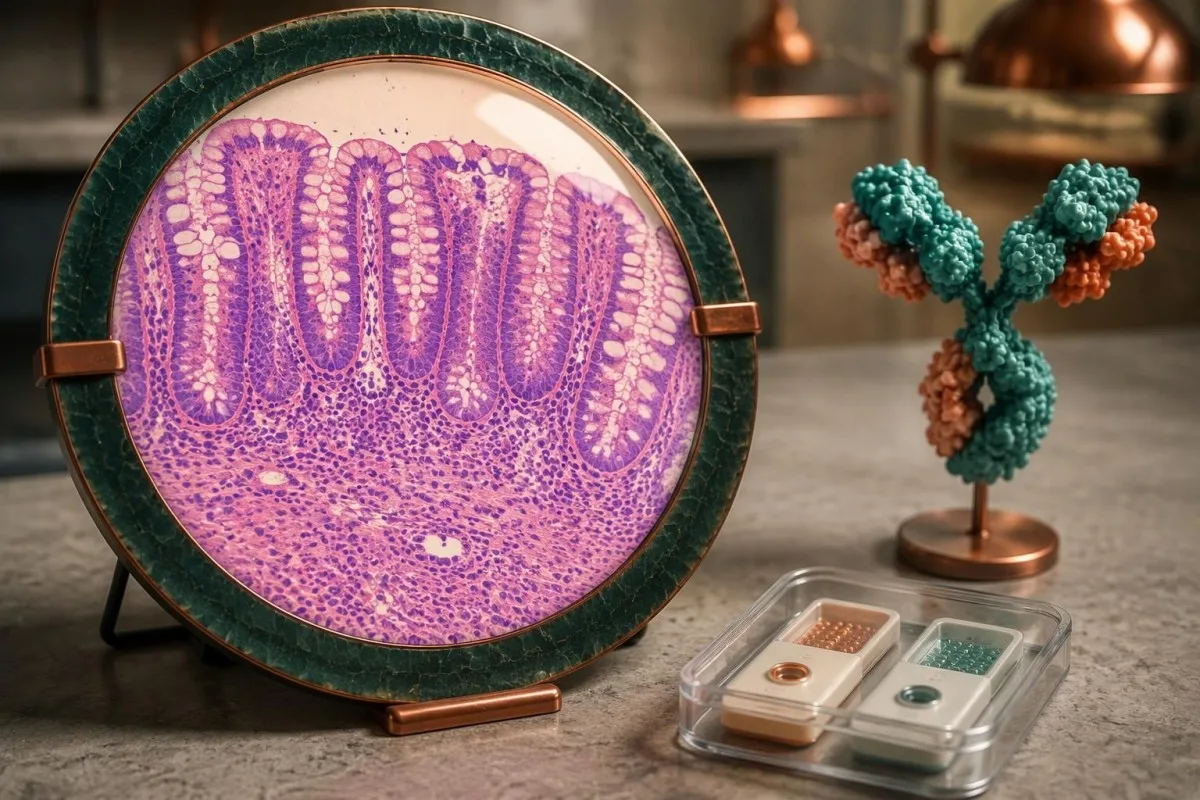
A useful review record includes the previous 2 infusion dates, actual dose, collection timing, assay name, antibody units, and recent CRP, albumin, and fecal calprotectin. Add symptom timing, steroid use, recent antibiotics, and missed doses; ask whether the proposed change addresses insufficient exposure, immunogenicity, active non-TNF disease, or a non-inflammatory explanation.
Contact your clinical team promptly for worsening diarrhea with dehydration, persistent vomiting, new significant bleeding, or fever of 38°C or higher while immunosuppressed. Severe abdominal pain with distension, fainting, or inability to keep fluids down may require emergency assessment; during an infusion, sudden breathing difficulty or collapse requires immediate staff attention, not interpretation of an antibody report.
Kantesti provides educational interpretation, not independent biologic prescribing, and our หลักการ AI ที่มีความรับผิดชอบ explain that boundary. A reassuring trough of 10 µg/mL does not establish that an infusion is safe during an acute illness; the treating service must assess symptoms, examination findings, and any necessary investigations.
The 2 Zenodo publications listed below address accompanying laboratory interpretation, not infliximab target validation: our คู่มือ RDW และเซลล์เม็ดเลือดแดง concerns anemia patterns, while our คำแนะนำ BUN และครีเอตินิน concerns renal and hydration context. These educational deposits are not evidence for anti-drug antibody cutoffs; the AGA guideline, TAXIT trial, and biologic-monitoring consensus supply the directly relevant clinical references.
คำถามที่พบบ่อย
ระดับอินฟลิซิแมบต่ำหมายความว่าอย่างไร?
ระดับ infliximab ต่ำหมายความว่าระดับยาที่หมุนเวียนในร่างกายต่ำกว่าเกณฑ์อ้างอิงที่เลือกไว้สำหรับระยะการรักษาและเป้าหมายนั้น แต่ไม่ได้หมายความโดยอัตโนมัติว่าควรหยุด infliximab ระดับยาช่วงต่ำสุดก่อนให้ยาครั้งถัดไปในการรักษาระยะคงสภาพที่ 2 µg/mL โดยไม่มีแอนติบอดีที่มีนัยสำคัญ อาจสะท้อนถึงการกำจัดยาที่เร็วขึ้น การสูญเสียโปรตีนทางลำไส้ หรือขนาดยาหรือช่วงห่างระหว่างการให้ยาที่ไม่เพียงพอ ส่วนระดับยาต่ำร่วมกับแอนติบอดีในระดับสูงอย่างต่อเนื่องกลับบ่งชี้ถึงการกำจัดยาโดยกลไกภูมิคุ้มกัน ทีมดูแลโรคลำไส้อักเสบของคุณควรแปลผลนี้โดยพิจารณาร่วมกับการประเมินกิจกรรมของโรคอย่างเป็นรูปธรรม ช่วงเวลาที่ให้ยา และวิธีตรวจวิเคราะห์.
ระดับอินฟลิซิแมบช่วงต่ำสุดที่เหมาะสมสำหรับโรคลำไส้อักเสบเรื้อรัง (IBD) คือเท่าใด?
ไม่มีระดับยา infliximab ช่วงปลายรอบการให้ยาที่เหมาะสมเพียงค่าเดียวสำหรับผู้ป่วย IBD ทุกคน แนวทางของ AGA ปี 2017 แนะนำให้มีระดับอย่างน้อย 5 µg/mL สำหรับการติดตามแบบตอบสนองระหว่างการรักษาเพื่อคงสภาพ ขณะที่ฉันทามติของผู้เชี่ยวชาญในปี 2021 ระบุความเข้มข้นระหว่างการรักษาเพื่อคงสภาพที่ 5–10 µg/mL ผู้ป่วยบางรายที่สูญเสียการตอบสนองในภายหลังอาจต้องประเมินซ้ำที่ระดับ 10–15 µg/mL ก่อนยุติการรักษา การชักนำให้เกิดการตอบสนอง ภาวะรูทะลุ และการรักษาแบบฉีดใต้ผิวหนังต้องพิจารณาบริบทที่แตกต่างกัน ดังนั้นช่วงอ้างอิงของห้องปฏิบัติการจึงไม่ใช่เป้าหมายการปรับขนาดยาที่ใช้ได้กับทุกกรณี.
ฉันควรตรวจระดับยา infliximab เมื่อใด?
For intravenous infliximab, a trough sample should be collected immediately before the next infusion begins. A sample obtained 2 days after an infusion is not comparable with routine pre-infusion targets. Record the last infusion date, dose, scheduled interval, and actual collection time, especially if an 8-week appointment was delayed. Subcutaneous infliximab has a different exposure profile, so sampling should follow the prescribing team's and laboratory's instructions.
แอนติบอดีต่ออินฟลิซิแมบสามารถหายไปได้หรือไม่?
แอนติบอดีต่อ infliximab ระดับต่ำบางครั้งอาจตรวจไม่พบอีกต่อไปหรือมีความเกี่ยวข้องทางคลินิกน้อยลง แต่การมีแอนติบอดีในระดับสูงอย่างต่อเนื่องร่วมกับระดับยาในร่างกายที่ต่ำมากนั้นแก้ไขได้ยากกว่า ฉันทามติของผู้เชี่ยวชาญในปี 2021 ระบุว่าแอนติบอดีไตเตอร์ต่ำหมายถึงระดับต่ำกว่า 10 U/mL สำหรับวิธีตรวจ homogeneous mobility shift assay ชนิดหนึ่ง โดยไม่สามารถนำค่าจุดตัดนี้ไปใช้กับวิธีตรวจทางห้องปฏิบัติการทุกวิธีได้ การปรับการรักษาภายใต้การดูแลหรือการใช้ยาปรับภูมิคุ้มกันอาจช่วยผู้ป่วยบางรายได้ ขณะที่ผู้ป่วยรายอื่นจำเป็นต้องเปลี่ยนการรักษา การตรวจซ้ำทั้งสองค่าในคราวเดียวกันอาจช่วยให้ทราบว่าภาวะดังกล่าวยังคงอยู่หรือไม่ แต่ผู้ป่วยไม่ควรปรับการรักษาด้วยตนเอง.
อินฟลิซิแมบอาจหยุดออกฤทธิ์ได้หรือไม่ แม้ว่าระดับยาจะปกติ?
อินฟลิซิแมบอาจควบคุม IBD ที่ยังมีการอักเสบอย่างชัดเจนไม่ได้ แม้ระดับยาในกระแสเลือดจะเพียงพอ ซึ่งทำให้สงสัยว่าอาจเกิดความล้มเหลวเชิงกลไก ระดับยาต่ำสุดก่อนให้ยาครั้งถัดไปที่ 10 µg/mL ไม่ได้รับประกันว่าเยื่อบุลำไส้จะหายดี หรือยืนยันว่า TNF เป็นเส้นทางเดียวที่ขับเคลื่อนโรค ก่อนเปลี่ยนกลไกการรักษา แพทย์จะยืนยันว่ามีการอักเสบ ประเมินภาวะแทรกซ้อนทางโครงสร้างหรือการติดเชื้อ และพิจารณาว่าระดับยาที่ได้รับเพียงพอต่อเป้าหมายการรักษาเฉพาะหรือไม่ อาการท้องเสียแม้ผลการประเมินตามหลักฐานเชิงวัตถุจะน่าไว้วางใจ ก็อาจมีสาเหตุที่ไม่ใช่การอักเสบได้.
ระดับอินฟลิซิแมบที่สูงเป็นอันตรายหรือไม่?
ความเข้มข้นของอินฟลิซิแมบที่สูงไม่ได้หมายความว่าจะเป็นอันตรายโดยอัตโนมัติ และไม่มีค่าขีดจำกัดความเป็นพิษในซีรัมที่กำหนดไว้เพียงค่าเดียวซึ่งใช้ได้กับผู้ป่วย IBD ทุกราย ผลตรวจ 15 µg/mL อาจตีความได้แตกต่างกันในช่วงการให้ยานำ การรักษารูทวาร หรือการให้ยาทางใต้ผิวหนัง เมื่อเทียบกับการให้ยาทางหลอดเลือดดำเพื่อคงสภาพตามปกติ ความปลอดภัยขึ้นอยู่กับแผนการรักษาโดยรวม การติดเชื้อ ปฏิกิริยาจากการให้ยา และผลตรวจทางคลินิกอื่น ๆ มากกว่าความเข้มข้นเพียงอย่างเดียว อย่าข้ามการให้ยาหรือลดขนาดยาโดยไม่ได้ปรึกษาทีมผู้สั่งจ่ายยาของคุณ.
ทำไมผลตรวจแอนติบอดีต่ออินฟลิซิแมบของฉันจึงเปลี่ยนไปหลังจากเปลี่ยนห้องปฏิบัติการ?
ผลตรวจแอนติบอดีต่อ infliximab อาจเปลี่ยนแปลงหลังเปลี่ยนห้องปฏิบัติการ เนื่องจากวิธีตรวจแตกต่างกันในด้านการสอบเทียบ หน่วย ขีดจำกัดการตรวจวัด และความทนต่อยาที่หมุนเวียนอยู่ในกระแสเลือด ผลตรวจ 20 AU/mL ไม่สามารถแปลงเป็น U/mL หรือ ng/mL ได้อย่างเป็นสากล วิธีตรวจที่ทนต่อยานี้อาจตรวจพบแอนติบอดีที่วิธีตรวจซึ่งไวต่อยาตรวจไม่พบ เมื่อยังตรวจวัด infliximab ได้ หากเป็นไปได้ ให้เปรียบเทียบแนวโน้มโดยใช้วิธีตรวจเดียวกัน และสอบถามว่ามีการตรวจแอนติบอดีจริงหรือไม่ แทนที่จะถูกละเว้นเนื่องจากกฎการตรวจแบบ reflex testing.
อ่านผลตรวจเลือดอย่างไร
อัปโหลดรายงานผลตรวจของคุณ แล้ว AI ของ Kantesti จะอธิบายตัวบ่งชี้ทางชีวภาพแต่ละรายการด้วยภาษาที่เข้าใจง่ายภายในไม่กี่วินาที มีผู้ใช้ทั่วโลกมากกว่า 2 ล้านคน.
เอกสารอ้างอิง
- ไคลน์, ที., มิตเชลล์, เอส., & เวเบอร์, เอช. (2026). การตรวจเลือด RDW: คู่มือฉบับสมบูรณ์เกี่ยวกับ RDW-CV, MCV และ MCHC. Kantesti AI การวิจัยทางการแพทย์. โดอิ
- ไคลน์, ที., มิตเชลล์, เอส., & เวเบอร์, เอช. (2026). อธิบายอัตราส่วน BUN/Creatinine: คู่มือการทดสอบการทำงานของไต. Kantesti AI การวิจัยทางการแพทย์. โดอิ
- Feuerstein JD et al. (2017). American Gastroenterological Association Institute Guideline on Therapeutic Drug Monitoring in Inflammatory Bowel Disease. Gastroenterology. โดอิ
- Vande Casteele N et al. (2015). Trough concentrations of infliximab guide dosing for patients with inflammatory bowel disease. Gastroenterology. โดอิ
- Cheifetz AS et al. (2021). A Comprehensive Literature Review and Expert Consensus Statement on Therapeutic Drug Monitoring of Biologics in Inflammatory Bowel Disease. The American Journal of Gastroenterology. โดอิ
- 2 ล้าน+การตรวจที่วิเคราะห์
- 127+ประเทศ
- 100+ภาษา
เกี่ยวกับทีมแพทย์


สัญญาณความน่าเชื่อถือ E-E-A-T
ประสบการณ์
การทบทวนเชิงคลินิกโดยแพทย์ที่นำโดยกระบวนการตีความผลตรวจในห้องแล็บ.
ความเชี่ยวชาญ
โฟกัสด้านเวชศาสตร์ห้องปฏิบัติการเกี่ยวกับพฤติกรรมของไบโอมาร์กเกอร์ในบริบททางคลินิก.
อำนาจ
ทบทวนทางการแพทย์โดย นพ. Thomas Klein พร้อมผลงานจาก นพ. Sarah Mitchell และศาสตราจารย์ ดร. Hans Weber.
ความน่าเชื่อถือ
การตีความที่อิงหลักฐาน พร้อมเส้นทางการติดตามที่ชัดเจนเพื่อลดความตื่นตระหนก.






ข้อจำกัดความรับผิดชอบทางการแพทย์
บทความนี้จัดทำเพื่อวัตถุประสงค์ด้านการศึกษาเท่านั้น และไม่ถือเป็นคำแนะนำทางการแพทย์ โปรดปรึกษาผู้ให้บริการด้านสุขภาพที่มีคุณสมบัติเหมาะสมเสมอสำหรับการตัดสินใจด้านการวินิจฉัยและการรักษา.
เผยแพร่แล้ว · ติดต่อทีมบรรณาธิการ
เผยแพร่โดย Kantesti Ltd จดทะเบียนในอังกฤษและเวลส์ เลขทะเบียนบริษัท. 17090423, ลอนดอน สหราชอาณาจักร.
