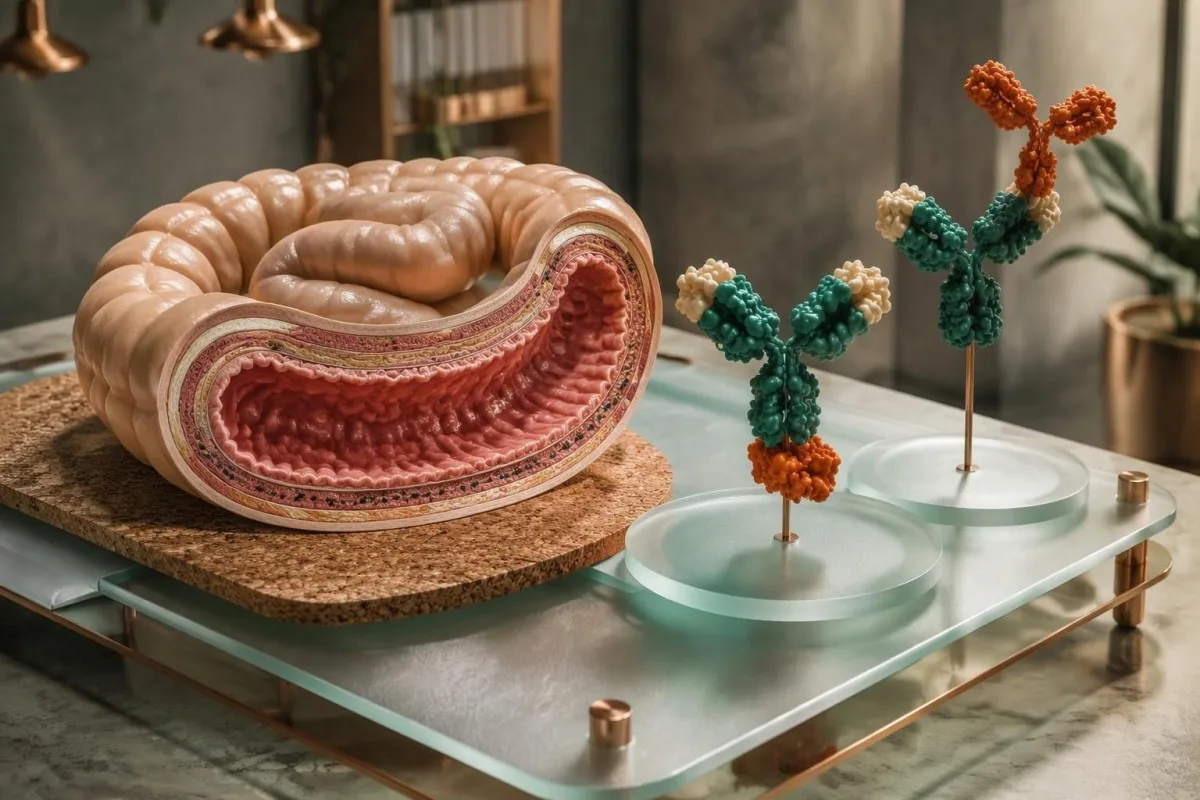
Infliximabipitoisuustesti yhdistää lääkeainepitoisuuden vasta-ainetulokseen, jotta IBD:n hallinnan menettämisen syy selviäisi. Matala lääkeainepitoisuus ilman merkittäviä vasta-aineita viittaa riittämättömään altistukseen; matala lääkeainepitoisuus ja jatkuvasti korkea vasta-ainepitoisuus viittaavat immuunivälitteiseen puhdistumaan. Aktiivinen tulehdus riittävästä altistuksesta huolimatta herättää epäilyn mekanistisesta hoidon epäonnistumisesta – mutta vasta, kun tulehdus ja näytteenoton oikea-aikaisuus on varmistettu ja hoidon tavoitteeseen sopiva tavoitepitoisuus määritelty.

Keskeiset huomiot
- Paritulokset erottavat riittämättömän infliksimabialtistuksen vasta-aineisiin liittyvästä puhdistumasta; kumpikaan tulos yksinään ei todista, miksi oireet palasivat.
- Näytteenotto ennen infuusiota tarkoittaa laboratoriokokeen ottamista ennen seuraavan laskimonsisäisen infuusion aloittamista, ei 2 päivää sen jälkeen.
- Ylläpitohoidon tavoitepitoisuudet vaihtelevat: vuoden 2017 AGA-ohjeistus ehdotti reaktiivisessa seurannassa vähintään 5 µg/mL:n pitoisuutta, kun taas asiantuntijakonsensus kuvaa ylläpitohoidon pitoisuudeksi 5–10 µg/mL.
- Matala infliksimabipitoisuus ilman vasta-aineita voi johtua nopeammasta puhdistumasta, proteiinin menetyksestä suolistoon, annostelun viivästymisestä tai liian pitkästä annosvälistä.
- Infliksimabivasta-aineet ovat tärkeimpiä silloin, kun ne ovat pysyviä, kyseiselle määritysmenetelmälle merkittäviä ja niihin liittyy hyvin pieni tai havaitsematon lääkeainepitoisuus.
- Mahdollinen mekanistinen hoidon epäonnistuminen edellyttää objektiivisesti aktiivista IBD:tä riittävästä lääkeainealtistuksesta huolimatta; ripuli ja jäännöspitoisuus 8 µg/mL eivät osoita sitä.
- Määrityksen yksiköt eivät ole keskenään vaihdettavissa: infliksimabia 1 µg/mL vastaa 1 mg/L, mutta vasta-aineyksiköitä U/mL ja AU/mL ei voi muuntaa yleispätevästi.
- Hoitomuutokset kuuluvat IBD-hoitotiimillesi; joissakin valikoiduissa hoitovasteen menetyksen tapauksissa altistuksen nostaminen tasolle 10–15 µg/mL voi olla aiheellista ennen infliksimabin käytön lopettamista.
Mitä infliximabipitoisuustesti oikeastaan kertoo?
An infliksimabipitoisuuden testi mittaa verenkierrossa olevan infliksimabin yleensä yhdessä lääkeainevasta-aineiden, kanssa, jotta voidaan selvittää riittämätöntä lääkeainealtistusta tai immuunivälitteistä lääkeaineen poistumaa. Tulos 2 µg/mL ilman havaittuja vasta-aineita herättää eri kysymyksen kuin tulos 2 µg/mL, johon liittyy pysyvästi suuria vasta-ainepitoisuuksia; kumpikaan ei automaattisesti tarkoita, että lääke on lopetettava.
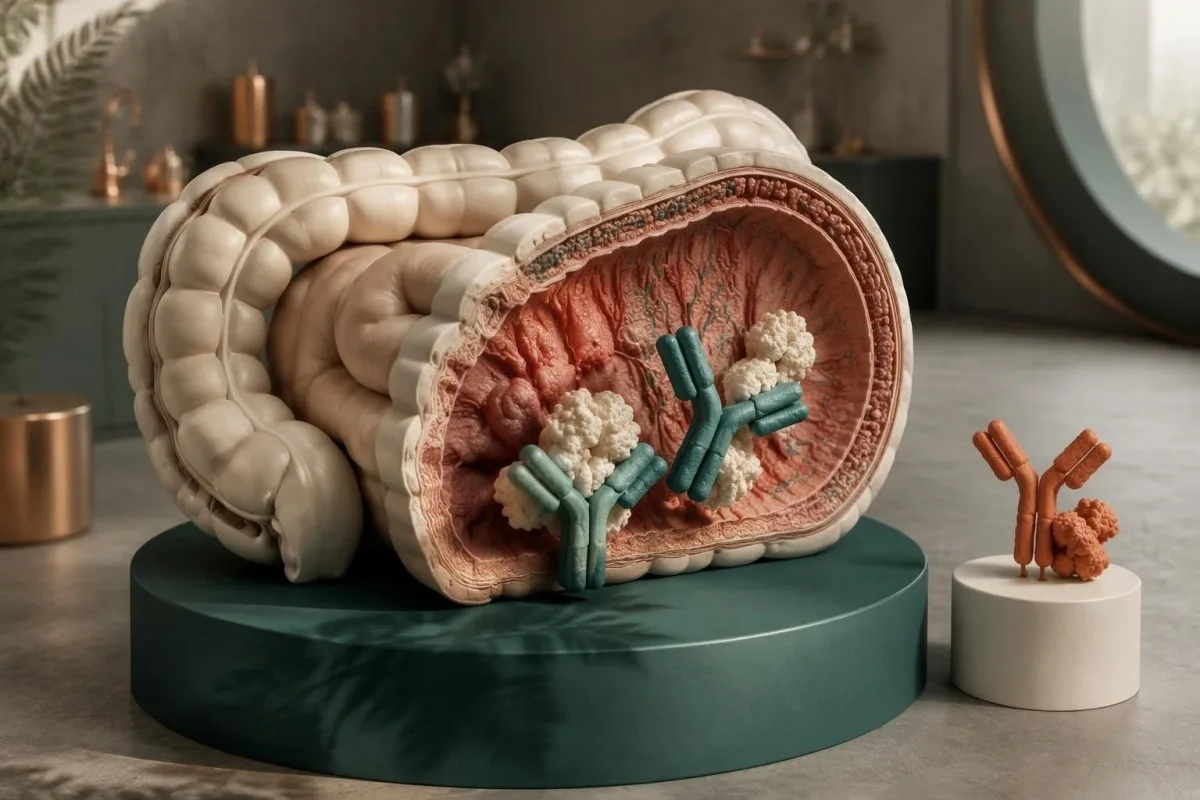
Reaktiivinen terapeuttinen lääkeaineseuranta tarkoittaa tutkimusta, joka tehdään oireiden pahentuessa tai aktiiviseen sairauteen viittaavan näytön perusteella. Se eroaa ennakoivasta seurannasta näennäisen remission aikana: hypoteettinen jäännöspitoisuus 4 µg/mL voi edellyttää lisäselvityksiä dokumentoidun pahenemisvaiheen aikana, mutta endoskopian ja ulostemarkkereiden osoittaessa pitkäkestoista paranemista siitä voidaan keskustella eri tavalla.
Infliksimabi estää tuumorinekroositekijää, josta käytetään yleisesti lyhennettä TNF; pitoisuustesti ei mittaa sitä, onko jokainen suoliston TNF-signaali neutraloitunut. Seerumin tulos 7 µg/mL mittaa verenkierrossa olevaa lääkettä, ei lääkkeen aktiivisuutta jokaisessa suolen sairastuneessa osassa eikä suoliston paranemisen astetta.
Käytännön tulkinnassa huomioidaan vähintään 3 tekijää: lääkeainepitoisuus, vasta-ainelöydökset ja objektiivinen taudin aktiivisuus. Myös aiempi hoitovaste on tärkeä—oireiden palaaminen 18 kuukauden hallinnan jälkeen merkitsee sekundaarista hoitovasteen menetystä, kun taas hoitotasapainon saavuttamatta jääminen aloitushoidon aikana herättää erilaisia kysymyksiä induktiohoidon aikaisesta lääkeainealtistuksesta ja hoidon vaikutusmekanismista.
Kantesti on Tekoälyinen verikoeanalysaattori joka auttaa lukijoita ymmärtämään infliksamibia koskevia yhdistelmälöydöksiä tulkitsematta yksittäistä 1 laboratoriotulosta annosteluohjeeksi. Alustaa ylläpitää Kantesti LTD, UK Company No. 17090423; tiedot aiheesta organisaatiossamme ovat erillisiä terapeuttista lääkeaineseurantaa tukevasta kliinisestä näytöstä.
Milloin infliksimabin jäännöspitoisuudet tulisi mitata?
Laskimonsisäisen infliksimabin jäännöspitoisuudet tulee mitata välittömästi ennen seuraavan infuusion aloittamista, jolloin pitoisuus on lähellä annosvälin alinta tasoa. 2 päivää infuusion jälkeen otettu näyte ei ole jäännöspitoisuusnäyte, eikä sitä tule verrata suoraan ennen infuusiota mitattaviin ylläpitohoidon tavoitepitoisuuksiin.
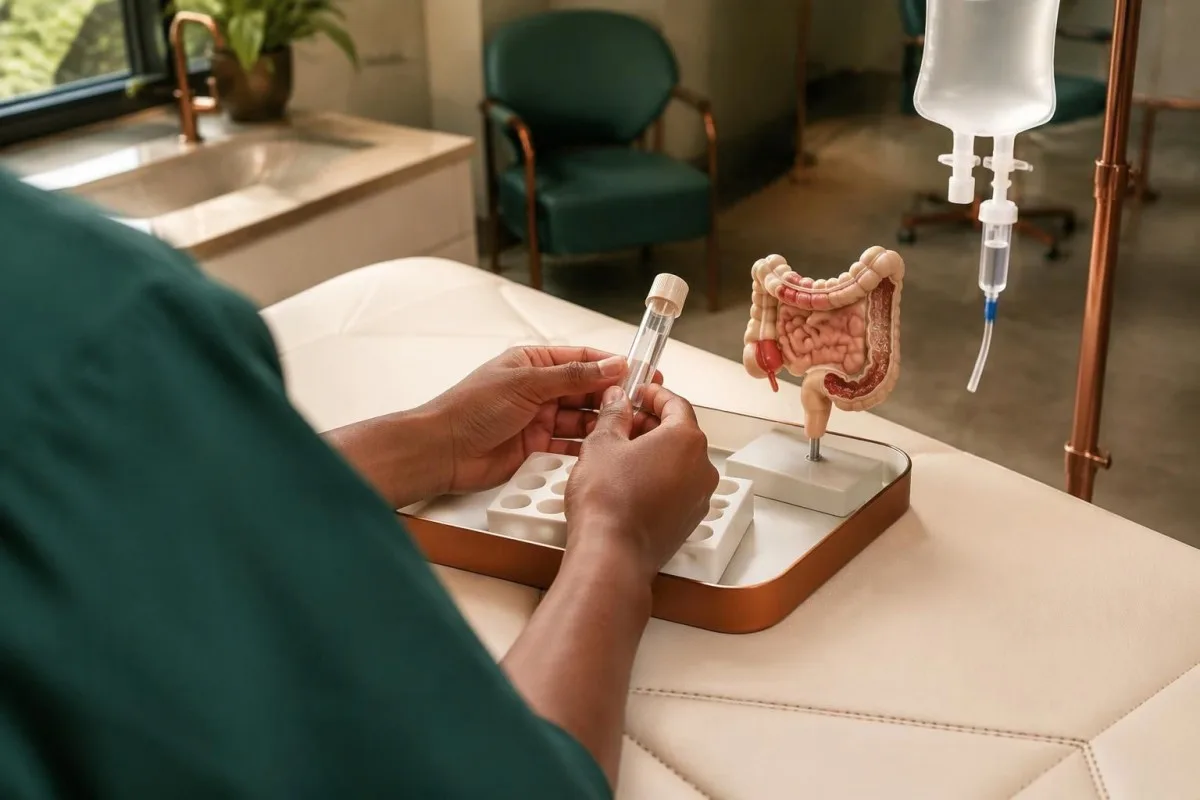
Näytteenoton ajoitus voi muuttaa tuloksen näennäistä merkitystä ilman, että hoidon teho muuttuu. Esimerkiksi hypoteettiset pitoisuudet 18 µg/mL pian infuusion jälkeen ja 3 µg/mL ennen seuraavaa infuusiota voivat kuvata samaa annostelusykliä—eivät äkillistä heikkenemistä kahden toisistaan riippumattoman hoitotilanteen välillä.
Kirjaa edellisen infuusion päivämäärä, todellinen annos milligrammoina, suunniteltu annosväli ja näytteenottoaika ennen tuloksen tulkintaa. Jos 8 viikon välein annettava infuusio viivästyy viikolle 10, pitoisuus kuvastaa pidempää lääketöntä väliä; sen perusteella ei voida luotettavasti arvioida, tarjosiko alkuperäinen 8 viikon annosteluaikataulu riittävän lääkeainealtistuksen.
Collection from a line recently used to administer infliximab can contaminate the specimen and produce a misleadingly high result. Ask the infusion service about its collection protocol, and tell it if sampling occurred after treatment started; the timing principles resemble other pre-dose medication tests, although their targets differ.
Fasting is generally not required for the infliximab concentration itself, but another test ordered during the same visit may have preparation requirements. Our ensivedosvalmisteluopas explains how to document medication timing; for this test, an accurate infusion timeline usually matters more than an 8-hour fast.
Mitä infliksimabipitoisuutta pidetään riittävänä?
On no universal adequate infliximab trough for every patient, disease phenotype, assay, and treatment phase. The 2017 AGA guideline suggested at least 5 µg/mL during reactive maintenance monitoring, while a 2021 expert consensus described maintenance concentrations of 5–10 µg/mL and higher exposure in selected loss-of-response situations.
The AGA benchmark of at least 5 µg/mL is a clinical decision aid, not a healthy-population reference range (Feuerstein et al., 2017). Infliximab is a prescribed biologic: an untreated person normally has no circulating infliximab, so a laboratory's therapeutic interval should never be read like the normal range for sodium.
The TAXIT trial enrolled 263 adults with stable responses and optimized intravenous infliximab toward 3–7 µg/mL before randomized follow-up. Its primary remission endpoint did not improve with concentration-based dosing, although some secondary outcomes favored that approach; this explains why the historical 3–7 µg/mL window is useful context rather than a universal modern target (Vande Casteele et al., 2015).
Cheifetz et al. (2021) recommended considering exposure of 10–15 µg/mL before discontinuing infliximab for secondary loss of response in selected patients. This is expert consensus, not proof that everyone should be escalated to 15 µg/mL; fistulas, endoscopic goals, disease severity, safety, and prior optimization affect whether that reasoning applies.
A concentration of 12 µg/mL is not automatically toxic, and a concentration of 4 µg/mL does not automatically require escalation in an asymptomatic patient with documented healing. Unlike the narrower toxicity discussions around some muiden lääkkeiden pitoisuutta juuri ennen annostelua mitattuna, infliximab has no single established serum toxicity cutoff that dictates action.
| Taso | Vaihteluväli | Mitä se tarkoittaa |
|---|---|---|
| Historical TAXIT optimization window | 3–7 µg/mL | Studied in adults with stable responses; not a universal threshold for active disease or fistula healing. |
| AGA reactive maintenance benchmark | At least 5 µg/mL | Suggested in the 2017 guideline for reactive monitoring; interpret alongside objective activity and the assay. |
| Expert-consensus maintenance range | 5–10 µg/mL | Described by the 2021 consensus; the appropriate goal varies with disease phenotype and desired outcome. |
| Selected loss-of-response reassessment | 10–15 µg/mL | Exposure experts suggest considering before abandoning treatment in selected cases; not a routine target or toxicity range. |
Miksi infliksimabipitoisuus on matala ilman vasta-aineita?
Low infliximab levels with no significant antibodies usually suggest pharmacokinetic underexposure: too little drug remains available over the dosing interval. A trough of 1.5 µg/mL can reflect faster clearance, intestinal protein loss, a delayed infusion, or insufficient dose or frequency—not necessarily failure of TNF blockade as a treatment mechanism.

Severe intestinal disease can increase infliximab clearance and allow protein, including therapeutic antibody, to be lost through the bowel. A hypothetical patient with albumin of 28 g/L and a trough of 1 µg/mL therefore needs assessment of disease burden and protein loss, not just a question about whether the infusion was attended.
Low albumin is associated with faster infliximab clearance, but it is not a direct measure of drug binding or an instruction to apply a free-drug correction. Albumin of 30 g/L and 40 g/L may provide different clearance context; our seerumin proteiinitulkintaopas explains why inflammation, liver synthesis, nutrition, and loss must be distinguished.
Infliximab is mainly broken down through protein-catabolic pathways rather than cleared unchanged by the kidneys. A creatinine of 90 µmol/L cannot predict the infliximab trough, and the medicine should not be interpreted using small-molecule renal dosing assumptions; body size, inflammatory burden, and treatment interruptions may be more informative.
Kantesti AI helps place a low trough alongside reported albumin, CRP, and infusion timing; 1 result cannot identify the clearance pathway by itself. Low albumin should not automatically trigger protein supplements, because inflammation also changes circulating proteins—as explained in our guide to inflammation and transferrin.
Mihin matala lääkeainepitoisuus ja vasta-aineet viittaavat?
Low or undetectable infliximab with persistent high antibodies suggests immune-mediated pharmacokinetic failure: antibodies can accelerate clearance, neutralize drug activity, or both. A trough below an assay's 0.5 µg/mL quantification limit with a substantial antibody result is more concerning than a weak antibody signal alongside a maintained drug concentration.
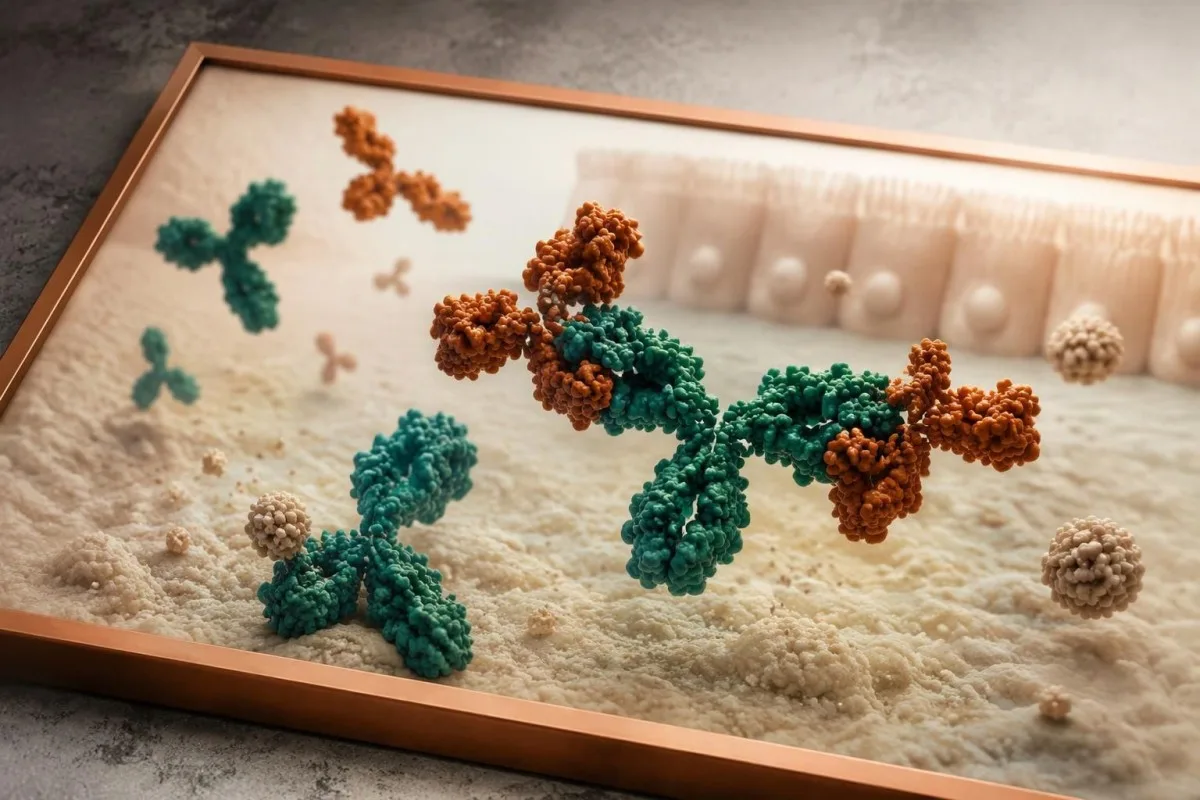
Anti-infliximab antibody tests usually detect binding antibodies; they do not all directly measure neutralizing activity. A positive result of 20 U/mL therefore identifies an assay-defined antibody signal, not a universal percentage of blocked infliximab or a precise prediction of how much benefit remains.
Antibody persistence and magnitude influence whether dose optimization is likely to recover exposure. Cheifetz et al. (2021) described low-titer antibodies as below 10 U/mL for the homogeneous mobility shift assay specifically; that threshold must not be transferred to an ELISA reporting AU/mL or to another laboratory's calibration.
A single low antibody result may be transient or become less clinically relevant after supervised treatment optimization. Repeating paired drug and antibody testing can distinguish a 1-time signal from a rising pattern, but severe disease or an infusion reaction may require action before a second result is available.
Antibodies to infliximab are not the same as antibodies against your own bowel, and they do not by themselves diagnose an immediate allergy. Our explanation of positiivisista vasta-ainetulostyypeistä helps separate these concepts; breathlessness or faintness during an infusion still requires immediate attention regardless of the antibody number.
Milloin riittävä jäännöspitoisuus viittaa mekanistiseen hoidon epäonnistumiseen?
Mahdollinen mekanistinen hoidon epäonnistuminen means objectively active IBD persists despite sufficient infliximab exposure for the treatment goal. A trough of 8 µg/mL with confirmed active colitis may raise this possibility, but selected patients need further exposure optimization before clinicians conclude that another inflammatory pathway should be targeted.
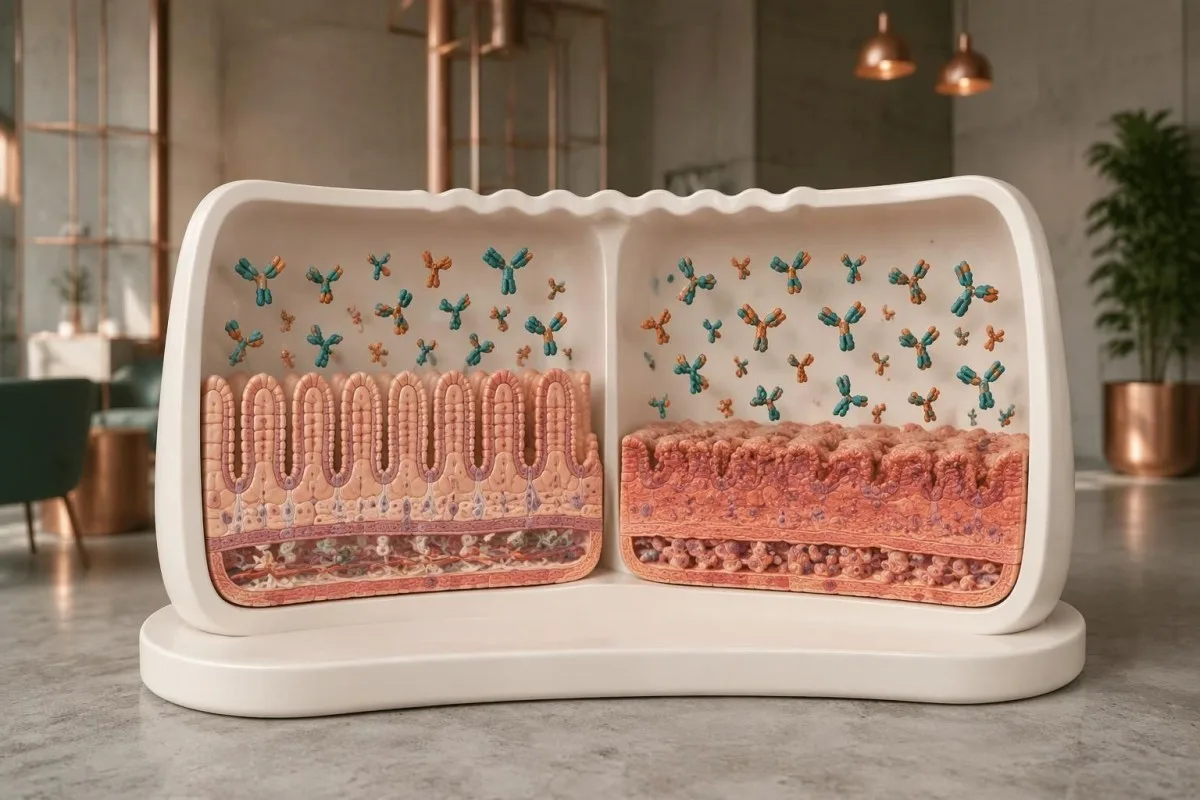
An adequate serum concentration cannot prove that TNF is the only pathway driving a person's current disease. Persistent endoscopic activity with a trough of 12 µg/mL is more supportive of a mechanism problem than the same concentration with normal objective testing and symptoms from bile acid diarrhea.
Calling treatment failure at exactly 5 µg/mL can be premature when the goal is fistula control or substantial endoscopic improvement. The 10–15 µg/mL reassessment discussed in the 2021 consensus provides a safeguard against abandoning an under-optimized treatment, but it is not a requirement to escalate every patient with symptoms.
Objective evidence also has limits: CRP of 3 mg/L does not exclude active IBD, especially in people whose CRP has remained low during previous flares. Borderline stool results need context and sometimes repetition; our guide to rajatapausulosteen kalprotektiini explains why an isolated intermediate value should not determine a biologic switch.
The strongest case for changing mechanism combines 3 findings: documented inflammation, adequate exposure on a correctly timed sample, and an inadequate clinical response despite appropriate optimization. Structural complications, such as a fixed Crohn's stricture, can also cause symptoms that neither more infliximab nor a different biologic will reliably reverse.
Voiko vasta-ainetulos olla positiivinen, vaikka infliksimabipitoisuus on riittävä?
Antibodies can be detected while infliximab remains measurable or adequate, particularly with drug-tolerant assays. A trough of 7 µg/mL and a weak positive antibody result do not automatically mean treatment failure; the assay, antibody trend, and evidence of disease activity determine how much weight that finding deserves.

Drug-tolerant methods can identify antibodies in samples containing infliximab that would interfere with some drug-sensitive methods. This greater analytical sensitivity may reveal early or low-level immunogenicity, but 1 newly detected signal does not necessarily establish clinically meaningful loss of response.
A qualitative positive result contains less information than a quantitative result with the assay's cutoff and units. A report reading only positive cannot distinguish a value just above a 10 AU/mL cutoff from a much larger signal; our guide to laadullisista ja määrällisistä testeistä explains what each format can establish.
Compare antibody trajectories using the same laboratory method whenever feasible. Hypothetical results of 12, 15, and 13 AU/mL across 3 correctly timed visits may carry a different implication from 12, 80, and 200 AU/mL, although analytical variability and clinical findings still prevent interpretation from trend alone.
Kantesti on AI verikoe-tulkinta-alusta that helps distinguish a reported antibody cutoff from a treatment target. When the report lacks the method or units, our interpretation should preserve that uncertainty rather than labeling 1 positive result as proof that infliximab has stopped working.
Miksi laboratoriomenetelmillä ja vasta-aineiden mittayksiköillä on merkitystä?
Infliximab and antibody results are method-dependent, so values from different assays are not always interchangeable. Infliximab 1 µg/mL equals 1 mg/L, but antibody results in U/mL, AU/mL, or ng/mL do not have a universal conversion because laboratories use different standards, detection limits, and approaches to drug interference.
An assay may report free or functionally available drug differently from another method that detects a broader pool of circulating drug. Two laboratories can therefore produce somewhat different concentrations from similar specimens; a change from 6 to 8 µg/mL after switching methods may not represent a true gain in exposure.
Below the quantification limit means the assay cannot reliably assign a numerical concentration below its validated boundary. A report of less than 0.4 µg/mL is not proof of exactly 0 µg/mL, and greater than 100 U/mL cannot tell you whether the true antibody result is 110 or 1,000 U/mL.
Some laboratories use reflex antibody testing only when the drug concentration falls below a preset threshold. If antibodies were not tested because infliximab was 9 µg/mL, the result is not equivalent to antibodies negative; ask whether the antibody field says not performed, not detected, or below detection.
Kantesti's report interpretation should retain the assay name, units, and collection context instead of silently converting 20 AU/mL into another method's scale. Our kliinistä menetelmää koskevat tiedot explains the distinction between technical interpretation and clinical decision-making; no AI explanation removes the need to confirm an unusual result with the reporting laboratory.
Miten kliinikot varmistavat, että palaavat oireet johtuvat IBD:stä?
Returning symptoms do not necessarily mean returning intestinal inflammation; clinicians combine stool markers, CRP, infection testing, endoscopy, and imaging as appropriate. Three loose stools daily with a trough of 6 µg/mL can arise from active IBD, an intestinal infection, bile acid diarrhea, or a functional bowel disorder.
Fecal calprotectin and lactoferrin assess intestinal inflammatory activity rather than infliximab exposure. A hypothetical calprotectin of 800 µg/g adds different information from a trough of 2 µg/mL; our stool inflammation marker comparison explains why paired disease and drug measurements answer separate clinical questions.
C. difficile testing can be necessary during new or worsening diarrhea, even without recent antibiotics. A positive screening test and negative toxin result require contextual interpretation, not automatic classification as an IBD flare; our guide to ristiriitaiset C. difficile -tulokset describes why 2 test components can disagree.
Bile acid diarrhea is particularly relevant after ileal disease or resection and can persist despite controlled inflammation. A person with a trough of 10 µg/mL and reassuring objective IBD assessment may need a different evaluation; our explanation of SeHCAT retention results covers one diagnostic route where that test is available.
Bloating, gas, and altered stool frequency can also reflect bacterial overgrowth or carbohydrate malabsorption. At least 2 explanations can coexist with IBD, so a satisfactory trough should not end the assessment; our SIBO breath test guide explains preparation and limitations rather than treating breath testing as proof of every symptom's cause.
Miten IBD-hoitotiimi voi reagoida vähäiseen altistukseen?
Low exposure without substantial persistent antibodies may lead an IBD team to increase the infliximab dose, shorten the dosing interval, or address a treatment interruption. A common adult intravenous maintenance schedule is 5 mg/kg every 8 weeks after induction, but any adjustment requires individualized prescribing and reassessment of disease activity.
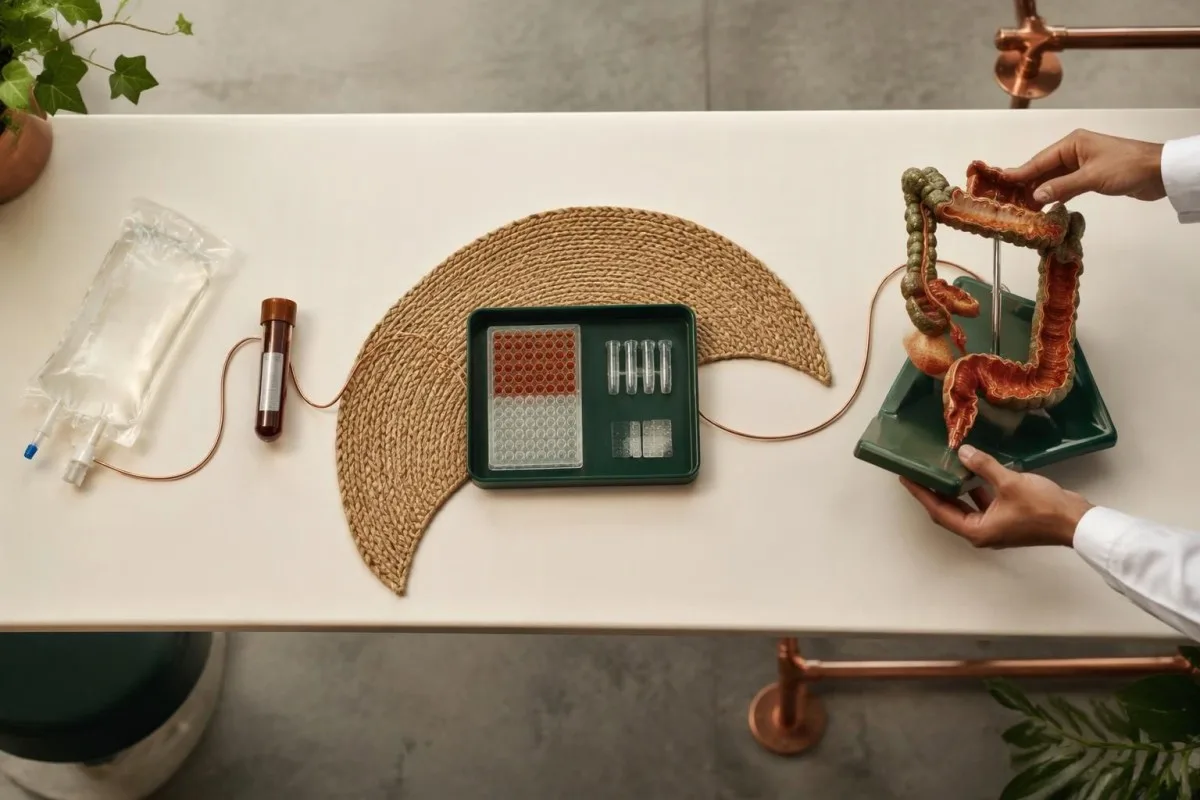
For a hypothetical 70 kg adult, 5 mg/kg corresponds to 350 mg before local preparation or rounding rules. Shortening an unchanged dose from every 8 weeks to every 6 weeks increases average drug administered per unit time by about 33%; the trough increase cannot be predicted as exactly 33% because clearance is not constant.
Increasing the dose and shortening the interval are not pharmacokinetically identical strategies. A larger dose changes peak exposure, while a shorter interval reduces time for concentrations to decline; a hypothetical patient whose symptoms repeatedly return during week 7 may prompt a different discussion from someone symptomatic throughout all 8 weeks.
A useful reassessment checks both exposure and the treatment outcome rather than declaring success because the trough rose. If infliximab increases from 2 to 9 µg/mL but calprotectin remains 900 µg/g and endoscopic disease persists, the new result has narrowed the explanation without necessarily improving the underlying disease.
The timing of repeat testing depends on severity, the revised schedule, and the clinical question; waiting 3 months is not appropriate for every deteriorating patient. Our lääkitysturvallisuuden trendiopas explains why comparable dates and methods matter, but an app should never independently recommend extra infusions.
Milloin harkitaan hoidon vaihtamista tai yhdistelmähoitoa?
Persistent high antibodies with low drug may favor changing treatment, while adequate exposure with confirmed active IBD may favor switching to a different mechanism. Low-level immunogenicity can sometimes be addressed through supervised optimization or an immunomodulator, but a result of 15 U/mL alone cannot determine which option offers the best benefit-risk balance.
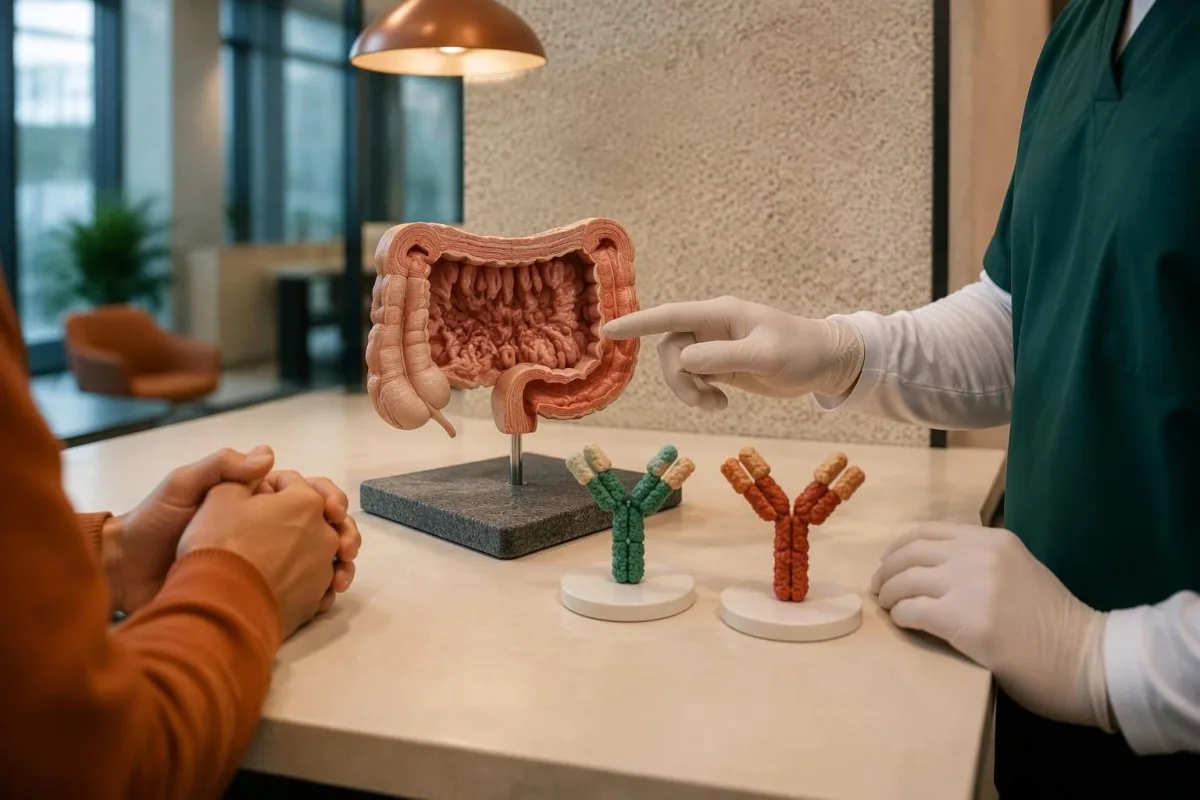
Switching within the anti-TNF class can make sense when infliximab previously controlled disease but antibody-associated clearance now prevents adequate exposure. Switching to another mechanism becomes more persuasive when inflammation persists with adequate exposure; these are 2 different failure patterns, not interchangeable reasons to choose the next medicine.
An immunomodulator such as azathioprine or methotrexate may reduce immunogenicity in selected circumstances, but adding one introduces additional monitoring and adverse-effect risks. Before azathioprine, TPMT testing and safety assessment can inform prescribing; TPMT and NUDT15 assessment do not replace ongoing CBC and liver monitoring, even when baseline results are normal.
If a person already takes a thiopurine, metabolite testing can help clarify exposure or a metabolism pattern before assuming combination therapy has failed. For example, 2 patients prescribed the same mg dose may have very different metabolite findings; our thiopurine treatment pattern guide explains why prescription dose alone is incomplete.
Restarting infliximab after a long interruption deserves a separate safety discussion because immunogenicity and infusion reactions can complicate re-exposure. A treatment gap of 6 months is not equivalent to a routine 1-week scheduling delay; never restart, add an immunomodulator, or stop an existing medicine based solely on an online interpretation.
Muuttavatko induktiohoito, fistelit, lasten hoito ja injektiot tavoitepitoisuuksia?
Treatment phase, disease phenotype, age, and formulation can change the relevant exposure goal; intravenous maintenance targets should not be copied into every setting. Standard adult intravenous induction commonly uses 5 mg/kg at weeks 0, 2, and 6, and those early concentrations are interpreted differently from an established 8-week maintenance trough.

The 2021 expert consensus described induction goals of approximately 20–25 µg/mL at week 2, 15–20 µg/mL at week 6, and 7–10 µg/mL at week 14 (Cheifetz et al., 2021). These are consensus exposure goals influenced by disease phenotype and outcome, not interchangeable minimums from one definitive randomized trial.
Perianal fistula outcomes may require higher exposure than symptom control in uncomplicated luminal disease, but observational associations do not establish a universal healing threshold. A fistula still draining at 10 µg/mL may also need imaging, drainage of an abscess, or procedural care; raising the trough cannot substitute for addressing an undrained collection.
Children can have different clearance and dosing requirements, particularly with lower body weight or severe disease. An adult maintenance benchmark of 5 µg/mL should not become a parent-directed dosing rule; our discussion of AI-tulosten tulkinta lapsille explains why pediatric specialist context and age-appropriate interpretation remain necessary.
Subcutaneous infliximab produces a different concentration-time profile from intermittent intravenous infusions, and availability and prescribing schedules vary internationally. A concentration of 15 µg/mL during injection treatment should not be labeled excessive merely because an intravenous report lists 3–7 µg/mL; the formulation, actual regimen, and sampling convention must be specified.
Miten paritulokset muuttavat kliinistä päättelyä?
Paired results guide the next question rather than dictate a prescription: low drug without antibodies suggests underexposure, low drug with persistent antibodies suggests immunogenicity, and adequate drug with inflammation raises possible mechanism failure. The following 4 examples are entirely hypothetical; the concentrations are illustrative, not personalized treatment recommendations.
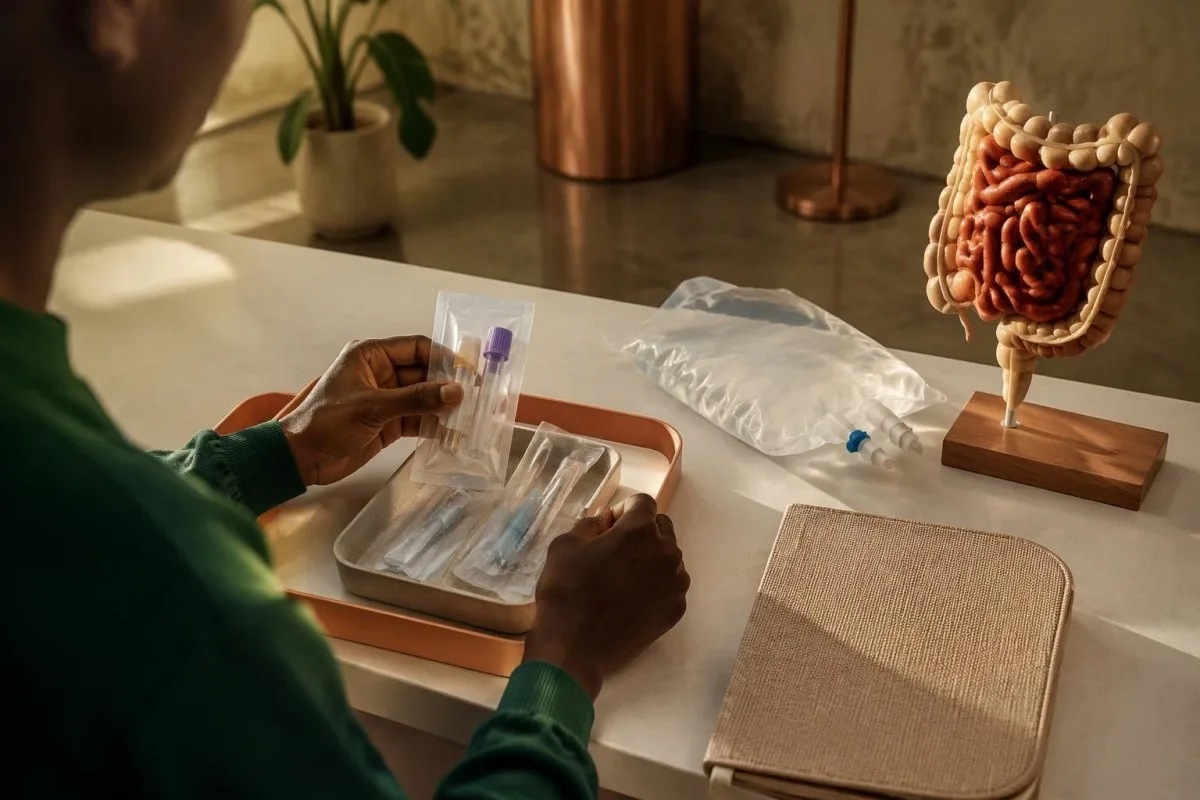
Example 1: a 34-year-old with Crohn's disease has a true trough of 1.8 µg/mL, no detected antibodies, albumin of 29 g/L, and calprotectin of 1,100 µg/g. This pattern supports underexposure in active disease; confirming the infusion schedule and considering supervised optimization are more logical than immediately declaring TNF blockade ineffective.
Example 2: a 46-year-old with ulcerative colitis has infliximab below 0.4 µg/mL and antibodies above the laboratory's 100 U/mL reporting limit on 2 visits. Assuming the assay defines that antibody signal as substantial, persistent immunogenicity is plausible; simply increasing the dose may be less successful than a clinician-directed treatment change.
Example 3: a 28-year-old has a trough of 11 µg/mL, no significant antibodies, and repeatedly active colitis on endoscopy despite appropriate optimization. Example 4: a 61-year-old has the same 11 µg/mL trough but reassuring endoscopy and diarrhea after ileal resection; the first pattern raises mechanism failure, whereas the second prompts investigation of non-inflammatory causes.
Kantesti on AI-pohjainen verikokeiden analyysityökalu that helps organize these distinctions when the report and treatment details are supplied. Our Tekoälyteknologian selitys describes how laboratory context informs interpretation; if a 2-week-old report lacks sampling timing, the missing information must stay visible rather than being guessed.
Mitä sinun pitäisi ottaa mukaan seurantakäynnille, ja mikä näyttö soveltuu tilanteeseesi?
Bring the complete report, infusion timeline, and objective disease results to your IBD review; these 3 evidence streams make paired drug-antibody testing actionable. Seek earlier care for severe deterioration rather than waiting for the next trough, and distinguish infliximab-specific clinical research from general educational publications about accompanying laboratory abnormalities.
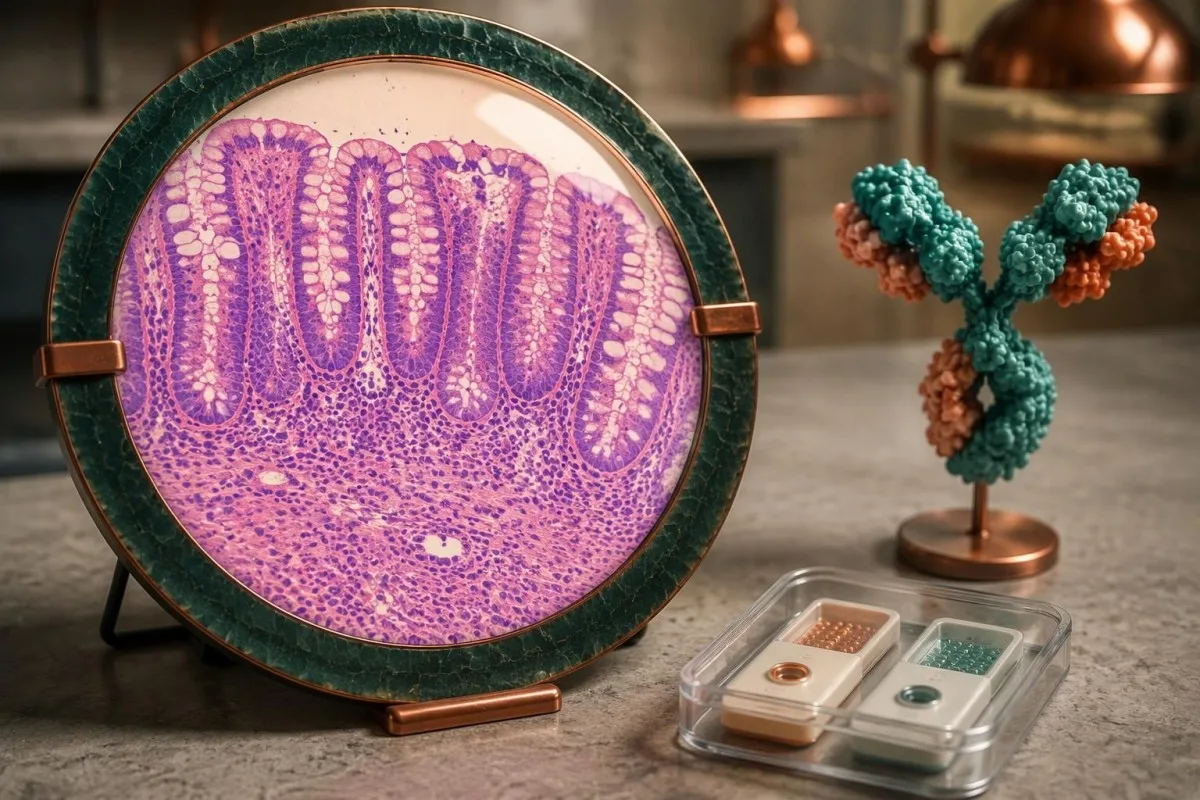
A useful review record includes the previous 2 infusion dates, actual dose, collection timing, assay name, antibody units, and recent CRP, albumin, and fecal calprotectin. Add symptom timing, steroid use, recent antibiotics, and missed doses; ask whether the proposed change addresses insufficient exposure, immunogenicity, active non-TNF disease, or a non-inflammatory explanation.
Contact your clinical team promptly for worsening diarrhea with dehydration, persistent vomiting, new significant bleeding, or fever of 38°C or higher while immunosuppressed. Severe abdominal pain with distension, fainting, or inability to keep fluids down may require emergency assessment; during an infusion, sudden breathing difficulty or collapse requires immediate staff attention, not interpretation of an antibody report.
Kantesti provides educational interpretation, not independent biologic prescribing, and our vastuullisen tekoälyn periaatteemme explain that boundary. A reassuring trough of 10 µg/mL does not establish that an infusion is safe during an acute illness; the treating service must assess symptoms, examination findings, and any necessary investigations.
The 2 Zenodo publications listed below address accompanying laboratory interpretation, not infliximab target validation: our RDW ja punasoluguide concerns anemia patterns, while our BUN- ja kreatiniinioppaamme concerns renal and hydration context. These educational deposits are not evidence for anti-drug antibody cutoffs; the AGA guideline, TAXIT trial, and biologic-monitoring consensus supply the directly relevant clinical references.
Usein kysytyt kysymykset
Mitä matala infliksimabipitoisuus tarkoittaa?
Matala infliksimabipitoisuus tarkoittaa, että verenkierrossa olevan lääkkeen altistus jää kyseiselle hoitovaiheelle ja hoitotavoitteelle valitun vertailuarvon alapuolelle; se ei automaattisesti tarkoita, että infliksimabihoito pitäisi lopettaa. Todellinen ylläpitohoidon pohjapitoisuus 2 µg/mL ilman merkittäviä vasta-aineita voi viitata nopeampaan puhdistumaan, suoliston proteiinikatoon tai riittämättömään annokseen tai annosväliin. Matala lääkeainepitoisuus ja jatkuvasti huomattava vasta-ainepitoisuus puolestaan viittaavat immuunivälitteiseen puhdistumaan. IBD-hoitotiimisi tulisi tulkita tulosta yhdessä objektiivisen taudin aktiivisuuden, infuusion ajoituksen ja käytetyn määritysmenetelmän kanssa.
Mikä on hyvä infliksimabin jäännöspitoisuus IBD:n hoidossa?
Kaikille IBD-potilaille ei ole olemassa yhtä ihanteellista infliksimabin jäännöspitoisuutta. Vuoden 2017 AGA:n ohjeistuksessa suositeltiin reaktiivisessa ylläpitohoidon seurannassa vähintään 5 µg/ml:n pitoisuutta, kun taas vuoden 2021 asiantuntijakonsensuksessa ylläpitopitoisuudeksi kuvattiin 5–10 µg/ml. Valikoiduilla potilailla, joilla hoitovaste on heikentynyt toissijaisesti, voi olla tarpeen arvioida tilanne uudelleen pitoisuudessa 10–15 µg/ml ennen hoidon lopettamista. Induktiohoito, fistelit ja ihonalainen hoito edellyttävät erilaista kontekstia, joten laboratorion viiteväli ei ole yleispätevä annostelun tavoite.
Milloin minun pitäisi käydä infliksimabipitoisuuden mittauksessa?
For intravenous infliximab, a trough sample should be collected immediately before the next infusion begins. A sample obtained 2 days after an infusion is not comparable with routine pre-infusion targets. Record the last infusion date, dose, scheduled interval, and actual collection time, especially if an 8-week appointment was delayed. Subcutaneous infliximab has a different exposure profile, so sampling should follow the prescribing team's and laboratory's instructions.
Voivatko infliksimabivasta-aineet hävitä?
0 Matalan tason infliksimabivasta-aineet voivat joskus muuttua mittaamattomiksi tai menettää kliinistä merkitystään, mutta jatkuvasti merkittävät vasta-ainetasot ja hyvin pieni lääkeainepitoisuus ovat vaikeammin hallittavissa. Vuoden 2021 asiantuntijakonsensuksessa matalatiitteriset vasta-aineet määriteltiin alle 10 U/ml:n pitoisuuksiksi yhdellä homogeenisellä liikkuvuussiirtymämenetelmällä; tätä raja-arvoa ei voi soveltaa kaikkiin laboratoriomenetelmiin. Hoidon valvottu optimointi tai immunomodulaattori voi auttaa valikoituja potilaita, kun taas toiset tarvitsevat hoidon vaihtamista. Uusintamittaukset pareittain voivat selventää vasta-aineiden jatkuvuutta, mutta potilaiden ei pidä muuttaa hoitoaan itse.
Voiko infliksimabi lakata tehoamasta, vaikka sen pitoisuus on normaali?
Infliximabi ei välttämättä pysty hallitsemaan objektiivisesti aktiivista IBD:tä riittävästä verenkierrossa olevasta pitoisuudesta huolimatta, mikä viittaa mahdolliseen mekanistiseen hoidon epäonnistumiseen. 10 µg/mL:n jäännöspitoisuus ei takaa suoliston paranemista eikä osoita, että TNF olisi ainoa sairauden etenemistä aiheuttava reitti. Ennen vaikutusmekanismin vaihtamista kliinikot varmistavat tulehduksen, arvioivat rakenteelliset tai infektioperäiset komplikaatiot ja pohtivat, oliko lääkealtistus riittävä kyseisen hoitotavoitteen saavuttamiseksi. Rauhoittavista objektiivisista arvioista huolimatta ripuli voi johtua muusta kuin tulehduksesta.
Onko korkea infliksimabipitoisuus vaarallinen?
Korkea infliksimabipitoisuus ei ole automaattisesti vaarallinen, eikä kaikille IBD-potilaille ole yhtä yleispätevää, vakiintunutta seerumin toksisuusarvoa. Tulos 15 µg/mL voidaan tulkita eri tavoin induktiohoidon, fistelin hoidon tai ihonalaisen hoidon aikana kuin tavanomaisessa suonensisäisessä ylläpitohoidossa. Turvallisuus riippuu koko hoito-ohjelmasta, infektioista, infuusioreaktioista ja muista kliinisistä löydöksistä, ei pelkästään pitoisuudesta. Älä jätä infuusiota väliin tai pienennä annosta keskustelematta tuloksesta hoitotiimisi kanssa.
Miksi infliksimabivasta-ainetulokseni muuttuivat laboratorion vaihtamisen jälkeen?
Infliximab-vasta-ainetulokset voivat muuttua laboratorioita vaihdettaessa, koska määritykset eroavat kalibroinnin, yksiköiden, havaitsemisrajojen ja verenkierrossa olevan lääkkeen sietokyvyn suhteen. Tulosta 20 AU/mL ei voida muuntaa yleispätevästi yksiköiksi U/mL tai ng/mL. Lääkettä sietävä menetelmä voi havaita vasta-aineita, jotka lääkkeelle herkkä määritys jättää havaitsematta, kun infliksimabia on edelleen mitattavissa. Vertaa kehityssuuntia mahdollisuuksien mukaan samalla menetelmällä ja varmista, tehtiinkö vasta-ainetesti todella vai jäikö se tekemättä refleksitutkimussäännön vuoksi.
Saat verikoetulokset selitettyinä
Lataa laboratoriolausuntosi, niin Kantesti:n tekoäly selittää jokaisen biomarkkerin selkokielellä sekunneissa. Yli 2 miljoonaa käyttäjää maailmanlaajuisesti.
Viitteet
- Klein, T., Mitchell, S. & Weber, H. (2026). RDW-verikoe: kattava opas RDW-CV:hen, MCV:hen ja MCHC:hen. Kantesti AI Medical Research. DOI-koodi
- Klein, T., Mitchell, S. & Weber, H. (2026). BUN/Creatinine-suhde selitetty: munuaistoimintatestin opas. Kantesti AI Medical Research. DOI-koodi
- Feuerstein JD et al. (2017). American Gastroenterological Association Institute Guideline on Therapeutic Drug Monitoring in Inflammatory Bowel Disease. Gastroenterology. DOI-koodi
- Vande Casteele N et al. (2015). Trough concentrations of infliximab guide dosing for patients with inflammatory bowel disease. Gastroenterology. DOI-koodi
- Cheifetz AS et al. (2021). A Comprehensive Literature Review and Expert Consensus Statement on Therapeutic Drug Monitoring of Biologics in Inflammatory Bowel Disease. The American Journal of Gastroenterology. DOI-koodi
- 2 kk+Analysoidut testit
- 127+Maat
- 100+Kielet
Tietoa lääketieteellisestä tiimistä


E-E-A-T-luottamussignaalit
Kokea
Lääkärin johtama kliininen arviointi laboratoriotulkinnan työnkuluista.
Asiantuntemus
Laboratoriolääketiede keskittyy siihen, miten biomarkkerit käyttäytyvät kliinisessä kontekstissa.
Auktoriteetti
Lääketieteellisen tarkastuksen on tehnyt tohtori Thomas Klein, ja siihen ovat osallistuneet tohtori Sarah Mitchell ja professori Hans Weber.
Luotettavuus
Näyttöön perustuva tulkinta selkeillä jatkopoluilla, jotka vähentävät hälytystä.





Lääketieteellinen vastuuvapauslauseke
Tämä artikkeli on tarkoitettu vain koulutustarkoituksiin eikä se muodosta lääketieteellistä neuvontaa. Ota aina yhteyttä pätevään terveydenhuollon ammattilaiseen diagnoosi- ja hoitopäätöksiä varten.
Julkaistu · Ota yhteyttä toimitukseen
Julkaisija: Kantesti Ltd, rekisteröity Englannissa ja Walesissa, yrityksen nro. 17090423, Lontoo, Yhdistynyt kuningaskunta.
