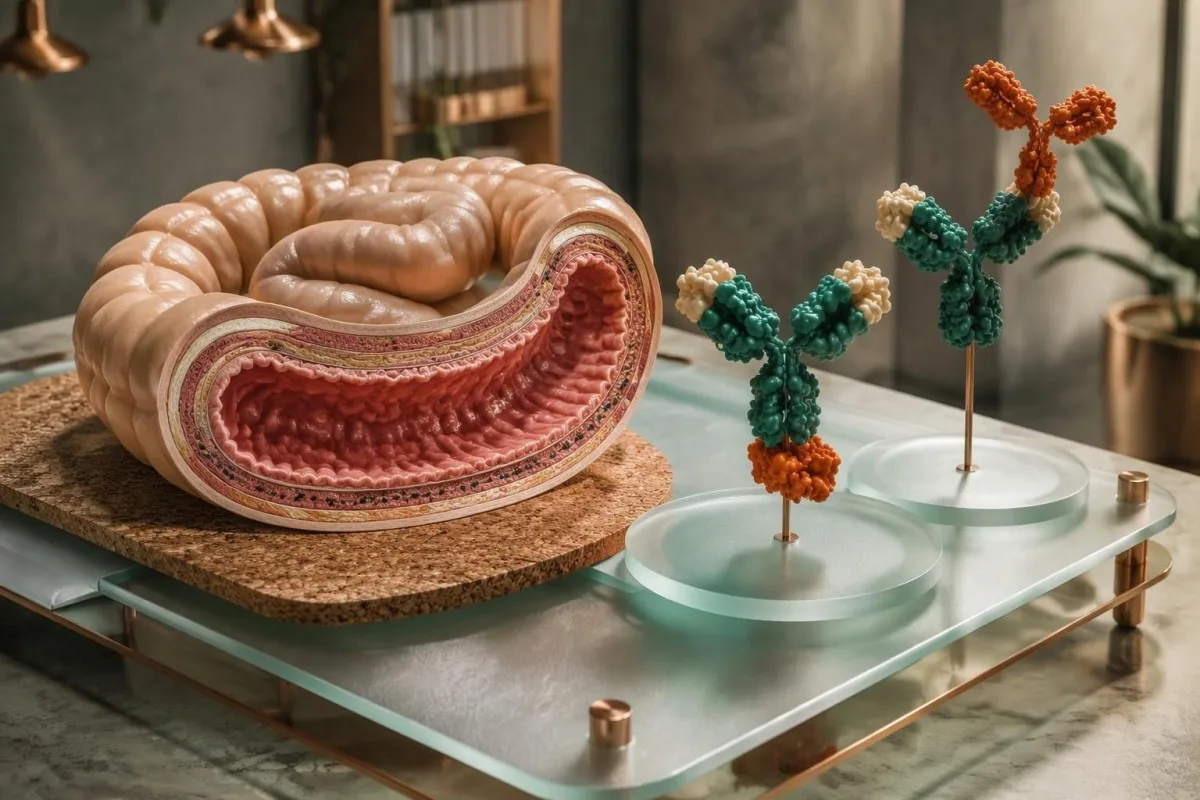
Un tèst del nivèl d’infliximab associa la concentracion del medicament als anticòrs per explicar la pèrda del contraròtle de la MII. Un nivèl bas del medicament sens anticòrs significatius suggerís una exposicion insufisenta; un nivèl bas del medicament amb d’anticòrs elevats persistents suggerís una eliminacion immunomediada. Una inflamacion activa malgrat una exposicion adequada fa pensar a un possible fracàs mecanistic—mas sonque après aver confirmat l’inflamacion, un prélèvement corrècte e una cibla adaptada a l’objectiu del tractament.

Punts essencials
- Resultats en parelh distinguisson una exposicion insufisenta a l’infliximab d’una eliminacion associada als anticòrs; cap dels dos resultats a el sol pròva pas perqué los simptòmas son tornats.
- Prélèvement abans la perfusion significa recampar l’escapolon de laboratòri abans que comence la perfusion intravenosa seguenta, e non pas 2 jorns après.
- Referéncias per lo tractament de mantenença diferisson: la directiva de l’AGA de 2017 suggerissiá almens 5 µg/mL per la monitorizacion reactiva, mentre que lo consens d’experts descriu 5–10 µg/mL pel tractament de mantenença.
- Nivèls bas d’infliximab sens anticòrs detectables pòdon reflèxar una eliminacion mai rapida, una pèrda proteïca intestinala, un retard de dòsi o un interval tròp long.
- Anticòrs contra l’infliximab compten sustot quand son persistents, significatius per aquel ensag e acompanhats d'un medicament fòrça bas o indetectable.
- Fracàs mecanistic possible exigís una MII objectivament activa malgrat una exposicion adequada; una diarreia amb una concentracion abans infusion de 8 µg/mL o establís pas.
- Unitats de l'ensag son pas intercanviablas: infliximab 1 µg/mL equival a 1 mg/L, mas las unitats U/mL e AU/mL dels anticòsses pòdon pas èsser convertidas universalament.
- Cambiaments de tractament son de decidir amb vòstra equipa de MII; dins de cases seleccionats de pèrda de responsa, una exposicion de 10–15 µg/mL pòt èsser justificada abans d'abandonar l'infliximab.
Qué vos indica vertadièrament un tèst del nivèl d’infliximab?
Un tèst del taus d'infliximab mesura l'infliximab circulant, generalament amb d'anticòsses contra lo medicament, per investigar una exposicion insufisenta o una eliminacion del medicament mediada per l'immunitat. Un resultat de 2 µg/mL sens anticòsses detectats pausa una question diferenta d'un resultat de 2 µg/mL amb d'anticòsses nauts persistents; cap dels dos significa automaticament que lo medicament deu èsser arrestat.
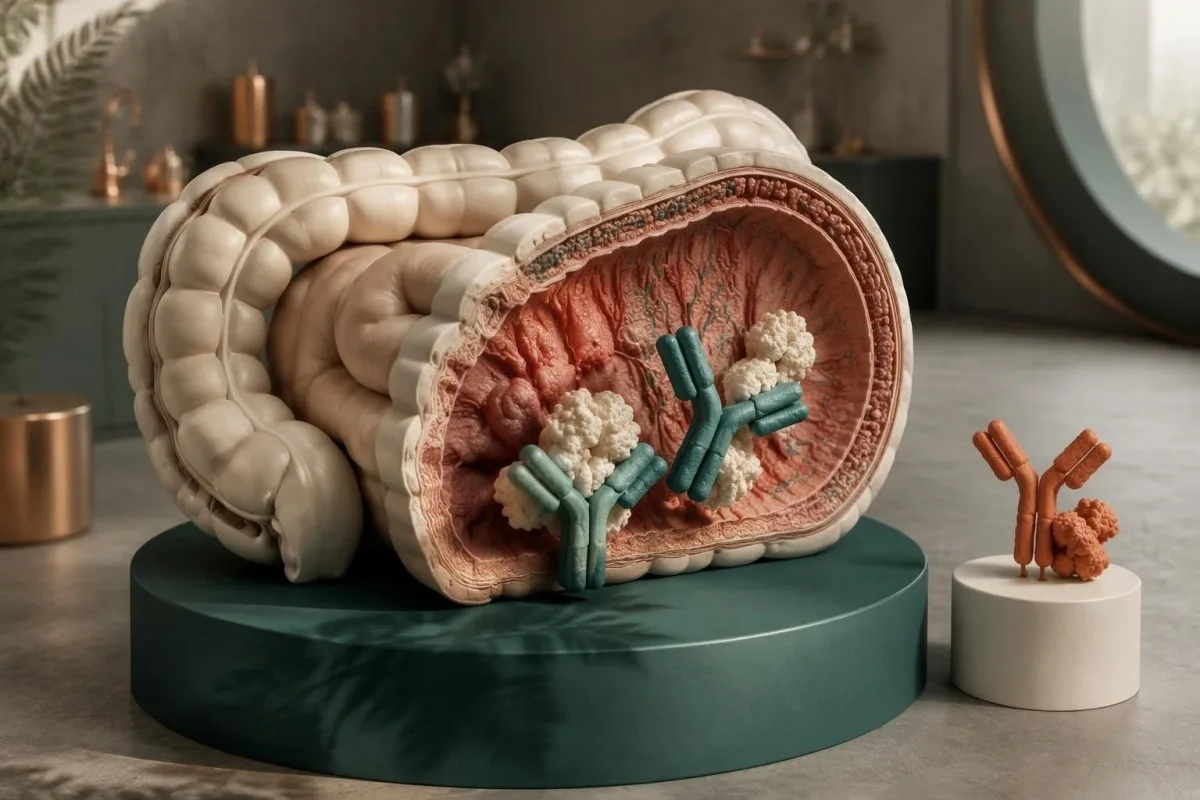
Suivi farmacologic terapeutic reactiu es un tèst demandat per una agravacion dels simptòmas o de signes de malautiá activa. Es diferent del suivi proactiu pendent una remision aparenta: una concentracion abans infusion ipotetica de 4 µg/mL pòt justificar una investigacion pendent una poussada documentada, mas demandar una discussion diferenta quand l'endoscòpia e los marcadors fecals mòstran una garison sostenguda.
L'infliximab blòca lo factor de necrosi tumorala, abreujat comunament TNF; lo tèst de concentracion mesura pas se totes los senhals de TNF intestinals son estats neutralizats. Un resultat seric de 7 µg/mL mesura lo medicament dins la circulacion, pas son activitat dins cada segment intestinal tocat ni lo gra de garison intestinal.
L'interpretacion practica utiliza almens 3 elements: la concentracion del medicament, los resultats dels anticòsses e l'activitat objectiva de la malautiá. La responsa anteriora compta tanben: lo retorn dels simptòmas après 18 meses de contraròtle representa una pèrda de responsa segondària, mentre que lo fach de jamai pas aver atengut lo contraròtle pendent lo tractament inicial pausa de questions diferentas sus l'exposicion a l'inducion e lo mecanisme del tractament.
Kantesti es un Analizador de tèst de sang d'IA que ajuda los lectors a comprene los resultats combinats de l'infliximab sens tractar un sol nombre de laboratòri coma una instruccion de posologia. Nòstra plataforma es gerida per Kantesti LTD, societat britanica n° 17090423; las informacions sus nòstre son distinctas de las donadas scientificas que sostenon lo suivi farmacologic terapeutic.
Quand cal prélever los nivèls minimals d’infliximab?
Tases minimals d'infliximab per via intravenosa devon èsser mesurats immediatament abans que comence la perfusion seguenta, quand la concentracion es pròcha de son minimum dins aquel interval de posologia. Un prélèvement efectuat 2 jorns après una perfusion es pas un taus minimal e deu pas èsser comparat dirèctament amb los objectius de mantenença abans perfusion.
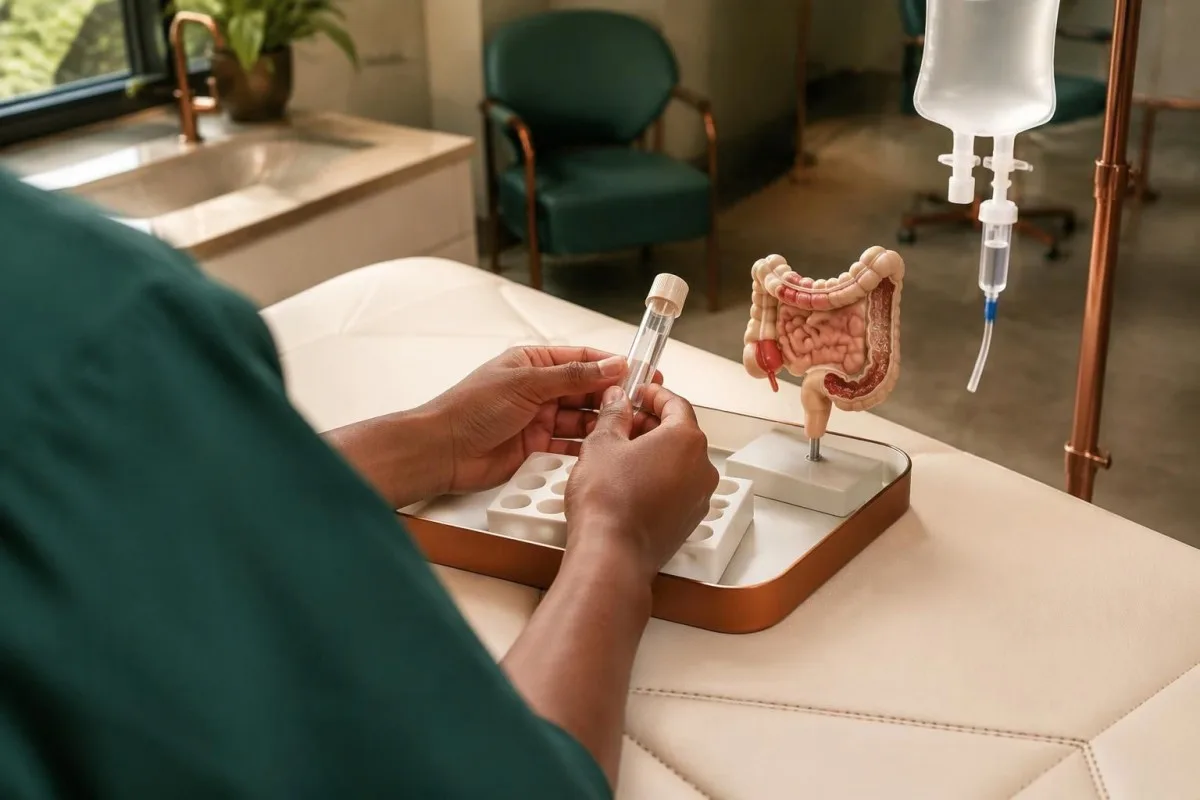
Lo moment del prélèvement pòt cambiar lo sens aparent d'un resultat sens cap de cambiament de l'eficacitat del tractament. Per exemple, un resultat ipotetic de 18 µg/mL recuelhit pauc après una perfusion e de 3 µg/mL recuelhit abans la perfusion seguenta pòdon descriure lo meteis cicle de posologia, e non pas una deterioracion sobta entre 2 estats de tractament independents.
Notatz la data de la perfusion precedenta, la dòsi reala en mg, l'interval previst e l'ora del prélèvement abans d'interpretar lo rapòrt. Se una perfusion prevista a 8 setmanas es retardada fins a la setmana 10, la concentracion obtenguda descriu un interval mai long sens medicament; pòt pas respondre clarament a la question de saber se lo regim inicial de 8 setmanas provesissiá una exposicion sufisenta.
Collection from a line recently used to administer infliximab can contaminate the specimen and produce a misleadingly high result. Ask the infusion service about its collection protocol, and tell it if sampling occurred after treatment started; the timing principles resemble other pre-dose medication tests, although their targets differ.
Fasting is generally not required for the infliximab concentration itself, but another test ordered during the same visit may have preparation requirements. Our guida de preparacion per lo primièr tiratge explains how to document medication timing; for this test, an accurate infusion timeline usually matters more than an 8-hour fast.
Quin nivèl d’infliximab es considerat adequat?
I a no universal adequate infliximab trough for every patient, disease phenotype, assay, and treatment phase. The 2017 AGA guideline suggested at least 5 µg/mL during reactive maintenance monitoring, while a 2021 expert consensus described maintenance concentrations of 5–10 µg/mL and higher exposure in selected loss-of-response situations.
The AGA benchmark of at least 5 µg/mL is a clinical decision aid, not a healthy-population reference range (Feuerstein et al., 2017). Infliximab is a prescribed biologic: an untreated person normally has no circulating infliximab, so a laboratory's therapeutic interval should never be read like the normal range for sodium.
The TAXIT trial enrolled 263 adults with stable responses and optimized intravenous infliximab toward 3–7 µg/mL before randomized follow-up. Its primary remission endpoint did not improve with concentration-based dosing, although some secondary outcomes favored that approach; this explains why the historical 3–7 µg/mL window is useful context rather than a universal modern target (Vande Casteele et al., 2015).
Cheifetz et al. (2021) recommended considering exposure of 10–15 µg/mL before discontinuing infliximab for secondary loss of response in selected patients. This is expert consensus, not proof that everyone should be escalated to 15 µg/mL; fistulas, endoscopic goals, disease severity, safety, and prior optimization affect whether that reasoning applies.
A concentration of 12 µg/mL is not automatically toxic, and a concentration of 4 µg/mL does not automatically require escalation in an asymptomatic patient with documented healing. Unlike the narrower toxicity discussions around some d'autres medicaments monitorizats en tros, infliximab has no single established serum toxicity cutoff that dictates action.
| Nivèl | Interval | Significacion |
|---|---|---|
| Historical TAXIT optimization window | 3–7 µg/mL | Studied in adults with stable responses; not a universal threshold for active disease or fistula healing. |
| AGA reactive maintenance benchmark | At least 5 µg/mL | Suggested in the 2017 guideline for reactive monitoring; interpret alongside objective activity and the assay. |
| Expert-consensus maintenance range | 5–10 µg/mL | Described by the 2021 consensus; the appropriate goal varies with disease phenotype and desired outcome. |
| Selected loss-of-response reassessment | 10–15 µg/mL | Exposure experts suggest considering before abandoning treatment in selected cases; not a routine target or toxicity range. |
Perqué los nivèls d’infliximab son bas sens anticòrs?
Low infliximab levels with no significant antibodies usually suggest pharmacokinetic underexposure: too little drug remains available over the dosing interval. A trough of 1.5 µg/mL can reflect faster clearance, intestinal protein loss, a delayed infusion, or insufficient dose or frequency—not necessarily failure of TNF blockade as a treatment mechanism.

Severe intestinal disease can increase infliximab clearance and allow protein, including therapeutic antibody, to be lost through the bowel. A hypothetical patient with albumin of 28 g/L and a trough of 1 µg/mL therefore needs assessment of disease burden and protein loss, not just a question about whether the infusion was attended.
Low albumin is associated with faster infliximab clearance, but it is not a direct measure of drug binding or an instruction to apply a free-drug correction. Albumin of 30 g/L and 40 g/L may provide different clearance context; our guida d'interpretacion de las proteïnas sericas explains why inflammation, liver synthesis, nutrition, and loss must be distinguished.
Infliximab is mainly broken down through protein-catabolic pathways rather than cleared unchanged by the kidneys. A creatinine of 90 µmol/L cannot predict the infliximab trough, and the medicine should not be interpreted using small-molecule renal dosing assumptions; body size, inflammatory burden, and treatment interruptions may be more informative.
Kantesti AI helps place a low trough alongside reported albumin, CRP, and infusion timing; 1 result cannot identify the clearance pathway by itself. Low albumin should not automatically trigger protein supplements, because inflammation also changes circulating proteins—as explained in our guide to inflammation and transferrin.
Qué suggerisson de nivèls bas del medicament amb d’anticòrs?
Low or undetectable infliximab with persistent high antibodies suggests immune-mediated pharmacokinetic failure: antibodies can accelerate clearance, neutralize drug activity, or both. A trough below an assay's 0.5 µg/mL quantification limit with a substantial antibody result is more concerning than a weak antibody signal alongside a maintained drug concentration.
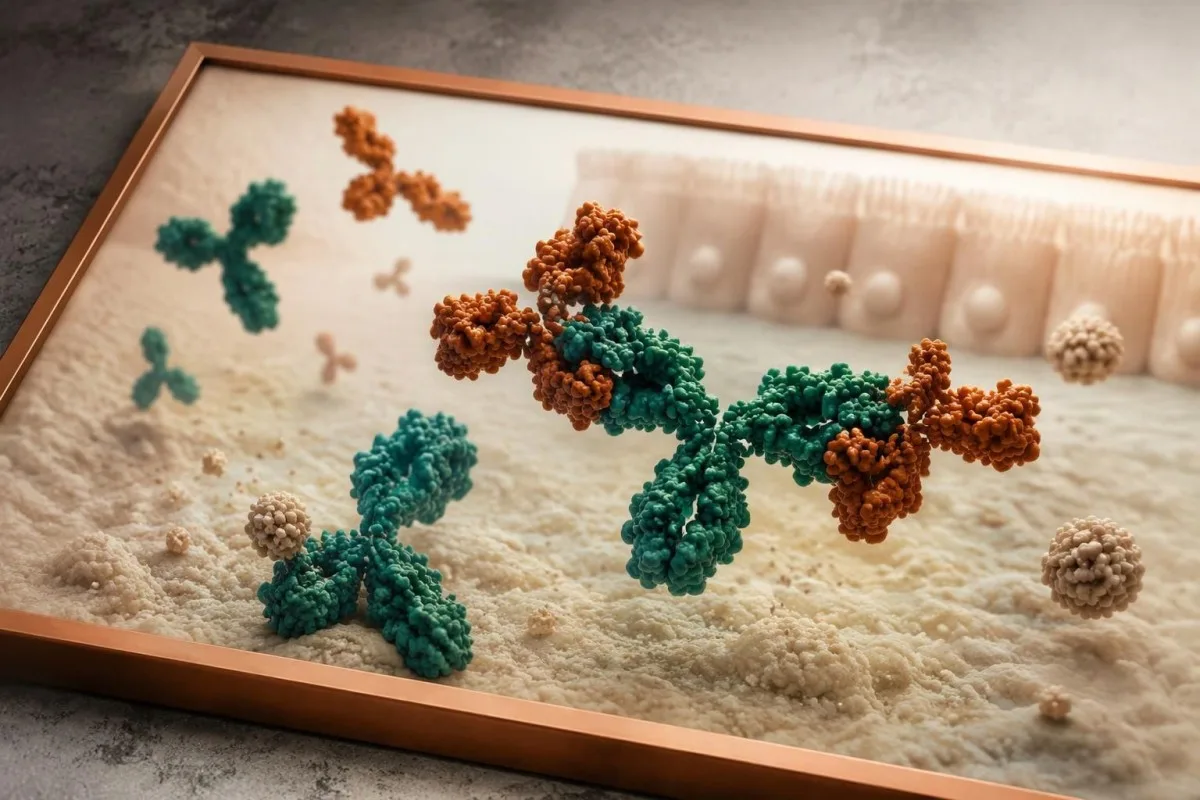
Anti-infliximab antibody tests usually detect binding antibodies; they do not all directly measure neutralizing activity. A positive result of 20 U/mL therefore identifies an assay-defined antibody signal, not a universal percentage of blocked infliximab or a precise prediction of how much benefit remains.
Antibody persistence and magnitude influence whether dose optimization is likely to recover exposure. Cheifetz et al. (2021) described low-titer antibodies as below 10 U/mL for the homogeneous mobility shift assay specifically; that threshold must not be transferred to an ELISA reporting AU/mL or to another laboratory's calibration.
A single low antibody result may be transient or become less clinically relevant after supervised treatment optimization. Repeating paired drug and antibody testing can distinguish a 1-time signal from a rising pattern, but severe disease or an infusion reaction may require action before a second result is available.
Antibodies to infliximab are not the same as antibodies against your own bowel, and they do not by themselves diagnose an immediate allergy. Our explanation of los tipes de resultats d'anticòrs positives helps separate these concepts; breathlessness or faintness during an infusion still requires immediate attention regardless of the antibody number.
Quand un nivèl minimal adequat suggerís un fracàs mecanistic?
Fracàs mecanistic possible means objectively active IBD persists despite sufficient infliximab exposure for the treatment goal. A trough of 8 µg/mL with confirmed active colitis may raise this possibility, but selected patients need further exposure optimization before clinicians conclude that another inflammatory pathway should be targeted.
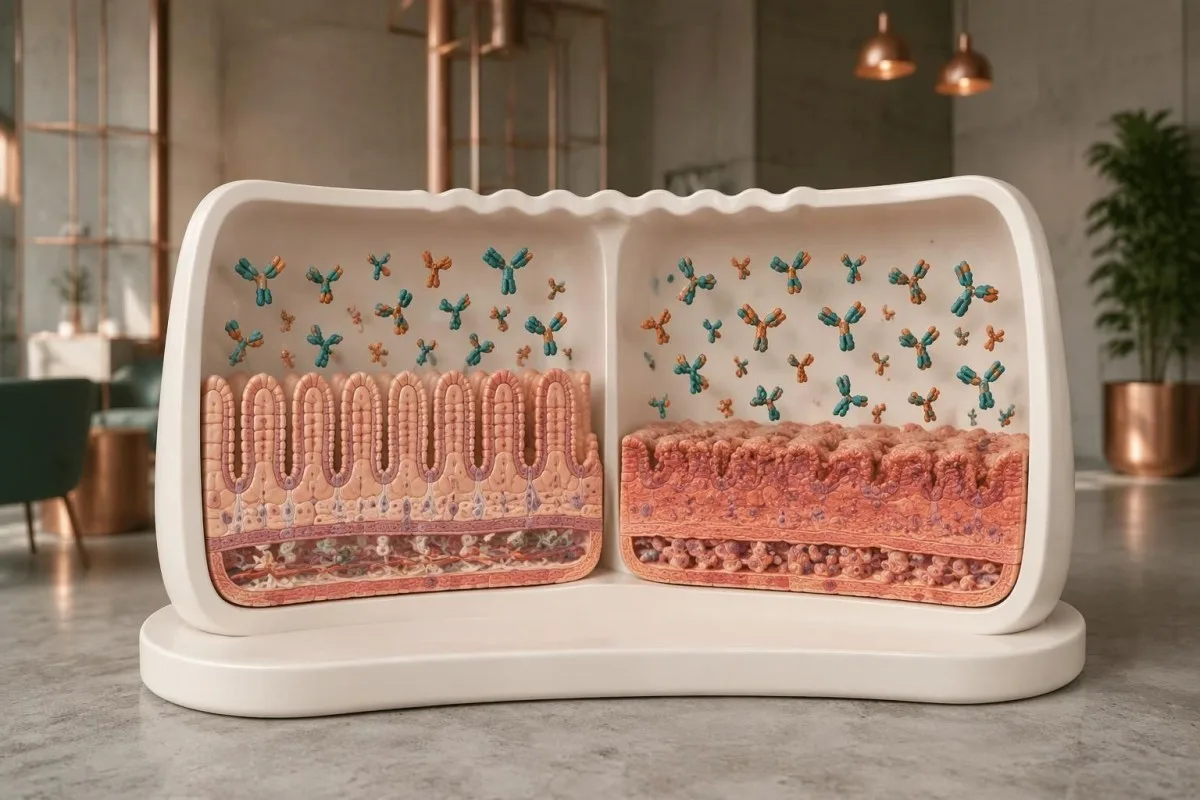
An adequate serum concentration cannot prove that TNF is the only pathway driving a person's current disease. Persistent endoscopic activity with a trough of 12 µg/mL is more supportive of a mechanism problem than the same concentration with normal objective testing and symptoms from bile acid diarrhea.
Calling treatment failure at exactly 5 µg/mL can be premature when the goal is fistula control or substantial endoscopic improvement. The 10–15 µg/mL reassessment discussed in the 2021 consensus provides a safeguard against abandoning an under-optimized treatment, but it is not a requirement to escalate every patient with symptoms.
Objective evidence also has limits: CRP of 3 mg/L does not exclude active IBD, especially in people whose CRP has remained low during previous flares. Borderline stool results need context and sometimes repetition; our guide to la calprotectina fecala limitat explains why an isolated intermediate value should not determine a biologic switch.
The strongest case for changing mechanism combines 3 findings: documented inflammation, adequate exposure on a correctly timed sample, and an inadequate clinical response despite appropriate optimization. Structural complications, such as a fixed Crohn's stricture, can also cause symptoms that neither more infliximab nor a different biologic will reliably reverse.
Los anticòrs pòdon èsser positius quand l’infliximab es a un nivèl adequat?
Antibodies can be detected while infliximab remains measurable or adequate, particularly with drug-tolerant assays. A trough of 7 µg/mL and a weak positive antibody result do not automatically mean treatment failure; the assay, antibody trend, and evidence of disease activity determine how much weight that finding deserves.

Drug-tolerant methods can identify antibodies in samples containing infliximab that would interfere with some drug-sensitive methods. This greater analytical sensitivity may reveal early or low-level immunogenicity, but 1 newly detected signal does not necessarily establish clinically meaningful loss of response.
A qualitative positive result contains less information than a quantitative result with the assay's cutoff and units. A report reading only positive cannot distinguish a value just above a 10 AU/mL cutoff from a much larger signal; our guide to tèsts qualitatius e quantitatius explains what each format can establish.
Compare antibody trajectories using the same laboratory method whenever feasible. Hypothetical results of 12, 15, and 13 AU/mL across 3 correctly timed visits may carry a different implication from 12, 80, and 200 AU/mL, although analytical variability and clinical findings still prevent interpretation from trend alone.
Kantesti es un plataforma d’interpretacion d’analisi de sang d’AI that helps distinguish a reported antibody cutoff from a treatment target. When the report lacks the method or units, our interpretation should preserve that uncertainty rather than labeling 1 positive result as proof that infliximab has stopped working.
Perqué las tecnicas de laboratòri e las unitats dels anticòrs comptan?
Infliximab and antibody results are method-dependent, so values from different assays are not always interchangeable. Infliximab 1 µg/mL equals 1 mg/L, but antibody results in U/mL, AU/mL, or ng/mL do not have a universal conversion because laboratories use different standards, detection limits, and approaches to drug interference.
An assay may report free or functionally available drug differently from another method that detects a broader pool of circulating drug. Two laboratories can therefore produce somewhat different concentrations from similar specimens; a change from 6 to 8 µg/mL after switching methods may not represent a true gain in exposure.
Below the quantification limit means the assay cannot reliably assign a numerical concentration below its validated boundary. A report of less than 0.4 µg/mL is not proof of exactly 0 µg/mL, and greater than 100 U/mL cannot tell you whether the true antibody result is 110 or 1,000 U/mL.
Some laboratories use reflex antibody testing only when the drug concentration falls below a preset threshold. If antibodies were not tested because infliximab was 9 µg/mL, the result is not equivalent to antibodies negative; ask whether the antibody field says not performed, not detected, or below detection.
Kantesti's report interpretation should retain the assay name, units, and collection context instead of silently converting 20 AU/mL into another method's scale. Our informacions sus la metodologia clinica explains the distinction between technical interpretation and clinical decision-making; no AI explanation removes the need to confirm an unusual result with the reporting laboratory.
Cossí los clinicians confirman que los simptòmas que tornan son deguts a la MII?
Returning symptoms do not necessarily mean returning intestinal inflammation; clinicians combine stool markers, CRP, infection testing, endoscopy, and imaging as appropriate. Three loose stools daily with a trough of 6 µg/mL can arise from active IBD, an intestinal infection, bile acid diarrhea, or a functional bowel disorder.
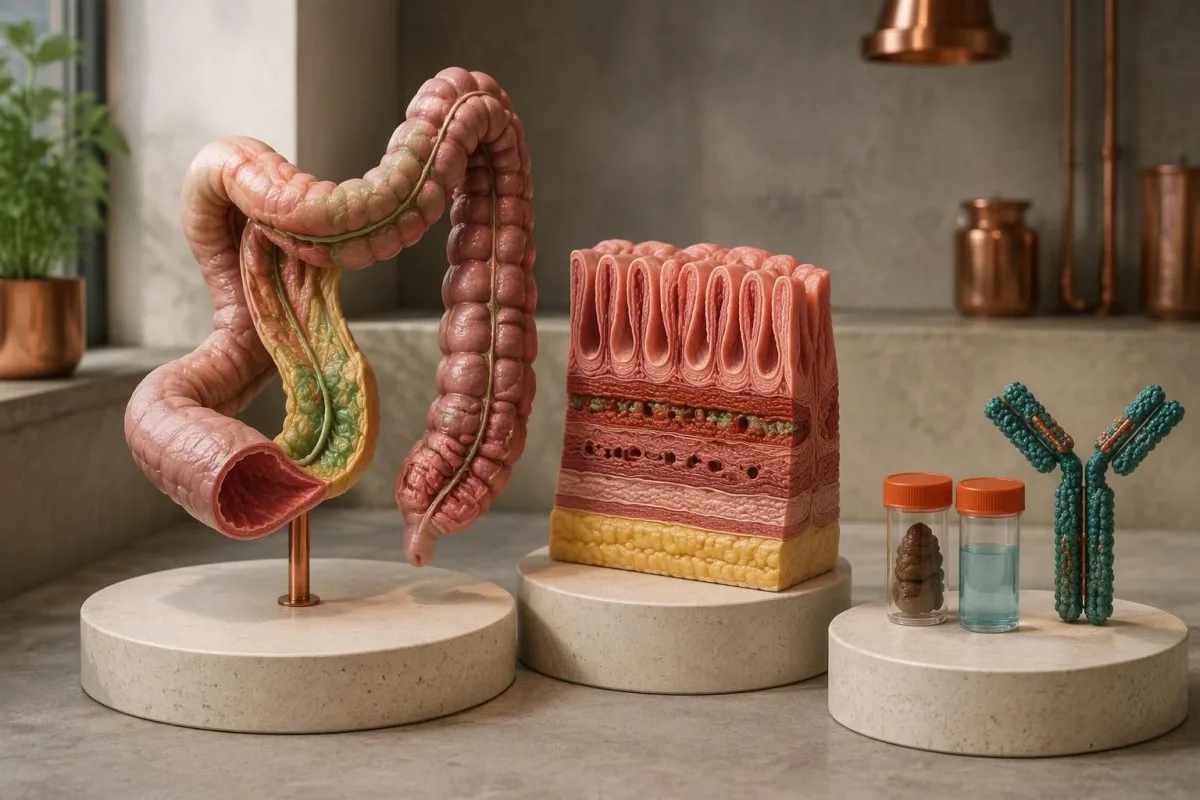
Fecal calprotectin and lactoferrin assess intestinal inflammatory activity rather than infliximab exposure. A hypothetical calprotectin of 800 µg/g adds different information from a trough of 2 µg/mL; our stool inflammation marker comparison explains why paired disease and drug measurements answer separate clinical questions.
C. difficile testing can be necessary during new or worsening diarrhea, even without recent antibiotics. A positive screening test and negative toxin result require contextual interpretation, not automatic classification as an IBD flare; our guide to resultats discordants de C. difficile describes why 2 test components can disagree.
Bile acid diarrhea is particularly relevant after ileal disease or resection and can persist despite controlled inflammation. A person with a trough of 10 µg/mL and reassuring objective IBD assessment may need a different evaluation; our explanation of SeHCAT retention results covers one diagnostic route where that test is available.
Bloating, gas, and altered stool frequency can also reflect bacterial overgrowth or carbohydrate malabsorption. At least 2 explanations can coexist with IBD, so a satisfactory trough should not end the assessment; our SIBO breath test guide explains preparation and limitations rather than treating breath testing as proof of every symptom's cause.
Cossí l’equipa de MII pòt respondre a una exposicion febla?
Low exposure without substantial persistent antibodies may lead an IBD team to increase the infliximab dose, shorten the dosing interval, or address a treatment interruption. A common adult intravenous maintenance schedule is 5 mg/kg every 8 weeks after induction, but any adjustment requires individualized prescribing and reassessment of disease activity.
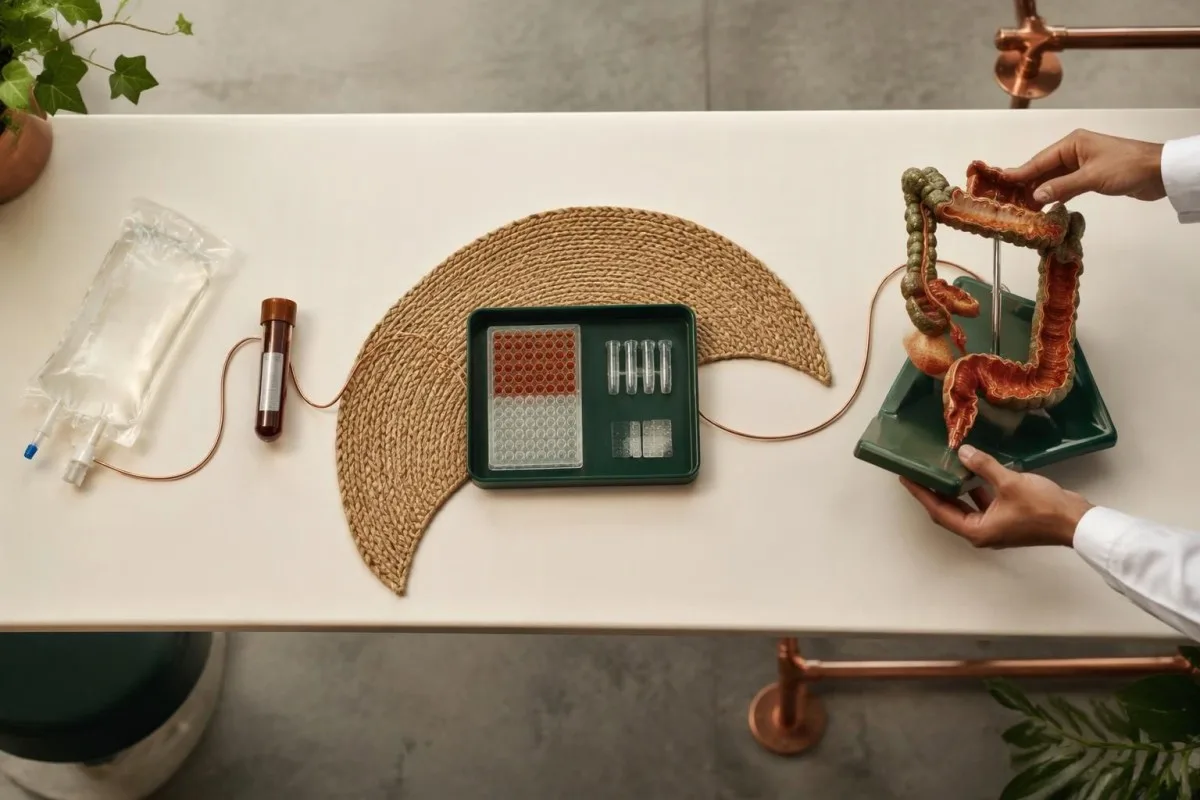
For a hypothetical 70 kg adult, 5 mg/kg corresponds to 350 mg before local preparation or rounding rules. Shortening an unchanged dose from every 8 weeks to every 6 weeks increases average drug administered per unit time by about 33%; the trough increase cannot be predicted as exactly 33% because clearance is not constant.
Increasing the dose and shortening the interval are not pharmacokinetically identical strategies. A larger dose changes peak exposure, while a shorter interval reduces time for concentrations to decline; a hypothetical patient whose symptoms repeatedly return during week 7 may prompt a different discussion from someone symptomatic throughout all 8 weeks.
A useful reassessment checks both exposure and the treatment outcome rather than declaring success because the trough rose. If infliximab increases from 2 to 9 µg/mL but calprotectin remains 900 µg/g and endoscopic disease persists, the new result has narrowed the explanation without necessarily improving the underlying disease.
The timing of repeat testing depends on severity, the revised schedule, and the clinical question; waiting 3 months is not appropriate for every deteriorating patient. Our guida de tendéncia de la seguretat dels medicaments explains why comparable dates and methods matter, but an app should never independently recommend extra infusions.
Quand se considèran lo cambiament de tractament o la terapèia combinada?
Persistent high antibodies with low drug may favor changing treatment, while adequate exposure with confirmed active IBD may favor switching to a different mechanism. Low-level immunogenicity can sometimes be addressed through supervised optimization or an immunomodulator, but a result of 15 U/mL alone cannot determine which option offers the best benefit-risk balance.
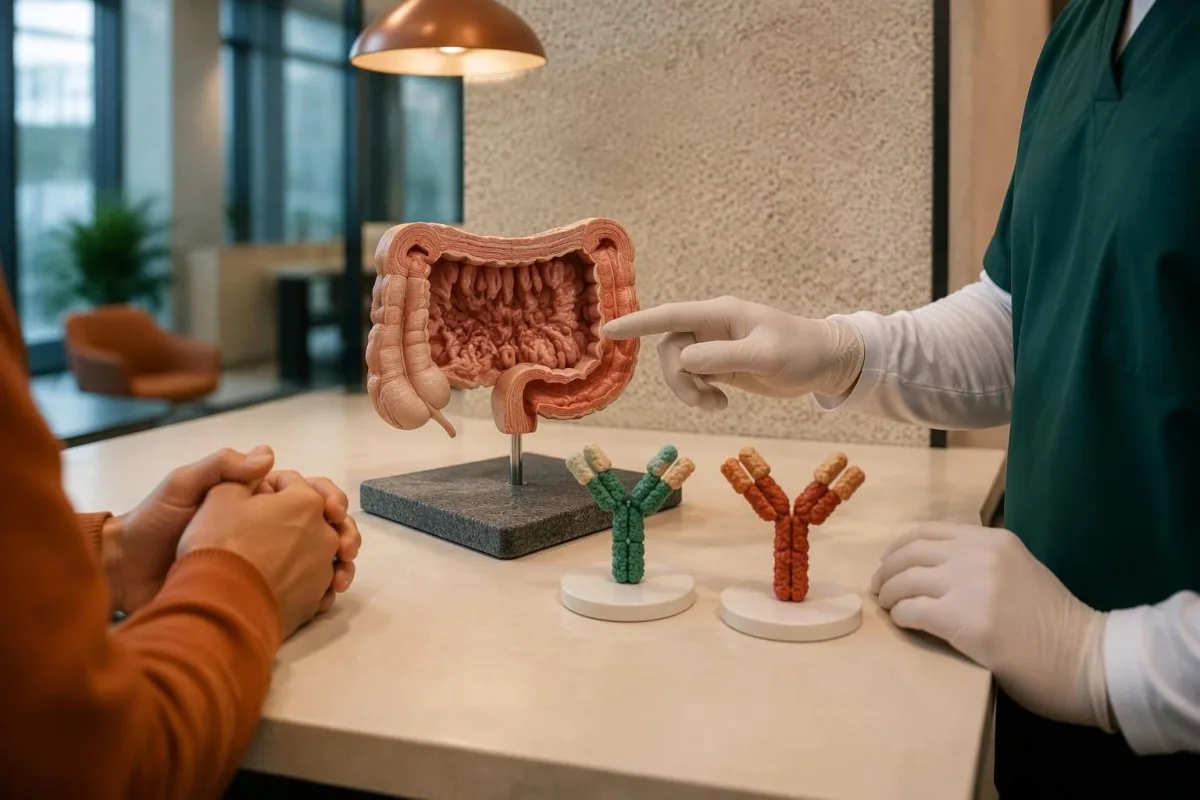
Switching within the anti-TNF class can make sense when infliximab previously controlled disease but antibody-associated clearance now prevents adequate exposure. Switching to another mechanism becomes more persuasive when inflammation persists with adequate exposure; these are 2 different failure patterns, not interchangeable reasons to choose the next medicine.
An immunomodulator such as azathioprine or methotrexate may reduce immunogenicity in selected circumstances, but adding one introduces additional monitoring and adverse-effect risks. Before azathioprine, TPMT testing and safety assessment can inform prescribing; TPMT and NUDT15 assessment do not replace ongoing CBC and liver monitoring, even when baseline results are normal.
If a person already takes a thiopurine, metabolite testing can help clarify exposure or a metabolism pattern before assuming combination therapy has failed. For example, 2 patients prescribed the same mg dose may have very different metabolite findings; our thiopurine treatment pattern guide explains why prescription dose alone is incomplete.
Restarting infliximab after a long interruption deserves a separate safety discussion because immunogenicity and infusion reactions can complicate re-exposure. A treatment gap of 6 months is not equivalent to a routine 1-week scheduling delay; never restart, add an immunomodulator, or stop an existing medicine based solely on an online interpretation.
L’inducion, las fistulas, los enfants e las injeccions càmbian las ciblas?
Treatment phase, disease phenotype, age, and formulation can change the relevant exposure goal; intravenous maintenance targets should not be copied into every setting. Standard adult intravenous induction commonly uses 5 mg/kg at weeks 0, 2, and 6, and those early concentrations are interpreted differently from an established 8-week maintenance trough.

The 2021 expert consensus described induction goals of approximately 20–25 µg/mL at week 2, 15–20 µg/mL at week 6, and 7–10 µg/mL at week 14 (Cheifetz et al., 2021). These are consensus exposure goals influenced by disease phenotype and outcome, not interchangeable minimums from one definitive randomized trial.
Perianal fistula outcomes may require higher exposure than symptom control in uncomplicated luminal disease, but observational associations do not establish a universal healing threshold. A fistula still draining at 10 µg/mL may also need imaging, drainage of an abscess, or procedural care; raising the trough cannot substitute for addressing an undrained collection.
Children can have different clearance and dosing requirements, particularly with lower body weight or severe disease. An adult maintenance benchmark of 5 µg/mL should not become a parent-directed dosing rule; our discussion of Interpretacion IA per mainatges explains why pediatric specialist context and age-appropriate interpretation remain necessary.
Subcutaneous infliximab produces a different concentration-time profile from intermittent intravenous infusions, and availability and prescribing schedules vary internationally. A concentration of 15 µg/mL during injection treatment should not be labeled excessive merely because an intravenous report lists 3–7 µg/mL; the formulation, actual regimen, and sampling convention must be specified.
Cossí los resultats en parelh modifian lo rasonament clinic?
Paired results guide the next question rather than dictate a prescription: low drug without antibodies suggests underexposure, low drug with persistent antibodies suggests immunogenicity, and adequate drug with inflammation raises possible mechanism failure. The following 4 examples are entirely hypothetical; the concentrations are illustrative, not personalized treatment recommendations.
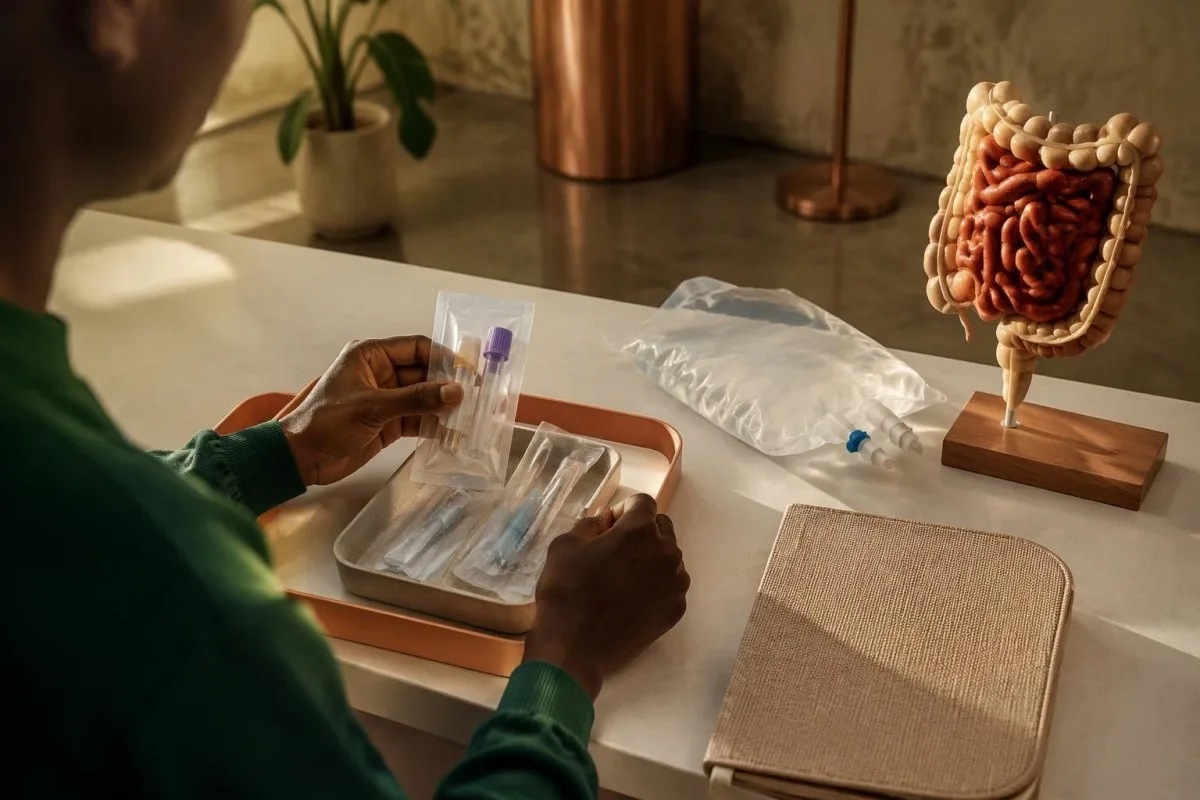
Example 1: a 34-year-old with Crohn's disease has a true trough of 1.8 µg/mL, no detected antibodies, albumin of 29 g/L, and calprotectin of 1,100 µg/g. This pattern supports underexposure in active disease; confirming the infusion schedule and considering supervised optimization are more logical than immediately declaring TNF blockade ineffective.
Example 2: a 46-year-old with ulcerative colitis has infliximab below 0.4 µg/mL and antibodies above the laboratory's 100 U/mL reporting limit on 2 visits. Assuming the assay defines that antibody signal as substantial, persistent immunogenicity is plausible; simply increasing the dose may be less successful than a clinician-directed treatment change.
Example 3: a 28-year-old has a trough of 11 µg/mL, no significant antibodies, and repeatedly active colitis on endoscopy despite appropriate optimization. Example 4: a 61-year-old has the same 11 µg/mL trough but reassuring endoscopy and diarrhea after ileal resection; the first pattern raises mechanism failure, whereas the second prompts investigation of non-inflammatory causes.
Kantesti es un Outil d’analisi de sang amb IA that helps organize these distinctions when the report and treatment details are supplied. Our explicacion de tecnologia IA describes how laboratory context informs interpretation; if a 2-week-old report lacks sampling timing, the missing information must stay visible rather than being guessed.
Qué deuriatz portar al seguiment, e quinas donadas probantas son aplicablas?
Bring the complete report, infusion timeline, and objective disease results to your IBD review; these 3 evidence streams make paired drug-antibody testing actionable. Seek earlier care for severe deterioration rather than waiting for the next trough, and distinguish infliximab-specific clinical research from general educational publications about accompanying laboratory abnormalities.
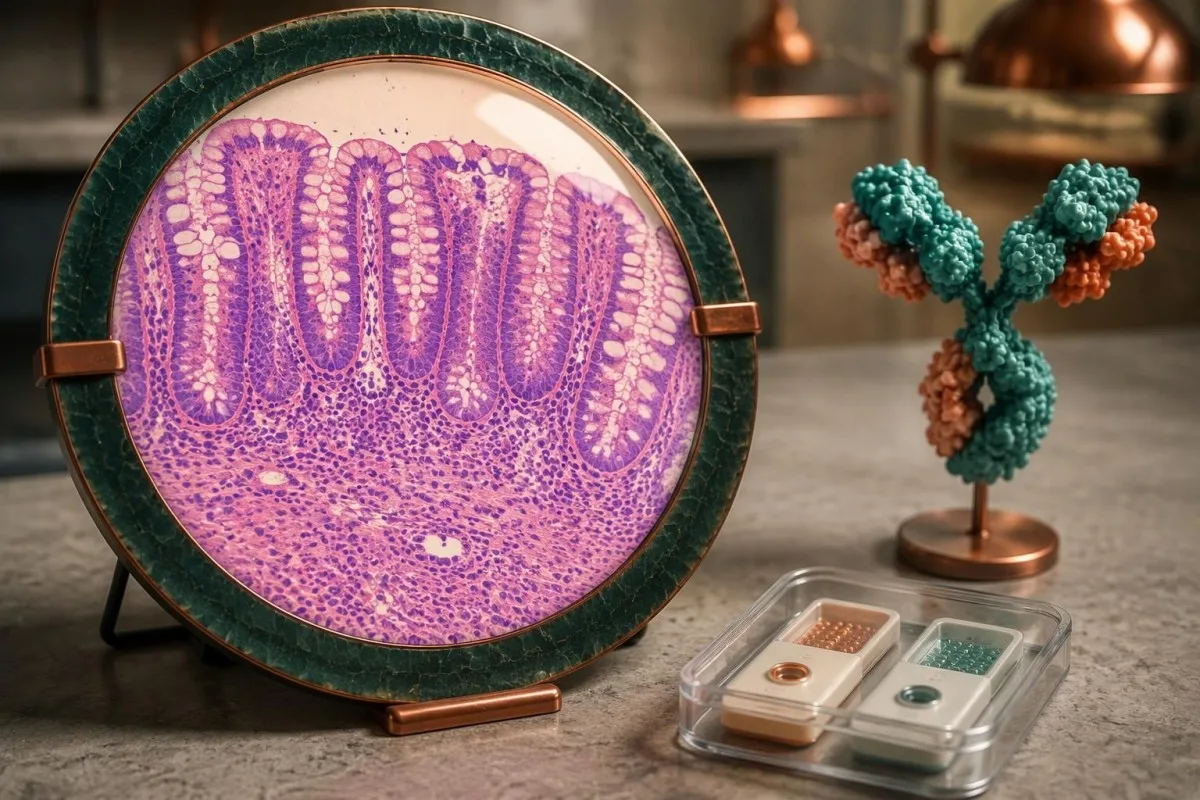
A useful review record includes the previous 2 infusion dates, actual dose, collection timing, assay name, antibody units, and recent CRP, albumin, and fecal calprotectin. Add symptom timing, steroid use, recent antibiotics, and missed doses; ask whether the proposed change addresses insufficient exposure, immunogenicity, active non-TNF disease, or a non-inflammatory explanation.
Contact your clinical team promptly for worsening diarrhea with dehydration, persistent vomiting, new significant bleeding, or fever of 38°C or higher while immunosuppressed. Severe abdominal pain with distension, fainting, or inability to keep fluids down may require emergency assessment; during an infusion, sudden breathing difficulty or collapse requires immediate staff attention, not interpretation of an antibody report.
Kantesti provides educational interpretation, not independent biologic prescribing, and our principis d’IA responsabla explain that boundary. A reassuring trough of 10 µg/mL does not establish that an infusion is safe during an acute illness; the treating service must assess symptoms, examination findings, and any necessary investigations.
The 2 Zenodo publications listed below address accompanying laboratory interpretation, not infliximab target validation: our guia RDW e globuls roges concerns anemia patterns, while our Guia BUN e creatinina concerns renal and hydration context. These educational deposits are not evidence for anti-drug antibody cutoffs; the AGA guideline, TAXIT trial, and biologic-monitoring consensus supply the directly relevant clinical references.
Preguntes més freqüents
0 Què significa un nivèl bas d’infliximab?
Un nivèl bas d’infliximab significa que l’exposicion al medicament en circulacion es inferior al valor de referéncia causit per aquela fasa del tractament e aquel objectiu; aquò significa pas automaticament que calga arrestar l’infliximab. Un taus résiduel de mantenença vertadièr de 2 µg/mL sens anticòrs significatius pòt reflectir una eliminacion mai rapida, una pèrda de proteïnas intestinalas o una dòsi o un interval insufisents. Un nivèl bas de medicament amb d’anticòrs persistents importants suggerís puslèu una eliminacion mediada per l’immunitat. Vòstra còla de MII deu interpretar lo resultat en lo comparant amb l’activitat objectiva de la malautiá, lo moment de la perfusion e lo tèst analitic.
Quin es un bon nivèl d’infliximab residual per la MII ?
I a pas una sola bona concentracion minimala d’infliximab que convingue a cada persona amb MII. La directritz de l’AGA de 2017 prepausèt almens 5 µg/mL per al contraròtle reactiu del tractament de mantenença, mentre qu’un consens d’expèrts de 2021 descriguèt de concentracions de mantenença de 5–10 µg/mL. De pacients seleccionats amb pèrda segondària de responsa pòdon aver besonh d’una reavaloracion a 10–15 µg/mL abans d’abandonar lo tractament. L’induccion, las fistulas e lo tractament per via soscutanèa exigisson un contèxte diferent, doncas un interval de laboratòri es pas una tòca universala de posologia.
Quand deuriái far lo tèst del nivèl d’infliximab ?
For intravenous infliximab, a trough sample should be collected immediately before the next infusion begins. A sample obtained 2 days after an infusion is not comparable with routine pre-infusion targets. Record the last infusion date, dose, scheduled interval, and actual collection time, especially if an 8-week appointment was delayed. Subcutaneous infliximab has a different exposure profile, so sampling should follow the prescribing team's and laboratory's instructions.
Los anticòrs contra l’infliximab pòdon desaparéisser?
0 Els anticòssers anti-infliximab de baix nivèl pòdon de còps venir indetectables o mens pertinents clinicament, mas d’anticòssers substancials persistents amb de nivèls fòrça basses del medicament son mai dificils de superar. Lo consens d’experts de 2021 descriviá los anticòssers de títol bas coma inferiors a 10 U/mL per un ensag d’analisi per desplaçament de mobilitat omogenèu; aquel lindal pòt pas s’aplicar a totes los metòdes de laboratòri. Una optimitzacion supervisada o un immunomodulator pòt ajudar de pacients seleccionats, mentre que d’autres an besonh d’un cambiament de tractament. De tèsts aparelhats repetits pòdon clarificar la persisténcia, mas los pacients deurián pas modificar lo tractament per eles meteisses.
L’infliximab pòt deixar de foncionar quitament se lo taus es normal?
L’infliximab pòt pas contrarotlar una MII objectivament activa malgrat una concentracion circulanta adequada, çò que fa pensar a un possible fracàs mecanistic. Una concentracion de 10 µg/mL abans de la dòsi seguenta garantís pas la cicatrizacion intestinala ni establís que lo TNF siá l’unica via que fa avançar la malautiá. Abans de cambiar de mecanisme, los clinicians confirman l’inflamacion, avaloran las complicacions estructuralas o infecciosas e considèran se l’exposicion èra adequada per l’objectiu terapeutic specific. Una diarreia amb una avaloracion objectiva rassuranta pòt aver una causa non inflamatòria.
Un nivèl d'infliximab naut es dangierós?
Una concentracion nauta d’infliximab es pas automaticament dangierosa, e cap de lindal de toxicitat serica establit unic s’aplica a totes las personas amb MII. Un resultat de 15 µg/mL pòt èsser interpretat diferentament pendent l’induccion, lo tractament de las fistulas o la terapia per via sostanada que pendent lo tractament de mantenença intravenós abitual. La seguretat depend del regim terapeutic global, de las infeccions, de las reaccions a la perfusion e d’autres resultats clinicis, puslèu que de la sola concentracion. Ometètz pas una perfusion e redusètz pas una dòsi sens discutir lo resultat amb vòstra equipa prescriptora.
Perqué cambièron los resultats dels anticòrses contra l’infliximab aprèp lo cambiament de laboratòri?
Los resultats dels anticòrs contra l’infliximab pòdon cambiar aprèp un cambiament de laboratòri perque los assages diferisson per lor calibratge, lors unitats, lors limits de deteccion e lor tolerància al medicament circulant. Un resultat de 20 AU/mL pòt pas èsser convertit universalament en U/mL o ng/mL. Una metòda tolerant al medicament pòt detectar d’anticòrs que mancan a un assatge sensible al medicament quand l’infliximab demòra mesurable. Comparatz las tendéncias amb la meteissa metòda quand es possible, e demandatz se lo tèst dels anticòrs foguèt efectivament realizat o omés en aplicacion d’una règla de tèst reflex.
Fasètz-vos explicar los resultats analisi de sang
Telecargatz vòstre compte rendut de laboratòri e l’IA de Kantesti explica cada biomarcador en lenga simpla en qualques segondas. Utilizat per mai de 2 milions de personas dins lo mond.
Referéncias
- Klein, T., Mitchell, S., & Weber, H. (2026). Analisi de sang RDW: guida completa de RDW-CV, MCV e MCHC. Recèrca medicala per IA de Kantesti. DOI
- Klein, T., Mitchell, S., & Weber, H. (2026). Explicacion del rapport BUN/Creatinina : Guia de test de foncion renal. Recèrca medicala per IA de Kantesti. DOI
- Feuerstein JD et al. (2017). American Gastroenterological Association Institute Guideline on Therapeutic Drug Monitoring in Inflammatory Bowel Disease. Gastroenterology. DOI
- Vande Casteele N et al. (2015). Trough concentrations of infliximab guide dosing for patients with inflammatory bowel disease. Gastroenterology. DOI
- Cheifetz AS et al. (2021). A Comprehensive Literature Review and Expert Consensus Statement on Therapeutic Drug Monitoring of Biologics in Inflammatory Bowel Disease. The American Journal of Gastroenterology. DOI
- 2M+Tèsts analisats
- 127+Païses
- 100+Lengas
A prepaus de l’equipa medicala


Senhals de confiança E-E-A-T
Experiéncia
Revisión clinica menada pel metge de las practicas d’interpretacion de las analisis.
Expertisa
Fòcus sus la medicina de laboratòri sus cossí los biomarcadors se comportan dins un contèxte clinic.
Autoritat
Revisat medicalament pel Dr Thomas Klein, amb de contribucions de la Dr Sarah Mitchell e del Prof. Dr Hans Weber.
Fisança
Interpretacion basada sus d’evidéncias amb de camins de seguiment clars per reduzir l’alarmisme.





Avís medical
Aqueste article es solament per tòcas educatius e constituís pas de conselh medical. Consultatz totjorn un professional de la sant qualificat per las decisions de diagnostica e de tractament.
Publicat · Contactar l’equipa editoriala
Publicat per Kantesti Ltd, enregistrada en Anglatèrra e País de Galas, n° d’entrepresa. 17090423, Londres, Reialme Unit.
