Infliksimabo koncentracijos tyrimas kartu nustato vaisto koncentraciją ir antikūnus, kad paaiškintų IBD kontrolės praradimą. Maža vaisto koncentracija be reikšmingo antikūnų kiekio rodo nepakankamą ekspoziciją; maža vaisto koncentracija kartu su nuolat dideliu antikūnų kiekiu rodo imuninės sistemos sąlygotą klirensą. Aktyvus uždegimas, nepaisant pakankamos ekspozicijos, leidžia įtarti galimą mechanizmo nesėkmę, tačiau tik patvirtinus uždegimą, tinkamą mėginio paėmimą ir gydymo tikslą atitinkantį koncentracijos tikslinį dydį.

Svarbiausios išvados
- Kartu vertinami rezultatai padeda atskirti nepakankamą infliksimabo ekspoziciją nuo su antikūnais susijusio klirenso; nė vienas rezultatas atskirai neįrodo, kodėl simptomai vėl atsirado.
- Mėginio paėmimas prieš infuziją reiškia, kad laboratorinis mėginys paimamas prieš pradedant kitą intraveninę infuziją, o ne praėjus 2 dienoms po jos.
- Palaikomojo gydymo orientacinės koncentracijos skiriasi: 2017 m. AGA rekomendacijose reaktyviajai stebėsenai siūlyta ne mažesnė kaip 5 µg/mL koncentracija, o ekspertų sutarime palaikomajam gydymui nurodoma 5–10 µg/mL.
- Maža infliksimabo koncentracija nesant antikūnų gali būti susijusi su greitesniu klirensu, baltymų netekimu per žarnyną, pavėluotu dozavimu arba pernelyg ilgu intervalu tarp dozių.
- Antikūnai prieš infliksimabą svarbiausi, kai jie yra nuolatiniai, reikšmingi konkrečiam tyrimo metodui ir kartu nustatoma labai maža arba neaptinkama vaisto koncentracija.
- Galimas mechanistinis gydymo nepakankamumas nustatomas tik esant objektyviai aktyviai IBD, nepaisant pakankamos vaisto ekspozicijos; viduriavimas, kai vaisto koncentracija prieš dozę yra 8 µg/mL, to nepatvirtina.
- Tyrimo metodų vienetai nėra tarpusavyje pakeičiami: 1 µg/mL infliksimabo yra lygu 1 mg/L, tačiau antikūnų U/mL ir AU/mL vienetų negalima visuotinai konvertuoti.
- Gydymo pakeitimus derinkite su savo IBD gydymo komanda; kai kuriais atvejais, kai gydymas nebeveiksmingas, prieš nutraukiant infliksimabo vartojimą gali būti tikslinga siekti 10–15 µg/mL ekspozicijos.
Ką iš tikrųjų parodo infliksimabo koncentracijos tyrimas?
An infliksimabo koncentracijos tyrimas matuoja kraujyje cirkuliuojantį infliksimabą, paprastai kartu tiriant antikūnus prieš vaistą, siekiant išsiaiškinti, ar nepakankama ekspozicija arba imuninės sistemos nulemtas vaisto pašalinimas iš organizmo. 2 µg/mL rezultatas, kai antikūnų neaptikta, kelia kitą klausimą nei 2 µg/mL rezultatas, kai nuolat nustatomas didelis antikūnų kiekis; nė vienas iš šių rezultatų savaime nereiškia, kad vaisto vartojimą būtina nutraukti.
Reaktyvusis terapinių vaistų koncentracijos stebėjimas – tai tyrimas, atliekamas pasunkėjus simptomams arba nustačius aktyvios ligos požymių. Jis skiriasi nuo proaktyvaus stebėjimo, kai liga, regis, yra remisijos stadijoje: hipotetinė 4 µg/mL koncentracija prieš dozę gali būti pagrindas atlikti papildomus tyrimus esant dokumentuotam paūmėjimui, tačiau kai endoskopijos ir išmatų žymenų tyrimai rodo ilgalaikį gijimą, reikėtų kitaip aptarti šį rezultatą.
Infliksimabas blokuoja naviko nekrozės faktorių, dažnai trumpinamą TNF; koncentracijos tyrimu nenustatoma, ar neutralizuotas kiekvienas TNF signalas žarnyne. Serumo tyrimo rezultatas 7 µg/mL rodo vaisto koncentraciją kraujyje, o ne vaisto aktyvumą kiekvienoje pažeistoje žarnyno dalyje ar žarnyno gijimo mastą.
Praktiniam vertinimui reikia atsižvelgti bent į 3 veiksnius: vaisto koncentraciją, antikūnų tyrimų rezultatus ir objektyvų ligos aktyvumą. Svarbus ir ankstesnis atsakas: simptomų atsinaujinimas po 18 mėnesių trukusios ligos kontrolės reiškia antrinį atsako praradimą, o jei gydymo pradžioje ligos kontrolės pasiekti nepavyko, kyla kitų klausimų dėl ekspozicijos indukcinio gydymo metu ir gydymo mechanizmo.
Kantesti yra AI kraujo tyrimo analizatorius padedantis skaitytojams suprasti kartu atliktų infliksimabo tyrimų rezultatus, nelaikant vieno laboratorinio skaičiaus nurodymu, kaip dozuoti vaistą. Mūsų platformą valdo Kantesti LTD, Jungtinės Karalystės įmonė Nr. 17090423; informacija apie organizacijoje yra atskirta nuo klinikinių įrodymų, kuriais pagrįstas terapinių vaistų koncentracijos stebėjimas.
Kada reikėtų paimti mėginį infliksimabo koncentracijai prieš kitą dozę nustatyti?
Intraveninio infliksimabo koncentracija prieš dozę turėtų būti tiriama prieš pat pradedant kitą infuziją, kai koncentracija per tą dozavimo intervalą yra beveik mažiausia. Mėginys, paimtas praėjus 2 dienoms po infuzijos, nėra mėginys koncentracijai prieš dozę nustatyti, todėl jo nereikėtų tiesiogiai lyginti su palaikomojo gydymo tikslinėmis koncentracijomis prieš infuziją.
Mėginio paėmimo laikas gali pakeisti tariamą rezultato reikšmę, nors gydymo veiksmingumas nepakito. Pavyzdžiui, hipotetiniai 18 µg/mL, išmatuoti netrukus po infuzijos, ir 3 µg/mL, išmatuoti prieš kitą infuziją, gali atspindėti tą patį dozavimo ciklą, o ne staigų pablogėjimą tarp 2 nepriklausomų gydymo būklių.
Prieš interpretuodami tyrimo ataskaitą, užrašykite ankstesnės infuzijos datą, tikrąją dozę mg, numatytą intervalą ir mėginio paėmimo laiką. Jei 8 savaičių intervalas tarp infuzijų pailgėja iki 10 savaičių, gauta koncentracija atspindi ilgesnį laikotarpį be vaisto; pagal ją negalima patikimai nustatyti, ar pradinis 8 savaičių grafikas užtikrino pakankamą ekspoziciją.
Collection from a line recently used to administer infliximab can contaminate the specimen and produce a misleadingly high result. Ask the infusion service about its collection protocol, and tell it if sampling occurred after treatment started; the timing principles resemble other pre-dose medication tests, although their targets differ.
Fasting is generally not required for the infliximab concentration itself, but another test ordered during the same visit may have preparation requirements. Our pirmosios analizės paruošimo vadovas explains how to document medication timing; for this test, an accurate infusion timeline usually matters more than an 8-hour fast.
Kokia infliksimabo koncentracija laikoma pakankama?
Yra no universal adequate infliximab trough for every patient, disease phenotype, assay, and treatment phase. The 2017 AGA guideline suggested at least 5 µg/mL during reactive maintenance monitoring, while a 2021 expert consensus described maintenance concentrations of 5–10 µg/mL and higher exposure in selected loss-of-response situations.
The AGA benchmark of at least 5 µg/mL is a clinical decision aid, not a healthy-population reference range (Feuerstein et al., 2017). Infliximab is a prescribed biologic: an untreated person normally has no circulating infliximab, so a laboratory's therapeutic interval should never be read like the normal range for sodium.
The TAXIT trial enrolled 263 adults with stable responses and optimized intravenous infliximab toward 3–7 µg/mL before randomized follow-up. Its primary remission endpoint did not improve with concentration-based dosing, although some secondary outcomes favored that approach; this explains why the historical 3–7 µg/mL window is useful context rather than a universal modern target (Vande Casteele et al., 2015).
Cheifetz et al. (2021) recommended considering exposure of 10–15 µg/mL before discontinuing infliximab for secondary loss of response in selected patients. This is expert consensus, not proof that everyone should be escalated to 15 µg/mL; fistulas, endoscopic goals, disease severity, safety, and prior optimization affect whether that reasoning applies.
A concentration of 12 µg/mL is not automatically toxic, and a concentration of 4 µg/mL does not automatically require escalation in an asymptomatic patient with documented healing. Unlike the narrower toxicity discussions around some kitus vaistus, kurių lygis stebimas bazalinis, infliximab has no single established serum toxicity cutoff that dictates action.
| Lygis | Diapazonas | Ką tai reiškia |
|---|---|---|
| Historical TAXIT optimization window | 3–7 µg/mL | Studied in adults with stable responses; not a universal threshold for active disease or fistula healing. |
| AGA reactive maintenance benchmark | At least 5 µg/mL | Suggested in the 2017 guideline for reactive monitoring; interpret alongside objective activity and the assay. |
| Expert-consensus maintenance range | 5–10 µg/mL | Described by the 2021 consensus; the appropriate goal varies with disease phenotype and desired outcome. |
| Selected loss-of-response reassessment | 10–15 µg/mL | Exposure experts suggest considering before abandoning treatment in selected cases; not a routine target or toxicity range. |
Kodėl infliksimabo koncentracija yra maža, kai antikūnų nėra?
Low infliximab levels with no significant antibodies usually suggest pharmacokinetic underexposure: too little drug remains available over the dosing interval. A trough of 1.5 µg/mL can reflect faster clearance, intestinal protein loss, a delayed infusion, or insufficient dose or frequency—not necessarily failure of TNF blockade as a treatment mechanism.

Severe intestinal disease can increase infliximab clearance and allow protein, including therapeutic antibody, to be lost through the bowel. A hypothetical patient with albumin of 28 g/L and a trough of 1 µg/mL therefore needs assessment of disease burden and protein loss, not just a question about whether the infusion was attended.
Low albumin is associated with faster infliximab clearance, but it is not a direct measure of drug binding or an instruction to apply a free-drug correction. Albumin of 30 g/L and 40 g/L may provide different clearance context; our serumo baltymų interpretacijos vadovas explains why inflammation, liver synthesis, nutrition, and loss must be distinguished.
Infliximab is mainly broken down through protein-catabolic pathways rather than cleared unchanged by the kidneys. A creatinine of 90 µmol/L cannot predict the infliximab trough, and the medicine should not be interpreted using small-molecule renal dosing assumptions; body size, inflammatory burden, and treatment interruptions may be more informative.
Kantesti AI helps place a low trough alongside reported albumin, CRP, and infusion timing; 1 result cannot identify the clearance pathway by itself. Low albumin should not automatically trigger protein supplements, because inflammation also changes circulating proteins—as explained in our guide to inflammation and transferrin.
Ką rodo maža vaisto koncentracija kartu su antikūnais?
Low or undetectable infliximab with persistent high antibodies suggests immune-mediated pharmacokinetic failure: antibodies can accelerate clearance, neutralize drug activity, or both. A trough below an assay's 0.5 µg/mL quantification limit with a substantial antibody result is more concerning than a weak antibody signal alongside a maintained drug concentration.
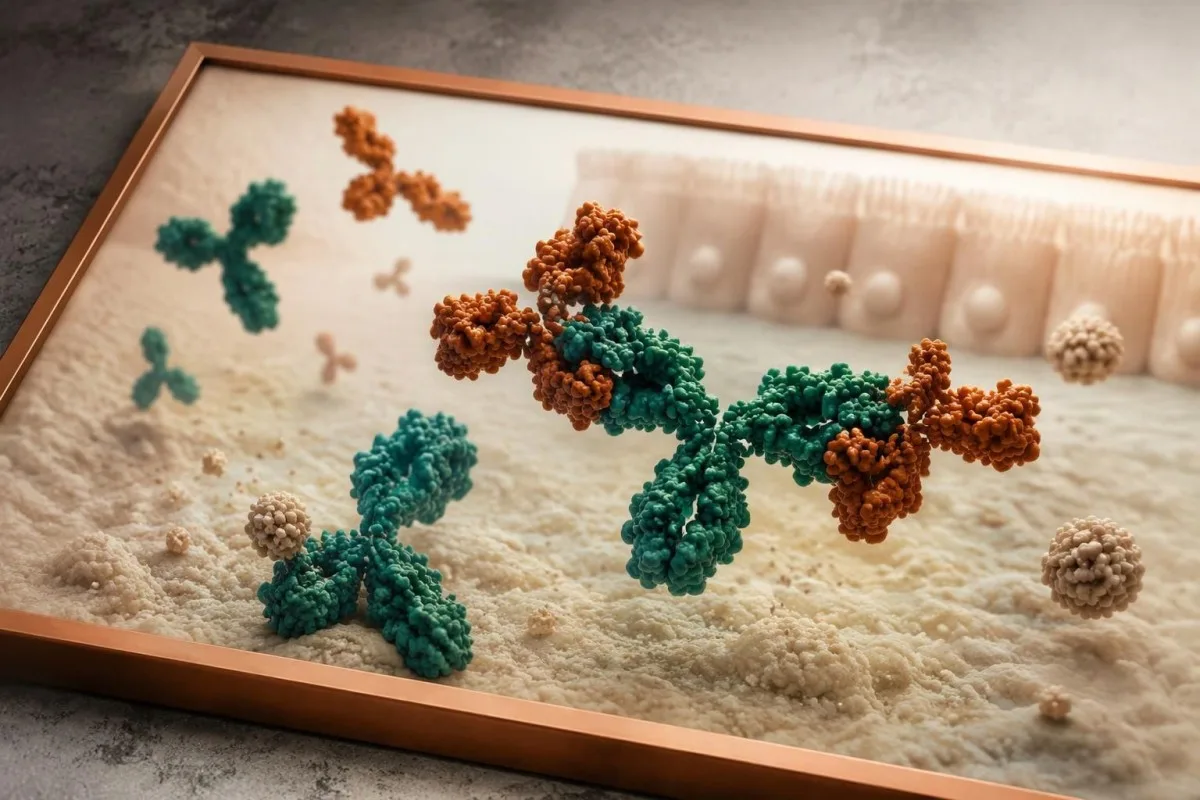
Anti-infliximab antibody tests usually detect binding antibodies; they do not all directly measure neutralizing activity. A positive result of 20 U/mL therefore identifies an assay-defined antibody signal, not a universal percentage of blocked infliximab or a precise prediction of how much benefit remains.
Antibody persistence and magnitude influence whether dose optimization is likely to recover exposure. Cheifetz et al. (2021) described low-titer antibodies as below 10 U/mL for the homogeneous mobility shift assay specifically; that threshold must not be transferred to an ELISA reporting AU/mL or to another laboratory's calibration.
A single low antibody result may be transient or become less clinically relevant after supervised treatment optimization. Repeating paired drug and antibody testing can distinguish a 1-time signal from a rising pattern, but severe disease or an infusion reaction may require action before a second result is available.
Antibodies to infliximab are not the same as antibodies against your own bowel, and they do not by themselves diagnose an immediate allergy. Our explanation of teigiamų antikūnų rezultatų tipų helps separate these concepts; breathlessness or faintness during an infusion still requires immediate attention regardless of the antibody number.
Kada pakankama koncentracija prieš kitą dozę leidžia įtarti mechanizmo nesėkmę?
Galimas mechanistinis gydymo nepakankamumas means objectively active IBD persists despite sufficient infliximab exposure for the treatment goal. A trough of 8 µg/mL with confirmed active colitis may raise this possibility, but selected patients need further exposure optimization before clinicians conclude that another inflammatory pathway should be targeted.
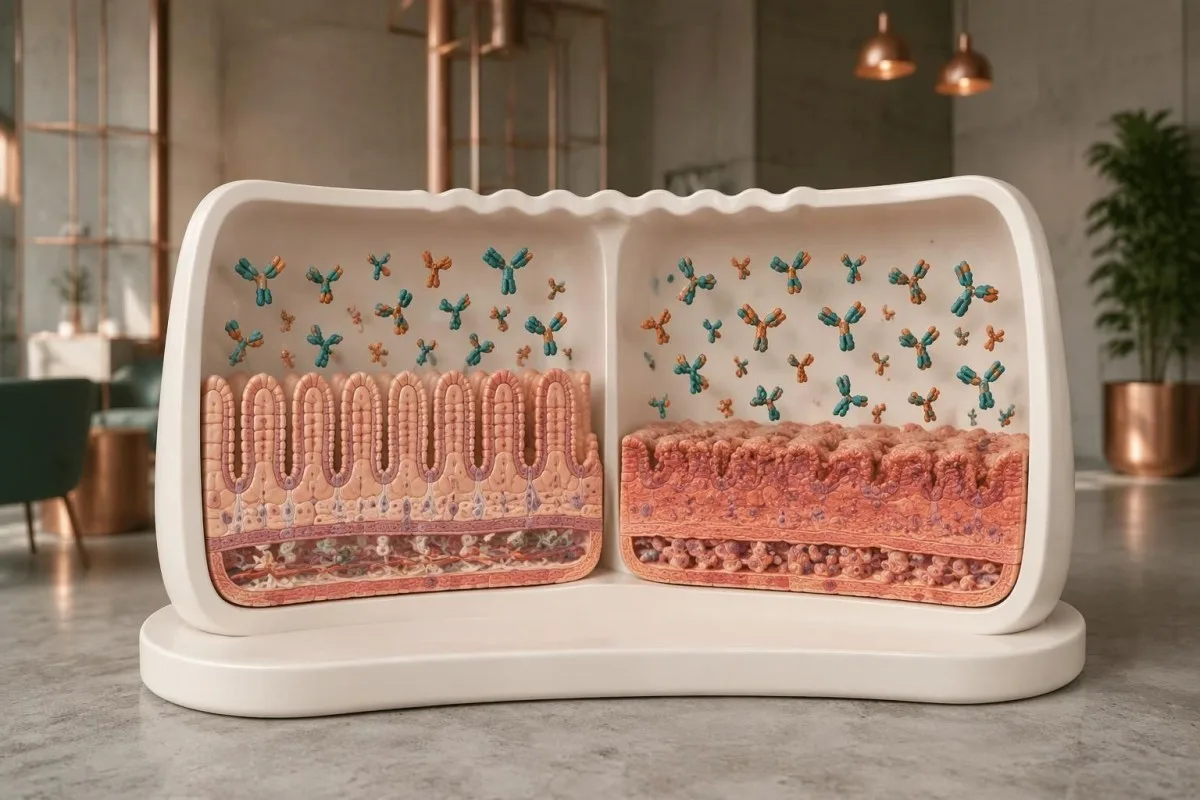
An adequate serum concentration cannot prove that TNF is the only pathway driving a person's current disease. Persistent endoscopic activity with a trough of 12 µg/mL is more supportive of a mechanism problem than the same concentration with normal objective testing and symptoms from bile acid diarrhea.
Calling treatment failure at exactly 5 µg/mL can be premature when the goal is fistula control or substantial endoscopic improvement. The 10–15 µg/mL reassessment discussed in the 2021 consensus provides a safeguard against abandoning an under-optimized treatment, but it is not a requirement to escalate every patient with symptoms.
Objective evidence also has limits: CRP of 3 mg/L does not exclude active IBD, especially in people whose CRP has remained low during previous flares. Borderline stool results need context and sometimes repetition; our guide to ribinį fekalijų kalprotekciną explains why an isolated intermediate value should not determine a biologic switch.
The strongest case for changing mechanism combines 3 findings: documented inflammation, adequate exposure on a correctly timed sample, and an inadequate clinical response despite appropriate optimization. Structural complications, such as a fixed Crohn's stricture, can also cause symptoms that neither more infliximab nor a different biologic will reliably reverse.
Ar antikūnų tyrimo rezultatas gali būti teigiamas, kai infliksimabo koncentracija pakankama?
Antibodies can be detected while infliximab remains measurable or adequate, particularly with drug-tolerant assays. A trough of 7 µg/mL and a weak positive antibody result do not automatically mean treatment failure; the assay, antibody trend, and evidence of disease activity determine how much weight that finding deserves.
Drug-tolerant methods can identify antibodies in samples containing infliximab that would interfere with some drug-sensitive methods. This greater analytical sensitivity may reveal early or low-level immunogenicity, but 1 newly detected signal does not necessarily establish clinically meaningful loss of response.
A qualitative positive result contains less information than a quantitative result with the assay's cutoff and units. A report reading only positive cannot distinguish a value just above a 10 AU/mL cutoff from a much larger signal; our guide to kokybiniai ir kiekybiniai tyrimai explains what each format can establish.
Compare antibody trajectories using the same laboratory method whenever feasible. Hypothetical results of 12, 15, and 13 AU/mL across 3 correctly timed visits may carry a different implication from 12, 80, and 200 AU/mL, although analytical variability and clinical findings still prevent interpretation from trend alone.
Kantesti yra AI kraujo tyrimo rezultatų interpretavimo platforma that helps distinguish a reported antibody cutoff from a treatment target. When the report lacks the method or units, our interpretation should preserve that uncertainty rather than labeling 1 positive result as proof that infliximab has stopped working.
Kodėl svarbūs laboratoriniai metodai ir antikūnų matavimo vienetai?
Infliximab and antibody results are method-dependent, so values from different assays are not always interchangeable. Infliximab 1 µg/mL equals 1 mg/L, but antibody results in U/mL, AU/mL, or ng/mL do not have a universal conversion because laboratories use different standards, detection limits, and approaches to drug interference.
An assay may report free or functionally available drug differently from another method that detects a broader pool of circulating drug. Two laboratories can therefore produce somewhat different concentrations from similar specimens; a change from 6 to 8 µg/mL after switching methods may not represent a true gain in exposure.
Below the quantification limit means the assay cannot reliably assign a numerical concentration below its validated boundary. A report of less than 0.4 µg/mL is not proof of exactly 0 µg/mL, and greater than 100 U/mL cannot tell you whether the true antibody result is 110 or 1,000 U/mL.
Some laboratories use reflex antibody testing only when the drug concentration falls below a preset threshold. If antibodies were not tested because infliximab was 9 µg/mL, the result is not equivalent to antibodies negative; ask whether the antibody field says not performed, not detected, or below detection.
Kantesti's report interpretation should retain the assay name, units, and collection context instead of silently converting 20 AU/mL into another method's scale. Our klinikinės metodikos informacijoje explains the distinction between technical interpretation and clinical decision-making; no AI explanation removes the need to confirm an unusual result with the reporting laboratory.
Kaip gydytojai patvirtina, kad vėl atsiradusius simptomus sukelia IBD?
Returning symptoms do not necessarily mean returning intestinal inflammation; clinicians combine stool markers, CRP, infection testing, endoscopy, and imaging as appropriate. Three loose stools daily with a trough of 6 µg/mL can arise from active IBD, an intestinal infection, bile acid diarrhea, or a functional bowel disorder.
Fecal calprotectin and lactoferrin assess intestinal inflammatory activity rather than infliximab exposure. A hypothetical calprotectin of 800 µg/g adds different information from a trough of 2 µg/mL; our stool inflammation marker comparison explains why paired disease and drug measurements answer separate clinical questions.
C. difficile testing can be necessary during new or worsening diarrhea, even without recent antibiotics. A positive screening test and negative toxin result require contextual interpretation, not automatic classification as an IBD flare; our guide to prieštaringus C. difficile tyrimų rezultatus describes why 2 test components can disagree.
Bile acid diarrhea is particularly relevant after ileal disease or resection and can persist despite controlled inflammation. A person with a trough of 10 µg/mL and reassuring objective IBD assessment may need a different evaluation; our explanation of SeHCAT retention results covers one diagnostic route where that test is available.
Bloating, gas, and altered stool frequency can also reflect bacterial overgrowth or carbohydrate malabsorption. At least 2 explanations can coexist with IBD, so a satisfactory trough should not end the assessment; our SIBO breath test guide explains preparation and limitations rather than treating breath testing as proof of every symptom's cause.
Kaip IBD gydymo komanda galėtų reaguoti į mažą ekspoziciją?
Low exposure without substantial persistent antibodies may lead an IBD team to increase the infliximab dose, shorten the dosing interval, or address a treatment interruption. A common adult intravenous maintenance schedule is 5 mg/kg every 8 weeks after induction, but any adjustment requires individualized prescribing and reassessment of disease activity.
For a hypothetical 70 kg adult, 5 mg/kg corresponds to 350 mg before local preparation or rounding rules. Shortening an unchanged dose from every 8 weeks to every 6 weeks increases average drug administered per unit time by about 33%; the trough increase cannot be predicted as exactly 33% because clearance is not constant.
Increasing the dose and shortening the interval are not pharmacokinetically identical strategies. A larger dose changes peak exposure, while a shorter interval reduces time for concentrations to decline; a hypothetical patient whose symptoms repeatedly return during week 7 may prompt a different discussion from someone symptomatic throughout all 8 weeks.
A useful reassessment checks both exposure and the treatment outcome rather than declaring success because the trough rose. If infliximab increases from 2 to 9 µg/mL but calprotectin remains 900 µg/g and endoscopic disease persists, the new result has narrowed the explanation without necessarily improving the underlying disease.
The timing of repeat testing depends on severity, the revised schedule, and the clinical question; waiting 3 months is not appropriate for every deteriorating patient. Our vaistų saugos tendencijų vadovas explains why comparable dates and methods matter, but an app should never independently recommend extra infusions.
Kada svarstoma keisti gydymą arba taikyti kombinuotą gydymą?
Persistent high antibodies with low drug may favor changing treatment, while adequate exposure with confirmed active IBD may favor switching to a different mechanism. Low-level immunogenicity can sometimes be addressed through supervised optimization or an immunomodulator, but a result of 15 U/mL alone cannot determine which option offers the best benefit-risk balance.
Switching within the anti-TNF class can make sense when infliximab previously controlled disease but antibody-associated clearance now prevents adequate exposure. Switching to another mechanism becomes more persuasive when inflammation persists with adequate exposure; these are 2 different failure patterns, not interchangeable reasons to choose the next medicine.
An immunomodulator such as azathioprine or methotrexate may reduce immunogenicity in selected circumstances, but adding one introduces additional monitoring and adverse-effect risks. Before azathioprine, TPMT testing and safety assessment can inform prescribing; TPMT and NUDT15 assessment do not replace ongoing CBC and liver monitoring, even when baseline results are normal.
If a person already takes a thiopurine, metabolite testing can help clarify exposure or a metabolism pattern before assuming combination therapy has failed. For example, 2 patients prescribed the same mg dose may have very different metabolite findings; our thiopurine treatment pattern guide explains why prescription dose alone is incomplete.
Restarting infliximab after a long interruption deserves a separate safety discussion because immunogenicity and infusion reactions can complicate re-exposure. A treatment gap of 6 months is not equivalent to a routine 1-week scheduling delay; never restart, add an immunomodulator, or stop an existing medicine based solely on an online interpretation.
Ar indukcija, fistulės, vaikai ir injekcijos keičia tikslinius dydžius?
Treatment phase, disease phenotype, age, and formulation can change the relevant exposure goal; intravenous maintenance targets should not be copied into every setting. Standard adult intravenous induction commonly uses 5 mg/kg at weeks 0, 2, and 6, and those early concentrations are interpreted differently from an established 8-week maintenance trough.

The 2021 expert consensus described induction goals of approximately 20–25 µg/mL at week 2, 15–20 µg/mL at week 6, and 7–10 µg/mL at week 14 (Cheifetz et al., 2021). These are consensus exposure goals influenced by disease phenotype and outcome, not interchangeable minimums from one definitive randomized trial.
Perianal fistula outcomes may require higher exposure than symptom control in uncomplicated luminal disease, but observational associations do not establish a universal healing threshold. A fistula still draining at 10 µg/mL may also need imaging, drainage of an abscess, or procedural care; raising the trough cannot substitute for addressing an undrained collection.
Children can have different clearance and dosing requirements, particularly with lower body weight or severe disease. An adult maintenance benchmark of 5 µg/mL should not become a parent-directed dosing rule; our discussion of dirbtinio intelekto interpretacija vaikams explains why pediatric specialist context and age-appropriate interpretation remain necessary.
Subcutaneous infliximab produces a different concentration-time profile from intermittent intravenous infusions, and availability and prescribing schedules vary internationally. A concentration of 15 µg/mL during injection treatment should not be labeled excessive merely because an intravenous report lists 3–7 µg/mL; the formulation, actual regimen, and sampling convention must be specified.
Kaip kartu vertinami rezultatai keičia klinikinį mąstymą?
Paired results guide the next question rather than dictate a prescription: low drug without antibodies suggests underexposure, low drug with persistent antibodies suggests immunogenicity, and adequate drug with inflammation raises possible mechanism failure. The following 4 examples are entirely hypothetical; the concentrations are illustrative, not personalized treatment recommendations.
Example 1: a 34-year-old with Crohn's disease has a true trough of 1.8 µg/mL, no detected antibodies, albumin of 29 g/L, and calprotectin of 1,100 µg/g. This pattern supports underexposure in active disease; confirming the infusion schedule and considering supervised optimization are more logical than immediately declaring TNF blockade ineffective.
Example 2: a 46-year-old with ulcerative colitis has infliximab below 0.4 µg/mL and antibodies above the laboratory's 100 U/mL reporting limit on 2 visits. Assuming the assay defines that antibody signal as substantial, persistent immunogenicity is plausible; simply increasing the dose may be less successful than a clinician-directed treatment change.
Example 3: a 28-year-old has a trough of 11 µg/mL, no significant antibodies, and repeatedly active colitis on endoscopy despite appropriate optimization. Example 4: a 61-year-old has the same 11 µg/mL trough but reassuring endoscopy and diarrhea after ileal resection; the first pattern raises mechanism failure, whereas the second prompts investigation of non-inflammatory causes.
Kantesti yra AI pagrindu veikiantis kraujo tyrimų analizės įrankis that helps organize these distinctions when the report and treatment details are supplied. Our Dirbtinio intelekto technologijos paaiškinimas describes how laboratory context informs interpretation; if a 2-week-old report lacks sampling timing, the missing information must stay visible rather than being guessed.
Ką reikėtų atsinešti į kontrolinį vizitą ir kokie įrodymai taikytini?
Bring the complete report, infusion timeline, and objective disease results to your IBD review; these 3 evidence streams make paired drug-antibody testing actionable. Seek earlier care for severe deterioration rather than waiting for the next trough, and distinguish infliximab-specific clinical research from general educational publications about accompanying laboratory abnormalities.
A useful review record includes the previous 2 infusion dates, actual dose, collection timing, assay name, antibody units, and recent CRP, albumin, and fecal calprotectin. Add symptom timing, steroid use, recent antibiotics, and missed doses; ask whether the proposed change addresses insufficient exposure, immunogenicity, active non-TNF disease, or a non-inflammatory explanation.
Contact your clinical team promptly for worsening diarrhea with dehydration, persistent vomiting, new significant bleeding, or fever of 38°C or higher while immunosuppressed. Severe abdominal pain with distension, fainting, or inability to keep fluids down may require emergency assessment; during an infusion, sudden breathing difficulty or collapse requires immediate staff attention, not interpretation of an antibody report.
Kantesti provides educational interpretation, not independent biologic prescribing, and our atsakingo dirbtinio intelekto principai explain that boundary. A reassuring trough of 10 µg/mL does not establish that an infusion is safe during an acute illness; the treating service must assess symptoms, examination findings, and any necessary investigations.
The 2 Zenodo publications listed below address accompanying laboratory interpretation, not infliximab target validation: our RDW ir raudonųjų kraujo kūnelių vadovas concerns anemia patterns, while our BUN ir kreatinino vadovas concerns renal and hydration context. These educational deposits are not evidence for anti-drug antibody cutoffs; the AGA guideline, TAXIT trial, and biologic-monitoring consensus supply the directly relevant clinical references.
Dažnai užduodami klausimai
Ką reiškia mažas infliksimabo kiekis?
Maža infliksimabo koncentracija reiškia, kad cirkuliuojančio vaisto ekspozicija yra mažesnė už šiam gydymo etapui ir tikslui pasirinktą ribinę vertę; tai savaime nereiškia, kad infliksimabo vartojimą reikėtų nutraukti. Tikroji palaikomojo gydymo mažiausia koncentracija prieš infuziją – 2 µg/mL – kai reikšmingų antikūnų nėra, gali rodyti greitesnį klirensą, baltymų netekimą per žarnyną arba nepakankamą dozę ar per ilgą intervalą tarp dozių. Maža vaisto koncentracija kartu su nuolat išliekančiais dideliais antikūnų kiekiais veikiau rodo imuninės sistemos sukeltą klirensą. Jūsų IBD gydymo komanda turėtų įvertinti rezultatą kartu su objektyviais ligos aktyvumo rodikliais, infuzijos laiku ir tyrimo metodu.
Koks yra geras infliksimabo koncentracijos IBD gydymo metu prieš kitą dozę lygis?
Nėra vienos tinkamos infliksimabo koncentracijos prieš kitą dozę, kuri tiktų kiekvienam IBD sergančiam žmogui. 2017 m. AGA gairėse rekomenduota, atliekant reaktyviąją palaikomojo gydymo stebėseną, siekti bent 5 µg/mL, o 2021 m. ekspertų konsensuse nurodyta, kad palaikomojo gydymo metu koncentracija turėtų būti 5–10 µg/mL. Kai kuriems pacientams, kuriems antrinis atsakas susilpnėjo, prieš nutraukiant gydymą gali reikėti pakartotinai įvertinti koncentraciją, kai ji siekia 10–15 µg/mL. Indukciniam gydymui, fistulėms ir poodiniam gydymui reikalingas kitoks kontekstas, todėl laboratorinis intervalas nėra universalus dozavimo tikslas.
Kada turėčiau atlikti infliksimabo koncentracijos tyrimą?
For intravenous infliximab, a trough sample should be collected immediately before the next infusion begins. A sample obtained 2 days after an infusion is not comparable with routine pre-infusion targets. Record the last infusion date, dose, scheduled interval, and actual collection time, especially if an 8-week appointment was delayed. Subcutaneous infliximab has a different exposure profile, so sampling should follow the prescribing team's and laboratory's instructions.
Ar gali išnykti antikūnai prieš infliksimabą?
0 Mažo titro antikūnai prieš infliksimabą kartais gali tapti neaptinkami arba būti mažiau kliniškai reikšmingi, tačiau didelio titro išliekantys antikūnai, kai vaisto koncentracija labai maža, yra sunkiau įveikiami. 2021 m. ekspertų konsensuse mažo titro antikūnais laikyti tie, kurių koncentracija atliekant vieną homogeninio mobilumo poslinkio tyrimą buvo mažesnė nei 10 U/mL; šios ribinės vertės negalima taikyti visiems laboratoriniams metodams. Prižiūrimas gydymo optimizavimas arba imunomoduliatorius gali padėti kai kuriems atrinktiems pacientams, o kitiems gali reikėti keisti gydymą. Pakartotinis porinis tyrimas gali padėti nustatyti, ar šis reiškinys išlieka, tačiau pacientai neturėtų patys keisti gydymo.
Ar infliksimabas gali nustoti veikti, net jei jo koncentracija yra normali?
Infliksimabas gali nepadėti kontroliuoti objektyviai aktyvios uždegiminės žarnų ligos (UŽL), nepaisant pakankamos koncentracijos kraujyje, todėl galima įtarti mechanizmo nepakankamumą. 10 µg/mL mažiausia koncentracija prieš kitą dozę negarantuoja žarnyno gleivinės gijimo ir neįrodo, kad TNF yra vienintelis ligą skatinantis kelias. Prieš keisdami veikimo mechanizmą, gydytojai patvirtina uždegimą, įvertina struktūrines ar infekcines komplikacijas ir apsvarsto, ar vaisto ekspozicija buvo pakankama konkrečiam gydymo tikslui pasiekti. Viduriavimas, kai objektyvaus tyrimo rezultatai ramina, gali būti nulemtas ne uždegimo priežasties.
Ar didelis infliksimabo kiekis yra pavojingas?
Didelė infliksimabo koncentracija nėra savaime pavojinga, o vienos nustatytos serumo koncentracijos ribos, kuri būtų toksiška visiems IBD sergantiems pacientams, nėra. 15 µg/mL rezultatas gali būti vertinamas skirtingai indukcijos, fistulių gydymo ar poodinės terapijos metu nei įprasto palaikomojo gydymo intraveninėmis infuzijomis metu. Saugumas priklauso nuo viso gydymo režimo, infekcijų, reakcijų į infuziją ir kitų klinikinių požymių, o ne vien nuo koncentracijos. Nepraleiskite infuzijos ir nemažinkite dozės, neaptarę rezultato su gydymą paskyrusia komanda.
Kodėl po laboratorijos pakeitimo pasikeitė mano antikūnų prieš infliksimabą tyrimo rezultatai?
Infliximabo antikūnų tyrimų rezultatai gali pasikeisti pakeitus laboratoriją, nes tyrimai skiriasi kalibravimu, matavimo vienetais, aptikimo ribomis ir tolerancija kraujyje cirkuliuojančiam vaistui. 20 AU/mL rezultato negalima universaliai perskaičiuoti į U/mL arba ng/mL. Vaistui atspariu metodu galima aptikti antikūnus, kurių vaistui jautrus tyrimas neaptinka, kai infliksimabo koncentracija tebėra išmatuojama. Jei įmanoma, tendencijas lyginkite taikydami tą patį metodą ir pasiteiraukite, ar antikūnų tyrimas iš tiesų buvo atliktas, o ne praleistas pagal automatinio refleksinio tyrimo taisyklę.
Sužinokite, kaip skaityti kraujo tyrimo rezultatus
Įkelkite laboratorinio tyrimo ataskaitą ir Kantesti AI per kelias sekundes paprasta kalba paaiškins kiekvieną biomarkerį. Juo naudojasi daugiau nei 2 milijonai žmonių visame pasaulyje.
Nuorodos
- Klein, T., Mitchell, S., & Weber, H. (2026). RDW kraujo tyrimas: išsamus RDW-CV, MCV ir MCHC vadovas. Kantesti AI medicininiai tyrimai. DOI
- Klein, T., Mitchell, S., & Weber, H. (2026). BUN/Creatininio santykio paaiškinimas: Nerų funkcijos testų vadovas. Kantesti AI medicininiai tyrimai. DOI
- Feuerstein JD et al. (2017). American Gastroenterological Association Institute Guideline on Therapeutic Drug Monitoring in Inflammatory Bowel Disease. Gastroenterologija. DOI
- Vande Casteele N et al. (2015). Trough concentrations of infliximab guide dosing for patients with inflammatory bowel disease. Gastroenterologija. DOI
- Cheifetz AS et al. (2021). A Comprehensive Literature Review and Expert Consensus Statement on Therapeutic Drug Monitoring of Biologics in Inflammatory Bowel Disease. The American Journal of Gastroenterology. DOI
- 2M+Ištirti tyrimai
- 127+Šalys
- 100+Kalbos
Apie medicinos komandą


E-E-A-T patikimumo signalai
Patirtis
Gydytojo vadovaujama klinikinė laboratorinių tyrimų interpretavimo darbo eigų peržiūra.
Ekspertizė
Laboratorinės medicinos dėmesys tam, kaip biomarkeriai elgiasi klinikiniame kontekste.
Autoritetas
Mediciniškai peržiūrėjo dr. Thomas Klein, prisidėjo dr. Sarah Mitchell ir prof. dr. Hans Weber.
Patikimumas
Įrodymais pagrįsta interpretacija su aiškiais tolesnių veiksmų keliais, siekiant sumažinti nerimą.





Medicininė atsakomybės ribojimo nuostata
Šis straipsnis skirtas tik mokymo tikslais ir nesudaro medicininės konsultacijos. Visada kreipkitės į kvalifikuotą sveikatos priežiūros specialistą dėl diagnozės ir gydymo sprendimų.
Paskelbta · Susisiekite su redakcine komanda
Išleido Kantesti Ltd, registruota Anglijoje ir Velse, įmonės Nr. 17090423, Londonas, Jungtinė Karalystė.
