ইনফ্লিক্সিম্যাবের মাত্রা পরীক্ষা ওষুধের ঘনত্বের সঙ্গে অ্যান্টিবডির মাত্রা মিলিয়ে IBD নিয়ন্ত্রণ হারানোর কারণ ব্যাখ্যা করে। উল্লেখযোগ্য অ্যান্টিবডি ছাড়া ওষুধের মাত্রা কম থাকলে অপর্যাপ্ত এক্সপোজারের ইঙ্গিত মেলে; স্থায়ীভাবে উচ্চ অ্যান্টিবডির সঙ্গে ওষুধের মাত্রা কম থাকলে ইমিউন-মধ্যস্থ ক্লিয়ারেন্সের ইঙ্গিত মেলে। পর্যাপ্ত এক্সপোজার থাকা সত্ত্বেও সক্রিয় প্রদাহ থাকলে সম্ভাব্য মেকানিস্টিক ব্যর্থতার ইঙ্গিত মিলতে পারে—তবে কেবল প্রদাহ, সঠিক সময়ে নমুনা সংগ্রহ, এবং চিকিৎসার লক্ষ্যের উপযোগী টার্গেট নিশ্চিত করার পর।.

মূল বিষয়গুলো
- একত্রে বিবেচিত ফলাফল অপর্যাপ্ত ইনফ্লিক্সিম্যাব এক্সপোজারকে অ্যান্টিবডি-সম্পর্কিত ক্লিয়ারেন্স থেকে আলাদা করে; উপসর্গ কেন ফিরে এসেছে, তা কোনো একটি ফলাফলই একা প্রমাণ করে না।.
- ইনফিউশনের আগে নমুনা সংগ্রহ অর্থ পরবর্তী শিরায় দেওয়া ইনফিউশন শুরু হওয়ার আগে পরীক্ষাগারের নমুনা সংগ্রহ করা, 2 দিন পরে নয়।.
- মেইনটেন্যান্সের মানদণ্ড ভিন্ন: 2017 সালের AGA নির্দেশিকা রিঅ্যাক্টিভ মনিটরিংয়ের জন্য অন্তত 5 µg/mL সুপারিশ করেছিল, অন্যদিকে বিশেষজ্ঞদের ঐকমত্যে মেইনটেন্যান্সের জন্য 5–10 µg/mL বলা হয়েছে।.
- ইনফ্লিক্সিম্যাবের মাত্রা কম অ্যান্টিবডি অনুপস্থিত থাকলে তা দ্রুততর ক্লিয়ারেন্স, অন্ত্র দিয়ে প্রোটিন ক্ষয়, ডোজ দিতে দেরি হওয়া, অথবা ডোজের ব্যবধান অত্যন্ত দীর্ঘ হওয়ার কারণে হতে পারে।.
- ইনফ্লিক্সিম্যাবের বিরুদ্ধে অ্যান্টিবডি যখন সেগুলো স্থায়ী হয়, ওই অ্যাসের জন্য যথেষ্ট উল্লেখযোগ্য হয় এবং ওষুধের মাত্রা খুব কম বা শনাক্তের অযোগ্য হয়, তখনই সবচেয়ে গুরুত্বপূর্ণ।.
- সম্ভাব্য কার্যপ্রণালিগত ব্যর্থতা নির্ণয়ের জন্য পর্যাপ্ত ওষুধ-এক্সপোজার থাকা সত্ত্বেও IBD সক্রিয়—এটি বস্তুনিষ্ঠভাবে প্রমাণিত হতে হবে; 8 µg/mL ট্রাফ মাত্রাসহ ডায়রিয়া থাকলেই তা প্রতিষ্ঠিত হয় না।.
- অ্যাসের একক পরস্পরের বদলে ব্যবহারযোগ্য নয়: infliximab 1 µg/mL = 1 mg/L, কিন্তু অ্যান্টিবডির U/mL ও AU/mL-কে সর্বজনীনভাবে রূপান্তর করা যায় না।.
- চিকিৎসায় পরিবর্তন আপনার IBD দলের সঙ্গে আলোচনা করে করতে হবে; নির্বাচিত কিছু ক্ষেত্রে সাড়া হারালে infliximab বন্ধ করার আগে 10–15 µg/mL এক্সপোজার বিবেচনা করা যেতে পারে।.
ইনফ্লিক্সিম্যাবের মাত্রা পরীক্ষা আসলে কী জানায়?
একটি infliximab মাত্রা পরীক্ষা রক্তে সঞ্চালিত infliximab-এর মাত্রা পরিমাপ করে, সাধারণত পাশাপাশি অ্যান্টি-ড্রাগ অ্যান্টিবডি, যাতে অপর্যাপ্ত এক্সপোজার বা রোগপ্রতিরোধী ব্যবস্থার কারণে ওষুধ দ্রুত অপসারিত হওয়ার বিষয়টি খতিয়ে দেখা যায়। অ্যান্টিবডি শনাক্ত না হওয়াসহ 2 µg/mL ফলাফল এবং স্থায়ী উচ্চ অ্যান্টিবডিসহ 2 µg/mL ফলাফল—দুটি ভিন্ন প্রশ্নের উত্তর চায়; কোনোটির অর্থই স্বয়ংক্রিয়ভাবে এই নয় যে ওষুধটি বন্ধ করতে হবে।.
প্রতিক্রিয়াভিত্তিক থেরাপিউটিক ড্রাগ মনিটরিং হলো উপসর্গ বেড়ে গেলে বা রোগ সক্রিয় থাকার প্রমাণ পাওয়া গেলে পরীক্ষা করা। আপাতদৃষ্টিতে রোগমুক্ত অবস্থায় নিয়মিত মনিটরিং থেকে এটি আলাদা: নথিভুক্ত ফ্লেয়ারের সময় কাল্পনিক 4 µg/mL ট্রাফ মাত্রা খতিয়ে দেখার কারণ হতে পারে, কিন্তু এন্ডোস্কোপি ও মলের মার্কারে দীর্ঘস্থায়ী নিরাময় দেখা গেলে ভিন্ন আলোচনা প্রয়োজন হতে পারে।.
Infliximab বাধা দেয় টিউমার নেক্রোসিস ফ্যাক্টরকে, যা সাধারণত TNF নামে সংক্ষেপে লেখা হয়; মাত্রা পরীক্ষা অন্ত্রের প্রতিটি TNF সংকেত নিষ্ক্রিয় হয়েছে কি না তা মাপে না। 7 µg/mL-এর সিরাম ফলাফল রক্তে ওষুধের মাত্রা মাপে, আক্রান্ত অন্ত্রের প্রতিটি অংশে ওষুধের কার্যকারিতা বা অন্ত্রের নিরাময়ের পরিমাণ নয়।.
ব্যবহারিক ব্যাখ্যায় অন্তত 3টি বিষয় বিবেচনায় নেওয়া হয়: ওষুধের ঘনত্ব, অ্যান্টিবডির ফলাফল এবং রোগের বস্তুনিষ্ঠ সক্রিয়তা। আগের সাড়াও গুরুত্বপূর্ণ—18 মাস নিয়ন্ত্রণে থাকার পর উপসর্গ ফিরে আসা হলো পরবর্তীকালে সাড়া হারানো; অন্যদিকে, প্রাথমিক চিকিৎসায় কখনোই নিয়ন্ত্রণ অর্জিত না হলে ইনডাকশন পর্যায়ে এক্সপোজার ও চিকিৎসার কার্যপ্রণালি নিয়ে ভিন্ন প্রশ্ন ওঠে।.
কান্তেস্তি হল একটি এআই রক্ত পরীক্ষা বিশ্লেষক যা পাঠকদের যুগ্ম infliximab ফলাফল বুঝতে সাহায্য করে, তবে 1টি ল্যাবরেটরি সংখ্যাকে ওষুধের মাত্রা নির্ধারণের নির্দেশ হিসেবে ধরে না নিয়ে। আমাদের প্ল্যাটফর্মটি Kantesti LTD পরিচালনা করে, UK Company No. 17090423; এ-সম্পর্কিত তথ্য আমাদের সংস্থায় থেরাপিউটিক ড্রাগ মনিটরিংয়ের পক্ষে থাকা ক্লিনিক্যাল প্রমাণ থেকে আলাদা।.
কখন ইনফ্লিক্সিম্যাবের ট্রাফ মাত্রা পরীক্ষা করার জন্য নমুনা সংগ্রহ করা উচিত?
শিরায় দেওয়া infliximab-এর ট্রাফ মাত্রা পরবর্তী ইনফিউশন শুরু হওয়ার ঠিক আগে সংগ্রহ করা উচিত, যখন ওই ডোজিং ব্যবধানে ঘনত্ব প্রায় সর্বনিম্ন থাকে। ইনফিউশনের 2 দিন পরে সংগৃহীত নমুনা ট্রাফ নয় এবং ইনফিউশনের আগের রক্ষণাবেক্ষণ-লক্ষ্যমাত্রার সঙ্গে সরাসরি তুলনা করা উচিত নয়।.
চিকিৎসার কার্যকারিতায় কোনো পরিবর্তন না হলেও নমুনা সংগ্রহের সময় ফলাফলের আপাত অর্থ বদলে দিতে পারে। উদাহরণস্বরূপ, ইনফিউশনের কিছুক্ষণ পর সংগৃহীত কাল্পনিক 18 µg/mL এবং পরবর্তী ইনফিউশনের আগে সংগৃহীত 3 µg/mL একই ডোজিং চক্রের বর্ণনা হতে পারে—এটি 2টি স্বতন্ত্র চিকিৎসা-অবস্থার মধ্যে হঠাৎ অবনতির ইঙ্গিত নয়।.
রিপোর্ট ব্যাখ্যা করার আগে আগের ইনফিউশনের তারিখ, mg-এ প্রকৃত ডোজ, নির্ধারিত ব্যবধান এবং নমুনা সংগ্রহের সময় লিখে রাখুন। 8-সপ্তাহের ইনফিউশন পিছিয়ে 10তম সপ্তাহে দিলে, সেই ফলের ঘনত্ব ওষুধবিহীন দীর্ঘতর ব্যবধানকে প্রতিফলিত করে; মূল 8-সপ্তাহের সময়সূচিতে যথেষ্ট এক্সপোজার ছিল কি না, তার স্পষ্ট উত্তর এটি দিতে পারে না।.
Collection from a line recently used to administer infliximab can contaminate the specimen and produce a misleadingly high result. Ask the infusion service about its collection protocol, and tell it if sampling occurred after treatment started; the timing principles resemble other pre-dose medication tests, although their targets differ.
Fasting is generally not required for the infliximab concentration itself, but another test ordered during the same visit may have preparation requirements. Our প্রথম-ড্র প্রস্তুতি নির্দেশিকা explains how to document medication timing; for this test, an accurate infusion timeline usually matters more than an 8-hour fast.
ইনফ্লিক্সিম্যাবের কোন মাত্রাকে পর্যাপ্ত বলে বিবেচনা করা হয়?
এখানে no universal adequate infliximab trough for every patient, disease phenotype, assay, and treatment phase. The 2017 AGA guideline suggested at least 5 µg/mL during reactive maintenance monitoring, while a 2021 expert consensus described maintenance concentrations of 5–10 µg/mL and higher exposure in selected loss-of-response situations.
The AGA benchmark of at least 5 µg/mL is a clinical decision aid, not a healthy-population reference range (Feuerstein et al., 2017). Infliximab is a prescribed biologic: an untreated person normally has no circulating infliximab, so a laboratory's therapeutic interval should never be read like the normal range for sodium.
The TAXIT trial enrolled 263 adults with stable responses and optimized intravenous infliximab toward 3–7 µg/mL before randomized follow-up. Its primary remission endpoint did not improve with concentration-based dosing, although some secondary outcomes favored that approach; this explains why the historical 3–7 µg/mL window is useful context rather than a universal modern target (Vande Casteele et al., 2015).
Cheifetz et al. (2021) recommended considering exposure of 10–15 µg/mL before discontinuing infliximab for secondary loss of response in selected patients. This is expert consensus, not proof that everyone should be escalated to 15 µg/mL; fistulas, endoscopic goals, disease severity, safety, and prior optimization affect whether that reasoning applies.
A concentration of 12 µg/mL is not automatically toxic, and a concentration of 4 µg/mL does not automatically require escalation in an asymptomatic patient with documented healing. Unlike the narrower toxicity discussions around some অন্যান্য ট্রাফ-নজরদারিকৃত ঔষধের, infliximab has no single established serum toxicity cutoff that dictates action.
| মাত্রা | সীমা | এর অর্থ |
|---|---|---|
| Historical TAXIT optimization window | 3–7 µg/mL | Studied in adults with stable responses; not a universal threshold for active disease or fistula healing. |
| AGA reactive maintenance benchmark | At least 5 µg/mL | Suggested in the 2017 guideline for reactive monitoring; interpret alongside objective activity and the assay. |
| Expert-consensus maintenance range | 5–10 µg/mL | Described by the 2021 consensus; the appropriate goal varies with disease phenotype and desired outcome. |
| Selected loss-of-response reassessment | 10–15 µg/mL | Exposure experts suggest considering before abandoning treatment in selected cases; not a routine target or toxicity range. |
অ্যান্টিবডি না থাকলেও ইনফ্লিক্সিম্যাবের মাত্রা কম কেন?
Low infliximab levels with no significant antibodies usually suggest pharmacokinetic underexposure: too little drug remains available over the dosing interval. A trough of 1.5 µg/mL can reflect faster clearance, intestinal protein loss, a delayed infusion, or insufficient dose or frequency—not necessarily failure of TNF blockade as a treatment mechanism.

Severe intestinal disease can increase infliximab clearance and allow protein, including therapeutic antibody, to be lost through the bowel. A hypothetical patient with albumin of 28 g/L and a trough of 1 µg/mL therefore needs assessment of disease burden and protein loss, not just a question about whether the infusion was attended.
Low albumin is associated with faster infliximab clearance, but it is not a direct measure of drug binding or an instruction to apply a free-drug correction. Albumin of 30 g/L and 40 g/L may provide different clearance context; our সিরাম প্রোটিন ব্যাখ্যার নির্দেশিকা explains why inflammation, liver synthesis, nutrition, and loss must be distinguished.
Infliximab is mainly broken down through protein-catabolic pathways rather than cleared unchanged by the kidneys. A creatinine of 90 µmol/L cannot predict the infliximab trough, and the medicine should not be interpreted using small-molecule renal dosing assumptions; body size, inflammatory burden, and treatment interruptions may be more informative.
Kantesti AI helps place a low trough alongside reported albumin, CRP, and infusion timing; 1 result cannot identify the clearance pathway by itself. Low albumin should not automatically trigger protein supplements, because inflammation also changes circulating proteins—as explained in our guide to inflammation and transferrin.
ওষুধের মাত্রা কম এবং অ্যান্টিবডি থাকলে কী বোঝায়?
Low or undetectable infliximab with persistent high antibodies suggests immune-mediated pharmacokinetic failure: antibodies can accelerate clearance, neutralize drug activity, or both. A trough below an assay's 0.5 µg/mL quantification limit with a substantial antibody result is more concerning than a weak antibody signal alongside a maintained drug concentration.
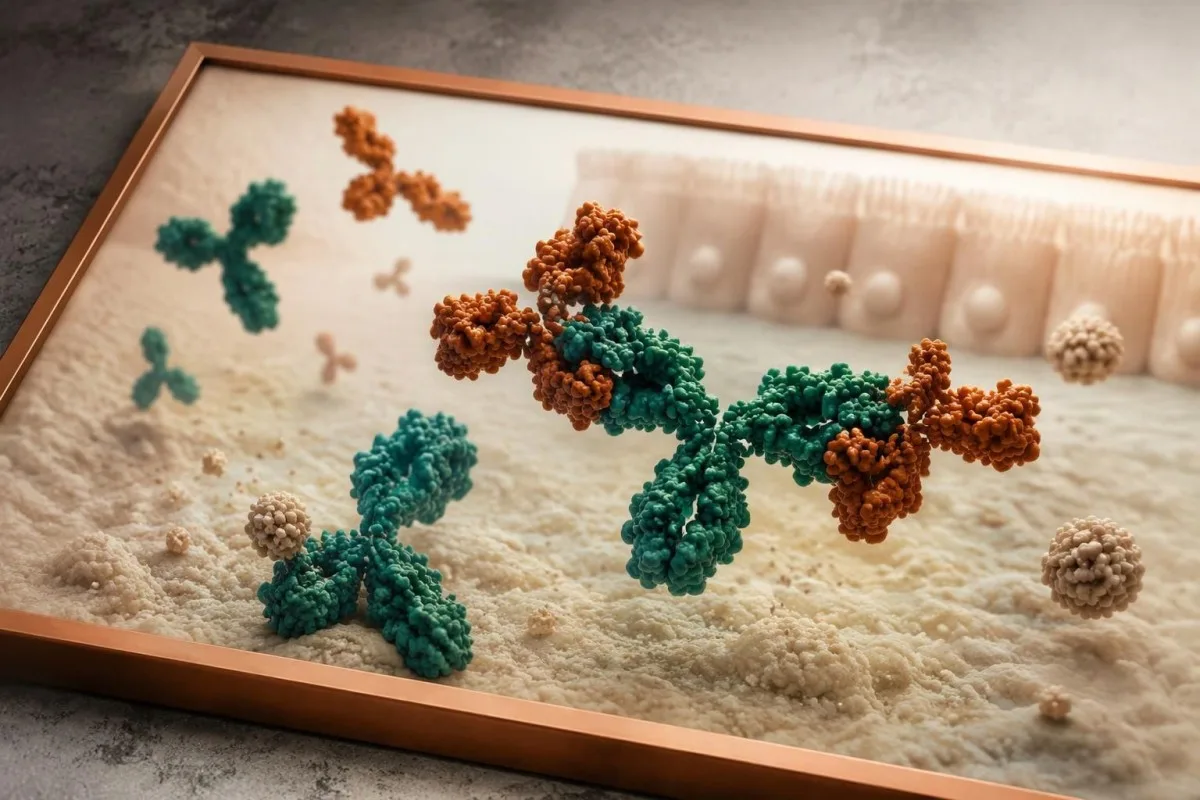
Anti-infliximab antibody tests usually detect binding antibodies; they do not all directly measure neutralizing activity. A positive result of 20 U/mL therefore identifies an assay-defined antibody signal, not a universal percentage of blocked infliximab or a precise prediction of how much benefit remains.
Antibody persistence and magnitude influence whether dose optimization is likely to recover exposure. Cheifetz et al. (2021) described low-titer antibodies as below 10 U/mL for the homogeneous mobility shift assay specifically; that threshold must not be transferred to an ELISA reporting AU/mL or to another laboratory's calibration.
A single low antibody result may be transient or become less clinically relevant after supervised treatment optimization. Repeating paired drug and antibody testing can distinguish a 1-time signal from a rising pattern, but severe disease or an infusion reaction may require action before a second result is available.
Antibodies to infliximab are not the same as antibodies against your own bowel, and they do not by themselves diagnose an immediate allergy. Our explanation of পজিটিভ অ্যান্টিবডি ফলাফলের প্রকার helps separate these concepts; breathlessness or faintness during an infusion still requires immediate attention regardless of the antibody number.
কখন পর্যাপ্ত ট্রাফ মেকানিস্টিক ব্যর্থতার ইঙ্গিত দেয়?
সম্ভাব্য কার্যপ্রণালিগত ব্যর্থতা means objectively active IBD persists despite sufficient infliximab exposure for the treatment goal. A trough of 8 µg/mL with confirmed active colitis may raise this possibility, but selected patients need further exposure optimization before clinicians conclude that another inflammatory pathway should be targeted.
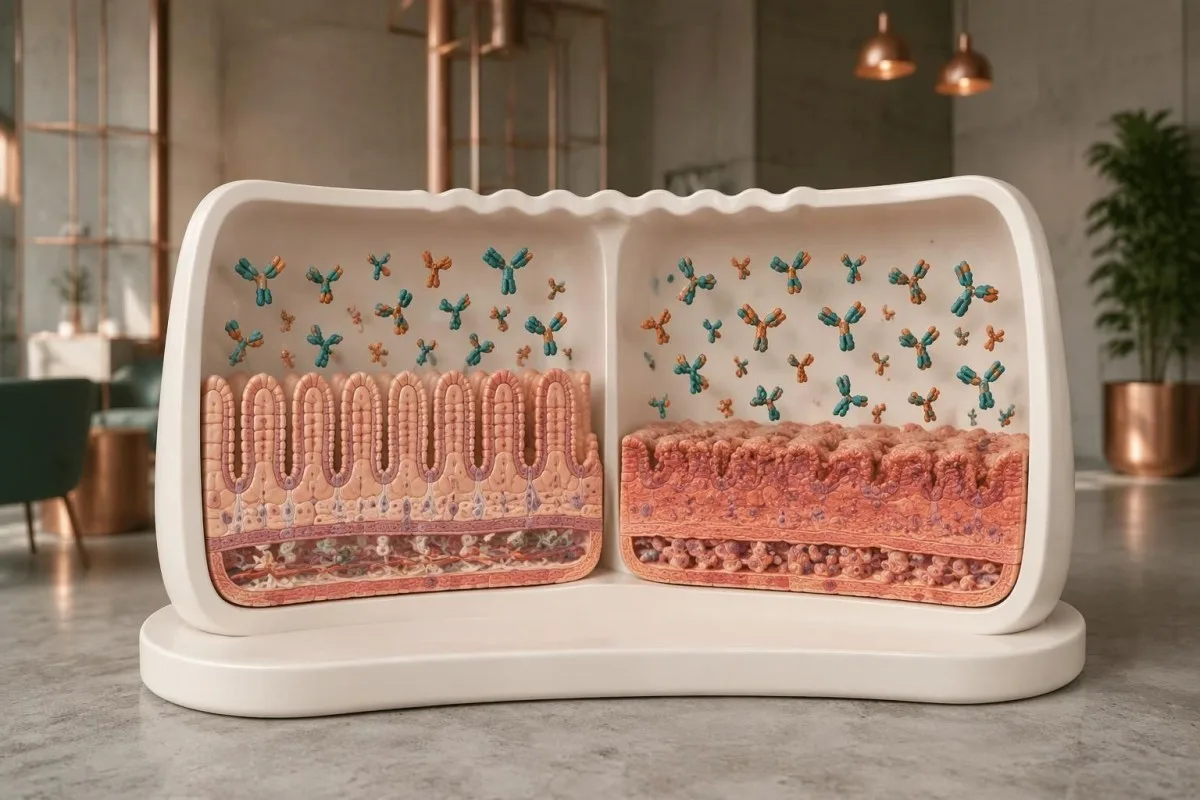
An adequate serum concentration cannot prove that TNF is the only pathway driving a person's current disease. Persistent endoscopic activity with a trough of 12 µg/mL is more supportive of a mechanism problem than the same concentration with normal objective testing and symptoms from bile acid diarrhea.
Calling treatment failure at exactly 5 µg/mL can be premature when the goal is fistula control or substantial endoscopic improvement. The 10–15 µg/mL reassessment discussed in the 2021 consensus provides a safeguard against abandoning an under-optimized treatment, but it is not a requirement to escalate every patient with symptoms.
Objective evidence also has limits: CRP of 3 mg/L does not exclude active IBD, especially in people whose CRP has remained low during previous flares. Borderline stool results need context and sometimes repetition; our guide to বর্ডারলাইন ফেকাল ক্যালপ্রোটেকটিন explains why an isolated intermediate value should not determine a biologic switch.
The strongest case for changing mechanism combines 3 findings: documented inflammation, adequate exposure on a correctly timed sample, and an inadequate clinical response despite appropriate optimization. Structural complications, such as a fixed Crohn's stricture, can also cause symptoms that neither more infliximab nor a different biologic will reliably reverse.
ইনফ্লিক্সিম্যাবের মাত্রা পর্যাপ্ত থাকলেও কি অ্যান্টিবডি পজিটিভ হতে পারে?
Antibodies can be detected while infliximab remains measurable or adequate, particularly with drug-tolerant assays. A trough of 7 µg/mL and a weak positive antibody result do not automatically mean treatment failure; the assay, antibody trend, and evidence of disease activity determine how much weight that finding deserves.
Drug-tolerant methods can identify antibodies in samples containing infliximab that would interfere with some drug-sensitive methods. This greater analytical sensitivity may reveal early or low-level immunogenicity, but 1 newly detected signal does not necessarily establish clinically meaningful loss of response.
A qualitative positive result contains less information than a quantitative result with the assay's cutoff and units. A report reading only positive cannot distinguish a value just above a 10 AU/mL cutoff from a much larger signal; our guide to গুণগত এবং পরিমাণগত পরীক্ষা explains what each format can establish.
Compare antibody trajectories using the same laboratory method whenever feasible. Hypothetical results of 12, 15, and 13 AU/mL across 3 correctly timed visits may carry a different implication from 12, 80, and 200 AU/mL, although analytical variability and clinical findings still prevent interpretation from trend alone.
কান্তেস্তি হল একটি AI রক্ত পরীক্ষার ফলাফল বোঝার প্ল্যাটফর্ম that helps distinguish a reported antibody cutoff from a treatment target. When the report lacks the method or units, our interpretation should preserve that uncertainty rather than labeling 1 positive result as proof that infliximab has stopped working.
পরীক্ষাগারের পদ্ধতি ও অ্যান্টিবডির একক কেন গুরুত্বপূর্ণ?
Infliximab and antibody results are method-dependent, so values from different assays are not always interchangeable. Infliximab 1 µg/mL equals 1 mg/L, but antibody results in U/mL, AU/mL, or ng/mL do not have a universal conversion because laboratories use different standards, detection limits, and approaches to drug interference.
An assay may report free or functionally available drug differently from another method that detects a broader pool of circulating drug. Two laboratories can therefore produce somewhat different concentrations from similar specimens; a change from 6 to 8 µg/mL after switching methods may not represent a true gain in exposure.
Below the quantification limit means the assay cannot reliably assign a numerical concentration below its validated boundary. A report of less than 0.4 µg/mL is not proof of exactly 0 µg/mL, and greater than 100 U/mL cannot tell you whether the true antibody result is 110 or 1,000 U/mL.
Some laboratories use reflex antibody testing only when the drug concentration falls below a preset threshold. If antibodies were not tested because infliximab was 9 µg/mL, the result is not equivalent to antibodies negative; ask whether the antibody field says not performed, not detected, or below detection.
Kantesti's report interpretation should retain the assay name, units, and collection context instead of silently converting 20 AU/mL into another method's scale. Our ক্লিনিক্যাল পদ্ধতিবিদ্যা-সংক্রান্ত তথ্য explains the distinction between technical interpretation and clinical decision-making; no AI explanation removes the need to confirm an unusual result with the reporting laboratory.
চিকিৎসকেরা কীভাবে নিশ্চিত করেন যে ফিরে আসা উপসর্গগুলো IBD-এর?
Returning symptoms do not necessarily mean returning intestinal inflammation; clinicians combine stool markers, CRP, infection testing, endoscopy, and imaging as appropriate. Three loose stools daily with a trough of 6 µg/mL can arise from active IBD, an intestinal infection, bile acid diarrhea, or a functional bowel disorder.
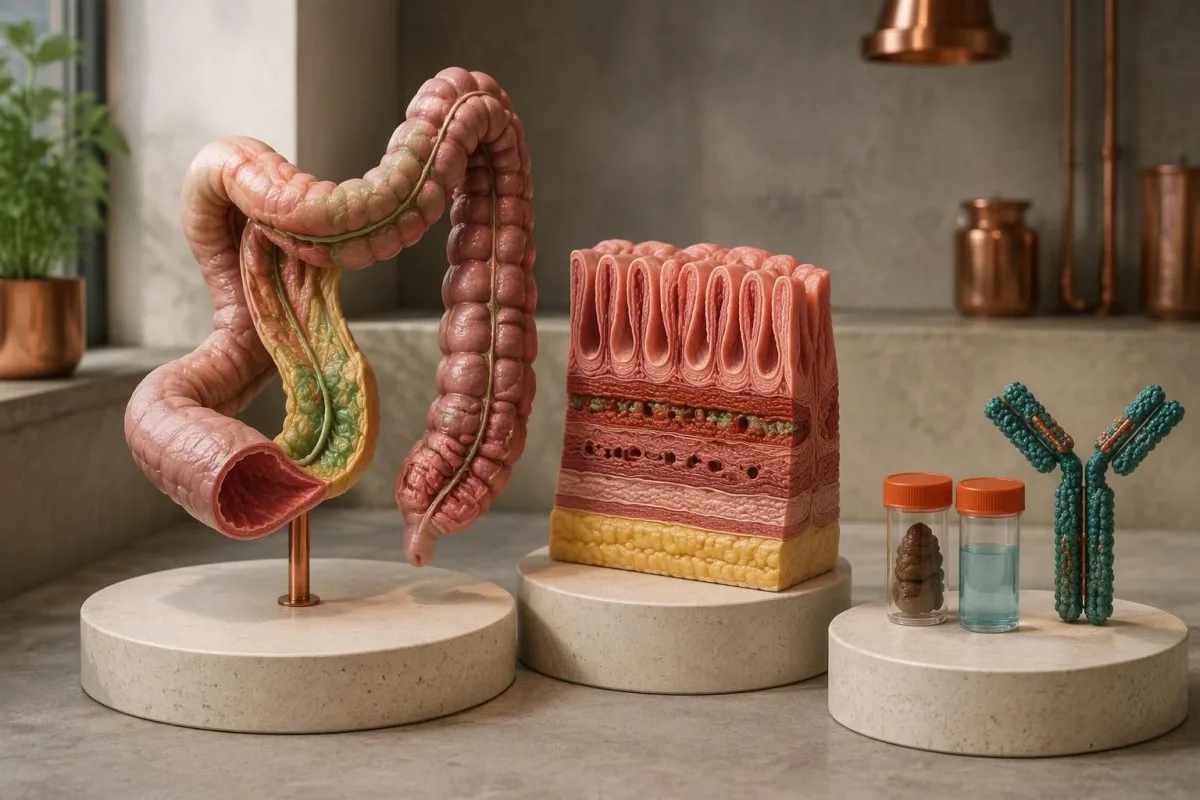
Fecal calprotectin and lactoferrin assess intestinal inflammatory activity rather than infliximab exposure. A hypothetical calprotectin of 800 µg/g adds different information from a trough of 2 µg/mL; our stool inflammation marker comparison explains why paired disease and drug measurements answer separate clinical questions.
C. difficile testing can be necessary during new or worsening diarrhea, even without recent antibiotics. A positive screening test and negative toxin result require contextual interpretation, not automatic classification as an IBD flare; our guide to C. difficile-এর অসংগত ফল describes why 2 test components can disagree.
Bile acid diarrhea is particularly relevant after ileal disease or resection and can persist despite controlled inflammation. A person with a trough of 10 µg/mL and reassuring objective IBD assessment may need a different evaluation; our explanation of SeHCAT retention results covers one diagnostic route where that test is available.
Bloating, gas, and altered stool frequency can also reflect bacterial overgrowth or carbohydrate malabsorption. At least 2 explanations can coexist with IBD, so a satisfactory trough should not end the assessment; our SIBO breath test guide explains preparation and limitations rather than treating breath testing as proof of every symptom's cause.
IBD টিম কম এক্সপোজারের ক্ষেত্রে কীভাবে সাড়া দিতে পারে?
Low exposure without substantial persistent antibodies may lead an IBD team to increase the infliximab dose, shorten the dosing interval, or address a treatment interruption. A common adult intravenous maintenance schedule is 5 mg/kg every 8 weeks after induction, but any adjustment requires individualized prescribing and reassessment of disease activity.
For a hypothetical 70 kg adult, 5 mg/kg corresponds to 350 mg before local preparation or rounding rules. Shortening an unchanged dose from every 8 weeks to every 6 weeks increases average drug administered per unit time by about 33%; the trough increase cannot be predicted as exactly 33% because clearance is not constant.
Increasing the dose and shortening the interval are not pharmacokinetically identical strategies. A larger dose changes peak exposure, while a shorter interval reduces time for concentrations to decline; a hypothetical patient whose symptoms repeatedly return during week 7 may prompt a different discussion from someone symptomatic throughout all 8 weeks.
A useful reassessment checks both exposure and the treatment outcome rather than declaring success because the trough rose. If infliximab increases from 2 to 9 µg/mL but calprotectin remains 900 µg/g and endoscopic disease persists, the new result has narrowed the explanation without necessarily improving the underlying disease.
The timing of repeat testing depends on severity, the revised schedule, and the clinical question; waiting 3 months is not appropriate for every deteriorating patient. Our ওষুধের নিরাপত্তা ট্রেন্ড গাইড explains why comparable dates and methods matter, but an app should never independently recommend extra infusions.
কখন চিকিৎসা পরিবর্তন বা সমন্বিত থেরাপি বিবেচনা করা হয়?
Persistent high antibodies with low drug may favor changing treatment, while adequate exposure with confirmed active IBD may favor switching to a different mechanism. Low-level immunogenicity can sometimes be addressed through supervised optimization or an immunomodulator, but a result of 15 U/mL alone cannot determine which option offers the best benefit-risk balance.
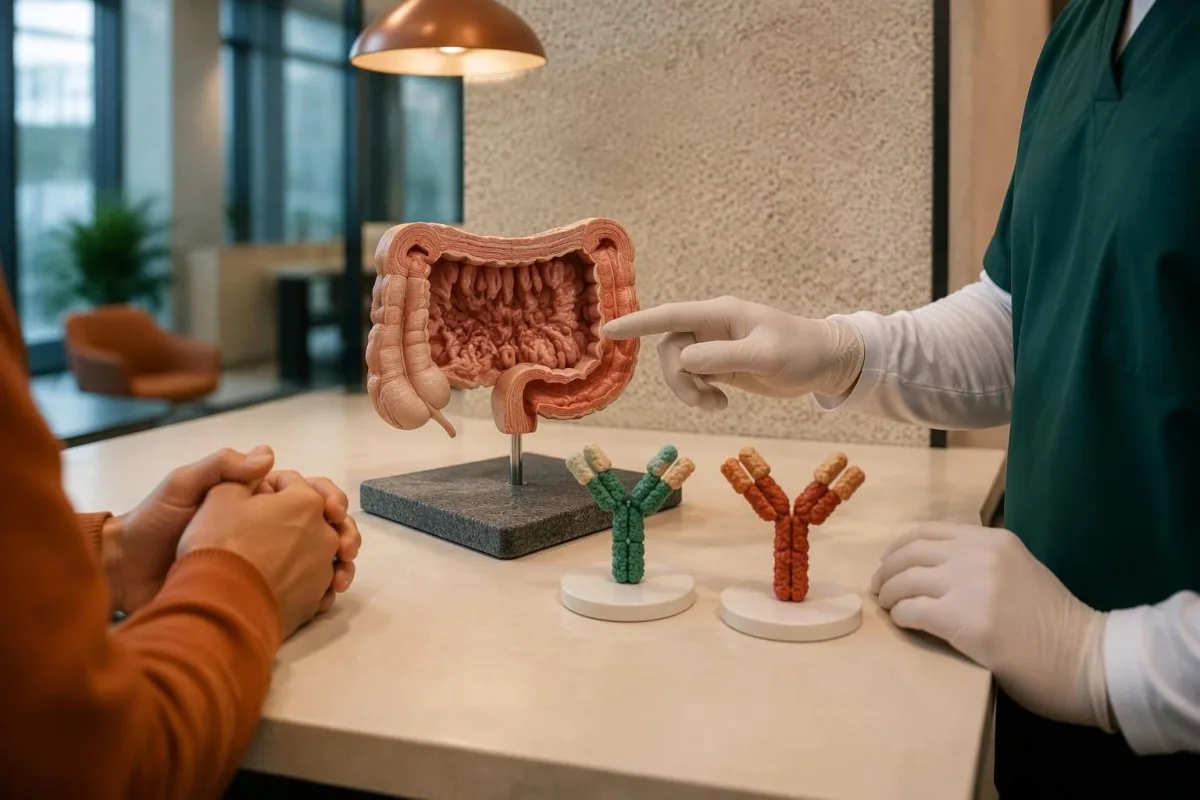
Switching within the anti-TNF class can make sense when infliximab previously controlled disease but antibody-associated clearance now prevents adequate exposure. Switching to another mechanism becomes more persuasive when inflammation persists with adequate exposure; these are 2 different failure patterns, not interchangeable reasons to choose the next medicine.
An immunomodulator such as azathioprine or methotrexate may reduce immunogenicity in selected circumstances, but adding one introduces additional monitoring and adverse-effect risks. Before azathioprine, TPMT testing and safety assessment can inform prescribing; TPMT and NUDT15 assessment do not replace ongoing CBC and liver monitoring, even when baseline results are normal.
If a person already takes a thiopurine, metabolite testing can help clarify exposure or a metabolism pattern before assuming combination therapy has failed. For example, 2 patients prescribed the same mg dose may have very different metabolite findings; our thiopurine treatment pattern guide explains why prescription dose alone is incomplete.
Restarting infliximab after a long interruption deserves a separate safety discussion because immunogenicity and infusion reactions can complicate re-exposure. A treatment gap of 6 months is not equivalent to a routine 1-week scheduling delay; never restart, add an immunomodulator, or stop an existing medicine based solely on an online interpretation.
ইনডাকশন, ফিস্টুলা, শিশু এবং ইনজেকশন কি টার্গেট বদলে দেয়?
Treatment phase, disease phenotype, age, and formulation can change the relevant exposure goal; intravenous maintenance targets should not be copied into every setting. Standard adult intravenous induction commonly uses 5 mg/kg at weeks 0, 2, and 6, and those early concentrations are interpreted differently from an established 8-week maintenance trough.

The 2021 expert consensus described induction goals of approximately 20–25 µg/mL at week 2, 15–20 µg/mL at week 6, and 7–10 µg/mL at week 14 (Cheifetz et al., 2021). These are consensus exposure goals influenced by disease phenotype and outcome, not interchangeable minimums from one definitive randomized trial.
Perianal fistula outcomes may require higher exposure than symptom control in uncomplicated luminal disease, but observational associations do not establish a universal healing threshold. A fistula still draining at 10 µg/mL may also need imaging, drainage of an abscess, or procedural care; raising the trough cannot substitute for addressing an undrained collection.
Children can have different clearance and dosing requirements, particularly with lower body weight or severe disease. An adult maintenance benchmark of 5 µg/mL should not become a parent-directed dosing rule; our discussion of শিশুদের জন্য এআই ব্যাখ্যা explains why pediatric specialist context and age-appropriate interpretation remain necessary.
Subcutaneous infliximab produces a different concentration-time profile from intermittent intravenous infusions, and availability and prescribing schedules vary internationally. A concentration of 15 µg/mL during injection treatment should not be labeled excessive merely because an intravenous report lists 3–7 µg/mL; the formulation, actual regimen, and sampling convention must be specified.
একত্রে বিবেচিত ফলাফলগুলো ক্লিনিক্যাল যুক্তিতে কীভাবে পরিবর্তন আনে?
Paired results guide the next question rather than dictate a prescription: low drug without antibodies suggests underexposure, low drug with persistent antibodies suggests immunogenicity, and adequate drug with inflammation raises possible mechanism failure. The following 4 examples are entirely hypothetical; the concentrations are illustrative, not personalized treatment recommendations.
Example 1: a 34-year-old with Crohn's disease has a true trough of 1.8 µg/mL, no detected antibodies, albumin of 29 g/L, and calprotectin of 1,100 µg/g. This pattern supports underexposure in active disease; confirming the infusion schedule and considering supervised optimization are more logical than immediately declaring TNF blockade ineffective.
Example 2: a 46-year-old with ulcerative colitis has infliximab below 0.4 µg/mL and antibodies above the laboratory's 100 U/mL reporting limit on 2 visits. Assuming the assay defines that antibody signal as substantial, persistent immunogenicity is plausible; simply increasing the dose may be less successful than a clinician-directed treatment change.
Example 3: a 28-year-old has a trough of 11 µg/mL, no significant antibodies, and repeatedly active colitis on endoscopy despite appropriate optimization. Example 4: a 61-year-old has the same 11 µg/mL trough but reassuring endoscopy and diarrhea after ileal resection; the first pattern raises mechanism failure, whereas the second prompts investigation of non-inflammatory causes.
কান্তেস্তি হল একটি AI-চালিত রক্ত পরীক্ষা বিশ্লেষণ টুল that helps organize these distinctions when the report and treatment details are supplied. Our এআই প্রযুক্তি ব্যাখ্যা describes how laboratory context informs interpretation; if a 2-week-old report lacks sampling timing, the missing information must stay visible rather than being guessed.
ফলো-আপে আপনার কী নিয়ে যাওয়া উচিত, এবং কোন প্রমাণ প্রযোজ্য?
Bring the complete report, infusion timeline, and objective disease results to your IBD review; these 3 evidence streams make paired drug-antibody testing actionable. Seek earlier care for severe deterioration rather than waiting for the next trough, and distinguish infliximab-specific clinical research from general educational publications about accompanying laboratory abnormalities.
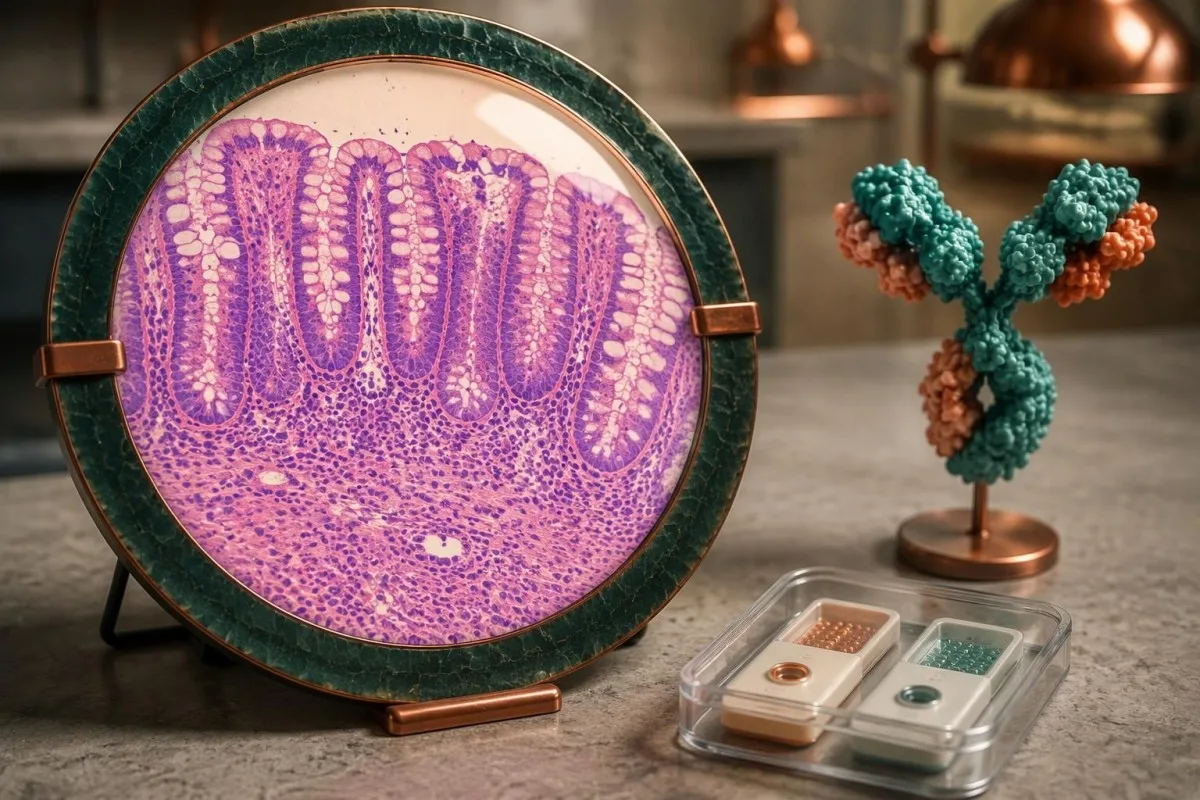
A useful review record includes the previous 2 infusion dates, actual dose, collection timing, assay name, antibody units, and recent CRP, albumin, and fecal calprotectin. Add symptom timing, steroid use, recent antibiotics, and missed doses; ask whether the proposed change addresses insufficient exposure, immunogenicity, active non-TNF disease, or a non-inflammatory explanation.
Contact your clinical team promptly for worsening diarrhea with dehydration, persistent vomiting, new significant bleeding, or fever of 38°C or higher while immunosuppressed. Severe abdominal pain with distension, fainting, or inability to keep fluids down may require emergency assessment; during an infusion, sudden breathing difficulty or collapse requires immediate staff attention, not interpretation of an antibody report.
Kantesti provides educational interpretation, not independent biologic prescribing, and our দায়িত্বশীল AI নীতিমালা explain that boundary. A reassuring trough of 10 µg/mL does not establish that an infusion is safe during an acute illness; the treating service must assess symptoms, examination findings, and any necessary investigations.
The 2 Zenodo publications listed below address accompanying laboratory interpretation, not infliximab target validation: our RDW এবং লোহিত রক্তকণিকা নির্দেশিকা concerns anemia patterns, while our BUN এবং ক্রিয়েটিনিন গাইড concerns renal and hydration context. These educational deposits are not evidence for anti-drug antibody cutoffs; the AGA guideline, TAXIT trial, and biologic-monitoring consensus supply the directly relevant clinical references.
প্রায়শই জিজ্ঞাসিত প্রশ্নাবলী
ইনফ্লিক্সিমাবের মাত্রা কম হলে এর অর্থ কী?
ইনফ্লিক্সিমাবের মাত্রা কম হওয়ার অর্থ হলো, রক্তে ওষুধের সংস্পর্শ ওই চিকিৎসা-পর্যায় ও লক্ষ্যের জন্য নির্ধারিত মানদণ্ডের নিচে; এর মানে এই নয় যে ইনফ্লিক্সিমাব অবশ্যই বন্ধ করতে হবে। উল্লেখযোগ্য অ্যান্টিবডি না থাকা অবস্থায় প্রকৃত মেইনটেন্যান্স ট্রফ ২ µg/mL দ্রুততর ক্লিয়ারেন্স, অন্ত্র দিয়ে প্রোটিন ক্ষয়, অথবা অপর্যাপ্ত ডোজ বা ডোজের ব্যবধানের প্রতিফলন হতে পারে। ওষুধের মাত্রা কম থাকার পাশাপাশি উল্লেখযোগ্য অ্যান্টিবডি স্থায়ী থাকলে তা রোগপ্রতিরোধ-মধ্যস্থ ক্লিয়ারেন্সের ইঙ্গিত দেয়। আপনার IBD দলকে রোগের বস্তুনিষ্ঠ সক্রিয়তা, ইনফিউশনের সময় এবং অ্যাসের ফলের সঙ্গে মিলিয়ে ফলটি ব্যাখ্যা করতে হবে।.
IBD-এর জন্য ইনফ্লিক্সিম্যাবের ভালো ট্রফ মাত্রা কত?
IBD আক্রান্ত সবার জন্য infliximab-এর একটিমাত্র আদর্শ ট্রাফ মাত্রা নেই। ২০১৭ সালের AGA নির্দেশিকায় রিঅ্যাক্টিভ মেইনটেন্যান্স মনিটরিংয়ের জন্য অন্তত 5 µg/mL প্রস্তাব করা হয়েছিল, আর ২০২১ সালের বিশেষজ্ঞ সম্মতিতে মেইনটেন্যান্সের মাত্রা 5–10 µg/mL বলা হয়েছিল। সেকেন্ডারি রেসপন্স-হ্রাসে আক্রান্ত নির্বাচিত রোগীদের চিকিৎসা পরিত্যাগের আগে 10–15 µg/mL মাত্রায় পুনর্মূল্যায়ন প্রয়োজন হতে পারে। ইনডাকশন, ফিস্টুলা এবং সাবকিউটেনিয়াস চিকিৎসার ক্ষেত্রে ভিন্ন প্রেক্ষাপট বিবেচনা করতে হয়, তাই পরীক্ষাগারের একটি রেফারেন্স সীমা সবার জন্য প্রযোজ্য ডোজের লক্ষ্য নয়।.
আমার ইনফ্লিক্সিম্যাবের মাত্রা পরীক্ষা কখন করানো উচিত?
For intravenous infliximab, a trough sample should be collected immediately before the next infusion begins. A sample obtained 2 days after an infusion is not comparable with routine pre-infusion targets. Record the last infusion date, dose, scheduled interval, and actual collection time, especially if an 8-week appointment was delayed. Subcutaneous infliximab has a different exposure profile, so sampling should follow the prescribing team's and laboratory's instructions.
ইনফ্লিক্সিম্যাবের বিরুদ্ধে অ্যান্টিবডি কি অদৃশ্য হয়ে যেতে পারে?
ইনফ্লিক্সিম্যাবের বিরুদ্ধে নিম্নমাত্রার অ্যান্টিবডি কখনও কখনও শনাক্তের অযোগ্য হয়ে যেতে পারে বা চিকিৎসাগতভাবে কম প্রাসঙ্গিক হয়ে উঠতে পারে, কিন্তু ওষুধের মাত্রা খুব কম থাকা অবস্থায় স্থায়ীভাবে উল্লেখযোগ্য অ্যান্টিবডি মোকাবিলা করা কঠিন। ২০২১ সালের বিশেষজ্ঞ ঐকমত্যে একটি homogeneous mobility shift assay-তে ১০ U/mL-এর নিচে অ্যান্টিবডিকে নিম্ন-টাইটার হিসেবে বর্ণনা করা হয়েছিল; এই সীমা সব পরীক্ষাগার পদ্ধতিতে প্রয়োগ করা যায় না। চিকিৎসকের তত্ত্বাবধানে মাত্রা সমন্বয় বা একটি ইমিউনোমডুলেটর নির্বাচিত কিছু রোগীকে সাহায্য করতে পারে, অন্যদের ক্ষেত্রে চিকিৎসা পরিবর্তন প্রয়োজন। পুনরায় যুগ্ম পরীক্ষা করলে অ্যান্টিবডির স্থায়িত্ব স্পষ্ট হতে পারে, তবে রোগীদের নিজেরা চিকিৎসা পরিবর্তন করা উচিত নয়।.
মাত্রা স্বাভাবিক থাকলেও কি ইনফ্লিক্সিম্যাব কাজ করা বন্ধ করে দিতে পারে?
পর্যাপ্ত রক্তসঞ্চালিত ঘনত্ব থাকা সত্ত্বেও ইনফ্লিক্সিম্যাব সক্রিয় IBD-কে বস্তুনিষ্ঠভাবে নিয়ন্ত্রণে ব্যর্থ হতে পারে, যা সম্ভাব্য কার্যপ্রণালিগত ব্যর্থতার ইঙ্গিত দেয়। 10 µg/mL ট্রাফ মাত্রা অন্ত্রের নিরাময়ের নিশ্চয়তা দেয় না বা প্রমাণ করে না যে রোগটি চালিত করার একমাত্র পথ হলো TNF। কার্যপ্রণালি পরিবর্তনের আগে চিকিৎসকেরা প্রদাহ নিশ্চিত করেন, কাঠামোগত বা সংক্রামক জটিলতা মূল্যায়ন করেন এবং নির্দিষ্ট চিকিৎসা-লক্ষ্যের জন্য ওষুধের সংস্পর্শ যথেষ্ট ছিল কি না বিবেচনা করেন। বস্তুনিষ্ঠ মূল্যায়ন আশ্বস্তকারী হওয়া সত্ত্বেও ডায়রিয়ার প্রদাহবহির্ভূত কারণ থাকতে পারে।.
0 উচ্চ ইনফ্লিক্সিম্যাবের মাত্রা কি বিপজ্জনক?
উচ্চ infliximab ঘনত্ব স্বয়ংক্রিয়ভাবে বিপজ্জনক নয়, এবং IBD-তে আক্রান্ত সব রোগীর ক্ষেত্রে প্রযোজ্য এমন কোনো একক প্রতিষ্ঠিত সিরাম টক্সিসিটি সীমা নেই। 15 µg/mL ফলাফলটি ইনডাকশন, ফিস্টুলার চিকিৎসা বা সাবকিউটেনিয়াস থেরাপির সময় নিয়মিত ইন্ট্রাভেনাস মেইনটেন্যান্সের সময়ের চেয়ে ভিন্নভাবে ব্যাখ্যা করা হতে পারে। নিরাপত্তা শুধু ঘনত্বের ওপর নয়, বরং সামগ্রিক চিকিৎসা-পরিকল্পনা, সংক্রমণ, ইনফিউশন প্রতিক্রিয়া এবং অন্যান্য ক্লিনিক্যাল ফলাফলের ওপর নির্ভর করে। প্রেসক্রাইব করা চিকিৎসক দলের সঙ্গে ফলাফলটি নিয়ে আলোচনা না করে কোনো ইনফিউশন বাদ দেবেন না বা ডোজ কমাবেন না।.
বিভিন্ন পরীক্ষাগারে পরীক্ষা করানোর পর আমার ইনফ্লিক্সিম্যাব অ্যান্টিবডির ফল কেন বদলে গেল?
পরীক্ষাগার পরিবর্তন করলে ইনফ্লিক্সিম্যাব অ্যান্টিবডির ফল বদলে যেতে পারে, কারণ অ্যাসেগুলোর ক্যালিব্রেশন, একক, শনাক্তকরণসীমা এবং রক্তে সঞ্চালিত ওষুধ সহ্য করার ক্ষমতা ভিন্ন। 20 AU/mL-এর ফলকে সর্বজনীনভাবে U/mL বা ng/mL-এ রূপান্তর করা যায় না। ইনফ্লিক্সিম্যাব পরিমাপযোগ্য থাকলে ওষুধ-সহনশীল পদ্ধতিতে এমন অ্যান্টিবডি শনাক্ত হতে পারে, যা ওষুধ-সংবেদনশীল অ্যাসেতে ধরা পড়ে না। সম্ভব হলে একই পদ্ধতি ব্যবহার করে প্রবণতার তুলনা করুন, এবং রিফ্লেক্স-টেস্টিংয়ের নিয়মে বাদ পড়েছে কি না, নাকি অ্যান্টিবডি পরীক্ষা সত্যিই করা হয়েছিল, তা জেনে নিন।.
আপনার রক্ত পরীক্ষার রিপোর্ট কীভাবে পড়বেন
আপনার ল্যাব রিপোর্ট আপলোড করুন, আর Kantesti-এর AI কয়েক সেকেন্ডের মধ্যে প্রতিটি বায়োমার্কার সহজ ভাষায় ব্যাখ্যা করবে। বিশ্বজুড়ে 2 মিলিয়নেরও বেশি মানুষ ব্যবহার করেন।.
তথ্যসূত্র
- ক্লেইন, টি., মিচেল, এস., & ওয়েবার, এইচ. (২০২৬)।. RDW রক্ত পরীক্ষা: RDW-CV, MCV ও MCHC-এর সম্পূর্ণ নির্দেশিকা।. Kantesti AI চিকিৎসাবিষয়ক গবেষণা।. ডিওআই
- ক্লেইন, টি., মিচেল, এস., & ওয়েবার, এইচ. (২০২৬)।. BUN/ক্রিয়েটিনিন অনুপাত ব্যাখ্যা: কিডনি কার্যকারিতা পরীক্ষা গাইড।. Kantesti AI চিকিৎসাবিষয়ক গবেষণা।. ডিওআই
- Feuerstein JD et al. (2017). American Gastroenterological Association Institute Guideline on Therapeutic Drug Monitoring in Inflammatory Bowel Disease. Gastroenterology।. ডিওআই
- Vande Casteele N et al. (2015). Trough concentrations of infliximab guide dosing for patients with inflammatory bowel disease. Gastroenterology।. ডিওআই
- Cheifetz AS et al. (2021). A Comprehensive Literature Review and Expert Consensus Statement on Therapeutic Drug Monitoring of Biologics in Inflammatory Bowel Disease. The American Journal of Gastroenterology. ডিওআই
- ২০ লক্ষ+বিশ্লেষণ করা পরীক্ষাগুলো
- 127+দেশগুলি
- 100+ভাষাসমূহ
চিকিৎসক দল সম্পর্কে


E-E-A-T বিশ্বাসযোগ্যতার সংকেত
অভিজ্ঞতা
চিকিৎসক-নেতৃত্বাধীন ল্যাব ব্যাখ্যা কর্মপ্রবাহের ক্লিনিক্যাল পর্যালোচনা।.
দক্ষতা
ক্লিনিকাল প্রেক্ষাপটে বায়োমার্কারগুলো কীভাবে আচরণ করে, সেটির ওপর ল্যাবরেটরি মেডিসিনের ফোকাস।.
কর্তৃত্ব
ডা. থমাস ক্লেইনের চিকিৎসাবিষয়ক পর্যালোচনায়, ডা. সারাহ মিচেল এবং প্রফেসর ডা. হান্স ভেবারের অবদানসহ।.
বিশ্বাসযোগ্যতা
প্রমাণভিত্তিক ব্যাখ্যা, যাতে সতর্কতা কমাতে স্পষ্ট পরবর্তী পদক্ষেপের পথ থাকে।.





চিকিৎসাবিষয়ক দাবিত্যাগ
এই প্রবন্ধটি কেবল শিক্ষামূলক উদ্দেশ্যে এবং এটি চিকিৎসা পরামর্শ হিসেবে গণ্য হয় না। রোগ নির্ণয় ও চিকিৎসা সিদ্ধান্তের জন্য সর্বদা একজন যোগ্য স্বাস্থ্যসেবা প্রদানকারীর সাথে পরামর্শ করুন।.
প্রকাশিত · সম্পাদকীয় দলের সঙ্গে যোগাযোগ করুন
Kantesti Ltd কর্তৃক প্রকাশিত, ইংল্যান্ড ও ওয়েলসে নিবন্ধিত, কোম্পানি নং. 17090423, লন্ডন, যুক্তরাজ্য।.
