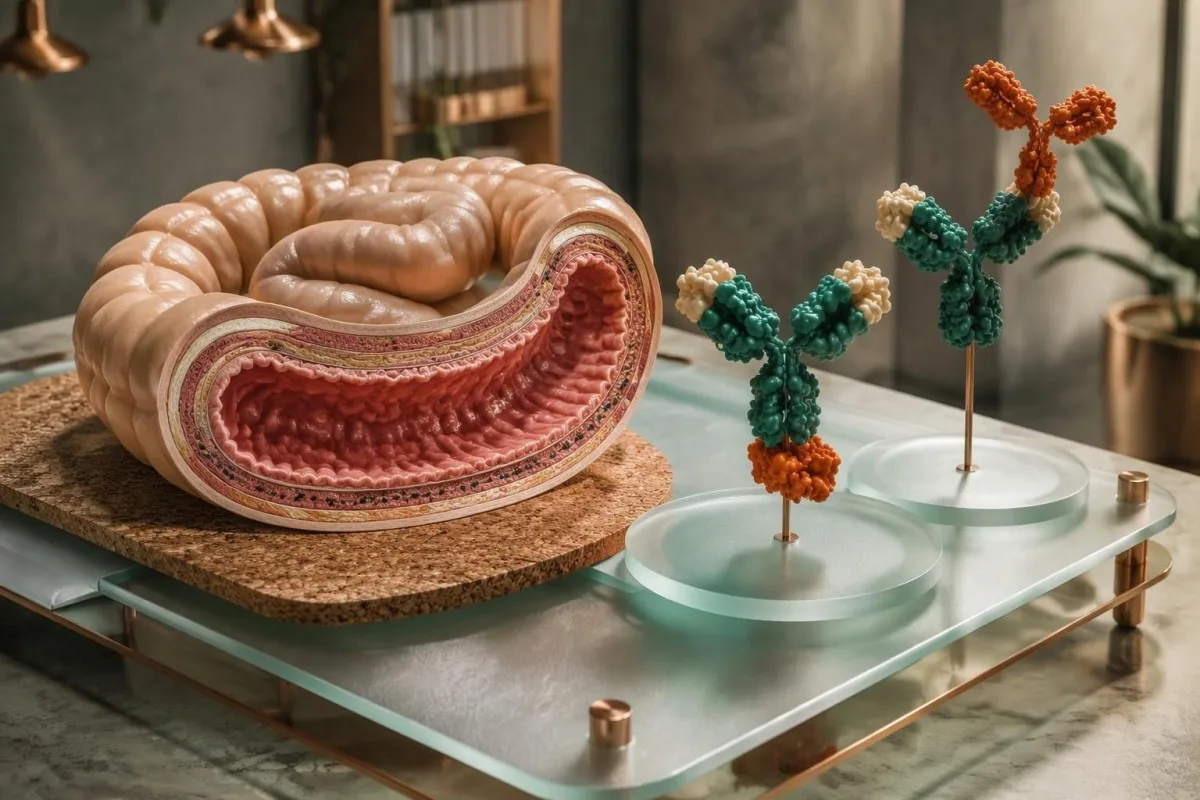
Test poziomu infliximabu łōnczy stynżynie leku z przeciwciałami, coby wyjaśnić utrata kontroli nad IBD. Niski poziom leku bez znaczōncych przeciwciał sugeruje za mało ekspozycyje; niski poziom leku z utrzymujōncymi sie wysoko przeciwciałami sugeruje klirens zależny ôd układu ôdpornościowego. Aktywne zapalenie mimo wystarczajōncy ekspozycyje nasuwa możebne niepowodzynie mechanistyczne — ale dopiyro po potwierdzyniu zapalenio, prawidłowego pobranio prōbki i celu odpowiedniego do celu leczenio.

Najważniejsze informacje
- Wyniki łōnczne ôdrōżniajōm niewystarczajōnco ekspozycyjo na infliximab ôd klirensu zwiōnzanego z przeciwciałami; żodyn z tych wynikōw ôsobno niy dowodzi, czamu ôbjawy wrōciły.
- Pobranie prōbki przed infuzyjōm ôznaczo pobranie prōbki laboratoryjnej przed rozpoczyńciem nastympnej infuzyje dożylnej, a niy 2 dni niyskorzij.
- Wartości graniczne w leczeniu podtrzymujōncym sōm rōżne: wytyczne AGA z 2017 roku sugerowały co najmni 5 µg/mL przy monitorowaniu reaktywnym, a konsensus ekspercki ôpisuje 5–10 µg/mL w leczeniu podtrzymujōncym.
- Niskie poziomy infliximabu przy braku przeciwciał mogōm wynikać z szybszego klirensu, utraty białka przez jelita, ôpōźniōnego podawanio abo zbyt długiego ôdstympu miyndzy dawkami.
- Przeciwciała przeciw infliximabowi nojwiynacyjważniyjsze, kej sōm trwołe, znaczne dlŏ tyj metody i towarzyszy im barzo mało abo niywykrywalny poziōm leku.
- Możebne niysprawianie mechanizmu wymŏgŏ objektownie czynnego IBD mimo dostatecznyj ekspozycyje; biegunka przy poziōmie dołkowym 8 µg/mL niy dowodzi tego.
- Jednostki testu niy sōm wymienialne: 1 µg/mL infliximabu rōwno sie 1 mg/L, ale jednostek U/mL i AU/mL dlo przeciwciał niy idzie uniwersalnie przeliczyć.
- Zmiany leczenia trza ômawiać ze swojim zespołym IBD; w wybranych przipadkach utraty ôdpowiedzi może być zasadne dōngniyńcie ekspozycyje do 10–15 µg/mL, kej infliximab bydzie ôdstawiōny.
Co tak naprowdy ôznaczo test poziomu infliximabu?
An test poziōmu infliximabu mierzi infliximab krōnżōncy we krwi, zwykle razym ze przeciwciałami przeciw lekowi, coby zbadać niydostatecznōm ekspozycyjōm abo usuwanie leku za pōmocōm mechanizmu immunologicznego. Wynik 2 µg/mL bez wykrytych przeciwciał stawia inksze pytanie niż 2 µg/mL przy trwołych, wysokich poziōmach przeciwciał; żodyn z tych wynikōw niy znaczy autōmatycznie, że lek trza ôdstawić.
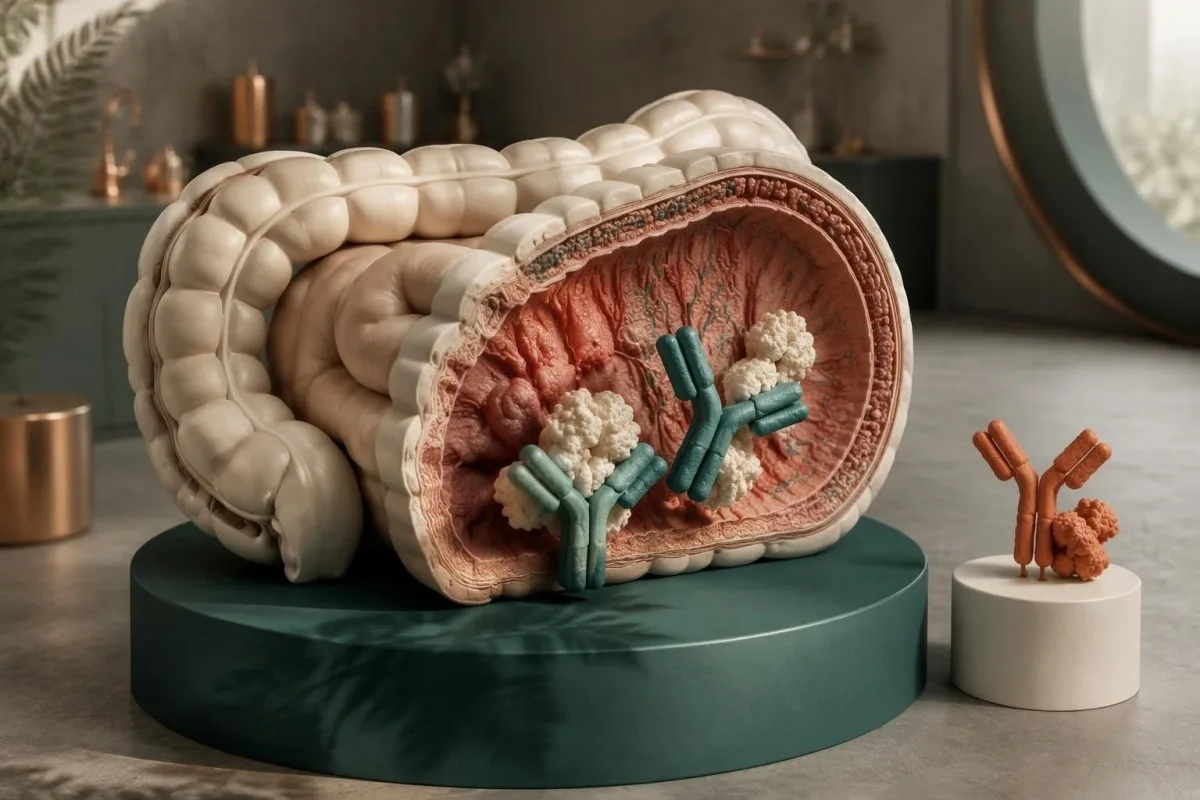
Reaktywne monitorowanie stężyniŏ leku to badanie zlecane ze pōwodu gorszych objawōw abo dowodōw czynnyj choroby. Rōżni sie ôd proaktywnego monitorowania w czasie pozōrnyj remisje: hipotetyczny poziōm dołkowy 4 µg/mL może uzasadnić dalsze badanie podczas udokumentowanego zaostrzeniŏ, ale wymagać inkszyj ômowy, kej endoskopia i markery w kale wskazujōm na trwołe gojynie.
Infliximab blokuje czynnik martwicy nowotworōw, zwykle ôznaczany skrōtym TNF; badanie stężyniŏ niy mierzi, czy kożdy sygnał TNF w jelitach ôstał zneutralizowany. Wynik w surowicy 7 µg/mL mierzi lek we krwi, a niy aktywność leku w kożdym chorym ôdcinku jelita ani stopiń wygojyniŏ jelit.
Praktycznŏ interpretacyjŏ ôpiyrŏ sie cołkij na trzech danych: stężyniu leku, wynikach badania przeciwciał i objektownej aktywności choroby. Ważnŏ je tyż wcześniejszŏ ôdpowiedź — powrōt objawōw po 18 miesiōncach skutecznej kontroli to wtōrnŏ utrata ôdpowiedzi, a niyôsiōngniyńcie kontroli w czasie poczōntkowego leczenia rodzi inksze pytania ô ekspozycyjōm w fazie indukcyje i mechanizm leczenia.
Kantesti je Analizatōr podszukowań krwi sztucznyj inteligyncyje kiery pōmŏgŏ czytelnikōm zrozumieć zestawione wyniki badania infliximabu, bez traktowaniŏ jednej liczby laboratoryjnyj jako instrukcyje dawkowaniŏ. Naszōm platformōm ôbsługuje Kantesti LTD, spōłka zarejestrowanŏ w Wielkij Brytanii pod numerem 17090423; informacyje ô naszej organizacyji sōm ôsobne ôd dowodōw klinicznych wspiyrajōncych terapeutyczne monitorowanie stężyniŏ leku.
Kedy pobiyra sie prōbki do ôznaczynio stynżynio minimalnego infliximabu?
Dołkowe poziōmy infliximabu podawanego dożylnie trza pobiyrać bezpośrednio przed zaczynaniym nastympnyj infuzyje, kej stężynie je prawie nojniższe w danym ôkresie dawkowaniŏ. Prōbka pobranŏ 2 dni po infuzyji niy je prōbkōm dołkowōm i niy trza jich bezpośrednio rōwnać z celowymi poziōmami podtrzymujōncego leczenia, mierzōnymi przed infuzyjōm.
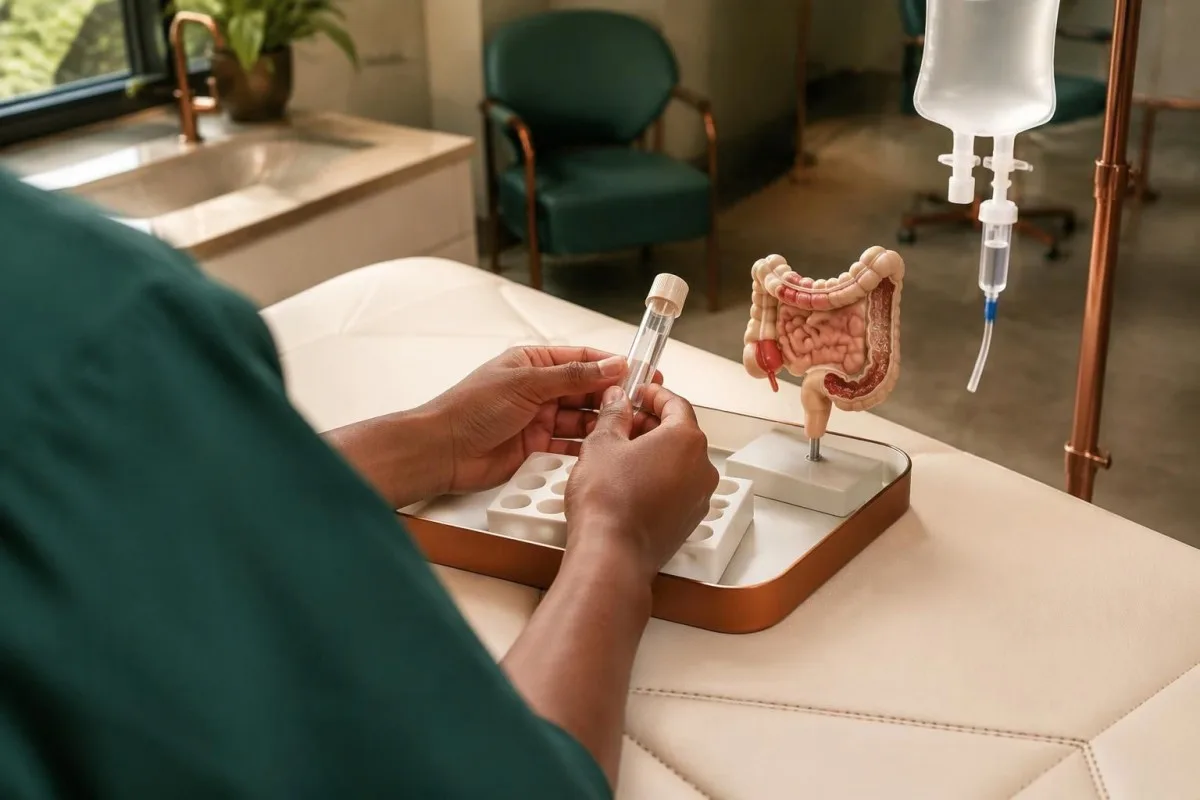
Pora pobraniŏ może zmienić pozōrne znaczynie wyniku, bez jakijkolwiek zmiany skuteczności leczenia. Przikładowo hipotetyczne 18 µg/mL pobrane krōtko po infuzyji i 3 µg/mL pobrane przed nastympnōm infuzyjōm mogōm ôpisywać tyn sōm cykl dawkowaniŏ — a niy nagłe pogorszynie miyndzy dwōma ôsobnymi stanami leczenia.
Przed interpretacyjōm wyniku zapisz data ôstatnij infuzyje, rzeczywistōm dawkym w mg, zaplanowany ôdstymp i pora pobraniŏ. Jeźli infuzyjŏ zaplanowanŏ co 8 tydniōw ôpōźni sie do 10. tydnia, wynik stężyniŏ ôpisuje dłuższy ôkres bez leku; niy idzie na jego podstŏwie jednoznacznie ôdpedzieć, czy pierwotny harmonogram co 8 tydniōw zapewniŏł dostatecznōm ekspozycyjōm.
Collection from a line recently used to administer infliximab can contaminate the specimen and produce a misleadingly high result. Ask the infusion service about its collection protocol, and tell it if sampling occurred after treatment started; the timing principles resemble other pre-dose medication tests, although their targets differ.
Fasting is generally not required for the infliximab concentration itself, but another test ordered during the same visit may have preparation requirements. Our poradnik przygotowania pierwszego pobrania explains how to document medication timing; for this test, an accurate infusion timeline usually matters more than an 8-hour fast.
Jakie stynżynie infliximabu uznawane je za wystarczajōnce?
Nie ma no universal adequate infliximab trough for every patient, disease phenotype, assay, and treatment phase. The 2017 AGA guideline suggested at least 5 µg/mL during reactive maintenance monitoring, while a 2021 expert consensus described maintenance concentrations of 5–10 µg/mL and higher exposure in selected loss-of-response situations.
The AGA benchmark of at least 5 µg/mL is a clinical decision aid, not a healthy-population reference range (Feuerstein et al., 2017). Infliximab is a prescribed biologic: an untreated person normally has no circulating infliximab, so a laboratory's therapeutic interval should never be read like the normal range for sodium.
The TAXIT trial enrolled 263 adults with stable responses and optimized intravenous infliximab toward 3–7 µg/mL before randomized follow-up. Its primary remission endpoint did not improve with concentration-based dosing, although some secondary outcomes favored that approach; this explains why the historical 3–7 µg/mL window is useful context rather than a universal modern target (Vande Casteele et al., 2015).
Cheifetz et al. (2021) recommended considering exposure of 10–15 µg/mL before discontinuing infliximab for secondary loss of response in selected patients. This is expert consensus, not proof that everyone should be escalated to 15 µg/mL; fistulas, endoscopic goals, disease severity, safety, and prior optimization affect whether that reasoning applies.
A concentration of 12 µg/mL is not automatically toxic, and a concentration of 4 µg/mL does not automatically require escalation in an asymptomatic patient with documented healing. Unlike the narrower toxicity discussions around some inkszych lekōw mōniyrowanych w fazie skoku, infliximab has no single established serum toxicity cutoff that dictates action.
| Poziōm | Zakres | Co to znaczy |
|---|---|---|
| Historical TAXIT optimization window | 3–7 µg/mL | Studied in adults with stable responses; not a universal threshold for active disease or fistula healing. |
| AGA reactive maintenance benchmark | At least 5 µg/mL | Suggested in the 2017 guideline for reactive monitoring; interpret alongside objective activity and the assay. |
| Expert-consensus maintenance range | 5–10 µg/mL | Described by the 2021 consensus; the appropriate goal varies with disease phenotype and desired outcome. |
| Selected loss-of-response reassessment | 10–15 µg/mL | Exposure experts suggest considering before abandoning treatment in selected cases; not a routine target or toxicity range. |
Czamu poziomy infliximabu sōm niskie bez przeciwciał?
Low infliximab levels with no significant antibodies usually suggest pharmacokinetic underexposure: too little drug remains available over the dosing interval. A trough of 1.5 µg/mL can reflect faster clearance, intestinal protein loss, a delayed infusion, or insufficient dose or frequency—not necessarily failure of TNF blockade as a treatment mechanism.

Severe intestinal disease can increase infliximab clearance and allow protein, including therapeutic antibody, to be lost through the bowel. A hypothetical patient with albumin of 28 g/L and a trough of 1 µg/mL therefore needs assessment of disease burden and protein loss, not just a question about whether the infusion was attended.
Low albumin is associated with faster infliximab clearance, but it is not a direct measure of drug binding or an instruction to apply a free-drug correction. Albumin of 30 g/L and 40 g/L may provide different clearance context; our przewodnik interpretacji białek surowicy explains why inflammation, liver synthesis, nutrition, and loss must be distinguished.
Infliximab is mainly broken down through protein-catabolic pathways rather than cleared unchanged by the kidneys. A creatinine of 90 µmol/L cannot predict the infliximab trough, and the medicine should not be interpreted using small-molecule renal dosing assumptions; body size, inflammatory burden, and treatment interruptions may be more informative.
Kantesti AI helps place a low trough alongside reported albumin, CRP, and infusion timing; 1 result cannot identify the clearance pathway by itself. Low albumin should not automatically trigger protein supplements, because inflammation also changes circulating proteins—as explained in our guide to inflammation and transferrin.
Co sugerujōm niskie poziomy leku plus przeciwciała?
Low or undetectable infliximab with persistent high antibodies suggests immune-mediated pharmacokinetic failure: antibodies can accelerate clearance, neutralize drug activity, or both. A trough below an assay's 0.5 µg/mL quantification limit with a substantial antibody result is more concerning than a weak antibody signal alongside a maintained drug concentration.
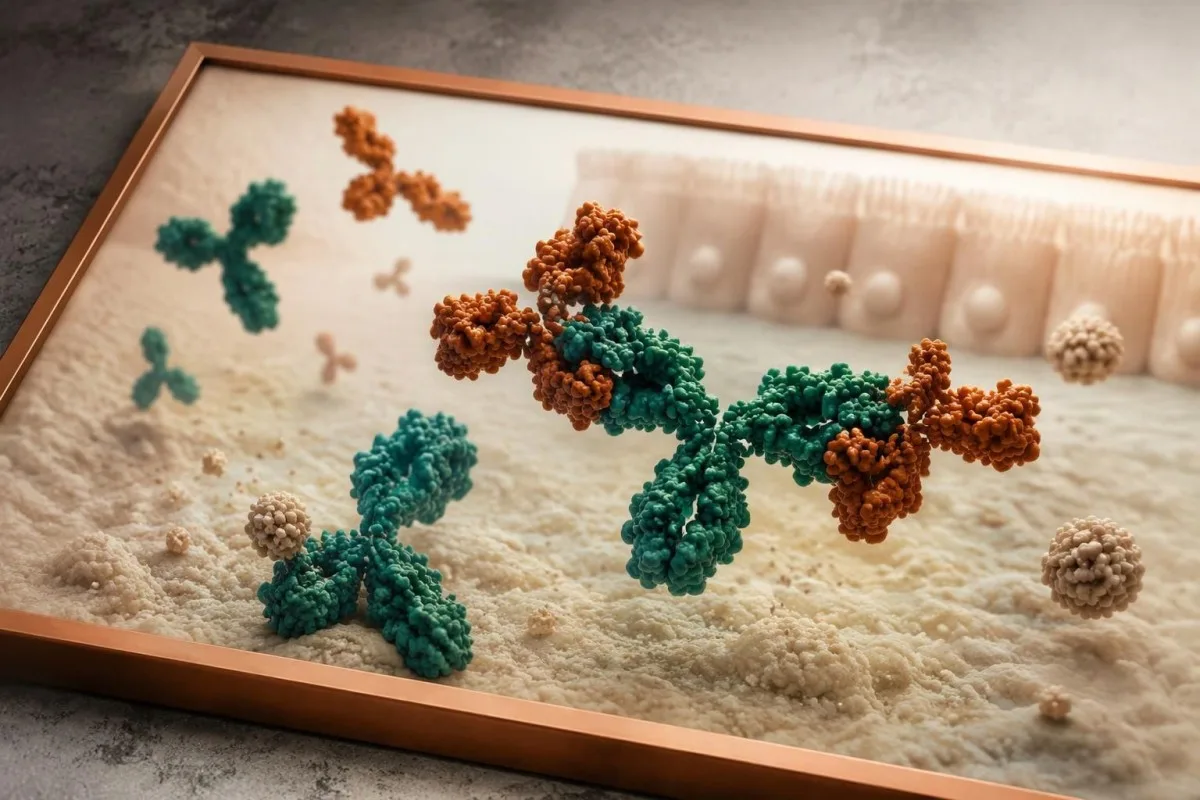
Anti-infliximab antibody tests usually detect binding antibodies; they do not all directly measure neutralizing activity. A positive result of 20 U/mL therefore identifies an assay-defined antibody signal, not a universal percentage of blocked infliximab or a precise prediction of how much benefit remains.
Antibody persistence and magnitude influence whether dose optimization is likely to recover exposure. Cheifetz et al. (2021) described low-titer antibodies as below 10 U/mL for the homogeneous mobility shift assay specifically; that threshold must not be transferred to an ELISA reporting AU/mL or to another laboratory's calibration.
A single low antibody result may be transient or become less clinically relevant after supervised treatment optimization. Repeating paired drug and antibody testing can distinguish a 1-time signal from a rising pattern, but severe disease or an infusion reaction may require action before a second result is available.
Antibodies to infliximab are not the same as antibodies against your own bowel, and they do not by themselves diagnose an immediate allergy. Our explanation of pozytywnych typach ôdpowiedzi antyciał helps separate these concepts; breathlessness or faintness during an infusion still requires immediate attention regardless of the antibody number.
Kedy wystarczajōnce stynżynie minimalne sugeruje niepowodzynie mechanistyczne?
Możebne niysprawianie mechanizmu means objectively active IBD persists despite sufficient infliximab exposure for the treatment goal. A trough of 8 µg/mL with confirmed active colitis may raise this possibility, but selected patients need further exposure optimization before clinicians conclude that another inflammatory pathway should be targeted.
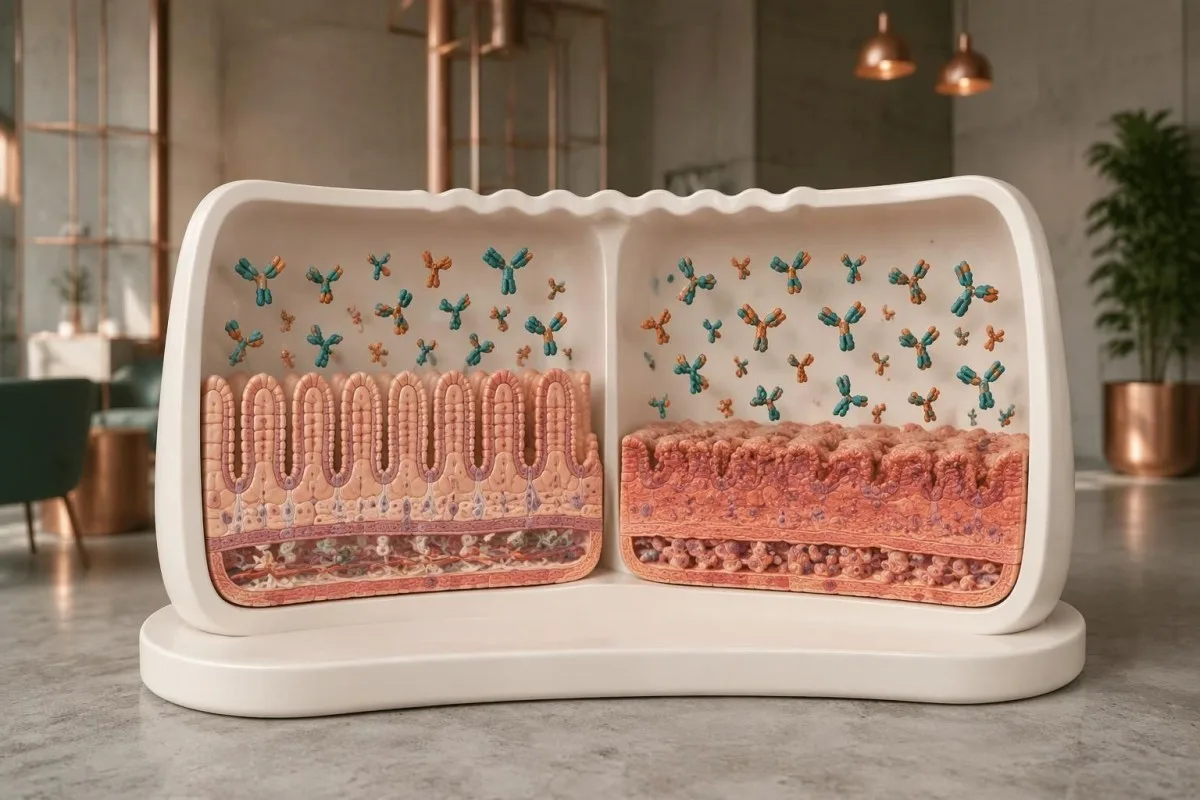
An adequate serum concentration cannot prove that TNF is the only pathway driving a person's current disease. Persistent endoscopic activity with a trough of 12 µg/mL is more supportive of a mechanism problem than the same concentration with normal objective testing and symptoms from bile acid diarrhea.
Calling treatment failure at exactly 5 µg/mL can be premature when the goal is fistula control or substantial endoscopic improvement. The 10–15 µg/mL reassessment discussed in the 2021 consensus provides a safeguard against abandoning an under-optimized treatment, but it is not a requirement to escalate every patient with symptoms.
Objective evidence also has limits: CRP of 3 mg/L does not exclude active IBD, especially in people whose CRP has remained low during previous flares. Borderline stool results need context and sometimes repetition; our guide to borderline kalprotektynie stolcōw explains why an isolated intermediate value should not determine a biologic switch.
The strongest case for changing mechanism combines 3 findings: documented inflammation, adequate exposure on a correctly timed sample, and an inadequate clinical response despite appropriate optimization. Structural complications, such as a fixed Crohn's stricture, can also cause symptoms that neither more infliximab nor a different biologic will reliably reverse.
Czy przeciwciała mogōm być dodatnie, kej poziom infliximabu je wystarczajōncy?
Antibodies can be detected while infliximab remains measurable or adequate, particularly with drug-tolerant assays. A trough of 7 µg/mL and a weak positive antibody result do not automatically mean treatment failure; the assay, antibody trend, and evidence of disease activity determine how much weight that finding deserves.
Drug-tolerant methods can identify antibodies in samples containing infliximab that would interfere with some drug-sensitive methods. This greater analytical sensitivity may reveal early or low-level immunogenicity, but 1 newly detected signal does not necessarily establish clinically meaningful loss of response.
A qualitative positive result contains less information than a quantitative result with the assay's cutoff and units. A report reading only positive cannot distinguish a value just above a 10 AU/mL cutoff from a much larger signal; our guide to testow jakościowych i ilościowych explains what each format can establish.
Compare antibody trajectories using the same laboratory method whenever feasible. Hypothetical results of 12, 15, and 13 AU/mL across 3 correctly timed visits may carry a different implication from 12, 80, and 200 AU/mL, although analytical variability and clinical findings still prevent interpretation from trend alone.
Kantesti je platforma do interpretacji wyników badań krwi AI that helps distinguish a reported antibody cutoff from a treatment target. When the report lacks the method or units, our interpretation should preserve that uncertainty rather than labeling 1 positive result as proof that infliximab has stopped working.
Czamu metody laboratoryjne i jednostki ôznaczynio przeciwciał sōm ważne?
Infliximab and antibody results are method-dependent, so values from different assays are not always interchangeable. Infliximab 1 µg/mL equals 1 mg/L, but antibody results in U/mL, AU/mL, or ng/mL do not have a universal conversion because laboratories use different standards, detection limits, and approaches to drug interference.
An assay may report free or functionally available drug differently from another method that detects a broader pool of circulating drug. Two laboratories can therefore produce somewhat different concentrations from similar specimens; a change from 6 to 8 µg/mL after switching methods may not represent a true gain in exposure.
Below the quantification limit means the assay cannot reliably assign a numerical concentration below its validated boundary. A report of less than 0.4 µg/mL is not proof of exactly 0 µg/mL, and greater than 100 U/mL cannot tell you whether the true antibody result is 110 or 1,000 U/mL.
Some laboratories use reflex antibody testing only when the drug concentration falls below a preset threshold. If antibodies were not tested because infliximab was 9 µg/mL, the result is not equivalent to antibodies negative; ask whether the antibody field says not performed, not detected, or below detection.
Kantesti's report interpretation should retain the assay name, units, and collection context instead of silently converting 20 AU/mL into another method's scale. Our informacyje ô metodologije klinicznyj explains the distinction between technical interpretation and clinical decision-making; no AI explanation removes the need to confirm an unusual result with the reporting laboratory.
Jak klinicyści potwierdzajōm, że nawracajōnce ôbjawy to IBD?
Returning symptoms do not necessarily mean returning intestinal inflammation; clinicians combine stool markers, CRP, infection testing, endoscopy, and imaging as appropriate. Three loose stools daily with a trough of 6 µg/mL can arise from active IBD, an intestinal infection, bile acid diarrhea, or a functional bowel disorder.
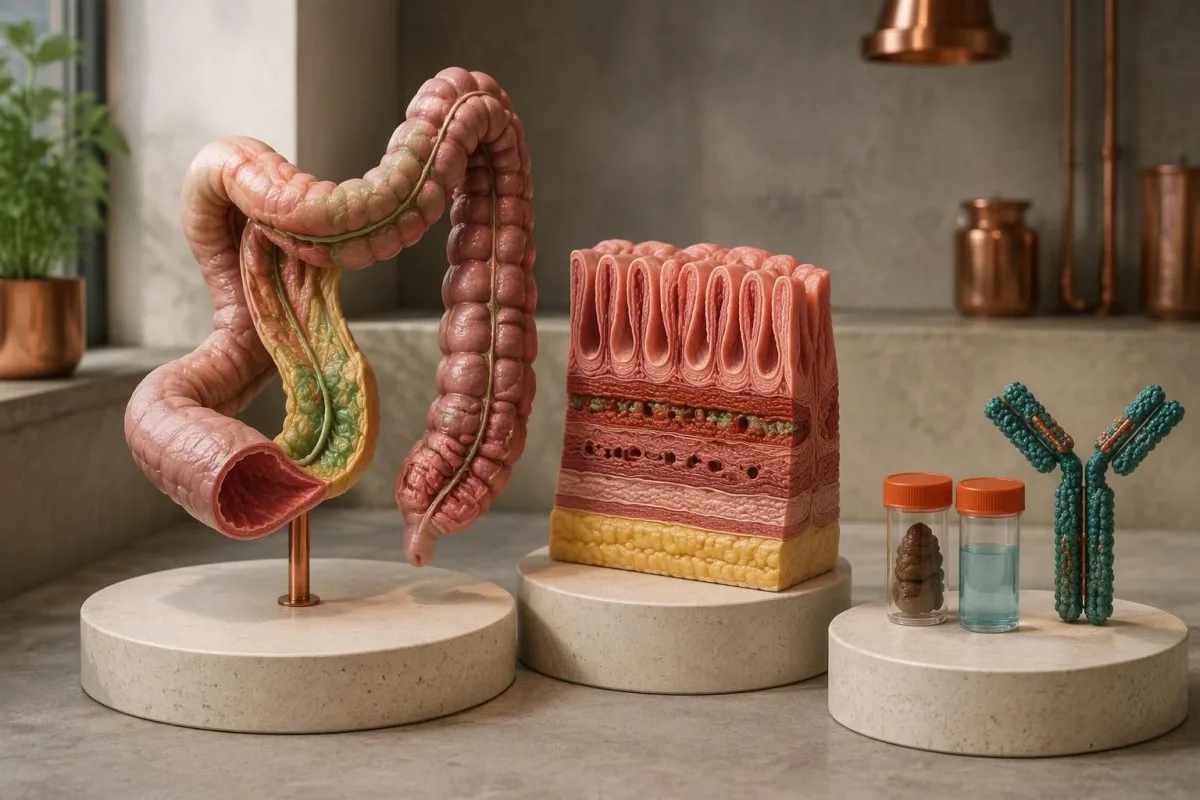
Fecal calprotectin and lactoferrin assess intestinal inflammatory activity rather than infliximab exposure. A hypothetical calprotectin of 800 µg/g adds different information from a trough of 2 µg/mL; our stool inflammation marker comparison explains why paired disease and drug measurements answer separate clinical questions.
C. difficile testing can be necessary during new or worsening diarrhea, even without recent antibiotics. A positive screening test and negative toxin result require contextual interpretation, not automatic classification as an IBD flare; our guide to rozbieżnych wynikach C. difficile describes why 2 test components can disagree.
Bile acid diarrhea is particularly relevant after ileal disease or resection and can persist despite controlled inflammation. A person with a trough of 10 µg/mL and reassuring objective IBD assessment may need a different evaluation; our explanation of SeHCAT retention results covers one diagnostic route where that test is available.
Bloating, gas, and altered stool frequency can also reflect bacterial overgrowth or carbohydrate malabsorption. At least 2 explanations can coexist with IBD, so a satisfactory trough should not end the assessment; our SIBO breath test guide explains preparation and limitations rather than treating breath testing as proof of every symptom's cause.
Jak zespōł leczōncy IBD może zareagować na niskōm ekspozycyjo?
Low exposure without substantial persistent antibodies may lead an IBD team to increase the infliximab dose, shorten the dosing interval, or address a treatment interruption. A common adult intravenous maintenance schedule is 5 mg/kg every 8 weeks after induction, but any adjustment requires individualized prescribing and reassessment of disease activity.
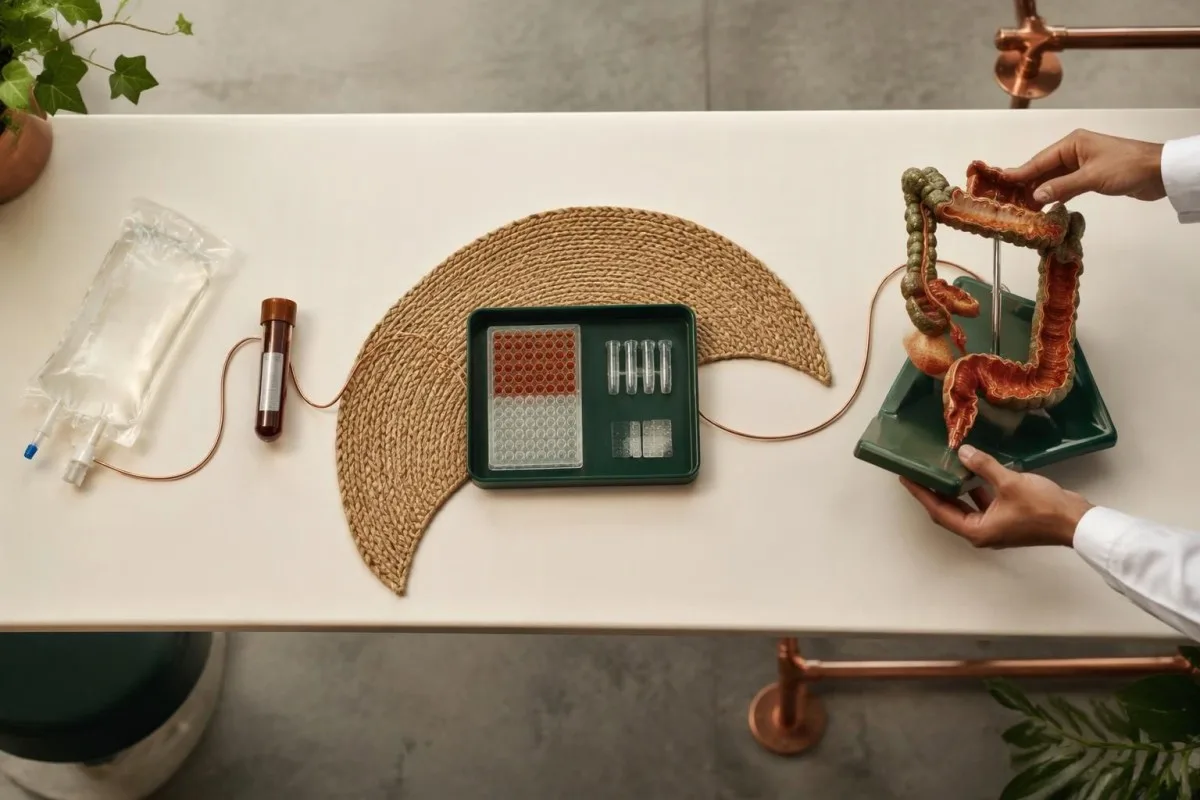
For a hypothetical 70 kg adult, 5 mg/kg corresponds to 350 mg before local preparation or rounding rules. Shortening an unchanged dose from every 8 weeks to every 6 weeks increases average drug administered per unit time by about 33%; the trough increase cannot be predicted as exactly 33% because clearance is not constant.
Increasing the dose and shortening the interval are not pharmacokinetically identical strategies. A larger dose changes peak exposure, while a shorter interval reduces time for concentrations to decline; a hypothetical patient whose symptoms repeatedly return during week 7 may prompt a different discussion from someone symptomatic throughout all 8 weeks.
A useful reassessment checks both exposure and the treatment outcome rather than declaring success because the trough rose. If infliximab increases from 2 to 9 µg/mL but calprotectin remains 900 µg/g and endoscopic disease persists, the new result has narrowed the explanation without necessarily improving the underlying disease.
The timing of repeat testing depends on severity, the revised schedule, and the clinical question; waiting 3 months is not appropriate for every deteriorating patient. Our przewodnik po trendach bezpieczeńswa medykamentōw explains why comparable dates and methods matter, but an app should never independently recommend extra infusions.
Kedy bierze sie pod uwaga zmiana leczenio abo terapia skojarzōno?
Persistent high antibodies with low drug may favor changing treatment, while adequate exposure with confirmed active IBD may favor switching to a different mechanism. Low-level immunogenicity can sometimes be addressed through supervised optimization or an immunomodulator, but a result of 15 U/mL alone cannot determine which option offers the best benefit-risk balance.
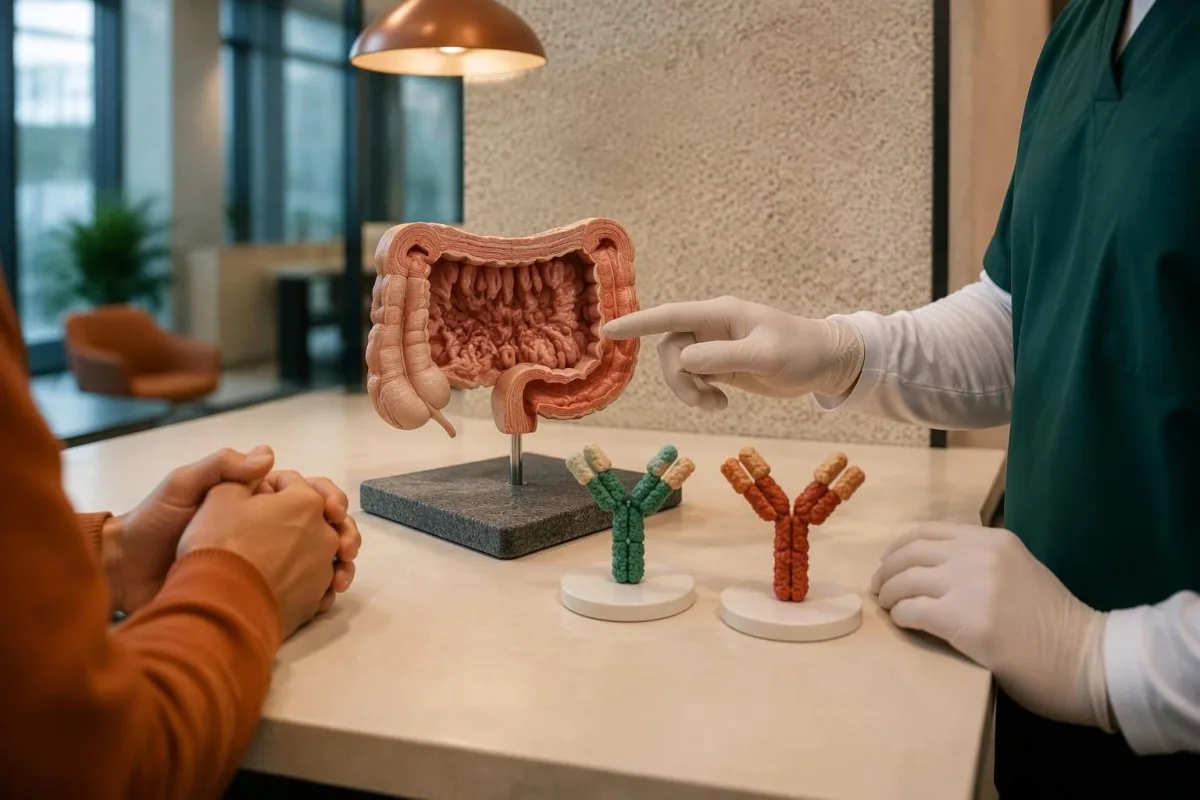
Switching within the anti-TNF class can make sense when infliximab previously controlled disease but antibody-associated clearance now prevents adequate exposure. Switching to another mechanism becomes more persuasive when inflammation persists with adequate exposure; these are 2 different failure patterns, not interchangeable reasons to choose the next medicine.
An immunomodulator such as azathioprine or methotrexate may reduce immunogenicity in selected circumstances, but adding one introduces additional monitoring and adverse-effect risks. Before azathioprine, TPMT testing and safety assessment can inform prescribing; TPMT and NUDT15 assessment do not replace ongoing CBC and liver monitoring, even when baseline results are normal.
If a person already takes a thiopurine, metabolite testing can help clarify exposure or a metabolism pattern before assuming combination therapy has failed. For example, 2 patients prescribed the same mg dose may have very different metabolite findings; our thiopurine treatment pattern guide explains why prescription dose alone is incomplete.
Restarting infliximab after a long interruption deserves a separate safety discussion because immunogenicity and infusion reactions can complicate re-exposure. A treatment gap of 6 months is not equivalent to a routine 1-week scheduling delay; never restart, add an immunomodulator, or stop an existing medicine based solely on an online interpretation.
Czy indukcyjo, przetoki, dzieci i zastrzyki zmieniajōm cele?
Treatment phase, disease phenotype, age, and formulation can change the relevant exposure goal; intravenous maintenance targets should not be copied into every setting. Standard adult intravenous induction commonly uses 5 mg/kg at weeks 0, 2, and 6, and those early concentrations are interpreted differently from an established 8-week maintenance trough.

The 2021 expert consensus described induction goals of approximately 20–25 µg/mL at week 2, 15–20 µg/mL at week 6, and 7–10 µg/mL at week 14 (Cheifetz et al., 2021). These are consensus exposure goals influenced by disease phenotype and outcome, not interchangeable minimums from one definitive randomized trial.
Perianal fistula outcomes may require higher exposure than symptom control in uncomplicated luminal disease, but observational associations do not establish a universal healing threshold. A fistula still draining at 10 µg/mL may also need imaging, drainage of an abscess, or procedural care; raising the trough cannot substitute for addressing an undrained collection.
Children can have different clearance and dosing requirements, particularly with lower body weight or severe disease. An adult maintenance benchmark of 5 µg/mL should not become a parent-directed dosing rule; our discussion of AI interpretacyjo dziyci explains why pediatric specialist context and age-appropriate interpretation remain necessary.
Subcutaneous infliximab produces a different concentration-time profile from intermittent intravenous infusions, and availability and prescribing schedules vary internationally. A concentration of 15 µg/mL during injection treatment should not be labeled excessive merely because an intravenous report lists 3–7 µg/mL; the formulation, actual regimen, and sampling convention must be specified.
Jak wyniki łōnczne zmieniajōm rozumowanie kliniczne?
Paired results guide the next question rather than dictate a prescription: low drug without antibodies suggests underexposure, low drug with persistent antibodies suggests immunogenicity, and adequate drug with inflammation raises possible mechanism failure. The following 4 examples are entirely hypothetical; the concentrations are illustrative, not personalized treatment recommendations.
Example 1: a 34-year-old with Crohn's disease has a true trough of 1.8 µg/mL, no detected antibodies, albumin of 29 g/L, and calprotectin of 1,100 µg/g. This pattern supports underexposure in active disease; confirming the infusion schedule and considering supervised optimization are more logical than immediately declaring TNF blockade ineffective.
Example 2: a 46-year-old with ulcerative colitis has infliximab below 0.4 µg/mL and antibodies above the laboratory's 100 U/mL reporting limit on 2 visits. Assuming the assay defines that antibody signal as substantial, persistent immunogenicity is plausible; simply increasing the dose may be less successful than a clinician-directed treatment change.
Example 3: a 28-year-old has a trough of 11 µg/mL, no significant antibodies, and repeatedly active colitis on endoscopy despite appropriate optimization. Example 4: a 61-year-old has the same 11 µg/mL trough but reassuring endoscopy and diarrhea after ileal resection; the first pattern raises mechanism failure, whereas the second prompts investigation of non-inflammatory causes.
Kantesti je Narzędzie do analizy badań krwi oparte na AI that helps organize these distinctions when the report and treatment details are supplied. Our u wyjasniyniy technologii AI describes how laboratory context informs interpretation; if a 2-week-old report lacks sampling timing, the missing information must stay visible rather than being guessed.
Co prziniyść na wizyty kontrolne i kero dowody majō zastosowanie?
Bring the complete report, infusion timeline, and objective disease results to your IBD review; these 3 evidence streams make paired drug-antibody testing actionable. Seek earlier care for severe deterioration rather than waiting for the next trough, and distinguish infliximab-specific clinical research from general educational publications about accompanying laboratory abnormalities.
A useful review record includes the previous 2 infusion dates, actual dose, collection timing, assay name, antibody units, and recent CRP, albumin, and fecal calprotectin. Add symptom timing, steroid use, recent antibiotics, and missed doses; ask whether the proposed change addresses insufficient exposure, immunogenicity, active non-TNF disease, or a non-inflammatory explanation.
Contact your clinical team promptly for worsening diarrhea with dehydration, persistent vomiting, new significant bleeding, or fever of 38°C or higher while immunosuppressed. Severe abdominal pain with distension, fainting, or inability to keep fluids down may require emergency assessment; during an infusion, sudden breathing difficulty or collapse requires immediate staff attention, not interpretation of an antibody report.
Kantesti provides educational interpretation, not independent biologic prescribing, and our zasady ôdpowiedzialnego używanio AI explain that boundary. A reassuring trough of 10 µg/mL does not establish that an infusion is safe during an acute illness; the treating service must assess symptoms, examination findings, and any necessary investigations.
The 2 Zenodo publications listed below address accompanying laboratory interpretation, not infliximab target validation: our RDW a przewodnik po czerwōnych krwinkach concerns anemia patterns, while our Przewodnik BUN i kreatynina concerns renal and hydration context. These educational deposits are not evidence for anti-drug antibody cutoffs; the AGA guideline, TAXIT trial, and biologic-monitoring consensus supply the directly relevant clinical references.
Często zadawane pytania
Co ônacza niski poziōm infliksymabu?
Niski poziōm infliksymabu ôznaczo, że ekspozycyjo na lek we krwi je pod benchmarkym ôbranym dlŏ tyj fazy leczenio i ôbranygo celu; niy ôznaczo to z automatu, że trza ôdstawić infliksymab. Prawdziwy trough w fazie podtrzimujōncyj 2 µg/mL bez znaczōncych przeciwciał może ôznaczać szybszy klirens, utrata białka przez jelyta abo za mało dawkōm lub za długi ôdstymp miyndzy dawkami. Niski poziōm leku przi utrzymujōncych sie znaczōncych przeciwciałach z kolei podpowiado klirens za pośrednictwym układu ôdpornościowego. Wasz zespōł IBD powinien ôcynić wynik we połōnczyniu z ôbiektywnōm aktywnościōm choroby, czasym ôd infuzji i testym.
Jaki je dobry minimalny poziom infliximabu we krwi przi IBD?
Nima jednego dobrego minimalnego stężynio infliksymabu dlo kożdyj ôsoby z IBD. Wytyczne AGA z 2017 roku sugerowały co nojmnij 5 µg/mL przi reaktywnym monitorowaniu podtrzymujōncego leczenio, a konsensus ekspertōw z 2021 roku ôpisoł stężynia podtrzymujōnce ôd 5 do 10 µg/mL. U wybranych pacjentōw z wtōrnōm utratōm ôdpowiedzi może być potrzebne ponowne ôceńyńy przi 10–15 µg/mL, zanim leczeŏnie bydzie ôdstawiōne. Indukcyjo, przetoki i podskōrne leczeŏnie wymagajōm innego kōntekstu, tōż zakres laboratoryjny niy je uniwersalnym docelowym dawkowaniym.
Kedy bych mioł zrobić badanie poziōmu infliksymabu?
For intravenous infliximab, a trough sample should be collected immediately before the next infusion begins. A sample obtained 2 days after an infusion is not comparable with routine pre-infusion targets. Record the last infusion date, dose, scheduled interval, and actual collection time, especially if an 8-week appointment was delayed. Subcutaneous infliximab has a different exposure profile, so sampling should follow the prescribing team's and laboratory's instructions.
Czy przeciwciała do infliksymabu mogōm zniknōńć?
0 Niskopoziomowe przeciwciała przeciwko infliksymabowi mogą czasym stać sie niewykrywalne abo mieć mniejsze znaczenie kliniczne, ale trwale wysokie poziomy przeciwciał przy bardzo niskim stężyniu leku je trudniyjsze do pokónanio. Konsensus ekspertów z 2021 roku określoł niskie miana przeciwciał jako poniżyj 10 U/mL w jednym teście z przesunięciem ruchliwości elektroforetycznej w warunkach jednorodnych; tego progu niy idzie stosować do kożdej metody laboratoryjnyj. Nadzorowano optymalizacyjo abo lek immunomodulujący mogōm pomōc wybranym pacjentōm, a inkszym je potrzebno zmiana leczenio. Powtōrzōne badanie sparowane może wyjaśnić, czy przeciwciała sie utrzymujōm, ale pacjenci niy powinni sami zmieniać leczenio.
Może infliksymab przestać działać, chocioż jego poziōm je normalny?
Infliximab może niy poradzić sie z kontrolōm obiektywnie czynnego IBD, tōż iże we krwi je jego dostateczno kōncentracyjo, co poddowo pod rozwoga możebno nieskuteczność mechanizmu. Najniższo kōncentracyjo 10 µg/mL niy gwarantuje wygojenio jelit ani niy dowodzi, że TNF je jedynōm ścieżkōm, co napyndzo choroba. Przed zmianōm mechanizmu lekarze potwierdzajōm stan zapalny, ocyniajōm powikłania strukturalne abo infekcyjne i rozwōżajōm, eli ekspozycyjo była dostateczno do kōnkretnego celu leczenio. Biegunka przi uspokajajōcej obiektywnej ocenie może mieć tyż przyczynã niezapalnōm.
0 Czy wysoki poziōm infliksymabu je niybezpieczny?
Wysokŏ koncentracyjŏ infliksymabu niy musi być ôd razu niybezpiecznŏ i niy ma jednego ustalōnego progu toksyczności we surowicy, co ôbowiōnzuje dlŏ wszyjskich pacjentōw z IBD. Wynik 15 µg/mL może być inaczyj interpretowany bezto, eli chodzi ô indukcja, leczynie przetok abo terapia podskōrnŏ, aniżeli bezto, eli chodzi ô rutynowe podtrzymanie dożylne. Bezpieczyństwo zależy ôd cołkowego schematu leczenia, infekcyji, reakcyji na infuzje i inkszych klinicznych ôbserwacyji, a niy ôd samej koncentracyje. Niy ôpuszczej infuzyje ani niy zmniyjszej dawki bez ômówianio wyniku ze swojim zespołym leczniczym.
Czamu wyniki moich przeciwciał przeciwko infliksymabowi zmieniły sie po zmianie labolatoryjōw?
Wyniki przeciwciał przeciwko infliksymabowi mogōm sie zmienić po przejściu na inksze laboratorium, bo testy różniōm sie kalibracyjōm, jednostkami, granicami wykrywalności i tolerancjōm na krōnżōncy lek. Wyniku 20 AU/mL niy idzie uniwersalnie przeliczyć na U/mL ani ng/mL. Metoda tolerancyjno na lek może wykryć przeciwciała, kere umykajō testowi wrażliwymu na lek, kej infliksymab dalij je wykrywalny. Kiedy to możliwe, porōwnuj trendy, używajōc tyj samej metody, i zapytaj, czy test na przeciwciała był faktycznie wykonany, a niy pominięty na skutek reguły automatycznego testowania refleksyjnego.
Dowiydz się, jak czytać wyniki badańo krwi
Wgraj raport laboratoryjny, a AI Kantesti wyjaśni kożdy biomarker prostym jynzykiym w pora sekund. Używane bezma 2 miliony ludzi na cołkim świecie.
Ôdniesiynia
- Klein, T., Mitchell, S., & Weber, H. (2026). Badanie krwi RDW: kompletny przewodnik po RDW-CV, MCV i MCHC. Badania medyczne AI Kantesti. DOI
- Klein, T., Mitchell, S., & Weber, H. (2026). Wyjaśnienie wskaźnika BUN/Creatynina: Przewodnik testu funkcji nerek. Badania medyczne AI Kantesti. DOI
- Feuerstein JD et al. (2017). American Gastroenterological Association Institute Guideline on Therapeutic Drug Monitoring in Inflammatory Bowel Disease. Gastroenterology. DOI
- Vande Casteele N et al. (2015). Trough concentrations of infliximab guide dosing for patients with inflammatory bowel disease. Gastroenterology. DOI
- Cheifetz AS et al. (2021). A Comprehensive Literature Review and Expert Consensus Statement on Therapeutic Drug Monitoring of Biologics in Inflammatory Bowel Disease. The American Journal of Gastroenterology. DOI
- 2M+Ônalyzowane badania
- 127+Kroje
- 100+Jynzyki
Ô zespole medycznym


Sygnały zaufanio E-E-A-T
Doświadczynie
Kliniczny przeglōnd prowadzōny przez lekarza w ramach procydur interpretacyje wynikōw laboratorijnych.
Ekspertyza
Skupiyńce na medycynie laboratorijnej: jak biomarkery zachowujōm sie w klinicznym kontekście.
Autorytetność
Zweryfikowane medycznie przez dr. Thomasa Kleina, przy współudziale dr Sarah Mitchell i prof. dr. Hansa Webera.
Godność
Interpretacyja na bazie dowodōw z jasnymi ścieżkami dalszego postępowania, coby zredukujōć alarm.





Zastrzeżynie medyczne
Ten artykuł je wyłōncznie do celōw edukacyjnych i nie stanowi porady medyczno. Zawsze skonsultuj się z wykwalifikowanym pracownikiem ochrony zdrowio w sprawie decyzji o diagnozie i leczeniu.
Opublikowane · Skontaktuj sie z redakcyjōm
Opublikowane przez Kantesti Ltd, zarejestrowane w Anglii i Walii, numer firmy. 17090423, Londyn, Zjednoczone Królestwo.
