
Voriconazole trough pobrany we ôdpowiednim czasie pōmōgo ôcenić, eli ekspozycyjo na lek przeciwgrzibiczy je dostateczno, ale niy nadmierno. Wiela protokołōw leczenio używo zakresu ôkoło 1–5.5 mg/L, ale infekcyjo, plan profilaktyki i skōtki uboczne ôkreślajōm twōj indywidualny cel.

Najważniejsze informacje
- Trough voriconazole je stężyniym leku bezpośrednio przed nastympnōm zaplanowanōm dawkōm; mierzi ekspozycyjo, a niy to, eli infekcyjo została wyleczōno.
- Cele leczenia zwołujejōm zwykle trough powyżyj 1–1.5 mg/L; niykere zespoły dōnżōm do co najmni 2 mg/L przy ciynżkich abo ciynżkich do leczenio infekcyjach.
- Gōrne limity wynoszōm zwykle ôkoło 5–6 mg/L, bo nadmierno ekspozycyjo zwiynkszo ryzyko neurologicznych i inkszych niykorzystnych skōtkōw.
- Cele profilaktyki zależōm ôd protokołu; niższego progu używanego przi profilaktyce niy trza automatycznie stosować do leczenio już istniejącyj infekcyje.
- Czas pobranio poziōmu nojczynij znaczy ôdebranie ôkoło 30 minut przed nastympnōm dawkōm, podug instrukcyji laboratorium.
- Przeliczenje jednostek je dokładne: 1 mg/L rōwno sie 1 µg/mL i 1,000 ng/mL.
- Nisko ekspozycyjo może ôznaczać pominiynte dawki, wpływ jedzynio, upośledzōne wchłanianie, leki wchodzōnce w interakcyje abo szybszy metabolizm — niy ino za mało przepisany lek.
- Bezpieczeństwo dawki wymogŏ zmian pod nadzorym lekarza, bo zwiynkszynie dawki 25% może sprowadzić niyproporcyjōnalnie wielki wzrost stynżynio.
Co tak naprowda pokazuje trough voriconazole?
A stynżynie voriconazole przed dawkōm ôznajmio lekarzōm, wiela leku przeciwgrzybiczego ôstało bezpośrednio przed nastympnōm dawkōm. Prawidłowo ôdebrany wynik ôkoło 1–5.5 mg/L często pasuje do protokołu leczenio, ale skuteczno dawkō zależy tyż ôd wrażliwości grziba, miyjsca infekcyje i poprawy klinicznyj.

Stynżynie przed dawkōm je praktycznym wskaźnikiym ekspozycyje w czasie miyndzy dawkōmi, a niy bezpośrednim pomiŏrym leku w chorym płucu abo mōzgu. U ôsoby biorōncyj voriconazole co 12 godzin stynżynie przed dawkōm pōmogo ustalić, czy ekspozycyjo może spaś za nisko miyndzy dawkōmi.
Monitorowanie stynżynio leku mo dwa ôsobne cele: utrzimać dosyć dużõ ekspozycyjo dlo działania przeciwgrzybiczego i uniknōńć nadmiernyj ekspozycyje. Wytyczne IDSA ô aspergilozie opisujō stynżynie lecznicze powyżyj 1–1.5 mg/L i poniżyj 5–6 mg/L jako czysto stosowane cele eksperckie, ôsobliwie dlo ôgraniczynio toksyczności ôśrodkowego układu nerwowego (Patterson et al., 2016).
Kantesti je Analizatōr podszukowań krwi sztucznyj inteligyncyje co może pōmōc wyjaśnić przesłany wynik voriconazole ôbok badań wōntroby, a zespōł przepisujōncy lek ustalo cel. Do wyniku 1.2 mg/L trza dodać wskazanie i godzina ôdebranio prōbki; nasze wyjaśniynie niy powinno robić z tyj liczby zalecynio dawkowanio.
Flaga laboratoryjno niy je rozstrzygniyńciym ô skuteczności leczenio. Inaczyj niż we wiela rutynowych przedziałach referyncyjnych biochemii, przedział monitorowanio leku ôznaczo kliniczny cel ekspozycyje; nasze wyjaśniynie wynikach laboratoryjnych spoza zakresu pōmogo ôdrōżnić flaga ôd diagnozy.
Kiedy trza pobrać krew na poziōm voriconazole?
Prawidłowe godziny ôdebranio prōbki voriconazole znaczō ôdebranie prōbki bezpośrednio przed nastympnōm zaplanowanōm dawkōm, zwykle w czasie do 30 minut przed niōm. Piyrszy rutynowy poziōm ôbiera sie czynsto miyndzy 4. a 7. dniym, choć dawki nasycajōnce, ciynżko choroba i lokalne protokoły mogō uzasadnić wcześniejsze badanie.

Przykładowo, wyobŏź se przepisany rozkłod ô 8 rano i 8 wieczōr. Prōbka ôdebrano ô 7:45 rano, przed rannym lekiym, dobrze ôddŏje stynżynie przed dawkōm; prōbka ôdebrano ô 10 rano po zażyciu dawkō nie ôddŏje go, nawet kej laboratorium ôznaczy jō jako stynżynie przed dawkōm.
Ôpōźniōno dawka tyż może zniekształcić interpretacyjo w ôpaczno strōna. Kej nastympno dawka miała być ô 8 rano, a prōbka była ôdebrano ô 11, dodatkowe 3 godziny bez leku mogō ôbniżyć zmierzone stynżynie; zespōł potrzebuje prawdziwych godzin, a niy ino zaplanowanego rozkłodu.
Dożylny voriconazole tyż wymogo prōbki ôdebranyj przed dawkōm, zwykle przed zaczynciym nastympnyj infuzyje. Ôdebranie prōbki z lini używanyj do podawanio leku może stwarzać ryzyko zanieczyszczenio, tōż laboratorium abo zespōł infuzyjny powinien wybrać sposōb ôdebranio, a niy zakłŏdać, że kożdo dostympno linia dŏ rōwnoważny wynik.
Całonocny post niy je z natury potrzebny do badania stynżynio, ale doustny voriconazole mo własne instrukcyje ô czasie jedzynio. Sprawdź plan ôdebranio prōbki wcześniej; zasady ôdebranio prōbki właściwe dlo danego leku wyjaśniajō, czamu prawidłowyj zasady czasu ôdebranio prōbki dlo jednego leku niy idzie przeniyś na inkszy lek.
Jaki je terapeutyczny zakres voriconazole?
Te zakres terapeutyczny voriconazole wynosi zwykle ôkoło 1–5.5 mg/L przy leczeniu, ale niy ma jednego przedziału dobrego dlo kożdego pacjynta. Wytyczne IDSA ômawiajō dolny cel powyżyj 1–1.5 mg/L i gōrno granica poniżyj 5–6 mg/L; przy niykerych trudnych infekcyjach wymogany je wyższy poziōm minimalny.

These boundaries describe probabilities, not biological switches. A trough of 0.9 mg/L does not prove failure, and 5.6 mg/L does not prove toxicity; repeated results, symptoms and organism susceptibility help determine whether a small boundary crossing is clinically meaningful or simply requires confirmation.
For invasive aspergillosis, the British Society for Medical Mycology recommends a treatment trough above 1 mg/L and discusses higher exposure goals for poor-prognosis situations, including central nervous system disease (Ashbee et al., 2014). A team may therefore consider 1.3 mg/L acceptable for one indication but insufficient for another.
The reason for a higher minimum is that the concentration needed to inhibit a less-susceptible fungus may exceed the concentration needed for a susceptible organism. Raising exposure indefinitely is not a safe solution: a trough approaching 5–6 mg/L can leave little room between a desired antifungal effect and adverse effects.
Always read the units before comparing reports. A result of 2 µg/mL is exactly 2 mg/L, not twice or half that value; the biomarker and units guide provides context for comparing laboratory values without mistaking a therapeutic target for a healthy-population range.
| Poziōm | Zakres | Co to znaczy |
|---|---|---|
| Below many treatment targets | <1 mg/l | Check collection timing, dosing history, absorption and interactions; not proof of treatment failure. |
| Lower treatment exposure | 1–<2 mg/L | May meet the prescribed target, but severe disease or reduced fungal susceptibility can require a higher minimum. |
| Common treatment exposure window | 2–5.5 mg/L | Often compatible with treatment goals when correctly timed; does not guarantee efficacy or freedom from toxicity. |
| Above many local upper limits | >5.5 mg/L | Requires review of symptoms, liver tests, timing and the local protocol; there is no universal emergency cutoff. |
Czamu cele leczenio i profilaktyki mogōm być roztōmne?
Treatment targets may be more demanding than prevention targets because an established fungal infection must be controlled, not merely prevented. Some local prophylaxis protocols accept 0.5 mg/L, whereas British guidance recommends a prophylaxis trough above 1 mg/L; these thresholds are not interchangeable.

Prophylaxis studies are harder to interpret because breakthrough fungal disease may be uncommon and heavily influenced by immune status. A threshold of 0.5 mg/L used in one prevention programme cannot establish equivalent protection for every stem-cell transplant recipient, particularly during prolonged neutropenia or intensive immunosuppression.
The British Society for Medical Mycology's prophylaxis recommendation above 1 mg/L carries a weaker evidence base than some treatment recommendations (Ashbee et al., 2014). The uncertainty is genuine: the exact preventive minimum is less settled than the principle that persistently very low exposure deserves investigation.
Consider a hypothetical result of 0.8 mg/L in two people. One is receiving prevention under a documented local protocol; the other has confirmed invasive aspergillosis. The same concentration can lead to different discussions because the indication, fungal burden and acceptable risk of inadequate exposure differ.
Transplant recipients often have several parallel monitoring plans, not one combined 'infection score.' Voriconazole does not prevent every opportunistic infection, and CMV results after transplantation answer a different question; a satisfactory antifungal trough does not replace viral surveillance or other prescribed prophylaxis.
Co może być prziczynōm niskigo poziōmu voriconazole?
A low voriconazole level can result from missed or delayed doses, food effects, impaired gastrointestinal absorption, enzyme-inducing medicines or faster metabolism. Before changing treatment, clinicians verify whether a result below 1 mg/L is a correctly timed trough and whether the prescribed doses actually reached the patient.
Oral voriconazole is generally taken at least 1 hour before or 1 hour after a meal, following the product instructions. Food can reduce exposure, but a low result should not be blamed on breakfast without checking the complete dosing history, formulation, vomiting and other medicines.
Imagine a hypothetical adult prescribed 200 mg every 12 hours whose trough is 0.6 mg/L. Taking each dose with a substantial meal and vomiting one evening dose creates two plausible explanations for low exposure; automatically escalating the prescription could cause excessive exposure once those problems resolve.
Severe diarrhoea, mucositis, gastrointestinal surgery and feeding-tube administration can make oral delivery less predictable. Clinicians may review the formulation or route rather than simply the milligram amount; testing for impaired fat absorption explains why gastrointestinal dysfunction needs its own assessment rather than being diagnosed from one drug level.
Acid-suppressing medicines deserve a medication review, but voriconazole should not be treated like an antifungal whose absorption always requires stomach acid. Some proton pump inhibitors inhibit metabolism and can raise exposure; our reflux treatment context helps readers identify these medicines without stopping them independently.
Czamu mało zmiana dawki czasym mocno zmienio poziōm?
Voriconazole has nonlinear metabolism in adults, meaning a dose increase can produce a more-than-proportional concentration increase. Changing a prescribed dose from 200 mg to 250 mg is a 25% increase, but the resulting trough cannot safely be predicted by multiplying the old result by 1.25.
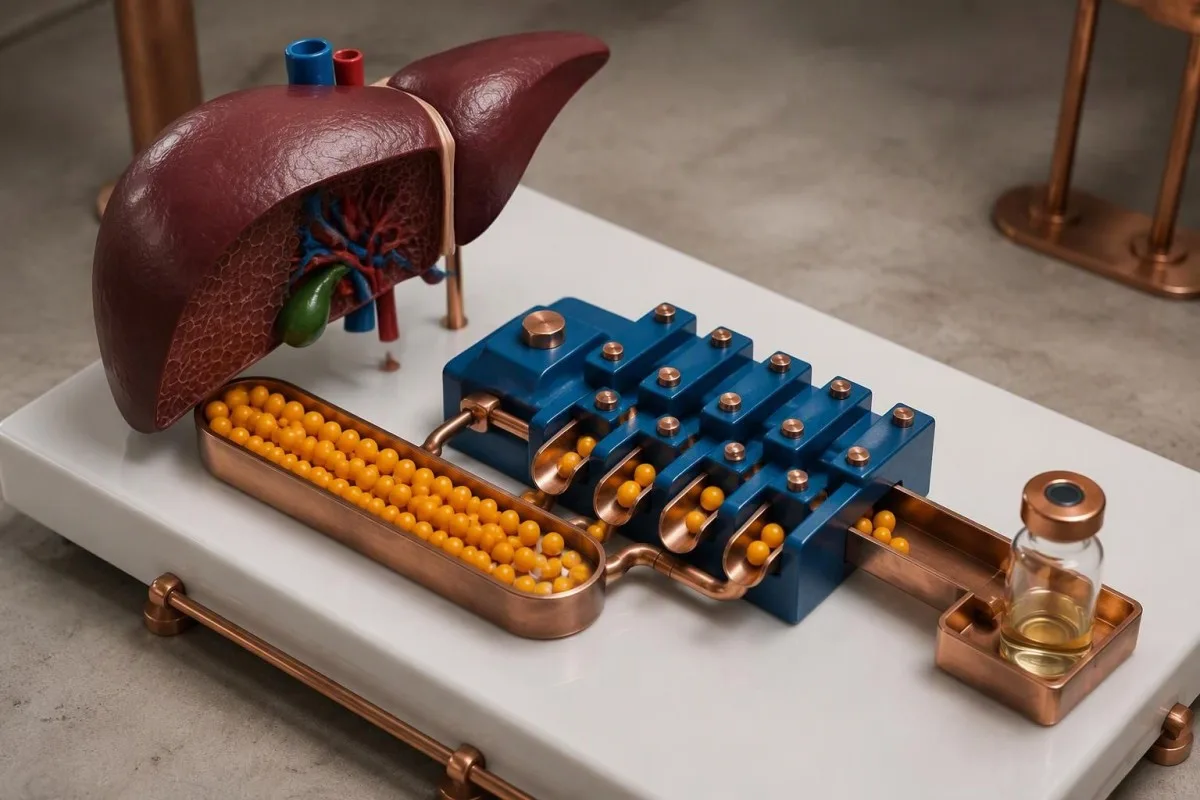
Metabolising enzymes can approach their processing capacity as exposure rises, so each additional milligram may be cleared less efficiently. A hypothetical rise from 2 mg/L to 4 mg/L after a modest dose adjustment is therefore plausible, but no single example provides a reliable formula for an individual patient.
The reverse calculation is unreliable too. A dose reduction of 25% does not guarantee a 25% concentration reduction, particularly when liver function or interacting medicines are changing; clinicians use repeat monitoring rather than assuming that the prescription and laboratory result move along a straight line.
A trough also reflects conditions during the preceding doses, not only the dose taken most recently. If a new prescription began 1 day before collection, the result may not represent the eventual exposure on that regimen, and an early result should be labelled as such rather than interpreted as settled.
This is a major reason not to borrow another person's adjustment advice. Nonlinear phenytoin monitoring illustrates a related principle, although phenytoin's free-versus-total measurement issues and target intervals are different; the shared lesson is that arithmetic alone cannot determine a safe drug dose.
Jak CYP2C19 wpływo na ekspozycyjo na voriconazole?
CYP2C19 genetic variation can influence voriconazole clearance: rapid and ultrarapid metabolisers may have low exposure, while poor metabolisers may develop higher concentrations. A genetic result can help explain a repeated trough below 1 mg/L or above the prescribed ceiling, but it does not replace drug monitoring.
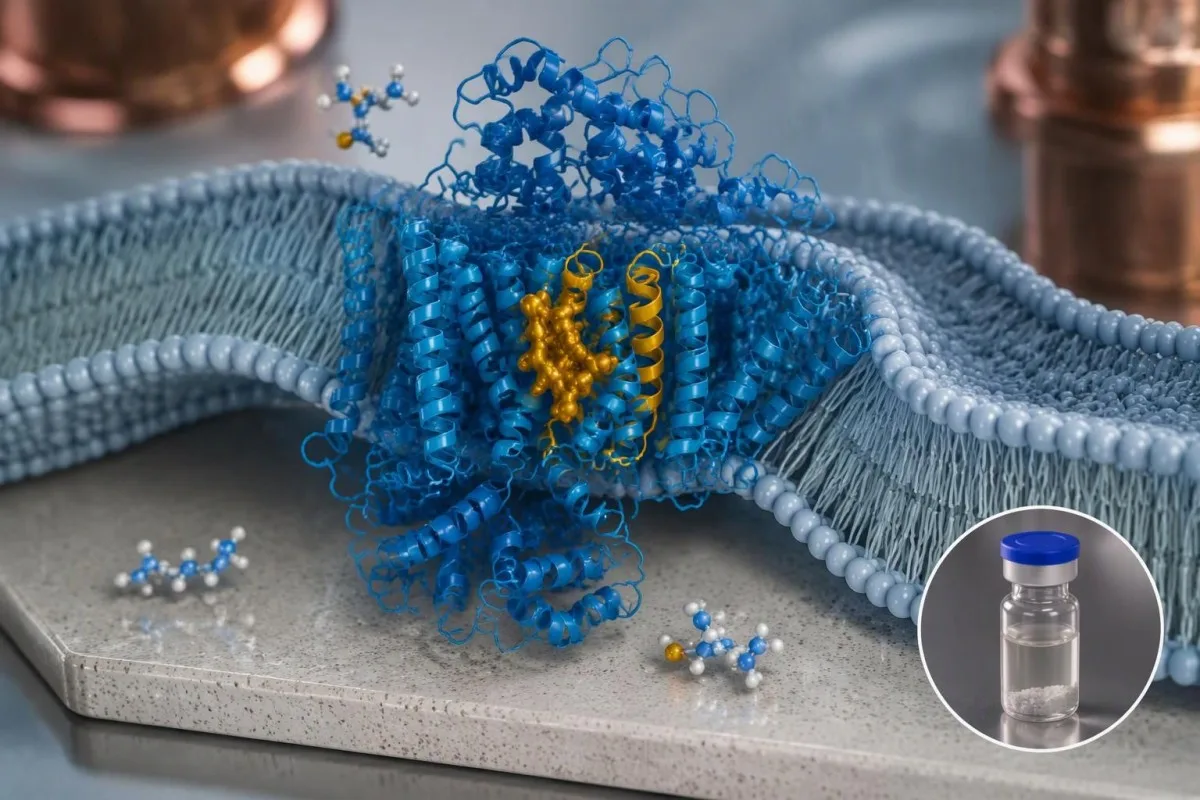
CPIC guidance recommends considering an alternative antifungal for certain CYP2C19 phenotypes when achieving reliable voriconazole exposure is difficult or adverse-effect risk is increased (Moriyama et al., 2017). This is a clinician-led choice between suitable treatments, not an instruction to stop an effective medicine after seeing a genetic category.
Genotype is only one input because liver illness, interacting medicines and systemic inflammatory responses can alter enzyme activity. A person genetically classified as a rapid metaboliser can still develop a trough of 6 mg/L under changed clinical conditions; inherited tendency does not establish a permanent, safe dose.
CYP2C19 influences more than one medicine, but the consequences are drug-specific. An enzyme variant that reduces activation of a prodrug can have a different clinical meaning from a variant that slows clearance of an active antifungal; 'fast metaboliser' is not automatically a favourable or unfavourable label.
Kantesti je platforma do interpretacji wyników badań krwi AI that can help organise the laboratory and medication context around a reported voriconazole concentration. Our u wyjasniyniy technologii AI describes the interpretation workflow; a chemistry panel cannot reveal CYP2C19 genotype unless a separate genetic test has actually been performed.
Kere interakcyje lekōw mogōm zmienić wynik?
Voriconazole interactions can either lower its concentration or increase exposure to voriconazole and other medicines. Rifampicin and carbamazepine are major enzyme-inducing concerns, while voriconazole can substantially increase tacrolimus exposure; a satisfactory trough of 2 mg/L does not make the combination automatically safe.

Rifampicin, carbamazepine and St John's wort can substantially reduce voriconazole exposure, and some combinations are contraindicated. Phenytoin creates a particularly complicated bidirectional interaction; any specialist exception requires an explicit monitoring plan rather than the assumption that increasing voriconazole will reliably overcome induction.
Starting or stopping an interacting medicine can matter as much as adding a new voriconazole dose. Enzyme induction and its reversal do not necessarily disappear within 24 hours, so clinicians need medication start and stop dates when explaining a concentration that changes despite an unchanged antifungal prescription.
Tacrolimus is a separate safety priority because voriconazole inhibits pathways involved in its clearance. A transplant team may need to adjust and closely monitor tacrolimus when voriconazole starts or stops; our tacrolimus trough interpretation guide explains why both drug concentrations must be reviewed independently.
Warfarin and medicines that prolong the QT interval also require attention even when the antifungal trough is within range. Voriconazole can increase anticoagulant effect, so understanding INR monitoring is useful; an antifungal level does not substitute for coagulation testing or an electrocardiogram.
Jak wyniki bōdań wōntroby wpływajōm na interpretacyjo trough?
Liver dysfunction can reduce voriconazole clearance and increase exposure, while voriconazole itself can cause liver injury. A rising trough above 5–6 mg/L together with increasing ALT or bilirubin deserves prompt clinical review, but an isolated liver-test abnormality does not prove the antifungal caused it.
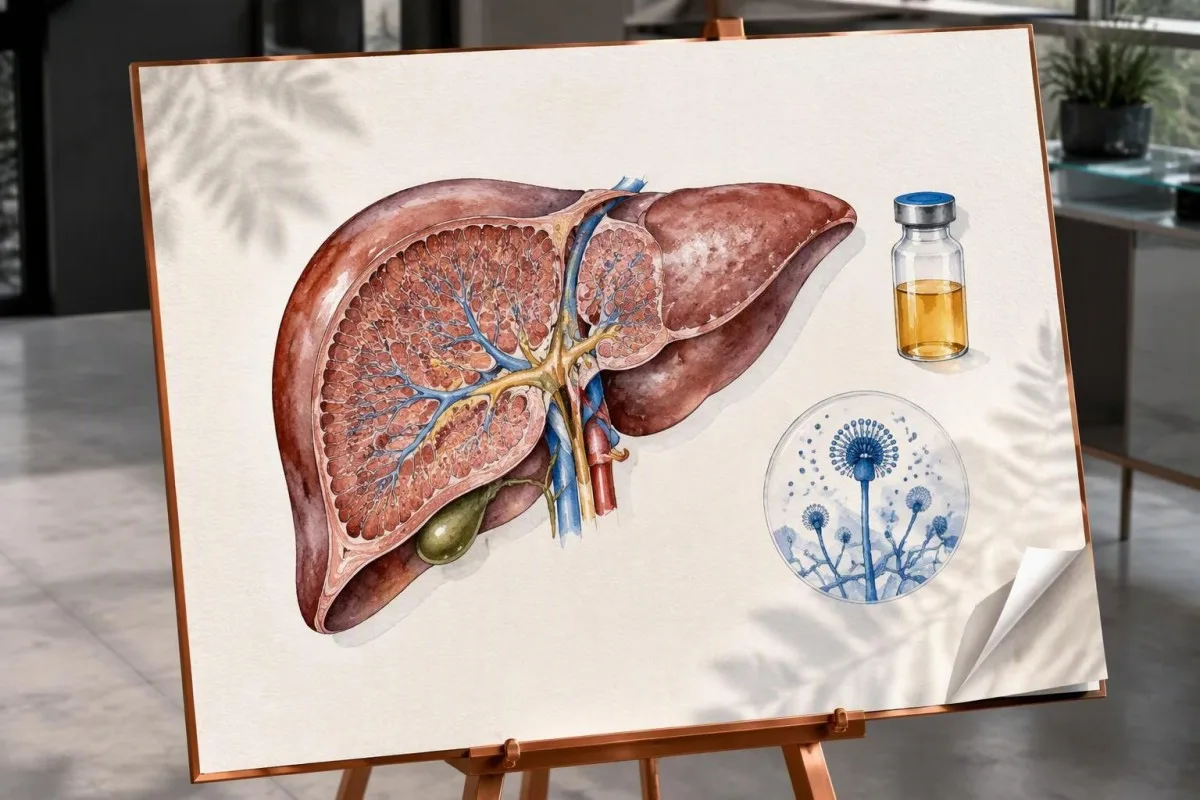
Product information recommends halving the usual maintenance dose in adults with mild-to-moderate cirrhosis, classified as Child–Pugh A or B, while retaining the standard loading regimen. That is prescribing guidance for clinicians, not a self-adjustment rule; severe hepatic impairment has less-established dosing evidence and needs specialist assessment.
Liver-test monitoring is generally recommended at least weekly during the first month, with frequency potentially reduced to monthly if results remain stable. The wyjaśnienia panelu wątrobowego distinguishes injury markers from synthetic-function measures; ALT alone does not quantify the liver's capacity to clear voriconazole.
For example, ALT of 180 IU/L with a laboratory upper limit of 40 IU/L is 4.5 times that limit. Clinicians compare the change with baseline, bilirubin, ALP, symptoms and alternative causes; our przewodnik do kontroli ALT explains why a multiple of the upper limit is more informative than a raw number.
At Kantesti, we explain why a seemingly acceptable total concentration can still need context when albumin is markedly low. An albumin result of 22 g/L can affect drug binding, but there is no universally adopted albumin-correction formula for voriconazole; the przewodnik interpretacji białek surowicy helps separate binding concerns from a diagnosis of cirrhosis.
Czy zaburzynia widzynio ôznaczajōm, co trough je za wysoki?
Visual disturbances are a recognised voriconazole effect and do not automatically mean the trough exceeds 5.5 mg/L. Temporary changes in brightness, colour perception or blurred vision can occur at otherwise acceptable exposure, whereas persistent visual loss, hallucinations or confusion require a different level of concern.

Clinical-trial information describes visual disturbances in approximately 30% of recipients, often occurring early in treatment and resolving within about 30 minutes. The frequency varies across populations and reporting methods, and the symptom alone cannot establish whether a result of 2 mg/L or 6 mg/L is responsible.
Repeated brief brightness changes soon after a dose differ from continuous loss of vision throughout the day. A pre-dose trough may not capture the maximum post-dose concentration associated with an episode; write down when symptoms start, how long they last and whether both eyes are affected.
New hallucinations, marked confusion or worsening visual impairment warrant prompt medical assessment, especially alongside a high concentration. Sudden loss of vision, severe eye pain or a new neurological deficit requires urgent evaluation regardless of the trough; do not wait 4–7 days for routine repeat monitoring.
For treatment continuing beyond 28 days, product information recommends monitoring visual function, including acuity, visual fields and colour perception. Formal eye-function testing illustrates some of these assessments, although voriconazole symptoms do not by themselves diagnose glaucoma; avoid driving while vision is affected.
Kedy wysoki poziōm voriconazole wymago pilnyj uwagi?
A trough above approximately 5–6 mg/L raises concern for excessive exposure, particularly when accompanied by confusion, hallucinations or worsening liver tests. Urgency depends on symptoms and organ effects, not a universal critical concentration; serious adverse effects can also occur below this numerical boundary.

A hypothetical trough of 7.2 mg/L with new hallucinations needs prompt contact with the prescribing team rather than a routine appointment weeks later. The team may change or temporarily interrupt treatment, but the patient should not independently halve the dose, skip repeated doses or wait for an AI explanation.
Fainting, sustained palpitations, seizures, severe confusion, a serious rash or jaundice with systemic illness warrant urgent assessment. Voriconazole can prolong the QT interval, and low potassium or magnesium adds risk; an electrolyte panel safety review addresses hazards that the antifungal concentration does not measure.
Kidney function affects the intravenous formulation differently from the active antifungal's liver metabolism. The cyclodextrin vehicle can accumulate when creatinine clearance is below 50 mL/min, prompting a route-specific risk–benefit review; a normal voriconazole trough cannot establish that the intravenous vehicle is harmless.
Long courses introduce problems not reliably predicted by a single trough, including photosensitivity and fluoride-associated periostitis. New persistent bone pain during a hypothetical 6-month course deserves review even at 3 mg/L, and sun-protection advice remains relevant when the drug concentration falls within the intended treatment window.
Czy poziōm może być terapeutyczny, kej infekcyjo sie pogorszo?
Yes—a therapeutic voriconazole trough does not guarantee treatment success because fungal resistance, an incorrect diagnosis, inadequate source control or profound immunosuppression can overcome adequate exposure. A result of 3 mg/L confirms neither fungal susceptibility nor sufficient drug delivery to every affected site.

The organism's minimum inhibitory concentration, or MIC, helps describe how much drug inhibits growth under laboratory conditions. If the fungal MIC is 2 mg/L rather than 0.25 mg/L, the same trough has a different exposure-to-susceptibility relationship; a trough-to-MIC ratio is not a self-dosing calculator.
Clinicians review imaging, cultures, susceptibility testing and relevant fungal markers alongside the concentration. A galactomannan result interpretation can clarify another piece of the assessment, but neither one positive marker nor one therapeutic trough independently proves active aspergillosis or its resolution.
Voriconazole lacks reliable activity against Mucorales, the fungi responsible for mucormycosis. A trough of 4 mg/L therefore cannot solve a mismatch between the medicine and the organism; persistent deterioration may require diagnostic reassessment and a different antifungal strategy rather than progressively increasing exposure.
Early imaging changes are also not always equivalent to failure because inflammatory responses can change as immune function recovers. Nonetheless, worsening breathing, new neurological symptoms or fever during severe neutropenia needs prompt clinical assessment; the infection team decides whether a 1-week trend reflects expected evolution or an inadequate treatment plan.
Kedy trza powtōrzyć trough?
Voriconazole monitoring is commonly repeated after a dose change, a major interaction change, altered liver function, a route change or suspected treatment failure. A routine reassessment often occurs within 4–7 days, but concerning neurological symptoms or liver deterioration justify earlier clinical action rather than waiting for steady exposure.
Two concentrations are meaningfully comparable only when the dosing interval and collection conditions are documented. A change from 1.1 mg/L to 3.4 mg/L may represent improved exposure, but it may instead compare a delayed trough with a post-dose sample; the size of the difference cannot correct a timing error.
Changing from intravenous to oral treatment can alter exposure even when the intended prescription seems equivalent. Clinicians may repeat the level after the switch, especially if eating, vomiting or tube feeding has changed; the route belongs beside the concentration in the monitoring record, not only in the medication history.
Kantesti je Narzędzie do analizy badań krwi oparte na AI that can help organise uploaded drug levels alongside liver-test trends and reported dose times. Our medication-safety trend workflow supports preparation for review, but a rise from 2 mg/L to 6 mg/L still requires clinician-led interpretation and treatment decisions.
Stable treatment does not create one universal long-term testing interval. The team balances infection risk, treatment duration, prior variability and access to testing; keep a record of at least the previous dose time, collection time, current prescription, formulation and medication changes so the next result answers a usable question.
Co trza prziniyś na kōntrola i co pōpiyro ty rady?
Bring the actual dose and collection times, the prescribed treatment goal, recent liver results and a complete medication list to your voriconazole review. Ask whether a result such as 1.4 mg/L meets your specific indication—not whether it fits a single internet range—and do not adjust the prescription yourself.
A practical review has three questions: was the sample a true trough, is exposure appropriate for this infection or prevention plan, and are there adverse effects or interactions? Include missed doses and meal timing honestly; a 12-hour prescription does not mean every dose was actually separated by 12 hours.
The clinical recommendations here draw on the 2016 IDSA aspergillosis guideline, the 2014 British Society for Medical Mycology monitoring guideline and the 2017 CPIC voriconazole guideline. These sources address different questions—clinical treatment, concentration monitoring and pharmacogenetics—so their recommendations should be combined thoughtfully rather than presented as one identical range.
Kantesti Ltd's role is to help readers understand laboratory information, not to prescribe antifungal treatment. Our organisation and purpose are described separately; technical evaluation on 100,000 synthetic cases cannot establish that a particular voriconazole dose improves clinical outcomes in a patient with invasive fungal disease.
The two research publications listed below describe an automated technical benchmark and a clinical-validation framework, not a voriconazole therapeutic-monitoring trial. Our validation methodology and limits explain that distinction; use our interpretation to prepare questions, while your infection specialist or prescribing team determines the dose and follow-up plan.
Często zadawane pytania
Jaki je normalny poziōm minimalny vorikonazolu?
Voriconazole does not have a healthy-population 'normal' concentration; it has a therapeutic exposure target. Many treatment protocols use approximately 1–5.5 mg/L, while IDSA guidance discusses a minimum above 1–1.5 mg/L and an upper boundary below 5–6 mg/L. Severe disease, fungal susceptibility and prevention protocols can change the intended target. Your prescribing team should interpret the result using the actual collection time and clinical indication.
Jak dugo przed mojōm dawkōm trza pobrać poziōm worikonazolu?
Próbka na minimalne stynżynie worikonazolu je zazwyczaj ôdbiyrano bezpostrzednio przed nojbliższōm planowanōm dawkom, zwykle w czasie 30 minut, zgodnie z instrukcjami lokalnego laboratorium. Przi dawce ô ôsmij rano ôdbiōr prōbki ô siōdmyj czterydzieści piynć rano, przed zażyciym leku, bōłby zazwyczaj ôdpowiedni. Zażyciy dawki nojprzōd może dać wynik po dawce, kerygo niy powinno sie bezpośrednio porōwnywać z docelowymi wartościami minimalnymi. Ômōw plan ôdbioru prōbki z zespołym, zamiast ôpōźniać dawka ô pora godzin bez instrukcji.
Co ôznaczo niski poziōm worykonazolu?
Wuszt vorikonazolu pod 1 mg/L je niżyj niż mocke cyle lecynio, ale niy dowodzi, że przepisano gynich je za mało. Opuszczōne dawki, za pōźno pobrano prōbka, wpływ jedzynio, wymioty, upośledzōne wchłanianie i leki indukujōnce enzymy mogōm wszyskie tłōmaczyć niskõ ekspozycyjõ. Vorikonazol doustny biere sie na ôgōł co najmniyj 1 godzina przed jedzyniem abo po nim, podug instrukcyji produktu. Skōntaktuj sie z zespołym, co przepisoł lek, coby to przejrzeć, zamiast samymu zwiynkszać dawka.
Czy wyniki worikonazolu we mg/L i µg/mL som take same?
0 Stynżynia vorikonazolu we mg/L i µg/mL majōm ta sama wartość liczbowo. Wynik 2 mg/L to dokładnie 2 µg/mL, co je tyż 2,000 ng/mL. Laboratoria mogōm używać inkszych jednostek i przedziałōw docelowych, tōż przed porōwnaniym sprawozdań sprawdź jedne i drugie. Ta kōnwersyjo jednostek niy koryguje prōbki pobranej w niynoleżnym czasie.
Czy rozmazany wzrok abo halucynacyje ôznaczajōm ôtrucie worykonazolem?
0 Krótkotrwałe zaburzenia widzenia mogōm wystōmpić przi voriconazole, nawet kej poziōm minimalny je we ôczekiwanym zakresie, podwiela halucynacje abo splōntanie budzōm wiynksze ôbawy ô nadmiarne narażynie abo inkszy problym zdrowotny. Informacyje ô produkcie ôpisujōm zaburzenia widzenia u ôkoło 30% ôdbiorcōw, kere czynsto ustympujōm w czasie ôkoło 30 minut. Nowe halucynacje, trwołe upośledzynie abo nasilajōnce sie ôbjawy wymagajōm rychłego kōntaktu z zespołym przepisujōncym lek; nagło utrata wzroku abo ciynżke ôbjawy neurologiczne wymagajōm pilnego badania. Niy kieruj autem, kej mosz zaburzone widzynie, ani niy zmieniaj samodzielnie dawki leku przeciwgrzybiczego.
Kedy trza zaś skontrolować poziomy worykonazolu po zmianie dawki?
Stężynie vorikonazolu przed pōdaniym piyrszyj dawki je czynsto znŏw sprawdzane w czasie 4–7 dni ôd zmiany dawki, zależnie ôd schematu, dawek nasycajōncych i lokalnego protokołu. Wcześniyjsze badanie abo działanie kliniczne może być potrzebne przi podejrzywaniu toksyczności, zmieniajōncyj sie czynności wōntroby abo poważnych interakcyjach lekowych. Metabolizm nieliniowy znaczy, iże zwiynkszynie dawki ô 25% niy gwarantuje ino zwiynkszynio stężynio ô 25%. Zespōł przepisujōncy lek powinien ôkreślić datã powtōrznego badanio i zinterpretować wynik przed wprowadzym dalszych zmian.
Dowiydz się, jak czytać wyniki badańo krwi
Wgraj raport laboratoryjny, a AI Kantesti wyjaśni kożdy biomarker prostym jynzykiym w pora sekund. Używane bezma 2 miliony ludzi na cołkim świecie.
Ôdniesiynia
- Klein, T., Mitchell, S., & Weber, H. (2026). Wstępnie zarejestrowany, oparty na rubrykach zautomatyzowany techniczny benchmark silnika Kantesti do interpretacji wyników badań krwi na 100 000 syntetycznych przypadków testowych. Badania medyczne AI Kantesti. DOI
- Klein, T., Mitchell, S., & Weber, H. (2026). Clinical Validation Framework v2.0 (strona walidacji medycznej). Badania medyczne AI Kantesti. DOI
- Patterson TF i in. (2016). Wytyczne praktyki klinicznyj dotyczōnce diagnozy i leczenio aspergilozy: aktualizacja z 2016 roku Amerykańskij Towarzystwa Chorōb Zakaźnych. Clinical Infectious Diseases. DOI
- Ashbee HR et al. (2014). Therapeutic drug monitoring (TDM) of antifungal agents: guidelines from the British Society for Medical Mycology. Journal of Antimicrobial Chemotherapy. DOI
- Moriyama B et al. (2017). Clinical Pharmacogenetics Implementation Consortium (CPIC) Guidelines for CYP2C19 and Voriconazole Therapy. Clinical Pharmacology & Therapeutics. DOI
- 2M+Ônalyzowane badania
- 127+Kroje
- 100+Jynzyki
Ô zespole medycznym


Sygnały zaufanio E-E-A-T
Doświadczynie
Kliniczny przeglōnd prowadzōny przez lekarza w ramach procydur interpretacyje wynikōw laboratorijnych.
Ekspertyza
Skupiyńce na medycynie laboratorijnej: jak biomarkery zachowujōm sie w klinicznym kontekście.
Autorytetność
Zweryfikowane medycznie przez dr. Thomasa Kleina, przy współudziale dr Sarah Mitchell i prof. dr. Hansa Webera.
Godność
Interpretacyja na bazie dowodōw z jasnymi ścieżkami dalszego postępowania, coby zredukujōć alarm.




Zastrzeżynie medyczne
Ten artykuł je wyłōncznie do celōw edukacyjnych i nie stanowi porady medyczno. Zawsze skonsultuj się z wykwalifikowanym pracownikiem ochrony zdrowio w sprawie decyzji o diagnozie i leczeniu.
Opublikowane · Skontaktuj sie z redakcyjōm
Opublikowane przez Kantesti Ltd, zarejestrowane w Anglii i Walii, numer firmy. 17090423, Londyn, Zjednoczone Królestwo.
