การเจาะระดับยา voriconazole ก่อนรับยาครั้งถัดไปในเวลาที่เหมาะสมช่วยประเมินว่าการได้รับยาต้านเชื้อราเพียงพอหรือไม่โดยไม่สูงเกินไป แนวทางการรักษาหลายฉบับกำหนดช่วงไว้ประมาณ 1–5.5 mg/L แต่เป้าหมายเฉพาะบุคคลขึ้นอยู่กับการติดเชื้อ แผนการป้องกัน และผลข้างเคียง.

ประเด็นสำคัญ
- ระดับยา voriconazole ก่อนรับยาครั้งถัดไป คือความเข้มข้นของยาทันทีก่อนถึงเวลารับยาครั้งถัดไปตามกำหนด ซึ่งใช้วัดการได้รับยา ไม่ได้บอกว่าการติดเชื้อหายแล้วหรือไม่.
- เป้าหมายการรักษา มักต้องมีระดับยาก่อนรับยาครั้งถัดไปสูงกว่า 1–1.5 mg/L โดยทีมรักษาบางแห่งตั้งเป้าไว้อย่างน้อย 2 mg/L สำหรับการติดเชื้อที่รักษายากหรือรุนแรง.
- ขีดจำกัดสูงสุด มักอยู่ที่ประมาณ 5–6 mg/L เนื่องจากการได้รับยามากเกินไปเพิ่มความกังวลเกี่ยวกับผลไม่พึงประสงค์ทางระบบประสาทและผลไม่พึงประสงค์อื่น ๆ.
- เป้าหมายในการป้องกัน ขึ้นอยู่กับแนวทางเฉพาะของแต่ละแห่ง ไม่ควรนำค่าตัดที่ต่ำกว่าซึ่งใช้สำหรับการป้องกันมาใช้กับการรักษาการติดเชื้อที่เกิดขึ้นแล้วโดยอัตโนมัติ.
- เวลาที่เก็บระดับยา โดยทั่วไปหมายถึงการเก็บตัวอย่างภายในประมาณ 30 นาทีก่อนให้ยาครั้งถัดไป โดยปฏิบัติตามคำแนะนำของห้องปฏิบัติการ.
- การแปลงหน่วย เป็นค่าที่แน่นอน: 1 mg/L เท่ากับ 1 µg/mL และ 1,000 ng/mL.
- การได้รับยาในระดับต่ำ อาจสะท้อนถึงการลืมรับประทานยา ผลของอาหาร การดูดซึมบกพร่อง ปฏิกิริยาระหว่างยาหรือการเผาผลาญที่เร็วขึ้น ไม่ได้หมายความว่าเป็นเพียงการสั่งยาในขนาดที่ไม่เพียงพอ.
- ความปลอดภัยของขนาดยา ต้องมีแพทย์เป็นผู้กำกับการปรับยา เนื่องจากการเพิ่มขนาดยา 25% อาจทำให้ความเข้มข้นของยาเพิ่มขึ้นอย่างไม่เป็นสัดส่วน.
ระดับยา voriconazole ก่อนรับยาครั้งถัดไปบอกอะไรได้จริงบ้าง?
A ระดับยาวอริโคนาโซลก่อนให้ยาครั้งถัดไป บอกแพทย์ว่ามียาต้านเชื้อราเหลืออยู่เท่าใดก่อนให้ยาครั้งถัดไปทันที ผลตรวจที่เก็บตัวอย่างอย่างถูกต้องและอยู่ที่ประมาณ 1–5.5 mg/L มักสอดคล้องกับแนวทางการรักษา แต่ขนาดยาที่ได้ผลยังขึ้นอยู่กับความไวของเชื้อรา ตำแหน่งที่ติดเชื้อ และการตอบสนองทางคลินิก.
ระดับยาก่อนให้ยาครั้งถัดไปเป็นตัวบ่งชี้การได้รับยาโดยประมาณตลอดช่วงห่างระหว่างการให้ยา ไม่ใช่การวัดปริมาณยาโดยตรงภายในปอดหรือสมองส่วนที่ได้รับผลกระทบ สำหรับผู้ที่รับประทานวอริโคนาโซลทุก 12 ชั่วโมง ความเข้มข้นยาก่อนให้ยาครั้งถัดไปช่วยระบุว่าระดับยาอาจต่ำเกินไประหว่างมื้อยาหรือไม่.
การติดตามระดับยาเพื่อการรักษามีเป้าหมายแยกกันสองประการ ได้แก่ คงระดับยาให้เพียงพอต่อฤทธิ์ต้านเชื้อรา และหลีกเลี่ยงระดับยาที่สูงเกินไป แนวทางรักษาแอสเปอร์จิลโลซิสของ IDSA ระบุว่ามักใช้ระดับยาก่อนให้ยาครั้งถัดไปที่สูงกว่า 1–1.5 mg/L และต่ำกว่า 5–6 mg/L เป็นเป้าหมายตามความเห็นของผู้เชี่ยวชาญ โดยเฉพาะเพื่อจำกัดพิษต่อระบบประสาทส่วนกลาง (Patterson et al., 2016).
คันเตสตีเป็น เครื่องวิเคราะห์ผลเลือด AI ที่ช่วยอธิบายผลตรวจวอริโคนาโซลที่ส่งมา พร้อมกับผลตรวจตับ ขณะที่ทีมผู้สั่งยาจะเป็นผู้กำหนดเป้าหมาย ผลตรวจที่ 1.2 mg/L ต้องระบุข้อบ่งใช้และเวลาเก็บตัวอย่างประกอบ คำอธิบายของเราไม่ควรเปลี่ยนตัวเลขดังกล่าวให้กลายเป็นคำแนะนำเรื่องขนาดยา.
เครื่องหมายแจ้งเตือนจากห้องปฏิบัติการไม่ใช่คำตัดสินว่าการรักษาได้ผลหรือไม่ ซึ่งต่างจากช่วงค่าอ้างอิงของการตรวจเคมีในเลือดทั่วไปหลายชนิด ช่วงค่าจากการติดตามระดับยาหมายถึงเป้าหมายการได้รับยาทางคลินิก คำอธิบายของเราเกี่ยวกับ ผลการตรวจนอกช่วงค่าอ้างอิงของห้องปฏิบัติการ ช่วยแยกความแตกต่างระหว่างเครื่องหมายแจ้งเตือนกับการวินิจฉัย.
ควรเก็บตัวอย่างตรวจระดับยา voriconazole เมื่อใด?
ที่ถูกต้อง การเก็บตัวอย่างตรวจระดับวอริโคนาโซล หมายถึงการเก็บตัวอย่างทันทีก่อนถึงเวลารับประทานครั้งถัดไป โดยทั่วไปภายใน 30 นาทีก่อนถึงเวลาดังกล่าว มักตรวจระดับยาตามปกติครั้งแรกในวันที่ 4–7 แม้ว่าการให้ยานำ ขนาดยาและแนวทางเฉพาะของแต่ละแห่งอาจทำให้ต้องประเมินเร็วกว่านั้น.
ตัวอย่างเช่น ลองนึกถึงตารางการให้ยาที่แพทย์สั่งคือ 8 a.m. และ 8 p.m. การเก็บตัวอย่างเวลา 7:45 a.m. ก่อนรับประทานยาตอนเช้า ให้ค่าใกล้เคียงระดับยาก่อนให้ยาครั้งถัดไป ส่วนตัวอย่างที่เก็บเวลา 10 a.m. หลังรับประทานยาแล้วไม่ใช่ แม้รายงานจากห้องปฏิบัติการจะเรียกว่าเป็นระดับยาก่อนให้ยาครั้งถัดไปก็ตาม.
การให้ยาล่าช้าก็อาจทำให้แปลผลคลาดเคลื่อนไปในทิศทางตรงกันข้ามได้เช่นกัน หากกำหนดให้ยาครั้งถัดไปเวลา 8 a.m. แต่เก็บตัวอย่างเวลา 11 a.m. ช่วงเวลาที่ไม่ได้รับยาเพิ่มขึ้น 3 ชั่วโมงอาจทำให้ความเข้มข้นที่วัดได้ลดลง ทีมรักษาจำเป็นต้องทราบเวลาจริง ไม่ใช่เพียงตารางเวลาที่วางแผนไว้.
การให้วอริโคนาโซลทางหลอดเลือดดำยังคงต้องเก็บตัวอย่างก่อนให้ยาครั้งถัดไป โดยปกติให้เก็บก่อนเริ่มการให้ยาทางหลอดเลือดครั้งถัดไป การเก็บตัวอย่างจากสายที่ใช้ให้ยาอาจมีความเสี่ยงต่อการปนเปื้อน ดังนั้นห้องปฏิบัติการหรือทีมให้ยาทางหลอดเลือดควรเป็นผู้เลือกวิธีเก็บตัวอย่าง แทนการสมมติว่าสายทุกเส้นที่เข้าถึงได้ให้ผลเทียบเท่ากัน.
โดยพื้นฐานแล้วไม่จำเป็นต้องอดอาหารตลอดคืนเพื่อการตรวจความเข้มข้นของยา แต่การรับประทานวอริโคนาโซลชนิดรับประทานมีคำแนะนำเรื่องช่วงเวลาที่สัมพันธ์กับมื้ออาหารของตนเอง โปรดตรวจสอบแผนการเก็บตัวอย่างล่วงหน้า; กฎการเก็บตัวอย่างเฉพาะของยาแต่ละชนิด อธิบายว่าเหตุใดกฎการกำหนดเวลาที่ถูกต้องสำหรับยาชนิดหนึ่งจึงนำไปใช้กับยาอีกชนิดหนึ่งไม่ได้.
ช่วงระดับยาเพื่อการรักษาของ voriconazole คือเท่าใด?
การ ช่วงการรักษาด้วยวอริโคนาโซล is commonly approximately 1–5.5 mg/L for treatment, but there is no universal interval suitable for every patient. IDSA guidance discusses a lower goal above 1–1.5 mg/L and an upper boundary below 5–6 mg/L; some difficult infections prompt a higher minimum.

These boundaries describe probabilities, not biological switches. A trough of 0.9 mg/L does not prove failure, and 5.6 mg/L does not prove toxicity; repeated results, symptoms and organism susceptibility help determine whether a small boundary crossing is clinically meaningful or simply requires confirmation.
For invasive aspergillosis, the British Society for Medical Mycology recommends a treatment trough above 1 mg/L and discusses higher exposure goals for poor-prognosis situations, including central nervous system disease (Ashbee et al., 2014). A team may therefore consider 1.3 mg/L acceptable for one indication but insufficient for another.
The reason for a higher minimum is that the concentration needed to inhibit a less-susceptible fungus may exceed the concentration needed for a susceptible organism. Raising exposure indefinitely is not a safe solution: a trough approaching 5–6 mg/L can leave little room between a desired antifungal effect and adverse effects.
Always read the units before comparing reports. A result of 2 µg/mL is exactly 2 mg/L, not twice or half that value; the biomarker and units guide provides context for comparing laboratory values without mistaking a therapeutic target for a healthy-population range.
| ระดับ | ช่วง | ความหมาย |
|---|---|---|
| Below many treatment targets | <1 มก./ลิตร | Check collection timing, dosing history, absorption and interactions; not proof of treatment failure. |
| Lower treatment exposure | 1–<2 mg/L | May meet the prescribed target, but severe disease or reduced fungal susceptibility can require a higher minimum. |
| Common treatment exposure window | 2–5.5 mg/L | Often compatible with treatment goals when correctly timed; does not guarantee efficacy or freedom from toxicity. |
| Above many local upper limits | >5.5 mg/L | Requires review of symptoms, liver tests, timing and the local protocol; there is no universal emergency cutoff. |
เหตุใดเป้าหมายการรักษาและการป้องกันจึงอาจแตกต่างกัน?
Treatment targets may be more demanding than prevention targets because an established fungal infection must be controlled, not merely prevented. Some local prophylaxis protocols accept 0.5 mg/L, whereas British guidance recommends a prophylaxis trough above 1 mg/L; these thresholds are not interchangeable.

Prophylaxis studies are harder to interpret because breakthrough fungal disease may be uncommon and heavily influenced by immune status. A threshold of 0.5 mg/L used in one prevention programme cannot establish equivalent protection for every stem-cell transplant recipient, particularly during prolonged neutropenia or intensive immunosuppression.
The British Society for Medical Mycology's prophylaxis recommendation above 1 mg/L carries a weaker evidence base than some treatment recommendations (Ashbee et al., 2014). The uncertainty is genuine: the exact preventive minimum is less settled than the principle that persistently very low exposure deserves investigation.
Consider a hypothetical result of 0.8 mg/L in two people. One is receiving prevention under a documented local protocol; the other has confirmed invasive aspergillosis. The same concentration can lead to different discussions because the indication, fungal burden and acceptable risk of inadequate exposure differ.
Transplant recipients often have several parallel monitoring plans, not one combined 'infection score.' Voriconazole does not prevent every opportunistic infection, and CMV results after transplantation answer a different question; a satisfactory antifungal trough does not replace viral surveillance or other prescribed prophylaxis.
อะไรทำให้ระดับยา voriconazole ต่ำได้บ้าง?
A low voriconazole level can result from missed or delayed doses, food effects, impaired gastrointestinal absorption, enzyme-inducing medicines or faster metabolism. Before changing treatment, clinicians verify whether a result below 1 mg/L is a correctly timed trough and whether the prescribed doses actually reached the patient.
Oral voriconazole is generally taken at least 1 hour before or 1 hour after a meal, following the product instructions. Food can reduce exposure, but a low result should not be blamed on breakfast without checking the complete dosing history, formulation, vomiting and other medicines.
Imagine a hypothetical adult prescribed 200 mg every 12 hours whose trough is 0.6 mg/L. Taking each dose with a substantial meal and vomiting one evening dose creates two plausible explanations for low exposure; automatically escalating the prescription could cause excessive exposure once those problems resolve.
Severe diarrhoea, mucositis, gastrointestinal surgery and feeding-tube administration can make oral delivery less predictable. Clinicians may review the formulation or route rather than simply the milligram amount; testing for impaired fat absorption explains why gastrointestinal dysfunction needs its own assessment rather than being diagnosed from one drug level.
Acid-suppressing medicines deserve a medication review, but voriconazole should not be treated like an antifungal whose absorption always requires stomach acid. Some proton pump inhibitors inhibit metabolism and can raise exposure; our reflux treatment context helps readers identify these medicines without stopping them independently.
เหตุใดการเปลี่ยนขนาดยาเพียงเล็กน้อยจึงทำให้ระดับยาเปลี่ยนแปลงมากในบางครั้ง?
Voriconazole has nonlinear metabolism in adults, meaning a dose increase can produce a more-than-proportional concentration increase. Changing a prescribed dose from 200 mg to 250 mg is a 25% increase, but the resulting trough cannot safely be predicted by multiplying the old result by 1.25.
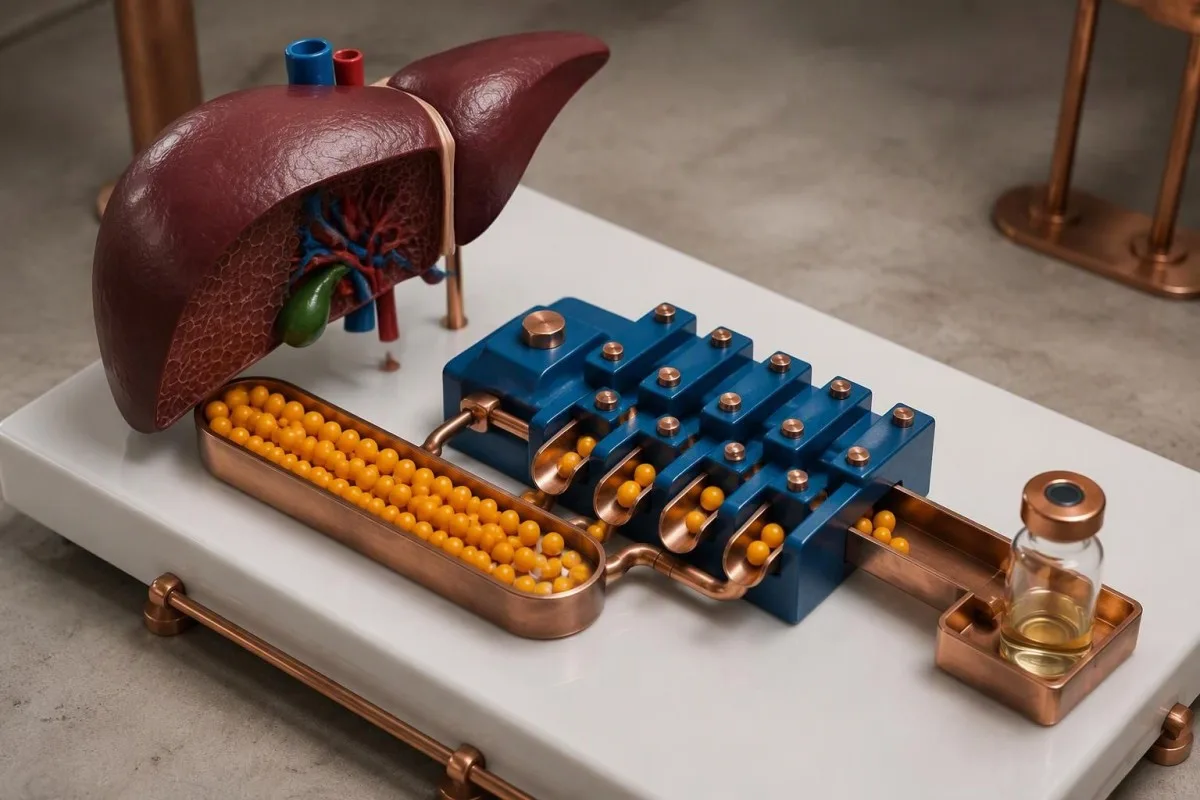
Metabolising enzymes can approach their processing capacity as exposure rises, so each additional milligram may be cleared less efficiently. A hypothetical rise from 2 mg/L to 4 mg/L after a modest dose adjustment is therefore plausible, but no single example provides a reliable formula for an individual patient.
The reverse calculation is unreliable too. A dose reduction of 25% does not guarantee a 25% concentration reduction, particularly when liver function or interacting medicines are changing; clinicians use repeat monitoring rather than assuming that the prescription and laboratory result move along a straight line.
A trough also reflects conditions during the preceding doses, not only the dose taken most recently. If a new prescription began 1 day before collection, the result may not represent the eventual exposure on that regimen, and an early result should be labelled as such rather than interpreted as settled.
This is a major reason not to borrow another person's adjustment advice. Nonlinear phenytoin monitoring illustrates a related principle, although phenytoin's free-versus-total measurement issues and target intervals are different; the shared lesson is that arithmetic alone cannot determine a safe drug dose.
CYP2C19 มีผลต่อการได้รับยา voriconazole อย่างไร?
CYP2C19 genetic variation can influence voriconazole clearance: rapid and ultrarapid metabolisers may have low exposure, while poor metabolisers may develop higher concentrations. A genetic result can help explain a repeated trough below 1 mg/L or above the prescribed ceiling, but it does not replace drug monitoring.
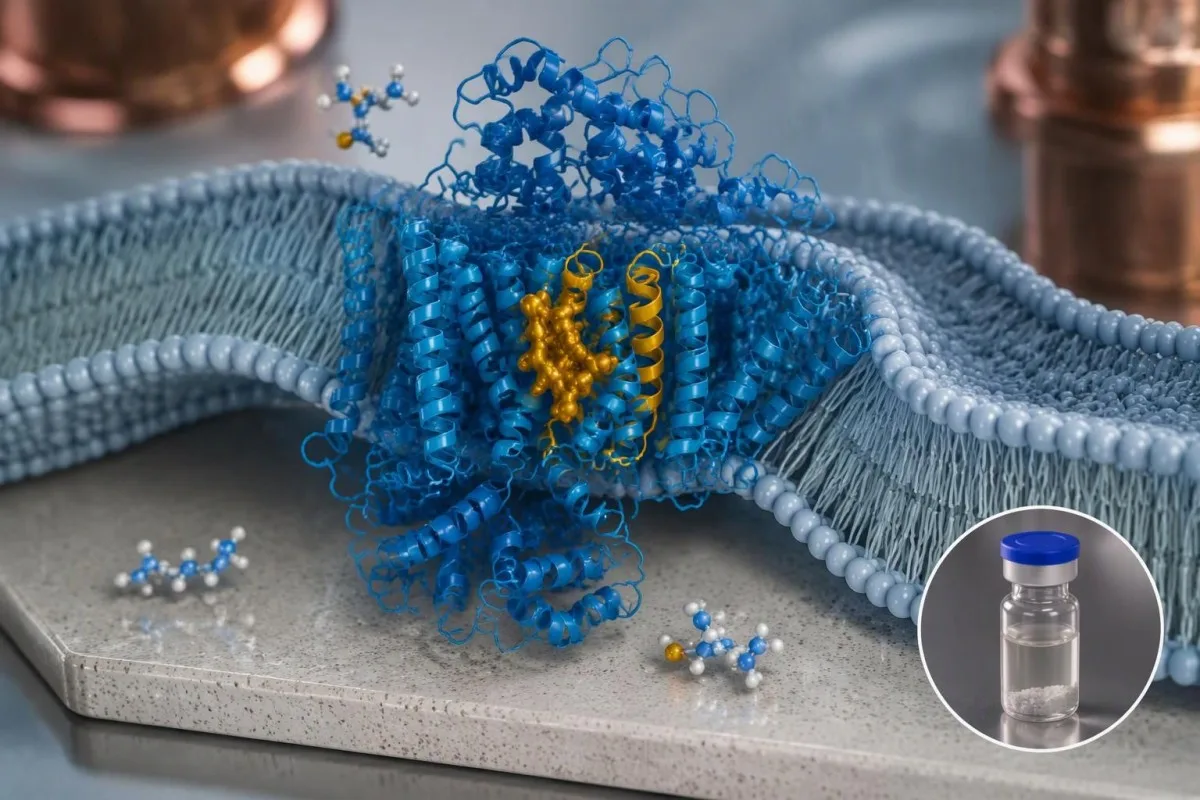
CPIC guidance recommends considering an alternative antifungal for certain CYP2C19 phenotypes when achieving reliable voriconazole exposure is difficult or adverse-effect risk is increased (Moriyama et al., 2017). This is a clinician-led choice between suitable treatments, not an instruction to stop an effective medicine after seeing a genetic category.
Genotype is only one input because liver illness, interacting medicines and systemic inflammatory responses can alter enzyme activity. A person genetically classified as a rapid metaboliser can still develop a trough of 6 mg/L under changed clinical conditions; inherited tendency does not establish a permanent, safe dose.
CYP2C19 influences more than one medicine, but the consequences are drug-specific. An enzyme variant that reduces activation of a prodrug can have a different clinical meaning from a variant that slows clearance of an active antifungal; 'fast metaboliser' is not automatically a favourable or unfavourable label.
คันเตสตีเป็น แพลตฟอร์มการแปลผลตรวจเลือดของ AI that can help organise the laboratory and medication context around a reported voriconazole concentration. Our คำอธิบายเทคโนโลยี AI describes the interpretation workflow; a chemistry panel cannot reveal CYP2C19 genotype unless a separate genetic test has actually been performed.
ปฏิกิริยาระหว่างยาชนิดใดที่อาจทำให้ผลตรวจเปลี่ยนแปลง?
Voriconazole interactions can either lower its concentration or increase exposure to voriconazole and other medicines. Rifampicin and carbamazepine are major enzyme-inducing concerns, while voriconazole can substantially increase tacrolimus exposure; a satisfactory trough of 2 mg/L does not make the combination automatically safe.

Rifampicin, carbamazepine and St John's wort can substantially reduce voriconazole exposure, and some combinations are contraindicated. Phenytoin creates a particularly complicated bidirectional interaction; any specialist exception requires an explicit monitoring plan rather than the assumption that increasing voriconazole will reliably overcome induction.
Starting or stopping an interacting medicine can matter as much as adding a new voriconazole dose. Enzyme induction and its reversal do not necessarily disappear within 24 hours, so clinicians need medication start and stop dates when explaining a concentration that changes despite an unchanged antifungal prescription.
Tacrolimus is a separate safety priority because voriconazole inhibits pathways involved in its clearance. A transplant team may need to adjust and closely monitor tacrolimus when voriconazole starts or stops; our tacrolimus trough interpretation guide explains why both drug concentrations must be reviewed independently.
Warfarin and medicines that prolong the QT interval also require attention even when the antifungal trough is within range. Voriconazole can increase anticoagulant effect, so understanding INR monitoring is useful; an antifungal level does not substitute for coagulation testing or an electrocardiogram.
ผลตรวจการทำงานของตับเปลี่ยนแปลงการแปลผลระดับยาก่อนรับยาครั้งถัดไปอย่างไร?
Liver dysfunction can reduce voriconazole clearance and increase exposure, while voriconazole itself can cause liver injury. A rising trough above 5–6 mg/L together with increasing ALT or bilirubin deserves prompt clinical review, but an isolated liver-test abnormality does not prove the antifungal caused it.
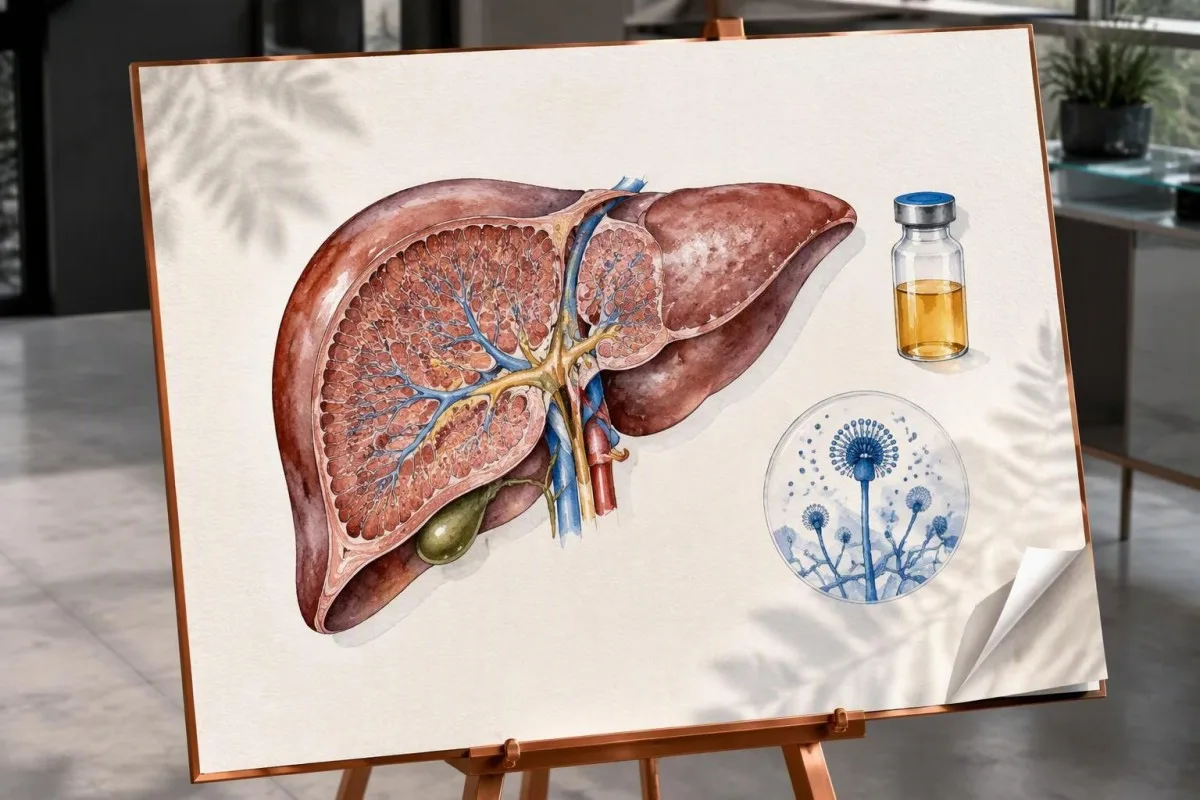
Product information recommends halving the usual maintenance dose in adults with mild-to-moderate cirrhosis, classified as Child–Pugh A or B, while retaining the standard loading regimen. That is prescribing guidance for clinicians, not a self-adjustment rule; severe hepatic impairment has less-established dosing evidence and needs specialist assessment.
Liver-test monitoring is generally recommended at least weekly during the first month, with frequency potentially reduced to monthly if results remain stable. The คำอธิบายการตรวจตับ (liver panel) distinguishes injury markers from synthetic-function measures; ALT alone does not quantify the liver's capacity to clear voriconazole.
For example, ALT of 180 IU/L with a laboratory upper limit of 40 IU/L is 4.5 times that limit. Clinicians compare the change with baseline, bilirubin, ALP, symptoms and alternative causes; our แนวทางติดตามผล ALT explains why a multiple of the upper limit is more informative than a raw number.
At Kantesti, we explain why a seemingly acceptable total concentration can still need context when albumin is markedly low. An albumin result of 22 g/L can affect drug binding, but there is no universally adopted albumin-correction formula for voriconazole; the คู่มือการตีความโปรตีนในซีรั่ม helps separate binding concerns from a diagnosis of cirrhosis.
การมองเห็นผิดปกติหมายความว่าระดับยาก่อนรับยาครั้งถัดไปสูงเกินไปหรือไม่?
Visual disturbances are a recognised voriconazole effect and do not automatically mean the trough exceeds 5.5 mg/L. Temporary changes in brightness, colour perception or blurred vision can occur at otherwise acceptable exposure, whereas persistent visual loss, hallucinations or confusion require a different level of concern.

Clinical-trial information describes visual disturbances in approximately 30% of recipients, often occurring early in treatment and resolving within about 30 minutes. The frequency varies across populations and reporting methods, and the symptom alone cannot establish whether a result of 2 mg/L or 6 mg/L is responsible.
Repeated brief brightness changes soon after a dose differ from continuous loss of vision throughout the day. A pre-dose trough may not capture the maximum post-dose concentration associated with an episode; write down when symptoms start, how long they last and whether both eyes are affected.
New hallucinations, marked confusion or worsening visual impairment warrant prompt medical assessment, especially alongside a high concentration. Sudden loss of vision, severe eye pain or a new neurological deficit requires urgent evaluation regardless of the trough; do not wait 4–7 days for routine repeat monitoring.
For treatment continuing beyond 28 days, product information recommends monitoring visual function, including acuity, visual fields and colour perception. Formal eye-function testing illustrates some of these assessments, although voriconazole symptoms do not by themselves diagnose glaucoma; avoid driving while vision is affected.
ระดับยา voriconazole ที่สูงต้องได้รับการดูแลเร่งด่วนเมื่อใด?
A trough above approximately 5–6 mg/L raises concern for excessive exposure, particularly when accompanied by confusion, hallucinations or worsening liver tests. Urgency depends on symptoms and organ effects, not a universal critical concentration; serious adverse effects can also occur below this numerical boundary.
A hypothetical trough of 7.2 mg/L with new hallucinations needs prompt contact with the prescribing team rather than a routine appointment weeks later. The team may change or temporarily interrupt treatment, but the patient should not independently halve the dose, skip repeated doses or wait for an AI explanation.
Fainting, sustained palpitations, seizures, severe confusion, a serious rash or jaundice with systemic illness warrant urgent assessment. Voriconazole can prolong the QT interval, and low potassium or magnesium adds risk; an electrolyte panel safety review addresses hazards that the antifungal concentration does not measure.
Kidney function affects the intravenous formulation differently from the active antifungal's liver metabolism. The cyclodextrin vehicle can accumulate when creatinine clearance is below 50 mL/min, prompting a route-specific risk–benefit review; a normal voriconazole trough cannot establish that the intravenous vehicle is harmless.
Long courses introduce problems not reliably predicted by a single trough, including photosensitivity and fluoride-associated periostitis. New persistent bone pain during a hypothetical 6-month course deserves review even at 3 mg/L, and sun-protection advice remains relevant when the drug concentration falls within the intended treatment window.
ระดับยาอาจอยู่ในช่วงเพื่อการรักษา แต่การติดเชื้อกลับแย่ลงได้หรือไม่?
Yes—a therapeutic voriconazole trough does not guarantee treatment success because fungal resistance, an incorrect diagnosis, inadequate source control or profound immunosuppression can overcome adequate exposure. A result of 3 mg/L confirms neither fungal susceptibility nor sufficient drug delivery to every affected site.

The organism's minimum inhibitory concentration, or MIC, helps describe how much drug inhibits growth under laboratory conditions. If the fungal MIC is 2 mg/L rather than 0.25 mg/L, the same trough has a different exposure-to-susceptibility relationship; a trough-to-MIC ratio is not a self-dosing calculator.
Clinicians review imaging, cultures, susceptibility testing and relevant fungal markers alongside the concentration. A galactomannan result interpretation can clarify another piece of the assessment, but neither one positive marker nor one therapeutic trough independently proves active aspergillosis or its resolution.
Voriconazole lacks reliable activity against Mucorales, the fungi responsible for mucormycosis. A trough of 4 mg/L therefore cannot solve a mismatch between the medicine and the organism; persistent deterioration may require diagnostic reassessment and a different antifungal strategy rather than progressively increasing exposure.
Early imaging changes are also not always equivalent to failure because inflammatory responses can change as immune function recovers. Nonetheless, worsening breathing, new neurological symptoms or fever during severe neutropenia needs prompt clinical assessment; the infection team decides whether a 1-week trend reflects expected evolution or an inadequate treatment plan.
ควรตรวจระดับยาก่อนรับยาครั้งถัดไปซ้ำเมื่อใด?
Voriconazole monitoring is commonly repeated after a dose change, a major interaction change, altered liver function, a route change or suspected treatment failure. A routine reassessment often occurs within 4–7 days, but concerning neurological symptoms or liver deterioration justify earlier clinical action rather than waiting for steady exposure.
Two concentrations are meaningfully comparable only when the dosing interval and collection conditions are documented. A change from 1.1 mg/L to 3.4 mg/L may represent improved exposure, but it may instead compare a delayed trough with a post-dose sample; the size of the difference cannot correct a timing error.
Changing from intravenous to oral treatment can alter exposure even when the intended prescription seems equivalent. Clinicians may repeat the level after the switch, especially if eating, vomiting or tube feeding has changed; the route belongs beside the concentration in the monitoring record, not only in the medication history.
คันเตสตีเป็น เครื่องมือวิเคราะห์ผลตรวจเลือดที่ขับเคลื่อนด้วย AI that can help organise uploaded drug levels alongside liver-test trends and reported dose times. Our medication-safety trend workflow supports preparation for review, but a rise from 2 mg/L to 6 mg/L still requires clinician-led interpretation and treatment decisions.
Stable treatment does not create one universal long-term testing interval. The team balances infection risk, treatment duration, prior variability and access to testing; keep a record of at least the previous dose time, collection time, current prescription, formulation and medication changes so the next result answers a usable question.
ควรนำอะไรไปในการพบแพทย์เพื่อติดตามผล และมีหลักฐานใดสนับสนุนคำแนะนำนี้?
Bring the actual dose and collection times, the prescribed treatment goal, recent liver results and a complete medication list to your voriconazole review. Ask whether a result such as 1.4 mg/L meets your specific indication—not whether it fits a single internet range—and do not adjust the prescription yourself.
A practical review has three questions: was the sample a true trough, is exposure appropriate for this infection or prevention plan, and are there adverse effects or interactions? Include missed doses and meal timing honestly; a 12-hour prescription does not mean every dose was actually separated by 12 hours.
The clinical recommendations here draw on the 2016 IDSA aspergillosis guideline, the 2014 British Society for Medical Mycology monitoring guideline and the 2017 CPIC voriconazole guideline. These sources address different questions—clinical treatment, concentration monitoring and pharmacogenetics—so their recommendations should be combined thoughtfully rather than presented as one identical range.
Kantesti Ltd's role is to help readers understand laboratory information, not to prescribe antifungal treatment. Our organisation and purpose are described separately; technical evaluation on 100,000 synthetic cases cannot establish that a particular voriconazole dose improves clinical outcomes in a patient with invasive fungal disease.
The two research publications listed below describe an automated technical benchmark and a clinical-validation framework, not a voriconazole therapeutic-monitoring trial. Our validation methodology and limits explain that distinction; use our interpretation to prepare questions, while your infection specialist or prescribing team determines the dose and follow-up plan.
คำถามที่พบบ่อย
ระดับยาวอริโคนาโซลต่ำสุดที่ปกติคือเท่าใด?
Voriconazole does not have a healthy-population 'normal' concentration; it has a therapeutic exposure target. Many treatment protocols use approximately 1–5.5 mg/L, while IDSA guidance discusses a minimum above 1–1.5 mg/L and an upper boundary below 5–6 mg/L. Severe disease, fungal susceptibility and prevention protocols can change the intended target. Your prescribing team should interpret the result using the actual collection time and clinical indication.
ควรตรวจระดับยาวอริโคนาโซลก่อนรับยาครั้งถัดไปนานเท่าใด?
โดยทั่วไปจะเก็บตัวอย่างระดับ voriconazole ช่วงต่ำสุดทันทีก่อนกำหนดรับยาครั้งถัดไป โดยมักเก็บภายใน 30 นาที ทั้งนี้ให้ปฏิบัติตามคำแนะนำของห้องปฏิบัติการในพื้นที่ หากกำหนดรับยาตอน 8 โมงเช้า โดยปกติการเก็บตัวอย่างตอน 7:45 น. ก่อนรับประทานยาจะเหมาะสม การรับประทานยาก่อนอาจทำให้ได้ผลตรวจหลังรับยา ซึ่งไม่ควรนำไปเปรียบเทียบโดยตรงกับค่าเป้าหมายของระดับยาช่วงต่ำสุด ควรวางแผนการเก็บตัวอย่างร่วมกับทีมดูแล แทนการเลื่อนรับยาออกไปหลายชั่วโมงโดยไม่มีคำแนะนำ.
ระดับวอริโคนาโซลต่ำหมายความว่าอย่างไร?
ระดับยาต่ำสุดของ voriconazole ต่ำกว่า 1 mg/L ต่ำกว่าเป้าหมายการรักษาหลายระดับ แต่ไม่ได้ยืนยันว่าขนาดยาที่สั่งนั้นน้อยเกินไป การลืมรับประทานยา การเก็บตัวอย่างล่าช้า ผลของอาหาร การอาเจียน การดูดซึมบกพร่อง และยาที่กระตุ้นเอนไซม์ ล้วนเป็นสาเหตุของระดับยาที่ได้รับต่ำได้ โดยทั่วไปควรรับประทาน voriconazole ชนิดรับประทานก่อนหรือหลังอาหารอย่างน้อย 1 ชั่วโมง ตามคำแนะนำผลิตภัณฑ์ ติดต่อทีมผู้สั่งยาเพื่อให้ทบทวน แทนที่จะเพิ่มขนาดยาด้วยตนเอง.
ผลของ voriconazole ที่มีหน่วยเป็น mg/L และ µg/mL เหมือนกันหรือไม่?
ความเข้มข้นของวอริโคนาโซลในหน่วย mg/L และ µg/mL มีค่าเป็นตัวเลขเท่ากัน ผลตรวจ 2 mg/L เท่ากับ 2 µg/mL พอดี ซึ่งเท่ากับ 2,000 ng/mL ด้วย ห้องปฏิบัติการอาจใช้หน่วยและช่วงเป้าหมายต่างกัน ดังนั้นควรตรวจสอบทั้งสองอย่างก่อนเปรียบเทียบรายงาน การแปลงหน่วยนี้ไม่ได้แก้ไขปัญหาการเก็บตัวอย่างผิดเวลา.
อาการตามัวหรือประสาทหลอนหมายถึงภาวะพิษจากวอริโคนาโซลหรือไม่?
อาจเกิดการรบกวนการมองเห็นชั่วครู่ได้เมื่อใช้ voriconazole แม้ระดับยาต่ำสุดจะอยู่ในช่วงที่ต้องการก็ตาม ขณะที่อาการประสาทหลอนหรือสับสนทำให้น่ากังวลมากขึ้นว่าได้รับยาในปริมาณมากเกินไปหรือมีปัญหาทางการแพทย์อื่น เอกสารข้อมูลผลิตภัณฑ์ระบุว่าผู้ที่ได้รับยาประมาณ 30% มีอาการรบกวนการมองเห็น ซึ่งมักหายภายในประมาณ 30 นาที หากมีอาการประสาทหลอนเกิดขึ้นใหม่ การมองเห็นบกพร่องต่อเนื่อง หรืออาการแย่ลง ควรติดต่อทีมผู้สั่งยาโดยเร็ว ส่วนการสูญเสียการมองเห็นฉับพลันหรืออาการทางระบบประสาทรุนแรงต้องได้รับการประเมินอย่างเร่งด่วน อย่าขับรถขณะมีอาการกระทบต่อการมองเห็น หรือปรับขนาดยาต้านเชื้อราเอง.
ควรตรวจระดับยาวอริโคนาโซลซ้ำเมื่อใดหลังจากปรับขนาดยา?
มักตรวจระดับยาวอริโคนาโซลช่วงต่ำสุดซ้ำภายใน 4–7 วันหลังเปลี่ยนขนาดยา ทั้งนี้ขึ้นอยู่กับสูตรการให้ยา ขนาดยาเริ่มต้น และแนวทางปฏิบัติในพื้นที่ อาจต้องตรวจเร็วกว่านั้นหรือดำเนินการทางคลินิกเมื่อสงสัยว่าเกิดพิษ การทำงานของตับเปลี่ยนแปลง หรือมีปฏิกิริยาระหว่างยาที่สำคัญ การเผาผลาญแบบไม่เป็นเชิงเส้นหมายความว่าการเพิ่มขนาดยา 25% ไม่ได้รับประกันว่าความเข้มข้นจะเพิ่มขึ้นเพียง 25% ทีมผู้สั่งยาควรกำหนดวันที่ตรวจซ้ำและแปลผลก่อนปรับเปลี่ยนเพิ่มเติม.
อ่านผลตรวจเลือดอย่างไร
อัปโหลดรายงานผลตรวจของคุณ แล้ว AI ของ Kantesti จะอธิบายตัวบ่งชี้ทางชีวภาพแต่ละรายการด้วยภาษาที่เข้าใจง่ายภายในไม่กี่วินาที มีผู้ใช้ทั่วโลกมากกว่า 2 ล้านคน.
เอกสารอ้างอิง
- ไคลน์, ที., มิตเชลล์, เอส., & เวเบอร์, เอช. (2026). เกณฑ์มาตรฐานทางเทคนิคแบบอัตโนมัติที่ลงทะเบียนไว้ล่วงหน้าและยึดตามรูบริกของเครื่องมือสำหรับการตีความผลตรวจเลือด Kantesti บนเคสทดสอบสังเคราะห์ 100,000 เคส. Kantesti AI การวิจัยทางการแพทย์. โดอิ
- ไคลน์, ที., มิตเชลล์, เอส., & เวเบอร์, เอช. (2026). Clinical Validation Framework v2.0 (หน้า Medical Validation). Kantesti AI การวิจัยทางการแพทย์. โดอิ
- Patterson TF และคณะ (2016). แนวทางเวชปฏิบัติสำหรับการวินิจฉัยและการรักษาโรคแอสเปอร์จิลโลซิส: ฉบับปรับปรุงปี 2016 โดยสมาคมโรคติดเชื้อแห่งอเมริกา. Clinical Infectious Diseases. โดอิ
- Ashbee HR et al. (2014). Therapeutic drug monitoring (TDM) of antifungal agents: guidelines from the British Society for Medical Mycology. Journal of Antimicrobial Chemotherapy. โดอิ
- Moriyama B et al. (2017). Clinical Pharmacogenetics Implementation Consortium (CPIC) Guidelines for CYP2C19 and Voriconazole Therapy. Clinical Pharmacology & Therapeutics. โดอิ
- 2 ล้าน+การตรวจที่วิเคราะห์
- 127+ประเทศ
- 100+ภาษา
เกี่ยวกับทีมแพทย์


สัญญาณความน่าเชื่อถือ E-E-A-T
ประสบการณ์
การทบทวนเชิงคลินิกโดยแพทย์ที่นำโดยกระบวนการตีความผลตรวจในห้องแล็บ.
ความเชี่ยวชาญ
โฟกัสด้านเวชศาสตร์ห้องปฏิบัติการเกี่ยวกับพฤติกรรมของไบโอมาร์กเกอร์ในบริบททางคลินิก.
อำนาจ
ทบทวนทางการแพทย์โดย นพ. Thomas Klein พร้อมผลงานจาก นพ. Sarah Mitchell และศาสตราจารย์ ดร. Hans Weber.
ความน่าเชื่อถือ
การตีความที่อิงหลักฐาน พร้อมเส้นทางการติดตามที่ชัดเจนเพื่อลดความตื่นตระหนก.

ข้อจำกัดความรับผิดชอบทางการแพทย์
บทความนี้จัดทำเพื่อวัตถุประสงค์ด้านการศึกษาเท่านั้น และไม่ถือเป็นคำแนะนำทางการแพทย์ โปรดปรึกษาผู้ให้บริการด้านสุขภาพที่มีคุณสมบัติเหมาะสมเสมอสำหรับการตัดสินใจด้านการวินิจฉัยและการรักษา.
เผยแพร่แล้ว · ติดต่อทีมบรรณาธิการ
เผยแพร่โดย Kantesti Ltd จดทะเบียนในอังกฤษและเวลส์ เลขทะเบียนบริษัท. 17090423, ลอนดอน สหราชอาณาจักร.
