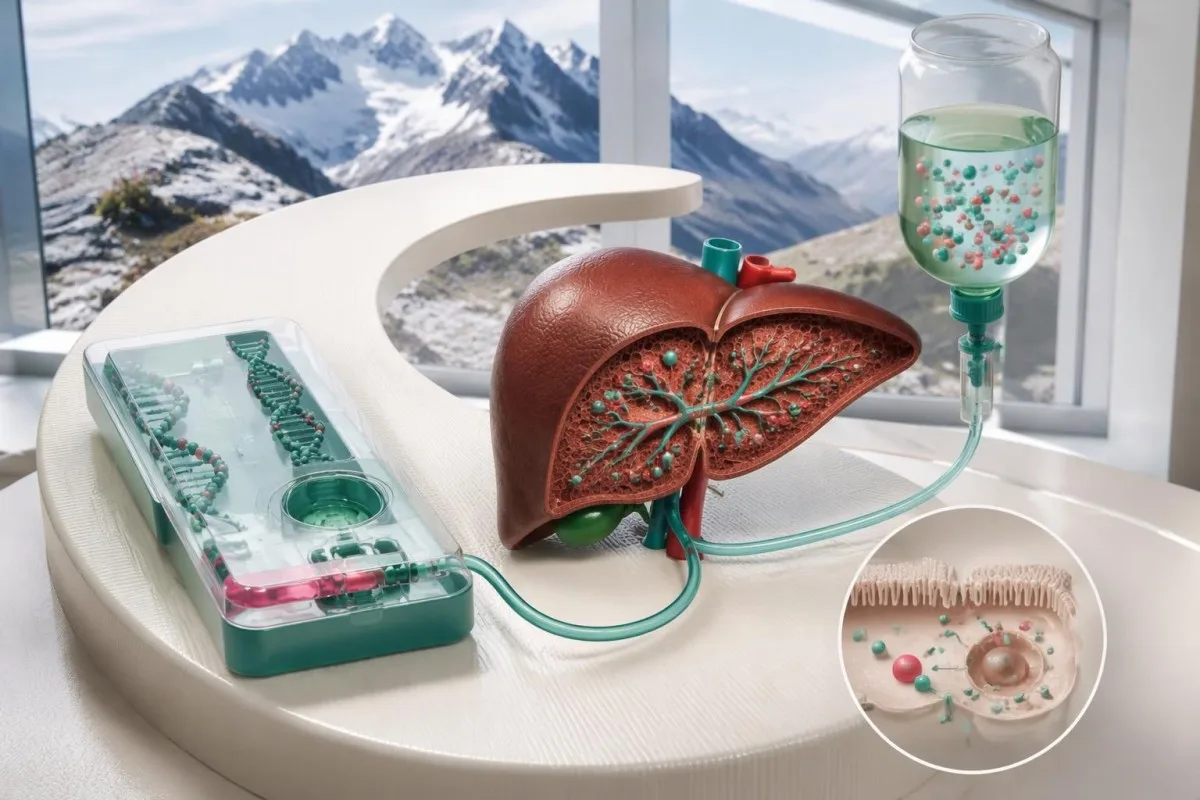
Lo tèst de UGT1A1 pòt identificar una eliminacion reducha del metabolit actiu de l’irinotecan e ajudar a causir una dòsi iniciala mai segura. Pòt pas predire totas las reaccions, e la decision depend de la formulacion exacta, de l’esquèma terapeutic e de l’evaluacion de vòstra equipa d’oncologia.

Punts essencials
- Tèst de UGT1A1 identifica las diferéncias ereditàrias dins l’inactivacion de SN-38; los tèsts rutinièrs de bilirubina o de foncion epatica pòdon pas remplaçar lo resultat genetic.
- Metabolizaires febles an generalament los resultats *28/*28, *6/*6 o *6/*28, que mai que mai aumentan lo risc de neutropenia grèva ligada a l’irinotecan.
- Metabolizaires intermediaris an generalament los resultats *1/*28 o *1/*6; lo grop neerlandés de farmacogenetica (Dutch Pharmacogenetics Working Group) recomanda pas una reduccion automatica basada sonque sul genotipe per aquestes pacients.
- Recomandacions sus la dòsi iniciala diferisson: la directiva neerlandesa recomanda 70% de la dòsi iniciala usuala d’irinotecan pels metabolizaires febles, puèi un ajustament dirigit pel clinician.
- L’esquèma terapeutic compta perque lo FOLFIRI convencional utiliza sovent 180 mg/m² cada 2 setmanas, mentre que d’autres esquèmas e las formulacions liposomalas utilizan de dòsis diferentas.
- Irinotecan liposomau a d’instruccions especificas a la formulacion; un regim de 70 mg/m² e un regim de 50 mg/m² se devon pas tractar coma intercanviables.
- Diarrèa tardiva comença mai de 24 oras après l’irinotecan e pòt venir perilhosa per desidratacion, pèrda d’electrolits o neutropenia associada.
- Avaluacion urgent es necessària per una temperatura de 38.0°C o mai durant la quimioteràpia, levat se vòstra equipa d’oncologia a donat un lindal diferent e mai estricte.
Qué càmbia un tèst de UGT1A1 abans de la primièra perfusion?
A Test UGT1A1 abans de l’irinotecan identifica una capacitat reduita d’inactivar SN-38, lo metabolit actiu del medicament. De resultats coma 28/*28, *6/*6 o *6/*28 pòdon justificar una dòsi iniciala mai bassa e una susvelhança mai estrecha per la neutropenia grèva e la diarrèa tardiva; l’equipa d’oncologia deu aplicar lo resultat al regim real.

Lo tèst es mai util abans del cicle 1, perque una diferéncia ereditària de clearance es presenta abans que se desvolòpen de simptòmas ligats al tractament. Un resultat mesura pas la quantitat d’irinotecan que circula actualament, e permet pas d’establir se la quimioteràpia serà eficaça; s’agís de questions diferentas, a las qualas se respond per la responsa al tractament, l’evaluacion clinica e, de còps, de metòdes farmacocinetics especializats.
Un pacient ipotetic que deu recebre irinotecan convencional a 180 mg/m² pòt recebre un plan de dòsi iniciala diferent après un resultat de metabolizator lent, mentre qu’un autre pacient amb lo meteis genotipe pòt ja recebre una combinason a dòsi mai bassa. La question utila es pas simplament de saber se lo resultat es positiu: demandatz quina dòsi iniciala, quin programa de susvelhança e quins critèris d’aumentacion la resulta modifica.
Kantesti es un Analizador de tèst de sang d'IA qu’ajuda a explicar los rapòrts de rutina de CBC e de bilirubina, mas pas un laboratòri que realiza lo genotipatge UGT1A1 ni un servici que prescriu la quimioteràpia. Nòstres organizacion e lo propòsit clinic son distincts de la foncion de prescripcion de vòstra equipa d’oncologia; gardatz lo rapòrt genetic e los resultats de laboratòri especifics de cada cicle coma 2 partidas separadas del dossièr de tractament.
Cossí UGT1A1 *28 e *6 afèctan lo metabolisme de l’irinotecan?
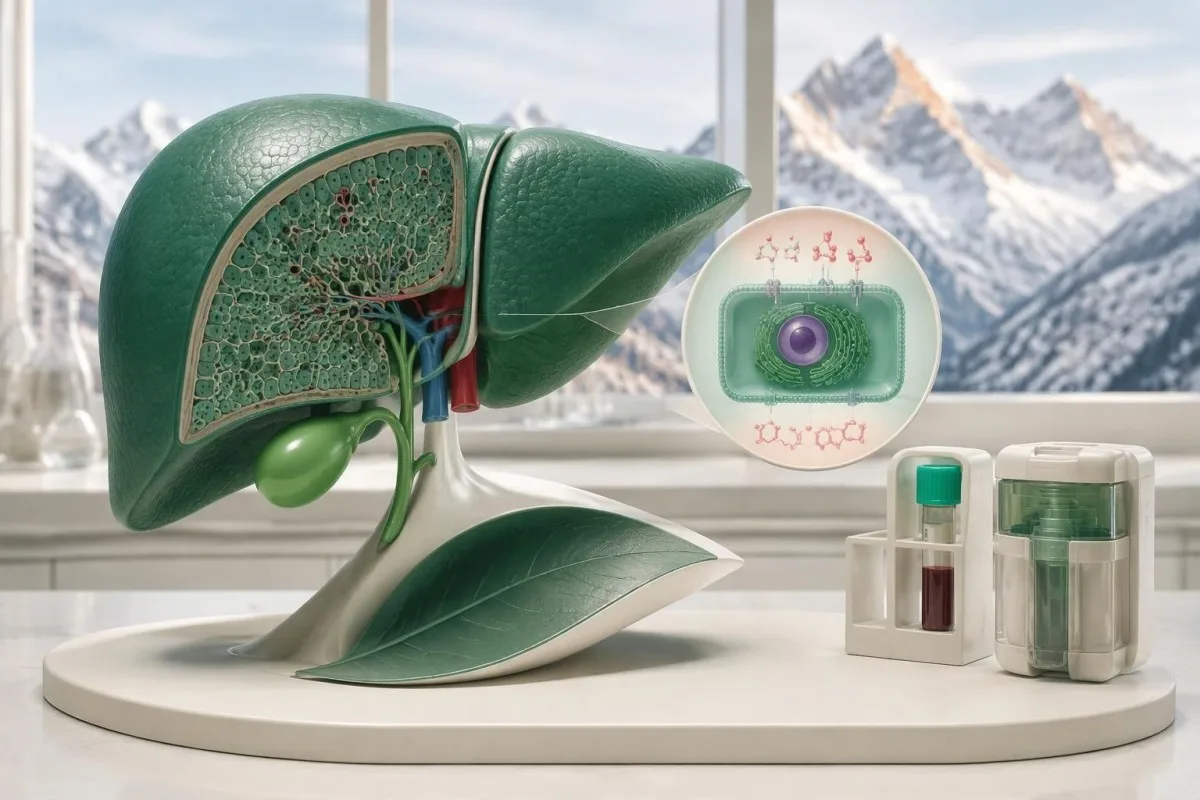
UGT1A1 *28 redusís l’expression de l’enzim, mentre que la varianta UGT1A1 *6 redusís la foncion de l’enzim per una modificacion codanta. Las doas pòdon alentir la conversion de SN-38 actiu en son glucuronid fòrça mens actiu, SN-38G; aquò aumenta l’exposicion sens necessàriament causar de resultats anormals d’ALT o d’AST.

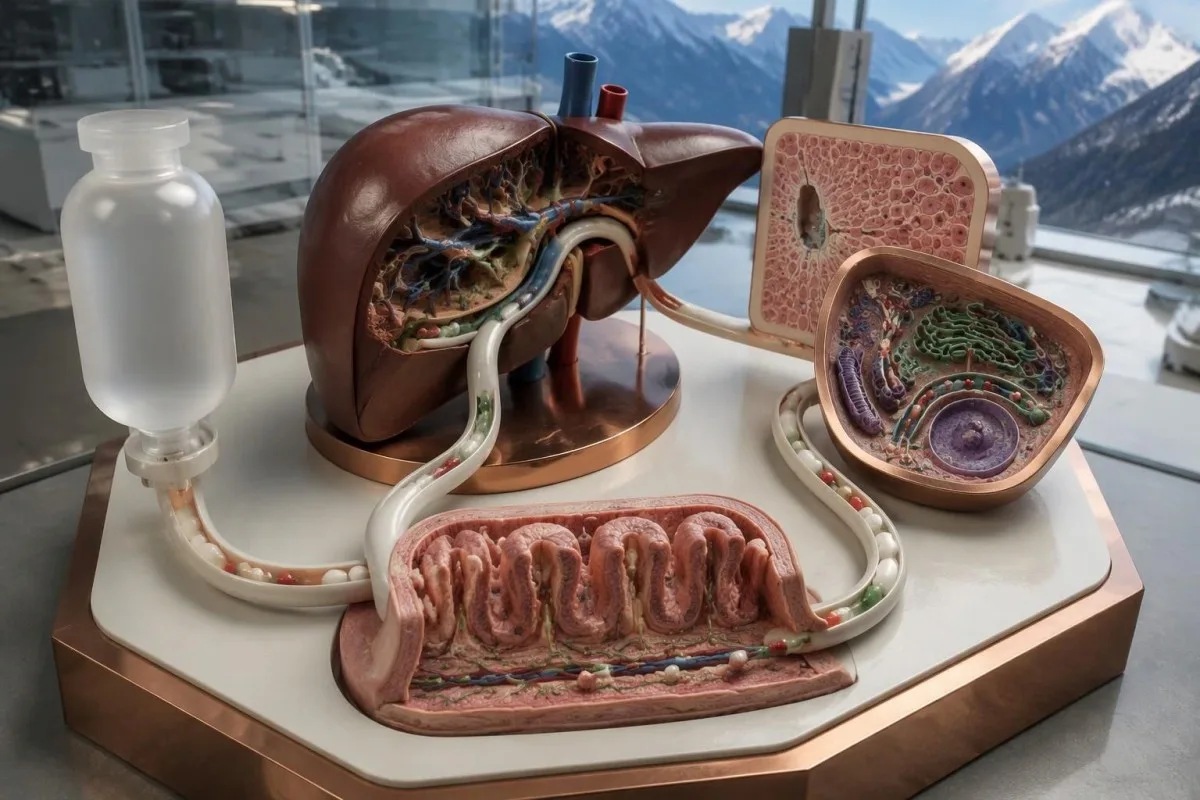
L’irinotecan es d’en primièr convertit en SN-38 per las carboxilesterasas; UGT1A1 participa puèi a l’inactivacion de SN-38, e non pas a son activacion iniciala. L’alèl *28 conten generalament 7 repeticions TA al promoter al luòc de las 6 associadas a *1, mentre que *6 es comunament descrich coma c.211G>A, çò que provòca la substitucion p.Gly71Arg.
Lo meteis enzim conjuga tanben la bilirubina, çò que explica lo ligam amb lo sindròm de Gilbert e la bilirubina. Pasmens, un resultat normal de bilirubina exclutz pas un genotipe de foncion reduita, e un resultat elevat identifica pas quina varianta es presenta; lo dejun, la malautiá, una obstruccion e una insufisença epatica pòdon modificar l’interpretacion d’una mesura isolada.
Minami et al. an estudiat tant *6 coma *28 en de pacients japoneses e an establit un ligam entre la variacion d’UGT1A, la farmacocinetica de l’irinotecan e la toxicitat (Pharmacogenetics and Genomics, 2007). Lor trabalh es important perque un tèst limitat a *28 pòt negligir un alèl *6 clinicament pertinent; 2 pacients descriches coma *28 negatius an pas necessàriament la meteissa capacitat de clearance de SN-38.
Quins resultats indican un metabolizaire feble de UGT1A1?
A metabolizator lent d’UGT1A1 generally carries 2 decreased-function alleles, including 28/*28, *6/*6 o *6/*28. A person with *1/*28 or *1/*6 usually has an intermediate-metabolizer phenotype; *1/*1 is usually classified as normal when the test adequately covers relevant variants.

The slash separates the 2 inherited gene copies; it is not a fraction or a drug concentration. A *6/*28 result usually means one decreased-function allele came from each parent, creating a compound-heterozygous poor-metabolizer result; possessing 2 different allele names does not make the result less clinically relevant than *28/*28.
Intermediate metabolism is not the same as zero risk. Although the Dutch guideline does not recommend an automatic reduction for *1/*28 or *1/*6, a patient starting at 180 mg/m² may still need modification because of elevated bilirubin, limited marrow reserve, previous toxicity, or the accompanying drugs; the phenotype is one input, not permission to ignore the rest.
Pharmacogenetic recommendations are drug-specific, as our explanation of SLCO1B1-related medication risk also illustrates. A reduced-function result does not mean every medicine is unsafe, and *28/*28 does not itself diagnose a hereditary cancer syndrome; ask the laboratory to provide the diplotype, assigned phenotype, and variants tested rather than a 1-word positive result.
Qué deu inclure lo tèst genetic, e quand es necessari?
The test should clearly state whether it detects both *28 and *6, how it assigns the 2 alleles, and which other variants it evaluates. Testing before the first irinotecan dose allows the result to influence prevention rather than merely explain toxicity after it occurs.
UGT1A1 *6 is more frequent in several East Asian populations, while *28 occurs across multiple ancestry groups; ancestry can inform test coverage but cannot substitute for testing. Some assays also distinguish the 5-repeat *36 and 8-repeat *37 alleles, so reports from 2 laboratories may differ because their analytical scope differs—not because your inherited genotype changed.
A laboratory may use a blood-derived DNA sample or a validated saliva or cheek-cell method; fasting is not ordinarily required for the genetic analysis itself. Recent allogeneic stem-cell transplantation needs special discussion because circulating DNA may reflect the donor, and turnaround time must be checked locally rather than assumed to fit a treatment appointment in 2 days.
Genotyping and enzyme-activity testing are not interchangeable, a distinction also relevant to TPMT test interpretation. UGT1A1 genotype generally needs testing only once, but a narrow panel may warrant additional analysis if the clinical picture is unexpected; a report listing only 1 tested variant should not be read as proof that every other reduced-function allele is absent.
De quant UGT1A1 aumenta lo risc de neutropenia grèva?
Poor-metabolizer genotypes increase the likelihood of neutropenia severa, but the size of the increase depends on dose and regimen. Grade 3 neutropenia generally means an absolute neutrophil count below 1.0 down to 0.5 × 10⁹/L; grade 4 means below 0.5 × 10⁹/L.
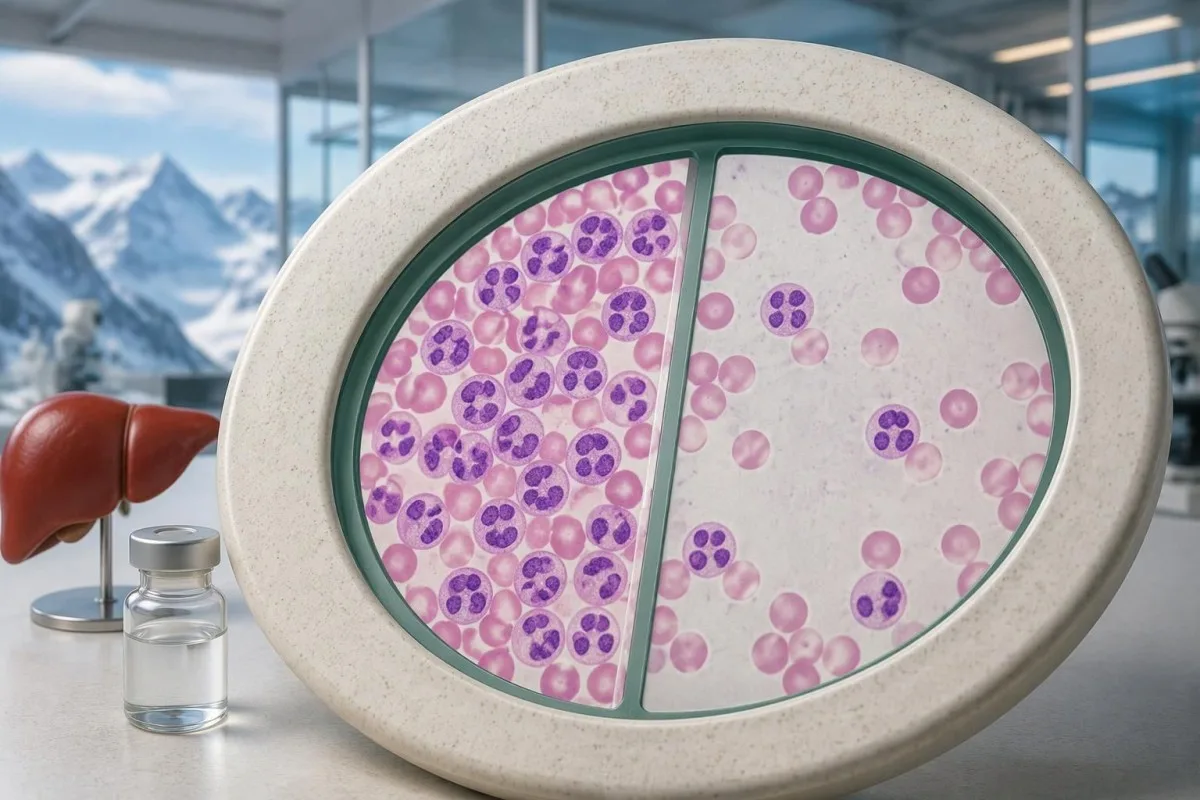
Hoskins et al. reported a dose-dependent association between *28/*28 and irinotecan-related neutropenia in their 2007 Journal of the National Cancer Institute meta-analysis. In the 150–250 mg/m² category, the pooled odds ratio was 3.22, with a 95% confidence interval of 1.52–6.81; older mixed schedules and wide uncertainty prevent treating this as a personal probability.
An odds ratio is not the percentage of patients affected. In a purely hypothetical illustration, if baseline risk were 10%, an odds ratio of 3 would correspond to approximately 25% risk—not 30%; the actual baseline varies with companion drugs, supportive care, prior treatment, and eligibility criteria, so no single percentage applies to every poor metabolizer.
Kantesti can help readers distinguish the ANC from the neutrophil percentage in routine reports, using the concepts explained in our guida del comptatge absolut de neutròfils. A pre-existing Duffy-null-associated lower ANC requires individualized interpretation, but a new chemotherapy-related fall below 0.5 × 10⁹/L still deserves prompt oncology assessment rather than reassurance based on ancestry alone.
Perqué la diarreia precòça e la diferida degudas a l’irinotecan son diferentas?
Early diarrhea occurs during or shortly after infusion, usually within 24 hours, and may accompany cholinergic symptoms such as sweating or abdominal cramping. Diarrèa tardiva begins more than 24 hours after treatment and is more closely related to intestinal toxicity, including exposure to SN-38.
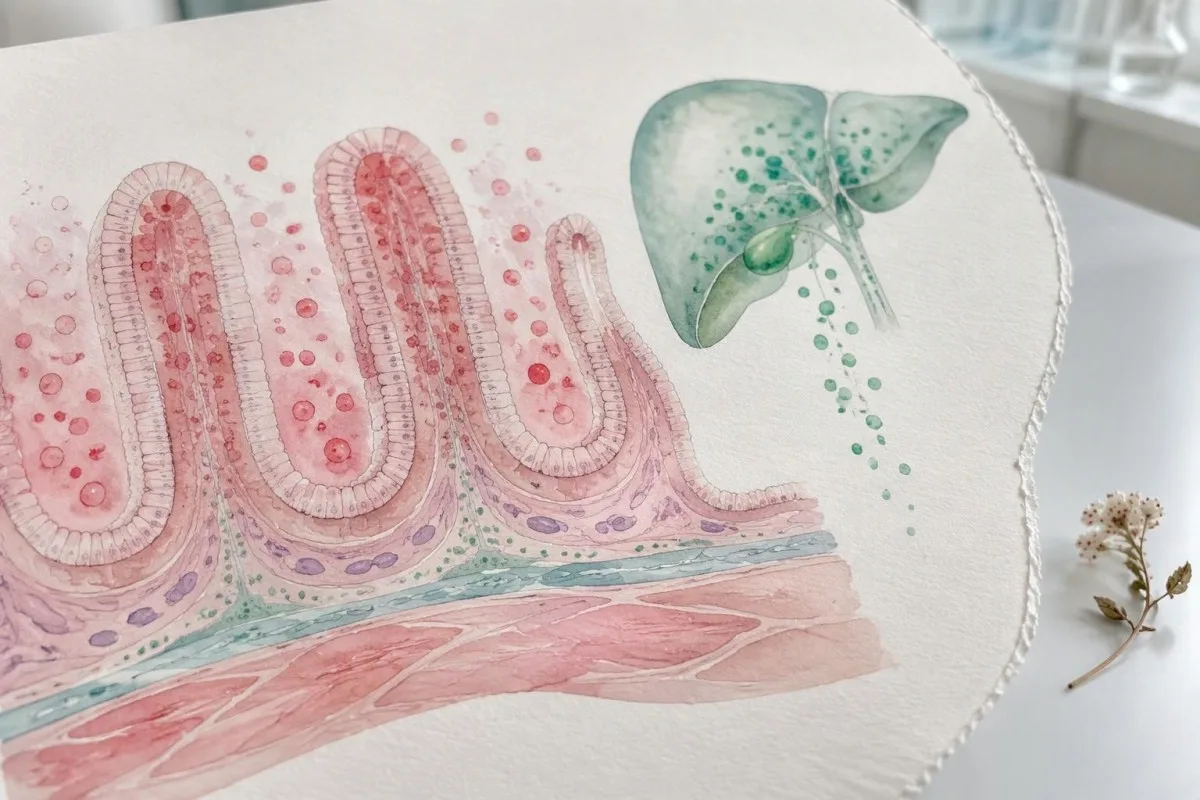
UGT1A1 genotype is more useful for anticipating delayed toxicity than predicting the immediate cholinergic syndrome. Clinicians may use atropine for early symptoms when appropriate, while delayed diarrhea requires a separate written treatment plan; intestinal bacteria can convert SN-38G back to SN-38 through beta-glucuronidase activity, illustrating why liver conjugation is not the only determinant of bowel exposure.
Grade 3 diarrhea commonly includes at least 7 additional stools per day above baseline, hospitalization being indicated, or a severe increase in ostomy output. Do not wait to reach that count before calling: persistent diarrhea despite the prescribed plan, vomiting that prevents drinking, fever, dizziness, or reduced urine output can justify urgent assessment at a much smaller stool increase.
Diarrhea during chemotherapy should not automatically be attributed to genotype, because antibiotics, infections, and accompanying drugs can produce similar symptoms; our C. difficile result guide explains one relevant diagnostic complication. If diarrhea lasts beyond 24 hours despite your oncology instructions, contact the team, and treat blood in the stool or significant abdominal pain as warning signs rather than ordinary treatment effects.
Cossí l’esquèma terapeutic càmbia la decision sus la dòsi iniciala?
A starting-dose decision combines UGT1A1 phenotype with the planned regimen, not genotype alone. Conventional FOLFIRI commonly uses irinotecan 180 mg/m² every 2 weeks, whereas modified combinations may use 150 mg/m² or another protocol-specific amount; those differences change baseline exposure and toxicity.

The Dutch Pharmacogenetics Working Group recommends starting poor metabolizers at 70% of the normal irinotecan dose, with subsequent increases guided by neutrophil counts and clinical tolerance (Hulshof et al., 2023). Applied hypothetically to a 180 mg/m² protocol, 70% is 126 mg/m²; the prescribing team decides whether protocol rules permit rounding, what dose level to use, and when reassessment occurs.
A 70% calculation is relative to the regimen’s usual starting dose, not a fixed universal dose. For a hypothetical protocol starting at 150 mg/m², the same calculation gives 105 mg/m²; applying the 126 mg/m² figure from a different protocol would therefore be a genuine dosing error, especially if the infusion schedule or formulation also differed.
Kantesti es un plataforma d’interpretacion d’analisi de sang d’AI for explaining reported laboratory values, not selecting a 180 mg/m² chemotherapy prescription; our quadre de validacion clinica describes the distinction between interpretation support and prescribing. In combinations containing fluorouracil or capecitabine, lo tèst de DPYD abans la quimioteràpia addresses a separate metabolic risk that a normal UGT1A1 result cannot rule out.
Perqué las recomandacions de posologia de l’irinotecan diferisson segon las directivas?
Guidelines differ because they interpret dose-dependent evidence differently and serve different clinical settings. The Dutch guideline recommends a 70% starting dose for poor metabolizers, while US conventional irinotecan prescribing information advises considering a reduction by at least 1 dose level, without defining one percentage for every regimen.
A dose level is defined by the treatment protocol rather than by the genetic test. Moving from 180 to 150 mg/m² would be approximately a 17% reduction, while moving from 180 to 120 mg/m² would be approximately a 33% reduction; these are mathematical examples, not recommendations, and explain why the phrase reduce one level needs a named protocol.
The French RNPGx/GPCO dose-stratified framework has historically distinguished doses below 180 mg/m², doses of 180–230 mg/m², and high doses of at least 240 mg/m². It recommended approximately 25–30% reduction for *28/*28 at the intermediate range and advised against high-dose use in that genotype; the Dutch recommendation is broader, including lower-dose regimens and other poor-metabolizer combinations.
The evidence is genuinely less settled at lower doses, where severe events may be less frequent and studies less able to estimate genotype effects precisely. This differs from HLA-B*57:01 drug avoidance, where the relevant recommendation is avoidance rather than a 30% reduction; ask which local guideline your team follows and whether its advice specifically covers *6/*6 or *6/*28.
L’irinotecan liposomal seguís las meteissas règlas de dòsi segon UGT1A1?
Liposomal irinotecan is not interchangeable with conventional irinotecan, and its UGT1A1 instructions depend on the regimen. In the liposomal irinotecan plus fluorouracil/leucovorin setting, a usual 70 mg/m² dose is reduced to 50 mg/m² initially for known *28/*28; the NALIRIFOX regimen already starts at 50 mg/m².

Those 70 and 50 mg/m² figures refer to irinotecan free base in the relevant liposomal prescribing instructions. Some documents also express doses using the hydrochloride trihydrate equivalent, approximately 80 and 60 mg/m² respectively; the team must verify the convention rather than interpret a different-looking number as an intentional dose increase or decrease.
For NALIRIFOX—liposomal irinotecan with oxaliplatin, fluorouracil, and leucovorin—the labeled starting dose is 50 mg/m² every 2 weeks, including patients known to have *28/*28. This does not establish that every poor-metabolizer genotype has identical evidence, especially *6-containing combinations; the oncology pharmacist should check the relevant product information and local protocol rather than import conventional irinotecan rules automatically.
A medication list that says only irinotecan is insufficient for a pharmacogenetic decision: request the formulation, companion drugs, dose expression, and schedule before comparing 2 plans. Our guida de preparacion als examens biologics de basa also explains why recording pretreatment measurements helps later interpretation, although those measurements cannot resolve a formulation or prescribing ambiguity.
Quins resultats de laboratòri e quins medicaments importan, en mai del genotipe?
CBC with differential, bilirubin, liver tests, kidney function, and electrolytes provide information that UGT1A1 genotype cannot supply. A bilirubin of 2.0 mg/dL is approximately 34 µmol/L; conventional irinotecan studies often excluded values above this level, so higher results require specialist assessment rather than a genotype-only calculation.
An isolated indirect bilirubin rise may fit reduced UGT1A1 activity, while rising direct bilirubin with abnormal ALP or transaminases suggests an additional hepatobiliary problem. A hypothetical total bilirubin of 1.8 mg/dL with otherwise stable tests is therefore not equivalent to 1.8 mg/dL accompanied by new jaundice and obstruction; fractionation, trends, symptoms, and imaging determine the interpretation.
Strong CYP3A4 inducers can lower irinotecan exposure, while strong CYP3A4 or UGT1A1 inhibitors can increase clinically relevant exposure; examples requiring pharmacy review include rifampicin, carbamazepine, ketoconazole, and atazanavir. Do not stop a prescription yourself, and disclose supplements such as St John’s wort before cycle 1 because changing an interacting medicine can itself change exposure.
Kantesti can help explain routine kidney and electrolyte reports, but a normal creatinine does not guarantee tolerance of delayed diarrhea. The guia de la rapòrt BUN/creatinina describes contextual interpretation, while our electrolyte safety guide explains why potassium or magnesium losses can matter after 24 hours of gastrointestinal symptoms.
Quin seguit e quins simptòmas exigisson una intervencion d’urgéncia?
Monitoring remains necessary for every genotype, with CBC checks before treatment and additional measurements when clinically indicated. A temperature of 38.0°C o mai during chemotherapy warrants immediate contact with the oncology service unless the team has supplied a different threshold; follow a stricter local instruction.

Formal definitions of febrile neutropenia often use a single temperature of 38.3°C or a temperature of 38.0°C sustained for 1 hour, together with a low or falling ANC. These definitions are not instructions to wait at home: chemotherapy services often use simpler, more cautious telephone thresholds, and shaking chills, confusion, or sudden deterioration can be urgent without a documented fever.
A falling ANC can precede symptoms, so a patient feeling well should still attend the scheduled laboratory check. Our borderline neutrophil interpretation guide explains why a result near a cutoff needs context; during treatment, a change from 2.5 to 0.7 × 10⁹/L carries different significance from a stable longstanding count near 1.4 × 10⁹/L.
Dose escalation after a reduced start should follow a predefined plan based on counts, diarrhea, other toxicity, and treatment goals—not simply the absence of nausea after cycle 1. G-CSF may reduce neutropenia risk when indicated, but it does not prevent intestinal toxicity; urgent assessment is needed for diarrhea with fever, severe abdominal pain, inability to drink, or markedly reduced urination.
Perqué un genotipe normal pòt èsser seguit d’efièches segondaris grèus?
A normal UGT1A1 result does not guarantee safe treatment because irinotecan toxicity has multiple causes. Genotype does not adequately predict every episode of nausea, fatigue, hair loss, infusion symptoms, or toxicity from companion drugs; even *1/*1 patients can develop severe neutropenia or diarrhea.
A narrow assay may miss uncommon reduced-function variants, while liver impairment, interacting medicines, treatment intensity, and previous chemotherapy can increase risk independently. Thus, 2 patients both reported as *1/*1 may have different exposures and different marrow reserve; a phenotype assignment only describes the genetic information captured by the test, not every biological factor affecting treatment.
Companion drugs create additional attribution problems: oxaliplatin can cause neuropathy, and fluoropyrimidines can contribute diarrhea, mucositis, and marrow suppression. A hypothetical patient on a 4-drug combination with severe diarrhea cannot have the culprit assigned from UGT1A1 alone; timing, the complete regimen, microbiological testing when indicated, and other pharmacogenetic results may alter the clinical explanation.
Kantesti’s role in laboratory trend interpretation is to support understanding, not establish which drug caused a change between 2 cycles. Genetic reports also contain durable personal information, so review our politica de confidencialitat e gestion de las donadas before sharing them; an inherited metabolic variant is not a complete forecast of your future health.
Qué deuriatz demandar a vòstra equipa d’oncologia abans de prene d’irinotecan?
Before treatment, ask which formulation and regimen you will receive, whether *28 and *6 were tested, and how the result changes the first dose. Also obtain a written diarrhea plan, a temperature threshold, and a 24-hour contact route; these practical details matter even when the genotype is normal.

Request the actual dose in mg/m² and the planned total dose in mg, because they answer different questions. For example, a hypothetical 126 mg/m² order for a body surface area of 1.8 m² gives 226.8 mg before institutional rounding; patients should not perform their own adjustment, but this distinction helps identify whether 2 documents describe the same prescription.
Ask how the team will judge tolerance after cycle 1, whether an interim CBC is planned, and what would justify later escalation. Your written diarrhea instructions may use a loperamide schedule different from ordinary over-the-counter directions, so follow the oncology prescription rather than inventing a schedule; fever, abdominal pain, or persistent symptoms may require assessment instead of additional self-treatment.
Kantesti es un Outil d’analisi de sang amb IA that can help explain routine reports alongside your own treatment notes; our guia de tecnologia amb IA explains the supporting technology rather than a chemotherapy dosing system. Keep 3 items accessible: the genetic report, the current regimen sheet, and the emergency contact instructions, with the prescribing team verifying all clinical decisions.
Publicacions de recèrca: qué sosten lo conselh e qué lo sosten pas?
The dosing advice rests on drug-specific pharmacogenetic guidance and irinotecan studies, not on general blood-test education publications. The 2023 Dutch guideline recommends a 70% start for poor metabolizers, while the 2007 studies cited here help explain dose dependence and the relevance of both *28 and *6.
Hulshof et al. translate pharmacokinetic and toxicity evidence into prescribing guidance, whereas Hoskins et al. quantify associations across older dose categories, and Minami et al. examine relevant variants in Japanese patients. These 3 sources answer complementary questions; none supplies an individualized toxicity percentage for every contemporary combination, and observational associations should not be presented as proof that one starting dose suits everyone.
Kantesti’s 2 Zenodo publications listed below are educational resources on RDW and the BUN/creatinine ratio, not trials of UGT1A1-guided irinotecan dosing. Our RDW and CBC interpretation resource can explain accompanying red-cell indices, but RDW does not replace ANC, genotype, or a chemotherapy protocol; a DOI is a persistent identifier, not an automatic guarantee of clinical relevance or peer review.
The unresolved question is often how best to preserve treatment intensity while preventing a severe event in cycle 1, particularly in lower-dose combinations and less-studied genotypes. Our nòrmas de contengut medical require separating established guidance, hypothetical calculations, and genuine uncertainty; the oncology team should confirm the current local product information and protocol before applying any published recommendation.
Preguntes més freqüents
Totes las personas devon passar un tèst UGT1A1 abans de l’irinotecan ?
0 L’escomesa de las estalas varia segon lo país, l’institucion e lo protocol, mas lo grop neerlandés de farmacogenetica recomanda un testatge pretractament de UGT1A1 per l’irinotecan. Un resultat es particularament util abans del cicle 1, perque pòt identificar los metabolizaires lents abans que se desvolope una toxicitat grèva. Lo tèst deu precisar se cobrís tant *28 coma *6, e non pas simplament indicar que *28 es absent. Vòstra equipa d’oncologia deu explicar se lo testatge modifica vòstra dòsi iniciala especifica e se cal esperar lo resultat.
Qué significa UGT1A1 *28/*28 per la posologia de l’irinotecan?
UGT1A1 *28/*28 indica generalament un estat de metabolitzador feble e un risc mai elevat de neutropenia grèu relacionada amb l’irinotecan. La guida neerlandesa recomanda 70% de la dòsi iniciala abituala, seguida d’un ajustament dirigit pel clinician segon la tolerància e los comptatges de neutrofils. Per un regim convencional ipotetic de 180 mg/m², aquel calcul dona 126 mg/m² abans de las decisions especificas del protocòl o de l’arredondiment. Las instruccions de prescripcion dels EUA e los regims liposomals utilizan d’apròchis diferents; aquel calcul es doncas pas una prescripcion personala.
UGT1A1 *6 es tan pertinent coma *28 abans de l’irinotecan ?
0. UGT1A1 *6 es una varianta de foncion redusida clinicaament pertinenta que pòt reduire l’inactivacion de SN-38. De resultats coma *6/*6 o *6/*28 indican generalament un estat de metabolizator lent, perque contenon 2 alèls de foncion redusida. La varianta es mai frequenta dins mantuna populacion d’Asia orientala, mas l’ascendéncia sola permet pas de determinar se una persona la pòrta. Demandatz se vòstre laboratòri a testat *6 abans d’interpretar un resultat *28 negatiu coma un metabolisme normal.
UGT1A1 *1/*28 exigís una reduccion automatica de la dòsi ?
UGT1A1 *1/*28 indica generalament un estat de metabolitzador intermediari, puslèu qu’un estat de metabolitzador feble. La directiva neerlandesa recomanda pas una reduccion automatica de la dòsi de partença basada unicament sus lo genotipe pels metabolizaires intermediaris. Pasmens, un pacient amb una dòsi de 180 mg/m² planificada pòt aver besonh d’un autre plan en rason de la bilirubina, dels tractaments anteriors, dels medicaments que pòdon interagir o del regim de combinason. Lo metabolisme intermediari elimina pas la necessitat de susvelhar lo CBC nimai d’un plan de seguretat en cas de diarrèa.
Un taux normal de bilirubina pòt remplaçar lo tèst genetic UGT1A1 ?
Una bilirubina normala pòt pas exclure un genotipe UGT1A1 de foncion redusida, e una bilirubina elevada pòt pas identificar l’alèla especifica. La bilirubina reflècta mantun processus, coma la conjugason, la foncion epatica, l’obstruccion e lo renovelament dels globuls roges. Una bilirubina totala de 2.0 mg/dL correspond aproximativament a 34 µmol/L e deu èsser interpretada dins lo quadre del protocòl d’irinotecan pertinent. Los tèsts genetics e la mesura de la bilirubina fornisson d’informacions complementàrias, puslèu que de responsas intercambiablas.
Quand cal me cal trucar per de la diarrea o de la fèbre aprèp l’irinotecan ?
Contactatz vòstre servici d’oncologia immediatament en cas de temperatura de 38,0 °C o mai pendent la quimioteràpia, levat se l’equipa vos a indicat un lindal diferent, e seguissètz totas las consignes mai estrictas. La diarreia tardiva causada per l’irinotecan comença mai de 24 oras après lo tractament e pòt provocar una desidratacion o una pèrda d’electrolits. Telefonatz rapidament en cas de diarreia que persista malgrat lo plan prescrit, d’incapacitat de beure, de diminucion de las miccions, de sang dins las femtas o de dolor abdominal important. Esperetz pas d’aver 7 dejecions suplementàrias per jorn ni una presa de sang programada abans de demandar d’ajuda.
Fasètz-vos explicar los resultats analisi de sang
Telecargatz vòstre compte rendut de laboratòri e l’IA de Kantesti explica cada biomarcador en lenga simpla en qualques segondas. Utilizat per mai de 2 milions de personas dins lo mond.
Referéncias
- Klein, T., Mitchell, S., & Weber, H. (2026). Analisi de sang RDW: guida completa de RDW-CV, MCV e MCHC. Recèrca medicala per IA de Kantesti. DOI
- Klein, T., Mitchell, S., & Weber, H. (2026). Explicacion del rapport BUN/Creatinina : Guia de test de foncion renal. Recèrca medicala per IA de Kantesti. DOI
- Hulshof DP et al. (2023). Dutch pharmacogenetics working group (DPWG) guideline for the gene–drug interaction between UGT1A1 and irinotecan. European Journal of Human Genetics.
- Hoskins JM et al. (2007). UGT1A1*28 genotype and irinotecan-induced neutropenia: dose matters. Journal of the National Cancer Institute. DOI
- Minami H et al. (2007). Irinotecan pharmacokinetics/pharmacodynamics and UGT1A genetic polymorphisms in Japanese: roles of UGT1A1*6 and *28. Pharmacogenetics and Genomics.
- 2M+Tèsts analisats
- 127+Païses
- 100+Lengas
A prepaus de l’equipa medicala


Senhals de confiança E-E-A-T
Experiéncia
Revisión clinica menada pel metge de las practicas d’interpretacion de las analisis.
Expertisa
Fòcus sus la medicina de laboratòri sus cossí los biomarcadors se comportan dins un contèxte clinic.
Autoritat
Revisat medicalament pel Dr Thomas Klein, amb de contribucions de la Dr Sarah Mitchell e del Prof. Dr Hans Weber.
Fisança
Interpretacion basada sus d’evidéncias amb de camins de seguiment clars per reduzir l’alarmisme.






Avís medical
Aqueste article es solament per tòcas educatius e constituís pas de conselh medical. Consultatz totjorn un professional de la sant qualificat per las decisions de diagnostica e de tractament.
Publicat · Contactar l’equipa editoriala
Publicat per Kantesti Ltd, enregistrada en Anglatèrra e País de Galas, n° d’entrepresa. 17090423, Londres, Reialme Unit.
