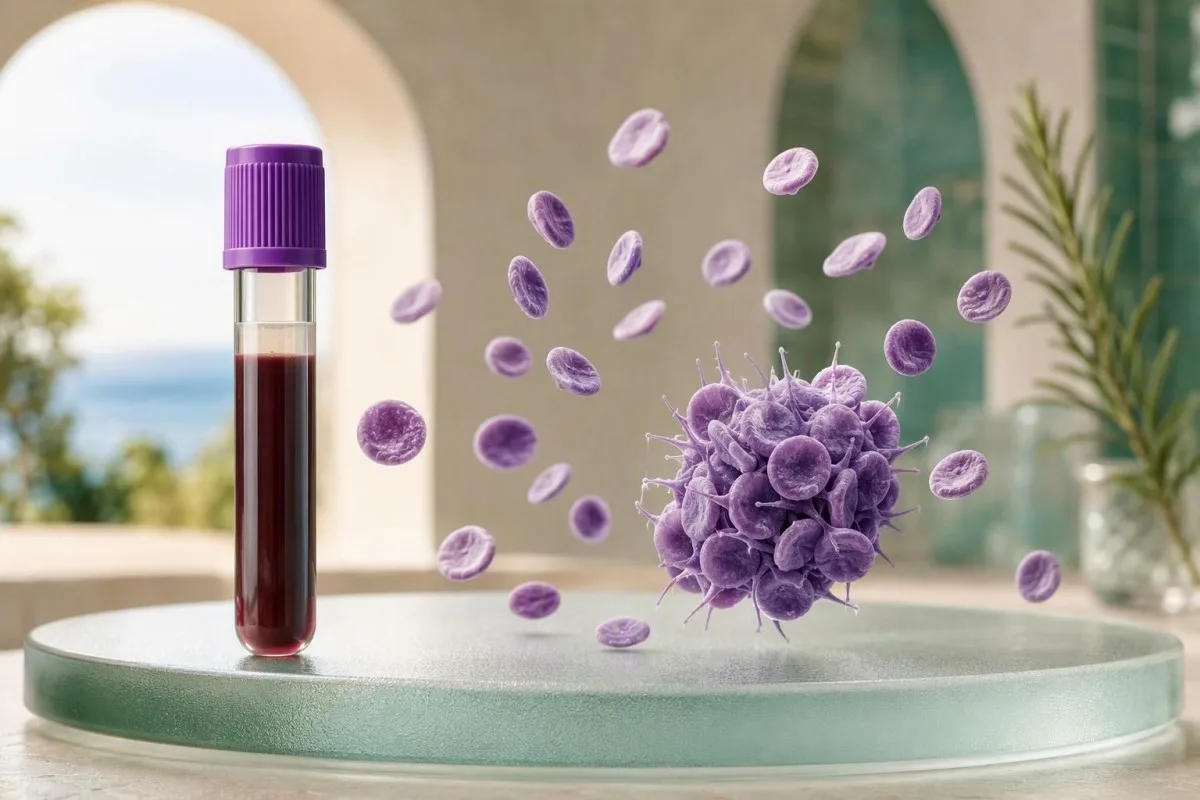
Un compte plaquettari bas pòt ocasionalament èsser una error de mesura ligada al tubus puslèu qu'un problèma dins lo sieu còs. Vaquí coma es identificada la pseudotrombocitopenia ligada a l'EDTA abans que qualqu'un vos etiqueta de trombocitopenia.


- Pseudotrombocitopenia es un compte plaquettari falsament bas causat per l'empachament de plaquetas aprés la recòlta, mai sovent dins un tubus d'EDTA.
- Gama tipica de plaquetas per la màger part dels adults non emprenhats es approximativament 150-450 × 10⁹/L, tot aquò que los laboratòris fixan los sieus intervals.
- Empachaments de plaquetas sus esmòrre pòdon far qu'un analysador automatizat soscompte las plaquetas perque un grop es pas mesurat coma de cellulas separadas.
- Redessenh de citrat resòlvan sovent l'empachament plaquettari d'EDTA; los laboratòris aplican comunament una correccion de dilucion de 1.1 a un compte plaquettari de citrat.
- Pas de simptòmas de sang mai un compte plaquettari bas isolat inesperat devon provocar una revision de l'esmòrre abans decidar de tractament o de referiment urgent.
- La veritabla trombocitopenia pòt coexistir amb aglomeracion de plaquetas EDTA, doncas un resultat de citrat normal es rasonable mas deu correspondre a la descripcion clinica.
- Avaluacion urgent es encara necessari en cas de emorràgia non controlada, petequias estendudas novèlas, cefalèa severa, confusion, o un compte plaquetoire inferieur a 10 × 10⁹/L.
Ce que lo empachament plaquettari de l'EDTA vòl dir en realitat
L'aglomeracion de plaquetas EDTA es un artifact de laboratòri in vitro on las plaquetas s'ajustan dins lo tube de reculh, çò que causa un compte plaquetoire automatic espuriament bas. Aquò ne vòl pas dire per se que las plaquetas son destruidas dins lo còrs, e aquò crea generalament pas un risc d'emorràgia.
L'EDTA es l'aditiu del tube amb lo tappet lavanda utilizat per la màger part dels hemogramas perque liga lo calç e empacha la coagulacion. Dins un pichon sosensembl de personas, la removal del calç expausa de cibles de superficia plaquetoira que permeton als anticòrs naturals de ligar las plaquetas entre elas. L'analizator pòt comptar un grop de plaquetas coma una particula gròssa, un eveniment de la talha d'una leucocita, o ren del tot; veire nòstra descripcion generala de què inclou una CBC.
Dins mon trabalh clinic, lo rapòrt classic es un compte plaquetoire de 48 × 10⁹/L a una persona que se sent totalament plan, a pas de jauna, e a un emoglobina e un compte de leucocitas normal. Aquela discrepància es pas una pròva, mas es lo moment de pausar. Kantesti es un Analizador de tèst de sang d'IA que signaliza un compte plaquetoire bas isolat amb de comentaris de laboratòri coma agregats plaquetaris, en plaça de tractar lo nombre coma un diagnostic.
La pseudotrombocitopenia depenenta de l'EDTA es estimada a aperaquí 0.03-0.27% dels escandilhs ambulatoris de rutina, amb de taus mai nautas entre los escandilhs ja referits per de comptes plaquetaris bas. Lippi e los sieus collegas la descrivon coma un fenomèn preanalitic clinicament inofensiu mas potencialament consequential perque pòt provocar d'admissions innecessàrias, de transfusions plaquetàrias, o de tractaments esteroïdiens (Lippi et al., 2012).
Coma los analysadors de plaquetas pòdon soscomptar los estujons empachats
Los comptes plaquetaris automatizats son fisables per las plaquetas dispersadas, mas los agregats càpitan defòra de la talha e dels patrons de senhal que l'analizator s'espèra. Un compte pòt doncas baissar d'un 220 × 10⁹/L vertadièr a un 40 × 10⁹/L aparent sens cap de pèrda biologica de plaquetas.
Los analizators d'impedància classan las particulas principalament per volum, mentre que los sistèmas optics i ajustan d'informacion de difusion de la lutz. Una plaqueta es generalament d'environ 2-3 micromètres de largor, mas un agregat pòt sobrepausar amb lo fragment de globul roge o la region leucocitària. Es per aquò qu'un idograma plaquetoire pòt èsser anormal e que un laboratòri pòt ajustar “agregats plaquetaris presents” o “compte non fiable”.”
La senhalizacion plaquetoira de l'analizator es una indicacion per una revision umana, pas un diagnostic final. Una estimacion manuala d'un frotis periferic ben fach pòt èsser mai utila que de repetir lo meteis tube d'EDTA, especialament se l'escandilh esperèt 2 oras abans l'analisi. Per de limits practics a l'entorn de proceduras, nòstre guia de comptes plaquetaris abans d'una extraccion dentària explica perque un resultat verificat es important.
Las plaquetas gròssas creèron un problèma diferent, de còps que se pòt sonar. Las plaquetas individualas fòrça gròssas pòdon èsser mancas pels metòdes d'impedància quitament sens agregats visibles, çò que leva sovent lo volum plaquetoire mejan (MPV). Un MPV naut es pas intercanviable amb la pseudotrombocitopenia; nòstra revision de causas de plaquetas gròssas sepàra aqueles dos trobalhs.
Ce que pareisson los empachaments de plaquetas sus un esmòrre
Los agregats plaquetaris sus frotis aparéisson coma de grops irregulars en forma de grapa d'elements pichons violacis granuloses, sovent concentrats a la bòrxa del pelat de la lamelha. Lor posicion es importanta perque comptar solament lo camp central del frotis pòt mancar la caracteristica que explica lo resultat bas.
Un morfològ format examina lo còrs e la coa del filmu jos un poder elevat, pas solament un camp representatiu unic. La satellitosi plaquetoira es un tipe de tipe d'EDTA mens frequent ont las plaquetas enrodan los neutrophils coma una rosassa; pòt tanben baissar lo compte plaquetoire raportat. Ambdos trobalhs son de fenomèns d'escandilh, totun la satellitosi e los agregats larges pòdon de còps aparéisser ensems.
Un detalh util es que l'aglomeracion EDTA s'acelèra de còps amb lo temps. Un escandilh mesurat 10 minutas aprèp reculh pòt mostrar 118 × 10⁹/L, puèi 42 × 10⁹/L a 90 minutas que mai d'agregats se forman. Los laboratòris varian dins lor flux de trabalh, doncas un compte inicial normal non exclutz pas completament aquò artifact se una senhalizacion posteriora de l'analizator apareis.
Quand ièu, Thomas Klein, MD, vei un bas comptatge acompanhat d'un comentari sus la pelha mas sens sangrament clinic, demani l'interpretacion de la pelha ela-meteissa abans de discutir de la purpura trombocitopenica imuna. Un rasonament similar basat sus la microscopia es util quand un rapòrt menciona de schistocits sus una pelha de sang, ben que los schistocits demandan un contèxte clinic de mai urgenta.
Perqué l'EDTA causa d'empachaments de plaquetas dins qualques personas
L'EDTA pòt provocar l'aglutinacion de las plaquetas en quelant lo calci e en cambiant la forma de las glicoproteïnas de la membrana plaquetària, permetent a las anticòrs de se liar e de pontejar las plaquetas vesinas. Aquela reaccion se debana aprés la recòlta, pas perque l'EDTA aja damatjat las plaquetas circulantas dins lo còs.
Lo mecanisme lo mai sostengut implica d'anticòrs, sovent IgG, IgM, o IgA, reconeissent de sètis criptics sus lo complèxe GPIIb/IIIa plaquetari aprés un cambiament structural dependent del calci. La reaccion es dependenta de la temperatura e del temps per cèrts pacients, çò que explica perque un eissample caud pòt ocasionalament melhorar lo comptatge mas es pas una solucion universala. Es un problèma de compatibilitat de laboratòri, pas una allergia a l'EDTA.
La pseudotrombocitopenia pòt aparéisser en personas sanas e es estada raportada amb de condicions autoimunas, d'infeccions, de malignitats e de grossessas, mas aquelas associacions non establiscan pas una causasona a un individú. Un ANA positiu o una malautiá virala recenta non devon pas èsser utilizats per explicar lo comptatge tant que l'artifici non siá exclus. La Kantesti es un plataforma d’interpretacion d’analisi de sang d’AI que legís un resultat de plaquetas amb son tipe de tub, los marcaires de l'analizator e lo rèste del CBC, puslèu qu'isolament.
Lo fenomèn pòt persister pendant d'annadas mas variar entre las prelevaments. Un pacient pòt aver un comptatge de plaquetas de 35 × 10⁹/L en EDTA un diluns e 230 × 10⁹/L en citrat lo meteis matin, puèi mostrar una aglutinacion parciala qualques meses aprés. Ensenhar lo tub preferat dins lo recòrd del laboratòri pòt empedir las alarmas repetidas.
Coma un redessenh de citrat confirma la pseudotrombocitopenia
Un comptatge de plaquetas que se normaliza dins un tub de citrat de sòdi mentre que lo tub d'EDTA conten d'agregats sosten fòrtament la pseudotrombocitopenia dependenta de l'EDTA. Lo comptatge de citrat a besonh d'un ajustament de dilucion perque lo tub conten d'anticoagulant liquid.
Los tubs de citrat de sòdi amb tapa blava son generalament emplenats a un ratio de sang-anticoagulant de 9:1. Los laboratòris multiplican sovent lo comptatge de plaquetas de citrat mesurat per 1.1 per corregir la dilucion, ben que la metòda validada del laboratòri local aja la prioritat. Per exemple, un resultat brut de citrat de 182 × 10⁹/L ven aperaquí 200 × 10⁹/L aprés correccion.
La tornada de recòlta deu èsser emplenada corrèctament e mesclada gentilament. Un tub de citrat tròp pauc emplenat càmbia lo ratio d'anticoagulant e pòt crear un resultat diferent enganós, çò que es una rason perque un scientific de laboratòri pòt regetar una repeticion aparentament simpla. Nosta explicacion dels colòrs dels tubs de prelevament de sang ajuda los pacients a reconéisser perque lo chausiment del tub fa partida de la metòda d'analisi.
Los tubs de sulfat de magnesi o d'acid-citrat-dèxtròsa pòdon èsser util per quand l'aglutinacion contunha en citrat, mas aquò es de costuma una decision dirigida pel laboratòri. Nagler e los sieus collègas an documentat un cas ont la reconeissença de la pseudotrombocitopenia dependenta de l'EDTA a evitat un trabalh de diagnostic innecessari aprés que l'analisi de citrat aja mostrat un comptatge sufisent (Nagler et al., 2014).
Quand un compte plaquettari de citrat tròba pas la responsa
Una tornada de recòlta de citrat non exclutz pas una trombocitopenia vertadièra quand lo comptatge corregit demòra bas, l'aglutinacion se produtz dins mai d'un anticoagulant, o los simptòmas suggerisson un sangrament. D'unes pacients an una agregacion de plaquetas multi-anticoagulant, e d'unes an un bas comptatge real a costat d'un artifici.
Se lo comptatge de plaquetas de citrat corregit es de 82 × 10⁹/L e la pelha es sens aglutinacions, es una trombocitopenia autentica tant que demostrat lo contrari. Se l'EDTA es de 25 × 10⁹/L e lo citrat de 86 × 10⁹/L amb d'agregats residuaus, pòdon èsser presents tant un artifici coma una reduccion reala. L'equipa clinica devè ussar de la mejana melhor verificada, pas simplicament de chausir lo numèro lo mai rasonable.
La coagulacion dins l'eissample pòt tanben invalidar un CBC perque las plaquetas son consumidas dins lo microcaus. A la diferéncia de la pseudotrombocitopenia per EDTA, un eissample partialament coagulat pòt tanben afectar los globuls blancs e los indèxis de globuls roges. Legissètz nòstre guida de tornada de recòlta aprés problèmas d'eissamples per las diferéncias practicas entre los artificis de recòlta.
Los espròvas de puncion de det son pas automaticament mai seguras. Una reculhuda lenta, un esprèmer, o un mesclatge tardiu pòdon promòure una agregacion locala e comprométe un compte de plaquetas, particularament quand la valor raportada es mendre que 100 × 10⁹/L. Una reculhuda venosa amb un tractament prompt es generalament la via de confirmacion la mai clara.
Intervals de compte plaquettari, risc de sang, e lo trapan d'artefact
La màger part dels laboratòris per adults utilisan un interval de referéncia del compte de plaquetas pròche de 150-450 × 10⁹/L, mas lo risc de sangrament depend del compte verificat, de sa causa, de la foncion plaquetària e dels medicaments. Un resultat EDTA falsament bas ne deu pas èsser utilizat sol per denegar un procediment o prescrire un tractament.
Un sangrament major espontan es mai probable quand un compte de plaquetas vertadièr càp jos aperaquí 10 × 10⁹/L, mentre que fòrça personas amb de contas establas qu'an passat 50 × 10⁹/L an pauc de sangrament espontan. Aquò es de linhas directritz clinicas amplas, non una permission d'ignorar los simptòmas. Los anticoagulants, l'aspirina, las malautiás del fetge, l'insufiséncia renala e la disfunccion plaquetària pòdon modificar lo risc a quina que siá numerò.
Un compte de plaquetas de 90 × 10⁹/L merita un tractament diferent per una persona sana amb un resultat de citrat normal que per qualqu'un amb un melèna novèl e un INR elevat. Es per aquò que l'interpretacion del compte de plaquetas aparten al costat dels tests de coagulacion; nòstre aPTT e test de coagulacion guidan explican çò que un ecran de coagulacion normal pòt e ne pòt pas exclure.
Los laboratòris pòdon utilizar 140 × 10⁹/L en luòc de 150 × 10⁹/L coma limita de referéncia inferiora, particularament amb d'intervals derivats localament. Un interval de referéncia descriu una fraccion d'una populacion comparativa; ne definís pas un espal per tractament universal. Aquela distinction permet d'estalviar una quantitat surpre nent d'inquietuds innecessàrias.
Patrons de CBC que rendent un artefact mai probable
Un compte de plaquetas baissat inesperadament isolat amb una emoglobina normala, de globuls blancs, e un comentari de agregacion es lo tipe de CBC que suggerís mai la pseudotrombocitopenia. Aquela representacion es suggerenta puslèu que diagnostica perque la trombocitopenia imuna o medicamentosa precòça pòt tanben èsser isolada.
Los veradièrs problèmas de la medula anètan sovent mai d'una linha de globuls sanguins, encara que siá excepcions. Las plaquetas bassas combinadas amb una emoglobina en baissa, de globuls blancs anormals, de blats, o de simptòmas constitucionals persistents demandan una revision rapida del clinician e sovent un examen formal de la pelicula. Nòstre article sus la via CBC per las malautiás sanguinas descrís perqué aqueles grops modifan l'urgéncia.
La relacion plaquetas/linfocits pòt venir sens sens quand lo denominator es valid mas lo numerator de plaquetas es artificialament reduch. Una PLR de 60 calculada a partir d'un compte EDTA agregat ne devèu pas èsser interpretada coma un sen inflammatòri o cardiovascular. Aquela es una error segondària, silenciosa mas comuna dins los rapòrts de santat automatizats; vejatz nòstra explicacion sus los resultats PLR nauts.
L'IA identifica la discordància entre un compte de plaquetas bas e las mesuras CBC vesinas normalas, puèi indirige lo lector a verificar los comentaris de l'espròva. Un Outil d’analisi de sang amb IA ne devèu jamai convertir una valor de plaquetas unica non verificada en una etiqueta de malautiá. Aquela resèrva clinica es mai importanta que la velocitat.
Emprenhament, saluts espitalaris, e autras configuracions de naut enjòc
L'agregacion plaquetària EDTA pòt arribar pendent la gràvida e lo tractament espitalarièr, mas ne devèu jamai assumir quand una trombocitopenia vertadiera pòt modificar la gestion urgenta. Causas especificas de l'embaràs tal coma la trombocitopenia gestacionala, la preeclampsa, lo sindròm HELLP e la trombocitopenia immuna demandan un recensament verificat.
Los recensaments plaquetaris baishan comunament pendent un embaràs sens complicacions, e qualques laboratòris acceptan de limits de referéncia trimestriala mai basas. Un recensament en dejós de 100 × 10⁹/L es mens tipic per la trombocitopenia gestacionala sens complicacions e merita unaizacion clinica atenta, quitament se s'observan d'agregats d'EDTA. Nòstra guida de referéncia plaquetària trimestriala pendent l'embaràs balha de context sens remplaçar l'avís obstetric. recensament plaquetari trimestrial pendent l'embaràs balha de context sens remplaçar l'avís obstetric.
A l'espital, una casuda subta de mai de 50% respecte al nivèl de basa pòt produsir de questions sus la septicemia, l'exposicion a de medicaments, la trombocitopenia induita per l'eparina, la dilucion o la consomança ligada a un dispositiu. Un artefact d'EDTA pòt imitar una casuda dramatica, particularament quand un resultat precedent proven d'un metòde de laboratòri diferent. La comparason d'un resultat de citrat verificat amb lo nivèl de basa del pacient es sovent mai utila que de repetir un CBC de rutina amb EDTA.
Abans una epidurala, una cirurgia, un cicle de quimioterapia, o una transfusion plaquetària, demandatz se lo laboratòri a confirmat la valor sus un frotiç o un anticoagulant alternatiu. Ai vist de retards de tractament evitar per aquela sola apelada. A l'invers, los simptòmas actius o un pacient instable devon èsser avalorats pendent que la confirmacion es en cors.
Medicaments e diagnostics que devon pas èsser blamats tròp rapidament
La formacion de grumèls plaquetaris amb EDTA devon èsser exclusas abans d'atribuir un recensament plaquetari bas isolat a un medicament, una malautiá autoimmuna, o una trombocitopenia immuna. Arrestar un medicament valable basat sus un recensament non verificat pòt causar un damatge evitable.
L'eparina, los produches contenent de quinina, lo trimetoprima-sulfametoxazòl, lo valproat, lo linezolida, la quimioterapia, e qualques immunoterapias pòdon causar una trombocitopenia reala. La relacion temporala es importanta: una casuda autenticament associada a un medicament persistís tipicament dins un echantillon de citrat que s'a recuelhut correctament e s'esvanís pas quand l'EDTA es remplaçat. Un istoric de medicaments devon inclure las injeccions, los produches de venda liura, e los preparats de plantas medicinalas.
La trombocitopenia immuna es un diagnostic d'exclusion, pas un senhal de laboratòri. Pòt se presentar amb de plaquetas isoladas en dejós de 100 × 10⁹/L, mas un frotiç d'EDTA agrumat rend lo recensament inicial non interpretable. Lippi et al. (2012) avertisson especificament que la reconeissença de la pseudotrombocitopenia empacha de tractaments inapropriats tal coma los corticosteroïdes e la esplenectomia.
Se un rapòrt sembla contradire los vòstres resultats precedents, conservatz lo PDF original e notatz la data de recuelh, lo comentari del tub, la malautiá aguda, e los nòus medicaments. Nòstra guida sus de cambiaments significatius entre tests de sang explica perqué un delta numeric es pas automaticament un cambi biologic.
Ce que demandar a vòstre laboratòri o clinic aprés
Per un recensament plaquetari bas inesperat, demandatz se s'an vist de grumèls plaquetaris, se un frotiç periferic a estat revist, e se un recensament amb anticoagulant alternatiu pòt èsser realizat. Aquelas tres questions clarifican generalament la pròcha estapa mai rapidament que la recerca de simptòmas en linha.
Una demanda practica es: “Lo laboratòri pòt revistar lo frotiç sanguin per cercar d'agregats plaquetaris e, se necessari, repetir lo recensament plaquetari dins de citrat?” Aquò es pas demandar un diagnostic particular; es demandar que la mesura siá validada. Se l'echantillon a estat recuelhut endacòm mai, lo clinician pòt aver de comandar un nòu tiratge puslèu que d'apondre de tèsts a un tub ancian.
Pregatz lo corregit resultat de citrat e se los grumèls persistisson dins aquel tub. Un resultat brut de 145 × 10⁹/L pòt semblar bordering fins a que la correccion per dilucion balhe aproximadament 160 × 10⁹/L. Demandatz tanben se lo laboratòri a utilizat un recensament plaquetari optic o per fluorescencia, car aqueles metòdes ameliòran de còps la numeracion dins d'echantillons complexes.
L'esquema d'interpretacion de Kantesti de 2026 encoratja los utilizaires a comparar lo resultat numeric amb la narrativa del laboratòri e los camps de senhal abans d'agir sus una alerta. Per un quadre de seguretat mai ample, nòstre checklist de precisions del rapòrt AI cobrís la transcripcion, las unitats, los intervals de referéncia, e la verificacion dels resultats.
Ce que cal pas far en esperant la confirmacion
Ne comencez pas de suplements, n'arrestatz pas de medicaments prescrits, o ne suposetz pas que avetz un deficit de coagulacion sonque perque un recensament plaquetari amb EDTA es bas. Al meteis temps, ne rebutatz pas un sagnament actiu just perque se sospècha de formacion de grumèls.
Existís pas de regim, de vitamina, o de remèdi de la maison que pòsca corregir la pseudotrombocitopenia depenenta d'EDTA que las plaquetas s'agruman dins lo tub, e non pas que defalin de l'interior del còrs. La carença de folat, de vitamina B12 e de fèrre pòdon afectar la formacion del sang dins d'autres situacions, mas los suplements ne pòdon pas validar un recensament discutible. Tractar l'artefact es una question de recuelh e d'analisi.
Evitar l'aspirina non essenciala, l'ibuprofèn, lo naproxèn e la consomacion excessiva d'alcohol tant que lo clinician a pas clarificat un comptatge reportat fòrça bas, particularament se vos escratz aisament. Ne'n s'arrestatz pas los anticoagulants, los medicaments antiplaquetaris, los medicaments antiepileptics, ni los tractaments del càncer sens avís del prescripteur; l'indicacion per aqueles medicaments pòt comportar un risc immediat pus grand que lo resultat non verificat.
Gardar un cronologia concisa dels resultats pòt cambiar lo rendetz-vos. Nòstre guida de seguiment dels resultats de laboratòri suggerís d'enregistrar l'ora de la presa, la malautiá recenta, los medicaments, los comentaris sus l'escanhilhon, e se lo resultat ven de l'EDTA o del citrat.
Senhals roges que necessitan una avaloracion medicala urgenta
Cercatz una avaloracion medicala urgenta per una emorragia non controlada, de las cagaròlas negri, de vomir de sang, un mal de cap novèl sever, confusion, desmaïament, o un exantèma ponctiform espandit, quitament se lo aglomeracion de l'EDTA es sospichada. Un artefacte de laboratòri e una emergéncia veritabla pòdon coexistir.
Un comptatge de plaquetas verai en dejós de 10 × 10⁹/L es generalament tractat coma un resultat urgent perqué lo risc d'orragia mucosa e intèrna espontana aumenta substancialament. Un comptatge en dejós de 20 × 10⁹/L amb una orragia novèla, fièbra, ipertension severa, complicacions de la grossessa, o una exposicion recenta a l'eparina merita tanben un input clinic del meteis jorn. L'avís d'emergéncia local devriá aver prioritat sus tota interpretacion en linha.
Los simptòmas neurologics novèls son particularament significatius perqué l'orragia intracraniala es rara mas greva. Ne conduisez pas voi-meme se avetz un mal de cap sever amb feblessa, cambis de paraulas, colaps, o confusion. En los mainats, un exantèma non blanchissable amb fièbra demanda una avaloracion urgenta independentament del resultat de las plaquetas.
Thomas Klein, MD, conselha als pacients de separar la question “Es aqueu comptatge verai?” de “La persona es segura uèi?”. La primièra demanda generalament un esmiritge e un redoblatge de citrat; la segonda depend dels simptòmas, dels trobalhaires de l'examen, e de la totalitat del quadre clinic. Nòstre guia de segonda opinion per un test de sang pòt ajudar a preparar una discussion focalizada après que las questions urgentas sián estadas tractadas.
Coma Kantesti interpreta un compte plaquettari senhalat en securitat
Kantesti AI tracta un bas comptatge de plaquetas amb comentaris d'aglomeracion d'EDTA coma un senhal de verificacion, pas coma una pròva de trombocitopenia. Nòstra interpretacion plaça los indicators de l'analisador, las autras linhas de CBC, los valors precedents, e los simptòmas reportats davant un simple etiqueta roja o verda.
Kantesti es un servici d’interpretacion de tests de l’IA concebut per explicar las donadas de laboratòri en lengatge simplificat tot en preservant los limits del rapòrt font. Se un PDF telecargat indica “aglomeracion de plaquetas”, nòstre sistèma devriá informar a l'usatgièr que lo nombre pòt èsser falsament bas e que lo laboratòri o lo clinician pòt lo confirmar amb una revision de la pelicula o un escanhilhon de citrat.
L'optica character recognition pòt legir mal un punt decimal, una unitat, o una nota de bas de pagina del laboratòri. Es per aquò que los pacients devon inspeccionar l'apercebut de l'imatge abans de se fisar d'una interpretacion digitala, particularament a l'entorn de valors coma 18 versus 180 × 10⁹/L. Nòstre checklist de qualitat per l’enviament de PDF explica los pauc de verificacions que prevenisson la màger part dels errors evitables.
La supervision clinica demòra un trabalh uman. La metòda de Kantesti es revista contra de flux de trabalh orientats a la seguretat; los lectors que vòlon comprendre nòstra apròcha pòdon revisar nòstre validacion tecnica e supervison clinica. L'IA pòt organizar las questions eficaçament, mas pòt pas inspeccionar l'esmiritge real ni avalorar una orragia activa.
Un plan de seguit practic aprés empachament plaquettari d'EDTA
Lo plan de seguiment usual es de documentar l'artefacte d'EDTA, d'obténer un comptatge de plaquetas verificat en tub alternatiu, e d'utilizar aqueste resultat per las decisions clinicas futuras. La màger part de las personas an pas besonh de tractament per l'artefacte el meteis un còp que lo laboratòri a establit lo patron.
Demandatz que lo registre del laboratòri note “aglomeracion de plaquetas dependenta de l'EDTA” o una formula equivalenta se la confirmacion es clara. Sus las presas futuras, l'equipa de flebotomia pòt reculhir un tub de citrat a costat del CBC d'EDTA de rutina, estalviant un segond rendetz-vos. Aquò es particularament util abans una cirurgia, pendent la grossessa, o quand un protocòl de tractament a de sius plaquetaris.
Una linha de basa verificada es mai valenta que de bas comptatges non verificats repetits. Se vòstre comptatge de citrat corregit es stabil a 205 × 10⁹/L sus 12 meses, un valor futura d'EDTA de 55 × 10⁹/L amb agregats es luenh mens alarmanta que lo meteis nombre qu'una persona sens documentacion prealabla. Las tendàncias son utilas sonque quand lo metòde de testatge es comparable.
Kantesti a sostengut mai de 2 milions d'usatgièrs dins 127+ païses amb d'explicacions multilinguas de laboratòri, mas los resultats demòran en la relacion de las usatgiaris amb vòstre clinician. Nòstres revisors mèdics e Conselh Consultatiu Medical meton l'accent sus la meteissa règla finala: verificar lo comptatge de plaquetas primièr, puèi decidir çò que —se res— demanda tractament.
Publicacions de recèrca
Dambres 29 d'agost de 2026, las doas publicacions de recèrca Kantesti listadas çai jos son de ressorças educativas suplementàrias. Donan pas lo diagnostic de pseudotrombocitopenia dependenta de l'EDTA ; lo frotiç de laboratòri e lo recampament plaquetari amb anticoagulant alternatiu demoran los instruments de confirmacion pertinents.
Questions frequentas
Lo trencament de plaquetas per l'EDTA pòt causar un nombre de plaquetas fòrça bas?
Òc. L'agregacion plaquetària amb EDTA pòt produire un comptatge plaquetari falsament bas, de còps que i aurà en dejós de 50 × 10⁹/L, quand lo nombre vertadièr de plaquetas en circulacion es normal. L'analisador comptarà pas pro los agregats plaquetaris pr'amor que pòt pas reconéisser de biais fisable cada plaqueta dins un gròs. Un escaner periferic que mòstra d'agregats e un comptatge de citrat corregit normal sostenon fòrtament la pseudotrombocitopenia. Lo resultat deuriá èsser revistat urgentament s'i a de sagnament actiu o se lo comptatge de citrat demòra bas.
Com se confirma la pseudotrombocitopenia?
La pseudotrombocitopenia es de costuma confirmada en examinant un esmòlhis peripheral per de grops de plaquetas e repetissent la compta de plaquetas dins un tub de citrat de sòdi. Los tubs de citrat contenon un anticoagulant liquid, de sòbra mantuns laboratòris multiplican la compta de plaquetas mesurada per 1,1 per tenir còmpte de la dilucion. Per exemple, una compta bruta de citrat de 180 × 10⁹/L es de costuma raportada coma aperaquí 198 × 10⁹/L après correccion. La correccion validada e l'interpretacion de l'esmòlhis per lo laboratòri locau devon guidar lo resultat finau.
Un agropament de plaquetas en EDTA vòl dire que ai un transtorne de la coagulacion?
Non. Lo rampelament de plaquetas per EDTA es un simple artefacte de parata de sang in vitro e ne vòl pas dire que avetz un desòrdre de la coagulacion o que vòstras plaquetas rampèlan dins vòstra circulacion. La màger part de las personas tocatas an ges de simptòmas hemorragics e an un recòmpte de plaquetas verificat dins l'interval normal de l'adult de 150-450 × 10⁹/L aperaquí. Un cliniciau devèu totjorn investigar los simptòmas hemorragics, los tests de coagulacion anormals, o un recòmpte de plaquetas de citrat persistentament bas. L'artefacte ne protegís pas qualqu'un dels riscs hemorragics non ligats causats per de medicaments o de condicions medicalas.
La agregacion plaquetària pòt tanben arribar en citrat?
O, i a que lo citrat de sòdi empacha sovent l'aglutinacion ligada a l'EDTA, l'agregacion plaquetària pòt de temps en temps persisir amb citrat o aparéisser amb anticoagulants multiples. Dins aquela situacion, lo laboratòri pòt utilizar un recensament plaquetari optic o de fluorescéncia, un tractament rapid amb calors, sulfat de magnesi, o citrat-acid-dextrose segon los sieus protocols validats. Un recensament de citrat corregit en dejós de 150 × 10⁹/L sens agregats se deviá considerar coma una possible veritabla trombocitopenia. L'aglutinacion amb anticoagulants multiples es rara e demanda una confirmacion guidada per lo laboratòri.
Deuriái repetir lo bilanç de plaquetas se lo rapòrt indica aglomerats de plaquetas ?
Sii. Un rapòrt que ditz que las massas plaquetàrias, los agregats plaquetaris, o un comptatge plaquetari non fisable justifícan mai sovent una verificacion puslèu que l'acceptacion del resultat numeric. La repetida abituada es un echantillon de citrat de sòdi recentament prelevat amb una revision de frotis, idealament tractat rapidament. Se lo comptatge original es de mens de 10 × 10⁹/L o avètz una emorragia non controlada, de stools negres, un mal de cap sever, o una confusion, cercatz de las urgéncias medicalas pendent que la confirmacion es organizada. Non cambiatz pas de medecina prescrita sens conselh del clinician que sap perqué foguèt prescrita.
La pseudotrombocitopenia per EDTA pòt aparéisser e desaparéisser?
Sias. La pseudotrombocitopenia per EDTA que pòt èsser permanenta pendent d'annadas o aparéisser variabla que lo gra de la trencada que depen del temps aprés la recòlta, de la temperatura de l'esproveta e de la metòda de l'analisador. Una esproveta EDTA que pòt raportar 70 × 10⁹/L alara que ne rapòrta 145 × 10⁹/L una autra recoltada un jorn diferent, malgrat un taus de plaquetas verai establ. Una comptada normala enregistrada amb citrat que balha una basa utila per la comparason futura. Demandar al laboratòri d'enregistrar l'anticoagulant preferit que pòt empachar de fausses alarmas repetidas.
Obtén uèi una analisi de sang amb IA
Joinhètz mai de 2 milions d’utilizaires al mond que confian en Kantesti per una analisi instantanèa e precisa dels analisis de laboratòri. Mandatz vòstres resultats analisi de sang e recebetz una interpretacion complèta de 15,000+ biomarcadors en segondas.
📚 Publicacions de recerca citadas
Klein, T., Mitchell, S., & Weber, H. (2026). Kantesti AI. (2026). Guida del test sanguin C3 C4 Complement & del titratge ANA. Zenodo. https://doi.org/10.5281/zenodo.18353989. Kantesti IA Recèrca Medicala.
Klein, T., Mitchell, S., & Weber, H. (2026). Kantesti AI. (2026). Guida de detection e diagnostic precòç del test sanguin del virus Nipah 2026. Zenodo. https://doi.org/10.5281/zenodo.18487418. Kantesti IA Recèrca Medicala.
📖 Referéncias mèdicas externes
⚕️ Avertiment medical
Aqueste article es solament per tòcas educatius e constituís pas de conselh medical. Consultatz totjorn un professional de la sant qualificat per las decisions de diagnostica e de tractament.
Senhals de confiança E-E-A-T
Experiéncia
Revisión clinica menada pel metge de las practicas d’interpretacion de las analisis.
Expertisa
Fòcus sus la medicina de laboratòri sus cossí los biomarcadors se comportan dins un contèxte clinic.
Autoritat
Escrich pel Dr. Thomas Klein amb revisión pel Dr. Sarah Mitchell e Prof. Dr. Hans Weber.
Fisança
Interpretacion basada sus d’evidéncias amb de camins de seguiment clars per reduzir l’alarmisme.