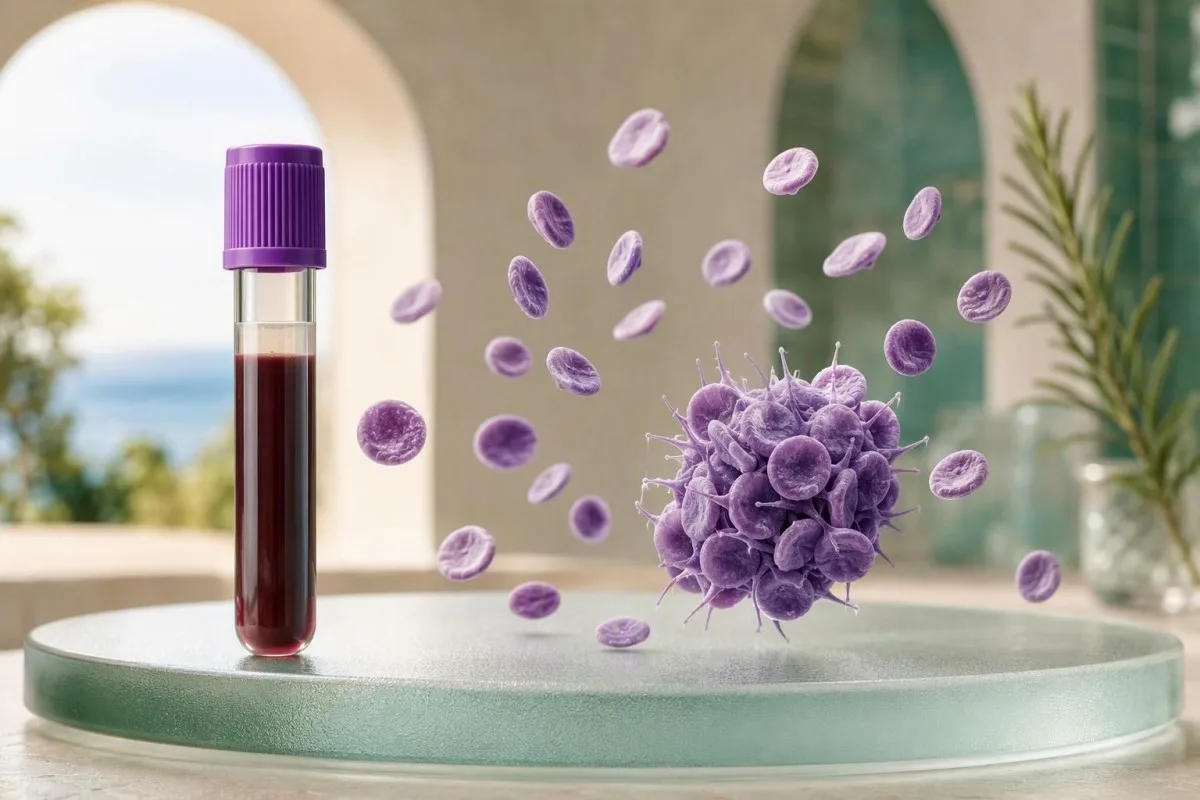
Cacah trombosit sing sithik kadhangkala bisa dadi kesalahan pangukuran tabung tinimbang masalah ing awak. Iki carane pseudothrombocytopenia sing ana gandhengane karo EDTA diidentifikasi sadurunge ana sing ngarani sampeyan trombositopenia.


- Pseudothrombocytopenia minangka cacah trombosit sing sithik banget amarga trombosit gumpalan sawise dikoleksi, asring banget ing tabung EDTA.
- Rentang trombosit sing umum kanggo wong diwasa non-meteng umume kira-kira 150-450 × 10⁹/L, sanajan laboratorium netepake interval dhewe.
- Gumpalan trombosit ing smear bisa nyebabake penganalisis otomatis ngitung trombosit kanthi kurang amarga kluster ora diukur minangka sel sing kapisah.
- njupuk maneh sitrat asring ngrampungake gumpalan trombosit EDTA; laboratorium umume ngetrapake koreksi dilusi 1,1 menyang cacah trombosit sitrat.
- Ora ana gejala getiunan ditambah cacah trombosit sithik sing ora dikarepke kudu mriksa smear sadurunge perawatan utawa keputusan rujukan sing cepet.
- Tlaten trombositopenia sejati bisa ana bebarengan kanthi gumpalan trombosit EDTA, mula asil sitrat sing normal nyenengake nanging kudu cocog karo gambaran klinis.
- Penilaian sing mendesak isih dibutuhake kanggo pendarahan sing ora bisa dikontrol, petechiae anyar sing nyebar, sakit kepala parah, bingung, utawa jumlah trombosit ing ngisor 10 × 10⁹/L.
Apa tegese gumpalan trombosit EDTA
Gumpalan trombosit EDTA minangka artefak laboratorium *in-vitro* ing ngendi trombosit nempel bebarengan ing tabung koleksi, nyebabake jumlah trombosit otomatis sing luwih murah. Ora kanthi dhewe ateges trombosit dirusak ing awak, lan biasane ora nyebabake risiko pendarahan.
EDTA minangka aditif tabung lavender-top sing digunakake kanggo umume jumlah getih lengkap amarga ngikat kalsium lan nyegah koagulasi. Ing subset cilik wong, mbusak kalsium mbukak target permukaan trombosit sing ngidini antibodi sing ana alami kanggo ngubungake trombosit bebarengan. Penganalisis bisa ngitung kluster trombosit minangka siji partikel gedhe, acara ukuran sel putih, utawa ora kabeh; waca ringkesan kita babagan apa sing kalebu ing CBC.
Ing pakaryanku ing klinik, laporan klasik yaiku jumlah trombosit 48 × 10⁹/L ing wong sing krasa sehat, ora ana memar, lan duwe hemoglobin lan jumlah sel putih normal. Disparitas kasebut dudu bukti, nanging minangka wayahe mandheg. Kantesti minangka Analisa tes getih AI sing nuduhake jumlah trombosit rendah sing terisolasi bebarengan karo komentar laboratorium kayata agregat trombosit, tinimbang nambani angka kasebut minangka diagnosis.
Pseudotrombositopenia gumantung EDTA dirata-rata kira-kira 0,03-0,27% sampel rawat jalan rutin, kanthi tingkat sing luwih dhuwur ing antarane sampel sing wis dikirim kanggo jumlah trombosit rendah. Lippi lan kanca-kanca nggambarake minangka fenomena pra-analitik sing ora mbebayani sacara klinis nanging bisa nyebabake akibat amarga bisa nyebabake admissions sing ora perlu, transfusi trombosit, utawa perawatan steroid (Lippi et al., 2012).
Carane penganalisis trombosit bisa ngitung sampel sing gumpal kanthi kurang
Cacah trombosit otomatis bisa dipercaya kanggo trombosit sing disebarake, nanging kluster ana ing njaba ukuran lan pola sinyal sing diarepake penganalisis. Mulane, jumlah bisa mudhun saka 220 × 10⁹/L sing asli dadi 40 × 10⁹/L sing katon tanpa ilang trombosit biologis.
Penganalisis impedansi nggolongake partikel utamane miturut volume, dene sistem optik nambah informasi pantulan cahya. Trombosit biasane udakara 2-3 mikrometer, nanging gumpalan bisa tumpang tindih karo fragmen sel abang utawa wilayah leukosit. Iki sebabe histogram trombosit bisa ora normal lan ngapa laboratorium bisa nambah “gumpalan trombosit ana” utawa “cacah ora bisa dipercaya.”
Tandha trombosit penganalisis minangka pituduh kanggo review manungsa, dudu diagnosis akhir. Prakiraan manual saka apusan perifer sing digawe kanthi apik bisa luwih migunani tinimbang mbaleni tabung EDTA sing padha, utamane yen sampel ngenteni 2 jam sadurunge dianalisis. Kanggo ambang praktis ing prosedur, panduan kita babagan jumlah trombosit sadurunge ekstraksi untu nerangake kenapa asil sing diverifikasi penting.
Trombosit gedhe nggawe masalah sing beda, kadang tumpang tindih. Trombosit individu sing gedhe banget bisa dilewatake dening metode impedansi sanajan tanpa gumpalan sing katon, asring ngunggahake volume trombosit rata-rata (MPV). MPV sing dhuwur ora bisa diganti karo pseudotrombositopenia; review kita babagan panyebab trombosit gedhe misahake rong panemuan kasebut.
Apa sing katon kaya gumpalan trombosit ing smear
Gumpalan trombosit ing apus katon minangka klompok unsur granular ungu cilik sing ora teratur kaya anggur, asring konsentrasi ing pinggir ngiris sing ngepung. Lokasine penting amarga ngitung mung lapangan apus tengah bisa nggawe fitur sing nerangake asil sing sithik.
Ahli morfologi terlatih mriksa awak lan buntut film ing kekuwatan dhuwur, ora mung lapangan sing makili. Satellitism trombosit minangka pola sing ana gandhengane karo EDTA sing luwih langka ing ngendi trombosit ngubengi neutrofil kaya rosette; uga bisa nyuda jumlah trombosit sing dilapurake. Kaloro panemuan kasebut minangka fenomena sampel, sanajan satellitism lan agregat sing amba bisa kadhangkala kedadeyan bebarengan.
Salah sawijining detail sing migunani yaiku gumpalan EDTA asring saya tambah kanthi wektu. Sampel sing diukur 10 menit sawise koleksi bisa nuduhake 118 × 10⁹/L, banjur 42 × 10⁹/L ing 90 menit amarga agregat liyane terbentuk. Laboratorium beda-beda ing alur kerjane, mula jumlah awal sing normal ora bisa ngilangi artefak iki yen tandha penganalisis mengko muncul.
Nalika kula, Thomas Klein, MD, mirsani jumlah platelet ingkang andhap dipunsertai komentar smear nanging boten wonten pendarahan klinis, kula nyuwun interpretasi smear ingkang leres sakderengipun ngrembag trombositopenia imun. Pamikiran ingkang sami ngginakaken mikroskop dados pigunan nalika laporan nyebataken schistocytes ing film getih, sanadyan schistocytes mbetahaken konteks klinis ingkang langkung mendesak.
Kenapa EDTA nyebabake gumpalan trombosit ing sawetara wong
EDTA saged nyebabaken platelet gumpal kanthi nyerep kalsium lan ngowahi wujud glycoprotein membran platelet, saengga antibodi saged nempel lan ngubungaken platelet ing sacedhake. Reaksi punika dumadi sasampunipun dipunpendhet, sanes amargi EDTA sampun ngrusak platelet ingkang mlampah wonten ing badan.
Mekanisme ingkang paling dipunsuportani nglibataken antibodi, asring IgG, IgM, utawi IgA, ingkang ngenali situs-situs tartamtu ing kompleks GPIIb/IIIa platelet sasampunipun owah-owahan struktural ingkang gumantung kalsium. Reaksi punika gumantung suhu lan wekdal ing sawetawis pasien, ingkang njelasaken ngapa sampel ingkang dipunangeti saged ngapikake cacahipun nanging boten dados solusi ingkang universal. Punika masalah kecocokan laboratorium, sanes alergi marang EDTA.
Pseudothrombocytopenia saged dumadi ing tiyang sehat lan sampun dipunlapuraken sesarengan kaliyan kondisi autoimun, infeksi, keganasan, lan meteng, nanging asosiasi kasebut boten netepaken sabab ing individu. ANA ingkang positif utawi penyakit virus ingkang nembe dumadi boten kedah dipun-ginakaken kangge njelasaken cacahipun ngantos artefakipun dipun-eksklusifaken. Kantesti inggih punika platform interpretasi hasil tes getih AI ingkang maos asil platelet kaliyan jinis tabungipun, penanda analyzer, lan sisa CBC sanesipun kanthi terpisah.
Fenomena punika saged tetep salami pirang-pirang taun nanging bervariasi antawisipun pangambilan. Pasien saged gadhah jumlah platelet 35 × 10⁹/L ing EDTA ing Senen lan 230 × 10⁹/L ing sitrat ing sonten ingkang sami, lajeng nampilaken gumpalan parsial malih sasampunipun pirang-pirang wulan. Nyathet tabung ingkang dipunpreferensi ing cathetan laboratorium saged nyegah alarem ingkang kaping pindho.
Carane njupuk maneh sitrat negesake pseudothrombocytopenia
Jumlah platelet ingkang normal ing tabung natrium sitrat nalika tabung EDTA ngemot agregat mbok menawi nuduhake pseudothrombocytopenia gumantung EDTA. Jumlah sitrat mbetahaken penyesuaian dilusi amargi tabung ngemot antikoagulan cair.
Tabung natrium sitrat kanthi tutup biru umume dipunisi kanthi rasio getih-antikoagulan 9:1. Kathah laboratorium nambahake jumlah platelet sitrat ingkang dipunukur kaping 1.1 kangge koreksi dilusi, sanadyan metode laboratorium lokal ingkang sampun dipunvalidasi dados prioritas. Contonipun, asil sitrat mentah 182 × 10⁹/L dados kirang langkung 200 × 10⁹/L sasampunipun koreksi.
Pangambilan malih kedah dipunisi kanthi leres lan dipuncampur kanthi alus. Tabung sitrat ingkang kirang isi ngowahi rasio antikoagulan lan saged nyiptakake asil ingkang sanes ingkang mblusukaken, ingkang dados salah satunggaling alesan ilmuwan laboratorium saged nolak pangulangan ingkang katingalipun gampil. Panjelasan kita babagan warna tabung tes getih mbiyantu pasien mangertos ngapa pilihan tabung dados péranganing metode tes.
Tabung magnesium sulfat utawi asam-sitrat-dekstrosa saged dados pigunan nalika gumpalan tetep wonten ing sitrat, nanging punika umume dados kaputusan ingkang dipunarahaken dening laboratorium. Nagler lan rekan-rekane nyathet kasus ing pundi pangertosan pseudothrombocytopenia gumantung EDTA nyegah investigasi diagnostik ingkang boten perlu sasampunipun tes sitrat nuduhake jumlah ingkang cekap (Nagler et al., 2014).
Kapan cacah trombosit sitrat ora ngrampungake pitakonan
Pangambilan sitrat malih boten nemtokake trombositopenia ingkang nyata nalika jumlah ingkang dipunkoreksi tetep andhap, gumpalan dumadi ing luwih saking setunggal antikoagulan, utawi gejala nuduhake pendarahan. Sawetawis pasien gadhah agregasi platelet multi-antikoagulan, lan sawetawis gadhah jumlah ingkang andhap ingkang nyata sesarengan kaliyan artefak.
Menawi jumlah platelet sitrat ingkang dipunkoreksi 82 × 10⁹/L lan smear bebas gumpalan, punika trombositopenia ingkang asli ngantos dibuktekaken sanesipun. Menawi EDTA 25 × 10⁹/L lan sitrat 86 × 10⁹/L kanthi agregat sisa, artefak lan pangurangan ingkang nyata saged wonten. Tim klinis kedah ngginakaken prakiraan ingkang paling sae ingkang dipunverifikasi, sanes sekadar milih angka ingkang langkung njamin.
Pembekuan ing sampel ugi saged mbatalake CBC amargi platelet dikonsumsi wonten ing mikrogumpalan. Sanes kaliyan pseudothrombocytopenia EDTA, sampel ingkang gumpalan sebagian saged mangaruhi sel putih lan indeks sel abang ugi. Waos pandhuan pengambilan malih sasampunipun masalah sampel kangge beda praktis antawisipun artefak koleksi.
Sampel tusuk driji ora kanthi otomatis luwih aman. Pangumpulan sing alon, remukan, utawa campuran sing ditundha bisa nyebabake agregasi lokal lan ngompromi jumlah trombosit, utamane nalika nilai sing dilaporake kurang saka 100 × 10⁹/L. Pangumpulan vena kanthi pangolahan sing cepet biasane minangka cara konfirmasi sing luwih resik.
Rentang cacah trombosit, risiko getiunan, lan jebakan artefak
Umume laboratorium wong diwasa nggunakake interval referensi jumlah trombosit cedhak 150-450 × 10⁹/L, nanging risiko getiunan gumantung saka jumlah sing diverifikasi, sababe, fungsi trombosit, lan obat-obatan. Asil EDTA sing salah rendah ora kena digunakake dhewe kanggo nolak prosedur utawa menehi perawatan.
Getiunan gedhe sing spontan luwih mungkin nalika jumlah trombosit sing sejati mudhun nganti udakara 10 × 10⁹/L, nalika akeh wong kanthi jumlah sing stabil luwih saka 50 × 10⁹/L duwe getiunan spontan sing sithik. Iki minangka pandhuan klinis sing jembar, dudu idin kanggo nglirwakake gejala. Antikoagulan, aspirin, penyakit ati, gagal ginjal, lan disfungsi trombosit bisa ngowahi risiko ing nomer apa wae.
Jumlah trombosit 90 × 10⁹/L mbutuhake penanganan sing beda ing wong sing sehat kanthi asil sitrat normal tinimbang ing wong sing duwe melena anyar lan INR sing dhuwur. Mulane interpretasi jumlah trombosit ana ing jejere tes koagulasi; kita aPTT lan pandhuan tes beku nerangake apa sing bisa lan ora bisa ditindakake dening layar pembekuan normal.
Laboratorium bisa nggunakake 140 × 10⁹/L tinimbang 150 × 10⁹/L minangka watesan referensi ngisor, utamane kanthi interval sing diturunake sacara lokal. Interval referensi nggambarake 95% saka populasi komparator; ora nemtokake ambang perawatan universal. Pembedaan iki ngirit akeh kekhawatiran sing ora perlu.
Pola CBC sing nggawe artefak luwih mungkin
Jumlah trombosit sing sithik banget sing terisolasi kanthi hemoglobin normal, sel putih, lan komentar gumpalan minangka pola CBC sing paling nuduhake pseudothrombocytopenia. Pola iki nuduhake tinimbang diagnostik amarga trombositopenia kekebalan utawa sing ana gandhengane karo obat ing wiwitan uga bisa terisolasi.
Gangguan sumsum sing sejati asring ngganti luwih saka siji jalur sel getih, sanajan ana pangecualian. Trombosit sing sithik digabungake karo hemoglobin sing mudhun, sel putih abnormal, blast, utawa gejala konstitusional sing terus-terusan mbutuhake tinjauan klinis sing cepet lan asring pemeriksaan film formal. Artikel kita babagan jalur CBC kanggo kelainan getih njlentrehake kenapa klompok kasebut ngowahi urgensi.
Rasio trombosit-kanggo-limfosit bisa ora ana tegese nalika denominator valid nanging numerator trombosit ditekan kanthi artifisial. PLR 60 sing diitung saka jumlah EDTA-gumpalan ora kudu ditafsirake minangka sinyal inflamasi utawa kardiovaskular. Iki minangka kesalahan sekunder sing tenang nanging umum ing laporan kesehatan otomatis; waca panjelasan kita babagan asil PLR dhuwur.
Kantesti AI ngenali discordance antarane jumlah trombosit sing sithik lan ukuran CBC tetanggan sing normal, banjur ngarahake pamaca kanggo verifikasi komentar sampel. A Piranti analisis tes getih berbasis AI ora bakal ngowahi siji nilai trombosit sing durung diverifikasi dadi label penyakit. Keterbatasan klinis kasebut luwih penting tinimbang kacepetan.
Kehamilan, perawatan rumah sakit, lan setelan liyane sing berisiko dhuwur
Gumpalan trombosit EDTA bisa kedadeyan nalika meteng lan perawatan rumah sakit, nanging ora kudu diasumsi nalika trombositopenia sejati bisa ngowahi manajemen darurat. Sabab-sabab sing spesifik kanggo meteng kayata trombositopenia gestasional, pre-eklampsia, sindrom HELLP, lan trombositopenia imun mbutuhake cacah sing wis diverifikasi.
Jumlah trombosit biasane mudhun nalika meteng tanpa komplikasi, lan sawetara laboratorium nampa wates referensi sing luwih murah miturut trimester. Cacah ing ngisor 100 × 10⁹/L luwih jarang kanggo trombositopenia gestasional tanpa komplikasi lan mbutuhake evaluasi klinis sing tliti, sanajan agregat EDTA katon. Panduan referensi trombosit trimester-spesifik kita nalika meteng menehi konteks tanpa ngganti tinjauan obstetrik. pandhuan referensi trombosit nalika meteng menehi konteks tanpa ngganti tinjauan obstetrik.
Ing rumah sakit, mudhun dadakan luwih saka 50% saka dhasar bisa nyebabake pitakonan babagan sepsis, paparan obat, trombositopenia sing disebabake heparin, dilusi, utawa konsumsi sing ana gandhengane karo piranti. Artefak EDTA bisa niru penurunan sing dramatis, utamane nalika asil sadurunge asale saka metode laboratorium sing beda. Mbandhingake asil sitrat sing diverifikasi karo dhasar pasien asring luwih migunani tinimbang mbaleni CBC EDTA rutin.
Sadurunge epidural, operasi, siklus kemoterapi, utawa transfusi trombosit, takon apa laboratorium wis ngonfirmasi nilai ing apus utawa antikoagulan alternatif. Aku wis weruh penundaan ing perawatan dihindari dening siji telpon kasebut. Kosok baline, gejala aktif utawa pasien sing ora stabil kudu dievaluasi nalika konfirmasi lagi berlangsung.
Obat-obatan lan diagnosis sing ora kudu disalahake kanthi cepet
Gumpalan trombosit EDTA kudu diilangi sadurunge ngubungake jumlah trombosit rendah sing terisolasi menyang obat, penyakit otoimun, utawa trombositopenia imun. Mungkasi obat sing penting adhedhasar cacah sing durung diverifikasi bisa nyebabake cilaka sing bisa dihindari.
Heparin, produk sing ngemot kuinin, trimethoprim-sulfamethoxazole, valproate, linezolid, kemoterapi, lan sawetara terapi kekebalan bisa nyebabake trombositopenia nyata. Hubungan wektu iku penting: penurunan sing ana gandhengane karo obat biasane terus ana ing sampel sitrat sing diklumpukake kanthi bener lan ora ilang nalika EDTA diganti. Riwayat obat kudu kalebu suntikan, produk over-the-counter, lan persiapan herbal.
Trombositopenia imun minangka diagnosis pengecualian, dudu tandha laboratorium. Bisa uga katon kanthi trombosit sing terisolasi ing ngisor 100 × 10⁹/L, nanging apus EDTA sing gumpalan nggawe cacah awal ora bisa ditafsirake. Lippi et al. (2012) khusus ngelingake yen ngerteni pseudotrombositopenia nyegah terapi sing ora cocog kayata kortikosteroid lan splenektomi.
Yen laporan katon nglawan asil sadurunge, simpen PDF asli lan cathet tanggal koleksi, komentar tabung, penyakit akut, lan obat-obatan anyar. Pandhuan kita kanggo owah-owahan sing nduweni makna ing antarane tes getih nerangake ngapa delta numerik ora otomatis owah-owahan biologis.
Apa sing kudu ditakoni menyang laboratorium utawa klinisi sabanjure
Kanggo jumlah trombosit rendah sing ora dikarepke, takon apa gumpalan trombosit katon, apa apus perifer ditinjau, lan apa jumlah antikoagulan alternatif bisa ditindakake. Telu pitakonan kasebut biasane ngklarifikasi langkah sabanjure luwih cepet tinimbang nggoleki gejala online.
Panjaluk praktis yaiku: “Apa laboratorium bisa mriksa film getih kanggo agregat trombosit lan, yen perlu, mbaleni jumlah trombosit ing sitrat?” Iki ora nuntut diagnosis tartamtu; iku njaluk supaya pangukuran divalidasi. Yen sampel diklumpukake ing papan liya, klinisi bisa uga kudu pesen draw anyar tinimbang nambah pengujian menyang tabung lawas.
Takon babagan corrected asil sitrat lan apa gumpalan terus ana ing tabung kasebut. Asil mentah 145 × 10⁹/L bisa katon wates nganti koreksi dilusi ngasilake kira-kira 160 × 10⁹/L. Uga takon apa laboratorium nggunakake jumlah trombosit optik utawa fluoresensi, amarga metode kasebut kadang-kadang nambah enumerasi ing sampel sing kompleks.
Alur kerja interpretasi Kantesti's 2026 nyengkuyung pangguna kanggo mbandhingake asil numerik karo narasi laboratorium lan bidang tandha sadurunge tumindak nalika ana peringatan. Kanggo kerangka keamanan sing luwih akeh, checklist akurasi laporan AI nyakup transkripsi, unit, kisaran referensi, lan verifikasi asil.
Apa sing ora kudu ditindakake nalika ngenteni konfirmasi
Aja miwiti suplemen, mungkasi obat sing diresepake, utawa nganggep sampeyan duwe kelainan getihen mung amarga siji cacah trombosit EDTA rendah. Ing wektu sing padha, aja nglirwakake getihen aktif mung amarga gumpalan dicurigai.
Ora ana diet, vitamin, utawa obat omah sing ngoreksi pseudotrombositopenia gumantung EDTA amarga trombosit lagi gumpalan ing tabung, ora gagal ing njero awak. Kekurangan folat, vitamin B12, lan zat besi bisa mengaruhi pembentukan getih ing setelan liyane, nanging suplemen ora bisa mbenerake cacah sing patut dipertanyakan. Ngatasi artefak babagan koleksi lan analisis.
Suwena saka aspirin, ibuprofen, naproxen sing ora perlu, lan ngombe alkohol akeh nganti ana klinisi sing njlentrehake jumlah sing dilaporake sithik banget, utamane yen gampang memar. Aja mandhegake obat antikoagulan, obat antiplatelet, obat antikonvulsan, utawa perawatan kanker tanpa pitutur saka sing menehi resep; indikasi kanggo obat kasebut bisa luwih mbebayani tinimbang asil sing durung diverifikasi.
Nglakokake garis wektu asil sing ringkes bisa ngganti janji temu. panuntun nelusuri asil laboratorium nyaranake nyathet wektu njupuk getih, penyakit anyar, obat-obatan, komentar sampel, lan apa asil kasebut asale saka EDTA utawa sitrat.
Tandha-tandha abang sing mbutuhake evaluasi medis sing cepet
Golek evaluasi medis darurat kanggo pendarahan sing ora dikontrol, bangku ireng, mutah getih, sirah abot sing anyar, bingung, pingsan, utawa ruam titik-titik sing nyebar, sanajan dicurigai klumping EDTA. Artefak laboratorium lan darurat sejati bisa ana bebarengan.
Jumlah platelet sing sejati kurang saka 10 × 10⁹/L umume dianggep minangka asil darurat amarga risiko pendarahan mukosa lan internal sing spontan mundhak banget. Jumlah kurang saka 20 × 10⁹/L kanthi pendarahan anyar, demam, hipertensi abot, komplikasi meteng, utawa paparan heparin anyar uga mbutuhake input klinisi dina sing padha. Nasihat darurat lokal kudu luwih diutamakake tinimbang interpretasi online apa wae.
Gejala neurologis anyar utamane penting amarga pendarahan intrakranial ora umum nanging serius. Aja nyopir dhewe yen sampeyan ngalami sirah abot kanthi kelemahan, owah-owahan ucapan, tiba, utawa bingung. Ing bocah-bocah, ruam sing ora bisa ilang kanthi demam mbutuhake evaluasi darurat sanajan ana asil platelet.
Thomas Klein, MD, menehi saran pasien supaya misahake pitakonan “Apa jumlah iki nyata?” saka “Apa wong iki aman dina iki?” Sing pertama biasane mbutuhake apusan lan redraw sitrat; sing terakhir gumantung saka gejala, temuan pemeriksaan, lan gambaran klinis sakabehe. pandhuan pendapat kapindho tes getih bisa mbantu nyiyapake diskusi sing fokus sawise masalah darurat ditangani.
Carane Kantesti ninterpretasikake cacah trombosit sing ditandhani kanthi aman
Kantesti AI ngolah jumlah platelet sing sithik kanthi komentar klumping EDTA minangka sinyal verifikasi, dudu bukti trombositopenia. Interpretasi kita nempatake tandha penganalisis, garis CBC liyane, nilai sadurunge, lan gejala sing dilaporake luwih dhisik tinimbang label abang-utawa-ijo sing gampang.
Kantesti iku sawijining layanan interpretasi tes lab AI dirancang kanggo nerangake data laboratorium kanthi basa sing gampang nalika njaga watesan laporan sumber. Yen PDF sing diunggah nyatakake “klump platelet,” sistem kita kudu ngandhani pangguna manawa jumlah kasebut bisa uga luwih murah lan laboratorium utawa klinisi bisa ngonfirmasi kanthi tinjauan film utawa sampel sitrat.
Pengenalan karakter digital bisa salah maca titik desimal, unit, utawa cathetan kaki laboratorium. Mulane, pasien kudu mriksa pratinjau gambar sadurunge ngandelake interpretasi digital apa wae, utamane ing sakiwa tengene nilai kayata 18 vs 180 × 10⁹/L. checklist kualitas unggah PDF nerangake sawetara cek sing nyegah akeh kesalahan sing bisa dicegah.
Pengawasan klinis tetep dadi karya manungsa. Metodologi Kantesti ditinjau marang alur kerja sing fokus ing keamanan; pamaca sing pengin ngerti pendekatan kita bisa mriksa validasi teknis lan pengawasan klinis. AI bisa ngatur pitakonan kanthi efisien, nanging ora bisa mriksa apusan sing asli utawa ngevaluasi pendarahan aktif.
Rencana tindak lanjut praktis sawise gumpalan trombosit EDTA
Rencana tindak lanjut biasane yaiku nyathet artefak EDTA, njupuk jumlah platelet alternatif sing wis diverifikasi, lan nggunakake asil kasebut kanggo keputusan klinis ing mbesuk. Umume wong ora butuh perawatan kanggo artefak kasebut sawise laboratorium netepake polane.
Nyuwun cathetan laboratorium kanggo nyathet “klumping platelet gumantung EDTA” utawa tembung sing padha yen konfirmasi cetha. Ing pangambilan sabanjure, tim phlebotomy bisa njupuk tabung sitrat bebarengan karo CBC EDTA rutin, ngirit janji temu kapindho. Iki utamané migunani sadurunge operasi, nalika meteng, utawa nalika protokol perawatan duwe ambang platelet.
Garis dasar sing wis diverifikasi luwih berharga tinimbang nilai sing sithik sing bola-bali durung diverifikasi. Yen jumlah sitrat sing wis dikoreksi stabil ing 205 × 10⁹/L sajrone 12 wulan, nilai EDTA ing mangsa ngarep 55 × 10⁹/L kanthi agregat luwih ora medeni tinimbang nomer sing padha ing wong tanpa dokumentasi sadurunge. Tren migunani mung nalika metode pengujian bisa dibandhingake.
Kantesti wis ndhukung luwih saka 2 yuta pangguna ing 127+ negara kanthi panjelasan laboratorium multibasa, nanging asil kasebut isih dadi hubungan perawatan karo klinisi sampeyan. Peninjau medis lan Dewan Penasehat Medis nandhesake aturan pungkasan sing padha: verifikasi jumlah platelet dhisik, banjur mutusake apa—yen ana—sing butuh perawatan.
Publikasi riset
Wiwit tanggal 29 Agustus 2026, kaloro publikasi riset Kantesti ing ngisor iki minangka sumber pendhidhikan tambahan. Dheweke ora netepake diagnosis pseudothrombocytopenia gumantung EDTA; smear laboratorium lan cacah platelet antikoagulan alternatif tetep dadi alat konfirmasi sing relevan.
Pitakonan sing Sering Ditakoni
Apa penggumpalan trombosit EDTA bisa nyebabake cacah trombosit sing sithik banget?
Inggih. Gumpalan trombosit EDTA saged ngasilaken cacah trombosit palsu ingkang sanget cendhek, kadhang kala kirang saking 50 × 10⁹/L, nalika cacah trombosit ing peredaran ingkang leres normal. Analyzer ngitung cacah trombosit kanthi boten leres amargi boten saged ngenali saben trombosit wonten ing klumpukaken. Ulesan smear perifer ingkang nuduhaken klumpukaken lan cacah sitrat koreksi normal kiyat maringi dhukungan pseudothrombocytopenia. Wangsul kedah tetep dipun priksa kanthi wigati menawi wonten pendarahan aktif utawi cacah sitrat tetep cendhek.
Kepriye carane netepake pseudothrombocytopenia?
Pseudothrombositopenia biasane dikonfirmasi kanthi mriksa apusan perifer kanggo gumpalan trombosit lan ngulang jumlah trombosit ing tabung natrium sitrat. Tabung sitrat ngemot antikoagulan cair, mula akeh laboratorium ngitake jumlah trombosit sing diukur kanthi 1,1 kanggo ngitung dilusi. Contone, jumlah sitrat mentah 180 × 10⁹/L biasane dilaporake udakara 198 × 10⁹/L sawise koreksi. Koreksi sing wis divalidasi lan interpretasi apusan laboratorium lokal kudu nuntun asil pungkasan.
Apa ngegumpalé platelet EDTA tegesé aku ngalami kelainan getihen?
KRESULT EDTA platelet clumping piyambak minangka artefak sampel ing vitro lan ora ateges sampeyan duwe kelainan getihen utawa trombosit sampeyan gumpalan ing sirkulasi. Umume wong sing kena pengaruh ora duwe gejala getihen lan duwe jumlah trombosit sing wis diverifikasi ing interval diwasa umum udakara 150-450 × 10⁹/L. Klinisi kudu nyelidiki gejala getihen, tes koagulasi sing ora normal, utawa jumlah trombosit sitrat sing terus-terusan kurang. Artefak kasebut ora nglindhungi wong saka risiko getihen sing ora ana gandhengane amarga obat-obatan utawa kondisi medis.
Apa penggumpalan trombosit bisa kedadeyan ing sitrat uga?
Inggih, sanadyan natrium sitrat asring nyegah gumpalan sing ana gandhengane karo EDTA, agregasi platelet kadhangkala bisa tetep ana ing sitrat utawa kedadeyan kanthi pirang-pirang antikoagulan. Ing kahanan kasebut, laboratorium bisa nggunakake cacah platelet optik utawa fluoresensi, pangolahan pemanasan cepet, magnesium sulfat, utawa asam-sitrat-dekstrosa gumantung saka protokol sing wis divalidasi. Cacah sitrat sing dibenerake ing ngisor 150 × 10⁹/L tanpa agregat kudu dianggep minangka trombositopenia sejati. Gumpalan multi-antikoagulan ora umum lan mbutuhake konfirmasi sing dipandu laboratorium.
Apa aku kudu ngulang etungane platelet yen laporene nyebutake klumpen platelet?
Inggih. Laporan ingkang nyatakaken gumpalan platelet, agregat platelet, utawi cacah platelet ingkang boten teras-terasan lumrahipun mbetahaken pangruksan tinimbang nampi asil angka. Ulangipun limrahipun sampel natrium sitrat ingkang nembe dipunpendhet kanthi pamriksan smear, prayoginipun dipunproses kanthi rikat. Menawi cacahipun asli kirang saking 10 × 10⁹/L utawi panjenengan ngalami pendarahan ingkang boten ngontrol, tinja cemeng, sakit sirah ingkang parah, utawi bingung, goleki pitulungan medis kanthi mendesak nalika pangruksan dipunatur. Boten nggantos obat ingkang dipundawuhaken tanpa pitutur saking klinisi ingkang mangertos alesanipun dipundawuhaken.
Apa pseudothrombocytopenia EDTA bisa teka lan lunga?
Inggih. Pseudothrombocytopenia EDTA saged tetep wonten ngantos pirang-pirang taun utawi katon gonta-ganti amargi tingkat kekempalan gumantung wekdal sasampunipun dipunpendhet, suhu sampel, lan metode analyzer. Sampel EDTA satunggal saged nglapuraken 70 × 10⁹/L wondene sanesipun ingkang dipundadosaken ing dinten benten nglapuraken 145 × 10⁹/L, senadyan cacah platelet sejatosipun stabil. Cekatan sitrat ingkang normal lan kadokumentasi saged dadosaken dhasar ingkang mupangati kangge perbandingan ing mangke. Nyadele laboratorium kanggé nyatet antikoagulan ingkang dipunremeni saged nyegah alarm palsu ingkang kaping-kaping.
Entuk Analisis Tes Getih Berbasis AI Dina Iki
Gabung karo luwih saka 2 yuta pangguna ing saindenging jagad sing percaya Kantesti kanggo analisis tes lab sing instan lan akurat. Unggah asil tes getihmu lan tampa interpretasi lengkap saka 15,000+ biomarker sajrone sawetara detik.
📚 Publikasi Riset sing Dirujuk
Klein, T., Mitchell, S., & Weber, H. (2026). Kantesti AI. (2026). Pandhuan Tes Getih Komplemen C3 C4 & Titer ANA. Zenodo. https://doi.org/10.5281/zenodo.18353989. Riset Medis AI Kantesti.
Klein, T., Mitchell, S., & Weber, H. (2026). Kantesti AI. (2026). Pandhuan Tes Getih Virus Nipah: Deteksi Dini & Diagnosis 2026. Zenodo. https://doi.org/10.5281/zenodo.18487418. Riset Medis AI Kantesti.
📖 Referensi Medis Eksternal
⚕️ Penafian Medis
Artikel iki mung kanggo tujuan edukasi lan ora dadi saran medis. Tansah konsultasi karo panyedhiya layanan kesehatan sing mumpuni kanggo keputusan diagnosis lan perawatan.
Sinyal Kepercayaan E-E-A-T
Pengalaman
Tinjauan klinis sing dipimpin dokter babagan alur kerja interpretasi lab.
Keahlian
Fokus kedokteran laboratorium babagan carane biomarker tumindak ing konteks klinis.
Kewibawaan
Ditulis dening Dr. Thomas Klein kanthi ditinjau dening Dr. Sarah Mitchell lan Prof. Dr. Hans Weber.
Kapercayan
Interpretasi adhedhasar bukti kanthi tindak lanjut sing cetha kanggo nyuda rasa kaget.