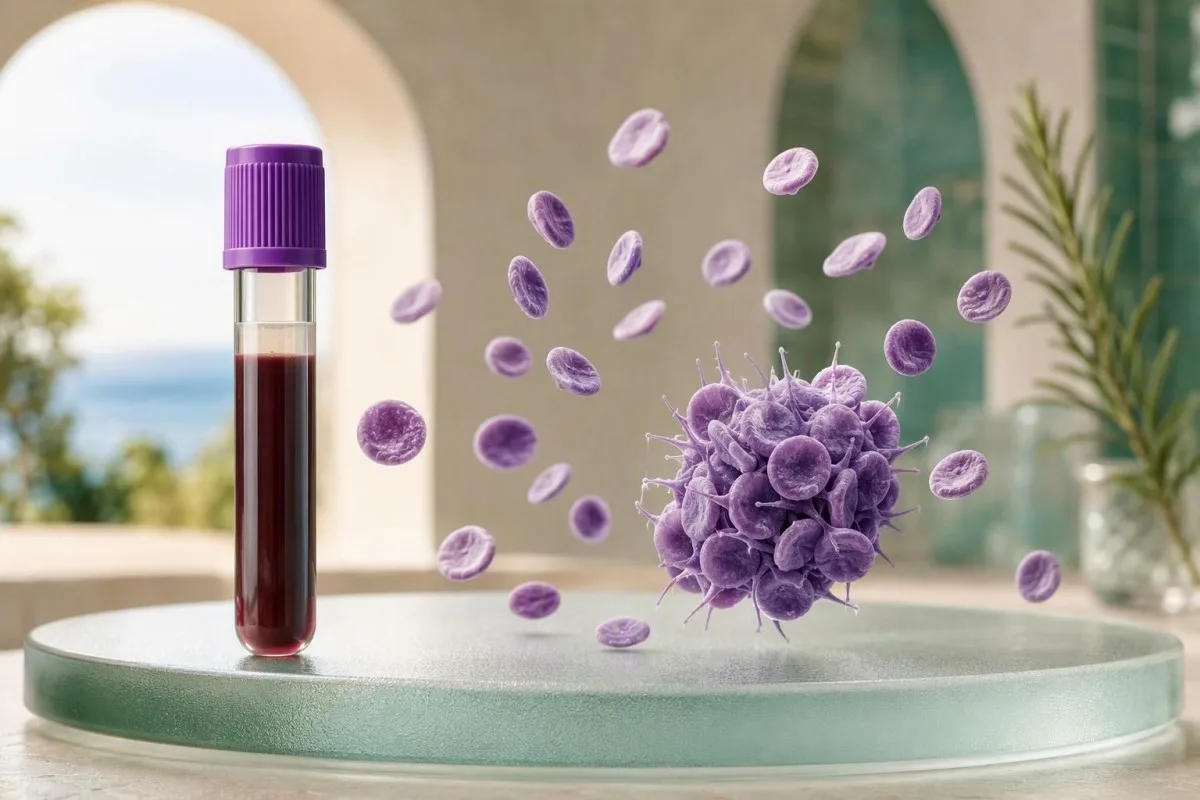
Un recompte baix de plaquetes pot ser ocasionalment un error de mesura relacionat amb el tub en lloc d'un problema dins del cos. Així és com s'identifica la pseudotrombocitopènia relacionada amb EDTA abans que se us etiqueti amb trombocitopènia.


- Pseudotrombocitopènia és un recompte de plaquetes falsament baix causat per l'agregació de plaquetes després de la recollida, més sovint en un tub d'EDTA.
- Rang típic de plaquetes per a la majoria d'adults no embarassades és aproximadament 150-450 × 10⁹/L, tot i que els laboratoris estableixen els seus propis intervals.
- Agregats de plaquetes en frotis poden fer que un analitzador automatitzat subestimi les plaquetes perquè un cúmul no es mesura com a cèl·lules separades.
- Nou dibuix amb citrat sovint resol l'agregació de plaquetes per EDTA; els laboratoris apliquen habitualment una correcció de dilució de 1,1 a un recompte de plaquetes amb citrat.
- Cap símptoma de sagnat més un recompte de plaquetes baix inesperadament aïllat hauria de provocar una revisió del frotis abans de prendre decisions de tractament o derivació urgent.
- La trombocitopènia veritable pot coexistir amb aglutinació plaquetària per EDTA, de manera que un resultat normal en citrat és tranquil·litzador, però s'ha d'ajustar al quadre clínic.
- Cal una valoració urgent encara cal per a sagnats no controlats, aparició de petèquies generalitzades, mal de cap intens, confusió o un recompte de plaquetes inferior a 10 × 10⁹/L.
Què significa realment l'agregació de plaquetes per EDTA
L'aglutinació plaquetària per EDTA és un artefacte de laboratori in vitro en el qual les plaquetes s'adhereixen al tub de recollida, provocant un recompte automatitzat de plaquetes falsament baix. No significa per si mateix que les plaquetes s'estiguin destruint al cos i normalment no crea un risc de sagnat.
L'EDTA és l'additiu del tub de tapa lavanda utilitzat per a la majoria dels hemogrames complets perquè s'uneix al calci i evita la coagulació. En un petit subconjunt de persones, l'eliminació del calci exposa antígens de la superfície plaquetària que permeten que anticossos naturals uneixin les plaquetes. L'analitzador pot comptar un cúmul de plaquetes com una partícula gran, un esdeveniment de la mida d'un leucòcit o res; vegeu la nostra visió general de què inclou una CBC.
En el meu treball clínic, l'informe clàssic és un recompte de plaquetes de 48 × 10⁹/L en algú que se sent completament bé, no té hematomes i té una hemoglobina i un recompte de leucòcits normals. Aquesta discrepància no és una prova, però és el moment de fer una pausa. El MPV és un Analitzador de sang amb IA que assenyala un recompte baixïtat aïllat de plaquetes juntament amb comentaris de laboratori com ara agregats plaquetaris, en lloc de tractar el número com un diagnòstic.
Es calcula que la pseudotrombocitopènia dependent d'EDTA es troba aproximadament en el 0,03-0,27% de les mostres rutinàries d'ambulatori, amb taxes més altes entre les mostres ja derivades per recomptes baixos de plaquetes. Lippi i col·legues la descriuen com un fenomen preanalític clínicament inofensiu però potencialment transcendent perquè pot desencadenar admissions, transfusions de plaquetes o tractament amb esteroides innecessaris (Lippi et al., 2012).
Com els analitzadors de plaquetes poden subestimar mostres agregades
Els recomptes automatitzats de plaquetes són fiables per a plaquetes disperses, però els cúmuls queden fora dels patrons de mida i senyal que espera l'analitzador. Per tant, un recompte pot caure d'un genuí 220 × 10⁹/L a un aparent 40 × 10⁹/L sense cap pèrdua biològica de plaquetes.
Els analitzadors d'impedància classifiquen les partícules principalment pel volum, mentre que els sistemes òptics hi afegeixen informació de dispersió de la llum. Una plaqueta sol tenir uns 2-3 micròmetres de diàmetre, però un cúmul pot solapar-se amb la regió de fragments de glòbuls vermells o leucòcits. Per això, un histograma de plaquetes pot ser anòmal i per això un laboratori pot afegir “clums plaquetaris presents” o “recompte no fiable”.”
El senyal de plaquetes de l'analitzador és una indicació per a la revisió humana, no un diagnòstic final. Una estimació manual d'un frotis perifèric ben fet pot ser més útil que repetir el mateix tub d'EDTA, especialment si la mostra va romandre 2 hores abans de l'anàlisi. Per a llindars pràctics al voltant de procediments, la nostra guia sobre recomptes de plaquetes abans d'extraccions dentàries explica per què un resultat verificat és important.
Les plaquetes grans creen un problema diferent, de vegades solapat. Les plaquetes individuals molt grans poden ser perdudes pels mètodes d'impedància fins i tot sense cúmuls visibles, sovint augmentant el volum plaquetari mitjà (MPV). Un MPV elevat no és intercanviable amb pseudotrombocitopènia; la nostra revisió de causes de plaquetes grans separa aquestes dues troballes.
Com es veuen els agregats de plaquetes en un frotis
Els cúmuls de plaquetes en un frotis apareixen com a grups irregulars semblants a raïms d'elements granulars porpres petits, sovint concentrats a la vora esfilagresada del portaobjectes. La seva ubicació és important perquè comptar només el camp central del frotis pot perdre la característica que explica el resultat baix.
Un morfòleg format comprova el cos i la cua de la pel·lícula amb un augment elevat, no només un camp representatiu. El satel·litismo plaquetari és un patró menys freqüent associat a l'EDTA en què les plaquetes envolten els neutròfils com una rosassa; també pot reduir el recompte de plaquetes reportat. Ambdues troballes són fenòmens de la mostra, encara que el satel·litismo i els agregats amplis poden ocórrer ocasionalment junts.
Un detall útil és que l'aglutinació per EDTA sovint progressa amb el temps. Una mostra mesurada 10 minuts després de la recollida pot mostrar 118 × 10⁹/L, després 42 × 10⁹/L als 90 minuts a mesura que es formen més agregats. Els laboratoris varien en el seu flux de treball, de manera que un recompte inicial normal no exclou completament aquest artefacte si apareix un senyal posterior de l'analitzador.
Quan, Thomas Klein, MD, veig un recompte baix juntament amb un comentari d'escritoris però sense hemorràgia clínica, demano la interpretació real de l'escritor sobre la trombocitopènia immune. Un raonament similar basat en la microscòpia és útil quan un informe esmenta esquistòcits en una pel·lícula de sang, tot i que els esquistòcits requereixen un context clínic molt més urgent.
Per què l'EDTA causa agregats de plaquetes en algunes persones
L'EDTA pot provocar l'agregació de plaquetes quelant el calci i canviant la forma de les glicoproteïnes de la membrana plaquetària, permetent que els anticossos s'uneixin i uneixin plaquetes veïnes. Aquesta reacció es produeix després de la recollida, no perquè l'EDTA hagi danyat les plaquetes circulants dins del cos.
El mecanisme millor fonamentat implica anticossos, sovint IgG, IgM o IgA, que reconeixen llocs críptics en el complex GPIIb/IIIa de les plaquetes després d'un canvi estructural dependent del calci. La reacció depèn de la temperatura i el temps en alguns pacients, cosa que explica per què una mostra escalfada pot millorar ocasionalment el recompte, però no és una solució universal. És un problema de compatibilitat de laboratori, no una al·lèrgia a l'EDTA.
La pseudotrombocitopènia pot ocórrer en persones sanes i s'ha informat juntament amb afeccions autoimmunes, infeccions, malignitat i embaràs, però aquestes associacions no estableixen causalitat en un individu. Un ANA positiu o una malaltia viral recent no s'han d'utilitzar per explicar el recompte fins que no s'hagi exclòs l'artefacte. Kantesti és un plataforma d’interpretació d’anàlisi de sang AI que llegeix un resultat de plaquetes amb el tipus de tub, les marques de l'analitzador i la resta de la CBC en lloc d'aïlladament.
El fenomen pot persistir durant anys i variar entre extraccions. Un pacient pot tenir un recompte de plaquetes de 35 × 10⁹/L en EDTA un dilluns i 230 × 10⁹/L en citrat el mateix matí, i després mostrar agregació parcial de nou mesos després. Enregistre el tub preferit al registre del laboratori pot evitar alarmes repetides.
Com un nou dibuix amb citrat confirma la pseudotrombocitopènia
Un recompte de plaquetes que es normalitza en un tub de citrat de sodi mentre que el tub d'EDTA conté agregats dóna suport sòlidament a la pseudotrombocitopènia dependent de l'EDTA. El recompte de citrat necessita un ajust de dilució perquè el tub conté anticoagulant líquid.
Els tubs de tub blau de citrat de sodi generalment s'omplen amb una relació sang-anticoagulant de 9:1. Molts laboratoris multipliquen el recompte de plaquetes de citrat mesurat per 1.1 per corregir la dilució, encara que el mètode validat del laboratori local té precedència. Per exemple, un resultat brut de citrat de 182 × 10⁹/L es converteix en aproximadament 200 × 10⁹/L després de la correcció.
La nova extracció s'ha d'omplir correctament i barrejar suaument. Un tub de citrat poc omplert canvia la relació anticoagulant i pot crear un resultat enganyós diferent, que és una de les raons per les quals un científic de laboratori pot rebutjar una repetició aparentment senzilla. La nostra explicació de colors dels tubs de mostres de sang ajuda els pacients a reconèixer per què l'elecció del tub forma part del mètode d'anàlisi.
Els tubs de sulfat de magnesi o àcid-citrat-dextrosa poden ser útils quan l'agregació continua en citrat, però això sol ser una decisió dirigida pel laboratori. Nagler i col·legues van documentar un cas en què el reconeixement de la pseudotrombocitopènia dependent de l'EDTA va evitar un estudi de diagnòstic innecessari després que les proves de citrat mostressin un recompte adequat (Nagler et al., 2014).
Quan un recompte de plaquetes amb citrat no resol la qüestió
Una nova extracció de citrat no descarta la trombocitopènia real quan el recompte corregit roman baix, l'agregació es produeix en més d'un anticoagulant o els símptomes suggereixen hemorràgia. Alguns pacients tenen agregació plaquetària multi-anticoagulant, i alguns tenen un recompte baix real al costat d'un artefacte.
Si el recompte de plaquetes de citrat corregit és de 82 × 10⁹/L i la pel·lícula està lliure d'agregats, això és trombocitopènia genuïna fins que es demostri el contrari. Si l'EDTA és de 25 × 10⁹/L i el citrat és de 86 × 10⁹/L amb agregats residuals, es poden presentar tant un artefacte com una reducció real. L'equip clínic ha d'utilitzar la millor estimació verificada, no simplement triar el número més tranquil·litzador.
La coagulació de la mostra també pot invalidar una CBC perquè les plaquetes es consumeixen dins del microcoàgul. A diferència de la pseudotrombocitopènia per EDTA, una mostra parcialment coagulada pot afectar també els glòbuls blancs i els índexs de glòbuls vermells. Llegeix la nostra guia de nova extracció després de problemes amb la mostra per a les diferències pràctiques entre els artefactes de recollida.
Les mostres de punció digital no són automàticament més segures. La recollida lenta, l'espremut o la barreja tardana poden promoure l'agregació local i comprometre el recompte de plaquetes, especialment quan el valor reportat és inferior a 100 × 10⁹/L. La recollida venosa amb processament ràpid sol ser la via de confirmació més neta.
Intervals del recompte de plaquetes, risc de sagnat i la trampa de l'artefacte
La majoria dels laboratoris d'adults utilitzen un interval de referència del recompte de plaquetes proper a 150-450 × 10⁹/L, però el risc de sagnat depèn del recompte verificat, la seva causa, la funció plaquetària i la medicació. Un resultat EDTA falsament baix no s'ha d'utilitzar sol per denegar un procediment o prescriure un tractament.
El sagnat espontani important es torna més probable a mesura que el recompte real de plaquetes cau per sota d'uns 10 × 10⁹/L, mentre que moltes persones amb recompte estable per sobre de 50 × 10⁹/L tenen poc sagnat espontani. Aquests són guies clíniques generals, no un permís per ignorar els símptomes. Els anticoagulants, l'aspirina, la malaltia hepàtica, la insuficiència renal i la disfunció plaquetària poden alterar el risc a qualsevol valor.
Un recompte de plaquetes de 90 × 10⁹/L mereix un tractament diferent en una persona sana amb un resultat de citrat normal que en algú amb melena nova i un INR elevat. Per això la interpretació del recompte de plaquetes pertany al costat de les proves de coagulació; el nostre aPTT i guia de proves de coagulació explica què pot i què no pot excloure una pantalla de coagulació normal.
Els laboratoris poden utilitzar 140 × 10⁹/L en lloc de 150 × 10⁹/L com a límit de referència inferior, especialment amb intervals derivats localment. Un interval de referència descriu 95% d'una població comparadora; no defineix un llindar de tractament universal. Aquesta distinció estalvia una quantitat sorprenent d'angoixa innecessària.
Patrons de CBC que fan més probable un artefacte
Un recompte de plaquetes baix inesperat i aïllat amb hemoglobina normal, glòbuls blancs normals i un comentari d'agregació és el patró de CBC més suggerent de pseudotrombocitopènia. Aquest patró és suggerent més que diagnòstic perquè la trombocitopènia immunològica o relacionada amb fàrmacs precoç també pot ser aïllada.
Els trastorns de medul·la veritable sovint alteren més d'una línia de cèl·lules sanguínies, tot i que existeixen excepcions. Les plaquetes baixes combinades amb hemoglobina descendent, glòbuls blancs anormals, blasts o símptomes constitucionals persistents requereixen una revisió clínica ràpida i sovint un examen formal de la pel·lícula. El nostre article sobre la via del CBC per a malalties de la sang descriu per què aquests clústers canvien la urgència.
La relació plaquetes/limfòcits pot esdevenir sense sentit quan el denominador és vàlid però el numerador de plaquetes està artificialment deprimit. Una PLR de 60 calculada a partir d'un recompte agregat per EDTA no s'ha d'interpretar com un senyal inflamatòri o cardiovascular. Aquest és un error secundari silenciós però comú en informes sanitaris automatitzats; vegeu la nostra explicació de resultats PLR alts.
Kantesti AI identifica la discordança entre un recompte baix de plaquetes i mesures normals del CBC veïnes, i després dirigeix el lector a verificar els comentaris de la mostra. Un Eina d’anàlisi d’analítica de sang impulsada per IA mai no hauria de convertir un valor de plaquetes únic no verificat en una etiqueta de malaltia. Aquesta moderació clínica és més important que la velocitat.
Embaràs, atenció hospitalària i altres situacions d'alt risc
L'agregació de plaquetes per EDTA pot ocórrer durant l'embaràs i l'atenció hospitalària, però mai s'ha d'assumir quan la trombocitopènia real podria canviar la gestió urgent. Causes específiques de l'embaràs com la trombocitopènia gestacional, la preeclàmpsia, la síndrome HELLP i la trombocitopènia immune requereixen un recompte verificat.
Els recompte de plaquetes sovint disminueixen en l'embaràs no complicat, i alguns laboratoris accepten límits de referència inferiors específics per trimestre. Un recompte per sota de 100 × 10⁹/L és menys típic de trombocitopènia gestacional no complicada i mereix una avaluació clínica acurada, fins i tot si s'observen agregats d'EDTA. La nostra guia de referència de plaquetes trimestral en l'embaràs proporciona context sense reemplaçar la revisió obstètrica.
A l'hospital, una caiguda sobtada de més del 50% respecte a la línia base pot plantejar dubtes sobre sèpsia, exposició a fàrmacs, trombocitopènia induïda per heparina, dilució o consum relacionat amb dispositius. Un artefacte d'EDTA pot imitar una disminució dramàtica, especialment quan un resultat anterior prové d'un mètode de laboratori diferent. Comparar un resultat verificat de citrat amb la línia base del pacient sovint és més útil que repetir un CBC rutinari amb EDTA.
Abans d'una epidural, cirurgia, cicle de quimioteràpia o transfusió de plaquetes, pregunteu si el laboratori ha confirmat el valor en un frotis o anticoagulant alternatiu. He vist retards en l'atenció evitats amb aquesta única trucada telefònica. Per contra, els símptomes actius o un pacient inestable s'han d'avaluar mentre la confirmació està en curs.
Medicaments i diagnòstics que no s'han de culpar massa ràpidament
S'ha d'excloure l'agrupació de plaquetes per EDTA abans d'atribuir un recompte baix aïllat de plaquetes a un medicament, una malaltia autoimmune o una trombocitopènia immune. Aturar un medicament valuós basant-se en un recompte no verificat pot causar danys evitables.
L'heparina, els productes que contenen quina, el trimetoprim-sulfametoxazol, el valproat, el linezolid, la quimioteràpia i algunes immunoteràpies poden causar trombocitopènia real. La relació temporal és important: una caiguda genuïna associada a fàrmacs persisteix típicament en una mostra de citrat recollida correctament i no desapareix quan es substitueix l'EDTA. Un historial mèdic ha d'incloure injeccions, productes de venda lliure i preparats herbals.
La trombocitopènia immune és un diagnòstic d'exclusió, no un senyal de laboratori. Pot presentar-se amb plaquetes aïllades per sota de 100 × 10⁹/L, però un frotis d'EDTA agrupat fa que el recompte inicial sigui ininterpretable. Lippi et al. (2012) adverteixen específicament que el reconeixement de la pseudotrombocitopènia impedeix teràpies inadequades com ara corticoides i esplenectomia.
Si un informe sembla contradir els seus resultats anteriors, conservi el PDF original i anotació la data de recollida, el comentari del tub, la malaltia aguda i els nous medicaments. La nostra guia per a canvis significatius entre proves de sang explica per què una diferència numèrica no és automàticament un canvi biològic.
Què preguntar al vostre laboratori o metge la propera vegada
Per a un recompte baix de plaquetes inesperat, pregunteu si es van veure agregats de plaquetes, si es va revisar un frotis perifèric i si es pot realitzar un recompte amb anticoagulant alternatiu. Aquestes tres preguntes solen aclarir el proper pas més ràpidament que buscar símptomes en línia.
Una sol·licitud pràctica és: “Podria el laboratori revisar la pel·lícula sanguínia per a aggregates de plaquetes i, si cal, repetir el recompte de plaquetes en citrat?” Això no és exigir un diagnòstic particular; és demanar que es validi la mesura. Si la mostra es va recollir en un altre lloc, el metge pot necessitar demanar una nova extracció en lloc d'afegir proves a un tub antic.
Demana la corregit resultat de citrat i si els agregats persisteixen en aquest tub. Un resultat brut de 145 × 10⁹/L pot semblar límit fins que la correcció per dilució doni aproximadament 160 × 10⁹/L. Pregunteu també si el laboratori va utilitzar un recompte de plaquetes òptic o de fluorescència, ja que aquests mètodes de vegades milloren l'enumeració en mostres complexes.
El flux de treball d'interpretació de Kantesti anima els usuaris a comparar el resultat numèric amb la narrativa del laboratori i els camps d'alerta abans d'actuar sobre una alerta. Per a un marc de seguretat més ampli, la nostra checklist de precisió del informe de l’IA cobreix la transcripció, les unitats, els rangs de referència i la verificació de resultats.
Què no fer mentre s'espera la confirmació
No comenci suplements, no interrompi medicaments prescrits, ni assumeixi que té un trastorn hemorràgic només perquè un recompte de plaquetes amb EDTA és baix. Al mateix temps, no ignori un sagnat actiu només perquè es sospita d'agrupació.
No hi ha cap dieta, vitamina o remei casolà que corregeixi la pseudotrombocitopènia dependent d'EDTA perquè les plaquetes s'agrupen a la proveta, no fallen dins del cos. La deficiència de folat, vitamina B12 i ferro pot afectar la formació de sang en altres situacions, però els suplements no poden validar un recompte qüestionable. El tractament de l'artefacte té a veure amb la recollida i l'anàlisi.
Evite l'aspirina no essencial, ibuprofèn, naproxèn i un consum excessiu d'alcohol fins que un metge hagi aclarit un recompte molt baix, especialment si us feu blaus fàcilment. No interrompeu anticoagulants, medicaments antiagregants plaquetaris, fàrmacs antiepilèptics ni tractaments contra el càncer sense consell mèdic; la indicació d'aquests medicaments pot comportar un risc immediat més gran que el resultat no verificat.
Mantenir una cronologia concisa dels resultats pot canviar la cita. La nostra guia de seguiment de resultats de laboratori suggereix registrar l'hora de l'extracció, malaltia recent, medicaments, comentaris de la mostra i si el resultat prové d'EDTA o citrat.
Senyals d'alarma que necessiten avaluació mèdica urgent
Busqueu una avaluació mèdica urgent per sagnat no controlat, femtes negres, vòmits de sang, un mal de cap intens nou, confusió, desmais o erupció generalitzada de punts petits, fins i tot si es sospita aglutinació amb EDTA. Un artefacte de laboratori i una emergència genuïna poden coexistir.
Un recompte real de plaquetes per sota de 10 × 10⁹/L generalment es tracta com un resultat urgent perquè el risc de sagnat mucós i intern espontani augmenta substancialment. Un recompte per sota de 20 × 10⁹/L amb sagnat nou, febre, hipertensió greu, complicacions de l'embaràs o exposició recent a heparina també requereix la valoració d'un metge el mateix dia. L'assessorament d'emergència local ha de tenir prioritat sobre qualsevol interpretació en línia.
Els nous símptomes neurològics són particularment significatius perquè el sagnat intracranial és poc comú però greu. No conduïu si teniu un mal de cap intens amb debilitat, canvis en la parla, col·lapse o confusió. En nens, una erupció no blanquejable amb febre requereix una avaluació urgent independentment del resultat de plaquetes.
Thomas Klein, MD, aconsella als pacients que separin la pregunta “Aquest recompte és real?” de “Aquesta persona està segura avui?”. La primera normalment requereix un frotis i una nova extracció amb citrat; la segona depèn dels símptomes, els troballes de l'examen i el quadre clínic complet. La nostra guia de segona opinió de la prova de sang pot ajudar a preparar una discussió centrada després d'abordar els problemes urgents.
Com Kantesti interpreta de manera segura un recompte de plaquetes marcat
Kantesti AI tracta un recompte baix de plaquetes amb comentaris d'aglutinació per EDTA com a senyal de verificació, no com a prova de trombocitopènia. La nostra interpretació dóna prioritat als indicadors de l'analitzador, les altres línies del CBC, valors anteriors i símptomes reportats per davant d'una etiqueta simplista de vermell o verd.
Kantesti és una servei d’interpretació de proves del laboratori d’IA dissenyat per explicar dades de laboratori en llenguatge clar preservant els límits de l'informe d'origen. Si un PDF carregat indica “aglutinació de plaquetes”, el nostre sistema hauria d'indicar a l'usuari que el número pot ser falsament baix i que el laboratori o el metge poden confirmar-ho amb una revisió de pel·lícula o una mostra de citrat.
L'escaneig òptic de caràcters pot llegir incorrectament un punt decimal, una unitat o una nota a peu de pàgina del laboratori. Per això, els pacients han d'inspeccionar la previsualització de la imatge abans de confiar en qualsevol interpretació digital, especialment al voltant de valors com 18 versus 180 × 10⁹/L. La nostra checklist de qualitat per a l’upload de PDF explica els pocs controls que prevenen la majoria d'errors evitables.
La supervisió clínica continua sent una tasca humana. La metodologia de Kantesti es revisa contra fluxos de treball centrats en la seguretat; els lectors que vulguin entendre el nostre enfocament poden revisar el nostre validació tècnica i supervisió clínica. La IA pot organitzar preguntes eficientment, però no pot inspeccionar el frotis real ni avaluar sagnats actius.
Un pla de seguiment pràctic després de l'agregació de plaquetes per EDTA
El pla de seguiment habitual és documentar l'artefacte d'EDTA, obtenir un recompte de plaquetes verificat en tub alternatiu i utilitzar aquest resultat per a futures decisions clíniques. La majoria de la gent no necessita tractament per a l'artefacte en si un cop el laboratori ha establert el patró.
Demaneu que el registre del laboratori indiqui “aglutinació de plaquetes dependent d'EDTA” o una redacció equivalent si la confirmació és clara. En futures extraccions, l'equip de flebotomia pot recollir un tub de citrat al costat del CBC rutinari amb EDTA, estalviant una segona cita. Això és especialment útil abans d'una cirurgia, durant l'embaràs o quan un protocol de tractament té llindars de plaquetes.
Una línia de base verificada és més valuosa que repeticions de valors baixos no verificats. Si el vostre recompte corregit amb citrat és estable a 205 × 10⁹/L durant 12 mesos, un recompte futur amb EDTA de 55 × 10⁹/L amb agregats és molt menys alarmant que el mateix número en algú sense documentació prèvia. Les tendències només són útils quan el mètode de prova és comparable.
Kantesti ha donat suport a més de 2 milions d'usuaris a 127+ països amb explicacions de laboratori multilingües, però els resultats encara pertanyen a la relació d'atenció amb el vostre metge. Els nostres revisors mèdics i Consell Assessor Mèdic emfatitzen la mateixa regla final: verifiqueu primer el recompte de plaquetes i després decidiu què (si escau) necessita tractament.
Publicacions de recerca
A partir del 29 d'agost de 2026, les dues publicacions de recerca Kantesti esmentades a continuació són recursos educatius suplementaris. No estableixen el diagnòstic de pseudotrombocitopènia dependent d'EDTA; el frotis de laboratori i el recompte de plaquetes amb anticoagulant alternatiu segueixen sent les eines de confirmació rellevants.
Preguntes freqüents
Pot un aglutinament de plaquetes per EDTA causar un recompte de plaquetes molt baix?
Sí. L'agregació de plaquetes per EDTA pot produir un recompte plaquetari falsament baix, de vegades per sota de 50 × 10⁹/L, quan el nombre real de plaquetes circulants de la persona és normal. L'analitzador subestima els agregats de plaquetes perquè no pot reconèixer de manera fiable cada plaqueta dins d'un cúmul. Un frotis perifèric que mostra agregats i un recompte citrat corregit normal donen un fort suport a la pseudotrombocitopènia. El resultat encara s'ha de revisar urgentment si hi ha sagnat actiu o si el recompte citrat roman baix.
Com es confirma la pseudotrombocitopènia?
La pseudotrombocitopènia normalment es confirma revisant un frotis perifèric per detectar agregats de plaquetes i repetint el recompte de plaquetes en un tub amb citrat de sodi. Els tubs de citrat contenen anticoagulant líquid, per la qual cosa molts laboratoris multipliquen el recompte de plaquetes mesurat per 1,1 per tenir en compte la dilució. Per exemple, un recompte cru de citrat de 180 × 10⁹/L es comunica habitualment com a aproximadament 198 × 10⁹/L després de la correcció. La correcció validada i la interpretació del frotis del laboratori local han de guiar el resultat final.
El reagrupament de plaquetes amb EDTA significa que tinc un trastorn de la coagulació?
No. L'agregació plaquetària en EDTA per si sola és un artefacte de la mostra *in vitro* i no significa que tingueu un trastorn hemorràgic ni que les vostres plaquetes s'agreguin en la vostra circulació. La majoria de les persones afectades no tenen símptomes hemorràgics i tenen un recompte de plaquetes verificat dins de l'interval habitual per a adults d'aproximadament 150-450 × 10⁹/L. Un metge encara hauria d'investigar els símptomes hemorràgics, les proves de coagulació anormals o un recompte de plaquetes en citrat persistentment baix. L'artefacte no protegeix algú de riscos de sagnat no relacionats causats per medicaments o afeccions mèdiques.
El reagrupament de plaquetes també pot ocórrer en citrat?
Sí, encara que el citrat de sodi sovint prevé l'agrupació relacionada amb l'EDTA, l'agregació de plaquetes pot persistir ocasionalment en citrat o produir-se amb múltiples anticoagulants. En aquesta situació, el laboratori pot utilitzar un recompte de plaquetes òptic o de fluorescència, processament ràpid en calent, sulfat de magnesi o àcid-citrat-dextrosa depenent dels seus protocols validats. Un recompte de citrat corregit inferior a 150 × 10⁹/L sense agregats s'ha de tractar com a possible trombocitopènia real. L'agrupació de múltiples anticoagulants és poc comuna i requereix confirmació guiada pel laboratori.
He de repetir el recompte de plaquetes si l'informe diu que hi ha aglomeracions de plaquetes?
Sí. Un informe que indica agregats de plaquetes, agregació plaquetària o un recompte plaquetari poc fiable justifica una verificació en lloc d'acceptar el resultat numèric. La repetició habitual és una mostra d'ictos de citrat de sodi recentment recollida amb revisió de frotis, idealment processada ràpidament. Si el recompte original és inferior a 10 × 10⁹/L o té hemorràgia incontrolada, femta negra, mal de cap intens o confusió, busqui atenció mèdica urgent mentre es coordina la confirmació. No canviï la medicació prescrita sense el consell del metge que sap per què es va prescriure.
La pseudotrombocitopènia per EDTA pot aparèixer i desaparèixer?
Sí. La pseudotrombocitopènia per EDTA pot ser persistent durant anys o aparèixer de manera variable perquè el grau d'agregació depèn del temps transcorregut des de la recollida, la temperatura de la mostra i el mètode de l'analitzador. Una mostra d'EDTA pot reportar 70 × 10⁹/L mentre que una altra recollida en un dia diferent reporta 145 × 10⁹/L, malgrat una comptada real de plaquetes estable. Un recompte documentat normal amb citrat proporciona una línia base útil per a comparacions futures. Demanar al laboratori que registri l'anticoagulant preferit pot evitar falses alarmes repetides.
Obteniu avui una anàlisi de sang amb IA
Uneix-te a més de 2 milions d’usuaris a tot el món que confien en Kantesti per a una anàlisi instantània i precisa de proves de laboratori. Pengeu els vostres resultats d’anàlisi de sang i rebeu una interpretació completa de biomarcadors 15,000+ en segons.
📚 Publicacions de recerca citades
Klein, T., Mitchell, S., & Weber, H. (2026). Kantesti IA. (2026). Guia de la prova de sang del C3 C4 del complement i del títol d'ANA. Zenodo. https://doi.org/10.5281/zenodo.18353989. Kantesti Recerca mèdica amb IA.
Klein, T., Mitchell, S., & Weber, H. (2026). Kantesti IA. (2026). Guia 2026 de la prova de sang del virus Nipah: detecció precoç i diagnòstic. Zenodo. https://doi.org/10.5281/zenodo.18487418. Kantesti Recerca mèdica amb IA.
📖 Referències mèdiques externes
⚕️ Avís mèdic
Aquest article és només per a finalitats educatives i no constitueix assessorament mèdic. Consulteu sempre un professional sanitari qualificat per a decisions de diagnòstic i tractament.
Senyals de confiança E-E-A-T
Experiència
Revisió clínica liderada per metges dels fluxos de treball d’interpretació de laboratori.
Experiència
Enfocament en medicina de laboratori sobre com es comporten els biomarcadors en context clínic.
Autoritat
Escrit pel Dr. Thomas Klein amb revisió de la Dra. Sarah Mitchell i el Prof. Dr. Hans Weber.
Fiabilitat
Interpretació basada en l’evidència amb vies de seguiment clares per reduir l’alarma.