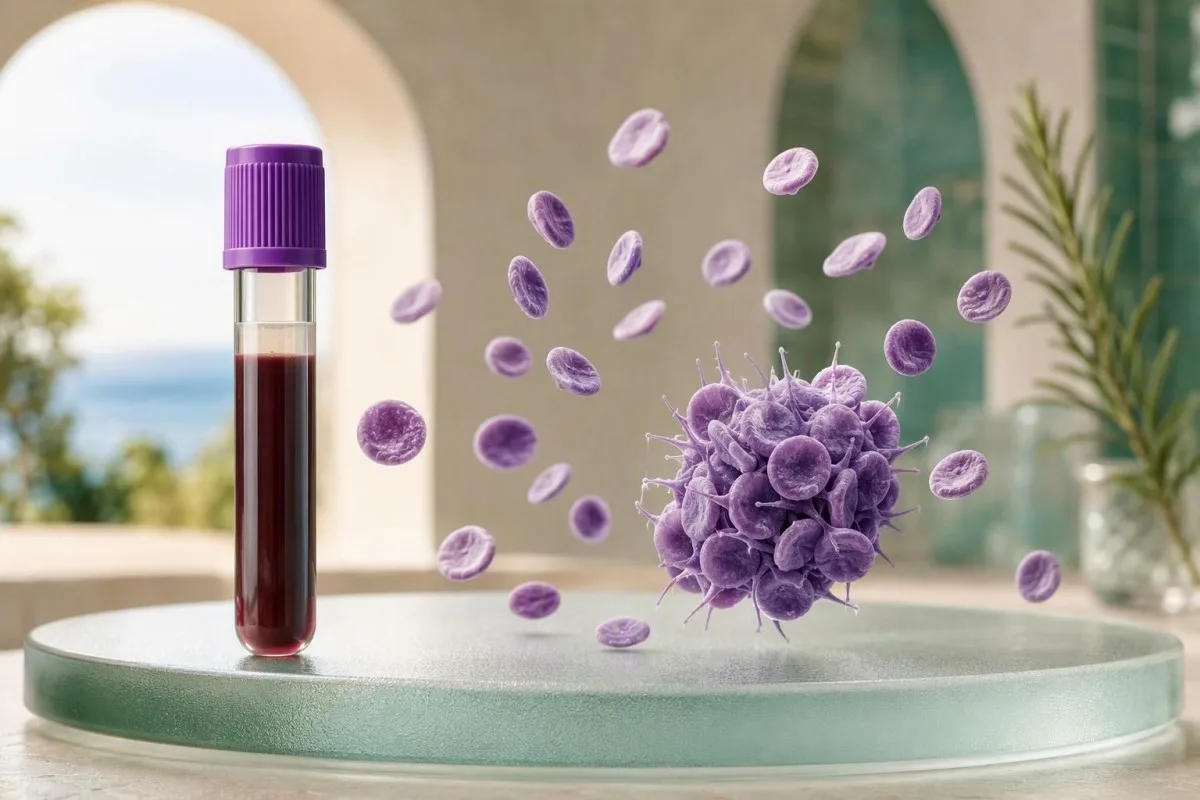
'n Lae bloedplaatjiegetal kan soms 'n buisverwante metingsfout wees eerder as 'n probleem binne u liggaam. Hier is hoe EDTA-verwante pseudotrombositopenie geïdentifiseer word voordat iemand u met trombositopenie etiketteer.


- Pseudotrombositopenie is 'n vals lae bloedplaatjiegetal wat veroorsaak word deur bloedplaatjies wat klont na versameling, meestal in 'n EDTA-buis.
- Tipiese bloedplaatjie-reeks vir die meeste nie-swanger volwassenes is ongeveer 150-450 × 10⁹/L, hoewel laboratoriums hul eie intervaller stel.
- Bloedplaatjieklonte op uitstryksel kan veroorsaak dat 'n geoutomatiseerde ontleder bloedplaatjies onderskat omdat 'n groep nie as aparte selle gemeet word nie.
- Sitraattrekker los dikwels EDTA bloedplaatjieklonting op; laboratoriums pas gewoonlik 'n 1.1 verdunningskorreksie toe op 'n sitraat bloedplaatjiegetal.
- Geen bloeding simptome nie plus 'n onverwags geïsoleerde lae bloedplaatjiegetal behoort 'n uitstryksel-oorsig te veroorsaak voordat behandeling of dringende verwysingsbesluite geneem word.
- Ware trombositopenie kan saamval met EDTA-bloedplaatjieklonting, dus is 'n normale sitraatresultaat gerusstellend, maar moet by die kliniese prentjie pas.
- Urgent assessment is steeds nodig vir onbeheerde bloeding, nuwe wydverspreide petegieë, erge hoofpyn, verwarring, of 'n bloedplaatjiegetal onder 10 × 10⁹/L.
Wat EDTA bloedplaatjieklomping eintlik beteken
EDTA-bloedplaatjieklonting is 'n in vitro laboratoriumartefak waarin bloedplaatjies in die versamelingbuis aan mekaar kleef, wat 'n vals lae geoutomatiseerde bloedplaatjiegetal veroorsaak. Dit beteken nie op sigself dat bloedplaatjies in die liggaam vernietig word nie, en dit skep gewoonlik nie 'n bloedingsrisiko nie.
EDTA is die laventelkleur-buis byvoeging wat gebruik word vir die meeste volledige bloedtellings omdat dit kalsium bind en stolling voorkom. In 'n klein subset van mense, verwydering van kalsium stel bloot bloedplaatjie-oppervlak teikens wat natuurlik voorkomende teenliggaampies toelaat om bloedplaatjies aanmekaar te oorbrug. Die ontleder mag 'n bloedplaatjiekluster tel as een groot partikel, 'n witbloedsel-grootte gebeurtenis, of glad nie; sien ons oorsig van wat ’n CBC insluit.
In my kliniese werk, is die klassieke verslag 'n bloedplaatjiegetal van 48 × 10⁹/L by iemand wat heeltemal goed voel, geen kneusplekke het nie, en 'n normale hemoglobien- en witbloedselgetal het. Daardie diskrepansie is nie bewys nie, maar dit is die oomblik om te stop. Kantesti is 'n KI-bloedtoetsontleder wat 'n geïsoleerde lae bloedplaatjiegetal merk saam met laboratoriumkommentare soos bloedplaatjie-aggregaat, eerder as om die getal as 'n diagnose te behandel.
EDTA-afhanklike pseudotrombositopenie word geskat in ongeveer 0.03-0.27% van roetine buitepasiëntmonsters, met hoër koerse onder monsters wat reeds vir lae bloedplaatjiegetalle verwys is. Lippi en kollegas beskryf dit as 'n klinies skadelose maar potensieel gevolglike pre-analitiese verskynsel omdat dit onnodige opnames, bloedplaatjie-oortappings, of steroïedbehandeling (Lippi et al., 2012) kan veroorsaak.
Hoe bloedplaatjie-ontleders geklonterde monsters kan onderskat
Geoutomatiseerde bloedplaatjiegetalle is betroubaar vir verspreide bloedplaatjies, maar klontjies val buite die grootte- en seinpatrone wat die ontleder verwag. 'n Telling kan dus val van 'n egte 220 × 10⁹/L na 'n skynbare 40 × 10⁹/L sonder enige biologiese bloedplaatjieverlies.
Impedans-ontleders klassifiseer partikels hoofsaaklik volgens volume, terwyl optiese stelsels ligstrooi-inligting byvoeg. “n Bloedplaatjie is gewoonlik ongeveer 2-3 mikrometer in deursnee, maar ”n klont kan oorvleuel met die rooibloedsel-fragment of leukosiet-streek. Dit is hoekom “n bloedplaatjie-histogram abnormaal kan wees en hoekom ”n laboratorium "bloedplaatjieklonte teenwoordig" of "telling onbetroubaar" mag byvoeg.”
Die ontleder se bloedplaatjie-vlag is 'n opdrag vir menslike hersiening, nie 'n finale diagnose nie. 'n Handmatige skatting van 'n goed-gemaakte perifere smeer kan nuttiger wees as om dieselfde EDTA-buis te herhaal, veral as die monster 2 uur gewag het voor ontleding. Vir praktiese drempels rondom prosedures, ons gids tot bloedplaatjiegetalle voor tandekstraksie verduidelik hoekom 'n geverifieerde resultaat saak maak.
Groot bloedplaatjies skep 'n ander, soms oorvleuelende probleem. Baie groot individuele bloedplaatjies kan deur impedans-metodes gemis word selfs sonder sigbare klontjies, wat dikwels die gemiddelde bloedplaatjievolume (MPV) verhoog. 'n Hoë MPV is nie uitruilbaar met pseudotrombositopenie nie; ons oorsig van groot bloedplaatjie oorsake skei hierdie twee bevindinge.
Hoe bloedplaatjieklonte op 'n uitstryksel lyk
Bloedplaatjieklonte op smeer verskyn as onreëlmatige druiwagtige groepe klein pers korrelêre elemente, dikwels gekonsentreer by die veeragtige rand van die skyfie. Hul ligging maak saak omdat die tel van slegs die sentrale smeerveld die baie kenmerk wat die lae resultaat verduidelik, kan mis.
'n Opleide morfoloog ondersoek die liggaam en stert van die film onder hoë krag, nie slegs 'n enkele verteenwoordigende veld nie. Bloedplaatjie-satellitisme is 'n seldsamer EDTA-geassosieerde patroon waarin bloedplaatjies neutrophils soos 'n roset omring; dit kan ook die gerapporteerde bloedplaatjiegetal verlaag. Beide bevindinge is monsterverskynsels, hoewel satellitisme en breë aggregaat soms saam kan voorkom.
Een nuttige detail is dat EDTA-klonting dikwels met tyd vorder. 'n Monster wat 10 minute na versameling gemeet word, mag 118 × 10⁹/L toon, dan 42 × 10⁹/L na 90 minute namate meer aggregaat vorm. Laboratoriums verskil in hul werkvloei, so 'n normale aanvanklike telling sluit hierdie artefak nie heeltemal uit as 'n latere ontleder-vlag verskyn nie.
Wanneer ek, Thomas Klein, MD, 'n lae telling sien gepaard met 'n smear-kommentaar maar geen kliniese bloeding nie, vra ek vir die werklike smear-interpretasie voordat ek immuun trombositopenie bespreek. Soortgelyke mikroskopie-eerstens redenering is nuttig wanneer 'n verslag noem skisotosiete op 'n bloedfilm, hoewel skisotosiete 'n veel dringender kliniese konteks vereis.
Hoekom EDTA bloedplaatjieklonte by sommige mense veroorsaak
EDTA kan bloedplaatjieklomping veroorsaak deur kalsium te cheleer en die vorm van bloedplaatjie membraan glikoproteïene te verander, wat toelaat dat antiliggame aan naburige bloedplaatjies bind en oorbrug. Hierdie reaksie vind plaas na versameling, nie omdat EDTA sirkulerende bloedplaatjies binne die liggaam beskadig het nie.
Die beste-ondersteunde meganisme behels antiliggame, dikwels IgG, IgM, of IgA, wat kriptiese webwerwe op die bloedplaatjie GPIIb/IIIa kompleks herken na kalsium-afhanklike strukturele verandering. Die reaksie is temperatuur- en tyd-afhanklik by sommige pasiënte, wat verklaar waarom 'n verwarmde monster af en toe telling kan verbeter, maar is nie 'n universele oplossing nie. Dit is 'n laboratorium-versoenbaarheids kwessie, nie 'n allergie vir EDTA nie.
Pseudotrombositopenie kan by gesonde mense voorkom en is aangemeld saam met outo-immuun toestande, infeksies, maligniteit en swangerskap, maar daardie assosiasies stel nie kousaliteit by 'n individu vas nie. 'n Positiewe ANA of 'n onlangse virale siekte moet nie gebruik word om die telling te verklaar totdat die artefak uitgesluit is nie. Kantesti is 'n AI bloedtoets interpretasie platform wat 'n bloedplaatjie-resultaat met sy buistipe, ontleder-vlae, en die res van die CBC lees eerder as in isolasie.
Die verskynsel kan jare lank voortduur, maar wissel tussen trekkings. 'n Pasiënt kan 'n bloedplaatjie telling van 35 × 10⁹/L in EDTA op Maandag en 230 × 10⁹/L in sitraat op dieselfde oggend hê, en dan gedeeltelike klomping weer maande later toon. Die aanteken van die voorkeurbuis in die laboratoriumrekord kan herhaalde alarms voorkom.
Hoe 'n sitraattrekker pseudotrombositopenie bevestig
'n Bloedplaatjie telling wat normaliseer in 'n natrium sitraat buis terwyl die EDTA buis aggregasies bevat, ondersteun sterk EDTA-afhanklike pseudotrombositopenie. Die sitraat telling benodig 'n verdunningsaanpassing omdat die buis vloeibare antistolmiddel bevat.
Blou-top natrium sitraat buise word gewoonlik gevul teen 'n 9:1 bloed-tot-antistolmiddel verhouding. Baie laboratoria vermenigvuldig die gemete sitraat bloedplaatjie telling met 1.1 om vir verdunning te korrigeer, hoewel die plaaslike laboratorium se gevalideerde metode voorrang geniet. Byvoorbeeld, 'n rou sitraat resultaat van 182 × 10⁹/L word ongeveer 200 × 10⁹/L na korreksie.
Die her-trekking moet behoorlik gevul word en saggies gemeng word. 'n Onder-gevulde sitraat buis verander die antistolmiddel verhouding en kan 'n ander misleidende resultaat skep, wat een rede is waarom 'n laboratoriumwetenskaplike 'n skynbaar eenvoudige herhaling kan verwerp. Ons verduideliking van bloedtoetsbuiskleure help pasiënte om te erken waarom die buiskeuse deel van die toetsmetode is.
Magnesiumsulfaat of suur-sitraat-dekstrose buise kan nuttig wees wanneer klomping in sitraat voortduur, maar dit is gewoonlik 'n laboratorium-gerigte besluit. Nagler en kollegas het 'n geval gedokumenteer waarin die erkenning van EDTA-afhanklike pseudotrombositopenie 'n onnodige diagnostiese ondersoek vermy het nadat sitraat toetsing 'n voldoende telling getoon het (Nagler et al., 2014).
Wanneer 'n sitraat bloedplaatjiegetal nie die vraag oplos nie
'n Sitraat her-trekking sluit nie ware trombositopenie uit wanneer die gekorrigeerde telling laag bly, klomping in meer as een antistolmiddel voorkom, of simptome op bloeding dui nie. Sommige pasiënte het multi-antistolmiddel bloedplaatjie aggregasie, en sommige het 'n werklike lae telling naas 'n artefak.
Indien die gekorrigeerde sitraat bloedplaatjie telling 82 × 10⁹/L is en die smear vry van klonte is, is dit egte trombositopenie totdat die teendeel bewys is. Indien EDTA 25 × 10⁹/L is en sitraat 86 × 10⁹/L is met oorblywende aggregasies, kan beide 'n artefak en 'n ware verlaging teenwoordig wees. Die kliniese span moet die beste geverifieerde skatting gebruik, nie bloot die meer gerusstellende getal kies nie.
Stolling in die monster kan ook 'n CBC ongeldig maak omdat bloedplaatjies binne die mikroklot verbruik word. Anders as EDTA pseudotrombositopenie, kan 'n gedeeltelik gestolde monster ook witbloedselle en rooibloedselindekse beïnvloed. Lees ons her-trek gids na monster probleme vir die praktiese verskille tussen versameling artefakte.
Vingerprikmonsters is nie outomaties veiliger nie. Stadige versameling, knypping, of vertraagde vermenging kan plaaslike aggregasie bevorder en 'n bloedplaatjiegetal benadeel, veral wanneer die gerapporteerde waarde onder 100 × 10⁹/L is. Veneuse herversameling met onmiddellike verwerking is gewoonlik die skoner bevestigingsroete.
Bloedplaatjiegetalreekse, bloedingsrisiko en die artefakval
Die meeste volwasse laboratoriums gebruik 'n bloedplaatjiegetal verwysingsinterval naby 150-450 × 10⁹/L, maar bloedingsrisiko hang af van die geverifieerde getal, die oorsaak daarvan, bloedplaatjiefunksie, en medikasie. 'n Vals-lae EDTA-resultaat mag nie alleen gebruik word om 'n prosedure te weier of behandeling voor te skryf nie.
Spontane groot bloeding word meer waarskynlik namate 'n ware bloedplaatjiegetal onder ongeveer 10 × 10⁹/L val, terwyl baie mense met stabiele tellings bo 50 × 10⁹/L min spontane bloeding het. Dit is breë kliniese riglynposte, nie verlof om simptome te ignoreer nie. Antikoagulante, aspirien, lewersiekte, nierversaking, en bloedplaatjie-disfunksie kan die risiko by enige getal verander.
'n Bloedplaatjiegetal van 90 × 10⁹/L verdien verskillende hantering by 'n gesonde persoon met 'n normale sitraatresultaat as by iemand met nuwe melena en 'n verhoogde INR. Daarom behoort bloedplaatjiegetal interpretasie langs stollingstoetse te lê; ons aPTT en stollingstoets gids verduidelik wat 'n normale stolling skerm kan en nie kan uitsluit nie.
Laboratoriums mag 140 × 10⁹/L eerder as 150 × 10⁹/L gebruik as die onderste verwysingslimiet, veral met plaaslik afgeleide intervalle. 'n Verwysingsinterval beskryf die middel 95% van 'n vergelykende bevolking; dit definieer nie 'n universele behandeling drempel nie. Hierdie onderskeid bespaar 'n verrassende hoeveelheid onnodige bekommernis.
CBC-patrone wat 'n artefak meer waarskynlik maak
'n Geïsoleerde onverwags lae bloedplaatjiegetal met normale hemoglobien, witbloedselle, en 'n klomp-kommentaar is die CBC patroon wat die meeste aanduidend is van pseudotrombositopenie. Hierdie patroon is aanduidend eerder as diagnosties omdat vroeë immuun- of dwelm-verwante trombositopenie ook geïsoleer kan wees.
Ware beenmurgversteurings beïnvloed dikwels meer as een bloedsellyn, hoewel uitsonderings bestaan. Lae bloedplaatjies gekombineer met dalende hemoglobien, abnormale witbloedselle, blaste, of aanhoudende konstitusionele simptome vereis dringende klinikus oorsig en dikwels 'n formele film ondersoek. Ons artikel oor die CBC pad vir bloedafwykings beskryf waarom hierdie groeperings die dringendheid verander.
Die bloedplaatjie-tot-limfosiet verhouding kan betekenisloos word wanneer die deler geldig is, maar die bloedplaatjie teller is kunsmatig verlaag. 'n PLR van 60 bereken vanaf 'n EDTA-geklonte telling moet nie geïnterpreteer word as 'n inflammatoriese of kardiovaskulêre sein nie. Dit is 'n stille maar algemene sekondêre fout in geoutomatiseerde gesondheidsverslae; sien ons verduideliking van hoë PLR resultate.
AI identifiseer diskordansie tussen 'n lae bloedplaatjiegetal en normale aangrensende CBC maatreëls, en rig dan die leser om monsterkommentaar te verifieer. 'n KI-aangedrewe bloedtoets-analisehulpmiddel moet nooit 'n enkele onverifieerde bloedplaatjie waarde in 'n siekte-etiket omskakel nie. Daardie kliniese terughoudendheid is belangriker as spoed.
Swangerskap, hospitaalsorg en ander hoë-risiko-omgewings
EDTA bloedplaatjie klomping kan voorkom tydens swangerskap en hospitaalversorging, maar dit moet nooit aangeneem word wanneer ware trombositopenie dringende bestuur kan verander nie. Swangerskap-spesifieke oorsake soos swangerskap-geïnduseerde trombositopenie, pre-eklampsie, HELLP-sindroom, en immuuntrombositopenie vereis 'n geverifieerde telling.
Bloedplaatjietellings daal dikwels in ongekompliseerde swangerskap, en sommige laboratoriums aanvaar laer trimester-spesifieke verwysingsgrense. 'n Telling onder 100 × 10⁹/L is minder tipies vir ongekompliseerde swangerskap-geïnduseerde trombositopenie en vereis 'n noukeurige kliniese assessering, selfs al word EDTA-aggregrate gesien. Ons trimester-spesifieke bloedplaatjie verwysingsgids in swangerskap gee konteks sonder om verloskundige oorsig te vervang.
In die hospitaal kan 'n skielike daling van meer as 50% vanaf die baslyn vrae laat ontstaan oor sepsis, blootstelling aan dwelms, heparien-geïnduseerde trombositopenie, verdunning, of toestel-verwante verbruik. 'n EDTA-artefak kan 'n dramatiese daling naboots, veral wanneer 'n vorige resultaat van 'n ander laboratoriummetode afkomstig was. Die vergelyking van 'n geverifieerde sitraat resultaat met die pasiënt se baslyn is dikwels nuttiger as die herhaling van 'n roetine EDTA CBC.
Vra voor 'n epiduraal, chirurgie, chemoterapiesiklus, of bloedplaatjie-oortapping of die laboratorium die waarde op 'n smeer of alternatiewe antikoagulant bevestig het. Ek het al vertragings in sorg vermy deur daardie een oproep. Omgekeerd, aktiewe simptome of 'n onstabiele pasiënt moet geassesseer word terwyl bevestiging aan die gang is.
Medisyne en diagnoses waaraan nie te vinnig die skuld gegee moet word nie
EDTA bloedplaatjie klontvorming moet uitgesluit word voordat 'n geïsoleerde lae bloedplaatjie telling aan 'n medisyne, outo-immuun siekte, of immuuntrombositopenie toegeskryf word. Die staking van 'n waardevolle medikasie op grond van 'n ongeverifieerde telling kan vermybare skade veroorsaak.
Heparien, kwinine-bevattende produkte, trimetoprim-sulfametoksasool, valproaat, linezolid, chemoterapie, en sommige immuunterapieë kan ware trombositopenie veroorsaak. Die tydsverwantskap is belangrik: 'n egte geneesmiddel-geassosieerde daling duur gewoonlik voort in 'n korrek versamelde sitraat monster en verdwyn nie wanneer EDTA vervang word nie. 'n Medikasiegeskiedenis moet inspuitings, oor-die-toonbank produkte, en kruie preparate insluit.
Immuuntrombositopenie is 'n diagnose van uitsluiting, nie 'n laboratoriumvlag nie. Dit kan voorkom met geïsoleerde bloedplaatjies onder 100 × 10⁹/L, maar 'n geklonterde EDTA-smeer maak die aanvanklike telling oninterpreteerbaar. Lippi et al. (2012) waarsku spesifiek dat die herkenning van pseudotrombositopenie inappropriêre terapieë soos kortikosteroïede en splenektomie voorkom.
Indien 'n verslag jou vorige resultate blyk te wees, bewaar die oorspronklike PDF en let op die versamelingsdatum, buiskommentaar, akute siekte, en nuwe medisyne. Ons gids tot betekenisvolle veranderinge tussen bloedtoetse verduidelik waarom 'n numeriese delta nie outomaties 'n biologiese verandering is nie.
Wat om volgende aan u laboratorium of klinikus te vra
Vir 'n onverwagte lae bloedplaatjie telling, vra of bloedplaatjie klonte gesien is, of 'n perifere smeer geëvalueer is, en of 'n alternatiewe-antikoagulant telling uitgevoer kan word. Hierdie drie vrae verduidelik gewoonlik die volgende stap vinniger as om aanlyn na simptome te soek.
“n Praktiese versoek is: ”Kan die laboratorium die bloedfilm vir bloedplaatjie-aggregrate nagaan en, indien nodig, die bloedplaatjie telling in sitraat herhaal?" Dit is nie om 'n spesifieke diagnose te eis nie; dit is om te vra dat die meting gevalideer word. Indien die monster elders versamel is, mag die klinikus dalk 'n nuwe trek bestel eerder as om toetsing by 'n ou buis te voeg.
Vra vir die gekorrigeer sitraat resultaat en of klonte in daardie buis voortduur. 'n Ruwe resultaat van 145 × 10⁹/L mag grenslyn lyk totdat verdunningskorreksie ongeveer 160 × 10⁹/L gee. Vra ook of die laboratorium 'n optiese of fluoressensie bloedplaatjie telling gebruik het, aangesien hierdie metodes soms telling in komplekse monsters verbeter.
se 2026 interpretasie werkstroom moedig gebruikers aan om die numeriese resultaat te vergelyk met die laboratorium narratief en vlagvelde voordat op 'n waarskuwing opgetree word. Vir 'n breër veiligheidsraamwerk, ons AI-verslag akkuraatheidskontrolelys dek transkripsie, eenhede, verwysingsreekse, en resultaatverifikasie.
Wat om nie te doen terwyl jy wag op bevestiging nie
Moenie aanvullings begin, voorgeskrewe medisyne stop, of aanneem dat jy 'n bloedingversteuring het slegs omdat een EDTA bloedplaatjie telling laag is nie. Terselfdertyd, moenie aktiewe bloeding ignoreer net omdat klontvorming vermoed word nie.
Daar is geen dieet, vitamien, of huismiddel wat EDTA-afhanklike pseudotrombositopenie regstel nie, want die bloedplaatjies klonter in die buis, nie omdat hulle binne die liggaam misluk nie. Folaat-, vitamien B12-, en ystertekort kan bloedvorming in ander omstandighede beïnvloed, maar aanvullings kan nie 'n twyfelagtige telling valideer nie. Om die artefak te behandel, gaan dit oor versameling en analise.
Vermy nie-essensiële aspirien, ibuprofen, naproxen, en swaar alkoholgebruik totdat 'n klinikus 'n baie lae gerapporteerde telling uitklaar, veral as jy maklik kneus. Moenie antikoagulante, antiplaatjie-medisyne, anti-epileptiese middels, of kankerbehandelings stop sonder voorskryweradvies nie; die aanduiding vir daardie medisyne mag groter onmiddellike risiko dra as die onverifieerde resultaat.
Om 'n bondige resultaatlyn te hou, kan die afspraak verander. Ons gids vir die opsporing van laboratoriumresultate stel voor dat jy trekkertyd, onlangse siekte, medisyne, monsterkommentaar, en of die resultaat van EDTA of sitraat gekom het, aanteken.
Rooi vlae wat dringende mediese assessering benodig
Soek dringende mediese assessering vir ongekontroleerde bloeding, swart stoelgange, bloed braak, 'n ernstige nuwe hoofpyn, verwarring, floute, of wydverspreide puntvormige uitslag, selfs al word EDTA-klomping vermoed. 'n Laboratorium artefak en 'n ware noodsituasie kan saam bestaan.
'n Ware plaatjie telling onder 10 × 10⁹/L word oor die algemeen as 'n dringende resultaat behandel omdat spontane mukosale en interne bloedingrisiko aansienlik toeneem. 'n Telling onder 20 × 10⁹/L met nuwe bloeding, koors, ernstige hipertensie, swangerskap komplikasies, of onlangse heparien blootstelling verdien ook dieselfde dag klinikus insette. Plaaslike noodadvies moet prioriteit geniet bo enige aanlyn interpretasie.
Nuwe neurologiese simptome is veral betekenisvol omdat intrakraniële bloeding ongewoon maar ernstig is. Moenie self bestuur as jy ernstige hoofpyn met swakheid, spraakverandering, ineenstorting, of verwarring het nie. By kinders benodig 'n nie-verblekende uitslag met koors dringende assessering ongeag die plaatjie resultaat.
Thomas Klein, MD, raai pasiënte aan om die vraag “Is hierdie telling werklik?” te skei van “Is hierdie persoon vandag veilig?” Die eerste vereis gewoonlik 'n smear en sitraat hertrekking; die tweede hang af van simptome, ondersoekbevindinge, en die hele kliniese prentjie. Ons bloedtoets tweede-meningsgids kan help om 'n gefokusde bespreking voor te berei nadat dringende sake aangespreek is.
Hoe Kantesti 'n gemerkte bloedplaatjiegetal veilig interpreteer
Kantesti AI behandel 'n lae plaatjie telling met EDTA-klompingkommentaar as 'n verifikasie sein, nie as bewys van trombositopenie nie. Ons interpretasie plaas ontledervlae, die ander CBC-lyne, vorige waardes, en gerapporteerde simptome voor 'n simplistiese rooi-of-groen etiket.
Kantesti is 'n KI-labtoets-interpretasiediens ontwerp om laboratoriumdata in eenvoudige taal te verduidelik terwyl die beperkings van die bronverslag behou word. Indien “n opgelaaide PDF sê ”plaatjie klontjies," moet ons stelsel die gebruiker vertel dat die nommer vals laag kan wees en dat die laboratorium of klinikus dit met 'n film oorsig of sitraatmonster kan bevestig.
Optiese karakterherkenning kan 'n desimale punt, 'n eenheid, of 'n laboratoriumvoetnoot verkeerd lees. Daarom moet pasiënte die beeldvoorskou inspekteer voordat hulle op enige digitale interpretasie staatmaak, veral rondom waardes soos 18 versus 180 × 10⁹/L. Ons PDF-oplaaikwaliteitkontrolelys verduidelik die paar kontroles wat die meeste vermybare foute voorkom.
Kliniese toesig bly menslike werk. Kantesti se metodologie word teen veiligheidsgerigte werkvloeie beoordeel; lesers wat ons benadering wil verstaan, kan ons tegniese validering en kliniese toesig. AI kan vrae doeltreffend organiseer, maar dit kan nie die werklike smear inspekteer of aktiewe bloeding assesseer nie.
'n Praktiese opvolgplan na EDTA bloedplaatjieklonting
Die gewone opvolgplan is om die EDTA-artefak te dokumenteer, 'n geverifieerde alternatiewe buis plaatjie telling te verkry, en daardie resultaat vir toekomstige kliniese besluite te gebruik. Die meeste mense benodig geen behandeling vir die artefak self sodra die laboratorium die patroon vasgestel het nie.
Vra vir die laboratoriumrekord om “EDTA-afhanklike plaatjie klomping” of ekwivalente bewoording aan te teken indien bevestiging duidelik is. By toekomstige trekkings mag die flebotomieteam 'n sitraatbuis saam met die roetine EDTA CBC versamel, wat 'n tweede afspraak bespaar. Dit is veral nuttig voor chirurgie, tydens swangerskap, of wanneer 'n behandelingsprotokol plaatjie drempels het.
'n Geverifieerde basislyn is waardevoller as herhaalde onverifieerde lae waardes. Indien jou gekorrigeerde sitraat telling stabiel is op 205 × 10⁹/L oor 12 maande, is 'n toekomstige EDTA waarde van 55 × 10⁹/L metAggregate baie minder ontstellend as dieselfde getal by iemand sonder vorige dokumentasie. Tendense is slegs nuttig wanneer die toetsmetode vergelykbaar is.
Kantesti het meer as 2 miljoen gebruikers in 127+ lande ondersteun met veeltalige laboratoriumverklarings, maar resultate behoort steeds in die sorgverhouding met jou klinikus te wees. Ons mediese beoordelaars en Mediese Adviesraad beklemtoon dieselfde finale reël: verifieer die plaatjie telling eers, besluit dan wat—indien enige iets—behandeling benodig.
Navorsingspublikasies
Vanaf 29 Augustus 2026 is die twee Kantesti navorsingspublikasies hieronder gelys aanvullende opvoedkundige hulpbronne. Hulle vestig nie die diagnose van EDTA-afhanklike pseudotrombositopenie nie; die laboratorium-smeer en alternatiewe-antikoagulant bloedplaatjie-telling bly die tersaaklike bevestigingsinstrumente.
Gereelde vrae
Kan EDTA-plaatjieklonte 'n baie lae plaatjiegetal veroorsaak?
Ja. EDTA-plaatjieklonting kan 'n merkwaardig vals lae plaatjiegetal tot gevolg hê, soms onder 50 × 10⁹/L, wanneer die persoon se werklike sirkulerende plaatjiegetal normaal is. Die ontleder tel plaatjie-aggregaatjies verkeerd omdat dit nie elke plaatjie binne 'n groep betroubaar kan herken nie. 'n Perifere smeer wat aggregaatjies toon en 'n normale gekorrigeerde sitraattelling ondersteun sterk pseudotrombositopenie. Die uitslag moet steeds dringend hersien word indien daar aktiewe bloeding is of die sitraattelling laag bly.
Hoe word pseudotrombositopenie bevestig?
Pseudotrombositopenie word gewoonlik bevestig deur 'n perifere smear te beoordeel vir bloedplaatjiesklonte en die bloedplaatjiegetal in 'n natriumsitraatbuisie te herhaal. Sitraatbuisies bevat vloeibare antikoagulant, dus vermenigvuldig baie laboratoriums die gemete bloedplaatjiegetal met 1,1 om vir verdunning voorsiening te maak. Byvoorbeeld, 'n rou sitraatgetal van 180 × 10⁹/L word algemeen gerapporteer as ongeveer 198 × 10⁹/L na korreksie. Die plaaslike laboratorium se gevalideerde korreksie- en smearinterpretasie moet die finale resultaat lei.
Beteken EDTA-plaatjieklonting dat ek 'n bloedingsteuring het?
Nee. EDTA-bloedplaatjieklonting alleen is 'n in-vitro monsterartefak en beteken nie dat jy 'n bloedingversteuring het of dat jou bloedplaatjies in jou bloedsomloop klont nie. Die meeste geaffekteerde persone het geen bloeding simptome nie en het 'n geverifieerde bloedplaatjie telling binne die gewone volwasse interval van ongeveer 150-450 × 10⁹/L. 'n Klinikus moet steeds bloeding simptome, abnormale stoltoetse, of 'n aanhoudend lae sitraat bloedplaatjie telling ondersoek. Die artefak beskerm iemand nie teen onverwante bloedingrisiko's wat deur medikasie of mediese toestande veroorsaak word nie.
Kan bloedplaatjie-aggregering ook in sitraat voorkom?
Ja, hoewel natriumsitraat dikwels EDTA-verwante klontvorming voorkom, kan bloedplaatjie-aggregasie af en toe in sitraat voortduur of met veelvuldige antistollingsmiddels voorkom. In daardie situasie mag die laboratorium 'n optiese of fluoressensie bloedplaatjie-telling, vinnige warmverwerking, magnesiumsulfaat, of suur-sitraat-dekstrose gebruik, afhangende van sy gevalideerde protokolle. 'n Gekorrigeerde sitraat-telling onder 150 × 10⁹/L sonder aggregaat moet as moontlike ware trombositopenie behandel word. Veelvuldige antistolling-klontvorming is ongewoon en benodig laboratorium-begeleide bevestiging.
Moet ek my bloedplaatjie telling herhaal as die verslag sê bloedplaatjie klonte?
Ja. 'n Verslag wat plaatjieklonte, plaatjie-aggregrate, of 'n onbetroubare plaatjiegetal meld, regverdig oor die algemeen verifiëring eerder as aanvaarding van die numeriese resultaat. Die gewone herhaling is 'n vars versamelde natrium-sitraatmonster met 'n uitstryk-oorsig, ideaal verwerk so spoedig moontlik. Indien die oorspronklike telling onder 10 × 10⁹/L is, of jy onbeheerste bloeding, swart stoelgang, erge hoofpyn, of verwarring het, soek dringende mediese sorg terwyl die bevestiging gereël word. Moenie voorgeskrewe medikasie verander sonder advies van die klinikus wat weet hoekom dit voorgeskryf is nie.
Kan EDTA-pseudotrombositopenie kom en gaan?
Ja. EDTA pseudotrombositopenie kan jare lank aanhoudend wees of wisselend voorkom omdat die graad van klontering afhang van die tyd na versameling, monster temperatuur en ontleder metode. Een EDTA monster mag 70 × 10⁹/L rapporteer terwyl nog een wat op 'n ander dag versamel is, 145 × 10⁹/L rapporteer, ten spyte van 'n stabiele ware plaatjie telling. 'n Gedokumenteerde normale sitraat telling bied 'n bruikbare basislyn vir toekomstige vergelyking. Om die laboratorium te vra om die verkose antistolmiddel aan te teken, kan herhaalde vals alarms voorkom.
Kry vandag KI-aangedrewe bloedtoets-analise
Sluit aan by meer as 2 miljoen gebruikers wêreldwyd wat Kantesti vertrou vir onmiddellike, akkurate laboratoriumtoetsanalise. Laai jou bloedtoetsresultate op en ontvang omvattende interpretasie van 15,000+-biomerkers binne sekondes.
📚 Verwysde navorsingspublikasies
Klein, T., Mitchell, S., & Weber, H. (2026). Kantesti AI. (2026). C3 C4 Komplement Bloedtoets & ANA Titer Gids. Zenodo. https://doi.org/10.5281/zenodo.18353989. Kantesti KI Mediese Navorsing.
Klein, T., Mitchell, S., & Weber, H. (2026). Kantesti AI. (2026). Nipah Virus Bloedtoets: Vroeë Opsporing & Diagnose Gids 2026. Zenodo. https://doi.org/10.5281/zenodo.18487418. Kantesti KI Mediese Navorsing.
📖 Eksterne mediese verwysings
⚕️ Mediese Vrywaring
Hierdie artikel is slegs vir opvoedkundige doeleindes en vorm nie mediese advies nie. Raadpleeg altyd ’n gekwalifiseerde gesondheidsorgverskaffer vir besluite oor diagnose en behandeling.
E-E-A-T Vertrouenseine
Ervaring
Kliniese oorsig gelei deur ’n geneesheer van laboratorium-interpretasie-werksvloei.
Kundigheid
Laboratoriumgeneeskunde fokus op hoe biomerkers in ’n kliniese konteks optree.
Gesagsvermoë
Geskryf deur dr. Thomas Klein met hersiening deur dr. Sarah Mitchell en prof. dr. Hans Weber.
Betroubaarheid
Bewysgebaseerde interpretasie met duidelike opvolgpaaie om alarm te verminder.