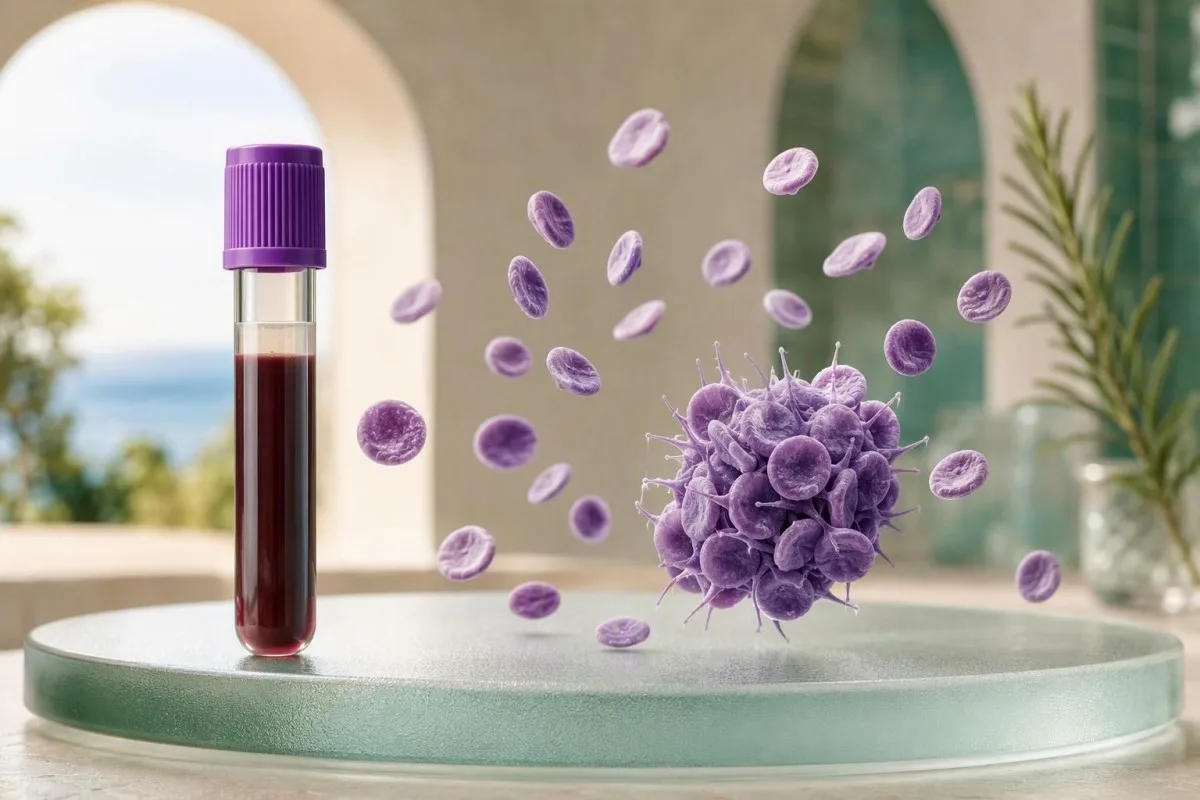
血小板计数低有时可能是管子相关的测量误差,而不是您体内的出血问题。以下是在将您诊断为血小板减少症之前,如何识别 EDTA 相关的假性血小板减少症。.


- 假性血小板减少症 是由于采集后血小板凝集(最常见于 EDTA 管中)引起的血小板计数假性降低。.
- 典型血小板范围 大多数非孕期成人的正常范围约为 150-450 × 10⁹/L,尽管实验室会设定自己的区间。.
- 涂片上的血小板凝集 会导致自动分析仪低估血小板计数,因为一个簇体不会被测量为独立的细胞。.
- 柠檬酸盐重测 通常可以解决 EDTA 血小板凝集问题;实验室通常会对柠檬酸盐血小板计数应用 1.1 的稀释校正。.
- 无出血症状 加上出乎意料的孤立性血小板计数低,在治疗或紧急转诊决定之前,应提示进行涂片复查。.
- 真性血小板减少症可以与EDTA诱导的血小板聚集并存 ,因此,柠檬酸盐的正常结果令人放心,但必须符合临床表现。.
- 需要紧急评估 在活动性出血、新发广泛性紫癜、严重头痛、意识模糊或血小板计数低于10 × 10⁹/L时仍然需要。.
EDTA 血小板凝集实际上意味着什么
EDTA诱导的血小板聚集是一种体外实验室假象,血小板在收集管中粘在一起,导致自动血小板计数出现虚假性降低。. 它本身并不意味着血小板在体内被破坏,通常也不会造成出血风险。.
EDTA是用于大多数全血细胞计数的薰衣草色顶管添加剂,因为它能结合钙并防止凝血。在少数人群中,钙的去除会暴露血小板表面靶点,使自然存在的抗体桥接血小板。分析仪可能将血小板簇计为一个大颗粒、一个白细胞大小的事件,或者根本不计;请参阅我们的概述 CBC 包含哪些内容.
在我的临床工作中,经典的报告是一名血小板计数为 48 × 10⁹/L 的患者,他感觉完全健康,没有瘀伤,并且血红蛋白和白细胞计数正常。这种差异不是证据,但它是值得停顿的时刻。CE 是一种 人工智能血液检测分析仪 ,它标志着孤立性血小板减少伴随实验室注释(如血小板聚集体),而不是将该数字视为诊断。.
EDTA依赖性假性血小板减少症估计在常规门诊样本中约占0.03-0.27%,在已转诊进行血小板减少症检查的样本中发生率更高。Lippi及其同事将其描述为一种临床上无害但可能产生后果的预分析现象,因为它可能引发不必要的住院、输血小板或类固醇治疗(Lippi et al., 2012)。.
血小板分析仪如何低估凝集样本
自动血小板计数对于分散的血小板是可靠的,但聚集体超出了分析仪预期的尺寸和信号模式。. 因此,计数可能从真实的220 × 10⁹/L下降到显现的40 × 10⁹/L,而没有任何生物学上的血小板丢失。.
阻抗分析仪主要根据体积对颗粒进行分类,而光学系统则增加了光散射信息。血小板通常直径约为2-3微米,但血小板簇可能与红细胞碎片或白细胞区域重叠。这就是为什么血小板直方图可能异常,以及为什么实验室可能会附加“存在血小板簇”或“计数不可靠”的说明。”
分析仪的血小板标志提示需要人工复核,而不是最终诊断。来自制备良好的外周血涂片的估计值可能比重复检测同一个EDTA管更有用,特别是如果样本在分析前放置了2小时。关于手术的实际阈值,请参阅我们的指南 牙齿拔除前的血小板计数 解释了为何经过验证的结果很重要。.
大血小板会引起不同、有时重叠的问题。即使没有明显的血小板簇,阻抗法也可能漏掉非常大的单个血小板,通常导致平均血小板体积(MPV)升高。高MPV与假性血小板减少症不具有可互换性;我们对 大血小板原因 的回顾区分了这两种发现。.
涂片上的血小板凝集看起来是怎样的
涂片上的血小板簇表现为不规则的葡萄状小紫色颗粒状元素团,常集中在载玻片的羽状边缘。. 它们的位置很重要,因为只计数中心涂片区域可能会错过解释低计数结果的特征。.
训练有素的形态学家在高倍镜下检查血片主体和尾部,而不仅仅是单个代表性区域。血小板卫星现象是一种罕见的EDTA相关模式,血小板环绕中性粒细胞呈玫瑰花结状;它也可以降低报告的血小板计数。这两种发现都是样本现象,尽管卫星现象和广泛的聚集体有时可能同时发生。.
一个有用的细节是,EDTA诱导的血小板聚集通常会随着时间推移而加剧。收集后10分钟测量的样本可能显示118 × 10⁹/L,90分钟后则显示42 × 10⁹/L,因为聚集体形成增多。实验室的工作流程各不相同,因此,如果后来出现分析仪标记,则正常的初始计数不能完全排除这种人为因素。.
当我 Thomas Klein, MD 看到血涂片结果显示血小板计数低并伴有涂片描述但无临床出血时,我会要求提供实际的血涂片解释,然后再讨论免疫性血小板减少症。类似的“先显微镜后临床”的推理方法在报告提到以下情况时也很有用: 裂细胞(schistocytes)出现在血涂片上, ,尽管裂细胞需要更紧急的临床背景。.
为什么 EDTA 会在某些人身上引起血小板凝集
EDTA 通过螯合钙并改变血小板膜糖蛋白的形状,使抗体能够结合并桥联相邻的血小板,从而触发血小板聚集。. 这种反应发生在采集后,而不是因为 EDTA 损害了体内循环的血小板。.
最有力的机制涉及抗体,通常是 IgG、IgM 或 IgA,在钙依赖性结构改变后识别血小板 GPIIb/IIIa 复合物上的隐匿位点。对于某些患者,该反应具有温度和时间依赖性,这解释了为什么加温样本偶尔可以改善计数,但并非普遍适用的解决方案。这是实验室兼容性问题,而不是对 EDTA 的过敏。.
假性血小板减少症可能发生在健康人群中,并已在自身免疫性疾病、感染、恶性肿瘤和怀孕等情况下有过报道,但这些关联并不在个体中确立因果关系。在排除伪影之前,不应使用阳性 ANA 或最近的病毒感染来解释计数。CBC 是一种 AI 血液检查解读平台 ,它会结合血小板结果、管类型、分析仪标志以及整个 CBC 来读取结果,而不是孤立地查看。.
这种现象可能持续数年,但在不同次采集之间会有所变化。一名患者周一在 EDTA 管中的血小板计数可能为 35 × 10⁹/L,当天上午在柠檬酸盐管中的计数可能为 230 × 10⁹/L,然后在几个月后再次出现部分聚集。在实验室记录中记录首选的采集管可以防止重复发出警报。.
柠檬酸盐重测如何确诊假性血小板减少症
当 EDTA 管含有聚集物而柠檬酸盐管中的血小板计数正常化时,强烈支持 EDTA 依赖性假性血小板减少症。. 柠檬酸盐计数需要稀释校正,因为管中含有液体抗凝剂。.
蓝色顶的柠檬酸钠管通常以 9:1 的血液与抗凝剂比例填充。许多实验室将测得的柠檬酸盐血小板计数乘以 1.1 进行稀释校正,但当地实验室经过验证的方法具有优先权。例如,原始柠檬酸盐结果为 182 × 10⁹/L,校正后约为 200 × 10⁹/L。.
重新采集的样本必须正确填充并轻轻混合。填充不足的柠檬酸盐管会改变抗凝剂比例并可能产生不同的误导性结果,这是实验室科学人员可能拒绝看似简单的重复采集的原因之一。我们对 血液采集管颜色 的解释有助于患者了解为什么选择管材是检测方法的一部分。.
当柠檬酸盐中继续出现血小板聚集时,可以使用硫酸镁或酸性柠檬酸葡萄糖管,但这通常是实验室决定的。Nagler 及其同事记录了一个案例,其中对 EDTA 依赖性假性血小板减少症的识别避免了在柠檬酸盐检测显示足够计数后进行不必要的诊断性检查(Nagler et al., 2014)。.
柠檬酸盐血小板计数不能解决问题时
当校正后的计数仍然很低、在多种抗凝剂中都发生聚集,或者症状提示出血时,柠檬酸盐的重新采集不能排除真正的血小板减少症。. 一些患者存在多抗凝剂血小板聚集,一些患者在出现伪影的同时存在真实的低计数。.
如果校正后的柠檬酸盐血小板计数为 82 × 10⁹/L 且涂片没有聚集物,则在有相反证据之前,这可以认为是真正的血小板减少症。如果 EDTA 计数为 25 × 10⁹/L,柠檬酸盐计数为 86 × 10⁹/L 并伴有残留聚集物,则可能同时存在伪影和真实的减少。临床团队应使用最佳验证估计值,而不是简单地选择更令人放心的数字。.
样本中的凝血也会使 CBC 无效,因为血小板会在微凝块中被消耗。与 EDTA 假性血小板减少症不同,部分凝固的样本也可能影响白细胞和红细胞指数。阅读我们的 样本问题后的重新采集指南 ,了解采集伪影之间的实际区别。.
指尖血样本并非自动更安全。采集缓慢、挤压或延迟混合会促进局部聚集,并影响血小板计数,特别是在报告值低于 100 × 10⁹/L 时。静脉重新采集并及时处理通常是更清晰的确认途径。.
血小板计数范围、出血风险和假象陷阱
大多数成人实验室使用的血小板计数参考区间接近 150-450 × 10⁹/L,但出血风险取决于已验证的计数、其原因、血小板功能和药物。. 错误的低 EDTA 结果不应单独用于拒绝手术或开具处方。.
当真实血小板计数低于约 10 × 10⁹/L 时,自发性严重出血的可能性会增加,而许多血小板计数稳定在 50 × 10⁹/L 以上的人自发性出血很少。这些是广泛的临床指南,并非忽略症状的许可。抗凝剂、阿司匹林、肝病、肾功能衰竭和血小板功能障碍可能会改变任何数值下的风险。.
在健康人中,90 × 10⁹/L 的血小板计数与新近出现的黑便和 INR 升高的患者相比,处理方式应有所不同。这就是为什么血小板计数解释应与凝血试验一起进行;我们的 aPTT 和凝血试验指南 解释了正常的凝血筛查可以排除和不能排除的内容。.
实验室可能使用 140 × 10⁹/L 而不是 150 × 10⁹/L 作为较低的参考限值,特别是在局部推导的区间中。参考区间描述了比较人群的 95%;它并没有定义通用的治疗阈值。这种区别可以消除令人惊讶的担忧。.
导致假象可能性的 CBC 模式
具有正常血红蛋白、白细胞和聚集评论的孤立性意外低血小板计数是提示假性血小板减少症最明显的 CBC 图案。. 这种模式是提示性的而非诊断性的,因为早期免疫性或药物相关性血小板减少症也可能孤立出现。.
真正的骨髓疾病通常会影响不止一条血细胞系,尽管存在例外。血小板减少合并血红蛋白下降、白细胞异常、原始细胞或持续性全身症状,需要及时由临床医生进行审查,并常常进行正式的涂片检查。我们关于 血细胞计数通道在血液疾病中的作用 的文章概述了这些组合为何会改变紧急程度。.
当分母有效但血小板分子被人为压低时,血小板与淋巴细胞比率可能变得无意义。从 EDTA 聚集的计数计算出的 PLR 为 60 不应被解释为炎症或心血管信号。这是自动健康报告中一个不显眼但常见的次要错误;请参阅我们对 高 PLR 结果.
的解释 Kantesti AI 识别低血小板计数与正常相邻 CBC 指标之间的不一致,然后指示读者验证样本评论。一 基于 AI 的血液检测分析工具 绝不能将单一的未经验证的血小板数值转化为疾病诊断。这种临床克制比速度更重要。.
怀孕、住院护理和其他高风险环境
EDTA 血小板聚集可能在怀孕和住院期间发生,但绝不能在可能需要紧急处理的真正血小板减少症出现时加以假设。. 妊娠特异性原因,如妊娠期血小板减少症、先兆子痫、HELLP 综合征和免疫性血小板减少症,需要经过验证的计数。.
在无并发症的怀孕期间,血小板计数通常会下降,一些实验室可以接受较低的特定孕期参考限值。计数低于 100 × 10⁹/L 对于无并发症的妊娠期血小板减少症来说不太典型,即使观察到 EDTA 聚集,也需要仔细的临床评估。我们的特定孕期 妊娠期血小板参考指南 提供背景信息,但不能取代产科审查。.
在医院,与基线相比突然下降超过 50% 可能引起对败血症、药物暴露、肝素诱导的血小板减少症、稀释或器械相关消耗的疑问。EDTA 伪影可以模拟急剧下降,尤其是在先前结果来自不同实验室方法时。比较经验证的柠檬酸盐结果与患者的基线值通常比重复常规 EDTA CBC 更有用。.
在接受硬膜外麻醉、手术、化疗周期或输注血小板之前,请询问实验室是否通过涂片或替代抗凝剂确认了数值。我见过一次电话咨询避免了延误治疗。反之,在确认过程中应评估活跃症状或不稳定的患者。.
不应过快归咎于的药物和诊断
在将孤立性低血小板计数归因于药物、自身免疫性疾病或免疫性血小板减少症之前,应排除 EDTA 血小板聚集。. 基于未经验证的计数而停止使用有价值的药物可能导致可避免的伤害。.
肝素、含奎宁产品、复方磺胺甲噁唑、丙戊酸盐、利奈唑胺、化疗和一些免疫疗法都可能导致真正的血小板减少症。时间关系很重要:在正确采集的柠檬酸盐样本中,真正与药物相关的下降通常会持续存在,并且在更换 EDTA 时不会消失。药物史应包括注射剂、非处方产品和草药制剂。.
免疫性血小板减少症是一种排除性诊断,而不是实验室标志。它可以表现为血小板计数低于 100 × 10⁹/L,但聚集的 EDTA 涂片使得初始计数无法解读。Lippi 等人(2012 年)特别警告说,识别假性血小板减少症可以避免不适当的治疗,如皮质类固醇和脾切除术。.
如果报告似乎与您之前的结果相矛盾,请保留原始 PDF 并记下采集日期、试管备注、急性疾病和新药物。我们的指南 血液检测之间的有意义变化 解释了为什么数值差异不一定代表生物学变化。.
接下来该问您的实验室或临床医生什么
对于意外的低血小板计数,请询问是否观察到血小板聚集,是否对周围血涂片进行了检查,以及是否可以进行替代抗凝剂计数。. 这三个问题通常比在线搜索症状更快地阐明下一步。.
一项实际的请求是:“实验室能否检查血涂片是否存在血小板聚集,并在必要时用柠檬酸盐重复血小板计数?” 这不是要求特定的诊断;这是要求对测量进行验证。如果样本是在其他地方采集的,临床医生可能需要订购新的抽血,而不是向旧试管添加检测。.
询问 已更正 柠檬酸盐结果以及该试管中聚集物是否持续存在。原始结果 145 × 10⁹/L 可能看起来是临界值,直到稀释校正给出大约 160 × 10⁹/L。还要询问实验室是否使用了光学或荧光血小板计数,因为这些方法有时可以改善复杂样本的计数。.
Kantesti 的 2026 年解读工作流程鼓励用户在对警报采取行动之前,将数值结果与实验室的文字说明和标记字段进行比较。为了更广泛的安全框架,我们的 AI 报告准确性核对清单 涵盖了转录、单位、参考范围和结果验证。.
在等待确认期间不该做什么
不要仅仅因为一次 EDTA 血小板计数低就开始补充剂、停止处方药或假设您有出血性疾病。. 同时,不要因为怀疑有聚集就忽视了活动性出血。.
没有饮食、维生素或家庭疗法可以纠正EDTA依赖性假性血小板减少症,因为血小板是在试管中聚集,而不是在体内衰竭。叶酸、维生素B12和铁缺乏在其他情况下会影响血液的形成,但补充剂不能验证有疑问的计数。处理假象的关键在于样本的采集和分析。.
在临床医生澄清了非常低的报告计数之前,尤其是在您容易瘀伤的情况下,请避免非必需的阿司匹林、布洛芬、萘普生和大量饮酒。请勿在未咨询医生的情况下停用抗凝剂、抗血小板药物、抗癫痫药或癌症治疗;这些药物的适应症可能比未经证实的检查结果带来更大的即时风险。.
保持简洁的结果时间线可以改变预约。我们的 实验室结果追踪指南 建议记录抽血时间、近期疾病、用药情况、样本备注以及结果是否来自EDTA或柠檬酸盐。.
需要紧急医疗评估的危险信号
对于无法控制的出血、黑便、呕血、严重的新头痛、意识模糊、昏厥或广泛性针尖样皮疹,即使怀疑EDTA聚集,也应寻求紧急医疗评估。. 实验室假象和真正的紧急情况可能同时存在。.
血小板计数低于10 × 10⁹/L通常被视为紧急结果,因为自发性粘膜和内出血的风险会显著增加。血小板计数低于20 × 10⁹/L,同时出现新出血、发烧、严重高血压、妊娠并发症或近期肝素暴露,也需要当天就诊。当地的紧急医疗建议应优先于任何在线解读。.
新出现的神经系统症状尤其重要,因为颅内出血虽然少见但很严重。如果您出现伴有虚弱、言语改变、晕厥或意识模糊的严重头痛,请勿自行驾车。在儿童中,伴有发烧的不能按压消退的皮疹,无论血小板结果如何,都需要紧急评估。.
Thomas Klein, MD, 建议患者将“这个计数是真实的吗?”与“这个人今天安全吗?”这两个问题分开。前者通常需要涂片和重新抽取柠檬酸盐样本;后者取决于症状、检查结果和整体临床情况。我们的 血液检测第二意见指南 可以在紧急问题得到解决后,帮助准备一次有针对性的讨论。.
Kantesti 如何安全地解读有警示的血小板计数
Kantesti AI 将EDTA聚集的低血小板计数评论视为验证信号,而非血小板减少症的证据。. 我们的解读将分析仪标志、其他的 CBC 系列、之前的数值以及报告的症状置于比简单的红色或绿色标签更重要的位置。.
Kantesti 是一个 AI 实验室检测解读服务 旨在用通俗易懂的语言解释实验室数据,同时保留原始报告的局限性。如果上传的PDF文件显示“血小板聚集”,我们的系统应告知用户该数值可能被错误地降低,并且实验室或临床医生可以通过显微镜检查或柠檬酸盐样本进行确认。.
光学字符识别可能错误地读取小数点、单位或实验室的脚注。这就是为什么患者在依赖任何数字解读之前,都应该检查图像预览,尤其是在18与180 × 10⁹/L等数值周围。我们的 PDF 上传质量核对清单 解释了能够防止大多数可避免错误的少数检查。.
临床监督仍然是人工工作。Kantesti 的方法论会针对安全相关的流程进行审查;想要了解我们方法的读者可以审查我们的 技术验证与临床监督. 。AI 可以有效地组织问题,但它无法检查实际的涂片或评估活动性出血。.
EDTA 血小板凝集后的实际随访计划
通常的随访计划是记录EDTA假象,获得经证实的替代试管血小板计数,并使用该结果进行未来的临床决策。. 一旦实验室确立了模式,大多数人无需为假象本身进行治疗。.
如果确认清楚,请要求实验室记录“EDTA依赖性血小板聚集”或同等措辞。在未来的抽血中,采血人员可能会在常规EDTA CBC的同时收集一个柠檬酸盐试管,从而节省一次预约。这在手术前、怀孕期间或治疗方案有血小板阈值时尤其有用。.
经证实的基线比反复的未经证实的低值更有价值。如果在12个月内,您经校正后的柠檬酸盐计数稳定在205 × 10⁹/L,那么未来EDTA计数为55 × 10⁹/L并伴有聚集,远不如没有既往记录的人出现相同数值那么令人担忧。只有当检测方法具有可比性时,趋势才有意义。.
Kantesti 已为 127+ 个国家/地区的 200 万多用户提供了多语种实验室解释,但结果仍属于您与临床医生之间的护理关系。我们的医学审稿人和 医疗顾问委员会 强调相同的最终规则:首先验证血小板计数,然后决定是否需要治疗。.
研究出版物
截至 2026 年 8 月 29 日,以下两篇 Kantesti 研究出版物是补充教育资源。它们不能确诊 EDTA 依赖性假性血小板减少症;实验室涂片和替代抗凝剂血小板计数仍然是相关的确认工具。.
常见问题
EDTA 引起的血小板聚集会导致血小板计数非常低吗?
是的。EDTA血小板聚集可导致血小板计数显著假性偏低,有时低于50 × 10⁹/L,而该个体真实的血循环血小板数量是正常的。分析仪因无法可靠地识别簇内每一个血小板而低估血小板聚集体。显示聚集体且柠檬酸钠计数校正后正常的周围血涂片强烈支持假性血小板减少症。如果存在活动性出血或柠檬酸钠计数仍然偏低,仍应紧急复核结果。.
假性血小板减少症如何确诊?
假性血小板减少症通常通过检查外周血涂片是否存在血小板聚集以及使用柠檬酸钠管复测血小板计数来确诊。柠檬酸钠管含有液体抗凝剂,因此许多实验室会将测得的血小板计数乘以 1.1 以校正稀释。例如,经校正后,180 × 10⁹/L 的原始柠檬酸钠计数通常报告为约 198 × 10⁹/L。当地实验室经过验证的校正和涂片解释应指导最终结果。.
EDTA 诱导的血小板聚集表明我患有出血性疾病吗?
EDTA 血小板聚集仅为体外样本伪影,并不意味着您患有出血性疾病或您的血小板在循环中聚集。大多数受影响的个体没有出血症状,并且其血小板计数在正常成人范围 150-450 × 10⁹/L 内。临床医生仍应调查出血症状、异常的凝血试验或持续性柠檬酸盐血小板计数低的情况。该伪影并不能使人免受药物或疾病引起的无关性出血风险。.
柠檬酸盐也会导致血小板聚集吗?
是的,尽管柠檬酸钠通常可以防止 EDTA 相关的细胞聚集,但血小板聚集偶尔仍会出现在柠檬酸钠样本中,或在使用多种抗凝剂时发生。在这种情况下,实验室可能会根据其验证的方案使用光学或荧光血小板计数、快速加温处理、硫酸镁或酸性柠檬酸葡萄糖。校正后的柠檬酸钠计数低于 150 × 10⁹/L 且无聚集体应视为可能存在真实的血小板减少症。多重抗凝剂聚集不常见,需要实验室指导下的确认。.
如果报告显示血小板聚集,我应该复查血小板计数吗?
是的。一份报告指出血小板聚集、血小板聚集成团或血小板计数不可靠,通常需要进行验证,而不是接受数值结果。通常的复查是使用新鲜采集的柠檬酸钠样本并进行涂片检查,最好尽快处理。如果原始计数低于 10 × 10⁹/L,或者您有无法控制的出血、黑便、剧烈头痛或意识模糊,请在安排确认的同时寻求紧急医疗护理。不要在未咨询开处方的医生建议的情况下更改处方药物。.
依地酸 (EDTA) 假性血小板减少症会反复发作吗?
是的。EDTA 假性血小板减少症可能持续多年,或表现为可变性,因为血小板聚集的程度取决于采集后时间、样本温度和分析仪方法。尽管真实的血小板计数稳定,但一个 EDTA 样本可能报告 70 × 10⁹/L,而另一天采集的样本可能报告 145 × 10⁹/L。已记录的正常枸橼酸盐计数可为将来进行比较提供有用的基线。请实验室记录首选抗凝剂可以防止重复的假警报。.
立即获取AI驱动的血液检测分析
加入全球超过2,000,000名用户,他们信任Kantesti进行即时、准确的检验分析。上传你的血液检查结果,并在几秒内获得对15,000+生物标志物的全面解读。.
📚 参考研究论文
Klein, T., Mitchell, S., & Weber, H. (2026). Kantesti AI. (2026). C3 C4 补体血检 & ANA 滴度指南. Zenodo. https://doi.org/10.5281/zenodo.18353989. Kantesti AI医学研究。.
Klein, T., Mitchell, S., & Weber, H. (2026). Kantesti AI. (2026). 尼帕病毒血检:2026 年早期检测与诊断指南. Zenodo. https://doi.org/10.5281/zenodo.18487418. Kantesti AI医学研究。.
📖 外部医学参考资料
⚕️ 医疗免责声明
本文仅用于教育目的,不构成医疗建议。诊断和治疗决策请始终咨询合格的医疗专业人员。.
E-E-A-T信任信号
经验
由医生主导的临床审阅:实验室解读工作流程。.
专业知识
实验室医学重点:生物标志物在临床情境中的表现。.
权威
由 Thomas Klein 博士撰写,并由 Sarah Mitchell 博士与 Hans Weber 教授审阅。.
可信度
基于循证的解读,并提供清晰的后续路径以减少警报。.