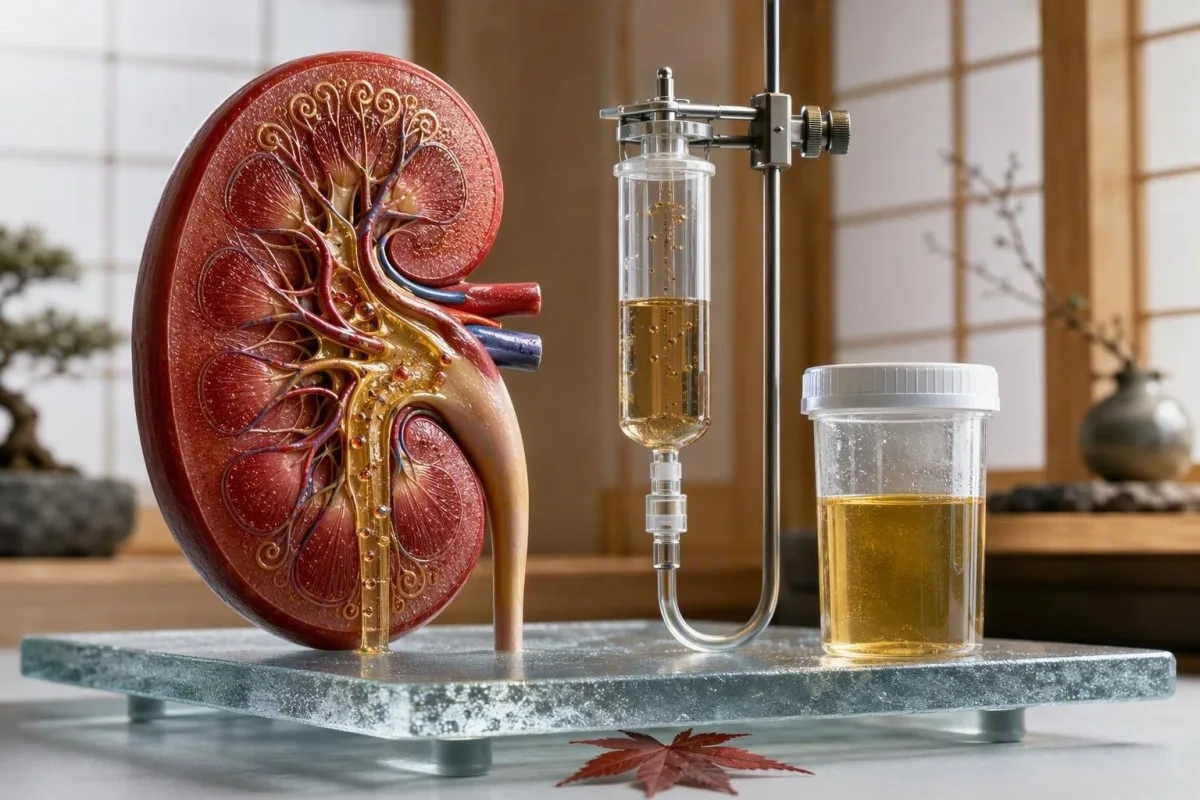
A SIADH é un diagnóstico de padrón, non un único resultado anormal. As pistas útiles proveñen de sangue e ouriños recollidos aproximadamente ao mesmo tempo, despois interpretados xunto con medicamentos, función tiroidea, cortisol e estado de volume.


- Hiponatremia hipotónica real significa que o sodio sérico está por baixo de 135 mmol/L e a osmolalidade sérica medida adoita estar por baixo de 275 mOsm/kg.
- Osmolalidade da urina na SIADH está inapropiadamente por riba de 100 mOsm/kg a pesar da baixa osmolalidade sérica; os riles retendo auga cando deberían facer ouriños diluídos.
- sodio na urina por riba de 30 mmol/L apoia a SIADH só despois de excluír diuréticos, insuficiencia suprarrenal, enfermidade tiroidea e depleción de volume clinicamente obvia.
- Patrón de deshidratación adoita producir ouriños concentrados con sodio na urina inferior a 30 mmol/L, urea ou BUN elevada e signos de volume circulante reducido.
- Insuficiencia suprarrenal pode ter un aspecto case idéntico á SIADH, polo que un cortisol matinal baixo ou un resultado equívoco require seguimento clínico urxente antes de diagnosticar a SIADH.
- Síntomas graves como convulsións, confusión, vómitos repetidos ou diminución da consciencia con baixo sodio requiren atención de emerxencia; o tratamento non debe esperar a unha interpretación en liña.
- Corrección de seguridade : na hiponatremia crónica, o sodio sérico en xeral non debe aumentar máis de 8 mmol/L en ningún período de 24 horas para pacientes con alto risco de desmielinización osmótica.
- O momento importa porque unha infusión de solución salina IV, unha dose de diurético ou varios litros de auga poden cambiar o sodio e a osmolalidade da urina en cuestión de horas.
Por que a SIADH require probas pareadas de sangue e ouriños
A análise de sangue de SIADH O patrón é un baixo nivel de sodio sérico cunha baixa osmolalidade sérica medida, xunto cunha urina que permanece demasiado concentrada e rica en sodio. En termos prácticos, o corpo ten un exceso de auga en relación co sodio porque a actividade da hormona antidiurética non se está a apagar normalmente; un valor de sodio só non pode demostrar isto.
sodio sérico por debaixo 135 mmol/L define hiponatremia, pero o sodio é unha concentración máis que unha medida do sodio corporal total. Unha persoa pode ter baixo sodio por retención de auga, perda de sal, glicosa alta, artefacto de laboratorio ou unha mestura destes; a nosa guía para síntomas de sodio baixo explica por que a gravidade dos síntomas a miúdo segue a velocidade do declive máis que o número exacto.
A primeira bifurcación útil é a osmolalidade sérica medida: menos de 275 mOsm/kg indica hiponatremia hipotónica, o escenario no que se considera o SIADH. A regra clínica do Dr. Thomas Klein é sinxela: nunca etiquetar SIADH a partir dun panel metabólico básico antes de comprobar a glicosa, os triglicéridos, a proteína total e, idealmente, a osmolalidade medida.
Kantesti é un Analizador de análises de sangue con IA que lê sodio, glicosa, urea, creatinina e achados urinarios emparellados como un problema fisiolóxico en lugar dunha colección de sinalizacións. Nas nosas revisións, o erro máis perigoso é a tranquilidade despois dun sodio de 122 mmol/L cando o informe non ten estudos urinarios contemporáneos nin historial de síntomas; os nosos casos de uso clínico mostran por que a perda de contexto cambia o seguinte paso.
Que significa realmente o SIADH
SIADH son as siglas de síndrome de antidiurese inapropiada, chamada historicamente secreción inapropiada da hormona antidiurética. A síndrome pode xurdir de medicamentos, náuseas, trastornos pulmonares ou do sistema nervioso central, dor, estrés postoperatorio e, ocasionalmente, malignidade; o padrón de laboratorio identifica o manexo da auga, non o desencadeante subxacente.
Sodio sérico e osmolalidade: confirmando exceso de auga real
A osmolalidade sérica por baixo de 275 mOsm/kg con sodio por baixo de 135 mmol/L confirma a hiponatremia hipotónica, pero non identifica o SIADH por si soa. Unha osmolalidade normal ou alta dirixe aos clínicos cara á glicosa, manitol, axentes de contraste, alcohois ou pseudohiponatremia en cambio.
A maioría dos laboratorios informan de osmolalidade calculada, comúnmente estimada como 2 × sodio + glicosa + urea en mmol/L, pero unha osmolalidade medida é preferible cando o diagnóstico non está claro. Unha brecha significativa entre os valores medidos e calculados pode revelar osmos non medidos; esta é unha razón pola que un resultado de sodio pode ser clinicamente real pero non representar o SIADH.
Glicosa superior a aproximadamente 13,9 mmol/L (250 mg/dL) reduce o sodio medido desprazando a auga das células ao plasma. Unha corrección comúnmente utilizada engade aproximadamente 1,6 a 2,4 mmol/L de sodio por cada 5,6 mmol/L (100 mg/dL) de glicosa por riba de 5,6 mmol/L, aínda que os clínicos non coinciden no factor exacto a niveis de glicosa moi altos.
Triglicéridos ou paraproteínas moi altos poden causar pseudohiponatremia con ensaios selectivos de ións indirectos, mentres que a osmolalidade medida permanece normal. Compare o resultado do sodio co panel metabólico básico e pregunte se o laboratorio utilizou un electrodo directo ou indirecto antes de asumir un trastorno do equilibrio hídrico.
Osmolalidade da urina na SIADH: a pista renal que cambia o caso
A osmolalidade urinaria por riba de 100 mOsm/kg nun paciente hipotónico significa que hai actividade da hormona antidiurética. Na SIADH, a osmolalidade urinaria adoita ser de 200 a 600 mOsm/kg, aínda que ningún valor urinario único é diagnóstico.
Unha osmolaridade da ouriña de 100 mOsm/kg ou inferior indica orina case maximamente diluída e fai que a SIADH sexa improbable. Ese patrón axústase á polidipsia primaria ou á baixa inxestión de solutos, onde a inxestión de auga supera a capacidade do ril de excretar auga libre; é particularmente relevante en persoas que consumen moi pouca proteína e sal.
Aquí está o punto contraintuitivo: a orina concentrada non significa automaticamente deshidratación. Tanto a hipovolemia como a SIADH aumentan a hormona antidiurética, pero a deshidratación faino apropiadamente para preservar a circulación, mentres que a SIADH faino a pesar dun volume arterial eficaz clinicamente adecuado.
A guía europea sobre hiponatremia recomenda a osmolalidade urinaria como un discriminador temperán porque a avaliación física do volume adoita ser pouco fiable (Spasovski et al., 2014). Lea a nosa explicación máis detallada sobre o proba de osmolaridade urinaria se o seu informe utiliza mOsm/kg en lugar de densidade específica de tira reactiva.
Por que unha única mostra de urina pode ser enganosa
A osmolalidade urinaria pode baixar rapidamente despois de que as náuseas melloren, a dor se controle ou se retire un medicamento ofensivo. Se a urina se recolleu despois de fluídos intravenosos, despois dun diurético de asa, ou horas despois da mostra de sangue, trátolo como unha pista en lugar dunha proba.
Sodio na urina: SIADH versus deshidratación e baixo volume efectivo
A sodio urinario por riba de 30 mmol/L apoia a SIADH na hiponatremia hipotónica cando a inxestión de sal na dieta é habitual e os diuréticos están ausentes. A sodio urinario por baixo de 30 mmol/L indica máis a miúdo a conservación de sodio renal por vómitos, diarrea, suoración, insuficiencia cardíaca, cirrose ou deshidratación verdadeira.
Na SIADH non complicada, os riles non son ávidos de sodio, polo que o sodio urinario é comúnmente por riba de 30 mmol/L e pode superar os 60 mmol/L. A urea adoita ser baixa e o ácido úrico sérico pode estar por baixo de 4 mg/dL (0,24 mmol/L) porque a expansión moderada do volume aumenta a aclaración de urato.
Unha muller de 68 anos que toma hidroclorotiazida pode ter un sodio urinario de 55 mmol/L e urina concentrada despois dun virus estomacal; iso non establece SIADH. A hiponatremia asociada a tiazidas pode imitar todas as características laboratoriais clásicas, por iso a lista de medicamentos non é un detalle administrativo senón datos diagnósticos.
O sodio urinario é menos fiable despois de diuréticos, con enfermidade renal avanzada ou con sodio dietético moi baixo. Pairao coa creatinina, a urea e o panel de electrólitos en lugar de tratar un corte de 30 mmol/L como un muro ríxido.
Excreción fraccional de urato
Unha excreción fraccional de urato por riba 12% pode apoiar a SIADH, particularmente cando os diuréticos desdibuxan o sodio na urina. Normalmente normalízase despois da corrección da SIADH, mentres que os estados de perda renal de sal poden mantelo elevado; este é un territorio de especialista, pero pode ser útil cando a historia non encaixa.
Como a deshidratación ten un aspecto diferente á SIADH nas probas de laboratorio
A deshidratación adoita causar urina concentrada con baixo sodio na urina, aumento da urea en relación coa creatinina e evidencia clínica de perda de volume. A SIADH tamén produce a miúdo urina concentrada, pero os pacientes adoitan estar clinicamente euvolémicos e non teñen a mesma resposta renal de aforro de sodio.
Con vómitos, diarrea ou forte suoración, o ril normalmente reduce o sodio na urina a por debaixo de 20-30 mmol/L mentres que a osmolalidade da urina aumenta por riba de 100 mOsm/kg. A urea pode aumentar desproporcionadamente á creatinina, pero esta relación está afectada pola inxesta de proteínas, hemorraxia gastrointestinal, esteroides e función hepática, polo que é de apoio e non definitiva.
Na SIADH, a presión arterial e o exame poden parecer normais, aínda que os achados sutís importan: sen síntomas ortostáticos, sen mucosas secas, sen edema periférico e sen perda gastrointestinal convincente. Vin pacientes chamados "deshidratados" simplemente porque a súa urina estaba escura; a cor da urina é un mal proxy para a fisioloxía do sodio, como o noso guía de ouriños escuros discute.
Unha infusión cautelosa de solución salina isotónica pode axudar en contornos monitorizados seleccionados: a hiponatremia hipovolémica tende a mellorar a medida que o volume suprime a hormona antidiurética. Na SIADH, a solución salina pode non conseguir aumentar o sodio ou pode empeoralo cando a urina é moito máis concentrada que a infusión; nunca debe ser un experimento caseiro.
Por que a solución salina pode empeorar a SIADH
Un litro de solución salina 0,9% contén 154 mmol de sodio, pero un ril que produce urina a 600 mOsm/kg pode excretar o sodio retendo proporcionalmente máis auga. Este efecto de "desalinización" é máis probable cando o sodio na urina máis o potasio é alto en relación co sodio sérico.
Insuficiencia suprarrenal: o imitador da SIADH que os clínicos deben excluír
A insuficiencia suprarrenal pode producir baixo sodio, baixa osmolalidade sérica, osmolalidade da urina superior a 100 mOsm/kg e sodio na urina superior a 30 mmol/L—case o mesmo patrón que a SIADH. A avaliación do cortisol é polo tanto parte dunha análise segura da SIADH, especialmente con fatiga, perda de peso, baixa presión arterial, hiperpotasemia ou exposición a esteroides.
Un cortisol sérico matinal por riba de aproximadamente 15-18 microgramos/dL (414-497 nmol/L) normalmente fai improbable a insuficiencia suprarrenal clinicamente significativa, dependendo do ensaio e do contexto. Valores por debaixo de 3-5 microgramos/dL (83-138 nmol/L) son preocupantes, mentres que os resultados intermedios adoitan necesitar unha proba de estimulación con ACTH en lugar de adiviñar.
A insuficiencia suprarrenal primaria adoita causar un alto nivel de potasio porque a aldosterona é deficiente, pero a insuficiencia suprarrenal secundaria pode ter un potasio normal e aínda causar hiponatremia grave. O mecanismo é a deficiencia de cortisol que aumenta a liberación de hormona antidiurética, non simplemente a perda de sal.
O panel de expertos de 2013 liderado por Verbalis aconsella excluír a insuficiencia suprarrenal antes de decidirse pola SIADH (Verbalis et al., 2013). Se esta posibilidade está no seu informe, a nosa visión xeral de pistas de laboratorio da enfermidade de Addison pode axudarche a preparar preguntas específicas para unha revisión clínica urxente.
Os medicamentos con esteroides complican as probas
A prednisona, a hidrocortisona e algúns esteroides inxectables poden alterar a interpretación do cortisol e suprimir o eixe suprarrenal. Non deixe de tomar os esteroides prescritos para "ter unha proba limpa"; a retirada abrupta pode precipitar unha crise suprarrenal.
Probas de tiroide: cando o hipotiroidismo realmente explica o baixo sodio
O hipotiroidismo severo pode prexudicar a excreción de auga, pero o hipotiroidismo subclínico común raramente explica unha hiponatremia significativa. Compróbanse a TSH e a T4 libre antes de diagnosticar SIADH porque a insuficiencia tiroidea profunda é tratable e pode coexistir con outras causas.
A hiponatremia hipotiroidea clinicamente importante é máis plausible en enfermidade grave, particularmente a fisioloxía do mixedema con T4 libre baixa, bradicardia, hipotermia ou gasto cardíaco reducido. Unha TSH de 6 mIU/L con T4 libre normal é común e non debe converterse nunha explicación conveniente para un sodio de 121 mmol/L.
Kantesti AI é un plataforma de interpretación de análise de sangue de IA que compara a TSH e a T4 libre co sodio, a función renal e o momento da medicación, xa que un resultado anómalo da TSH pode distraer dunha causa suprarrenal ou relacionada con fármacos máis urxente. Unha TSH normal non exclúe o hipotiroidismo central; unha T4 libre baixa cunha TSH non elevada merece unha vía diferente, explicada no noso artigo sobre T4 libre baixa con TSH normal.
A substitución tiroidea debe axustarse a indicacións tiroideas establecidas, non usarse como un tratamento rápido de sodio. Na miña experiencia, o sodio a miúdo só mellora despois de que o verdadeiro impulsor da retención de auga —náuseas, medicación, deficiencia de cortisol ou enfermidade— tamén fose abordado.
A enfermidade hipofisaria cambia o estudo
A dor de cabeza, os síntomas do campo visual, a baixa libido, a presión arterial baixa inexplicable ou as múltiples hormonas hipofisarias baixas suscitan preocupación por enfermidade hipofisaria central. Nese contexto, compróbase o cortisol antes de comezar a levotiroxina porque a hormona tiroidea pode aumentar a eliminación de cortisol.
Diferenzas de embarazo, idade avanzada e tamaño corporal na interpretación da SIADH
O embarazo reduce o limiar osmótico normal e o sodio sérico nuns 4-5 mmol/L, polo que un sodio próximo a 130 mmol/L pode ser fisiolóxico a principios do embarazo pero aínda así require contexto. As persoas maiores teñen un maior risco de hiponatremia relacionada con medicamentos e a miúdo preséntanse con caídas ou confusión en lugar de sede.
Durante o embarazo sen complicacións, a osmolalidade sérica diminúe tipicamente nuns 5-10 mOsm/kg e o sodio pode establecerse preto de 130-134 mmol/L porque o osmostato se resetea. O sodio por baixo de 130 mmol/L, síntomas neurolóxicos, hipertensión, anomalías hepáticas ou proteinuria requiren avaliación obstétrica urxente en lugar de descartarse como un cambio normal do embarazo.
En persoas maiores de 75 anos, os ISRS, as tiazidas, a carbamazepina, a desmopresina e as dietas baixas en solutos solápense comúnmente. Unha caída do sodio de só 5 mmol/L pode importar cando a cognición basal é fráxil; a inestabilidade da marcha e as caídas poden ser os primeiros sinais observables.
A filtración renal cambia naturalmente durante o embarazo, e a interpretación debe usar referencias conscientes do embarazo; a nosa guía para valores de eGFR no embarazo explica por que un eGFR reportado a miúdo non está validado no embarazo. A restrición de líquidos debe individualizarse no embarazo e na fraxilidade, non copiarse dun folleto xenérico sobre SIADH.
O baixo peso corporal non é un detalle trivial
Unha persoa de 45 kg ten menos auga corporal total que unha persoa de 100 kg, polo que a mesma carga de auga ou dose de fármaco pode producir un maior cambio de sodio. Os pacientes fráxiles tamén teñen menos reserva fisiolóxica se o sodio cambia rapidamente.
Efectos de medicamentos que imitan ou desencadean a SIADH
Os diuréticos tiazídicos, os ISRS, os IRSN, a carbamazepina, a oxcarbazepina, a desmopresina e algúns antipsicóticos son causas frecuentes de hiponatremia hipotónica por medicamentos. Algúns producen unha fisioloxía SIADH real, mentres que as tiazidas poden imitar a SIADH a través dunha dificultade na dilución e perda de sodio.
A hiponatremia relacionada coas tiazidas adoita comezar dentro do primeiro 2 semanas despois de comezar ou aumentar unha dose, aínda que pode ocorrer meses despois cando se engade enfermidade, inxestión reducida de alimentos ou inxestión adicional de auga. Os diuréticos de asa teñen menos probabilidades de causar este patrón particular porque reducen a capacidade de concentración do ril.
A hiponatremia asociada a ISRS é máis común en adultos maiores, persoas con baixo peso corporal e aqueles que tamén toman diuréticos. Un novo antidepresivo non é automaticamente o culpable, pero a secuencia temporal importa máis que unha lista de libros de texto: documente cada inicio, parada e cambio de dose durante os 30 días anteriores.
Non suspenda a medicación para convulsións, psiquiátrica, hormonal ou de presión arterial sen o prescriptor que coñeza a indicación. O baixo cloruro pode acompañar o uso de diuréticos e vómitos; a nosa explicación de resultados de baixo cloruro pode axudar a distinguir o patrón xeral de electrólitos.
Contribuíntes de venda libre
A desmopresina utilizada para a nocturia merece unha atención especial porque beber libremente despois dunha dose pode causar retención de auga abrupta. Os AINE tamén poden amplificar a acción da hormona antidiurética en persoas susceptibles, particularmente durante unha enfermidade intercorrente.
Inxesta baixa de solutos e exceso de auga: patróns que non son SIADH
A polidipsia primaria e a moi baixa inxestión de solutos na dieta adoitan causar unha osmolalidade na urina de 100 mOsm/kg ou menos, a diferenza da SIADH clásica. A distinción importa porque a restrición estrita de líquidos por si soa pode pasar por alto a desnutrición, a enfermidade relacionada co alcol ou unha perigosa corrección rápida unha vez que se reanuda a inxestión de solutos.
O ril necesita solutos —principalmente urea da proteína e electrólitos— para excretar auga. Con só 250 mOsm de solutos dispoñibles ao día, unha persoa pode excretar uns 2,5 L de urina a 100 mOsm/kg, pero só 1 L se a hormona antidiurética mantén a urina a 250 mOsm/kg.
Na polidipsia primaria, a urina adoita estar notablemente diluída e a historia pode revelar máis de 4-6 L de inxestión de líquidos ao día, aínda que o recordo é imperfecto. Na hiponatremia con baixo soluto, a urea pode ser baixa e a historia dietética pode revelar un período recente de baixa inxestión de proteínas e sal.
As cetonas, a baixa urea e a perda de peso poden sinalar subnutrición ou xaxún prolongado en lugar de SIADH. Repase o noso artigo sobre cetonas na urina se hai cetose; a cetoacidose diabética é unha emerxencia separada e pode distorsionar a interpretación do sodio.
O risco de realimentación
Cando se restaura a nutrición, o sodio pode aumentar máis rápido do esperado a medida que o ril recupera a excreción de solutos. Os equipos hospitalarios monitorizan o sodio con frecuencia en pacientes de alto risco, ás veces cada 2-4 horas durante a corrección activa.
Enfermidade renal, cardíaca e hepática: baixo sodio sen SIADH
A insuficiencia cardíaca, a cirrose e a enfermidade renal avanzada causan hiponatremia a través dun baixo volume arterial efectivo, non SIADH primario. Estas condicións aínda poden producir urina concentrada, pero o edema, a redución da perfusión, a baixa albumina ou a dificultade de filtración adoitan cambiar o panorama xeral.
Na insuficiencia cardíaca e cirrose, o corpo pode conter exceso de auga total e sodio pero sente un enchemento arterial inadecuado, activando a hormona antidiurética e as vías de retención de sodio. O sodio na urina adoita estar por debaixo 30 mmol/L a menos que diuréticos ou lesión renal confundan o resultado.
A enfermidade renal avanzada limita tanto a excreción de auga como a concentración da urina, polo que a osmolalidade da urina pode estar próxima á osmolalidade do plasma arredor de 250-350 mOsm/kg. Nesa situación, os limiares clásicos de SIADH perden precisión e a aportación de nefrología é máis útil que probas repetidas de urina spot.
A proteinuria, os cilindros, a albúmina, a tendencia da creatinina e o edema non son problemas secundarios; axudan a identificar a fisioloxía. A nosa guía práctica para gravidade específica urinaria explica por que unha estimación con tira reactiva non pode substituír a osmolalidade da urina medida nun caso renal complexo.
O edema non descarta o perigo
Unha persoa con edema aínda pode desenvolver síntomas neurolóxicos graves cun sodio inferior a 120 mmol/L. O estado de fluidos explica a causa pero non diminúe a urxencia da hiponatremia sintomática aguda.
Tempo de mostraxe, fluidos IV e trampas de laboratorio
O sangue e a urina deberían recollerse idealmente antes dos fluidos IV e cunhas poucas horas de diferenza, xa que o tratamento pode alterar rapidamente os resultados de laboratorio do SIADH. Unha mostra de urina tardía pode describir a resposta á terapia en lugar da causa da hiponatremia.
Un litro de salino, unha dose de furosemida, tratamento antiemético, alivio da dor, ou a interrupción da desmopresina poden cambiar a produción de urina e a osmolalidade en cuestión de horas. Rexistre as horas exactas de recolección, a inxesta recente de líquidos, a terapia IV e os medicamentos; este detalle mundano adoita resolver resultados de laboratorio do SIADH aparentemente contradictorios.
A hemólise normalmente non crea un sodio falsamente baixo, pero unha hiperlipidemia importante, unha hiperproteinemia e a contaminación da mostra poden facelo. Un resultado de sodio que difire marcadamente do valor de onte sen unha explicación clínica debería provocar unha nova mostra ou unha medida directa con electrodo iónico selectivo, non un diagnóstico por folla de cálculo.
A IA Kantesti compara datas e sinala cambios implausibles, pero non pode ver unha infusión de salino non rexistrada ou unha dose omitida. Use unha liña temporal de análise de sangue para anotar enfermidade, exercicio, xaxún, inxesta de líquidos e eventos de medicación xunto a cada resultado.
A densidade urinaria específica non é osmolalidade
A densidade específica reflicte a masa de partículas ademais da concentración e pode ser distorsionada por glicosa, proteínas ou medios de contraste. Un valor de 1.020 non se traduce de forma fiable nun valor de mOsm/kg particular en todos os pacientes.
O traballo enfocado da SIADH que os clínicos adoitan pedir
Unha avaliación segura do SIADH adoita incluír sodio sérico, potasio, glicosa, urea, creatinina, osmolalidade sérica medida, osmolalidade urinaria, sodio urinario, TSH, T4 libre e cortisol matutino. O obxectivo é confirmar a hiponatremia hipotónica e excluír mímicos reversibles antes de asignar a etiqueta SIADH.
Probas adicionais dependen do contexto: ácido úrico, marcadores hepáticos, perfil lipídico, proteína total, ACTH, imaxe torácica, imaxe cerebral ou revisión de medicacións poden ser apropiados. Nun paciente aparentemente euvolémico cun sodio de 126 mmol/L, o par de osmolalidade simultánea e o cortisol adoitan ser máis informativos que probas amplas e non enfocadas.
A comparación de guías de Hoorn e Zietse subliña que o exame de volume só ten unha precisión diagnóstica limitada e apoia un enfoque bioquímico centrado na urina (Hoorn e Zietse, 2017). É por iso que un exame de aparencia normal non debería anular unha osmolalidade urinaria de 550 mOsm/kg e unha osmolalidade sérica de 260 mOsm/kg.
O Dr. Thomas Klein recomenda facer unha fotografía de cada páxina de resultados, incluíndo a hora de recolección, o intervalo de referencia e a lista de medicamentos, antes dunha visita. O noso lista de verificación de seguridade de informes médicos con IA explica como preservar os detalles da fonte que unha interpretación necesita.
Cando a imaxe se fai relevante
A SIADH nova e persistente sen unha medicación clara ou enfermidade aguda pode indicar imaxe torácica, particularmente en persoas maiores con exposición ao tabaco ou síntomas respiratorios. A imaxe está dirixida pola historia e o exame; non é obrigatoria para cada sodio de 132 mmol/L.
Que significan os números de tratamento e por que a corrección do sodio pode ser perigosa
A hiponatremia sintomática severa trátase en hospital con salino hipertonico coidadosamente monitorizado, mentres que o manexo da SIADH crónica ten como obxectivo a causa e o equilibrio hídrico controlado. O perigo é bilateral: o inchazo cerebral sen tratar e a corrección demasiado rápida poden causar lesión neurolóxica permanente.
Para convulsións, coma, confusión profunda ou vómitos severos debidos á hiponatremia, as directrices usan comúnmente 100-150 mL de salino 3% como un bolo intermitente con controis repetidos de sodio. O obxectivo inicial é un pequeno aumento duns 4-6 mmol/L para reducir o edema cerebral, non a normalización inmediata.
Para a hiponatremia crónica, moitos clínicos limitan a corrección a 8 mmol/L en 24 horas para persoas con alto risco de desmielinización osmótica, incluíndo alcoholismo, desnutrición, enfermidade hepática grave, hipocalemia ou un sodio inicial moi baixo. Algunhas directrices permiten 10 mmol/L no primeiro día para pacientes de menor risco, pero prefiro a precaución porque un número pode aumentar inesperadamente unha vez que a hormona antidiurética diminúe.
A restrición de líquidos adoita comezar ao redor de 800-1.000 mL diarios en SIADH estable, pero o seu éxito depende da concentración da urina e da inxestión de solutos. A urea, os diuréticos de asa con sal ou os antagonistas da vasopresina son decisións especializadas; Kantesti é un Ferramenta de análise de probas de sangue impulsada por IA deseñado para sinalar o patrón relevante, non para prescribir ou substituír a atención urxente. Consulte a nosa supervisión clínica técnica ao considerar como se revisa medicamente a interpretación automatizada.
A corrección do potasio tamén aumenta o sodio
O potasio é un osmol eficaz, polo que o tratamento da hipocalemia pode aumentar o sodio sérico mesmo sen salino. Isto é facilmente pasado por alto ao calcular a taxa de corrección total de 24 horas.
Cando o baixo sodio ou a posible SIADH requiren atención médica urxente
Busque atención de emerxencia agora en caso de convulsións, desmaio, nova confusión severa, somnolencia marcada, vómitos repetidos, dor de cabeza severa ou dificultade para respirar con baixo sodio coñecido ou sospeitoso. Un sodio inferior a 120 mmol/L merece avaliación clínica o mesmo día, mesmo se os síntomas parecen leves, especialmente cando a caída pode ser recente.
Chame ao médico que solicitou a proba con prontitude para o sodio 125-129 mmol/L, nova exposición a medicamentos, tratamento contra o cancro, embarazo, síntomas suprarrenais ou unha tendencia descendente significativa. Non beba deliberadamente auga extra, tome pastillas de sal ou restrinxa todos os líquidos antes de recibir consello individual; cada acción pode empeorar unha causa diferente.
A partir do 27 de agosto de 2026, a contribución máis útil do paciente é unha historia precisa: líquidos diarios, inxestión de alcohol, vómitos ou diarrea recentes, todas as prescricións e suplementos, líquidos IV, dor, náuseas, síntomas pulmonares e valores de sodio previos. Esa historia adoita distinguir a liberación transitoria de hormona antidiurética da SIADH persistente de forma máis eficaz que un panel de química illado adicional.
O equipo médico de Kantesti utiliza a revisión de resultados baseada en patróns con supervisión médica; os lectores poden ver aos clínicos detrás dese proceso na nosa Consello Asesor Médico. Se os resultados son confusos, leve o informe de laboratorio orixinal e este marco de proba pareada a un médico con licenza en lugar de autotratar un número de sodio.
Preguntas para levar á túa consulta
Pregunte se a hiponatremia está confirmada como hipotónica, se a urina se recolleu antes do tratamento, se se controlaron o cortisol e o T4 libre, e se un medicamento ou unha inxestión baixa de solutos podería explicar o patrón. Esas catro preguntas manteñen a discusión centrada nas causas que cambian o tratamento.
Preguntas frecuentes
Que resultados de análise de sangue suxiren SIADH?
SIADH suxérese por un sodio sérico inferior a 135 mmol/L, unha osmolalidade sérica medida inferior a 275 mOsm/kg, unha osmolalidade na urina superior a 100 mOsm/kg e un sodio na urina xeralmente superior a 30 mmol/L. A persoa adoita estar clinicamente euvolémica, sen deshidratación convincente, edema, insuficiencia renal, insuficiencia suprarrenal ou hipotiroidismo grave. A baixa urea e o ácido úrico sérico inferior a aproximadamente 4 mg/dL poden axudar, pero ningún é diagnóstico por si só. Os clínicos deben interpretar estas probas de sangue e ouriños recollidos case ao mesmo tempo.
Que osmolalidade urinaria é típica na SIADH?
A osmolalidade urinaria na SIADH está inapropiadamente acima de 100 mOsm/kg, apesar da baixa osmolalidade sérica, e muitos pacientes apresentam valores entre 200 e 600 mOsm/kg. Uma osmolalidade urinaria de 100 mOsm/kg ou inferior argumenta contra a SIADH porque mostra que o rim pode diluir a urina apropriadamente. A desidratação também pode produzir uma osmolalidade urinaria acima de 100 mOsm/kg, portanto, o sódio urinario e a avaliação clínica do volume são necessários. Uma amostra coletada após tratamento com salina, diuréticos ou tratamento para náuseas pode ser enganosa.
A deshidratación pode causar baixo sodio e parecerse á SIADH?
Si, a deshidratación por vómitos, diarrea, sudoración ou inxestión deficiente pode causar hiponatremia hipotónica con ouriña concentrada superior a 100 mOsm/kg. Na deshidratación directa, o sodio na ouriña adoita estar por baixo de 20-30 mmol/L porque os riles conservan sodio, e a urea pode aumentar en relación coa creatinina. A SIADH ten máis frecuentemente sodio na ouriña superior a 30 mmol/L sen signos claros de depleción de líquidos. Os diuréticos poden desdibuxar esta distinción, polo que o historial de medicación é esencial.
Por que se comproba o cortisol cando os médicos sospeitan SIADH?
O cortisol é verificado porque a insuficiência adrenal pode causar o mesmo padrão de baixa concentração de sódio, baixa osmolalidade sérica e urina concentrada que a SIADH. Um cortisol matinal acima de aproximadamente 15-18 microgramas/dL, dependendo do ensaio e do contexto clínico, geralmente torna improvável uma insuficiência adrenal significativa; um resultado abaixo de 3-5 microgramas/dL é preocupante. Valores intermediários muitas vezes necessitam de um teste de estimulação com ACTH. A falha em diagnosticar a insuficiência adrenal é perigosa porque requer substituição de esteroides, e não apenas restrição de fluidos.
Un ISRS ou un diurétique peuvent-ils entraîner des résultats de laboratoire SIADH ?
Os ISRS, ISRN, carbamazepina, oxcarbazepina e desmopressina podem desencadear retenção de água semelhante à SIADH, enquanto os diuréticos tiazídicos podem imitar de perto os achados laboratoriais da SIADH. A hiponatremia associada a tiazídicos geralmente se desenvolve em até 14 dias após o início ou aumento do tratamento, mas uma doença intercorrente pode desencadeá-la mais tarde. O sódio urinário pode permanecer acima de 30 mmol/L em ambas as condições, portanto, o cronograma do medicamento é clinicamente decisivo. Os pacientes não devem interromper a medicação psiquiátrica, anticonvulsivante ou para pressão arterial prescrita sem o conselho do prescritor.
Canta velocidade pode ser correxida a hiponatremia con seguridade?
Na hiponatremia crónica, moitos clínicos buscan manter a corrección do sodio en 8 mmol/L ou menos en 24 horas para pacientes con alto risco de desmielinización osmótica, como aqueles con desnutrición, alcoholismo, hepatopatía grave, hipopotasemia ou sodio moi baixo. Os síntomas de emerxencia poden requirir bolos de 100-150 mL de salino 3% no hospital para acadar un aumento inicial duns 4-6 mmol/L. O obxectivo exacto depende da duración, dos síntomas e dos factores de risco. O tratamento con sodio require análises de sangue repetidas xa que a diurese acuosa espontánea pode acelerar a corrección inesperadamente.
Obtén hoxe unha análise de sangue con IA
Únete a máis de 2 millóns de usuarios en todo o mundo que confían en Kantesti para obter unha análise instantánea e precisa das análises de laboratorio. Carga os teus resultados de análise de sangue e recibe unha interpretación completa de biomarcadores de 15,000+ en segundos.
📚 Publicacións de investigación citadas
Klein, T., Mitchell, S., & Weber, H. (2026). Guía de saúde da muller: ovulación, menopausa e síntomas hormonais. Kantesti Investigación médica con IA.
Klein, T., Mitchell, S., & Weber, H. (2026). Soporte de decisión clínica multilingüe asistido por IA para el triaje temprano de hantavirus: diseño, validación de ingeniería y despliegue en el mundo real en 50.000 informes de análisis de sangre interpretados. Kantesti Investigación médica con IA.
📖 Referencias médicas externas
⚕️ Aviso médico
Este artigo é só para fins educativos e non constitúe asesoramento médico. Consulta sempre un/ha profesional sanitario/a cualificado/a para decisións de diagnóstico e tratamento.
Sinais de confianza E-E-A-T
Experiencia
Revisión clínica dirixida por un médico dos fluxos de interpretación de análises.
Experiencia
Foco en medicina de laboratorio sobre como se comportan os biomarcadores no contexto clínico.
Autoridade
Escrito polo Dr. Thomas Klein, con revisión da Dra. Sarah Mitchell e do Prof. Dr. Hans Weber.
Fiabilidade
Interpretación baseada en evidencias con vías de seguimento claras para reducir a alarma.