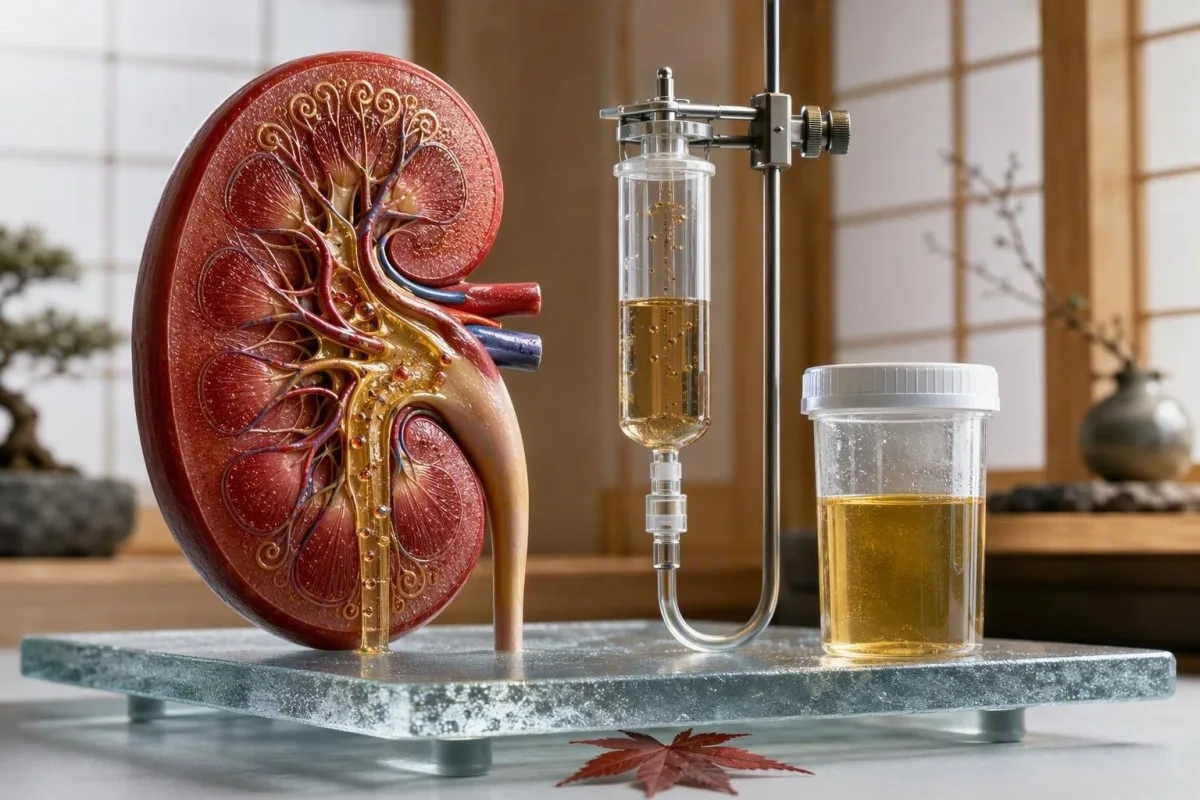
La SIADH és un diagnòstic de patró, no un sol resultat anòmal. Les pistes útils provenen de la sang i l'orina recollides més o menys al mateix temps, després interpretades juntament amb medicaments, funció tiroïdal, cortisol i estat de volum.


- Hiponatrèmia hipotònica real significa que el sodi sèric està per sota de 135 mmol/L i l'osmolalitat sèrica mesurada sol estar per sota de 275 mOsm/kg.
- Osmolalitat de l'orina en la SIADH és inapropiament superior a 100 mOsm/kg malgrat una baixa osmolalitat sèrica; els ronyons retenen aigua quan haurien de produir orina diluïda.
- sodi urinari per sobre de 30 mmol/L dóna suport a la SIADH només després d'excloure diürètics, insuficiència suprarrenal, malaltia tiroïdal i depleció de fluids clínicament òbvia.
- Patròn de desidratacion sol produir orina concentrada amb sodi urinari per sota de 30 mmol/L, urea o BUN elevada, i signes de volum circulatori reduït.
- Insufisença suprarenala pot semblar gairebé idèntic a la SIADH, de manera que un cortisol matinal baix o un resultat equívoc requereix un seguiment clínic urgent abans de diagnosticar la SIADH.
- Simptòmas severes com convulsions, confusió, vòmits repetits o consciència reduïda amb sodi baix requereixen atenció d'emergència; el tractament no ha d'esperar una interpretació en línia.
- Seguretat de la correcció en matèria: en la hiponatrèmia crònica, el sodi sèric generalment no hauria d’augmentar més de 8 mmol/L en cap període de 24 hores per a pacients amb alt risc de desmielinització osmòtica.
- Lo moment es important ja que una infusió de sèrum salí, una dosi de diürètic o diversos litres d’aigua poden canviar el sodi i l’osmolalitat de l’orina en poques hores.
Per què la SIADH requereix proves de sang i orina aparellades
A anàlisi de sang per a SIADH el patró és un baix sodi sèric amb una baixa osmolalitat sèrica mesurada, combinat amb una orina que roman massa concentrada i relativament rica en sodi. En termes pràctics, el cos té un excés d’aigua en relació amb el sodi perquè l’activitat de l’hormona antidiürètica no s’atura normalment; un valor de sodi sol no pot demostrar-ho.
Sodi sèric inferior a 135 mmol/L defineix la hiponatrèmia, però el sodi és una concentració més que una mesura del sodi corporal total. Una persona pot tenir un baix nivell de sodi per retenció d’aigua, pèrdua de sal, glucosa alta, artefacte de laboratori o una barreja d’aquests; la nostra guia per a los símptomes de sodi bass explica per què la gravetat dels símptomes sovint segueix la velocitat de descens més que el número exacte.
La primera bifurcació útil és l’osmolalitat sèrica mesurada: inferior a 275 mOsm/kg indica hiponatrèmia hipotònica, la situació en què es considera el SIADH. La regla clínica del Dr. Thomas Klein és senzilla: mai etiquetar SIADH a partir d’un perfil metabòlic bàsic abans de comprovar la glucosa, els triglicèrids, les proteïnes totals i, idealment, l’osmolalitat mesurada.
Kantesti es un Analizador de tèst de sang d'IA que llegeix el sodi, la glucosa, la urea, la creatinina i els resultats de l’orina aparellats com un problema fisiològic en lloc d’una col·lecció de senyals. En les nostres revisions, l’error més perillós és la tranquil·litat després d’un sodi de 122 mmol/L quan l’informe no té estudis d’orina contemporanis ni historial de símptomes; els nostres casos d’ús clínic mostren per què la pèrdua de context canvia el següent pas.
Què significa realment el SIADH
SIADH significa síndrome de diüresi inapropiada, anomenada històricament secreció inapropiada d’hormona antidiürètica. La síndrome pot sorgir de medicaments, nàusees, trastorns pulmonars o del sistema nerviós central, dolor, estrès postoperatori i, ocasionalment, malignitat; el patró de laboratori identifica la gestió de l’aigua, no el desencadenant subjacent.
Sodi i osmolalitat sèrica: confirmació d'excés d'aigua real
Osmolalitat sèrica inferior a 275 mOsm/kg amb sodi inferior a 135 mmol/L confirma la hiponatrèmia hipotònica, però no identifica el SIADH per si sola. Una osmolalitat normal o alta dirigeix els clínics cap a glucosa, manitol, agents de contrast, alcohols o pseudohiponatrèmia en el seu lloc.
La majoria dels laboratoris informen d’osmolalitat calculada, comunament estimada com 2 × sodi + glucosa + urea en mmol/L, però una osmolalitat mesurada és preferible quan el diagnòstic no està clar. Una bretxa significativa entre els valors mesurats i calculats pot revelar osmols no mesurats; aquesta és una raó per la qual un resultat de sodi pot ser clínicament real però no representar SIADH.
Glucosa superior a aproximadament 13,9 mmol/L (250 mg/dL) redueix el sodi mesurat per desplaçament d’aigua des de les cèl·lules cap al plasma. Una correcció d’ús comú afegeix aproximadament 1,6 a 2,4 mmol/L de sodi per cada 5,6 mmol/L (100 mg/dL) de glucosa per sobre de 5,6 mmol/L, tot i que els clínics discrepen sobre el factor exacte a nivells de glucosa molt alts.
Trigliceridèmas o paraproteinèmas trè an anauta la pòdon kaudar pseudohiponatrèmia cont'un ensag an-directe a sèl-selective, mentretant que l'osmolalitat mesurada rèsta nòrmala. Comparatz lo resultat de sodi cont'lo un panèl metabolic basic e demandatz se lo laboratòri a utilizat una electrode dirècta o an-directa avans de supausar un desòrdre de l'equilibri idric.
Osmolalitat de l'orina en la SIADH: la pista renal que canvia el cas
Una osmolalitat urinària de mai de 100 mOsm/kg en un pacient ipotonic indica la preséncia d'activitat de l'ormona antidiuretica. En cas de SIADH, l'osmolalitat urinària es sovent de 200 a 600 mOsm/kg, ben que cap valor urinari siec diagnostic.
Una osmolaritat de l’urina de 100 mOsm/kg o mens indica una orina quasi maximalament diluida e fa improbable lo SIADH. Aqueth patron s'ajusta a la polidipsia primària o a un absorbiment de soluts bas, ont l'absorbiment d'aiga depassa la capacitat del renha de'n excrèir d'aiga liura; es particularament pertinent per las personas que consumisson fòrça pauc de proteïnas e de sal.
Aquí es lo ponch contraintuitiu: una orina concentrada non significa automaticament desidratacion. L'ipovolemia e lo SIADH aumentan l'ormona antidiuretica, mas la desidratacion o hè de faiçon apropriada per preservar la circulacion, mentre que lo SIADH o hè tot aquò en despieit d'un volum arterial eficaç adequat clinicament.
La guia europèa sus l'iponatrèmia recomanda l'osmolalitat urinària com'un discriminant precòc perque l'avaliacao fisica del volum es sovent pauc fiable (Spasovski et al., 2014). Legissètz nòstra explicacion mai a fons de la prova d’osmolalitat urinària se vòstre rapòrt utiliza mOsm/kg en luòc de la densitat especifica d'una benda reagenta.
Perqué un simple echantillon d'urina pòt enganar
L'osmolalitat urinària pòt demorar rapidament aprés que la nausèa s'apaise, que la dolor siá controlada, o que medicament ofenent siá retirat. Se l'urina foguèt reculhida aprés fluid intravenós, aprés un diüretic de ansa, o unas oras aprés l'echantillon de sang, o consideri com'un indici puslèu que coma una pròva.
Sodi urinari: SIADH versus deshidratació i baix volum efectiu
Un sodi urinari de mai de 30 mmol/L sosten lo SIADH en cas d'iponatrèmia ipotonica quan l'absorbiment de sal dietetica es normal e los diüretics son absents. Un sodi urinari de mens de 30 mmol/L indica mai sovent una conservacion renala de sodi deguda a vòmits, diarrea, sudoracion, insufiséncia cardiaca, cirròsi, o una veritabla desidratacion.
En cas de SIADH non complicat, los renlhas non son avids de sodi, donc lo sodi urinari es comunament al dessús de 30 mmol/L e pòt depassar 60 mmol/L. L'urea es sovent bassa, e l'acid uric seric pòt èsser de mens de 4 mg/dL (0,24 mmol/L) perque una expansion volumica leuja aumenta la clarença d'urat.
Una persona de 68 ans que pren d'idroclorotiazida pòt aver un sodi urinari de 55 mmol/L e una urina concentrada aprés un virus estomacal; aquò non establis pas un SIADH. L'iponatrèmia associada a la tiazida pòt mimetizar totas las caracteristicas laboratorialas classicas, qu'es perqué la lista de medicaments non es un detalh administratiu mas una donada diagnostica.
Lo sodi urinari es mens fiable aprés diüretics, en cas de malautia renala avançada, o amb un absorbiment de sodi dietetic fòrça bas. Associatz-lo amb la creatinina, l'urea e la panèl d’electrolits puslèu que de tractar un treshau de 30 mmol/L com'una muralha rigida.
Fraccion d'excrecion d'urat
Una excreció fraccionada d'urat per sobre 12% pot donar suport a la SIADH, particularment quan els diürètics emmascaren el sodi urinari. Normalment es normalitza després de la correcció de la SIADH, mentre que els estats de pèrdua de sal renal poden mantenir-la elevada; aquest és un territori especialitzat, però pot ser útil quan la història no encaixa.
Com la deshidratació es veu diferent de la SIADH en les proves de laboratori
La deshidratació sol causar orina concentrada amb baix sodi urinari, augment de la urea en relació amb la creatinina i evidència clínica de pèrdua de volum. La SIADH sovint produeix orina concentrada també, però els pacients solen estar clínicament euvolèmics i no tenen la mateixa resposta renal de conservació de sodi.
Amb vòmits, diarrea o sudoració abundant, el ronyó normalment redueix el sodi urinari a per sota de 20-30 mmol/L mentre que l'osmolalitat urinària augmenta per sobre de 100 mOsm/kg. La urea pot augmentar desproporcionadament en relació amb la creatinina, però aquesta relació es veu afectada per la ingesta de proteïnes, el sagnat gastrointestinal, els esteroides i la funció hepàtica, de manera que és un suport més que definitiu.
En la SIADH, la pressió arterial i l'exploració poden semblar normals, però els signes subtils són importants: no hi ha símptomes ortostàtics, no hi ha mucoses seques, no hi ha edemes perifèrics i no hi ha una pèrdua gastrointestinal convincent. He vist pacients anomenats "deshidratats" simplement perquè la seva orina era fosca; el color de l'orina és un mal indicador de la fisiologia del sodi, com discuteix el nostre guia d’orina fosca .
Un desafiament cautelós de solució salina isotònica pot ajudar en situacions monitorades seleccionades: la hiponatrèmia hipovolèmica tendeix a millorar a mesura que el volum suprimeix l'hormona antidiürètica. En la SIADH, la salina pot no aconseguir augmentar el sodi o pot empitjorar-lo quan l'orina és molt més concentrada que la infusió; mai hauria de ser un experiment casolà.
Per què la salina pot empitjorar la SIADH
Un litre de salina al 0,9% conté 154 mmol de sodi, però un ronyó que produeix orina a 600 mOsm/kg pot excretar el sodi mentre reté proporcionalment més aigua. Aquest efecte de "desalinació" és més probable quan el sodi urinari més el potassi és alt en relació amb el sodi sèric.
Insuficiència suprarrenal: el mim de la SIADH que els clínics han d'excloure
La insuficiència suprarrenal pot produir baix sodi, baixa osmolalitat sèrica, osmolalitat urinària per sobre de 100 mOsm/kg i sodi urinari per sobre de 30 mmol/L, gairebé el mateix patró que la SIADH. Per tant, una avaluació del cortisol forma part d'un estudi segur de SIADH, especialment amb fatiga, pèrdua de pes, pressió arterial baixa, hiperpotasèmia o exposició a esteroides.
Un cortisol sèric matinal per sobre d'aproximadament 15-18 microgramas/dL (414-497 nmol/L) normalment fa que la insuficiència suprarrenal clínicament significativa sigui poc probable, depenent de l'assaig i el context. Els valors per sota de 3-5 microgramas/dL (83-138 nmol/L) són preocupants, mentre que els resultats intermedis sovint requereixen una prova d'estimulació amb ACTH en lloc d'endevinar.
La insuficiència suprarrenal primària sovint causa potassi alt perquè l'aldosterona és deficient, però la insuficiència suprarrenal secundària pot tenir potassi normal i encara causar hiponatrèmia greu. El mecanisme és la deficiència de cortisol que augmenta l'alliberament d'hormona antidiürètica, no simplement la pèrdua de sal.
El panel d'experts de 2013 dirigit per Verbalis aconsella excloure la insuficiència suprarrenal abans de decidir-se per la SIADH (Verbalis et al., 2013). Si aquesta possibilitat és al vostre informe, la nostra visió general de pistes de laboratori de la malaltia d'Addison us pot ajudar a preparar preguntes dirigides per a una revisió urgent d'un metge.
Los medicaments esteroïdes complican los tests
La prednisolona, l'idrocortisona e qualques esteroïdes injectables que pòdon alterir l'interpretacion del cortisòl e suprimir l'èxa adrenal. Ne paratz pas los esteroïdes prescriches per "obténer un test net" ; un retirament abrupte que pòt provocar una crisi adrenal.
Exàmens tiroïdian: quan l'hipotiroïdisme explica realment el sodi baix
L'ipotiroïdisme sever que pòt atalhar l'excrecion d'aiga, mas l'ipotiroïdisme subclinica ordinari qu'es rarament l'explicacion d'una iponatrièmia significativa. Lo TSH e lo T4 liure son verificats abans de diagnosticar SIADH que l'esfòrç tiroidian profond es tractable e que pòt coexistir amb d'autras causas.
L'iponatrièmia ipotiroïdiana clinicament importanta es mai plausibla dins una malautiá severa, particularament la fisiologia de miixedema amb un T4 liure bas, bradicardia, ipotermia o un debit cardiac redusit. Un TSH de 6 mIU/L amb un T4 liure normal es comun e que deuriá pas venir una explicacion comoda per un sòdi de 121 mmol/L.
Kantesti AI es un plataforma d’interpretacion d’analisi de sang d’AI que compara lo TSH e lo T4 liure amb lo sòdi, la foncion renala e lo moment de la medicacion, que un resultat de TSH marcat que pòt destornar d'una causa adrenal o medicamentosa mai urgenta. Un TSH normal n'exclutz pas l'ipotiroïdisme central ; un T4 liure bas amb un TSH non elevat que merita un caminament diferent, explicat dins nòstre article sus T4 lliure baix amb TSH normal.
Lo remplaçament tiroidian que deuriá èsser ajustat per las indicacions tiroidianas establidas, e non pas utilizat coma un tractament rapid del sòdi. Dins mon experiéncia, lo sòdi que s'amelhora sovent sonque aprés que lo verai motor de la retencion d'aiga — la nausa, la medicacion, la deficiença de cortisòl, o la malautiá — aja tanben estat abordat.
La patologia ipofisària que cambia lo diagnostic
Mal de cap, simptòmas del camp visual, libido bassa, pression arteriala bassa inexplicada o plurals ormonas ipofisàrias bassas que suscitent la preocupacion per una patologia ipofisària centrala. Dins aquel contèxte, que verificatz lo cortisòl abans de començar la levotiroxina que l'ormona tiroidiana que pòt aumentar l'aclarament del cortisòl.
Embaràs, edat avançada i diferències de mida corporal en la interpretació de la SIADH
LaPregnancy que redusís lo leugièr osmotic normal e lo sòdi seric de çò que fa 4-5 mmol/L, doncas un sòdi pròche de 130 mmol/L que pòt èsser fisiologic al començament de laPregnancy mas que demanda totjorn un contèxte. Los adults majors que an un risc mai naut d'iponatrièmia ligada a la medicacion e que se presenten sovent amb de casudas o confusion puslèu que de set.
Durant laPregnancy sens complications, l'osmolalitat serica que descreis generalament de 5-10 mOsm/kg 5-10 mOsm/kg e lo sòdi que pòt s'establir pròche de 130-134 mmol/L que l'osmostat se resèta. Lo sòdi per devath de 130 mmol/L, los simptòmes neurologics, l'ipertension, las anomalias hepaticas o la proteinuria que demandan una evaluacion obstetrica urgenta puslèu qu'una dismissal coma un cambiament normal de laPregnancy.
Dins las personas de mai de 75 ans, los SSRI, los tiazids, la carbamazepina, la desmopression e los regims bas en soluts que se crosan comunament. Una caiguda del sòdi de sonque 5 mmol/L que pòt aver de l'importància que la cognicion de basa es fragila; l'instabilitat de la marchada e las casudas que pòdon èsser los primièrs signes observables.
La filtracion renala que cambia naturalament pendent laPregnancy, e l'interpretacion que deuriá utilizar de referéncias caufadas dePregnancy; nòstre guida de las valors de eGFR dePregnancy valors de eGFR dePregnancy explica perqué un eGFR raportat es sovent non validat pendent laPregnancy. La restriction de liquids que deuriá èsser individualizada pendent laPregnancy e la fragilitat, non pas copiada d'un guida generic de SIADH.
La massa corporala bassa que n'es pas un detalh trivial
Una persona de 45 kg que possedís mens d'aiga corporala totala qu'una persona de 100 kg, doncas la meteissa carga d'aiga o la meteissa dòsi de medicament que pòt produire un desplaçament mai important del sòdi. Los patients fragils que possedisson tanben mens de resèrva fisiologica se lo sòdi cambia rapidament.
Efectes medicaments que imiten o desencadenen la SIADH
Los diuretics tiazids, los SSRI, los SNRI, la carbamazepina, l'oxcarbazepina, la desmopression e qualques antipsicotics que son de causas frequentas de medicacion d'iponatrièmia ipotonica. Qu'unes que produson una vertadièra fisiologia de SIADH, mentre que los tiazids que pòdon mimetizar SIADH per un desdoblament atalhat e una pèrda de sòdi.
L'igponatrèmia ligada a las tiazidas comença sovent dins lo primièr 2 setmanas après aver començat o aumentat una dòsi, mas pòt aparéisser de meses après quand una malautiá, una reduccion de l'ingestion alimentària o una ingestion d'aiga excessiva s'i apondon. Las diureticas de nassa son mens susceptiblas de causar aquel tipe de problèma particular perque reduson la capacitat de concentracion del ren.
L'igponatrèmia associada als ISAS es mai frequenta en personas de la vielha edat, amb un pes bas, e que prenèron tanben de diureticas. Un nòu antidepressant es pas automaticament lo culpable, mas la sequéncia temporala es mai importanta qu'una lista de manual: documentatz cada començament, arrèst e cambi de dòsi pendent los 30 jorns precedents.
Ne paratz pas los medicaments anti-convulsivants, psiquiatrices, hormonals o de tension arteriala sens lo prescandaire que coneis l'indicacion. Un bas nivèl de clorur pòt acompanhar la presa de diureticas e los vòmits; nòstra explicacion de bas nivèl de clorur pòt ajudar a destriar lo tipe general d'electrolits.
Contribucions de medicaments sens prescription
La desmopressina utilisada per la noctúria merita una atencion especiala perque beure liurament après una dòsi pòt provocar una retencion d'aiga brutala. Los AINE pòdon tanben amplificar l'accion de l'ormona antidiuretica en personas susceptible, particularament pendent una malautiá intercurrenta.
Baixa ingesta de soluts i excés d'aigua: patrons que no són SIADH
La polidipsia primària e una ingestion alimentària de soluts fòrça bassa causan generalament una osmolalitat urinària de 100 mOsm/kg o mens, a la diferéncia del SIALH classic. La destincion es importanta perque una restriction idrica estricta sola pòt mancar una malnutricion, una malautiá ligada a l'alcòl, o una correccion rapida dangierosa un còp que l'ingestion de soluts repren.
Lo ren a besonh de soluts —principalament d'urèa de las proteïnas e d'electrolits— per excretar l'aiga. Amb sonque 250 mOsm de soluts disponibles per jorn, una persona pòt excretar aperaquí 2,5 L d'urina a 100 mOsm/kg, mas sonque 1 L se l'ormona antidiuretica manten l'urina a 250 mOsm/kg.
En cas de polidipsia primària, l'urina es sovent remarcablament diluïda e l'istorial pòt revelar mai de 4-6 L d'ingestion de liquids per jorn, encara que lo sovenir siá imperfecte. En cas d'igponatrèmia amb bas solut, l'urèa pòt èsser bassa e l'istorial alimentari pòt revelar una periòda recenta de bassa ingestion de proteïnas e de sal.
Las cetonas, l'urèa bassa e la pèrda de pes pòdon senhalar una desnutricion o un dejun prolungat puslèu qu'un SIALH. Consultatz nòstre article sus las cetonas urinàrias se la cetoza es presenta; la cetoacidòsi diabetica es una emergéncia separada e pòt distorsionar l'interpretacion del sòdi.
Lo risc de retro-alimentacion
Quand la nutricion es restablida, lo sòdi pòt aumentar mai rapidament que previst mentre que lo ren recupèra l'excrecion de soluts. Las equipas d'espital balhan un suenh especial al sòdi frequentament en los pacients de nalt risc, de còps que non cada 2-4 oras pendent una correccion activa.
Malalties renals, cardíaques i hepàtiques: sodi baix sense SIADH
L'insufiséncia cardiaca, la cirròsi e las malautiás renalas avançadas causan l'igponatrèmia per un bas volum arterial efecatiu, non pas per SIALH primari. Aquests condicions pòdon totjorn produire d'urina concentrada, mas l'edèma, la perfusion reducida, l'albumina bassa o una filtracion compremesa cambian generalament lo quadre global.
En cas d'insufiséncia cardiaca e de cirròsi, lo còrs pòt contenir d'aiga e de sòdi total excessius mas sentís un empachament arterial insufisenta, activant l'ormona antidiuretica e las vias de retencion de sòdi. L'urina sodica es sovent mendre que 30 mmol/L levat si los diureticas o lesiuna renau complican lo resultat.
Malautiá renala avançada limita tant l'excrecion d'aiga coma la concentracion de l'urina, doncas que l'osmolalitat de l'urina pòt èsser pròcha de l'osmolalitat plasmatica a l'entorn de 250-350 mOsm/kg. Dins aquela situacion, los sieus palaus de SIADH tradicionals pèrdon de precision e l'avís de nefrologia es mai util que de proves repetidas d'urina ponctuala.
La proteinuria, los cèsts, l'albumina, la tendéncia de la creatinina e l'edèma son pas de problèmas secondaris; ajudan a identificar la fisiologia. Nòstre guida practica a gravetat especifica de l’urina explica perqué una estimacion per bandeta reactiva pòt pas remplaçar l'osmolalitat de l'urina mesurada dins un cas renal complèxe.
L'edèma empacha pas lo dangièr
Una persona amb edèma pòt encara desvolopar de simptòmas neurologics severes amb un sòdi inferior a 120 mmol/L. L'estat fluidic explica la causa, mas abaissa pas l'urgéncia d'una iponatrèmia acuta sintomatica.
Moments de mostreig, fluids IV i trampes de laboratori
Lo sang e l'urina devon idealament èsser recuelhits abans los liquids IV e dins las oras que se seguisson, perqué lo tractament pòt alterar rapidament los resultats de laboratòri del SIADH. Un mostre d'urina retardat pòt descriure la responsa al tractament puslèu que la causa de l'iponatrèmia.
Un litre de salina, una dòsi de furosèmida, un tractament anti-nauseas, un soulajament de la dolor, o l'arrèst de la desmopresina pòdon cambiar la produccion d'urina e l'osmolalitat en quauques oras. Enregistrats los temps de reculhida exactes, la presa de liquids recenta, la terapia IV e los medicaments; aquel detalh mundane resòl l'òra los resultats de laboratòri del SIADH aparentament contradictòris.
L'emolisi creaa pas abitualament un sòdi falsament bas, mas una hiperlipidèmia majora, una hiperproteïnèmia e una contaminacion del mostre pòdon lo faire. Un resultat de sòdi que diferís fòrça del valor d'ier sens explicacion clinica devria provocar un nòu tiratge o una mesura dirècta per electrode iono-selectiu, pas un diagnostic per un full de calcul.
Kantesti AI compara las datas e marca los cambiaments implausibles, mas pòt pas veire una infusion de salina non enregistrada o una dòsi mancada. Utilizar cronologia de presa de sang per nòtar los eveniments de malautiá, exercici, dejuni, presa de liquids e medicaments a costat de cada resultat.
La gravetat specifica de l'urina es pas l'osmolalitat
La gravetat specifica refleta la massa de particulas aital coma la concentracion e pòt èsser distorsionada pel glucòsa, las proteïnas o los mejans de contrast. Un valor de 1.020 se tradutz pas de manièra fiabla en un valor mOsm/kg particular per cada pacient.
L'estudi enfocat de la SIADH que els clínics solen demanar
Una evaluacion segura del SIADH inclutz generalament lo sòdi seric, lo potassi, lo glucòsa, l'urea, la creatinina, l'osmolalitat serica mesurada, l'osmolalitat de l'urina, lo sòdi urinar, TSH, T4 liura e lo cortisol del matin. L'objectiu es de confirmar l'iponatrèmia ipotonica e d'exclure los mimics reversibles abans d'atribuir l'eticeta SIADH.
Los tests addicionals depenon del contèxte: l'acid uric, los marcaires hepatics, lo perfil lipidic, las proteïnas totalas, l'ACTH, l'imagiologia toracica, l'imagiologia cerebrala o la revision de la medecina pòdon èsser apropriats. Dins un pacient aparentament euvolemic amb un sòdi de 126 mmol/L, la paria d'osmolalitat simultanèa e lo cortisol son generalament mai informatius que de tests larjas, non focalizats.
La comparason de las guidas de Hoorn e Zietse met en abans que l'examen del volum sol a una precision diagnostica limitada e sosten una aboradga bioquimica de l'urina primièr (Hoorn e Zietse, 2017). Aquò es perqué un examen de qualitat normala devria pas passar per dessús una osmolalitat de l'urina de 550 mOsm/kg e una osmolalitat serica de 260 mOsm/kg.
Lo Dr. Thomas Klein conselha de far una fotografia de cada pagina de resultat, incluent lo temps de reculhida, l'interval de referéncia e la lista de medicaments, abans una visita. Nòstre Lista de verificacion de seguretat del rapòrt medical AI explica cossí preservar los detalhs de la font que l'interpretacion a besonh.
Quand l'imagiologia ven pertinent
Una SIADH novèla e persistenta sensa una medecina clara o una malautiá aguda pòt suggerir una imatjariá toracica, particularament en personas gròssas amb exposicion al tabat o simptòmas respiratòris. L'imatjariá es cibla per l'istòria e l'examinacion; non es automaticament requista per cada sòdi de 132 mmol/L.
Què signifiquen els números de tractament i per què la correcció de sodi pot ser perillosa
L'igponatrèmia simptomatica severa es tractada a l'espital amb salina hipertonica cuidadosamente monitorizada, mentre que la gestion cronica de la SIADH cibla la causa e l'equilibri idric controlat. Lo dangièr es de doas parts: l'enflament cerebral non tractat e una correccion tròp rapida pòdon tot dos causar de damatges neurologics permanents.
Per convulsiòns, coma, confusion profunda o vòmits severes deguts a l'igponatrèmia, las directivas utilizan comunament 100-150 mL de salina 3% coma bolus intermittent amb verificacions repetidas del sòdi. L'objectiu inicial es una pichona pujada d'aperaquí 4-6 mmol/L per reduire l'edèma cerebral, non la normalizacion immediata.
Per l'igponatrèmia cronica, de clinicians limitan la correccion a 8 mmol/L dins 24 oras per personas a risca elevada de demielinizacion osmotica, inclusent l'alcòlisme, la malnutricion, malautiá hepatica severa, ipocalèmia o un sòdi inicial fòrça bas. De directivas permeton 10 mmol/L lo primièr jorn per los patients de bas risca, mas favorizi la prudéncia perque un nombre pòt pujar inesperadament un còp que l'ormona antidiuretica baissa.
La restriction idrica comença sovent a l'entorn de 800-1.000 mL per jorn en cas de SIADH establa, mas son succès depen de la concentracion urinària e de l'ingestion de soluts. L'urea, los diuretics deansa amb sal, o los antagonistas de la vasopressina son de decisions especializadas; Kantesti es un Outil d’analisi de sang amb IA concebut per senhalar lo tipe pertinent, non per prescríver o remplaçar los urgènts. Consultatz nòstra supervison clinica tecnica en considerant coma l'interpretacion automatizada es revista medicalament.
La correccion del potassi tanben puja lo sòdi
Lo potassi es un osmòl eficaç, doncas lo tractament de l'ipocalèmia pòt aumentar lo sòdi seric quitament sens salina. Aquò es aisit de mancar en calculant lo taus de correccion total de 24 oras.
Quan el sodi baix o la possible SIADH necessita atenció mèdica urgent
Cercatz urgèrament los servicis d'emergéncia ara per convulsiòns, síncopas, confusion severa novèla, somnoléncia marcada, vòmits repetits, cefalea severa o dificultat de respirar amb un sòdi bas conegut o sospichat. Un sòdi inferior a 120 mmol/L merita unaizacion clinica lo meteis jorn quitament se los simptòmas semblan leugièrs, particularament quan la baissa pòt èsser recenta.
Apelatz lo clinician que comandèt lo tèst prèstament per lo sòdi 125-129 mmol/L, exposicion a un mediament novèl, tractament del càncer, emprenhament, simptòmas adrenalhs, o una tendéncia descendenta significativa. Ne bevètz pas deliberadament mai d'aiga, ne prenetz pas de pastilhas de sal, o ne restringissètz pas totes los liquids abans de recebre un conselh individualizat; cada accion pòt empèorar una causa diferenta.
A la debuta del 27 d'agost de 2026, la contribucion del pacient la mai utila es una istòria precisa: liquids quotidianes, consum d'alcòl, vòmits o diarrea recents, totas las prescriptions e suplementas, liquids IV, dolor, nàusea, simptòmas pulmonars e valors de sòdi anterioras. Aquela istòria destria sovent lo relargatge transitori de l'ormona antidiuretica de la SIADH persistenta mai eficaçament qu'un tèst de quimia isolat suplementari.
L'equipa medicala de Kantesti utilisa l'revision de tipe basat sus un tipe de resulta amb supervisiona del mètge; los legedors pòdon veire los clinicians darrièr aquel proces sus nòstra Conselh Consultatiu Medical. Se los resultats son confuses, portatz lo rapòrt de laboratòri original e aquel quadre de tèst parelh a un clinician autorizat puslèu que de s'automedicar amb un nombre de sòdi.
Questions per prene a vòstra reünion
Demandatz se l'igponatrèmia es confirmada coma ipotonica, se l'urina foguèt recuelhuda abans lo tractament, se lo cortisòl e lo T4 liure fogueron verificats, e se un mediament o una bassa ingestion de soluts podriá explicar lo tipe. Quas trobas perguntas mantengan la discussion focalizada sus las causas que cambian lo tractament.
Questions frequentas
Quins resultats analisis de sang suggereixen SIADH?
SIADH es sugerida por un sodio sérico inferior a 135 mmol/L, una osmolalidad sérica medida inferior a 275 mOsm/kg, una osmolalidad urinaria superior a 100 mOsm/kg y un sodio urinario comúnmente superior a 30 mmol/L. La persona suele estar clínicamente eutrómica, sin deshidratación convincente, edema, insuficiencia renal, insuficiencia suprarrenal o hipotiroidismo severo. La urea baja y el ácido úrico sérico por debajo de aproximadamente 4 mg/dL pueden añadir apoyo, pero ninguno es diagnóstico por sí solo. Los clínicos deben interpretar estas pruebas de sangre y orina recogidas casi al mismo tiempo.
Quina osmolalitat urinària és típica en la SIADH?
L'osmolalitat urinària en la SIADH és inapropiadament superior a 100 mOsm/kg malgrat una osmolalitat sèrica baixa, i molts pacients tenen valors entre 200 i 600 mOsm/kg. Una osmolalitat urinària de 100 mOsm/kg o inferior argumenta en contra de la SIADH perquè demostra que el ronyó pot diluir l'orina adequadament. La deshidratació també pot produir una osmolalitat urinària superior a 100 mOsm/kg, per la qual cosa es necessiten sodi urinari i una avaluació clínica del volum. Una mostra recollida després de tractament amb salí, diürètics o nàusees pot ser enganyosa.
La desidratació pot causar un baix nivell de sodi i semblar-se a la SIADH?
Sí, la deshidratación por vómitos, diarrea, sudoración o ingesta deficiente puede causar hiponatremia hipotónica con orina concentrada superior a 100 mOsm/kg. En la deshidratación simple, el sodio en orina suele ser inferior a 20-30 mmol/L porque los riñones conservan el sodio y la urea puede aumentar en relación con la creatinina. El SIADH con más frecuencia presenta sodio en orina superior a 30 mmol/L sin signos claros de depleción de líquidos. Los diuréticos pueden difuminar esta distinción, por lo que el historial de medicación es esencial.
Per què es comprova el cortisol quan els metges sospiten SIADH?
Lo cortisol es verificat que l'insufiséncia surrenalenca pòt provocar lo meteis tipe de plas de sodi bas, d'osmolalitat serica bassa e d'urina concentrada que l'SIADH. Un cortisol del matin superior a gaireben 15-18 micrograms/dL, dependent del metòde d'analisi e del quadre clinic, rend generalament pauc probable una insufiséncia surrenalenca significativa; un resultat inferior a 3-5 micrograms/dL es preocupant. Las valors intermedias demandan sovent un test d'estimulacion a l'ACTH. Mancar una insufiséncia surrenalenca es perilhós que requerís un remplaçament per estoroïdes, e non son que una restriction de fluids.
Un ISRS o un diürètic pot causar resultats de laboratori de SIADH?
Els ISRS, IRSN, carbamazepina, oxcarbazepina i desmopresina poden provocar retenció d'aigua semblant a la SIADH, mentre que els diürètics de tiazida poden imitar de prop els resultats de laboratori de la SIADH. La hiponatrèmia associada a les tiazides sovint es desenvolupa en els 14 dies posteriors a l'inici o augment del tractament, però una malaltia intercurrent pot provocar-la més tard. El sodi a l'orina pot romandre per sobre de 30 mmol/L en qualsevol de les dues condicions, per la qual cosa el cronograma del medicament és clínicament decisiu. Els pacients no han d'interrompre la medicació psiquiàtrica, antiepilèptica o per a la pressió arterial prescrita sense el consell del metge prescriptor.
A quina velocitat es pot corregir una hiponatrèmia de forma segura?
En la hiponatremia crónica, muchos médicos intentan mantener la corrección de sodio en o por debajo de 8 mmol/L en 24 horas para pacientes con alto riesgo de desmielinización osmótica, como aquellos con desnutrición, alcoholismo, enfermedad hepática grave, hipopotasemia o sodio muy bajo. Los síntomas de emergencia pueden requerir bolos de 100-150 mL de solución salina al 3% en el hospital para lograr un aumento inicial de aproximadamente 4-6 mmol/L. El objetivo exacto depende de la duración, los síntomas y los factores de riesgo. El tratamiento con sodio requiere análisis de sangre repetidos porque la diuresis acuosa espontánea puede hacer que la corrección se acelere inesperadamente.
Obtén uèi una analisi de sang amb IA
Joinhètz mai de 2 milions d’utilizaires al mond que confian en Kantesti per una analisi instantanèa e precisa dels analisis de laboratòri. Mandatz vòstres resultats analisi de sang e recebetz una interpretacion complèta de 15,000+ biomarcadors en segondas.
📚 Publicacions de recerca citadas
Klein, T., Mitchell, S., & Weber, H. (2026). Guida de santat de las femnas: Ovulacion, menopausa e simptòmas ormonals. Kantesti IA Recèrca Medicala.
Klein, T., Mitchell, S., & Weber, H. (2026). IA multilingüe d'ajuda a la decision clinica per la tria precòça de l'Hantavirus: concepcion, validacion d'engenhariá e desplegament real sus 50 000 rapòrts de bilans sanguins interpretats. Kantesti IA Recèrca Medicala.
📖 Referéncias mèdicas externes
⚕️ Avertiment medical
Aqueste article es solament per tòcas educatius e constituís pas de conselh medical. Consultatz totjorn un professional de la sant qualificat per las decisions de diagnostica e de tractament.
Senhals de confiança E-E-A-T
Experiéncia
Revisión clinica menada pel metge de las practicas d’interpretacion de las analisis.
Expertisa
Fòcus sus la medicina de laboratòri sus cossí los biomarcadors se comportan dins un contèxte clinic.
Autoritat
Escrich pel Dr. Thomas Klein amb revisión pel Dr. Sarah Mitchell e Prof. Dr. Hans Weber.
Fisança
Interpretacion basada sus d’evidéncias amb de camins de seguiment clars per reduzir l’alarmisme.