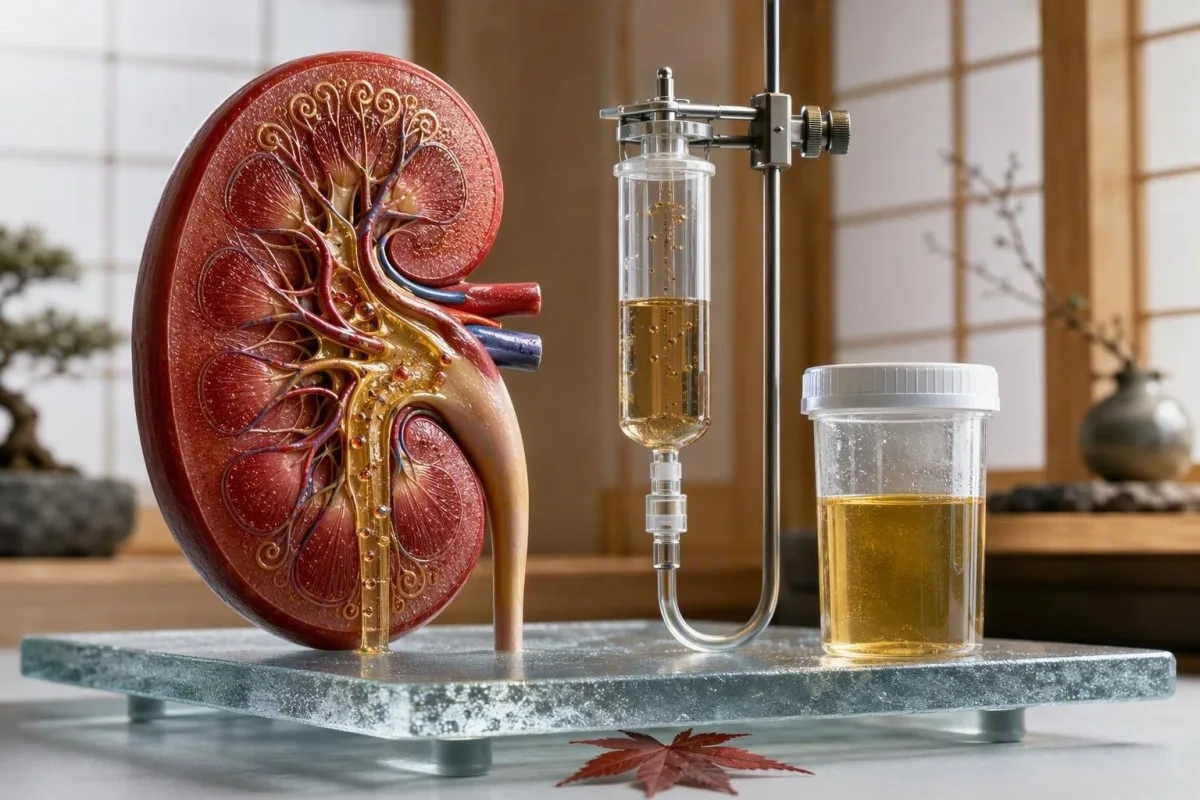
O SIADH é um diagnóstico de padrão, não um único resultado anormal. As pistas úteis vêm de sangue e urina coletados aproximadamente ao mesmo tempo, depois interpretados em conjunto com medicamentos, função da tireoide, cortisol e status de volume.


- Verdadeira hiponatremia hipotônica significa que o sódio sérico está abaixo de 135 mmol/L e a osmolalidade sérica medida geralmente está abaixo de 275 mOsm/kg.
- Osmolalidade urinária no SIADH está inapropriadamente acima de 100 mOsm/kg apesar da baixa osmolalidade sérica; os rins estão retendo água quando deveriam produzir urina diluída.
- Sódio urinário acima de 30 mmol/L suporta SIADH apenas após excluir diuréticos, insuficiência adrenal, doença tireoidiana e depleção de fluidos clinicamente óbvia.
- Padrão de desidratação geralmente produz urina concentrada com sódio urinário abaixo de 30 mmol/L, ureia ou BUN elevada e sinais de volume circulante reduzido.
- Insuficiência adrenal pode parecer quase idêntico ao SIADH, portanto, um baixo cortisol matinal ou um resultado equívoco necessita de acompanhamento clínico urgente antes que o SIADH seja diagnosticado.
- Sintomas graves como convulsão, confusão, vômitos repetidos ou diminuição da consciência com baixo sódio requerem cuidados de emergência; o tratamento não deve esperar por uma interpretação online.
- Segurança da correção a matéria: na hiponatremia crônica, o sódio sérico geralmente não deve aumentar mais de 8 mmol/L em qualquer período de 24 horas para pacientes com alto risco de desmielinização osmótica.
- O timing importa pois uma infusão de soro IV, uma dose de diurético ou vários litros de água podem alterar o sódio urinário e a osmolalidade em poucas horas.
Por que o SIADH requer testes pareados de sangue e urina
A exame de sangue para SIADH O padrão é baixo sódio sérico com baixa osmolalidade sérica medida, associado a urina que permanece muito concentrada e relativamente rica em sódio. Em termos práticos, o corpo tem excesso de água em relação ao sódio porque a atividade do hormônio antidiurético não está desligando normalmente; um valor isolado de sódio não pode comprovar isso.
Sódio sérico abaixo de 135 mmol/L define hiponatremia, mas o sódio é uma concentração em vez de uma medida do sódio corporal total. Uma pessoa pode ter baixo sódio devido à retenção de água, perda de sal, glicose alta, artefato laboratorial ou uma combinação destes; nosso guia para sintomas de sódio baixo explica por que a gravidade dos sintomas geralmente acompanha a velocidade da queda mais do que o número exato.
O primeiro desvio útil é a osmolalidade sérica medida: abaixo de 275 mOsm/kg indica hiponatremia hipotônica, o cenário em que o SIADH é considerado. A regra clínica do Dr. Thomas Klein é simples: nunca rotule SIADH com base em um painel metabólico básico antes de verificar glicose, triglicerídeos, proteína total e, idealmente, a osmolalidade medida.
Kantesti é um Analisador de teste de sangue de IA que lê sódio, glicose, ureia, creatinina e achados urinários pareados como um problema fisiológico, em vez de uma coleção de bandeiras. Em nossas revisões, o erro mais perigoso é a tranquilização após um sódio de 122 mmol/L quando o relatório não possui estudos urinários contemporâneos ou histórico de sintomas; nossos casos de uso clínico mostram por que a falta de contexto altera o próximo passo.
O que SIADH realmente significa
SIADH é a sigla para síndrome da antidiurese inapropriada, historicamente chamada de secreção inapropriada de hormônio antidiurético. A síndrome pode surgir de medicamentos, náuseas, distúrbios pulmonares ou do sistema nervoso central, dor, estresse pós-operatório e, ocasionalmente, malignidade; o padrão laboratorial identifica o manejo da água, não o gatilho subjacente.
Sódio sérico e osmolalidade: confirmando excesso real de água
Osmolalidade sérica abaixo de 275 mOsm/kg com sódio abaixo de 135 mmol/L confirma hiponatremia hipotônica, mas não identifica SIADH por si só. Uma osmolalidade normal ou alta direciona os clínicos para glicose, manitol, agentes de contraste, álcoois ou pseudohiponatremia, em vez disso.
A maioria dos laboratórios relata a osmolalidade calculada, comumente estimada como 2 × sódio + glicose + ureia em mmol/L, mas uma osmolalidade medida é preferível quando o diagnóstico é incerto. Uma lacuna significativa entre os valores medidos e calculados pode revelar osmóios não medidos; esta é uma razão pela qual um resultado de sódio pode ser clinicamente real, mas não representar SIADH.
Glicose acima de aproximadamente 13,9 mmol/L (250 mg/dL) reduz o sódio medido por deslocamento de água das células para o plasma. Uma correção comumente usada adiciona aproximadamente 1,6 a 2,4 mmol/L de sódio para cada 5,6 mmol/L (100 mg/dL) de glicose acima de 5,6 mmol/L, embora os clínicos discordem sobre o fator exato em níveis de glicose muito altos.
Triglicérides muito altos ou paraproteínas podem causar pseudohiponatremia com ensaios indiretos por ion-selectivos, enquanto a osmolalidade medida permanece normal. Compare o resultado de sódio com a painel metabólico básico e pergunte se o laboratório usou um eletrodo direto ou indireto antes de assumir um distúrbio do balanço hídrico.
Osmolalidade urinária no SIADH: a pista renal que muda o caso
Osmolalidade urinária acima de 100 mOsm/kg em um paciente hipotônico significa que a atividade do hormônio antidiurético está presente. Na SIADH, a osmolalidade urinária é frequentemente de 200 a 600 mOsm/kg, embora nenhum valor urinário único seja diagnóstico.
Uma osmolaridade urinária de 100 mOsm/kg ou menos indica urina quase maximamente diluída e torna a SIADH improvável. Esse padrão se encaixa em polidipsia primária ou baixa ingestão de solutos, onde a ingestão de água excede a capacidade do rim de excretar água livre; é particularmente relevante em pessoas que consomem muito pouca proteína e sal.
Aqui está o ponto contraintuitivo: urina concentrada não significa automaticamente desidratação. Tanto a hipovolemia quanto a SIADH aumentam o hormônio antidiurético, mas a desidratação o faz apropriadamente para preservar a circulação, enquanto a SIADH o faz apesar do volume arterial efetivo clinicamente adequado.
A diretriz europeia sobre hiponatremia recomenda a osmolalidade urinária como um discriminador precoce porque a avaliação física do volume é frequentemente não confiável (Spasovski et al., 2014). Leia nossa explicação mais aprofundada sobre a teste de osmolalidade urinária se o seu laudo usar mOsm/kg em vez de densidade específica de fita.
Por que uma única amostra de urina pode enganar
A osmolalidade urinária pode cair rapidamente após o alívio da náusea, controle da dor ou suspensão de um medicamento ofensivo. Se a urina foi coletada após fluidos intravenosos, após um diurético de alça, ou horas após a amostra de sangue, eu a trato como uma pista em vez de prova.
Sódio urinário: SIADH versus desidratação e baixo volume efetivo
Sódio urinário acima de 30 mmol/L apoia SIADH em hiponatremia hipotônica quando a ingestão de sal dietético é usual e diuréticos estão ausentes. Sódio urinário abaixo de 30 mmol/L indica mais frequentemente conservação renal de sódio por vômito, diarreia, sudorese, insuficiência cardíaca, cirrose ou desidratação verdadeira.
Na SIADH não complicada, os rins não são ávidos por sódio, portanto o sódio urinário é comumente acima de 30 mmol/L e pode exceder 60 mmol/L. A ureia é frequentemente baixa e a ureia sérica pode estar abaixo de 4 mg/dL (0,24 mmol/L) porque a expansão leve do volume aumenta a depuração de urato.
Um homem de 68 anos tomando hidroclorotiazida pode ter sódio urinário de 55 mmol/L e urina concentrada após um vírus estomacal; isso não estabelece SIADH. A hiponatremia associada à tiazida pode mimetizar todas as características laboratoriais clássicas, razão pela qual a lista de medicamentos não é um detalhe administrativo, mas sim dados diagnósticos.
O sódio urinário é menos confiável após o uso de diuréticos, com doença renal avançada ou com sódio dietético muito baixo. Combine-o com creatinina, ureia e a painel de eletrólitos em vez de tratar um ponto de corte de 30 mmol/L como uma parede rígida.
Excreção fracionada de urato
Uma excreção fracionada de urato acima 12% pode apoiar SIADH, particularmente quando diuréticos obscurecem o sódio urinário. Geralmente normaliza após a correção de SIADH, enquanto estados de perda renal de sal podem mantê-lo elevado; isto é território de especialista, mas pode ser útil quando a história não se encaixa.
Como a desidratação se apresenta de forma diferente do SIADH em testes laboratoriais
A desidratação geralmente causa urina concentrada com baixo sódio urinário, aumento da ureia em relação à creatinina e evidências clínicas de perda de volume. A SIADH também produz urina concentrada, mas os pacientes geralmente estão clinicamente euvolêmicos e não têm a mesma resposta renal de conservação de sódio.
Com vômitos, diarreia ou suor intenso, o rim normalmente diminui o sódio urinário para abaixo de 20-30 mmol/L enquanto a osmolalidade urinária sobe acima de 100 mOsm/kg. A ureia pode aumentar desproporcionalmente à creatinina, mas essa relação é afetada pela ingestão de proteínas, sangramento gastrointestinal, esteroides e função hepática, portanto, é um suporte em vez de definitivo.
Na SIADH, a pressão arterial e o exame podem parecer normais, mas achados sutis importam: sem sintomas ortostáticos, sem membranas mucosas secas, sem edema periférico e sem perda gastrointestinal convincente. Já vi pacientes chamados de "desidratados" simplesmente porque sua urina estava escura; a cor da urina é um pobre indicador da fisiologia do sódio, como nosso guia de urina escura discute.
Um desafio cuidadoso com solução salina isotônica pode ajudar em ambientes monitorados selecionados: a hiponatremia hipovolêmica tende a melhorar à medida que o volume suprime o hormônio antidiurético. Na SIADH, a solução salina pode não conseguir aumentar o sódio ou pode piorá-lo quando a urina é muito mais concentrada do que a infusão; nunca deve ser um experimento caseiro.
Por que a solução salina pode piorar a SIADH
Um litro de solução salina 0.9% contém 154 mmol de sódio, mas um rim que produz urina a 600 mOsm/kg pode excretar o sódio enquanto retém proporcionalmente mais água. Este efeito de "dessalinização" é mais provável quando o sódio e o potássio urinários são altos em relação ao sódio sérico.
Insuficiência adrenal: o mímico do SIADH que os médicos devem excluir
A insuficiência adrenal pode produzir baixo sódio, baixa osmolalidade sérica, osmolalidade urinária acima de 100 mOsm/kg e sódio urinário acima de 30 mmol/L—quase o mesmo padrão da SIADH. Uma avaliação de cortisol é, portanto, parte de uma investigação segura de SIADH, especialmente com fadiga, perda de peso, pressão arterial baixa, hipercalemia ou exposição a esteroides.
Um cortisol sérico matinal acima de aproximadamente 15-18 microgramas/dL (414-497 nmol/L) geralmente torna improvável a insuficiência adrenal clinicamente significativa, dependendo do ensaio e do ambiente. Valores abaixo de 3-5 microgramas/dL (83-138 nmol/L) são preocupantes, enquanto resultados intermediários geralmente precisam de um teste de estimulação com ACTH em vez de adivinhação.
A insuficiência adrenal primária geralmente causa alto potássio porque a aldosterona é deficiente, mas a insuficiência adrenal secundária pode ter potássio normal e ainda causar hiponatremia grave. O mecanismo é a deficiência de cortisol aumentando a liberação do hormônio antidiurético, não simplesmente a perda de sal.
O painel de especialistas de 2013 liderado por Verbalis aconselha excluir a insuficiência adrenal antes de concluir sobre SIADH (Verbalis et al., 2013). Se essa possibilidade estiver em seu relatório, nossa visão geral de pistas laboratoriais da doença de Addison pode ajudá-lo a preparar perguntas direcionadas para uma revisão clínica urgente.
Medicamentos esteroides complicam os testes
Prednisona, hidrocoritisona e alguns esteroides injetáveis podem alterar a interpretação do cortisol e suprimir o eixo adrenal. Não interrompa os esteroides prescritos para "obter um teste limpo"; a retirada abrupta pode precipitar crise adrenal.
Exames de tireoide: quando o hipotireoidismo realmente explica o baixo sódio
O hipotireoidismo severo pode prejudicar a excreção de água, mas o hipotireoidismo subclínico comum raramente explica hiponatremia significativa. TSH e T4 livre são verificados antes de diagnosticar SIADH porque a falha tireoidiana profunda é tratável e pode coexistir com outras causas.
A hiponatremia hipotiroidiana clinicamente importante é mais plausível em doenças graves, particularmente na fisiologia do mixedema com T4 livre baixa, bradicardia, hipotermia ou débito cardíaco reduzido. Um TSH de 6 mIU/L com T4 livre normal é comum e não deve se tornar uma explicação conveniente para um sódio de 121 mmol/L.
Kantesti AI é uma plataforma de interpretação de exame de sangue da AI que compara TSH e T4 livre com sódio, função renal e tempo de medicação, pois um resultado de TSH sinalizado pode desviar a atenção de uma causa adrenal ou relacionada a medicamentos mais urgente. Um TSH normal não exclui hipotireoidismo central; T4 livre baixa com TSH não elevado merece um caminho diferente, explicado em nosso artigo sobre T4 livre baixa com TSH normal.
A reposição tireoidiana deve ser ajustada para indicações tireoidianas estabelecidas, não usada como tratamento rápido de sódio. Em minha experiência, o sódio muitas vezes melhora apenas depois que o verdadeiro causador da retenção de água — náusea, medicação, deficiência de cortisol ou doença — também foi abordado.
Doença hipofisária muda a investigação
Dor de cabeça, sintomas visuais, baixa libido, pressão arterial baixa inexplicada ou múltiplos hormônios hipofisários baixos levantam preocupação para doença hipofisária central. Nesse contexto, verifique o cortisol antes de iniciar a levotiroxina porque o hormônio tireoidiano pode aumentar o clearance do cortisol.
Gravidez, idade avançada e diferenças de tamanho corporal na interpretação do SIADH
A gravidez diminui o limiar osmótico normal e o sódio sérico em cerca de 4-5 mmol/L, portanto, um sódio perto de 130 mmol/L pode ser fisiológico no início da gravidez, mas ainda requer contexto. Adultos mais velhos têm um risco maior de hiponatremia relacionada a medicamentos e muitas vezes apresentam quedas ou confusão em vez de sede.
Durante a gravidez sem complicações, a osmolalidade sérica geralmente diminui em cerca de 5-10 mOsm/kg e o sódio pode se estabilizar perto de 130-134 mmol/L porque o osmostato é reajustado. Sódio abaixo de 130 mmol/L, sintomas neurológicos, hipertensão, anormalidades hepáticas ou proteinúria necessitam de avaliação obstétrica urgente em vez de serem descartados como alteração normal da gravidez.
Em pessoas com mais de 75 anos, ISRS, tiazidas, carbamazepina, desmopressina e dietas com baixo teor de soluto se sobrepõem comumente. Uma queda de sódio de apenas 5 mmol/L pode ser importante quando a cognição basal é frágil; instabilidade na marcha e quedas podem ser os primeiros sinais observáveis.
A filtração renal muda naturalmente durante a gravidez, e a interpretação deve usar referências conscientes da gravidez; nosso guia para valores de eGFR na gravidez explica por que um eGFR relatado muitas vezes não é validado na gravidez. A restrição de fluidos deve ser individualizada na gravidez e fragilidade, não copiada de um folheto genérico de SIADH.
Baixo índice de massa corporal não é um detalhe trivial
Uma pessoa de 45 kg tem menos água corporal total do que uma pessoa de 100 kg, portanto, a mesma carga de água ou dose de medicamento pode produzir uma mudança maior no sódio. Pacientes frágeis também têm menos reserva fisiológica se o sódio mudar rapidamente.
Efeitos de medicamentos que imitam ou desencadeiam o SIADH
Diuréticos tiazídicos, ISRS, IRSN, carbamazepina, oxcarbazepina, desmopressina e alguns antipsicóticos são causas medicamentosas frequentes de hiponatremia hipotônica. Alguns produzem verdadeira fisiologia SIADH, enquanto as tiazidas podem mimetizar SIADH através de diluição prejudicada e perda de sódio.
A hiponatremia relacionada a tiazidas geralmente começa dentro do primeiro 2 semanas após o início ou aumento de uma dose, mas pode ocorrer meses depois, quando intercorrentes, redução da ingestão de alimentos ou ingestão extra de água são adicionadas. Diuréticos de alça são menos propensos a causar este padrão particular porque reduzem a capacidade de concentração do rim.
A hiponatremia associada a ISRS é mais comum em idosos, pessoas com baixo peso corporal e aqueles que também tomam diuréticos. Um novo antidepressivo não é automaticamente o culpado, mas a sequência temporal é mais importante do que uma lista de livro didático: documente cada início, parada e mudança de dose nos 30 dias anteriores.
Não interrompa medicamentos para convulsão, psiquiátricos, hormonais ou pressão arterial sem o prescritor que conhece a indicação. Baixo cloreto pode acompanhar o uso de diuréticos e vômitos; nossa explicação de resultados de baixo cloreto pode ajudar a distinguir o padrão eletrolítico mais amplo.
Contribuintes de venda livre
A desmopressina usada para noctúria merece atenção especial porque beber livremente após uma dose pode causar retenção hídrica abrupta. AINEs também podem amplificar a ação do hormônio antidiurético em pessoas suscetíveis, particularmente durante doenças intercorrentes.
Baixa ingestão de solutos e excesso de água: padrões que não são SIADH
Polidipsia primária e ingestão dietética de solutos muito baixa geralmente causam osmolalidade urinária de 100 mOsm/kg ou menos, ao contrário da SIADH clássica. A distinção é importante porque a restrição hídrica rigorosa sozinha pode não detectar desnutrição, doença relacionada ao álcool ou correção rápida perigosa após a retomada da ingestão de solutos.
O rim precisa de soluto — principalmente ureia de proteína e eletrólitos — para excretar água. Com apenas 250 mOsm de soluto disponíveis diariamente, uma pessoa pode excretar cerca de 2,5 L de urina a 100 mOsm/kg, mas apenas 1 L se o hormônio antidiurético mantiver a urina em 250 mOsm/kg.
Na polidipsia primária, a urina é frequentemente notavelmente diluída e o histórico pode revelar mais de 4-6 L de ingestão de líquidos diariamente, embora a lembrança seja imperfeita. Na hiponatremia de baixo soluto, a ureia pode estar baixa e o histórico dietético pode revelar um período recente de baixa ingestão de proteína e sal.
Cetonas, baixa ureia e perda de peso podem sinalizar desnutrição ou jejum prolongado em vez de SIADH. Revise nosso artigo sobre cetonas na urina se a cetose estiver presente; cetoacidose diabética é uma emergência separada e pode distorcer a interpretação do sódio.
O risco de realimentação
Quando a nutrição é restaurada, o sódio pode subir mais rápido do que o esperado à medida que o rim recupera a excreção de solutos. Equipes hospitalares monitoram o sódio frequentemente em pacientes de alto risco, às vezes a cada 2-4 horas durante a correção ativa.
Doenças renais, cardíacas e hepáticas: baixo sódio sem SIADH
Insuficiência cardíaca, cirrose e doença renal avançada causam hiponatremia por baixo volume arterial efetivo, não SIADH primária. Essas condições ainda podem produzir urina concentrada, mas edema, perfusão reduzida, baixa albumina ou filtração prejudicada geralmente mudam o quadro geral.
Na insuficiência cardíaca e cirrose, o corpo pode conter excesso de água total e sódio, mas sente inadequado preenchimento arterial, ativando o hormônio antidiurético e as vias de retenção de sódio. O sódio urinário geralmente está abaixo de 30 mmol/L a menos que diuréticos ou lesão renal confundam o resultado.
A doença renal avançada limita tanto a excreção de água quanto a concentração de urina, de modo que a osmolalidade urinária pode ficar próxima da osmolalidade plasmática em torno de 250-350 mOsm/kg. Nessa situação, os limiares clássicos de SIADH perdem precisão e a avaliação nefrológica é mais útil do que testes repetidos de urina spot.
A proteinúria, os cilindros, a albumina, a tendência da creatinina e o edema não são questões secundárias; eles ajudam a identificar a fisiologia. Nosso guia prático para gravidade específica urinária explica por que uma estimativa de dipstick não pode substituir a osmolalidade urinária medida em um caso renal complexo.
O edema não exclui perigo
Uma pessoa com edema ainda pode desenvolver sintomas neurológicos graves com sódio abaixo de 120 mmol/L. O estado volêmico explica a causa, mas não diminui a urgência da hiponatremia sintomática aguda.
Momento da coleta, fluidos IV e armadilhas laboratoriais
O sangue e a urina devem ser coletados idealmente antes da administração de fluidos IV e dentro de algumas horas um do outro, pois o tratamento pode alterar rapidamente os resultados laboratoriais de SIADH. Uma amostra de urina atrasada pode descrever a resposta à terapia em vez da causa da hiponatremia.
Um litro de salina, uma dose de furosemida, tratamento antiemético, alívio da dor ou interrupção da desmopressina podem alterar o débito urinário e a osmolalidade em poucas horas. Registre os horários exatos de coleta, a ingestão recente de fluidos, a terapia IV e os medicamentos; esse detalhe mundano muitas vezes resolve resultados laboratoriais de SIADH aparentemente contraditórios.
A hemólise geralmente não causa um sódio falsamente baixo, mas a hiperlipidemia acentuada, a hiperproteinemia e a contaminação da amostra podem. Um resultado de sódio que difere acentuadamente do valor de ontem sem uma explicação clínica deve levar a uma nova coleta ou medição direta por eletrodo íon-seletivo, não a um diagnóstico por planilha.
Kantesti AI compara datas e sinaliza alterações implausíveis, mas não pode ver uma infusão de salina não registrada ou uma dose perdida. Use um linha do tempo de exame de sangue para anotar doenças, exercícios, jejum, ingestão de fluidos e eventos de medicação ao lado de cada resultado.
A densidade relativa da urina não é a osmolalidade
A densidade relativa reflete a massa de partículas, bem como a concentração, e pode ser distorcida por glicose, proteína ou meios de contraste. Um valor de 1.020 não se traduz de forma confiável em um valor específico de mOsm/kg em todos os pacientes.
A investigação focada de SIADH que os médicos geralmente solicitam
Uma avaliação segura de SIADH geralmente inclui sódio sérico, potássio, glicose, ureia, creatinina, osmolalidade sérica medida, osmolalidade urinária, sódio urinário, TSH, T4 livre e cortisol matinal. O objetivo é confirmar a hiponatremia hipotônica e excluir mímicos reversíveis antes de atribuir o rótulo de SIADH.
Testes adicionais dependem do contexto: ácido úrico, marcadores hepáticos, perfil lipídico, proteína total, ACTH, imagem torácica, imagem cerebral ou revisão de medicamentos podem ser apropriados. Em um paciente aparentemente euvolêmico com sódio de 126 mmol/L, o par de osmolalidade simultâneo e o cortisol são geralmente mais informativos do que testes amplos e não focados.
A comparação de diretrizes de Hoorn e Zietse enfatiza que apenas o exame de volume tem precisão diagnóstica limitada e apoia uma abordagem bioquímica com foco na urina (Hoorn e Zietse, 2017). É por isso que um exame com aparência normal não deve invalidar uma osmolalidade urinária de 550 mOsm/kg e uma osmolalidade sérica de 260 mOsm/kg.
O Dr. Thomas Klein recomenda tirar uma foto de cada página de resultado, incluindo horário de coleta, intervalo de referência e lista de medicamentos, antes de uma consulta. Nosso checklist de segurança de relatórios médicos com IA explica como preservar os detalhes de origem de que uma interpretação necessita.
Quando a imagem se torna relevante
Nova SIADH persistente sem uma causa medicamentosa clara ou doença aguda pode justificar imagem torácica, particularmente em idosos com exposição ao tabagismo ou sintomas respiratórios. A imagem é direcionada pela história clínica e exame físico; não é automaticamente necessária para cada sódio de 132 mmol/L.
O que os números de tratamento significam e por que a correção do sódio pode ser perigosa
A hiponatremia sintomática grave é tratada em hospital com salina hipertônica cuidadosamente monitorada, enquanto o manejo crônico da SIADH visa a causa e o equilíbrio hídrico controlado. O perigo é duplo: o edema cerebral não tratado e a correção excessivamente rápida podem causar lesões neurológicas permanentes.
Para convulsões, coma, confusão profunda ou vômitos graves devido à hiponatremia, as diretrizes geralmente usam 100-150 mL de salina a 3% como um bolus intermitente com verificações repetidas de sódio. O objetivo inicial é um pequeno aumento de cerca de 4-6 mmol/L para reduzir o edema cerebral, não a normalização imediata.
Para hiponatremia crônica, muitos clínicos limitam a correção a 8 mmol/L em 24 horas para pessoas com alto risco de desmielinização osmótica, incluindo alcoolismo, desnutrição, doença hepática grave, hipocalemia ou sódio inicial muito baixo. Algumas diretrizes permitem 10 mmol/L no primeiro dia para pacientes de menor risco, mas eu prefiro cautela porque um número pode subir inesperadamente assim que o hormônio antidiurético diminuir.
A restrição de fluidos geralmente começa em torno de 800-1.000 mL por dia na SIADH estável, mas seu sucesso depende da concentração da urina e da ingestão de solutos. Ureia, diuréticos de alça com sal ou antagonistas da vasopressina são decisões de especialistas; ALT é uma Ferramenta de análise de exames de sangue com IA projetada para sinalizar o padrão relevante, não para prescrever ou substituir cuidados urgentes. Revise nossa supervisão clínica técnica ao considerar como a interpretação automatizada é revisada clinicamente.
A correção de potássio também aumenta o sódio
O potássio é um osmolo eficaz, portanto, o tratamento da hipocalemia pode aumentar o sódio sérico mesmo sem salina. Isso é facilmente esquecido ao calcular a taxa de correção total de 24 horas.
Quando o baixo sódio ou possível SIADH necessita de cuidados médicos urgentes
Procure atendimento de emergência agora em caso de convulsão, desmaio, nova confusão grave, sonolência acentuada, vômitos repetidos, dor de cabeça intensa ou dificuldade para respirar com baixo teor de sódio conhecido ou suspeito. Sódio abaixo de 120 mmol/L merece avaliação clínica no mesmo dia, mesmo que os sintomas pareçam leves, especialmente quando a queda pode ser recente.
Ligue prontamente para o médico que solicitou o exame para sódio 125-129 mmol/L, nova exposição a medicamentos, tratamento de câncer, gravidez, sintomas adrenais ou uma tendência de queda significativa. Não beba deliberadamente água extra, tome comprimidos de sal ou restrinja todos os fluidos antes de receber aconselhamento individual; cada ação pode piorar uma causa diferente.
Em 27 de agosto de 2026, a contribuição mais útil do paciente é uma história clínica precisa: fluidos diários, ingestão de álcool, vômitos ou diarreia recentes, todas as prescrições e suplementos, fluidos IV, dor, náuseas, sintomas pulmonares e valores anteriores de sódio. Essa história clínica geralmente distingue a liberação transitória do hormônio antidiurético da SIADH persistente de forma mais eficaz do que um painel de química isolado adicional.
A equipe médica da 150 usa revisão de resultados baseada em padrões com supervisão médica; os leitores podem ver os médicos por trás desse processo em nossa Conselho Consultivo Médico. Se os resultados forem confusos, leve o laudo laboratorial original e esta estrutura de teste pareada a um médico licenciado em vez de se automedicar com base em um número de sódio.
Perguntas para levar à sua consulta
Pergunte se a hiponatremia foi confirmada como hipotônica, se a urina foi coletada antes do tratamento, se cortisol e T4 livre foram verificados e se um medicamento ou baixa ingestão de solutos poderia explicar o padrão. Essas quatro perguntas mantêm a discussão focada nas causas que alteram o tratamento.
Perguntas frequentes
Que resultados de exame de sangue sugerem SIADH?
O SIADH é sugerido por sódio sérico abaixo de 135 mmol/L, osmolalidade sérica medida abaixo de 275 mOsm/kg, osmolalidade urinária acima de 100 mOsm/kg e sódio urinário geralmente acima de 30 mmol/L. A pessoa geralmente está clinicamente euvolêmica, sem desidratação convincente, edema, insuficiência renal, insuficiência adrenal ou hipotireoidismo grave. Baixa ureia e ácido úrico sérico abaixo de cerca de 4 mg/dL podem adicionar suporte, mas nenhum deles é diagnóstico isoladamente. Os clínicos devem interpretar esses testes de sangue e urina coletados quase ao mesmo tempo.
Qual a osmolalidade urinária típica na SIADH?
A osmolalidade urinária na SIADH está inapropriadamente acima de 100 mOsm/kg apesar da baixa osmolalidade sérica, e muitos pacientes apresentam valores entre 200 e 600 mOsm/kg. Uma osmolalidade urinária de 100 mOsm/kg ou inferior argumenta contra a SIADH porque demonstra que o rim consegue diluir a urina apropriadamente. A desidratação também pode produzir uma osmolalidade urinária acima de 100 mOsm/kg, portanto, o sódio urinário e a avaliação clínica do volume são necessários. Uma amostra coletada após infusão de salina, diuréticos ou tratamento para náuseas pode ser enganosa.
A desidratação pode causar baixo teor de sódio e parecer SIADH?
Sim, a desidratação por vômitos, diarreia, sudorese ou ingestão inadequada pode causar hiponatremia hipotônica com urina concentrada acima de 100 mOsm/kg. Na desidratação simples, o sódio urinário geralmente está abaixo de 20-30 mmol/L porque os rins conservam sódio, e a ureia pode aumentar em relação à creatinina. A SIADH, mais frequentemente, apresenta sódio urinário acima de 30 mmol/L sem sinais claros de depleção de fluidos. Diuréticos podem confundir essa distinção, sendo assim o histórico medicamentoso é essencial.
Por que o cortisol é verificado quando os médicos suspeitam de SIADH?
O cortisol é verificado porque a insuficiência adrenal pode causar o mesmo padrão de baixo sódio, baixa osmolalidade sérica e urina concentrada que a SIADH. Um cortisol matinal acima de aproximadamente 15-18 microgramas/dL, dependendo do ensaio e do contexto clínico, geralmente torna a insuficiência adrenal significativa improvável; um resultado abaixo de 3-5 microgramas/dL é preocupante. Valores intermediários frequentemente necessitam de um teste de estimulação com ACTH. Ignorar a insuficiência adrenal é perigoso porque requer reposição de esteroides, não apenas restrição hídrica.
Um ISRS ou um diurético pode causar resultados laboratoriais de SIADH?
Os ISRSs, IRNSs, carbamazepina, oxcarbazepina e desmopressina podem desencadear retenção hídrica semelhante à SIADH, enquanto os diuréticos tiazídicos podem mimetizar estreitamente os achados laboratoriais da SIADH. A hiponatremia associada a tiazídicos geralmente se desenvolve dentro de 14 dias de início ou aumento do tratamento, mas uma doença intercorrente pode desencadeá-la mais tarde. O sódio urinário pode permanecer acima de 30 mmol/L em ambas as condições, portanto, o cronograma da medicação é clinicamente decisivo. Os pacientes não devem interromper a medicação psiquiátrica, anticonvulsivante ou para pressão arterial prescrita sem o aconselhamento do prescritor.
Com que rapidez a hiponatremia pode ser corrigida com segurança?
Na hiponatremia crônica, muitos clínicos visam manter a correção do sódio em 8 mmol/L ou menos em 24 horas para pacientes com alto risco de desmielinização osmótica, como aqueles com desnutrição, alcoolismo, doença hepática grave, hipocalemia ou sódio muito baixo. Sintomas de emergência podem exigir bolos de 100-150 mL de solução salina a 3% no hospital para atingir um aumento inicial de cerca de 4-6 mmol/L. O alvo exato depende da duração, sintomas e fatores de risco. O tratamento com sódio requer exames de sangue repetidos porque a diurese hídrica espontânea pode acelerar a correção inesperadamente.
Faça hoje a análise de exame de sangue com IA
Junte-se a mais de 2 milhões de usuários no mundo todo que confiam na Kantesti para análise instantânea e precisa de exames laboratoriais. Envie seus resultados de exame de sangue e receba uma interpretação abrangente de biomarcadores 15,000+ em segundos.
📚 Publicações de pesquisa referenciadas
Klein, T., Mitchell, S., & Weber, H. (2026). Guia de Saúde da Mulher: Ovulação, Menopausa e Sintomas Hormonais. Pesquisa Médica por IA da Kantesti.
Klein, T., Mitchell, S., & Weber, H. (2026). Suporte de Decisão Clínica Multilíngue Auxiliado por IA para Triagem Precoce de Hantavírus: Design, Validação de Engenharia e Implantação no Mundo Real em 50.000 Relatórios de Exames de Sangue Interpretados. Pesquisa Médica por IA da Kantesti.
📖 Referências Médicas Externas
⚕️ Aviso Médico
Este artigo é apenas para fins educacionais e não constitui aconselhamento médico. Consulte sempre um profissional de saúde qualificado para decisões de diagnóstico e tratamento.
Sinais de confiança E-E-A-T
Experiência
Revisão clínica orientada por médicos dos fluxos de interpretação de exames laboratoriais.
Especialização
Foco em medicina laboratorial sobre como os biomarcadores se comportam no contexto clínico.
Autoridade
Escrito pelo Dr. Thomas Klein, com revisão da Dra. Sarah Mitchell e do Prof. Dr. Hans Weber.
Confiabilidade
Interpretação baseada em evidências, com caminhos de acompanhamento claros para reduzir alarmes.