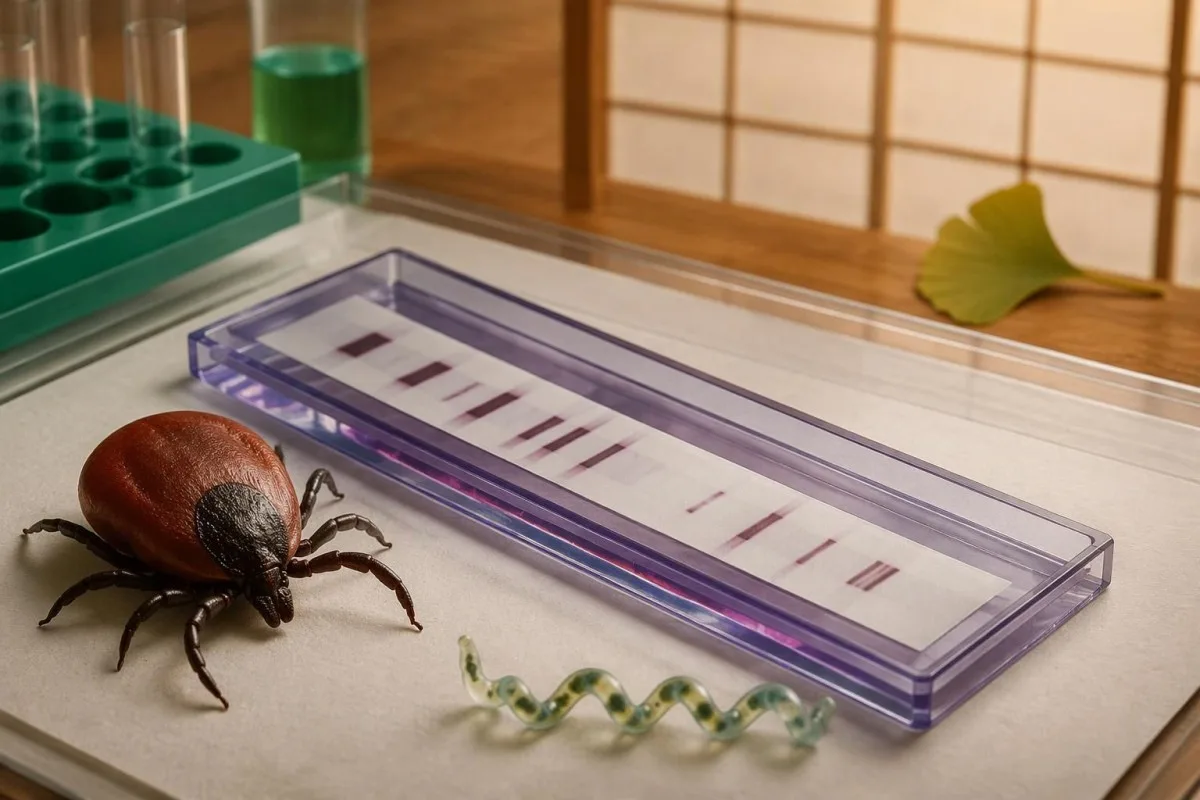
Reaktiva bendo montras ligadon de antikorpoj—ne diagnozon. La kompleta testada algoritmo, la historio de eksponiĝo kaj la templinio de simptomoj determinas, ĉu tiu trovo subtenas la diagnozon de Lyme-malsano.

Ĉefaj konkludoj
- Individuaj bendoj ne establas Lyme-malsanon; eĉ relative specifa bendo bezonas interpreton kadre de validigita duŝtupa testada algoritmo.
- Tradiciaj IgM-kriterioj postulas almenaŭ 2 el 3 elektitaj bendoj: proksimume 23–25, 39 kaj 41 kDa.
- Tradiciaj IgG-kriterioj postulas almenaŭ 5 el 10 elektitaj bendoj: 18, 23, 28, 30, 39, 41, 45, 58, 66 kaj 93 kDa.
- La 30-taga regulo signifas, ke izolita IgM ne devas subteni diagnozon de Lyme-malsano, kiam simptomoj daŭris pli ol 30 tagojn.
- Negativa ĝenerala rezulto povas kunekzisti kun reaktivaj bendoj, ĉar la laboratorio taksas validigitan ŝablonon, ne ĉu aperas iu bendo.
- Modifita duŝtupa testado uzas 2 sinsekvajn enzimimunanalizojn anstataŭ imunobloton; ĝi eble ne provizas liston de bendoj.
- Frua testado povas esti negativa antaŭ ol formiĝas antikorpoj; tipa eritema migrans-ekzantemo en taŭga eksponiĝa kunteksto estas diagnozata klinike.
- Persistantaj antikorpoj povas resti detektebla dum jaroj post kuracado kaj ne povas pruvi daŭran infekton aŭ mezuri resaniĝon.
Kion fakte signifas pozitiva bendo en Western blot-testo pri Lyme-malsano?
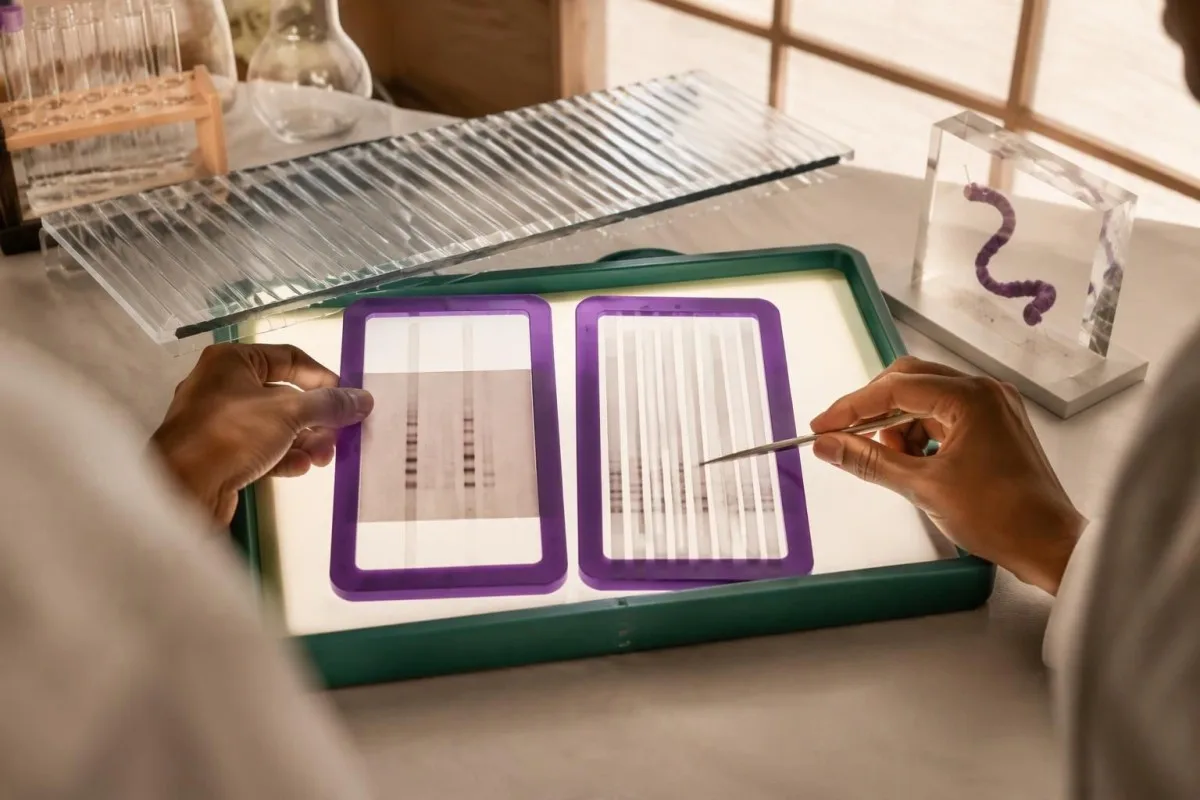
A pozitiva bendo de Lyme-imunobloto signifas, ke antikorpoj ligiĝis al testantigeno; ĝi ne sendepende pruvas Lyme-malsanon. En tradicia usona duŝtupa testado, IgM postulas 2 el 3 difinitaj bendoj dum la unuaj 30 tagoj de simptomoj, dum IgG postulas 5 el 10; modifita testado uzas 2 imunanalizojn anstataŭe.
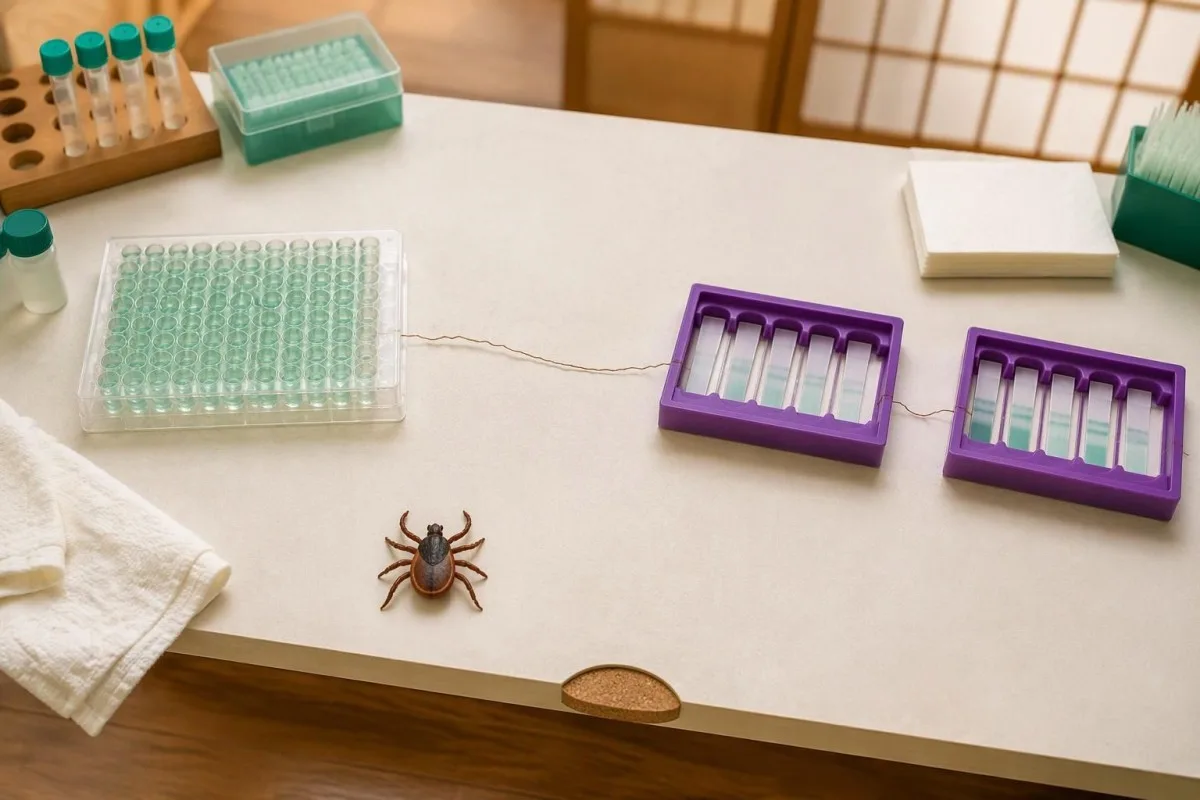
La ĝenerala rezulto kombinas la unuanivelan ekzamenan teston kun la taŭga dunivela rezulto, anstataŭ trakti ĉiun videblan strion kiel apartan diagnozon. Raporto montranta 1 reaktivan bendon do povas prave diri «negativa», kaj eĉ kompleta pozitiva antikorpa rezulto devas esti konsiderata laŭ la eksponiĝo, kongruaj trovaĵoj kaj antaŭa Lyme-malsano.
La identeco de bendo respondas al mallarĝa demando: kiu antigeno altiris ligadon de antikorpoj sub la kondiĉoj de ĉi tiu analizo? Ĝi ne respondas la 3 demandojn, kiuj kutime gravas al pacientoj—ĉu infekto ĉeestas nun, ĉu ĝi klarigas iliajn simptomojn, aŭ ĉu necesas antibiotikoj; nia gvidilo pri pozitivaj antikorpo-rezultoj apartigas ĉi tiujn demandojn.
Kantesti estas AI-sangotesta analizilo kiu povas helpi klarigi, kial raporto pri Lyme enhavas reaktivajn bendojn, sed negativan duŝtupan interpreton. Ni konsideras la finan interpreton de la laboratorio, la metodon de analizo kaj la daŭron de la simptomoj esencaj kuntekstaj informoj—ne detaloj superruleblaj per kalkulado de emfazitaj linioj en alŝutita raporto.
Kiel tradicia duŝtupa testado pri Lyme-malsano determinas la rezulton
Norma duŝtupa testado komenciĝas per enzimimunanalizo, aŭ foje per imunofluoreska analizo, kaj daŭrigas per imunobloto kiam la unua testo estas pozitiva aŭ nekonkludebla. La 2 stadioj funkcias kune; pozitiva ekzamena rezulto sola ne estas konfirmita pozitiva rezulto de Lyme-serologio.
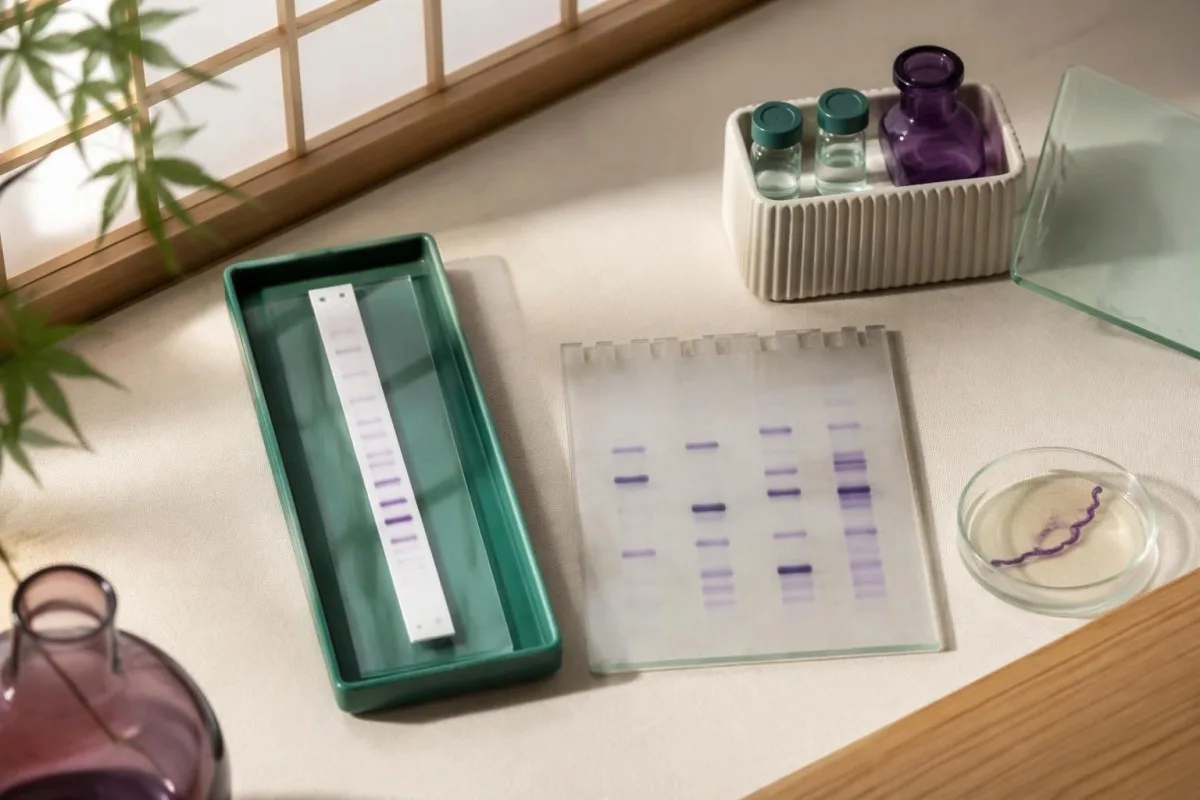
A pozitiva aŭ nekonkludebla unuanivela testo sekvata de negativaj taŭgaj imunoblotaj testoj estas interpretata kiel negativa laŭ la norma algoritmo. La komenca ekzameno intence kaptas pli da eblaj respondoj, dum la dua nivelo filtras nespecifan reaktivecon; Moore et al. priskribis ĉi tiun ekvilibron kaj ĝiajn oftajn interpretajn erarojn en Emerging Infectious Diseases en 2016.
Indekso de 1.4 en unu ekzamena testo ne estas interŝanĝebla kun 1.4 en alia, ĉar la antigenkonsisto kaj limvaloroj de la fabrikanto malsamas. Same, nekonkludebla ekzamena rezulto estas instrukcio kompletigi la algoritmon—ne diagnozo duonvoje inter infekto kaj nenia infekto; kvalita kontraŭ kvanta rezultoj klarigas, kial la formatoj de raportoj gravas.
Mendi imunobloton post negativa ekzameno, sen klinika kialo por rekonsideri la tempigon aŭ taŭgecon de la analizo, preterpasas la sinsekvon, kies efikeco estis taksita. Petu 3 informojn: la ekzamenan rezulton, la dunivelan interpreton kaj ĉu ambaŭ apartenas al la sama validigita testa proceduro; nekompleta raporto ne estu rekonstruata nur el la bendoj.
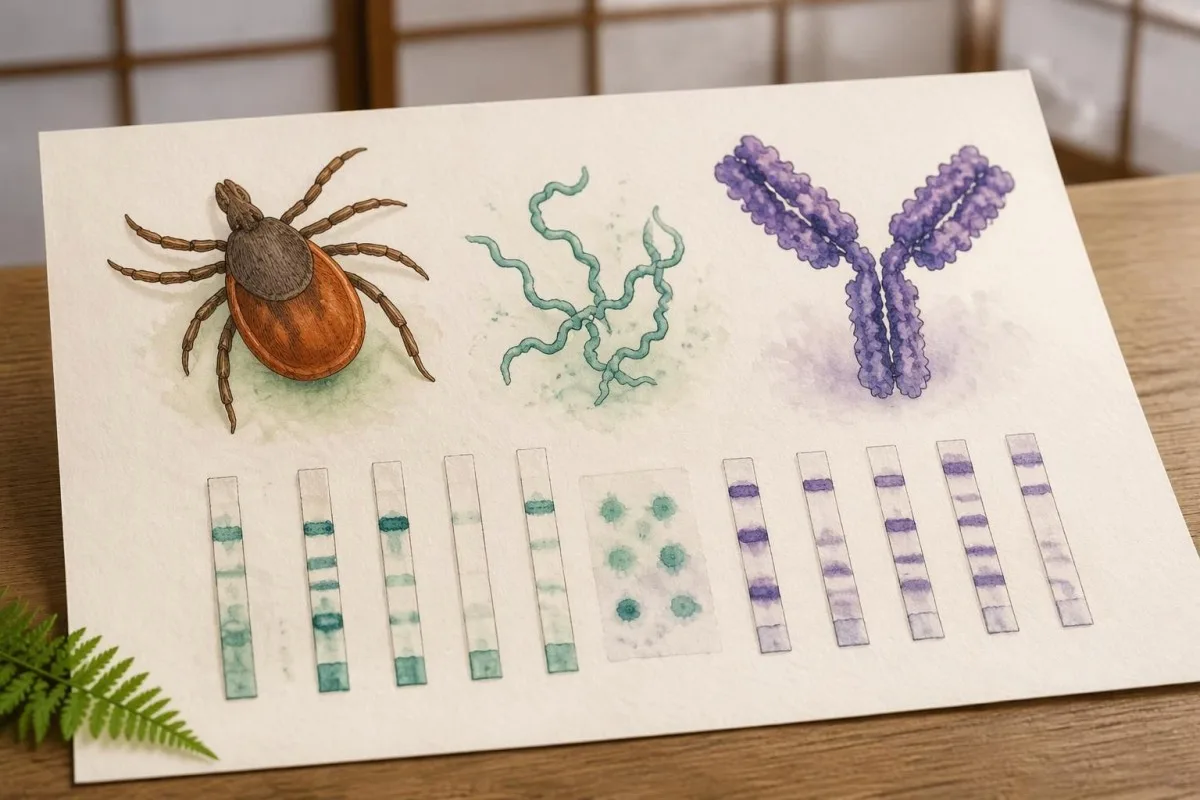
Bendoj en Western blot-testo pri Lyme-malsano klarigitaj: kriterioj por IgM kaj IgG
Laŭ konvenciaj usonaj kriterioj, pozitiva IgM-imunobloto postulas almenaŭ 2 el la bendoj 23–25, 39 kaj 41 kDa. Pozitiva IgG-imunobloto requires at least 5 of the 18, 23, 28, 30, 39, 41, 45, 58, 66 and 93 kDa bands.
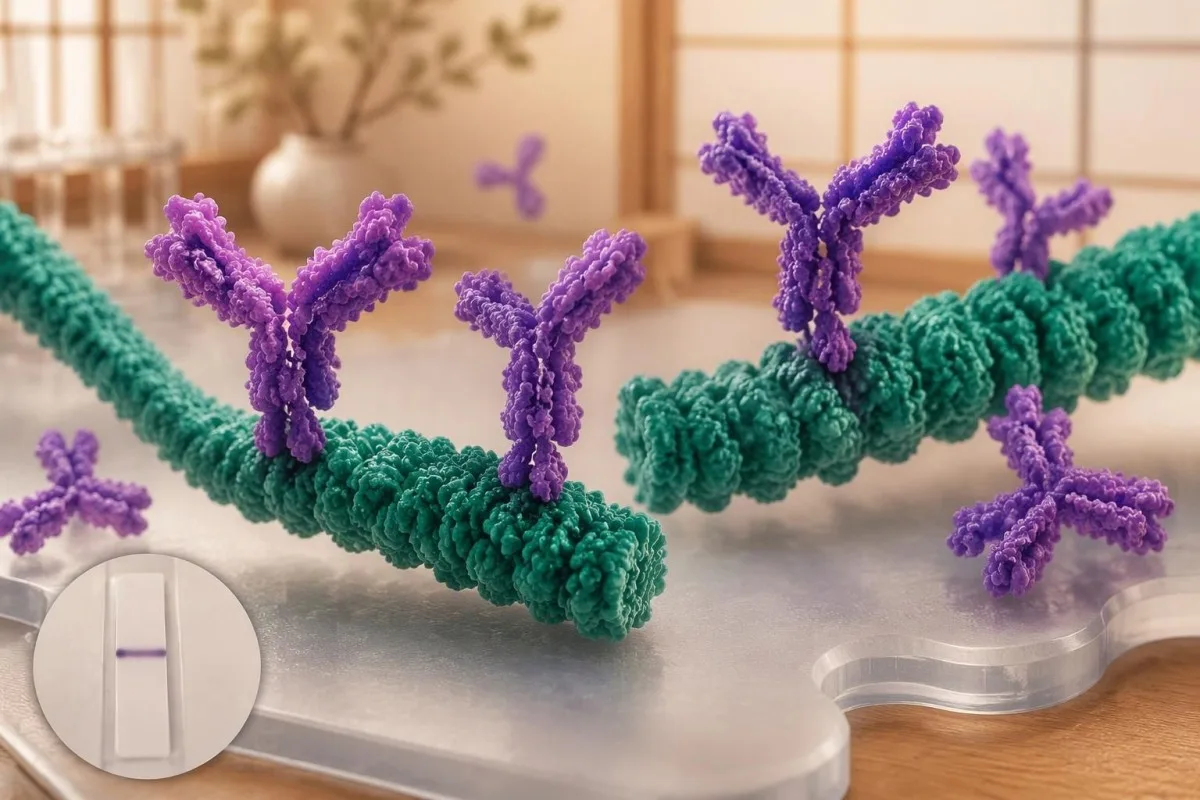
Kilodaltons, abbreviated kDa, describe approximate protein molecular mass, not antibody concentration or disease severity. The approximately 23–25 kDa band commonly represents outer surface protein C, 39 kDa represents BmpA and 41 kDa represents flagellin; the numbers identify antigen regions, so a higher-numbered band does not mean a more advanced infection.
The IgG list's 58 kDa criterion excludes GroEL, and reports may use assay-specific names or approximate mass conventions rather than identical labels. Because not every commercial strip uses the same antigen preparation, our sangotesta markilo-gvidilo should complement—not replace—the actual laboratory legend and the assay manufacturer's interpretation instructions.
Bands at 31 and 34 kDa are not part of the conventional CDC IgG counting criteria, even though they may appear on some reports. Their absence from that list does not make them meaningless biologically, but adding them to manufacture a 5-band positive result changes the validated rule; neither band darkness nor extra bands quantify bacterial burden.
Kial bendo 41 kaj aliaj reaktivaj bendoj povas esti falsaj signaloj
La 41 kDa band reacts with flagellin, a protein associated with bacterial movement, and can cross-react with antibodies unrelated to Lyme disease. A single reactive 41 kDa band is therefore insufficient to diagnose Lyme disease, even when a patient has fatigue, aching or a remembered tick bite.
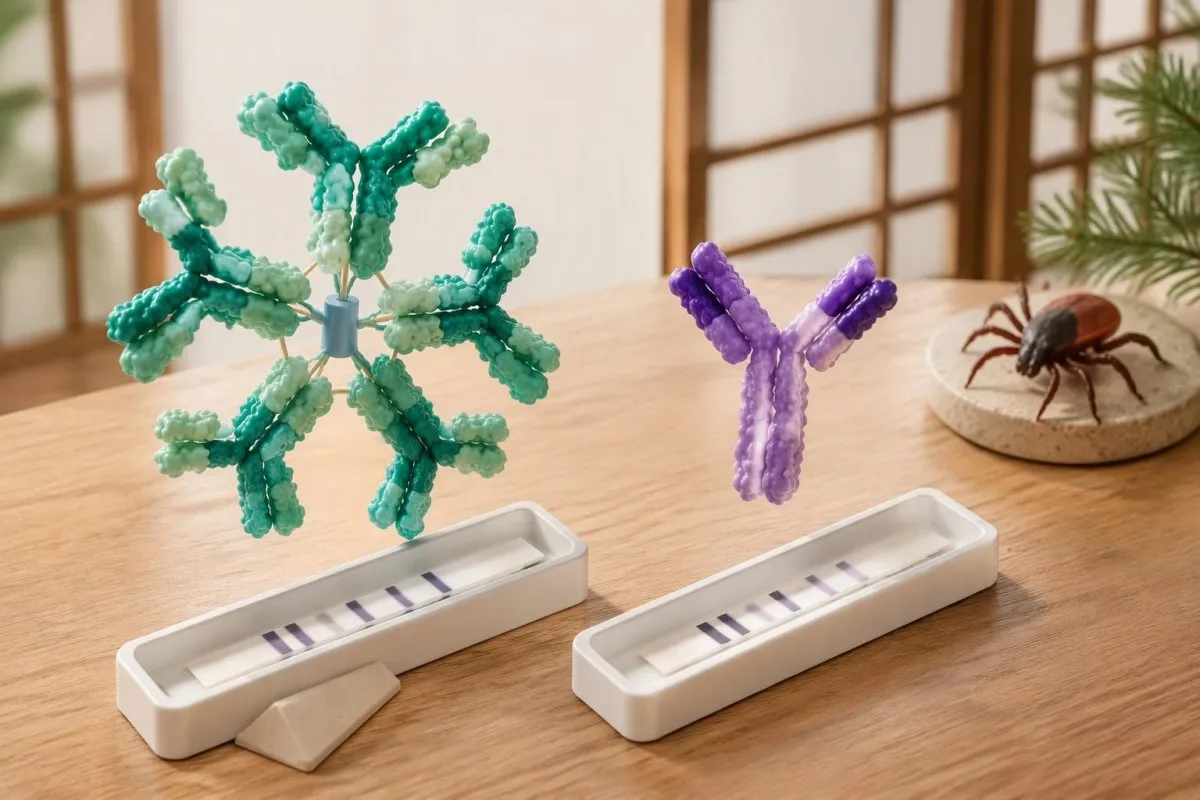
Moore et al. (2016) cited a study in which 41 kDa reactivity occurred in 43% of healthy controls, illustrating why this band cannot stand alone. That percentage is not a universal false-positive rate for every modern assay; it is evidence that recognizable antigen binding can occur in people without the clinical condition being investigated.
Epstein–Barr virus, syphilis, relapsing-fever Borrelia and some autoimmune conditions can contribute to false-positive Lyme serology, although the mechanism and affected assay vary. A recent mononucleosis-like illness should prompt attention to the complete EBV antibody pattern, not the assumption that 1 Lyme band proves a simultaneous tick-borne infection.
Cross-reactivity is not a reason to order every alternative antibody panel: 1 unexplained band usually does not justify broad autoimmune screening. When examination findings genuinely suggest an immune disorder, komplemento kaj interpreto de ANA belongs to a separate clinical question; repeated low-probability testing can generate additional misleading positives rather than a clearer answer.
Lyme IgM kontraŭ IgG: kial gravas la regulo pri 30 tagoj da simptomoj
Lyme IgM should not be used to support a diagnosis when symptoms have lasted more than 30 days. IgM is most useful early, whereas an appropriate IgG response carries greater diagnostic weight later; the clock starts with symptoms of the suspected illness, not the testing date or remembered tick removal.
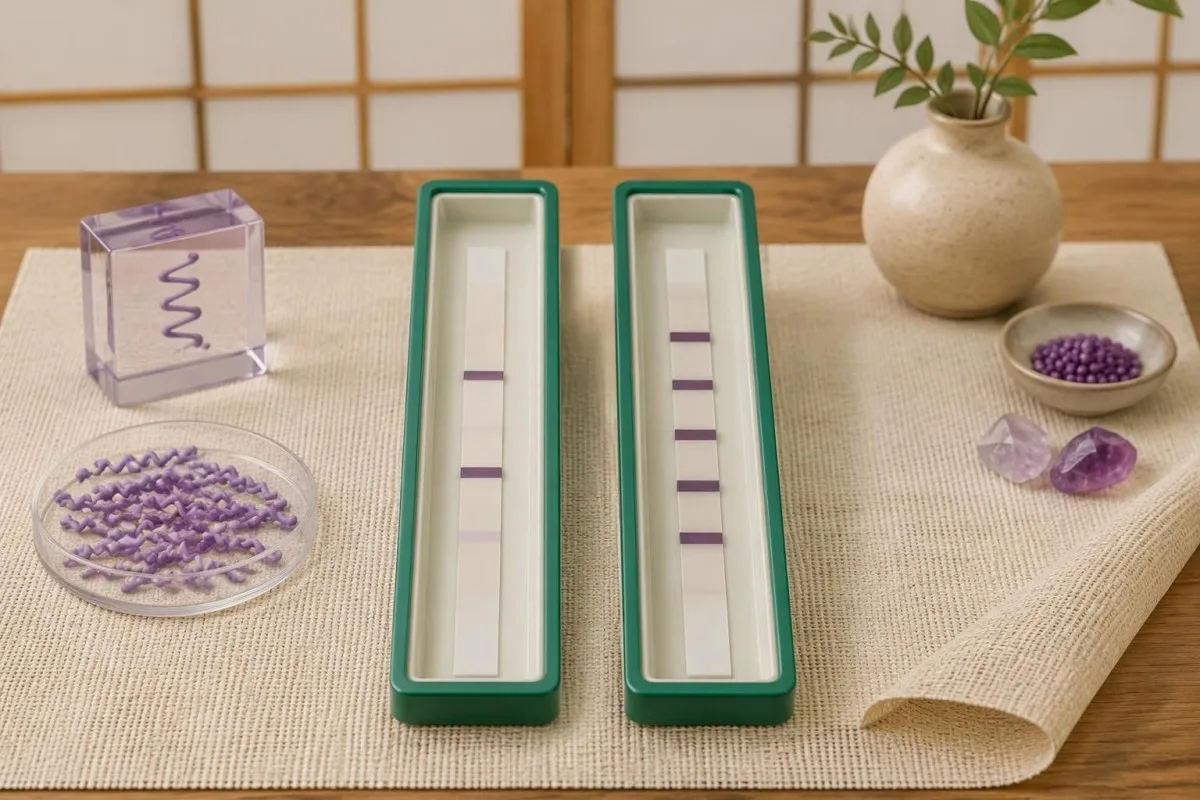
La 30-day restriction reduces misclassification from persistent or nonspecific IgM responses when later disease should usually have an established IgG response. It is an interpretation rule, not a biological switch that flips overnight: antibody maturation varies, and early treatment may alter seroconversion, but those exceptions do not make isolated late IgM reliable evidence.
For a hypothetical patient tested on day 75 of continuous symptoms, IgM bands 23 and 41 with negative IgG should not be used as proof of Lyme disease. By contrast, the same IgM pattern on day 12, following a reactive first-tier assay and compatible exposure, can support an early diagnosis; the numerical band count is identical, but its evidential value changes.
A positive IgM result does not automatically mean a new infection, a misconception also addressed in our Mycoplasma IgM interpretation guide. If symptoms began 8 weeks ago but one symptom appeared yesterday, clinicians need to decide whether this is a genuinely new illness or another feature of the original episode—not simply restart the IgM clock.
Pozitivaj bendoj pri Lyme-malsano sed negativa ĝenerala rezulto: prilaboritaj ekzemploj
Positive Lyme bands but negative overall usually means the report did not meet the required pattern within the testing algorithm. For example, 3 designated IgG bands are below the conventional 5-of-10 threshold; that result is negative, not a smaller positive, and it does not measure how much infection is present.
Consider a clearly hypothetical 42-year-old with 10 weeks of fatigue, a reactive screening assay and IgG bands 18, 41 and 58. The IgG immunoblot is negative because only 3 qualifying bands are present; if the examination lacks objective Lyme findings, the next step is a symptom-focused assessment rather than antibiotics prescribed to treat the band's molecular masses.
A second hypothetical patient has a reactive screen, IgM bands 23 and 39, and compatible symptoms beginning 14 days earlier. This can meet the traditional early serologic criteria, but an atypical exposure history or a stronger alternative diagnosis still affects the clinical conclusion; Kantesti AI can explain the 2-of-3 rule without converting it into an independent diagnosis.
A third report lists 5 IgG bands but provides no first-tier result; the missing screening stage prevents straightforward confirmation of a standard 2-tier outcome. Confirmation requirements are assay-specific, as our HSV IgG confirmation guide also illustrates, so request the complete laboratory report rather than borrowing a cutoff or confirmation rule from another infection.
Kiel modifita duŝtupa testado diferencas de Western blot
Modified two-tier testing, or MTTT, uses 2 sequential enzyme immunoassays instead of an enzyme immunoassay followed by an immunoblot. A report from this pathway may have no bands at all; its overall interpretation depends on the particular assay combination and its cleared instructions, not the conventional immunoblot band-count criteria.
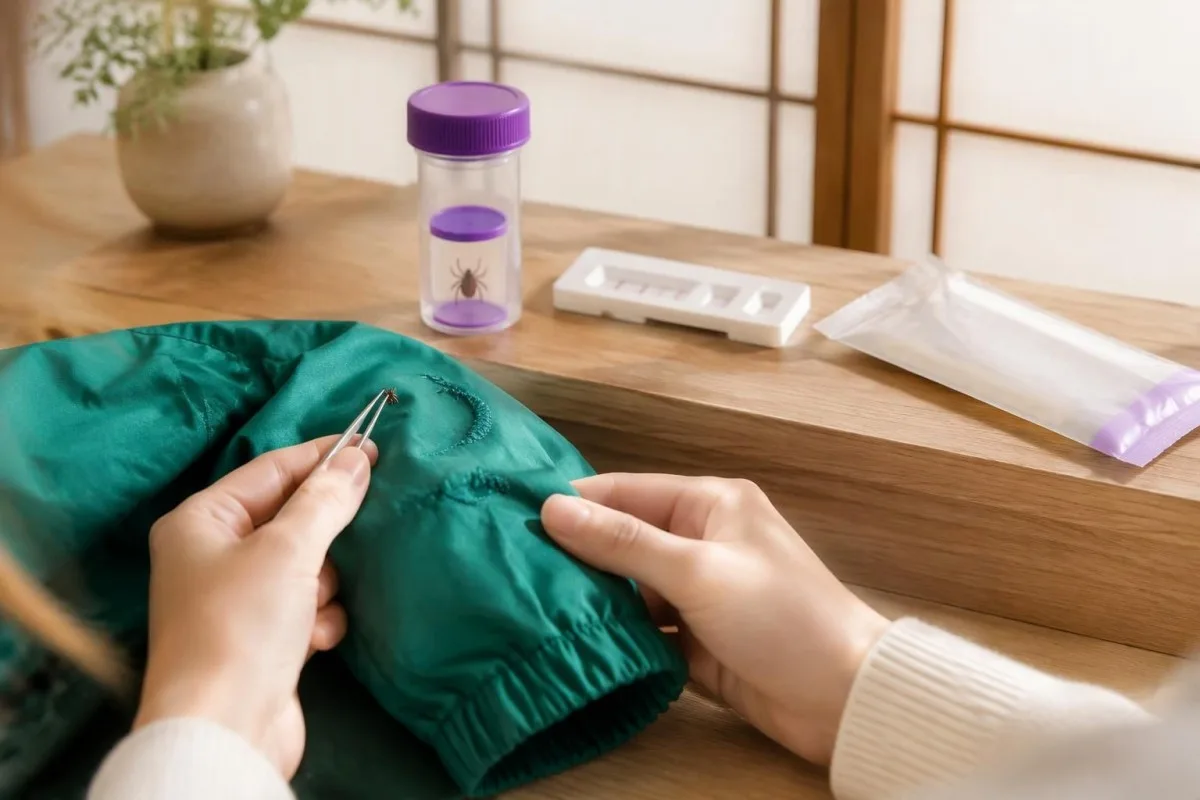
La 2019 CDC recommendation accepted modified algorithms using FDA-cleared assays for that purpose, following clearance of relevant test combinations (Mead et al., 2019). The change was not permission to combine any 2 tests: the evaluated pairing matters, and some combinations improve early sensitivity while preserving high specificity compared with standard two-tier testing.
Some modified algorithms measure total antibodies, while others report separate IgM and IgG components; consequently, the familiar 30-day IgM restriction cannot be mechanically applied to a total-antibody result. Kantesti is an AI sangotesta interpretada platformo that can help distinguish a 2-immunoassay report from an immunoblot report before discussing what its positive or negative designation means.
A second immunoassay is not simply a repeat of the same screening test, and an immunoblot is not routinely needed after a completed validated MTTT result. Our gvidilo pri konfirmo de Ĉagas-malsano illustrates the broader principle of complementary assays, but its 2-test rules are different; ask your laboratory which Lyme algorithm produced the final interpretation.
Ĉu testado pri Lyme-malsano povas esti negativa frue malgraŭ infekto?
Lyme antibody testing can be negative early because antibodies have not yet reached detectable levels. A typical erythema migrans rash with an appropriate exposure history is diagnosed clinically rather than by waiting for a positive immunoblot; a negative result during the first 1–2 weeks does not safely exclude that presentation.
Across early-infection settings, conventional 2-tier sensitivity has been reported at approximately 30–40%, while specificity remains high when testing and interpretation are appropriate (Moore et al., 2016). These are population estimates, not a personal probability: sensitivity changes with the clinical manifestation, time since onset and whether the patient has already received antibiotics.
For a rash suggestive of but not typical for erythema migrans, the 2020 IDSA/AAN/ACR guideline supports acute serology and, if initially negative, a convalescent sample at least 2–3 weeks later (Lantos et al., 2021). The same guideline recommends clinical diagnosis for a typical lesion; a rash need not have textbook concentric rings to warrant assessment.
Repeating a test 24 hours later usually offers little advantage when the limitation is antibody development rather than a processing error. Our spotted fever testing guide explains a related timing problem, but suspected spotted fever has its own urgent treatment rules; do not delay care for an expanding rash or significant illness while waiting for more bands.
Ĉu pozitiva Lyme IgG signifas aktivan infekton aŭ malsukcesan kuracadon?
Positive Lyme IgG cannot distinguish active infection from a previous infection that has resolved. Lyme antibodies can remain detectable for years or decades, and repeat immunoblot testing is not a test of cure; neither a persistent 5-band pattern nor changes in band intensity establish that treatment failed.
La 2020 IDSA/AAN/ACR guideline describes persistence of both IgM and IgG responses after infection, which complicates interpretation in previously affected patients (Lantos et al., 2021). A positive result obtained 4 years after treatment must therefore be compared with the clinical history, not interpreted as a laboratory photograph of living bacteria in the body.
Reinfection can occur because previous Lyme disease does not provide reliable lifelong protection, but an old positive antibody result cannot prove a new episode. For a hypothetical person with positive IgG from 2019 and a new expanding rash after recent tick exposure, the new clinical findings matter more than whether a sixth band appears; CMV antikorpa padronoj illustrate why exposure history and current illness are separate questions.
Persistent fatigue, pain or cognitive symptoms deserve evaluation even when no new laboratory evidence appears. The guideline recommends against additional antibiotics for persistent nonspecific symptoms after recommended treatment when there is no objective evidence of reinfection or treatment failure; 1 positive antibody panel cannot identify the cause of those symptoms or justify an open-ended antibiotic course.
Kion signifas IgG ĉe suspektata Lyme-artrito aŭ neŭrologia malsano
Lyme arthritis usually produces a strong IgG response, so isolated IgM is poor evidence for that diagnosis. Conventional two-tier serology has approximately 95–100% sensitivity in Lyme arthritis, according to the 2020 IDSA/AAN/ACR guideline; a negative appropriate IgG result should prompt serious consideration of other causes of joint swelling.
A hypothetical patient with a markedly swollen knee and only 2 IgM bands after 3 months of symptoms does not have the expected serologic pattern for Lyme arthritis. The clinician should reassess alternative causes and assay reliability rather than call this late Lyme based on IgM alone; when indicated, joint fluid examination answers additional questions that the antibody test cannot.
Suspected central nervous system Lyme disease requires clinical assessment and, when cerebrospinal fluid testing is undertaken, simultaneous CSF and serum for a validated antibody index. Testing CSF antibody alone or running a standalone CSF immunoblot is not the preferred approach; 1 elevated index may also persist after treatment, so it must be interpreted alongside the neurological findings and CSF cell response.
Numb feet or tingling do not become Lyme-specific because 41 kDa is reactive; neuropathy has metabolic, mechanical and immune causes. Our anti-MAG neuropathy guide explains one targeted alternative, while immunoglobulin panel interpretation clarifies that total serum IgG is different from the 5-of-10 Lyme-specific IgG immunoblot criterion.
Kial laboratorioj kaj landoj povas uzi malsamajn kriteriojn pri Lyme-malsano
Lyme immunoblot criteria are assay- and region-dependent, so conventional US 5-of-10 IgG counting rules should not automatically be imposed on every European report. European assays may use different Borrelia antigens and recombinant line blots because the species causing human Lyme borreliosis differ across regions.
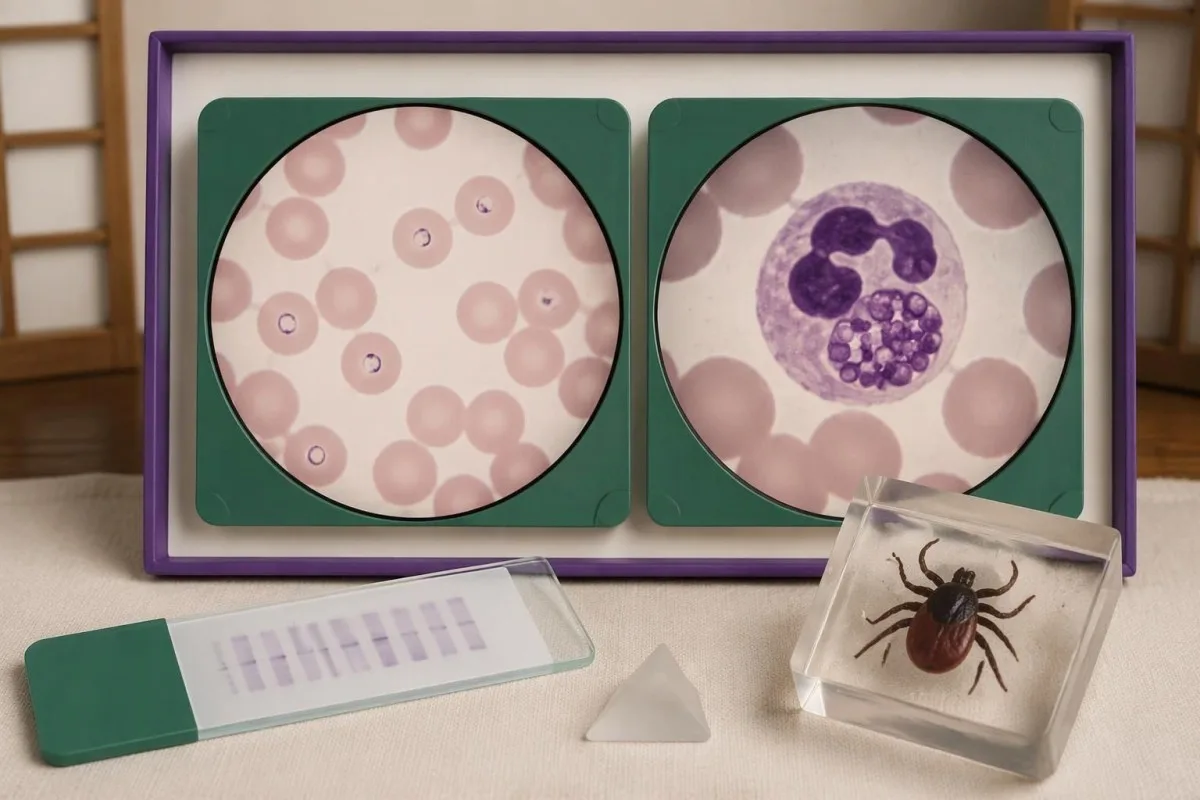
B. burgdorferi sensu stricto predominates in North America, while European disease also commonly involves B. afzelii and B. garinii. A report using VlsE, OspC or other recombinant antigen labels may therefore not resemble a 10-position conventional US blot; the clinically useful question is whether the assay was validated for the exposure setting and interpreted according to its instructions.
Different laboratory criteria are not automatically inferior, but claims that 1 or 2 bands prove disease require evidence for that assay's complete diagnostic performance. When reading a report described by Kantesti, consult the laboratory's interpretation and our medicina validiga kadro separately; general AI assessment or a software benchmark is not proof that a particular Lyme assay has validated sensitivity and specificity.
Record 3 details before comparing reports from different laboratories: assay manufacturer, algorithm type and the country where exposure occurred. Our AI-raporta fonto-kontrolilo explains why preserving source wording matters; apparent conversion from negative to positive may reflect a changed method or cutoff rather than a newly acquired infection or worsening illness.
Ĉu bendoj pri Lyme-malsano identigas Babesia, Anaplasma aŭ aliajn kuninfektojn?
Lyme Western blot bands do not diagnose tick-borne coinfections. Babesia, Anaplasma and Ehrlichia require their own clinical assessment and tests; 1 positive Lyme antibody result neither confirms nor excludes these infections, even when an exposure setting allows more than one tick-borne organism to be transmitted.

Babesiozozoose deserves consideration when relevant exposure accompanies fever and evidence such as anemia, low platelets or hemolysis, especially if fever persists during Lyme-directed treatment. A Babesia antibody titer of 1:256 alone does not establish current infection; our Babesia test interpretation guide explains why a cellular sample examination or PCR may be needed to demonstrate active infection.
Anaplasmozo can produce fever, leukopenia, thrombocytopenia and elevated liver enzymes, findings that should not be explained away as extra Lyme bands. PCR is most useful during the first week of illness and becomes less sensitive after appropriate antibiotics; our Anaplasma sample timing guide separates this early direct-detection window from later antibody interpretation.
Ehrlichiosis follows a different organism-specific testing pathway, and a negative early antibody result is not a safe reason to dismiss significant febrile illness. Our Ehrlichia PCR and titer guide explains why 2 samples collected at different times may help establish seroconversion; targeted testing should follow symptoms, geography and laboratory abnormalities rather than an indiscriminate panel ordered for isolated fatigue.
Kion vi faru, se la testa raporto pri Lyme-malsano estas neklara?
For an unclear Lyme report, obtain the complete 2-tier interpretation, write down symptom onset and discuss exposure plus objective findings with a clinician. Faint or isolated bands do not determine urgency; fainting, chest pain, breathlessness, a markedly slow pulse or new neurological deficits require prompt assessment regardless of the antibody result.
Lyme carditis can cause heart conduction block, so fainting or palpitations after compatible exposure should not wait for an immunoblot to become positive. The 2020 IDSA/AAN/ACR guideline identifies a PR interval greater than 300 milliseconds, other arrhythmias or features of myopericarditis as reasons for hospital admission with monitoring; that interval is measured on an ECG, not inferred from band intensity.
New facial weakness warrants urgent assessment, and sudden facial droop with arm weakness or speech difficulty needs emergency evaluation for stroke rather than attribution to Lyme. Our gvidilo pri avertosignoj de apopleksio explains that distinction; for a routine appointment, bring 4 dates—possible exposure, first symptom, sample collection and antibiotic initiation—because each changes a different part of the reasoning.
Kantesti estas AI-movita ilo por analizo de sangotestoj that can help organize the 2-tier result, reported bands and missing clinical context into questions for your appointment. Our Gvidilo de AI-teknologio describes the explanation workflow, but our AI cannot examine a rash, measure an ECG interval, confirm Lyme disease independently or decide whether you should start, stop or extend antibiotics.
Esploraj publikaĵoj, limoj de la pruvoj kaj sekura interpretado
The clinical interpretation in this article rests on 3 directly relevant sources: a laboratory-diagnosis review, the CDC's modified two-tier recommendation and the IDSA/AAN/ACR Lyme guideline. The 2 additional Figshare publications listed below concern other health topics and must not be treated as validation of Lyme band interpretation or Lyme diagnosis.
Moore et al. (2016) explains why individual bands and incomplete testing sequences create diagnostic errors; Mead et al. (2019) establishes the CDC recommendation for appropriately cleared modified algorithms. Lantos et al. (2021), publishing the 2020 guideline, connects testing to clinical manifestations, including early rash, arthritis and neurological disease; these sources support different parts of the reasoning rather than one universal band shortcut.
The 2 Figshare records address women's hormonal health and multilingual AI-assisted hantavirus triage, respectively, not Lyme immunoblot performance. A deployment involving 50,000 interpreted reports, as described in the hantavirus publication's title, cannot establish sensitivity, specificity or patient benefit for Lyme diagnosis; those claims would require Lyme-specific methods, reference standards and evaluation populations.
La materialoj de Kantesti principoj pri respondeca AI place report explanation alongside—not above—the laboratory and clinician, including when IgM appears after 30 days of symptoms. For symptoms linked to cycle changes or menopausal transition, our hormonal symptom guide addresses a separate assessment pathway; symptom overlap is a reason to investigate carefully, not evidence that a reactive Lyme band explains everything.
Oftaj demandoj
Ĉu unu pozitiva bando ĉe Lyme-imunbloto signifas, ke mi havas Lyme-malsanon?
Unu reaktiva bendo en la Western-blot-testo pri Lyme-malsano ne establas la diagnozon de Lyme-malsano. La konvenciaj usonaj kriterioj postulas almenaŭ 2 el 3 elektitaj IgM-bendoj dum la unuaj 30 tagoj de simptomoj, aŭ 5 el 10 elektitaj IgG-bendoj, kadre de la konvena duŝtupa testa proceduro. Unu sola bendo povas speguli krucreaktivecon aŭ nekompletan fruan antikorpan respondon, depende de la situacio. Tipa eritema migrans-ekzantemo post konvena eksponiĝo povas tamen subteni klinikan diagnozon malgraŭ negativa frua serologio.
Kial iuj Lyme-strioj estas pozitivaj, sed la ĝenerala testo estas negativa?
Testo pri Lyme-malsano povas enhavi reaktivajn bendojn sed tamen esti negativa, ĉar la imunoblotado ne plenumis la validigitan ŝablonon postulatan de la testa algoritmo. Ekzemple, 3 kvalifikaj IgG-bendoj estas malpli ol la konvencia sojlo de 5 el 10 IgG-bendoj. Pozitiva aŭ nedecida unuanivela ekzamen-testo, sekvata de negativaj konvenaj imunoblotaj testoj, estas interpretata kiel negativa en norma dunivela testado. Se la simptomoj aperis tre lastatempe, klinikisto povas konsideri ripeti la testadon post konvena intervalo, anstataŭ reetikedi la nekompletan ŝablonon kiel pozitivan.
Kion signifas pozitiva 41 kDa-bendo en testo pri Lyme-malsano?
La Lyme-bendo de 41 kDa kutime reflektas la ligadon de antikorpoj al flagelino, proteino rilata al bakteria moviĝo, kiu povas krucreagi kun antikorpoj senrilataj al Lyme-malsano. Ĝi estas nur 1 el la elektitaj bendoj uzataj laŭ konvenciaj kriterioj por imunblotado kaj ne povas sola diagnozi Lyme-malsanon. Moore et al. (2016) citis studon, kiu trovis ĉi tiun bendon ĉe 43% de sanaj kontrolpersonoj, kvankam tiu procento ne estas universala por ĉiuj analizoj. La plena sinsekvo de testoj kaj la klinika prezentiĝo determinas, ĉu la rezulto subtenas diagnozon de Lyme-malsano.
Ĉu pozitiva Lyme-IgM kaj negativa Lyme-IgG pruvas freŝan infekton?
Pozitiveco de IgM kontraŭ Lyme kun negativa IgG povas subteni fruan infekton nur kiam ĝi kongruas kun la taŭga testa algoritmo, la klinika prezentiĝo kaj la tempigo. Izolita IgM ne estu uzata por subteni diagnozon de Lyme-malsano kiam la simptomoj daŭras pli ol 30 tagojn, ĉar persista aŭ nespecifa IgM povas misgvidi la interpreton. Ekzemple, 2 kvalifikaj IgM-bendoj en la 14-a tago havas alian signifon ol la sama ŝablono post 3 monatoj da kontinuaj simptomoj. La tempiga regulo rilatas al la komenco de la simptomoj, ne al la tago, kiam la laboratorio-specimeno estis kolektita.
Ĉu mi povas havi pozitivan teston pri Lyme-malsano sen iaj bendoj ĉe la Western-blot-testo?
Jes: validigita modifita duŝtupa algoritmo por Lyme uzas du sinsekvajn enzimimunanalizojn kaj eble tute ne faras Western-bloton. La CDC rekomendis taŭge aprobitajn de la FDA modifitajn algoritmojn en 2019. Iuj kombinaĵoj de analizoj mezuras totalajn antikorpojn, dum aliaj donas apartajn rezultojn pri IgM kaj IgG, do la konvenciaj reguloj pri nombrado de bendoj ne validas por ĉiu raporto. Demandu al la laboratorio, kiu algoritmo kaj kombinaĵo de analizoj produktis la finan interpreton.
Ĉu la bendoj de Lyme-imunoblotado malaperu post antibiotika terapio?
La bendoj de Lyme Western blot ne devas malaperi post sukcesa kuracado, ĉar antikorpoj povas persisti dum jaroj aŭ jardekoj. Persista 5-benda IgG-profilo ne pruvas daŭran infekton, kaj ripeta testado de bendoj ne estas validigita kuracrezulta testo. La respondo al kuracado estas taksata laŭ la klinika evoluo kaj koncernaj objektivaj trovoj, ne per postulo, ke antikorpa panelo fariĝu negativa. Novaj simptomoj aŭ alia mordo de iksodo postulas novan klinikan taksadon, ĉar malnovaj antikorpoj ne povas establi reinfekton.
Klarigu viajn rezultojn de sangoanalizo
Alŝutu vian laboratorian raporton kaj la AI de Kantesti klarigas ĉiun biomarkilon per simpla lingvaĵo ene de sekundoj. Uzata de pli ol 2 milionoj da homoj tutmonde.
Referencoj
- Klein, T., Mitchell, S., & Weber, H. (2026). Gvidilo pri Virina Sano: Ovulado, Menopaŭzo kaj Hormonaj Simptomoj. Kantesti AI-esplorado pri medicino. DOI
- Klein, T., Mitchell, S., & Weber, H. (2026). Plurlingva klinika decid-subteno helpata de AI por frua triado de hantaviruso: projektado, inĝeniera validigo kaj realmonda apliko tra 50,000 interpretitaj raportoj pri sangoanalizo. Kantesti AI-esplorado pri medicino. DOI
- Moore A et al. (2016). Current Guidelines, Common Clinical Pitfalls, and Future Directions for Laboratory Diagnosis of Lyme Disease, United States. Emerging Infectious Diseases. DOI PubMed
- Mead P et al. (2019). Updated CDC Recommendation for Serologic Diagnosis of Lyme Disease. MMWR-Semajna raporto pri malsaneco kaj morteco. DOI
- Lantos PM et al. (2021). Clinical Practice Guidelines by the Infectious Diseases Society of America (IDSA), American Academy of Neurology (AAN), and American College of Rheumatology (ACR): 2020 Guidelines for the Prevention, Diagnosis and Treatment of Lyme Disease. Clinical Infectious Diseases. DOI
- 2M+Analizitaj testoj
- 127+Landoj
- 100+Lingvoj
Pri la medicina teamo


Signaloj de fido E-E-A-T
Sperto
Kuracista gvidata klinika revizio de laboratoriaj interpretaj laborfluoj.
Kompetenteco
Laboratoria medicino fokusiĝas pri kiel biomarkiloj kondutas en klinika kunteksto.
Aŭtoritateco
Medicine recenzita de D-ro Thomas Klein, kun kontribuoj de D-rino Sarah Mitchell kaj Prof. D-ro Hans Weber.
Fidindeco
Evident-bazita interpretado kun klaraj sekvaj vojoj por redukti alarmon.






Medicina malrespondeca deklaro
Ĉi tiu artikolo estas nur por edukaj celoj kaj ne konsistigas medicinan konsilon. Ĉiam konsultu kvalifikitan sanprovizanton por diagnozaj kaj traktadaj decidoj.
Publikigita · Kontaktu la redakcian teamon
Eldonita de Kantesti Ltd, registrita en Anglio kaj Kimrio, kompanio n-ro. 17090423, Londono, Unuiĝinta Reĝlando.
