Pri spremljanju klozapina se za odkrivanje nevarne nevtropenije uporablja absolutno število nevtrofilcev (ANC); nizke vrednosti lahko zahtevajo dodatno testiranje, specialistični pregled ali prekinitev zdravljenja po navodilu zdravnika. Urniki se razlikujejo glede na državo in fazo zdravljenja. Vročina, boleče grlo ali nenadno slabo počutje zahtevajo nujno oceno – tudi po pomirjujočem izvidu. Klozapina ne spreminjajte sami.

Ključne ugotovitve
- Enote ANC: 1,0 × 10⁹/L je enako 1.000 celicam/µL; pred primerjavo izvidov s pragovi za zdravljenje preverite enote.
- Splošni ameriški pragovi: ANC 1.000–1.499 celic/µL lahko omogoča nadaljevanje zdravljenja s pogostejšim spremljanjem; pri vrednosti 500–999 celic/µL je običajno potrebna prekinitev zdravljenja po navodilu zdravnika, kadar obstaja sum na nevtropenijo, povzročeno s klozapinom.
- Huda nevtropenija: ANC pod 500 celic/µL zahteva nujno klinično obravnavo, običajno prekinitev zdravljenja in vključitev hematologa.
- Število nevtrofilcev pri odsotnosti antigena Duffy: Dokumentirano število nevtrofilcev, povezano z odsotnostjo antigena Duffy, lahko upraviči drugačen postopek zdravljenja; samo poreklo ne določa upravičenosti.
- Ameriški urnik: Spremljanje v skladu z informacijami o predpisovanju se običajno začne s tedenskimi kontrolami 6 mesecev, nato s kontrolami vsaka 2 tedna 6 mesecev, zatem pa mesečno.
- Administrativne spremembe: FDA je 13. junija 2025 odpravila ameriški program REMS za klozapin; s tem so bile odpravljene zahteve glede registra, ne pa klinična potreba po spremljanju ANC.
- Mednarodni urniki: Tradicionalni protokoli v Združenem kraljestvu predvidevajo tedenske preiskave 18 tednov, preiskave na 14 dni do 1 leta, nato pa vsake 4 tedne; revidirana evropska priporočila lahko pri ustreznih stabilnih bolnikih dopuščajo daljše intervale.
- Nujni simptomi: Vročina 38,0 °C ali več, novo vneto grlo, razjede v ustih, mrzlica s tresavico ali nenadno izrazito poslabšanje počutja zahtevajo nujno oceno še isti dan. Zmedenost, težave z dihanjem ali kolaps zahtevajo nujno pomoč.
Kaj spremljanje klozapina dejansko določa?
Pri spremljanju zdravljenja s klozapinom se rezultati ANC uporabljajo za pomoč zdravnikom pri odločanju, ali se zdravljenje lahko nadaljuje, je potrebno natančnejše spremljanje ali ga je treba prekiniti. ANC pod 500 celic/µL je resna varnostna ugotovitev, vendar so odločitve pri višjih vrednostih odvisne od protokola v posamezni državi, prejšnjih rezultatov in bolnikove dokumentirane izhodiščne vrednosti.

Rezultat ANC sam po sebi ni navodilo za predpisovanje: vrednost 1.200 celic/µL lahko po enem protokolu dopušča nadaljevanje zdravljenja, po drugem pa sproži drugačen odziv. Predpisovalec mora pred razlago vrednosti določiti ustrezni protokol; uporaba ameriškega praga pri opozorilu britanske službe za spremljanje lahko povzroči preprečljivo težavo z dobavo zdravila. Kantesti.
je analizator krvnih preiskav z umetno inteligenco, ki lahko pojasni, da ANC 1,2 × 10⁹/L ustreza 1.200 celicam/µL, vendar naša razlaga ne more odobriti izdaje klozapina ali nadomestiti predpisovalne ekipe. Naš informacije o podjetju označuje organizacijo, ki zagotavlja to izobraževalno storitev, in ne registra za spremljanje zdravljenja s klozapinom.
Zniževanje vrednosti si zasluži pozornost še preden doseže prag za ukrepanje: hipotetičen padec z 4.000 na 1.700 celic/µL se razlikuje od dolgotrajne izhodiščne vrednosti okoli 1.700. Naš vodnik za mejni rezultati nevtrofilcev pojasnjuje običajna nihanja, vendar naj se uporabniki klozapina glede zdravila posvetujejo posebej, namesto da bi upoštevali splošni urnik ponovnih testiranj.
Kako odčitate enote ANC in izračunate število?
ANC meri absolutno število nevtrofilcev, ne njihovega deleža med belimi krvnimi celicami. Pretvorba je natančna: 1,0 × 10⁹/L je enako 1.000 celicam/µL. Referenčno območje laboratorija in prag za zdravljenje s klozapinom odgovarjata na različni vprašanji, zato označen rezultat ne pomeni samodejno, da je treba zdravljenje prekiniti.
Večina sodobnih laboratorijev ANC poroča neposredno, običajno kot nevtrofilce, absolutne nevtrofilce ali NEUT#. Če je potreben izračun, pomnožite skupno vrednost WBC z deležem nevtrofilcev, vključno s paličastimi nevtrofilci, če so navedeni ločeno; na primer 4.000 celic/µL × 0,40 pomeni ANC 1.600 celic/µL, ne 40 celic/µL.
Pri hipotetični vrednosti WBC 6.000 celic/µL in deležu nevtrofilcev 15% je ANC 900 celic/µL, čeprav je skupna vrednost WBC lahko znotraj referenčnega območja laboratorija. To neskladje pojasnjuje, zakaj vodnik po referenčnih vrednostih nevtrofilcev razlikuje med absolutnim številom in odstotkom v diferencialni krvni sliki.
Zapis decimalk lahko povzroči nevarne nesporazume: 0,8 × 10⁹/L pomeni 800 celic/µL, medtem ko 8,0 × 10⁹/L pomeni 8.000 celic/µL. Preverite izvirno poročilo, datum odvzema in enote, ne pa obrezanega posnetka zaslona ali ročno vnesene vrednosti, ter se pred uporabo rezultata za predpisovanje obrnite na laboratorij ali ekipo za spremljanje, da razjasni morebitne nejasnosti.
| Raven | Razpon | Kaj pomeni |
|---|---|---|
| Nad običajnim pragom za nevtropenijo | ≥1,5 × 10⁹/L; ≥1.500 celic/µL | Usually outside the conventional adult neutropenia definition; this is not a universal laboratory reference interval or dispensing rule. |
| Blaga nevtropenija | 1.0–1.499 × 10⁹/L; 1,000–1,499 cells/µL | Requires interpretation against baseline, symptoms and the applicable clozapine pathway. |
| Zmerna nevtropenija | 0.5–0.999 × 10⁹/L; 500–999 cells/µL | Often requires urgent prescriber review; treatment actions differ for general and documented Duffy-null pathways. |
| Huda nevtropenija | <0.5 × 10⁹/L; <500 cells/µL | High-risk finding requiring urgent clinical management, usually hematology involvement and clinician-directed interruption. |
Kateri izvidi ANC spremenijo zdravljenje po ameriškem postopku?
The US general-population pathway usually permits clozapine initiation at ANC ≥1,500 cells/µL. During treatment, ANC of 1,000–1,499 cells/µL can allow continuation with intensified monitoring; 500–999 cells/µL generally requires interruption when clozapine-induced neutropenia is suspected. These are clinician actions, not instructions for patients to adjust medication.
For mild neutropenia, the US prescribing-information approach commonly increases ANC checks to 3 times weekly until recovery to at least 1,500 cells/µL. Correll et al. (2022), in CNS Drugs, reproduce these management pathways and emphasize that clozapine's substantial psychiatric benefits must be considered alongside hematological risk rather than treating every low result identically.
For ANC of 500–999 cells/µL in the general pathway, clinicians usually arrange hematology input and daily testing initially, with treatment resumption considered after recovery according to the label. A repeat sample can clarify an unexpected result, but a symptomatic patient or a rapidly falling count should not wait 24 hours merely to obtain a more convenient number.
A count below 500 cells/µL enters the severe-neutropenia pathway, where any later rechallenge requires an explicit specialist risk–benefit decision. Total WBC or CRP cannot substitute for ANC; our explanation of neskladjih med WBC in CRP shows why apparently reassuring results elsewhere in the panel do not cancel a low neutrophil count.
| Raven | Razpon | Kaj pomeni |
|---|---|---|
| US general-pathway initiation threshold | ANC ≥1,500 cells/µL | Usually eligible for initiation from a hematological perspective, subject to the full prescribing assessment. |
| Mild neutropenia during treatment | ANC 1,000–1,499 cells/µL | Treatment can often continue under prescriber direction with ANC monitoring 3 times weekly. |
| Moderate neutropenia during treatment | ANC 500–999 cells/µL | Usually interrupt if clozapine-induced neutropenia is suspected; obtain hematology advice and intensified monitoring. |
| Severe neutropenia during treatment | ANC <500 cells/µL | Interrupt under urgent clinical management; any future rechallenge needs specialist justification. |
Kako število, povezano z odsotnostjo antigena Duffy, spremeni odločitve?
Documented Duffy-null-associated neutrophil counts can justify lower clozapine ANC thresholds because a stable lower circulating count does not necessarily indicate impaired immunity. US prescribing information has historically called this the benign ethnic neutropenia, or BEN, pathway; its usual initiation threshold is ANC ≥1,000 cells/µL with at least 2 baseline measurements.
Under the US documented BEN pathway, an ANC of 500–999 cells/µL may permit continued clozapine with hematology consultation and monitoring 3 times weekly. This differs from the general pathway at the same number; the distinction must already be established clinically, not inferred after an alarming result simply to avoid an interruption.
Ancestry is not a diagnostic test for Duffy-null status, and 2 people with similar ancestry may have different baseline ANC patterns. Our Duffy-null count explanation discusses phenotype or genotype evidence, historical counts and assessment for other causes; genetic testing is not universally required, but a clinician-documented explanation is needed for an alternative treatment pathway.
A hypothetical stable baseline of 1,200 cells/µL does not make a new fall to 450 cells/µL harmless: that result meets the severe-neutropenia threshold even in the US BEN pathway. Fever, recurrent unusual infections, anemia or low platelets also weakens the assumption that a low ANC is an isolated constitutional finding and warrants a broader assessment.
Kako veliko je tveganje za nevtropenijo zaradi klozapina sčasoma?
Clozapine neutropenia risk is concentrated early in treatment, especially during the first 18 weeks to 6 months, but it does not disappear later. Correll et al. (2022) describe agranulocytosis as affecting approximately 1% of treated patients; estimates vary across populations, monitoring systems and definitions, so this is not an individual prediction.

Approximately 1% means roughly 1 in 100 treated people in that broad estimate, not a 1% risk every month and not a 1% risk after every dose. Mild neutropenia is more frequent than agranulocytosis, and studies that combine the two outcomes can make the risk of life-threatening neutrophil depletion appear larger than it actually is.
Early intensive testing reflects the concentration of events during the first 6 months, rather than an assumption that each additional tablet causes predictable cumulative marrow damage. Severe clozapine-associated neutropenia is not reliably prevented by choosing a low dose alone, and a previously normal count cannot guarantee that the next count will remain normal.
After 2 years of stable treatment, the absolute risk is generally much lower than during initiation, which helps explain proposals for less frequent routine testing. Late neutropenia still needs investigation for medication effects, illness and marrow disease; our guide to testiranju za pogoste okužbe explains why symptoms and other cell lines can reveal risks that an ANC-only schedule misses.
Kakšen je ameriški urnik spremljanja klozapina po REMS?
The US prescribing-information ANC schedule generally remains weekly for 6 months, every 2 weeks for the next 6 months, then monthly. The FDA removed the clozapine REMS on June 13, 2025, ending its enrollment and ANC-reporting requirements; that administrative change did not remove the clinical recommendation to monitor neutrophils.

The FDA's 2025 clozapine REMS removal communication separates access restrictions from safe prescribing: prescribers, pharmacies and patients no longer need to participate in that federal registry. A pharmacy no longer needs the former REMS dispensing authorization, but the prescriber may still require a recent ANC and a local service may still use an electronic safety workflow.
For a hypothetical patient completing 6 months without a concerning ANC event, the usual label pathway moves from weekly to every-2-week monitoring rather than immediately to monthly testing. Neutropenia, a treatment interruption or a relevant medication change can alter that plan; ask which event starts the next monitoring period instead of counting months independently.
Kantesti can help explain a trend across 3 dated ANC reports, but our platform does not determine the next legally or clinically acceptable dispensing date. Our vodnik po trendih varnosti zdravil explains why the original collection dates and the prescribing team's schedule must remain attached to any AI-generated summary.
Zakaj lahko službe za spremljanje v Združenem kraljestvu uporabljajo drugačen urnik?
Traditional UK clozapine monitoring pathways use weekly testing for 18 weeks, every 2 weeks until 1 year, then every 4 weeks. UK dispensing has also depended on product-linked monitoring-service clearance; revised recommendations and local implementation can change the pathway, so the patient's own service must confirm the schedule and action thresholds.

An older UK pathway may classify ANC of 1.5–2.0 × 10⁹/L as amber and below 1.5 × 10⁹/L as red in patients without an approved lower-baseline pathway. Those thresholds are not interchangeable with the US continuation algorithm, and legacy UK systems may also consider total WBC; the relevant service must state which rules it currently applies.
Every 4 weeks means every 28 days, not simply once in each calendar month, so a missed appointment can affect a supply window even when the previous result was satisfactory. A useful baseline testing plan should include who books the sample, who receives it and who contacts the patient if the monitoring service cannot release medication.
Administrative alerts can arise from an overdue sample, an unprocessed sample or a genuinely low count—3 different problems with different solutions. Contact the prescribing team and pharmacy promptly if supply is threatened; do not stretch doses, borrow tablets or assume that a policy change in another country has automatically changed your own monitoring-service rules.
Kaj se je spremenilo v revidiranih evropskih priporočilih za ANC?
Revised European recommendations allow less frequent ANC testing in eligible stable patients: weekly for 18 weeks, monthly through the first year, every 12 weeks after 1 year and annually after 2 years. These longer intervals depend on the specified absence of neutropenia and the locally implemented product information; they are not a universal schedule.
The European Medicines Agency's 2025 communication on revised routine blood count monitoring shifts the principal hematological measure toward ANC rather than combined WBC and ANC surveillance. The revised approach generally uses baseline ANC of at least 1,500 cells/µL, or at least 1,000 cells/µL in an established BEN pathway, while lowering some treatment-interruption thresholds compared with older European systems.
In the revised European approach, ANC below 1,000 cells/µL generally triggers stopping treatment in the standard pathway, whereas below 500 cells/µL is the corresponding threshold for an established BEN pathway. Results above those stopping thresholds can still require intensified surveillance; a hypothetical count of 1,100 cells/µL is not a reason to ignore a new downward trend.
Country authorization, the particular product information and service implementation can differ, even when patients have each taken clozapine for 2 years. Our guide to blood-test timing and changes explains why historical stability matters; obtain written confirmation before assuming that an annual European schedule applies to a UK, US or other national pathway.
Kaj je treba storiti po nepričakovano nizkem ANC?
An unexpected low ANC needs prompt prescriber review, confirmation when appropriate and assessment for causes other than clozapine. In the US label pathway, an initial ANC below 1,500 cells/µL is generally confirmed within 24 hours, but severe neutropenia or infection symptoms require immediate management rather than waiting for a routine repeat.
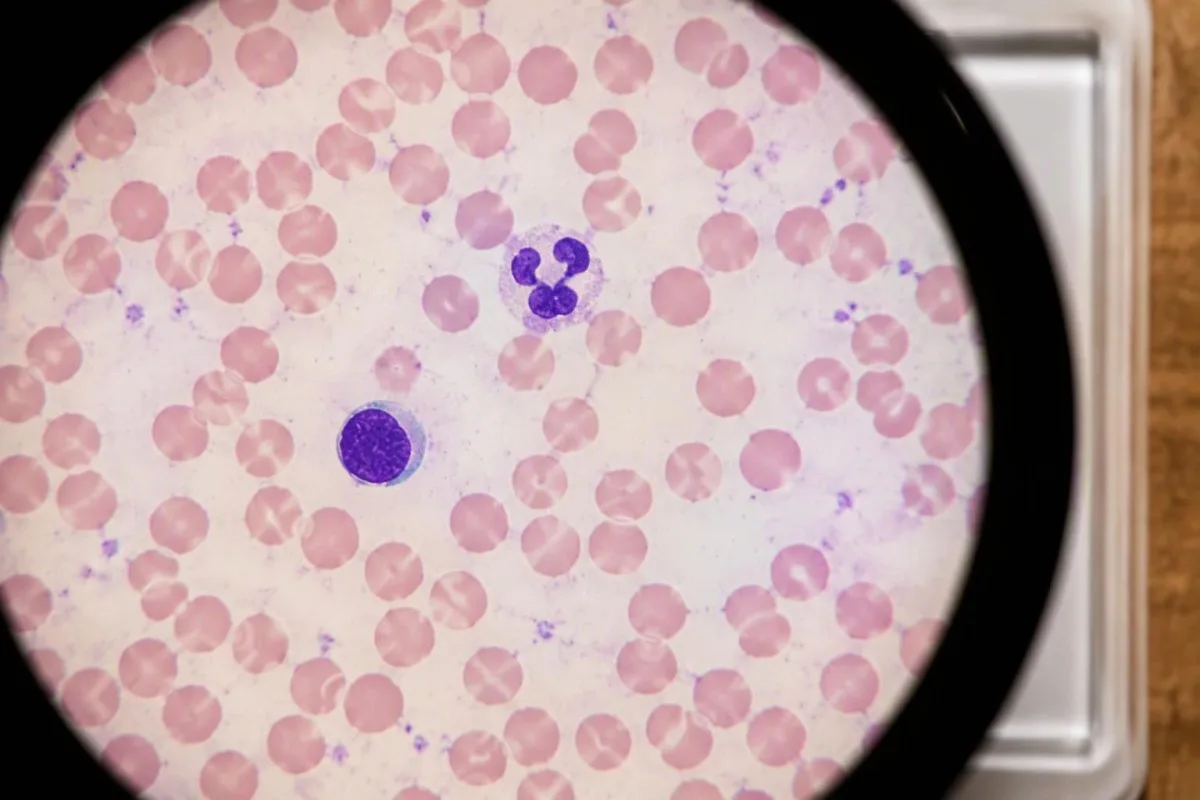
Recent viral illness, other medicines, autoimmune disease and nutritional deficiency can all lower ANC; a count of 900 cells/µL establishes neutropenia but does not establish its cause. Clinicians review the timing of drug exposure and may examine hemoglobin, platelets and a cell sample slide; concurrent abnormalities can justify evaluation for possible marrow disorders.
Kantesti is an AI blood test interpretation platform that can place an ANC of 0.9 × 10⁹/L beside platelet and hemoglobin trends, while leaving causation and medication decisions to clinicians. Our broader vodnik za hematološke označevalce explains why a normal red-cell result does not erase an isolated neutrophil problem.
Sampling time and temporary physiological variation can affect a borderline result, but there is no safe rule that an afternoon repeat will always normalize an ANC of 1,400 cells/µL. If a clinician requests a repeat at a consistent time, follow that plan without delaying necessary care; exercise, supplements or deliberate timing changes should not be used to manipulate a treatment-clearance result.
Kateri simptomi okužbe zahtevajo nujno oceno?
During clozapine treatment, fever of 38.0°C or higher, new sore throat, mouth sores, shaking chills or sudden marked illness warrants urgent same-day clinical assessment. A known ANC below 500 cells/µL makes possible infection especially urgent. Confusion, breathing difficulty, fainting or rapidly worsening illness requires emergency help, regardless of the last count.

Formal febrile-neutropenia definitions often use a single temperature of at least 38.3°C or at least 38.0°C sustained for 1 hour, together with severe or impending severe neutropenia. Those definitions support clinical classification—not a home instruction to wait an hour; tell the urgent-care team that you take clozapine and provide your last ANC if available.
An ANC of 2,000 cells/µL measured 7 days ago cannot exclude a new fall today, and severe neutropenia can weaken usual local signs such as redness or discharge. Assessment may include an urgent CBC with differential, cultures and examination; our procalcitonin interpretation guide explains why a low infection biomarker cannot independently rule out an early serious infection.
New fever may also signal pneumonia, myocarditis or another illness that raises clozapine concentrations, creating 2 linked safety questions: immune protection and medication toxicity. Call the prescribing team's urgent number immediately for advice about the next dose; if you cannot reach them promptly while significantly unwell, seek urgent care rather than waiting for an app interpretation or routine appointment.
Kako druga zdravila, kajenje in bolezen vplivajo na spremljanje?
Other medicines can increase neutropenia risk or change clozapine concentrations, and those are different problems requiring different tests. ANC is measured in cells/µL, whereas clozapine concentration is commonly measured in ng/mL; a normal ANC does not exclude excessive drug exposure, and a therapeutic concentration does not exclude neutropenia.

Carbamazepine is generally avoided with clozapine because of marrow-suppression risk and clinically relevant interactions; concurrent valproate has also been associated with neutropenia in observational studies. A hypothetical ANC decline from 2,600 to 1,300 cells/µL after adding another medicine warrants a complete medication review, not a conclusion that clozapine is necessarily the sole cause; valproate level interpretation addresses the separate issue of drug exposure.
Stopping combustible smoking can raise clozapine concentrations because smoke components—not nicotine itself—induce CYP1A2 metabolism. A person who stops smoking during a 3-day hospital admission may therefore need prescriber-directed concentration monitoring and dose review; our nicotine test explanation clarifies why cotinine alone does not measure the smoke-related enzyme effect.
Kantesti can explain why an ANC of 2,100 cells/µL and a clozapine level of 900 ng/mL describe different risks, but we cannot select a safer dose. Fever, major caffeine changes and interacting medicines such as ciprofloxacin can alter exposure; report new excessive sedation, confusion or muscle jerks promptly, even if the neutrophil result is reassuring.
Kaj se zgodi po izpuščenih testih ali prekinitvi zdravljenja?
A missed ANC appointment can create a supply problem, while a clozapine treatment break can create a separate restarting hazard. After more than 48 hours without clozapine, many protocols require supervised re-titration beginning at 12.5 mg once or twice daily rather than immediate return to the previous dose; exact instructions depend on the prescribing information.
Tolerance to clozapine's blood-pressure effects can be lost quickly, so restarting a previous 300 mg daily regimen after a break may cause profound hypotension or collapse. US prescribing information also specifies reduced restart doses for shorter interruptions; patients should contact the prescribing team after missed doses rather than using a remembered 48-hour rule to decide what to take.
A treatment break does not always reset ANC surveillance to the beginning, because monitoring rules depend on interruption duration and the reason treatment stopped. In the US normal-ANC pathway, interruptions of 30 days or longer generally return patients to initiation-style monitoring; national monitoring services may use different interruption rules, especially after an abnormal count.
After a hypothetical 5-day admission, confirm the last dose, current prescription, latest ANC and who will supervise the next dose before leaving hospital. Our explanation of rezultatih po bolnišničnem odpustu helps organize altered laboratory values, but it cannot reconcile prescriptions or authorize restarting after neutropenia.
Česa spremljanje ANC ne zazna glede varnosti klozapina?
ANC monitoring does not detect clozapine-related myocarditis, constipation, metabolic complications or excessive drug concentrations. Some initiation protocols add weekly troponin and CRP during the first 4 weeks, while ongoing care assesses bowel function, weight, glucose and lipids. A satisfactory ANC therefore confirms only one part of medication safety.

New chest pain, breathlessness or persistent unexplained tachycardia during the first 4 weeks needs prompt clinical assessment rather than reassurance from a normal ANC. Troponin and CRP can support a myocarditis investigation, but thresholds and screening practices vary; our myocarditis testing explanation describes why laboratory results must be interpreted with symptoms and cardiac evaluation.
Clozapine-related bowel slowing can become dangerous even when stool is still passing, and severe abdominal pain, distension or vomiting requires urgent assessment. Record bowel frequency and stool consistency rather than asking only whether constipation is present; the vodnik za konsistenco blata provides a shared description, while a change lasting 48 hours should prompt contact according to the patient's bowel-management plan.
Correll et al. (2022) describe a clozapine plasma reference range of approximately 350–600 ng/mL for many treatment-response decisions, while emphasizing individual variation and adverse effects. That range is not an ANC target or a universal safe-dose boundary; concentration samples usually need defined timing relative to the last dose, whereas routine ANC collection generally does not require a trough sample.
Kako se pripraviti na naslednji pregled zaradi klozapina?
Bring the latest ANC, its units, earlier counts and a complete medication list to every clozapine review. Ask which national and service-specific pathway applies, what happens below its thresholds and whom to contact urgently. Keeping at least 3 dated results available helps distinguish a stable baseline from a new decline.

For a hypothetical sequence of 2,400, 1,900 and 1,400 cells/µL, useful questions concern the trend, recent illness, interacting medicines and the required next sample—not simply whether the latest value is red. Also ask who receives results outside office hours and whether the pharmacy needs monitoring-service clearance; these practical details can prevent an avoidable treatment gap.
Kantesti is an AI biomarker interpretation platform that helps translate an ANC of 1.4 × 10⁹/L into an understandable count and a list of clinician questions. Our tehnični in klinični nadzor describes the boundaries of interpretation; it does not establish that an automated answer is a validated clozapine prescribing decision or a substitute for hematology advice.
Kantesti's educational workflow should preserve 3 essentials: the source result, the applicable clinical protocol and the human decision-maker. Our načela odgovorne uporabe umetne inteligence explain why urgent symptoms take priority over automated analysis, while our informacijami o zasebnosti in podatkih explains considerations when sharing sensitive psychiatric and laboratory records.
Raziskovalne publikacije in meje dokazov
The 2 Kantesti publications listed in the research publication section concern digestive symptoms and women's health, not clozapine ANC thresholds or monitoring schedules. Their Figshare DOIs identify those publications but do not establish peer review or provide evidence for clozapine decisions; the directly relevant medical and regulatory sources are listed separately below.
Pogosta vprašanja
Kolikšno absolutno število nevtrofilcev je prenizko za nadaljevanje zdravljenja s klozapinom?
The ANC threshold for continuing clozapine depends on the country and the patient's documented baseline pathway. In the US general pathway, ANC of 1,000–1,499 cells/µL can allow continuation with increased monitoring, while 500–999 cells/µL usually requires interruption when clozapine-induced neutropenia is suspected. A documented BEN or Duffy-null-associated pathway can permit continuation at 500–999 cells/µL under specialist supervision. ANC below 500 cells/µL requires urgent clinical management; patients should obtain immediate prescriber instructions rather than change treatment themselves.
Ali po odpravi programa clozapine REMS še vedno potrebujem krvne preiskave za ANC?
Da, ukinitev ameriškega programa REMS za klozapin ni odpravila kliničnega priporočila za spremljanje absolutnega števila nevtrofilcev (ANC). FDA je 13. junija 2025 ukinila register in s tem končala zahteve glede vključevanja, poročanja in dovoljenj za izdajo zdravila. Urnik iz informacij o predpisovanju na splošno ostaja tedenski prvih 6 mesecev, nato vsaka 2 tedna naslednjih 6 mesecev, zatem pa mesečno. Zdravnik, ki vam predpisuje zdravilo, lahko zahteva dodatne preiskave po nevtropeniji, prekinitvi zdravljenja ali drugi relevantni klinični spremembi.
Why is my clozapine blood test schedule different from someone else's?
Urniki krvnih preiskav za klozapin se razlikujejo, ker se nacionalne informacije o zdravilu, službe za spremljanje, trajanje zdravljenja in predhodni dogodki, povezani z ANC, med seboj razlikujejo. Tradicionalni protokoli v Združenem kraljestvu predvidevajo tedensko testiranje 18 tednov, nato testiranje vsaka dva tedna do dopolnjenega 1 leta in zatem testiranje vsake 4 tedne. Revidirana evropska priporočila lahko pri primernih stabilnih bolnikih po 1 letu dovolijo testiranje vsakih 12 tednov, po 2 letih pa letno testiranje, odvisno od lokalne uvedbe. Pred spremembo katerega koli termina se pri svoji službi, ki predpisuje zdravilo, pozanimajte, kateri urnik velja za vas.
Ali lahko klozapin povzroči nevtropenijo po več letih normalnih izvidov?
0 Klospin povezana nevtropenija se lahko pojavi po letih normalnih izvidov, čeprav je tveganje med začetnim zdravljenjem precej večje. Prvih 18 tednov do 6 mesecev predstavlja velik delež hudih dogodkov. Novo znižano število celic po 2 letih še vedno zahteva oceno glede klosapina, drugih zdravil, okužbe ter bolezni kostnega mozga ali avtoimunskih bolezni. Predhodni pomirjujoč ANC ne odpravlja potrebe po nujni oceni ob pojavu vročine ali nenadnega poslabšanja zdravstvenega stanja.
Kaj naj storim, če imam med jemanjem klozapina vročino?
Vročina 38,0 °C ali več med jemanjem klozapina zahteva nujno klinično oceno še isti dan, zlasti ob bolečem žrelu, razjedah v ustih, močnem tresenju zaradi mrzlice ali izraziti šibkosti. Zdravniku povejte, da jemljete klozapin, in navedite zadnje število absolutnih nevtrofilcev (ANC), če je na voljo. Znano število ANC pod 500 celic/µL pomeni, da je morebitna okužba še posebej nujna, pri zmedenosti, težavah z dihanjem ali kolapsu pa poiščite nujno pomoč. Glede naslednjega odmerka nemudoma poiščite nasvet zdravnika, ki vam je predpisal zdravilo; ne čakajte na naslednjo redno preiskavo in zdravila ne spreminjajte na lastno pest.
Ali lahko po dveh dneh brez jemanja ponovno začnem jemati običajni odmerek klozapina?
Po prekinitvi zdravljenja ne smete ponovno začeti jemati običajnega odmerka klozapina brez navodil predpisujoče ekipe. Po več kot 48 urah brez zdravljenja številni protokoli zahtevajo ponovno titracijo z začetnim odmerkom 12,5 mg enkrat ali dvakrat na dan, ker se lahko izgubi toleranca za učinke na krvni tlak. Nekatere informacije za predpisovanje zahtevajo tudi zmanjšane odmerke po krajših prekinitvah. Čim prej se obrnite na ekipo, saj sta ustrezen načrt ponovnega uvajanja zdravljenja in časovni razpored ANC odvisna od natančnega trajanja in razloga prekinitve.
Ali normalno število belih krvnih celic pomeni, da je moj ANC pri jemanju klozapina varen?
Normalno skupno število belih krvničk ne zagotavlja, da je ANC ustrezen za zdravljenje s klozapinom. Na primer, WBC 6.000 celic/µL in 15% nevtrofilcev pomeni ANC 900 celic/µL. Pri odločitvah o zdravljenju je treba upoštevati absolutno število nevtrofilcev, veljavni protokol in klinični kontekst, ne pa zgolj WBC. Tudi normalen ANC ne more izključiti miokarditisa, hude upočasnitve črevesne peristaltike ali previsokih koncentracij klozapina.
Poskrbite, da vam razložijo rezultate krvnih preiskav
Naložite svoj laboratorijski izvid in AI Kantesti bo v nekaj sekundah preprosto razložil vsak biomarker. Uporablja ga več kot 2 milijona ljudi po vsem svetu.
Reference
- Klein, T., Mitchell, S., & Weber, H. (2026). Driska po postu, črne pikice v blatu in gastrointestinalni vodnik 2026. Kantesti AI Medical Research. DOI
- Klein, T., Mitchell, S., & Weber, H. (2026). Vodnik po zdravju žensk: ovulacija, menopavza in hormonski simptomi. Kantesti AI Medical Research. DOI
- Correll CU et al. (2022). A Guideline and Checklist for Initiating and Managing Clozapine Treatment in Patients with Treatment-Resistant Schizophrenia. CNS Drugs. DOI
- US Food and Drug Administration (2025). FDA removes risk evaluation and mitigation strategy (REMS) program for the antipsychotic drug Clozapine. FDA Drug Safety and Availability.
- European Medicines Agency (2025). Clozapine: revised recommendations for routine blood count monitoring. Direct healthcare professional communication.
- 2 milijona+Analizirani testi
- 127+Države
- 100+Jeziki
O zdravstveni ekipi


E-E-A-T zaupanja vredni signali
Izkušnje
Zdravniški klinični pregled delovnih postopkov za interpretacijo laboratorijskih izvidov.
Strokovno znanje
Laboratorijska medicina s poudarkom na tem, kako se biomarkerji obnašajo v kliničnem kontekstu.
Avtoritativnost
Zdravstveno pregledal dr. Thomas Klein, s prispevki dr. Sarah Mitchell in prof. dr. Hansa Webra.
Zanesljivost
Interpretacija na podlagi dokazov z jasnimi nadaljnjimi potmi za zmanjšanje alarmiranja.





Zdravstvena omejitev odgovornosti
Ta članek je namenjen izobraževalnim namenom in ne predstavlja medicinskega nasveta. Za odločitve o diagnozi in zdravljenju se vedno posvetujte z usposobljenim izvajalcem zdravstvenih storitev.
Objavljeno · Obrnite se na uredniško ekipo
Izdala družba Kantesti Ltd, registrirana v Angliji in Walesu, matična št. 17090423, London, Združeno kraljestvo.
