
Pozitiven rezultat testa na protitelesa ne zahteva samodejno zdravljenja. Simptomi, podatki o izpostavljenosti, število eozinofilcev in pregled oči lahko pomagajo razlikovati naključno najdbo od bolezni, ki zahteva obravnavo.

Ključne ugotovitve
- Pozitivna protitelesa kažejo imunski odziv na antigene toksokar; 1 pozitiven rezultat ne more potrditi, ali ličinke trenutno povzročajo bolezen.
- Prejšnja izpostavljenost lahko pustijo zaznaven IgG še več let, zato vztrajna pozitivnost ni zanesljiv pokazatelj neuspešnega zdravljenja.
- Eozinofilija na splošno pomeni absolutno število eozinofilcev nad 0.5 × 10⁹/L; podpira nadaljnje preiskave, vendar ne opredeli toksokar kot vzroka.
- Višje število eozinofilcev v višini najmanj 1.5 × 10⁹/L zahteva oceno, kadar je vztrajno ali ga spremljajo simptomi prizadetosti organov, ne pa samodejnega zdravljenja proti parazitom.
- Očesni simptomi kot so na novo nastalo zamegljen vid, plavajoče motnjave ali slabši vid na 1 očesu, zahtevajo takojšnjo oceno; nenadna izguba vida zahteva nujno obravnavo.
- Zdravljenje pri visceralni toksokariozi lahko po smernicah CDC vključuje albendazol 400 mg dvakrat na dan 5 dni pod nadzorom zdravnika.
- Očesna bolezen potrebuje zdravljenje pod vodstvom specialista, ker je obvladovanje tkivnega odziva lahko enako pomembno kot zdravljenje parazita.
- Nadaljnje spremljanje mora spremljati simptome in ustrezne laboratorijske trende; znižanje indeksa protiteles z 2,0 na 1,5 samo po sebi ne dokazuje okrevanja.
Ali je treba pozitiven rezultat testa na protitelesa proti toksokaram zdraviti?
Pozitivna protitelesa proti toksokari ne zahtevajo samodejno zdravljenja. Zaznavna protitelesa lahko odražajo preteklo izpostavljenost in ne aktivne toksokaroze; odločitve o zdravljenju so odvisne od skladnih simptomov, anamneze izpostavljenosti in podpornih izvidov, kot je eozinofilija. Novi očesni simptomi zahtevajo takojšnjo oceno, tudi kadar je rezultat protiteles šibko pozitiven ali so drugi testi normalni.
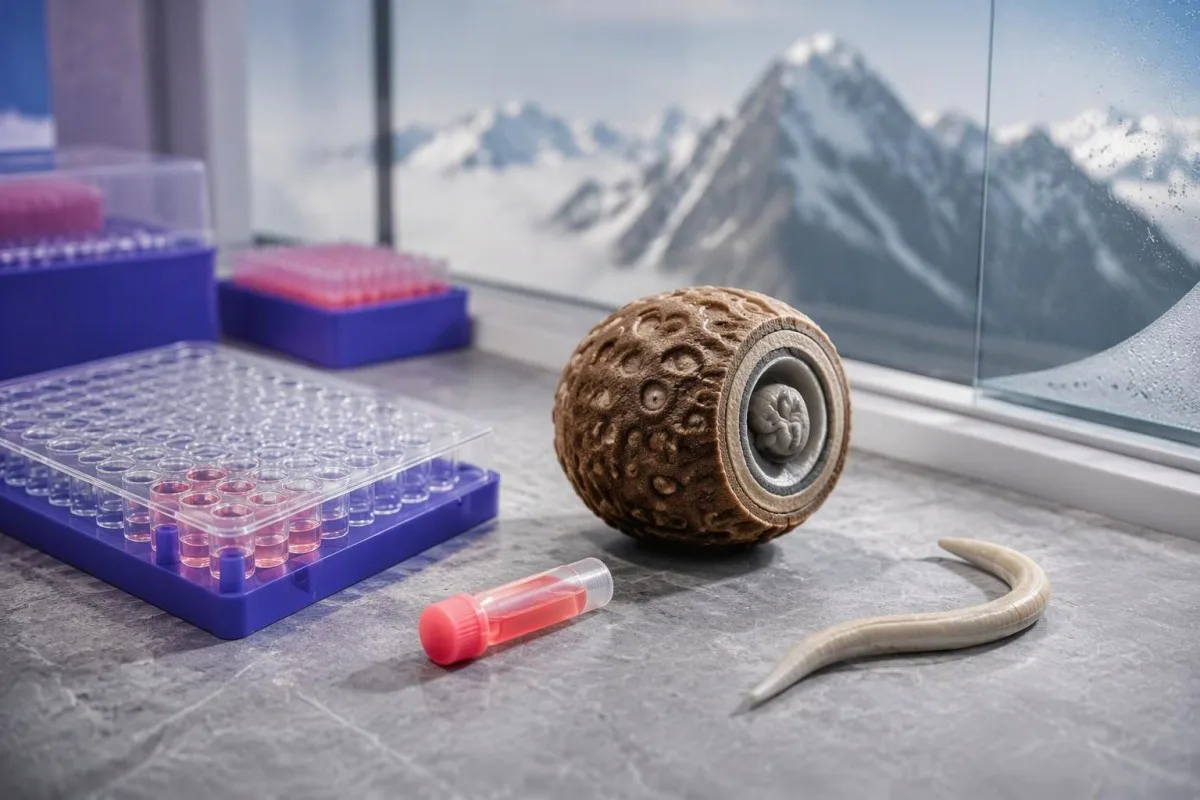
Pozitiven test na protitelesa zazna imunsko prepoznavanje, ne pa števila živih parazitov. Zdravniki zato ločijo 3 vprašanja: ali je prišlo do izpostavljenosti, ali je bolezen prisotna in ali bo zdravljenje verjetno koristilo; laboratorijski rezultat odgovarja le na del prvega vprašanja.
Vzemimo na primer hipotetično 38-letno osebo s pozitivnim presejalnim izvidom, brez simptomov in z absolutnim številom eozinofilcev 0,18 × 10⁹/L. Ta kombinacija ne dokazuje aktivne toksokaroze, medtem ko bi isti rezultat ob vztrajnem kašlju, eozinofiliji in ustrezni izpostavljenosti upravičeval bolj usmerjeno oceno.
Zdravljenje mora obravnavati klinični sindrom, ne pa poskrbeti, da bi bil rezultat protiteles negativen. Magnaval et al. (2001) opisujejo težavnost razlikovanja med preteklo izpostavljenostjo in klinično pomembno toksokarozo samo na podlagi serologije; naš vodnik do interpretacijo pozitivnih rezultatov protiteles pojasnjuje, zakaj različni testi protiteles vodijo do različnih odločitev.
Kantesti je AI analizator krvi ki lahko pomaga urediti rezultate protiteles ob CBC in jetrnem panelu, ne more pa na podlagi enega izvida določiti sposobnosti preživetja ličink. Preberite o naši organizaciji o razliki med našo storitvijo interpretacije in klinično oceno pod vodstvom zdravnika, ki je potrebna za predpis zdravljenja.
Zakaj lahko protitelesa proti toksokaram ostanejo prisotna po pretekli izpostavljenosti
IgG proti toksokari je lahko zaznaven še več let po izpostavljenosti in lahko vztraja tudi po zdravljenju. Protitelesa so del imunskega spomina, ne pa časovni žig, ki bi pokazal, kdaj je prišlo do izpostavljenosti. En sam pozitiven vzorec ne more zanesljivo razlikovati med oddaljeno izpostavljenostjo, vztrajajočimi ličinkami brez trenutnih simptomov in ličinkami, ki povzročajo aktivno tkivno bolezen.

Ljudje običajno gostijo ličinke toksokare in ne odraslih črevesnih črvov. Glavni vrsti, povezani z boleznijo pri ljudeh, sta Toxocara canis in Toxocara cati; ličinke se lahko preselijo v tkiva, kjer se imunski odzivi in simptomi razlikujejo od običajne okužbe s črevesnimi glistami.
Vztrajajoče ličinke in vztrajajoča protitelesa so povezana, vendar ne pomenita istega. Oseba ima lahko zaznaven IgG še 3 leta po domnevni izpostavljenosti, ne da bi bilo dokazov o trenutni okvari organov, sam rezultat protiteles pa ne more ugotoviti, ali so morebitne preostale ličinke žive.
Močno pozitiven rezultat ne omogoča zanesljive določitve časa izpostavljenosti. Ponavljajoča se izpostavljenost lahko zviša raven protiteles, različni testi pa prepoznavajo različne antigenske pripravke; številčnega indeksa 4,0 zato ni mogoče pretvoriti v 4-krat več ličink ali 4-krat večjo resnost bolezni.
Dolgoživa protitelesa razlikujejo toksokarozo od okužb, pri katerih je povzročitelja mogoče neposredno zaznati. Naša razprava o protitelesih proti Babesia in okužbi ponazarja isto splošno razliko, čeprav potrditvenih testov in pravil zdravljenja za Babesia ni mogoče prenesti na toksokaro.
Kako razlagati indekse protiteles, titre in mejne rezultate
Pri razlagi seroloških izvidov za toksokaro je treba upoštevati metodo in mejno vrednost laboratorija, ki je izdal izvid. There is no universal antibody concentration in IU/mL that separates past exposure from active disease. ELISA indexes, optical-density ratios and dilution titres are different measurements, so 2 laboratories can report the same specimen differently.

An antibody index is usually an assay-specific signal rather than an absolute concentration. In a hypothetical laboratory using positivity above 1.1, an index of 1.3 would be just above the cutoff; that invented example is not a reference range to apply to your own report.
Borderline results deserve particular attention when symptoms and exposure are absent. A laboratory may recommend another specimen or a more specific confirmatory method, such as an immunoblot; our explanation of kvalitativni in kvantitativni rezultati helps distinguish a positive flag from a genuinely comparable numerical measurement.
The probability of disease before testing changes what a positive result means. In an explicitly simulated group of 1,000 people, with 10% disease prevalence, 80% sensitivity and 90% specificity, testing would produce 80 true positives and 90 false positives—only about 47% of positive results would represent disease.
Those simulated figures are not performance estimates for a particular Toxocara assay. Kantesti AI can help identify the method and reference information on a report, but cannot replace missing validation data; antibody index confirmation also requires assay-specific reasoning, not borrowing cutoffs from another infection.
Kateri podatki o izpostavljenosti povečujejo verjetnost toksokarioze?
Toxocariasis is most often acquired by swallowing infective eggs from contaminated soil, hands or food. Dog and cat exposure matters because these animals can shed eggs, but simply owning a pet does not establish infection. Eggs generally require approximately 2–4 weeks in the environment to become infective.

Fresh animal faeces and established soil contamination are not identical exposure situations. Because eggs require environmental development, a garden or play area contaminated over several weeks can be more relevant than a single recent contact; daily pet-waste removal helps prevent eggs from reaching the infective stage.
Ask about 3 practical routes: soil or sand exposure, unwashed produce or hands, and consumption of undercooked tissues from infected animals. Foodborne transmission through larvae in animal tissues is recognised, but its contribution varies by setting; Trichinella antibody assessment involves a different parasite and different exposure clues.
A cat scratch is not the usual mechanism of Toxocara acquisition. Scratches instead raise other diagnostic possibilities, including Bartonella; our guide to cat scratch antibody testing explains why 1 animal-related event should not be used to label every positive infection test.
Geography changes the background likelihood of exposure but does not establish active disease. A hypothetical adult who gardened barefoot for 10 years may have a plausible exposure history, yet current symptoms, eosinophils and examination findings still determine whether that history explains the positive result.
Kateri simptomi in število eozinofilcev podpirajo diagnozo aktivne bolezni?
Active visceral toxocariasis becomes more plausible when positive antibodies accompany compatible organ symptoms and eosinophilia. Fever, persistent cough, wheeze, abdominal discomfort or liver enlargement can support investigation, but none is specific. An absolute eosinophil count above approximately 0.5 × 10⁹/L is generally considered elevated in adults.
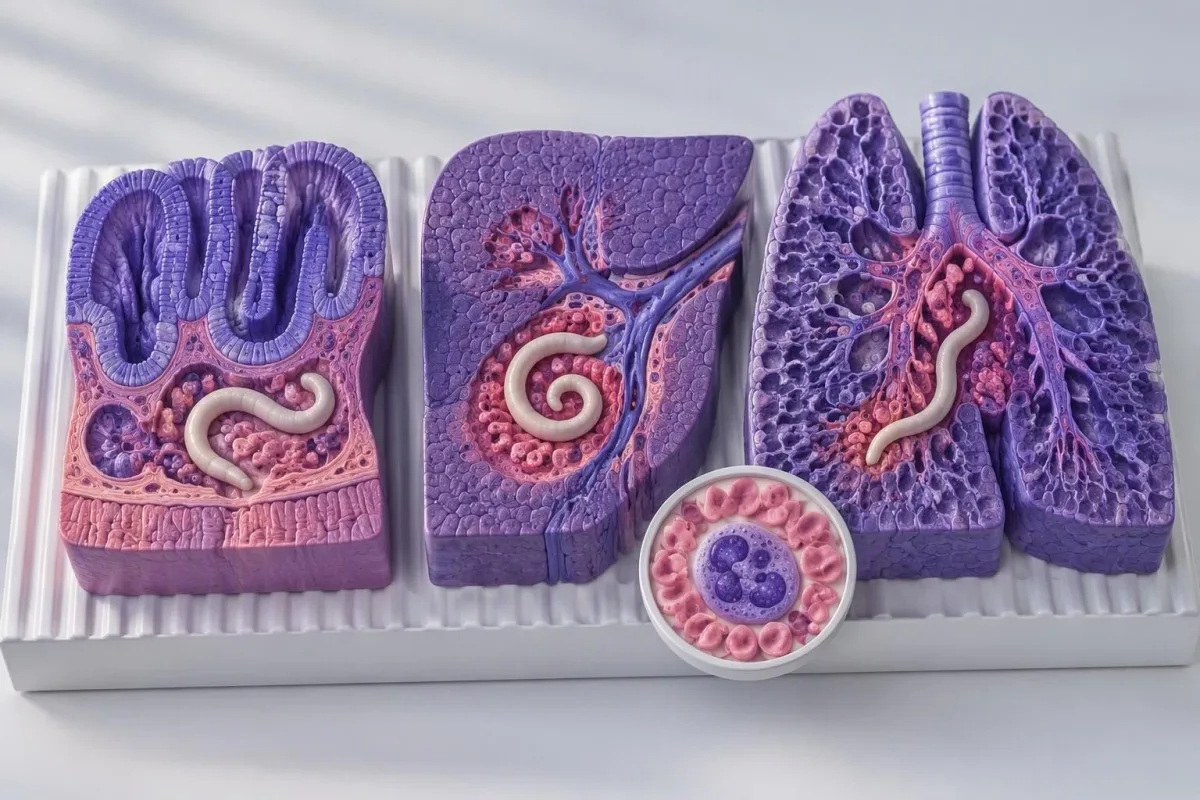
Eosinophilia is a clue to tissue responses, not a parasite identification test. Allergic disease, medicines, other helminths and some haematological disorders can raise eosinophils; a count of 0.8 × 10⁹/L therefore requires context rather than an automatic albendazole prescription.
Persistent counts of at least 1.5 × 10⁹/L warrant evaluation, especially when accompanied by respiratory, cardiac, neurological or other organ symptoms. That threshold reflects concern about hypereosinophilia and potential organ injury—not a validated Toxocara treatment cutoff; high eosinophil assessment pojasnjuje širšo diferencialno diagnozo.
Normal eosinophils do not exclude ocular toxocariasis. Disease confined to 1 eye may produce little systemic laboratory response, so a normal CBC cannot overrule new visual symptoms; this distinction is why eye complaints are assessed separately from the visceral disease pattern.
Mild or so-called covert toxocariasis is harder to establish because fatigue, itch and abdominal symptoms have many competing explanations. Magnaval et al. (2001) discuss these less specific presentations; when only 1 vague symptom is present, clinicians must avoid treating an incidental antibody result as proof of its cause.
Kateri drugi laboratorijski izvidi pomagajo pri razlagi protiteles proti toksokaram?
A CBC with an absolute eosinophil count usually adds more diagnostic context than the antibody index alone. Liver tests, total IgE and inflammatory markers may help assess a suspected clinical syndrome, but none confirms toxocariasis. Read the actual values and units, not just whether 1 result is flagged red.

The absolute eosinophil count equals the white-cell count multiplied by the eosinophil fraction. A hypothetical WBC of 8.0 × 10⁹/L with 12% eosinophils gives 0.96 × 10⁹/L; 12% alone is less informative because the same percentage produces a different absolute count when total WBC changes.
Inflammatory markers cannot reliably separate Toxocara from allergy or another infection. CRP of 3 mg/L does not exclude localised eye disease, and CRP of 35 mg/L does not prove visceral toxocariasis; our guide to neskladjih med WBC in CRP pojasnjuje, zakaj ti označevalci odgovarjajo na različna vprašanja.
Liver enzyme abnormalities describe tissue stress rather than its cause. A hypothetical ALT of 72 IU/L with a laboratory upper limit of 40 IU/L is 1.8 times that limit, but medicines, metabolic liver disease and other infections remain possibilities; interpretacijo jetrnega panela pomaga ločiti ta vzorca.
Kantesti je platforma za interpretacijo biomarkerjev z AI that can place eosinophils, ALT and antibody results in 1 organised summary for clinician review. Total IgE is particularly nonspecific: an elevated value may fit an allergic or helminth-related response, but no IgE threshold reliably establishes active toxocariasis.
Zakaj je treba očesne simptome nemudoma oceniti?
New blurred vision, floaters or reduced vision—especially in 1 eye—need prompt assessment for ocular disease, regardless of the Toxocara antibody strength. Sudden visual loss, a curtain-like shadow or severe eye pain requires emergency care. Ocular toxocariasis can occur with low or negative serum antibodies and normal eosinophils.
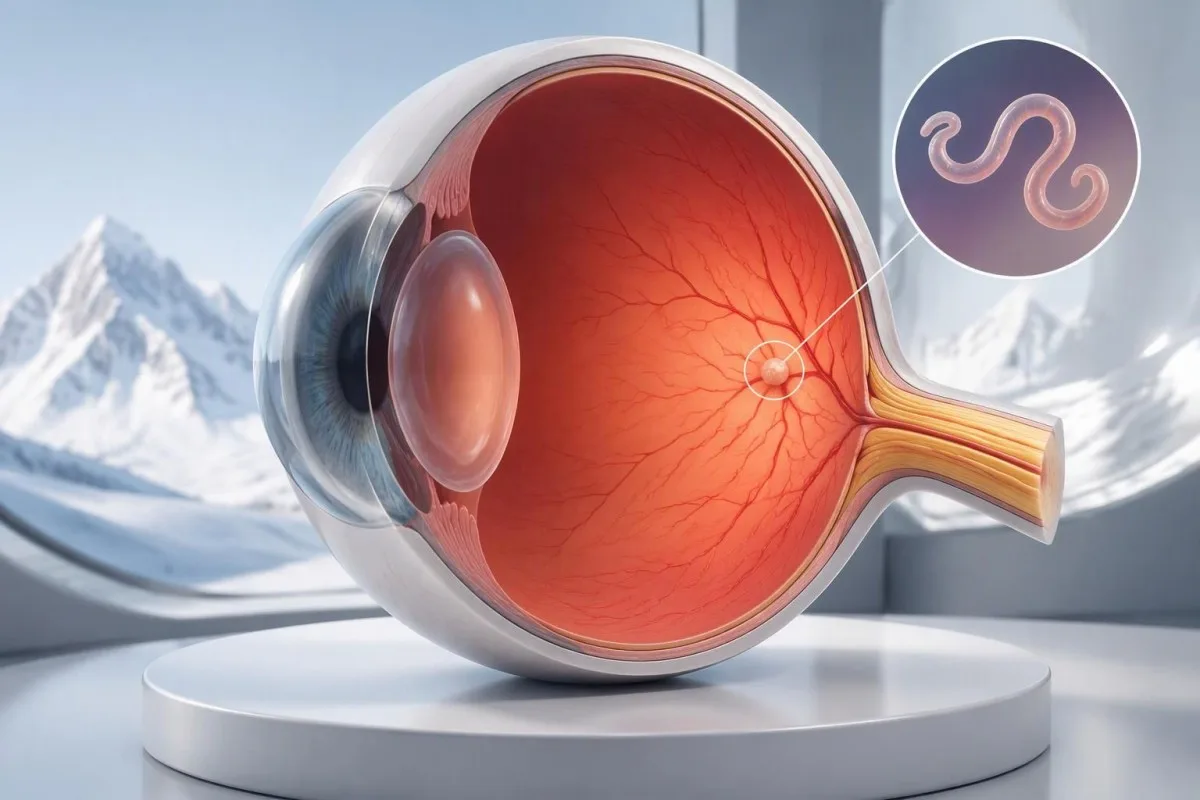
Ocular toxocariasis often affects only 1 eye. Ahn et al. (2014) describe retinal granulomas, vitreous tissue responses and other complications; the small local parasite burden helps explain why serum testing may be less informative than in systemic disease.
A positive antibody result does not identify the cause of every visual complaint. Uveitis, retinal tears, glaucoma and other conditions require different management, and HLA-B27-associated eye symptoms illustrate another reason that 1 positive laboratory marker cannot replace an eye examination.
Ocular toxocariasis diagnosis rests heavily on specialist examination. A dilated retinal examination and, when indicated, OCT or ocular ultrasound assess structures the antibody test cannot show; a weakly positive index of 1.2 should neither confirm the diagnosis nor delay referral in a symptomatic patient.
Do not wait several weeks for a repeat antibody result if vision has changed. Contact an urgent eye service the same day for new visual symptoms; in a child, a newly observed squint or white pupil also warrants urgent assessment because several sight-threatening conditions—not only Toxocara—can present that way.
Kako zdravniki postavijo diagnozo toksokarioze?
Toxocariasis diagnosis usually combines exposure history, compatible clinical findings, serology and exclusion of better explanations. No single routine test reliably confirms every form of the disease. Clinicians consider at least 3 evidence domains—exposure, organ findings and laboratory support—rather than treating a positive antibody flag as a diagnosis.
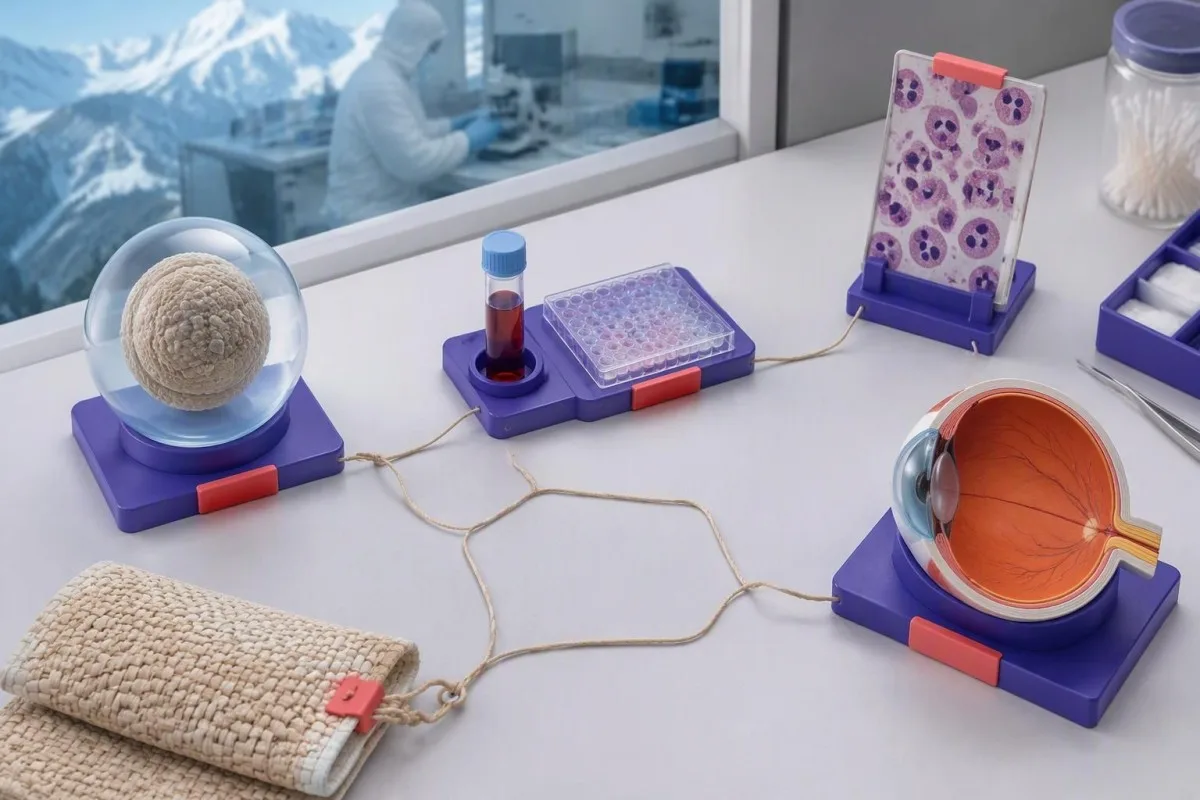
Human stool testing does not normally detect Toxocara eggs. Humans are accidental hosts, and larvae generally do not mature into egg-producing adult worms; 3 negative stool samples therefore do not rule out toxocariasis, although stool testing may help identify other parasites.
Cross-reactivity with other helminths can reduce serological specificity, particularly where multiple parasites circulate. Before prescribing systemic corticosteroids, clinicians may assess Strongyloides risk because steroids can precipitate severe strongyloidiasis; Strongyloides IgG follow-up follows different treatment principles from incidental Toxocara positivity.
Imaging should answer a specific organ-related question. Liver ultrasound or other imaging may be useful when symptoms, examination or laboratory findings suggest organ involvement, but scanning an asymptomatic person because of 1 positive antibody test can discover unrelated abnormalities without clarifying the diagnosis.
Kantesti can help organise these findings, but cannot resolve a discordant clinical picture from laboratory data alone. If antibodies are positive, eosinophils are 0.1 × 10⁹/L and symptoms point strongly toward another condition, the appropriate next step is clinician-led reassessment—not labelling every complaint as a parasite effect.
Kdaj je po pozitivnem rezultatu primerno spremljanje brez zdravljenja?
Observation can be reasonable when a person has positive Toxocara antibodies but no compatible symptoms or evidence of organ involvement. This is a clinician-led decision, not a rule that all asymptomatic positives can be ignored. One unexplained laboratory abnormality, such as persistent eosinophilia, may still require investigation.

Evidence for treating every asymptomatic seropositive person is limited. Antibody persistence makes eradication difficult to measure, and the balance between benefit and medicine-related harm differs from symptomatic visceral disease; there is no universal antibody index, such as 2.0, that mandates treatment by itself.
An observation plan should specify what will be reviewed and what should trigger earlier contact. For example, a hypothetical clinician might arrange symptom and CBC review in 4–6 weeks when mild unexplained eosinophilia is present; that interval is an illustrative plan, not a universal toxocariasis follow-up guideline.
Routine parasite antibody screening is not usually useful solely because someone feels well and owns a pet. Broad screening increases the chance of finding evidence of past exposure without actionable disease; our guide to blood work without symptoms explains how risk-based testing reduces unnecessary follow-up.
Safety-net instructions make observation an active decision rather than neglect. New visual symptoms, persistent fever, worsening breathing or neurological symptoms should prompt earlier assessment, and a rising eosinophil count from 0.7 to 1.8 × 10⁹/L deserves review even if the antibody result is unchanged.
Kakšno zdravljenje se uporablja pri simptomatski toksokariozi?
Clinicians commonly use albendazole for symptomatic visceral toxocariasis, while ocular disease needs specialist-directed treatment. CDC Clinical Care guidance lists albendazole 400 mg orally twice daily for 5 days for adults and children, but also states that the optimal treatment duration is undefined. This is prescribing information, not a self-treatment instruction.

Treatment duration can differ across specialist practice because evidence is limited. CDC also lists mebendazole 100–200 mg twice daily for 5 days, while longer albendazole courses appear in published clinical practice; different schedules should not be interpreted as proof that a short course always fails.
Ocular management aims to protect sight and control the tissue response. Ahn et al. (2014) discuss antiparasitic therapy, corticosteroids and procedural treatment in selected cases; 1 standard visceral regimen should not be copied into an eye-disease treatment plan without ophthalmology input.
Longer albendazole courses may require liver-enzyme and blood-count monitoring. Baseline liver disease, interacting medicines and treatment duration affect the monitoring plan; our guide to analiza trendov varnosti zdravil explains why changes from an individual baseline can matter more than a single flag.
Kantesti does not prescribe antiparasitic medicines or corticosteroids. A hypothetical ALT rise from 30 to 110 IU/L during treatment needs clinician review rather than an AI-directed dose change; pregnancy, age under 2 years, liver disease and other medicines also require individual prescribing assessment.
Kako starost otrok, nosečnost in imunski status vplivajo na odločitve?
Children, pregnant people and patients needing immunosuppression require individual assessment rather than automatic treatment after positive serology. Exposure behaviours, eye findings and medicine safety differ across these groups. CDC notes limited albendazole safety evidence in children under 6 years, despite experience with younger children in public-health programmes.
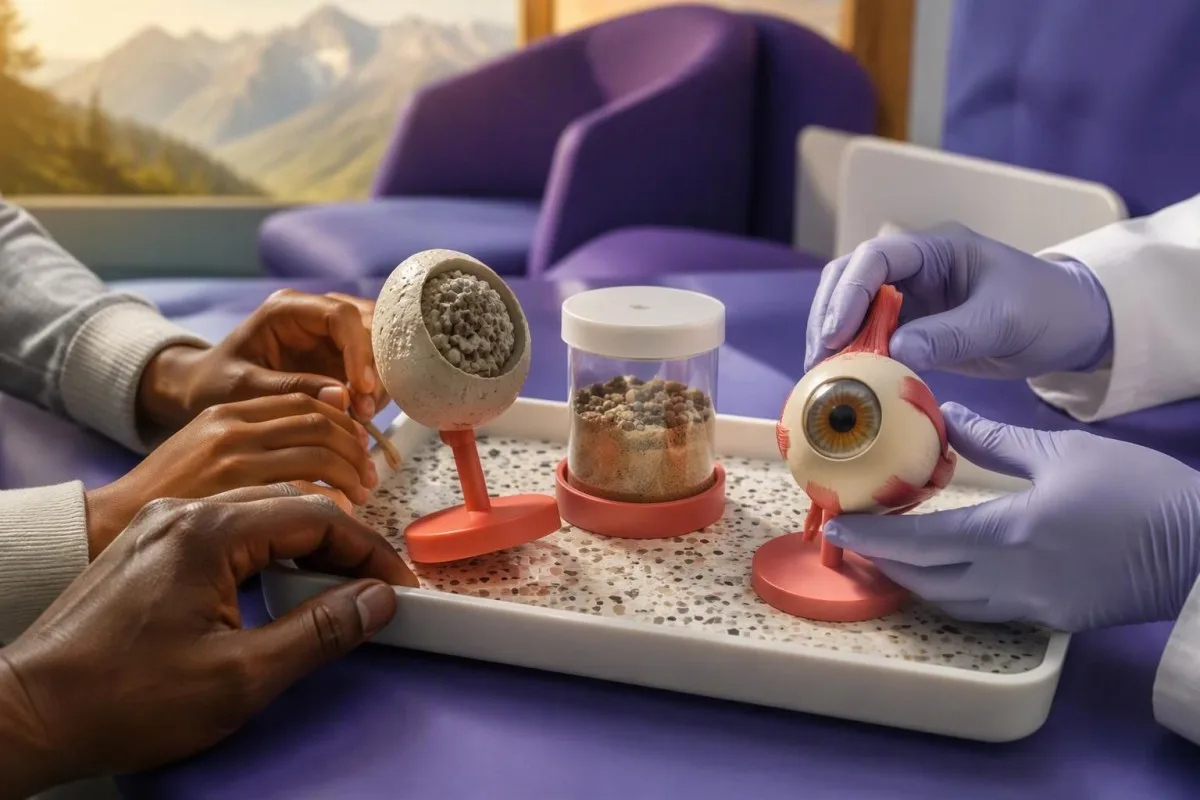
Young children may have greater hand-to-mouth soil exposure, particularly with pica. A 3-year-old with repeated soil ingestion and eosinophilia has a different exposure profile from an asymptomatic adult, but neither age nor behaviour proves that a positive test represents active disease.
Paediatric laboratory interpretation needs age-appropriate reference information and an adult who can provide a reliable symptom history. Our discussion of AI interpretacija za otroke explains why 1 automated summary cannot replace assessment of growth, visual behaviour and medicine suitability.
Pregnancy does not convert Toxocara IgG into proof of a new infection. Unlike toxoplasmosis, toxocariasis does not have an established routine prenatal serological screening pathway; an isolated positive result at 10 weeks of pregnancy requires contextual review, not assumptions about fetal infection or automatic antiparasitic treatment.
Before prolonged corticosteroid treatment, parasite assessment should match travel and exposure history. The immediate safety concern may be Strongyloides rather than Toxocara, and a patient taking prednisone 40 mg daily should not independently add or stop medicines because of an antibody report.
Ali je treba po zdravljenju ponoviti test na protitelesa proti toksokaram?
Repeat Toxocara antibodies are not a reliable stand-alone test of cure because IgG can remain positive for years. Follow-up should prioritise symptom improvement, relevant organ findings and eosinophil trends. One antibody measurement after treatment cannot establish either eradication or failure.
Use the same laboratory method when numerical trends are clinically needed. A result of 2.4 on one assay and 1.7 on another may reflect different calibrators or antigen preparations, rather than biological improvement; switching assays can create a trend that does not exist.
Symptoms and eosinophils often provide a more practical follow-up signal than persistent IgG. In a hypothetical case, cough improving alongside an eosinophil decline from 1.2 to 0.4 × 10⁹/L supports clinical improvement, but does not prove that every larva has been eliminated.
A small numerical change may fall within assay variation. An index shifting from 1.4 to 1.3 should not be treated as meaningful without laboratory information about reproducibility; our guide to pomembnih spremembah krvnih testov explains the distinction between analytical variation and a real trend.
Ocular follow-up requires eye examination rather than antibody tracking alone. Stable serum IgG cannot show whether a retinal affected area is improving, and persistent or recurrent visual symptoms after a 5-day medicine course need specialist reassessment rather than repeated unsupervised treatment.
Kako lahko umetna inteligenca pomaga, ne da bi precenila prisotnost aktivne toksokarioze?
AI can help organise Toxocara antibodies, eosinophils and liver results, but cannot diagnose active disease from serology alone. A useful interpretation preserves uncertainty and highlights missing clinical information. At minimum, the report should be considered with 3 details: symptoms, exposure history and the laboratory’s assay method.
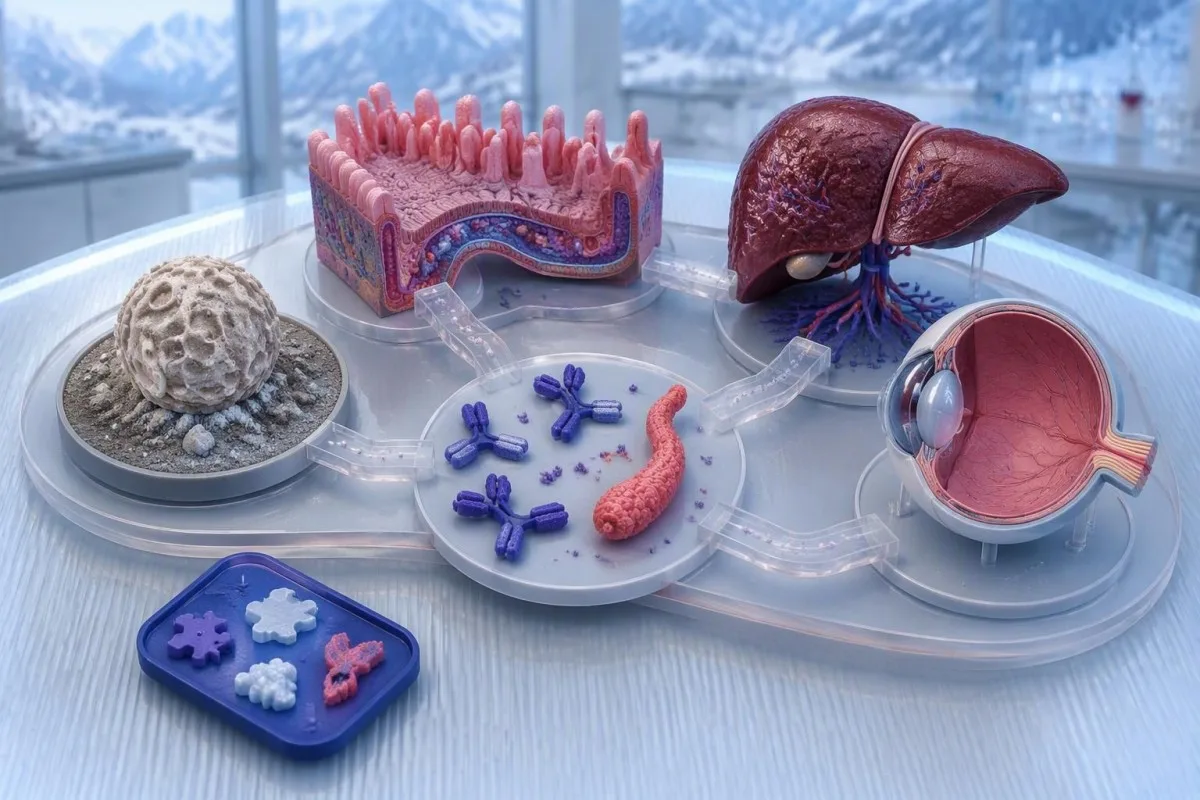
Kantesti je platforma za razlaga krvne slike z AI that can summarise related results and help prepare questions for a clinician. Our razlaga tehnologije umetne inteligence describes the interpretation workflow; a response generated in approximately 60 seconds is not an examination, a parasite-viability test or permission to delay urgent eye care.
Clinical reasoning should remain traceable to the original report. Check that an eosinophil value of 0.8 × 10⁹/L has not been confused with 0.8%, and that borderline and confirmed-positive findings are distinguished; our informacije o validaciji in kliničnem nadzoru information describes how we discuss methodology without claiming every output establishes a diagnosis.
Privacy also matters when sharing laboratory documents. Remove unnecessary identifiers and obtain consent before submitting another person’s report; our informacijami o zasebnosti in podatkih explains data handling, but privacy safeguards do not change the medical limitations of interpreting 1 antibody result.
Bring 4 items to the appointment: the complete report, symptom dates, exposure details and a medicine list. Ask whether the result explains a defined clinical syndrome, whether another diagnosis fits better, what would justify treatment, and which symptoms require urgent reassessment.
Znanstvene objave: kaj podpira te odločitve o zdravljenju?
Treatment decisions in this article rely on Toxocara-specific clinical literature and CDC guidance, not unrelated laboratory publications. The 2 peer-reviewed reviews listed below explain diagnostic limitations and ocular management. The separate Zenodo records cover iron and coagulation testing; they do not establish how positive Toxocara antibodies should be treated.
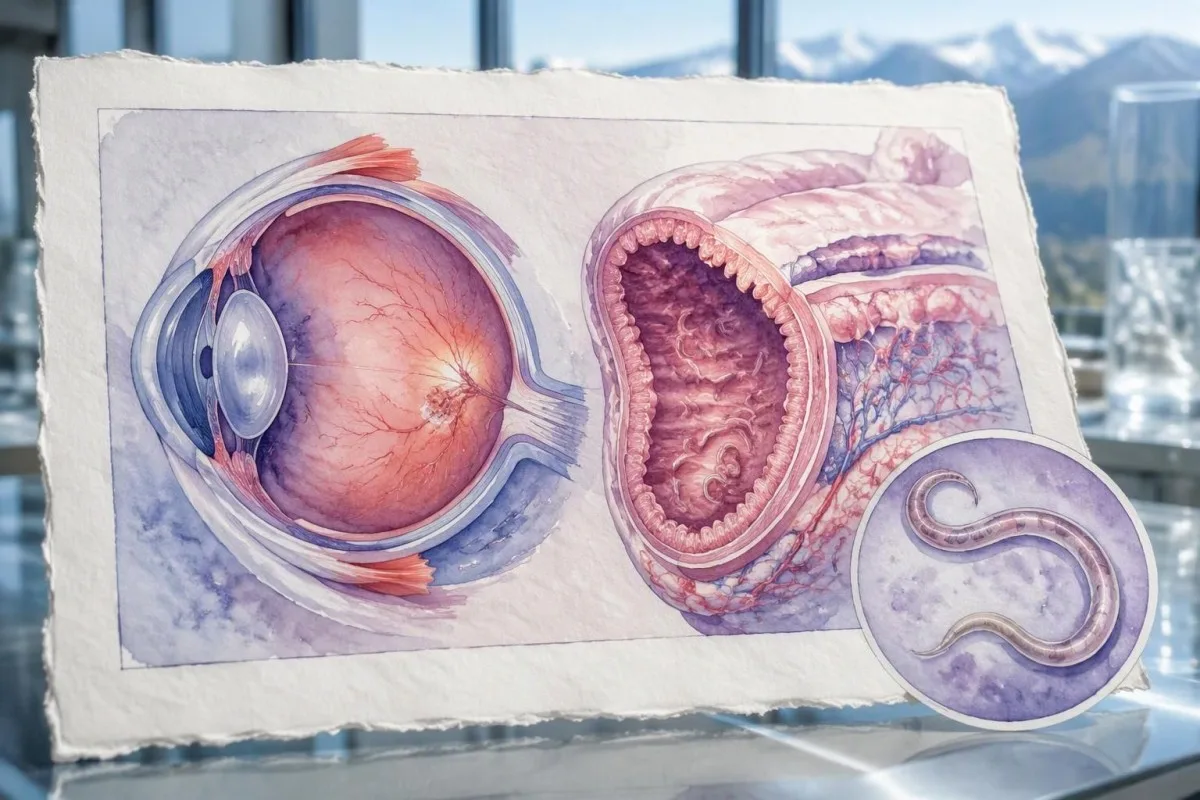
A review article is not the same as a randomised treatment trial. Magnaval et al. (2001) and Ahn et al. (2014) bring together clinical observations and published evidence, but important uncertainties remain about optimal treatment duration and the benefit of treating asymptomatic seropositivity.
Kantesti’s 2 listed Zenodo publications address different laboratory topics. The osnovni vodnik po preiskavah železa may help with an independently identified iron abnormality, while the coagulation testing background guide addresses clotting tests; neither is a confirmatory test for toxocariasis.
A useful medical article must separate evidence, inference and illustration. The hypothetical antibody indexes and worked examples here are not patient records or validated treatment thresholds; our standardi za medicinske vsebine explain that approach, including why 1 positive antibody finding should never be presented as a complete diagnosis.
Pogosta vprašanja
Ali pozitiven test na protitelesa proti toksokari pomeni, da potrebujem albendazol?
Pozitiven test protiteles proti toksokari ne pomeni samodejno, da potrebujete albendazol. IgG je lahko zaznaven še več let, zato zdravniki poleg enega samega pozitivnega izvida upoštevajo tudi značilne simptome, podatke o izpostavljenosti in dodatne izvide, namesto da bi se odločali za zdravljenje zgolj na njegovi podlagi. CDC za visceralno toksokarozo navaja albendazol v odmerku 400 mg dvakrat dnevno 5 dni, vendar morata odločitev o zdravljenju in njegovo trajanje potekati pod zdravniškim nadzorom. Ob novih očesnih simptomih je potreben takojšen oftalmološki pregled, ne pa samozdravljenje.
Ali lahko protitelesa proti toksokari ostanejo pozitivna po zdravljenju?
Protitelesa proti toksokari lahko ostanejo pozitivna še več let po izpostavitvi in so lahko zaznavna tudi po zdravljenju. Rezultat, ki je še vedno pozitiven po 6 mesecih, sam po sebi ne dokazuje neuspešnega zdravljenja. Simptomi, gibanje ravni eozinofilcev in pregledi prizadetih organov so običajno koristnejši kazalniki za spremljanje. Številčne vrednosti protiteles je treba primerjati le, kadar so laboratorijske metode dovolj primerljive.
Kakšno število eozinofilcev nakazuje toksokarozo?
Absolutno število eozinofilcev nad približno 0,5 × 10⁹/L je razlog za nadaljnje preiskave, vendar ne kaže posebej na toksokarozo. Alergija, zdravila, drugi paraziti in hematološka stanja lahko povzročijo enako ugotovitev. Vztrajno število vsaj 1,5 × 10⁹/L zahteva oceno, zlasti ob simptomih s strani organov. Normalno število eozinofilcev ne izključuje bolezni, omejene na oko.
Ali se očesna toksokaroza lahko pojavi ob negativnem krvnem testu?
Očesna toksokaroza se lahko pojavi ob nizki ravni protiteles v serumu ali njihovi odsotnosti, saj je bolezen lahko omejena na 1 oko. Normalno število eozinofilcev prav tako ne izključuje prizadetosti očesa. Oftalmolog oceni ugotovitve na mrežnici in v steklovini ter si včasih pomaga z OCT ali ultrazvokom, da razjasni diagnozo. Ob novem zamegljenem vidu ali motnjavah v vidnem polju je potreben čimprejšnji pregled, nenadna izguba vida pa zahteva nujno medicinsko pomoč.
Ali negativen test blata izključuje toksokarozo?
Negativen izvid preiskave blata ne izključuje človeške toksokariaze. Ljudje običajno gostijo ličinke v tkivih, ne pa odraslih črvov Toxocara, ki proizvajajo jajčeca, zato bolezni ne morejo izključiti niti 3 negativni vzorci blata. Preiskava blata lahko kljub temu odkrije druge črevesne parazite. Ocena toksokariaze namesto tega vključuje klinične ugotovitve, podatke o izpostavljenosti, serologijo in po potrebi oceno posameznih organov.
Kaj pomeni mejna vrednost indeksa protiteles proti toksokari?
Mejna vrednost indeksa protiteles proti toksokari pomeni, da je signal testa blizu mejne vrednosti, ki jo laboratorij uporablja za odločanje, ne pa, da je bila potrjena aktivna bolezen. Indeks 1,3 je lahko na primer nekoliko nad hipotetično mejno vrednostjo 1,1, vendar te številke niso univerzalne referenčne vrednosti. Laboratorij, ki izda izvid, lahko priporoči ponovitev testiranja ali bolj specifično potrditveno metodo. Simptomi in podatki o izpostavljenosti določajo, ali je dodatno pojasnilo klinično koristno.
Poskrbite, da vam razložijo rezultate krvnih preiskav
Naložite svoj laboratorijski izvid in AI Kantesti bo v nekaj sekundah preprosto razložil vsak biomarker. Uporablja ga več kot 2 milijona ljudi po vsem svetu.
Reference
- Klein, T., Mitchell, S., & Weber, H. (2026). Vodnik po preiskavah železa: TIBC, nasičenost z železom in sposobnost vezave. Kantesti AI Medical Research. DOI
- Klein, T., Mitchell, S., & Weber, H. (2026). Normalno območje aPTT: vodnik za D-dimer, protein C in strjevanje krvi. Kantesti AI Medical Research. DOI
- Magnaval JF et al. (2001). Highlights of human toxocariasis. The Korean Journal of Parasitology. DOI
- Ahn SJ et al. (2014). Ocular toxocariasis: clinical features, diagnosis, treatment, and prevention. Asia Pacific Allergy. DOI
- Centers for Disease Control and Prevention (n.d.). Clinical Care of Toxocariasis. CDC Parasites.
- 2 milijona+Analizirani testi
- 127+Države
- 100+Jeziki
O zdravstveni ekipi


E-E-A-T zaupanja vredni signali
Izkušnje
Zdravniški klinični pregled delovnih postopkov za interpretacijo laboratorijskih izvidov.
Strokovno znanje
Laboratorijska medicina s poudarkom na tem, kako se biomarkerji obnašajo v kliničnem kontekstu.
Avtoritativnost
Zdravstveno pregledal dr. Thomas Klein, s prispevki dr. Sarah Mitchell in prof. dr. Hansa Webra.
Zanesljivost
Interpretacija na podlagi dokazov z jasnimi nadaljnjimi potmi za zmanjšanje alarmiranja.





Zdravstvena omejitev odgovornosti
Ta članek je namenjen izobraževalnim namenom in ne predstavlja medicinskega nasveta. Za odločitve o diagnozi in zdravljenju se vedno posvetujte z usposobljenim izvajalcem zdravstvenih storitev.
Objavljeno · Obrnite se na uredniško ekipo
Izdala družba Kantesti Ltd, registrirana v Angliji in Walesu, matična št. 17090423, London, Združeno kraljestvo.
