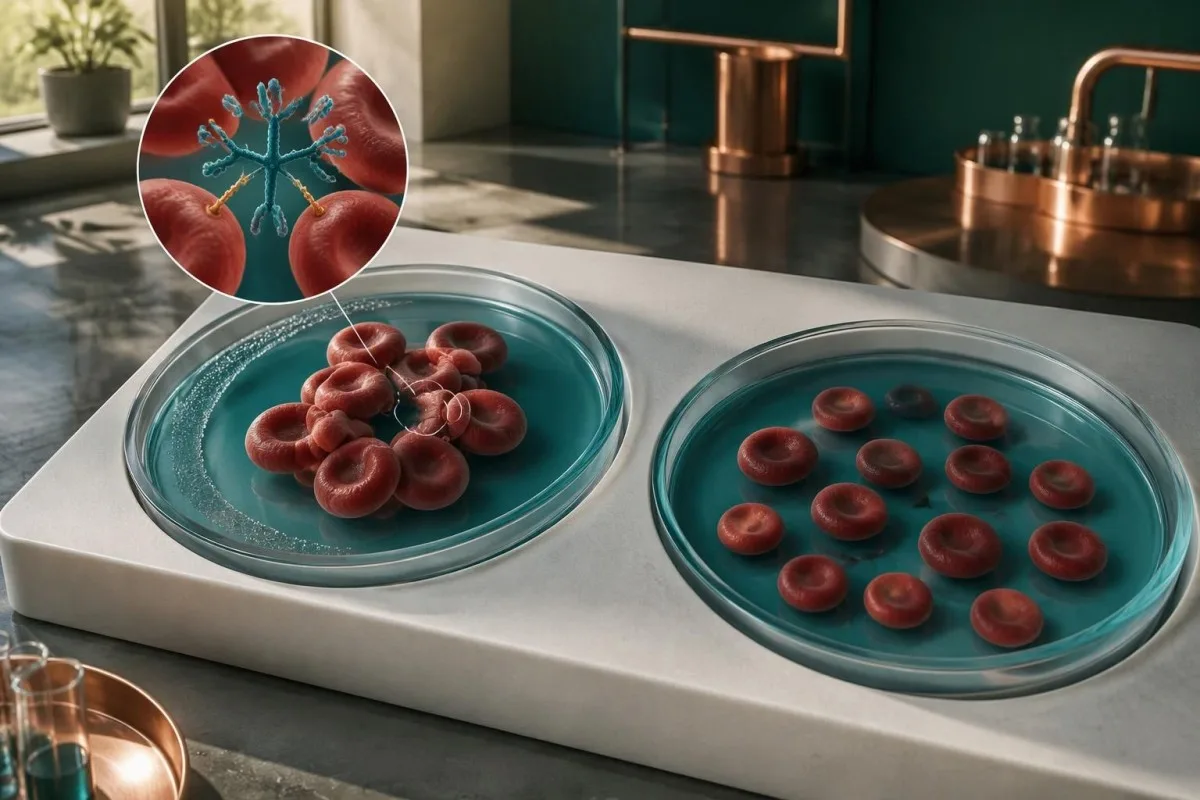
Ein hoher Kälteagglutinintiter bedeutet, dass Antikörper auch nach erheblicher Verdünnung noch nachweisbar sind – nicht unbedingt, dass sie Ihre roten Blutkörperchen schädigen. Die Unterscheidung hängt von ihrem Temperaturbereich, Hinweisen auf eine Hämolyse, einem positiven Komplementtest und einer zuverlässigen Probenhandhabung ab.

Wichtigste Erkenntnisse
- Positive result weist kältereaktive Antikörper nach; allein dadurch wird eine Kälteagglutininkrankheit nicht festgestellt.
- Titer von mindestens 1:64 bei 4°C ist ein häufig verwendeter diagnostischer Bestandteil, doch Kliniker benötigen außerdem Hinweise auf eine Hämolyse und das passende Muster im direkten Antiglobulintest.
- Thermische Amplitude bezeichnet die höchste Temperatur, bei der ein Antikörper reagiert; eine Aktivität bei etwa 30°C oder darüber ist im Allgemeinen bedenklicher als eine Aktivität, die auf sehr kalte Laborbedingungen beschränkt ist.
- Positiver C3d-Direkt-Antiglobulintest spricht für einen komplementvermittelten Prozess, doch dasselbe Muster kann auch außerhalb einer Kälteagglutininkrankheit auftreten.
- Hämolysebeurteilung berücksichtigt den Hämoglobinverlauf, Retikulozyten, LDH, indirektes Bilirubin und Haptoglobin, statt sich auf einen einzelnen abnormalen Marker zu stützen.
- Probenhandhabung bei 37–38 °C bis zur Serumtrennung kann für den Kälteagglutinintest erforderlich sein; bestätigen Sie vor Ihrem Termin die Anweisungen des entnehmenden Labors.
- Infektionsbedingte Antikörper können vorübergehend sein, obwohl eine klinisch bedeutsame Hämolyse auch dann abgeklärt werden muss, wenn eine Infektion der Auslöser ist.
- Dringende Symptome umfassen Brustschmerzen, Atemnot in Ruhe, Ohnmacht oder Verwirrtheit; neu auftretende Gelbsucht, dunkler Urin oder rasch zunehmende Müdigkeit sollten zeitnah ärztlich beurteilt werden.
Bedeutet ein positiver Kälteagglutinintest, dass eine Erkrankung vorliegt?
A ein positiver Kälteagglutinintest bedeutet nicht automatisch eine Kälteagglutininkrankheit. Auch ein hoher Titer muss zusammen mit 3 klinischen Befunden interpretiert werden: dem Temperaturbereich des Antikörpers, Hinweisen auf die Zerstörung roter Blutkörperchen und einem komplementpositiven direkten Antiglobulintest.

Kälteagglutinine sind meist IgM-Antikörper, die bei niedrigeren Temperaturen leichter an rote Blutkörperchen binden und diese verklumpen lassen können. Bei der Untersuchung wird häufig ihre Aktivität bei 4 °C gemessen – weit kälter als das meiste zirkulierende Blut –, sodass eine auffällige Laborreaktion mit geringer oder keiner klinisch relevanten Aktivität im Körper einhergehen kann.
Ein einzelner Befund wie 1:256 kann Ihnen nicht sagen, ob Sie eine Anämie haben, ob der Antikörper bei Körpertemperatur reagiert oder ob er nach einer Erkrankung vorübergehend ist. Unsere Erläuterung zu positiven Antikörperergebnissen unterscheidet zwischen Nachweis und Diagnose; die nächste hilfreiche Frage ist, was die begleitenden Tests zeigen.
Kantesti ist ein KI-Bluttestanalysator das dabei hilft, einen Kälteagglutinintiter zusammen mit verwandten Laborergebnissen einzuordnen, unter anderem damit, ob die angegebene Testtemperatur 4 °C betrug. Unser Unternehmenshintergrund erläutert die Organisation hinter diesem Informationsangebot; wir ersetzen nicht die hämatologische und labormedizinische Abklärung, die für eine Diagnose erforderlich ist.
Was misst ein hoher Kälteagglutinintiter?
A Kälteagglutinintiter ist die höchste Verdünnung Ihres Serums, bei der die vom Labor definierte Agglutinationsreaktion noch auftritt. Ein Ergebnis von 1:512 bedeutet, dass die Aktivität auch nach einer deutlich stärkeren Verdünnung noch nachweisbar ist als bei einem Ergebnis von 1:32; keine der beiden Zahlen misst direkt das Ausmaß der Anämie.
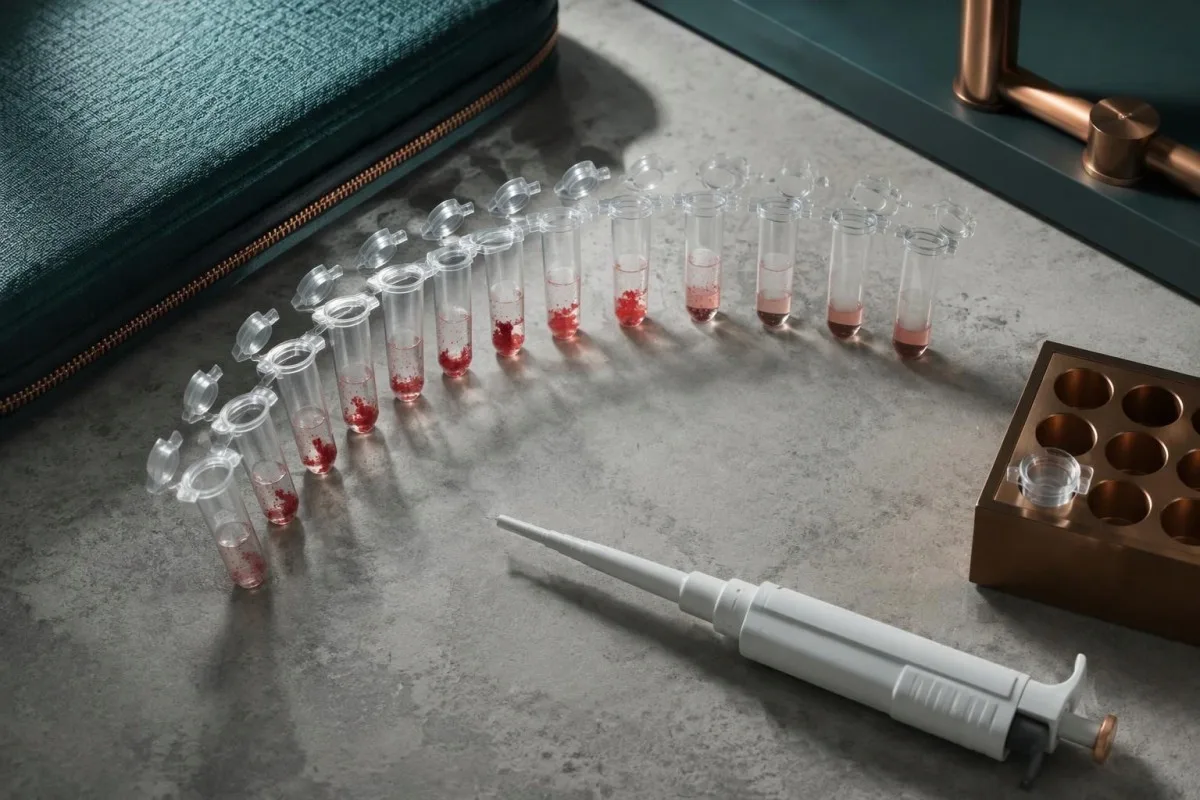
Ein Titer von mindestens 1:64 bei 4 °C ist ein häufig verwendeter Bestandteil der Diagnose einer Kälteagglutininkrankheit, aber kein eigenständiges Screening-Urteil. Die hämatologische Übersichtsarbeit beschreibt diesen Schwellenwert zusammen mit chronischer Hämolyse und starker C3d-Positivität im direkten Antiglobulintest (Berentsen, 2016); es gibt keinen universellen Titer, der automatisch eine Notfallbehandlung erfordert.
Bei zweifachen Verdünnungsschritten ergeben sich häufig Ergebnisse wie 1:64, 1:128 und 1:256. Ein Unterschied von einem Schritt kann auf die Variabilität des Tests, den gewählten Endpunkt oder die Probenhandhabung zurückzuführen sein und muss keine bedeutsame biologische Veränderung darstellen; ein Zahlenvergleich ist am aussagekräftigsten, wenn dasselbe Labor dieselbe Methode und Temperatur verwendet.
Einige Labore melden lediglich positiv oder negativ, während andere eine reziproke Zahl wie 256 angeben, statt 1:256 zu schreiben. Unser Leitfaden zu qualitative und quantitative Ergebnisse explains that distinction; ask for the actual dilution, assay temperature and local reference interval before comparing reports.
| Wert | Bereich | Bedeutung |
|---|---|---|
| Low-level activity | Below 1:64 at 4°C | Often incidental when thermal amplitude is narrow and hemolysis is absent; this is not a universal laboratory reference interval. |
| Common diagnostic threshold | At least 1:64 at 4°C | Supports further assessment when hemolysis and a compatible direct antiglobulin test are present; does not confirm disease alone. |
| Higher dilution endpoint | Examples: 1:256 or 1:512 | Shows activity after greater dilution, but does not establish thermal amplitude or predict treatment need. |
| Very high reported endpoint | Example: 1:1024 or higher | Still requires clinical interpretation; no titer-only emergency threshold is established. |
Warum die thermische Amplitude wichtiger sein kann als der Titer
Thermische Amplitude is the highest temperature at which a cold antibody reacts under the laboratory's testing conditions. Reactivity around 30°C or above is generally more clinically concerning than reactivity confined to 4°C, because cooler peripheral circulation can reach temperatures at which the antibody becomes active.
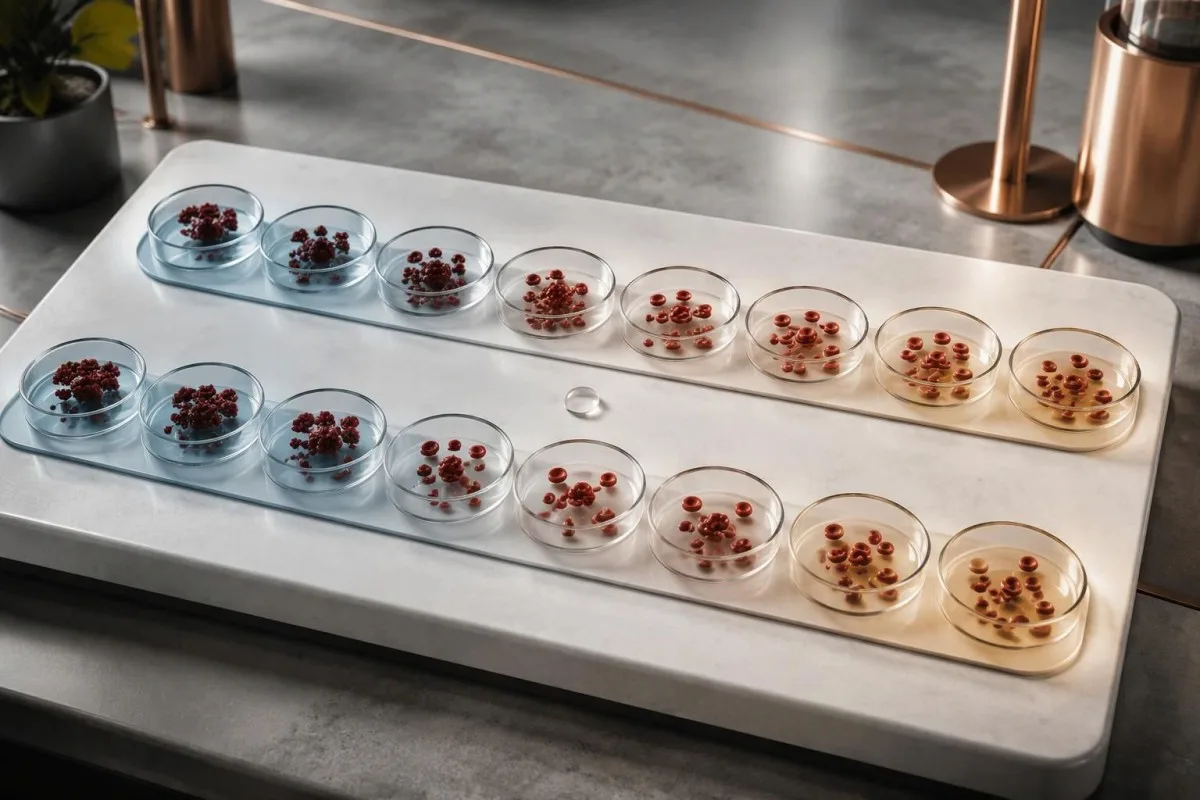
A high-titer antibody active only at 4°C may matter less clinically than a lower-titer antibody that remains active at 30–32°C. The reason is exposure: red cells do not normally circulate at refrigerator temperature, but they can encounter substantially cooler conditions in fingers, toes and other peripheral areas.
Complement can attach while red cells are cool and remain relevant after they return toward 37°C, even when the IgM antibody detaches. This explains why antibody-related injury is not simply a matter of visible clumping; our Leitfaden für ergänzende Tests also distinguishes circulating complement measurements from complement deposited on cells.
Thermal amplitude testing is not standardized into 1 universal patient-facing cutoff, and many routine reports omit it entirely. Specialist laboratories may test several temperatures, such as 4°C, room temperature, 30°C and 37°C; clinicians usually request that additional work when the titer, symptoms and hemolysis results do not fit together.
Welche Blutwerte weisen auf eine tatsächliche Hämolyse hin?
Hemolysis means red cells are being destroyed faster than expected, and assessment usually combines 5 measurements: hemoglobin, reticulocytes, LDH, indirect bilirubin and haptoglobin. A high cold agglutinin titer without this supporting pattern does not establish a hemolytic disorder.
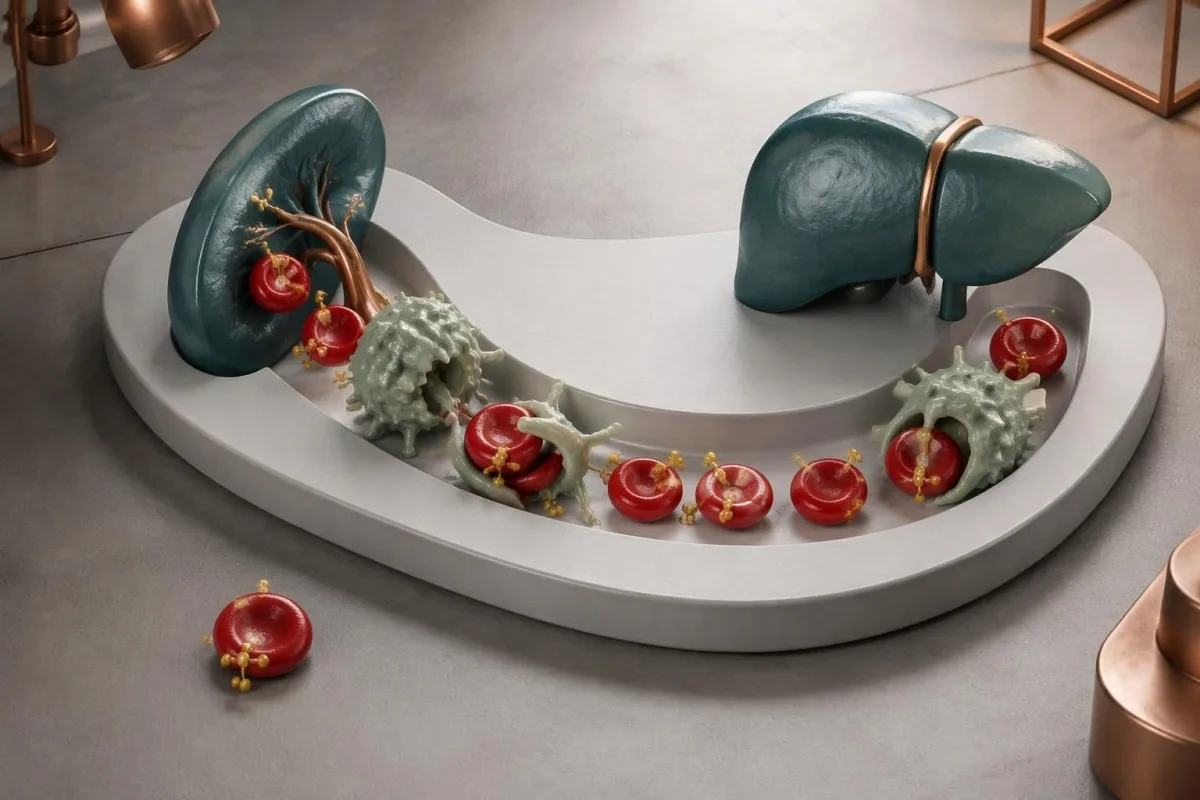
A hypothetical hemoglobin fall from 13.2 to 9.6 g/dL, accompanied by rising indirect bilirubin and LDH, is more concerning than an unchanged hemoglobin with the same titer. Reticulocytes often increase as the marrow replaces lost cells, although an early episode, nutrient deficiency or marrow disorder can blunt that response.
Low haptoglobin supports hemolysis but is not definitive: liver disease can reduce production, while an acute-phase response can raise the concentration despite red-cell destruction. Our explanation of Ursachen für niedriges Haptoglobin covers these exceptions; a result below 1 laboratory's reference limit should be interpreted with the other markers rather than alone.
Kantesti AI helps explain LDH trends, including why a hypothetical rise from 220 to 650 U/L needs the laboratory's reference interval and specimen-quality information. Our LDH interpretation guide describes other sources of elevation; normal hemoglobin also does not exclude compensated hemolysis when the marrow is keeping pace.
Was bedeutet ein positiver C3d-Direkt-Antiglobulintest?
A C3d-positive direct antiglobulin test, also called a direct Coombs test, detects complement fragments attached to red cells. Cold agglutinin disease typically produces strong C3d positivity with absent or sometimes weak IgG reactivity, but these 2 antibody-testing results are not sufficient without clinical evidence of hemolysis.

The direct antiglobulin test and the cold agglutinin titer answer 2 unterschiedliche Fragen: what is attached to your red cells, and what cold-reactive activity is present in your serum? The Blood Reviews international consensus recommends a monospecific direct antiglobulin test as part of autoimmune hemolytic anemia assessment (Jäger et al., 2020).
A report stating only DAT positive may not distinguish IgG from C3d; asking for those 2 components can materially change interpretation. Our guide to a positiver direkter Coombs-Test explains why transfusion-related antibodies, medications and other immune processes can also produce a positive result without proving cold agglutinin disease.
In a child with abrupt post-illness hemolysis, a C3d-positive DAT and a low cold agglutinin titer can raise a different possibility: paroxysmal cold hemoglobinuria. This condition usually involves an IgG antibody assessed by Donath–Landsteiner testing, so a cold agglutinin result below 1:64 should not end the investigation when symptoms suggest significant hemolysis.
Zufällig nachgewiesene Antikörper, Infektionen und persistierende Erkrankung
Incidental cold antibodies may cause no symptoms, while infection-related antibodies can be temporary and occasionally cause substantial hemolysis. Persistent cold agglutinin disease is usually associated with a clonal marrow B-cell process; these 3 situations require different follow-up rather than the same response to a positive test.
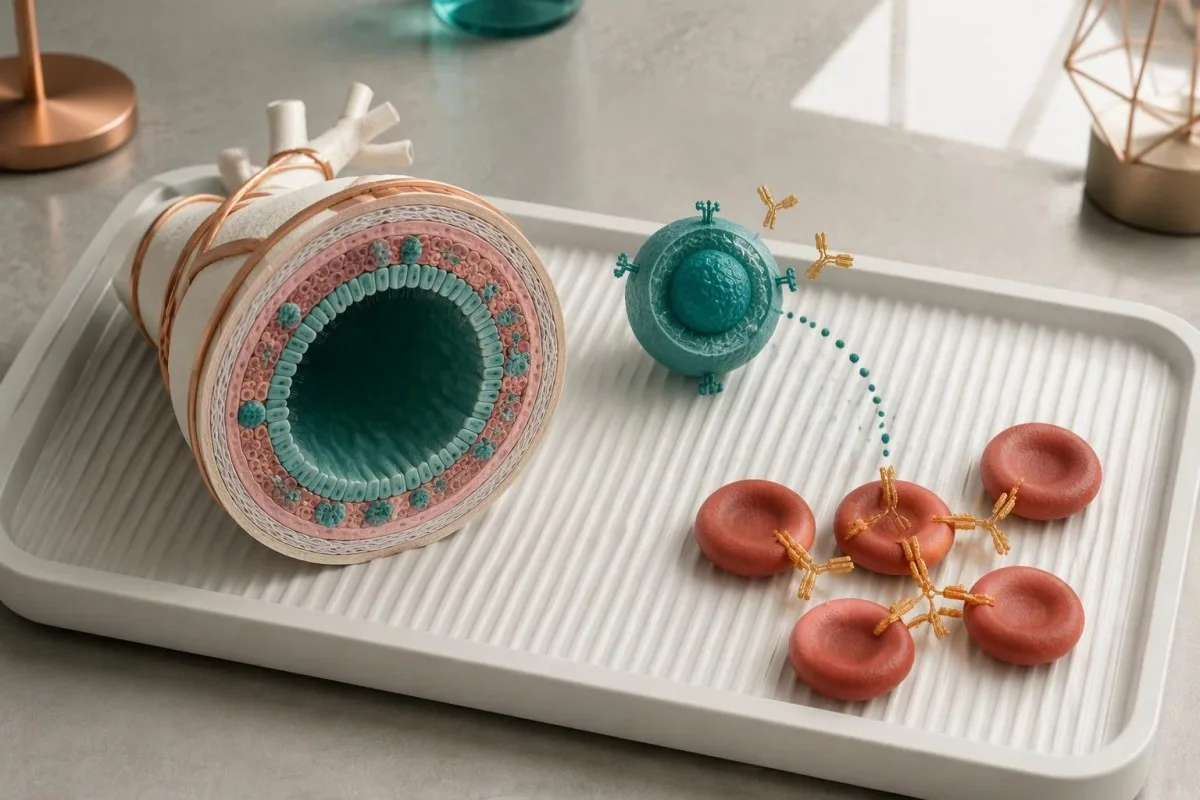
Mycoplasma pneumoniae and Epstein–Barr virus are 2 recognized infection-related associations, but a cold agglutinin test cannot reliably diagnose either infection. Our guide to Mycoplasma antibody interpretation explains why antibody timing and persistence complicate that diagnosis; respiratory symptoms may require pathogen-directed testing rather than inference from the titer.
Recent fever or sore throat changes the questions clinicians ask, not the urgency of genuine hemolysis: a hemoglobin of 8,5 g/dL with new jaundice still requires assessment even if the antibody is expected to be temporary. Our EBV result interpretation explains how VCA and EBNA patterns provide more specific information about exposure timing.
Terminology matters: cold agglutinin syndrome generally describes cold-antibody hemolysis secondary to another condition, while cold agglutinin disease is a distinct, usually persistent disorder. A titer of 1:512 does not identify lymphoma; specialist investigation may find a small marrow clone without overt lymphoma, and incidental antibodies do not automatically justify cancer investigations.
Warum Ihre Probe vor der Untersuchung möglicherweise erwärmt werden muss
For cold agglutinin titer testing, many specialist laboratories require the specimen to remain at 37–38°C from collection until serum separation. Cooling before separation can allow antibodies to bind the patient's cells, potentially lowering the antibody activity left in the serum and producing a misleading result.
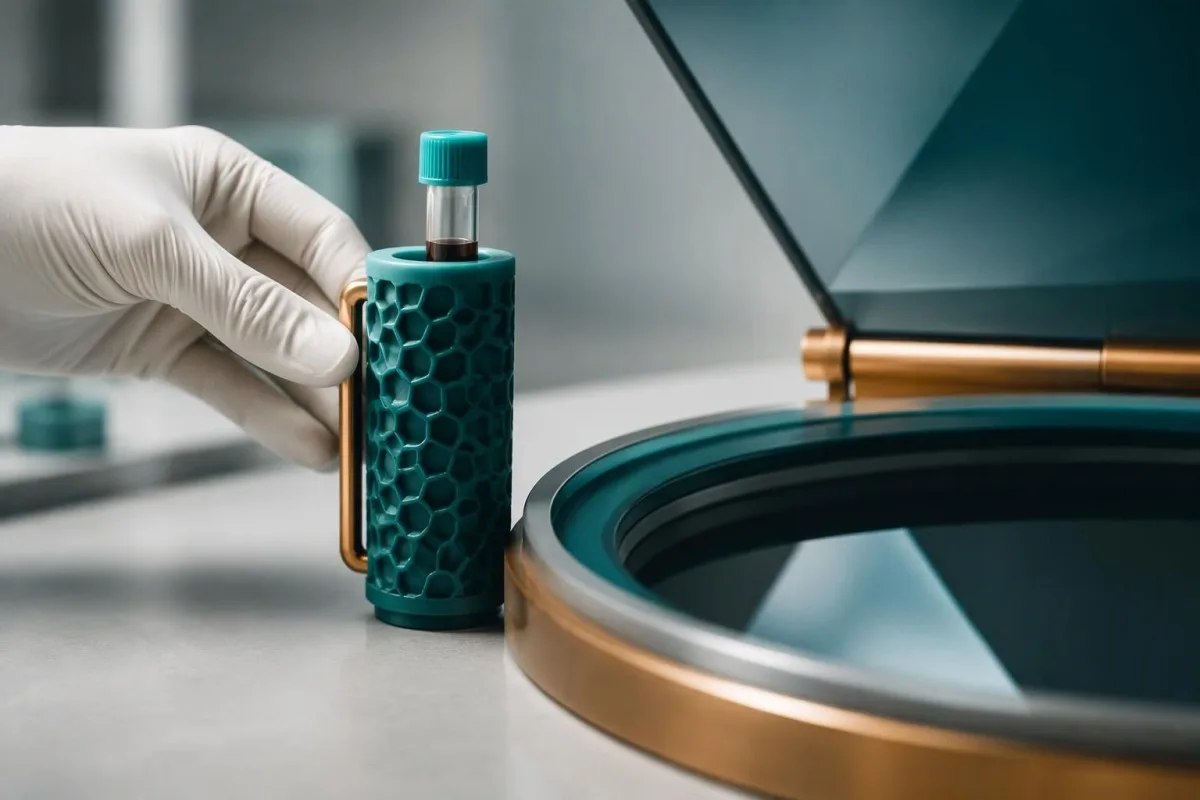
The pre-analytical requirement is different from the assay temperature: serum may be kept near 37°C during preparation and then deliberately tested at 4°C. The Hematology review emphasizes warm collection and separation for cold antibody studies (Berentsen, 2016); the laboratory creates the controlled cooling step only after an appropriate specimen is available.
Warming a specimen after it has already cooled may not fully reverse every earlier problem, so repeating the test can be more useful than interpreting an unexpected low titer. Our repeat specimen guide explains another handling distinction: cells breaking inside a collection tube are not the same as hemolysis occurring inside your body.
Before the appointment, ask 3 praktische Fragen: which tube is required, how warmth will be maintained and where serum separation will occur. Titer testing, an EDTA specimen for the DAT and a warmed CBC may have different instructions; do not heat, transport or store your own specimen unless the collecting service specifically directs you.
Wie Kälteagglutinine Ihr CBC verfälschen können
Cold-related red-cell clumping can falsely lower the RBC count and raise MCV or MCHC on an automated complete blood count. A CBC repeated after laboratory warming near 37°C can help identify this artifact, although correcting the numbers does not by itself establish or exclude cold agglutinin disease.

Automated counters may treat a cluster as 1 large particle rather than several separate cells, making the calculated mean cell volume appear high. Hematocrit and derived indices can become internally inconsistent, while photometrically measured hemoglobin is often less affected; the laboratory must still check whether other specimen or instrument issues are present.
Beispielsweise hat ein hypothetischer MCHC of 40 g/dL with an analyzer agglutination flag should prompt verification rather than an immediate diagnosis of an unusually concentrated red-cell disorder. Our high MCHC explanation covers this reasoning; genuine anemia can coexist with an artifact, so neither finding should erase the other.
Kantesti ist ein AI-Bluttest-Auswertungsplattform that helps explain discrepancies between CBC values and a reported cold agglutinin titer, including whether a result was rerun near 37°C. Our KI-Technologie-Leitfaden describes the interpretation process; only the testing laboratory can confirm that warming corrected a measurement error.
Was bestätigt die Diagnose einer Kälteagglutininkrankheit?
A cold agglutinin disease diagnosis usually combines chronic hemolysis, a strongly C3d-positive DAT and a cold agglutinin titer of at least 1:64 at 4°C, with assessment for secondary causes. These are linked diagnostic components, not a checklist that an isolated positive report can complete.
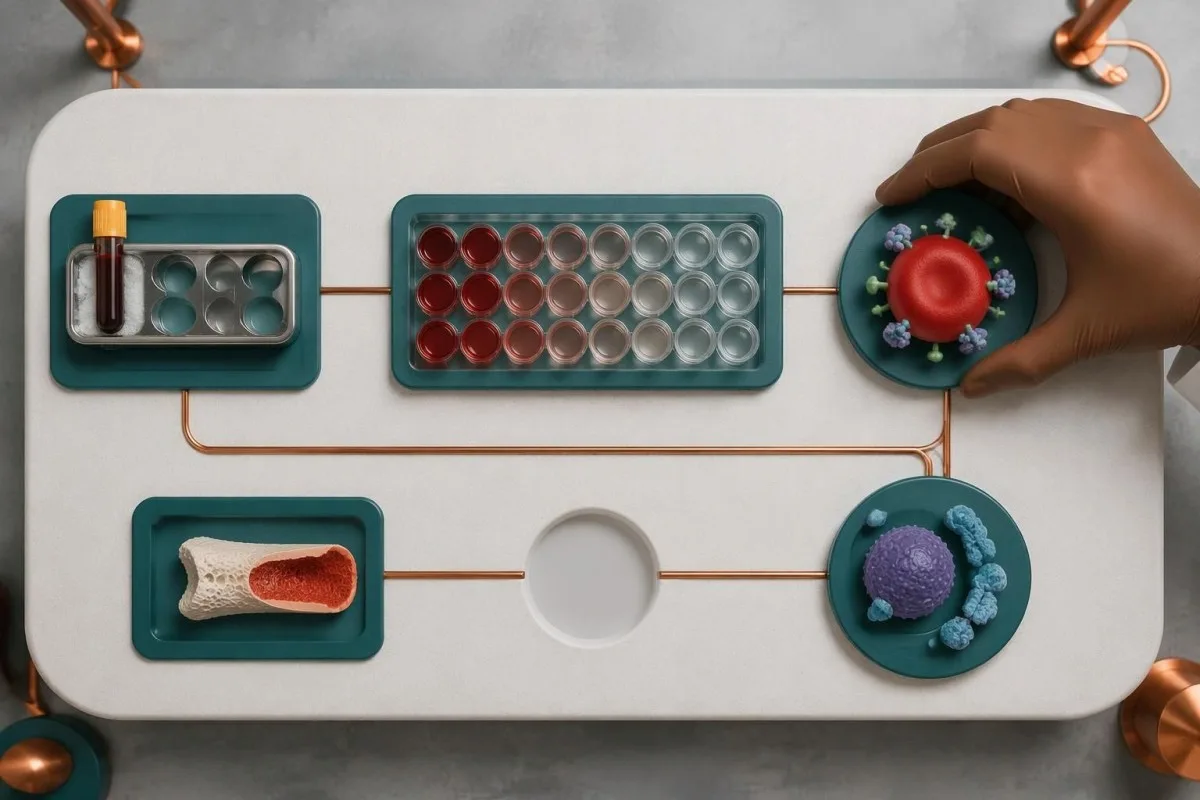
Clinicians first verify the 2 core laboratory patterns—hemolysis and immune attachment to cells—then assess symptoms, duration, medications, recent infections and transfusion history. A broad thermal amplitude can support interpretation when routine results are borderline or discordant; the international consensus treats autoimmune hemolytic anemia as a pattern-based diagnosis (Jäger et al., 2020).
Persistent findings may lead to serum protein electrophoresis, immunofixation and hematology-directed marrow assessment to characterize antibody production. Our guide to immunofixation band results explains why a monoclonal band needs context; even a titer of 1:1024 cannot determine whether a detectable protein represents overt lymphoma or a smaller clonal process.
Kantesti AI can help organize 3 groups of information for the appointment: antibody tests, hemolysis markers and changes over time. It cannot establish whether the specimen followed the warm-handling protocol or replace a specialist's assessment of marrow findings; bring the full report, because an isolated screenshot may omit the method and interpretive comments.
Drei Beispiele: gleicher Titer, unterschiedliche nächste Schritte
The same cold agglutinin titer can lead to different next steps because clinical significance depends on temperature-dependent activity and red-cell injury. The following 3 examples are hypothetical teaching scenarios, not patient accounts or rules for diagnosing yourself from a single report.

In the first example, an adult has a titer of 1:256 at 4°C, hemoglobin of 14.0 g/dL, normal hemolysis markers and no cold-related symptoms. If specialist testing shows a narrow thermal amplitude, incidental antibodies become more plausible; the useful step is confirming the context and need for follow-up, not assuming that antibody detection requires treatment.
In the second example, a person recovering from a respiratory illness has a titer of 1:256 and hemoglobin that has fallen from 13.5 to 10.2 g/dL, with rising indirect bilirubin. An infection-associated syndrome is possible, but the falling hemoglobin still needs assessment; our polychromasia explanation describes one smear clue to the marrow's replacement response.
In the third example, a person has months of fatigue, a titer of 1:256, strong C3d positivity, low haptoglobin and antibody reactivity at 30°C. Persistent clinically significant cold-antibody hemolysis becomes more likely; hematology assessment addresses diagnosis and treatment need, while the identical titer across all 3 examples shows why the number alone cannot choose the pathway.
Welche Symptome erfordern eine zeitnahe ärztliche Abklärung?
Chest pain, breathlessness at rest, fainting or confusion require emergency assessment, regardless of the cold agglutinin titer. New jaundice, dark urine or rapidly worsening fatigue warrant prompt, often same-day medical review; a result below 1:64 does not make these symptoms safe to ignore.
A rapid hemoglobin decline can be more dangerous than a stable low value, because your circulation has less time to adapt. A hypothetical fall from 12 to 8 g/dL over several days deserves prompt assessment even if someone with a long-standing, monitored value near 8 g/dL has fewer symptoms; these examples are not universal transfusion thresholds.
Dark urine can reflect hemoglobin released during marked intravascular hemolysis, but dehydration, liver conditions and urinary causes can produce similar appearances. Our dark urine assessment guide explains the alternatives; dark urine together with jaundice or weakness should not be dismissed because only 1 antibody result is abnormal.
Cold-related blue or purple fingers can occur with agglutination, but persistent discoloration, severe pain or failure to improve after gentle warming needs urgent evaluation for impaired circulation. Clinically significant cold agglutinin disease also carries increased clot risk; sudden breathlessness or 1 newly swollen leg requires assessment rather than attribution to cold sensitivity alone.
Wie Sie sich warm halten und auf klinische Eingriffe vorbereiten
Keeping the whole body warm can reduce cold-triggered symptoms in clinically significant cold-antibody disorders. Tell the care team before transfusion, anesthesia or a procedure, because laboratory compatibility testing and clinical temperature management may need coordination near 37°C rather than routine handling.

Practical protection includes layers, gloves, warm footwear and avoiding abrupt whole-body cooling; do not test your tolerance with an ice bath or deliberate cold challenge. Reactivity around 30°C does not translate into 1 safe outdoor temperature, because wind, wet clothing, exposure duration and individual circulation change how much peripheral tissues cool.
For transfusion, the laboratory may perform antibody investigation and compatibility testing at 37°C to limit cold-antibody interference while still identifying clinically significant additional antibodies. Our transfusion compatibility guide explains that distinction; a clinical warming device may also be used, but emergency treatment should not be delayed unnecessarily while pursuing perfect routine test conditions.
Ein isoliertes 1:128 titer without hemolysis does not automatically mean you need to avoid all travel, exercise or procedures. The useful precaution is sharing the report and any prior laboratory interference with the treating team; clinical staff—not the patient—should decide whether warmed fluids, a transfusion warmer or additional temperature monitoring are necessary.
Wann ist eine Behandlung erforderlich und was wird überwacht?
Treatment is guided by anemia, symptoms, transfusion need and functional impact—not a titer alone. In clinically significant cold agglutinin disease, specialist options include B-cell-directed therapy and complement inhibition; a titer of 1:512 without attributable symptoms or hemolysis does not itself establish a reason to start medication.
Sutimlimab inhibits C1s, an early classical complement component, and can reduce complement-mediated hemolysis in adults with cold agglutinin disease. It does not remove the IgM antibody, so cold-related agglutination and circulation symptoms may persist even if hemoglobin improves; immunization and infection-risk precautions must follow the product information and the specialist's plan.
B-cell-directed options include rituximab-based treatment, sometimes combined with another agent in selected patients; the appropriate choice depends on goals, comorbidities and treatment tolerance. Corticosteroids, commonly used for warm autoimmune hemolytic anemia, generally perform poorly in cold agglutinin disease; the 2020 international consensus emphasizes distinguishing the subtype before applying a treatment pathway (Jäger et al., 2020).
Kantesti helps explain why a hypothetical hemoglobin improvement from 8.7 to 11.8 g/dL, falling bilirubin and fewer transfusions can matter more than a persistently high titer. Our red-cell monitoring guide explains reticulocytes and related markers; do not change treatment from an AI interpretation, and do not assume anemia means iron deficiency.
Ihren Befund sicher nutzen: Evidenz und Grenzen von KI
Kantesti ist ein KI-Labor-Befundinterpretationsservice that helps organize cold agglutinin results for discussion, but it cannot independently confirm cold agglutinin disease. A useful interpretation needs 3 information groups: the antibody method and handling, the hemolysis pattern and the patient's symptoms and history.

Keep the complete report rather than only the 1:256 result: the test temperature, reference interval, DAT components and laboratory comments can change its meaning. Useful appointment questions include whether hemolysis is present, whether thermal amplitude testing would help and whether specimen handling was adequate; bring earlier hemoglobin values when available.
The Kantesti technical benchmark listed below concerns 100.000 synthetische Testfälle, not 100,000 patients with cold agglutinin disease. The accompanying validation framework describes an assessment approach, not proof that AI can diagnose this rare condition; our validation and oversight page provides the appropriate context for these research publications and their limitations.
Before sharing 1 report or a series of reports, review consent and remove information you do not need to provide, especially when the results belong to someone else. Our Leitlinien zu Datenschutz und Daten explains data-handling considerations; urgent symptoms belong with emergency or clinical services, not in an upload queue awaiting interpretation.
Häufig gestellte Fragen
Bedeutet ein positiver Kälteagglutinintest, dass ich an einer Kälteagglutininerkrankung leide?
Ein positiver Kälteagglutinin-Test stellt für sich genommen keine Diagnose einer Kälteagglutinin-Krankheit. Ein Titer von mindestens 1:64 bei 4 °C ist ein häufig verwendeter diagnostischer Bestandteil; Ärztinnen und Ärzte beurteilen jedoch auch eine chronische Hämolyse und einen passenden, in der Regel deutlich C3d-positiven direkten Antiglobulintest. Zufällig nachweisbare oder infektionsbedingte Antikörper können zu positiven Ergebnissen führen. Die thermische Amplitude und eine zuverlässige Probenhandhabung helfen, unklare Befunde einzuordnen.
Ist ein Kälteagglutinintiter von 1:256 oder 1:512 gefährlich?
Ein Kälteagglutinintiter von 1:256 oder 1:512 ist kein eigenständiger Grenzwert für eine Gefährdung. Das Ergebnis zeigt, wie weit das Serum verdünnt werden kann, während die Antikörperaktivität unter den Testbedingungen noch nachweisbar ist. Ein bei etwa 30 °C aktiver Antikörper kann klinisch bedeutsamer sein als ein Antikörper mit höherem Titer, der nur bei 4 °C reagiert. Symptome, Hämoglobinverlauf und Hämolysemarker bestimmen, wie dringend eine Beurteilung ist.
Was ist die thermische Amplitude bei einem Kälteagglutinintest?
Thermal amplitude is the highest temperature at which a cold antibody reacts under the laboratory's testing conditions. Reactivity around 30°C or above is generally more concerning than activity restricted to 4°C because peripheral circulation can become cool enough for the antibody to act. Thermal amplitude is different from titer, which measures activity after dilution. Specialist laboratories may assess it when routine findings are discordant or the clinical significance is unclear.
Warum muss eine Probe auf Kälteagglutinine warm gehalten werden?
Many laboratories require a cold agglutinin specimen to remain at 37–38°C from collection until serum separation. Premature cooling can allow antibody to bind the patient's cells, leaving less detectable activity in the separated serum and potentially producing a falsely low result. This preparation requirement is separate from deliberately testing the serum at 4°C. Confirm the collecting laboratory's instructions rather than attempting to warm or transport the specimen yourself.
Kann eine Infektion zu einem positiven Kälteagglutinintest führen?
Infektionen, darunter Mycoplasma pneumoniae und das Epstein-Barr-Virus, können mit vorübergehend kältereaktiven Antikörpern einhergehen. Ein Titer wie 1:256 kann nicht feststellen, welche Infektion vorliegt oder ob sie noch aktiv ist. Infektionsbedingte Antikörper verursachen mitunter eine klinisch bedeutsame Hämolyse, daher müssen ein sinkender Hämoglobinwert oder eine neu auftretende Gelbsucht weiterhin abgeklärt werden. Erregerspezifische Tests und der zeitliche Krankheitsverlauf sind aussagekräftiger, als Kälteagglutinine zur Diagnose einer Infektion heranzuziehen.
Können Kälteagglutinine zu einem fälschlich erhöhten MCV- oder MCHC-Wert führen?
Kälteagglutinine können Erythrozytenaggregate verursachen, die automatisierte CBC-Messungen verfälschen, darunter falsch hohe MCV- oder MCHC-Werte und eine falsch niedrige RBC-Zahl. Beispielsweise sollte ein MCHC-Wert von 40 g/dL zusammen mit einem Agglutinationshinweis eine Überprüfung im Labor veranlassen, statt ihn sofort als echte Zellauffälligkeit zu interpretieren. Eine Wiederholungsmessung nach Erwärmung auf etwa 37 °C kann die Interferenz beheben. Ein korrigiertes CBC schließt eine gleichzeitige Hämolyse nicht aus.
Welche Symptome erfordern nach einem positiven Kälteagglutinin-Test eine sofortige medizinische Behandlung?
Brustschmerzen, Atemnot in Ruhe, Ohnmacht oder Verwirrtheit erfordern unabhängig vom Kälteagglutinin-Titer eine notfallmäßige Abklärung. Neu auftretende Gelbsucht, dunkler Urin oder rasch zunehmende Schwäche erfordern eine zeitnahe, oft noch am selben Tag erfolgende ärztliche Untersuchung. Ein rascher Abfall des Hämoglobins, etwa eine hypothetische Veränderung von 12 auf 8 g/dL, ist besorgniserregend, auch wenn kein einzelner Wert bei allen Betroffenen die Dringlichkeit bestimmt. Anhaltende schmerzhafte Verfärbungen der Finger oder plötzlich auftretende Symptome, die auf ein Blutgerinnsel hindeuten, müssen ebenfalls dringend abgeklärt werden.
Lassen Sie sich Ihre Blutwerte erklären
Laden Sie Ihren Laborbericht hoch und die KI von Kantesti erklärt jeden Biomarker innerhalb von Sekunden in einfacher Sprache. Weltweit von mehr als 2 Millionen Menschen genutzt.
Referenzen
- Klein, T., Mitchell, S. & Weber, H. (2026). Ein vorregistrierter, rubrikbasierter automatisierter technischer Benchmark der Kantesti-Bluttest-Interpretations-Engine auf 100.000 synthetischen Testfällen. Kantesti KI-Medizinrecherche. DOI
- Klein, T., Mitchell, S. & Weber, H. (2026). Klinischer Validierungsrahmen v2.0 (Seite zur medizinischen Validierung). Kantesti KI-Medizinrecherche. DOI
- Berentsen S. (2016). Cold agglutinin disease. Hematology, American Society of Hematology Education Program. DOI
- Jäger U et al. (2020). Diagnosis and treatment of autoimmune hemolytic anemia in adults: Recommendations from the First International Consensus Meeting. Blood Reviews. DOI
- 2M+Analysierte Tests
- 127+Länder
- 100+Sprachen
Über das medizinische Team


E-E-A-T Vertrauenssignale
Erfahrung
Ärztlich geleitete klinische Überprüfung von Labor-Interpretations-Workflows.
Sachverstand
Fokus der Labormedizin darauf, wie Biomarker sich im klinischen Kontext verhalten.
Autorität
Medizinisch geprüft von Dr. Thomas Klein, mit Beiträgen von Dr. Sarah Mitchell und Prof. Dr. Hans Weber.
Vertrauenswürdigkeit
Evidenzbasierte Interpretation mit klaren nächsten Schritten zur Reduzierung von Alarm.






Medizinischer Haftungsausschluss
Dieser Artikel dient nur zu Bildungszwecken und stellt keine medizinische Beratung dar. Wende dich für Diagnose- und Behandlungsentscheidungen immer an eine qualifizierte medizinische Fachkraft.
Veröffentlicht · Kontaktieren Sie das Redaktionsteam
Veröffentlicht von Kantesti Ltd, eingetragen in England und Wales, Firmennr. 17090423, London, Vereinigtes Königreich.
