
Die PCR weist den Erreger nach; Antikörper dokumentieren die Immunreaktion. Werden beide Ergebnisse dem Symptombeginn und dem Zeitpunkt der Antibiotikagabe zugeordnet, lassen sich scheinbare Widersprüche erklären.

Wichtigste Erkenntnisse
- Frühe PCR ist in der ersten Krankheitswoche am aussagekräftigsten; eine positive PCR aus Vollblut liefert einen eindeutigen Hinweis auf eine aktive Anaplasmose.
- Frühe Antikörper können in Woche 1 noch negativ sein, sodass eine positive PCR bei negativem IgG ein erwartetes Muster ist – nicht unbedingt ein Laborfehler.
- Negative PCR schließt eine Anaplasmose nicht aus, insbesondere nach einer Antibiotikabehandlung; die Sensitivität der PCR kann innerhalb von 48 Stunden nach Beginn einer geeigneten Behandlung abnehmen.
- Gepaarte IgG-Proben werden während der ersten 2 Krankheitswochen und erneut 2–10 Wochen später entnommen; ein vierfacher Anstieg stützt die Bestätigung einer kürzlich erfolgten Infektion.
- Ein einzelner positiver IgG-Befund kann keine neue Infektion nachweisen. Ein Titer von mindestens 1:128 ist gemäß CDC-Leitlinien ein unterstützender Hinweis, aber keine eigenständige Behandlungsanweisung.
- Behandlungstiming hängt vom klinischen Verdacht ab, nicht allein von der Bestätigung. Bei Verdacht auf Anaplasmose sollten Ärztinnen und Ärzte Doxycyclin nicht bis zum Vorliegen der Ergebnisse zurückhalten.
- Andere durch Zecken übertragene Erkrankungen erfordern eigene Tests. Ein Anaplasma-PCR-Test weist weder Lyme-Borreliose noch Babesiose, Ehrlichiose oder Rocky-Mountain-Fleckfieber nach.
- Dringende Symptome wie Verwirrtheit, Atemnot, neue Blutungen oder stark verminderte Urinausscheidung erfordern eine notfallmäßige Untersuchung, statt auf eine Wiederholungsprobe zu warten.
Warum können frühe PCR- und Antikörperergebnisse voneinander abweichen?
Die Ergebnisse von Anaplasmose-Tests können voneinander abweichen, weil die PCR bakterielle DNA nachweist, während IgG eine Immunreaktion erfasst, die sich erst später entwickelt. In der ersten Woche kann die PCR positiv und der Antikörpertest negativ sein; nach der Behandlung kann die PCR negativ werden, während IgG ansteigt, und bei Verdacht auf eine Infektion kann eine Behandlung weiterhin vor der Laborbestätigung erforderlich sein.
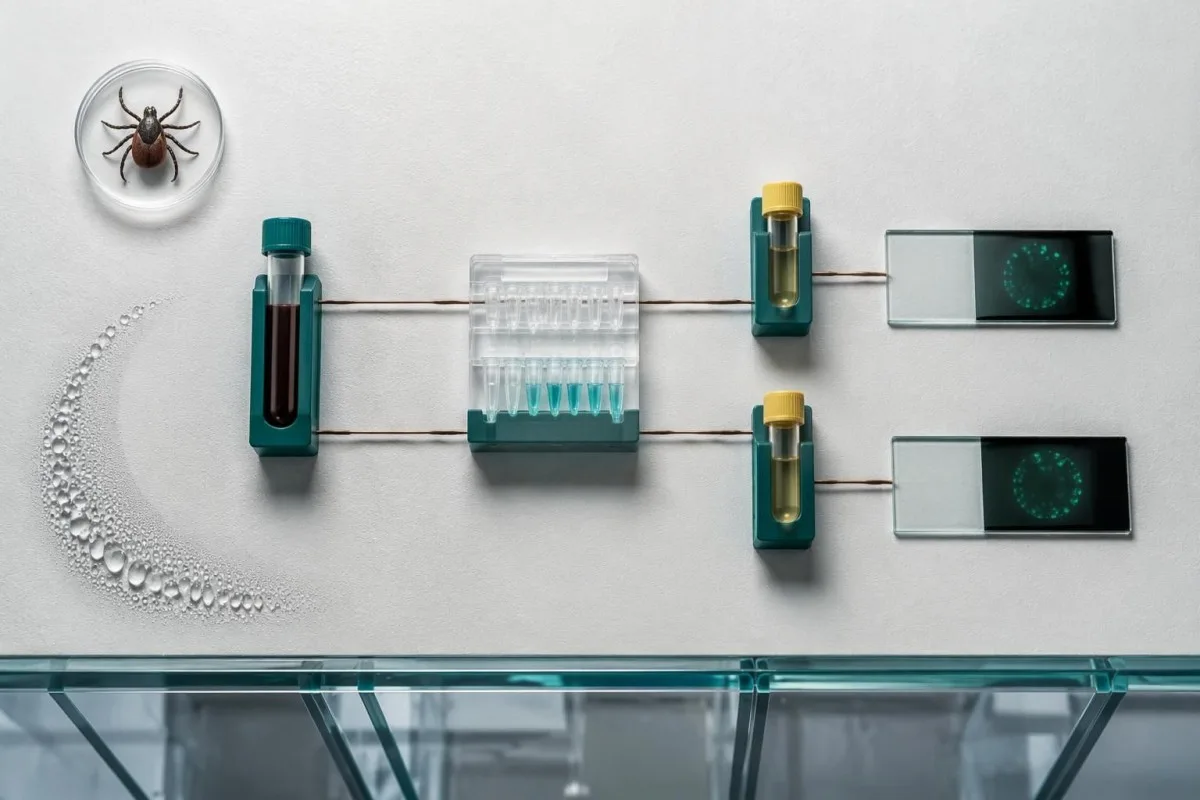
Anaplasma phagocytophilum. verursacht die humane granulozytäre Anaplasmose und befällt vor allem Neutrophile, eine Art weißer Blutkörperchen. Die Symptome beginnen gewöhnlich 5–14 Tage nach dem Stich einer infizierten Zecke, doch viele Menschen bemerken die Zecke nie; für die zeitliche Einordnung im Labor zählt der erste Krankheitstag, nicht ein unsicheres Expositionsdatum.
Ein am Krankheitstag 3 entnommener Befund beantwortet eine andere Frage als ein am Tag 24 entnommener, auch wenn in beiden Befunden Anaplasma steht. Der in der Zeitschrift Journal of Clinical Microbiology veröffentlichte Echtzeit-PCR-Vergleich ergab, dass die diagnostische Ausbeute vom Zeitpunkt im Krankheitsverlauf abhing. Das erklärt, warum direkter Erregernachweis und Serologie gemeinsam interpretiert werden sollten, statt sie als austauschbare Tests zu betrachten (Schotthoefer et al., 2013).
Kantesti ist ein KI-Bluttestanalysator das helfen kann, den Zusammenhang zwischen einem Anaplasma-Befund und den begleitenden CBC- oder Leberwerten zu erklären, aber die Diagnose nicht allein anhand von Zahlen stellen kann. Für eine aussagekräftige Interpretation sollten Sie 3 Angaben machen: Symptombeginn, Datum der Probenentnahme und Zeitpunkt der ersten Antibiotikadosis; Angaben zu unserer Organisation erklärt die Rolle des Dienstes.
Was bedeutet ein positives Anaplasma-PCR-Ergebnis?
Ein positives Anaplasma-PCR-Ergebnis bedeutet, dass der Test Anaplasma-DNA in der eingesandten Probe nachgewiesen hat. Bei einer Person mit einer passenden akuten Erkrankung ist eine positive artspezifische PCR aus Vollblut ein eindeutiger Hinweis auf eine aktive Anaplasmose; sie misst nicht die Antikörperspiegel, gibt keinen Aufschluss über den Schweregrad der Erkrankung und weist nicht alle möglichen Koinfektionen durch Zecken nach.

EDTA-Vollblut wird häufig für die Anaplasma-PCR verwendet, da der Erreger mit zirkulierenden zellulären Bestandteilen assoziiert ist. Eine Serumprobe zum Nachweis von Antikörpern ist nicht automatisch ein geeigneter Ersatz: Bevor Sie 2 scheinbar widersprüchliche Ergebnisse interpretieren, prüfen Sie, ob das Labor für jeden Test die erforderliche Probe erhalten hat und ob beide Entnahmedaten korrekt dokumentiert sind.
Ein hypothetischer Befund mit dem Wortlaut 'A. phagocytophilum-DNA nachgewiesen' am Krankheitstag 4 bei Fieber und sinkender Thrombozytenzahl stützt die klinische Diagnose stark. Ein Befund, der lediglich 'Anaplasma-Spezies nachgewiesen' ausweist, kann auf einem breiter angelegten Test beruhen; daher ist das genaue Testziel wichtig. Fragen Sie nach, ob der Befund A. phagocytophilum ausdrücklich identifiziert oder eine weitere Laborabklärung erfordert.
Ein qualitativer PCR-Test ist kein Maß für die Bakterienmenge. Auch wenn ein Befund einen Schwellenwert-Zyklus enthält, gibt es keinen allgemein gültigen Anaplasma-Grenzwert, der einen Krankenhausaufenthalt vorhersagt oder die Behandlungsdauer vorgibt; unsere Erklärung zu qualitative vs. quantitative Ergebnisse hilft, den Nachweis von einer standardisierten Konzentrationsmessung zu unterscheiden.
Wann ist die Anaplasma-PCR am aussagekräftigsten?
Die Anaplasma-PCR ist in der ersten Krankheitswoche am empfindlichsten, bevor eine geeignete Antibiotikabehandlung die zirkulierende bakterielle DNA reduziert. Laut CDC-Leitlinien nimmt die Sensitivität innerhalb von 48 Stunden nach Beginn einer geeigneten Antibiotikabehandlung ab; dadurch sinkt die diagnostische Ausbeute, doch das bedeutet nicht, dass jede behandelte Probe zur selben Stunde negativ wird.

Entnehmen Sie die PCR-Probe vor der Behandlung, sofern dies sofort möglich ist, aber verschieben Sie eine notwendige Behandlung niemals, um die Probenentnahme zu organisieren. Eine am Tag 5 vor der ersten Doxycyclin-Dosis entnommene Probe ist beispielsweise im Allgemeinen aussagekräftiger als eine am Tag 7 nach mehreren Dosen entnommene; die MMWR-Leitlinie räumt einer umgehenden Behandlung ausdrücklich Vorrang vor dem Warten auf eine Bestätigung ein (Biggs et al., 2016).
The 48-hour statement does not apply equally to every antibiotic a person may have taken. A prior course of an antibiotic that does not reliably treat anaplasmosis cannot be assumed to have the same effect as doxycycline; record the drug name, dose, and dose times rather than writing only 'already on antibiotics.'
If the first PCR was collected after 3 days of doxycycline, a negative result should be interpreted with that limitation visible on the report review. Repeating PCR without changing the timing problem may add little; arranging convalescent IgG may be more informative, and a dated blood test timeline prevents treatment-related changes from being mistaken for contradictory evidence.
Was bedeutet ein positives Anaplasma-IgG-Ergebnis?
The anaplasma IgG positive meaning is evidence of an antibody response, not automatic proof of a current infection. A single IgG result may reflect recent illness, previous exposure, or cross-reactivity; CDC considers a single titer of at least 1:128 supportive laboratory evidence, while confirmation usually requires the clinical picture and direct detection or paired serology.

Anaplasma IgG can remain elevated for months, and high titers have been reported up to 4 years after illness. Persistently positive antibodies in a well person do not by themselves justify another antibiotic course; the relevant question is whether there is a new compatible illness, a new exposure, or evidence that the antibody level has changed meaningfully.
In some areas, approximately 5–10% of healthy people may have elevated Anaplasma antibodies because of previous exposure or related organisms, according to CDC testing guidance. That estimate is geographically dependent, not a universal false-positive rate; a low positive in someone with no fever or plausible tick exposure carries a different meaning from the same result during an acute illness.
Kantesti treats 1 positive antibody result as a finding to explain, not a diagnosis to announce. The distinction between immune memory and active disease is covered in die Interpretation positiver Antikörperergebnisse; unlike some vaccine antibody tests, Anaplasma IgG does not provide an established protective-immunity threshold.
Wie bestätigen gepaarte IgG-Proben eine kürzlich erfolgte Infektion?
Paired Anaplasma IgG testing compares an acute specimen from the first 2 weeks of illness with a convalescent specimen collected 2–10 weeks later. A fourfold rise in IgG titer by indirect fluorescent antibody testing is evidence of seroconversion and helps confirm recent infection when the early result was negative or PCR was unavailable.

A rise from 1:64 to 1:256 is fourfold; a rise from 1:128 to 1:256 is only twofold. In a hypothetical case, an illness-day-4 titer of 1:64 and a day-28 titer of 1:256 would meet the fourfold criterion, while the smaller increase would not independently confirm infection by that criterion.
Titers are reciprocal dilutions, not concentrations in mg/dL or arbitrary screen-index units. If the acute report gives an index of 1.4 and the later report gives a titer of 1:256, a fourfold change cannot be calculated directly; use the same laboratory and method where possible, and ask whether archived samples can be compared together.
Antibody responses may be weaker or delayed in people receiving immunosuppressive treatment. A person taking B-cell-depleting therapy, for example, may not produce the expected rise over 2 samples, so clinicians may rely more heavily on PCR, clinical findings, and exposure history; IgG, IgA, and IgM patterns can provide background context but do not replace organism-specific testing.
Warum sind IgM und kreuzreaktive Antikörper unzuverlässig?
Anaplasma IgM is not a reliable stand-alone marker of recent anaplasmosis, and antibodies can cross-react with related Ehrlichia organisms. When both illnesses are plausible, clinicians may request 2 separate organism-specific PCR tests and side-by-side IgG testing; dual antibody positivity does not automatically establish 2 active infections.

IgM does not consistently mean 'new infection' in anaplasmosis. An isolated IgM positive result with negative IgG and negative PCR is therefore insufficient confirmation, particularly if it was obtained on day 2 of a nonspecific illness; the recommended serologic approach is paired IgG interpreted alongside symptoms and the direct-detection window.
Anaplasma phagocytophilum and Ehrlichia species are different organisms, despite overlapping fever, headache, cytopenias, and antibody cross-reactivity. A positive Ehrlichia antibody assay does not substitute for an Anaplasma PCR result; our guide to ehrlichiosis PCR and titers explains why testing for each target matters when 2 diagnoses remain plausible.
Babesia requires separate assessment because doxycycline does not treat babesiosis. In a patient with anemia, elevated LDH, low haptoglobin, or persistent fever after 48 hours of appropriate anaplasmosis treatment, clinicians may consider Babesia PCR or a manually reviewed smear; Babesia-Antikörpern im Vergleich zur Infektion explains why an antibody result alone can also mislead.
Kann trotz negativer Ergebnisse eine Anaplasmose vorliegen?
An anaplasmosis test false negative is possible when antibodies are checked too early or PCR is collected after its best detection window or after treatment. Negative PCR plus negative IgG during week 1 does not reliably exclude the illness; clinicians must weigh exposure, symptoms, CBC changes, liver enzymes, and the timing of both tests.

There is no single dependable false-negative percentage for every Anaplasma test. PCR assays differ, studies use different reference standards, and patients present on different illness days; a sensitivity estimate from untreated day-3 specimens cannot simply be applied to a day-9 sample obtained after 4 days of doxycycline (Schotthoefer et al., 2013).
A hypothetical person has fever, platelets of 78 × 10^9/L, a WBC of 2.9 × 10^9/L, and recent woodland exposure, but both tests are negative on illness day 4. That pattern leaves substantial clinical concern even without confirmation; by contrast, the same negative tests in a well person with normal counts and no plausible exposure answer a much lower-risk question.
Kantesti ist ein AI-Bluttest-Auswertungsplattform that can explain why 2 negative tests may be limited by their collection dates, but it cannot determine whether antibiotics are needed. Our Ansatz zur klinischen Validierung beschreibt Schutzmaßnahmen bei der Interpretation, während checking report source details helps readers verify specimen type, method, and reference comments before relying on a summary.
Welche CBC- und Leberbefunde stützen die Diagnose?
Low white blood cells, low platelets, and raised AST or ALT commonly support suspicion of anaplasmosis, but none is diagnostic alone. Many adult laboratories use WBC reference intervals around 4.0–11.0 × 10^9/L and platelet intervals around 150–450 × 10^9/L; use the ranges printed on your own report.

A falling platelet count can be more informative than one mildly low result. A hypothetical decline from 182 to 84 × 10^9/L over 3 days during fever suggests an acute process, whereas a stable count of 138 × 10^9/L for years has a different context; plateletcrit and platelet count are related measurements, but plateletcrit is not an Anaplasma diagnostic test.
AST and ALT indicate cellular injury rather than identifying the organism. An AST of 84 IU/L is approximately 2.1 times an upper limit of 40 IU/L, but muscle injury, other infections, and medication effects can also produce that result; what ALT measures helps distinguish supportive liver findings from proof of a specific cause.
Morulae are clusters of organisms that may be visible inside granulocytes during the first week. Their absence does not exclude anaplasmosis, and their presence is not reliably species-specific because some Ehrlichia organisms can also affect granulocytes; manual microscopy can provide a fast clue, but PCR is needed for clearer organism identification (Bakken and Dumler, 2015).
| Wert | Bereich | Bedeutung |
|---|---|---|
| Üblicher WBC-Referenzbereich für Erwachsene | 4,0–11,0 × 10^9/L | Laboratory-dependent reference interval; a normal WBC does not exclude early anaplasmosis. |
| WBC below the local interval | Often <4.0 × 10^9/L | Leukopenia supports suspicion during a compatible acute illness but has many other causes. |
| Common adult platelet interval | 150–450 × 10^9/L | Check the local interval and previous results before interpreting a borderline value. |
| Platelets below the local interval | Often <150 × 10^9/L | Thrombocytopenia is a supportive clue; rapid decline and symptoms determine urgency. |
Worin unterscheiden sich Anaplasma-Tests von anderen Tests auf durch Zecken übertragene Erkrankungen?
Anaplasma PCR, Lyme serology, Babesia testing, Ehrlichia PCR, and spotted-fever serology detect different targets and cannot substitute for one another. A laboratory panel tests only the organisms explicitly listed; a negative result for 1 target is not a negative result for all tick-borne illnesses.
Lyme disease is usually evaluated with a validated two-tier antibody algorithm when testing is indicated. A classic expanding erythema migrans rash can be diagnosed clinically without waiting for positive antibodies, while marked leukopenia or thrombocytopenia should raise concern for an additional diagnosis; an Anaplasma PCR result does not answer either of these 2 Lyme questions.
Rocky Mountain spotted fever may have negative early serology, and whole-blood PCR is less reassuring when negative than it is for some circulating-cell infections. Rash appearance and specimen choice matter, but absence of rash does not make waiting safe; spotted-fever testing windows explains why the Anaplasma PCR window cannot simply be transferred to that illness.
Alpha-gal syndrome is a tick-associated allergy, not an Anaplasma infection. Delayed allergic symptoms roughly 2–6 hours after mammalian meat exposure require an allergy-focused history and appropriate IgE testing rather than PCR or paired Anaplasma IgG; alpha-gal IgE interpretation illustrates how one exposure category can lead to very different diagnostic pathways.
Warum kann die Behandlung vor der Bestätigung beginnen?
Suspected anaplasmosis should be treated promptly because early tests can be negative and delayed therapy can allow severe illness to develop. The MMWR guideline recommends that clinicians neither delay treatment while awaiting laboratory results nor withhold treatment because an early test is negative; the usual adult doxycycline dose is 100 mg every 12 hours (Biggs et al., 2016).

CDC recommends doxycycline for anaplasmosis in adults and children of all ages. For children weighing less than 45 kg, the usual dose is 2.2 mg/kg every 12 hours, with a maximum of 100 mg per dose; these are clinician-prescribed regimens, not instructions to start leftover medication or adjust a child's dose without assessment.
Treatment commonly lasts 10–14 days to provide coverage for possible concurrent Borrelia infection. Duration still depends on the suspected coinfections and clinical course, so an improving fever after 2 doses is not a reason to stop early; pregnancy, severe drug allergy, vomiting, or organ dysfunction require individualized decisions, sometimes with infectious-disease input.
Starting doxycycline is a clinical decision based on exposure, symptoms, examination, and the overall pattern—not on a single CRP or WBC cutoff. A WBC of 3.0 × 10^9/L during acute fever may strengthen concern even when CRP is only modestly raised; diskordante Infektionsmarker im Blut explains why one reassuring-looking number should not overrule the complete assessment.
Welche Reaktion ist zu erwarten, und wann ist eine dringende Behandlung erforderlich?
Fever from anaplasmosis usually improves within 24–48 hours of doxycycline, but severe illness may take longer. Difficulty breathing, confusion, new bleeding, fainting, or markedly reduced urination requires emergency assessment; failure to improve is a reason for reassessment, not an instruction to increase the antibiotic dose yourself.

Persistent fever beyond about 48 hours should prompt review of the diagnosis, medication delivery, and possible coinfections. The person may not be absorbing oral treatment because of vomiting, may have an additional illness such as babesiosis, or may have developed a complication; the interval is a practical reassessment point rather than an absolute recovery deadline.
Severe anaplasmosis can involve respiratory failure, kidney injury, or coagulation abnormalities. Falling platelets accompanied by rising creatinine, prolonged clotting times, or new bleeding should not be dismissed as a routine CBC fluctuation; disseminated coagulation laboratory patterns explains why 2 or more changing systems can signal a problem beyond an isolated low count.
Clotting tests assess complications rather than confirming Anaplasma itself. For example, an INR of 1.8 in someone not taking warfarin needs explanation in context, but does not establish anaplasmosis or DIC on its own; our Leitfaden zur Interpretation von Gerinnungstests helps separate PT, aPTT, D-dimer, and platelet findings without treating them as interchangeable measurements.
Sollten PCR oder Antikörper nach der Behandlung erneut untersucht werden?
Routine PCR or IgG testing is generally not needed to prove cure after clinically successful anaplasmosis treatment. A convalescent IgG sample collected 2–10 weeks after the acute sample can document the diagnosis, but persistent antibodies alone do not demonstrate treatment failure and should not trigger repeated antibiotics in a well person.

A persistently positive IgG is not a test-of-cure result. If a person is well after a completed 10–14-day course, an elevated titer may simply reflect immune memory; if symptoms recur, clinicians should reassess the new symptoms and exposure history rather than assume that the old antibody result proves persistent infection.
CBC, creatinine, and liver enzymes may be repeated when they were abnormal or the illness was severe, but there is no universal day-7 retesting schedule for everyone. Kantesti AI can help organize serial results—for example, platelets rising from 82 to 164 × 10^9/L—while Überprüfung der Trends bei der Medikamentensicherheit explains why recovery patterns still require clinical context.
Antibiotic prophylaxis after a tick bite is not recommended specifically to prevent anaplasmosis. After an asymptomatic bite, monitor for fever or other illness over the following 2 weeks and obtain medical advice if symptoms appear; a separate Lyme prophylaxis decision, when indicated, should not be mistaken for an Anaplasma prevention protocol.
Wie können Sie einen verwirrenden Befund sicher ordnen?
The safest report review separates organism detection, antibody evidence, supportive blood findings, and clinical timing into 4 distinct questions. Record the assay target, specimen type, result format, collection date, symptom-onset date, and antibiotic start; missing context should remain explicitly unknown rather than being filled in by an AI explanation.

Kantesti ist ein KI-Labor-Befundinterpretationsservice that can explain uploaded laboratory reports and help readers identify questions for their clinician. In a hypothetical 2-report review, our AI should distinguish 'PCR not detected after treatment' from 'paired IgG rise consistent with recent infection,' rather than flattening both statements into a single positive-or-negative label.
An upload is not a substitute for urgent assessment. A photo showing platelets of 74 × 10^9/L cannot reveal whether the person is confused, dehydrated, pregnant, or short of breath; our KI-Interpretationstechnologie describes the analytical workflow, but clinical observations and prescribing decisions remain outside what the report alone can establish.
Before sharing 2 samples, check that both belong to the same person and remove identifiers if they are not needed for your purpose. Kantesti does not perform Anaplasma PCR, validate specimen handling, or confirm that an uploaded titer used the same laboratory method; retain the original PDF and ask the laboratory to resolve unclear assay comments or mismatched result units.
Welche Befunde sollten Ihre nächsten Schritte leiten?
Anaplasmosis testing decisions should follow condition-specific guidance and diagnostic research, not general blood-test publications. The 2016 MMWR guideline, the 2013 PCR comparison, and the 2015 clinical review support the distinction between early direct detection, later antibody confirmation, and treatment based on clinical suspicion rather than a single laboratory result.

Bring 3 questions to the clinical review: was PCR collected early enough, is paired IgG needed, and do other tick-borne targets require separate testing? If the first specimen followed several doxycycline doses, say so; if the report is a single low-positive IgG, ask what evidence supports current illness before assuming that another antibiotic course is required.
At Kantesti, we distinguish externally published medical evidence from our own educational resources. Our medizinische Inhaltsstandards explain that distinction; the 2 Figshare publications listed below are supplementary general laboratory and digestive-health guides, not studies establishing Anaplasma assay accuracy, treatment efficacy, or diagnostic thresholds.
The general hematology guide can help explain LDH and reticulocyte results when anemia raises a separate concern such as hemolysis. Use the hematology marker background guide for that limited purpose, not to interpret Anaplasma PCR; a 4-fold IgG rise, a positive organism-specific PCR, and the patient's clinical course each provide different kinds of evidence.
Häufig gestellte Fragen
Kann die Anaplasma-PCR positiv sein, wenn die Antikörper negativ sind?
Die Anaplasma-PCR kann in der ersten Krankheitswoche positiv sein, während IgG-Antikörper negativ sind, da bakterielle DNA nachweisbar sein kann, bevor sich eine Antikörperreaktion entwickelt. Dieses Muster kann für eine aktive Anaplasmose sprechen und muss nicht auf einen Laborfehler hindeuten. Eine Akutprobe für IgG kann mit einer 2–10 Wochen später entnommenen Rekonvaleszenzprobe verglichen werden. Bei klinischem Verdacht auf die Erkrankung sollte die Behandlung nicht aufgeschoben werden, bis eine Serokonversion nachgewiesen ist.
Bedeutet ein positiver Anaplasma-IgG-Befund, dass ich Antibiotika brauche?
Ein einzelnes positives Anaplasma-IgG-Ergebnis bedeutet nicht automatisch, dass Antibiotika erforderlich sind, da die Antikörper eine frühere Exposition oder Kreuzreaktionen widerspiegeln können. Die CDC wertet einen einzelnen Titer von mindestens 1:128 als unterstützenden Hinweis, jedoch nicht als definitiven Nachweis einer neuen Infektion. Die Antikörper können über Monate erhöht bleiben; hohe Titer wurden bis zu 4 Jahre nach der Erkrankung festgestellt. Kliniker stützen ihre Behandlungsentscheidung auf aktuelle Symptome, Exposition, PCR-Befunde und gepaarte Antikörpermessungen statt allein auf persistierendes IgG.
Wie schnell kann Doxycyclin dazu führen, dass eine Anaplasma-PCR negativ ausfällt?
Anaplasma PCR sensitivity can decrease within 48 hours of appropriate antibiotic treatment, according to CDC guidance. That does not mean every person's PCR becomes negative at exactly 48 hours, because assay performance and circulating organism levels differ. A negative PCR collected after treatment is therefore less reassuring than a well-timed pretreatment result. Record the first doxycycline dose and specimen collection time so the clinician can interpret the result correctly.
Was gilt als vierfacher Anstieg der Anaplasma-Antikörper?
A rise in Anaplasma IgG titer from 1:64 to 1:256 is fourfold, while a rise from 1:128 to 1:256 is only twofold. Paired testing generally compares an acute specimen from the first 2 weeks of illness with a convalescent specimen collected 2–10 weeks later. The comparison should use compatible methods, ideally the same laboratory's IgG indirect fluorescent antibody assay. An antibody screen index cannot be directly converted into a dilution titer for this calculation.
Kann ich Anaplasmose haben, wenn PCR und IgG beide negativ sind?
Eine Anaplasmose kann weiterhin vorliegen, auch wenn PCR und IgG negativ sind, insbesondere wenn die IgG-Probe in der ersten Woche und die PCR nach einer angemessenen Antibiotikatherapie entnommen wurden. Fieber, eine plausible Zeckenexposition, eine niedrige Thrombozytenzahl, eine niedrige Zahl weißer Blutkörperchen und erhöhte Leberenzymwerte können trotz negativer Tests den klinischen Verdacht aufrechterhalten. Ärztinnen und Ärzte können 2–10 Wochen nach der Akutprobe eine IgG-Verlaufskontrolle veranlassen und andere mögliche Diagnosen abklären. Bei Verdacht auf Anaplasmose sollte nicht allein deshalb auf eine Behandlung verzichtet werden, weil die frühen Testergebnisse negativ sind.
Wie schnell sollten sich die Symptome bessern, und brauche ich einen Test zur Bestätigung der Heilung?
Fieber infolge einer Anaplasmose bessert sich unter Doxycyclin gewöhnlich innerhalb von 24–48 Stunden, bei schwerem Krankheitsverlauf kann es jedoch länger dauern. Anhaltendes Fieber sollte Anlass für eine erneute Abklärung von Problemen bei der Aufnahme des Medikaments, einer anderen Diagnose, einer Koinfektion oder Komplikationen sein. Nach erfolgreicher Behandlung sind routinemäßige PCR- oder Antikörpertests in der Regel nicht erforderlich, um die Ausheilung nachzuweisen; gepaartes IgG wird hauptsächlich zum Nachweis einer kürzlich erfolgten Infektion verwendet. Atemnot, Verwirrtheit, neue Blutungen oder deutlich verminderte Urinausscheidung erfordern unabhängig vom Laborergebnis eine dringende Abklärung.
Lassen Sie sich Ihre Blutwerte erklären
Laden Sie Ihren Laborbericht hoch und die KI von Kantesti erklärt jeden Biomarker innerhalb von Sekunden in einfacher Sprache. Weltweit von mehr als 2 Millionen Menschen genutzt.
Referenzen
- Klein, T., Mitchell, S. & Weber, H. (2026). Leitfaden zu Blutgruppe B negativ, LDH-Bluttest und Retikulozytenzahl. Kantesti KI-Medizinrecherche. DOI
- Klein, T., Mitchell, S. & Weber, H. (2026). Durchfall nach dem Fasten, schwarze Sprenkel im Stuhl und Magen-Darm-Leitfaden 2026. Kantesti KI-Medizinrecherche. DOI
- Biggs HM et al. (2016). Diagnose und Behandlung von durch Zecken übertragenen Rickettsiosen: Rocky-Mountain-Fleckfieber und andere Rickettsiosen der Fleckfiebergruppe, Ehrlichiosen und Anaplasmose — Vereinigte Staaten. MMWR Recommendations and Reports. DOI PubMed
- Schotthoefer AM et al. (2013). Comparison of a real-time PCR method with serology and blood smear analysis for diagnosis of human anaplasmosis: importance of infection time course for optimal test utilization. Journal of Clinical Microbiology. DOI
- Bakken JS and Dumler JS (2015). Human granulocytic anaplasmosis. Infectious Disease Clinics of North America.
- 2M+Analysierte Tests
- 127+Länder
- 100+Sprachen
Über das medizinische Team


E-E-A-T Vertrauenssignale
Erfahrung
Ärztlich geleitete klinische Überprüfung von Labor-Interpretations-Workflows.
Sachverstand
Fokus der Labormedizin darauf, wie Biomarker sich im klinischen Kontext verhalten.
Autorität
Medizinisch geprüft von Dr. Thomas Klein, mit Beiträgen von Dr. Sarah Mitchell und Prof. Dr. Hans Weber.
Vertrauenswürdigkeit
Evidenzbasierte Interpretation mit klaren nächsten Schritten zur Reduzierung von Alarm.






Medizinischer Haftungsausschluss
Dieser Artikel dient nur zu Bildungszwecken und stellt keine medizinische Beratung dar. Wende dich für Diagnose- und Behandlungsentscheidungen immer an eine qualifizierte medizinische Fachkraft.
Veröffentlicht · Kontaktieren Sie das Redaktionsteam
Veröffentlicht von Kantesti Ltd, eingetragen in England und Wales, Firmennr. 17090423, London, Vereinigtes Königreich.
