
PCR qo‘zg‘atuvchini aniqlaydi; antitanalar esa immun javobni qayd etadi. Ikkala natijani ham simptomlar boshlanishi va antibiotik qabul qilingan vaqt bilan taqqoslash ko‘rinadigan ziddiyatlarni tushuntiradi.

Asosiy xulosalar
- Erta PCR kasallikning birinchi haftasida eng foydali hisoblanadi; butun qon namunasidagi PCR musbat natijasi faol anaplazmoz borligini aniq ko‘rsatadi.
- Dastlabki antitanalar 1-haftada hali manfiy bo‘lishi mumkin, shuning uchun PCR musbat, IgG manfiy bo‘lishi kutiladigan holat — bu laboratoriya xatosi degani emas.
- Salbiy PCR anaplazmozni istisno qilmaydi, ayniqsa antibiotiklar qabul qilingandan keyin; tegishli davolash boshlanganidan so‘ng 48 soat ichida PCR sezgirligi pasayishi mumkin.
- Juft IgG namunalari kasallikning dastlabki 2 haftasida va yana 2–10 haftadan so‘ng olinadi; ko‘rsatkichning to‘rt baravar oshishi yaqinda yuqqan infeksiya tasdiqlanishini qo‘llab-quvvatlaydi.
- Yagona musbat IgG yangi infeksiyani tasdiqlay olmaydi. CDC ko‘rsatmalariga ko‘ra, kamida 1:128 titr qo‘llab-quvvatlovchi dalildir, ammo davolashni belgilash uchun yakka o‘zi yetarli emas.
- Davolashni boshlash vaqti faqat tasdiqlashga emas, klinik shubhaga bog‘liq. Anaplazmoz gumon qilinganda, shifokorlar natijalarni kutib, doksisiklin bilan davolashni kechiktirmasligi kerak.
- Boshqa kana orqali yuqadigan kasalliklar uchun alohida testlar kerak. Anaplasma PCR Lyme kasalligi, babezioz, ehrlichioz yoki Rokki tog‘lari dog‘li isitmasini tekshirmaydi.
- Shoshilinch belgilar chalkashlik, nafas olish qiyinlashuvi, yangi qon ketish yoki siydik miqdorining keskin kamayishi kabi holatlar takroriy namuna olishni kutish o‘rniga shoshilinch ko‘rikni talab qiladi.
Nega dastlabki PCR va antitana natijalari bir-biriga mos kelmasligi mumkin?
Anaplazmoz testlari natijalari bir-biriga mos kelmasligi mumkin, chunki PCR bakterial DNKni, IgG esa keyinroq rivojlanadigan immun javobni aniqlaydi. Birinchi hafta davomida PCR musbat, antitanalar esa manfiy bo‘lishi mumkin; davolashdan keyin PCR manfiylashib, IgG ko‘tarilishi mumkin, shuningdek, gumon qilingan infeksiya laboratoriya tasdig‘idan oldin ham davolashni talab qilishi mumkin.
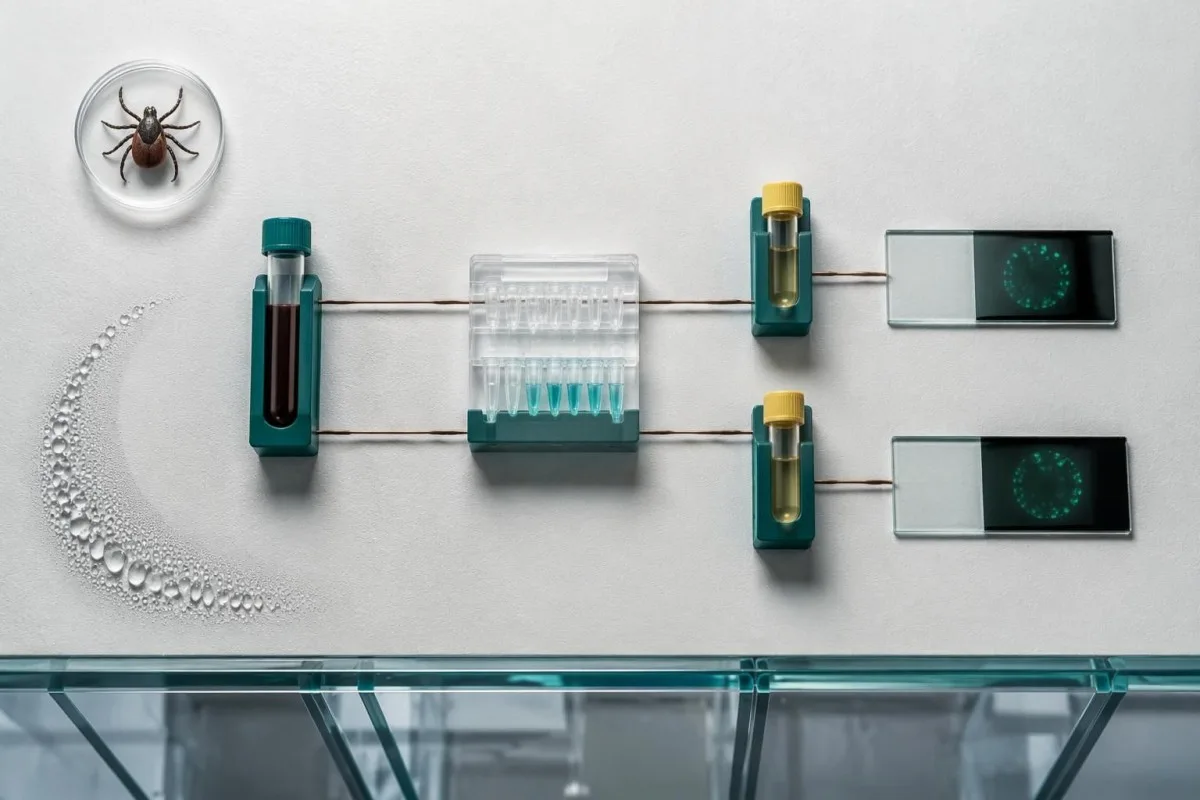
Anaplasma phagocytophilum odamda granulotsitar anaplazmozni keltirib chiqaradi va asosan oq qon hujayralarining bir turi bo‘lgan neytrofillarga ta’sir qiladi. Alomatlar odatda infeksiyalangan kana chaqqanidan 5–14 kun o‘tib boshlanadi, ammo ko‘pchilik kana chaqqanini payqamaydi; laboratoriya uchun muhim vaqt hisobi noaniq ta’sirlanish sanasidan emas, kasallikning birinchi kunidan boshlanadi.
Kasallikning 3-kunida olingan natija 24-kunida olingan natijadan boshqa savolga javob beradi, garchi ikkala hisobotda ham Anaplasma deb yozilgan bo‘lsa-da. Journal of Clinical Microbiology jurnalida chop etilgan real vaqt PCR taqqoslovida diagnostik samaradorlik kasallikning qaysi bosqichida tekshirilganiga bog‘liqligi aniqlangan; bu bevosita aniqlash va serologik tekshiruvni o‘zaro almashtiriladigan testlar sifatida emas, birgalikda talqin qilish kerakligini izohlaydi (Schotthoefer va boshq., 2013).
Kantesti - bu AI qon testi analizatori Anaplasma hisoboti bilan unga qo‘shilgan CBC yoki jigar natijalari o‘rtasidagi bog‘liqlikni tushuntirishga yordam berishi mumkin, ammo faqat raqamlarga qarab tashxis qo‘ya olmaydi. Natijalarni mazmunli talqin qilish uchun 3 ta ma’lumotni taqdim eting: alomatlar boshlangan sana, namuna olingan sana va antibiotikning birinchi dozasi; ma’lumotlar haqida bizning tashkilotimizda xizmatning vazifasini tushuntiradi.
Anaplasma uchun PCR natijasi musbat bo‘lishi nimani anglatadi?
Anaplazma uchun PCR musbat natijasi tahlil topshirilgan namunada Anaplasma DNKsi aniqlanganini anglatadi. O‘tkir kasallik alomatlari mos keladigan odamda butun qonda o‘tkazilgan turga xos PCRning musbat natijasi faol anaplazmozning aniq dalilidir; u antitana darajasini o‘lchamaydi, kasallik og‘irligini belgilamaydi yoki kana orqali yuqishi mumkin bo‘lgan barcha birgalikdagi infeksiyalarni aniqlamaydi.

EDTA qo‘shilgan butun qon Anaplasma PCR uchun odatda qo‘llanadi, chunki organizm qonda aylanib yuruvchi hujayra elementlari bilan bog‘liq. Zardobdagi antitanalar namunasi uning o‘rnini avtomatik ravishda bosa olmaydi: bir-biriga zid ko‘ringan 2 natijani talqin qilishdan oldin laboratoriya har bir tahlil uchun talab etilgan namunani olganini va ikkala namuna olingan sana to‘g‘ri qayd etilganini tekshiring.
Kasallikning 4-kunida isitma va trombotsitlar soni pasayishi bilan birga 'A. phagocytophilum DNKsi aniqlandi' deb yozilgan shartli hisobot klinik tashxisni kuchli qo'llab-quvvatlaydi. Faqat 'Anaplasma turi aniqlandi” deb yozilgan hisobot kengroq tahlildan olingan bo‘lishi mumkin, shu bois aynan qaysi nishon aniqlangani muhim; natija A. phagocytophilum ni alohida aniqlaydimi yoki laboratoriyadan qo‘shimcha izoh talab qiladimi, deb so‘rang.
Sifat PCRi bakteriyalar miqdorini ko‘rsatuvchi baho emas. Hisobotda sikl chegarasi qiymati berilgan bo‘lsa ham, Anaplasma uchun shifoxonaga yotqizishni bashorat qiladigan yoki davolash muddatini belgilaydigan universal chegara mavjud emas; bizning izohimiz sifatli va miqdoriy natijalar aniqlashni standartlashtirilgan konsentratsiya o‘lchovidan farqlashga yordam beradi.
Anaplasma uchun PCR qachon eng foydali bo‘ladi?
Anaplasma PCR kasallikning birinchi haftasida, tegishli antibiotiklar qonda aylanib yuruvchi bakterial DNK miqdorini kamaytirishidan oldin, eng sezgir bo‘ladi. CDC ko‘rsatmalariga ko‘ra, tegishli antibiotik qabul qilingandan keyin 48 soat ichida sezgirlik pasayadi; bu diagnostik samaradorlikning pasayishidir, davolangan har bir namuna aynan shu vaqtda manfiy bo‘lishiga kafolat emas.

Imkon bo‘lsa, PCR uchun namunani davolashdan oldin darhol oling, ammo tahlil uchun qon olishni tashkil qilish maqsadida zarur davolashni hech qachon kechiktirmang. For example, a sample collected on day 5 before the first doxycycline dose is generally more informative than one collected on day 7 after several doses; the MMWR guideline explicitly prioritizes prompt treatment over waiting for confirmation (Biggs et al., 2016).
The 48-hour statement does not apply equally to every antibiotic a person may have taken. A prior course of an antibiotic that does not reliably treat anaplasmosis cannot be assumed to have the same effect as doxycycline; record the drug name, dose, and dose times rather than writing only 'already on antibiotics.'
If the first PCR was collected after 3 days of doxycycline, a negative result should be interpreted with that limitation visible on the report review. Repeating PCR without changing the timing problem may add little; arranging convalescent IgG may be more informative, and a dated blood test timeline prevents treatment-related changes from being mistaken for contradictory evidence.
Anaplasma uchun IgG natijasi musbat bo‘lishi nimani anglatadi?
The anaplasma IgG positive meaning is evidence of an antibody response, not automatic proof of a current infection. A single IgG result may reflect recent illness, previous exposure, or cross-reactivity; CDC considers a single titer of at least 1:128 supportive laboratory evidence, while confirmation usually requires the clinical picture and direct detection or paired serology.

Anaplasma IgG can remain elevated for months, and high titers have been reported up to 4 years after illness. Persistently positive antibodies in a well person do not by themselves justify another antibiotic course; the relevant question is whether there is a new compatible illness, a new exposure, or evidence that the antibody level has changed meaningfully.
In some areas, approximately 5–10% of healthy people may have elevated Anaplasma antibodies because of previous exposure or related organisms, according to CDC testing guidance. That estimate is geographically dependent, not a universal false-positive rate; a low positive in someone with no fever or plausible tick exposure carries a different meaning from the same result during an acute illness.
Kantesti treats 1 positive antibody result as a finding to explain, not a diagnosis to announce. The distinction between immune memory and active disease is covered in ijobiy antitela natijalarini talqin qilishga; unlike some vaccine antibody tests, Anaplasma IgG does not provide an established protective-immunity threshold.
Juft IgG namunalari yaqinda yuqqan infeksiyani qanday tasdiqlaydi?
Paired Anaplasma IgG testing compares an acute specimen from the first 2 weeks of illness with a convalescent specimen collected 2–10 weeks later. A fourfold rise in IgG titer by indirect fluorescent antibody testing is evidence of seroconversion and helps confirm recent infection when the early result was negative or PCR was unavailable.

A rise from 1:64 to 1:256 is fourfold; a rise from 1:128 to 1:256 is only twofold. In a hypothetical case, an illness-day-4 titer of 1:64 and a day-28 titer of 1:256 would meet the fourfold criterion, while the smaller increase would not independently confirm infection by that criterion.
Titers are reciprocal dilutions, not concentrations in mg/dL or arbitrary screen-index units. If the acute report gives an index of 1.4 and the later report gives a titer of 1:256, a fourfold change cannot be calculated directly; use the same laboratory and method where possible, and ask whether archived samples can be compared together.
Antibody responses may be weaker or delayed in people receiving immunosuppressive treatment. A person taking B-cell-depleting therapy, for example, may not produce the expected rise over 2 samples, so clinicians may rely more heavily on PCR, clinical findings, and exposure history; IgG, IgA, and IgM patterns can provide background context but do not replace organism-specific testing.
Nega IgM va o‘zaro reaksiyaga kirishuvchi antitanalarga ishonib bo‘lmaydi?
Anaplasma IgM is not a reliable stand-alone marker of recent anaplasmosis, and antibodies can cross-react with related Ehrlichia organisms. When both illnesses are plausible, clinicians may request 2 separate organism-specific PCR tests and side-by-side IgG testing; dual antibody positivity does not automatically establish 2 active infections.

IgM does not consistently mean 'new infection' in anaplasmosis. An isolated IgM positive result with negative IgG and negative PCR is therefore insufficient confirmation, particularly if it was obtained on day 2 of a nonspecific illness; the recommended serologic approach is paired IgG interpreted alongside symptoms and the direct-detection window.
Anaplasma phagocytophilum and Ehrlichia species are different organisms, despite overlapping fever, headache, cytopenias, and antibody cross-reactivity. A positive Ehrlichia antibody assay does not substitute for an Anaplasma PCR result; our guide to ehrlichiosis PCR and titers explains why testing for each target matters when 2 diagnoses remain plausible.
Babesia requires separate assessment because doxycycline does not treat babesiosis. In a patient with anemia, elevated LDH, low haptoglobin, or persistent fever after 48 hours of appropriate anaplasmosis treatment, clinicians may consider Babesia PCR or a manually reviewed smear; Babesia antitanalari va infeksiya haqidagi muhokamamiz explains why an antibody result alone can also mislead.
Natijalar manfiy bo‘lsa ham, bu anaplazmoz bo‘lishi mumkinmi?
An anaplasmosis test false negative is possible when antibodies are checked too early or PCR is collected after its best detection window or after treatment. Negative PCR plus negative IgG during week 1 does not reliably exclude the illness; clinicians must weigh exposure, symptoms, CBC changes, liver enzymes, and the timing of both tests.
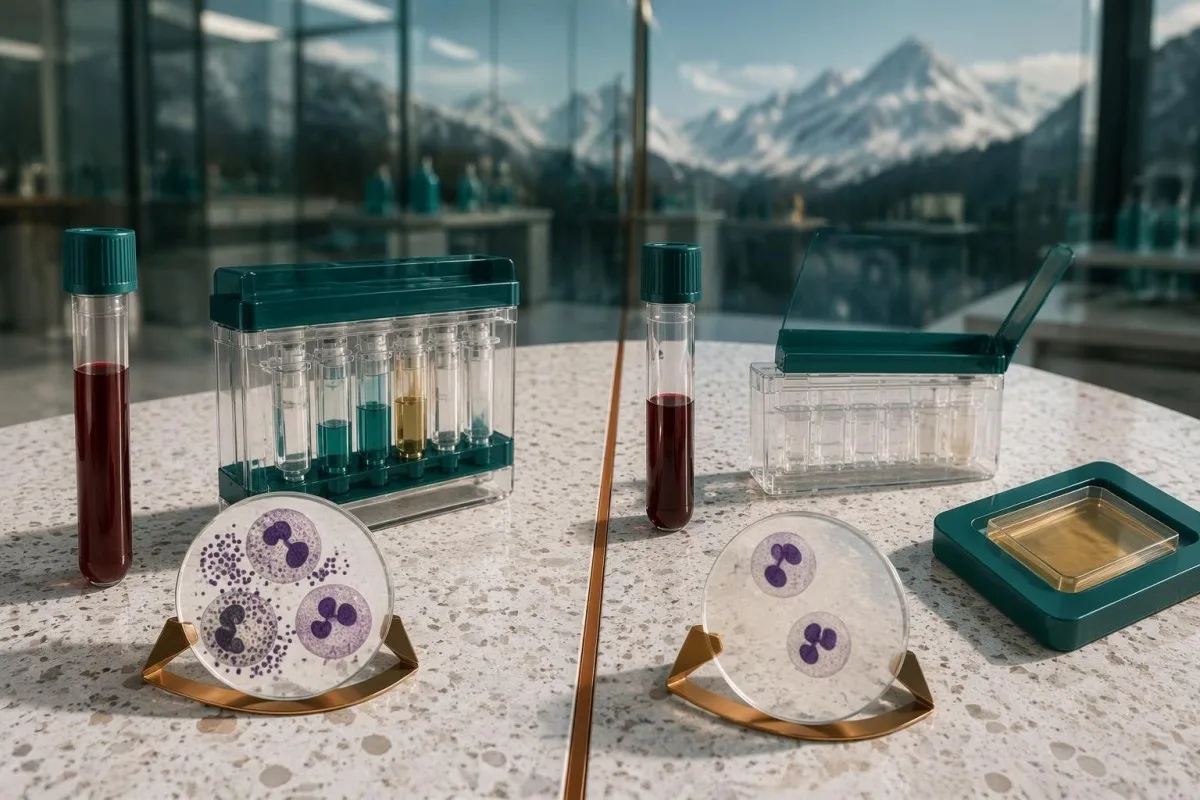
There is no single dependable false-negative percentage for every Anaplasma test. PCR assays differ, studies use different reference standards, and patients present on different illness days; a sensitivity estimate from untreated day-3 specimens cannot simply be applied to a day-9 sample obtained after 4 days of doxycycline (Schotthoefer et al., 2013).
A hypothetical person has fever, platelets of 78 × 10^9/L, a WBC of 2.9 × 10^9/L, and recent woodland exposure, but both tests are negative on illness day 4. That pattern leaves substantial clinical concern even without confirmation; by contrast, the same negative tests in a well person with normal counts and no plausible exposure answer a much lower-risk question.
Kantesti - bu AI qon tahlili natijalari platformasi that can explain why 2 negative tests may be limited by their collection dates, but it cannot determine whether antibiotics are needed. Our klinik validatsiya yondashuvimiz maqolamiz talqin qilishda e’tiborga olinishi lozim bo‘lgan jihatlarni bayon qiladi, shu bilan birga, checking report source details helps readers verify specimen type, method, and reference comments before relying on a summary.
Qaysi CBC va jigar ko‘rsatkichlari tashxisni tasdiqlaydi?
Low white blood cells, low platelets, and raised AST or ALT commonly support suspicion of anaplasmosis, but none is diagnostic alone. Many adult laboratories use WBC reference intervals around 4.0–11.0 × 10^9/L and platelet intervals around 150–450 × 10^9/L; use the ranges printed on your own report.

A falling platelet count can be more informative than one mildly low result. A hypothetical decline from 182 to 84 × 10^9/L over 3 days during fever suggests an acute process, whereas a stable count of 138 × 10^9/L for years has a different context; plateletcrit and platelet count are related measurements, but plateletcrit is not an Anaplasma diagnostic test.
AST and ALT indicate cellular injury rather than identifying the organism. An AST of 84 IU/L is approximately 2.1 times an upper limit of 40 IU/L, but muscle injury, other infections, and medication effects can also produce that result; what ALT measures helps distinguish supportive liver findings from proof of a specific cause.
Morulae are clusters of organisms that may be visible inside granulocytes during the first week. Their absence does not exclude anaplasmosis, and their presence is not reliably species-specific because some Ehrlichia organisms can also affect granulocytes; manual microscopy can provide a fast clue, but PCR is needed for clearer organism identification (Bakken and Dumler, 2015).
| Daraja | Diapazon | Bu nimani anglatadi |
|---|---|---|
| Kattalarda WBC uchun keng qo‘llanadigan oraliq | 4.0–11.0 × 10^9/L | Laboratory-dependent reference interval; a normal WBC does not exclude early anaplasmosis. |
| WBC below the local interval | Often <4.0 × 10^9/L | Leukopenia supports suspicion during a compatible acute illness but has many other causes. |
| Common adult platelet interval | 150–450 × 10^9/L | Check the local interval and previous results before interpreting a borderline value. |
| Platelets below the local interval | Often <150 × 10^9/L | Thrombocytopenia is a supportive clue; rapid decline and symptoms determine urgency. |
Anaplasma testlari boshqa kanalar orqali yuqadigan infeksiyalar testlaridan qanday farq qiladi?
Anaplasma PCR, Lyme serology, Babesia testing, Ehrlichia PCR, and spotted-fever serology detect different targets and cannot substitute for one another. A laboratory panel tests only the organisms explicitly listed; a negative result for 1 target is not a negative result for all tick-borne illnesses.
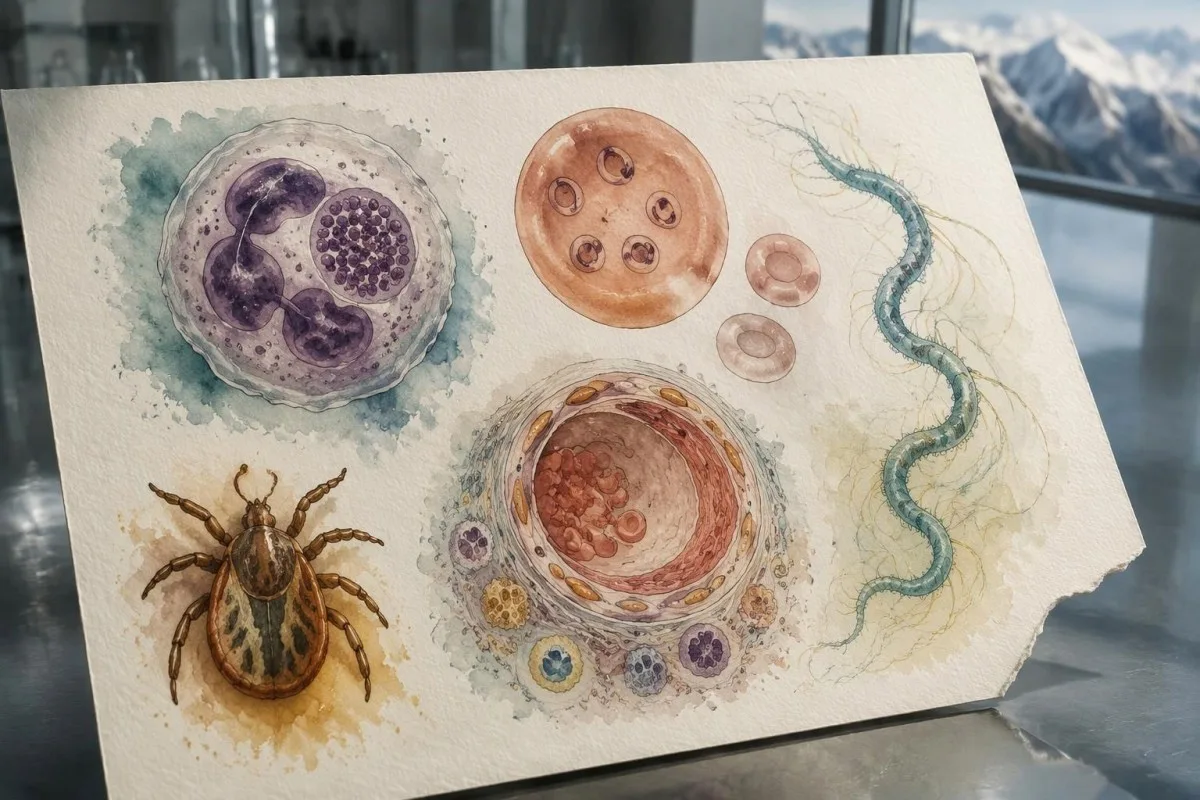
Lyme disease is usually evaluated with a validated two-tier antibody algorithm when testing is indicated. A classic expanding erythema migrans rash can be diagnosed clinically without waiting for positive antibodies, while marked leukopenia or thrombocytopenia should raise concern for an additional diagnosis; an Anaplasma PCR result does not answer either of these 2 Lyme questions.
Rocky Mountain spotted fever may have negative early serology, and whole-blood PCR is less reassuring when negative than it is for some circulating-cell infections. Rash appearance and specimen choice matter, but absence of rash does not make waiting safe; spotted-fever testing windows explains why the Anaplasma PCR window cannot simply be transferred to that illness.
Alpha-gal syndrome is a tick-associated allergy, not an Anaplasma infection. Delayed allergic symptoms roughly 2–6 hours after mammalian meat exposure require an allergy-focused history and appropriate IgE testing rather than PCR or paired Anaplasma IgG; alpha-gal IgE interpretation illustrates how one exposure category can lead to very different diagnostic pathways.
Nega tasdiqlashdan oldin davolashni boshlash mumkin?
Suspected anaplasmosis should be treated promptly because early tests can be negative and delayed therapy can allow severe illness to develop. The MMWR guideline recommends that clinicians neither delay treatment while awaiting laboratory results nor withhold treatment because an early test is negative; the usual adult doxycycline dose is 100 mg every 12 hours (Biggs et al., 2016).

CDC recommends doxycycline for anaplasmosis in adults and children of all ages. For children weighing less than 45 kg, the usual dose is 2.2 mg/kg every 12 hours, with a maximum of 100 mg per dose; these are clinician-prescribed regimens, not instructions to start leftover medication or adjust a child's dose without assessment.
Treatment commonly lasts 10–14 days to provide coverage for possible concurrent Borrelia infection. Duration still depends on the suspected coinfections and clinical course, so an improving fever after 2 doses is not a reason to stop early; pregnancy, severe drug allergy, vomiting, or organ dysfunction require individualized decisions, sometimes with infectious-disease input.
Starting doxycycline is a clinical decision based on exposure, symptoms, examination, and the overall pattern—not on a single CRP or WBC cutoff. A WBC of 3.0 × 10^9/L during acute fever may strengthen concern even when CRP is only modestly raised; diskordant infektsiya qon belgilari explains why one reassuring-looking number should not overrule the complete assessment.
Qanday javob kutiladi va qachon shoshilinch tibbiy yordam kerak?
Fever from anaplasmosis usually improves within 24–48 hours of doxycycline, but severe illness may take longer. Difficulty breathing, confusion, new bleeding, fainting, or markedly reduced urination requires emergency assessment; failure to improve is a reason for reassessment, not an instruction to increase the antibiotic dose yourself.

Persistent fever beyond about 48 hours should prompt review of the diagnosis, medication delivery, and possible coinfections. The person may not be absorbing oral treatment because of vomiting, may have an additional illness such as babesiosis, or may have developed a complication; the interval is a practical reassessment point rather than an absolute recovery deadline.
Severe anaplasmosis can involve respiratory failure, kidney injury, or coagulation abnormalities. Falling platelets accompanied by rising creatinine, prolonged clotting times, or new bleeding should not be dismissed as a routine CBC fluctuation; disseminated coagulation laboratory patterns explains why 2 or more changing systems can signal a problem beyond an isolated low count.
Clotting tests assess complications rather than confirming Anaplasma itself. For example, an INR of 1.8 in someone not taking warfarin needs explanation in context, but does not establish anaplasmosis or DIC on its own; our koagulatsiya tekshiruvi natijalarini talqin qilish bo‘yicha qo‘llanmamiz helps separate PT, aPTT, D-dimer, and platelet findings without treating them as interchangeable measurements.
Davolashdan keyin PCR yoki antitanalarni qayta tekshirish kerakmi?
Routine PCR or IgG testing is generally not needed to prove cure after clinically successful anaplasmosis treatment. A convalescent IgG sample collected 2–10 weeks after the acute sample can document the diagnosis, but persistent antibodies alone do not demonstrate treatment failure and should not trigger repeated antibiotics in a well person.

A persistently positive IgG is not a test-of-cure result. If a person is well after a completed 10–14-day course, an elevated titer may simply reflect immune memory; if symptoms recur, clinicians should reassess the new symptoms and exposure history rather than assume that the old antibody result proves persistent infection.
CBC, creatinine, and liver enzymes may be repeated when they were abnormal or the illness was severe, but there is no universal day-7 retesting schedule for everyone. Kantesti AI can help organize serial results—for example, platelets rising from 82 to 164 × 10^9/L—while dori vositalarining xavfsizligi tendensiyasini ko'rib chiqish explains why recovery patterns still require clinical context.
Antibiotic prophylaxis after a tick bite is not recommended specifically to prevent anaplasmosis. After an asymptomatic bite, monitor for fever or other illness over the following 2 weeks and obtain medical advice if symptoms appear; a separate Lyme prophylaxis decision, when indicated, should not be mistaken for an Anaplasma prevention protocol.
Chalkash tahlil javoblarini qanday qilib xavfsiz tartibga solish mumkin?
The safest report review separates organism detection, antibody evidence, supportive blood findings, and clinical timing into 4 distinct questions. Record the assay target, specimen type, result format, collection date, symptom-onset date, and antibiotic start; missing context should remain explicitly unknown rather than being filled in by an AI explanation.

Kantesti - bu AI lab test interpretatsiya xizmati that can explain uploaded laboratory reports and help readers identify questions for their clinician. In a hypothetical 2-report review, our AI should distinguish 'PCR not detected after treatment' from 'paired IgG rise consistent with recent infection,' rather than flattening both statements into a single positive-or-negative label.
An upload is not a substitute for urgent assessment. A photo showing platelets of 74 × 10^9/L cannot reveal whether the person is confused, dehydrated, pregnant, or short of breath; our AI tahlil texnologiyamiz describes the analytical workflow, but clinical observations and prescribing decisions remain outside what the report alone can establish.
Before sharing 2 samples, check that both belong to the same person and remove identifiers if they are not needed for your purpose. Kantesti does not perform Anaplasma PCR, validate specimen handling, or confirm that an uploaded titer used the same laboratory method; retain the original PDF and ask the laboratory to resolve unclear assay comments or mismatched result units.
Keyingi qadamlaringizni qaysi dalillar belgilashi kerak?
Anaplasmosis testing decisions should follow condition-specific guidance and diagnostic research, not general blood-test publications. The 2016 MMWR guideline, the 2013 PCR comparison, and the 2015 clinical review support the distinction between early direct detection, later antibody confirmation, and treatment based on clinical suspicion rather than a single laboratory result.

Bring 3 questions to the clinical review: was PCR collected early enough, is paired IgG needed, and do other tick-borne targets require separate testing? If the first specimen followed several doxycycline doses, say so; if the report is a single low-positive IgG, ask what evidence supports current illness before assuming that another antibiotic course is required.
At Kantesti, we distinguish externally published medical evidence from our own educational resources. Our tibbiy kontent standartlari explain that distinction; the 2 Figshare publications listed below are supplementary general laboratory and digestive-health guides, not studies establishing Anaplasma assay accuracy, treatment efficacy, or diagnostic thresholds.
The general hematology guide can help explain LDH and reticulocyte results when anemia raises a separate concern such as hemolysis. Use the hematology marker background guide for that limited purpose, not to interpret Anaplasma PCR; a 4-fold IgG rise, a positive organism-specific PCR, and the patient's clinical course each provide different kinds of evidence.
Tez-tez beriladigan savollar
Anaplasma PCR testi antitanachalar manfiy bo‘lganda ham musbat chiqishi mumkinmi?
Kasallikning birinchi haftasida Anaplasma PCR testi musbat, IgG antitanachalari esa manfiy bo‘lishi mumkin, chunki bakteriya DNKsi antitana javobi shakllanishidan oldin aniqlanishi mumkin. Bu holat laboratoriya xatosidan ko‘ra faol anaplazmoz borligini ko‘rsatishi mumkin. Kasallikning o‘tkir davrida olingan IgG namunasi 2–10 haftadan keyin olingan sog‘ayish davridagi namuna bilan solishtirilishi mumkin. Kasallik klinik jihatdan gumon qilinsa, antitanalar paydo bo‘lishini kutib, davolashni kechiktirmaslik kerak.
Anaplasma IgG musbat chiqsa, antibiotiklar qabul qilishim kerakmi?
Anaplasma IgG uchun bitta ijobiy natija antibiotiklar zarurligini avtomatik ravishda anglatmaydi, chunki antitanalar avvalgi ta’sirlanish yoki o‘zaro reaksiyani aks ettirishi mumkin. CDC kamida 1:128 titrni dalillovchi omil deb hisoblaydi, biroq bu yangi infeksiyaning uzil-kesil isboti emas. Antitanalar bir necha oy davomida yuqori bo‘lib turishi mumkin; kasallikdan keyin 4 yilgacha yuqori titrlar qayd etilgan. Shifokorlar davolash qarorini faqat saqlanib qolgan IgG natijasiga emas, balki hozirgi alomatlar, ta’sirlanish, PCR natijalari va juft antitana natijalariga asoslanib qabul qiladilar.
Doksisiklin Anaplasma PZR natijasini qanchalik tez manfiy qilishi mumkin?
Anaplasma PCR sensitivity can decrease within 48 hours of appropriate antibiotic treatment, according to CDC guidance. That does not mean every person's PCR becomes negative at exactly 48 hours, because assay performance and circulating organism levels differ. A negative PCR collected after treatment is therefore less reassuring than a well-timed pretreatment result. Record the first doxycycline dose and specimen collection time so the clinician can interpret the result correctly.
Anaplasmaga qarshi antitanalar miqdorining to‘rt baravar oshishi nimani anglatadi?
A rise in Anaplasma IgG titer from 1:64 to 1:256 is fourfold, while a rise from 1:128 to 1:256 is only twofold. Paired testing generally compares an acute specimen from the first 2 weeks of illness with a convalescent specimen collected 2–10 weeks later. The comparison should use compatible methods, ideally the same laboratory's IgG indirect fluorescent antibody assay. An antibody screen index cannot be directly converted into a dilution titer for this calculation.
PCR va IgG natijalari ikkalasi ham manfiy bo‘lsa, menda anaplazmoz bo‘lishi mumkinmi?
PCR va IgG natijalari manfiy bo‘lsa ham, ayniqsa IgG 1-haftada olingan va PCR tegishli antibiotiklar qabul qilinganidan keyin o‘tkazilgan bo‘lsa, anaplazmoz mavjud bo‘lishi mumkin. Isitma, kana chaqish ehtimoli, trombotsitlar va oq qon hujayralarining kamayishi hamda jigar fermentlarining ko‘tarilishi testlar manfiy bo‘lsa-da, klinik shubhani saqlab qolishi mumkin. Shifokorlar o‘tkir davrdagi namuna olinganidan 2–10 hafta o‘tib, sog‘ayish davridagi IgG namunasini olishni tashkil qilishi va boshqa ehtimoliy tashxislarni baholashi mumkin. Erta tekshiruvlar manfiy chiqqani uchungina anaplazmozga shubha qilingan holatni davolamaslik kerak emas.
Alomatlar qanchalik tez yaxshilanishi kerak va tuzalganimni tekshirish uchun test topshirishim kerakmi?
Fever from anaplasmosis usually improves within 24–48 hours of doxycycline, although severe illness may take longer. Persistent fever should prompt reassessment for medication absorption problems, another diagnosis, coinfection, or complications. Routine PCR or antibody testing is generally unnecessary to prove cure after successful treatment; paired IgG is mainly used to document recent infection. Difficulty breathing, confusion, new bleeding, or markedly reduced urination requires urgent assessment regardless of the laboratory result.
Qon tahlili natijalarini qanday o‘qish kerak
Laboratoriya hisobotingizni yuklang va Kantesti sun’iy intellekti har bir biomarkerni soniyalar ichida sodda tilda tushuntiradi. Dunyo bo‘ylab 2 milliondan ortiq kishi foydalanadi.
Adabiyotlar
- Klein, T., Mitchell, S., & Weber, H. (2026). B manfiy qon guruhi, LDH qon tahlili va retikulotsitlar soni bo‘yicha qo‘llanma. Kantesti AI tibbiy tadqiqotlari. DOI
- Klein, T., Mitchell, S., & Weber, H. (2026). Ochlikdan keyingi diareya, najasdagi qora nuqtalar va oshqozon-ichak tizimi bo‘yicha qo‘llanma, 2026. Kantesti AI tibbiy tadqiqotlari. DOI
- Biggs HM va boshq. (2016). Kana orqali yuqadigan rikketsioz kasalliklarini tashxislash va davolash: Rokki tog‘ dog‘li isitmasi va dog‘li isitmalar guruhining boshqa rikketsiozlari, ehrlichiozlar va anaplazmoz — AQSh. MMWR tavsiyalari va hisobotlari. DOI PubMed
- Schotthoefer AM et al. (2013). Comparison of a real-time PCR method with serology and blood smear analysis for diagnosis of human anaplasmosis: importance of infection time course for optimal test utilization. Journal of Clinical Microbiology. DOI
- Bakken JS and Dumler JS (2015). Human granulocytic anaplasmosis. Infectious Disease Clinics of North America.
- 2M+Tahlil qilingan testlar
- 127+Mamlakatlar
- 100+Tillar
Tibbiy guruh haqida


E-E-A-T ishonch signallari
Tajriba
Shifokor boshchiligidagi laboratoriya talqin qilish ish jarayonlarini klinik ko‘rib chiqish.
Tajriba
Laboratoriya tibbiyoti biomarkerlarning klinik kontekstda qanday o‘zini tutishini yoritadi.
Vakolatlilik
Doktor Thomas Klein tomonidan tibbiy jihatdan ko‘rib chiqilgan, doktor Sarah Mitchell va professor doktor Hans Weber hissalari bilan.
Ishonchlilik
Xavotirni kamaytirish uchun aniq keyingi qadamlar yo‘nalishlari bilan dalillarga asoslangan talqin.






Tibbiy ogohlantirish
Ushbu maqola faqat ta’lim maqsadlari uchun mo‘ljallangan va tibbiy maslahatni anglatmaydi. Tashxis va davolash bo‘yicha qarorlar uchun har doim malakali sog‘liqni saqlash mutaxassisiga murojaat qiling.
Nashr etilgan · Tahririyat jamoasi bilan bog‘laning
Angliya va Uelsda ro‘yxatdan o‘tgan Kantesti Ltd tomonidan nashr etilgan, kompaniya raqami. 17090423, London, Birlashgan Qirollik.
