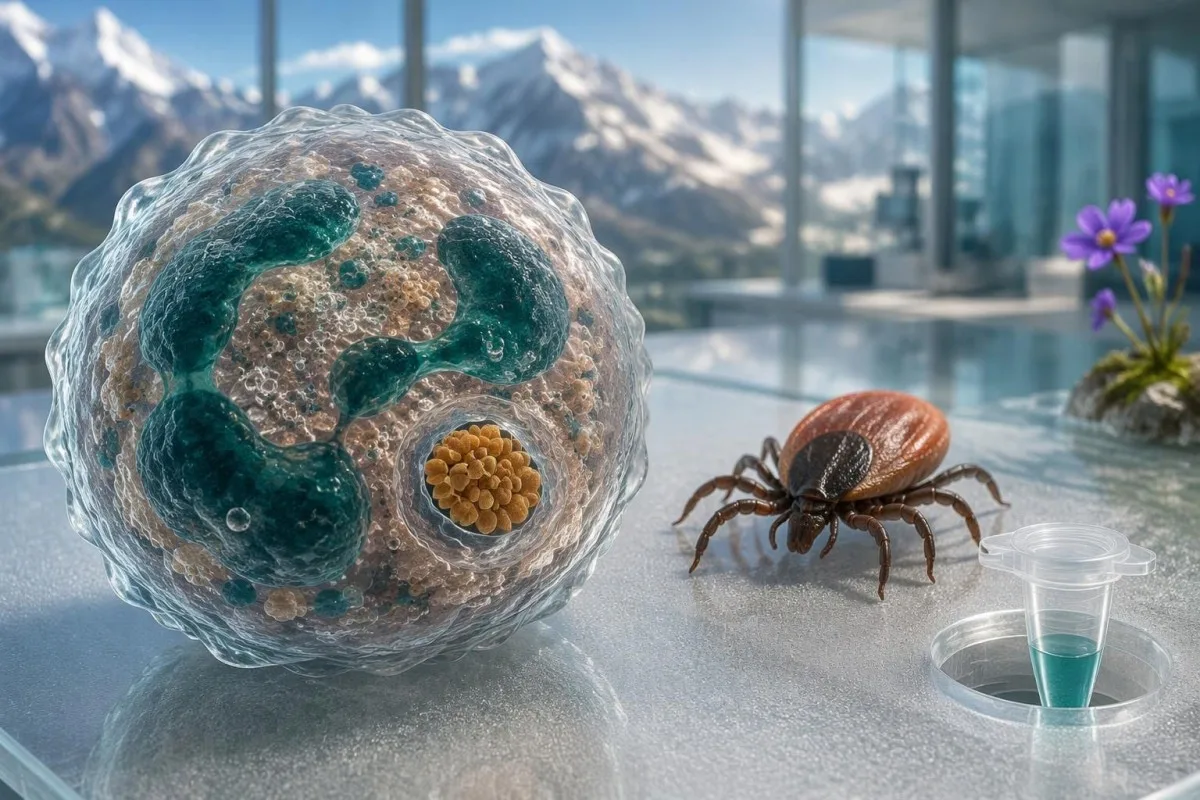
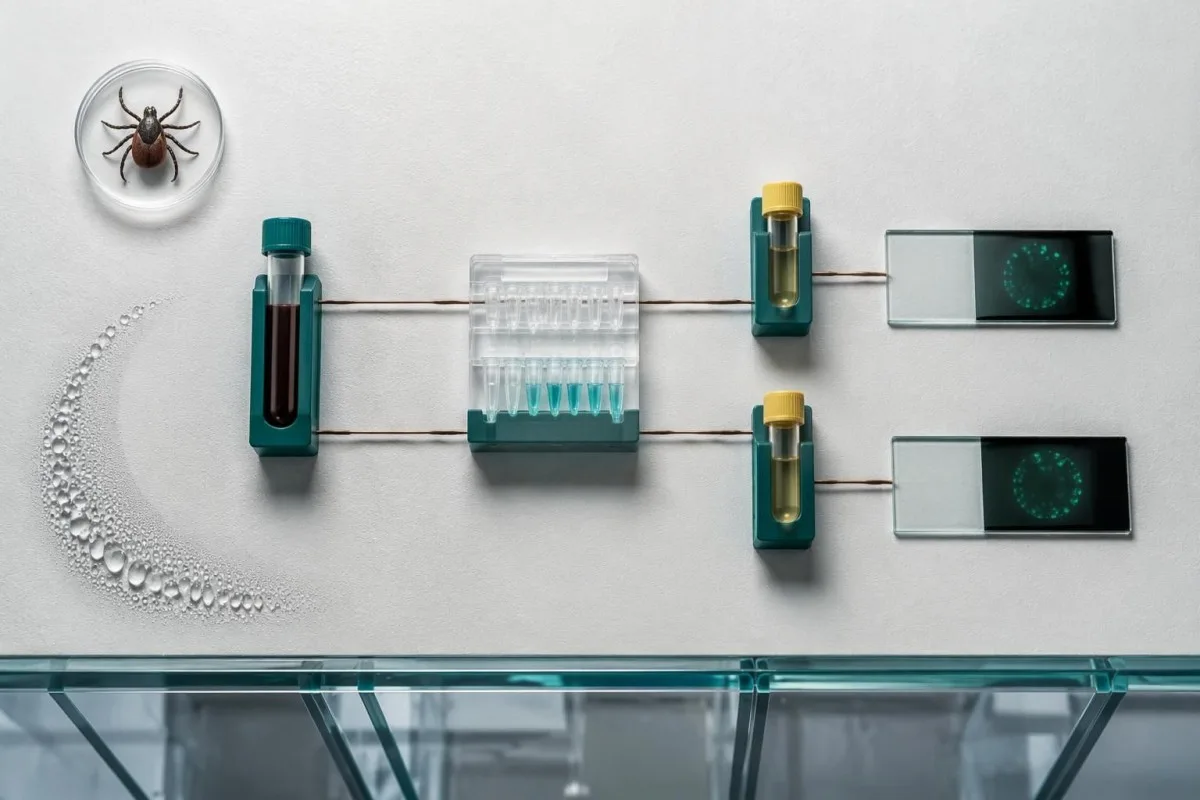
PCR detekuje původce; protilátky zaznamenávají imunitní odpověď. Porovnání obou výsledků s nástupem příznaků a načasováním antibiotické léčby vysvětluje zdánlivé rozpory.

Klíčová sdělení
- Včasná PCR je nejpřínosnější během prvního týdne onemocnění; pozitivní PCR z plné krve poskytuje jasný důkaz aktivní anaplazmózy.
- Časné protilátky mohou zůstat negativní během 1. týdne, takže pozitivní PCR při negativním IgG je očekávaný nález — nemusí jít o laboratorní chybu.
- Negativní PCR nevylučuje anaplazmózu, zejména po antibiotické léčbě; citlivost PCR se může snížit do 48 hodin od zahájení odpovídající léčby.
- Párové vzorky IgG se odebírají během prvních 2 týdnů onemocnění a znovu za 2–10 týdnů; čtyřnásobný vzestup podporuje potvrzení nedávné infekce.
- Jediný pozitivní nález IgG nemůže potvrdit novou infekci. Titr alespoň 1:128 je podle pokynů CDC podpůrným důkazem, nikoli samostatným pokynem k léčbě.
- Načasování léčby závisí na klinickém podezření, nikoli pouze na potvrzení. Pokud je podezření na anaplazmózu, lékaři by neměli odkládat podání doxycyklinu do obdržení výsledků.
- Jiná onemocnění přenášená klíšťaty vyžadují vlastní testy. PCR na Anaplasma netestuje lymskou boreliózu, babesiózu, ehrlichiózu ani horečku Skalistých hor.
- Naléhavé příznaky například zmatenost, potíže s dýcháním, nové krvácení nebo výrazně snížené močení vyžadují neodkladné vyšetření, nikoli čekání na opakovaný odběr.
Proč se mohou časné výsledky PCR a testů na protilátky lišit?
Výsledky testů na anaplazmózu se mohou lišit, protože PCR detekuje bakteriální DNA, zatímco IgG detekuje imunitní odpověď, která se rozvíjí později. Během prvního týdne může být PCR pozitivní a protilátky negativní; po léčbě může být PCR negativní, zatímco hladina IgG stoupá, a při podezření na infekci může být nutné zahájit léčbu ještě před laboratorním potvrzením.
Anaplasma phagocytophilum způsobuje lidskou granulocytární anaplazmózu a postihuje především neutrofily, což je druh bílých krvinek. Příznaky obvykle začínají 5–14 dní po přisátí infikovaného klíštěte, ale mnoho lidí si klíštěte nikdy nevšimne; užitečné laboratorní počítání času začíná prvním dnem onemocnění, nikoli nejistým datem expozice.
Výsledek odebraný 3. den nemoci odpovídá na jinou otázku než výsledek odebraný 24. den, přestože oba nálezy uvádějí Anaplasma. Srovnání PCR v reálném čase publikované v časopise Journal of Clinical Microbiology zjistilo, že diagnostická výtěžnost závisela na načasování v průběhu nemoci, což vysvětluje, proč je třeba interpretovat přímou detekci a sérologii společně, nikoli je řadit jako zaměnitelné testy (Schotthoefer et al., 2013).
Kantesti je Analyzátor krevních testů AI který může pomoci vysvětlit vztah mezi nálezem Anaplasma a souvisejícími výsledky CBC nebo jaterních testů, ale samotné číselné hodnoty nemohou stanovit diagnózu. Pro užitečnou interpretaci uveďte 3 údaje: začátek příznaků, datum odběru vzorku a první dávku antibiotik; informace o naší organizace vysvětluje úlohu služby.
Co znamená pozitivní výsledek PCR na Anaplasma?
Pozitivní výsledek PCR na Anaplasma znamená, že test ve vzorku, který byl do laboratoře zaslán, detekoval DNA bakterie Anaplasma. U osoby s odpovídajícím akutním onemocněním je pozitivní PCR z plné krve specifická pro daný druh jasným důkazem aktivní anaplazmózy; neměří hladinu protilátek, neurčuje závažnost onemocnění ani neidentifikuje všechny možné souběžné infekce přenášené klíšťaty.

Plná krev s EDTA se běžně používá pro PCR na Anaplasma, protože mikroorganismus je spojen s cirkulujícími buněčnými složkami. Vzorek séra na protilátky není automaticky přijatelnou náhradou: než budete interpretovat 2 zdánlivě protichůdné výsledky, ověřte, že laboratoř obdržela vzorek požadovaný pro každý test a že jsou správně zaznamenána data obou odběrů.
Hypotetický nález 'detekována DNA A. phagocytophilum' 4. den nemoci, při horečce a klesajícím počtu krevních destiček, výrazně podporuje klinickou diagnózu. Nález uvádějící pouze 'detekován druh Anaplasma' může pocházet z širšího testu, proto záleží na přesném cíli; zeptejte se, zda výsledek konkrétně identifikuje A. phagocytophilum, nebo zda je třeba další laboratorní upřesnění.
Kvalitativní PCR není skóre bakteriální nálože. I když nález uvádí hodnotu prahu cyklu, neexistuje univerzální práh pro Anaplasma, který by předpovídal nutnost hospitalizace nebo určoval délku léčby; naše vysvětlení kvalitativní versus kvantitativní výsledky pomáhá odlišit detekci od standardizovaného měření koncentrace.
Kdy je PCR na Anaplasma nejpřínosnější?
PCR na Anaplasma je nejcitlivější během prvního týdne nemoci, než vhodná antibiotika sníží množství cirkulující bakteriální DNA. Pokyny CDC uvádějí, že citlivost klesá během 48 hodin od podání vhodných antibiotik; jde o snížení diagnostické výtěžnosti, nikoli o záruku, že každý léčený vzorek bude ve stejnou chvíli negativní.

Odeberte vzorek na PCR před léčbou, pokud to lze provést okamžitě, nikdy však neodkládejte nezbytnou léčbu kvůli zajištění odběru. For example, a sample collected on day 5 before the first doxycycline dose is generally more informative than one collected on day 7 after several doses; the MMWR guideline explicitly prioritizes prompt treatment over waiting for confirmation (Biggs et al., 2016).
The 48-hour statement does not apply equally to every antibiotic a person may have taken. A prior course of an antibiotic that does not reliably treat anaplasmosis cannot be assumed to have the same effect as doxycycline; record the drug name, dose, and dose times rather than writing only 'already on antibiotics.'
If the first PCR was collected after 3 days of doxycycline, a negative result should be interpreted with that limitation visible on the report review. Repeating PCR without changing the timing problem may add little; arranging convalescent IgG may be more informative, and a dated blood test timeline prevents treatment-related changes from being mistaken for contradictory evidence.
Co znamená pozitivní výsledek IgG na Anaplasma?
The anaplasma IgG positive meaning is evidence of an antibody response, not automatic proof of a current infection. A single IgG result may reflect recent illness, previous exposure, or cross-reactivity; CDC considers a single titer of at least 1:128 supportive laboratory evidence, while confirmation usually requires the clinical picture and direct detection or paired serology.

Anaplasma IgG can remain elevated for months, and high titers have been reported up to 4 years after illness. Persistently positive antibodies in a well person do not by themselves justify another antibiotic course; the relevant question is whether there is a new compatible illness, a new exposure, or evidence that the antibody level has changed meaningfully.
In some areas, approximately 5–10% of healthy people may have elevated Anaplasma antibodies because of previous exposure or related organisms, according to CDC testing guidance. That estimate is geographically dependent, not a universal false-positive rate; a low positive in someone with no fever or plausible tick exposure carries a different meaning from the same result during an acute illness.
Kantesti treats 1 positive antibody result as a finding to explain, not a diagnosis to announce. The distinction between immune memory and active disease is covered in interpretaci pozitivních výsledků protilátek; unlike some vaccine antibody tests, Anaplasma IgG does not provide an established protective-immunity threshold.
Jak párové vzorky IgG potvrzují nedávnou infekci?
Paired Anaplasma IgG testing compares an acute specimen from the first 2 weeks of illness with a convalescent specimen collected 2–10 weeks later. A fourfold rise in IgG titer by indirect fluorescent antibody testing is evidence of seroconversion and helps confirm recent infection when the early result was negative or PCR was unavailable.

A rise from 1:64 to 1:256 is fourfold; a rise from 1:128 to 1:256 is only twofold. In a hypothetical case, an illness-day-4 titer of 1:64 and a day-28 titer of 1:256 would meet the fourfold criterion, while the smaller increase would not independently confirm infection by that criterion.
Titers are reciprocal dilutions, not concentrations in mg/dL or arbitrary screen-index units. If the acute report gives an index of 1.4 and the later report gives a titer of 1:256, a fourfold change cannot be calculated directly; use the same laboratory and method where possible, and ask whether archived samples can be compared together.
Antibody responses may be weaker or delayed in people receiving immunosuppressive treatment. A person taking B-cell-depleting therapy, for example, may not produce the expected rise over 2 samples, so clinicians may rely more heavily on PCR, clinical findings, and exposure history; IgG, IgA, and IgM patterns can provide background context but do not replace organism-specific testing.
Proč jsou IgM a zkříženě reagující protilátky nespolehlivé?
Anaplasma IgM is not a reliable stand-alone marker of recent anaplasmosis, and antibodies can cross-react with related Ehrlichia organisms. When both illnesses are plausible, clinicians may request 2 separate organism-specific PCR tests and side-by-side IgG testing; dual antibody positivity does not automatically establish 2 active infections.

IgM does not consistently mean 'new infection' in anaplasmosis. An isolated IgM positive result with negative IgG and negative PCR is therefore insufficient confirmation, particularly if it was obtained on day 2 of a nonspecific illness; the recommended serologic approach is paired IgG interpreted alongside symptoms and the direct-detection window.
Anaplasma phagocytophilum and Ehrlichia species are different organisms, despite overlapping fever, headache, cytopenias, and antibody cross-reactivity. A positive Ehrlichia antibody assay does not substitute for an Anaplasma PCR result; our guide to ehrlichiosis PCR and titers explains why testing for each target matters when 2 diagnoses remain plausible.
Babesia requires separate assessment because doxycycline does not treat babesiosis. In a patient with anemia, elevated LDH, low haptoglobin, or persistent fever after 48 hours of appropriate anaplasmosis treatment, clinicians may consider Babesia PCR or a manually reviewed smear; protilátkách proti babesiím versus infekci explains why an antibody result alone can also mislead.
Může jít o anaplazmózu i při negativních výsledcích?
An anaplasmosis test false negative is possible when antibodies are checked too early or PCR is collected after its best detection window or after treatment. Negative PCR plus negative IgG during week 1 does not reliably exclude the illness; clinicians must weigh exposure, symptoms, CBC changes, liver enzymes, and the timing of both tests.
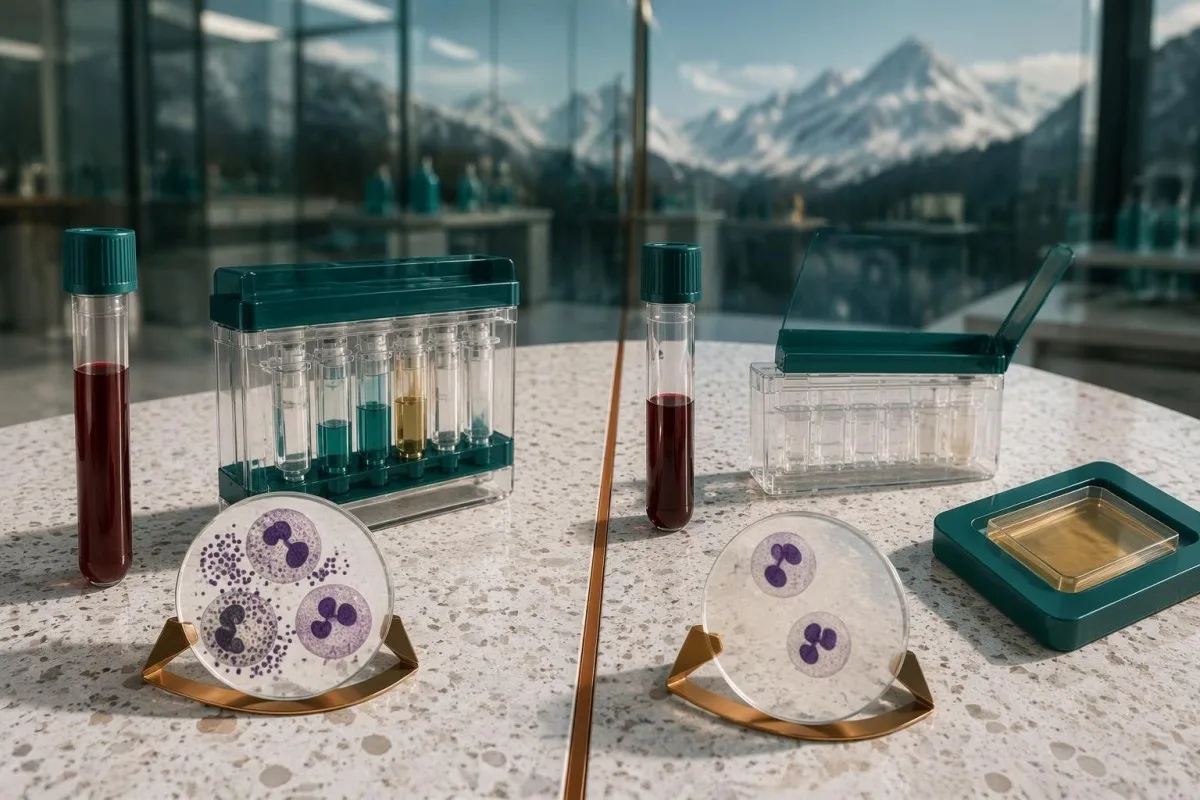
There is no single dependable false-negative percentage for every Anaplasma test. PCR assays differ, studies use different reference standards, and patients present on different illness days; a sensitivity estimate from untreated day-3 specimens cannot simply be applied to a day-9 sample obtained after 4 days of doxycycline (Schotthoefer et al., 2013).
A hypothetical person has fever, platelets of 78 × 10^9/L, a WBC of 2.9 × 10^9/L, and recent woodland exposure, but both tests are negative on illness day 4. That pattern leaves substantial clinical concern even without confirmation; by contrast, the same negative tests in a well person with normal counts and no plausible exposure answer a much lower-risk question.
Kantesti je platforma pro rozbor krevních výsledků AI that can explain why 2 negative tests may be limited by their collection dates, but it cannot determine whether antibiotics are needed. Our přístup k klinické validaci popisuje ochranná opatření při interpretaci, zatímco checking report source details helps readers verify specimen type, method, and reference comments before relying on a summary.
Které nálezy v CBC a jaterní testy podporují diagnózu?
Low white blood cells, low platelets, and raised AST or ALT commonly support suspicion of anaplasmosis, but none is diagnostic alone. Many adult laboratories use WBC reference intervals around 4.0–11.0 × 10^9/L and platelet intervals around 150–450 × 10^9/L; use the ranges printed on your own report.
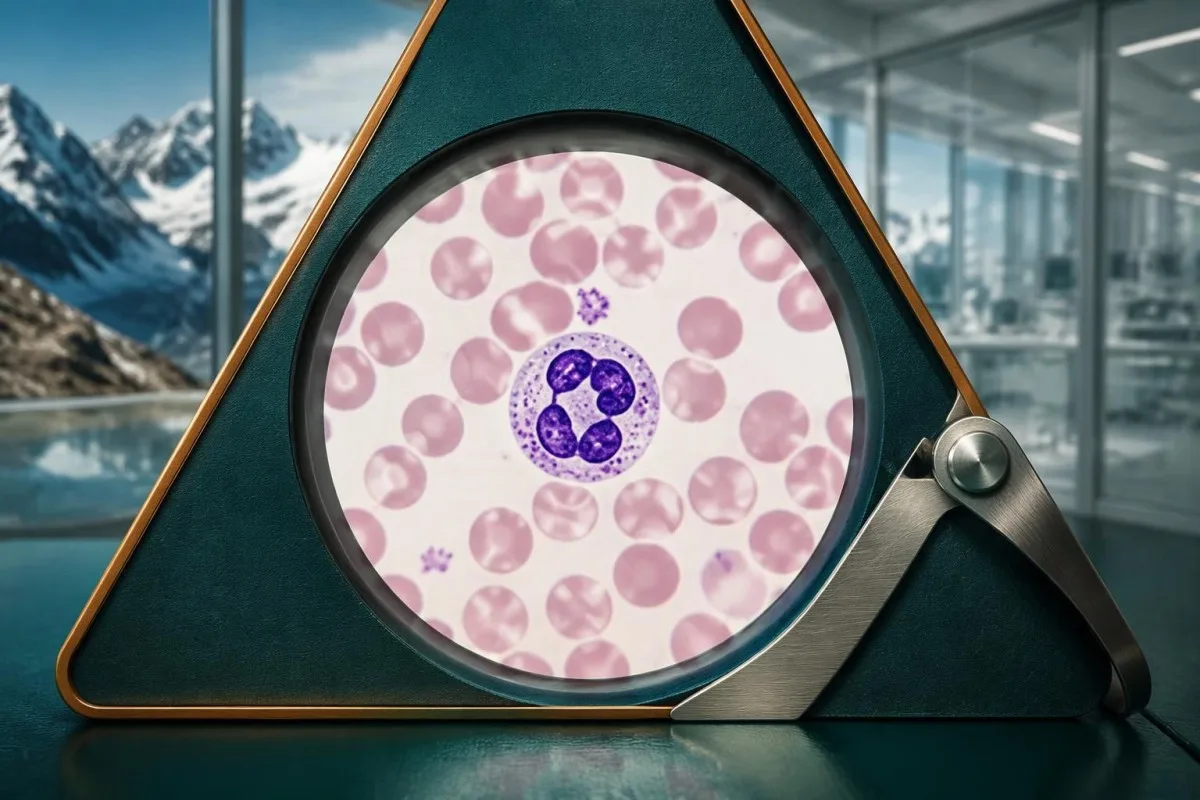
A falling platelet count can be more informative than one mildly low result. A hypothetical decline from 182 to 84 × 10^9/L over 3 days during fever suggests an acute process, whereas a stable count of 138 × 10^9/L for years has a different context; plateletcrit and platelet count are related measurements, but plateletcrit is not an Anaplasma diagnostic test.
AST and ALT indicate cellular injury rather than identifying the organism. An AST of 84 IU/L is approximately 2.1 times an upper limit of 40 IU/L, but muscle injury, other infections, and medication effects can also produce that result; what ALT measures helps distinguish supportive liver findings from proof of a specific cause.
Morulae are clusters of organisms that may be visible inside granulocytes during the first week. Their absence does not exclude anaplasmosis, and their presence is not reliably species-specific because some Ehrlichia organisms can also affect granulocytes; manual microscopy can provide a fast clue, but PCR is needed for clearer organism identification (Bakken and Dumler, 2015).
| Úroveň | Rozmezí | Co to znamená |
|---|---|---|
| Běžné rozmezí WBC u dospělých | 4,0–11,0 × 10^9/l | Laboratory-dependent reference interval; a normal WBC does not exclude early anaplasmosis. |
| WBC below the local interval | Often <4.0 × 10^9/L | Leukopenia supports suspicion during a compatible acute illness but has many other causes. |
| Common adult platelet interval | 150–450 × 10^9/l | Check the local interval and previous results before interpreting a borderline value. |
| Platelets below the local interval | Often <150 × 10^9/L | Thrombocytopenia is a supportive clue; rapid decline and symptoms determine urgency. |
Jak se testy na Anaplasma liší od testů na jiná onemocnění přenášená klíšťaty?
Anaplasma PCR, Lyme serology, Babesia testing, Ehrlichia PCR, and spotted-fever serology detect different targets and cannot substitute for one another. A laboratory panel tests only the organisms explicitly listed; a negative result for 1 target is not a negative result for all tick-borne illnesses.
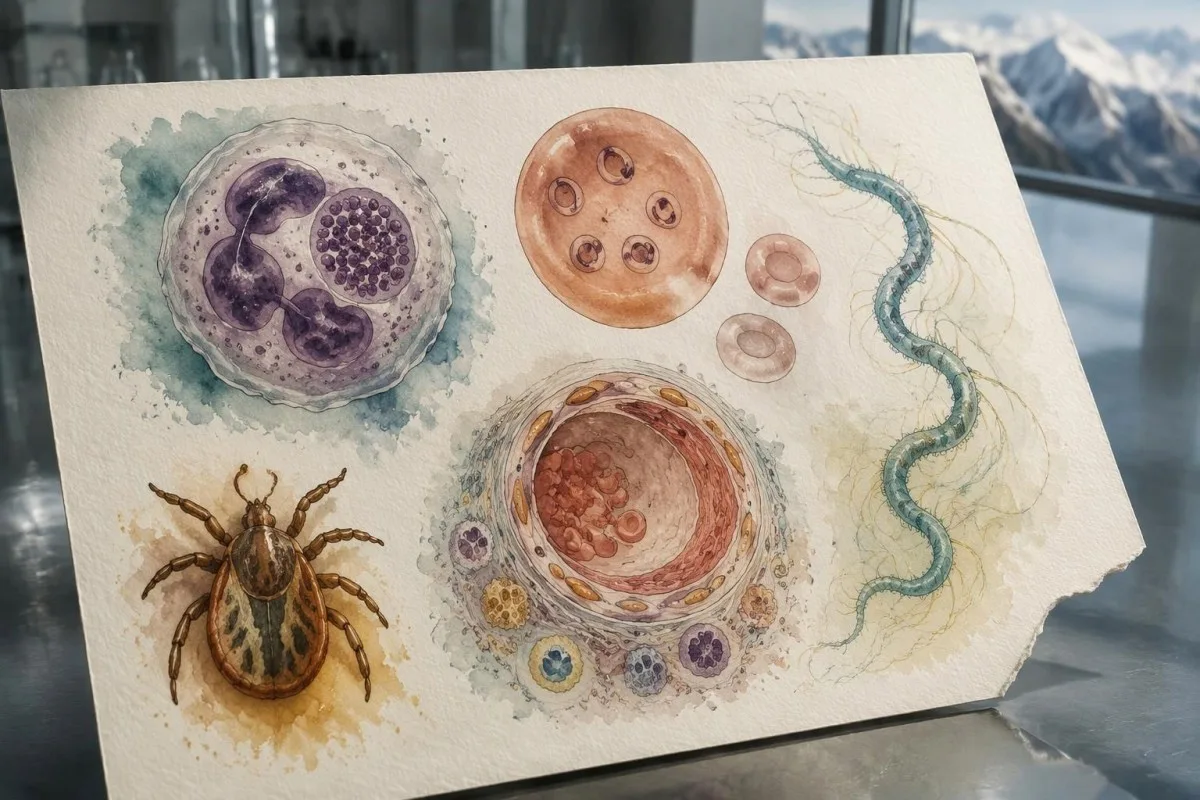
Lyme disease is usually evaluated with a validated two-tier antibody algorithm when testing is indicated. A classic expanding erythema migrans rash can be diagnosed clinically without waiting for positive antibodies, while marked leukopenia or thrombocytopenia should raise concern for an additional diagnosis; an Anaplasma PCR result does not answer either of these 2 Lyme questions.
Rocky Mountain spotted fever may have negative early serology, and whole-blood PCR is less reassuring when negative than it is for some circulating-cell infections. Rash appearance and specimen choice matter, but absence of rash does not make waiting safe; spotted-fever testing windows explains why the Anaplasma PCR window cannot simply be transferred to that illness.
Alpha-gal syndrome is a tick-associated allergy, not an Anaplasma infection. Delayed allergic symptoms roughly 2–6 hours after mammalian meat exposure require an allergy-focused history and appropriate IgE testing rather than PCR or paired Anaplasma IgG; alpha-gal IgE interpretation illustrates how one exposure category can lead to very different diagnostic pathways.
Proč může léčba začít ještě před potvrzením diagnózy?
Suspected anaplasmosis should be treated promptly because early tests can be negative and delayed therapy can allow severe illness to develop. The MMWR guideline recommends that clinicians neither delay treatment while awaiting laboratory results nor withhold treatment because an early test is negative; the usual adult doxycycline dose is 100 mg every 12 hours (Biggs et al., 2016).
CDC recommends doxycycline for anaplasmosis in adults and children of all ages. For children weighing less than 45 kg, the usual dose is 2.2 mg/kg every 12 hours, with a maximum of 100 mg per dose; these are clinician-prescribed regimens, not instructions to start leftover medication or adjust a child's dose without assessment.
Treatment commonly lasts 10–14 days to provide coverage for possible concurrent Borrelia infection. Duration still depends on the suspected coinfections and clinical course, so an improving fever after 2 doses is not a reason to stop early; pregnancy, severe drug allergy, vomiting, or organ dysfunction require individualized decisions, sometimes with infectious-disease input.
Starting doxycycline is a clinical decision based on exposure, symptoms, examination, and the overall pattern—not on a single CRP or WBC cutoff. A WBC of 3.0 × 10^9/L during acute fever may strengthen concern even when CRP is only modestly raised; nesourodá infekce krevní markery explains why one reassuring-looking number should not overrule the complete assessment.
Jaká odpověď na léčbu se očekává a kdy je nutná neodkladná péče?
Fever from anaplasmosis usually improves within 24–48 hours of doxycycline, but severe illness may take longer. Difficulty breathing, confusion, new bleeding, fainting, or markedly reduced urination requires emergency assessment; failure to improve is a reason for reassessment, not an instruction to increase the antibiotic dose yourself.
Persistent fever beyond about 48 hours should prompt review of the diagnosis, medication delivery, and possible coinfections. The person may not be absorbing oral treatment because of vomiting, may have an additional illness such as babesiosis, or may have developed a complication; the interval is a practical reassessment point rather than an absolute recovery deadline.
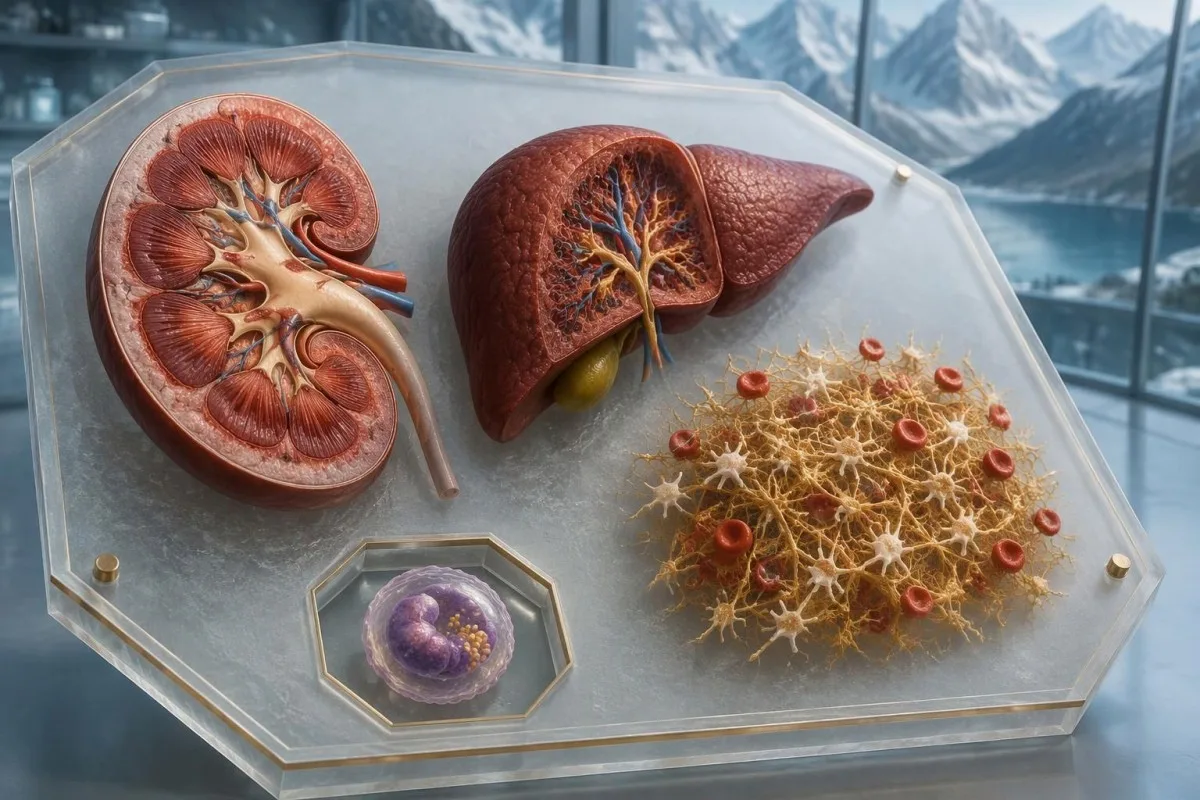
Severe anaplasmosis can involve respiratory failure, kidney injury, or coagulation abnormalities. Falling platelets accompanied by rising creatinine, prolonged clotting times, or new bleeding should not be dismissed as a routine CBC fluctuation; disseminated coagulation laboratory patterns explains why 2 or more changing systems can signal a problem beyond an isolated low count.
Clotting tests assess complications rather than confirming Anaplasma itself. For example, an INR of 1.8 in someone not taking warfarin needs explanation in context, but does not establish anaplasmosis or DIC on its own; our průvodce interpretací koagulačních testů helps separate PT, aPTT, D-dimer, and platelet findings without treating them as interchangeable measurements.
Má se po léčbě PCR nebo test na protilátky opakovat?
Routine PCR or IgG testing is generally not needed to prove cure after clinically successful anaplasmosis treatment. A convalescent IgG sample collected 2–10 weeks after the acute sample can document the diagnosis, but persistent antibodies alone do not demonstrate treatment failure and should not trigger repeated antibiotics in a well person.

A persistently positive IgG is not a test-of-cure result. If a person is well after a completed 10–14-day course, an elevated titer may simply reflect immune memory; if symptoms recur, clinicians should reassess the new symptoms and exposure history rather than assume that the old antibody result proves persistent infection.
CBC, creatinine, and liver enzymes may be repeated when they were abnormal or the illness was severe, but there is no universal day-7 retesting schedule for everyone. Kantesti AI can help organize serial results—for example, platelets rising from 82 to 164 × 10^9/L—while přehled trendů bezpečnosti medikace explains why recovery patterns still require clinical context.
Antibiotic prophylaxis after a tick bite is not recommended specifically to prevent anaplasmosis. After an asymptomatic bite, monitor for fever or other illness over the following 2 weeks and obtain medical advice if symptoms appear; a separate Lyme prophylaxis decision, when indicated, should not be mistaken for an Anaplasma prevention protocol.
Jak bezpečně uspořádat nejasnou laboratorní zprávu?
The safest report review separates organism detection, antibody evidence, supportive blood findings, and clinical timing into 4 distinct questions. Record the assay target, specimen type, result format, collection date, symptom-onset date, and antibiotic start; missing context should remain explicitly unknown rather than being filled in by an AI explanation.

Kantesti je službě pro interpretaci výsledků laboratorních testů AI that can explain uploaded laboratory reports and help readers identify questions for their clinician. In a hypothetical 2-report review, our AI should distinguish 'PCR not detected after treatment' from 'paired IgG rise consistent with recent infection,' rather than flattening both statements into a single positive-or-negative label.
An upload is not a substitute for urgent assessment. A photo showing platelets of 74 × 10^9/L cannot reveal whether the person is confused, dehydrated, pregnant, or short of breath; our technologie interpretace AI describes the analytical workflow, but clinical observations and prescribing decisions remain outside what the report alone can establish.
Before sharing 2 samples, check that both belong to the same person and remove identifiers if they are not needed for your purpose. Kantesti does not perform Anaplasma PCR, validate specimen handling, or confirm that an uploaded titer used the same laboratory method; retain the original PDF and ask the laboratory to resolve unclear assay comments or mismatched result units.
Které důkazy by měly určovat další postup?
Anaplasmosis testing decisions should follow condition-specific guidance and diagnostic research, not general blood-test publications. The 2016 MMWR guideline, the 2013 PCR comparison, and the 2015 clinical review support the distinction between early direct detection, later antibody confirmation, and treatment based on clinical suspicion rather than a single laboratory result.

Bring 3 questions to the clinical review: was PCR collected early enough, is paired IgG needed, and do other tick-borne targets require separate testing? If the first specimen followed several doxycycline doses, say so; if the report is a single low-positive IgG, ask what evidence supports current illness before assuming that another antibiotic course is required.
At Kantesti, we distinguish externally published medical evidence from our own educational resources. Our standardy zdravotnického obsahu explain that distinction; the 2 Figshare publications listed below are supplementary general laboratory and digestive-health guides, not studies establishing Anaplasma assay accuracy, treatment efficacy, or diagnostic thresholds.
The general hematology guide can help explain LDH and reticulocyte results when anemia raises a separate concern such as hemolysis. Use the hematology marker background guide for that limited purpose, not to interpret Anaplasma PCR; a 4-fold IgG rise, a positive organism-specific PCR, and the patient's clinical course each provide different kinds of evidence.
Často kladené dotazy
Může být PCR na Anaplasma pozitivní, i když jsou protilátky negativní?
PCR na Anaplasma může být během prvního týdne onemocnění pozitivní, zatímco protilátky IgG jsou negativní, protože bakteriální DNA může být detekovatelná ještě před rozvojem protilátkové odpovědi. Tento nález může svědčit pro aktivní anaplazmózu, nikoli pro laboratorní chybu. Akutní vzorek na IgG lze porovnat se vzorkem odebraným v rekonvalescenci o 2–10 týdnů později. Pokud je onemocnění klinicky podezřelé, léčba by se neměla odkládat do doby, než dojde k sérokonverzi.
Znamená pozitivní IgG proti anaplazmě, že potřebuji antibiotika?
Jediný pozitivní výsledek testu na IgG proti anaplazmě automaticky neznamená, že jsou zapotřebí antibiotika, protože protilátky mohou svědčit o předchozí expozici nebo zkřížené reaktivitě. CDC považuje jediný titr alespoň 1:128 za podpůrný důkaz, nikoli však za definitivní potvrzení nové infekce. Hladiny protilátek mohou zůstat zvýšené po celé měsíce; vysoké titry byly zaznamenány až 4 roky po onemocnění. Lékaři zakládají léčbu na aktuálních příznacích, expozici, výsledcích PCR a výsledcích vyšetření párových vzorků protilátek, nikoli pouze na přetrvávajících IgG.
Za jak dlouho může doxycyklin způsobit negativitu PCR na anaplazmata?
Anaplasma PCR sensitivity can decrease within 48 hours of appropriate antibiotic treatment, according to CDC guidance. That does not mean every person's PCR becomes negative at exactly 48 hours, because assay performance and circulating organism levels differ. A negative PCR collected after treatment is therefore less reassuring than a well-timed pretreatment result. Record the first doxycycline dose and specimen collection time so the clinician can interpret the result correctly.
Co se považuje za čtyřnásobný vzestup protilátek proti anaplazmě?
A rise in Anaplasma IgG titer from 1:64 to 1:256 is fourfold, while a rise from 1:128 to 1:256 is only twofold. Paired testing generally compares an acute specimen from the first 2 weeks of illness with a convalescent specimen collected 2–10 weeks later. The comparison should use compatible methods, ideally the same laboratory's IgG indirect fluorescent antibody assay. An antibody screen index cannot be directly converted into a dilution titer for this calculation.
Mohu mít anaplazmózu, pokud jsou PCR i IgG negativní?
Anaplazmóza může být přítomna i při negativním výsledku PCR i IgG, zejména pokud byl vzorek na IgG odebrán během 1. týdne a vzorek na PCR až po podání vhodných antibiotik. Horečka, pravděpodobná expozice klíšťatům, nízký počet krevních destiček, nízký počet bílých krvinek a zvýšené jaterní enzymy mohou navzdory negativním testům udržovat klinické podezření. Lékaři mohou zajistit odběr rekonvalescentního vzorku na IgG za 2–10 týdnů po akutním vzorku a posoudit další možné diagnózy. Při podezření na anaplazmózu by se léčba neměla odkládat pouze kvůli negativním výsledkům časných testů.
Jak rychle by se měly příznaky zlepšit a potřebuji kontrolní test?
Horečka způsobená anaplazmózou obvykle ustupuje během 24–48 hodin od zahájení léčby doxycyklinem, těžké onemocnění však může vyžadovat delší dobu. Přetrvávající horečka by měla vést k opětovnému posouzení možných problémů se vstřebáváním léku, jiné diagnózy, koinfekce nebo komplikací. Rutinní vyšetření PCR ani protilátek obvykle není po úspěšné léčbě nutné k potvrzení vyléčení; párové IgG se používá především k doložení nedávné infekce. Potíže s dýcháním, zmatenost, nové krvácení nebo výrazně snížené močení vyžadují neodkladné vyšetření bez ohledu na laboratorní výsledek.
Nechte si vysvětlit výsledky krevních testů
Nahrajte svou laboratorní zprávu a AI Kantesti během několika sekund vysvětlí jednotlivé biomarkery srozumitelným jazykem. Používá ji více než 2 miliony lidí na celém světě.
Reference
- Klein, T., Mitchell, S. & Weber, H. (2026). Průvodce krevní skupinou B Rh negativní, krevním testem LDH a počtem retikulocytů. Lékařský výzkum AI Kantesti. DOI
- Klein, T., Mitchell, S. & Weber, H. (2026). Průjem po půstu, černé tečky ve stolici a průvodce gastrointestinálním traktem 2026. Lékařský výzkum AI Kantesti. DOI
- Biggs HM a kol. (2016). Diagnostika a léčba rickettsiových onemocnění přenášených klíšťaty: skvrnitá horečka Skalistých hor a další rickettsiózy ze skupiny skvrnitých horeček, ehrlichióza a anaplazmóza — Spojené státy. Doporučení a zprávy MMWR. DOI PubMed
- Schotthoefer AM et al. (2013). Comparison of a real-time PCR method with serology and blood smear analysis for diagnosis of human anaplasmosis: importance of infection time course for optimal test utilization. Journal of Clinical Microbiology. DOI
- Bakken JS and Dumler JS (2015). Human granulocytic anaplasmosis. Infectious Disease Clinics of North America.
- 2 miliony+Analyzovaná vyšetření
- 127+země
- 100+Jazyky
O lékařském týmu


Signály důvěry E-E-A-T
Zažít
Lékařem vedená klinická revize pracovních postupů pro interpretaci laboratorních výsledků.
Odbornost
Zaměření laboratorní medicíny na to, jak se biomarkery chovají v klinickém kontextu.
Autoritativnost
Lékařskou kontrolu provedl Dr. Thomas Klein, s přispěním Dr. Sarah Mitchell a prof. Dr. Hanse Webera.
Důvěryhodnost
Interpretace založená na důkazech s jasnými následnými kroky pro snížení poplachu.






Lékařské upozornění
Tento článek je pouze pro vzdělávací účely a nepředstavuje lékařské poradenství. Pro rozhodnutí o diagnóze a léčbě se vždy poraďte s kvalifikovaným poskytovatelem zdravotních služeb.
Publikováno · Kontaktujte redakční tým
Vydává Kantesti Ltd, registrovaná v Anglii a Walesu, číslo společnosti. 17090423, Londýn, Spojené království.
