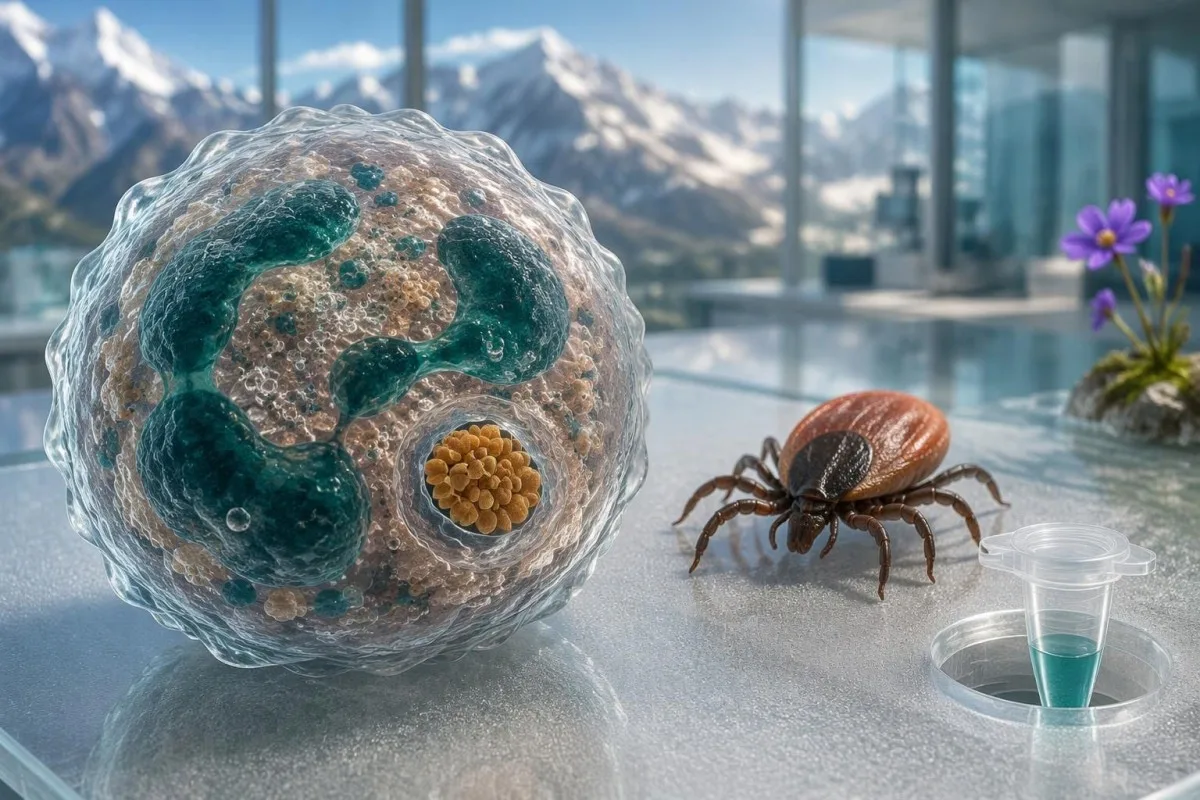
Lorgaidh PCR an t-orgánachas; clàraichidh antibodies freagairt an t-siostaim dìona. Le bhith a’ co-fhreagairt an dà thoradh ri toiseach nan comharraidhean agus àm nan antibiotaicean, mìnichear na contrarrachdan a tha coltach ris.

Prìomh phuingean
- PCR tràth tha e as fheumaile rè a’ chiad seachdain den tinneas; tha PCR dearbhach ann am fuil slàn na fhianais shoilleir air anaplasmosis ghnìomhach.
- Antibodies tràtha faodaidh iad fuireach àicheil rè seachdain 1, agus mar sin tha PCR dearbhach le IgG àicheil na phàtran ris a bheil dùil—chan e mearachd obair-lann a th’ ann gu feum.
- PCR àicheil chan eil e a’ dùnadh a-mach anaplasmosis, gu h-àraidh às dèidh antibiotaicean; faodaidh mothalachd PCR lùghdachadh taobh a-staigh 48 uairean bho thòisicheas làimhseachadh iomchaidh.
- Sampallan IgG càraideach thèid an cruinneachadh rè a’ chiad 2 sheachdain den tinneas agus a-rithist 2–10 seachdainean às a dhèidh; tha àrdachadh ceithir-fhillte a’ cur taic ri dearbhadh gur e galar a thachair o chionn ghoirid a th’ ann.
- Aon IgG dearbhach chan urrainn dha galar ùr a dhearbhadh. Tha titer de 1:128 co-dhiù na fhianais thaiceil fo stiùireadh an CDC, chan e stiùireadh làimhseachaidh leis fhèin.
- Àm an làimhseachaidh an urra ri amharas clionaigeach, chan ann ri dearbhadh a-mhàin. Cha bu chòir do luchd-clionaigeach dàil a chur air doxycycline fhad ’s a tha iad a’ feitheamh ri toraidhean nuair a tha amharas ann air anaplasmosis.
- Tinneasan eile a tha air an giùlan le breaban feumaidh iad na deuchainnean aca fhèin. Cha dèan Anaplasma PCR deuchainn airson galar Lyme, babesiosis, ehrlichiosis no fiabhras spotach nan Rocky Mountains.
- Comharraidhean èiginneach leithid troimh-chèile, duilgheadas analach, fuil ùr no lùghdachadh mòr ann am maistreadh, feumar measadh èiginneach orra seach feitheamh ri sampall eile.
Carson a dh’fhaodas toraidhean tràtha PCR agus antibodies a bhith an aghaidh a chèile?
Faodaidh toraidhean deuchainn anaplasmosis a bhith eadar-dhealaichte oir tha PCR a’ lorg DNA bactaraidh, agus tha IgG a’ lorg freagairt dìonach a thig am bàrr nas anmoiche. Tron chiad seachdain, faodaidh PCR a bhith dearbhach agus antibodies àicheil; às dèidh làimhseachaidh, faodaidh PCR fàs àicheil fhad ’s a dh’èireas IgG, agus dh’fhaodadh gum bi feum fhathast air làimhseachadh airson galar a tha fo amharas mus tèid a dhearbhadh san obair-lann.
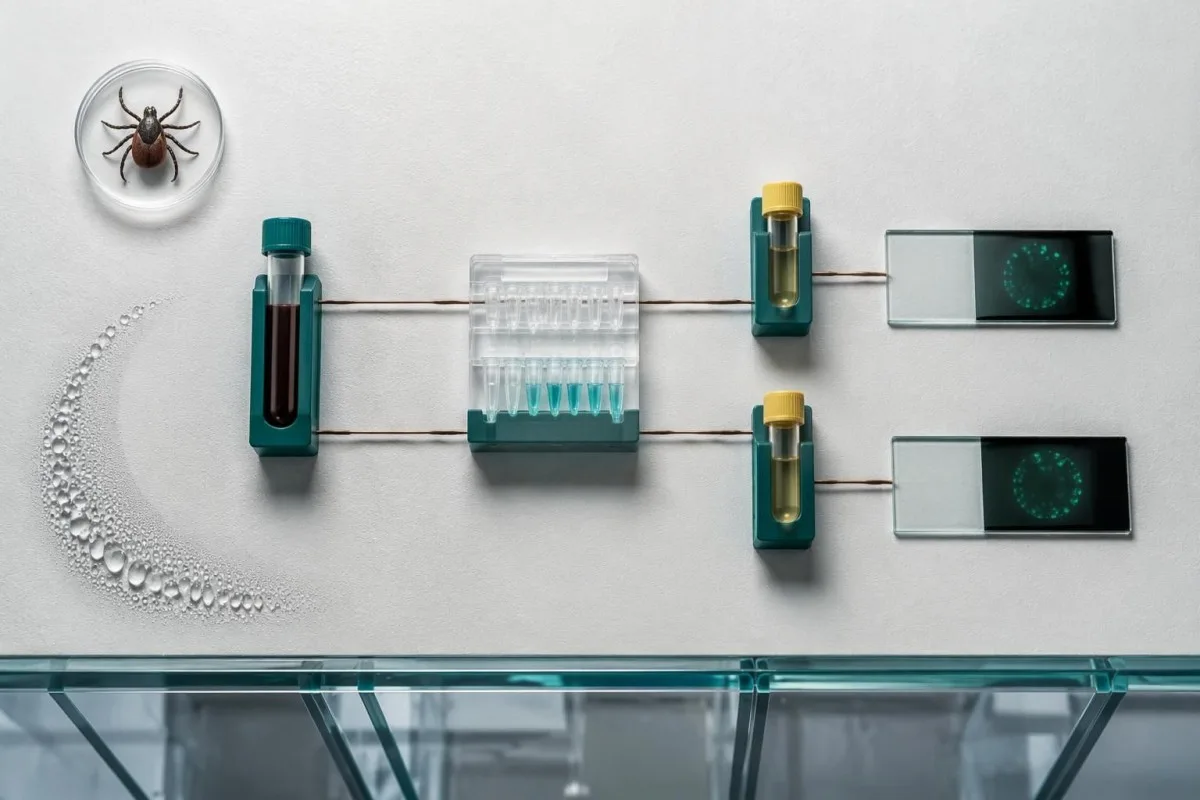
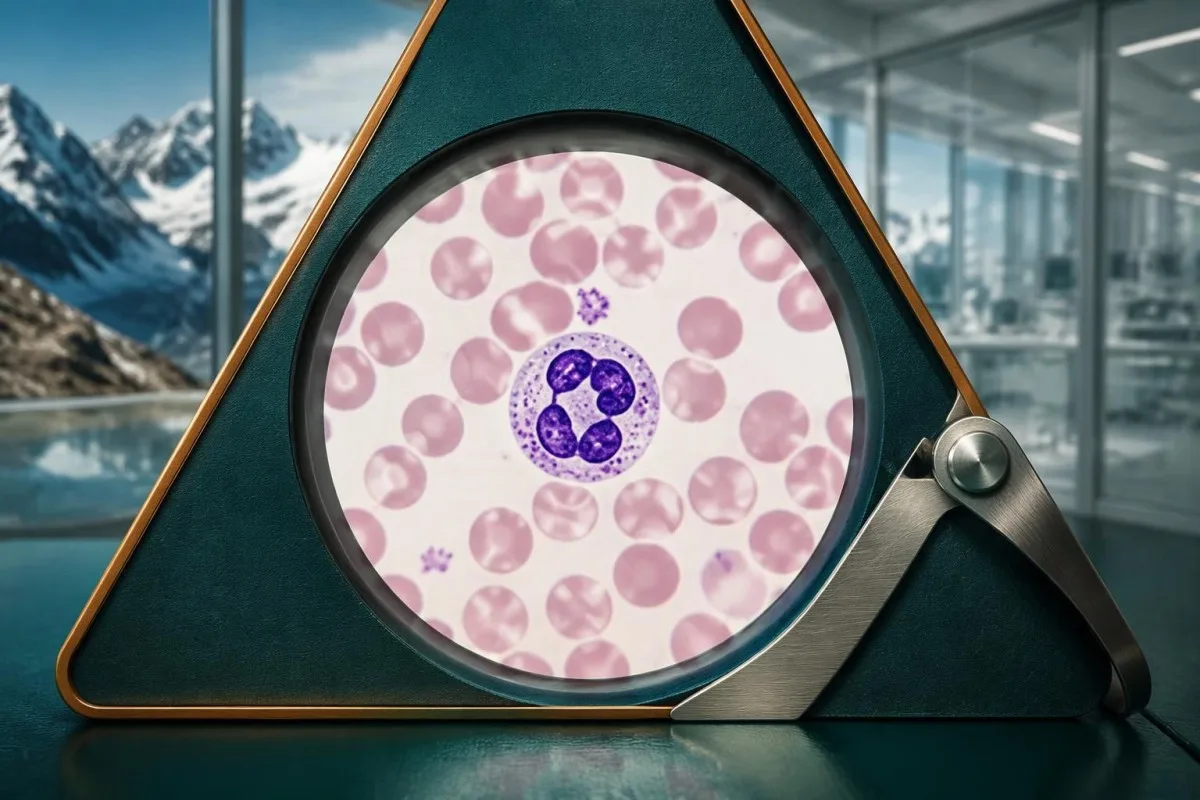
Anaplasma phagocytophilum ag adhbharachadh anaplasmosis granulocytic daonna agus a’ toirt buaidh sa mhòr-chuid air neutrophils, seòrsa de chealla fala gheal. Mar as trice tòisichidh na comharraidhean 5–14 latha às dèidh bìdeadh bho bhreab le galar, ach cha mhothaich mòran dhaoine a’ bhreab idir; tòisichidh an cunntas-ama feumail san obair-lann air a’ chiad latha den tinneas, chan ann air ceann-là neo-chinnteach an nochdaidh.
Tha toradh a chaidh a chruinneachadh air latha 3 den tinneas a’ freagairt ceist eadar-dhealaichte bho fhear a chaidh a chruinneachadh air latha 24, fiù ’s nuair a chanas an dà aithisg Anaplasma. Fhuair coimeas PCR fìor-ùine a chaidh fhoillseachadh anns an Journal of Clinical Microbiology gu robh an toradh breithneachail an urra ri àm a’ ghalair, rud a tha a’ mìneachadh carson a bu chòir lorg dìreach agus serology a mhìneachadh còmhla seach a bhith gam meas mar dheuchainnean eadar-mhalairteach (Schotthoefer et al., 2013).
Tha Kantesti na Anailisiche deuchainn fala AI a chuidicheas le bhith a’ mìneachadh a’ cheangail eadar aithisg Anaplasma agus toraidhean CBC no grùthan a tha na cois, ach chan urrainn dha am breithneachadh a dhearbhadh bho àireamhan a-mhàin. Airson mìneachadh feumail, thoir seachad 3 mion-fhiosrachadh: toiseach nan comharraidhean, ceann-là cruinneachadh an t-sampaill, agus a’ chiad dòs de antibiotic; fiosrachadh mu —àireamhan a tha cudromach oir tha iad a’ cruinneachadh, chan ann air sgàth ’s gu bheil luach sam bith fa leth a’ coimhead dràmadach. Aig a’ mìneachadh dreuchd na seirbheis.
Dè tha toradh dearbhach Anaplasma PCR a’ ciallachadh?
Tha toradh Anaplasma PCR dearbhach a’ ciallachadh gun do lorg an assay DNA Anaplasma anns an t-sampall a chaidh a chur a-steach. Ann an neach air a bheil tinneas geur a tha a’ freagairt ris a’ ghalar, tha PCR dearbhach sònraichte don ghnè ann am fuil iomlan na fhianais shoilleir air anaplasmosis ghnìomhach; chan eil e a’ tomhas ìrean antibody, a’ dearbhadh dè cho dona ’s a tha an tinneas, no a’ comharrachadh gach co-ghalar a dh’fhaodadh a bhith air a ghiùlan le breaban.

Fuil iomlan EDTA a thathar a’ cleachdadh gu tric airson Anaplasma PCR oir tha an t-organism co-cheangailte ri eileamaidean ceallach a tha a’ cuairteachadh san fhuil. Chan eil sampall serum airson antibodies gu fèin-obrachail na àite iomchaidh: mus mìnich thu 2 thoradh a tha coltach ri bhith an aghaidh a chèile, thoir sùil gun d’ fhuair an obair-lann an sampall a tha riatanach airson gach assay agus gun deach an dà cheann-là cruinneachaidh a chlàradh gu ceart.
Tha aithisg bharraichte ag ràdh 'A. phagocytophilum DNA detected' air latha 4 den tinneas, le fiabhras agus truinnsearan a' crìonadh, a' toirt taic làidir don bhreithneachadh clionaigeach. Dh’fhaodadh aithisg a tha ag ràdh dìreach ‘Anaplasma species detected’ tighinn bho assay nas fharsainge, agus mar sin tha an dearbh thargaid cudromach; faighnich a bheil an toradh ag aithneachadh A. phagocytophilum gu sònraichte no a bheil feum air soilleireachadh a bharrachd bhon obair-lann.
Chan e sgòr luchd bactaraidh a th’ ann am PCR càileachdail. Fiù ’s ma tha luach stairsnich chearcaill san aithisg, chan eil stairsneach Anaplasma uile-choitcheann ann a tha a’ ro-innse gum bi feum air ospadal no a’ dearbhadh fad an làimhseachaidh; tha am mìneachadh againn air toraidhean càileachdail an aghaidh toraidhean tomhasach a’ cuideachadh le dealachadh a dhèanamh eadar lorg agus tomhas dùmhlachd àbhaisteach.
Cuin a tha Anaplasma PCR as fheumaile?
Tha Anaplasma PCR as motha buailteach a bhith mothachail tron chiad seachdain den tinneas, mus lùghdaich antibiotics iomchaidh an DNA bactaraidh a tha a’ cuairteachadh san fhuil. Tha stiùireadh an CDC ag ràdh gu bheil mothalachd a’ lùghdachadh taobh a-staigh 48 uairean bho bhith a’ toirt seachad antibiotics iomchaidh; ’s e lùghdachadh ann an toradh breithneachail a tha seo, chan e gealladh gum fàs gach sampall a chaidh a làimhseachadh àicheil aig an aon àm.

Gabh an sampall airson PCR mus tòisich an làimhseachadh ma ghabhas sin dèanamh sa bhad, ach na cuir dàil gu bràth air làimhseachadh riatanach airson an tarraing fala a chur air dòigh. For example, a sample collected on day 5 before the first doxycycline dose is generally more informative than one collected on day 7 after several doses; the MMWR guideline explicitly prioritizes prompt treatment over waiting for confirmation (Biggs et al., 2016).
The 48-hour statement does not apply equally to every antibiotic a person may have taken. A prior course of an antibiotic that does not reliably treat anaplasmosis cannot be assumed to have the same effect as doxycycline; record the drug name, dose, and dose times rather than writing only 'already on antibiotics.'
If the first PCR was collected after 3 days of doxycycline, a negative result should be interpreted with that limitation visible on the report review. Repeating PCR without changing the timing problem may add little; arranging convalescent IgG may be more informative, and a dated blood test timeline prevents treatment-related changes from being mistaken for contradictory evidence.
Dè tha toradh dearbhach Anaplasma IgG a’ ciallachadh?
The anaplasma IgG positive meaning is evidence of an antibody response, not automatic proof of a current infection. A single IgG result may reflect recent illness, previous exposure, or cross-reactivity; CDC considers a single titer of at least 1:128 supportive laboratory evidence, while confirmation usually requires the clinical picture and direct detection or paired serology.

Anaplasma IgG can remain elevated for months, and high titers have been reported up to 4 years after illness. Persistently positive antibodies in a well person do not by themselves justify another antibiotic course; the relevant question is whether there is a new compatible illness, a new exposure, or evidence that the antibody level has changed meaningfully.
In some areas, approximately 5–10% of healthy people may have elevated Anaplasma antibodies because of previous exposure or related organisms, according to CDC testing guidance. That estimate is geographically dependent, not a universal false-positive rate; a low positive in someone with no fever or plausible tick exposure carries a different meaning from the same result during an acute illness.
Kantesti treats 1 positive antibody result as a finding to explain, not a diagnosis to announce. The distinction between immune memory and active disease is covered in mìneachadh toraidhean antibody adhartach; unlike some vaccine antibody tests, Anaplasma IgG does not provide an established protective-immunity threshold.
Ciamar a dhearbhas sampallan IgG càraideach galar a thachair o chionn ghoirid?
Paired Anaplasma IgG testing compares an acute specimen from the first 2 weeks of illness with a convalescent specimen collected 2–10 weeks later. A fourfold rise in IgG titer by indirect fluorescent antibody testing is evidence of seroconversion and helps confirm recent infection when the early result was negative or PCR was unavailable.
A rise from 1:64 to 1:256 is fourfold; a rise from 1:128 to 1:256 is only twofold. In a hypothetical case, an illness-day-4 titer of 1:64 and a day-28 titer of 1:256 would meet the fourfold criterion, while the smaller increase would not independently confirm infection by that criterion.
Titers are reciprocal dilutions, not concentrations in mg/dL or arbitrary screen-index units. If the acute report gives an index of 1.4 and the later report gives a titer of 1:256, a fourfold change cannot be calculated directly; use the same laboratory and method where possible, and ask whether archived samples can be compared together.
Antibody responses may be weaker or delayed in people receiving immunosuppressive treatment. A person taking B-cell-depleting therapy, for example, may not produce the expected rise over 2 samples, so clinicians may rely more heavily on PCR, clinical findings, and exposure history; IgG, IgA, and IgM patterns can provide background context but do not replace organism-specific testing.
Carson nach eil IgM agus antibodies a tha a’ tar-fhreagairt earbsach?
Anaplasma IgM is not a reliable stand-alone marker of recent anaplasmosis, and antibodies can cross-react with related Ehrlichia organisms. When both illnesses are plausible, clinicians may request 2 separate organism-specific PCR tests and side-by-side IgG testing; dual antibody positivity does not automatically establish 2 active infections.

IgM does not consistently mean 'new infection' in anaplasmosis. An isolated IgM positive result with negative IgG and negative PCR is therefore insufficient confirmation, particularly if it was obtained on day 2 of a nonspecific illness; the recommended serologic approach is paired IgG interpreted alongside symptoms and the direct-detection window.
Anaplasma phagocytophilum and Ehrlichia species are different organisms, despite overlapping fever, headache, cytopenias, and antibody cross-reactivity. A positive Ehrlichia antibody assay does not substitute for an Anaplasma PCR result; our guide to ehrlichiosis PCR and titers explains why testing for each target matters when 2 diagnoses remain plausible.
Babesia requires separate assessment because doxycycline does not treat babesiosis. In a patient with anemia, elevated LDH, low haptoglobin, or persistent fever after 48 hours of appropriate anaplasmosis treatment, clinicians may consider Babesia PCR or a manually reviewed smear; antibodies Babesia an aghaidh galar explains why an antibody result alone can also mislead.
An urrainn gur e anaplasmosis a th’ ann fhathast ged a tha na toraidhean àicheil?
An anaplasmosis test false negative is possible when antibodies are checked too early or PCR is collected after its best detection window or after treatment. Negative PCR plus negative IgG during week 1 does not reliably exclude the illness; clinicians must weigh exposure, symptoms, CBC changes, liver enzymes, and the timing of both tests.
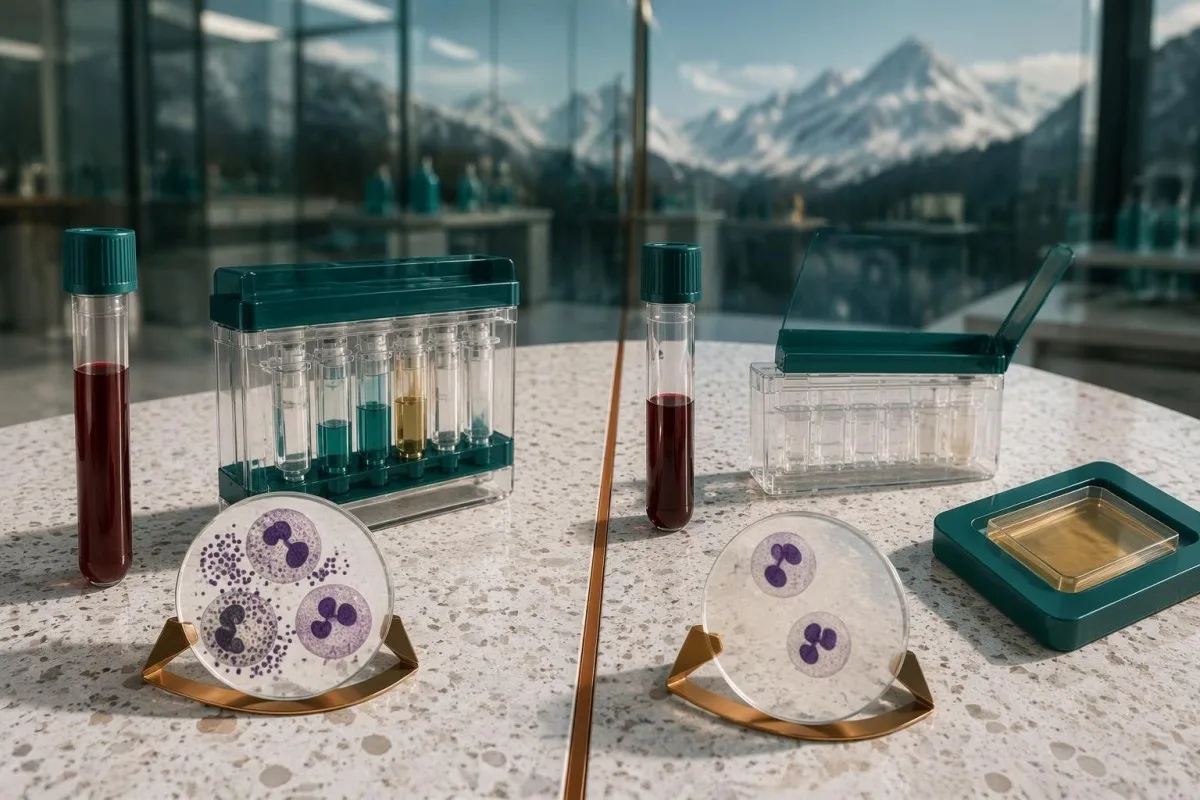
There is no single dependable false-negative percentage for every Anaplasma test. PCR assays differ, studies use different reference standards, and patients present on different illness days; a sensitivity estimate from untreated day-3 specimens cannot simply be applied to a day-9 sample obtained after 4 days of doxycycline (Schotthoefer et al., 2013).
A hypothetical person has fever, platelets of 78 × 10^9/L, a WBC of 2.9 × 10^9/L, and recent woodland exposure, but both tests are negative on illness day 4. That pattern leaves substantial clinical concern even without confirmation; by contrast, the same negative tests in a well person with normal counts and no plausible exposure answer a much lower-risk question.
Tha Kantesti na àrd-ùrlar mìneachaidh deuchainn fala AI that can explain why 2 negative tests may be limited by their collection dates, but it cannot determine whether antibiotics are needed. Our an dòigh-obrach airson dearbhadh clionaigeach a’ mìneachadh nan ceumannan dìona ann am mìneachadh, agus tha checking report source details helps readers verify specimen type, method, and reference comments before relying on a summary.
Dè na toraidhean CBC agus grùthan a tha a’ cur ris a’ bhreithneachadh?
Low white blood cells, low platelets, and raised AST or ALT commonly support suspicion of anaplasmosis, but none is diagnostic alone. Many adult laboratories use WBC reference intervals around 4.0–11.0 × 10^9/L and platelet intervals around 150–450 × 10^9/L; use the ranges printed on your own report.
A falling platelet count can be more informative than one mildly low result. A hypothetical decline from 182 to 84 × 10^9/L over 3 days during fever suggests an acute process, whereas a stable count of 138 × 10^9/L for years has a different context; plateletcrit and platelet count are related measurements, but plateletcrit is not an Anaplasma diagnostic test.
AST and ALT indicate cellular injury rather than identifying the organism. An AST of 84 IU/L is approximately 2.1 times an upper limit of 40 IU/L, but muscle injury, other infections, and medication effects can also produce that result; what ALT measures helps distinguish supportive liver findings from proof of a specific cause.
Morulae are clusters of organisms that may be visible inside granulocytes during the first week. Their absence does not exclude anaplasmosis, and their presence is not reliably species-specific because some Ehrlichia organisms can also affect granulocytes; manual microscopy can provide a fast clue, but PCR is needed for clearer organism identification (Bakken and Dumler, 2015).
| Ìre | Raon | Na tha e a’ ciallachadh |
|---|---|---|
| Eadar-ama WBC cumanta airson inbhich | 4.0–11.0 × 10^9/L | Laboratory-dependent reference interval; a normal WBC does not exclude early anaplasmosis. |
| WBC below the local interval | Often <4.0 × 10^9/L | Leukopenia supports suspicion during a compatible acute illness but has many other causes. |
| Common adult platelet interval | 150–450 × 10^9/L | Check the local interval and previous results before interpreting a borderline value. |
| Platelets below the local interval | Often <150 × 10^9/L | Thrombocytopenia is a supportive clue; rapid decline and symptoms determine urgency. |
Ciamar a tha deuchainnean Anaplasma eadar-dhealaichte bho dheuchainnean eile airson galairean a thèid a ghiùlan le breacan?
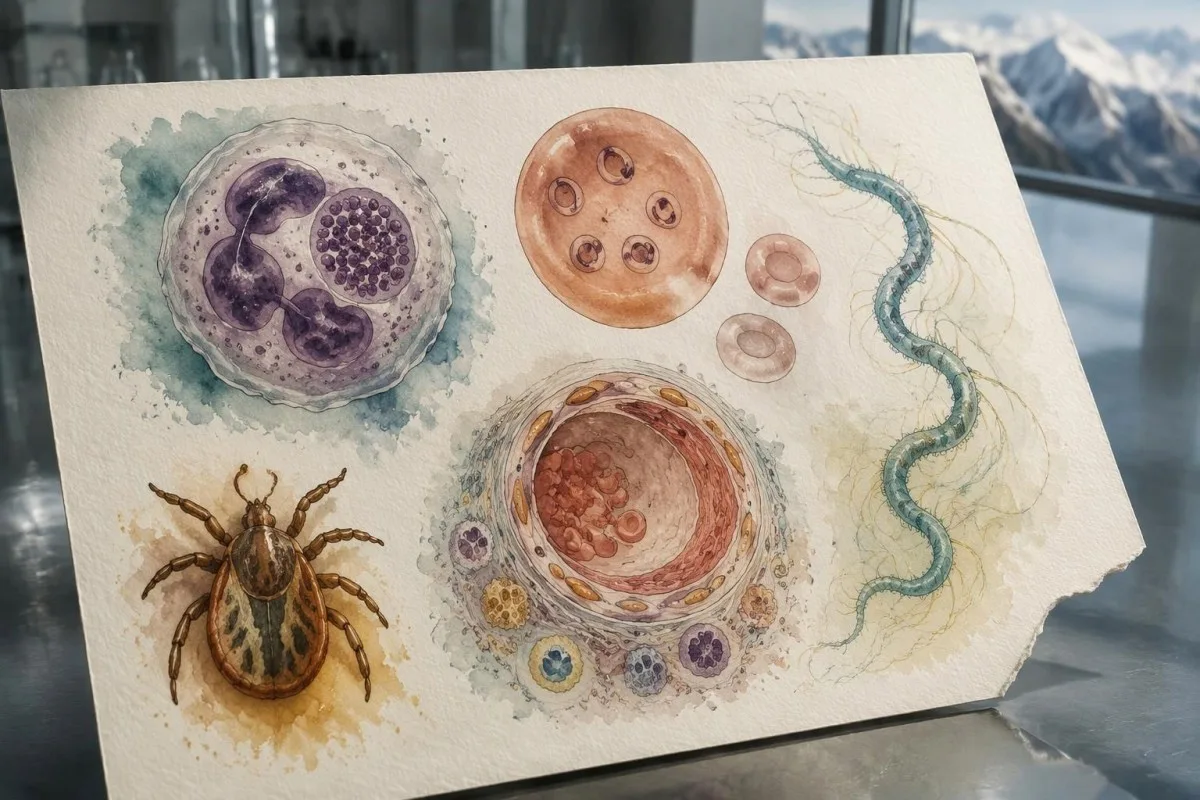
Anaplasma PCR, Lyme serology, Babesia testing, Ehrlichia PCR, and spotted-fever serology detect different targets and cannot substitute for one another. A laboratory panel tests only the organisms explicitly listed; a negative result for 1 target is not a negative result for all tick-borne illnesses.
Lyme disease is usually evaluated with a validated two-tier antibody algorithm when testing is indicated. A classic expanding erythema migrans rash can be diagnosed clinically without waiting for positive antibodies, while marked leukopenia or thrombocytopenia should raise concern for an additional diagnosis; an Anaplasma PCR result does not answer either of these 2 Lyme questions.
Rocky Mountain spotted fever may have negative early serology, and whole-blood PCR is less reassuring when negative than it is for some circulating-cell infections. Rash appearance and specimen choice matter, but absence of rash does not make waiting safe; spotted-fever testing windows explains why the Anaplasma PCR window cannot simply be transferred to that illness.
Alpha-gal syndrome is a tick-associated allergy, not an Anaplasma infection. Delayed allergic symptoms roughly 2–6 hours after mammalian meat exposure require an allergy-focused history and appropriate IgE testing rather than PCR or paired Anaplasma IgG; alpha-gal IgE interpretation illustrates how one exposure category can lead to very different diagnostic pathways.
Carson a dh’fhaodadh làimhseachadh tòiseachadh mus tèid dearbhadh a dhèanamh?
Suspected anaplasmosis should be treated promptly because early tests can be negative and delayed therapy can allow severe illness to develop. The MMWR guideline recommends that clinicians neither delay treatment while awaiting laboratory results nor withhold treatment because an early test is negative; the usual adult doxycycline dose is 100 mg every 12 hours (Biggs et al., 2016).
CDC recommends doxycycline for anaplasmosis in adults and children of all ages. For children weighing less than 45 kg, the usual dose is 2.2 mg/kg every 12 hours, with a maximum of 100 mg per dose; these are clinician-prescribed regimens, not instructions to start leftover medication or adjust a child's dose without assessment.
Treatment commonly lasts 10–14 days to provide coverage for possible concurrent Borrelia infection. Duration still depends on the suspected coinfections and clinical course, so an improving fever after 2 doses is not a reason to stop early; pregnancy, severe drug allergy, vomiting, or organ dysfunction require individualized decisions, sometimes with infectious-disease input.
Starting doxycycline is a clinical decision based on exposure, symptoms, examination, and the overall pattern—not on a single CRP or WBC cutoff. A WBC of 3.0 × 10^9/L during acute fever may strengthen concern even when CRP is only modestly raised; comh-shìneadh comharran fuil gabhaltachd explains why one reassuring-looking number should not overrule the complete assessment.
Dè an fhreagairt ris a bheil dùil, agus cuin a tha feum air cùram èiginneach?
Fever from anaplasmosis usually improves within 24–48 hours of doxycycline, but severe illness may take longer. Difficulty breathing, confusion, new bleeding, fainting, or markedly reduced urination requires emergency assessment; failure to improve is a reason for reassessment, not an instruction to increase the antibiotic dose yourself.
Persistent fever beyond about 48 hours should prompt review of the diagnosis, medication delivery, and possible coinfections. The person may not be absorbing oral treatment because of vomiting, may have an additional illness such as babesiosis, or may have developed a complication; the interval is a practical reassessment point rather than an absolute recovery deadline.
Severe anaplasmosis can involve respiratory failure, kidney injury, or coagulation abnormalities. Falling platelets accompanied by rising creatinine, prolonged clotting times, or new bleeding should not be dismissed as a routine CBC fluctuation; disseminated coagulation laboratory patterns explains why 2 or more changing systems can signal a problem beyond an isolated low count.
Clotting tests assess complications rather than confirming Anaplasma itself. For example, an INR of 1.8 in someone not taking warfarin needs explanation in context, but does not establish anaplasmosis or DIC on its own; our stiùireadh againn airson mìneachadh dheuchainnean coagulation helps separate PT, aPTT, D-dimer, and platelet findings without treating them as interchangeable measurements.
Am bu chòir PCR no antibodies a dhèanamh a-rithist às dèidh làimhseachaidh?
Routine PCR or IgG testing is generally not needed to prove cure after clinically successful anaplasmosis treatment. A convalescent IgG sample collected 2–10 weeks after the acute sample can document the diagnosis, but persistent antibodies alone do not demonstrate treatment failure and should not trigger repeated antibiotics in a well person.

A persistently positive IgG is not a test-of-cure result. If a person is well after a completed 10–14-day course, an elevated titer may simply reflect immune memory; if symptoms recur, clinicians should reassess the new symptoms and exposure history rather than assume that the old antibody result proves persistent infection.
CBC, creatinine, and liver enzymes may be repeated when they were abnormal or the illness was severe, but there is no universal day-7 retesting schedule for everyone. Kantesti AI can help organize serial results—for example, platelets rising from 82 to 164 × 10^9/L—while ath-sgrùdadh clàr-ama sàbhailteachd cungaidhean-leighis explains why recovery patterns still require clinical context.
Antibiotic prophylaxis after a tick bite is not recommended specifically to prevent anaplasmosis. After an asymptomatic bite, monitor for fever or other illness over the following 2 weeks and obtain medical advice if symptoms appear; a separate Lyme prophylaxis decision, when indicated, should not be mistaken for an Anaplasma prevention protocol.
Ciamar as urrainn dhut aithisg thoinnte a chur ann an òrdugh gu sàbhailte?
The safest report review separates organism detection, antibody evidence, supportive blood findings, and clinical timing into 4 distinct questions. Record the assay target, specimen type, result format, collection date, symptom-onset date, and antibiotic start; missing context should remain explicitly unknown rather than being filled in by an AI explanation.

Tha Kantesti na seirbheis eadar-mhìneachaidh deuchainn-lann AI that can explain uploaded laboratory reports and help readers identify questions for their clinician. In a hypothetical 2-report review, our AI should distinguish 'PCR not detected after treatment' from 'paired IgG rise consistent with recent infection,' rather than flattening both statements into a single positive-or-negative label.
An upload is not a substitute for urgent assessment. A photo showing platelets of 74 × 10^9/L cannot reveal whether the person is confused, dehydrated, pregnant, or short of breath; our teicneòlas mìneachaidh AI describes the analytical workflow, but clinical observations and prescribing decisions remain outside what the report alone can establish.
Before sharing 2 samples, check that both belong to the same person and remove identifiers if they are not needed for your purpose. Kantesti does not perform Anaplasma PCR, validate specimen handling, or confirm that an uploaded titer used the same laboratory method; retain the original PDF and ask the laboratory to resolve unclear assay comments or mismatched result units.
Dè an fhianais a bu chòir do na h-ath cheumannan agad a stiùireadh?
Anaplasmosis testing decisions should follow condition-specific guidance and diagnostic research, not general blood-test publications. The 2016 MMWR guideline, the 2013 PCR comparison, and the 2015 clinical review support the distinction between early direct detection, later antibody confirmation, and treatment based on clinical suspicion rather than a single laboratory result.

Bring 3 questions to the clinical review: was PCR collected early enough, is paired IgG needed, and do other tick-borne targets require separate testing? If the first specimen followed several doxycycline doses, say so; if the report is a single low-positive IgG, ask what evidence supports current illness before assuming that another antibiotic course is required.
At Kantesti, we distinguish externally published medical evidence from our own educational resources. Our inbhean susbaint mheidigeach explain that distinction; the 2 Figshare publications listed below are supplementary general laboratory and digestive-health guides, not studies establishing Anaplasma assay accuracy, treatment efficacy, or diagnostic thresholds.
The general hematology guide can help explain LDH and reticulocyte results when anemia raises a separate concern such as hemolysis. Use the hematology marker background guide for that limited purpose, not to interpret Anaplasma PCR; a 4-fold IgG rise, a positive organism-specific PCR, and the patient's clinical course each provide different kinds of evidence.
Ceistean cumanta
Am faod PCR airson Anaplasma a bhith deimhinneach nuair a tha na h-antibodhaigean àicheil?
Faodaidh PCR airson Anaplasma a bhith deimhinneach fhad ’s a tha na h-antigìonaichean IgG àicheil anns a’ chiad seachdain den tinneas, oir dh’fhaodadh DNA a’ bhactair a bhith ri lorg mus tig freagairt nan antagìonan air adhart. Faodaidh am pàtran seo taic a thoirt do dhiagnosachd anaplasmosis ghnìomhaich, seach a bhith na chomharra air mearachd obair-lann. Faodar sampall IgG aig ìre ghèire a choimeas ri sampall aig àm slànachaidh, a thèid a chruinneachadh 2–10 seachdainean às dèidh sin. Cha bu chòir dàil a chur air làimhseachadh fhad ’s a thathar a’ feitheamh ri tionndadh nan antagìonan nuair a tha amharas clionaigeach ann mun tinneas.
A bheil IgG dearbhach airson Anaplasma a’ ciallachadh gu bheil feum agam air antibiotaicean?
Chan eil aon toradh dearbhach Anaplasma IgG leis fhèin a’ ciallachadh gu fèin-obrachail gu bheil feum air antibiotaicean, oir dh’fhaodadh na h-antibodies a bhith a’ nochdadh nochdadh roimhe no tar-fhreagairt. Tha an CDC den bheachd gu bheil aon titre de 1:128 no nas àirde na fhianais thaiceil, ach chan eil e na dhearbhadh deimhinnte air galar ùr. Faodaidh ìrean nan antibodies fuireach àrd fad mhìosan, agus chaidh titres àrda aithris suas ri 4 bliadhna an dèidh tinneis. Bidh luchd-clionaigeach a’ stèidheachadh làimhseachadh air na comharraidhean làithreach, an nochdadh, toraidhean PCR agus toraidhean antibodies ann an sampallan càraideach, seach air IgG leantainneach leis fhèin.
Dè cho luath ’s a bheir doxycycline air PCR Anaplasma a bhith àicheil?
Anaplasma PCR sensitivity can decrease within 48 hours of appropriate antibiotic treatment, according to CDC guidance. That does not mean every person's PCR becomes negative at exactly 48 hours, because assay performance and circulating organism levels differ. A negative PCR collected after treatment is therefore less reassuring than a well-timed pretreatment result. Record the first doxycycline dose and specimen collection time so the clinician can interpret the result correctly.
Dè a tha air a mheas mar àrdachadh ceithir uiread ann an antibodies Anaplasma?
A rise in Anaplasma IgG titer from 1:64 to 1:256 is fourfold, while a rise from 1:128 to 1:256 is only twofold. Paired testing generally compares an acute specimen from the first 2 weeks of illness with a convalescent specimen collected 2–10 weeks later. The comparison should use compatible methods, ideally the same laboratory's IgG indirect fluorescent antibody assay. An antibody screen index cannot be directly converted into a dilution titer for this calculation.
Am faod anaplasmosis a bhith orm ma tha PCR agus IgG le chèile àicheil?
Faodaidh anaplasmosis a bhith an làthair fhathast ged a tha PCR agus IgG le chèile àicheil, gu h-àraidh ma chaidh IgG a chruinneachadh ann an seachdain 1 agus PCR a dhèanamh an dèidh antibiotaicean iomchaidh. Faodaidh fiabhras, nochdadh creidsinneach do bhreacan, àireamh ìosal de phlàtaidean, àireamh ìosal de cheallan fala geala agus ìrean àrdaichte de dh’enzyman grùthan amharas clionaigeach a chumail suas a dh’aindeoin nan deuchainnean àicheil. Faodaidh luchd-clionaigeach sampall IgG rè na h-ùine-fhaighinn air ais a chur air dòigh 2–10 seachdainean às dèidh an t-sampaill gheur agus measadh a dhèanamh air breithneachaidhean eile a dh’fhaodadh a bhith ann. Cha bu chòir amharas air anaplasmosis fhàgail gun làimhseachadh dìreach air sgàth ’s gu bheil deuchainnean tràtha àicheil.
Dè cho luath ’s a bu chòir piseach tighinn air na comharraidhean, agus a bheil feum agam air deuchainn dearbhaidh-slànachaidh?
Mar as trice bidh fiabhras anaplasmosis a’ fàs nas fheàrr taobh a-staigh 24–48 uairean bho thòisicheas doxycycline, ged a dh’fhaodadh tinneas trom ùine nas fhaide a thoirt. Bu chòir fiabhras leantainneach ath-mheasadh a bhrosnachadh gus faighinn a-mach a bheil duilgheadasan ann le gabhail a-steach a’ chungaidh-leigheis, breithneachadh eile, co-ghalair no duilgheadasan eile. Mar as trice chan eil feum air PCR àbhaisteach no deuchainn antibody gus dearbhadh gu bheil an galar air leigheas às dèidh làimhseachadh soirbheachail; bithear a’ cleachdadh IgG càraideach sa mhòr-chuid gus galar o chionn ghoirid a chlàradh. Feumar measadh èiginneach ma tha duilgheadas analach, troimh-chèile, sèididh ùr no lùghdachadh mòr ann am mùin, ge b’ e dè an toradh obair-lann.
Faigh mìneachadh air na toraidhean deuchainn fala agad
Luchdaich suas aithisg an obair-lann agad agus mìnichidh AI Kantesti gach bith-chomharradh ann an cànan soilleir taobh a-staigh diogan. Air a chleachdadh le còrr is 2 mhillean neach air feadh an t-saoghail.
Tùsan
- Klein, T., Mitchell, S., & Weber, H. (2026). Iùl air Seòrsa Fala B Negative, Deuchainn Fala LDH agus Cunntas Reticulocyte. Rannsachadh Meidigeach AI Kantesti. DOI
- Klein, T., Mitchell, S., & Weber, H. (2026). Buinneach an dèidh Fastadh, Speicean Dubha anns an Stòl agus Iùl GI 2026. Rannsachadh Meidigeach AI Kantesti. DOI
- Biggs HM et al. (2016). Breithneachadh agus Làimhseachadh Ghalaran Rickettsial a Thèid a Sgaoileadh le Cnàimh: Fiabhras Breacach nam Beanntan Creagach agus Rickettsioses Eile den Bhuidheann Fiabhrais Bhreacaich, Ehrlichioses agus Anaplasmosis — Na Stàitean Aonaichte. Molaidhean agus Aithisgean MMWR. DOI PubMed
- Schotthoefer AM et al. (2013). Comparison of a real-time PCR method with serology and blood smear analysis for diagnosis of human anaplasmosis: importance of infection time course for optimal test utilization. Journal of Clinical Microbiology. DOI
- Bakken JS and Dumler JS (2015). Human granulocytic anaplasmosis. Infectious Disease Clinics of North America.
- 2M+Deuchainnean air an sgrùdadh
- 127+Dùthchannan
- 100+Cànanan
Mu dheidhinn an sgioba mheidigeach


Comharran earbsa E-E-A-T
Eòlas
Lèirmheas clionaigeach air a stiùireadh le lighiche air sruthan-obrach mìneachaidh obair-lann.
Eòlas
Fòcas air leigheas obair-lann air mar a bhios bith-chomharraidhean (biomarkers) a’ giùlan ann an co-theacsa clionaigeach.
Ùghdarrasachd
Ath-sgrùdadh meidigeach leis an Dr Thomas Klein, le tabhartasan bhon Dr Sarah Mitchell agus an t-Oll. Dr Hans Weber.
Earbsachd
Mìneachadh stèidhichte air fianais le slighean leanmhainn soilleir gus dragh a lughdachadh.






Àicheadh meidigeach
Tha an artaigil seo dìreach airson adhbharan foghlaim agus chan eil e a’ dèanamh comhairle mheidigeach. Cuir fios an-còmhnaidh gu solaraiche cùram slàinte teisteanasach airson co-dhùnaidhean breithneachaidh is leigheis.
Foillsichte · Cuir fios chun sgioba dheasachaidh
Foillsichte le Kantesti Ltd, clàraichte ann an Sasainn agus sa Chuimrigh, àireamh companaidh. 17090423, Lunnainn, an Rìoghachd Aonaichte.
