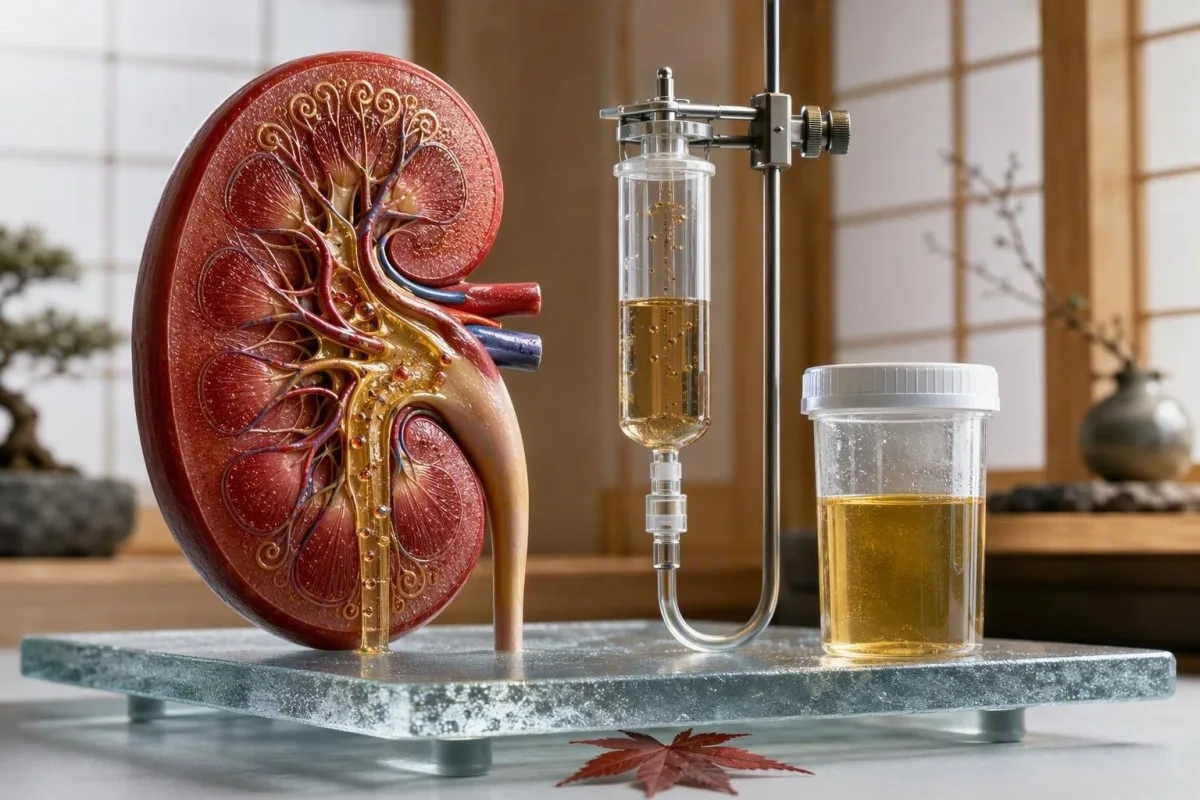
SIADH 是一种模式诊断,而非单一的异常结果。有用的线索来自于大致同时采集的血液和尿液,然后结合药物、甲状腺功能、皮质醇和容量状态进行解读。.

本指南在以下人员的领导下撰写: 托马斯·克莱因医学博士 与……合作 Kantesti AI 医疗顾问委员会, 其中包括 Hans Weber 教授博士的贡献以及 Sarah Mitchell 医学博士、哲学博士的医学审查。.
托马斯·克莱因,医学博士
Kantesti AI首席医疗官
Thomas Klein 博士是经董事会认证的临床血液科医师兼内科医师,拥有超过 15 年的实验室医学与 AI 辅助临床分析经验。作为 Kantesti AI 的首席医疗官,他负责对专有神经网络的医疗准确性进行临床监督。Klein 博士已发表关于生物标志物解读与实验室诊断的研究。.
Sarah Mitchell,医学博士,哲学博士
首席医学顾问 - 临床病理学和内科
Sarah Mitchell博士是获得董事会认证的临床病理科医生,拥有超过18年的实验室医学与诊断分析经验。她在临床化学方面拥有专业认证,并在临床实践中就生物标志物面板与实验室分析发表了大量研究成果。.
汉斯·韦伯教授,博士
实验室医学与临床生物化学教授
Hans Weber教授博士在临床生物化学、实验室医学和生物标志物研究方面拥有30年以上的专业经验。曾任德国临床化学学会主席,他专注于诊断面板分析、生物标志物标准化以及AI辅助的实验室医学。.
- 真性低渗性低钠血症 意味着血清钠低于 135 mmol/L,血清渗透压通常低于 275 mOsm/kg。.
- SIADH 尿液渗透压 尽管血清渗透压低,但尿液渗透压不适当地高于 100 mOsm/kg;肾脏在应该产生稀释尿液时却在潴留水分。.
- 尿钠 排除利尿剂、肾上腺功能不全、甲状腺疾病和临床上明显的液体消耗后,高于 30 mmol/L 才支持 SIADH。.
- 脱水模式 通常产生浓缩尿液,尿钠低于 30 mmol/L,尿素或 BUN 升高,并有循环血量减少的迹象。.
- 肾上腺功能不全 表现几乎与 SIADH 相同,因此清晨皮质醇水平低或结果模棱两可者,在诊断 SIADH 之前需要紧急临床随访。.
- 严重症状 如癫痫发作、意识模糊、反复呕吐或意识水平下降伴低钠血症,需要急诊处理;治疗不能等待在线解读。.
- 校正安全 注意事项:在慢性低钠血症中,对于有高渗性脱髓鞘综合征高风险的患者,血清钠在任何24小时内的升高幅度通常不应超过 8 mmol/L。.
- 时间很关键 因为静脉输注生理盐水、利尿剂剂量或数升水都可能在几小时内改变尿钠和尿渗透压。.
为什么 SIADH 需要配对的血液和尿液检测
A SIADH 血液检查 模式是低血清钠伴低血清渗透压,同时尿液浓度过高且钠含量相对较高。实际情况是,身体相对于钠而言水分过多,因为抗利尿激素活性没有正常关闭;仅凭钠值无法证明这一点。.
血清钠低于 135 mmol/L 定义为低钠血症,但钠只是浓度而不是体内总钠的衡量标准。一个人可能因水潴留、失盐、高血糖、实验室假象或这些因素的组合而导致钠含量低;我们的指南 低钠症状 解释了症状严重程度为何通常比确切数值更能反映下降速度。.
第一个实用的分叉点是测得的血清渗透压: 低于 275 mOsm/kg 表明低渗性低钠血症,这是考虑 SIADH 的情况。Thomas Klein 医生的临床规则很简单:在检查葡萄糖、甘油三酯、总蛋白以及最好是测得的渗透压之前,切勿仅凭基础代谢组合进行 SIADH 诊断。.
Kantesti 是一个 人工智能血液检测分析仪 将钠、葡萄糖、尿素、肌酐和配对的尿液检查结果视为一个生理问题,而不是一堆标志。在我们回顾的病例中,最危险的错误是在钠值为 122 mmol/L 后获得安全感,而报告中没有同时进行的尿液研究或症状史;; 我们的临床用例 展示了遗漏背景信息如何改变下一步。.
SIADH 实际含义
SIADH 代表抗利尿激素分泌失调综合征,过去称为抗利尿激素分泌失调。该综合征可能由药物、恶心、肺部或中枢神经系统疾病、疼痛、术后应激以及偶尔出现的恶性肿瘤引起;实验室模式识别的是水代谢,而不是潜在的触发因素。.
血清钠和血清渗透压:确认真实的水过多
血清渗透压低于 275 mOsm/kg 且钠低于 135 mmol/L 确认低渗性低钠血症, ,但这本身并不诊断 SIADH。正常或高渗透压会引导临床医生考虑葡萄糖、甘露醇、造影剂、酒精或假性低钠血症。.
大多数实验室报告计算出的渗透压,通常估计为 2 × 钠 + 葡萄糖 + 尿素 (mmol/L),但 测得的渗透压 在诊断不明确时更可取。测得值与计算值之间的有意义的差距可能显示未测量的溶质;这就是为什么钠值在临床上可能是真实的,但不能代表 SIADH 的原因之一。.
葡萄糖高于约 13.9 mmol/L (250 mg/dL) lowers measured sodium by water shifting from cells into plasma. A commonly used correction adds roughly 1.6 to 2.4 mmol/L sodium for every 5.6 mmol/L (100 mg/dL) glucose above 5.6 mmol/L, although clinicians disagree on the exact factor at very high glucose.
Very high triglycerides or paraproteins can cause pseudohyponatremia with indirect ion-selective assays, while measured osmolality remains normal. Compare the sodium result with the 基础代谢面板 and ask whether the laboratory used a direct or indirect electrode before assuming a water-balance disorder.
SIADH 尿液渗透压:改变病情的肾脏线索
Urine osmolality above 100 mOsm/kg in a hypotonic patient means antidiuretic hormone activity is present. In SIADH, urine osmolality is often 200 to 600 mOsm/kg, although no single urine value is diagnostic.
尿液渗透压为 100 mOsm/kg or lower indicates nearly maximally dilute urine and makes SIADH unlikely. That pattern fits primary polydipsia or low-solute intake, where water intake exceeds the kidney's ability to excrete free water; it is particularly relevant in people consuming very little protein and salt.
Here is the counterintuitive point: concentrated urine does not automatically mean dehydration. Both hypovolemia and SIADH raise antidiuretic hormone, but dehydration does so appropriately to preserve circulation, whereas SIADH does so despite clinically adequate effective arterial volume.
The European hyponatremia guideline recommends urine osmolality as an early discriminator because physical assessment of volume is often unreliable (Spasovski et al., 2014). Read our deeper explanation of the 尿液渗透压检测 if your report uses mOsm/kg rather than a dipstick-specific gravity.
Why a single urine sample can mislead
Urine osmolality can fall quickly after nausea settles, pain is controlled, or an offending medicine is withheld. If urine was collected after intravenous fluid, after a loop diuretic, or hours after the blood sample, I treat it as a clue rather than proof.
尿钠:SIADH 与脱水和有效循环血量不足
Urine sodium above 30 mmol/L supports SIADH in hypotonic hyponatremia when dietary salt intake is usual and diuretics are absent. Urine sodium below 30 mmol/L more often indicates renal sodium conservation from vomiting, diarrhea, sweating, heart failure, cirrhosis, or true dehydration.
In uncomplicated SIADH, the kidneys are not sodium-avid, so urine sodium is commonly 高于30 mmol/L and may exceed 60 mmol/L. Urea is often low, and serum uric acid may be below 4 mg/dL (0.24 mmol/L) because mild volume expansion increases urate clearance.
A 68-year-old taking hydrochlorothiazide may have urine sodium of 55 mmol/L and concentrated urine after a stomach virus; that does not establish SIADH. Thiazide-associated hyponatremia can mimic every classic laboratory feature, which is why the medication list is not administrative detail but diagnostic data.
Urine sodium is less reliable after diuretics, with advanced kidney disease, or with very low dietary sodium. Pair it with creatinine, urea and the 电解质面板 rather than treating a 30 mmol/L cutoff as a rigid wall.
Fractional excretion of urate
A fractional excretion of urate above 12% can support SIADH, particularly when diuretics obscure urine sodium. It usually normalizes after correction of SIADH, whereas renal salt-wasting states may keep it elevated; this is specialist territory, but it can be useful when the story does not fit.
脱水在实验室检查中与 SIADH 的不同之处
Dehydration usually causes concentrated urine with low urine sodium, rising urea relative to creatinine, and clinical evidence of volume loss. SIADH often produces concentrated urine too, but patients are usually clinically euvolemic and do not have the same sodium-conserving kidney response.
With vomiting, diarrhea or heavy sweating, the kidney typically lowers urine sodium to below 20-30 mmol/L while urine osmolality rises above 100 mOsm/kg. Urea may rise disproportionately to creatinine, but this ratio is affected by protein intake, gastrointestinal bleeding, steroids and liver function, so it is supportive rather than definitive.
In SIADH, blood pressure and examination may appear normal, yet subtle findings matter: no orthostatic symptoms, no dry mucous membranes, no peripheral edema, and no compelling gastrointestinal loss. I have seen patients called "dehydrated" simply because their urine was dark; urine colour is a poor proxy for sodium physiology, as our 尿色指南 discusses.
A cautious isotonic saline challenge can help in selected monitored settings: hypovolemic hyponatremia tends to improve as volume suppresses antidiuretic hormone. In SIADH, saline may fail to raise sodium or can worsen it when urine is much more concentrated than the infusion; it should never be a home experiment.
Why saline can worsen SIADH
One litre of 0.9% saline contains 154 mmol sodium, but a kidney producing urine at 600 mOsm/kg may excrete the sodium while retaining proportionally more water. This "desalination" effect is most likely when urine sodium plus potassium is high relative to serum sodium.
肾上腺功能不全:临床医生必须排除的 SIADH 模拟病症
Adrenal insufficiency can produce low sodium, low serum osmolality, urine osmolality above 100 mOsm/kg and urine sodium above 30 mmol/L—almost the same pattern as SIADH. A cortisol assessment is therefore part of a safe SIADH work-up, especially with fatigue, weight loss, low blood pressure, hyperkalemia or steroid exposure.
A morning serum cortisol above roughly 15-18 micrograms/dL (414-497 nmol/L) usually makes clinically significant adrenal insufficiency unlikely, depending on the assay and setting. Values below 3-5 micrograms/dL (83-138 nmol/L) are concerning, while intermediate results often need an ACTH stimulation test rather than guesswork.
Primary adrenal insufficiency often causes high potassium because aldosterone is deficient, but secondary adrenal insufficiency can have normal potassium and still cause severe hyponatremia. The mechanism is cortisol deficiency increasing antidiuretic hormone release, not simply salt loss.
The 2013 expert panel led by Verbalis advises excluding adrenal insufficiency before settling on SIADH (Verbalis et al., 2013). If this possibility is on your report, our overview of Addison disease laboratory clues may help you prepare targeted questions for an urgent clinician review.
Steroid medicines complicate testing
Prednisolone, hydrocortisone and some injected steroids can alter cortisol interpretation and suppress the adrenal axis. Do not stop prescribed steroids to "get a clean test"; abrupt withdrawal can precipitate adrenal crisis.
甲状腺检查:甲状腺功能减退症何时真正导致低钠血症
Severe hypothyroidism can impair water excretion, but ordinary subclinical hypothyroidism rarely explains meaningful hyponatremia. TSH and free T4 are checked before diagnosing SIADH because profound thyroid failure is treatable and may coexist with other causes.
Clinically important hypothyroid hyponatremia is most plausible in severe disease, particularly myxedema physiology with low free T4, bradycardia, hypothermia or reduced cardiac output. A TSH of 6 mIU/L with normal free T4 is common and should not become a convenient explanation for sodium of 121 mmol/L.
Kantesti AI 是一种 AI 血液检查解读平台 that compares TSH and free T4 with sodium, renal function and medication timing, because a flagged TSH result can distract from a more urgent adrenal or drug-related cause. A normal TSH does not exclude central hypothyroidism; low free T4 with a non-elevated TSH deserves a different pathway, explained in our article on low free T4 with normal TSH.
Thyroid replacement should be adjusted for established thyroid indications, not used as a rapid sodium treatment. In my experience, sodium often improves only after the true water-retention driver—nausea, medication, cortisol deficiency, or illness—has also been addressed.
Pituitary disease changes the work-up
Headache, visual-field symptoms, low libido, unexplained low blood pressure or multiple low pituitary hormones raise concern for central pituitary disease. In that setting, check cortisol before starting levothyroxine because thyroid hormone can increase cortisol clearance.
SIADH 解释中的妊娠、高龄和体型差异
Pregnancy lowers the normal osmotic threshold and serum sodium by about 4-5 mmol/L, so a sodium near 130 mmol/L may be physiologic early in pregnancy but still warrants context. Older adults have a higher risk of medication-related hyponatremia and often present with falls or confusion rather than thirst.
During uncomplicated pregnancy, serum osmolality typically decreases by around 5-10 mOsm/kg and sodium may settle near 130-134 mmol/L because the osmostat resets. Sodium below 130 mmol/L, neurological symptoms, hypertension, liver abnormalities or proteinuria need urgent obstetric assessment rather than dismissal as normal pregnancy change.
In people over 75, SSRIs, thiazides, carbamazepine, desmopressin and low-solute diets commonly overlap. A sodium fall of only 5 mmol/L can matter when baseline cognition is fragile; gait instability and falls may be the first observable signs.
Kidney filtration naturally changes during pregnancy, and interpretation should use pregnancy-aware references; our guide to pregnancy eGFR values explains why a reported eGFR is often not validated in pregnancy. Fluid restriction should be individualized in pregnancy and frailty, not copied from a generic SIADH handout.
Low body mass is not a trivial detail
A 45 kg person has less total body water than a 100 kg person, so the same water load or drug dose can produce a larger sodium shift. Frail patients also have less physiologic reserve if sodium changes quickly.
模仿或诱发 SIADH 的药物作用
Thiazide diuretics, SSRIs, SNRIs, carbamazepine, oxcarbazepine, desmopressin and some antipsychotics are frequent medication causes of hypotonic hyponatremia. Some produce true SIADH physiology, while thiazides can mimic SIADH through impaired dilution and sodium loss.
Thiazide-related hyponatremia often begins within the first 2周 after starting or increasing a dose, yet it can occur months later when illness, reduced food intake or extra water intake is added. Loop diuretics are less likely to cause this particular pattern because they reduce the kidney's concentrating capacity.
SSRI-associated hyponatremia is most common in older adults, people with low body weight, and those also taking diuretics. A new antidepressant is not automatically the culprit, but the temporal sequence matters more than a textbook list: document every start, stop and dose change during the preceding 30 days.
Do not stop seizure, psychiatric, hormone or blood-pressure medication without the prescriber who knows the indication. Low chloride may accompany diuretic use and vomiting; our explanation of low chloride results can help distinguish the broader electrolyte pattern.
Over-the-counter contributors
Desmopressin used for nocturia deserves special attention because drinking freely after a dose can cause abrupt water retention. NSAIDs can also amplify antidiuretic hormone action in susceptible people, particularly during intercurrent illness.
低溶质摄入和过量饮水:并非 SIADH 的模式
Primary polydipsia and very low dietary solute intake usually cause urine osmolality of 100 mOsm/kg or less, unlike classic SIADH. The distinction matters because strict fluid restriction alone may miss malnutrition, alcohol-related illness, or dangerous rapid correction once solute intake resumes.
The kidney needs solute—mainly urea from protein and electrolytes—to excrete water. With only 250 mOsm of solute available daily, a person can excrete about 2.5 L of urine at 100 mOsm/kg, but only 1 L if antidiuretic hormone keeps urine at 250 mOsm/kg.
In primary polydipsia, urine is often strikingly dilute and the history may reveal more than 4-6 L of fluid intake daily, though recall is imperfect. In low-solute hyponatremia, urea may be low and dietary history can reveal a recent period of poor protein and salt intake.
Ketones, low urea and weight loss can signal undernutrition or prolonged fasting rather than SIADH. Review our article on urine ketones if ketosis is present; diabetic ketoacidosis is a separate emergency and can distort sodium interpretation.
The refeeding risk
When nutrition is restored, sodium can rise faster than expected as the kidney regains solute excretion. Hospital teams monitor sodium frequently in high-risk patients, sometimes every 2-4 hours during active correction.
肾脏、心脏和肝脏疾病:无 SIADH 的低钠血症
Heart failure, cirrhosis and advanced kidney disease cause hyponatremia through low effective arterial volume, not primary SIADH. These conditions can still produce concentrated urine, but edema, reduced perfusion, low albumin or impaired filtration usually change the overall picture.
In heart failure and cirrhosis, the body may contain excess total water and sodium but senses inadequate arterial filling, activating antidiuretic hormone and sodium-retaining pathways. Urine sodium is often below 30 mmol/L unless diuretics or kidney injury confound the result.
Advanced kidney disease limits both water excretion and urine concentration, so urine osmolality may sit near plasma osmolality around 250-350 mOsm/kg. In that situation, classic SIADH thresholds lose precision and nephrology input is more useful than repeated spot urine testing.
Proteinuria, casts, albumin, creatinine trend and edema are not side issues; they help identify the physiology. Our practical guide to 尿比重 explains why a dipstick estimate cannot replace measured urine osmolality in a complex kidney case.
Edema does not rule out danger
A person with edema can still develop severe neurological symptoms at sodium below 120 mmol/L. Fluid status explains the cause but does not lower the urgency of acute symptomatic hyponatremia.
采样时间、静脉输液和实验室陷阱
Blood and urine should ideally be collected before IV fluids and within a few hours of each other, because treatment can rapidly alter SIADH lab results. A delayed urine sample may describe the response to therapy rather than the cause of hyponatremia.
A litre of saline, a dose of furosemide, anti-nausea treatment, pain relief, or stopping desmopressin can change urine output and osmolality within hours. Record the exact collection times, recent fluid intake, IV therapy and medicines; this mundane detail often resolves apparently contradictory SIADH lab results.
Hemolysis does not usually create a falsely low sodium, but major hyperlipidemia, hyperproteinemia and specimen contamination can. A sodium result that differs sharply from yesterday's value without a clinical explanation should prompt a redraw or direct ion-selective electrode measurement, not a diagnosis by spreadsheet.
Kantesti AI compares dates and flags implausible changes, but it cannot see an unrecorded saline infusion or a missed dose. Use a 血液检测时间线 to note illness, exercise, fasting, fluid intake and medication events beside each result.
Urine specific gravity is not osmolality
Specific gravity reflects particle mass as well as concentration and can be distorted by glucose, protein or contrast media. A value of 1.020 does not translate reliably into a particular mOsm/kg value in every patient.
临床医生通常开出的 SIADH 集中性检查
A safe SIADH evaluation usually includes serum sodium, potassium, glucose, urea, creatinine, measured serum osmolality, urine osmolality, urine sodium, TSH, free T4 and morning cortisol. The objective is to confirm hypotonic hyponatremia and exclude reversible mimics before assigning the SIADH label.
Additional tests depend on context: uric acid, liver markers, lipid profile, total protein, ACTH, chest imaging, brain imaging or medication review may be appropriate. In an apparently euvolemic patient with sodium of 126 mmol/L, the simultaneous osmolality pair and cortisol are usually more informative than broad, unfocused testing.
Hoorn and Zietse's guideline comparison emphasizes that volume examination alone has limited diagnostic accuracy and supports a urine-first biochemical approach (Hoorn and Zietse, 2017). This is why a normal-looking examination should not overrule urine osmolality of 550 mOsm/kg and serum osmolality of 260 mOsm/kg.
Dr. Thomas Klein recommends taking a photograph of every result page, including collection time, reference interval and medication list, before a visit. Our AI medical report safety checklist explains how to preserve the source details an interpretation needs.
When imaging becomes relevant
New, persistent SIADH without a clear medicine or acute illness may prompt chest imaging, particularly in older people with smoking exposure or respiratory symptoms. Imaging is targeted by history and examination; it is not automatically required for every sodium of 132 mmol/L.
治疗数值的含义以及为何纠正钠可能危险
Severe symptomatic hyponatremia is treated in hospital with carefully monitored hypertonic saline, while chronic SIADH management targets the cause and controlled water balance. The danger is two-sided: untreated brain swelling and overly rapid correction can both cause permanent neurological injury.
For seizure, coma, profound confusion or severe vomiting due to hyponatremia, guidelines commonly use 100-150 mL of 3% saline as an intermittent bolus with repeat sodium checks. The initial objective is a small rise of about 4-6 mmol/L to reduce cerebral edema, not immediate normalization.
For chronic hyponatremia, many clinicians limit correction to 8 mmol/L for people at high risk of osmotic demyelination, including alcoholism, malnutrition, severe liver disease, hypokalemia or very low starting sodium. Some guidelines allow 10 mmol/L in the first day for lower-risk patients, but I favor caution because a number can climb unexpectedly once antidiuretic hormone falls.
Fluid restriction often starts around 800-1,000 mL daily in stable SIADH, but its success depends on urine concentration and solute intake. Urea, loop diuretics with salt, or vasopressin antagonists are specialist decisions; Kantesti is an 基于 AI 的血液检测分析工具 designed to flag the relevant pattern, not to prescribe or replace urgent care. Review our 技术性的临床监督 when considering how automated interpretation is medically reviewed.
Potassium correction also raises sodium
Potassium is an effective osmole, so treating hypokalemia can increase serum sodium even without saline. This is easily missed when calculating the total 24-hour correction rate.
何时低钠血症或疑似 SIADH 需要紧急医疗护理
Seek emergency care now for seizure, fainting, new severe confusion, marked drowsiness, repeated vomiting, severe headache or breathing difficulty with known or suspected low sodium. Sodium below 120 mmol/L deserves same-day clinical assessment even if symptoms seem mild, especially when the fall may be recent.
Call the clinician who ordered the test promptly for sodium 125-129 mmol/L, new medication exposure, cancer treatment, pregnancy, adrenal symptoms, or a meaningful downward trend. Do not deliberately drink extra water, take salt tablets, or restrict all fluids before receiving individual advice; each action can worsen a different cause.
As of August 27, 2026, the most useful patient contribution is a precise history: daily fluids, alcohol intake, recent vomiting or diarrhea, all prescriptions and supplements, IV fluids, pain, nausea, lung symptoms and previous sodium values. That history often distinguishes transient antidiuretic hormone release from persistent SIADH more effectively than an additional isolated chemistry panel.
Kantesti's medical team uses pattern-based result review with physician oversight; readers can see the clinicians behind that process on our 医疗顾问委员会. If results are confusing, bring the original laboratory report and this paired-test framework to a licensed clinician rather than self-treating a sodium number.
预约时要带去的问题
Ask whether the hyponatremia is confirmed as hypotonic, whether urine was collected before treatment, whether cortisol and free T4 were checked, and whether a medicine or low-solute intake could explain the pattern. Those four questions keep the discussion focused on causes that change treatment.
常见问题
哪些血液检查结果提示 SIADH?
抗利尿激素分泌异常综合征(SIADH)的诊断线索包括:血清钠低于 135 mmol/L,血清渗透压低于 275 mOsm/kg,尿液渗透压高于 100 mOsm/kg,以及尿钠通常高于 30 mmol/L。患者通常临床上处于 euvolemic(正常血容量)状态,没有明显脱水、水肿、肾功能衰竭、肾上腺功能不全或严重甲状腺功能减退。低尿素和血清尿酸低于约 4 mg/dL 可以提供支持性证据,但单独一项均不具诊断价值。临床医生必须在几乎同时采集的血液和尿液样本中解读这些检测结果。.
SIADH 典型的尿渗透压是多少?
在 SIADH 中,尽管血清渗透压低,但尿液渗透压却异常地高于 100 mOsm/kg,许多患者的数值在 200 至 600 mOsm/kg 之间。尿液渗透压为 100 mOsm/kg 或更低则不支持 SIADH,因为它表明肾脏能够适当地稀释尿液。脱水也可能导致尿液渗透压高于 100 mOsm/kg,因此需要进行尿钠和临床容量评估。在接受生理盐水、利尿剂或恶心治疗后采集的样本可能具有误导性。.
脱水会导致低钠血症并类似 SIADH 吗?
是的,呕吐、腹泻、出汗或摄入不足导致的脱水可引起低渗性低钠血症,伴尿液浓缩,其渗透压高于 100 mOsm/kg。在单纯脱水的情况下,由于肾脏保留钠,尿钠通常低于 20-30 mmol/L,并且尿素相对于肌酐可能会升高。抗利尿激素分泌失调综合征 (SIADH) 的尿钠通常高于 30 mmol/L,且没有明显的液体耗竭迹象。利尿剂可能模糊这种区分,因此用药史至关重要。.
为什么医生怀疑抗利尿激素过多时要检查皮质醇?
检查皮质醇是因为肾上腺功能不全可能引起与SIADH相同的低钠血症、低血清渗透压、尿液浓缩模式。晨间皮质醇高于大约15-18微克/分升(取决于检测方法和临床环境)通常可排除明显的肾上腺功能不全;低于3-5微克/分升的结果则令人担忧。中间值通常需要ACTH兴奋试验。漏诊肾上腺功能不全很危险,因为它需要类固醇替代治疗,而不仅仅是限制液体摄入。.
SSRI 或利尿剂会引起 SIADH 检验结果吗?
SSRI、SNRI、卡马西平、奥卡西平以及去氨加压素会引发类似SIADH的液体潴留,而噻嗪类利尿剂则可能高度模拟SIADH的实验室检查结果。噻嗪类药物相关的低钠血症通常在开始治疗或增加剂量后的14天内发生,但期间发生的疾病可能稍后引发。在这两种情况下,尿钠浓度可能仍高于30 mmol/L,因此药物使用时间线在临床上具有决定性意义。患者在未咨询处方医生建议的情况下,不应停用处方精神类、抗惊厥或降压药物。.
低钠血症安全纠正的速度有多快?
在慢性低钠血症中,许多临床医生会针对有发生渗透性脱髓鞘综合征高风险的患者(例如营养不良、酗酒、严重肝病、低钾血症或钠极低的患者),将血钠纠正速度控制在 24 小时内达到或低于 8 mmol/L。紧急情况下的症状可能需要住院时给予 100-150 mL 的 3% 盐水推注,以实现最初约 4-6 mmol/L 的升高。确切的目标取决于病程、症状和危险因素。钠治疗需要反复进行血液检查,因为自发性水性利尿可能导致纠正速度意外加快。.
立即获取AI驱动的血液检测分析
加入全球超过2,000,000名用户,他们信任Kantesti进行即时、准确的检验分析。上传你的血液检查结果,并在几秒内获得对15,000+生物标志物的全面解读。.
📚 参考研究论文
Klein, T., Mitchell, S., & Weber, H. (2026). 女性健康指南:排卵、更年期和激素症状. Kantesti AI医学研究。.
Klein, T., Mitchell, S., & Weber, H. (2026). 面向早期汉坦病毒分诊的多语言AI辅助临床决策支持:设计、工程验证与跨50,000份已解读血液检查报告的真实世界部署. Kantesti AI医学研究。.
📖 外部医学参考资料
📖 继续阅读
从 坎特什蒂 医疗团队探索更多经过专家审核的医学指南:

再生障碍性贫血血液检查:CBC 警示模式
血液学实验室解读 2026 年更新 患者友好版 再生障碍性贫血通常会产生显著的 CBC 三系异常模式:贫血、白细胞减少…….
阅读文章 →
儿童大便pH值低意味着什么:碳水化合物的线索
儿科消化内科实验室解读 2026 更新 患者友好型 粪便呈酸性可能提示未吸收糖类发酵,但它….
阅读文章 →
尿液中的黏液丝:原因、检查和警示信号
尿液健康实验室解读 2026 年更新 患者友好型 尿液显微镜报告中的粘液通常是收集问题…….
阅读文章 →
尿液中的上皮细胞:类型、意义及后续步骤
尿液分析实验室解读 2026 更新 患者友好型 尿液中大多数上皮细胞来自正常脱落或收集污染,...
阅读文章 →
雌二醇在绝经期:为何单次结果可能具有误导性
绝经健康实验室解读 2026 年更新 患者友好型 单次雌二醇结果很少能确定您处于绝经的哪个阶段…….
阅读文章 →
动力低下:可能揭示原因的血液检查
动力与能量实验室解读 2026 年更新 患者友好型 动力不足可能是心理健康症状,也可能是…….
阅读文章 →发现我们所有的健康指南以及 基于AI的血液检查分析工具 在 kantesti.net
⚕️ 医疗免责声明
本文仅用于教育目的,不构成医疗建议。诊断和治疗决策请始终咨询合格的医疗专业人员。.
E-E-A-T信任信号
经验
由医生主导的临床审阅:实验室解读工作流程。.
专业知识
实验室医学重点:生物标志物在临床情境中的表现。.
权威
由 Thomas Klein 博士撰写,并由 Sarah Mitchell 博士与 Hans Weber 教授审阅。.
可信度
基于循证的解读,并提供清晰的后续路径以减少警报。.