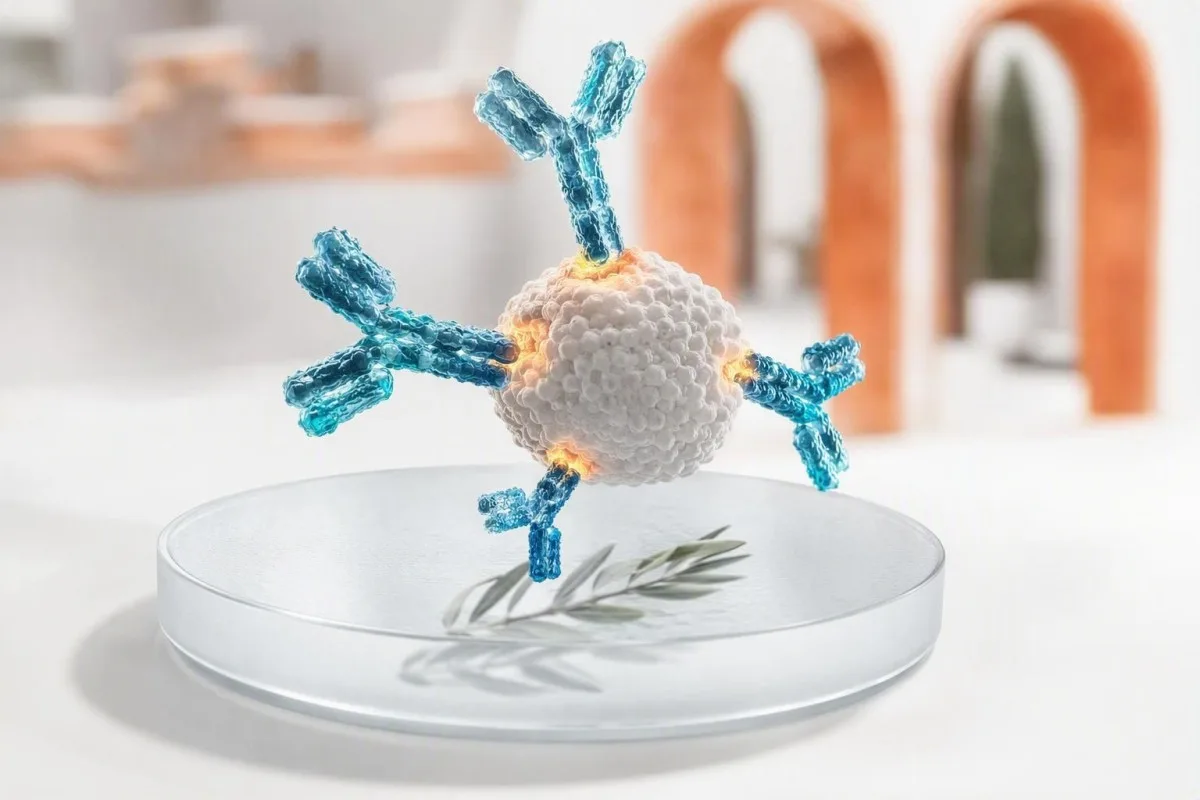
Un résultat positif pour les anticorps signifie que votre système immunitaire a reconnu une cible particulière ; cela ne prouve pas, en soi, une infection active ou une maladie. La classe d'anticorps, la méthode de test, le moment, les symptômes et les tests associés déterminent si vous avez besoin d'être rassuré, d'un test de répétition, d'une confirmation ou de soins cliniques rapides.


- Résultat positif pour les anticorps montre généralement une reconnaissance immunitaire, pas nécessairement une maladie actuelle ou une contagiosité.
- IgM versus IgG est un indice de moment, pas une horloge : l'IgM peut persister pendant des mois et l'IgG peut apparaître tôt.
- Anticorps de vaccin peuvent rendre les tests d'immunité positifs sans indiquer d'infection naturelle.
- IgE spécifiques d'allergènes au-dessus de 0,35 kUA/L indique une sensibilisation, mais les symptômes après exposition établissent une allergie clinique.
- Positivité ANA se trouve chez jusqu'à 20% des adultes en bonne santé à des titres bas, en particulier avec l'âge ; les symptômes et les anticorps spécifiques sont plus importants.
- réactivité au dépistage du VIH nécessite toujours l'algorithme de confirmation en laboratoire avant qu'un diagnostic soit posé.
- Anti-tTG IgA n'est fiable pour l'évaluation de la maladie cœliaque que lorsque la personne consomme du gluten et a un IgA total adéquat.
- Symptômes urgents tels que des difficultés respiratoires, une confusion, une jaunisse, une douleur thoracique ou une éruption cutanée vésiculeuse étendue l'emportent sur le résultat d'un anticorps de routine.
Ce qu'un résultat positif pour les anticorps vous dit réellement
A test d'anticorps positif signifie que le dosage a détecté des protéines immunitaires qui se lient à une cible particulière ; il ne pas signifie pas automatiquement que vous avez une infection active, une maladie auto-immune ou une allergie nécessitant un traitement. La prochaine étape dépend du type d'anticorps, de la force du résultat, des symptômes, du moment de l'exposition et de tout antigène associé, PCR ou tests de la fonction organique.
Les anticorps sont des protéines de lymphocytes B fabriquées après une vaccination, une infection, une exposition allergique, une auto-immunité, ou occasionnellement sans raison cliniquement nocive. Un résultat positif répond à une question analytique étroite — “ la liaison a-t-elle été détectée au-dessus de ce seuil de laboratoire ? ” — plutôt qu'à la question clinique plus large de ce qui se passe dans votre corps aujourd'hui.
Au cours de mes 15 années de pratique clinique, l'erreur la plus courante a été de lire “ positif ” comme un diagnostic. La règle pratique du Dr Thomas Klein est d'abord d'identifier la cible— un virus, un antigène vaccinal, une protéine alimentaire, une enzyme thyroïdienne, un antigène nucléaire ou un médicament — puis de demander si le test détecte une exposition passée, un organisme présent, une sensibilisation ou une mauvaise orientation immunitaire.
Kantesti AI est une Analyseur de test sanguin AI qui lit les indicateurs d'anticorps à côté des dates, de la classe d'immunoglobulines et des résultats connexes plutôt que de traiter une seule ligne positive comme un verdict. Ce contexte est particulièrement utile lorsque les patients comparent les rapports de différents laboratoires ; résultats qualitatifs et quantitatifs ne sont pas interchangeables même lorsqu'ils disent tous les deux positifs.
Positif IgG versus IgM : pourquoi le moment est moins simple qu'il n'y paraît
IgM positif peut suggérer une réponse immunitaire récente, tandis que IgG positive suggère souvent une exposition passée ou une réponse vaccinale ; aucun des deux schémas ne permet de dater de manière fiable une maladie isolément. Certaines infections produisent des IgG dans les 7 à 14 jours, et les IgM peuvent rester détectables pendant 3 à 12 mois ou plus.
Les IgM sont de gros anticorps à cinq unités qui sont souvent détectables tôt, mais leur taille et leur liaison large les rendent plus sujets aux réactions croisées. Le virus d'Epstein-Barr, le parvovirus B19, le facteur rhumatoïde et certains anticorps auto-immuns peuvent provoquer des réactions IgM trompeuses ; un résultat IgM isolé de faible niveau mérite plus de scepticisme que de panique.
Les IgG persistent généralement après le développement de la mémoire immunitaire, parfois pendant des décennies. Un résultat IgG positif peut refléter une infection infantile, un vaccin récent, des anticorps passifs provenant d'immunoglobulines intraveineuses ou un transfert maternel à un nourrisson ; il ne peut pas prouver une protection à moins que cet essai particulier n'ait un seuil de protection validé.
Des spécimens appariés peuvent être plus utiles qu'un seul prélèvement : une augmentation de quatre fois du titre d'anticorps entre des échantillons prélevés environ 2 à 4 semaines d'intervalle soutient une infection récente dans des maladies sélectionnées. Si le rapport indique les IgG, IgA et IgM totaux, examinez le schéma plutôt qu'un seul chiffre avec notre guide d'interprétation des immunoglobulines.
Quand les anticorps d'infection signifient ou ne signifient pas une maladie active
les anticorps d'infection montrent généralement une exposition, tandis que la PCR, le test antigénique, la culture ou une augmentation des titres sont de meilleurs outils pour détecter de nombreuses infections actives. Un résultat positif d'anticorps sans symptômes est souvent historique, mais l'exception dépend de l'organisme et de votre état immunitaire.
Pour l'hépatite C, un anticorps réactif signifie une exposition à un moment donné, mais seul l'ARN du VHC détectable établit une virémie actuelle. Pour l'hépatite B, la combinaison est importante : l'antigène de surface, l'anticorps de surface et l'anticorps du core séparent l'infection active, l'infection résolue et l'immunité vaccinale beaucoup mieux qu'un seul marqueur positif.
Le VIH est un autre cas où la formulation est extrêmement importante. Un dépistage réactif de quatrième génération n'est pas un diagnostic ; le laboratoire poursuit avec un test immunologique de différenciation VIH-1/VIH-2 et, si nécessaire, un test d'acide nucléique. Une personne prenant une prophylaxie post-exposition a besoin de tests spécifiques au temps, comme expliqué dans notre guide de dépistage du VIH après la TPE.
J'ai vu un patient bien portant effrayé par un anticorps tréponémique positif de syphilis après un traitement 18 ans plus tôt. Les tests tréponémiques restent souvent positifs à vie, tandis qu'un titre RPR ou VDRL aide à juger de l'activité et de la réponse actuelles ; les schémas des tests de syphilis rendent cette distinction plus claire.
Comment les anticorps des vaccins diffèrent des anticorps après une infection
Les anticorps liés au vaccin montrent que le système immunitaire a répondu à un antigène vaccinal ; ils ne signifient pas que le vaccin a causé une infection active. Un résultat positif peut toujours être inférieur à un corrélat protecteur connu, car les anticorps de liaison et les anticorps neutralisants fonctionnels ne sont pas identiques.
les concentrations d'anticorps de surface du virus de l'hépatite B 10 mUI/mL ou plus mesurées 1 à 2 mois après une série de vaccinations documentée sont généralement considérées comme protectrices chez les personnes immunocompétentes. L'anti-HBc, l'anticorps du core de l'hépatite B, n'est pas produit par la vaccination standard contre l'hépatite B ; sa présence indique une exposition naturelle et devrait inciter à une interprétation complète.
Les IgG de la rubéole sont couramment vérifiés avant la grossesse car ils indiquent une immunité antérieure, et non une maladie active de la rubéole. Les laboratoires fixent des seuils spécifiques à chaque test, et les résultats limites sont généralement considérés comme non immunitaires pour la planification préconceptionnelle plutôt que comme une infection récente ; le calendrier est détaillé dans notre guide des tests de rubéole.
Kantesti AI est une plateforme d’interprétation prise de sang AI qui sépare les anticorps de type vaccin des anticorps de type infection lorsque le rapport inclut les marqueurs compagnons pertinents. La question pratique est souvent pas “ suis-je positif ? ” mais “ quel antigène a été mesuré, quand ai-je été vacciné, et ce résultat change-t-il le plan de protection actuel ? ”
Pourquoi un test positif pour les anticorps d'allergie peut ne pas signifier une allergie
un anticorps spécifique à un allergène positif IgE le test indique une sensibilisation, c'est-à-dire que les IgE reconnaissent un allergène ; il ne diagnostique pas une allergie clinique sans antécédents de réaction compatibles. Une valeur supérieure à 0.35 kUA/L est un seuil de positivité analytique courant, pas un seuil universel pour éviter un aliment ou un médicament.
L'histoire pré-test est plus importante que ce que beaucoup de gens pensent. Si une personne mange des cacahuètes chaque semaine sans urticaire, sifflement, vomissements ou évanouissement, un faible résultat positif aux IgE de cacahuète seul ne devrait pas entraîner d'évitement ; une restriction alimentaire inutile peut causer des problèmes nutritionnels et sociaux.
La directive sur les allergies alimentaires parrainée par le NIAID stipule que les tests cutanés et les tests d'IgE spécifiques identifient des aliments déclencheurs potentiels mais ne peuvent pas diagnostiquer indépendamment l'allergie alimentaire (Sampson et al., 2010). Dans des cas sélectionnés, un allergologue utilise des tests résolus par composant ou un test de provocation orale sous surveillance médicale, qui reste le standard de référence pour résoudre les incertitudes.
Les IgE totales sont mesurées en UI/mL et peuvent être élevées en cas d'eczéma, d'exposition parasitaire, de tabagisme et de diverses affections immunitaires ; elles ne peuvent pas identifier un allergène responsable. Les tests par composant peuvent distinguer une protéine de stockage stable d'une protéine réactive croisée liée au pollen, une différence explorée dans notre article sur les tests d'allergie moléculaire.
Pourquoi les anticorps auto-immuns nécessitent des symptômes et des indices d'organes
Les anticorps auto-immuns peuvent précéder une maladie, accompagner une maladie ou se présenter chez des personnes en bonne santé ; un résultat positif à lui seul établit rarement un diagnostic auto-immun. Les cliniciens interviennent lorsque le profil des anticorps correspond aux symptômes, aux résultats de l'examen, aux marqueurs d'inflammation ou aux changements objectifs des organes.
Un anticorps antinucléaire, ou ANA, est positif à de faibles titres chez environ 13% des personnes à 1:80 et environ 20% à 1:40 dans les études de population, avec des taux plus élevés chez les femmes et les adultes plus âgés. Un profil homogène ou moucheté ne permet pas de diagnostiquer un lupus ; les ANA sont mieux utilisés comme test d'entrée lorsque le tableau clinique rend une maladie du tissu conjonctif plausible.
Le cadre de classification du lupus EULAR/ACR 2019 utilise les ANA à un titre d'au moins 1:80 comme critère d'entrée, puis exige des caractéristiques cliniques et immunologiques supplémentaires pondérées (Aringer et al., 2019). Une nouvelle protéine dans l'urine, un faible taux de C3/C4, des cytopénies, un gonflement inflammatoire des articulations ou une éruption cutanée photosensible convaincante changent l'urgence beaucoup plus qu'un ANA faible seul.
Les anti-dsDNA prennent plus de sens lorsqu'ils sont associés à un faible taux de complément et à des résultats rénaux, bien que les méthodes d'essai varient considérablement. Notre guide de suivi des anti-dsDNA et aperçu des tests du complément expliquent pourquoi un spécialiste peut répéter les tests sur une plateforme différente.
Anticorps spécifiques d'organes : exemples thyroïdiens, cœliaques et gastriques
Les anticorps spécifiques d'organes identifient le ciblage immunitaire d'un tissu, mais ils ne montrent pas toujours si l'organe est actuellement endommagé ou nécessite un traitement. Les anticorps anti-thyroïde peroxydase, les anticorps anti-transglutaminase tissulaire et les anticorps anti-facteur intrinsèque nécessitent chacun des tests compagnons différents.
Les anticorps anti-TPO sont courants dans la thyroïdite de Hashimoto et peuvent être présents pendant des années alors que la TSH et la T4 libre restent normales. Chez un adulte non enceinte ayant une fonction thyroïdienne normale, le résultat soutient généralement une surveillance périodique de la TSH plutôt qu'un traitement hormonal thyroïdien ; la grossesse, les projets de fertilité et les symptômes peuvent modifier cette approche.
Un test positif tTG-IgA ne suggère la maladie cœliaque que si la personne consomme toujours du gluten et si l'IgA totale est adéquate. Une déficience sélective en IgA peut rendre le tTG-IgA faussement négatif, de sorte que les cliniciens utilisent des tests basés sur les IgG comme le peptide de gliadine désamidé ou le tTG lorsque l'IgA totale est faible ; voir notre explication sur les pièges des IgA faibles.
L'anticorps anti-facteur intrinsèque est relativement spécifique mais pas très sensible pour l'anémie pernicieuse. Lorsqu'il est positif avec une faible teneur en B12, une augmentation de l'acide méthylmalonique et une macrocytose, le profil est convaincant ; sans ce profil, j'évite de traiter une étiquette de laboratoire plutôt que le patient. Tests d'anémie pernicieuse montre la séquence de confirmation habituelle.
Qu'est-ce qui cause un résultat d'anticorps faux positif
Les faux résultats positifs d'anticorps surviennent lorsque l'essai détecte une liaison non intentionnelle, et non lorsque le laboratoire “se trompe” simplement. Les anticorps réactifs croisés, le facteur rhumatoïde, une stimulation immunitaire récente, les immunoglobulines passives et une faible probabilité pré-test sont des raisons courantes.
La spécificité n'est pas la perfection. Un test avec une spécificité de 99% produit environ 10 faux positifs pour 1 000 personnes réellement négatives testées ; lorsque la maladie est rare, ces résultats peuvent surpasser les vrais positifs. C'est pourquoi un dépistage généralisé chez une personne sans symptômes crée souvent de l'ambiguïté plutôt que de la réassurance.
La biotine est connue pour interférer avec certains dosages hormonaux et cardiaques, tandis que les anticorps hétérophiles et le facteur rhumatoïde peuvent interférer avec certains immunoessais. Le laboratoire peut parfois diluer l'échantillon, utiliser des réactifs bloquants, répéter le résultat sur une autre architecture d'essai, ou effectuer une méthode de confirmation plus spécifique.
Un résultat positif qui contredit un tableau clinique totalement remarquable n'est pas à ignorer ; c'est une raison de vérifier. Kantesti AI compare les marqueurs discordants et les dates de test, et notre checklist de précision des résultats de laboratoire peut vous aider à enregistrer les suppléments, les perfusions récentes et les maladies avant de parler avec le clinicien prescripteur.
Test d'anticorps positif mais pas de symptômes : un plan de triage pratique
Lorsqu'un test d'anticorps est positif mais que vous vous sentez bien, la plupart des gens ont besoin d'une clarification plutôt que de soins d'urgence. Les premières étapes les plus sûres consistent à vérifier l'essai exact, à vérifier les dates d'exposition et de vaccination, et à rechercher le test compagnon qui confirme la maladie actuelle ou l'atteinte d'un organe.
Commencez par le rapport lui-même : notez le nom de l'analyte, la classe d'anticorps, l'indice numérique ou le titre, l'intervalle de référence, la méthode de laboratoire et la date de collecte. “ Réactif ” peut signifier un rapport signal/seuil juste au-dessus de 1,0 ou un résultat beaucoup plus fort ; les laboratoires n'utilisent pas de seuils identiques, et l'ampleur ne suit que parfois la probabilité clinique.
Ensuite, demandez s'il existe un test pour la maladie active. Les exemples incluent la PCR pour l'hépatite C, le RPR en série pour la syphilis, l'analyse des selles ou le test respiratoire pour Helicobacter pylori actif, la TSH/T4 libre pour les anticorps thyroïdiens, et l'analyse d'urine plus la créatinine pour les préoccupations rénales liées au lupus.
Au 8 septembre 2026, je ne recommanderais pas de commencer vous-même les antibiotiques, les antiviraux, les régimes sans gluten, les médicaments thyroïdiens ou les évitements alimentaires uniquement à partir d'un résultat d'anticorps isolé. Enregistrez le PDF original, notez votre point de référence avec le suivi longitudinal au laboratoire, et organisez une révision de routine, sauf en présence de symptômes d'alerte.
Tests de confirmation qui modifient la prochaine étape
Le meilleur test de confirmation dépend de ce que cible l'anticorps : la détection moléculaire confirme de nombreuses infections, les essais fonctionnels clarifient les allergies et les tests de fonction d'organe évaluent l'impact auto-immun. La répétition du même test d'anticorps n'est utile que lorsque le changement attendu au fil du temps a une signification clinique.
Pour un dépistage VIH réactif, le parcours de confirmation par réflexion est un essai de différenciation suivi d'un test d'acide nucléique VIH si les résultats sont indéterminés. Pour un anticorps de l'hépatite C, l'ARN du VHC est le suivi décisif ; pour un anticorps positif du noyau de l'hépatite B, l'antigène de surface, l'anticorps de surface et parfois l'ADN du VHB clarifient le schéma.
En cas de suspicion de maladie cœliaque, les décisions de biopsie doivent être prises pendant que l'exposition au gluten est suffisante pour les tests. En cas d'allergie alimentaire possible, un allergologue tient compte de l'historique d'exposition, du niveau d'IgE spécifique, du profil des composants et du risque de provocation, et non d'un panel de résultats faibles non liés commandés sans question clinique.
Kantesti AI est une Outil d’analyse de prise de sang alimenté par l’IA qui peut organiser ces marqueurs liés en une liste de questions prête pour le clinicien, mais cela ne remplace pas les tests de confirmation ou le diagnostic. Si vous ne savez pas dans quelle mesure faire confiance à un résultat aberrant, notre normes de validation médicale décrit pourquoi la vérification et la surveillance clinique sont importantes.
Symptômes qui rendent un résultat d'anticorps positif plus urgent
Un résultat positif d'anticorps justifie une évaluation urgente lorsqu'il s'accompagne de difficultés respiratoires, de gonflement du visage ou de la gorge, d'évanouissement, de confusion, de douleurs thoraciques, de jaunisse, d'éruption cutanée à propagation rapide, de déshydratation sévère ou de nouvelle faiblesse neurologique. Les symptômes, et non le nombre d'anticorps seul, déterminent l'urgence.
L'anaphylaxie possible est une urgence : de l'urticaire généralisée soudaine avec respiration sifflante, une sensation de constriction dans la gorge, des vomissements persistants, un malaise ou une hypotension après exposition nécessite les services d'urgence et de l'adrénaline prescrite si disponible. Une IgE alimentaire ou venimeuse positive datant de plusieurs mois ne prédit ni n'exclut ce risque immédiat.
Une nouvelle jaunisse avec urine foncée, une douleur abdominale marquée, de la fièvre ou de la confusion doit inciter à une évaluation le jour même, que les anticorps de l'hépatite virale soient positifs ou non. Les enzymes hépatiques, la bilirubine, l'INR et les tests directs sur agent pathogène aident à distinguer l'histoire immunitaire de la maladie hépatobiliaire active ; composants du bilan hépatique fournissent un contexte utile.
Une préoccupation auto-immune devient sensible au temps avec toux de sang, essoufflement, augmentation rapide de la créatinine, diarrhée sanglante, changement visuel, convulsions ou une nouvelle faiblesse unilatérale. J'ai appris à ne pas rassurer quelqu'un sur la base d'un titre d'anticorps limite lorsque sa trajectoire symptomatique se détériore clairement.
Un chiffre d'anticorps plus élevé signifie-t-il une maladie plus grave ?
Un indice ou un titre d'anticorps plus élevé augmente parfois la probabilité qu'un résultat soit réel, mais il ne mesure généralement pas la gravité de la maladie. Les valeurs des dosages dépendent de la méthode et un résultat de 80 AU/mL ne peut pas être comparé directement à 80 U/mL d'un autre laboratoire.
Dans les maladies auto-immunes, les tendances des anticorps anti-ADNdb peuvent parfois suivre l'activité du lupus, en particulier lorsqu'elles sont mesurées de manière cohérente par la même méthode et interprétées avec le complément et les protéines urinaires. Le titre ANA, cependant, est une mauvaise mesure de la gravité du lupus et ne doit pas être poursuivi à plusieurs reprises chez une personne stable.
Pour les infections, un signal d'anticorps fort peut appuyer une exposition antérieure mais indique rarement une contagiosité. Les tests d'anticorps neutralisants sont spécialisés et leurs seuils de protection peuvent varier selon l'agent pathogène, l'âge, le produit vaccinal et l'immunosuppression ; un simple test commercial d'IgG n'est pas un passeport d'immunité personnelle.
Lors de la comparaison des rapports, gardez le laboratoire, le dosage et les unités visibles. Un changement biologique réel doit dépasser la variation analytique ordinaire et la variation d'un jour à l'autre, c'est pourquoi notre guide de comparaison des analyses de sang se concentre sur les dates et les méthodes plutôt que sur les indicateurs codés en couleur seuls.
La grossesse, les enfants et l'immunosuppression modifient l'interprétation
La grossesse, la petite enfance et le traitement immunosuppresseur peuvent altérer à la fois la production d'anticorps et la sécurité de l'attente de confirmation. Dans ces groupes, un résultat positif peut refléter des anticorps maternels, une réponse vaccinale réduite, un risque de réactivation ou un besoin de conseils spécialisés plus précoces.
Les IgG maternelles traversent le placenta et peuvent rester détectables chez un nourrisson pendant plusieurs mois, tandis que les IgM maternelles ne traversent généralement pas. Par conséquent, une positivité isolée des IgG chez un nourrisson reflète souvent une immunité maternelle, tandis que les IgM spécifiques à l'organisme ou la détection directe peuvent mériter une évaluation plus ciblée en fonction de l'infection et de l'âge.
Pendant la grossesse, les résultats des anticorps de rubéole ou de parvovirus sont interprétés avec les dates d’exposition, les tests d’avidité et les échantillons répétés plutôt qu’un seul IgM isolé. L’IgM faux positif est un problème reconnu, et une alarme évitable peut entraîner des investigations invasives inutiles ; un avis obstétrical ou de maladies infectieuses est judicieux lorsque l’exposition est crédible.
Les personnes recevant du rituximab, des corticostéroïdes à haute dose, une chimiothérapie ou des médicaments de transplantation peuvent avoir des réponses immunitaires faibles ou absentes malgré une infection ou une vaccination. Pour les décisions familiales, les limites d’interprétation de l’IA pédiatrique et le comité consultatif médical de Kantesti renforcent la nécessité d’une évaluation dirigée par le clinicien.
Comment se préparer à un examen clinique utile d'un résultat positif
Apportez le rapport de laboratoire complet, la raison pour laquelle le test a été commandé, les dates des symptômes ou de l’exposition, les antécédents de vaccination, les médicaments et les résultats antérieurs. Ces informations peuvent transformer un résultat d’anticorps positif apparemment vague en une prochaine action claire dans un seul rendez-vous.
Notez cinq faits avant la visite : le premier jour des symptômes, la dernière exposition plausible, les dates de vaccination, les médicaments immunosuppresseurs ou les perfusions d’immunoglobulines, et si les symptômes s’améliorent ou s’aggravent. Une fièvre qui a commencé 3 jours avant l’échantillonnage est interprétée très différemment d’une fatigue qui a commencé il y a 6 mois.
Posez trois questions ciblées : “ Que détecte ce test ? ”, “ Quel test établit une maladie active ou un effet organique ? ” et “ Quel résultat changerait le traitement ? ” Dr Thomas Klein constate que ces questions réduisent les panels répétés inutiles et aident les patients à repartir avec un délai défini : aujourd’hui, 1 à 2 semaines, ou une surveillance de routine.
L’IA Kantesti prend en charge l’examen sécurisé des rapports dans plus de 75 langues et peut identifier les tests compagnons manquants à partir d’un PDF photographié ou téléchargé en environ 60 secondes. Notre Guide de technologie IA explique l’approche de mise en correspondance contextuelle, tandis que notre équipe clinique fournit la supervision médicale derrière l’interprétation destinée aux patients.
Questions fréquemment posées
Que signifie un résultat positif d'anticorps si je n'ai pas de symptômes ?
Un résultat d'anticorps positif sans symptômes indique le plus souvent une exposition antérieure, une vaccination, une sensibilisation ou un résultat qui nécessite une confirmation plutôt qu'une maladie active. La prochaine étape dépend de la cible : un anticorps contre l'hépatite C nécessite l'ARN du VHC, un dépistage réactif du VIH nécessite l'algorithme de confirmation de laboratoire et les anticorps thyroïdiens nécessitent la TSH et la T4 libre. Un résultat isolé faiblement positif est moins convaincant en l'absence d'antécédents d'exposition ou de symptômes compatibles. Demandez des soins rapides si une nouvelle jaunisse, une difficulté à respirer, une confusion, des douleurs thoraciques ou une éruption cutanée qui s'aggrave rapidement apparaissent.
IgM positif et IgG négatif signifient-ils toujours une nouvelle infection ?
IgM positif avec IgG négatif peut survenir tôt dans une infection, mais cela ne prouve pas toujours une nouvelle infection. L'IgM peut réagir de manière croisée avec des protéines immunitaires non apparentées, et certains dosages produisent des résultats IgM faussement positifs plus souvent que les résultats IgG. Les cliniciens peuvent répéter la sérologie après 1 à 2 semaines, demander un test PCR ou antigénique, ou utiliser un test de confirmation plus spécifique. La bonne interprétation dépend également du calendrier de la maladie et de l'organisme spécifique testé.
Un vaccin peut-il rendre un test d'anticorps positif ?
Oui, les vaccins rendent souvent les tests d'anticorps positifs pour l'antigène contenu dans le vaccin. Pour l'hépatite B, une concentration d'anti-HBs d'au moins 10 mUI/mL mesurée 1 à 2 mois après une série complète indique généralement une réponse protectrice du vaccin chez les personnes immunocompétentes. La vaccination standard contre l'hépatite B ne produit pas d'anti-HBc, donc la positivité des anticorps centraux suggère une exposition naturelle plutôt qu'une vaccination seule. La positivité liée au vaccin ne signifie pas que vous avez une infection active.
Pouvez-vous avoir un test d'anticorps auto-immuns positif et être en bonne santé ?
Oui, les personnes en bonne santé peuvent avoir des anticorps auto-immuns positifs, en particulier des résultats ANA à faible titre. Les ANA sont détectables chez environ 131 TP54T des personnes à un titre de 1:80 et environ 1 TP44T à 1:40, ce n'est donc pas un test autonome du lupus. Des symptômes tels que des gonflements articulaires inflammatoires, des ulcères buccaux, des éruptions cutanées photosensibles, un faible taux de complément, des protéines dans les urines ou des anomalies sanguines déterminent si une évaluation spécialisée est nécessaire. Un résultat positif doit être interprété dans le contexte de la raison pour laquelle le test a été demandé.
Un test sanguin IgE positif signifie-t-il que je dois éviter cet aliment?
Non, un résultat positif d'IgE spécifique à un aliment signifie une sensibilisation et ne prouve pas que la consommation de l'aliment provoque une réaction allergique. De nombreux laboratoires considèrent comme positifs les résultats supérieurs à 0,35 kUA/L, mais ce seuil est conçu pour la détection plutôt que pour une décision d'évitement universelle. Une personne qui consomme régulièrement l'aliment sans urticaire, sifflements, vomissements répétitifs ou évanouissement ne devrait pas l'exclure automatiquement de son alimentation. Un allergologue peut utiliser l'historique des réactions, des tests moléculaires et parfois un test de provocation orale supervisé pour clarifier le risque.
Combien de temps les anticorps restent-ils positifs après une infection ?
La durée des anticorps varie considérablement selon l'infection et la classe d'anticorps. Les IgM peuvent disparaître en quelques semaines mais peuvent persister pendant 3 à 12 mois ou plus, tandis que les IgG peuvent rester mesurables pendant des années, voire toute la vie. Les anticorps de la syphilis tréponémique restent souvent positifs à vie après un traitement réussi, tandis que les titres RPR ou VDRL sont utilisés pour suivre l'activité. Un résultat d'anticorps positif ne peut donc pas vous dire de manière fiable quand une infection s'est produite sans autres informations cliniques et de laboratoire.
Obtenez dès aujourd’hui une analyse de sang par IA
Rejoignez plus de 2 millions d’utilisateurs dans le monde qui font confiance à Kantesti pour une analyse instantanée et précise des analyses de laboratoire. Téléversez vos résultats prise de sang et recevez une interprétation complète des biomarqueurs de 15,000+ en quelques secondes.
📚 Publications de recherche citées
Klein, T., Mitchell, S., & Weber, H. (2026). Prise de décision clinique assistée par IA multilingue pour le triage précoce des Hantavirus : conception, validation d’ingénierie et déploiement dans le monde réel sur 50 000 rapports d’analyses sanguines interprétés. Figshare. https://www.researchgate.net/. Recherche médicale par IA Kantesti.
Klein, T., Mitchell, S., & Weber, H. (2026). Étalon technique automatisé basé sur une grille, pré-enregistré, du moteur d’interprétation d’analyses sanguines Kantesti sur 100 000 cas de test synthétiques. Figshare. https://www.academia.edu/. Recherche médicale par IA Kantesti.
📖 Références médicales externes
⚕️ Avertissement médical
Cet article est fourni à des fins éducatives uniquement et ne constitue pas un avis médical. Consultez toujours un professionnel de santé qualifié pour les décisions de diagnostic et de traitement.
Signaux de confiance E-E-A-T
Expérience
Revue clinique guidée par un médecin des flux d’interprétation des analyses.
Compétence
Orientation en médecine de laboratoire sur la façon dont les biomarqueurs se comportent dans un contexte clinique.
autorité
Rédigé par le Dr Thomas Klein, avec relecture par le Dr Sarah Mitchell et le Prof. Dr Hans Weber.
Fiabilité
Interprétation fondée sur des preuves, avec des parcours de suivi clairs pour réduire l’alarme.